EP0761837B1 - Verfahren zur Herstellung von ALuminiumlegierungen mit superplastischen Eigenschaften - Google Patents
Verfahren zur Herstellung von ALuminiumlegierungen mit superplastischen Eigenschaften Download PDFInfo
- Publication number
- EP0761837B1 EP0761837B1 EP96306298A EP96306298A EP0761837B1 EP 0761837 B1 EP0761837 B1 EP 0761837B1 EP 96306298 A EP96306298 A EP 96306298A EP 96306298 A EP96306298 A EP 96306298A EP 0761837 B1 EP0761837 B1 EP 0761837B1
- Authority
- EP
- European Patent Office
- Prior art keywords
- alloy
- temperature
- hot rolling
- heat
- aluminium
- Prior art date
- Legal status (The legal status is an assumption and is not a legal conclusion. Google has not performed a legal analysis and makes no representation as to the accuracy of the status listed.)
- Expired - Lifetime
Links
Images



Classifications
-
- C—CHEMISTRY; METALLURGY
- C22—METALLURGY; FERROUS OR NON-FERROUS ALLOYS; TREATMENT OF ALLOYS OR NON-FERROUS METALS
- C22F—CHANGING THE PHYSICAL STRUCTURE OF NON-FERROUS METALS AND NON-FERROUS ALLOYS
- C22F1/00—Changing the physical structure of non-ferrous metals or alloys by heat treatment or by hot or cold working
- C22F1/04—Changing the physical structure of non-ferrous metals or alloys by heat treatment or by hot or cold working of aluminium or alloys based thereon
-
- C—CHEMISTRY; METALLURGY
- C22—METALLURGY; FERROUS OR NON-FERROUS ALLOYS; TREATMENT OF ALLOYS OR NON-FERROUS METALS
- C22F—CHANGING THE PHYSICAL STRUCTURE OF NON-FERROUS METALS AND NON-FERROUS ALLOYS
- C22F1/00—Changing the physical structure of non-ferrous metals or alloys by heat treatment or by hot or cold working
- C22F1/04—Changing the physical structure of non-ferrous metals or alloys by heat treatment or by hot or cold working of aluminium or alloys based thereon
- C22F1/047—Changing the physical structure of non-ferrous metals or alloys by heat treatment or by hot or cold working of aluminium or alloys based thereon of alloys with magnesium as the next major constituent
-
- C—CHEMISTRY; METALLURGY
- C22—METALLURGY; FERROUS OR NON-FERROUS ALLOYS; TREATMENT OF ALLOYS OR NON-FERROUS METALS
- C22F—CHANGING THE PHYSICAL STRUCTURE OF NON-FERROUS METALS AND NON-FERROUS ALLOYS
- C22F1/00—Changing the physical structure of non-ferrous metals or alloys by heat treatment or by hot or cold working
- C22F1/04—Changing the physical structure of non-ferrous metals or alloys by heat treatment or by hot or cold working of aluminium or alloys based thereon
- C22F1/053—Changing the physical structure of non-ferrous metals or alloys by heat treatment or by hot or cold working of aluminium or alloys based thereon of alloys with zinc as the next major constituent
Definitions
- the present invention relates to superplastic aluminium alloys. More specifically, the invention relates to a method for producing heat-treatable and non-heat treatable aluminium alloys having superplastic properties.
- Plasticity is a phenomenon in which a material has an exceptional ability of being capable of elongation under special forming conditions to an extent of fifty to one thousand percent or more of its initial size, without breaking or necking. In general, the special forming conditions require high temperatures and slow forming rates. Metal sheet that has improved superplastic properties, however, allows lower temperatures and faster forming rates.
- US-A-4486242, US-A-4486244 and US-A-4528042 all to Ward et al., describe methods of using superplastic aluminium sheet wherein the sheet is subjected to certain thermomechanical processes and then recrystallized.
- Ward et al. begin their processes with a solution heat treating step to dissolve the normally soluble phases and then hot roll between 600 and 700°F (316 and 371°C) followed by a cold rolling step.
- hot rolling above 700°F (371°C) may produce a sheet product having a grain size greater than 20 ⁇ m which results in unsatisfactory superplastic properties.
- the methods of Ward et al are generally limited to heat-treatable alloys.
- US-A-4618382 to Miyagi et al. which also is directed only to heat-treatable alloys, requires a mid-process thermal step of heating the alloy to above the heat-treatment temperature.
- US-A-5181969 to Komatsubara et al. describes a process of obtaining superplastic properties in a non-heat treatable alloy consisting essentially of 2.0 to 8.0 wt.% magnesium, 0.3 to 1.5 wt.% manganese, 0.0001 to 0.01 wt.% beryllium, less than 0.2 wt.% iron, and less than 0.1 wt.% silicon as impurities with the balance aluminium.
- the present invention provides a method of producing an aluminium alloy having superplastic properties. It comprises the steps of: providing an aluminium alloy; heating the alloy; hot rolling the alloy at an initial temperature; cooling the alloy during hot rolling to an exit temperature ranging from 650 to 70°F (343 to 21°C) such that strain energy in the alloy is retained and the loss of this energy by recrystallisation and recovery is impeded; and cold rolling to a gauge corresponding to a percentage of cold work falling within the zone defined by the lines joining the points of A (475°F, 246°C; 10%), B (650°F, 343°C; 99%), C (70°F, 21°C; 10%) and D(70°F, 21°C; 10%) in a graphic representation of the relationship between the hot rolling exit temperature and the percent of cold work, thereby producing a non-heat treatable aluminium alloy capable of having superplastic properties.
- superplastic properties can be produced in heat-treatable alloys
- the method comprises the steps of: providing a heat-treatable aluminium alloy; heating the alloy; initial hot rolling; holding at a temperature and time period sufficient to create precipitates of intermetallic constituents having a diameter ranging from about 0.5 to 10 ⁇ m; hot rolling the alloy at an initial temperature; cooling the alloy during hot rolling to an exit temperature ranging from 650 to 70°F (343 to 21°C) such that strain energy in the alloy is retained and the loss of this energy by recrystallisation and recovery is impeded; and cold rolling to a gauge corresponding to a percentage of cold work falling within the zone referred to above.
- the points A and B of the said zone correspond to (350°F, 177°C; 10%) and (600°F, 316°C; 99%), respectively.
- the grain sizes referred to herein are those measured in the longest grain direction, which is the sheet rolling direction, and because grains are often elongated in the rolling direction, the sizes reported may be larger than the average grain size, or than sizes measured in other directions.
- the present invention provides a method which can produce superplastic properties in conventional aluminium alloys by a process that can utilize conventional processing equipment and procedures, and therefore produces the sheet at significantly lower cost.
- the alloys of the present invention can either be heat-treated or non-heat treated aluminium alloys.
- non-heat treatable alloys are employed, such as those of the Aluminum Association ("AA") 3000 and 5000 series aluminium alloys.
- the non-heat treatable alloy is AA 5083 and consists essentially of 4.0 to 4.9 wt.% magnesium; 0.4 to 1.0 wt. % manganese; not more than 0.25 wt.% chromium; not more that 0.4 wt.% iron; not more than 0.4 wt.% silicon; and the balance aluminium.
- the alloy is heated and hot rolled and then cold rolled to obtain an alloy capable of having superplastic properties. It has been found that there is a very important relationship between the hot rolling exit temperature and the percent of cold work necessary to obtain the desirable superplastic properties.
- the general time-temperature cycles necessary to accomplish the invention are shown in Fig. 1.
- the processing sequence comprises heating, optional cooling and reheating, hot rolling, and cold rolling.
- a final anneal step is utilised fully to recrystallize the sheet to a fine grained microstructure.
- the correct combination of these steps, particularly the amount of cold rolling as a function of the hot rolling exit temperature, will produce a fine grained microstructure which is capable of exhibiting superplastic behaviour at elevated temperatures.
- stock in the form of a DC (direct chill) or continuously cast ingot is taken and heated to a temperature ranging from 750 to 1100°F (399 to 593°C) for a period of from 1 to 24 hours.
- a temperature ranging from 750 to 1100°F (399 to 593°C) for a period of from 1 to 24 hours.
- the temperature ranges and times normally used in the production of conventional sheet of the particular non-heat treatable alloy are used.
- This process is known in the trade as "homogenizing” or "preheating”.
- the cast DC ingot is soaked at temperatures from 850 to 1050°F (454 to 566°C) for periods from about 4 to 24 hours.
- the ingot is optionally cooled to the rolling temperature, which ranges between about 700 and 950°F (371 and 510°C), either in the furnace, or by still or forced air cooling.
- the ingot is cooled to room temperature and then reheated to the hot rolling temperature. In general, the ingot is cooled between about 20 and 100°F/hr (11 and 56°C/hr).
- hot rolling is carried out at initial temperatures from 700 to 1000°F (371 to 538°C).
- work hardenable alloys such as 5083, that do not produce a significant volumes of precipitates during holding at these temperatures, is not interrupted by an over aging step as preferred for heat treatable alloys as discussed below.
- the metal is then hot rolled continuously to the desired gauge such that the metal is cooled rapidly, particularly in the later stages of hot rolling, and before the metal is coiled or stacked.
- This part of the process which is an important part, uses concurrent precipitation and/or reduced temperatures of hot rolling to retain in the metal as much strain energy as possible, and to impede the loss of this energy by recrystallization and recovery.
- This is particularly important when the metal is coiled, usually at thicknesses between 0.5 and 0.05" (12.7 and 1.27mm), as large coils cool much slower than uncoiled strip.
- a finishing or coiling temperature of less than 500°F (260°C), and preferably less than 450°F (232°C) is generally required.
- the hot rolled coil is next allowed to cool naturally, and then cold rolled to final gauge.
- the hot rolled sheet can be cold rolled from 0 to 99%, either as coil or as individual sheets or plates to the desired gauge.
- the amount of cold rolling required to produce superplastic properties in the final product may be a function of, or at least strongly dependent on, the hot rolling exit or coiling temperature. It has been determined that superplastic properties are obtained only by cold rolling to a gauge corresponding to a percentage of cold work which falls within the zone defined by the lines joining the points of A (475°F, 246°C; 10%), B (650°F, 343°C; 99%), C (70°F, 21°C; 99%) and D (70°F, 21°C; 10%) as illustrated in Fig. 2. In addition, it has been found that optimum superplastic properties are obtained when the amount of cold work falls within the zone defined by the line joining the points A', B', C and D.
- Points A' and B' correspond to A and B, respectively, except that the temperature values are approximately 325°F (163°C) and 550°F (288°C), respectively.
- 50% or more cold rolling is required to produce an annealed grain size below 10 to 15 ⁇ m, and to develop good superplastic properties.
- a principle advantage of the process of the present invention is that by discovering the relationship between hot rolling exit temperature and the amount of cold work, the amount of cold work necessary to obtain the desirable superplastic properties as compared to conventional processes can be significantly reduced. Unexpectedly, it has been found that the relationship between the amount of necessary cold work and the hot rolling exit temperature is similar for both heat-treatable and non-heat treatable alloys.
- a requirement for fine grain size is that the annealing of the coil be done as unwound strip so that sufficiently rapid heating rates to the annealing temperature are obtained. Because of the above prior treatments, stirred air heating of sheet or unwound strip is sufficient to produce grain sizes less than 10 to 15 ⁇ m, but finer grain sizes of 8 to 10 ⁇ m can be achieved consistently by using salt bath or other more rapid heating rate annealing processes.
- air heating permits use of conventional aluminium sheet heat treatment lines, and enables the production of wide, continuously annealed or heat treated coils.
- the annealing may also be achieved incidentally during heating to the elevated forming temperature in a superplastic forming furnace.
- an "F" temper, unannealed product may be supplied by the producer, but the grain size and degree of superplasticity will be dependent on the heating rate in the forming furnace, but it will generally be superior to material produced in prior art processes using similar degrees of cold rolling.
- superplastic properties can be produced in heat-treatable alloys such as AA 2000 and 7000 series alloys.
- This embodiment will be illustrated using a AA 7475 alloy that consists essentially of 5.2 to 6.2 wt.% zinc, 1.9 to 2.6 wt.% magnesium, 1.2 to 1.9 wt.% copper, and 0.18 to 0.28 wt.% chromium.
- a preferred AA 2000 composition is given in claim 11.
- the preferred processing sequence for heat treatable alloys comprises heating, initial hot rolling, over aging, secondary hot rolling, cold rolling, and optional annealing.
- the heat-treatable alloy is first heated and then hot rolled. But then a holding period followed by a second hot rolling step is introduced before cold rolling.
- the ingot After heating the ingot is cooled directly to the rolling temperature or to room temperature and then reheated to the rolling temperature if this is desired.
- a rolling temperature that is used normally for the alloy being rolled is used and this is usually in the range 700 to 1000°F (371 to 538°C).
- the alloy is generally rolled to a convenient thickness, typically in the range 2 to 9 inches (51 to 229mm).
- the hot rolling is interrupted at this stage and then the slab is either cooled to room temperature and reheated or placed directly in a furnace at 600 to 850°F (316 to 454°C), for about 1 to 24 hours or from 650 to 850°F (343 to 454°C) for at least 2 hours.
- the amount of time that the metal is held depends upon the specific heat-treatable alloy that is being rolled.
- the goal however is to create precipitation of intermetallic constituents that produce a dispersion of particles from 0.5 to 10 ⁇ m in size; these precipitates can act as recrystallization nuclei for new grains in later stages of the process and enhance the development of fine grains.
- a temperature of about 750°F (399°C) is employed for a period of about 1 to 14 hours, typically about 8 hours.
- This step allows precipitates of intermetallic constituents, which are soluble in the aluminium at higher temperatures, to form and grow to sizes around 0.5 to 10 ⁇ m. These precipitates help to control the final grain size by acting as nuclei during the static recrystallization that occurs during the final annealing of the cold rolled sheet.
- non-heat treated alloys do not receive this heating step and hot rolling is continued.
- the over aging treatment is followed with a second stage of hot rolling.
- this step it is preferred to roll using conventional intermediate and continuous mills, but other mills could be used.
- the metal is cooled rapidly as it passes through the mill, and it exits the mill at a temperature selected in reference to Fig. 2. This is an important part of the invention.
- the desired exit temperature can be achieved by judicious selection of rolling speed, entry temperature, rolling lubricant/coolant flow rates, and by balancing the rolling reductions in each pass through the rolls. These control methods are well known to those skilled in the art of hot rolling.
- the line A-B in the example shown in Fig. 2 is drawn for the cooling conditions observed in a large coil of aluminium sheet when cooling from the exit (or coiling) temperature to room temperature.
- the exact position of the line will depend to some extent on the actual cooling rate and will of course be different for sheets or plates rolled individually and not coiled or stacked, and in this case it will also depend on he product thickness.
- the line may also be drawn for finer desired grain sizes, and better superplastic properties, at some level below the line A-B, or line A'-B'.
- the second stage rolling is combined in with the initial stage for a single hot rolling step, or for convenience it may follow cooling and reheating to the second stage rolling temperature.
- the sheet may then be cold or warm rolled an amount of from 0 to 99%, either as coil or as individual sheets or plates to the desired gauge. Optimum superplastic properties are obtained when this amount of rolling follows the relationship shown in Fig. 2, with the exit temperature.
- the amount of cold rolling required to produce superplastic properties in the final product may be a function of, or at least strongly dependent on, the hot rolling exit or coiling temperature. It has been determined that superplastic properties are obtained only by cold rolling to a gauge corresponding to a percentage of cold work which falls within the zone defined by the lines joining the points of A, B, C and D as illustrated in Fig. 2. In addition, it has been found that optimum superplastic properties are obtained when the amount of cold work falls within the zone defined by the line joining the points A',B', C and D.
- a principle advantage of the process of the present invention is that by discovering the relationship between hot rolling exit temperature and the amount of cold work, the amount of cold work necessary to obtain the desirable superplastic properties can be significantly reduced as compared with conventional processes.
- an anneal step can optionally be used to obtain an "O" or "T4" temper for heat treatable alloys. Cooling from the annealing temperature may be rapid, using for example a water quench, to produce a solution treated "T" temper product in alloys 7X75 or 2X24, or slow to produce an "O" temper product.
- the slab was heated to 760°F (404°C) and held at that temperature for 8 hours, and transferred back to the hot rolling mill where it was rolled in a reversing mill and then in a 5 stand continuous mill to a gauge of 0.25" (6.35mm) and then coiled.
- the hot rolling exit temperature which in this case was also the coiling temperature, and coiled each rolled ingot at different temperatures, specifically 580°F, (304°C), 500°F (260°C) and 420°F (216°C).
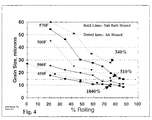
- the strips Upon exiting the mill, the strips were immediately coiled and allowed to coil naturally to ambient temperature. The coil was then cold rolled various amounts up to about 84% as depicted in Fig. 5. Those sections were then rapidly heated by salt bath annealing or by circulating air to recrystallize them, and the grain size then measured as shown in Fig. 5. Superplastic elongations by using longitudinal and transverse uniaxial tensile test specimens tested at a strain rate of 2 x 10 4 and at a temperature of 1022°F (550°C) were determined.
Landscapes
- Chemical & Material Sciences (AREA)
- Physics & Mathematics (AREA)
- Thermal Sciences (AREA)
- Crystallography & Structural Chemistry (AREA)
- Engineering & Computer Science (AREA)
- Materials Engineering (AREA)
- Mechanical Engineering (AREA)
- Metallurgy (AREA)
- Organic Chemistry (AREA)
- Metal Rolling (AREA)
Claims (12)
- Verfahren zur Herstellung einer Aluminiumlegierung mit superplastischen Eigenschaften, das folgende Schritte aufweist:(a) Eine Aluminiumlegierung wird bereitgestellt;(b) die Legierung wird erwärmt;(c) die Legierung wird bei einer Anfangstemperatur warmgewalzt;(d) während des Warmwalzens wird die Legierung auf eine Austrittstemperatur von 650° F bis 70° F (343°C bis 21°C) gekühlt, so dass Formänderungsarbeit in der Legierung beibehalten und der Verlust dieser Formänderungsarbeit durch Rekristallisation und Erholung behindert wird; und(e) Kaltwalzen auf ein Maß, das einem Prozentsatz der Kaltverformung entspricht, der in die Zone (A B C D in Fig. 2) fällt, welche definiert ist durch die die Punkte (475° F, 246° C; 10%), (650° F, 343° C; 99%),
(70° F, 21° C; 99%) und (70° F, 21° C; 10%) miteinander verbindenden Geraden in einer grafischen Darstellung des Verhältnisses zwischen der Warmwalzaustrittstemperatur und dem Prozentsatz der Kaltverformung, wodurch eine Aluminiumlegierung hergestellt wird, die dazu fähig ist, superplastische Eigenschaften zu besitzen. - Verfahren nach Anspruch 1, bei dem im Schritt (e) die Legierung auf ein Maß kaltgewalzt wird, das einem Prozentsatz der Kaltverformung entspricht, der in die Zone fällt, welche definiert ist durch die die Punkte (350° F; 177° C; 10%), (600° F, 316° C; 99%), (70° F, 21° C; 99%) und (70° F, 21° C; 10%) miteinander verbindenden Geraden in einer grafischen Darstellung des Verhältnisses zwischen der Warmwalzaustrittstemperatur und dem Prozentsatz der Kaltverformung.
- Verfahren nach Anspruch 1 oder 2, bei dem die Erwärmung in Schritt (b) das Homogenisieren der Legierung bei einer Temperatur von 750 bis 1100° F (399 bis 593° C) während 1 bis 24 Stunden umfasst.
- Verfahren nach einem der vorstehenden Ansprüche, bei dem die Legierung im Schritt (c) bei einer Anfangstemperatur von 700 bis 1000° F (371 bis 538° C) warmgewalzt wird.
- Verfahren nach einem der vorstehenden Ansprüche, bei dem außerdem die kaltgewalzte Legierung angelassen wird, wodurch eine Aluminiumlegierung mit superplastischen Eigenschaften hergestellt wird.
- Verfahren nach einem der vorstehenden Ansprüche, bei dem die Aluminiumlegierung aus den Legierungsgruppen AA 3000 und AA 5000 ausgewählt wird.
- Verfahren nach einem der vorstehenden Ansprüche, bei dem die Legierung im Wesentlichen besteht aus 4,0 bis 4,9 Gew.-% Magnesium; 0,4 bis 1,0 Gew.-% Mangan; nicht mehr als 0,25 Gew.-% Chrom; nicht mehr als 0,4 Gew.-% Eisen; nicht mehr als 0,4 Gew.-% Silizium; Rest Aluminium.
- Verfahren nach einem der Ansprüche 1 bis 5, das außerdem zwischen den Schritten (b) und (c) folgende Schritte aufweist:wobei die Legierung wärmebehandelbar ist.(i) Die Legierung wird anfänglich warmgewalzt; und(ii) auf einer Temperatur während einer Zeitdauer gehalten, die ausreichen, um Präzipitate intermetallischer Bestandteile mit einem Durchmesser von 0,5 bis 10 µm zu schaffen;
- Verfahren nach Anspruch 8, bei dem die wärmebehandelbare Aluminiumlegierung aus den Legierungsgruppen AA 2000 und AA 7000 ausgewählt wird.
- Verfahren nach Anspruch 8 oder 9, bei dem die wärmebehandelbare Legierung im Wesentlichen besteht aus 5,2 bis 6,2 Gew.-% Zink, 1,9 bis 2,6 Gew.-% Magnesium, 1,2 bis 1,9 Gew.-% Kupfer und 0,18 bis 0,28 Gew.-% Chrom.
- Verfahren nach Anspruch 8, bei dem die wärmebehandelbare Aluminiumlegierung im Wesentlichen besteht aus nicht mehr als 6 Gew.-% Kupfer, nicht mehr als 2 Gew.-% Magnesium, Rest im Wesentlichen Aluminium und Verunreinigungen.
- Verfahren nach einem der Ansprüche 8 bis 11, bei dem die ursprünglich warmgewalzte Legierung während wenigstens 2 Stunden auf einer Temperatur von 650 bis 850° F (343 bis 454° C) gehalten wird.
Applications Claiming Priority (2)
| Application Number | Priority Date | Filing Date | Title |
|---|---|---|---|
| US521364 | 1995-08-31 | ||
| US08/521,364 US5772804A (en) | 1995-08-31 | 1995-08-31 | Method of producing aluminum alloys having superplastic properties |
Publications (2)
| Publication Number | Publication Date |
|---|---|
| EP0761837A1 EP0761837A1 (de) | 1997-03-12 |
| EP0761837B1 true EP0761837B1 (de) | 2001-10-24 |
Family
ID=24076461
Family Applications (1)
| Application Number | Title | Priority Date | Filing Date |
|---|---|---|---|
| EP96306298A Expired - Lifetime EP0761837B1 (de) | 1995-08-31 | 1996-08-30 | Verfahren zur Herstellung von ALuminiumlegierungen mit superplastischen Eigenschaften |
Country Status (5)
| Country | Link |
|---|---|
| US (1) | US5772804A (de) |
| EP (1) | EP0761837B1 (de) |
| JP (1) | JPH09111428A (de) |
| DE (1) | DE69616218T2 (de) |
| ES (1) | ES2165958T3 (de) |
Families Citing this family (13)
| Publication number | Priority date | Publication date | Assignee | Title |
|---|---|---|---|---|
| US6322646B1 (en) * | 1997-08-28 | 2001-11-27 | Alcoa Inc. | Method for making a superplastically-formable AL-Mg product |
| US6350329B1 (en) | 1998-06-15 | 2002-02-26 | Lillianne P. Troeger | Method of producing superplastic alloys and superplastic alloys produced by the method |
| DE10227076B4 (de) * | 2002-06-17 | 2006-08-31 | Rolf-Josef Schwartz | Verfahren und Anlage zum Erwärmen von Werkstücken vor dem Warmformen |
| DE102004035043A1 (de) * | 2004-07-20 | 2006-04-13 | Daimlerchrysler Ag | Verfahren zum Umformen eines Leichtmetall-Blechs und entsprechendes Leichtmetall-Blechbauteil |
| US20060042727A1 (en) * | 2004-08-27 | 2006-03-02 | Zhong Li | Aluminum automotive structural members |
| US20080202646A1 (en) * | 2004-08-27 | 2008-08-28 | Zhong Li | Aluminum automotive structural members |
| EP2270249B2 (de) * | 2009-06-30 | 2020-05-27 | Hydro Aluminium Deutschland GmbH | AlMgSi-Band für Anwendungen mit hohen Umformungsanforderungen |
| US9469892B2 (en) * | 2010-10-11 | 2016-10-18 | Engineered Performance Materials Company, Llc | Hot thermo-mechanical processing of heat-treatable aluminum alloys |
| EP2570509B1 (de) * | 2011-09-15 | 2014-02-19 | Hydro Aluminium Rolled Products GmbH | Herstellverfahren für AlMgSi-Aluminiumband |
| DE102013221710A1 (de) | 2013-10-25 | 2015-04-30 | Sms Siemag Aktiengesellschaft | Aluminium-Warmbandwalzstraße und Verfahren zum Warmwalzen eines Aluminium-Warmbandes |
| US11499209B2 (en) | 2014-10-09 | 2022-11-15 | Uacj Corporation | Superplastic-forming aluminum alloy plate and production method therefor |
| CN110036127A (zh) | 2016-12-08 | 2019-07-19 | 爱励轧制产品德国有限责任公司 | 制造耐磨铝合金板材产品的方法 |
| CA3068470C (en) | 2017-07-06 | 2022-07-19 | Novelis Inc. | High performance aluminum alloys having high amounts of recycled material and methods of making the same |
Family Cites Families (16)
| Publication number | Priority date | Publication date | Assignee | Title |
|---|---|---|---|---|
| JPS5911651B2 (ja) * | 1980-10-29 | 1984-03-16 | 三井アルミニウム工業株式会社 | 超塑性アルミニウム合金及びその製造方法 |
| US4490188A (en) * | 1981-07-06 | 1984-12-25 | Rockwell International Corporation | Method of imparting a fine grain structure to 2000 & 7000 series aluminum alloys |
| US4486244A (en) * | 1982-12-17 | 1984-12-04 | Reynolds Metals Company | Method of producing superplastic aluminum sheet |
| JPS59159961A (ja) * | 1983-02-28 | 1984-09-10 | Mitsubishi Alum Co Ltd | 超塑性Al合金 |
| US4528042A (en) * | 1983-03-28 | 1985-07-09 | Reynolds Metals Company | Method for producing superplastic aluminum alloys |
| US4486242A (en) * | 1983-03-28 | 1984-12-04 | Reynolds Metals Company | Method for producing superplastic aluminum alloys |
| US4618382A (en) * | 1983-10-17 | 1986-10-21 | Kabushiki Kaisha Kobe Seiko Sho | Superplastic aluminium alloy sheets |
| US4659396A (en) * | 1984-07-30 | 1987-04-21 | Aluminum Company Of America | Metal working method |
| JPH0672295B2 (ja) * | 1986-03-03 | 1994-09-14 | スカイアルミニウム株式会社 | 微細結晶粒を有するアルミニウム合金材料の製造方法 |
| US4770848A (en) * | 1987-08-17 | 1988-09-13 | Rockwell International Corporation | Grain refinement and superplastic forming of an aluminum base alloy |
| US4867805A (en) * | 1988-02-03 | 1989-09-19 | Agrawal Suphal P | Superplastic aluminum alloys, alloy processes and component part formations thereof |
| US4830682A (en) * | 1988-05-25 | 1989-05-16 | Reynolds Metals Company | Process for producing aluminum-lithium alloys having improved superplastic properties |
| JPH0310053A (ja) * | 1989-06-07 | 1991-01-17 | Mitsubishi Heavy Ind Ltd | 超塑性加工法 |
| JP2640993B2 (ja) * | 1990-06-11 | 1997-08-13 | スカイアルミニウム株式会社 | 超塑性成形用アルミニウム合金圧延板 |
| CH682326A5 (de) * | 1990-06-11 | 1993-08-31 | Alusuisse Lonza Services Ag | |
| FR2664618B1 (fr) * | 1990-07-10 | 1993-10-08 | Pechiney Aluminium | Procede de fabrication de cathodes pour pulverisation cathodique a base d'aluminium de tres haute purete. |
-
1995
- 1995-08-31 US US08/521,364 patent/US5772804A/en not_active Expired - Lifetime
-
1996
- 1996-08-30 EP EP96306298A patent/EP0761837B1/de not_active Expired - Lifetime
- 1996-08-30 DE DE69616218T patent/DE69616218T2/de not_active Expired - Fee Related
- 1996-08-30 ES ES96306298T patent/ES2165958T3/es not_active Expired - Lifetime
- 1996-08-30 JP JP8230903A patent/JPH09111428A/ja active Pending
Also Published As
| Publication number | Publication date |
|---|---|
| JPH09111428A (ja) | 1997-04-28 |
| US5772804A (en) | 1998-06-30 |
| ES2165958T3 (es) | 2002-04-01 |
| EP0761837A1 (de) | 1997-03-12 |
| DE69616218T2 (de) | 2002-04-18 |
| DE69616218D1 (de) | 2001-11-29 |
Similar Documents
| Publication | Publication Date | Title |
|---|---|---|
| EP0097319B1 (de) | Kaltgewalztes, ziehfähiges Blech aus Aluminiumlegierung und Verfahren zu ihrer Herstellung | |
| EP0970259B1 (de) | Verfahren zur herstellung eines aluminiumbleches | |
| CA3165733C (en) | Method of manufacturing an aluminium alloy rolled product | |
| EP1411137B1 (de) | Verfahren zur Herstellung eines stranggegossenen Aluminiumbleches | |
| EP0761837B1 (de) | Verfahren zur Herstellung von ALuminiumlegierungen mit superplastischen Eigenschaften | |
| US4699673A (en) | Method of manufacturing aluminum alloy sheets excellent in hot formability | |
| US6423164B1 (en) | Method of making high strength aluminum sheet product and product therefrom | |
| US5098490A (en) | Super position aluminum alloy can stock manufacturing process | |
| EP0832308B1 (de) | Behandlung von aluminiumartikeln zur erhöhung der einbrennhärtbarkeit | |
| US5913989A (en) | Process for producing aluminum alloy can body stock | |
| WO2003066927A1 (en) | Method and apparatus for producing a solution heat treated sheet | |
| US4486244A (en) | Method of producing superplastic aluminum sheet | |
| WO1998014626A1 (en) | Aluminium alloy for rolled product process | |
| US4894096A (en) | Products based on aluminum containing lithium which can be used in their recrystallized state and a process for obtaining them | |
| US4955413A (en) | A alloy product containing Li, resistance to corrosion under stress, and process to obtain said product | |
| US4528042A (en) | Method for producing superplastic aluminum alloys | |
| US4486242A (en) | Method for producing superplastic aluminum alloys | |
| JPH0672295B2 (ja) | 微細結晶粒を有するアルミニウム合金材料の製造方法 | |
| US4830682A (en) | Process for producing aluminum-lithium alloys having improved superplastic properties | |
| US2934462A (en) | Rolling magnesium alloy | |
| JP2003328095A (ja) | 成形加工用アルミニウム合金板の製造方法 | |
| US12618131B2 (en) | Method of manufacturing an aluminium alloy rolled product | |
| JPS61170549A (ja) | アルミニウム箔地の製造方法 | |
| JP2626922B2 (ja) | 板幅方向の機械的性質および耳率が均一なアルミニウム板の製造方法 |
Legal Events
| Date | Code | Title | Description |
|---|---|---|---|
| PUAI | Public reference made under article 153(3) epc to a published international application that has entered the european phase |
Free format text: ORIGINAL CODE: 0009012 |
|
| AK | Designated contracting states |
Kind code of ref document: A1 Designated state(s): BE DE ES FR GB IT NL |
|
| 17P | Request for examination filed |
Effective date: 19970807 |
|
| 17Q | First examination report despatched |
Effective date: 19980109 |
|
| GRAG | Despatch of communication of intention to grant |
Free format text: ORIGINAL CODE: EPIDOS AGRA |
|
| GRAG | Despatch of communication of intention to grant |
Free format text: ORIGINAL CODE: EPIDOS AGRA |
|
| GRAH | Despatch of communication of intention to grant a patent |
Free format text: ORIGINAL CODE: EPIDOS IGRA |
|
| RAP1 | Party data changed (applicant data changed or rights of an application transferred) |
Owner name: KAISER ALUMINIUM & CHEMICAL CORPORATION |
|
| GRAH | Despatch of communication of intention to grant a patent |
Free format text: ORIGINAL CODE: EPIDOS IGRA |
|
| GRAA | (expected) grant |
Free format text: ORIGINAL CODE: 0009210 |
|
| AK | Designated contracting states |
Kind code of ref document: B1 Designated state(s): BE DE ES FR GB IT NL |
|
| REF | Corresponds to: |
Ref document number: 69616218 Country of ref document: DE Date of ref document: 20011129 |
|
| REG | Reference to a national code |
Ref country code: GB Ref legal event code: IF02 |
|
| ET | Fr: translation filed | ||
| REG | Reference to a national code |
Ref country code: ES Ref legal event code: FG2A Ref document number: 2165958 Country of ref document: ES Kind code of ref document: T3 |
|
| PGFP | Annual fee paid to national office [announced via postgrant information from national office to epo] |
Ref country code: NL Payment date: 20020830 Year of fee payment: 7 |
|
| PLBE | No opposition filed within time limit |
Free format text: ORIGINAL CODE: 0009261 |
|
| STAA | Information on the status of an ep patent application or granted ep patent |
Free format text: STATUS: NO OPPOSITION FILED WITHIN TIME LIMIT |
|
| 26N | No opposition filed | ||
| PGFP | Annual fee paid to national office [announced via postgrant information from national office to epo] |
Ref country code: BE Payment date: 20021017 Year of fee payment: 7 |
|
| PG25 | Lapsed in a contracting state [announced via postgrant information from national office to epo] |
Ref country code: BE Free format text: LAPSE BECAUSE OF NON-PAYMENT OF DUE FEES Effective date: 20030831 |
|
| BERE | Be: lapsed |
Owner name: *KAISER ALUMINIUM & CHEMICAL CORP. Effective date: 20030831 |
|
| PG25 | Lapsed in a contracting state [announced via postgrant information from national office to epo] |
Ref country code: NL Free format text: LAPSE BECAUSE OF NON-PAYMENT OF DUE FEES Effective date: 20040301 |
|
| NLV4 | Nl: lapsed or anulled due to non-payment of the annual fee |
Effective date: 20040301 |
|
| PGFP | Annual fee paid to national office [announced via postgrant information from national office to epo] |
Ref country code: GB Payment date: 20040901 Year of fee payment: 9 |
|
| PGFP | Annual fee paid to national office [announced via postgrant information from national office to epo] |
Ref country code: FR Payment date: 20040908 Year of fee payment: 9 |
|
| PGFP | Annual fee paid to national office [announced via postgrant information from national office to epo] |
Ref country code: DE Payment date: 20040909 Year of fee payment: 9 |
|
| PGFP | Annual fee paid to national office [announced via postgrant information from national office to epo] |
Ref country code: ES Payment date: 20040921 Year of fee payment: 9 |
|
| PG25 | Lapsed in a contracting state [announced via postgrant information from national office to epo] |
Ref country code: IT Free format text: LAPSE BECAUSE OF NON-PAYMENT OF DUE FEES;WARNING: LAPSES OF ITALIAN PATENTS WITH EFFECTIVE DATE BEFORE 2007 MAY HAVE OCCURRED AT ANY TIME BEFORE 2007. THE CORRECT EFFECTIVE DATE MAY BE DIFFERENT FROM THE ONE RECORDED. Effective date: 20050830 Ref country code: GB Free format text: LAPSE BECAUSE OF NON-PAYMENT OF DUE FEES Effective date: 20050830 |
|
| PG25 | Lapsed in a contracting state [announced via postgrant information from national office to epo] |
Ref country code: ES Free format text: LAPSE BECAUSE OF NON-PAYMENT OF DUE FEES Effective date: 20050831 |
|
| PG25 | Lapsed in a contracting state [announced via postgrant information from national office to epo] |
Ref country code: DE Free format text: LAPSE BECAUSE OF NON-PAYMENT OF DUE FEES Effective date: 20060301 |
|
| GBPC | Gb: european patent ceased through non-payment of renewal fee |
Effective date: 20050830 |
|
| PG25 | Lapsed in a contracting state [announced via postgrant information from national office to epo] |
Ref country code: FR Free format text: LAPSE BECAUSE OF NON-PAYMENT OF DUE FEES Effective date: 20060428 |
|
| REG | Reference to a national code |
Ref country code: FR Ref legal event code: ST Effective date: 20060428 |
|
| REG | Reference to a national code |
Ref country code: ES Ref legal event code: FD2A Effective date: 20050831 |