EP0762207A2 - Positivarbeitendes strahlenempfindliches Gemisch und Verfahren zur Herstellung von Reliefstrukturen - Google Patents
Positivarbeitendes strahlenempfindliches Gemisch und Verfahren zur Herstellung von Reliefstrukturen Download PDFInfo
- Publication number
- EP0762207A2 EP0762207A2 EP96114061A EP96114061A EP0762207A2 EP 0762207 A2 EP0762207 A2 EP 0762207A2 EP 96114061 A EP96114061 A EP 96114061A EP 96114061 A EP96114061 A EP 96114061A EP 0762207 A2 EP0762207 A2 EP 0762207A2
- Authority
- EP
- European Patent Office
- Prior art keywords
- radiation
- sensitive mixture
- mixture according
- acid
- sensitive
- Prior art date
- Legal status (The legal status is an assumption and is not a legal conclusion. Google has not performed a legal analysis and makes no representation as to the accuracy of the status listed.)
- Granted
Links
- 239000000203 mixture Substances 0.000 title claims description 47
- 238000000034 method Methods 0.000 title claims description 9
- 230000005855 radiation Effects 0.000 claims abstract description 45
- 239000002253 acid Substances 0.000 claims abstract description 21
- 125000000217 alkyl group Chemical group 0.000 claims abstract description 11
- 239000011230 binding agent Substances 0.000 claims abstract description 10
- 239000000243 solution Substances 0.000 claims description 49
- -1 phenyl halogen Chemical class 0.000 claims description 45
- 150000002894 organic compounds Chemical class 0.000 claims description 16
- 125000001997 phenyl group Chemical group [H]C1=C([H])C([H])=C(*)C([H])=C1[H] 0.000 claims description 16
- 125000004432 carbon atom Chemical group C* 0.000 claims description 14
- RWSOTUBLDIXVET-UHFFFAOYSA-N Dihydrogen sulfide Chemical class S RWSOTUBLDIXVET-UHFFFAOYSA-N 0.000 claims description 7
- 239000012670 alkaline solution Substances 0.000 claims description 7
- 229910052736 halogen Inorganic materials 0.000 claims description 7
- 238000004519 manufacturing process Methods 0.000 claims description 6
- XMBWDFGMSWQBCA-UHFFFAOYSA-N hydrogen iodide Chemical class I XMBWDFGMSWQBCA-UHFFFAOYSA-N 0.000 claims description 4
- 239000000463 material Substances 0.000 claims description 4
- 239000003791 organic solvent mixture Substances 0.000 claims description 4
- WQGWDDDVZFFDIG-UHFFFAOYSA-N pyrogallol Chemical compound OC1=CC=CC(O)=C1O WQGWDDDVZFFDIG-UHFFFAOYSA-N 0.000 claims description 4
- MCVVDMSWCQUKEV-UHFFFAOYSA-N (2-nitrophenyl)methyl 4-methylbenzenesulfonate Chemical compound C1=CC(C)=CC=C1S(=O)(=O)OCC1=CC=CC=C1[N+]([O-])=O MCVVDMSWCQUKEV-UHFFFAOYSA-N 0.000 claims description 3
- DLDWUFCUUXXYTB-UHFFFAOYSA-N (2-oxo-1,2-diphenylethyl) 4-methylbenzenesulfonate Chemical compound C1=CC(C)=CC=C1S(=O)(=O)OC(C=1C=CC=CC=1)C(=O)C1=CC=CC=C1 DLDWUFCUUXXYTB-UHFFFAOYSA-N 0.000 claims description 3
- 238000011161 development Methods 0.000 claims description 3
- 239000000758 substrate Substances 0.000 claims description 3
- 239000011248 coating agent Substances 0.000 claims description 2
- 238000000576 coating method Methods 0.000 claims description 2
- 238000001035 drying Methods 0.000 claims description 2
- 238000010438 heat treatment Methods 0.000 claims description 2
- 229940079877 pyrogallol Drugs 0.000 claims description 2
- 230000000052 comparative effect Effects 0.000 description 60
- 235000012431 wafers Nutrition 0.000 description 44
- 229920002120 photoresistant polymer Polymers 0.000 description 38
- 238000012545 processing Methods 0.000 description 23
- LZCLXQDLBQLTDK-UHFFFAOYSA-N ethyl 2-hydroxypropanoate Chemical compound CCOC(=O)C(C)O LZCLXQDLBQLTDK-UHFFFAOYSA-N 0.000 description 22
- 238000012360 testing method Methods 0.000 description 21
- 150000001875 compounds Chemical class 0.000 description 19
- 229920000642 polymer Polymers 0.000 description 19
- XUIMIQQOPSSXEZ-UHFFFAOYSA-N Silicon Chemical compound [Si] XUIMIQQOPSSXEZ-UHFFFAOYSA-N 0.000 description 11
- 229940116333 ethyl lactate Drugs 0.000 description 11
- 229910052710 silicon Inorganic materials 0.000 description 11
- 239000010703 silicon Substances 0.000 description 11
- 125000002496 methyl group Chemical group [H]C([H])([H])* 0.000 description 10
- 239000011148 porous material Substances 0.000 description 10
- MFQDYKJWLZMHCA-UHFFFAOYSA-N (4-hydroxy-2-methyl-5-propan-2-ylphenyl)-dimethylsulfanium;trifluoromethanesulfonate Chemical compound [O-]S(=O)(=O)C(F)(F)F.CC(C)C1=CC([S+](C)C)=C(C)C=C1O MFQDYKJWLZMHCA-UHFFFAOYSA-N 0.000 description 8
- FUGYGGDSWSUORM-UHFFFAOYSA-N 4-hydroxystyrene Chemical compound OC1=CC=C(C=C)C=C1 FUGYGGDSWSUORM-UHFFFAOYSA-N 0.000 description 8
- RTZKZFJDLAIYFH-UHFFFAOYSA-N Diethyl ether Chemical compound CCOCC RTZKZFJDLAIYFH-UHFFFAOYSA-N 0.000 description 8
- BGTOWKSIORTVQH-UHFFFAOYSA-N cyclopentanone Chemical compound O=C1CCCC1 BGTOWKSIORTVQH-UHFFFAOYSA-N 0.000 description 6
- 150000002367 halogens Chemical class 0.000 description 6
- 125000001495 ethyl group Chemical group [H]C([H])([H])C([H])([H])* 0.000 description 5
- 238000009472 formulation Methods 0.000 description 5
- RWSOTUBLDIXVET-UHFFFAOYSA-O sulfonium Chemical compound [SH3+] RWSOTUBLDIXVET-UHFFFAOYSA-O 0.000 description 5
- DSWMUVIYEKTWMR-UHFFFAOYSA-N (4-hydroxy-3-methylphenyl)-dimethylsulfanium;trifluoromethanesulfonate Chemical compound [O-]S(=O)(=O)C(F)(F)F.C[S+](C)C1=CC=C(O)C(C)=C1 DSWMUVIYEKTWMR-UHFFFAOYSA-N 0.000 description 4
- 239000000460 chlorine Substances 0.000 description 4
- 150000002148 esters Chemical class 0.000 description 4
- 125000002887 hydroxy group Chemical group [H]O* 0.000 description 4
- 125000004108 n-butyl group Chemical group [H]C([H])([H])C([H])([H])C([H])([H])C([H])([H])* 0.000 description 4
- 125000004123 n-propyl group Chemical group [H]C([H])([H])C([H])([H])C([H])([H])* 0.000 description 4
- 230000000269 nucleophilic effect Effects 0.000 description 4
- CVTHSGLYZCOAMN-UHFFFAOYSA-N (4-hydroxy-2,3,5-trimethylphenyl)-dimethylsulfanium;trifluoromethanesulfonate Chemical compound [O-]S(=O)(=O)C(F)(F)F.C[S+](C)C1=CC(C)=C(O)C(C)=C1C CVTHSGLYZCOAMN-UHFFFAOYSA-N 0.000 description 3
- NVFDHSAAXWUULH-UHFFFAOYSA-N (4-hydroxyphenyl)-dimethylsulfanium;trifluoromethanesulfonate Chemical compound [O-]S(=O)(=O)C(F)(F)F.C[S+](C)C1=CC=C(O)C=C1 NVFDHSAAXWUULH-UHFFFAOYSA-N 0.000 description 3
- XLLXMBCBJGATSP-UHFFFAOYSA-N 2-phenylethenol Chemical compound OC=CC1=CC=CC=C1 XLLXMBCBJGATSP-UHFFFAOYSA-N 0.000 description 3
- XEKOWRVHYACXOJ-UHFFFAOYSA-N Ethyl acetate Chemical compound CCOC(C)=O XEKOWRVHYACXOJ-UHFFFAOYSA-N 0.000 description 3
- YXFVVABEGXRONW-UHFFFAOYSA-N Toluene Chemical compound CC1=CC=CC=C1 YXFVVABEGXRONW-UHFFFAOYSA-N 0.000 description 3
- YPPVLYIFEAESGO-UHFFFAOYSA-N [2,3-bis(methylsulfonyloxy)phenyl] methanesulfonate Chemical compound CS(=O)(=O)OC1=CC=CC(OS(C)(=O)=O)=C1OS(C)(=O)=O YPPVLYIFEAESGO-UHFFFAOYSA-N 0.000 description 3
- 150000001241 acetals Chemical class 0.000 description 3
- 239000000654 additive Substances 0.000 description 3
- CXJVMJWCNFOERL-UHFFFAOYSA-N benzenesulfonylsulfonylbenzene Chemical compound C=1C=CC=CC=1S(=O)(=O)S(=O)(=O)C1=CC=CC=C1 CXJVMJWCNFOERL-UHFFFAOYSA-N 0.000 description 3
- 229920001577 copolymer Polymers 0.000 description 3
- 150000002170 ethers Chemical class 0.000 description 3
- 125000004051 hexyl group Chemical group [H]C([H])([H])C([H])([H])C([H])([H])C([H])([H])C([H])([H])C([H])([H])* 0.000 description 3
- 125000000959 isobutyl group Chemical group [H]C([H])([H])C([H])(C([H])([H])[H])C([H])([H])* 0.000 description 3
- 125000001449 isopropyl group Chemical group [H]C([H])([H])C([H])(*)C([H])([H])[H] 0.000 description 3
- 230000035945 sensitivity Effects 0.000 description 3
- 239000002904 solvent Substances 0.000 description 3
- 125000000999 tert-butyl group Chemical group [H]C([H])([H])C(*)(C([H])([H])[H])C([H])([H])[H] 0.000 description 3
- ITMCEJHCFYSIIV-UHFFFAOYSA-M triflate Chemical compound [O-]S(=O)(=O)C(F)(F)F ITMCEJHCFYSIIV-UHFFFAOYSA-M 0.000 description 3
- GETQZCLCWQTVFV-UHFFFAOYSA-N trimethylamine Chemical compound CN(C)C GETQZCLCWQTVFV-UHFFFAOYSA-N 0.000 description 3
- XLYOFNOQVPJJNP-UHFFFAOYSA-N water Chemical compound O XLYOFNOQVPJJNP-UHFFFAOYSA-N 0.000 description 3
- GERFLGZJIRWNOW-UHFFFAOYSA-N 1-(4-methoxyphenyl)-2-[2-(4-methoxyphenyl)phenyl]sulfonylsulfonylbenzene Chemical compound COC1=CC=C(C=C1)C1=C(C=CC=C1)S(S(=O)(=O)C1=C(C=CC=C1)C1=CC=C(C=C1)OC)(=O)=O GERFLGZJIRWNOW-UHFFFAOYSA-N 0.000 description 2
- ARXJGSRGQADJSQ-UHFFFAOYSA-N 1-methoxypropan-2-ol Chemical compound COCC(C)O ARXJGSRGQADJSQ-UHFFFAOYSA-N 0.000 description 2
- HUHXLHLWASNVDB-UHFFFAOYSA-N 2-(oxan-2-yloxy)oxane Chemical compound O1CCCCC1OC1OCCCC1 HUHXLHLWASNVDB-UHFFFAOYSA-N 0.000 description 2
- DTCYSRAEJHGSNY-UHFFFAOYSA-N 2-methoxy-2-(2-methoxypropan-2-yloxy)propane Chemical compound COC(C)(C)OC(C)(C)OC DTCYSRAEJHGSNY-UHFFFAOYSA-N 0.000 description 2
- XLLIQLLCWZCATF-UHFFFAOYSA-N 2-methoxyethyl acetate Chemical compound COCCOC(C)=O XLLIQLLCWZCATF-UHFFFAOYSA-N 0.000 description 2
- NLDIHQURFMTKTR-UHFFFAOYSA-N 2-methyl-2-[(2-methylpropan-2-yl)oxyperoxy]propane Chemical compound CC(C)(C)OOOC(C)(C)C NLDIHQURFMTKTR-UHFFFAOYSA-N 0.000 description 2
- YEJRWHAVMIAJKC-UHFFFAOYSA-N 4-Butyrolactone Chemical compound O=C1CCCO1 YEJRWHAVMIAJKC-UHFFFAOYSA-N 0.000 description 2
- RTAVHOUBRHMRPA-UHFFFAOYSA-N 4-[2-(2,6-dinitrophenyl)ethyl]benzenesulfonic acid Chemical compound C1=CC(S(=O)(=O)O)=CC=C1CCC1=C([N+]([O-])=O)C=CC=C1[N+]([O-])=O RTAVHOUBRHMRPA-UHFFFAOYSA-N 0.000 description 2
- QKFFSWPNFCXGIQ-UHFFFAOYSA-M 4-methylbenzenesulfonate;tetraethylazanium Chemical compound CC[N+](CC)(CC)CC.CC1=CC=C(S([O-])(=O)=O)C=C1 QKFFSWPNFCXGIQ-UHFFFAOYSA-M 0.000 description 2
- JAGRUUPXPPLSRX-UHFFFAOYSA-N 4-prop-1-en-2-ylphenol Chemical compound CC(=C)C1=CC=C(O)C=C1 JAGRUUPXPPLSRX-UHFFFAOYSA-N 0.000 description 2
- PPBRXRYQALVLMV-UHFFFAOYSA-N Styrene Chemical compound C=CC1=CC=CC=C1 PPBRXRYQALVLMV-UHFFFAOYSA-N 0.000 description 2
- RAHZWNYVWXNFOC-UHFFFAOYSA-N Sulphur dioxide Chemical compound O=S=O RAHZWNYVWXNFOC-UHFFFAOYSA-N 0.000 description 2
- GLGXSTXZLFQYKJ-UHFFFAOYSA-N [cyclohexylsulfonyl(diazo)methyl]sulfonylcyclohexane Chemical compound C1CCCCC1S(=O)(=O)C(=[N+]=[N-])S(=O)(=O)C1CCCCC1 GLGXSTXZLFQYKJ-UHFFFAOYSA-N 0.000 description 2
- 125000003545 alkoxy group Chemical group 0.000 description 2
- 125000003118 aryl group Chemical group 0.000 description 2
- 229910052801 chlorine Inorganic materials 0.000 description 2
- LYCAIKOWRPUZTN-UHFFFAOYSA-N ethylene glycol Natural products OCCO LYCAIKOWRPUZTN-UHFFFAOYSA-N 0.000 description 2
- 238000002474 experimental method Methods 0.000 description 2
- UQEAIHBTYFGYIE-UHFFFAOYSA-N hexamethyldisiloxane Chemical compound C[Si](C)(C)O[Si](C)(C)C UQEAIHBTYFGYIE-UHFFFAOYSA-N 0.000 description 2
- WGCNASOHLSPBMP-UHFFFAOYSA-N hydroxyacetaldehyde Natural products OCC=O WGCNASOHLSPBMP-UHFFFAOYSA-N 0.000 description 2
- 238000001459 lithography Methods 0.000 description 2
- 239000000178 monomer Substances 0.000 description 2
- YCWSUKQGVSGXJO-NTUHNPAUSA-N nifuroxazide Chemical group C1=CC(O)=CC=C1C(=O)N\N=C\C1=CC=C([N+]([O-])=O)O1 YCWSUKQGVSGXJO-NTUHNPAUSA-N 0.000 description 2
- ISWSIDIOOBJBQZ-UHFFFAOYSA-N phenol group Chemical group C1(=CC=CC=C1)O ISWSIDIOOBJBQZ-UHFFFAOYSA-N 0.000 description 2
- 150000002989 phenols Chemical class 0.000 description 2
- BBEAQIROQSPTKN-UHFFFAOYSA-N pyrene Chemical compound C1=CC=C2C=CC3=CC=CC4=CC=C1C2=C43 BBEAQIROQSPTKN-UHFFFAOYSA-N 0.000 description 2
- 238000010517 secondary reaction Methods 0.000 description 2
- 239000000126 substance Substances 0.000 description 2
- FGTJJHCZWOVVNH-UHFFFAOYSA-N tert-butyl-[tert-butyl(dimethyl)silyl]oxy-dimethylsilane Chemical compound CC(C)(C)[Si](C)(C)O[Si](C)(C)C(C)(C)C FGTJJHCZWOVVNH-UHFFFAOYSA-N 0.000 description 2
- 125000005207 tetraalkylammonium group Chemical group 0.000 description 2
- WZJMWYMSRQPSMH-UHFFFAOYSA-O (3-ethyl-4-hydroxy-5-methylphenyl)-dimethylsulfanium Chemical class CCC1=CC([S+](C)C)=CC(C)=C1O WZJMWYMSRQPSMH-UHFFFAOYSA-O 0.000 description 1
- RKELFBRSWGYKDR-UHFFFAOYSA-N (3-methylsulfonyloxyphenyl) methanesulfonate Chemical compound CS(=O)(=O)OC1=CC=CC(OS(C)(=O)=O)=C1 RKELFBRSWGYKDR-UHFFFAOYSA-N 0.000 description 1
- NXLKVAUTSYGXEW-UHFFFAOYSA-O (4-hydroxy-3,5-dimethylphenyl)-dimethylsulfanium Chemical class C[S+](C)C1=CC(C)=C(O)C(C)=C1 NXLKVAUTSYGXEW-UHFFFAOYSA-O 0.000 description 1
- QWGIGVLZJVFWAO-UHFFFAOYSA-N (4-hydroxy-3,5-dimethylphenyl)-dimethylsulfanium;trifluoromethanesulfonate Chemical compound [O-]S(=O)(=O)C(F)(F)F.C[S+](C)C1=CC(C)=C(O)C(C)=C1 QWGIGVLZJVFWAO-UHFFFAOYSA-N 0.000 description 1
- QAEDNLDMOUKNMI-UHFFFAOYSA-O (4-hydroxyphenyl)-dimethylsulfanium Chemical compound C[S+](C)C1=CC=C(O)C=C1 QAEDNLDMOUKNMI-UHFFFAOYSA-O 0.000 description 1
- IGSACVYRURLYJJ-UHFFFAOYSA-N 1-(benzenesulfonylsulfonyl)-4-methoxybenzene Chemical compound C1=CC(OC)=CC=C1S(=O)(=O)S(=O)(=O)C1=CC=CC=C1 IGSACVYRURLYJJ-UHFFFAOYSA-N 0.000 description 1
- KUXDDVUXCGCYFX-UHFFFAOYSA-N 1-methyl-4-(4-methylphenyl)sulfonylsulfonylbenzene Chemical compound C1=CC(C)=CC=C1S(=O)(=O)S(=O)(=O)C1=CC=C(C)C=C1 KUXDDVUXCGCYFX-UHFFFAOYSA-N 0.000 description 1
- 150000003923 2,5-pyrrolediones Chemical class 0.000 description 1
- WCUWXIHEIPVBEI-UHFFFAOYSA-N 2-(2-phenylethenoxy)oxane Chemical compound O1CCCCC1OC=CC1=CC=CC=C1 WCUWXIHEIPVBEI-UHFFFAOYSA-N 0.000 description 1
- XNWFRZJHXBZDAG-UHFFFAOYSA-N 2-METHOXYETHANOL Chemical compound COCCO XNWFRZJHXBZDAG-UHFFFAOYSA-N 0.000 description 1
- FXRQXYSJYZPGJZ-UHFFFAOYSA-N 2-[(2-methylpropan-2-yl)oxy]ethenylbenzene Chemical compound CC(C)(C)OC=CC1=CC=CC=C1 FXRQXYSJYZPGJZ-UHFFFAOYSA-N 0.000 description 1
- POAOYUHQDCAZBD-UHFFFAOYSA-N 2-butoxyethanol Chemical compound CCCCOCCO POAOYUHQDCAZBD-UHFFFAOYSA-N 0.000 description 1
- ZNQVEEAIQZEUHB-UHFFFAOYSA-N 2-ethoxyethanol Chemical compound CCOCCO ZNQVEEAIQZEUHB-UHFFFAOYSA-N 0.000 description 1
- CCTFMNIEFHGTDU-UHFFFAOYSA-N 3-methoxypropyl acetate Chemical compound COCCCOC(C)=O CCTFMNIEFHGTDU-UHFFFAOYSA-N 0.000 description 1
- FAZZFXWVHOPPPD-UHFFFAOYSA-N 4-(4-hydroxyphenyl)sulfonylsulfonylphenol Chemical compound C1=CC(O)=CC=C1S(=O)(=O)S(=O)(=O)C1=CC=C(O)C=C1 FAZZFXWVHOPPPD-UHFFFAOYSA-N 0.000 description 1
- RYRGGXUPGWTAPZ-UHFFFAOYSA-N 4-ethenyl-3-methylphenol Chemical compound CC1=CC(O)=CC=C1C=C RYRGGXUPGWTAPZ-UHFFFAOYSA-N 0.000 description 1
- ISZXJFVXRGAVSQ-UHFFFAOYSA-N 4-methoxy-2-(2-phenylethenoxy)oxane Chemical compound C1C(OC)CCOC1OC=CC1=CC=CC=C1 ISZXJFVXRGAVSQ-UHFFFAOYSA-N 0.000 description 1
- QTBSBXVTEAMEQO-UHFFFAOYSA-M Acetate Chemical compound CC([O-])=O QTBSBXVTEAMEQO-UHFFFAOYSA-M 0.000 description 1
- 229910017008 AsF 6 Inorganic materials 0.000 description 1
- ZAMOUSCENKQFHK-UHFFFAOYSA-N Chlorine atom Chemical compound [Cl] ZAMOUSCENKQFHK-UHFFFAOYSA-N 0.000 description 1
- YYLLIJHXUHJATK-UHFFFAOYSA-N Cyclohexyl acetate Chemical compound CC(=O)OC1CCCCC1 YYLLIJHXUHJATK-UHFFFAOYSA-N 0.000 description 1
- BUDQDWGNQVEFAC-UHFFFAOYSA-N Dihydropyran Chemical compound C1COC=CC1 BUDQDWGNQVEFAC-UHFFFAOYSA-N 0.000 description 1
- NSGDYZCDUPSTQT-UHFFFAOYSA-N N-[5-bromo-1-[(4-fluorophenyl)methyl]-4-methyl-2-oxopyridin-3-yl]cycloheptanecarboxamide Chemical compound Cc1c(Br)cn(Cc2ccc(F)cc2)c(=O)c1NC(=O)C1CCCCCC1 NSGDYZCDUPSTQT-UHFFFAOYSA-N 0.000 description 1
- CTQNGGLPUBDAKN-UHFFFAOYSA-N O-Xylene Chemical compound CC1=CC=CC=C1C CTQNGGLPUBDAKN-UHFFFAOYSA-N 0.000 description 1
- 206010034972 Photosensitivity reaction Diseases 0.000 description 1
- XBDQKXXYIPTUBI-UHFFFAOYSA-M Propionate Chemical compound CCC([O-])=O XBDQKXXYIPTUBI-UHFFFAOYSA-M 0.000 description 1
- 229910018286 SbF 6 Inorganic materials 0.000 description 1
- DHKHKXVYLBGOIT-UHFFFAOYSA-N acetaldehyde Diethyl Acetal Natural products CCOC(C)OCC DHKHKXVYLBGOIT-UHFFFAOYSA-N 0.000 description 1
- KXKVLQRXCPHEJC-UHFFFAOYSA-N acetic acid trimethyl ester Natural products COC(C)=O KXKVLQRXCPHEJC-UHFFFAOYSA-N 0.000 description 1
- RHYWINORESCUAK-UHFFFAOYSA-N acetic acid;pentane-2,3-diol Chemical compound CC(O)=O.CCC(O)C(C)O RHYWINORESCUAK-UHFFFAOYSA-N 0.000 description 1
- 150000001252 acrylic acid derivatives Chemical class 0.000 description 1
- 239000002318 adhesion promoter Substances 0.000 description 1
- 125000001931 aliphatic group Chemical group 0.000 description 1
- 230000003321 amplification Effects 0.000 description 1
- 150000001450 anions Chemical class 0.000 description 1
- 125000003710 aryl alkyl group Chemical group 0.000 description 1
- 125000001797 benzyl group Chemical group [H]C1=C([H])C([H])=C(C([H])=C1[H])C([H])([H])* 0.000 description 1
- YHOITYOXMQABRO-UHFFFAOYSA-O bis(4-hydroxyphenyl)iodanium Chemical class C1=CC(O)=CC=C1[I+]C1=CC=C(O)C=C1 YHOITYOXMQABRO-UHFFFAOYSA-O 0.000 description 1
- 125000000484 butyl group Chemical group [H]C([*])([H])C([H])([H])C([H])([H])C([H])([H])[H] 0.000 description 1
- 229930188620 butyrolactone Natural products 0.000 description 1
- 125000005587 carbonate group Chemical group 0.000 description 1
- 230000003197 catalytic effect Effects 0.000 description 1
- 238000006243 chemical reaction Methods 0.000 description 1
- 239000003795 chemical substances by application Substances 0.000 description 1
- QNFLEMMKPDQCEZ-UHFFFAOYSA-N dimethyl-[4-[(2-methylpropan-2-yl)oxycarbonyloxy]phenyl]sulfanium Chemical class C[S+](C)C1=CC=C(OC(=O)OC(C)(C)C)C=C1 QNFLEMMKPDQCEZ-UHFFFAOYSA-N 0.000 description 1
- OZLBDYMWFAHSOQ-UHFFFAOYSA-N diphenyliodanium Chemical class C=1C=CC=CC=1[I+]C1=CC=CC=C1 OZLBDYMWFAHSOQ-UHFFFAOYSA-N 0.000 description 1
- KPUWHANPEXNPJT-UHFFFAOYSA-N disiloxane Chemical class [SiH3]O[SiH3] KPUWHANPEXNPJT-UHFFFAOYSA-N 0.000 description 1
- 239000000975 dye Substances 0.000 description 1
- 230000003628 erosive effect Effects 0.000 description 1
- GVEPBJHOBDJJJI-UHFFFAOYSA-N fluoranthrene Natural products C1=CC(C2=CC=CC=C22)=C3C2=CC=CC3=C1 GVEPBJHOBDJJJI-UHFFFAOYSA-N 0.000 description 1
- UQSQSQZYBQSBJZ-UHFFFAOYSA-M fluorosulfonate Chemical compound [O-]S(F)(=O)=O UQSQSQZYBQSBJZ-UHFFFAOYSA-M 0.000 description 1
- 125000005842 heteroatom Chemical group 0.000 description 1
- 150000002576 ketones Chemical class 0.000 description 1
- QSHDDOUJBYECFT-UHFFFAOYSA-N mercury Chemical compound [Hg] QSHDDOUJBYECFT-UHFFFAOYSA-N 0.000 description 1
- 229910052753 mercury Inorganic materials 0.000 description 1
- 150000002734 metacrylic acid derivatives Chemical class 0.000 description 1
- 229910001507 metal halide Inorganic materials 0.000 description 1
- 150000005309 metal halides Chemical class 0.000 description 1
- JESXATFQYMPTNL-UHFFFAOYSA-N mono-hydroxyphenyl-ethylene Natural products OC1=CC=CC=C1C=C JESXATFQYMPTNL-UHFFFAOYSA-N 0.000 description 1
- 125000001624 naphthyl group Chemical group 0.000 description 1
- 238000003199 nucleic acid amplification method Methods 0.000 description 1
- 230000003287 optical effect Effects 0.000 description 1
- 239000003960 organic solvent Substances 0.000 description 1
- 125000004430 oxygen atom Chemical group O* 0.000 description 1
- 125000002080 perylenyl group Chemical group C1(=CC=C2C=CC=C3C4=CC=CC5=CC=CC(C1=C23)=C45)* 0.000 description 1
- CSHWQDPOILHKBI-UHFFFAOYSA-N peryrene Natural products C1=CC(C2=CC=CC=3C2=C2C=CC=3)=C3C2=CC=CC3=C1 CSHWQDPOILHKBI-UHFFFAOYSA-N 0.000 description 1
- 230000036211 photosensitivity Effects 0.000 description 1
- 239000004014 plasticizer Substances 0.000 description 1
- 238000004626 scanning electron microscopy Methods 0.000 description 1
- 239000007787 solid Substances 0.000 description 1
- 241000894007 species Species 0.000 description 1
- 238000004528 spin coating Methods 0.000 description 1
- 239000003381 stabilizer Substances 0.000 description 1
- XTXNWQHMMMPKKO-UHFFFAOYSA-N tert-butyl 2-phenylethenyl carbonate Chemical compound CC(C)(C)OC(=O)OC=CC1=CC=CC=C1 XTXNWQHMMMPKKO-UHFFFAOYSA-N 0.000 description 1
- XKXIQBVKMABYQJ-UHFFFAOYSA-N tert-butyl hydrogen carbonate Chemical class CC(C)(C)OC(O)=O XKXIQBVKMABYQJ-UHFFFAOYSA-N 0.000 description 1
- QEXMAFRBZROOMX-UHFFFAOYSA-N tert-butyl-dimethyl-(2-phenylethenoxy)silane Chemical compound CC(C)(C)[Si](C)(C)OC=CC1=CC=CC=C1 QEXMAFRBZROOMX-UHFFFAOYSA-N 0.000 description 1
- GTCDARUMAMVCRO-UHFFFAOYSA-M tetraethylazanium;acetate Chemical compound CC([O-])=O.CC[N+](CC)(CC)CC GTCDARUMAMVCRO-UHFFFAOYSA-M 0.000 description 1
- 125000000383 tetramethylene group Chemical group [H]C([H])([*:1])C([H])([H])C([H])([H])C([H])([H])[*:2] 0.000 description 1
- 125000003944 tolyl group Chemical group 0.000 description 1
- ZMANZCXQSJIPKH-UHFFFAOYSA-O triethylammonium ion Chemical compound CC[NH+](CC)CC ZMANZCXQSJIPKH-UHFFFAOYSA-O 0.000 description 1
- LGMUVWLDYISOQX-UHFFFAOYSA-N trimethyl(2-phenylethenoxy)silane Chemical compound C[Si](C)(C)OC=CC1=CC=CC=C1 LGMUVWLDYISOQX-UHFFFAOYSA-N 0.000 description 1
- WLOQLWBIJZDHET-UHFFFAOYSA-N triphenylsulfonium Chemical class C1=CC=CC=C1[S+](C=1C=CC=CC=1)C1=CC=CC=C1 WLOQLWBIJZDHET-UHFFFAOYSA-N 0.000 description 1
- XUWXFPUSCUUNPR-UHFFFAOYSA-O tris(4-hydroxyphenyl)sulfanium Chemical class C1=CC(O)=CC=C1[S+](C=1C=CC(O)=CC=1)C1=CC=C(O)C=C1 XUWXFPUSCUUNPR-UHFFFAOYSA-O 0.000 description 1
- RDCODPXHHPLMQI-UHFFFAOYSA-N tris[4-[(2-methylpropan-2-yl)oxycarbonyloxy]phenyl]sulfanium Chemical class C1=CC(OC(=O)OC(C)(C)C)=CC=C1[S+](C=1C=CC(OC(=O)OC(C)(C)C)=CC=1)C1=CC=C(OC(=O)OC(C)(C)C)C=C1 RDCODPXHHPLMQI-UHFFFAOYSA-N 0.000 description 1
- 238000009736 wetting Methods 0.000 description 1
- 239000008096 xylene Substances 0.000 description 1
Classifications
-
- G—PHYSICS
- G03—PHOTOGRAPHY; CINEMATOGRAPHY; ANALOGOUS TECHNIQUES USING WAVES OTHER THAN OPTICAL WAVES; ELECTROGRAPHY; HOLOGRAPHY
- G03F—PHOTOMECHANICAL PRODUCTION OF TEXTURED OR PATTERNED SURFACES, e.g. FOR PRINTING, FOR PROCESSING OF SEMICONDUCTOR DEVICES; MATERIALS THEREFOR; ORIGINALS THEREFOR; APPARATUS SPECIALLY ADAPTED THEREFOR
- G03F7/00—Photomechanical, e.g. photolithographic, production of textured or patterned surfaces, e.g. printing surfaces; Materials therefor, e.g. comprising photoresists; Apparatus specially adapted therefor
- G03F7/004—Photosensitive materials
- G03F7/0045—Photosensitive materials with organic non-macromolecular light-sensitive compounds not otherwise provided for, e.g. dissolution inhibitors
-
- G—PHYSICS
- G03—PHOTOGRAPHY; CINEMATOGRAPHY; ANALOGOUS TECHNIQUES USING WAVES OTHER THAN OPTICAL WAVES; ELECTROGRAPHY; HOLOGRAPHY
- G03F—PHOTOMECHANICAL PRODUCTION OF TEXTURED OR PATTERNED SURFACES, e.g. FOR PRINTING, FOR PROCESSING OF SEMICONDUCTOR DEVICES; MATERIALS THEREFOR; ORIGINALS THEREFOR; APPARATUS SPECIALLY ADAPTED THEREFOR
- G03F7/00—Photomechanical, e.g. photolithographic, production of textured or patterned surfaces, e.g. printing surfaces; Materials therefor, e.g. comprising photoresists; Apparatus specially adapted therefor
- G03F7/004—Photosensitive materials
- G03F7/039—Macromolecular compounds which are photodegradable, e.g. positive electron resists
-
- Y—GENERAL TAGGING OF NEW TECHNOLOGICAL DEVELOPMENTS; GENERAL TAGGING OF CROSS-SECTIONAL TECHNOLOGIES SPANNING OVER SEVERAL SECTIONS OF THE IPC; TECHNICAL SUBJECTS COVERED BY FORMER USPC CROSS-REFERENCE ART COLLECTIONS [XRACs] AND DIGESTS
- Y10—TECHNICAL SUBJECTS COVERED BY FORMER USPC
- Y10S—TECHNICAL SUBJECTS COVERED BY FORMER USPC CROSS-REFERENCE ART COLLECTIONS [XRACs] AND DIGESTS
- Y10S430/00—Radiation imagery chemistry: process, composition, or product thereof
- Y10S430/1053—Imaging affecting physical property or radiation sensitive material, or producing nonplanar or printing surface - process, composition, or product: radiation sensitive composition or product or process of making binder containing
- Y10S430/1055—Radiation sensitive composition or product or process of making
- Y10S430/106—Binder containing
- Y10S430/111—Polymer of unsaturated acid or ester
Definitions
- the invention relates to positive-working radiation-sensitive mixtures which contain acid-labile groups and photoactive components, are sensitive to actinic radiation and have improved contrast. These radiation-sensitive mixtures are particularly suitable as resist materials for deposit resists for the production of relief patterns.
- Positive-working radiation-sensitive mixtures which are based on the principle of "chemical amplification" are known per se. In this way, a species is generated in a primary photoreaction, which then triggers a catalytic secondary reaction independent of the radiation and thereby drastically increases the sensitivity.
- Such systems which photochemically generate a strong acid which then cleaves acid labile groups in a secondary reaction are e.g. known from US-PS 3 923 514, US-PS 3 915 706 and DE-A 34 06 927.
- the object of the present invention is to show a radiation-sensitive mixture which gives very good photosensitivity, good processing latitude, no loss of layer thickness between the different process steps and relief structures with improved contrast.
- the present invention relates to
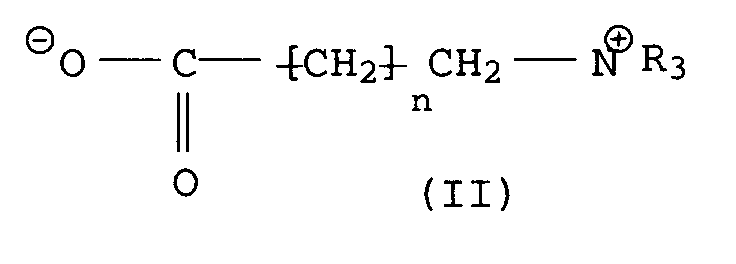
- Either the polymer (a 1 ) containing the acid-labile groups or component (a 2.1 ) units of the formulas (III), (IV) and / or (V) contain incorporated or the radiation-sensitive mixture according to the invention can as component (c) an organic compound from the group wherein R 1 , R 2 and R 3 are identical or different from one another and represent H, CH 3 , C 2 H 5 , nC 3 H 7 , OCH 3 , phenyl, halogen, straight-chain or branched C 4 H 9 , and R 4 and R 5 may be the same or different from one another and are substituted for alkyl having 1 to 6 carbon atoms, phenyl, alkyl, halogen or hydroxy Are phenyl or R 4 are closed with R 5 via CH 2 groups to form a five- or six-membered ring, contain.
- component (c) an organic compound from the group wherein R 1 , R 2 and R 3 are identical or different from one another and represent H, CH 3
- Sulfonium salts or iodonium salts are preferably used as component (b); however, compounds such as benzoin tosylate, pyrogallol trimesylate, o-nitrobenzyl tosylate, diaryl disulfone, bis-arylsulfonyl-diazomethane, bis-cyclohexylsulfonyl-diazomethane, iminosulfonates with the structural unit or mixtures of the aforementioned compounds can be used as component (b).
- compounds such as benzoin tosylate, pyrogallol trimesylate, o-nitrobenzyl tosylate, diaryl disulfone, bis-arylsulfonyl-diazomethane, bis-cyclohexylsulfonyl-diazomethane, iminosulfonates with the structural unit or mixtures of the aforementioned compounds can be used as component (b).
- the radiation-sensitive mixture according to the invention is preferably in the form of a solution in an organic solvent or solvent mixture and is processed therefrom.
- the present invention also relates to a process for the production of light-sensitive coating materials and a process for the production of relief structures by applying a radiation-sensitive mixture according to the invention in a layer thickness of 0.1 to 5 ⁇ m to a substrate pretreated in a customary manner, drying at temperatures from 70 to 140 ° C, imagewise exposure, optionally heating to temperatures of 40 to 160 ° C, and development with an aqueous alkaline solution, the radiation-sensitive mixture according to the invention being used.
- the radiation-sensitive mixtures according to the invention have high sensitivity to actinic light and can be processed into relief structures with a significantly improved contrast. They are also characterized by easier processability, good resolution and better processing stability.
- Suitable acid-labile groups, water-insoluble polymeric organic binders (a 1 ), whose solubility in aqueous alkaline developers increases due to the action of acid are, for example, polymers based on poly- (p-hydroxystyrene) or poly- (p-hydroxy- ⁇ ) -methylstyrene), the hydroxyl groups of which are partially replaced by tert-butoxy, tert-butoxycarbonyloxy, tert-amylcarbonyloxy or p-tetrahydropyranyloxy groups, and all the customary acid-labile groups containing water-insoluble organic binders, the solubility in aqueous -Alkaline developers increases due to the action of acid.
- Suitable acid-labile groups include, in particular, ether, ester, acetal, ketal or carbonate groups.
- Preferred are ethers such as t-butoxy ether, trimethylsilyl ether or t-butyldimethylsilyl ether, acetals such as tetrahydropyranyl ether, and ketals such as 4-methoxy-tetrahydroypyranyl ether and 1-methyl-1-methoxyethyl ether.
- Polymers (a 1 ) which contain water-insoluble acid-labile groups and whose solubility in aqueous alkaline developers increases as a result of the action of acid are, in particular, polymers or copolymers which, as monomer units, contain 4-hydroxystyrene, 2,6-dimethyl-4- contain hydroxystyrene, 2-methyl-4-hydroxystyrene, 4-hydroxy-alpha-methylstyrene, t-butoxystyrene, t-butoxycarbonyloxystyrene, tetrahydropyranyloxystyrene, t-butyldimethylsilyloxystyrene, trimethylsilyloxystyrene or 4-methoxytetrahydropyranyloxystyrene.
- all monomers copolymerizable with styrene such as, for example, acrylates, methacrylates, sulfur dioxide and maleimides, are suitable as comonomers.
- the molecular weights ( M ⁇ w ) these homo- or copolymers (a 1 ) are between 2000 and 100000, preferably between 4000 and 35000. In addition, all such polymers are preferred, which are described in DE-A-4 007 924 and DE-A-4 202 845 are.
- Polymers (a 1 ), the units of the formulas (VI), (VII) and (VIII) are also particularly preferred. built-in included.
- Such polymers (a 1 ) to be used according to the invention generally have molecular weights ( M ⁇ w ) between 2,000 and 100,000, preferably between 4,000 and 30,000, and can be obtained, for example, from poly (p-hydroxystyrene) or, preferably, additionally non-aromatic cyclic alcohol units (vinylcyclohexanol-4 units) in amounts of up to 15 mol% of poly (p -hydroxystyrene), for example by polymer-analogous reaction with appropriate amounts of dihydropyran in the presence of acid.
- a corresponding method can be found in EP-342 498-B (DE-A-3 817 012).
- Suitable starting products for the production of such polymers (a 1 ) to be used according to the invention are, for example, also partially hydrogenated poly- (p-hydroxystyrenes) such as can be found in J 01 103 604-A and EP-A-0 401 499.
- polymer (a 1 ) contains no units of the formula (VIII) incorporated, preferably 50-70 mol% of units of the formula (VI) and 30-50 mol% of units of the formula (VII) are incorporated as structural units.
- the polymer (a 1 ) preferably contains units of the formula (VIII) in amounts of 2 to 15 mol%, preferably 6 to 14 mol%, based on the total amount of the structural units of the formulas (VI), (VII) and (VIII) , installed as structural units.
- the polymer (a 1 ) generally contains 37-60 mol%, and in particular 38-58 mol% of the structural units of the formula (VI) and 38 to 48 mol% of the structural units of the formula (VII).
- Suitable water-insoluble, polymeric binders (a 2.1 ) which are soluble in aqueous alkaline solutions are polymers based on homo- or copolymers of 4-hydroxystyrene and / or 4-hydroxy-alphamethylstyrene, the comonomer units being particularly in the o-position Hydroxy group mono- or disubstituted hydroxystyrenes or hydroxystyrenes, the phenolic group of which is protected with acid-labile groups, are suitable.
- acid-labile groups are ethers such as t-butoxy ether, trimethylsilyl ether or t-butyldimethylsilyl ether, acetals such as tetrahydropyranyl ether, esters such as t-butyl ester, and ketals such as 4-methoxy-tetrahydroypyranyl ether and 1-methyl-1-methoxyethyl ether ether.
- comonomer units containing acid-labile groups are only present in such quantities that the polymeric binder (a 2.1 ) is soluble in alkaline water. In general, ranges of 5-50 mol% are preferred.
- the polymers (a 2.1 ) have a molecular weight ( M ⁇ w ) between 2000 and 100000, preferably between 4000 and 30000.
- Non-polymeric compounds which have at least one aromatic ring system with one or more tetrahydropyranyloxy substituents according to EP-A-0 475 903 can also be used, for example:
- the polymer (a 1 ) or the combination (a 2.1 ) + (a 2.2 ) is in the mixture according to the invention in general in an amount of 80 to 99.5, preferably 90 to 99% by weight, based on the total amount of Components (a 1 ) + (b) or (a 2.1 ) + (a 2.2 ) + (b) contain.
- Examples of highly suitable components (b) according to the general formulas (IX) and (X) are triphenylsulfonium salts and diphenyliodonium salts as well as tris (4-hydroxyphenyl) sulfonium salts and bis (4-hydroxyphenyl) iodonium salts.
- Particularly suitable sulfonium salts have the general formula (XI) in which R 7 and R 8 are identical or different from one another and are H, OH, alkyl having 1 to 18, preferably 1 to 6, carbon atoms, such as, for example, methyl, ethyl, n-propyl, n-butyl, isobutyl, tert-butyl, Hexyl, or alkoxy with 1 to 6 carbon atoms, such as methoxy, ethoxy, propoxy, butoxy, or phenyl, R 9 and R 10 are the same or different from one another and for alkyl radicals with 1 to 18, preferably 1 to 6 carbon atoms, such as Are methyl, butyl or are phenyl, alkyl, halogen or hydroxy-substituted phenyl or R 9 are closed with R 10 via CH 2 groups to form a five- or six-membered ring and X ⁇ is a non-nucleophilic counteri
- sulfonium salts are 4-hydroxyphenyl-dimethylsulfonium and 3,5-dimethyl-4-hydroxyphenyl-dimethylsulfonium salts, as well as 3-ethyl-5-methyl-4-hydroxyphenyldimethylsulfonium salts.
- complex metal halides such as tetrafluoroborate, hexafluoroantimonate, hexafluoroarsenate and hexafluorophosphate
- Two or more sulfonium units in the molecule can also be linked via the radicals R 11 to R 12 .
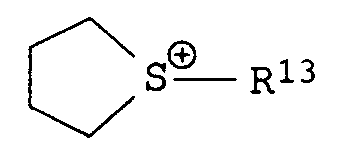
- Preferred sulfonium salts of the general formula (XII) are those in which R 11 and R 12 are methyl groups and R 13 are substituted phenyl derivatives with acid-cleavable groups, for example where R 13 is, for example, 4-t-butoxycarbonyloxyphenyl-, 4-t-butoxycarbonyloxy-3,5-dimethylphenyl, 4-t-butoxycarbonyloxy-3-methylphenyl-, 4-t-butoxycarbonyloxy-2-methylphenyl-, 4- t-Butoxycarbonyloxy-3,5-dimethoxyphenyl, 4-t-butoxicarbonyloxy-3,5-dimethylphenyl-, 1-t-butoxycarbonyloxy-naphthyl-, 4-trimethylsilyl-oxyphenyl, 4-trimethylsilyl-oxy-naphthyl- or also such , in which two of the radicals R 11 to R 13 are linked together to form a ring, in particular a five
- Preferred examples of compounds (b) are dimethyl-4-t-butoxycarbonyloxy-phenyl-sulfonium salts with hexafluoroarsenate, hexafluoroantimonate, hexafluorophosphate, hexafluoroborate or trifluoromethanesulfonate as counterion, phenyl- (bis- (4-t-butoxycarbonyloxyphenyl) -sulfonium-called sulfonium) sulfonium , Tris (4-t-butoxycarbonyloxyphenyl) sulfonium salt with the counterions mentioned or 1-naphthyl-4-trimethylsilyloxytetramethylene sulfonium salts with the counterions mentioned.
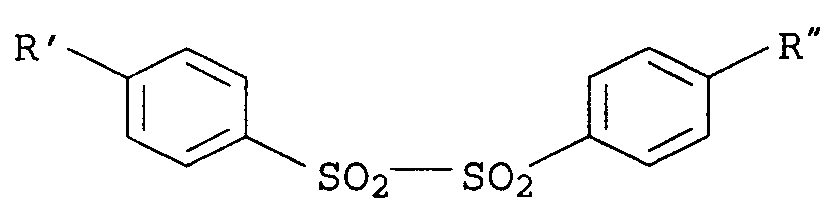
- suitable organic compounds (b) which generate an acid under the action of actinic radiation are, for example, benzointosylate, pyrogallotrimesylate, o-nitrobenzyl tosylate, diaryl disulfones, such as, for example, diphenyl disulfone or substituted diphenyl disulfones of the formula in which R 'and R''are identical or different from one another and represent H, CH 3 , C 2 H 5 , C 3 H 7 , C 4 H 9 , OCH 3 , OC 2 H 5 or Cl, such as, for example, di- ( p-tolyl) disulfone, bis-arylsulfonyldiazomethane, for example those of the formula wherein R 'and R''are identical or different from one another and are for H, CH 3 , C 2 H 5 , C 3 H 7 , C 4 H 9 , or Cl stand Bis
- component (b) are alkyl sulfonic acid esters of compounds which contain at least two phenolic hydroxyl groups.
- alkyl sulfonic acid esters of compounds which contain at least two phenolic hydroxyl groups are particularly suitable substances.
- particularly suitable substances are 1,2,3-tris (methanesulfonyloxy) benzene and 1,3-bis (methanesulfonyloxy) benzene or disulfones such as e.g. Diphenyl disulfone, 4-methoxyphenyl phenyl disulfone or bis (4-hydroxyphenyl) disulfone.
- the amount the sum of all components (b) in the radiation-sensitive mixture according to the invention is generally 0.5 to 20, preferably 1 to 10% by weight, based on the sum of all components (a 1 ) + (b) or (a 2.1 ) + (a 2.2 ) + (b) in the radiation-sensitive mixture.
- Possible components (c) to be used according to the invention are organic compounds which have groups of the general formula (I) ⁇ O ⁇ N ⁇ R 4 (I) not contain bound to polymeric radicals, where R is an alkyl radical having 1 to 6 carbon atoms, such as C 4 H 9 , C 3 H 7 , C 2 H 5 and preferably CH 3 .
- R 1 , R 2 and R 3 can be the same or different from each other and for H, CH 3 , C 2 H 5 , nC 3 H 7 , OCH 3 , halogen (eg Cl, Br, J), phenyl, straight-chain or branched C 4 H 9 , and R 4 and R 5 may be the same or different from one another and represent alkyl having 1 to 6, preferably 1 to 4, carbon atoms, for example methyl, ethyl, n-propyl, i-propyl, n-butyl, i -Butyl, preferably methyl, represents phenyl, alkyl, such as methyl, ethyl, isopropyl, halogen, such as chlorine, or hydroxy-substituted phenyl, or R 4 with R 5 via CH 2 groups a five- or six-membered ring are closed and X ⁇ is BF 4 ⁇ , AsF 6
- the tetraalkylammonium group N ⁇ R 4 can thus either be bound to the polymer (a) or be part of monomeric, low molecular weight organic compounds.
- the tetraalkylammonium group is generally present in the radiation-sensitive mixture according to the invention in amounts of 0.01 to 50, preferably 0.1 to 10, mol percent, based on component (b).
- the radiation-sensitive mixture according to the invention can additionally contain further, conventional auxiliaries and additives (sensitizers, dyes, flow control agents, wetting aids, stabilizers, etc.) corresponding to the prior art. These additives are generally added in amounts of less than 3% by weight.
- the mixtures according to the invention are preferably dissolved in an organic solvent, the solids content usually being in the range between 5 and 40% by weight.
- Preferred solvents are aliphatic ketones, ethers and esters, and mixtures thereof.
- Alkylene glycol monoalkyl ethers such as, for example, ethyl cellosolve, butyl glycol, methyl cellosolve and 1-methoxy-2-propanol
- alkylene glycol alkyl ether esters such as, for example, methyl cellosolve acetate, methyl propylene glycol acetate and ethyl propylene glycol acetate
- ketones such as, for example, cyclohexyl acetate and methyl acetate, cyclateentyl acetate, cyclopentanone, cyclopentanone, cyclopentanone, Ethyl acetate, other esters such as ethyl lactate and butyrolactone and aromatics
- additives such as adhesion promoters and plasticizers can be added, generally in amounts of up to 1% by weight.
- the radiation-sensitive mixtures according to the invention are sensitive to X-ray, electron and UV radiation. If necessary, small amounts of sensitizers, such as pyrene and perylene, can be added in order to sensitize the compounds in the longer-wave UV to the visible wavelength range. For the exposure in special wavelength ranges, such as in short-wave UV ( ⁇ 300 nm), a high transparency of the layers is required at the respective exposure wavelength. In common exposure devices based on mercury lamps, the 254 nm line is used or excimer lasers are used which emit at 248 nm (KrF). Radiation-sensitive recording materials should therefore have the lowest possible optical densities in this area.
- sensitizers such as pyrene and perylene
- a radiation-sensitive recording layer which essentially consists of the radiation-sensitive mixture according to the invention, is imagewise irradiated with actinimic light in such a dose that the solubility of the exposed areas after a thermal baking step at temperatures between 40 and 160 ° C increases in aqueous alkaline solvents and these areas can be removed selectively with the alkaline developer.
- the photoresist solutions containing the radiation-sensitive mixture according to the invention are generally applied in a layer thickness of 0.1 to 5 ⁇ m, preferably 0.5 to 1.5 ⁇ m, to suitable substrates, for example surface-oxidized silicon wafers by spin coating, dried (for example at temperatures between 70 and 140 ° C) and image-wise exposed with a suitable light source through a photomask, e.g. with short-wave UV rays (deep UV) with wavelengths between 200 and 300 nm. Excimer lasers from KrF (248 nm ). After the imagewise exposure - if necessary after a short bake (postbake) at temperatures up to 160 ° C.
- a short bake postbake
- the exposure energy required for the radiation-sensitive mixtures according to the invention is generally between 10 and 300 mJ / cm 2 with layer thicknesses of 1 ⁇ m.
- the radiation-sensitive mixtures according to the invention are notable for high sensitivity, good resolution and easy processing, in particular improved exposure latitude and good storage stability after exposure, and are therefore particularly advantageous for lithography in the short-wave range since both contrast and depth of focus are improved.
- the contrast of the resist was determined by plotting the layer thickness against the exposure dose.
- a photoresist solution was prepared from 5 parts of 4-hydroxyphenyldimethylsulfonium triflate, 95 parts of poly [4-hydroxystyrene-co-4-tetra-hydropyranyloxystyrene] (Molar ratio of the comonomers 60:40) and 300 parts of ethyl lactate.
- This solution was filtered through a filter with a pore diameter of 0.2 ⁇ m.
- the contrast of the resist was determined.
- the gamma value was 6.
- a photoresist solution was prepared as in Comparative Example 1, but 3 mol% of trimethylammonium butrobetain, based on 4-hydroxyphenyldimethylsulfonium triflate, were added. After the further processing described in Comparative Example 1, a gamma value of 7 resulted.
- a photoresist solution which was prepared analogously to Comparative Example 1, but with the addition of 5 mol% of trimethylammonium butrobetain, based on 4-hydroxyphenyldimethylsulfonium triflate, gave a gamma value of 9.
- the resist solutions of comparative example 1 and examples 1 and 2 were applied to wafers with a diameter of 200 mm in a layer thickness of approximately 800 nm to check the photolithographic properties. After baking at 130 ° C on one The wafers were exposed hotplate with a wafer stepper from ASM Lithography, type PAS 5500. After different waiting times, the wafers were then annealed at 130 ° C. and washed out in an aqueous alkaline developer.
- the line widths were then determined by scanning electron microscopy depending on the waiting time.
- a photoresist solution was prepared from 5 parts of 2,3,5-trimethyl-4-hydroxyphenyl-dimethylsulfonium triflate, 95 parts of poly- [4-hydroxystyrene-co-4-tetrahydropyranyloxystyrene] (Molar ratio of the comonomers 55:45) and 300 parts of ethyl lactate and then filtered through a filter with a pore diameter of 0.2 ⁇ m.
- the contrast of the resist was determined.
- the gamma value was 7.
- a photoresist solution was prepared analogously to Example 2, but with 6 mol% of the compound C1, based on 2,3,5-trimethyl-4-hydroxyphenyldimethylsulfonium triflate.
- the gamma value was 9.5.
- the resist solutions from comparative example 2 and examples 4 and 5 were applied to check the storage stability on 200 mm wafers in a layer thickness of approximately 800 nm.
- Example 3 The further processing and testing was carried out as described in Example 3. waiting period 10 min 30 min 60 min Comparative Example 2 without adding C1 252 nm 235 nm 225 nm
- Example 4 with 3 mol% C1 252 nm 250 nm 243 nm
- Example 5 with 6 mol% C1 251 nm 250 nm 248 nm
- a photoresist solution was prepared from 5 parts of 2-methyl-4-hydroxy-5-isopropyl-phenyl-dimethylsulfonium triflate, 95 parts of poly- [4-hydroxystyrene-co-4-tetrahydropyranyloxystyrene] (Molar ratio of comonomers 65:35) and 320 parts of ethyl lactate and then filtered through a filter with a pore diameter of 0.2 ⁇ m.
- the contrast of the resist was determined.
- the gamma value was 6.
- a photoresist solution was prepared analogously to Comparative Example 3, but with 5 mol% of compound C2, based on 2-methyl-4-hydroxy-5-isopropylphenyldimethylsulfonium triflate.
- the gamma value was 8.
- the resist solutions from Comparative Example 3 and Examples 7 and 8 were applied to check the storage stability on 200 mm wafers in a layer thickness of approximately 800 nm.
- Example 7 with 3 mol% C2 251 nm 250 nm 245 nm
- Example 8 with 5 mol% C2 252 nm 252 nm 249 nm
- the exposure latitude was determined in a further experiment.
- the so-called "depth of focus” was determined by processing the wafers with different exposure doses and variable depth of focus of the exposure device. After development with an aqueous alkaline developer, the widths of the lines produced were determined with a scanning electron microscope.
- a photoresist solution was prepared from 5 parts of 2-methyl-4-hydroxy-5-isopropyl-phenyl-dimethylsulfonium triflate, 95 parts of poly- [4-hydroxystyrene-co-4-tetrahydropyranyloxystyrene-co-4-vinyl-cyclohexanol] (Molar ratio of the comonomers 55: 38: 7) and 320 parts of ethyl lactate and then filtered through a filter with a pore diameter of 0.2 ⁇ m.
- the contrast of the resist was determined.
- the gamma value was 6.5.
- the resist solutions from Comparative Example 4 and Example 11 were applied to check the depth of focus on 200 mm wafers in a layer thickness of approximately 100 nm.
- a photoresist solution was prepared from 2.5 parts of 2-methyl-4-hydroxy-5-isopropyl-phenyl-dimethylsulfonium triflate, 2.5 parts of 3,5-dimethyl-4-hydroxyphenyl-dimethylsulfonium triflate, 95 parts of poly- [4-hydroxystyrene-co -4-tetrahydropyranyloxystyrene-co-4-vinylcyclohexanol] (Molar ratio of the comonomers 48:40:12) and 320 parts of ethyl lactate and then filtered through a filter with a pore diameter of 0.2 ⁇ m.
- the contrast of the resist was determined.
- the gamma value was 7.5.
- a photoresist solution was prepared from 3 parts of 4-methoxyphenylphenyl disulfone, 95 parts of poly- [4-hydroxystyrene-co-4-tetrahydropyranyloxystyrene-co-4-vinyl-cyclohexanol] (Molar ratio of the comonomers 49:38:13) and 320 parts of ethyl lactate and then filtered through a filter with a pore diameter of 0.2 ⁇ m.
- the contrast of the resist was determined.
- the gamma value was 5.5.
- the resist solutions from comparative example 6 and example 15 were applied to check the depth of focus on 200 mm wafers in a layer thickness of approximately 800 nm.
- a photoresist solution was prepared from 6 parts bis-4-methylphenylsulfonyldiazomethane, 95 parts poly- [4-hydroxystyrene-co-4-tetrahydropyranyloxystyrene-co-4-vinyl-cyclohexanol] (Molar ratio of the comonomers 49:38:13) and 320 parts of ethyl lactate and then filtered through a filter with a pore diameter of 0.2 ⁇ m.
- the contrast of the resist was determined.
- the gamma value was 6.4.
- a photoresist solution was prepared from 10 parts of 2,6-dinitrobenzyl-4-toluenesulfonate, 90 parts of poly [4-hydroxystyrene-co-4-tetrahydropyranyloxystyrene-co-4-vinyl-cyclohexanol] (Molar ratio of the comonomers 55: 38: 7) and 320 parts of ethyl lactate and then filtered through a filter with a pore diameter of 0.2 ⁇ m.
- the contrast of the resist was determined.
- the gamma value was 5.0.
- the resist solutions from Comparative Example 8 and Example 18 were applied to check the depth of focus on 200 mm wafers in a layer thickness of approximately 800 nm.
- a photoresist solution was prepared from 5 parts of 3-methyl-4-hydroxyphenyldimethylsulfonium triflate, 95 parts of poly [4-hydroxystyrene-co-4-tetrahydropyranyloxystyrene-co-4-vinyl-cyclohexanol] (Molar ratio of the comonomers 54: 40: 6) and 320 parts of ethyl lactate and then filtered through a filter with a pore diameter of 0.2 ⁇ m.
- the contrast of the resist was determined.
- the gamma value was 6.5.
- photoresist solutions from comparative example 9 and examples 20, 21 and 22 were applied to wafers with a diameter of 200 mm in a layer thickness of approximately 800 nm.
- the following table shows the measured line widths after different waiting times: waiting period none 20 min 40 min 60 min Comparative Example 9 without addition 252 nm 242 nm 230 nm 218 nm
- Example 20 with 2 mol% C9 253 nm 251 nm 230 nm 225 nm
- Example 21 with 4 mol% C9 256 nm 252 nm 249 nm 242 nm
- Example 22 with 6 mol% C9 255 nm 250 nm 247 nm 239 nm
- the exposure latitude was determined in a further experiment.
- the so-called "depth of focus” was determined by processing the wafers with different exposure doses and variable depth of focus of the exposure device.
- a photoresist solution was prepared from 10 parts of 1,2,3-tris (methanesulfonyloxy) benzene, 90 parts of poly [4-hydroxystyrene-co-4-tetrahydropyranyloxystyrene-co-4-vinyl-cyclohexanol] (Molar ratio of the comonomers 47:40:13) and 320 parts of ethyl lactate and then filtered through a filter with a pore diameter of 0.2 ⁇ m.
- the contrast of the resist was determined.
- the gamma value was 5.4.
- the resist solutions from comparative example 10 and example 25 were applied to check the storage stability on 200 mm wafers in a layer thickness of approximately 800 nm.
- the following table shows the measured line widths of 250 nm wide structures after different waiting times: waiting period none 20 min 40 min 60 min Comparative Example 10 without addition 253 nm 240 nm 231 nm 219 nm Example 25 with 5 mol% C10 251 nm 250 nm 237 nm 230 nm.
Landscapes
- Physics & Mathematics (AREA)
- Spectroscopy & Molecular Physics (AREA)
- General Physics & Mathematics (AREA)
- Materials For Photolithography (AREA)
- Exposure And Positioning Against Photoresist Photosensitive Materials (AREA)
- Laminated Bodies (AREA)
Abstract
- (a1) mindestens einem säurelabile Gruppierungen enthaltenden, in Wasser unlöslichen, organischen polymeren Bindemittel, das durch Einwirkung von Säure in wäßrig-alkalischen Lösungen löslich wird, oder
- (a2.1) einem in Wasser unlöslichen, in wäßrig-alkalischen Lösungen löslichen polymeren Bindemittel und
- (a2.2) einer niedermolekularen organischen Verbindung, deren Löslichkeit in einem wäßrig-alkalischen Entwickler durch Einwirkung von Säure erhöht wird,
- (b) mindestens einer organischen Verbindung, welche unter Einwirkung von aktinischer Strahlung eine Säure erzeugt, sowie gegebenenfalls
- (c) einer oder mehreren weiteren von (b) verschiedenen organischen Verbindungen,
Description
- Die Erfindung betrifft positiv arbeitende strahlungsempfindliche Gemische, die säurelabile Gruppierungen und photoaktive Komponenten enthalten, sensitiv gegenüber aktinischer Strahlung sind und verbesserten Kontrast aufweisen. Diese strahlungsempfindlichen Gemische eignen sich besonders als Resistmaterialien für Einlagenresiste zur Herstellung von Reliefmustern.
- Positiv arbeitende strahlungsempfindliche Gemische, die auf dem Prinzip der "chemischen Verstärkung" beruhen, sind an sich bekannt. Dabei wird in einer Primärphotoreaktion eine Spezies erzeugt, die dann unabhängig von der Strahlung eine katalytische Sekundärreaktion auslöst und dadurch die Empfindlichkeit drastisch erhöht. Solche Systeme, die photochemisch eine starke Säure erzeugen, die dann in einer Sekundärreaktion säurelabile Gruppen spaltet, sind z.B. aus US-PS 3 923 514, US-PS 3 915 706 und DE-A 34 06 927 bekannt.
- Der Kontrast derartiger Resiste, d.h. die "Schärfe" bei der Differenzierung zwischen unbelichteten und belichteten Bereichen, ist eine wichtige anwendungstechnische Größe. Daher sind Verfahren zur Verbesserung des Kontrasts immer gesucht.
- Aufgabe der vorliegenden Erfindung ist es, ein strahlungsempfindliches Gemisch aufzuzeigen, das sehr gute Lichtempfindlichkeit, guten Verarbeitungsspielraum, keinen Schichtdickenverlust zwischen den verschiedenen Prozeßschritten und Reliefstrukturen mit verbessertem Kontrast ergibt.
- Diese Aufgabe läßt sich überraschenderweise durch die erfindungsgemäßen positiv arbeitenden strahlungsempfindlichen Gemische lösen.
- Positiv arbeitende strahlungsempfindliche Gemische im wesentlichen bestehend aus
- (a1) mindestens einem säurelabile Gruppierungen enthaltenden, in Wasser unlöslichen, organischen polymeren Bindemittel, das durch Einwirkung von Säure in wäßrig-alkalischen Lösungen löslich wird, oder
- (a2.1) einem in Wasser unlöslichen, in wäßrig-alkalischen Lösungen löslichen polymeren Bindemittel und
- (a2.2) einer niedermolekularen organischen Verbindung, deren Löslichkeit in einem wäßrig-alkalischen Entwickler durch Einwirkung von Säure erhöht wird, und
- (b) mindestens einer organischen Verbindung, welche unter Einwirkung von aktinischer Strahlung eine Säure erzeugt, sowie gegebenenfalls
- (c) einer oder mehreren weiteren, von (b) verschiedenen organischen Verbindungen,
- Dabei kann entweder das die säurelabile Gruppierungen enthaltende Polymere (a1) oder die Komponente (a2.1) Einheiten der Formeln (III), (IV) und/oder (V)

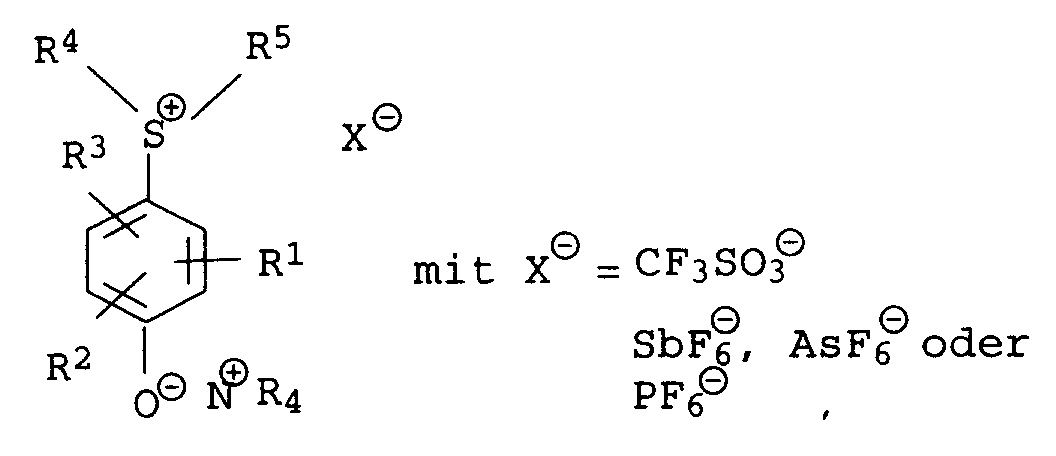


- Als Komponente (b) werden vorzugsweise Sulfoniumsalze oder Jodoniumsalze eingesetzt; es können jedoch auch Verbindungen, wie Benzointosylat, Pyrogalloltrimesylat, o-Nitrobenzyltosylat, Diaryldisulfon, Bis-arylsulfonyl-diazomethan, Bis-cyclohexylsulfonyl-diazomethan, Iminosulfonate mit der Struktureinheit

- Bevorzugt sind auch solche strahlungsempfindliche Gemische, deren Polymere (a1) Einheiten der Formeln (VI), (VII) und gegebenenfalls (VIII)

- 35-70 mol% Einheiten der Formel (VI)
- 30-50 mol% Einheiten der Formel (VII)und
- 0-15 mol% Einheiten der Formel (VIII)
- Das erfindungsgemäße strahlungsempfindliche Gemisch liegt vorzugsweise in Form einer Lösung in einem organischen Lösungsmittel oder Lösungsmittelgemisch vor und wird aus dieser verarbeitet.
- Gegenstand der vorliegenden Erfindung ist außerdem ein Verfahren zur Herstellung lichtempfindlicher Beschichtungsmaterialien sowie ein Verfahren zur Herstellung von Reliefstrukturen durch Auftragen eines erfindungsgemäßen strahlungsempfindlichen Gemisches in einer Schichtdicke von 0,1 bis 5 µm auf ein in üblicher Weise vorbehandeltes Substrat, Trocknen bei Temperaturen von 70 bis 140°C, bildmäßiges Belichten, gegebenenfalls Erhitzen auf Temperaturen von 40 bis 160°C, und Entwickeln mit einer wäßrig-alkalischen Lösung, wobei das erfindungsgemäße strahlungsempfindliche Gemisch eingesetzt wird.
- Die erfindungsgemäßen strahlungsempfindlichen Gemische weisen hohe Empfindlichkeit gegen aktinisches Licht auf und lassen sich zu Reliefstrukturen mit wesentlich verbessertem Kontrast verarbeiten. Außerdem zeichnen sie sich durch leichtere Verarbeitbarkeit, gute Auflösung und bessere Verarbeitungsstabilität aus.
- Zu den Aufbaukomponenten des erfindungsgemäßen strahlungsempfindlichen Gemisches ist im einzelnen folgendes auszuführen.
- Als säurelabile Gruppierungen enthaltende, in Wasser unlösliche polymere organische Bindemittel (a1), deren Löslichkeit in wäßrigalkalischen Entwicklern durch Einwirkung von Säure zunimmt, eignen sich beispielsweise Polymere auf Basis von Poly-(p-hydroxistyrol) oder Poly-(p-hydroxi-α-methylstyrol), deren Hydroxylgruppen durch tert.-Butoxy-, tert.-Butoxycarbonyloxy-, tert.-Amylcarbonyloxy oder p-Tetrahydropyranyloxy-gruppen teilweise ersetzt sind, sowie alle üblichen säurelabile Gruppen enthaltenden, in Wasser unlöslichen organischen Bindemittel, deren Löslichkeit in wäßrig-alkalischen Entwicklern durch Einwirkung von Säure zunimmt.
- Als verwendbare säurelabile Gruppen sind insbesondere Ether-, Ester-, Acetal-, Ketal- oder Carbonatgruppen zu erwähnen. Bevorzugt dabei sind Ether wie t-Butoxyether, Trimethylsilylether oder t-Butyldimethylsilylether, Acetale wie Tetrahydropyranylether, sowie Ketale wie 4-Methoxy-tetrahydroypyranylether und 1-Methyl-1-methoxyethylether.
- Als in Wasser unlösliche säurelabile Gruppierungen enthaltende Polymere (a1), deren Löslichkeit in wäßrig-alkalischen Entwicklern durch Einwirkung von Säure zunimmt, kommen insbesondere Polymere bzw. Copolymere in Frage, die als Monomereinheiten 4-Hydroxystyrol, 2,6-Dimethyl-4-hydroxystyrol, 2-Methyl-4-hydroxystyrol, 4-Hydroxy-alpha-methylstyrol, t-Butoxystyrol, t-Butoxycarbonyloxystyrol, Tetrahydropyranyloxystyrol, t-Butyldimethyl-silyloxystyrol, Trimethylsilyloxystyrol oder 4-Methoxytetrahydropyranyloxystyrol enthalten. Als Comonomeren kommen darüber hinaus alle mit Styrol copolymerisierbaren Monomere, wie z.B. Acrylate, Methacrylate, Schwefeldioxid und Maleinimide, in Betracht.
- Die Molekulargewichte (

- Besonders bevorzugt sind auch Polymere (a1), die Einheiten der Formeln (VI), (VII) und (VIII)

- Derartige erfindungsgemäß einzusetzende Polymere (a1) weisen im allgemeinen Molekulargewichte (

- Als Ausgangsprodukte zur Herstellung derartiger erfindungsgemäß einzusetzender Polymerer (a1) eignen sich beispielsweise auch solche teilweise hydrierten Poly-(p-hydroxystyrole), wie sie der J 01 103 604-A und der EP-A-0 401 499 entnommen werden können.
- Derartige Polymere (a1) können die Einheiten der Formeln (VI), (VII) und (VIII) beispielsweise in Mengen von
- 35-70 mol% Einheiten der Formel (VI),
- 30-50 mol% Einheiten der Formel (VII) und
- 0-15 mol% Einheiten der Formel (VIII) eingebaut, enthalten.
- Sofern das Polymere (a1) keine Einheiten der Formel (VIII) eingebaut enthält, sind vorzugsweise 50-70 mol% Einheiten der Formel (VI) und 30-50 mol% Einheiten der Formel (VII) als Struktureinheiten eingebaut.
- Bevorzugt enthält jedoch das Polymere (a1) Einheiten der Formel (VIII) in Mengen von 2 bis 15 mol%, vorzugsweise 6 bis 14 mol%, bezogen auf die Gesamtmenge der Struktureinheiten der Formeln (VI), (VII) und (VIII), als Struktureinheiten eingebaut. In diesem Fall enthält das Polymer (a1) in aller Regel 37-60 mol%, und insbesondere 38-58 mol% der Struktureinheiten der Formel (VI) und 38 bis 48 mol% der Struktureinheiten der Formel (VII).
- Als in Wasser unlösliche, in wäßrig-alkalischen Lösungen lösliche polymere Bindemittel (a2.1) kommen Polymere auf Basis von Homo- oder Copolymeren des 4-Hydroxystyrols und/oder 4-Hydroxy-alphamethylstyrols in Betracht, wobei als Comonomereinheiten besonders in o-Stellung zur Hydroxygruppe mono- oder disubstituierte Hydroxystyrole oder Hydroxystyrole, deren phenolische Gruppe mit säurelabilen Gruppierungen geschützt ist, in Frage kommen. Besonders bevorzugte säurelabile Gruppierungen sind dabei Ether wie t-Butoxyether, Trimethylsilylether oder t-Butyldimethylsilylether, Acetale wie Tetrahydropyranyl-ether, Ester, wie t.-Butylester, sowie Ketale, wie 4-Methoxy-tetrahydroypyranylether und 1-Methyl-1-methoxyethyl-ether. Diese säurelabile Gruppierungen enthaltenden Comonomereinheiten sind dabei nur in solchen Mengen vorhanden, daß das polymere Bindemittel (a2.1) wäßrig alkalisch löslich ist. Im allgemeinen werden dazu Bereiche von 5 - 50 mol-% bevorzugt.
- Die Polymeren (a2.1) weisen ein Molekulargewicht (

- Als niedermolekulare organische Verbindungen (a2.2), deren Löslichkeit in einem wäßrigen alkalischen Entwickler durch Einwirkung von Säure erhöht wird, welche also säurelabile Gruppen enthalten, seien hier beispielshaft aufgeführt:

- Brauchbar sind auch nichtpolymere Verbindungen, die mindestens ein aromatisches Ringsystem mit einem oder mehreren Tetrahydropyranyloxysubstituenten gemäß der EP-A-0 475 903 aufweisen, beispielsweise:

- Das Polymere (a1) bzw. die Kombination (a2.1) + (a2.2) ist im erfindungsgemäßen Gemisch im allgemeinen in einer Menge von 80 bis 99,5, vorzugsweise von 90 bis 99 Gew.-%, bezogen auf die Gesamtmenge der Komponenten (a1) + (b) bzw. (a2.1) + (a2.2) + (b) enthalten.
- Als organische Verbindungen, welche unter Einwirkung von aktinischer Strahlung eine Säure erzeugen (= Säurespender) (b), kommen alle dem Fachmann bekannten photochemischen Säurespender in Frage.
- Bevorzugt sind Sulfonium- oder Jodoniumsalze der allgemeinen Formel (IX) oder (X),

R1―J⊕―R2 X⊖ (X)
worin R1, R2 oder R3 untereinander gleich oder verschieden sind und für geradkettig oder verzweigtes Alkyl mit 1 bis 18, vorzugsweise 1 bis 6 Kohlenstoffatomen, wie z.B. Methyl, Ethyl, n-Propyl, Isopropyl, n-Butyl, Isobutyl, tert.-Butyl, Hexyl, Oxaalkyl mit bis zu 3 Sauerstoffatomen und bis zu 10 Kohlenstoffatomen, Aryl mit 6 bis 12 Kohlenstoffatomen, wie z.B. Phenyl oder Naphthyl, C1- bis C6-alkyl- oder C1- bis C6-alkoxysubstituiertes Aryl, Aralkyl, wie z.B. Benzyl, oder den Rest
- Beispiele für gut geeignete Komponenten (b) nach den allgemeinen Formeln (IX) bzw. (X) sind Triphenylsulfoniumsalze und Diphenyliodoniumsalze sowie Tris-(4-hydroxyphenyl)sulfoniumsalze und Bis-(4-hydroxyphenyl)iodoniumsalze.
- Besonders gut geeignete Sulfoniumsalze besitzen die allgemeine Formel (XI)

- Beispiele besonders vorteilhafter Sulfoniumsalze sind 4-Hydroxyphenyl-dimethylsulfonium- und 3,5-Dimethyl-4-hydroxyphenyl-dimethylsulfoniumsalze, sowie 3-Ethyl-5-methyl-4-hydroxyphenyldimethylsulfoniumsalze.
- Beispiele gut geeigneter, nicht-nukleophiler Anionen X⊖ sind komplexe Metallhalogenide wie Tetrafluoroborat, Hexafluoroantimonat, Hexafluoroarsenat sowie Hexafluorophosphat und starke organische Säureanionen wie Trifluormethansulfonat (= Triflat) und Fluorsulfonat.
- Hervorzuheben sind auch die Sulfoniumsalze der allgemeinen Formel (XII),

- Es können auch zwei oder mehrere Sulfoniumeinheiten im Molekül über die Reste R11 bis R12 verknüpft sein.
- Bevorzugte Sulfoniumsalze der allgemeinen Formel (XII) sind solche, in denen R11 und R12 für Methylgruppen und R13 für substituierte Phenylderivate mit säurespaltbaren Gruppen stehen, z.B.

- Bevorzugte Beispiele für Verbindungen (b) sind Dimethyl-4-t-butoxycarbonyloxy-phenyl-sulfoniumsalze mit Hexafluoroarsenat, Hexafluoroantimonat, Hexafluorophosphat, Hexafluoroborat oder Trifluormethansulfonat als Gegenion, Phenyl-(bis-(4-t-butoxycarbonyloxyphenyl-)sulfoniumsalz mit den genannten Gegenionen, Tris-(4-t-butoxycarbonyloxyphenyl-)sulfoniumsalz mit den genannten Gegenionen oder 1-Naphthyl-4-trimethylsilyloxytetramethylensulfoniumsalze mit den genannten Gegenionen.
- Außer diesen Sulfonium- und Jodoniumsalzen eignen sich als organische Verbindungen (b), welche unter Einwirkung von aktinischer Strahlung eine Säure erzeugen, beispielsweise Benzointosylat, Pyrogallotrimesylat, o-Nitrobenzyltosylat, Diaryldisulfone, wie z.B. Diphenyldisulfon oder substituierte Diphenyldisulfone der Formel


Bis-cyclohexyl-sulfonyl-diazomethan, Iminosulfonate mit der Struktureinheit
- Ebenfalls bevorzugt werden als Komponente (b) Alkylsulfonsäureester von Verbindungen, die mindestens zwei phenolische Hydroxy-Gruppen enthalten. Beispiele besonders gut geeigneter Substanzen sind 1,2,3-Tris-(methansulfonyloxy)benzol und 1,3-Bis-(methansulfonyloxy)benzol oder Disulfone wie z.B. Diphenyldisulfon, 4-Methoxyphenyl-phenyldisulfon oder Bis-(4-hydroxyphenyl)disulfon.
- Auch Gemische der unter (b) genannten Verbindungen mit sich selbst oder anderen, hier nicht explizit aufgeführten organischen photochemischen Säurespendern können eingesetzt werden. Die Menge der Summe aller Komponenten (b) beträgt im erfindungsgemäßen strahlungsempfindlichen Gemisch im allgemeinen 0,5 bis 20, vorzugsweise 1 bis 10 Gew.-%, bezogen auf die Summe aller Komponenten (a1) + (b) bzw. (a2.1) + (a2.2) + (b) im strahlungsempfindlichen Gemisch.
- Als erfindungsgemäß gegebenenfalls einzusetzende Komponenten (c) kommen organische Verbindungen in Betracht, die Gruppierungen der allgemeinen Formel (I)
―O⊖ N⊕R4 (I)
nicht an polymere Reste gebunden enthalten, wobei R für einen Alkylrest mit 1 bis 6 Kohlenstoffatomen, wie C4H9, C3H7, C2H5 und vorzugsweise CH3 steht. Beispiele für derartige organische Verbindungen (c) sind
sowie Verbindungen der folgenden Formeln


- Als erfindungsgemäß gegebenenfalls einzusetzende Komponente (c) kommen auch folgende organische Verbindungen in Betracht, die Gruppierungen der Formel (I) oder (II)
―O⊖N⊕ R4 (I)

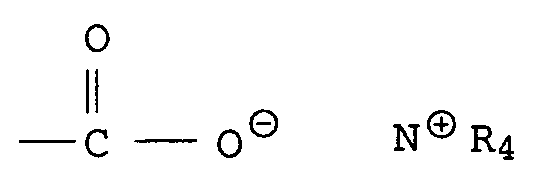


- Die Tetraalkylammoniumgruppe N⊕R4 kann also entweder an das Polymere (a) gebunden oder Bestandteil monomerer, niedermolekularer organischer Verbindungen sein.
- Die Tetraalkylammoniumgruppe ist im erfindungsgemäßen strahlungsempfindlichen Gemisch im allgemeinen in Mengen von 0,01 bis 50, vorzugsweise 0,1 bis 10 Molprozent, bezogen auf die Komponente (b) enthalten.
- Das erfindungsgemäße strahlungsempfindliche Gemisch kann zusätzlich noch weitere, dem Stand der Technik entsprechende, übliche Hilfs- und Zusatzstoffe (Sensibilisatoren, Farbstoffe, Verlaufshilfsmittel, Netzhilfsmittel, Stabilisatoren usw.) enthalten. Diese Zusatzstoffe werden im allgemeinen in Mengen von weniger als 3 Gew.-% zugesetzt.
- Die erfindungsgemäßen Gemische werden zur Herstellung von Resists bevorzugt in einem organischen Lösungsmittel gelöst, wobei der Feststoffgehalt üblicherweise im Bereich zwischen 5 und 40 Gew.-% liegt. Als Lösungsmittel kommen bevorzugt aliphatische Ketone, Ether und Ester, sowie Mischungen derselben in Frage. Besonders bevorzugt sind Alkylenglykol-monoalkylether, wie beispielsweise Ethylcellosolve, Butylglykol, Methylcellosolve und 1-Methoxy-2-propanol, Alkylenglykolalkylether-ester, wie beispielsweise Methylcellosolveacetat, Methylpropylenglykolacetat und Ethylpropylenglykolacetat, Ketone, wie beispielsweise Cyclohexanon, Cyclopentanon und Methylethylketon, sowie Acetate wie Butylacetat, Ethylacetat, andere Ester, wie Ethyllactat und Butyrolacton sowie Aromaten wie Toluol und Xylol. Die Auswahl der entsprechenden Lösungsmittel, sowie deren Mischungen richtet sich nach der Wahl der jeweiligen Komponenten des strahlungsempfindlichen Gemischs.
- Weiterhin können andere Zusätze wie Haftvermittler und Weichmacher zugesetzt werden, im allgemeinen in Mengen von bis zu 1 Gew.-%.
- Die erfindungsgemäßen strahlungsempfindlichen Gemische sind sensitiv gegenüber Röntgen-, Elektronen- und UV-Strahlung. Gegebenenfalls können Sensibilisatoren in geringen Mengen zugesetzt werden, wie beispielsweise Pyren und Perylen, um die Verbindungen im längerwelligen UV bis hin zum sichtbaren Wellenlängenbereich zu sensibilisieren. Für die Belichtung in speziellen Wellenlängenbereichen, wie beispielsweise im kurzwelligen UV (< 300 nm), ist eine hohe Transparenz der Schichten bei der jeweiligen Belichtungswellenlänge gefordert. In gängigen Belichtungsgeräten auf Basis von Quecksilberlampen nutzt man die 254 nm Linie oder man verwendet Excimer-Laser, die bei 248 nm (KrF) emittieren. Strahlungsempfindliche Aufzeichnungsmaterialien sollten deshalb in diesem Bereich möglichst niedrige optische Dichten aufweisen.
- Bei dem erfindungsgemäßen Verfahren zur Herstellung von positiven Reliefmustern wird eine strahlungsempfindliche Aufzeichnungsschicht, die im wesentlichen aus dem erfindungsgemäßen strahlungsempfindlichen Gemisch besteht, bildmäßig mit aktinimischem Licht in solcher Dosis bestrahlt, daß die Löslichkeit der belichteten Bereiche nach einem thermischen Ausheizschritt bei Temperaturen zwischen 40 und 160°C in wäßrig-alkalischen Lösungsmitteln zunimmt und diese Bereiche selektiv mit dem alkalischen Entwickler entfernt werden können.
- Die das erfindungsgemäße strahlungsempfindliche Gemisch enthaltenden Photoresistlösungen werden im allgemeinen in Schichtdicken von 0,1 bis 5 µm, vorzugsweise 0,5 bis 1,5 µm auf geeignete Substrate, beispielsweise oberflächlich oxidierte Silizium-Wafer durch Aufschleudern (spin coating) aufgetragen, getrocknet (z.B. bei Temperaturen zwischen 70 und 140°C) und mit einer geeigneten Lichtquelle durch eine Photomaske bildmäßig belichtet, z.B. mit kurzwelligen UV-Strahlen (deep UV) mit Wellenlängen zwischen 200 und 300 nm. Besonders geeignete Lichtquellen sind Excimer-Laser von KrF (248 nm). Nach dem bildmäßigen Belichten wird - gegebenenfalls nach kurzem Ausheizen (postbake) bei Temperaturen bis zu 160°C - mit üblichen wäßrig-alkalischen Entwicklerlösungen - im allgemeinen bei pH-Werten zwischen 12 und 14 - entwickelt, wobei die belichteten Stellen ausgewaschen werden. Die Auflösung liegt im Submikron-Bereich. Die für die erfindungsgemäßen strahlungsempfindlichen Gemische benötigte Belichtungsenergie liegt im allgemeinen zwischen 10 und 300 mJ/cm2 bei Schichtdicken von 1 µm.
- Die erfindungsgemäßen strahlungsempfindlichen Gemische zeichnen sich durch hohe Empfindlichkeit, gute Auflösung und leichte Verarbeitbarkeit, insbesondere verbesserten Belichtungsspielraum sowie gute Lagerstabilität nach der Belichtung aus und eignen sich daher besonders vorteilhaft für die Lithographie im kurzwelligen Bereich, da sowohl Kontrast als auch Focustiefe verbessert sind.
- Der Kontrast des Resists, ausgedrückt mittels des Gamma-Werts (Γp), wurde aus einer Auftragung von Schichtdicke gegen Belichtungsdosis ermittelt. Für Positiv-Resistsysteme ist der Gamma-Wert definiert als

- Die in den Beispielen und Vergleichsbeispielen genannten Teile und Prozente sind, soweit nicht anders angegeben, Gewichtsteile bzw. Gewichtsprozente.
- Eine Photoresistlösung wurde aus 5 Teilen 4-Hydroxyphenyl-dimethylsulfoniumtriflat, 95 Teilen Poly-[4-hydroxystyrol-co-4-tetra-hydropyranyloxystyrol]
(Molares Verhältnis der Comonomeren 60:40)
und 300 Teilen Ethyllaktat hergestellt. - Diese Lösung wurde durch ein Filter mit einem Porendurchmesser von 0,2 µm filtriert.
- Von dieser Lösung wurde eine ca. 0,8 µm dicke Schicht auf oberflächlich oxidierte Siliziumwafer aufgeschleudert und 1 Min. bei 130°C ausgeheizt. Nach der Belichtung durch eine strukturierte Testmaske mit Excimer-Laserlicht der Wellenlänge 248 nm wurde dieser Wafer bei 130°C für 1 Min. ausgeheizt und mit einem wäßrigalkalischen Entwickler 1 Min. entwickelt.
- Nach Messung der auf dem Testwafer zurückgebliebenen Photolackschichten wurde der Kontrast des Resistes ermittelt. Es ergab sich ein Gamma-Wert von 6.
- Eine Photoresistlösung wurde analog Vergleichsbeispiel 1 hergestellt, jedoch wurden 3 Mol% Trimethylammoniumbutyrobetain, bezogen auf 4-Hydroxyphenyl-dimethylsulfoniumtriflat, zugegeben. Nach der in Vergleichsbeispiel 1 beschriebenen Weiterverarbeitung ergab sich ein Gamma-Wert von 7.
- Eine Photoresistlösung, die analog Vergleichsbeispiel 1, jedoch mit einem Zusatz von 5 Mol% Trimethylammoniumbutyrobetain, bezogen auf 4-Hydroxyphenyl-dimethylsulfoniumtriflat, hergestellt wurde, ergab einen Gamma-Wert von 9.
- Die Resistlösungen von Vergleichsbeispiel 1 und den Beispielen 1 und 2 wurden zur Überprüfung der photolithografischen Eigenschaften auf Wafer von 200 mm Durchmesser in einer Schichtdicke von ca. 800 nm aufgetragen. Nach dem Ausheizen bei 130°C auf einer Hotplate wurden die Wafer mit einem Waferstepper der Firma ASM Lithography, Typ PAS 5500 belichtet. Nach unterschiedlichen Wartezeiten wurden die Wafer anschließend bei 130°C getempert und in einem wäßrig-alkalischen Entwickler ausgewaschen.
- Anschließend wurden die Linienbreiten in Abhängigkeit von der Wartezeit rasterelektronenmikroskopisch ermittelt.
- Nachfolgende Tabelle zeigt die gefundenen Linienbreiten von 250 nm-Strukturen.
Wartezeit 10 min 30 min 60 min Vergleichsbeispiel 1 ohne Zusatz 254 nm 230 nm 220 nm Beispiel 1 mit 2 mol % Triethylammoniumbutyrobetain 255 nm 250 nm 245 nm Beispiel 2 mit 5 mol % Trimethylammoniumbutyrobetain 253 nm 250 nm 246 nm - Eine Photoresistlösung wurde aus 5 Teilen 2,3,5-Trimethyl-4-hydroxyphenyl-dimethylsulfoniumtriflat, 95 Teilen Poly-[4-hydroxystyrol-co-4-tetrahydropyranyloxystyrol]
(Molares Verhältnis der Comonomeren 55:45)
und 300 Teilen Ethyllaktat hergestellt und anschließend durch ein Filter mit einem Porendurchmesser von 0,2 µm filtriert. - Von dieser Lösung wurde eine ca. 0,8 µm dicke Schicht auf oberflächlich oxidierte Siliziumwafer aufgeschleudert und 1 Min. bei 130°C ausgeheizt. Nach der Belichtung durch eine strukturierte Testmaske mit Excimer-Laserlicht der Wellenlänge 248 nm wurde dieser Wafer bei 130°C für 1 Min. ausgeheizt und mit einem wäßrigalkalischen Entwickler 1 Min. entwickelt.
- Nach Messung der auf dem Testwafer zurückgebliebenen Photolackschichten wurde der Kontrast des Resistes ermittelt. Es ergab sich ein Gamma-Wert von 7.
- Eine Photoresistlösung wurde analog Vergleichsbeispiel 2 hergestellt, jedoch wurden 3 Mol% der Verbindung

- Nach der Verarbeitung gemäß Vergleichsbeispiel 2 ergab sich ein Gamma-Wert von 10.
- Eine Photoresistlösung wurde analog Beispiel 2, jedoch mit 6 mol% der Verbindung C1, bezogen auf 2,3,5-Trimethyl-4-hydroxyphenyldimethylsulfoniumtriflat hergestellt. Es ergab sich ein Gamma-Wert von 9,5.
- Die Resistlösungen von Vergleichsbeispiel 2 und den Beispielen 4 und 5 wurden zur Überprüfung der Lagerstabilität auf 200 mm-Wafer in einer Schichtdicke von ca. 800 nm aufgetragen.
- Die weitere Verarbeitung und Prüfung erfolgte wie unter Beispiel 3 beschrieben.
Wartezeit 10 min 30 min 60 min Vergleichsbeispiel 2 ohne Zusatz von C1 252 nm 235 nm 225 nm Beispiel 4 mit 3 mol % C1 252 nm 250 nm 243 nm Beispiel 5 mit 6 mol % C1 251 nm 250 nm 248 nm - Eine Photoresistlösung wurde aus 5 Teilen 2-Methyl-4-hydroxi-5-isopropyl-phenyl-dimethylsulfoniumtriflat, 95 Teilen Poly-[4-hydroxystyrol-co-4-tetrahydropyranyloxystyrol]
(Molares Verhältnis der Comonomeren 65:35)
und 320 Teilen Ethyllaktat hergestellt und anschließend durch ein Filter mit einem Porendurchmesser von 0,2 µm filtriert. - Von dieser Lösung wurde eine ca. 0,8 µm dicke Schicht auf oberflächlich oxidierte Siliziumwafer aufgeschleudert und 1 Min. bei 130°C ausgeheizt. Nach der Belichtung durch eine strukturierte Testmaske mit Excimer-Laserlicht der Wellenlänge 248 nm wurde dieser Wafer bei 130°C für 1 min. ausgeheizt und mit einem wäßrigalkalischen Entwickler 1 min. entwickelt.
- Nach Messung der auf dem Testwafer zurückgebliebenen Photolackschichten wurde der Kontrast des Resistes ermittelt. Es ergab sich ein Gamma-Wert von 6.
- Eine Photoresistlösung wurde analog Vergleichsbeispiel 3 hergestellt, jedoch wurden 3 Mol% der Verbindung

- Nach der Verarbeitung gemäß Vergleichsbeispiel 3 ergab sich ein Gamma-Wert von 8.
- Eine Photoresistlösung wurde analog Vergleichsbeispiel 3, jedoch mit 5 mol% der Verbindung C2, bezogen auf 2-Methyl-4-hydroxy-5-isopropyl-phenyl-dimethylsulfoniumtriflat hergestellt. Es ergab sich ein Gamma-Wert von 8.
- Die Resistlösungen von Vergleichsbeispiel 3 und den Beispielen 7 und 8 wurden zur Überprüfung der Lagerstabilität auf 200 mm-Wafer in einer Schichtdicke von ca. 800 nm aufgetragen.
- Die weitere Verarbeitung erfolgte wie unter Beispiel 3 beschrieben.
Wartezeit 10 min 30 min 60 min Vergleichsbeispiel 3 ohne Zusatz von C2 249 nm 230 nm 220 nm Beispiel 7 mit 3 mol % C2 251 nm 250 nm 245 nm Beispiel 8 mit 5 mol % C2 252 nm 252 nm 249 nm - In einem weiteren Experiment wurde der Belichtungsspielraum ermittelt. Die sog. "Depth of Focus" wurde bestimmt, indem die Wafer mit unterschiedlichen Belichtungsdosen und veränderlicher Focustiefe des Belichtungsgerätes prozessiert wurden. Nach der Entwicklung mit einem wäßrig-alkalischen Entwickler wurden die Breiten der hergestellten Linien mit einem Rasterelektronenmikroskop bestimmt.
- Da die Depth of Focus von den Maskendimensionen abhängig ist, wurden unterschiedliche Linienbreiten ausgemessen.
- Für die Resistformulierungen aus Vergleichsbeispiel 3 und den Beispielen 7 und 8 wurden folgende Resultate erhalten:
Depth of Focus (µm) bei einer Linienbreite von 250 nm 350 nm Vergleichsbeispiel 3 0,8 1,2 Beispiel 7 1,3 1,6 Beispiel 8 1,3 1,6 - Eine Photoresistlösung wurde aus 5 Teilen 2-Methyl-4-hydroxy-5-isopropyl-phenyl-dimethylsulfoniumtriflat, 95 Teilen Poly-[4-hydroxystyrol-co-4-tetrahydropyranyloxystyrol-co-4-vinyl-cyclohexanol]
(Molares Verhältnis der Comonomeren 55:38:7)
und 320 Teilen Ethyllaktat hergestellt und anschließend durch ein Filter mit einem Porendurchmesser von 0,2 µm filtriert. - Von dieser Lösung wurde eine ca. 1,0 µm dicke Schicht auf oberflächlich oxidierte Siliziumwafer aufgeschleudert und 1 Min. bei 130°C ausgeheizt. Nach der Belichtung durch eine strukturierte Testmaske mit Excimer-Laserlicht der Wellenlänge 248 nm wurde dieser Wafer bei 130°C für 1 min. ausgeheizt und mit einem wäßrigalkalischen Entwickler 1 min. entwickelt.
- Nach Messung der auf dem Testwafer zurückgebliebenen Photolackschichten wurde der Kontrast des Resistes ermittelt. Es ergab sich ein Gamma-Wert von 6,5.
- Eine Photoresistlösung wurde analog Vergleichsbeispiel 4 hergestellt, jedoch wurden 5 Mol% der Verbindung

- Nach der Verarbeitung gemäß Vergleichsbeispiel 4 ergab sich ein Gamma-Wert von 9.
- Die Resistlösungen aus Vergleichsbeispiel 4 und Beispiel 11 wurden zur Überprüfung der Depth of Focus auf 200 mm-Wafer in einer Schichtdicke von ca. 100 nm aufgetragen.
- Die weitere Verarbeitung erfolgte wie unter Beispiel 10 beschrieben.
- Für die Resistformulierungen von Vergleichsbeispiel 4 und Beispiel 11 ergaben sich folgende Resultate:
Depth of Focus (µm) bei einer Linienbreite von 250 nm 350 nm Vergleichsbeispiel 4 0,7 nm 1,1 nm Beispiel 11 1,2 nm 1,7 nm - Eine Photoresistlösung wurde aus 2,5 Teilen 2-Methyl-4-hydroxy-5-isopropyl-phenyl-dimethylsulfoniumtriflat, 2,5 Teilen 3,5-Dimethyl-4-hydroxyphenyl-dimethylsulfoniumtriflat, 95 Teilen Poly-[4-hydroxystyrol-co-4-tetrahydropyranyloxystyrol-co-4-vinylcyclohexanol]
(Molares Verhältnis der Comonomeren 48:40:12)
und 320 Teilen Ethyllaktat hergestellt und anschließend durch ein Filter mit einem Porendurchmesser von 0,2 µm filtriert. - Von dieser Lösung wurde eine ca. 0,8 µm dicke Schicht auf oberflächlich oxidierte Siliziumwafer aufgeschleudert und 1 min. bei 130°C ausgeheizt. Nach der Belichtung durch eine strukturierte Testmaske mit Excimer-Laserlicht der Wellenlänge 248 nm wurde dieser Wafer bei 130°C für 1 min. ausgeheizt und mit einem wäßrigalkalischen Entwickler 1 min. entwickelt.
- Nach Messung der auf dem Testwafer zurückgebliebenen Photolackschichten wurde der Kontrast des Resistes ermittelt. Es ergab sich ein Gamma-Wert von 7,5.
- Eine Photoresistlösung wurde analog Vergleichsbeispiel 5 hergestellt, jedoch wurden 6 Mol% Tetraethylammonium-(toluol-4-sulfonat) (= C5) bezogen auf 2-Methyl-4-hydroxy-5-isopropyl-phenyl-dimethylsulfoniumtriflat zugegeben.
- Nach der Verarbeitung gemäß Vergleichsbeispiel 5 ergab sich ein Gamma-Wert von 8,5.
- Eine Photoresistlösung wurde analog Vergleichsbeispiel 5 hergestellt, jedoch wurden 10 Mol% Tetraethylammonium-(toluol-4-sulfonat) (= C5), bezogen auf 2-Methyl-4-hydroxy-5-isopropyl-phenyl-dimethylsulfoniumtriflat zugegeben.
- Nach der Verarbeitung gemäß Vergleichsbeispiel 5 ergab sich ein Gamma-Wert von ebenfalls 8,5.
- Eine Photoresistlösung wurde aus 3 Teilen 4-Methoxyphenylphenyldisulfon, 95 Teilen Poly-[4-hydroxystyrol-co-4-tetrahydropyranyloxystyrol-co-4-vinyl-cyclohexanol]
(Molares Verhältnis der Comonomeren 49:38:13)
und 320 Teilen Ethyllaktat hergestellt und anschließend durch ein Filter mit einem Porendurchmesser von 0,2 µm filtriert. - Von dieser Lösung wurde eine ca. 0,8 µm dicke Schicht auf oberflächlich oxidierte Siliziumwafer aufgeschleudert und 1 min. bei 130°C ausgeheizt. Nach der Belichtung durch eine strukturierte Testmaske mit Excimer-Laserlicht der Wellenlänge 248 nm wurde dieser Wafer bei 130°C für 1 min. ausgeheizt und mit einem wäßrigalkalischen Entwickler 1 min. entwickelt.
- Nach Messung der auf dem Testwafer zurückgebliebenen Photolackschichten wurde der Kontrast des Resistes ermittelt. Es ergab sich ein Gamma-Wert von 5,5.
- Eine Photoresistlösung wurde analog Vergleichsbeispiel 6 hergestellt, jedoch wurden 5 mol% der Verbindung
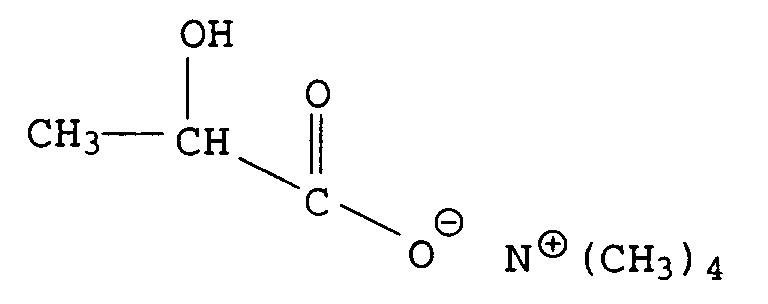
- Nach der Verarbeitung gemäß Vergleichsbeispiel 6 ergab sich ein Gamma-Wert von 7,5.
- Die Resistlösungen aus Vergleichsbeispiel 6 und Beispiel 15 wurden zur Überprüfung der Depth of Focus auf 200 mm-Wafer in einer Schichtdicke von ca. 800 nm aufgetragen.
- Die weitere Verarbeitung erfolgte wie unter Beispiel 10 beschrieben.
- Für die Resistformulierungen aus Vergleichsbeispiel 6 und Beispiel 15 ergaben sich folgende Resultate:
Depth of Focus (µm) bei einer Linienbreite von 250 nm 350 nm Vergleichsbeispiel 6 0,6 1,0 Beispiel 15 1,0 1,3 - Eine Photoresistlösung wurde aus 6 Teilen Bis-4-Methylphenylsulfonyl-diazomethan, 95 Teilen Poly-[4-hydroxystyrol-co-4-tetrahydropyranyloxystyrol-co-4-vinyl-cyclohexanol]
(Molares Verhältnis der Comonomeren 49:38:13)
und 320 Teilen Ethyllaktat hergestellt und anschließend durch ein Filter mit einem Porendurchmesser von 0,2 µm filtriert. - Von dieser Lösung wurde eine ca. 0,8 µm dicke Schicht auf oberflächlich oxidierte Siliziumwafer aufgeschleudert und 1 min. bei 100°C ausgeheizt. Nach der Belichtung durch eine strukturierte Testmaske mit Excimer-Laserlicht der Wellenlänge 248 nm wurde dieser Wafer bei 100°C für 1 min. ausgeheizt und mit einem wäßrigalkalischen Entwickler 1 min. entwickelt.
- Nach Messung der auf dem Testwafer zurückgebliebenen Photolackschichten wurde der Kontrast des Resistes ermittelt. Es ergab sich ein Gamma-Wert von 6,4.
- Eine Photoresistlösung wurde analog Vergleichsbeispiel 7 hergestellt, jedoch wurden 4 mol% der Verbindung

- Nach der Verarbeitung gemäß Vergleichsbeispiel 7 ergab sich ein Gamma-Wert von 7,5.
- Eine Photoresistlösung wurde aus 10 Teilen 2,6-Dinitrobenzyl-4-toluolsulfonat, 90 Teilen Poly-[4-hydroxystyrol-co-4-tetrahydropyranyloxystyrol-co-4-vinyl-cyclohexanol]
(Molares Verhältnis der Comonomeren 55:38:7)
und 320 Teilen Ethyllaktat hergestellt und anschließend durch ein Filter mit einem Porendurchmesser von 0,2 µm filtriert. - Von dieser Lösung wurde eine ca. 1,0 µm dicke Schicht auf oberflächlich oxidierte Siliziumwafer aufgeschleudert und 1 min. bei 130°C ausgeheizt. Nach der Belichtung durch eine strukturierte Testmaske mit Excimer-Laserlicht der Wellenlänge 248 nm wurde dieser Wafer bei 130°C für 1 min. ausgeheizt und mit einem wäßrigalkalischen Entwickler 1 min. entwickelt.
- Nach Messung der auf dem Testwafer zurückgebliebenen Photolackschichten wurde der Kontrast des Resistes ermittelt. Es ergab sich ein Gamma-Wert von 5,0.
- Eine Photoresistlösung wurde analog Vergleichsbeispiel 8 hergestellt, jedoch wurden 5 mol% der Verbindung
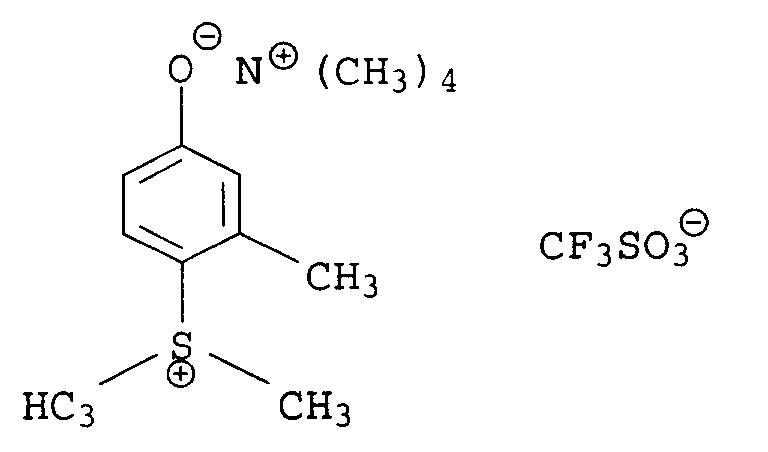
- Nach der Verarbeitung gemäß Vergleichsbeispiel 8 ergab sich ein Gamma-Wert von 6,5.
- Die Resistlösungen aus Vergleichsbeispiel 8 und Beispiel 18 wurden zur Überprüfung der Depth of Focus auf 200 mm-Wafer in einer Schichtdicke von ca. 800 nm aufgetragen.
- Die weitere Verarbeitung erfolgte wie unter Beispiel 10 beschrieben.
- Für die Resistformulierungen aus Vergleichsbeispiel 8 und Beispiel 18 ergaben sich folgende Resultate:
Depth of Focus (µm) bei einer Linienbreite von 250 nm 350 nm Vergleichsbeispiel 8 0,8 1,2 Beispiel 18 1,1 1,6 - Eine Photoresistlösung wurde aus 5 Teilen 3-Methyl-4-hydroxyphenyl-dimethylsulfoniumtriflat, 95 Teilen Poly-[4-hydroxystyrol-co-4-tetrahydropyranyloxystyrol-co-4-vinyl-cyclohexanol]
(Molares Verhältnis der Comonomeren 54:40:6)
und 320 Teilen Ethyllaktat hergestellt und anschließend durch ein Filter mit einem Porendurchmesser von 0,2 µm filtriert. - Von dieser Lösung wurde eine ca. 0,8 µm dicke Schicht auf oberflächlich oxidierte Siliziumwafer aufgeschleudert und 1 min. bei 130°C ausgeheizt. Nach der Belichtung durch eine strukturierte Testmaske mit Excimer-Laserlicht der Wellenlänge 248 nm wurde dieser Wafer bei 130°C für 1 min. ausgeheizt und mit einem wäßrigalkalischen Entwickler 1 min. entwickelt.
- Nach Messung der auf dem Testwafer zurückgebliebenen Photolackschichten wurde der Kontrast des Resistes ermittelt. Es ergab sich ein Gamma-Wert von 6,5.
- Eine Photoresistlösung wurde analog Vergleichsbeispiel 9 hergestellt, jedoch wurden 2 mol% der Verbindung

- Nach der Verarbeitung gemäß Vergleichsbeispiel 9 ergab sich ein Gamma-Wert von 7,5.
- Eine Photoresistlösung analog Vergleichsbeispiel 9, jedoch mit 4 mol% der Verbindung C9, bezogen auf 3-Methyl-4-hydroxy-phenyldimethylsulfoniumtriflat ergab einen Gamma-Wert von 9.
- Eine Photoresistlösung analog Vergleichsbeispiel 9, jedoch mit 6 mol% der Verbindung C9, bezogen auf 3-Methyl-4-hydroxy-phenyldimethylsulfoniumtriflat ergab ein Gamma-Wert von 9.
- Photoresistlösungen aus Vergleichsbeispiel 9 und den Beispielen 20, 21 und 22 wurden zur Überprüfung der Lagerstabilität auf Wafer mit einem Durchmesser von 200 mm in einer Schichtdicke von ca. 800 nm aufgetragen.
- Die weitere Verarbeitung erfolgte wie unter Beispiel 3 beschrieben.
- Die gemessenen Linienbreiten nach unterschiedlichen Wartezeiten zeigt folgende Tabelle:
Wartezeit keine 20 min 40 min 60 min Vergleichsbeispiel 9 ohne Zusatz 252 nm 242 nm 230 nm 218 nm Beispiel 20 mit 2 mol % C9 253 nm 251 nm 230 nm 225 nm Beispiel 21 mit 4 mol % C9 256 nm 252 nm 249 nm 242 nm Beispiel 22 mit 6 mol % C9 255 nm 250 nm 247 nm 239 nm - In einem weiteren Experiment wurde der Belichtungsspielraum ermittelt. Die sogenannte "Depth of Focus" wurde bestimmt, indem die Wafer mit unterschiedlichen Belichtungsdosen und veränderlicher Focustiefe des Belichtungsgerätes prozessiert wurden.
- Dabei ergaben sich für die Resistformulierungen aus Vergleichsbeispiel 9 und den Beispielen 20, 21 und 22 für 250 nm bzw. 350 nm breite lithographisch hergestellte Linien folgende Resultate:
Depth of Focus (µm) bei einer Linienbreite von 250 nm 350 nm Vergleichsbeispiel 9 0,7 1,2 Beispiel 20 1,2 1,6 Beispiel 21 1,4 1,8 Beispiel 22 1,4 1,8 - Eine Photoresistlösung wurde aus 10 Teilen 1,2,3-Tris-(methansulfonyl-oxy)benzol, 90 Teilen Poly-[4-hydroxystyrol-co-4-tetrahydropyranyloxystyrol-co-4-vinyl-cyclohexanol]
(Molares Verhältnis der Comonomeren 47:40:13)
und 320 Teilen Ethyllaktat hergestellt und anschließend durch ein Filter mit einem Porendurchmesser von 0,2 µm filtriert. - Von dieser Lösung wurde eine ca. 0,8 µm dicke Schicht auf oberflächlich oxidierte Siliziumwafer aufgeschleudert und 1 min. bei 125°C ausgeheizt. Nach der Belichtung durch eine strukturierte Testmaske mit Excimer-Laserlicht der Wellenlänge 248 nm wurde dieser Wafer bei 125°C für 1 min. ausgeheizt und mit einem wäßrigalkalischen Entwickler 1 min. entwickelt.
- Nach Messung der auf dem Testwafer zurückgebliebenen Photolackschichten wurde der Kontrast des Resistes ermittelt. Es ergab sich ein Gamma-Wert von 5,4.
- Eine Photoresistlösung wurde analog Vergleichsbeispiel 10 hergestellt, jedoch wurden 5 mol-% der Verbindung

- Nach der Verarbeitung gemäß Vergleichsbeispiel 10 ergab sich ein Gamma-Wert von 6,5.
- Die Resistlösungen aus Vergleichsbeispiel 10 und Beispiel 25 wurden zur Überprüfung der Lagerstabilität auf 200 mm-Wafer in einer Schichtdicke von ca. 800 nm aufgetragen.
- Die weitere Verarbeitung erfolgte wie unter Beispiel 3 beschrieben.
- Die gemessenen Linienbreiten von 250 nm breiten Strukturen nach unterschiedlichen Wartezeiten zeigt folgende Tabelle:
Wartezeit keine 20 min 40 min 60 min Vergleichsbeispiel 10 ohne Zusatz 253 nm 240 nm 231 nm 219 nm Beispiel 25 mit 5 mol % C10 251 nm 250 nm 237 nm 230 nm.
vorzugsweise eine Gruppierung der Formeln


Claims (11)
- Positiv arbeitendes strahlungsempfindliches Gemisch im wesentlichen bestehend aus(a1) mindestens einem säurelabile Gruppierungen enthaltenden, in Wasser unlöslichen organischen polymeren Bindemittel, das durch Einwirkung von Säure in wäßrigalkalischen Lösungen löslich wird, oder(a2.1) einem in Wasser unlöslichen, in wäßrig-alkalischen Lösungen löslichen polymeren Bindemittel und(a2.2) einer niedermolekularen organischen Verbindung, deren Löslichkeit in einem wäßrig-alkalischen Entwickler durch Einwirkung von Säure erhöht wird, und(b) mindestens einer organischen Verbindung, welche unter Einwirkung von aktinischer Strahlung eine Säure erzeugt,sowie gegebenenfalls(c) einer oder mehreren weiteren von (b) verschiedenen organischen Verbindungen,dadurch gekennzeichnet, daß mindestens eine der Komponenten (a1), (a2.1), (a2.2), (b) und (c) eine Gruppierung der allgemeinen Formel (I) -O⊖ N⊕R4 gebunden enthält, oder Komponente (c) der Formel (II) entspricht,

- Strahlungsempfindliches Gemisch nach Anspruch 1, dadurch gekennzeichnet, daß mindestens eine der Komponenten (a1), (a2.1), (a2.2), (b) und (c) eine Gruppierung der Formel

- Strahlungsempfindliches Gemisch nach Anspruch 1, dadurch gekennzeichnet, daß Komponente (a1) bzw. (a2.1) Einheiten der Formel (III), (IV) und/oder (V)
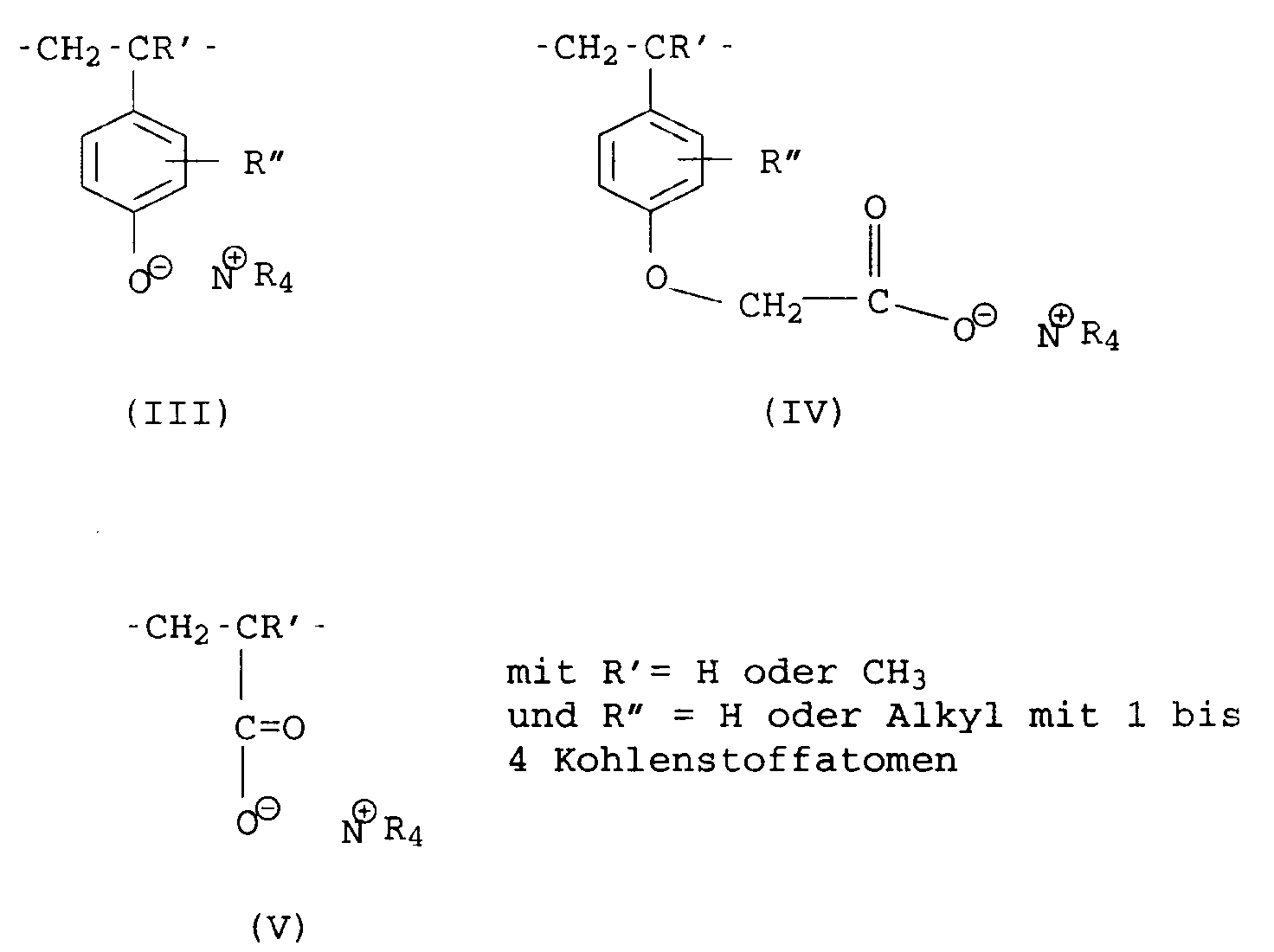
- Strahlungsempfindliches Gemisch nach Anspruch 1 oder 2, dadurch gekennzeichnet, daß es als Komponente (c) eine organische Verbindung aus der Gruppe
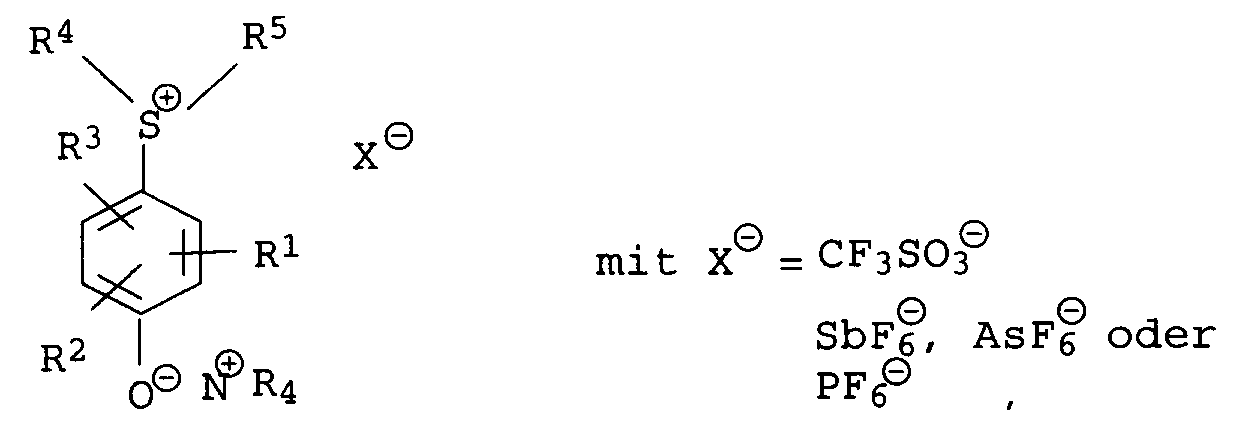
- Strahlungsempfindliches Gemisch nach Anspruch 1, dadurch gekennzeichnet, daß es als Komponente (c) eine organische Verbindung aus der Gruppe


- Strahlungsempfindliches Gemisch nach einem der vorhergehenden Ansprüche, dadurch gekennzeichnet, daß es als Komponente (b) ein Sulfoniumsalz, Iodoniumsalz, Benzointosylat, Pyrogalloltrimesylat, o-Nitrobenzyltosylat, Diaryldisulfon, Bis-arylsulfonyl-diazomethan, Bis-cyclohexylsulfonyl-diazomethan und/oder Iminosulfonate mit der Struktureinheit

- Strahlungsempfindliches Gemisch nach einem der vorhergehenden Ansprüche, dadurch gekennzeichnet, daß die Komponente (a1) Einheiten der Formeln (VI), (VII) und gegebenenfalls (VIII)

- Strahlungsempfindliches Gemisch nach Anspruch 1, dadurch gekennzeichnet, daß in den Formeln (I) oder (II) R für CH3 steht.
- Strahlungsempfindliches Gemisch nach einem der vorhergehenden Ansprüche, dadurch gekennzeichnet, daß es in Form einer Lösung in einem organischen Lösungsmittel oder Lösungsmittelgemisch vorliegt.
- Verfahren zur Herstellung lichtempfindlicher Beschichtungsmaterialien, dadurch gekennzeichnet, daß ein strahlungsempfindliches Gemisch gemäß einem der Ansprüche 1 bis 9 eingesetzt wird.
- Verfahren zur Herstellung von Reliefstrukturen durch Auftragen eines strahlungsempfindlichen Gemisches in einer Schichtdicke von 0,1 bis 5 µm auf ein in üblicher Weise vorbehandeltes Substrat, Trocknen bei Temperaturen von 70 bis 140°C, bildmäßiges Belichten mit aktinischem Licht, gegebenenfalls Erhitzen auf Temperaturen von 40 bis 160°C, und Entwickeln mit einer wäßrig-alkalischen Lösung, dadurch gekennzeichnet, daß ein strahlungsempfindliches Gemisch gemäß einem der Ansprüche 1 bis 9 eingesetzt wird.
Applications Claiming Priority (2)
| Application Number | Priority Date | Filing Date | Title |
|---|---|---|---|
| DE19533608 | 1995-09-11 | ||
| DE19533608A DE19533608A1 (de) | 1995-09-11 | 1995-09-11 | Positivarbeitendes strahlungsempfindliches Gemisch und Verfahren zur Herstellung von Reliefstrukturen |
Publications (3)
| Publication Number | Publication Date |
|---|---|
| EP0762207A2 true EP0762207A2 (de) | 1997-03-12 |
| EP0762207A3 EP0762207A3 (de) | 1997-06-25 |
| EP0762207B1 EP0762207B1 (de) | 2000-04-12 |
Family
ID=7771861
Family Applications (1)
| Application Number | Title | Priority Date | Filing Date |
|---|---|---|---|
| EP96114061A Expired - Lifetime EP0762207B1 (de) | 1995-09-11 | 1996-09-03 | Positivarbeitendes strahlenempfindliches Gemisch und Verfahren zur Herstellung von Reliefstrukturen |
Country Status (6)
| Country | Link |
|---|---|
| US (1) | US5783354A (de) |
| EP (1) | EP0762207B1 (de) |
| JP (1) | JPH09127700A (de) |
| KR (1) | KR970016742A (de) |
| DE (2) | DE19533608A1 (de) |
| TW (1) | TW451112B (de) |
Cited By (5)
| Publication number | Priority date | Publication date | Assignee | Title |
|---|---|---|---|---|
| EP0803775A1 (de) * | 1996-04-25 | 1997-10-29 | Fuji Photo Film Co., Ltd. | Positiv-arbeitende lichtempfindliche Zusammensetzung |
| EP1084456A1 (de) * | 1998-04-24 | 2001-03-21 | Ciba SC Holding AG | Schwermetallfreie beschichtungsformulierungen |
| WO2011104127A1 (en) | 2010-02-24 | 2011-09-01 | Basf Se | Latent acids and their use |
| WO2016124493A1 (en) | 2015-02-02 | 2016-08-11 | Basf Se | Latent acids and their use |
| DE10015255B4 (de) | 1999-03-31 | 2020-06-04 | Ciba Holding Inc. | Verfahren zur Herstellung von Oximderivaten und ihre Verwendung als latente Säuren in chemisch verstärkten Photoresistzusammensetzungen, sowie Verfahren zur Herstellung eines Photoresists |
Families Citing this family (11)
| Publication number | Priority date | Publication date | Assignee | Title |
|---|---|---|---|---|
| US5908730A (en) * | 1996-07-24 | 1999-06-01 | Tokyo Ohka Kogyo Co., Ltd. | Chemical-sensitization photoresist composition |
| US6383715B1 (en) * | 2000-06-28 | 2002-05-07 | Infineon Technologies Ag | Strongly water-soluble photoacid generator resist compositions |
| DE10120661A1 (de) | 2001-04-27 | 2002-11-21 | Infineon Technologies Ag | Photolackzusammensetzung und Verfahren zur Strukturierung einer Photolackschicht |
| EP1308781A3 (de) * | 2001-10-05 | 2003-09-03 | Shipley Co. L.L.C. | Cyclische sulfonium und sulfoxonium Fotosäure erzeugende Verbindungen und diese Verbindungen enthaltende Fotoresiste |
| JP2004217551A (ja) * | 2003-01-14 | 2004-08-05 | Sanshin Chem Ind Co Ltd | スルホニウム化合物 |
| JP4729377B2 (ja) * | 2005-09-27 | 2011-07-20 | 富士フイルム株式会社 | ポジ型レジスト組成物及びそれを用いたパターン形成方法 |
| US8153346B2 (en) | 2007-02-23 | 2012-04-10 | Fujifilm Electronic Materials, U.S.A., Inc. | Thermally cured underlayer for lithographic application |
| JP5846889B2 (ja) * | 2011-12-14 | 2016-01-20 | 東京応化工業株式会社 | レジスト組成物、レジストパターン形成方法、化合物 |
| JP2014240942A (ja) | 2012-09-13 | 2014-12-25 | 富士フイルム株式会社 | 感活性光線性又は感放射線性樹脂組成物、レジスト膜、及び、パターン形成方法、並びに、これらを用いた電子デバイスの製造方法、及び、電子デバイス |
| JP6062878B2 (ja) * | 2014-03-07 | 2017-01-18 | 信越化学工業株式会社 | 化学増幅型ポジ型レジスト組成物及びレジストパターン形成方法 |
| JP6848776B2 (ja) * | 2016-10-12 | 2021-03-24 | 信越化学工業株式会社 | スルホニウム化合物、レジスト組成物、及びパターン形成方法 |
Family Cites Families (19)
| Publication number | Priority date | Publication date | Assignee | Title |
|---|---|---|---|---|
| US3844787A (en) * | 1972-04-24 | 1974-10-29 | Upjohn Co | Process of chemically bonding a dyestuff to a substrate |
| US3915706A (en) * | 1974-03-11 | 1975-10-28 | Xerox Corp | Imaging system based on photodegradable polyaldehydes |
| US3923514A (en) * | 1974-06-27 | 1975-12-02 | Xerox Corp | Method for the preparation of relief printing masters |
| DE3406927A1 (de) * | 1984-02-25 | 1985-08-29 | Hoechst Ag, 6230 Frankfurt | Strahlungsempfindliches gemisch auf basis von saeurespaltbaren verbindungen |
| JPS62123444A (ja) * | 1985-08-07 | 1987-06-04 | Japan Synthetic Rubber Co Ltd | ポジ型感放射線性樹脂組成物 |
| JPH01103604A (ja) * | 1987-07-17 | 1989-04-20 | Maruzen Petrochem Co Ltd | p−ビニルフェノール系重合体の特性を改善する方法 |
| GB8729510D0 (en) * | 1987-12-18 | 1988-02-03 | Ucb Sa | Photosensitive compositions containing phenolic resins & diazoquinone compounds |
| US5128232A (en) * | 1989-05-22 | 1992-07-07 | Shiply Company Inc. | Photoresist composition with copolymer binder having a major proportion of phenolic units and a minor proportion of non-aromatic cyclic alcoholic units |
| EP0412457A1 (de) * | 1989-08-08 | 1991-02-13 | Tosoh Corporation | Löslichkeitsinhibitor und positiv arbeitende Photolackzusammensetzung |
| DE3930086A1 (de) * | 1989-09-09 | 1991-03-21 | Hoechst Ag | Positiv arbeitendes strahlungsempfindliches gemisch und daraus hergestelltes strahlungsempfindliches aufzeichnungsmaterial |
| JPH03267941A (ja) * | 1990-03-19 | 1991-11-28 | Sanyo Chem Ind Ltd | 導電性レジスト材料 |
| DE59107712D1 (de) * | 1990-09-13 | 1996-05-30 | Ocg Microelectronic Materials | Säurelabile Lösungsinhibitoren und darauf basierende positiv und negativ arbeitende strahlungsempfindliche Zusammensetzung |
| JP2677460B2 (ja) * | 1991-02-14 | 1997-11-17 | 日本ペイント株式会社 | アルカリ現像性感光性樹脂組成物 |
| DE4112973A1 (de) * | 1991-04-20 | 1992-10-22 | Hoechst Ag | Positiv arbeitendes strahlungsempfindliches gemisch und damit hergestelltes strahlungsempfindliches aufzeichnungsmaterial |
| KR100355254B1 (en) * | 1993-02-15 | 2003-03-31 | Clariant Finance Bvi Ltd | Positive type radiation-sensitive mixture |
| DE4306069A1 (de) * | 1993-03-01 | 1994-09-08 | Basf Ag | Strahlungsempfindliches Gemisch und Verfahren zur Herstellung von Reliefstrukturen mit verbessertem Kontrast |
| JPH07140666A (ja) * | 1993-06-04 | 1995-06-02 | Internatl Business Mach Corp <Ibm> | マイクロリトグラフィックレジスト組成物、酸不安定化合物、マイクロリトグラフィックレリーフ画像形成方法及び酸感知性ポリマー組成物 |
| JPH08110635A (ja) * | 1994-10-07 | 1996-04-30 | Shin Etsu Chem Co Ltd | 化学増幅ポジ型レジスト材料 |
| EP0732628A1 (de) * | 1995-03-07 | 1996-09-18 | Minnesota Mining And Manufacturing Company | Wässrig-alkalische Lösung zum Entwickeln von Flachdruckplatten |
-
1995
- 1995-09-11 DE DE19533608A patent/DE19533608A1/de not_active Withdrawn
-
1996
- 1996-09-03 DE DE59604943T patent/DE59604943D1/de not_active Expired - Lifetime
- 1996-09-03 EP EP96114061A patent/EP0762207B1/de not_active Expired - Lifetime
- 1996-09-04 TW TW085110814A patent/TW451112B/zh not_active IP Right Cessation
- 1996-09-09 US US08/711,016 patent/US5783354A/en not_active Expired - Fee Related
- 1996-09-10 KR KR1019960039052A patent/KR970016742A/ko not_active Abandoned
- 1996-09-11 JP JP8240821A patent/JPH09127700A/ja not_active Withdrawn
Cited By (6)
| Publication number | Priority date | Publication date | Assignee | Title |
|---|---|---|---|---|
| EP0803775A1 (de) * | 1996-04-25 | 1997-10-29 | Fuji Photo Film Co., Ltd. | Positiv-arbeitende lichtempfindliche Zusammensetzung |
| US5891603A (en) * | 1996-04-25 | 1999-04-06 | Fuji Photo Film Co., Ltd. | Positive working photosensitive composition |
| EP1084456A1 (de) * | 1998-04-24 | 2001-03-21 | Ciba SC Holding AG | Schwermetallfreie beschichtungsformulierungen |
| DE10015255B4 (de) | 1999-03-31 | 2020-06-04 | Ciba Holding Inc. | Verfahren zur Herstellung von Oximderivaten und ihre Verwendung als latente Säuren in chemisch verstärkten Photoresistzusammensetzungen, sowie Verfahren zur Herstellung eines Photoresists |
| WO2011104127A1 (en) | 2010-02-24 | 2011-09-01 | Basf Se | Latent acids and their use |
| WO2016124493A1 (en) | 2015-02-02 | 2016-08-11 | Basf Se | Latent acids and their use |
Also Published As
| Publication number | Publication date |
|---|---|
| JPH09127700A (ja) | 1997-05-16 |
| EP0762207B1 (de) | 2000-04-12 |
| EP0762207A3 (de) | 1997-06-25 |
| US5783354A (en) | 1998-07-21 |
| DE19533608A1 (de) | 1997-03-13 |
| KR970016742A (ko) | 1997-04-28 |
| DE59604943D1 (de) | 2000-05-18 |
| TW451112B (en) | 2001-08-21 |
Similar Documents
| Publication | Publication Date | Title |
|---|---|---|
| EP0616258B1 (de) | Strahlungsempfindliches Gemisch und Verfahren zur Herstellung von Reliefstrukturen mit verbessertem Kontrast | |
| EP0342498B1 (de) | Positiv und negativ arbeitende strahlungsempfindliche Gemische sowie Verfahren zur Herstellung von Reliefmustern | |
| EP0342496B1 (de) | Strahlungsempfindliches Gemisch und Verfahren zur Herstellung von Reliefmustern | |
| EP0297443B1 (de) | Strahlungsempfindliches Gemisch für lichtempfindliche Beschichtungsmaterialien | |
| EP0447868B1 (de) | Strahlungsempfindliches Gemisch | |
| EP0342495B1 (de) | Strahlungsempfindliches Gemisch und Verfahren zur Herstellung von Reliefmustern | |
| DE69517547T2 (de) | Strahlungsempfindliche Mischung | |
| EP0762207B1 (de) | Positivarbeitendes strahlenempfindliches Gemisch und Verfahren zur Herstellung von Reliefstrukturen | |
| EP0553737B1 (de) | Strahlungsempfindliches Gemisch | |
| EP0367131B1 (de) | Strahlungsempfindliches Gemisch | |
| DE112004000021T5 (de) | Positiv-Photoresist-Zusammensetzung vom chemisch verstärkten Typ und Methode zur Bildung eines Resistmusters | |
| EP0367132B1 (de) | Strahlungsempfindliches Gemisch | |
| EP0510443B1 (de) | Negativ arbeitendes strahlungsempfindliches Gemisch und damit hergestelltes strahlungsempfindliches Aufzeichnungsmaterial | |
| EP0337257B1 (de) | Positiv arbeitendes, strahlungsempfindliches Gemisch auf Basis von säurespaltbaren und photochemisch säurebildenden Verbindungen und Verfahren zur Herstellung von Reliefmustern und Reliefbildern | |
| EP0737897A1 (de) | Nasschemisch entwickelbares, ätzstabiler Photoresist für UV-Strahlung mit einer Wellenlänge unter 200 nm | |
| EP0540965B1 (de) | Positiv arbeitendes strahlungsempfindliches Gemisch und Verfahren zur Herstellung von Reliefmustern | |
| EP0762206B1 (de) | Positivarbeitendes strahlungsempfindliches Gemisch und Verfahren zur Herstellung von Reliefstrukturen | |
| EP0372408B1 (de) | Strahlungsempfindliches Gemisch | |
| EP0443415A2 (de) | Strahlungsempfindliches Gemisch | |
| DE4408318C2 (de) | Positiv arbeitende Lichtempfindliche Zusammensetzung | |
| EP0432622B1 (de) | Verfahren zum Entwickeln von Photoresisten |
Legal Events
| Date | Code | Title | Description |
|---|---|---|---|
| PUAI | Public reference made under article 153(3) epc to a published international application that has entered the european phase |
Free format text: ORIGINAL CODE: 0009012 |
|
| AK | Designated contracting states |
Kind code of ref document: A2 Designated state(s): BE DE FR GB IT NL |
|
| PUAL | Search report despatched |
Free format text: ORIGINAL CODE: 0009013 |
|
| AK | Designated contracting states |
Kind code of ref document: A3 Designated state(s): BE DE FR GB IT NL |
|
| 17P | Request for examination filed |
Effective date: 19970528 |
|
| 17Q | First examination report despatched |
Effective date: 19981112 |
|
| GRAG | Despatch of communication of intention to grant |
Free format text: ORIGINAL CODE: EPIDOS AGRA |
|
| GRAG | Despatch of communication of intention to grant |
Free format text: ORIGINAL CODE: EPIDOS AGRA |
|
| GRAH | Despatch of communication of intention to grant a patent |
Free format text: ORIGINAL CODE: EPIDOS IGRA |
|
| GRAH | Despatch of communication of intention to grant a patent |
Free format text: ORIGINAL CODE: EPIDOS IGRA |
|
| GRAA | (expected) grant |
Free format text: ORIGINAL CODE: 0009210 |
|
| AK | Designated contracting states |
Kind code of ref document: B1 Designated state(s): BE DE FR GB IT NL |
|
| PG25 | Lapsed in a contracting state [announced via postgrant information from national office to epo] |
Ref country code: GB Free format text: LAPSE BECAUSE OF FAILURE TO SUBMIT A TRANSLATION OF THE DESCRIPTION OR TO PAY THE FEE WITHIN THE PRESCRIBED TIME-LIMIT Effective date: 20000412 |
|
| REF | Corresponds to: |
Ref document number: 59604943 Country of ref document: DE Date of ref document: 20000518 |
|
| ITF | It: translation for a ep patent filed | ||
| ET | Fr: translation filed | ||
| PG25 | Lapsed in a contracting state [announced via postgrant information from national office to epo] |
Ref country code: BE Free format text: LAPSE BECAUSE OF NON-PAYMENT OF DUE FEES Effective date: 20000930 |
|
| GBV | Gb: ep patent (uk) treated as always having been void in accordance with gb section 77(7)/1977 [no translation filed] |
Effective date: 20000412 |
|
| PLBE | No opposition filed within time limit |
Free format text: ORIGINAL CODE: 0009261 |
|
| STAA | Information on the status of an ep patent application or granted ep patent |
Free format text: STATUS: NO OPPOSITION FILED WITHIN TIME LIMIT |
|
| 26N | No opposition filed | ||
| BERE | Be: lapsed |
Owner name: BASF A.G. Effective date: 20000930 |
|
| PGFP | Annual fee paid to national office [announced via postgrant information from national office to epo] |
Ref country code: FR Payment date: 20020820 Year of fee payment: 7 |
|
| PGFP | Annual fee paid to national office [announced via postgrant information from national office to epo] |
Ref country code: NL Payment date: 20020821 Year of fee payment: 7 |
|
| PGFP | Annual fee paid to national office [announced via postgrant information from national office to epo] |
Ref country code: DE Payment date: 20021018 Year of fee payment: 7 |
|
| PG25 | Lapsed in a contracting state [announced via postgrant information from national office to epo] |
Ref country code: DE Free format text: LAPSE BECAUSE OF THE APPLICANT RENOUNCES Effective date: 20030927 |
|
| PG25 | Lapsed in a contracting state [announced via postgrant information from national office to epo] |
Ref country code: NL Free format text: LAPSE BECAUSE OF NON-PAYMENT OF DUE FEES Effective date: 20040401 |
|
| PG25 | Lapsed in a contracting state [announced via postgrant information from national office to epo] |
Ref country code: FR Free format text: LAPSE BECAUSE OF NON-PAYMENT OF DUE FEES Effective date: 20040528 |
|
| NLV4 | Nl: lapsed or anulled due to non-payment of the annual fee |
Effective date: 20040401 |
|
| REG | Reference to a national code |
Ref country code: FR Ref legal event code: ST |
|
| PG25 | Lapsed in a contracting state [announced via postgrant information from national office to epo] |
Ref country code: IT Free format text: LAPSE BECAUSE OF NON-PAYMENT OF DUE FEES;WARNING: LAPSES OF ITALIAN PATENTS WITH EFFECTIVE DATE BEFORE 2007 MAY HAVE OCCURRED AT ANY TIME BEFORE 2007. THE CORRECT EFFECTIVE DATE MAY BE DIFFERENT FROM THE ONE RECORDED. Effective date: 20050903 |