EP0763614A1 - Tricot de recouvrement coupé en biais pour une courroie, tuyau ou similaire - Google Patents
Tricot de recouvrement coupé en biais pour une courroie, tuyau ou similaire Download PDFInfo
- Publication number
- EP0763614A1 EP0763614A1 EP96306765A EP96306765A EP0763614A1 EP 0763614 A1 EP0763614 A1 EP 0763614A1 EP 96306765 A EP96306765 A EP 96306765A EP 96306765 A EP96306765 A EP 96306765A EP 0763614 A1 EP0763614 A1 EP 0763614A1
- Authority
- EP
- European Patent Office
- Prior art keywords
- fabric
- belt
- strip
- angle
- longitudinal axis
- Prior art date
- Legal status (The legal status is an assumption and is not a legal conclusion. Google has not performed a legal analysis and makes no representation as to the accuracy of the status listed.)
- Granted
Links
- 239000004744 fabric Substances 0.000 claims abstract description 161
- 229920001971 elastomer Polymers 0.000 claims abstract description 16
- 230000005540 biological transmission Effects 0.000 claims abstract description 12
- 229920001084 poly(chloroprene) Polymers 0.000 claims abstract description 10
- 239000000806 elastomer Substances 0.000 claims abstract description 8
- 238000000576 coating method Methods 0.000 claims abstract description 6
- 239000011248 coating agent Substances 0.000 claims abstract description 5
- 230000006866 deterioration Effects 0.000 claims description 4
- 238000000034 method Methods 0.000 description 14
- 239000002759 woven fabric Substances 0.000 description 14
- 239000000835 fiber Substances 0.000 description 5
- 230000008901 benefit Effects 0.000 description 4
- 238000003490 calendering Methods 0.000 description 4
- 238000004513 sizing Methods 0.000 description 4
- 230000015572 biosynthetic process Effects 0.000 description 3
- 229920000742 Cotton Polymers 0.000 description 2
- 239000004698 Polyethylene Substances 0.000 description 2
- 239000011230 binding agent Substances 0.000 description 2
- 230000008859 change Effects 0.000 description 2
- 238000010073 coating (rubber) Methods 0.000 description 2
- 150000001875 compounds Chemical class 0.000 description 2
- 238000010276 construction Methods 0.000 description 2
- 230000008602 contraction Effects 0.000 description 2
- 239000012530 fluid Substances 0.000 description 2
- 230000006872 improvement Effects 0.000 description 2
- 238000009940 knitting Methods 0.000 description 2
- 238000004519 manufacturing process Methods 0.000 description 2
- 230000035515 penetration Effects 0.000 description 2
- 229920000728 polyester Polymers 0.000 description 2
- -1 polyethylene Polymers 0.000 description 2
- 229920000573 polyethylene Polymers 0.000 description 2
- 230000008569 process Effects 0.000 description 2
- 239000007787 solid Substances 0.000 description 2
- 229920002472 Starch Polymers 0.000 description 1
- 238000005299 abrasion Methods 0.000 description 1
- 239000002318 adhesion promoter Substances 0.000 description 1
- 230000003190 augmentative effect Effects 0.000 description 1
- 238000005452 bending Methods 0.000 description 1
- 230000000295 complement effect Effects 0.000 description 1
- 230000006835 compression Effects 0.000 description 1
- 238000007906 compression Methods 0.000 description 1
- 238000007796 conventional method Methods 0.000 description 1
- 238000005520 cutting process Methods 0.000 description 1
- 238000010586 diagram Methods 0.000 description 1
- 230000009977 dual effect Effects 0.000 description 1
- 230000008030 elimination Effects 0.000 description 1
- 238000003379 elimination reaction Methods 0.000 description 1
- 238000005470 impregnation Methods 0.000 description 1
- 239000000049 pigment Substances 0.000 description 1
- 230000009467 reduction Effects 0.000 description 1
- 230000002787 reinforcement Effects 0.000 description 1
- 239000002904 solvent Substances 0.000 description 1
- 235000019698 starch Nutrition 0.000 description 1
- 239000008107 starch Substances 0.000 description 1
- 239000000758 substrate Substances 0.000 description 1
- 230000001360 synchronised effect Effects 0.000 description 1
- 239000004753 textile Substances 0.000 description 1
Images

Classifications
-
- D—TEXTILES; PAPER
- D04—BRAIDING; LACE-MAKING; KNITTING; TRIMMINGS; NON-WOVEN FABRICS
- D04B—KNITTING
- D04B1/00—Weft knitting processes for the production of fabrics or articles not dependent on the use of particular machines; Fabrics or articles defined by such processes
- D04B1/22—Weft knitting processes for the production of fabrics or articles not dependent on the use of particular machines; Fabrics or articles defined by such processes specially adapted for knitting goods of particular configuration
-
- D—TEXTILES; PAPER
- D04—BRAIDING; LACE-MAKING; KNITTING; TRIMMINGS; NON-WOVEN FABRICS
- D04B—KNITTING
- D04B9/00—Circular knitting machines with independently-movable needles
- D04B9/42—Circular knitting machines with independently-movable needles specially adapted for producing goods of particular configuration
- D04B9/44—Circular knitting machines with independently-movable needles specially adapted for producing goods of particular configuration elongated tubular articles of small diameter, e.g. coverings for cables
-
- F—MECHANICAL ENGINEERING; LIGHTING; HEATING; WEAPONS; BLASTING
- F16—ENGINEERING ELEMENTS AND UNITS; GENERAL MEASURES FOR PRODUCING AND MAINTAINING EFFECTIVE FUNCTIONING OF MACHINES OR INSTALLATIONS; THERMAL INSULATION IN GENERAL
- F16G—BELTS, CABLES, OR ROPES, PREDOMINANTLY USED FOR DRIVING PURPOSES; CHAINS; FITTINGS PREDOMINANTLY USED THEREFOR
- F16G5/00—V-belts, i.e. belts of tapered cross-section
- F16G5/04—V-belts, i.e. belts of tapered cross-section made of rubber
- F16G5/06—V-belts, i.e. belts of tapered cross-section made of rubber with reinforcement bonded by the rubber
-
- D—TEXTILES; PAPER
- D10—INDEXING SCHEME ASSOCIATED WITH SUBLASSES OF SECTION D, RELATING TO TEXTILES
- D10B—INDEXING SCHEME ASSOCIATED WITH SUBLASSES OF SECTION D, RELATING TO TEXTILES
- D10B2403/00—Details of fabric structure established in the fabric forming process
- D10B2403/03—Shape features
- D10B2403/031—Narrow fabric of constant width
- D10B2403/0312—Bulk fabric, e.g. belts
Definitions
- the present invention is directed to an improved cover for a belt, hose or the like, and, more particularly, to a knitted fabric cover for a power transmission belt such as a V-belt, which is bias-out such that the wales of the knit fabric run at an angle with respect to the length of the cover.
- U.S. Patent No. 3,784,427 to Griffin discloses a method and apparatus for manufacturing an elastomer-coated bias cut fabric wherein a tubular woven fabric is cut spirally at a 45° angle to produce a continuous sheet of fabric which is impregnated with a curable binder and transversely stretched on a tenter frame to increase the complementary angle of the warp and weft threads.
- the binder is cured or otherwise hardened to stabilize the fabric and is subsequently immersion-impregnated with an elastomeric composition such as neoprene dissolved in a solvent, dried,and cut into strips for application to V-belt cores.
- tubular woven fabrics are not consistent.
- An area of about one half to three fourths inch wide along the folded edge of a tubular woven fabric has a very high yarn count (compared to the balance of the fabric) which shows up every 50 to 60 inches diagonally across the fabric. This area has an appearance that is objectionable on the surface of the V-belts.
- the area of high yarn count can cause a belt to be unbalanced, resulting in increased belt vibration.
- V-belt cover fabric Another method used to produce V-belt cover fabric uses plain weave flat fabric, which is coated or calendered with rubber compound, bias-slit at 45° with respect to the length of the fabric, turned and spliced, and then slit into tape widths for wrapping individual belts. With this method, the angle at the yarn crossover is never greater than 90°. As a result, the life of belts that are subjected to back bending is reduced.
- V-belt covers uses a plain woven flat fabric before coating or calendering with rubber, as described in U.S. Pat. No. 4,308,896 to Davis and U.S. Pat. No. 5,068,000 to Landerdale. This method requires an extra process which increases the cost.
- This method as well as methods using regular square woven fabric and tubular woven fabric bias-slit at around 15° to 18°, requires banner or bias slitting, after rubber is applied, into panels which are turned 90° and spliced using an overlap. These overlap splices are typically every 50 to 60 inches in the final cover fabric as used to wrap belts. These methods produce cover fabric having multi-overlap splices on belts. These extra splices in the belt cover can increase drive belt vibration.
- the present invention is directed to a knitted, bias-cut cover fabric. It has been found that such a cover fabric provides a surprising and remarkable increase in durability over heretofore employed cover fabrics, including woven, bias-cut fabrics and knit, conventionally cut fabrics. Moreover, the cover fabric embodying the present invention has improved appearance and handling characteristics as compared to cover fabrics of the prior art.
- the cover fabric is particularly well suited for power transmission belts, for example, V-belts, ribbed belts, synchronous belts, etc., as well as hoses and the like.
- the cover fabric comprises a strip of knit fabric having a longitudinal axis and including a plurality of stitch loops forming interconnected loop chains.
- the interconnected loop chains form wales and courses.
- the fabric strip is bias-cut such that each of the wales is disposed at an angle with respect to the longitudinal axis of the fabric strip.
- the wales of the knit fabric strip are disposed at an angle of from about 40° to about 70° with respect to the longitudinal axis, and more preferably, at an angle of about 55°.
- the wales of the fabric strip are preferably disposed at an angle of greater than 90° with respect to the courses of the fabric, and, more preferably, at an angle of from about 100° to about 110°.
- the fabric strip is preferably a single Jersey knit.
- the cover fabric may further include a coating of elastomer thereon.
- the elastomer may be, for example, impregnated into the fabric.
- the elastomer is preferably a polychloroprene.
- the present invention is further directed to a power transmission belt including an improved cover fabric as described above.
- the cover fabric covers and is secured to a belt body having a longitudinal axis.
- the longitudinal axis of the cover fabric is substantially coextensive with the longitudinal axis of the belt body.
- An object of the present invention is to provide an improved fabric for covering power transmission belts, hoses, and the like.
- An object of the present invention is to provide such a cover fabric having increased durability in use.
- a further object of the present invention is to provide a cover fabric having a desirable appearance. Accordingly, an object of the present invention is to provide a cover fabric which has relatively few blemishes.
- an object of the present invention is to provide a cover fabric which does not require sizing.
- a related object of the present invention is to provide such a cover fabric which is relatively soft and has low resilience, allowing the fabric to be more easily applied to a power transmission belt body, hose or the like.
- an improved V-belt cover and laminate fabric strip is provided.
- fabric 10 is adapted for use on, for example, a V-belt body 102 to provide an exceptionally durable V-belt 100.
- V-belt as used herein will be understood to mean a power transmission belt.
- Fabric 10 may be utilized in any other suitable application such as, for example, hoses and other types of belts.
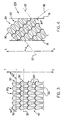
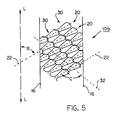
- Knit cover fabric strip 10 includes a plurality of wales 20 and courses 30, depicted schematically in Figure 1 and shown in greater detail in Figures 3-5.
- the side edges of the fabric strip 10 run parallel to reference lines 16 and along a bias with respect to the grain of the fabric.
- the angle of the bias is preferably chosen such that the wales 20 are disposed at an angle of from about 40° to about 70° with respect to the longitudinal axis L-L of fabric strip 10, and, more preferably, at an angle of about 55° with respect thereto.
- Longitudinal axis L-L is also preferably the longitudinal axis of the belt.
- any suitable knit formation may be utilized, single Jersey knit is preferred.
- the construction of fabric strip 10 will be further understood from the discussion below regarding the formation and treatment of the fabric.
- V-belts including cover fabric strip 10 as described herein provide many advantages over V-belts of the prior art, as discussed in more detail below.
- Of primary benefit is a substantial improvement in the durability of the V-belts which is attributable to the combination of knit fabric and bias-cut of the fabric.
- the bias angle of the opposing wales and courses changes, and the loops of the fabric strip of the present invention open and close, as the V-belt is extended and compressed. This allows for greater flex of the V-belt body both lengthwise and widthwise with less stress on the fibers of the fabric. By stretching as needed through a wider range of extensions, both lengthwise and widthwise, the fabric remains intact so that it continues to hold the shape of, and reinforce, the V-belt body.
- Cover fabric strip 10 may be formed as follows. First, with reference to Figure 2, knit fabric tube 12 is formed on a circular knit machine in conventional fashion. Circular knit fabrics having various type stitches, various yarn sizes, and various spun and filament fibers may be used. As noted above, a single Jersey knit is preferred.
- tube 12 includes a plurality of stitch loops 40 which form interconnected loop chains 42, which in turn form a plurality of generally parallel courses 30 and a plurality of parallel wales 20.
- each course 30 includes an axis 32 which extends substantially perpendicular to the longitudinal axis T-T of tube 12.
- Each wale 20 includes an axis 22 which extends substantially parallel to the longitudinal axis T-T of tube 12.
- axes 22 and 32 define an angle of about 90° therebetween.
- a strip 10a having width of about 65 to 70 inches is continuously cut from tube 12 by hand or suitable cutting apparatus along bias cut line C-C as shown in Figure 2.
- Cut line C-C is disposed at a prescribed angle with respect to the longitudinal axis T-T of the knit tube.
- the prescribed angle is preferably in the range of from about 30° to about 60°, and, more preferably, is about 45°.
- strip 10a has a longitudinal axis L-L.
- Reference lines 16 run parallel to the edges formed by the aforementioned cut line C-C and show the relationship between the side edges and the threads of the fabric.
- Wale axes 22 are disposed at an angle A with respect to axis L-L. It will be appreciated that angle A is the same size as the angle between line C-C and longitudinal axis T-T.
- the bias slit knit fabric 10a is impregnated to encapsulate the individual fibers with a solvated or aqueous oil-resistant elastomer such as NEOPRENETM, a polychloroprene product available from DuPont. This is preferably accomplished by immersing strip 10a in a fluid mix 202a in a conventional dip tank 202b or the like. Strip 10a is then passed through standard textile squeeze or pad rolls 202c for leveling and removing excess fluid mix.
- a solvated or aqueous oil-resistant elastomer such as NEOPRENETM, a polychloroprene product available from DuPont.
- the fabric is coated with a viscous oil-resistant compound, for example, NEOPRENETM polychloroprene available from DuPont.
- a rubber applicator may be used to coat.
- the fabric strip 10a is overfed onto a pin tenter at from about 10% to about 60% overfeed, and preferably at about 35% overfeed.
- the width is pulled out from about 10% to about 50%, and preferably at about 35%, to produce a stable fabric widthwise with low elongation.
- the preferred 35% overfeed and 35% width increase changes the angle of the courses off the wales from 90° to about 100° to 110° which increases the elongation in the machine direction to approximately 100% to 150% at break and reduces the elongation in the cross machine direction to approximately 30% to 60% at break.
- the resulting fabric strip 10b has a width of about 80 to 86 inches.
- Wale axes 22 are reoriented with respect to the longitudinal axis L-L so that axes 22 define an angle B with respect to axis L-L, angle B being greatcr than angle A.
- course axes 32 are reoriented with respect to wale axes 22 such that a new angle C is defined therebetween, angle C being from about 100° to about 110°.
- the preferred 35% overfeed and 35% width increase changes the bias angle by about 10° so that, if angle A is 45°, angle B is about 55°.
- bias slit fabric 10a can be overfed onto the tenter frame and the width pulled out with no impregnation or coating applied before pinning (i.e., step 203 is eliminated). Fabric 10a is instead coated between the tenter frame pins (i.e., during step 204) with a dual reverse roll coater or the equivalent using a low viscosity mix to achieve thorough mix penetration.
- step 205 fabric strip 10b is dried (not cured) and batched up with a release liner to prevent the coatings from sticking together. The fabric is thereafter cooled in step 206.
- strip 10b is cut into a strip 10 of suitable width for the intended purpose.
- Strip 10, in step 208, is wrapped about belt body 102 in conventional fashion ( Figure 1), albeit with the advantages in handling and performance as set forth below.
- the elongation in the cross machine direction allows the fabric to work in harmony or stretch and contract with belt body 102 as the belt goes around pulleys and back idlers, while still providing sufficient reinforcement to hold belt 100 in its V-shape.
- Elongation in the width direction can be controlled at levels at least as low as for woven, biased fabric.
- the high elongation and contraction of the bias-slit, knit fabric in the machine direction i.e., along axis L-L
- This high elongation in the length direction increases the belt life over belts covered with conventional fabric due to less stress placed on the cover fabric fibers as the belt goes over or around back idlers.
- Elongation in the length direction can be controlled to about 110% to 120% (i.e., at levels up to 100% higher than for woven, biased fabric).
- Another advantage from the high elongation and contraction in the length direction of the biased knit is the resulting low resistance to belt flex.
- the lower resistance to belt flex reduces heat build up which increases belt life.
- the V-belt cover according to the present invention provides further improvements over conventional cover fabrics.
- the appearance of the strip of bias-slit, knit fabric is consistent.
- the structural and operating characteristics of the fabric are consistent and continuous throughout its length. Splices as required every 50-60 inches on some conventional cover fabrics are not needed. As a result, a continuous length of fabric may be provided, allowing greater belt integrity and better appearance.
- less stress is placed on the yarns of the fabric because the knit stitch loops open and close along with the angle change as the associated V-belt flexes.
- the knit fabric does not have or require any added sizing (e.g., starch. PVA, etc.).
- sizing e.g., starch. PVA, etc.
- improved adhesion to rubber is achieved (on the order of 10% better adhesion).
- Aqueous adhesion promoters penetrate the fabric much better than for sized, woven fabric of the same yam.
- rubber penetration into the yarn bundles is much higher because of the absence of sizing. This increases the abrasion resistance of the fabric resulting in increased life.
- the absence of sizing also provides a softer cover fabric.
- the softer fabric flips around the associated V-belt core more easily, providing a tighter wrap.
- the lower resilience (near zero) of the fabric results in a reduced tendency to pull the overlap splice on the belt apart before it is cured, which allows the fabric to wrap satisfactorily with about one half the green tack needed for conventional woven, biased fabric.
- the tighter wrap also results in less compression of the fabric during cure in a mold and, hence, improved V-belt appearance. Further, there are substantially no blemishes in the knit fabric as compared to tubular, woven, biased fabric.
- the back of the bias-slit knit has a preferred appearance on the outside of a belt. However, either side of the knit fabric can be placed on the outside.
- Bias-slit, knit V-belt covers formed as described above provide substantially improved wear characteristics when compared with standard biased, woven fabrics, as demonstrated by the following examples.
- a tube was knitted using a single stitch Jersey knit at 18/19 wales/inch by 24/26 courses/inch to a greige weight of 6.5 oz./yd. 2 .
- This tube was bias slit at a 45° angle.
- the bias-slit fabric was impregnated with a 26% solids solvated neoprene rubber, coated with a high viscosity (50,000 cps) neoprene rubber, overfed 35% onto a pin frame, pulled the width out 35%, and then dried.
- the fabric was batched up with a .003 inch embossed polyethylene release liner to prevent the tacky rubber coating from sticking together.
- the coated fabric was then slit to tape widths of 1 9/16 inches wide.
- a tube was knitted using a single stitch Jersey knit at 20/24 wales/inch by 34/36 courses/inch to a greige weight of 5.8 oz./yd. 2 .
- This fabric was bias-slit at a 45° angle.
- the bias-slit fabric was impregnated with a 26% solids solvated neoprene rubber, coated with a high viscosity (50,000 cps) neoprene rubber, overfed 35% onto a pin frame, pulled the width out 35%, and then dried.
- the fabric was batched up with a .003 inch embossed polyethylene release liner to prevent the tacky rubber coating from sticking together.
- the coated fabric was then slit to tape widths of 1 9/16 inches wide.
Landscapes
- Engineering & Computer Science (AREA)
- Textile Engineering (AREA)
- General Engineering & Computer Science (AREA)
- Mechanical Engineering (AREA)
- Knitting Of Fabric (AREA)
- Treatments For Attaching Organic Compounds To Fibrous Goods (AREA)
Applications Claiming Priority (2)
| Application Number | Priority Date | Filing Date | Title |
|---|---|---|---|
| US529550 | 1995-09-18 | ||
| US08/529,550 US5616090A (en) | 1995-09-18 | 1995-09-18 | Bias cut, knit V-belt cover |
Publications (2)
| Publication Number | Publication Date |
|---|---|
| EP0763614A1 true EP0763614A1 (fr) | 1997-03-19 |
| EP0763614B1 EP0763614B1 (fr) | 2002-03-27 |
Family
ID=24110369
Family Applications (1)
| Application Number | Title | Priority Date | Filing Date |
|---|---|---|---|
| EP96306765A Expired - Lifetime EP0763614B1 (fr) | 1995-09-18 | 1996-09-18 | Tricot de recouvrement coupé en biais pour une courroie, tuyau ou similaire |
Country Status (3)
| Country | Link |
|---|---|
| US (1) | US5616090A (fr) |
| EP (1) | EP0763614B1 (fr) |
| DE (1) | DE69620086T2 (fr) |
Cited By (2)
| Publication number | Priority date | Publication date | Assignee | Title |
|---|---|---|---|---|
| WO2001034999A1 (fr) * | 1999-11-12 | 2001-05-17 | The Gates Corporation | Courroie de transmission de puissance comportant une gaine tubulaire tricotee |
| JP2015127590A (ja) * | 2013-11-29 | 2015-07-09 | 三ツ星ベルト株式会社 | 摩擦伝動ベルト及びその製造方法 |
Families Citing this family (5)
| Publication number | Priority date | Publication date | Assignee | Title |
|---|---|---|---|---|
| CN1230636C (zh) * | 1999-11-12 | 2005-12-07 | 盖茨公司 | 使用开口网格纺织材料的动力传送带 |
| US8607593B2 (en) * | 2009-02-27 | 2013-12-17 | Habasit Ag | Seamless knit belt |
| JP5727683B2 (ja) * | 2013-03-21 | 2015-06-03 | バンドー化学株式会社 | 摩擦伝動ベルト |
| DE102017219339A1 (de) * | 2017-10-27 | 2019-05-02 | Contitech Antriebssysteme Gmbh | Artikel mit mehrfach abwechselnd plattierter Textilauflage |
| ES2748214B2 (es) * | 2019-06-13 | 2022-02-01 | Gates Corp | Correa de transmision de potencia con superficie a franjas y una tela de recubrimiento a franjas. |
Citations (6)
| Publication number | Priority date | Publication date | Assignee | Title |
|---|---|---|---|---|
| US2239378A (en) * | 1938-07-09 | 1941-04-22 | Western Electric Co | Knitting machine |
| GB1107408A (en) * | 1964-03-31 | 1968-03-27 | Deering Milliken Res Corp | Improvements in the treatment of knitted fabrics |
| US3784427A (en) * | 1970-06-03 | 1974-01-08 | Burlington Industries Inc | Method of making and treating bias cut fabric |
| US3853017A (en) * | 1973-11-06 | 1974-12-10 | Dayco Corp | Endless power transmission belt |
| US3981206A (en) * | 1975-08-20 | 1976-09-21 | Dayco Corporation | Endless power transmission belt |
| US5520018A (en) * | 1995-02-10 | 1996-05-28 | The Goodyear Tire & Rubber Company | Machine for knitting a reinforcement pattern of yarn on a hose |
Family Cites Families (18)
| Publication number | Priority date | Publication date | Assignee | Title |
|---|---|---|---|---|
| US3724284A (en) * | 1971-05-17 | 1973-04-03 | Sveriges Forenade Trikafab Ab | V-belt and method of forming same |
| US3759112A (en) * | 1971-09-01 | 1973-09-18 | A Titarenko | V-belt |
| US4150581A (en) * | 1973-08-27 | 1979-04-24 | Walters Howard G | Belt for transport of materials and transmission of power |
| US4283455A (en) * | 1979-11-19 | 1981-08-11 | Burlington Industries, Inc. | Production of cover fabrics for V belts which function as wear indicators due to different layer characteristics |
| US4308896A (en) * | 1979-12-31 | 1982-01-05 | Burlington Industries, Inc. | Fabric reinforced hose |
| US4526637A (en) * | 1982-01-29 | 1985-07-02 | The Goodyear Tire & Rubber Company | Method of making conveyor belt |
| US4501771A (en) * | 1982-02-22 | 1985-02-26 | Dayco Corporation | Elastomer-coated bias reinforcement fabric and method for producing same |
| US4501791A (en) * | 1982-03-09 | 1985-02-26 | Burlington Industries, Inc. | Non-woven fabric for V-belt bead wrap and chafer |
| US4514179A (en) * | 1983-03-02 | 1985-04-30 | Uniroyal, Inc. | Power transmission belt with fabric cover |
| US4937925A (en) * | 1983-04-12 | 1990-07-03 | Highland Industries, Inc. | Method for producing reinforced V-belt containing fiber-loaded non-woven fabric |
| US4684569A (en) * | 1983-04-12 | 1987-08-04 | Burlington Industries, Inc. | Reinforced V-belt containing fiber-loaded non-woven fabric and method for producing same |
| JPS63246532A (ja) * | 1987-03-31 | 1988-10-13 | Bando Chem Ind Ltd | 伝動ベルト |
| US5068000A (en) * | 1990-02-27 | 1991-11-26 | West Point Pepperell, Inc. | Method of making a reinforcing fabric for power transmission belts, hoses and the like |
| JPH0712753Y2 (ja) * | 1990-09-21 | 1995-03-29 | 三ツ星ベルト株式会社 | 動力伝動用vベルト |
| JPH04151048A (ja) * | 1990-10-09 | 1992-05-25 | Mitsuboshi Belting Ltd | Vリブドベルトおよび同ベルトの製造方法 |
| JPH05272593A (ja) * | 1992-03-30 | 1993-10-19 | Bando Chem Ind Ltd | 工業用ベルト |
| DE4317652C2 (de) * | 1993-05-27 | 1995-04-27 | Schlatterer Gmbh & Co Kg Max | Endloses Flachband sowie Verfahren zu seiner Herstellung |
| US5536554A (en) * | 1994-09-19 | 1996-07-16 | Wellington Sears Company | Reinforcing fabric for power transmission belts |
-
1995
- 1995-09-18 US US08/529,550 patent/US5616090A/en not_active Expired - Lifetime
-
1996
- 1996-09-18 DE DE69620086T patent/DE69620086T2/de not_active Expired - Fee Related
- 1996-09-18 EP EP96306765A patent/EP0763614B1/fr not_active Expired - Lifetime
Patent Citations (6)
| Publication number | Priority date | Publication date | Assignee | Title |
|---|---|---|---|---|
| US2239378A (en) * | 1938-07-09 | 1941-04-22 | Western Electric Co | Knitting machine |
| GB1107408A (en) * | 1964-03-31 | 1968-03-27 | Deering Milliken Res Corp | Improvements in the treatment of knitted fabrics |
| US3784427A (en) * | 1970-06-03 | 1974-01-08 | Burlington Industries Inc | Method of making and treating bias cut fabric |
| US3853017A (en) * | 1973-11-06 | 1974-12-10 | Dayco Corp | Endless power transmission belt |
| US3981206A (en) * | 1975-08-20 | 1976-09-21 | Dayco Corporation | Endless power transmission belt |
| US5520018A (en) * | 1995-02-10 | 1996-05-28 | The Goodyear Tire & Rubber Company | Machine for knitting a reinforcement pattern of yarn on a hose |
Cited By (5)
| Publication number | Priority date | Publication date | Assignee | Title |
|---|---|---|---|---|
| WO2001034999A1 (fr) * | 1999-11-12 | 2001-05-17 | The Gates Corporation | Courroie de transmission de puissance comportant une gaine tubulaire tricotee |
| US6632151B1 (en) | 1999-11-12 | 2003-10-14 | The Gates Corporation | Power transmission belt with tubular knit overcord |
| US6945892B2 (en) | 1999-11-12 | 2005-09-20 | The Gates Corporation | Power transmission belt with tubular knit overcord |
| US7182826B2 (en) | 1999-11-12 | 2007-02-27 | The Gates Corporation | Power transmission belt with tubular knit overcord |
| JP2015127590A (ja) * | 2013-11-29 | 2015-07-09 | 三ツ星ベルト株式会社 | 摩擦伝動ベルト及びその製造方法 |
Also Published As
| Publication number | Publication date |
|---|---|
| DE69620086T2 (de) | 2002-10-31 |
| EP0763614B1 (fr) | 2002-03-27 |
| US5616090A (en) | 1997-04-01 |
| DE69620086D1 (de) | 2002-05-02 |
Similar Documents
| Publication | Publication Date | Title |
|---|---|---|
| AU758487C (en) | Power transmission belt using stabilized open mesh textile material in overcord for enhanced rubber penetration | |
| US11828349B2 (en) | Banded friction power transmission belt | |
| US20190177889A1 (en) | Method of weaving tubular fabric, the fabric, and a belt using the fabric | |
| JPH071054B2 (ja) | 歯付ベルト | |
| EP0763614B1 (fr) | Tricot de recouvrement coupé en biais pour une courroie, tuyau ou similaire | |
| EP0511667B1 (fr) | Courroie dentée | |
| US5858147A (en) | Method of making a reinforcing fabric for power transmission belts | |
| US2822856A (en) | Method and apparatus for manufacturing covered belts | |
| WO2002000531A1 (fr) | Bande de renforcement pour transporteurs a courroie et transporteurs a courroie utilisant cette bande | |
| US4741924A (en) | Method of making a polymeric coated fabric layer | |
| WO2005052083A1 (fr) | Bande adhesive et son renforcement | |
| JPH07180747A (ja) | 歯付ベルトの駆動装置 | |
| US6518207B1 (en) | Agricultural belting | |
| EP1098829B1 (fr) | Matériau pour courroie améliorée à usage agricole | |
| JPH08258932A (ja) | パイプコンベヤベルト | |
| EP1630451A2 (fr) | Courroie de transmission avec revètement extérieur en matériau textile stabilisé à mailles ouvertes pour une pénétration améliorée du caoutchouc | |
| US20200011456A1 (en) | Belt-shaped fabric for hose, and hose | |
| EP0328511A1 (fr) | Fabrication de tissu de recouvrement sans revêtement extérieur pour courroie trapézoidale | |
| JPS63242847A (ja) | 紙葉類搬送用無端ベルト | |
| JPH02152807A (ja) | コンベヤベルト | |
| JPH07190150A (ja) | 歯付ベルト |
Legal Events
| Date | Code | Title | Description |
|---|---|---|---|
| PUAI | Public reference made under article 153(3) epc to a published international application that has entered the european phase |
Free format text: ORIGINAL CODE: 0009012 |
|
| AK | Designated contracting states |
Kind code of ref document: A1 Designated state(s): CH DE FR GB IT LI |
|
| 17P | Request for examination filed |
Effective date: 19970912 |
|
| 17Q | First examination report despatched |
Effective date: 19991229 |
|
| APAB | Appeal dossier modified |
Free format text: ORIGINAL CODE: EPIDOS NOAPE |
|
| APAB | Appeal dossier modified |
Free format text: ORIGINAL CODE: EPIDOS NOAPE |
|
| GRAG | Despatch of communication of intention to grant |
Free format text: ORIGINAL CODE: EPIDOS AGRA |
|
| APBJ | Interlocutory revision of appeal recorded |
Free format text: ORIGINAL CODE: EPIDOS IRAPE |
|
| APAD | Appeal reference recorded |
Free format text: ORIGINAL CODE: EPIDOS REFNE |
|
| APAD | Appeal reference recorded |
Free format text: ORIGINAL CODE: EPIDOS REFNE |
|
| GRAG | Despatch of communication of intention to grant |
Free format text: ORIGINAL CODE: EPIDOS AGRA |
|
| GRAH | Despatch of communication of intention to grant a patent |
Free format text: ORIGINAL CODE: EPIDOS IGRA |
|
| APCB | Communication from the board of appeal sent |
Free format text: ORIGINAL CODE: EPIDOS OBAPE |
|
| GRAH | Despatch of communication of intention to grant a patent |
Free format text: ORIGINAL CODE: EPIDOS IGRA |
|
| APCB | Communication from the board of appeal sent |
Free format text: ORIGINAL CODE: EPIDOS OBAPE |
|
| REG | Reference to a national code |
Ref country code: GB Ref legal event code: IF02 |
|
| GRAA | (expected) grant |
Free format text: ORIGINAL CODE: 0009210 |
|
| AK | Designated contracting states |
Kind code of ref document: B1 Designated state(s): CH DE FR GB IT LI |
|
| REG | Reference to a national code |
Ref country code: CH Ref legal event code: EP |
|
| REF | Corresponds to: |
Ref document number: 69620086 Country of ref document: DE Date of ref document: 20020502 |
|
| ET | Fr: translation filed | ||
| REG | Reference to a national code |
Ref country code: CH Ref legal event code: NV Representative=s name: PATENTANWAELTE SCHAAD, BALASS, MENZL & PARTNER AG |
|
| PLBE | No opposition filed within time limit |
Free format text: ORIGINAL CODE: 0009261 |
|
| STAA | Information on the status of an ep patent application or granted ep patent |
Free format text: STATUS: NO OPPOSITION FILED WITHIN TIME LIMIT |
|
| 26N | No opposition filed |
Effective date: 20021230 |
|
| APAW | Appeal reference deleted |
Free format text: ORIGINAL CODE: EPIDOSDREFNO |
|
| APAY | Date of receipt of notice of appeal deleted |
Free format text: ORIGINAL CODE: EPIDOSDNOA2O |
|
| APBA | Date of receipt of statement of grounds of appeal deleted |
Free format text: ORIGINAL CODE: EPIDOSDNOA3O |
|
| APBM | Appeal reference recorded |
Free format text: ORIGINAL CODE: EPIDOSNREFNO |
|
| APBP | Date of receipt of notice of appeal recorded |
Free format text: ORIGINAL CODE: EPIDOSNNOA2O |
|
| APBQ | Date of receipt of statement of grounds of appeal recorded |
Free format text: ORIGINAL CODE: EPIDOSNNOA3O |
|
| APBU | Appeal procedure closed |
Free format text: ORIGINAL CODE: EPIDOSNNOA9O |
|
| APAH | Appeal reference modified |
Free format text: ORIGINAL CODE: EPIDOSCREFNO |
|
| PGFP | Annual fee paid to national office [announced via postgrant information from national office to epo] |
Ref country code: GB Payment date: 20060907 Year of fee payment: 11 |
|
| PGFP | Annual fee paid to national office [announced via postgrant information from national office to epo] |
Ref country code: FR Payment date: 20060922 Year of fee payment: 11 |
|
| PGFP | Annual fee paid to national office [announced via postgrant information from national office to epo] |
Ref country code: CH Payment date: 20060925 Year of fee payment: 11 |
|
| PGFP | Annual fee paid to national office [announced via postgrant information from national office to epo] |
Ref country code: IT Payment date: 20060930 Year of fee payment: 11 |
|
| PGFP | Annual fee paid to national office [announced via postgrant information from national office to epo] |
Ref country code: DE Payment date: 20070921 Year of fee payment: 12 |
|
| REG | Reference to a national code |
Ref country code: CH Ref legal event code: PL |
|
| GBPC | Gb: european patent ceased through non-payment of renewal fee |
Effective date: 20070918 |
|
| PG25 | Lapsed in a contracting state [announced via postgrant information from national office to epo] |
Ref country code: LI Free format text: LAPSE BECAUSE OF NON-PAYMENT OF DUE FEES Effective date: 20070930 Ref country code: CH Free format text: LAPSE BECAUSE OF NON-PAYMENT OF DUE FEES Effective date: 20070930 |
|
| REG | Reference to a national code |
Ref country code: FR Ref legal event code: ST Effective date: 20080531 |
|
| PG25 | Lapsed in a contracting state [announced via postgrant information from national office to epo] |
Ref country code: FR Free format text: LAPSE BECAUSE OF NON-PAYMENT OF DUE FEES Effective date: 20071001 |
|
| PG25 | Lapsed in a contracting state [announced via postgrant information from national office to epo] |
Ref country code: GB Free format text: LAPSE BECAUSE OF NON-PAYMENT OF DUE FEES Effective date: 20070918 |
|
| PG25 | Lapsed in a contracting state [announced via postgrant information from national office to epo] |
Ref country code: IT Free format text: LAPSE BECAUSE OF NON-PAYMENT OF DUE FEES Effective date: 20070918 Ref country code: DE Free format text: LAPSE BECAUSE OF NON-PAYMENT OF DUE FEES Effective date: 20090401 |