EP0764290B1 - Druckverfahren - Google Patents
Druckverfahren Download PDFInfo
- Publication number
- EP0764290B1 EP0764290B1 EP95919495A EP95919495A EP0764290B1 EP 0764290 B1 EP0764290 B1 EP 0764290B1 EP 95919495 A EP95919495 A EP 95919495A EP 95919495 A EP95919495 A EP 95919495A EP 0764290 B1 EP0764290 B1 EP 0764290B1
- Authority
- EP
- European Patent Office
- Prior art keywords
- dye
- formula
- group
- process according
- polymer precursor
- Prior art date
- Legal status (The legal status is an assumption and is not a legal conclusion. Google has not performed a legal analysis and makes no representation as to the accuracy of the status listed.)
- Expired - Lifetime
Links
- 0 Cc1c(*)c(*)n[n]1* Chemical compound Cc1c(*)c(*)n[n]1* 0.000 description 2
- NIRQSUHXBXQCSQ-UHFFFAOYSA-N C[N](C)(=CC=C1)=CC=C1OCCO Chemical compound C[N](C)(=CC=C1)=CC=C1OCCO NIRQSUHXBXQCSQ-UHFFFAOYSA-N 0.000 description 1
- PGZXQQILVKKFAU-UHFFFAOYSA-N Nc([nH]nc1-c2ccccc2)c1C#N Chemical compound Nc([nH]nc1-c2ccccc2)c1C#N PGZXQQILVKKFAU-UHFFFAOYSA-N 0.000 description 1
Classifications
-
- C—CHEMISTRY; METALLURGY
- C09—DYES; PAINTS; POLISHES; NATURAL RESINS; ADHESIVES; COMPOSITIONS NOT OTHERWISE PROVIDED FOR; APPLICATIONS OF MATERIALS NOT OTHERWISE PROVIDED FOR
- C09D—COATING COMPOSITIONS, e.g. PAINTS, VARNISHES OR LACQUERS; FILLING PASTES; CHEMICAL PAINT OR INK REMOVERS; INKS; CORRECTING FLUIDS; WOODSTAINS; PASTES OR SOLIDS FOR COLOURING OR PRINTING; USE OF MATERIALS THEREFOR
- C09D11/00—Inks
- C09D11/30—Inkjet printing inks
-
- B—PERFORMING OPERATIONS; TRANSPORTING
- B41—PRINTING; LINING MACHINES; TYPEWRITERS; STAMPS
- B41M—PRINTING, DUPLICATING, MARKING, OR COPYING PROCESSES; COLOUR PRINTING
- B41M3/00—Printing processes to produce particular kinds of printed work, e.g. patterns
- B41M3/003—Printing processes to produce particular kinds of printed work, e.g. patterns on optical devices, e.g. lens elements; for the production of optical devices
-
- C—CHEMISTRY; METALLURGY
- C03—GLASS; MINERAL OR SLAG WOOL
- C03C—CHEMICAL COMPOSITION OF GLASSES, GLAZES OR VITREOUS ENAMELS; SURFACE TREATMENT OF GLASS; SURFACE TREATMENT OF FIBRES OR FILAMENTS MADE FROM GLASS, MINERALS OR SLAGS; JOINING GLASS TO GLASS OR OTHER MATERIALS
- C03C17/00—Surface treatment of glass, not in the form of fibres or filaments, by coating
- C03C17/28—Surface treatment of glass, not in the form of fibres or filaments, by coating with organic material
- C03C17/32—Surface treatment of glass, not in the form of fibres or filaments, by coating with organic material with synthetic or natural resins
-
- C—CHEMISTRY; METALLURGY
- C08—ORGANIC MACROMOLECULAR COMPOUNDS; THEIR PREPARATION OR CHEMICAL WORKING-UP; COMPOSITIONS BASED THEREON
- C08F—MACROMOLECULAR COMPOUNDS OBTAINED BY REACTIONS ONLY INVOLVING CARBON-TO-CARBON UNSATURATED BONDS
- C08F8/00—Chemical modification by after-treatment
- C08F8/30—Introducing nitrogen atoms or nitrogen-containing groups
-
- C—CHEMISTRY; METALLURGY
- C09—DYES; PAINTS; POLISHES; NATURAL RESINS; ADHESIVES; COMPOSITIONS NOT OTHERWISE PROVIDED FOR; APPLICATIONS OF MATERIALS NOT OTHERWISE PROVIDED FOR
- C09B—ORGANIC DYES OR CLOSELY-RELATED COMPOUNDS FOR PRODUCING DYES, e.g. PIGMENTS; MORDANTS; LAKES
- C09B29/00—Monoazo dyes prepared by diazotising and coupling
- C09B29/0025—Monoazo dyes prepared by diazotising and coupling from diazotized amino heterocyclic compounds
- C09B29/0029—Monoazo dyes prepared by diazotising and coupling from diazotized amino heterocyclic compounds the heterocyclic ring containing only nitrogen as heteroatom
- C09B29/0037—Monoazo dyes prepared by diazotising and coupling from diazotized amino heterocyclic compounds the heterocyclic ring containing only nitrogen as heteroatom containing a five-membered heterocyclic ring with two nitrogen atoms
-
- C—CHEMISTRY; METALLURGY
- C09—DYES; PAINTS; POLISHES; NATURAL RESINS; ADHESIVES; COMPOSITIONS NOT OTHERWISE PROVIDED FOR; APPLICATIONS OF MATERIALS NOT OTHERWISE PROVIDED FOR
- C09B—ORGANIC DYES OR CLOSELY-RELATED COMPOUNDS FOR PRODUCING DYES, e.g. PIGMENTS; MORDANTS; LAKES
- C09B29/00—Monoazo dyes prepared by diazotising and coupling
- C09B29/34—Monoazo dyes prepared by diazotising and coupling from other coupling components
- C09B29/36—Monoazo dyes prepared by diazotising and coupling from other coupling components from heterocyclic compounds
- C09B29/3604—Monoazo dyes prepared by diazotising and coupling from other coupling components from heterocyclic compounds containing only a nitrogen as heteroatom
- C09B29/3647—Monoazo dyes prepared by diazotising and coupling from other coupling components from heterocyclic compounds containing only a nitrogen as heteroatom containing a five-membered ring with two nitrogen atoms as heteroatoms
- C09B29/3652—Monoazo dyes prepared by diazotising and coupling from other coupling components from heterocyclic compounds containing only a nitrogen as heteroatom containing a five-membered ring with two nitrogen atoms as heteroatoms containing a 1,2-diazoles or hydrogenated 1,2-diazoles
- C09B29/3656—Monoazo dyes prepared by diazotising and coupling from other coupling components from heterocyclic compounds containing only a nitrogen as heteroatom containing a five-membered ring with two nitrogen atoms as heteroatoms containing a 1,2-diazoles or hydrogenated 1,2-diazoles containing amino-1,2-diazoles
-
- G—PHYSICS
- G02—OPTICS
- G02B—OPTICAL ELEMENTS, SYSTEMS OR APPARATUS
- G02B5/00—Optical elements other than lenses
- G02B5/20—Filters
- G02B5/22—Absorbing filters
- G02B5/223—Absorbing filters containing organic substances, e.g. dyes, inks or pigments
Definitions
- This invention relates to processes for printing substrates, to a mixture of polymer precursor and dye, to a process for making optical filters, to optical filters and to novel dyes.
- the light-filtering substance comprises the result of the reaction of a binder polymer with a reactive dye.
- the reactive groups in the binder polymer are hydroxy or amino groups, while the reactive dye is of cellulose-reactive type, containing either a vinylsulphone group (or a precursor thereof), or an electrophilic reactive group (e.g. a chlorine atom attached to a triazine ring), or a mixture of these types.
- United States Patent 5,176,971 proposes a method of making a colour filter in which the filter picture elements (red, green and blue) are made of polyimide resin containing a dye.
- United States Patent 4,781,444 proposes a method of making a colour filter by electrodeposition of a coloured layer on a substrate.
- the coloured layer comprises a polymer having a dye chemically bonded to it.
- the dye used is a cellulose-reactive dye containing for example a vinyl sulphone group or an electrophilic reactive group (e.g. a chlorine atom attached to a triazine ring), as described above for European Patent Application 531,106.
- United States Patent 5,231,135 proposes a method of making a coloured polymer coating on a substrate, in which the coloured polymer is prepared by reaction of a colourant of formula R-[polymeric constituent-X] n wherein R is an organic dyestuff radical and X is a reactive moiety (e.g. -OH, -NH 2 , or -SH) with a linking agent (e.g. a polyisocyanate or a melamine-formaldehyde resin), which in turn reacts with a polymer having reactive groups and links the colourant with the polymer.
- a linking agent e.g. a polyisocyanate or a melamine-formaldehyde resin
- the colourant is reacted directly with the polymer, without a linking agent.
- the coloured polymers are said to be useful as coatings for automobiles.
- an optical filter comprising a coloured cross-linked polymeric coating on a transparent substrate; or a transparent, coloured cross-linked polymeric coating on a substrate; the process comprising applying to the substrate by a printing process a mixture comprising one or more cross-linkable polymer precursor(s) for the cross-linked polymer of the polymeric coating; and one or more dye(s) each capable of forming a covalent bond with group(s) of at least one of the polymeric precursor(s) via one or more heterocyclic NH group(s) in a heterocyclic part of the dye or via substituent groups each of which is attached to the dye either directly or via optionally substituted alkyl or aryl groups; where the substituents are selected from -OH; -NH 2 , -NHalkyl; -SH; -COOH, -COOalkyl; epoxy; -NHCOalkenyl; and -COalkenyl; and
- the mixtures of the polymer precursors and the specified dyes can be used to give coloured, transparent films and coatings on substrates in general, including substrates which are not transparent.
- heterocyclic NH group means an NH group in which the nitrogen atom forms part of a heterocyclic ring. In many dyes the heterocyclic NH group will itself be capable of forming a covalent bond with the polymer precursor.
- the cross-linkable polymer precursor may be any organic monomer, co-monomer, polymer or co-polymer and mixtures thereof having groups which are capable of reacting directly with the above-mentioned group(s) on the dye(s). Where mixtures of different polymer precursors are used at least one of the polymer precursors is required to be capable of reacting with the dye(s).
- polymer precursors include cross-linkable forms of the following: acrylates, methacrylates, acrylamides and methacrylamides which may be in (co)monomeric or (co)polymeric form as mentioned above; also: epoxides, esters, urethanes, isocyanates, alcohols, vinylalcohols, imides, amides, phenols, acetates, carbonates and their derivatives, amines, carboxylic acids and orthoformaldehyde condensates; also: polyvinylalcohol resins, melamine formaldehyde resin condensates, alkyd resins, epoxy resins, polyimides, polyamide resins, phenolic resins, polyester resins, polyvinylacetate, polycarbonate resins, urethane resins and their derivatives and copolymers.
- the polymer precursor is preferably selected from cross-linkable forms of acrylamides, epoxides, epoxy resins, acrylamide / epoxy resin systems, melamine formaldehyde resin condensates, polyesters, alkyd resins, hydroxylated or carboxylated acrylics, hydroxylated acrylic-melamine formaldehyde systems and especially from acrylamide/epoxy resin systems and hydroxylated acrylic-melamine formaldehydesystems.
- dye means a compound which absorbs radiation from part of the electromagnetic spectrum and includes compounds which are infra red (IR) or ultraviolet (UV) absorbers which may or may not be coloured and coloured compounds which absorb radiation in the visible part of the electromagnetic spectrum.
- IR infra red
- UV ultraviolet
- the dye may be referred to below as a polymer-reactive dye. It is preferably a dye with inherently high light-fastness.
- Dyes used in the process of the present invention are those which form covalent bonds with the polymeric precursors via a heterocyclic NH group in a heterocyclic part of the dye or via substituent groups each of which is attached to the dye either directly or via optionally substituted alkyl or aryl groups, where the substituents are selected from -OH; -NH 2 , -NHalkyl, -SH, -COOH, -COOalkyl; epoxy; -COalkenyl (such as -CO-vinyl) and -NHCOalkenyl (such as -NHCOvinyl).
- the -OH, -NHR and -SH groups are preferably attached to aliphatic carbon atoms (e.g.
- all the preferred dyes described herein also comprise either a heterocyclic NH group in a heterocyclic part of the dye or at least one of the substituents listed above.
- the dye may be selected from the monoazo, disazo, azomethine, quinophthalone, cyanine, pyrroline, maleimide, thiophenedioxide, anthraquinone, phthalocyanine, benzofuranone, benzodifuranone, triphenodioxazine, triphenazonaphthylamine, styryl, dithiene and pyrrole dye classes.
- Generally preferred dyes are those which have substituent groups which aid the solubility of the dye(s) in liquid media used in the process or which aid the solubility of the dye(s) in the polymer precursor(s).
- the heterocyclic group represented by A, D, E and G may be selected from thienyl, thiazolyl, isothiazolyl, pyrazolyl, benzopyrazolyl, imidazolyl, pyridyl, pyridonyl, thiadiazolyl, furanyl, pyrrolyl, pyridazyl, pyrimidyl, pyrazinyl, benzothiazolyl, benzoisothiazolyl, quinolinyl, isoquinolinyl, indolyl, pyridothiazolyl, pyridoisothiazolyl, triazolyl, dioxazolyl, oxazolyl, isooxazolyl, imidazolyl and carbazolyl.
- the carbocyclic group represented by A, D, E and G may be phenyl or naphthyl.
- A is preferably phenyl, pyrazolyl, triazolyl, pyrrolyl, indolyl or carbazolyl, more preferably phenyl or pyrazolyl.
- A is phenyl it is preferably of Formula (3):
- a preferred sub group of dyes are those of Formula (1) in which A is of Formula (3), in which:
- G is preferably phenyl or pyrazolyl more preferably a phenyl of Formula (5) or pyrazolyl of Formula (6).
- R, R 1 , R 2 , R 3 , R 5 , R 6 , R 9 , R 10 , R 11 , R 12 , R 13 , R 14 , R 18 or R 19 is or contains an alkyl or alkoxy group it is preferably a C 1-6 -alkyl or C 1-6 -alkoxy group.
- R 5 , R 6 , R 7 , R 8 , R 11 , R 18 or R 19 is or contains an aryl group it is preferably a phenyl or naphthyl group more preferably a phenyl group.
- R 6 , R 7 , R 8 , R 10 is or contains an alkenyl group it is preferably a C 2-6 -alkenyl more preferably vinyl or allyl.
- R 7 or R 8 contains an alkynyl group it is preferably C 2-6 -alkynyl.
- alkyl or alkoxy group or substituents containing alkyl or alkoxy groups represented by any one of R, R 1 to R 3 and R 5 to R 14 , R 16 , R 18 and R 19 may be straight or branched chain alkyl or alkoxy groups.
- substituents are preferably selected from -OR 18 , -NR 18 R 19 , -COOR 18 , -SO 2 R 18 , -COR 18 , -SO 2 NR 18 R 19 , -CONR 18 R 19 , -SR 18 , -NHCOR 18 , -NHSO 2 R 18 , -NHCOOR 18 , C 1-6 -alkyl and C 1-6 -alkoxy in which R 18 and R 19 are as hereinbefore defined.
- dyes are mono and disazo dyes, especially those having at least one heterocyclic component and particularly those where the heteroatom of the heterocyclic component can react with the polymer precursor to form a covalent bond.
- Such dyes have the advantage of being stronger, brighter colours with good light and heat fastness properties.
- Especially preferred dyes of Formula (1) are of Formula (8): in which:
- the dyes of Formula (8) form a further feature of the present invention.
- a specific example of a dye of Formula (8) is Dye 1 in which R 15 is -CN, R 16 is t-butyl and R 17 is phenyl.
- dyes of Formula (9) are Dye 2 in which R 6 is -H, R 7 is ethyl, R 8 is ethyl and R 15 is -CN and Dye 3 in which R 6 is -H, R 7 is ethyl, R 8 is 1-methylpropyl and R 15 is phenyl.
- a further preferred sub group of dyes are phthalocyanines of the type: MPc(X) n in which
- Preferred phthalocyanines are those having 4 X substituents. Particularly tetrasulphonamidophthalocyanines and especially those in which X is -SO 2 NH-R-Z or in which R is branched or straight chain alkyl, aryl or aralkyl each of which may be optionally substituted and Z is a group selected from alkyl OH, alkylNH 2 , alkylCO 2 H preferably alkylOH.
- the phthalocyanines are especially useful in coloured films, particularly those prepared by reaction of the phthalocyanine, a thermosetting acrylic polymer precursor and water, which have been applied to glass plates and cured. Such coloured films have excellent heat, light and solvent fastness properties.
- a preferred type of dye is a dye in which the substituent capable of forming a covalent bond with the polymer precursor is isolated from the chromophore, for example a dye having an alkylOH substituent. In this type of dye, reaction with the polymer precursor does not cause any appreciable change in colour.
- the dyes used in the present invention may be prepared by conventional means.
- the monoazo and disazo dyes may be formed by diazotisation of an amine and coupling.
- Phthalocyanines of Formula MPc(X) n may be conveniently prepared by published procedures. For example, heating copper phthalocyanine firstly with chlorosulphmic acid and then with phosphorus pentachloride forms copper phthalocyanine tetra(sulphonylchloride) which may be isolated from the reaction mixture by filtration. The copper phthalocyanine tetra(sulphonylchloride) may be further reacted with an amino compound in a liquid medium such as dioxan to produce a tetra(sulphonamide) derivative.
- a liquid medium such as dioxan
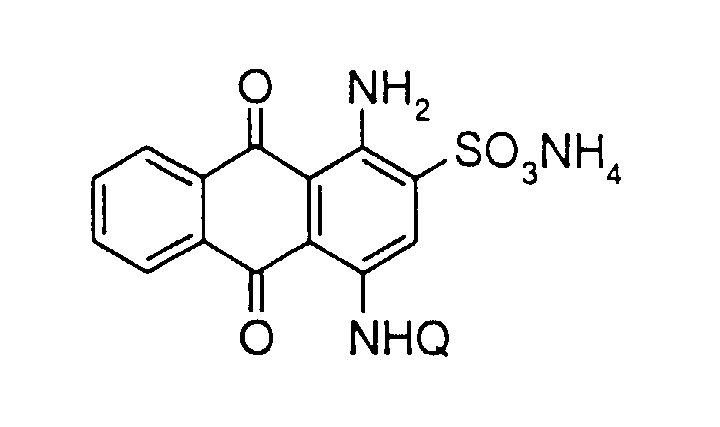
- Preferred anthraquinone dyes include compounds of the Formula (10): in which Q is a meta or para linked group of Formula:
- the cross-linked polymeric coating may be formed on a substrate to which the coating will bond, adhere, absorb or fuse.
- Suitable transparent substrates include glass; plastics films and plates such as those of polyvinylalcohol, polyester, polyvinylchloride, polyvinylfluoride, polycarbonate, polystyrene, polyamide or polyimide.
- a preferred substrate is glass.
- the substrates may be pre-treated to improve bonding, adhesion, absorption, fusion or spreading of the cross-linked polymeric coating on the substrate.
- Suitable pretreatments include plasma etching in which the substrate is placed in an oxygen atmosphere and subjected to an electrical discharge or application of an adhesion promoter such as a silane.
- the cross-linking of the polymer precursor(s) may be initiated thermally, chemically or photochemically.
- the reaction between the polymer precursor(s) and dye(s) may be initiated thermally, chemically or photochemically.
- the reaction between polymer precursor(s) and dye(s) may, where they are sufficiently reactive, be initiated simply by mixing the polymer precursor(s) and dye(s) each optionally in a liquid medium and allowing the mixture to air dry.
- the polymer precursor used in processes of the invention is one which is capable of cross-linking by itself when cured (e.g. melamine - formaldehyde resin condensate) no additional cross-linking agent need be added to the mixture of dye and polymer precursor.
- the polymer precursor is one which is not capable of extensive cross-linking by itself, it may be desirable to add a cross-linking agent to the mixture of dye and polymer precursor.
- a cross-linking agent to the mixture of dye and polymer precursor.
- an acrylamide-containing polymer is used as the polymer precursor
- an epoxide is added as a cross-linking agent.
- cross-linking agents is well known in the polymer art, and the choice of cross-linking agent will be readily made by one skilled in the art.
- the printing process or curing is preferably carried out at a temperature of from 80°C to 250°C, more preferably at from 100°C to 200°C and especially at from 110°C to 180°C.
- Chemical initiation may be achieved by addition of agents such as epoxides, amines, ammonia, acids, dicyandiamides and acid anhydrides.
- Photochemical initiation may be achieved by addition of initiators for example azides, ketones such as acetophenone or benzophenone, ketals such as benzyldimethyl ketal, peroxides such as benzoyl peroxide or aryl sulphonium salts such as diphenyl-(4-phenylthio)-phenyl sulphonium tetrafluorophosphate, followed by irradiation with UV or visible light.
- initiators for example azides, ketones such as acetophenone or benzophenone, ketals such as benzyldimethyl ketal, peroxides such as benzoyl peroxide or aryl sulphonium salts such as diphenyl-(4-phenylthio)-phenyl sulphonium tetrafluorophosphate, followed by irradiation with UV or visible light.
- Thermally initiated cross-linking and reaction is preferred since it has the advantage of simplicity (avoiding the need to add initiators, etc to the mixture) over chemical and photochemical initiation.
- the mixture of polymer precursor(s) and dye(s) used in the present process may further comprise one or more formulating agents and one or more liquid(s) may be added to the mixture to improve the solubility of dye in the polymer precursor(s) and vice versa, and to improve the flow and handling properties of the mixture.
- the liquid(s) may be aqueous or organic.
- the liquid is preferably water, an aromatic hydrocarbon such as toluene or xylene, a ketone such as cyclohexanone, 2-pyrrolidone, N-methylpyrrolidone, methyl ethyl ketone, an ester such as ethyl acetate or ethyl propionate, an alcohol such as methyl, ethanol or isopropanol, glycols such as ethylene glycol, diethyleneglycol, hexylene glycol, glycol ethers such as ethylene glycol monobutylether, ethers such as tetrahydrofuran or mixtures thereof. More preferably the liquid is a ketone such as methyl ethyl ketone or water, or mixtures thereof.
- the printed substrate may be dried by heating or by air drying at ambient temperature to evaporate the liquid before the coating is cured or during curing.
- the mixture of polymer precursor(s) and dye(s) may further comprise one or more pigments.
- pigments generally do not react with the polymer precursor(s) or the dye(s) and may be used in combination with the dye(s) for shading purposes.
- the dye(s) is not significantly coloured i.e. it is an IR or UV absorber as described above the pigment may be the sole colorant.
- the printing process may be any printing process such a flexographic, off-set lithographic, gravure, intaglio printing, ink-jet, dye diffusion thermal transfer and screen printing processes.
- the printing process is preferably ink-jet printing, especially thermal or piezoeletric ink-jet printing.
- ink jet printing is described in the literature for example in High Technology Applications of Organic Colorants, P. Gregory, Chapter 9 ISBN 0-306-43637-X.
- a formulation comprising a mixture comprising one or more polymer precursor(s) and one or more dye(s).
- the polymer precursor(s) and dye (s) are as hereinbefore defined.
- Optical filters are used in liquid crystal displays, for example in small television receivers.
- a process for preparing an optical filter according to the present invention may comprise the steps of:
- the discrete coloured filter regions of the optical filter composition may be formed in step (3) by forming a uniformly thick layer of the coloured varnish on the surface of the substrate and subsequently patterning the layer of the coloured varnish into discrete filter regions distributed in a desired pattern while optically setting the individual filter regions.
- the discrete coloured filter regions may be formed by applying the varnish in a desired pattern onto the surface of the substrate.
- the steps (1) to (4) are followed for each of the desired colours to form a multicolour optical filter structure so that the filter structure finally comprises the transparent substrate and a single layer of differently coloured filter elements arranged in triads or in any desired groups each consisting of a predetermined number of differently coloured filter elements.
- the process used for applying the polymer precursor / polymer-reactive dye mixture to the transparent substrate is ink jet printing, it is possible to achieve printing of all three primary colours (red, green and blue) simultaneously to form triads or any desired groupings of filter elements by using a printing head having appropriately designed outlets for the three coloured polymer precursor / polymer-reactive dye mixtures.
- Red filter elements prepared according to the invention are usually made by using a mixture of magenta and yellow dye.
- yellow dyes include those of Formula (8) above in which R 15 is cyano or cyanomethyl, R 16 is tert butyl, and R 17 is phenyl. These dyes are soluble in organic solvents. Examples of water-soluble yellow dyes include those of the following Formula: in which Y is Cl or SO 3 NH 4 .
- magenta dyes examples include compounds of Formula (9) above having the substituents shown in the following table : R 6 R 15 -NR 7 R 8 H Ph -N(Et) 2 H Ph -N(Et)(2-Bu) H NCCH 2 -N(Et)(2-Bu) and the compounds of the following Formula: These compounds are soluble in organic solvents. Me is methyl, Et is ethyl, Bu is butyl and Ph is phenyl.
- Green filter elements prepared according to the invention are usually made by using a mixture of cyan and yellow dyes.
- cyan dyes examples include phthalocyanine dyes having the following formulae : These dyes are water-soluble.
- Blue filter elements prepared according to the invention are usually made by using a single blue dye.
- blue dyes include the phthalocyanines shown above.
- an optical filter comprising red, green and blue filter elements, and comprising a coloured polymeric coating on a transparent substrate, in which at least one of the filter elements comprises a dye covalently bonded to the polymer of the polymeric coating as a result of reaction between a heterocyclic NH group in a heterocyclic part of the dye, or a substituent in the dye selected from -OH; -NHR; -SH; or COOR; epoxy; -COalkenyl; or -NHCOalkenyl, in which R is H or alkyl; and the polymer precursor used to form the polymeric coating.
- the red and the green elements of the colour filter will contain a dye covalently bonded to the polymer, while the blue element may contain an anthraquinone dye of the formula above which is not covalently bonded to the polymer.
- the polymer precursor(s) and dye(s) are as hereinbefore defined.
- a stock polymer precursor solution can be prepared by mixing the following components: 56.65% by weight SYNOCRYL 836S (a cross-linkable acrylamide-containing polymer available from Cray Valley Products), 8.0% EPIKOTE 1001 X75 (an epoxy available from Shell Chemicals) and 35.35% methyl ethyl ketone (MEK).
- SYNOCRYL 836S a cross-linkable acrylamide-containing polymer available from Cray Valley Products
- EPIKOTE 1001 X75 an epoxy available from Shell Chemicals
- MEK methyl ethyl ketone
- Ink samples can be made as follows: A mixture of the stock solution (0.31g), dyestuff (0.05g) and MEK (0.13g) is shaken in a small vial with glass beads until homogeneous.
- the resultant ink which contains 10% dyestuff and 25% solid resin can be coated onto a clean glass surface using a suitable wire-wound coating bar to give a wet film thickness of ca. 6mm, eg using a No. 1 K-bar as supplied by RK Print-Coat Instruments Ltd.
- the coating is dried for 30 minutes at ambient temperature before the resin is fully cured by heating at a temperature of 180°C for 30 minutes.
- the cured film is approximately 2mm in thickness and exhibits excellent transparency, adhesion and resistance to strong organic solvents. In addition, heat resistance is excellent (2 hours at 200°C; DE ab ⁇ 5) as is the photostability (200 hours at 67KLux; DE ab ⁇ 5).
- the stock polymer precursor is made up of the following constituents : Constituent Percentage by Weight CYMEL 327 (90% strength) 11 Distilled Water 18 2-Amino-2-methyl-1-propanol 0.5 2-Methyl-2,4-pentane diol 3 2- n -Butoxyethanol 2 SURFYNOL 104E 0.5 NEOCRYL XK69 (47.5% strength) 65 Notes CYMEL 327 is a melamine-formaldehyde condensate included as a cross-linking agent. The 2-amino-2-methyl-1-propanol is added as a base.
- SURFYNOL 104E is a surfactant comprising a hydroxyalkyl alkyne.
- NEOCRYL XK69 is a cross-linkable styryl-(meth)acrylate co-polymer. SYNOCRYL, EPIKOTE, CYMEL, SURFYNOL and NEOCRYL are registered trade marks.
Landscapes
- Chemical & Material Sciences (AREA)
- Organic Chemistry (AREA)
- Engineering & Computer Science (AREA)
- Life Sciences & Earth Sciences (AREA)
- Chemical Kinetics & Catalysis (AREA)
- General Chemical & Material Sciences (AREA)
- Physics & Mathematics (AREA)
- Materials Engineering (AREA)
- Manufacturing & Machinery (AREA)
- Medicinal Chemistry (AREA)
- Polymers & Plastics (AREA)
- Wood Science & Technology (AREA)
- Geochemistry & Mineralogy (AREA)
- General Physics & Mathematics (AREA)
- Optics & Photonics (AREA)
- Health & Medical Sciences (AREA)
- Compositions Of Macromolecular Compounds (AREA)
- Inks, Pencil-Leads, Or Crayons (AREA)
- Glass Compositions (AREA)
- Transition And Organic Metals Composition Catalysts For Addition Polymerization (AREA)
- Photoreceptors In Electrophotography (AREA)
- Printing Methods (AREA)
- Optical Filters (AREA)
- Acyclic And Carbocyclic Compounds In Medicinal Compositions (AREA)
- Polymers With Sulfur, Phosphorus Or Metals In The Main Chain (AREA)
Claims (15)
- Verfahren zur Herstellung:eines optischen Filters, umfassend eine gefärbte, vernetzte polymere Beschichtung auf einem transparenten Substrat; odereiner transparenten, gefärbten, vernetzten polymeren Beschichtung auf einem Substrat;wobei das Verfahren die Auftragung einer Mischung auf ein Substrat durch ein Druckverfahren umfaßt, wobei die Mischung umfaßt:ein oder mehr vernetzbare Polymervorstufen für das vernetzte Polymer der polymeren Beschichtung; undein oder mehr Farbstoffe, die jeweils eine kovalente Bindung mit einer Gruppe (Gruppen) wenigstens einer der polymeren Vorstufe(n) über ein oder mehr heterocyclische NH-Gruppe in einem heterocyclischen Teil des Farbstoffs oder über Substituentengruppen bilden können, die jeweils entweder direkt oder über gegebenenfalls substituierte Alkyl- oder Aryl-Gruppen an den Farbstoff gebunden sind; wobei die Substituenten ausgewählt sind aus -OH, -NH2, -NH-Alkyl; -SH; -COOH, -COO-Alkyl; Epoxy; -NHCO-Alkenyl; und -CO-Alkenyl; unddanach Aushärten der Mischung.
- Verfahren gemäß Anspruch 1, worin das Druckverfahren den Tintenstrahldruck umfaßt.
- Verfahren gemäß einem der vorhergehenden Ansprüche, worin das Substrat Glas ist.
- Verfahren gemäß einem der vorhergehenden Ansprüche, worin die Polymervorstufe(n) ausgewählt ist (sind) aus vernetzbaren Formen von: Acrylamiden, Epoxiden, Epoxidharzen, Acrylamid/Epoxidharz-Systemen, Malamin-Formaldehyd-Harzkondensaten, Polyestern, Alkydharzen, hydroxylierten oder carboxylierten Acrylharzen und hydroxylierten Acryl-Melamin-Formaldehyd-Systemen.
- Verfahren gemäß einem der vorhergehenden Ansprüche, worin die Polymervorstufe(n) ausgewählt ist (sind) aus vernetzbaren Formen von Acrylamid/Epoxidharz-Systemen und hydroxylierten Acryl-Melamin-Formaldehyd-Systemen.
- Verfahren gemäß einem der vorhergehenden Ansprüche, worin der Farbstoff ausgewählt ist aus den Monoazo-, Disazo-, Azomethin-, Chinophthalon-, Cyanin-, Pyrrolin-, Maleinimid-, Thiophendioxid-, Anthrachinon-, Phthalocyanin-, Benzofuranon-, Benzodifuranon-, Triphenodioxazin-, Triphenazonaphthylamin-, Styryl-, Dithien- und Pyrrol-Farbstoffklassen.
- Verfahren gemäß einem der vorhergehenden Ansprüche, worin der (die) Farbstoff(e) von Formel (1) ist (sind):A eine gegebenenfalls substituierte heterocyclische oder carbocyclische Gruppe ist; undD eine gegebenenfalls substituiert heterocyclische oder carbocyclische Gruppe oder eine Gruppe der Formel (2) ist:E und G jeweils unabhängig eine gegebenenfalls substituierte heterocyclische oder carbocyclische Gruppe sind.
- Verfahren gemäß einem der Ansprüche 1 bis 6, worin der (die) Farbstoff(e) von der Formel:M H, Si, Ge, Metall, Oxymetall, Hydroxymetall oder Halogenmetall ist;X eine Substituentengruppe oder ein Atom ist oder trägt, die jeweils eine kovalente Bindung mit Gruppen wenigstens einer Polymervorstufe bilden können;n 1 bis 16 ist; undPc ein Phthalocyaninkern ist.
- Verfahren gemäß einem der Ansprüche 1 bis 6, worin der Farbstoff die Formel:hat, worin Q eine meta- oder para-verknüpfte Gruppe der Formel:
 ist.
ist.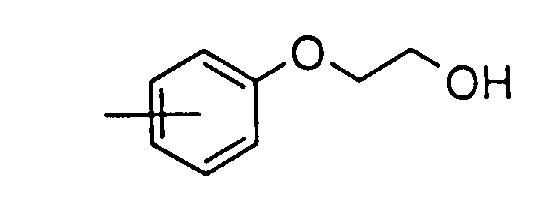
- Verfahren gemäß einem der Ansprüche 1 bis 6, worin der Farbstoff von Formel (8) ist:worin:
 R15 Phenyl, -CH2CN oder -CN ist;R16 C1-4-Alkyl ist; undR17 -H oder Phenyl ist.
 - Verfahren gemäß Anspruch 10, worin der Farbstoff umfaßt:
2-(4-Cyano-3-phenyl-1(H)-pyrazol-5-azo)-5-(N-sek-butyl-N-ethylamino)acetanilid. - Verfahren gemäß einem der vorhergehenden Ansprüche, worin die Mischung thermisch gehärtet wird.
- Zusammensetzung, umfassend ein oder mehr vernetzbare Polymer-Vorstufen und ein oder mehr Farbstoffe, worin:die Polymervorstufe(n) ausgewählt ist (sind) aus vernetztbaren Formen von: Acrylamiden, Epoxiden, Epoxidharzen, Acrylamid/Epoxidharz-Systemen, Melamin-Formaldehyd-Harzkondensaten, Polyestern, Alkydharzen, hydroxylierten oder carboxylierten Acrylharzen, hydroxylierten Acryl-Melamin-Formaldehyd-Systemen; undder (die) Farbstoff(e) ein oder mehr Substituenten hat (haben), die jeweils eine kovalente Bindung mit einer Gruppe (Gruppen) wenigstens einer der Polymervorstufen bilden können, und wobei jeder Substituent entweder direkt oder über gegebenenfalls substituierte Alkyl- oder Aryl-Gruppen an den Farbstoff gebunden ist; wobei die Substituenten ausgewählt sind aus: -OH; -NH2, -NH-Alkyl; -SH; COOH, -COO-Alkyl; Epoxy; -CO-Alkenyl und -NHCO-Alkenyl.
- Zusammensetzung gemäß Anspruch 13, die zusätzlich ein Verdünnungsmittel, umfassend Wasser oder eine organische Flüssigkeit oder eine Mischung davon, und gegebenenfalls ein Tensid umfaßt.
- Optischer Filter, umfassend rote, grüne und blaue Filterelemente, und umfassend eine gefärbte polymere Beschichtung auf einem transparenten Substrat, hergestellt nach einem Verfahren wie in einem der Ansprüche 1 bis 12 beansprucht.
Applications Claiming Priority (3)
| Application Number | Priority Date | Filing Date | Title |
|---|---|---|---|
| GB9411586A GB9411586D0 (en) | 1994-06-09 | 1994-06-09 | Coating process |
| GB9411586 | 1994-06-09 | ||
| PCT/GB1995/001122 WO1995034024A1 (en) | 1994-06-09 | 1995-05-18 | Printing process |
Publications (2)
| Publication Number | Publication Date |
|---|---|
| EP0764290A1 EP0764290A1 (de) | 1997-03-26 |
| EP0764290B1 true EP0764290B1 (de) | 1998-12-16 |
Family
ID=10756480
Family Applications (1)
| Application Number | Title | Priority Date | Filing Date |
|---|---|---|---|
| EP95919495A Expired - Lifetime EP0764290B1 (de) | 1994-06-09 | 1995-05-18 | Druckverfahren |
Country Status (12)
| Country | Link |
|---|---|
| US (2) | US5972544A (de) |
| EP (1) | EP0764290B1 (de) |
| JP (2) | JP3930901B2 (de) |
| KR (1) | KR970703548A (de) |
| AT (1) | ATE174693T1 (de) |
| AU (1) | AU699928B2 (de) |
| CA (1) | CA2188679A1 (de) |
| DE (1) | DE69506706T2 (de) |
| GB (1) | GB9411586D0 (de) |
| MY (1) | MY130545A (de) |
| TW (1) | TW412657B (de) |
| WO (1) | WO1995034024A1 (de) |
Families Citing this family (28)
| Publication number | Priority date | Publication date | Assignee | Title |
|---|---|---|---|---|
| AU4311797A (en) * | 1996-10-01 | 1998-04-24 | Zeneca Limited | Aqueous ink compositions |
| DE69718922D1 (de) * | 1996-10-01 | 2003-03-13 | Avecia Ltd | Wässrige tintenzusammensetzungen |
| KR20000048789A (ko) | 1996-10-01 | 2000-07-25 | 돈 리사 로얄 | 수성 잉크 조성물 |
| AP1062A (en) * | 1996-12-23 | 2002-04-25 | Deutsche Bank Ag | Chip card and process for the use of the chip card. |
| US6093455A (en) * | 1997-05-23 | 2000-07-25 | Deco Patents, Inc. | Method and compositions for decorating glass |
| GB9824818D0 (en) | 1998-11-12 | 1999-01-06 | Zeneca Ltd | Composition,process and use |
| US6323257B1 (en) * | 1999-04-23 | 2001-11-27 | Hewlett-Packard Company | Ink-jet ink compositions containing reactive macromolecular chromophores for digital and textile printing |
| WO2002012400A2 (en) | 2000-08-07 | 2002-02-14 | Eastman Chemical Company | Thermally stable, anthraquinone colorants containing copolymerizable vinyl groups |
| ATE338792T1 (de) | 2000-08-07 | 2006-09-15 | Eastman Chem Co | Thermisch stabile anthrachinonfarbstoffe mit copolymerisierbaren vinylgruppen |
| JP4530570B2 (ja) * | 2001-04-09 | 2010-08-25 | 富士フイルム株式会社 | 着色画像のオゾンガス堅牢性改良方法 |
| US20070032598A1 (en) * | 2001-07-24 | 2007-02-08 | Cyr Michael J | Thermally stable, anthraquinone colorants containing copolymerizable vinyl groups |
| US6841591B2 (en) * | 2002-01-28 | 2005-01-11 | Hewlett-Packard Development Company, L.P. | Encapsulated dye particle |
| US6858289B2 (en) * | 2002-02-08 | 2005-02-22 | The United States Of America As Represented By The Secretary Of The Navy | Optical filters comprising solar blind dyes and UV-transparent substrates |
| CN100390573C (zh) * | 2002-02-19 | 2008-05-28 | 佳能株式会社 | 光量调节装置、其制造方法以及摄影装置 |
| KR20040051320A (ko) * | 2002-12-12 | 2004-06-18 | 삼성에스디아이 주식회사 | 평판 디스플레이 장치 |
| US7514149B2 (en) * | 2003-04-04 | 2009-04-07 | Corning Incorporated | High-strength laminated sheet for optical applications |
| DE602004022192D1 (de) * | 2003-11-12 | 2009-09-03 | Vutek Inc | Strahlenhärtbare tintenzusammensetzungen und anwendungen dafür |
| US7316475B2 (en) * | 2004-11-10 | 2008-01-08 | Robert Wilson Cornell | Thermal printing of silver ink |
| US7125446B2 (en) * | 2004-11-19 | 2006-10-24 | Eastman Kodak Company | Yellow dyes for ink jet inks |
| CN101115803B (zh) | 2005-02-07 | 2012-12-12 | 富士胶片株式会社 | 色料、油墨、喷墨用油墨、喷墨记录方法、彩色墨粉及彩色滤色片 |
| JP2007203636A (ja) * | 2006-02-02 | 2007-08-16 | Fujifilm Corp | インクジェット記録用セット、及びインクジェット記録方法 |
| US20070215883A1 (en) * | 2006-03-20 | 2007-09-20 | Dixon Michael J | Electroluminescent Devices, Subassemblies for use in Making Electroluminescent Devices, and Dielectric Materials, Conductive Inks and Substrates Related Thereto |
| US7820323B1 (en) | 2006-09-07 | 2010-10-26 | The United States Of America As Represented By The Secretary Of The Army | Metal borate synthesis process |
| US7833660B1 (en) | 2006-09-07 | 2010-11-16 | The United States Of America As Represented By The Secretary Of The Army | Fluorohaloborate salts, synthesis and use thereof |
| US20100291723A1 (en) * | 2007-08-28 | 2010-11-18 | Agency For Science, Technology And Research | Method of manufacturing an organic electronic or optoelectronic device |
| WO2011078163A1 (ja) * | 2009-12-22 | 2011-06-30 | 大日精化工業株式会社 | 非対称型ポリアゾ色素、その製造方法、着色剤および着色方法 |
| JP2013185126A (ja) * | 2012-03-09 | 2013-09-19 | Mitsubishi Chemicals Corp | スチリル系、トリシアノビニル系化合物を含むインク |
| KR20130123486A (ko) * | 2012-05-03 | 2013-11-13 | 삼성디스플레이 주식회사 | 컬러필터 제조용 포토레지스트 조성물 및 표시 장치용 기판의 제조 방법 |
Family Cites Families (18)
| Publication number | Priority date | Publication date | Assignee | Title |
|---|---|---|---|---|
| US3499781A (en) * | 1964-09-02 | 1970-03-10 | Mc Donnell Douglas Corp | Process for producing multiple layer colored coating using actinic irradiation |
| DE1595364A1 (de) * | 1966-11-26 | 1970-04-23 | Basf Ag | Verfahren zur Herstellung von organischen Dispersionen farbiger vernetzbarer Copolymerisate |
| FR1570578A (de) * | 1968-03-29 | 1969-06-13 | ||
| US4132841A (en) * | 1974-08-02 | 1979-01-02 | Produits Chimiques Ugine Kuhlmann | Copolymers of dyes and acrylamide |
| US4171282A (en) * | 1977-12-07 | 1979-10-16 | Ciba-Geigy Corporation | Fluorinated nonionic surfactants |
| FR2442257A1 (fr) * | 1978-11-21 | 1980-06-20 | Ugine Kuhlmann | Composes structurellement colores reticulables, leur preparation et leur utilisation dans des compositions pour revetements |
| US4284729A (en) * | 1980-03-31 | 1981-08-18 | Milliken Research Corporation | Process for coloring thermosetting resins |
| JPS60192903A (ja) * | 1984-03-14 | 1985-10-01 | Canon Inc | カラ−フイルタ− |
| WO1985004679A1 (en) * | 1984-04-06 | 1985-10-24 | Barnes-Hind, Inc. | Tinting contact lenses |
| US5231135A (en) * | 1989-09-05 | 1993-07-27 | Milliken Research Corporation | Lightfast colored polymeric coatings and process for making same |
| JP2983242B2 (ja) * | 1990-03-09 | 1999-11-29 | 大日本印刷株式会社 | 化粧シート及びその製造方法 |
| US4997897A (en) * | 1990-04-03 | 1991-03-05 | Bausch & Lomb Incorporated | Polymerizable dye |
| US5144015A (en) * | 1990-12-21 | 1992-09-01 | Eastman Kodak Company | Synthesis of pyrazole dyes |
| JPH0527113A (ja) * | 1991-07-24 | 1993-02-05 | Konica Corp | カラーフイルターアレイ素子の製造方法 |
| US5250107A (en) * | 1991-07-31 | 1993-10-05 | Hewlett-Packard Company | Water-fast ink composition and method for making the same |
| JP3147423B2 (ja) * | 1991-09-05 | 2001-03-19 | インターナショナル・ビジネス・マシーンズ・コーポレ−ション | カラーフィルタ及びその製造方法 |
| JPH05224077A (ja) * | 1992-02-07 | 1993-09-03 | Sumitomo Electric Ind Ltd | 光結合装置 |
| JPH05224007A (ja) | 1992-02-13 | 1993-09-03 | Toray Ind Inc | カラ−フィルタ |
-
1994
- 1994-06-09 GB GB9411586A patent/GB9411586D0/en active Pending
-
1995
- 1995-05-18 US US08/750,347 patent/US5972544A/en not_active Expired - Fee Related
- 1995-05-18 CA CA002188679A patent/CA2188679A1/en not_active Abandoned
- 1995-05-18 JP JP50047696A patent/JP3930901B2/ja not_active Expired - Fee Related
- 1995-05-18 AT AT95919495T patent/ATE174693T1/de active
- 1995-05-18 AU AU25292/95A patent/AU699928B2/en not_active Ceased
- 1995-05-18 WO PCT/GB1995/001122 patent/WO1995034024A1/en not_active Ceased
- 1995-05-18 DE DE69506706T patent/DE69506706T2/de not_active Expired - Fee Related
- 1995-05-18 EP EP95919495A patent/EP0764290B1/de not_active Expired - Lifetime
- 1995-05-18 KR KR1019960706909A patent/KR970703548A/ko not_active Withdrawn
- 1995-05-23 TW TW084105126A patent/TW412657B/zh not_active IP Right Cessation
- 1995-06-07 MY MYPI95001499A patent/MY130545A/en unknown
-
1999
- 1999-08-02 US US09/366,218 patent/US6331204B1/en not_active Expired - Fee Related
-
2006
- 2006-12-07 JP JP2006330301A patent/JP2007056277A/ja active Pending
Also Published As
| Publication number | Publication date |
|---|---|
| CA2188679A1 (en) | 1995-12-14 |
| MY130545A (en) | 2007-06-29 |
| DE69506706T2 (de) | 1999-05-20 |
| ATE174693T1 (de) | 1999-01-15 |
| AU2529295A (en) | 1996-01-04 |
| DE69506706D1 (de) | 1999-01-28 |
| US6331204B1 (en) | 2001-12-18 |
| KR970703548A (ko) | 1997-07-03 |
| WO1995034024A1 (en) | 1995-12-14 |
| AU699928B2 (en) | 1998-12-17 |
| US5972544A (en) | 1999-10-26 |
| TW412657B (en) | 2000-11-21 |
| JP3930901B2 (ja) | 2007-06-13 |
| GB9411586D0 (en) | 1994-08-03 |
| JP2007056277A (ja) | 2007-03-08 |
| JPH10501074A (ja) | 1998-01-27 |
| EP0764290A1 (de) | 1997-03-26 |
Similar Documents
| Publication | Publication Date | Title |
|---|---|---|
| EP0764290B1 (de) | Druckverfahren | |
| US6165681A (en) | Black-pigmented structured high molecular weight material | |
| EP1386945B1 (de) | Anthrapyridonverbindung, wässrige magentafarbe und tintenstrahldruckverfahren | |
| JPS636058A (ja) | 有機顔料及びその製造方法 | |
| KR101009809B1 (ko) | 아조 화합물 | |
| US6040005A (en) | Colored polymers | |
| JPH02212566A (ja) | インクジエツト記録方法 | |
| JPS6031563A (ja) | トリシアノ系感熱転写記録用色素 | |
| JPS6031564A (ja) | トリシアノビニルキノリン系感熱転写記録用色素 | |
| JP3218739B2 (ja) | ピラゾールアゾ色素及び感熱転写シート | |
| JP5353038B2 (ja) | ピラゾロトリアゾール系アゾメチン誘導体およびそれを用いた感熱転写記録用色素 | |
| EP1188805B1 (de) | Tintenstrahltintezusammensetzung auf Farbstoffbasis mit verbesserter Stabilität und Lichtechtheit | |
| EP1066341B1 (de) | 1,3,4-thiadiazolylazofarbstoffe-enthaltende tintenzusammensetzungen | |
| JP2002192828A (ja) | インクジェット印刷方法 | |
| JP2002535433A (ja) | 化合物 | |
| JP3163799B2 (ja) | ピロールアゾ色素及び感熱転写シート | |
| JP3218738B2 (ja) | イミダゾールアゾ色素及び感熱転写シート | |
| JP5082284B2 (ja) | 銅キレート色素、着色組成物、着色微粒子分散物、それらを用いたインクジェット用インク、インクジェット記録方法、カラーフィルター | |
| JP3211421B2 (ja) | イソオキサゾールアゾ色素及び感熱転写シート | |
| EP1239318A2 (de) | Optische Bank | |
| HK1084144B (en) | Azo compounds |
Legal Events
| Date | Code | Title | Description |
|---|---|---|---|
| PUAI | Public reference made under article 153(3) epc to a published international application that has entered the european phase |
Free format text: ORIGINAL CODE: 0009012 |
|
| 17P | Request for examination filed |
Effective date: 19970109 |
|
| AK | Designated contracting states |
Kind code of ref document: A1 Designated state(s): AT BE CH DE DK ES FR GB IE IT LI LU NL PT SE |
|
| 17Q | First examination report despatched |
Effective date: 19970813 |
|
| GRAG | Despatch of communication of intention to grant |
Free format text: ORIGINAL CODE: EPIDOS AGRA |
|
| GRAG | Despatch of communication of intention to grant |
Free format text: ORIGINAL CODE: EPIDOS AGRA |
|
| GRAH | Despatch of communication of intention to grant a patent |
Free format text: ORIGINAL CODE: EPIDOS IGRA |
|
| GRAH | Despatch of communication of intention to grant a patent |
Free format text: ORIGINAL CODE: EPIDOS IGRA |
|
| GRAA | (expected) grant |
Free format text: ORIGINAL CODE: 0009210 |
|
| AK | Designated contracting states |
Kind code of ref document: B1 Designated state(s): AT BE CH DE DK ES FR GB IE IT LI LU NL PT SE |
|
| PG25 | Lapsed in a contracting state [announced via postgrant information from national office to epo] |
Ref country code: NL Free format text: LAPSE BECAUSE OF FAILURE TO SUBMIT A TRANSLATION OF THE DESCRIPTION OR TO PAY THE FEE WITHIN THE PRESCRIBED TIME-LIMIT Effective date: 19981216 Ref country code: LI Free format text: LAPSE BECAUSE OF FAILURE TO SUBMIT A TRANSLATION OF THE DESCRIPTION OR TO PAY THE FEE WITHIN THE PRESCRIBED TIME-LIMIT Effective date: 19981216 Ref country code: IT Free format text: LAPSE BECAUSE OF FAILURE TO SUBMIT A TRANSLATION OF THE DESCRIPTION OR TO PAY THE FEE WITHIN THE PRE;WARNING: LAPSES OF ITALIAN PATENTS WITH EFFECTIVE DATE BEFORE 2007 MAY HAVE OCCURRED AT ANY TIME BEFORE 2007. THE CORRECT EFFECTIVE DATE MAY BE DIFFERENT FROM THE ONE RECORDED.SCRIBED TIME-LIMIT Effective date: 19981216 Ref country code: ES Free format text: THE PATENT HAS BEEN ANNULLED BY A DECISION OF A NATIONAL AUTHORITY Effective date: 19981216 Ref country code: CH Free format text: LAPSE BECAUSE OF FAILURE TO SUBMIT A TRANSLATION OF THE DESCRIPTION OR TO PAY THE FEE WITHIN THE PRESCRIBED TIME-LIMIT Effective date: 19981216 Ref country code: BE Free format text: LAPSE BECAUSE OF FAILURE TO SUBMIT A TRANSLATION OF THE DESCRIPTION OR TO PAY THE FEE WITHIN THE PRESCRIBED TIME-LIMIT Effective date: 19981216 Ref country code: AT Free format text: LAPSE BECAUSE OF FAILURE TO SUBMIT A TRANSLATION OF THE DESCRIPTION OR TO PAY THE FEE WITHIN THE PRESCRIBED TIME-LIMIT Effective date: 19981216 |
|
| REF | Corresponds to: |
Ref document number: 174693 Country of ref document: AT Date of ref document: 19990115 Kind code of ref document: T |
|
| REG | Reference to a national code |
Ref country code: CH Ref legal event code: EP |
|
| REF | Corresponds to: |
Ref document number: 69506706 Country of ref document: DE Date of ref document: 19990128 |
|
| REG | Reference to a national code |
Ref country code: IE Ref legal event code: FG4D |
|
| PG25 | Lapsed in a contracting state [announced via postgrant information from national office to epo] |
Ref country code: SE Free format text: LAPSE BECAUSE OF FAILURE TO SUBMIT A TRANSLATION OF THE DESCRIPTION OR TO PAY THE FEE WITHIN THE PRESCRIBED TIME-LIMIT Effective date: 19990316 Ref country code: PT Free format text: LAPSE BECAUSE OF FAILURE TO SUBMIT A TRANSLATION OF THE DESCRIPTION OR TO PAY THE FEE WITHIN THE PRESCRIBED TIME-LIMIT Effective date: 19990316 Ref country code: DK Free format text: LAPSE BECAUSE OF FAILURE TO SUBMIT A TRANSLATION OF THE DESCRIPTION OR TO PAY THE FEE WITHIN THE PRESCRIBED TIME-LIMIT Effective date: 19990316 |
|
| ET | Fr: translation filed | ||
| PG25 | Lapsed in a contracting state [announced via postgrant information from national office to epo] |
Ref country code: LU Free format text: LAPSE BECAUSE OF NON-PAYMENT OF DUE FEES Effective date: 19990518 Ref country code: IE Free format text: LAPSE BECAUSE OF NON-PAYMENT OF DUE FEES Effective date: 19990518 |
|
| NLV1 | Nl: lapsed or annulled due to failure to fulfill the requirements of art. 29p and 29m of the patents act | ||
| REG | Reference to a national code |
Ref country code: CH Ref legal event code: PL |
|
| PLBE | No opposition filed within time limit |
Free format text: ORIGINAL CODE: 0009261 |
|
| STAA | Information on the status of an ep patent application or granted ep patent |
Free format text: STATUS: NO OPPOSITION FILED WITHIN TIME LIMIT |
|
| REG | Reference to a national code |
Ref country code: GB Ref legal event code: 732E |
|
| 26N | No opposition filed | ||
| REG | Reference to a national code |
Ref country code: GB Ref legal event code: IF02 |
|
| REG | Reference to a national code |
Ref country code: FR Ref legal event code: TP |
|
| REG | Reference to a national code |
Ref country code: GB Ref legal event code: 732E |
|
| REG | Reference to a national code |
Ref country code: FR Ref legal event code: TP |
|
| PGFP | Annual fee paid to national office [announced via postgrant information from national office to epo] |
Ref country code: DE Payment date: 20080522 Year of fee payment: 14 |
|
| PGFP | Annual fee paid to national office [announced via postgrant information from national office to epo] |
Ref country code: GB Payment date: 20090513 Year of fee payment: 15 |
|
| REG | Reference to a national code |
Ref country code: FR Ref legal event code: ST Effective date: 20100129 |
|
| PG25 | Lapsed in a contracting state [announced via postgrant information from national office to epo] |
Ref country code: FR Free format text: LAPSE BECAUSE OF NON-PAYMENT OF DUE FEES Effective date: 20090602 |
|
| PGFP | Annual fee paid to national office [announced via postgrant information from national office to epo] |
Ref country code: FR Payment date: 20080514 Year of fee payment: 14 |
|
| PG25 | Lapsed in a contracting state [announced via postgrant information from national office to epo] |
Ref country code: DE Free format text: LAPSE BECAUSE OF NON-PAYMENT OF DUE FEES Effective date: 20091201 |
|
| GBPC | Gb: european patent ceased through non-payment of renewal fee |
Effective date: 20100518 |
|
| PG25 | Lapsed in a contracting state [announced via postgrant information from national office to epo] |
Ref country code: GB Free format text: LAPSE BECAUSE OF NON-PAYMENT OF DUE FEES Effective date: 20100518 |