EP0765743A2 - Formbeständige, orientierungsfreie Verbundfolie und Verfahren zu ihrer Herstellung - Google Patents
Formbeständige, orientierungsfreie Verbundfolie und Verfahren zu ihrer Herstellung Download PDFInfo
- Publication number
- EP0765743A2 EP0765743A2 EP96112992A EP96112992A EP0765743A2 EP 0765743 A2 EP0765743 A2 EP 0765743A2 EP 96112992 A EP96112992 A EP 96112992A EP 96112992 A EP96112992 A EP 96112992A EP 0765743 A2 EP0765743 A2 EP 0765743A2
- Authority
- EP
- European Patent Office
- Prior art keywords
- film
- und
- dimensionally stable
- mit
- adhesive film
- Prior art date
- Legal status (The legal status is an assumption and is not a legal conclusion. Google has not performed a legal analysis and makes no representation as to the accuracy of the status listed.)
- Granted
Links
- 238000002360 preparation method Methods 0.000 title 1
- 239000002313 adhesive film Substances 0.000 claims abstract description 26
- 239000002131 composite material Substances 0.000 claims abstract description 24
- 229920001296 polysiloxane Polymers 0.000 claims abstract description 16
- 229920001577 copolymer Polymers 0.000 claims abstract description 14
- 239000006185 dispersion Substances 0.000 claims abstract description 9
- 238000000034 method Methods 0.000 claims abstract description 7
- PPBRXRYQALVLMV-UHFFFAOYSA-N Styrene Chemical compound C=CC1=CC=CC=C1 PPBRXRYQALVLMV-UHFFFAOYSA-N 0.000 claims description 8
- 239000007787 solid Substances 0.000 claims description 6
- NIXOWILDQLNWCW-UHFFFAOYSA-N 2-Propenoic acid Natural products OC(=O)C=C NIXOWILDQLNWCW-UHFFFAOYSA-N 0.000 claims description 4
- CQEYYJKEWSMYFG-UHFFFAOYSA-N butyl acrylate Chemical compound CCCCOC(=O)C=C CQEYYJKEWSMYFG-UHFFFAOYSA-N 0.000 claims description 4
- SMZOUWXMTYCWNB-UHFFFAOYSA-N 2-(2-methoxy-5-methylphenyl)ethanamine Chemical compound COC1=CC=C(C)C=C1CCN SMZOUWXMTYCWNB-UHFFFAOYSA-N 0.000 claims description 2
- CERQOIWHTDAKMF-UHFFFAOYSA-N Methacrylic acid Chemical compound CC(=C)C(O)=O CERQOIWHTDAKMF-UHFFFAOYSA-N 0.000 claims description 2
- 125000004432 carbon atom Chemical group C* 0.000 claims description 2
- KPUWHANPEXNPJT-UHFFFAOYSA-N disiloxane Chemical class [SiH3]O[SiH3] KPUWHANPEXNPJT-UHFFFAOYSA-N 0.000 claims description 2
- 238000001035 drying Methods 0.000 claims description 2
- 238000004519 manufacturing process Methods 0.000 abstract description 9
- 238000001125 extrusion Methods 0.000 abstract description 3
- 230000033458 reproduction Effects 0.000 abstract 1
- 238000007639 printing Methods 0.000 description 4
- QTBSBXVTEAMEQO-UHFFFAOYSA-N Acetic acid Chemical compound CC(O)=O QTBSBXVTEAMEQO-UHFFFAOYSA-N 0.000 description 3
- HEMHJVSKTPXQMS-UHFFFAOYSA-M Sodium hydroxide Chemical compound [OH-].[Na+] HEMHJVSKTPXQMS-UHFFFAOYSA-M 0.000 description 3
- 239000000976 ink Substances 0.000 description 3
- 239000004753 textile Substances 0.000 description 3
- NBIIXXVUZAFLBC-UHFFFAOYSA-N Phosphoric acid Chemical compound OP(O)(O)=O NBIIXXVUZAFLBC-UHFFFAOYSA-N 0.000 description 2
- 238000000071 blow moulding Methods 0.000 description 2
- 239000000463 material Substances 0.000 description 2
- 238000005406 washing Methods 0.000 description 2
- XLYOFNOQVPJJNP-UHFFFAOYSA-N water Substances O XLYOFNOQVPJJNP-UHFFFAOYSA-N 0.000 description 2
- 239000004908 Emulsion polymer Substances 0.000 description 1
- CDBYLPFSWZWCQE-UHFFFAOYSA-L Sodium Carbonate Chemical compound [Na+].[Na+].[O-]C([O-])=O CDBYLPFSWZWCQE-UHFFFAOYSA-L 0.000 description 1
- 229920002472 Starch Polymers 0.000 description 1
- 239000000853 adhesive Substances 0.000 description 1
- 230000001070 adhesive effect Effects 0.000 description 1
- 229910000147 aluminium phosphate Inorganic materials 0.000 description 1
- 150000001735 carboxylic acids Chemical class 0.000 description 1
- 238000004090 dissolution Methods 0.000 description 1
- 239000004744 fabric Substances 0.000 description 1
- 235000013305 food Nutrition 0.000 description 1
- 125000000524 functional group Chemical group 0.000 description 1
- 239000008187 granular material Substances 0.000 description 1
- 238000002372 labelling Methods 0.000 description 1
- 150000007522 mineralic acids Chemical class 0.000 description 1
- 239000000178 monomer Substances 0.000 description 1
- 238000007645 offset printing Methods 0.000 description 1
- 238000007649 pad printing Methods 0.000 description 1
- 235000019698 starch Nutrition 0.000 description 1
- 239000008107 starch Substances 0.000 description 1
- 239000012209 synthetic fiber Substances 0.000 description 1
- 229920002994 synthetic fiber Polymers 0.000 description 1
Images
Classifications
-
- B—PERFORMING OPERATIONS; TRANSPORTING
- B32—LAYERED PRODUCTS
- B32B—LAYERED PRODUCTS, i.e. PRODUCTS BUILT-UP OF STRATA OF FLAT OR NON-FLAT, e.g. CELLULAR OR HONEYCOMB, FORM
- B32B38/00—Ancillary operations in connection with laminating processes
- B32B38/10—Removing layers, or parts of layers, mechanically or chemically
-
- B—PERFORMING OPERATIONS; TRANSPORTING
- B32—LAYERED PRODUCTS
- B32B—LAYERED PRODUCTS, i.e. PRODUCTS BUILT-UP OF STRATA OF FLAT OR NON-FLAT, e.g. CELLULAR OR HONEYCOMB, FORM
- B32B37/00—Methods or apparatus for laminating, e.g. by curing or by ultrasonic bonding
- B32B37/14—Methods or apparatus for laminating, e.g. by curing or by ultrasonic bonding characterised by the properties of the layers
- B32B37/26—Methods or apparatus for laminating, e.g. by curing or by ultrasonic bonding characterised by the properties of the layers with at least one layer which influences the bonding during the lamination process, e.g. release layers or pressure equalising layers
Definitions
- the invention relates to a dimensionally stable, orientation-free composite film, which consists of a film provided with an adhesive film, is dissolvable, and a process for its production.
- Self-adhesive films are already known for various fields of application, in some cases reinforced or combined with paper or in the form of laminates. However, these known films are difficult to dissolve and the removal of the residues causes problems.
- EP-PS 0316676 also discloses an adhesive film for labels which can be redissolved in aqueous alkalis and which consists of acrylate copolymers. Although this film is completely dissolvable, it is not dimensionally stable and orientation-free due to its production. Films that are stretched at least in one direction and are therefore not universally applicable are produced from granules of acrylate copolymers by extrusion or blow molding. Furthermore, the manufacturing process described proves to be complex.
- the invention is based on the problem of developing a dimensionally stable and orientation-free film provided with an adhesive film which is easily dissolvable. Another problem of the invention is the development of a method for producing this film.
- the film consists of an acrylate copolymer of 20 to 30% by weight of butyl acrylate, 5 to 10% by weight of methacrylic acid, 3 to 5% by weight of one Acrylic acid alkyl esters from 6 carbon atoms with 2 to 7% by weight of termonomers such as styrene and / or siloxane, the molar masses being 80,000 to 300,000 and the film having a thickness of 10 to 300 ⁇ m, preferably 50 to 250 ⁇ m.
- the adhesive film consists of an acrylate copolymer of 30 to 50% by weight butyl acrylate and 5 to 10% by weight acrylic acid with 1 to 5% by weight termonomers such as styrene, the molar masses being 10,000 to 120,000 and the adhesive film a starch from 5 to 100 microns, preferably 20 to 50 microns.
- the residual moisture of the composite may not exceed 5%.
- an aqueous dispersion with a solids content of 40 to 60% of an acrylate copolymer for the film is first applied to a silicone paper by means of a doctor blade and dried with hot air; and an aqueous dispersion of an acrylate copolymer for the adhesive film is applied from a container to a silicone paper by means of a doctor blade and dried with hot air.
- the films and adhesive films applied to silicone papers are passed through a pair of rolls at 0.5 m / s and a tight bond of film and adhesive film is produced at a roller temperature of 25 to 50 ° C. and a pressure of 200 N / cm 2 .
- the composite film is then rolled up with silicone paper as an intermediate layer and the silicone paper of the adhesive film is fed for reuse.
- the dispersions for film and adhesive film are emulsion polymers, produced under customary, known conditions.
- the ratio of the termonomers and the selection of the special monomers which have functional groups make it possible to set special properties of the composite.
- the composite film is water-resistant and resistant to dilute carboxylic acids and highly diluted inorganic acids. It can be washed off or dissolved with industrial cleaners.
- the film can be printed with commercially available printing inks, for example in flexo printing, pad printing or offset printing. It is also suitable for labeling systems with water-dispersible paper, for temporary covering of varnished, tempered or polished surfaces and also for temporary covering of paper or textile materials where a dimensionally stable fixation is required.
- the composite film according to the invention can be used in a variety of ways and, due to its dimensional stability or freedom of orientation, is also suitable for prints in which exact, constant reproduction, for example for the use of the EAN code or similar codes, is required.
- the easy removability also enables use in reusable transport systems.
- the acrylate copolymers used also allow use in the food sector.
- the composite film according to the invention is compared to the known solutions comparatively easy and inexpensive to manufacture. Both advantages of known solutions are improved with the method according to the invention, but the disadvantages of the lack of dimensional stability and freedom of orientation which arise from extrusion or blow molding of the films are avoided.
- Table 1 Test conditions Status Length (cm) Width (cm) Thickness (mm) original Room temp. 10.0 10.0 0.035 Storage for 30 min in 25 ° C warm water wet 9.8 9.7 0.041 dry 9.9 9.8 0.037 Storage for 24 h at 50 ° C and 100% rel. Humidity warm 10.1 10.1 0.034 Room temp. 10.1 10.0 0.033 Storage in the freezer at -18 ° C for 24 h Room temp. 10.0 10.0 0.037
- a composite film according to the invention with a weight of 150 g / m 2 , a film thickness of 100 ⁇ m and an adhesive film of 50 ⁇ m was, without additional mechanical processing, dissolved with highly diluted alkalis and commercially available industrial cleaners.
- the dissolution rates are summarized in Table 2.
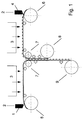
- An embodiment of the composite film according to the invention was produced as follows. An aqueous dispersion with a solids content of 50% of an acrylate copolymer for the film was applied from a container 1 to a commercial silicone paper coming from roll 5 using a doctor blade 2 in such a way that the thickness of the dry film was 100 ⁇ m. After application, the film is heated with hot air up to max. 150 ° C dried. Analogously to this, an aqueous dispersion for the adhesive film with a solids content of 55% is applied from a container 4 to a silicone paper coming from roll 6 in such a way that the thickness of the dry adhesive film was 50 ⁇ m and then dried. Instead of application with a doctor blade, other conventional application devices or metering devices can also be used.
- the films and adhesive films applied in each case to silicone paper were carried out at a speed of 0.5 m / s through a fixed heated pair of rollers with a flat surface, such that a pressure of 200 N / cm 2 produced a firm bond between the film and the adhesive film has been.
- the temperature of the rolls was 40 ° C.
- Conventional guide rollers indicated in the drawing were used to guide the applied films and the composite produced.
- a composite film produced according to Example 3 was covered with a screen template and printing ink was applied with a roller.
- the screen template was designed in such a way that a common bar coding was created in different widths and distances. After the printing ink had dried, the coding was checked for accurate reproduction and distortion, and the tests were repeated after 24 and 48 hours. As a result, no distortion and misleading playback errors were found.
- Example 3 With test strips of 20 x 30 cm one according to Example 3 The composite film produced was fixed on 15 x 25 cm textile materials on a wooden base and on a textile synthetic fiber fabric and stored at room temperature for 48 hours. The following tests showed perfect fixations.
- Example 2 On two test strips of a composite film according to the invention. Example 2 was allowed to act on 5% acetic acid and dilute phosphoric acid at room temperature for 30 minutes. No negative changes in the network could be identified.
Landscapes
- Engineering & Computer Science (AREA)
- Mechanical Engineering (AREA)
- Manufacture Of Macromolecular Shaped Articles (AREA)
- Laminated Bodies (AREA)
Abstract
- 2.1 Bekannte Verbundfolien, bestehend aus einer mit einem Klebstoffilm versehenen wiederauflösbaren Folie, werden durch Extrusion o.ä. hergestellt. Sie sind damit nicht formbeständig bzw. orientierungsfrei und nicht universell anwendbar. Weiterhin erweisen sich die Herstellungsverfahren als aufwendig. Aufgabe der Erfindung ist es eine formbeständige, orientierungsfreie mit einem Klebstoffilm versehene wiederauflösbare Verbundfolie und ein Verfahren zu ihrer Herstellung zu entwickeln.
- 2.2 Die Verbundfolie besteht aus einer Folie, mit 10 bis 300 µm Stärke, von Acrylat-Copolymerisaten mit Termonomeren und Molmassen von 80.000 bis 300.000 und einem Klebstoffilm, mit 5 bis 100 µm Stärke von Acrylat-Copolymerisaten mit Termonomeren. Zur Herstellung der Verbundfolie werden zunächst wässrige Dispersionen auf Siliconpapier aufgetragen und mit Heißluft getrocknet. Folie und Klebstoffilm werden durch ein Walzenpaar hindurchgeführt und ein fester Verbund erzeugt.
- 2.3 Die Verbundfolie ist vielseitig einsetzbar z.B. für genaue Druckwiedergaben und für temporäre Abdeckungen, bei denen eine formbeständige Fixierung erforderlich ist. Das Verfahren ermöglicht die formbeständige und orientierungsfreie Herstellung.
Description
- Die Erfindung betrifft eine formbeständige, orientierungsfreie Verbundfolie, die aus einer mit einem Klebstoffilm versehenen Folie besteht, auflösbar ist und ein Verfahren zu ihrer Herstellung.
- Bekannt sind bereits selbstklebende Folien für verschiedene Anwendungsgebiete, teilweise verstärkt bzw. kombiniert mit Papier oder in Form von Laminaten. Diese bekannten Folien lassen sich jedoch schwierig auflösen und die Beseitigung der Rückstände bereitet Probleme.
- Aus der EP-PS 0316676 ist weiterhin eine in wässrigen Alkalien wiederauflösbare Klebefolie für Etiketten bekannt, die aus Acrylat-Copolymeren bestehen. Diese Folie ist zwar vollständig auflösbar, aber auf Grund ihrer Herstellung nicht formbeständig und orientierungsfrei. Aus Granulaten von Acrylat-Copolymeren werden durch Extrusion oder Blasformen Folien hergestellt, die mindestens in einer Richtung gereckt und damit nicht universell anwendbar sind. Weiterhin erweist sich das beschriebene Herstellungsverfahren als aufwendig.
- Der Erfindung liegt das Problem zugrunde, eine formbeständige und orientierungsfreie mit Klebstoffilm versehene Folie zu entwickeln, die leicht auflösbar ist. Ein weiteres Problem der Erfindung ist die Entwicklung eines Verfahrens zur Herstellung dieser Folie.
- Gelöst wird das Problem durch die kennzeichnenden Merkmale der Ansprüche 1 und 2. Danach besteht die Folie aus einem Acrylat-Copolymerisat von 20 bis 30 Gew.- % Butylacrylat, 5 bis 10 Gew.- % Methacrylsäure, 3 bis 5 Gew.- % eines Acrylsäurealkylesters ab 6 C-Atomen mit 2 bis 7 Gew.- % Termonomeren wie Styrol und/oder Siloxan, wobei die Molmassen 80.000 bis 300.000 betragen und die Folie eine Stärke von 10 bis 300 µm, vorzugsweise 50 bis 250 µm aufweist. Der Klebstoffilm besteht aus einem Acrylat-Copolymerisat von 30 bis 50 Gew.- % Butylacrylat und 5 bis 10 Gew.- % Acrylsäure mit 1 bis 5 Gew.- % Termonomeren wie Styrol, wobei die Molmassen 10.000 bis 120.000 betragen und der Klebstoffilm eine Stärke von 5 bis 100 µm, vorzugsweise 20 bis 50 µm aufweist. Die Restfeuchte des Verbundes darf maximal 5 % betragen.
- Zur Herstellung der erfindungsgemäßen Verbundfolie wird zunächst aus einem Behälter eine wässrige Dispersion mit 40 bis 60 % Feststoffgehalt eines Acrylat-Copolymerisates für die Folie mittels eines Rakels auf ein Siliconpapier aufgetragen und mit Heißluft getrocknet; sowie aus einem Behälter eine wässrige Dispersion eines Acrylat-Copolymerisates für den Klebstoffilm mittels eines Rakels auf ein Siliconpapier aufgetragen und mit Heißluft getrocknet.
- In einem weiteren Verfahrensschritt werden die jeweils auf Siliconpapieren aufgetragenen Folien und Klebstoffilme mit 0,5 m/s durchein Walzenpaar hindurchgeführt und bei 25 bis 50 °C Walzentemperatur und einem Druck von 200 N/cm2 ein fester Verbund von Folie und Klebstoffilm erzeugt. Die Verbundfolie wird nachfolgend mit Siliconpapier, als Zwischenlage, aufgerollt und das Siliconpapier des Klebstoffilmes, einer Wiederverwendung zugeführt. Grundsätzlich ist es auch vorteilhafterweise möglich, für besondere Anwendungen die getrocknete Folie direkt mit der Klebstoffdispersion zu bestreichen und zu trocknen.
- Die Dispersionen für Folie und Klebstoffilm sind Emulsionspolymerisate, unter üblichen, bekannten Bedingungen hergestellt. Durch das Verhältnis der Termonomere bzw. die Auswahl der Spezialmonomere, die funktionelle Gruppen aufweisen, können spezielle Eigenschaften des Verbundes eingestellt werden.
- Die Verbundfolie ist wasserbeständig sowie beständig gegen verdünnte Carbonsäuren und stark verdünnte anorganische Säuren. Sie kann mit Industriereinigern abgewaschen bzw. aufgelöst werden.
Die Folie kann mit handelsüblichen Druckfarben z.B. im Flexodruck, Tampondruck oder Offsetdruck bedruckt werden. Sie ist auch geeignet für Etikettiersysteme mit wasserdispergierbarem Papier, für temporäre Abdeckungen von lackierten, bzw. vergütet oder polierten Oberflächen und auch für temporäre Abdeckungen von Papier- oder Textilmaterialien, bei denen eine formbeständige Fixierung erforderlich ist.
Die erfindungsgemäße Verbundfolie ist vielseitig einsetzbar und durch ihre Formbeständigkeit bzw. Orientierungsfreiheit auch für Drucke geeignet, bei denen eine exakte, gleichbleibende Wiedergabe, z.B. für die Anwendung des EAN-Code oder ähnlicher Codierungen, erforderlich ist.
Die einfache Wiederentfernbarkeit ermöglicht auch den Einsatz bei Mehrwegtransportsystemen. Die verwendeten Acrylat-Copolymerisate gestatten auch die Verwendung im Lebensmittelbereich.
Die erfindungsgemäße Verbundfolie ist gegenüber den bekannten Lösungen vergleichsweise einfach und kostengünstig herzustellen.
Mit dem erfindungsgemäßen Verfahren werden sowohl Vorteile bekannter Lösungen verbessert, wobei jedoch, die Nachteile der fehlenden Formbeständigkeit und Orientierungsfreiheit, welche durch Extrusion bzw. Blasformen der Folien entstehen, vermieden werden. - Die Erfindung wird im folgenden anhand von Ausführungsbeispielen im Zusammenhang mit der Zeichnung näher erläutert. Es zeigt:
- Figur 1
- - eine schematische Darstellung einer Ausführungsform des Herstellungsverfahrens
- Eine Testfolie mit den Abmessungen 10 x 10 cm wurde einer Prüfung auf Formbeständigkeit unter verschiedenen klimatischen Einflüssen unterworfen. Die Ergebnisse sind in Tabelle 1 zusammengefaßt.
Tabelle 1 Testbedingungen Zustand Länge (cm) Breite (cm) Dicke (mm) Original Raumtemp. 10,0 10,0 0,035 Lagerung über 30 min in 25°C warmen Wasser naß 9,8 9,7 0,041 trocken 9,9 9,8 0,037 Lagerung über 24 h bei 50°C und 100 % rel. Luftfeucht warm 10,1 10,1 0,034 Raumtemp. 10,1 10,0 0,033 Lagerung über 24 h bei -18°C im Gefrierschrank Raumtemp. 10,0 10,0 0,037 - Eine erfindungsgemäße Verbundfolie mit einem Gewicht von 150 g/m2, mit einer Foliendicke von 100 um und einem Klebstoffilm von 50 µm wurden, ohne zusätzliche mechanische Bearbeitung, mit stark verdünnten Alkalien und handelsüblichen Industriereinigern aufgelöst. Die Auflösungsgeschwindigkeiten sind in Tabelle 2 zusammengefaßt.
Tabelle 2 Reiniger pH-Wert Ergebnis bei 30°C Waschlös. Ergebnis bei 60°C Waschlös. Ergebnis bei 80°C Waschlös 1%ige Soda Lösung 10,5 nach 50 s alles gelöst nach 25 s alles gelöst nach 20 s alles gelöst 1%ige NaOH Lösung 12 nach 50 s alles gelöst nach 40 s alles gelöst nach 35 s alles gelöst 0,5%ige EW Pol 9110 Lösung 8-9,5 nach 60 s redispergiert nach 45 s redispergiert nach 10 s redispergiert 0,5%ige Silex 2005114 M Lösung 10-11 nach 60 s alles gelöst nach 20 s alles gelöst nach 10 s alles gelöst 0,5%ige P3-mip zentra Lösung 11 nach 70 s alles gelöst nach 20 s alles gelöst nach 10 s alles gelöst - Eine Ausführungsform der erfindungsgemäßen Verbundfolie wurde wie folgt hergestellt.
Auf ein von Rolle 5 kommendes handelsübliches Siliconpapier wurde aus einem Behälter 1 eine wässrige Dispersion mit 50 % Feststoffgehalt eines Acrylat-Copolymerisates für die Folie mittels eines Rakels 2 so aufgetragen, daß die Stärke der trockenen Folie 100 µm betrug.
Nach dem Auftragen wird die Folie in üblicher Weise mit Heißluft bis max. 150°C getrocknet. Analog dazu wird auf ein von Rolle 6 kommendes Siliconpapier eine wässrige Dispersion für den Klebstoffilm mit 55 % Feststoffgehalt aus einem Behälter 4 mittels eines Rakels so aufgetragen, daß die Stärke des trockenen Klebstoffilmes 50 µm betrug und anschließend getrocknet. Anstelle des Auftragens mit einem Rakel, können auch andere übliche Auftragsvorrichtungen oder Dosiereinrichtungen eingesetzt werden. Auch für die Trocknung können andere geeignete Wärmequellen verwendet werden. In einem weiteren Verfahrensschritt wurden die jeweils auf Siliconpapier aufgetragenen Folien und Klebstoffilme mit einer Geschwindigkeit von 0,5 m/s durch ein feststehendes beheiztes Walzenpaar mit planer Oberfläche durchgeführt, daß einem Druck von 200 N/cm2 ein fester Verbund von Folie und Klebstoffilm erzeugt wurde. Die Temperatur der Walzen betrug 40°C. Zur Führung der aufgetragenen Folien und des erzeugten Verbundes wurden in der Zeichnung angedeutete übliche Führungsrollen verwendet. Die so erzeugte Verbundfolie wurde, zusammen mit dem Siliconpapier der Folie als Zwischenlage, auf Rolle 9 aufgerollt, während das Siliconpapier des Klebstoffilmes auf Rolle 8 aufgerollt, einer Wiederverwendung zugeführt wird. - Eine nach Beispiel 3 hergestellte Verbundfolie wurde mit einer Siebschablone bedeckt, und mit einer Rolle wurde Druckfarbe aufgebracht. Die Siebschablone war so gestaltet, daß eine übliche Strichcodierung in verschiedenen Breiten und Abständen entstand.
Nach Trocknen der Druckfarbe wurde die Codierung hinsichtlich genauer Wiedergabe und Verzerrungen geprüft und die Prüfungen nach 24 h und 48 h wiederholt. Im Ergebnis wurden keine Verzerrungen und irreführenden Wiedergabefehler festgestellt. - Mit Teststreifen von 20 x 30 cm einer nach Beispiel 3 hergestellten Verbundfolie wurden Textilmaterialien von 15 x 25 cm auf eine Holzunterlage und auf ein textiles Kunstfasergewebe fixiert und bei Raumtemperatur 48 h gelagert. Die nachfolgenden Prüfungen ergaben einwandfreie Fixierungen.
- Auf zwei Teststreifen einer erfindungsgemäßen Verbundfolie gem. Beispiel 2 ließ man über 30 min bei Raumtemperatur jeweils 5%ige Essigsäure und verdünnte Phosphorsäure einwirken.
Es konnten keine negativen Veränderungen am Verbund festgestellt werden.
Claims (2)
- Formbeständige, orientierungsfreie Verbundfolie bestehend ausa) einer Folie eines Acrylat-Copolymerisates von 20 bis 30 Gew.-% Butylacrylat, 5 bis 10 Gew.-% Methacrylsäure, 3 bis 5 Gew.-% eines Acrylsäurealkylesters ab 6 C-Atomen mit 2 bis 7 Gew.-% Termonomeren wie Styrol und/oder Siloxan, wobei- die Molmassen 80.000 bis 300.000 betragen,- die Folie eine Stärke von 10 bis 300 µm, vorzugsweise 50 bis 250 µm aufweist;b) einem Klebstoffilm eines Acrylat-Copolymerisates von 30 bis 50 Gew.-% Butylacrylat und 5 bis 10 Gew.-% Acrylsäure mit 1 bis 5 Gew.-% Termonomer, wie Styrol, wobei- die Molmassen 10.000 bis 120.000 betragen,- der Klebstoffilm eine Stärke von 5 bis 100 µm, vorzugsweise 20 bis 50 µm aufweist;c) einer maximalen Restfeuchte des Verbundes von 5 %.
- Verfahren zur Herstellung einer formbeständigen, orientierungsfreien Verbundfolie, dadurch gekennzeichnet, daß mana) aus einem Behälter 1 eine wässrige Dispersion mit 40 bis 60 % Feststoffgehalt eines Acrylat-Copolymerisates für die Folie mittels eines Rakels 2 auf ein von Rolle 5 kommendes Siliconpapier aufträgt und mit Heißluft trocknet;b) aus einem Behälter 4 eine wässrige Dispersion mit 40 bis 60 % Feststoffgehalt eines Acrylat-Copolymerisates für den Klebstoffilm mittels eines Rakels 2 auf ein von Rolle 6 kommendes Siliconpapier aufträgt und mit Heißluft trocknet;c) die jeweils auf Siliconpapier aufgetragenen Folien und Klebstoffilme mit 0,5 m/s durch ein Walzenpaar 7 hindurchführt und bei 25 bis 50°C Walzentemperatur und einem Druck von 200 N/cm2 einen festen Verbund von Folie und Klebstoffilm erzeugt;d) die Verbundfolie mit den Siliconpapier, von Rolle 5 kommend, als Zwischenlage auf Rolle 9 aufrollt;e) das Siliconpapier, von Rolle 6 kommend, auf Rolle 8 aufrollt und einer Wiederverwendung zuführt.
Applications Claiming Priority (2)
| Application Number | Priority Date | Filing Date | Title |
|---|---|---|---|
| DE19536048A DE19536048A1 (de) | 1995-09-28 | 1995-09-28 | Formbeständige orientierungsfreie Verbundfolie und Verfahren zu ihrer Herstellung |
| DE19536048 | 1995-09-28 |
Publications (3)
| Publication Number | Publication Date |
|---|---|
| EP0765743A2 true EP0765743A2 (de) | 1997-04-02 |
| EP0765743A3 EP0765743A3 (de) | 1998-04-15 |
| EP0765743B1 EP0765743B1 (de) | 2003-05-02 |
Family
ID=7773392
Family Applications (1)
| Application Number | Title | Priority Date | Filing Date |
|---|---|---|---|
| EP96112992A Expired - Lifetime EP0765743B1 (de) | 1995-09-28 | 1996-08-13 | Leicht auflösbare Verbundfolie und Verfahren zu ihrer Herstellung |
Country Status (4)
| Country | Link |
|---|---|
| EP (1) | EP0765743B1 (de) |
| AT (1) | ATE239065T1 (de) |
| DE (2) | DE19536048A1 (de) |
| ES (1) | ES2196109T3 (de) |
Cited By (1)
| Publication number | Priority date | Publication date | Assignee | Title |
|---|---|---|---|---|
| EP2452991A1 (de) * | 2010-11-10 | 2012-05-16 | Nitto Denko Corporation | Isolierband |
Family Cites Families (9)
| Publication number | Priority date | Publication date | Assignee | Title |
|---|---|---|---|---|
| US3575910A (en) * | 1965-08-25 | 1971-04-20 | Dow Corning | Siloxane-acrylate copolymers and emulsions thereof |
| DE3335954A1 (de) * | 1983-10-04 | 1985-04-04 | Roland Dipl.-Kaufm. 7022 Leinfelden-Echterdingen Belz | Verfahren zur durchfuehrung von chemischen reaktionen, insbesondere zur herstellung von kunststoffen mit hilfe von extrudern und anlage hierzu |
| DE8702864U1 (de) * | 1987-02-20 | 1987-06-04 | Hans Neschen GmbH & Co KG i.K., 31675 Bückeburg | Selbstklebefolie in Blatt- oder Bahnform |
| DE3738786A1 (de) * | 1987-11-14 | 1989-05-24 | Belland Ag | Im waessrigem alkali aufloesbare klebefolie, wie etikett und dgl. |
| DE3809335A1 (de) * | 1988-03-19 | 1989-10-05 | Goettel Heinz Komet Druck | Gepaeckstreifenanhaenger und vorrichtung zur herstellung desselben |
| DE3818869A1 (de) * | 1988-06-03 | 1989-12-14 | Basf Ag | Dispersionen von nicht-tertiaeren butyl(meth)acrylat-copolymerisaten mit glastemperaturen unter -10(grad)c |
| MX169040B (es) * | 1988-07-07 | 1993-06-17 | Rohm & Haas | Copolimeros estables de emulsion acuosa con funcionalidad de siloxano |
| US6312777B1 (en) * | 1993-04-06 | 2001-11-06 | Decora Incorporated | Methods and composition for making a pressure sensitive adhesive coated laminate |
| KR960007660A (ko) * | 1994-08-12 | 1996-03-22 | 아크릴계 시트, 아크릴계 접착시트 및 이들의 제조방법 |
-
1995
- 1995-09-28 DE DE19536048A patent/DE19536048A1/de not_active Withdrawn
-
1996
- 1996-08-13 AT AT96112992T patent/ATE239065T1/de not_active IP Right Cessation
- 1996-08-13 ES ES96112992T patent/ES2196109T3/es not_active Expired - Lifetime
- 1996-08-13 EP EP96112992A patent/EP0765743B1/de not_active Expired - Lifetime
- 1996-08-13 DE DE59610397T patent/DE59610397D1/de not_active Expired - Fee Related
Cited By (1)
| Publication number | Priority date | Publication date | Assignee | Title |
|---|---|---|---|---|
| EP2452991A1 (de) * | 2010-11-10 | 2012-05-16 | Nitto Denko Corporation | Isolierband |
Also Published As
| Publication number | Publication date |
|---|---|
| EP0765743A3 (de) | 1998-04-15 |
| DE59610397D1 (de) | 2003-06-05 |
| EP0765743B1 (de) | 2003-05-02 |
| ATE239065T1 (de) | 2003-05-15 |
| DE19536048A1 (de) | 1997-04-03 |
| ES2196109T3 (es) | 2003-12-16 |
Similar Documents
| Publication | Publication Date | Title |
|---|---|---|
| EP0129674B1 (de) | Polyesterfolie mit Haftvermittlerschicht aus Copolyester | |
| DE19540277B4 (de) | Folie mit feinen Hohlräumen und Verfahren zu deren Herstellung | |
| DE69728653T2 (de) | Trennfolie | |
| DE69922630T2 (de) | Trennfolie | |
| DE69705285T2 (de) | Antistatische Rückseitenschicht für photographisches Papier | |
| DE2402120A1 (de) | Biaxial orientierter polyaethylenterephthalat-film mit einer zum schreiben geeigneten oberflaeche | |
| DE69716891T2 (de) | Verfahren zur Herstellung von synthetischem Papier aus biaxialorientiertem Polypropylen mit hohem Glanz und der Fähigkeit schnell zu trocknen beim Bedrucken | |
| DE60034901T2 (de) | Abdeckfilm für einen Trockenfilmresist | |
| DE69830237T2 (de) | Biaxial orientierte polyesterfolie für membranschalter | |
| DE69727793T2 (de) | Verbundmaterial aus Silikongummi und Polyesterharz | |
| DE4439031A1 (de) | Polymerbeschichtetes Mehrschichtmaterial und Verfahren zu seiner Herstellung | |
| DE69322270T2 (de) | Wässrige imprägnierzusammensetzung | |
| DE69321853T2 (de) | Imprägniertes papier als dekorative oberflächenschicht | |
| DE2604915C3 (de) | Verfahren zur Herstellung eines dem Druckbild entsprechende Poren oder Strukturen aufweisenden sogenannten Fertigeffektfilmes | |
| DE69407343T2 (de) | Verfahren zur Herstellung einer graphischen Abbildung auf Gegenständen hergestellt aus einem polyolefinen Polymer und Polypropylenmembran zur Durchführung dieses Verfahrens | |
| DE68924971T2 (de) | Höchst wärmeempfindlicher Mehrschichtfilm und Herstellungsverfahren für eine Schablone. | |
| EP0765743B1 (de) | Leicht auflösbare Verbundfolie und Verfahren zu ihrer Herstellung | |
| DE1560899A1 (de) | Zusammengesetztes verstaerktes Harz-Bahnen- bzw. Bogenmaterial | |
| DE3854317T2 (de) | Magnetische Karte. | |
| DE3315517C2 (de) | Transparentes Zwischenoriginalblatt | |
| DE69015469T2 (de) | Verfahren zur Herstellung einer Abdeckfolie für biegsame Leiterplatten. | |
| DE10119023A1 (de) | Mehrschichtige transparente biaxial orientierte Polywsterfolie, Verfahren zu ihrer Herstellung und ihre Verwendung | |
| DE4228436C2 (de) | Druckempfindlicher Polyacrylsäureesterhaftkleber und dessen Verwendung zur Herstellung von selbstklebenden, flächigen Substraten | |
| DE3851590T2 (de) | Mit einer Beschichtung versehener kleinzelliger Polyesterfilm. | |
| DE2602032C2 (de) |
Legal Events
| Date | Code | Title | Description |
|---|---|---|---|
| PUAI | Public reference made under article 153(3) epc to a published international application that has entered the european phase |
Free format text: ORIGINAL CODE: 0009012 |
|
| AK | Designated contracting states |
Kind code of ref document: A2 Designated state(s): AT BE CH DE ES FR GB IT LI NL SE |
|
| PUAL | Search report despatched |
Free format text: ORIGINAL CODE: 0009013 |
|
| AK | Designated contracting states |
Kind code of ref document: A3 Designated state(s): AT BE CH DE ES FR GB IT LI NL SE |
|
| RHK1 | Main classification (correction) |
Ipc: C09J 7/02 |
|
| 17P | Request for examination filed |
Effective date: 19980930 |
|
| 17Q | First examination report despatched |
Effective date: 19991215 |
|
| GRAG | Despatch of communication of intention to grant |
Free format text: ORIGINAL CODE: EPIDOS AGRA |
|
| RTI1 | Title (correction) |
Free format text: READILY SOLUBLE LAMINATED FILM AND PREPARATION PROCESS THEREFOR |
|
| GRAG | Despatch of communication of intention to grant |
Free format text: ORIGINAL CODE: EPIDOS AGRA |
|
| GRAG | Despatch of communication of intention to grant |
Free format text: ORIGINAL CODE: EPIDOS AGRA |
|
| GRAH | Despatch of communication of intention to grant a patent |
Free format text: ORIGINAL CODE: EPIDOS IGRA |
|
| RIN1 | Information on inventor provided before grant (corrected) |
Inventor name: SCHUMACHER, RAINER, DR. Inventor name: HUEFFTLEIN, KARLHEINZ Inventor name: HARDEWEG, HEIKE, Inventor name: HAUK, JUERGEN, DR. |
|
| RTI1 | Title (correction) |
Free format text: READILY SOLUBLE LAMINATED FILM AND PREPARATION PROCESS THEREFOR |
|
| GRAH | Despatch of communication of intention to grant a patent |
Free format text: ORIGINAL CODE: EPIDOS IGRA |
|
| GRAA | (expected) grant |
Free format text: ORIGINAL CODE: 0009210 |
|
| RIN1 | Information on inventor provided before grant (corrected) |
Inventor name: SCHUMACHER, RAINER, DR. Inventor name: HUEFFTLEIN, KARLHEINZ Inventor name: HARDEWEG, HEIKE, Inventor name: HAUK, JUERGEN, DR. |
|
| AK | Designated contracting states |
Designated state(s): AT BE CH DE ES FR GB IT LI NL SE |
|
| PG25 | Lapsed in a contracting state [announced via postgrant information from national office to epo] |
Ref country code: IT Free format text: LAPSE BECAUSE OF FAILURE TO SUBMIT A TRANSLATION OF THE DESCRIPTION OR TO PAY THE FEE WITHIN THE PRESCRIBED TIME-LIMIT;WARNING: LAPSES OF ITALIAN PATENTS WITH EFFECTIVE DATE BEFORE 2007 MAY HAVE OCCURRED AT ANY TIME BEFORE 2007. THE CORRECT EFFECTIVE DATE MAY BE DIFFERENT FROM THE ONE RECORDED. Effective date: 20030502 |
|
| REG | Reference to a national code |
Ref country code: GB Ref legal event code: FG4D Free format text: NOT ENGLISH |
|
| REG | Reference to a national code |
Ref country code: CH Ref legal event code: NV Representative=s name: ISLER & PEDRAZZINI AG Ref country code: CH Ref legal event code: EP |
|
| GBT | Gb: translation of ep patent filed (gb section 77(6)(a)/1977) |
Effective date: 20030502 |
|
| REF | Corresponds to: |
Ref document number: 59610397 Country of ref document: DE Date of ref document: 20030605 Kind code of ref document: P |
|
| REG | Reference to a national code |
Ref country code: SE Ref legal event code: TRGR |
|
| PG25 | Lapsed in a contracting state [announced via postgrant information from national office to epo] |
Ref country code: SE Free format text: LAPSE BECAUSE OF NON-PAYMENT OF DUE FEES Effective date: 20030814 |
|
| PG25 | Lapsed in a contracting state [announced via postgrant information from national office to epo] |
Ref country code: BE Free format text: LAPSE BECAUSE OF NON-PAYMENT OF DUE FEES Effective date: 20030831 |
|
| ET | Fr: translation filed | ||
| REG | Reference to a national code |
Ref country code: ES Ref legal event code: FG2A Ref document number: 2196109 Country of ref document: ES Kind code of ref document: T3 |
|
| BERE | Be: lapsed |
Owner name: *RMH POLYMERS G.M.B.H. & CO. K.G. Effective date: 20030831 |
|
| PG25 | Lapsed in a contracting state [announced via postgrant information from national office to epo] |
Ref country code: NL Free format text: LAPSE BECAUSE OF NON-PAYMENT OF DUE FEES Effective date: 20040301 |
|
| PLBE | No opposition filed within time limit |
Free format text: ORIGINAL CODE: 0009261 |
|
| STAA | Information on the status of an ep patent application or granted ep patent |
Free format text: STATUS: NO OPPOSITION FILED WITHIN TIME LIMIT |
|
| EUG | Se: european patent has lapsed | ||
| 26N | No opposition filed |
Effective date: 20040203 |
|
| NLV4 | Nl: lapsed or anulled due to non-payment of the annual fee |
Effective date: 20040301 |
|
| PGFP | Annual fee paid to national office [announced via postgrant information from national office to epo] |
Ref country code: DE Payment date: 20050225 Year of fee payment: 9 |
|
| PGFP | Annual fee paid to national office [announced via postgrant information from national office to epo] |
Ref country code: GB Payment date: 20050817 Year of fee payment: 10 |
|
| PGFP | Annual fee paid to national office [announced via postgrant information from national office to epo] |
Ref country code: FR Payment date: 20050829 Year of fee payment: 10 |
|
| PGFP | Annual fee paid to national office [announced via postgrant information from national office to epo] |
Ref country code: AT Payment date: 20050830 Year of fee payment: 10 |
|
| PGFP | Annual fee paid to national office [announced via postgrant information from national office to epo] |
Ref country code: ES Payment date: 20050902 Year of fee payment: 10 |
|
| PGFP | Annual fee paid to national office [announced via postgrant information from national office to epo] |
Ref country code: CH Payment date: 20050921 Year of fee payment: 10 |
|
| PG25 | Lapsed in a contracting state [announced via postgrant information from national office to epo] |
Ref country code: DE Free format text: LAPSE BECAUSE OF NON-PAYMENT OF DUE FEES Effective date: 20060301 |
|
| PG25 | Lapsed in a contracting state [announced via postgrant information from national office to epo] |
Ref country code: AT Free format text: LAPSE BECAUSE OF NON-PAYMENT OF DUE FEES Effective date: 20060813 |
|
| PG25 | Lapsed in a contracting state [announced via postgrant information from national office to epo] |
Ref country code: LI Free format text: LAPSE BECAUSE OF NON-PAYMENT OF DUE FEES Effective date: 20060831 Ref country code: CH Free format text: LAPSE BECAUSE OF NON-PAYMENT OF DUE FEES Effective date: 20060831 |
|
| REG | Reference to a national code |
Ref country code: CH Ref legal event code: PL |
|
| GBPC | Gb: european patent ceased through non-payment of renewal fee |
Effective date: 20060813 |
|
| REG | Reference to a national code |
Ref country code: FR Ref legal event code: ST Effective date: 20070430 |
|
| REG | Reference to a national code |
Ref country code: ES Ref legal event code: FD2A Effective date: 20060814 |
|
| PG25 | Lapsed in a contracting state [announced via postgrant information from national office to epo] |
Ref country code: GB Free format text: LAPSE BECAUSE OF NON-PAYMENT OF DUE FEES Effective date: 20060813 |
|
| PG25 | Lapsed in a contracting state [announced via postgrant information from national office to epo] |
Ref country code: ES Free format text: LAPSE BECAUSE OF NON-PAYMENT OF DUE FEES Effective date: 20060814 |
|
| PG25 | Lapsed in a contracting state [announced via postgrant information from national office to epo] |
Ref country code: FR Free format text: LAPSE BECAUSE OF NON-PAYMENT OF DUE FEES Effective date: 20060831 |