EP0765743B1 - Leicht auflösbare Verbundfolie und Verfahren zu ihrer Herstellung - Google Patents
Leicht auflösbare Verbundfolie und Verfahren zu ihrer Herstellung Download PDFInfo
- Publication number
- EP0765743B1 EP0765743B1 EP96112992A EP96112992A EP0765743B1 EP 0765743 B1 EP0765743 B1 EP 0765743B1 EP 96112992 A EP96112992 A EP 96112992A EP 96112992 A EP96112992 A EP 96112992A EP 0765743 B1 EP0765743 B1 EP 0765743B1
- Authority
- EP
- European Patent Office
- Prior art keywords
- per cent
- adhesive film
- reel
- acrylate
- film
- Prior art date
- Legal status (The legal status is an assumption and is not a legal conclusion. Google has not performed a legal analysis and makes no representation as to the accuracy of the status listed.)
- Expired - Lifetime
Links
- 238000002360 preparation method Methods 0.000 title description 3
- 239000002313 adhesive film Substances 0.000 claims abstract description 27
- PPBRXRYQALVLMV-UHFFFAOYSA-N Styrene Chemical compound C=CC1=CC=CC=C1 PPBRXRYQALVLMV-UHFFFAOYSA-N 0.000 claims abstract description 12
- 238000000034 method Methods 0.000 claims abstract description 8
- CQEYYJKEWSMYFG-UHFFFAOYSA-N butyl acrylate Chemical compound CCCCOC(=O)C=C CQEYYJKEWSMYFG-UHFFFAOYSA-N 0.000 claims abstract description 7
- NIXOWILDQLNWCW-UHFFFAOYSA-N 2-Propenoic acid Natural products OC(=O)C=C NIXOWILDQLNWCW-UHFFFAOYSA-N 0.000 claims abstract description 4
- CERQOIWHTDAKMF-UHFFFAOYSA-N Methacrylic acid Chemical compound CC(=C)C(O)=O CERQOIWHTDAKMF-UHFFFAOYSA-N 0.000 claims abstract description 4
- 125000004432 carbon atom Chemical group C* 0.000 claims abstract description 3
- KPUWHANPEXNPJT-UHFFFAOYSA-N disiloxane Chemical class [SiH3]O[SiH3] KPUWHANPEXNPJT-UHFFFAOYSA-N 0.000 claims abstract description 3
- 229920001296 polysiloxane Polymers 0.000 claims description 14
- 239000006185 dispersion Substances 0.000 claims description 11
- 239000007787 solid Substances 0.000 claims description 8
- 238000004519 manufacturing process Methods 0.000 claims description 5
- 239000000463 material Substances 0.000 claims description 4
- 239000011888 foil Substances 0.000 claims description 3
- 150000001875 compounds Chemical class 0.000 claims 6
- NIXOWILDQLNWCW-UHFFFAOYSA-M Acrylate Chemical compound [O-]C(=O)C=C NIXOWILDQLNWCW-UHFFFAOYSA-M 0.000 claims 4
- 239000002131 composite material Substances 0.000 abstract description 22
- 229920001577 copolymer Polymers 0.000 abstract description 10
- SMZOUWXMTYCWNB-UHFFFAOYSA-N 2-(2-methoxy-5-methylphenyl)ethanamine Chemical compound COC1=CC=C(C)C=C1CCN SMZOUWXMTYCWNB-UHFFFAOYSA-N 0.000 abstract description 2
- -1 acrylate ester Chemical class 0.000 abstract 1
- 238000007639 printing Methods 0.000 description 4
- QTBSBXVTEAMEQO-UHFFFAOYSA-N Acetic acid Chemical compound CC(O)=O QTBSBXVTEAMEQO-UHFFFAOYSA-N 0.000 description 3
- HEMHJVSKTPXQMS-UHFFFAOYSA-M Sodium hydroxide Chemical compound [OH-].[Na+] HEMHJVSKTPXQMS-UHFFFAOYSA-M 0.000 description 3
- 239000000976 ink Substances 0.000 description 3
- 238000003860 storage Methods 0.000 description 3
- 239000004753 textile Substances 0.000 description 3
- XLYOFNOQVPJJNP-UHFFFAOYSA-N water Substances O XLYOFNOQVPJJNP-UHFFFAOYSA-N 0.000 description 3
- NBIIXXVUZAFLBC-UHFFFAOYSA-N Phosphoric acid Chemical compound OP(O)(O)=O NBIIXXVUZAFLBC-UHFFFAOYSA-N 0.000 description 2
- 238000001125 extrusion Methods 0.000 description 2
- 238000005406 washing Methods 0.000 description 2
- 239000004908 Emulsion polymer Substances 0.000 description 1
- CDBYLPFSWZWCQE-UHFFFAOYSA-L Sodium Carbonate Chemical compound [Na+].[Na+].[O-]C([O-])=O CDBYLPFSWZWCQE-UHFFFAOYSA-L 0.000 description 1
- 239000002253 acid Substances 0.000 description 1
- 150000007513 acids Chemical class 0.000 description 1
- 229920006243 acrylic copolymer Polymers 0.000 description 1
- 239000000853 adhesive Substances 0.000 description 1
- 230000001070 adhesive effect Effects 0.000 description 1
- 229910000147 aluminium phosphate Inorganic materials 0.000 description 1
- 238000000071 blow moulding Methods 0.000 description 1
- 150000001735 carboxylic acids Chemical class 0.000 description 1
- 238000013329 compounding Methods 0.000 description 1
- 238000004090 dissolution Methods 0.000 description 1
- 238000001035 drying Methods 0.000 description 1
- 238000005516 engineering process Methods 0.000 description 1
- 239000004744 fabric Substances 0.000 description 1
- 125000000524 functional group Chemical group 0.000 description 1
- 239000008187 granular material Substances 0.000 description 1
- 238000002372 labelling Methods 0.000 description 1
- 239000000178 monomer Substances 0.000 description 1
- 238000007645 offset printing Methods 0.000 description 1
- 238000007649 pad printing Methods 0.000 description 1
- 239000000049 pigment Substances 0.000 description 1
- 239000012209 synthetic fiber Substances 0.000 description 1
- 229920002994 synthetic fiber Polymers 0.000 description 1
Images
Classifications
-
- B—PERFORMING OPERATIONS; TRANSPORTING
- B32—LAYERED PRODUCTS
- B32B—LAYERED PRODUCTS, i.e. PRODUCTS BUILT-UP OF STRATA OF FLAT OR NON-FLAT, e.g. CELLULAR OR HONEYCOMB, FORM
- B32B38/00—Ancillary operations in connection with laminating processes
- B32B38/10—Removing layers, or parts of layers, mechanically or chemically
-
- B—PERFORMING OPERATIONS; TRANSPORTING
- B32—LAYERED PRODUCTS
- B32B—LAYERED PRODUCTS, i.e. PRODUCTS BUILT-UP OF STRATA OF FLAT OR NON-FLAT, e.g. CELLULAR OR HONEYCOMB, FORM
- B32B37/00—Methods or apparatus for laminating, e.g. by curing or by ultrasonic bonding
- B32B37/14—Methods or apparatus for laminating, e.g. by curing or by ultrasonic bonding characterised by the properties of the layers
- B32B37/26—Methods or apparatus for laminating, e.g. by curing or by ultrasonic bonding characterised by the properties of the layers with at least one layer which influences the bonding during the lamination process, e.g. release layers or pressure equalising layers
Definitions
- the invention relates to an easily dissolvable composite film, which consists of a with an adhesive film provided carrier film, is resolvable and a process for their preparation.
- Self-adhesive films for various areas of application are already known, in some cases reinforced or combined with paper or in the form of laminates. These well-known However, foils are difficult to dissolve and remove their residues causes problems.
- EP-A-0 316 676 discloses an adhesive film which can be redissolved in aqueous alkalis according to the preamble of claim 1, i.e. a film with adhesive film for labels etc. known from acrylic copolymers consists.
- the starting products for such an adhesive film in the form of granules polymerized in special reaction extruders and then by compounding mixed with pigments and then extruded as a flat film. Through extrusion technology this adhesive film is stretched at least in one direction and is therefore not universally applicable.
- the average molar masses of this adhesive film are Max. 100,000.
- the invention is based on the problem of an easily dissolvable composite film to develop on a carrier film with adhesive film - which can be used on all sides. Another problem with the invention is the development of a method of manufacture such a composite film.
- the easily dissolvable composite film consists of a composite of a carrier film and an adhesive film. It is characterized in that the composite film is dimensionally stable and orientation-free.
- the preparation is based on aqueous acrylate copolymer dispersions with a solids content of 40 to 60% by weight.
- the carrier film consists of an acrylate copolymer of 20 to 30% by weight of butyl acrylate, 5 to 10% by weight of methacrylic acid, 3 to 5% by weight of an acrylic acid alkyl ester 6 carbon atoms and 2 to 7% by weight of styrene and / or siloxane, based on the dispersion.
- she has molar masses in the range of 80,000 to 300,000 and is in layers of 10 to 300 microns, preferably 50 to 250 microns generated.
- the adhesive film consists of an acylate copolymer made from 30 to 50% by weight of butyl acrylate, 5 to 10% by weight of acrylic acid and 1 to 5% by weight of styrene, based on the dispersion. It has molar masses in the range from 10,000 to 120,000 and is in layer thicknesses from 5 to 100 microns, preferably 20 to 50 microns applied.
- the composite film made from it has a maximum residual moisture of 5%.
- Adhesive film For the production of an easily dissolvable composite film from a carrier film with a Adhesive film according to claim 1 becomes an aqueous dispersion from a container with 40 to 60% solids content of an acrylate copolymer for the carrier film applied to a silicone paper with a squeegee and dried with hot air; such as an aqueous dispersion of an acrylate copolymer from a further container for the adhesive film with 40 to 60% solids content using a doctor blade applied to a silicone paper and dried with hot air.
- the films and adhesive films applied to silicone papers are passed through a pair of rollers at 0.5 m / s and a solid bond of film and adhesive film is produced at a roller temperature of 25 to 50 ° C. and a pressure of 200 N / cm 2 .
- the composite film is then reused with silicone paper as an intermediate layer.
- the dispersions for the carrier film and adhesive film are emulsion polymers, below usual, known conditions. By choosing special monomers, which have functional groups can have special properties of the composite can be set.
- the composite film is water-resistant and resistant to dilute carboxylic acids and strongly diluted acids. It can be washed off or dissolved with industrial cleaners.
- the composite film can be printed with commercially available printing inks, for example in flexographic printing, pad printing or offset printing. It is also suitable for labeling systems with water-dispersible paper, for temporary covering of varnished, tempered or polished surfaces and also for temporary covering of paper or textile materials, where a dimensionally stable fixation is required.
- the composite film according to the invention is versatile and due to its dimensional stability or freedom of orientation also suitable for prints where an exact, constant reproduction, e.g. for the application of the EAN code or similar Encodings, is required.
- the easy removability also enables that Use in returnable transport systems. Allow the acrylate copolymers used also the use in the food sector.
- the composite film according to the invention is comparatively simple and inexpensive to produce compared to the known solutions. Both advantages of known solutions are improved with the method according to the invention, but the disadvantages of the lack of dimensional stability and freedom of orientation, which result from extrusion or blow molding of the films, are avoided.
- test film with the dimensions 10 x 10 cm was subjected to a test for dimensional stability under various climatic influences.
- the results are summarized in Table 1.
- a composite film according to the invention with a weight of 150 g / m 2 , with a film thickness of 100 ⁇ m and an adhesive film of 50 ⁇ m was dissolved with highly diluted alkalis and commercially available industrial cleaners without additional mechanical processing.
- the dissolution rates are summarized in Table 2.
- cleanser PH value Result at 30 ° C washing solution.
- Result at 60 ° C wash solution.
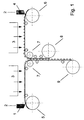
- An embodiment of the composite film according to the invention was produced as follows. An aqueous dispersion with a solids content of 50% of an acrylate copolymer for the film was applied from a container 1 to a commercial silicone paper coming from roll 5 using a doctor blade 2 so that the thickness of the dry film was 100 ⁇ m. After application, the film is heated with hot air up to max. 150 ° C dried. Analogously, an aqueous dispersion for the adhesive film with a solids content of 55% is applied from a container 4 to a silicone paper coming from roll 6 in such a way that the thickness of the dry adhesive film was 50 ⁇ m and then dried. Instead of application with a doctor blade, other conventional application devices or metering devices can also be used.
- the films and adhesive films applied in each case to silicone paper were carried out at a speed of 0.5 m / s through a fixed pair of heated rollers with a flat surface, such that a pressure of 200 N / cm 2 produced a firm bond of film and adhesive film has been.
- the temperature of the rolls was 40 ° C.
- Conventional guide rollers indicated in the drawing were used to guide the applied films and the composite produced.
- a composite film produced according to Example 3 was covered with a screen stencil and printing ink was applied with a roller.
- the screen template was designed in such a way that a common bar coding was created in different widths and distances. After the printing ink had dried, the coding was checked for accurate reproduction and distortion, and the tests were repeated after 24 h and 48 h. As a result, no distortion and misleading playback errors were found.
- test strips of 20 x 30 cm one according to example 3 manufactured composite film were textile materials of 15 x 25 cm on a wooden base and on a textile synthetic fiber fabric fixed and at room temperature Stored for 48 hours. The following tests showed flawless fixations.
- Example 2 On two test strips of a composite film according to the invention. Example 2 was allowed to act on 5% acetic acid and dilute phosphoric acid at room temperature for 30 minutes. No negative changes in the network could be identified.
Landscapes
- Engineering & Computer Science (AREA)
- Mechanical Engineering (AREA)
- Manufacture Of Macromolecular Shaped Articles (AREA)
- Laminated Bodies (AREA)
Description
Die leicht auflösbare Verbundfolie besteht aus einem Verbund aus einer Trägerfolie und einem Klebstofffilm. Sie ist dadurch gekennzeichnet, dass die Verbundfolie formbeständig und orientierungsfrei ist. Die Herstellung erfolgt ausgehend von wässrigen Acrylat-Copolymerdispersionen mit einem Feststoffgehalt von 40 bis 60 Gew-%.
Die Verbundfolie kann mit handelsüblichen Druckfarben z.B. im Flexodruck, Tampondruck oder Offsetdruck bedruckt werden. Sie ist auch geeignet für Etikettiersysteme mit wasserdispergierbarem Papier, für temporäre Abdeckungen von lackierten, bzw. vergüteten oder polierten Oberflächen und auch für temporäre Abdeckungen von Papieroder Textilmaterilien, bei denen eine formbeständige Fixierung erforderlich ist.
Mit dem erfindungsgemäßen Verfahren werden sowohl Vorteile bekannter Lösungen verbessert, wobei jedoch, die Nachteile der fehlenden Formbeständigkeit und Orientierungsfreiheit, welche durch Extrusion bzw. Blasformen der Folien entstehen, vermieden werden.
| Testbedingungen | Zustand | Länge (cm) | Breite (cm) | Dicke (mm) |
| Original | Raumtemp. | 10,0 | 10,0 | 0,035 |
| Lagerung über 30 min in 25°C warmen Wasser | naß | 9,8 | 9,7 | 0,041 |
| trocken | 9,9 | 9,8 | 0,037 | |
| Lagerung über 24 h bei 50°C und 100 % rel. Luftfeucht | warm | 10,1 | 10,1 | 0,034 |
| Raumtemp. | 10,1 | 10,0 | 0,033 | |
| Lagerung über 24 h bei -18°C im Gefrierschrank | Raumtemp. | 10,0 | 10,0 | 0,037 |
| Reiniger | pH-Wert | Ergebnis bei 30°C Waschlös. | Ergebnis bei 60°C Waschlös. | Ergebnis bei 80°C Waschlös |
| 1%ige Soda Lösung | 10,5 | nach 50 s alles gelöst | nach 25 s alles gelöst | nach 20 s alles gelöst |
| 1%ige NaOH Lösung | 12 | nach 50 s alles gelöst | nach 40 s alles gelöst | nach 35 s alles gelöst |
| 0,5%ige EW Pol 9110 Lösung | 8-9,5 | nach 60 s redispergiert | nach 45 s redispergiert | nach 10 s redispergiert |
| 0,5%ige Silex 2005114 M Lösung | 10-11 | nach 60 s alles gelöst | nach 20 s alles gelöst | nach 10 s alles gelöst |
| 0,5%ige P3-mip zentra Lösung | 11 | nach 70 s alles gelöst | nach 20 s alles gelöst | nach 10 s alles gelöst |
Auf ein von Rolle 5 kommendes handelsübliches Siliconpapier wurde aus einem Behälter 1 eine wässrige Dispersion mit 50 % Feststoffgehalt eines Acrylat-Copolymerisates für die Folie mittels eines Rakels 2 so aufgetragen, daß die Stärke der trockenen Folie 100 µm betrug.
Nach dem Auftragen wird die Folie in üblicher Weise mit Heißluft bis max. 150°C getrocknet. Analog dazu wird auf ein von Rolle 6 kommendes Siliconpapier eine wässrige Dispersion für den Klebstoffilm mit 55 % Feststoffgehalt aus einem Behälter 4 mittels eines Rakels so aufgetragen, daß die Stärke des trockenen Klebstoffilmes 50 µm betrug und anschließend getrocknet. Anstelle des Auftragens mit einem Rakel, können auch andere übliche Auftragsvorrichtungen oder Dosiereinrichtungen eingesetzt werden. Auch für die Trocknung können andere geeignete Wärmequellen verwendet werden. In einem weiteren Verfahrensschritt wurden die jeweils auf Siliconpapier aufgetragenen Folien und Klebstoffilme mit einer Geschwindigkeit von 0,5 m/s durch ein feststehendes beheiztes Walzenpaar mit planer Oberfläche durchgeführt, daß einem Druck von 200 N/cm2 ein fester Verbund von Folie und Klebstoffilm erzeugt wurde. Die Temperatur der Walzen betrug 40°C. Zur Führung der aufgetragenen Folien und des erzeugten Verbundes wurden in der Zeichnung angedeutete übliche Führungsrollen verwendet. Die so erzeugte Verbundfolie wurde, zusammen mit dem Siliconpapier der Folie als Zwischenlage, auf Rolle 9 aufgerollt, während das Siliconpapier des Klebstoffilmes auf Rolle 8 aufgerollt, einer Wiederverwendung zugeführt wird.
Nach Trocknen der Druckfarbe wurde die Codierung hinsichtlich genauer Wiedergabe und Verzerrungen geprüft und die Prüfungen nach 24 h und 48 h wiederholt. Im Ergebnis wurden keine Verzerrungen und irreführenden Wiedergabefehler festgestellt.
Es konnten keine negativen Veränderungen am Verbund festgestellt werden.
Claims (2)
- Leicht auflösbarer Verbund einer Folie mit einer Stärke von 10 bis 300 µm, vorzugsweise 50 bis 250 µm, aus einem Acrylat-Copolymerisat mit Molmassen von 80.000 bis 300.000 aus 20 bis 30 Gew.% Butylacrylat, 5 bis 10 Gew.% Methacrylsäure, 3 bis 5 Gew.% eines Acrylsäurealkylesters ab 6 C-Atomen und 2 bis 7 Gew.% Termonomeren, wie Styrol und/oder Siloxan, mit einem Klebstofffilm mit einer Stärke von 5 bis 100 µm, vorzugsweise 20 bis 50 µm, aus einem Acrylat-Copolymerisat mit Molmassen von 10.000 bis 120.000 aus 30 bis 50 Gew.% Butylacrylat, 5 bis 10 Gew.% Acrylsäure und aus 1 bis 5 Gew.% Termonomeren, wie Styrol, wobei die maximale Restfeuchte des Verbundes 5 % beträgt, dadurch gekennzeichnet, dass der Verbund orientierungsfrei und formbeständig ist.
- Verfahren zur Herstellung einer leicht auflösbaren Verbundfolie bestehend aus einer Trägerfolie und einem Klebstofffilm gemäß Patentanspruch 1 das folgende Merkmale aufweist,a) aus einem Behälter (1) wird eine wässrige Dispersion mit 40 bis 60 % Feststoffgehalt eines Acrylat-Copolymerisates für die Trägerfolie mittels eines Rakels (2) auf ein von Rolle (5) kommendes Siliconpapier aufgetragen und mit Heißluft getrocknet,b) aus einem Behälter (4) wird eine wässrige Dispersion mit 40 bis 60 % Feststoffgehalt eines Acrylat-Copolymerisates für den Klebstofffilm mittels eines Rakels (2) auf ein von Rolle (6) kommendes Siliconpapier aufgetragen und mit Heißluft getrocknet,c) die jeweils auf Siliconpapier aufgetragenen Trägerfolien und Klebstofffilme werden mit 0,5 m/s durch ein Walzenpaar (7) hindurchgeführt und bei 25 bis 50 °C Walzentemperatur und einem Druck von 200 N/cm2 ein fester Verbund von Trägerfolie und Klebstofffilm erzeugt;d) die Verbundfolie mit dem Siliconpapier wird, von Rolle (5) kommend, als Zwischenlage auf Rolle (9) aufgerollt unde) das Siliconpapier, von Rolle (6) kommend, wird auf Rolle (8) aufgerollt und einer Wiederverwendung zugeführt.
Applications Claiming Priority (2)
| Application Number | Priority Date | Filing Date | Title |
|---|---|---|---|
| DE19536048A DE19536048A1 (de) | 1995-09-28 | 1995-09-28 | Formbeständige orientierungsfreie Verbundfolie und Verfahren zu ihrer Herstellung |
| DE19536048 | 1995-09-28 |
Publications (3)
| Publication Number | Publication Date |
|---|---|
| EP0765743A2 EP0765743A2 (de) | 1997-04-02 |
| EP0765743A3 EP0765743A3 (de) | 1998-04-15 |
| EP0765743B1 true EP0765743B1 (de) | 2003-05-02 |
Family
ID=7773392
Family Applications (1)
| Application Number | Title | Priority Date | Filing Date |
|---|---|---|---|
| EP96112992A Expired - Lifetime EP0765743B1 (de) | 1995-09-28 | 1996-08-13 | Leicht auflösbare Verbundfolie und Verfahren zu ihrer Herstellung |
Country Status (4)
| Country | Link |
|---|---|
| EP (1) | EP0765743B1 (de) |
| AT (1) | ATE239065T1 (de) |
| DE (2) | DE19536048A1 (de) |
| ES (1) | ES2196109T3 (de) |
Families Citing this family (1)
| Publication number | Priority date | Publication date | Assignee | Title |
|---|---|---|---|---|
| JP5520785B2 (ja) * | 2010-11-10 | 2014-06-11 | 日東電工株式会社 | 絶縁テープ |
Family Cites Families (9)
| Publication number | Priority date | Publication date | Assignee | Title |
|---|---|---|---|---|
| US3575910A (en) * | 1965-08-25 | 1971-04-20 | Dow Corning | Siloxane-acrylate copolymers and emulsions thereof |
| DE3335954A1 (de) * | 1983-10-04 | 1985-04-04 | Roland Dipl.-Kaufm. 7022 Leinfelden-Echterdingen Belz | Verfahren zur durchfuehrung von chemischen reaktionen, insbesondere zur herstellung von kunststoffen mit hilfe von extrudern und anlage hierzu |
| DE8702864U1 (de) * | 1987-02-20 | 1987-06-04 | Hans Neschen GmbH & Co KG i.K., 31675 Bückeburg | Selbstklebefolie in Blatt- oder Bahnform |
| DE3738786A1 (de) * | 1987-11-14 | 1989-05-24 | Belland Ag | Im waessrigem alkali aufloesbare klebefolie, wie etikett und dgl. |
| DE3809335A1 (de) * | 1988-03-19 | 1989-10-05 | Goettel Heinz Komet Druck | Gepaeckstreifenanhaenger und vorrichtung zur herstellung desselben |
| DE3818869A1 (de) * | 1988-06-03 | 1989-12-14 | Basf Ag | Dispersionen von nicht-tertiaeren butyl(meth)acrylat-copolymerisaten mit glastemperaturen unter -10(grad)c |
| MX169040B (es) * | 1988-07-07 | 1993-06-17 | Rohm & Haas | Copolimeros estables de emulsion acuosa con funcionalidad de siloxano |
| US6312777B1 (en) * | 1993-04-06 | 2001-11-06 | Decora Incorporated | Methods and composition for making a pressure sensitive adhesive coated laminate |
| KR960007660A (ko) * | 1994-08-12 | 1996-03-22 | 아크릴계 시트, 아크릴계 접착시트 및 이들의 제조방법 |
-
1995
- 1995-09-28 DE DE19536048A patent/DE19536048A1/de not_active Withdrawn
-
1996
- 1996-08-13 AT AT96112992T patent/ATE239065T1/de not_active IP Right Cessation
- 1996-08-13 ES ES96112992T patent/ES2196109T3/es not_active Expired - Lifetime
- 1996-08-13 EP EP96112992A patent/EP0765743B1/de not_active Expired - Lifetime
- 1996-08-13 DE DE59610397T patent/DE59610397D1/de not_active Expired - Fee Related
Also Published As
| Publication number | Publication date |
|---|---|
| EP0765743A3 (de) | 1998-04-15 |
| DE59610397D1 (de) | 2003-06-05 |
| EP0765743A2 (de) | 1997-04-02 |
| ATE239065T1 (de) | 2003-05-15 |
| DE19536048A1 (de) | 1997-04-03 |
| ES2196109T3 (es) | 2003-12-16 |
Similar Documents
| Publication | Publication Date | Title |
|---|---|---|
| DE19540277B4 (de) | Folie mit feinen Hohlräumen und Verfahren zu deren Herstellung | |
| EP0129674B1 (de) | Polyesterfolie mit Haftvermittlerschicht aus Copolyester | |
| DE69822287T2 (de) | Phenolharzzusammensetzungen für faserverstärkte verbundwerkstoffe, prepreg und verfahren zur herstellung der fäserverstärkten verbundwerkstoffe | |
| DE69833875T2 (de) | Leicht haftbarer polyesterfilm | |
| DE69922630T2 (de) | Trennfolie | |
| DE69705285T2 (de) | Antistatische Rückseitenschicht für photographisches Papier | |
| DE2402120A1 (de) | Biaxial orientierter polyaethylenterephthalat-film mit einer zum schreiben geeigneten oberflaeche | |
| DE69816760T2 (de) | Trennfolie | |
| DE69621858T2 (de) | Folie mit verbessertem Haftvermögen und Verfahren zu ihrer Herstellung | |
| DE69716891T2 (de) | Verfahren zur Herstellung von synthetischem Papier aus biaxialorientiertem Polypropylen mit hohem Glanz und der Fähigkeit schnell zu trocknen beim Bedrucken | |
| DE69326863T2 (de) | Selbstklebende Etikettfolie | |
| JPS61144342A (ja) | 抗静電性塗膜をもつフイルム | |
| DE69321853T2 (de) | Imprägniertes papier als dekorative oberflächenschicht | |
| DE68929124T2 (de) | Bildempfangsschicht für thermische Übertragung | |
| DE2604915C3 (de) | Verfahren zur Herstellung eines dem Druckbild entsprechende Poren oder Strukturen aufweisenden sogenannten Fertigeffektfilmes | |
| DE69810216T2 (de) | Thermisch schrumpfbares Tintenstrahl-Aufzeichnungsmaterial | |
| DE69022319T2 (de) | Empfangsmaterial für die thermische Farbstoffübertragung. | |
| DE60116419T2 (de) | Schichtige, wärmeschrumpfbare Folien und Etiketten für Flaschen | |
| DE3315517C2 (de) | Transparentes Zwischenoriginalblatt | |
| DE10119023A1 (de) | Mehrschichtige transparente biaxial orientierte Polywsterfolie, Verfahren zu ihrer Herstellung und ihre Verwendung | |
| EP0765743A2 (de) | Formbeständige, orientierungsfreie Verbundfolie und Verfahren zu ihrer Herstellung | |
| DE4228436C2 (de) | Druckempfindlicher Polyacrylsäureesterhaftkleber und dessen Verwendung zur Herstellung von selbstklebenden, flächigen Substraten | |
| DE2704328C2 (de) | ||
| DE2602032C2 (de) | ||
| DE69110979T2 (de) | Polymerfilm. |
Legal Events
| Date | Code | Title | Description |
|---|---|---|---|
| PUAI | Public reference made under article 153(3) epc to a published international application that has entered the european phase |
Free format text: ORIGINAL CODE: 0009012 |
|
| AK | Designated contracting states |
Kind code of ref document: A2 Designated state(s): AT BE CH DE ES FR GB IT LI NL SE |
|
| PUAL | Search report despatched |
Free format text: ORIGINAL CODE: 0009013 |
|
| AK | Designated contracting states |
Kind code of ref document: A3 Designated state(s): AT BE CH DE ES FR GB IT LI NL SE |
|
| RHK1 | Main classification (correction) |
Ipc: C09J 7/02 |
|
| 17P | Request for examination filed |
Effective date: 19980930 |
|
| 17Q | First examination report despatched |
Effective date: 19991215 |
|
| GRAG | Despatch of communication of intention to grant |
Free format text: ORIGINAL CODE: EPIDOS AGRA |
|
| RTI1 | Title (correction) |
Free format text: READILY SOLUBLE LAMINATED FILM AND PREPARATION PROCESS THEREFOR |
|
| GRAG | Despatch of communication of intention to grant |
Free format text: ORIGINAL CODE: EPIDOS AGRA |
|
| GRAG | Despatch of communication of intention to grant |
Free format text: ORIGINAL CODE: EPIDOS AGRA |
|
| GRAH | Despatch of communication of intention to grant a patent |
Free format text: ORIGINAL CODE: EPIDOS IGRA |
|
| RIN1 | Information on inventor provided before grant (corrected) |
Inventor name: SCHUMACHER, RAINER, DR. Inventor name: HUEFFTLEIN, KARLHEINZ Inventor name: HARDEWEG, HEIKE, Inventor name: HAUK, JUERGEN, DR. |
|
| RTI1 | Title (correction) |
Free format text: READILY SOLUBLE LAMINATED FILM AND PREPARATION PROCESS THEREFOR |
|
| GRAH | Despatch of communication of intention to grant a patent |
Free format text: ORIGINAL CODE: EPIDOS IGRA |
|
| GRAA | (expected) grant |
Free format text: ORIGINAL CODE: 0009210 |
|
| RIN1 | Information on inventor provided before grant (corrected) |
Inventor name: SCHUMACHER, RAINER, DR. Inventor name: HUEFFTLEIN, KARLHEINZ Inventor name: HARDEWEG, HEIKE, Inventor name: HAUK, JUERGEN, DR. |
|
| AK | Designated contracting states |
Designated state(s): AT BE CH DE ES FR GB IT LI NL SE |
|
| PG25 | Lapsed in a contracting state [announced via postgrant information from national office to epo] |
Ref country code: IT Free format text: LAPSE BECAUSE OF FAILURE TO SUBMIT A TRANSLATION OF THE DESCRIPTION OR TO PAY THE FEE WITHIN THE PRESCRIBED TIME-LIMIT;WARNING: LAPSES OF ITALIAN PATENTS WITH EFFECTIVE DATE BEFORE 2007 MAY HAVE OCCURRED AT ANY TIME BEFORE 2007. THE CORRECT EFFECTIVE DATE MAY BE DIFFERENT FROM THE ONE RECORDED. Effective date: 20030502 |
|
| REG | Reference to a national code |
Ref country code: GB Ref legal event code: FG4D Free format text: NOT ENGLISH |
|
| REG | Reference to a national code |
Ref country code: CH Ref legal event code: NV Representative=s name: ISLER & PEDRAZZINI AG Ref country code: CH Ref legal event code: EP |
|
| GBT | Gb: translation of ep patent filed (gb section 77(6)(a)/1977) |
Effective date: 20030502 |
|
| REF | Corresponds to: |
Ref document number: 59610397 Country of ref document: DE Date of ref document: 20030605 Kind code of ref document: P |
|
| REG | Reference to a national code |
Ref country code: SE Ref legal event code: TRGR |
|
| PG25 | Lapsed in a contracting state [announced via postgrant information from national office to epo] |
Ref country code: SE Free format text: LAPSE BECAUSE OF NON-PAYMENT OF DUE FEES Effective date: 20030814 |
|
| PG25 | Lapsed in a contracting state [announced via postgrant information from national office to epo] |
Ref country code: BE Free format text: LAPSE BECAUSE OF NON-PAYMENT OF DUE FEES Effective date: 20030831 |
|
| ET | Fr: translation filed | ||
| REG | Reference to a national code |
Ref country code: ES Ref legal event code: FG2A Ref document number: 2196109 Country of ref document: ES Kind code of ref document: T3 |
|
| BERE | Be: lapsed |
Owner name: *RMH POLYMERS G.M.B.H. & CO. K.G. Effective date: 20030831 |
|
| PG25 | Lapsed in a contracting state [announced via postgrant information from national office to epo] |
Ref country code: NL Free format text: LAPSE BECAUSE OF NON-PAYMENT OF DUE FEES Effective date: 20040301 |
|
| PLBE | No opposition filed within time limit |
Free format text: ORIGINAL CODE: 0009261 |
|
| STAA | Information on the status of an ep patent application or granted ep patent |
Free format text: STATUS: NO OPPOSITION FILED WITHIN TIME LIMIT |
|
| EUG | Se: european patent has lapsed | ||
| 26N | No opposition filed |
Effective date: 20040203 |
|
| NLV4 | Nl: lapsed or anulled due to non-payment of the annual fee |
Effective date: 20040301 |
|
| PGFP | Annual fee paid to national office [announced via postgrant information from national office to epo] |
Ref country code: DE Payment date: 20050225 Year of fee payment: 9 |
|
| PGFP | Annual fee paid to national office [announced via postgrant information from national office to epo] |
Ref country code: GB Payment date: 20050817 Year of fee payment: 10 |
|
| PGFP | Annual fee paid to national office [announced via postgrant information from national office to epo] |
Ref country code: FR Payment date: 20050829 Year of fee payment: 10 |
|
| PGFP | Annual fee paid to national office [announced via postgrant information from national office to epo] |
Ref country code: AT Payment date: 20050830 Year of fee payment: 10 |
|
| PGFP | Annual fee paid to national office [announced via postgrant information from national office to epo] |
Ref country code: ES Payment date: 20050902 Year of fee payment: 10 |
|
| PGFP | Annual fee paid to national office [announced via postgrant information from national office to epo] |
Ref country code: CH Payment date: 20050921 Year of fee payment: 10 |
|
| PG25 | Lapsed in a contracting state [announced via postgrant information from national office to epo] |
Ref country code: DE Free format text: LAPSE BECAUSE OF NON-PAYMENT OF DUE FEES Effective date: 20060301 |
|
| PG25 | Lapsed in a contracting state [announced via postgrant information from national office to epo] |
Ref country code: AT Free format text: LAPSE BECAUSE OF NON-PAYMENT OF DUE FEES Effective date: 20060813 |
|
| PG25 | Lapsed in a contracting state [announced via postgrant information from national office to epo] |
Ref country code: LI Free format text: LAPSE BECAUSE OF NON-PAYMENT OF DUE FEES Effective date: 20060831 Ref country code: CH Free format text: LAPSE BECAUSE OF NON-PAYMENT OF DUE FEES Effective date: 20060831 |
|
| REG | Reference to a national code |
Ref country code: CH Ref legal event code: PL |
|
| GBPC | Gb: european patent ceased through non-payment of renewal fee |
Effective date: 20060813 |
|
| REG | Reference to a national code |
Ref country code: FR Ref legal event code: ST Effective date: 20070430 |
|
| REG | Reference to a national code |
Ref country code: ES Ref legal event code: FD2A Effective date: 20060814 |
|
| PG25 | Lapsed in a contracting state [announced via postgrant information from national office to epo] |
Ref country code: GB Free format text: LAPSE BECAUSE OF NON-PAYMENT OF DUE FEES Effective date: 20060813 |
|
| PG25 | Lapsed in a contracting state [announced via postgrant information from national office to epo] |
Ref country code: ES Free format text: LAPSE BECAUSE OF NON-PAYMENT OF DUE FEES Effective date: 20060814 |
|
| PG25 | Lapsed in a contracting state [announced via postgrant information from national office to epo] |
Ref country code: FR Free format text: LAPSE BECAUSE OF NON-PAYMENT OF DUE FEES Effective date: 20060831 |