EP0767749B1 - Piece composite pour carosseries et son procede de fabrication - Google Patents
Piece composite pour carosseries et son procede de fabrication Download PDFInfo
- Publication number
- EP0767749B1 EP0767749B1 EP95924166A EP95924166A EP0767749B1 EP 0767749 B1 EP0767749 B1 EP 0767749B1 EP 95924166 A EP95924166 A EP 95924166A EP 95924166 A EP95924166 A EP 95924166A EP 0767749 B1 EP0767749 B1 EP 0767749B1
- Authority
- EP
- European Patent Office
- Prior art keywords
- car body
- body part
- composite car
- composite
- part according
- Prior art date
- Legal status (The legal status is an assumption and is not a legal conclusion. Google has not performed a legal analysis and makes no representation as to the accuracy of the status listed.)
- Revoked
Links
- 239000002131 composite material Substances 0.000 title claims description 54
- 238000000034 method Methods 0.000 title claims description 52
- 230000008569 process Effects 0.000 title claims description 43
- 238000004519 manufacturing process Methods 0.000 title claims description 21
- 239000010410 layer Substances 0.000 claims description 42
- 229910052751 metal Inorganic materials 0.000 claims description 34
- 239000002184 metal Substances 0.000 claims description 34
- 239000004831 Hot glue Substances 0.000 claims description 24
- 239000000853 adhesive Substances 0.000 claims description 21
- 230000001070 adhesive effect Effects 0.000 claims description 21
- 238000006243 chemical reaction Methods 0.000 claims description 20
- 238000000576 coating method Methods 0.000 claims description 11
- 229910052782 aluminium Inorganic materials 0.000 claims description 10
- XAGFODPZIPBFFR-UHFFFAOYSA-N aluminium Chemical compound [Al] XAGFODPZIPBFFR-UHFFFAOYSA-N 0.000 claims description 9
- 239000004922 lacquer Substances 0.000 claims description 9
- 238000005260 corrosion Methods 0.000 claims description 6
- 239000000126 substance Substances 0.000 claims description 5
- 229910000838 Al alloy Inorganic materials 0.000 claims description 3
- 239000011248 coating agent Substances 0.000 claims description 3
- 238000010276 construction Methods 0.000 claims description 3
- 230000001050 lubricating effect Effects 0.000 claims description 3
- 238000003466 welding Methods 0.000 claims description 3
- 239000000945 filler Substances 0.000 claims description 2
- 239000004033 plastic Substances 0.000 claims description 2
- 229920003023 plastic Polymers 0.000 claims description 2
- 238000007654 immersion Methods 0.000 claims 4
- 229910000831 Steel Inorganic materials 0.000 claims 1
- 229910045601 alloy Inorganic materials 0.000 claims 1
- 239000000956 alloy Substances 0.000 claims 1
- 239000004411 aluminium Substances 0.000 claims 1
- 239000000470 constituent Substances 0.000 claims 1
- 230000004927 fusion Effects 0.000 claims 1
- 239000010959 steel Substances 0.000 claims 1
- 238000010422 painting Methods 0.000 description 5
- 238000004026 adhesive bonding Methods 0.000 description 4
- 239000012790 adhesive layer Substances 0.000 description 4
- ZCDOYSPFYFSLEW-UHFFFAOYSA-N chromate(2-) Chemical compound [O-][Cr]([O-])(=O)=O ZCDOYSPFYFSLEW-UHFFFAOYSA-N 0.000 description 4
- 230000007797 corrosion Effects 0.000 description 4
- 239000003973 paint Substances 0.000 description 4
- 239000011265 semifinished product Substances 0.000 description 4
- 238000005516 engineering process Methods 0.000 description 3
- 238000005304 joining Methods 0.000 description 3
- 230000004888 barrier function Effects 0.000 description 2
- 230000008901 benefit Effects 0.000 description 2
- 238000005520 cutting process Methods 0.000 description 2
- 238000001035 drying Methods 0.000 description 2
- 230000000694 effects Effects 0.000 description 2
- 239000003292 glue Substances 0.000 description 2
- 239000000463 material Substances 0.000 description 2
- TWNQGVIAIRXVLR-UHFFFAOYSA-N oxo(oxoalumanyloxy)alumane Chemical compound O=[Al]O[Al]=O TWNQGVIAIRXVLR-UHFFFAOYSA-N 0.000 description 2
- 238000005554 pickling Methods 0.000 description 2
- 238000002360 preparation method Methods 0.000 description 2
- 238000003860 storage Methods 0.000 description 2
- 239000002966 varnish Substances 0.000 description 2
- BPQQTUXANYXVAA-UHFFFAOYSA-N Orthosilicate Chemical compound [O-][Si]([O-])([O-])[O-] BPQQTUXANYXVAA-UHFFFAOYSA-N 0.000 description 1
- 241000950638 Symphysodon discus Species 0.000 description 1
- 230000002378 acidificating effect Effects 0.000 description 1
- 239000000654 additive Substances 0.000 description 1
- 230000000996 additive effect Effects 0.000 description 1
- QVGXLLKOCUKJST-UHFFFAOYSA-N atomic oxygen Chemical compound [O] QVGXLLKOCUKJST-UHFFFAOYSA-N 0.000 description 1
- 239000010953 base metal Substances 0.000 description 1
- 230000001680 brushing effect Effects 0.000 description 1
- 238000004532 chromating Methods 0.000 description 1
- 230000006735 deficit Effects 0.000 description 1
- 230000007613 environmental effect Effects 0.000 description 1
- 238000005530 etching Methods 0.000 description 1
- 238000001879 gelation Methods 0.000 description 1
- 238000000227 grinding Methods 0.000 description 1
- 230000006872 improvement Effects 0.000 description 1
- 230000008595 infiltration Effects 0.000 description 1
- 238000001764 infiltration Methods 0.000 description 1
- 238000012432 intermediate storage Methods 0.000 description 1
- HOQADATXFBOEGG-UHFFFAOYSA-N isofenphos Chemical compound CCOP(=S)(NC(C)C)OC1=CC=CC=C1C(=O)OC(C)C HOQADATXFBOEGG-UHFFFAOYSA-N 0.000 description 1
- 239000007788 liquid Substances 0.000 description 1
- 150000002739 metals Chemical class 0.000 description 1
- 229910052760 oxygen Inorganic materials 0.000 description 1
- 239000001301 oxygen Substances 0.000 description 1
- 238000003825 pressing Methods 0.000 description 1
- 238000002203 pretreatment Methods 0.000 description 1
- 239000011241 protective layer Substances 0.000 description 1
- 230000008439 repair process Effects 0.000 description 1
- 230000003678 scratch resistant effect Effects 0.000 description 1
- 230000002123 temporal effect Effects 0.000 description 1
- XLYOFNOQVPJJNP-UHFFFAOYSA-N water Substances O XLYOFNOQVPJJNP-UHFFFAOYSA-N 0.000 description 1
Images
Classifications
-
- B—PERFORMING OPERATIONS; TRANSPORTING
- B62—LAND VEHICLES FOR TRAVELLING OTHERWISE THAN ON RAILS
- B62D—MOTOR VEHICLES; TRAILERS
- B62D27/00—Connections between superstructure or understructure sub-units
- B62D27/02—Connections between superstructure or understructure sub-units rigid
- B62D27/026—Connections by glue bonding
Definitions
- the invention relates to a composite body part consisting of a metal sheet, a body component and one consisting of a hot melt adhesive and on the contact surfaces glued to the body component and to the metal sheet lin or welded plastic layer.
- the invention also relates to a Process for manufacturing the composite body part.
- the high oxygen affinity of aluminum leads to the fact that depending on the environmental conditions, a natural oxide layer forms by the usual pretreatment measures for large areas Parts can only be insufficiently eliminated. Also freshly sanded aluminum immediately coats in air with an oxide layer that works at room temperature in a few minutes reaches a thickness of the order of a few ⁇ m.
- the one The natural oxide film formed in moist air consists of two partial layers lying one above the other: the almost non-porous Base or barrier layer made of amorphous aluminum oxide and one Base or barrier layer made of amorphous aluminum oxide and one porous, water-containing top layer with low crystalline Shares.
- a first protective layer in particular a Silicate layer with hexavalent chromates and on this one second layer which is conducive to the forming process are applied.
- the second layer should be electrical be conductive to the subsequent cathodic dip painting to enable.
- the lengths Treatment times in the gluing process are among other things caused the usual adhesive materials for a long time Remain viscous discus and gel only after a certain time. Until the gelation occurs, the ones to be connected must Parts are held so that the liquid adhesive is not leaks from the adhesive joint.
- Another disadvantage of the known method is that it is long Drying time due to the setting of the adhesives and a any necessary re-pressing force, for example EP adhesives with and without filler are required.
- the object of the present invention is a composite body part of the type mentioned at the outset with improved adhesion properties, Forming properties and an improved Elasticity in a process suitable for large series to produce under reproducible conditions.
- the individual process steps are based on the coil coating technology directly on the metal sheet in an integrated Execute process, whereby through the defined verb treatment and a qualitative due to the direct application of adhesive better and less expensive result is achieved.
- the invention also offers an advantageous method variant the possibility of using the adhesive at the same time to carry out the KTL stoving. This is done using an adhesive used with its softening point in the area of the KTL baking temperature lies. In connection with a pre-fixation Conventional joining techniques can reduce short cycle times of production are observed.
- the conversion layer according to the invention is a chemically generated chromate layer, which is a particularly cheap Has capillary activity. This can advantageously on a band painting immediately after the usual Pickling treatment.
- the hot melt adhesive contain an additive with a lubricating effect. This allows high Deformation levels of up to 25% without problems with aluminum components produce.
- AlMgSi or AlMg As a preferred aluminum alloy, AlMgSi or AlMg, because here the achievable strengths are special are cheap.
- the thickness of the metal band should preferably be 0.2 to 3 mm.
- metal strip is to be used in the coil coating process provided with a chemical conversion layer and immediately then coated with a hot melt adhesive.
- the conversion layer can be within the total thickness of 5 to 10 microns are kept, advantageously a primer between Hot melt adhesive and conversion layer is arranged.
- a suitable hot melt adhesive can also be done under the Aspect of improving the anti-corrosion properties respectively. This also favors suitability for a longer period Temporary storage or also for use in the body area in particularly harsh operating conditions.
- the composite body part can be made according to the known non-cutting and cutting forming processes are deformed. This can either be for the coated metal sheets and Body components are done separately or immediately in the composite. Body components are done separately or immediately in the composite.
- the composite body part can be glued through clinching or other mechanical joining processes be fixed. This gives the structure a pre-strength, which is also advantageous in the final state.
- the hot melt adhesive contains electrically conductive components, so that cathodic dip painting (KTL) can be applied.
- KTL cathodic dip painting
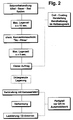
- Figure 2 is the order of manufacture according to the invention of spherically shaped body composite parts schematically shown.
- the metal strip is rinsed and undergo chemical conversion immediately afterwards. This is done in a "no-rinse" process, with capillary activity Form surface areas on the metal band.
- the glue application this preferably in all three processes in a coil coating process is carried out.
- the semi-finished tape After the adhesive has been applied, the semi-finished tape is ready for dispatch ready to the automobile factories. Even longer storage times and rough Transport work can be carried out with this semi-finished product, because the surface is scratch-resistant and against chemical influences is protected.
- the subsequent paint application can be done by control the conductivity in the adhesive layer can be influenced. At the same time, this has an impact on the corrosion properties, since the dip painting also in the critical points of the Body composite acts.
- the following baking process results in accordance with the invention considerable advantages through the combination of baking with drying and curing of the adhesive. While traditionally the adhesive layers have a proportional increase in Show stiffness at increasing temperatures is according to the invention a hot melt adhesive selected within a cures at short softening intervals from 180 ° C. this makes possible the combined baking-curing treatment, so that the Process times can be significantly reduced.
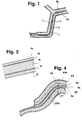
- Figure 3 shows a cross section through a coated on both sides Metal sheet 12, in which both Knoversions slaughteren 13, 16 and also adhesive layers 14, 15, as described at the outset in the coil coating process were applied.
- This manufacturing process of the composite body according to the invention has the Advantage that it consists of prepared semi-finished parts on site one or more body fittings can. Before connecting to the body connector these are carefully pretreated. But they are also paint systems known that when sprayed onto the metal surface Form conversion layer. The latter procedure is only for repair work and for smaller ones Metal surfaces approved.
- FIG. 4 shows a multilayer arrangement of two metal sheets 22, 27 which according to the invention have a conversion layer 23, 26 via jewails and two adhesive layers 24, 25 to form a composite body part are welded together.
- the entire composite part is from one Lacquer layer 21a, 21b covered. From this illustration it can be seen that the lacquer layer 21a, 21b also at the critical points after a Forming shows no signs of peeling.
Landscapes
- Engineering & Computer Science (AREA)
- Chemical & Material Sciences (AREA)
- Combustion & Propulsion (AREA)
- Transportation (AREA)
- Mechanical Engineering (AREA)
- Laminated Bodies (AREA)
- Adhesives Or Adhesive Processes (AREA)
- Application Of Or Painting With Fluid Materials (AREA)
Claims (31)
- Pièce composite de carrosserie, constituée d'une tôle métallique, d'un élément de carrosserie et d'une couche de matière synthétique constituée d'une code fusible et collée ou soudée sur les faces de contact vers l'élément de carrosserie et vers la tôle métallique,
caractérisée en ce qu'une couche de conversion est disposée entre la code fusible et la tôle métallique. - Pièce composite de carrosserie selon la revendication 1, caractérisée en ce que la tôle métallique est réalisée sous la forme d'une bande de métal.
- Pièce composite de carrosserie selon une des revendications précédentes, caracterisée en ce que la bande de métal est constituée d'un alliage d'aluminium.
- Pièce composite de carrosserie selon une des revendications précédentes, caractérisée en ce que la bande de métal est constituée d'un alliage d'aluminium du type AlMgSi.
- Pièce composite de carrosserie selon une des revendications précédentes, caractérisée en ce que l'élément de carrosserie est une construction mixte acier-aluminium.
- Pièce composite de carrosserie selon une des revendications précédentes, caractérisée en ce que la bande de métal présente une épaisseur de 0,2 à 3 mm.
- Pièce composite de carrosserie selon une des revendications précédentes, caractérisée en ce que la colle fusible est appliquée en une épaisseur uniforme de 5 à 80 µm, avec une tolérance de ± 20 %.
- Pièce composite de carrosserie selon une des revendications précédentes, caractérisée en ce que la code fusible présente des propriétés d'agent antifriction et favorise la déformation de la tôle de carrosserie.
- Pièce composite de carrosserie selon une des revendications précédentes, caractérisée en ce que la couche de conversion présente une épaisseur de 0,2 à 2 g/m2.
- Pièce composite de carrosserie selon une des revendications précédentes, caractérisée en ce qu'un apprêt monocouche ou multicouche est appliqué entre la code fusible et la couche de conversion.
- Pièce composite de carrosserie selon une des revendications précédentes, caractérisée en ce que la couche de code est constituée d'une peinture adhésive.
- Pièce composite de carrosserie selon une des revendications précédentes, caractérisée en ce que la colle fusible présente des propriétés de protection contre la corrosion.
- Pièce composite de carrosserie selon une des revendications précédentes, caractérisée en ce que la colle fusible contient des composants électriquement conducteurs afin de régler la conductivité.
- Pièce composite de carrosserie selon une des revendications précédentes, caracterisée en ce que le composite est déformé sous une forme sphérique, avec un degré de déformation compris entre 5 et 25 %, par emboutissage, étirage ou autre procédé de déformation.
- Pièce composite de carrosserie selon une des revendications précédentes, caractérisée en ce que la bande de métal et l'élément de carrosserie sont en outre fixés en position par soudage par fusion ou jointoiement mécanique.
- Pièce composite de carrosserie selon une des revendications précédentes, caractérisée en ce que la fixation s'effectue par jointoiement entrelacé.
- Pièce composite de carrosserie selon une des revendications précédentes, caractérisée en ce que l'élément de carrosserie consiste en une autre tôle métallique qui est enduite d'une couche de code fusible et présente une couche de conversion entre la couche de code fusible et la surface du métal.
- Pièce composite de carrosserie selon une des revendications précédentes, caractérisée en ce que la pièce composite est revêtue d'un vernis.
- Pièce composite de carrosserie selon une des revendications précédentes, caractérisée en ce que le vernis est un vernis à cuire.
- Pièce composite de carrosserie selon une des revendications précédentes, caractérisée en ce que la colle fusible est choisie de telle sorte qu'elle durcit à la température de cuisson.
- Procédé de fabrication de pièces composites de carrosserie de forme sphérique, une bande de métal étant assemblée par collage à un élément de carrosserie, déformée puis vernie, caractérisé en ce que la bande de métal est pourvue d'une couche de conversion chimique par couchage sur bande, et enduite juste après d'une couche de colle fusible, et la bande de métal enduite est, après la déformation, assemblée à l'élément de carrosserie et soumise à un vernissage par immersion.
- Procédé de fabrication de pièces composites de carrosserie de forme sphérique selon une des revendications de procédé précédentes, caractérisé en ce qu'on utilise comme vernissage par immersion un vernissage par électrodéposition cathodique, suivi d'une étape de cuisson à des températures d'environ 180°C.
- Procédé de fabrication de pièces composites de carrosserie de forme sphérique selon une des revendications de procédé précédentes, caractérisé en ce qu'on utilise pour la fabrication de la bande de métal un alliage durcissable, et le durcissement métallurgique est entrepris pendant le processus de cuisson à des températures comprises entre 160°C et 240°C.
- Procédé de fabrication de pièces composites de carrosserie de forme sphérique selon une des revendications de procédé précédentes, caractérisé en ce que le vernissage comprend un apprêt garnissant, un vernis de base et un vernis transparent, et les températures de cuisson à la suite de l'enduction vont en diminuant de 180 à 120°C.
- Procédé de fabrication de pièces composites de carrosserie de forme sphérique selon une des revendications de procédé précédentes, caractérisé en ce que la colle fusible a un comportement chimique inerte pendant le vernissage par électrodéposition cathodique.
- Procédé de fabrication de pièces composites de carrosserie de forme sphérique selon une des revendications de procédé précédentes, caractérisé en ce que la colle fusible est résistante au lavage.
- Procédé de fabrication de pièces composites de carrosserie de forme sphérique selon une des revendications de procédé précédentes, caractérisé en ce que la couche de conversion chimique est réalisée par le procédé 〈〈 no rinse 〉〉.
- Procédé de fabrication de pièces composites de carrosserie de forme sphérique selon une des revendications de procédé précédentes, caractérisé en ce qu'un intervalle de temps d'au plus 10 secondes se déroule entre le traitement préalable et la réalisation de la couche de conversion.
- Procédé de fabrication de pièces composites de carrosserie de forme sphérique selon une des revendications de procédé précédentes, caractérisé en ce qu'un intervalle de temps d'au plus 15 secondes se déroule entre la réalisation de la couche de conversion et l'application de la colle fusible.
- Procédé de fabrication de pièces composites de carrosserie de forme sphérique selon une des revendications de procédé précédentes, caractérisé en ce que l'écart d'épaisseur dans la couche de conversion est au plus de 5%.
- Procédé de fabrication de pièces composites de carrosserie de forme sphérique selon une des revendications de procédé précédentes, caractérisé en ce que l'écart d'épaisseur dans la couche de colle fusible est au plus de 15 %.
Applications Claiming Priority (3)
| Application Number | Priority Date | Filing Date | Title |
|---|---|---|---|
| DE4422839 | 1994-06-30 | ||
| DE4422839 | 1994-06-30 | ||
| PCT/DE1995/000859 WO1996000675A1 (fr) | 1994-06-30 | 1995-06-29 | Piece composite pour carosseries et son procede de fabrication |
Publications (2)
| Publication Number | Publication Date |
|---|---|
| EP0767749A1 EP0767749A1 (fr) | 1997-04-16 |
| EP0767749B1 true EP0767749B1 (fr) | 1999-01-27 |
Family
ID=6521852
Family Applications (1)
| Application Number | Title | Priority Date | Filing Date |
|---|---|---|---|
| EP95924166A Revoked EP0767749B1 (fr) | 1994-06-30 | 1995-06-29 | Piece composite pour carosseries et son procede de fabrication |
Country Status (3)
| Country | Link |
|---|---|
| EP (1) | EP0767749B1 (fr) |
| DE (1) | DE19523498A1 (fr) |
| WO (1) | WO1996000675A1 (fr) |
Cited By (1)
| Publication number | Priority date | Publication date | Assignee | Title |
|---|---|---|---|---|
| CN101068897B (zh) * | 2004-07-13 | 2010-09-01 | Sika技术股份公司 | 由含有水合氧化物和/或氢氧化物层的金属或金属合金制成的工件的处理和粘合方法 |
Families Citing this family (8)
| Publication number | Priority date | Publication date | Assignee | Title |
|---|---|---|---|---|
| DE19846533A1 (de) | 1998-10-09 | 2000-04-20 | Thyssenkrupp Stahl Ag | Verfahren zum Herstellen eines einbrennlackierten Formbauteils |
| DE10143126B4 (de) * | 2001-09-03 | 2007-12-13 | Barbara Simon | Verfahren zur Herstellung von metallischem Halbzeug sowie danach hergestelltes Halbzeug und dessen Verwendung |
| DE10336189A1 (de) * | 2003-08-07 | 2005-03-10 | Daimler Chrysler Ag | Verbindung zwischen zwei Bauteilen und zugehöriges Verbindungsverfahren |
| DE102007031349A1 (de) * | 2007-07-05 | 2009-01-08 | Bayerische Motoren Werke Aktiengesellschaft | Hybridbauteil mit haftvermittelnder Beschichtung sowie Verfahren zu dessen Herstellung |
| DE102011104483A1 (de) * | 2011-06-17 | 2012-12-20 | MAN Truck & Bus Aktiengesellschaft | Rahmenlängsträgeraufbau für Fahrgestellrahmen von Nutzfahrzeugen, insbesondere von Lastkraftwagen und/oder Bussen |
| DE102013012927A1 (de) * | 2013-08-02 | 2015-02-05 | Man Truck & Bus Ag | Verfahren zum Aufbau eines Nutzfahrzeug-Fahrerhauses |
| DE102020118934A1 (de) * | 2020-07-17 | 2022-01-20 | 3M Company and 3M Innovative Properties Company | Verfahren zum Herstellen einer Karosseriekomponente einer Fahrzeugkarosserie eines Fahrzeugs sowie Karosseriekomponente und Fahrzeugkarosserie |
| DE102020005111A1 (de) | 2020-08-20 | 2022-02-24 | Daimler Ag | Verfahren zum stoffschlüssigen Verbinden von zwei Bauteilen sowie Bauteilanordnung mit zwei stoffschlüssig miteinander verbundenen Bauteilen |
Family Cites Families (9)
| Publication number | Priority date | Publication date | Assignee | Title |
|---|---|---|---|---|
| FR1021609A (fr) * | 1950-07-07 | 1953-02-20 | Daimler Benz Ag | Parois, en particulier pour la réalisation d'une voiture automobile |
| US3052021A (en) * | 1956-12-07 | 1962-09-04 | Smith Corp A O | Method of forming a multi-layer head |
| DE3117604A1 (de) * | 1981-05-05 | 1983-01-05 | Chemie-Werk Weinsheim Gmbh, 6520 Worms | "mehrschichtiges flaechenhaftes aussteifungsteil" |
| JPS5914575A (ja) * | 1982-07-14 | 1984-01-25 | Nissan Motor Co Ltd | 自動車のル−フ補強構造 |
| GB8502148D0 (en) * | 1985-01-29 | 1985-02-27 | Alcan Int Ltd | Metal-forming lubricant |
| JPS6291580A (ja) * | 1985-10-18 | 1987-04-27 | Nissan Motor Co Ltd | パネルの接合シ−ル方法 |
| JPH0633056B2 (ja) * | 1986-06-12 | 1994-05-02 | トヨタ車体株式会社 | 自動車ボデ−の構造用接着剤の硬化方法 |
| US4969251A (en) * | 1988-04-04 | 1990-11-13 | Pittsburgh Coil Technology | Method of making brake shoe stock (II) |
| DE4036586C2 (de) * | 1990-11-16 | 1994-05-19 | Bayerische Motoren Werke Ag | Verfahren zur Behandlung von beim Bau von Fahrzeugen zum Einsatz kommenden Aluminiumblech |
-
1995
- 1995-06-28 DE DE19523498A patent/DE19523498A1/de not_active Ceased
- 1995-06-29 EP EP95924166A patent/EP0767749B1/fr not_active Revoked
- 1995-06-29 WO PCT/DE1995/000859 patent/WO1996000675A1/fr not_active Ceased
Cited By (1)
| Publication number | Priority date | Publication date | Assignee | Title |
|---|---|---|---|---|
| CN101068897B (zh) * | 2004-07-13 | 2010-09-01 | Sika技术股份公司 | 由含有水合氧化物和/或氢氧化物层的金属或金属合金制成的工件的处理和粘合方法 |
Also Published As
| Publication number | Publication date |
|---|---|
| DE19523498A1 (de) | 1996-01-04 |
| EP0767749A1 (fr) | 1997-04-16 |
| WO1996000675A1 (fr) | 1996-01-11 |
Similar Documents
| Publication | Publication Date | Title |
|---|---|---|
| DE102008020467B4 (de) | Verfahren zur Herstellung eines Hilfsrahmens, eines Kraftfahrzeugs sowie Hilfsrahmen eines Kraftfahrzeugs | |
| DE4203460C2 (de) | Verfahren zum Herstellen eines trägerartigen Bauteils mit einem Leichtstoffkern | |
| EP3149224B1 (fr) | Procédé de fabrication d'une structure sandwich, structure sandwich fabriquée par ledit procédé, et utilisation de ladite structure | |
| WO2001085860A1 (fr) | Revetements organiques conducteurs | |
| WO2001030923A2 (fr) | Revetements organiques conducteurs | |
| EP0767749B1 (fr) | Piece composite pour carosseries et son procede de fabrication | |
| DE2114615A1 (de) | Verfahren zum Korrosionsschutz von Blechteilen von Fahrzeugaufbauten und -bodengruppe n | |
| DE19800038A1 (de) | Verfahren zum Fügen von mindestens zwei Karosseriebauteilen | |
| DE102008026356A1 (de) | Verfahren zum Blindnieten sowie Bauteilverbindung | |
| EP0908632B1 (fr) | Méthode d'assemblage d'au moins deux éléments | |
| DE10162215A1 (de) | Bolzenfestziehstruktur eines Magnesiumlegierungselements | |
| DE102006047805A1 (de) | Verfahren zur Herstellung eines Kraftfahrzeugbauteils | |
| CA2417668C (fr) | Methode de pretraitement a l'acide pour l'amelioration de l'adhesion a des alliages d'aluminium | |
| DE102009051899B3 (de) | Bauteil mit einer Zinklamellenschicht und Verfahren zu dessen Herstellung | |
| DE10360350A1 (de) | Verfahren zur Herstellung eines Kraftfahrzeugs in Modulbauweise | |
| DE102006056489A1 (de) | Verfahren zur Herstellung eines Stahl-/Aluminium-Verbundbauteils | |
| DE19918758A1 (de) | Verfahren zur Erzeugung einer Beschichtung, insbesondere Korrosionsschutzschicht | |
| EP1531012B1 (fr) | Protection supplémentaire contre la corrosion pour des piéces de tôle métallique disposant déjà d'un revêtement organique | |
| WO2005073058A1 (fr) | Composant hybride | |
| DE102018125338B4 (de) | Verfahren zur Herstellung eines profilierten Aluminiumelements mit Haftvermittlerschicht | |
| EP2852693B1 (fr) | Procédé de production d'un assemblage de pièces | |
| EP4182205B1 (fr) | Procédé de fabrication d'un élément de carrosserie de véhicule, élément de carrosserie de véhicule et carrosserie de véhicule. | |
| DE10028705B4 (de) | Verfahren zur Herstellung eines mit mindestens zwei unterschiedlichen Lacken beschichteten Karosserieelementes eines Kraftfahrzeugs | |
| EP0610685B1 (fr) | Procédé pour joindre des articles à paroi mince en métal en tenant la pression | |
| EP0247239A2 (fr) | Pièce allégée thermostable qui peut être laqué facilement et durablement, particulièrement pour l'industrie de véhicule |
Legal Events
| Date | Code | Title | Description |
|---|---|---|---|
| PUAI | Public reference made under article 153(3) epc to a published international application that has entered the european phase |
Free format text: ORIGINAL CODE: 0009012 |
|
| 17P | Request for examination filed |
Effective date: 19961212 |
|
| AK | Designated contracting states |
Kind code of ref document: A1 Designated state(s): ES FR GB IT PT SE |
|
| GRAG | Despatch of communication of intention to grant |
Free format text: ORIGINAL CODE: EPIDOS AGRA |
|
| 17Q | First examination report despatched |
Effective date: 19970813 |
|
| GRAG | Despatch of communication of intention to grant |
Free format text: ORIGINAL CODE: EPIDOS AGRA |
|
| GRAG | Despatch of communication of intention to grant |
Free format text: ORIGINAL CODE: EPIDOS AGRA |
|
| GRAH | Despatch of communication of intention to grant a patent |
Free format text: ORIGINAL CODE: EPIDOS IGRA |
|
| GRAH | Despatch of communication of intention to grant a patent |
Free format text: ORIGINAL CODE: EPIDOS IGRA |
|
| GRAA | (expected) grant |
Free format text: ORIGINAL CODE: 0009210 |
|
| AK | Designated contracting states |
Kind code of ref document: B1 Designated state(s): ES FR GB IT PT SE |
|
| PG25 | Lapsed in a contracting state [announced via postgrant information from national office to epo] |
Ref country code: SE Free format text: LAPSE BECAUSE OF FAILURE TO SUBMIT A TRANSLATION OF THE DESCRIPTION OR TO PAY THE FEE WITHIN THE PRESCRIBED TIME-LIMIT Effective date: 19990127 Ref country code: IT Free format text: LAPSE BECAUSE OF FAILURE TO SUBMIT A TRANSLATION OF THE DESCRIPTION OR TO PAY THE FEE WITHIN THE PRE;WARNING: LAPSES OF ITALIAN PATENTS WITH EFFECTIVE DATE BEFORE 2007 MAY HAVE OCCURRED AT ANY TIME BEFORE 2007. THE CORRECT EFFECTIVE DATE MAY BE DIFFERENT FROM THE ONE RECORDED.SCRIBED TIME-LIMIT Effective date: 19990127 |
|
| PG25 | Lapsed in a contracting state [announced via postgrant information from national office to epo] |
Ref country code: PT Free format text: LAPSE BECAUSE OF FAILURE TO SUBMIT A TRANSLATION OF THE DESCRIPTION OR TO PAY THE FEE WITHIN THE PRESCRIBED TIME-LIMIT Effective date: 19990427 |
|
| PG25 | Lapsed in a contracting state [announced via postgrant information from national office to epo] |
Ref country code: ES Free format text: LAPSE BECAUSE OF FAILURE TO SUBMIT A TRANSLATION OF THE DESCRIPTION OR TO PAY THE FEE WITHIN THE PRESCRIBED TIME-LIMIT Effective date: 19990428 |
|
| GBT | Gb: translation of ep patent filed (gb section 77(6)(a)/1977) |
Effective date: 19990421 |
|
| ET | Fr: translation filed | ||
| PLBQ | Unpublished change to opponent data |
Free format text: ORIGINAL CODE: EPIDOS OPPO |
|
| PLBI | Opposition filed |
Free format text: ORIGINAL CODE: 0009260 |
|
| PLBF | Reply of patent proprietor to notice(s) of opposition |
Free format text: ORIGINAL CODE: EPIDOS OBSO |
|
| 26 | Opposition filed |
Opponent name: ALCAN DEUTSCHLAND GMBH Effective date: 19991021 |
|
| PLBF | Reply of patent proprietor to notice(s) of opposition |
Free format text: ORIGINAL CODE: EPIDOS OBSO |
|
| PGFP | Annual fee paid to national office [announced via postgrant information from national office to epo] |
Ref country code: FR Payment date: 20000531 Year of fee payment: 6 |
|
| PGFP | Annual fee paid to national office [announced via postgrant information from national office to epo] |
Ref country code: GB Payment date: 20000602 Year of fee payment: 6 |
|
| RDAH | Patent revoked |
Free format text: ORIGINAL CODE: EPIDOS REVO |
|
| RDAG | Patent revoked |
Free format text: ORIGINAL CODE: 0009271 |
|
| STAA | Information on the status of an ep patent application or granted ep patent |
Free format text: STATUS: PATENT REVOKED |
|
| 27W | Patent revoked |
Effective date: 20000727 |
|
| GBPR | Gb: patent revoked under art. 102 of the ep convention designating the uk as contracting state |
Free format text: 20000727 |