EP0768799A2 - Verfahren und Schaltung zum Wiedereinordnen von Ausgangsdaten in einem variablen Längendekodierer - Google Patents
Verfahren und Schaltung zum Wiedereinordnen von Ausgangsdaten in einem variablen Längendekodierer Download PDFInfo
- Publication number
- EP0768799A2 EP0768799A2 EP19960307456 EP96307456A EP0768799A2 EP 0768799 A2 EP0768799 A2 EP 0768799A2 EP 19960307456 EP19960307456 EP 19960307456 EP 96307456 A EP96307456 A EP 96307456A EP 0768799 A2 EP0768799 A2 EP 0768799A2
- Authority
- EP
- European Patent Office
- Prior art keywords
- data
- signal
- internal memory
- vld
- read
- Prior art date
- Legal status (The legal status is an assumption and is not a legal conclusion. Google has not performed a legal analysis and makes no representation as to the accuracy of the status listed.)
- Withdrawn
Links
Images



Classifications
-
- H—ELECTRICITY
- H04—ELECTRIC COMMUNICATION TECHNIQUE
- H04N—PICTORIAL COMMUNICATION, e.g. TELEVISION
- H04N19/00—Methods or arrangements for coding, decoding, compressing or decompressing digital video signals
- H04N19/42—Methods or arrangements for coding, decoding, compressing or decompressing digital video signals characterised by implementation details or hardware specially adapted for video compression or decompression, e.g. dedicated software implementation
- H04N19/423—Methods or arrangements for coding, decoding, compressing or decompressing digital video signals characterised by implementation details or hardware specially adapted for video compression or decompression, e.g. dedicated software implementation characterised by memory arrangements
-
- H—ELECTRICITY
- H04—ELECTRIC COMMUNICATION TECHNIQUE
- H04N—PICTORIAL COMMUNICATION, e.g. TELEVISION
- H04N19/00—Methods or arrangements for coding, decoding, compressing or decompressing digital video signals
-
- H—ELECTRICITY
- H03—ELECTRONIC CIRCUITRY
- H03M—CODING; DECODING; CODE CONVERSION IN GENERAL
- H03M7/00—Conversion of a code where information is represented by a given sequence or number of digits to a code where the same, similar or subset of information is represented by a different sequence or number of digits
- H03M7/30—Compression; Expansion; Suppression of unnecessary data, e.g. redundancy reduction
- H03M7/40—Conversion to or from variable length codes, e.g. Shannon-Fano code, Huffman code, Morse code
-
- H—ELECTRICITY
- H04—ELECTRIC COMMUNICATION TECHNIQUE
- H04N—PICTORIAL COMMUNICATION, e.g. TELEVISION
- H04N19/00—Methods or arrangements for coding, decoding, compressing or decompressing digital video signals
- H04N19/44—Decoders specially adapted therefor, e.g. video decoders which are asymmetric with respect to the encoder
-
- H—ELECTRICITY
- H04—ELECTRIC COMMUNICATION TECHNIQUE
- H04N—PICTORIAL COMMUNICATION, e.g. TELEVISION
- H04N19/00—Methods or arrangements for coding, decoding, compressing or decompressing digital video signals
- H04N19/60—Methods or arrangements for coding, decoding, compressing or decompressing digital video signals using transform coding
- H04N19/61—Methods or arrangements for coding, decoding, compressing or decompressing digital video signals using transform coding in combination with predictive coding
-
- H—ELECTRICITY
- H04—ELECTRIC COMMUNICATION TECHNIQUE
- H04N—PICTORIAL COMMUNICATION, e.g. TELEVISION
- H04N19/00—Methods or arrangements for coding, decoding, compressing or decompressing digital video signals
- H04N19/10—Methods or arrangements for coding, decoding, compressing or decompressing digital video signals using adaptive coding
- H04N19/102—Methods or arrangements for coding, decoding, compressing or decompressing digital video signals using adaptive coding characterised by the element, parameter or selection affected or controlled by the adaptive coding
- H04N19/13—Adaptive entropy coding, e.g. adaptive variable length coding [AVLC] or context adaptive binary arithmetic coding [CABAC]
-
- H—ELECTRICITY
- H04—ELECTRIC COMMUNICATION TECHNIQUE
- H04N—PICTORIAL COMMUNICATION, e.g. TELEVISION
- H04N19/00—Methods or arrangements for coding, decoding, compressing or decompressing digital video signals
- H04N19/70—Methods or arrangements for coding, decoding, compressing or decompressing digital video signals characterised by syntax aspects related to video coding, e.g. related to compression standards
-
- H—ELECTRICITY
- H04—ELECTRIC COMMUNICATION TECHNIQUE
- H04N—PICTORIAL COMMUNICATION, e.g. TELEVISION
- H04N19/00—Methods or arrangements for coding, decoding, compressing or decompressing digital video signals
- H04N19/90—Methods or arrangements for coding, decoding, compressing or decompressing digital video signals using coding techniques not provided for in groups H04N19/10-H04N19/85, e.g. fractals
- H04N19/91—Entropy coding, e.g. variable length coding [VLC] or arithmetic coding
Definitions
- the present invention relates to a device for compressing and recovering an image. More particularly, it relates to a method and a circuit especially, though not exclusively, for rearranging output data of a variable-length decoder where, when variable-length decoded bit streams packed into 64-bit units are recorded in a memory up to a predetermined capacity, 8 units of the packed data are read out from the memory while in a high-speed page mode.
- MPEG Moving Picture Experts Group
- a variable-length encoder in the image compressing apparatus allocates a shorter code to those symbols which occur more frequently.
- the encoded image signal is applied to an image restoring apparatus comprising a variable-length decoder (VLD) to perform the restoration.
- VLD variable-length decoder
- the VLD controls an external memory to read the shorter codes slowly and the longer codes quickly, by generating a request signal and providing the request signal to the external memory in a timely manner. Accordingly, whenever the request signal is received from the VLD, the external memory sends the data to the VLD immediately, regardless of code length.
- the external memory stores many kinds of data to be accessed and when a request signal of higher priority is received from elsewhere in the system, the request signal from the variable-length decoder must stand by. During this brief waiting period the image compressing/restoring process is unavoidably interrupted since the VLD is directly connected to the external memory, with no interface circuitry.
- a method for rearranging output data of a VLD comprising the steps of:
- said predetermined number of data bits of said data unit is 64 and said predetermined threshold value of said internal memory equals 1/2 the capacity of said internal memory.
- a circuit for rearranging output data of a VLD comprising:
- said first data processing unit detects a start code from said variable-length decoded bit stream and performs a byte-alignment operation based on said detected start code.
- said predetermined number of bits of said packed data unit equals 64.
- said predetermined threshold value is 1/2 of the capacity of said internal memory.
- said first data processing unit comprises:
- said first shift register is a 24-bit shift register for shifting 24 bits of data of said variable-length decoded bit stream.
- said plurality of second shift registers is comprised of eight 8-bit shift registers.
- said first value is “0"
- said second value is “7”
- said third value is “7”
- said fourth value is “15”.
- said first clock signal is generated by frequency-dividing said second clock signal by two.
- said second data processing unit comprises:
- said predetermined value equals "7".
- said first clock signal is generated by frequency-dividing said second clock signal by two.
- VLD variable length decoder
- the method and circuit further comprises any one or more of the features or steps of the accompanying description, claims, abstract and/or drawings, in any combination.
- a device for compressing and recovering an image comprising a circuit according to the second or third aspects of the invention and/or operating according to the first or third aspects of the invention.
- FIG. 1 is a block diagram of a circuit 10 for rearranging output data in a VLD, according to the present invention.
- circuit 10 is comprised of an internal memory unit 15, a first data processing unit 11 for packing a variable-length decoded serial-bit stream into a unit of packed data of a predetermined number of bits, for example, into a unit of 64 bits, generating a write address WADDR for each unit of packed data to store the packed data in internal memory unit 15, and generating a request signal VWR for transmitting the stored unit of packed data to an external memory (not shown) during a high-speed page mode, when the unit of packed data stored in internal memory unit 15 exceeds a predetermined threshold value, for example, half of the capacity of the internal memory unit 15.
- a predetermined threshold value for example, half of the capacity of the internal memory unit 15.
- Circuit 10 also includes a second data processing unit 13 for generating a read address RADDR for reading each of N units of packed data, for example, 8 units of packed data, from internal memory unit 15, when an accept signal VBV_ACC is generated in response to the request signal, and applying the read address RADDR to internal memory unit 15. At this time, the N units of packed data stored in the corresponding read addresses are sequentially read out from internal memory unit 15 and transmitted to the external memory.
- a second data processing unit 13 for generating a read address RADDR for reading each of N units of packed data, for example, 8 units of packed data, from internal memory unit 15, when an accept signal VBV_ACC is generated in response to the request signal, and applying the read address RADDR to internal memory unit 15.
- the N units of packed data stored in the corresponding read addresses are sequentially read out from internal memory unit 15 and transmitted to the external memory.
- a first-in first-out (FIFO) memory of 64 bits ⁇ 16 words, or a RAM may be used as internal memory unit 15.
- FIG 2 is a detailed circuit diagram of first data processing unit 11 shown in Figure 1.
- first data processing unit 11 includes a 24-bit shift register 21, first through third decoders 22, 24 and 27, first through third counters 23, 26 and 28, six D-flip flops D1-D6, a buffer B1, eight 8-bit shift registers 25a-25h, three AND gates A1-A3, and a NAND gate NA1.
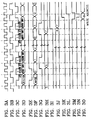
- Figures 3A-30 are operational timing diagrams of the first data processing unit shown in Figure 2, for the instance in which 8-bit data is written to internal memory unit 15.
- Figures 3A-3C illustrate signals CLK 40, CLK 20 and SCK, respectively.
- Figure 3D illustrates the output of 24-bit shift register 21
- Figure 3E illustrates a reset signal of first counter 23, which is output from a terminal Q ⁇ of first D-flip flop D1
- Figure 3F illustrates the output of first counter 23
- Figure 3G illustrates the result of latching "0", that is, the binary value "000”, from among the output values of first counter 23, in second decoder 24 at a falling edge of signal SCK
- Figure 3H illustrates the output of second counter 26
- Figure 3I illustrates the result of latching "7", that is, a binary value "111”, from among the output values of second counter 26, in third decoder 27 at a rising edge of the signal SCK
- Figure 3J illustrates a clock signal of third counter 28
- Figure 3K illustrate
- FIG 4 is a detailed circuit diagram of second data processing unit 13 shown in Figure 1.
- second data processing unit 13 includes a fourth counter 31, an address upper-bit generator 32, a fourth decoder 33, four D-flip flops D7-D10, two NAND gates NA2 and NA3, an AND gate A4, and two inverters I1 and I2.
- address upper bit generator 32 includes an AND gate 32a and an exclusive NOR gate 32b.
- Figures 5A-5K are operational timing diagrams of second data processing unit 13 of Figure 1 and shown in detail in Figure 4.
- Figures 5A-5C illustrate signals CLK 40, CLK 20, and VBVACC, respectively.
- Figure 5D illustrates a signal output from a terminal Q of seventh D-flip flop D7
- Figure 5E illustrates a signal output from a terminal Q ⁇ of eighth D-flip flop D8
- Figure 5F illustrates the output of second NAND gate NA2
- Figure 5G illustrates the output of fourth counter 31
- Figure 5H illustrates a signal output from a terminal Q of ninth D-flip flop D9
- Figure 5I illustrates a signal output from a terminal Q of tenth D-flip flop D10
- Figure 5J illustrates the output of fourth AND gate A4
- Figure 5K illustrates a signal RCE output from third NAND gate NA3.
- FIG. 6 is a detailed circuit diagram of internal memory unit 15 shown in Figure 1.
- internal memory unit 15 includes six inverters I3-I8, a fifth AND gate A5, a multiplexer 41, and a memory 42.
- a 64-bit shift register 43 is provided to shift the 64-bit data output from memory 42.
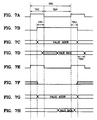
- Figures 7A-7H are operational timing diagrams of memory unit 15 shown of Figure 1 which is shown in detail in Figure 6.
- Figures 7A-7D illustrate a read cycle.
- Figure 7A illustrates a chip enable signal CEN in an active "low” state, in which the label “TRP” denotes a read or write portion of the cycle, and the label “TPC” denotes a pre-charge portion of the cycle.
- Figure 7B illustrates a read/write control signal RW
- Figure 7C illustrates an address ADDR
- Figure 7D illustrates a data in DOUT data signal read out from memory 42.
- Figures 7E-7H illustrate a write cycle.
- Figure 7E illustrates chip enable signal CEN in an active "low” state
- Figure 7F illustrates read/write control signal RW
- Figure 7G illustrates address ADDR
- Figure 7H illustrates a data in DIN data signal written in memory 42.
- read/write control signal RW is "low” while chip enable signal CEN is “low” in the write cycle, data is made valid at a rising edge of chip enable signal CEN.
- the embodiment of the present invention described in relation to Figures 1-7 relates to an image recovering apparatus which receives a bit stream, encoded by an image compressing apparatus, at a rate of about 20Mbits per second, and converts this received bit stream to recover an originally transmitted video signal.
- the image recovering apparatus performs the recovery operation through a VLD (not shown), an inverse-quantizer (not shown), and an inverse-discrete cosine transformer (not shown), in which first data processing unit 11 detects a start code from the input serial bit stream and performs a byte-alignment operation depending on the detected start code.
- First data processing unit 11 simultaneously packs the bit stream into a 64-bit unit and generates a write address for each unit of packed data to store the packed data unit in internal memory unit 15.
- a request signal is generated to transmit the stored packed data unit to an external memory (not shown) in a high-speed page mode.
- first data processing unit 11 is described below in more detail, referring to Figures 2 and 3.
- a signal HOLD ⁇ having a "low” value indicates that a variable-length serial decoded bit stream SERIAL-IN is valid, while a "high” value of signal HOLD ⁇ indicates that the variable-length decoded serial bit stream SERIAL-IN is invalid.
- the variable-length decoded serial bit stream is converted into parallel data, using signal SCK shown in Figure 3C as a clock signal, and then output.
- First decoder 22 decodes the start code output from 24-bit shift register 21 as the parallel data, as shown in Figure 3D, and output decoded start code to first counter 23 via first D-flip flop D1.
- first decoder 22 decodes the sequence "0000 0000 0000 0000 0001" in the case of a signal transmitted in a MPEG-2 format.
- the start code decoded in first decoder 22 is latched in first D-flip flop D1 according to an inverted SCK signal, and output to terminal Q ⁇ .
- First counter 23 is a 3-bit counter for performing a byte-alignment operation, and is reset by a signal shown in Figure 3E which is output from first D-flip flop D1.
- First counter 23 outputs a count value as shown in Figure 3F, using signal SCK shown in Figure 3C as a clock signal.
- This count value shown in Figure 3F is applied via second decoder 24, second D-flip flop D2, and first buffer B1 to clock terminals of eight 8-bit shift registers 25a-25h, and to a clock terminal of second counter 26.
- Third decoder 27 decodes a value of "7", that is, a binary value "111", from among the count values output from second counter 26, and outputs a signal as shown in Figure 3I.
- Third D-flip flop D3 latches the decoded value output from third decoder 27 according to signal SCK shown in Figure 3C and applies the latched value to a clock terminal of third counter 28 through terminal Q of D3.
- a signal output from terminal Q ⁇ of third D-flip flop D3 is latched in fourth D-flip flop D4 by signal CLK 20 shown in Figure 3B and is then output to first AND gate A1, fifth D-flip flop D5, and first NAND gate NA1 via terminal Q of fourth D-flip flop D4, respectively.
- Third counter 28 acting as a write address counter counts a signal output from terminal Q of third D-flip flop D3, which is applied to a clock terminal of third counter 28, and outputs write address WADDR[3:0] which is incremented by "1' for each 64-bit data unit, as shown in Figure 3H. That is, when the least significant eight bits are collected in each of eight 8-bit shift registers 25a-25h, write address WADDR is incremented by "1".
- write request signal VWR is generated by fourth D-flip flop D4, fifth D-flip flop D5, first AND gate A1, second AND gate A2, and sixth D-flip flop D6.
- write request signal VWR is generated in pulses at a falling edge of signal CLK 20 shown in Figure 3B.
- read/write control signal RW is generated by fifth D-flip flop D5 and first NAND gate NA1, as shown in Figure 3N.
- a write chip enable signal WCE is generated by third AND gate A3.
- read/write control signal RW is "high”, RW is classified as a read signal, and when RW is "low”, RW is classified as a write signal.
- variable-length decoded bit stream which is received by first data processing unit 11, is packed into a 64-bit data unit, and a request signal VWR for 8 of the packed data units is generated.
- time taken from generation of the request signal to generation of the accept signal is set as a clock time of 8 ⁇ 8 ⁇ 8bits. This time can be changed by modifying the size of internal memory unit 15.
- the request signal VWR generated in first data processing unit 11 is input to a memory controller (not shown), in which an accept signal VBV_ACC is generated in response to this request signal at a predetermined point in time and is applied to second data processing unit 13.
- Second data processing unit 13 is described below, referring to Figures 4 and 5.
- accept signal VBV_ACC which is shown in Figure 5C
- accept signal VBV_ACC is latched in seventh D-flip flop D7 by signal CLK 20 shown in Figure 5B, and output from terminal Q of seventh D-flip flop D7 as shown in Figure 5D.
- the output signal of seventh D-flip flop D7 is latched again in eighth D-flip flop D8 by signal CLK 20 shown in Figure 5B, and output from terminal Q of eighth D-flip flop D8 as shown in Figure 5E.
- Second NAND gate NA2 performs a NAND operation on the output signal of seventh D-flip flop D7 shown in Figure 5D and the output signal shown of eighth D-flip flop D8 shown in Figure 5E to output the signal shown in Figure 5F, which is applies to fourth counter 31.
- Fourth counter 31 generates a read address RADDR[3:0], and is reset by the output signal of second NAND gate NA2. It counts signal CLK 20 shown in Figure 5B, and outputs read address RADDR as shown in Figure 5G.
- read address RADDR must be a value within the range 0-7 or 8-15, in order to avoid the portion of internal memory unit 15 in which data is being written.
- Address upper bit generator 32 by using AND gate 32a and exclusive-NOR gate 32b, generates the upper-bit (here, MSB) of the read address RADDR according to write address WADDR such that the accesses to the read and write banks in memory 42 do not overlap by using AND gate 32a and XNOR gate 32b. That is, when each of the write addresses WADDR are "0111”, "1000”... “1101”, "1110", the MSB of the read address RADDR corresponding to each of the write addresses WADDR become “0.” Accordingly, the read address RADDR corresponding to each of the write address WADDR "0111”, “1000”!1101”,”1110” become "0000", "0001",...,”0110", “0111”, respectively.
- Fourth decoder 33 decodes the value "7", that is, a binary value "111", from among the count values of fourth counter 31.
- the output signal of fourth decoder 33 is latched by ninth D-flip flop D9 at a falling edge of signal CLK 20 shown in Figure 5B, and output from terminal Q as a shown in Figure 5H.
- the output signal shown in Figure 5H of ninth D-flip flop D9 is latched at a rising edge of signal CLK 20 shown in Figure 5B by tenth D-flip flop D10, and output as a signal shown in Figure 5I.
- Fourth AND gate A4 performs an AND operation on the output signal of ninth D-flip flop D9 shown in Figure 5H and the output signal of tenth D-flip flop D10 shown in Figure 5I, and outputs a signal as shown in Figure 5J.
- Third NAND gate NA3 performs a NAND operation on the output signal from fourth AND gate A4 shown in Figure 5J, the output signal from first inverter I1, and the output signal from second inverter I2, and generates a read chip enable signal RCE of Figure 5K.
- second data processing unit 13 generates read address RADDR for reading out eight 64-bit data from memory unit 15 at a rate of the CLK 20 signal, when an accept signal is generated, and applies the read address RADDR to memory unit 15. Then, the eight data units stored in the corresponding read addresses are read out of memory unit 15.
- Internal memory unit 15 is shown in detail in Figure 6 and includes memory 42 having a data input port DIN, a data output port DOUT, a common address port ADDR, and a read/write selection port RW. Memory unit 15 as described above can be easily modified for operation with the present invention.
- Write chip enable signal WCE output from first data processing unit 11 and read chip enable signal RCE output from second data processing unit 13 are input to a fifth AND gate A5 upon which an AND operation is performed, and the output signal of fifth AND gate A5 is applied to a chip enable terminal CEN of memory 42.
- Memory 42 does not operate when chip enable signal CEN is “high”, while it selects and operates when chip enable signal CEN is “low”.
- read/write control signal RW is "high”
- read operation is performed
- read/write control signal RW is "low”
- read address RADDR[3:0] output from first data processing unit 11 is delayed by third and fourth inverters I3 and I4, and then applied to mulitiplexer 41.
- Write address WADDR[3:0] output from second data processing unit 13 is delayed by fifth and sixth inverters IS and I6, and applied to multiplexer 41.
- Multiplexer 41 selects either of write address WADDR[3:0] and read address RADDR[3:0] which are delayed, according to read/write control signal RW, and applies the selected address to address port ADDR[3:0] via seventh and eighth inverters I7 and I8.
- memory 42 writes data applied to data input port DIN[63:0] or outputs stored data to 64-bit shift register 43 through output port DOUT[63:0], according to the address applied to address port ADDR[3:0].
- data is packed in units of 64 bits and a request signal is generated for 8 units of packed data.
- CLK 20 and CLK 40 are set as 20MHz and 40MHz, for convenience's sake, and thus, can be changed to other values.
- CLK 20 is generated by dividing the frequency of CLK 40 by two, and thus, the frequency of CLK 40 must be twice that of CLK 20.
- the present invention can be applied to every kind of hardware which employs a system of defining write and read operations of a memory for storing a variable-length decoded bit stream.
- a variable-length decoded bit stream is packed into units having a predetermined number of bits, and a number of units of such packed data are transmitted to an external memory while in a high-speed page mode by using a request signal and an accept signal. Therefore, the timing margin can be ensured through request and accept signals, and an automatic byte-alignment by start code is possible. Further, the read and write timing of a memory is stabilized, and read and write banks of the memory are efficiently switched during read and write operations.
Landscapes
- Engineering & Computer Science (AREA)
- Multimedia (AREA)
- Signal Processing (AREA)
- Theoretical Computer Science (AREA)
- Compression, Expansion, Code Conversion, And Decoders (AREA)
- Compression Or Coding Systems Of Tv Signals (AREA)
- Compression Of Band Width Or Redundancy In Fax (AREA)
Applications Claiming Priority (2)
| Application Number | Priority Date | Filing Date | Title |
|---|---|---|---|
| KR9535370 | 1995-10-13 | ||
| KR1019950035370A KR100195098B1 (ko) | 1995-10-13 | 1995-10-13 | 영상 압축 및 복원장치에 있어서 가변길이복호화된 데이타 재배열방법 및 회로 |
Publications (2)
| Publication Number | Publication Date |
|---|---|
| EP0768799A2 true EP0768799A2 (de) | 1997-04-16 |
| EP0768799A3 EP0768799A3 (de) | 2001-05-09 |
Family
ID=19430154
Family Applications (1)
| Application Number | Title | Priority Date | Filing Date |
|---|---|---|---|
| EP19960307456 Withdrawn EP0768799A3 (de) | 1995-10-13 | 1996-10-14 | Verfahren und Schaltung zum Wiedereinordnen von Ausgangsdaten in einem variablen Längendekodierer |
Country Status (4)
| Country | Link |
|---|---|
| US (1) | US5822552A (de) |
| EP (1) | EP0768799A3 (de) |
| JP (1) | JP3032160B2 (de) |
| KR (1) | KR100195098B1 (de) |
Families Citing this family (3)
| Publication number | Priority date | Publication date | Assignee | Title |
|---|---|---|---|---|
| JP4614732B2 (ja) * | 2004-10-22 | 2011-01-19 | パナソニック株式会社 | デコード装置 |
| US20060230241A1 (en) * | 2005-03-30 | 2006-10-12 | Mehta Kalpesh D | Buffer architecture for data organization |
| WO2021174405A1 (en) * | 2020-03-03 | 2021-09-10 | Intel Corporation | Graphics processing unit and central processing unit cooperative variable length data bit packing |
Family Cites Families (8)
| Publication number | Priority date | Publication date | Assignee | Title |
|---|---|---|---|---|
| US5119092A (en) * | 1988-11-22 | 1992-06-02 | Sharp Kabushiki Kaisha | Apparatus for encoding, decoding, and storing waveforms |
| US5363097A (en) * | 1992-09-14 | 1994-11-08 | Industrial Technology Research Institute | Direct sequential-bit variable length decoder |
| US5426462A (en) * | 1993-05-13 | 1995-06-20 | Intel Corporation | Apparatus for encoding signals using a configurable transform circuit |
| US5592399A (en) * | 1993-05-26 | 1997-01-07 | Intel Corporation | Pipelined video encoder architecture |
| FR2705805B1 (fr) * | 1993-05-27 | 1996-06-28 | Sgs Thomson Microelectronics | Système de traitement d'images. |
| EP0649224B1 (de) * | 1993-09-23 | 1999-03-03 | Lg Electronics Inc. | Variabler Längen-Kodieren und variabler Längen-Dekodierer |
| GB9400101D0 (en) * | 1994-01-05 | 1994-03-02 | Thomson Consumer Electronics | Consumer interface for a satellite television system |
| US5502493A (en) * | 1994-05-19 | 1996-03-26 | Matsushita Electric Corporation Of America | Variable length data decoder for use with MPEG encoded video data |
-
1995
- 1995-10-13 KR KR1019950035370A patent/KR100195098B1/ko not_active Expired - Fee Related
- 1995-12-29 US US08/581,374 patent/US5822552A/en not_active Expired - Lifetime
-
1996
- 1996-10-11 JP JP27030696A patent/JP3032160B2/ja not_active Expired - Fee Related
- 1996-10-14 EP EP19960307456 patent/EP0768799A3/de not_active Withdrawn
Non-Patent Citations (1)
| Title |
|---|
| None |
Also Published As
| Publication number | Publication date |
|---|---|
| EP0768799A3 (de) | 2001-05-09 |
| JP3032160B2 (ja) | 2000-04-10 |
| KR970025176A (ko) | 1997-05-30 |
| KR100195098B1 (ko) | 1999-06-15 |
| JPH09294078A (ja) | 1997-11-11 |
| US5822552A (en) | 1998-10-13 |
Similar Documents
| Publication | Publication Date | Title |
|---|---|---|
| US5778255A (en) | Method and system in a data processing system for decompressing multiple compressed bytes in a single machine cycle | |
| US5751860A (en) | Method for compressing and decompressing digital image data | |
| US5805086A (en) | Method and system for compressing data that facilitates high-speed data decompression | |
| US6859561B2 (en) | Faster lossless rotation of JPEG images | |
| JP2002366419A (ja) | データ処理装置およびデータ処理方法 | |
| JP4057650B2 (ja) | 大ギャップを有するスライド窓データ圧縮システム | |
| US4760461A (en) | Binary data compression and expansion processing apparatus | |
| US5309156A (en) | Variable-length code decoding device | |
| US4800440A (en) | Digital image signal coding/decoding circuit with buffer memory storing reference line as compression codes | |
| US6940909B2 (en) | Video decoding during I-frame decode at resolution change | |
| EP1154575B1 (de) | Entropie Kodierer/Dekodierer zur schnellen Datenkompression und -dekompression | |
| US7689047B2 (en) | Reduced buffer size for JPEG encoding | |
| EP0768799A2 (de) | Verfahren und Schaltung zum Wiedereinordnen von Ausgangsdaten in einem variablen Längendekodierer | |
| US6205255B1 (en) | Method and apparatus for run-length encoding of multi-colored images | |
| WO2002052836A2 (en) | Graphic image coding | |
| US5822770A (en) | Memory interfacing method and circuit of variable length decoder for accessing external memory when empty portion of internal memory exceeds a predetermined level | |
| JPH09154021A (ja) | 印字制御装置と印字制御方法 | |
| JP5218015B2 (ja) | データ伸長装置 | |
| JP2859507B2 (ja) | 画像データの圧縮・伸長方法および装置 | |
| EP0499225A2 (de) | Dekodierungsvorrichtung für Kodes variabler Länge | |
| US20060072840A1 (en) | Conversion device for performing a raster scan conversion between a JPEG decoder and an image memory | |
| JPS60251763A (ja) | フアクシミリ情報の拡大縮小回路 | |
| JPS63245717A (ja) | デ−タ変換装置 | |
| JPS6342472B2 (de) | ||
| JPH03110975A (ja) | データ伸長方法及びその装置 |
Legal Events
| Date | Code | Title | Description |
|---|---|---|---|
| PUAI | Public reference made under article 153(3) epc to a published international application that has entered the european phase |
Free format text: ORIGINAL CODE: 0009012 |
|
| AK | Designated contracting states |
Kind code of ref document: A2 Designated state(s): DE FR GB |
|
| PUAL | Search report despatched |
Free format text: ORIGINAL CODE: 0009013 |
|
| AK | Designated contracting states |
Kind code of ref document: A3 Designated state(s): DE FR GB |
|
| RIC1 | Information provided on ipc code assigned before grant |
Free format text: 7H 04N 7/50 A, 7H 03M 7/40 B |
|
| 17P | Request for examination filed |
Effective date: 20010626 |
|
| 17Q | First examination report despatched |
Effective date: 20061026 |
|
| STAA | Information on the status of an ep patent application or granted ep patent |
Free format text: STATUS: THE APPLICATION IS DEEMED TO BE WITHDRAWN |
|
| 18D | Application deemed to be withdrawn |
Effective date: 20120212 |