EP0770427A2 - Procédé d'échange d'ions thermo-sensibles pour la récupération de lithium - Google Patents
Procédé d'échange d'ions thermo-sensibles pour la récupération de lithium Download PDFInfo
- Publication number
- EP0770427A2 EP0770427A2 EP96117114A EP96117114A EP0770427A2 EP 0770427 A2 EP0770427 A2 EP 0770427A2 EP 96117114 A EP96117114 A EP 96117114A EP 96117114 A EP96117114 A EP 96117114A EP 0770427 A2 EP0770427 A2 EP 0770427A2
- Authority
- EP
- European Patent Office
- Prior art keywords
- temperature
- ion
- zone
- solution
- enriched
- Prior art date
- Legal status (The legal status is an assumption and is not a legal conclusion. Google has not performed a legal analysis and makes no representation as to the accuracy of the status listed.)
- Withdrawn
Links
- 238000005342 ion exchange Methods 0.000 title claims abstract description 102
- 238000011084 recovery Methods 0.000 title claims description 22
- 229910052744 lithium Inorganic materials 0.000 title abstract description 62
- WHXSMMKQMYFTQS-UHFFFAOYSA-N Lithium Chemical compound [Li] WHXSMMKQMYFTQS-UHFFFAOYSA-N 0.000 title abstract description 61
- 150000002500 ions Chemical class 0.000 claims abstract description 203
- 238000000034 method Methods 0.000 claims abstract description 132
- 230000008569 process Effects 0.000 claims abstract description 119
- 239000000463 material Substances 0.000 claims abstract description 68
- 229910001413 alkali metal ion Inorganic materials 0.000 claims abstract description 6
- 239000000243 solution Substances 0.000 claims description 77
- 229910001416 lithium ion Inorganic materials 0.000 claims description 65
- 239000010457 zeolite Substances 0.000 claims description 58
- 238000010992 reflux Methods 0.000 claims description 45
- 229910021536 Zeolite Inorganic materials 0.000 claims description 41
- HNPSIPDUKPIQMN-UHFFFAOYSA-N dioxosilane;oxo(oxoalumanyloxy)alumane Chemical compound O=[Si]=O.O=[Al]O[Al]=O HNPSIPDUKPIQMN-UHFFFAOYSA-N 0.000 claims description 40
- 150000001768 cations Chemical class 0.000 claims description 21
- 239000012527 feed solution Substances 0.000 claims description 15
- 230000001419 dependent effect Effects 0.000 claims description 11
- HBBGRARXTFLTSG-UHFFFAOYSA-N Lithium ion Chemical compound [Li+] HBBGRARXTFLTSG-UHFFFAOYSA-N 0.000 claims description 7
- 238000005341 cation exchange Methods 0.000 claims description 5
- OYPRJOBELJOOCE-UHFFFAOYSA-N Calcium Chemical compound [Ca] OYPRJOBELJOOCE-UHFFFAOYSA-N 0.000 claims description 4
- 239000011575 calcium Substances 0.000 claims description 4
- FYYHWMGAXLPEAU-UHFFFAOYSA-N Magnesium Chemical compound [Mg] FYYHWMGAXLPEAU-UHFFFAOYSA-N 0.000 claims description 3
- 229910052791 calcium Inorganic materials 0.000 claims description 3
- 239000011777 magnesium Substances 0.000 claims description 3
- 229910052749 magnesium Inorganic materials 0.000 claims description 3
- 230000000977 initiatory effect Effects 0.000 claims 1
- 238000000926 separation method Methods 0.000 abstract description 34
- 230000008859 change Effects 0.000 abstract description 10
- 230000000694 effects Effects 0.000 abstract description 9
- 239000012267 brine Substances 0.000 description 59
- 239000000047 product Substances 0.000 description 58
- HPALAKNZSZLMCH-UHFFFAOYSA-M sodium;chloride;hydrate Chemical compound O.[Na+].[Cl-] HPALAKNZSZLMCH-UHFFFAOYSA-M 0.000 description 56
- 229910001415 sodium ion Inorganic materials 0.000 description 49
- 239000012071 phase Substances 0.000 description 33
- 238000001816 cooling Methods 0.000 description 20
- 238000010438 heat treatment Methods 0.000 description 18
- 239000011734 sodium Substances 0.000 description 17
- 239000012530 fluid Substances 0.000 description 15
- 238000011068 loading method Methods 0.000 description 14
- DGAQECJNVWCQMB-PUAWFVPOSA-M Ilexoside XXIX Chemical compound C[C@@H]1CC[C@@]2(CC[C@@]3(C(=CC[C@H]4[C@]3(CC[C@@H]5[C@@]4(CC[C@@H](C5(C)C)OS(=O)(=O)[O-])C)C)[C@@H]2[C@]1(C)O)C)C(=O)O[C@H]6[C@@H]([C@H]([C@@H]([C@H](O6)CO)O)O)O.[Na+] DGAQECJNVWCQMB-PUAWFVPOSA-M 0.000 description 13
- 238000004519 manufacturing process Methods 0.000 description 12
- 229910052708 sodium Inorganic materials 0.000 description 12
- 238000003860 storage Methods 0.000 description 10
- 239000003463 adsorbent Substances 0.000 description 9
- 150000001450 anions Chemical class 0.000 description 9
- 239000000203 mixture Substances 0.000 description 9
- 241000894007 species Species 0.000 description 8
- 239000007788 liquid Substances 0.000 description 7
- -1 lithium cations Chemical class 0.000 description 7
- 238000009835 boiling Methods 0.000 description 6
- 229910052500 inorganic mineral Inorganic materials 0.000 description 6
- 239000011707 mineral Substances 0.000 description 6
- 239000003513 alkali Substances 0.000 description 5
- 230000007423 decrease Effects 0.000 description 5
- 239000003456 ion exchange resin Substances 0.000 description 5
- 229920003303 ion-exchange polymer Polymers 0.000 description 5
- 239000011347 resin Substances 0.000 description 5
- 229920005989 resin Polymers 0.000 description 5
- 230000035945 sensitivity Effects 0.000 description 5
- 239000002699 waste material Substances 0.000 description 5
- XLYOFNOQVPJJNP-UHFFFAOYSA-N water Substances O XLYOFNOQVPJJNP-UHFFFAOYSA-N 0.000 description 5
- FAPWRFPIFSIZLT-UHFFFAOYSA-M Sodium chloride Chemical compound [Na+].[Cl-] FAPWRFPIFSIZLT-UHFFFAOYSA-M 0.000 description 4
- 239000007864 aqueous solution Substances 0.000 description 4
- 229910052792 caesium Inorganic materials 0.000 description 4
- 230000003247 decreasing effect Effects 0.000 description 4
- 238000001640 fractional crystallisation Methods 0.000 description 4
- 238000005057 refrigeration Methods 0.000 description 4
- 230000002441 reversible effect Effects 0.000 description 4
- 229910052701 rubidium Inorganic materials 0.000 description 4
- IGLNJRXAVVLDKE-UHFFFAOYSA-N rubidium atom Chemical compound [Rb] IGLNJRXAVVLDKE-UHFFFAOYSA-N 0.000 description 4
- 238000012546 transfer Methods 0.000 description 4
- JLVVSXFLKOJNIY-UHFFFAOYSA-N Magnesium ion Chemical compound [Mg+2] JLVVSXFLKOJNIY-UHFFFAOYSA-N 0.000 description 3
- 230000008901 benefit Effects 0.000 description 3
- 238000001704 evaporation Methods 0.000 description 3
- 230000008020 evaporation Effects 0.000 description 3
- 229910001414 potassium ion Inorganic materials 0.000 description 3
- 238000005086 pumping Methods 0.000 description 3
- 150000003839 salts Chemical class 0.000 description 3
- 238000001179 sorption measurement Methods 0.000 description 3
- NWUYHJFMYQTDRP-UHFFFAOYSA-N 1,2-bis(ethenyl)benzene;1-ethenyl-2-ethylbenzene;styrene Chemical compound C=CC1=CC=CC=C1.CCC1=CC=CC=C1C=C.C=CC1=CC=CC=C1C=C NWUYHJFMYQTDRP-UHFFFAOYSA-N 0.000 description 2
- IJGRMHOSHXDMSA-UHFFFAOYSA-N Atomic nitrogen Chemical compound N#N IJGRMHOSHXDMSA-UHFFFAOYSA-N 0.000 description 2
- ZOXJGFHDIHLPTG-BJUDXGSMSA-N Boron-10 Chemical compound [10B] ZOXJGFHDIHLPTG-BJUDXGSMSA-N 0.000 description 2
- ZLMJMSJWJFRBEC-UHFFFAOYSA-N Potassium Chemical compound [K] ZLMJMSJWJFRBEC-UHFFFAOYSA-N 0.000 description 2
- VYPSYNLAJGMNEJ-UHFFFAOYSA-N Silicium dioxide Chemical compound O=[Si]=O VYPSYNLAJGMNEJ-UHFFFAOYSA-N 0.000 description 2
- 239000003929 acidic solution Substances 0.000 description 2
- 230000009471 action Effects 0.000 description 2
- 229910052783 alkali metal Inorganic materials 0.000 description 2
- 238000005349 anion exchange Methods 0.000 description 2
- XDFCIPNJCBUZJN-UHFFFAOYSA-N barium(2+) Chemical compound [Ba+2] XDFCIPNJCBUZJN-UHFFFAOYSA-N 0.000 description 2
- 229910052796 boron Inorganic materials 0.000 description 2
- TVFDJXOCXUVLDH-UHFFFAOYSA-N caesium atom Chemical compound [Cs] TVFDJXOCXUVLDH-UHFFFAOYSA-N 0.000 description 2
- 239000001913 cellulose Substances 0.000 description 2
- 229920002678 cellulose Polymers 0.000 description 2
- 229920001429 chelating resin Polymers 0.000 description 2
- 239000007795 chemical reaction product Substances 0.000 description 2
- 239000000356 contaminant Substances 0.000 description 2
- 125000004122 cyclic group Chemical group 0.000 description 2
- 238000013461 design Methods 0.000 description 2
- 238000003795 desorption Methods 0.000 description 2
- 238000009792 diffusion process Methods 0.000 description 2
- 239000007789 gas Substances 0.000 description 2
- XGFJCRNRWOXGQM-UHFFFAOYSA-N hot-2 Chemical compound CCSC1=CC(OC)=C(CCNO)C=C1OC XGFJCRNRWOXGQM-UHFFFAOYSA-N 0.000 description 2
- 239000012500 ion exchange media Substances 0.000 description 2
- 150000002641 lithium Chemical class 0.000 description 2
- KWGKDLIKAYFUFQ-UHFFFAOYSA-M lithium chloride Chemical compound [Li+].[Cl-] KWGKDLIKAYFUFQ-UHFFFAOYSA-M 0.000 description 2
- VVNXEADCOVSAER-UHFFFAOYSA-N lithium sodium Chemical compound [Li].[Na] VVNXEADCOVSAER-UHFFFAOYSA-N 0.000 description 2
- 239000002609 medium Substances 0.000 description 2
- 239000002808 molecular sieve Substances 0.000 description 2
- 239000002245 particle Substances 0.000 description 2
- 229920001467 poly(styrenesulfonates) Polymers 0.000 description 2
- 229910052700 potassium Inorganic materials 0.000 description 2
- 239000011591 potassium Substances 0.000 description 2
- 238000000746 purification Methods 0.000 description 2
- 230000002829 reductive effect Effects 0.000 description 2
- NCCSSGKUIKYAJD-UHFFFAOYSA-N rubidium(1+) Chemical compound [Rb+] NCCSSGKUIKYAJD-UHFFFAOYSA-N 0.000 description 2
- 239000013535 sea water Substances 0.000 description 2
- URGAHOPLAPQHLN-UHFFFAOYSA-N sodium aluminosilicate Chemical compound [Na+].[Al+3].[O-][Si]([O-])=O.[O-][Si]([O-])=O URGAHOPLAPQHLN-UHFFFAOYSA-N 0.000 description 2
- 239000011780 sodium chloride Substances 0.000 description 2
- PWYYWQHXAPXYMF-UHFFFAOYSA-N strontium(2+) Chemical compound [Sr+2] PWYYWQHXAPXYMF-UHFFFAOYSA-N 0.000 description 2
- 239000011800 void material Substances 0.000 description 2
- 125000000022 2-aminoethyl group Chemical group [H]C([*])([H])C([H])([H])N([H])[H] 0.000 description 1
- QTBSBXVTEAMEQO-UHFFFAOYSA-M Acetate Chemical compound CC([O-])=O QTBSBXVTEAMEQO-UHFFFAOYSA-M 0.000 description 1
- 108091006522 Anion exchangers Proteins 0.000 description 1
- ZOXJGFHDIHLPTG-UHFFFAOYSA-N Boron Chemical compound [B] ZOXJGFHDIHLPTG-UHFFFAOYSA-N 0.000 description 1
- CPELXLSAUQHCOX-UHFFFAOYSA-M Bromide Chemical compound [Br-] CPELXLSAUQHCOX-UHFFFAOYSA-M 0.000 description 1
- 241001250115 Chironomus duplex Species 0.000 description 1
- VEXZGXHMUGYJMC-UHFFFAOYSA-M Chloride anion Chemical compound [Cl-] VEXZGXHMUGYJMC-UHFFFAOYSA-M 0.000 description 1
- KRKNYBCHXYNGOX-UHFFFAOYSA-K Citrate Chemical compound [O-]C(=O)CC(O)(CC([O-])=O)C([O-])=O KRKNYBCHXYNGOX-UHFFFAOYSA-K 0.000 description 1
- 241000114270 Diplura simplex Species 0.000 description 1
- KRHYYFGTRYWZRS-UHFFFAOYSA-M Fluoride anion Chemical compound [F-] KRHYYFGTRYWZRS-UHFFFAOYSA-M 0.000 description 1
- BDAGIHXWWSANSR-UHFFFAOYSA-M Formate Chemical compound [O-]C=O BDAGIHXWWSANSR-UHFFFAOYSA-M 0.000 description 1
- 229910002651 NO3 Inorganic materials 0.000 description 1
- NHNBFGGVMKEFGY-UHFFFAOYSA-N Nitrate Chemical compound [O-][N+]([O-])=O NHNBFGGVMKEFGY-UHFFFAOYSA-N 0.000 description 1
- MUBZPKHOEPUJKR-UHFFFAOYSA-N Oxalic acid Chemical compound OC(=O)C(O)=O MUBZPKHOEPUJKR-UHFFFAOYSA-N 0.000 description 1
- 239000004793 Polystyrene Substances 0.000 description 1
- QAOWNCQODCNURD-UHFFFAOYSA-L Sulfate Chemical compound [O-]S([O-])(=O)=O QAOWNCQODCNURD-UHFFFAOYSA-L 0.000 description 1
- ZMZDMBWJUHKJPS-UHFFFAOYSA-M Thiocyanate anion Chemical compound [S-]C#N ZMZDMBWJUHKJPS-UHFFFAOYSA-M 0.000 description 1
- 239000002253 acid Substances 0.000 description 1
- 150000001340 alkali metals Chemical class 0.000 description 1
- 229910001420 alkaline earth metal ion Inorganic materials 0.000 description 1
- PNEYBMLMFCGWSK-UHFFFAOYSA-N aluminium oxide Inorganic materials [O-2].[O-2].[O-2].[Al+3].[Al+3] PNEYBMLMFCGWSK-UHFFFAOYSA-N 0.000 description 1
- JYIBXUUINYLWLR-UHFFFAOYSA-N aluminum;calcium;potassium;silicon;sodium;trihydrate Chemical compound O.O.O.[Na].[Al].[Si].[K].[Ca] JYIBXUUINYLWLR-UHFFFAOYSA-N 0.000 description 1
- 239000003957 anion exchange resin Substances 0.000 description 1
- 239000008346 aqueous phase Substances 0.000 description 1
- QVGXLLKOCUKJST-UHFFFAOYSA-N atomic oxygen Chemical compound [O] QVGXLLKOCUKJST-UHFFFAOYSA-N 0.000 description 1
- 230000002238 attenuated effect Effects 0.000 description 1
- 229910052788 barium Inorganic materials 0.000 description 1
- DSAJWYNOEDNPEQ-UHFFFAOYSA-N barium atom Chemical compound [Ba] DSAJWYNOEDNPEQ-UHFFFAOYSA-N 0.000 description 1
- YOUGRGFIHBUKRS-UHFFFAOYSA-N benzyl(trimethyl)azanium Chemical compound C[N+](C)(C)CC1=CC=CC=C1 YOUGRGFIHBUKRS-UHFFFAOYSA-N 0.000 description 1
- 229910001424 calcium ion Inorganic materials 0.000 description 1
- 239000003729 cation exchange resin Substances 0.000 description 1
- 229940023913 cation exchange resins Drugs 0.000 description 1
- 238000006243 chemical reaction Methods 0.000 description 1
- ZCDOYSPFYFSLEW-UHFFFAOYSA-N chromate(2-) Chemical compound [O-][Cr]([O-])(=O)=O ZCDOYSPFYFSLEW-UHFFFAOYSA-N 0.000 description 1
- 229910001603 clinoptilolite Inorganic materials 0.000 description 1
- 238000010276 construction Methods 0.000 description 1
- 239000000498 cooling water Substances 0.000 description 1
- 239000013078 crystal Substances 0.000 description 1
- 238000000354 decomposition reaction Methods 0.000 description 1
- 238000012217 deletion Methods 0.000 description 1
- 230000037430 deletion Effects 0.000 description 1
- 238000010612 desalination reaction Methods 0.000 description 1
- 238000010586 diagram Methods 0.000 description 1
- 238000006073 displacement reaction Methods 0.000 description 1
- 229910052675 erionite Inorganic materials 0.000 description 1
- 239000004744 fabric Substances 0.000 description 1
- 238000005243 fluidization Methods 0.000 description 1
- 238000007710 freezing Methods 0.000 description 1
- 230000008014 freezing Effects 0.000 description 1
- XMBWDFGMSWQBCA-UHFFFAOYSA-N hydrogen iodide Chemical compound I XMBWDFGMSWQBCA-UHFFFAOYSA-N 0.000 description 1
- ZMZDMBWJUHKJPS-UHFFFAOYSA-N hydrogen thiocyanate Natural products SC#N ZMZDMBWJUHKJPS-UHFFFAOYSA-N 0.000 description 1
- 239000012535 impurity Substances 0.000 description 1
- 238000005372 isotope separation Methods 0.000 description 1
- 230000000670 limiting effect Effects 0.000 description 1
- 229910003002 lithium salt Inorganic materials 0.000 description 1
- 159000000002 lithium salts Chemical class 0.000 description 1
- 229910001425 magnesium ion Inorganic materials 0.000 description 1
- 238000012423 maintenance Methods 0.000 description 1
- 239000011159 matrix material Substances 0.000 description 1
- 238000012986 modification Methods 0.000 description 1
- 230000004048 modification Effects 0.000 description 1
- 229910052680 mordenite Inorganic materials 0.000 description 1
- 229910052757 nitrogen Inorganic materials 0.000 description 1
- 238000005457 optimization Methods 0.000 description 1
- 239000001301 oxygen Substances 0.000 description 1
- 229910052760 oxygen Inorganic materials 0.000 description 1
- 238000005192 partition Methods 0.000 description 1
- 235000020030 perry Nutrition 0.000 description 1
- 229920000768 polyamine Polymers 0.000 description 1
- 229920002223 polystyrene Polymers 0.000 description 1
- 239000011148 porous material Substances 0.000 description 1
- 238000001556 precipitation Methods 0.000 description 1
- 238000012545 processing Methods 0.000 description 1
- 229910052705 radium Inorganic materials 0.000 description 1
- HCWPIIXVSYCSAN-UHFFFAOYSA-N radium atom Chemical compound [Ra] HCWPIIXVSYCSAN-UHFFFAOYSA-N 0.000 description 1
- 230000008929 regeneration Effects 0.000 description 1
- 238000011069 regeneration method Methods 0.000 description 1
- 239000000377 silicon dioxide Substances 0.000 description 1
- 239000007787 solid Substances 0.000 description 1
- 239000002904 solvent Substances 0.000 description 1
- 239000007858 starting material Substances 0.000 description 1
- 229910052712 strontium Inorganic materials 0.000 description 1
- CIOAGBVUUVVLOB-UHFFFAOYSA-N strontium atom Chemical compound [Sr] CIOAGBVUUVVLOB-UHFFFAOYSA-N 0.000 description 1
- 229910001427 strontium ion Inorganic materials 0.000 description 1
- 239000000126 substance Substances 0.000 description 1
- 239000000725 suspension Substances 0.000 description 1
- 230000002277 temperature effect Effects 0.000 description 1
- 229910000439 uranium oxide Inorganic materials 0.000 description 1
- 125000005289 uranyl group Chemical group 0.000 description 1
- 239000002351 wastewater Substances 0.000 description 1
Images




Classifications
-
- B—PERFORMING OPERATIONS; TRANSPORTING
- B01—PHYSICAL OR CHEMICAL PROCESSES OR APPARATUS IN GENERAL
- B01J—CHEMICAL OR PHYSICAL PROCESSES, e.g. CATALYSIS OR COLLOID CHEMISTRY; THEIR RELEVANT APPARATUS
- B01J39/00—Cation exchange; Use of material as cation exchangers; Treatment of material for improving the cation exchange properties
- B01J39/08—Use of material as cation exchangers; Treatment of material for improving the cation exchange properties
- B01J39/14—Base exchange silicates, e.g. zeolites
-
- B—PERFORMING OPERATIONS; TRANSPORTING
- B01—PHYSICAL OR CHEMICAL PROCESSES OR APPARATUS IN GENERAL
- B01J—CHEMICAL OR PHYSICAL PROCESSES, e.g. CATALYSIS OR COLLOID CHEMISTRY; THEIR RELEVANT APPARATUS
- B01J39/00—Cation exchange; Use of material as cation exchangers; Treatment of material for improving the cation exchange properties
- B01J39/26—Cation exchangers for chromatographic processes
-
- B—PERFORMING OPERATIONS; TRANSPORTING
- B01—PHYSICAL OR CHEMICAL PROCESSES OR APPARATUS IN GENERAL
- B01J—CHEMICAL OR PHYSICAL PROCESSES, e.g. CATALYSIS OR COLLOID CHEMISTRY; THEIR RELEVANT APPARATUS
- B01J49/00—Regeneration or reactivation of ion-exchangers; Apparatus therefor
- B01J49/40—Thermal regeneration
-
- C—CHEMISTRY; METALLURGY
- C01—INORGANIC CHEMISTRY
- C01D—COMPOUNDS OF ALKALI METALS, i.e. LITHIUM, SODIUM, POTASSIUM, RUBIDIUM, CAESIUM, OR FRANCIUM
- C01D15/00—Lithium compounds
-
- C—CHEMISTRY; METALLURGY
- C01—INORGANIC CHEMISTRY
- C01D—COMPOUNDS OF ALKALI METALS, i.e. LITHIUM, SODIUM, POTASSIUM, RUBIDIUM, CAESIUM, OR FRANCIUM
- C01D17/00—Rubidium, caesium or francium compounds
-
- C—CHEMISTRY; METALLURGY
- C01—INORGANIC CHEMISTRY
- C01D—COMPOUNDS OF ALKALI METALS, i.e. LITHIUM, SODIUM, POTASSIUM, RUBIDIUM, CAESIUM, OR FRANCIUM
- C01D3/00—Halides of sodium, potassium or alkali metals in general
- C01D3/14—Purification
- C01D3/145—Purification by solid ion-exchangers or solid chelating agents
-
- G—PHYSICS
- G01—MEASURING; TESTING
- G01N—INVESTIGATING OR ANALYSING MATERIALS BY DETERMINING THEIR CHEMICAL OR PHYSICAL PROPERTIES
- G01N30/00—Investigating or analysing materials by separation into components using adsorption, absorption or similar phenomena or using ion-exchange, e.g. chromatography or field flow fractionation
- G01N30/96—Investigating or analysing materials by separation into components using adsorption, absorption or similar phenomena or using ion-exchange, e.g. chromatography or field flow fractionation using ion-exchange
-
- G—PHYSICS
- G01—MEASURING; TESTING
- G01N—INVESTIGATING OR ANALYSING MATERIALS BY DETERMINING THEIR CHEMICAL OR PHYSICAL PROPERTIES
- G01N30/00—Investigating or analysing materials by separation into components using adsorption, absorption or similar phenomena or using ion-exchange, e.g. chromatography or field flow fractionation
- G01N30/02—Column chromatography
- G01N30/26—Conditioning of the fluid carrier; Flow patterns
- G01N30/28—Control of physical parameters of the fluid carrier
- G01N30/30—Control of physical parameters of the fluid carrier of temperature
- G01N2030/3007—Control of physical parameters of the fluid carrier of temperature same temperature for whole column
-
- G—PHYSICS
- G01—MEASURING; TESTING
- G01N—INVESTIGATING OR ANALYSING MATERIALS BY DETERMINING THEIR CHEMICAL OR PHYSICAL PROPERTIES
- G01N30/00—Investigating or analysing materials by separation into components using adsorption, absorption or similar phenomena or using ion-exchange, e.g. chromatography or field flow fractionation
- G01N30/02—Column chromatography
Definitions
- the present invention relates to processes, or methods, for recovering lithium ions from lithium-containing aqueous solutions that also contain other alkali metal or alkaline-earth metal ions. More generally, the present invention relates to methods for separating one set of one or more ions from another set of one or more ions in situations wherein the selectivity of an ion-exchange adsorbent for the ion set sought to be separated has a substantial temperature dependence.
- Zeolite adsorbents are used commercially as adsorbents in "pressure-swing" processes for separating and purifying gases.
- zeolites containing Li + ions such as LiX or LiCaX zeolites
- Lithium-containing zeolites Li + zeolites
- a concentrated aqueous solution of Li + Cl - is passed through a column containing the Na + zeolite.
- the Na + ions in the zeolite are displaced by the Li + ions to produce the desired Li + zeolite.
- Li-exchanged zeolite after conversion, the Li-exchanged zeolite must be washed and dried.
- the spent wash water also contains Li + ions. In current processes, these are not recovered but are lost in the discharged waste water. Quantities of lithium are also lost in Li-exchanged zeolite that does not meet specifications. This lithium also can be released into solution (e.g. by displacement with Na + ) but in practice this is not done principally because of the cost involved.
- desirable ions e.g. lithium ions
- ion-containing e.g. lithium-containing
- contaminant ions such as sodium and calcium
- enriching the ion content e.g. increasing the lithium content
- Figure 1 is a process schematic of a duplex embodiment of an ion-exchange process according to the invention in which two trains of two ion-exchange beds each are employed for separation of Li + from a solution also containing Na + .
- Figure 2 is a graph of the concentration gradient of Li + storage and loading (in ion-equivalents/unit volume of the ion-exchange bed) as a function of position (percent length) in the direction of liquid flow within an ion-exchange bed at a constant total (Li + and Na + ) ion storage during a process step in which Li + is taken up by the bed.
- Figure 3 is a schematic of one type of temperature control means (cooling or heating) with heat-exchange coils embedded in the ion-exchange bed that can be employed in the process of the invention.
- Figure 4 is a process schematic of a duplex lithium separation (recovery) process according to the invention employing two trains of two beds each and depicting an alternative method for temperature control using heating and cooling of fluids, instead of heating and cooling of ion-exchange beds.
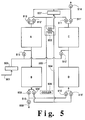
- Figure 5 is a process schematic of a preferred duplex embodiment of the invention utilizing fluid heating and cooling and illustrating a heat-exchange option.
- Figure 6 is a process schematic of a particular duplex embodiment according to the invention.
- Figure 7 is a process schematic of a simplex two-bed separation process (two trains of one bed each) according to the present invention which is preferred when an ion (e.g Li + ) is removed from relatively low-ion-value brines that may be relatively dilute.
- an ion e.g Li +
- Figure 8 is a process schematic of an inverted simplex, two-bed separation process (two trains of one bed each) according to the invention in which trace quantities of lithium are removed from brines of other ions.
- the Figure 8 process is inverted in that the product stream (Li + -impoverished brine) is collected off the cold bed.
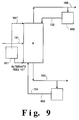
- Figure 9 is a process schematic of a single zone in a duplex (single-bed but intermediate feed) separation process according to the invention.
- Ions e.g. lithium
- brines containing these ions and optionally one or more other ions e.g. other alkali metal ions
- ion-exchange process employing an ion-exchange material. The process depends on a change in the selectivity coefficient of an ion exchange material for the ions desired to be recovered with a change in temperature, resulting in desirable ions being relatively selectively released at one temperature and undesirable ions being relatively selectively released at another temperature.
- the process of the invention can be used to effect the separation of any ion (or set of ions) from another ion or from a set of ions wherein the selectivity coefficient for one ion (or set of ions) has a substantial temperature dependence (or strong temperature sensitivity), compared to that for the other ion (or set of ions).
- the invention is directed to apparatus for carrying out the process.
- This invention comprises a thermally-driven ion-exchange process that can recover Li+ from concentrated or dilute brines in a single processing unit.
- the process of the invention is more energy efficient and simpler than evaporation and fractional crystallization, and permits e.g. lithium-containing solutions to become enriched in lithium and/or (if applicable) impoverished in undesirable ions.
- the use of the ion-exchange process of the invention also permits cost- and energy-efficient recovery of lithium that is normally discarded in the manufacture of specialty zeolite adsorbents, resulting in appreciable savings in overall manufacturing costs. Additionally, the process of this invention permits the use in zeolite manufacture of lower-cost, lower-purity lithium salts as starting materials, since contaminant ions can be removed by the process of the invention, before solutions of these lithium-containing materials are used in such manufacture.
- the designations herein “desirable ion” and “undesirable ion” are used for convenience only, as both the cold-released and the hot-released ions may be valuable and their recovery desirable.
- the designation “top” and “bottom”, applied to various parts of the process and apparatus, are also employed only for convenience, as the collection points for each ion or ion mixture may be reversed.
- it is preferred to run the process in a vertical arrangement it could also be run horizontally. If the process is run in a vertical arrangement, it is preferred to collect the lighter ion(s) (e.g. Li + ) at the top and the heavier ion(s) (e.g. Na + ) at the bottom.
- the invention may be used to recover lithium cations for the production of lithium-exchanged zeolites and for all other processes employing ionic solutions that are potentially enrichable in valuable cations the selectivity of which for a particular solid adsorbent varies with temperature as provided above (and is different from the selectivity of undesirable ions contained in the same solution).
- Ion-exchanged media that can be used to enrich such solutions include, without limitation, zeolites with exchangeable cations, cation-exchange resins, anion-exchange resins and fabrics or structures with exchangeable cations or anions. Ion-exchange media in each category are commercially available.
- the invention comprises a "temperature-swing, ion-exchange process" to separate Li + ions from Na + and K + ions (and, in addition or alternatively, also Ca ++ and heavier alkaline earth ions) from process brine streams.
- the process depends on the fact that the ion-selectivity of zeolite X (or another suitable ion-exchange material) exhibits a strong temperature sensitivity, at least for Li + ions, relative to other alkaline and alkaline earth ions.
- This temperature sensitivity permits the construction of a cyclic, reversible process that in turn permits the nearly complete separation of Li + ions from the Na + ions (and other alkali and alkaline earth ions).
- the extent of the separation in terms of recovery and purity) can be controlled by the amount of reflux employed in the process (which in turn determines the size or capacity of the system).
- the ion-exchange bed will develop an ion-concentration gradient wherein the adsorbed Li + is concentrated at one end of the bed and Na + is concentrated at the other end.
- An example of such a concentration gradient is depicted in Figure 2.
- the abscissa represents the position in an ion-exchange medium bed in the direction of liquid (brine) flow during a step in which lithium is being taken up by the bed.
- the total ion concentration with feed brine is equal to that of the brine initially in the bed.
- the feed brine is richer in lithium than the brine initially in the bed.
- the total storage for both lithium and sodium ions (ions in liquid plus ions held on the ion-exchange medium) in thousands of moles preferably remains constant, as shown in Fig. 2.
- the feed brine being rich in lithium
- the adsorbed lithium is higher at the end of the bed near the feed and the adsorbed sodium is higher at the end of the bed remote from the feed entry point.
- the process of the invention comprises a "duplex, temperature-swing, ion-exchange process" as depicted in Figure 1.
- Four ion-exchange beds (A through D) in two in-series pairs (A-B and C-D), loaded with zeolite-X ion-exchange material, are depicted in Figure 1, representing a particularly preferred embodiment, but the process could be conducted with only one pair of beds (one kept hot and one kept cold during each part of a two-part cycle) or even a single bed as in Fig. 9 with appropriate surge tanks (901-903) to store feed brine while the temperature is being changed, or to store product brine which can then be used as reflux (the single bed is alternatively heated and cooled).
- the zone containing the gradient of the type depicted in Figure 2 is divided into two beds, A and B, so that the fluid composition at the junction between the two beds is relatively close to that of the feed brine, 101.
- the feed can be introduced either in the hot zone, 101, or the cold zone, 111, the choice depending primarily on the temperature of the feed stream. If the feed is at a temperature close to that of the hot zone, then that zone is preferred for feed introduction. Of course, it is possible to change the temperature of the feed as well as its composition if desired and it is further preferred to alternate the feed introduction point, when the cold and hot zone are interchanged.
- the feed may be introduced continuously (during both the hot and the cold phases) or intermittently (during at least a portion of a phase), the choice being of the process operator and depending on product specifications and other product control parameters as is well-appreciated in the field of the invention.
- a Li + -rich reflux, or recycle stream, 102 is injected into the top of bed A.
- the lithium ion-gradient moves downward through beds A and B and Na + -rich brine emerges from the bottom 103 of bed B.
- a Na + -rich reflux (a portion of the Na + -rich bottom product brine) 104, preferably after cooling (not shown), is injected into the bottom of bed D.
- the reflux ratio can be increased, and/or the size of beds A and C can be increased, and/or the particle size of the ion-exchange material in beds A and C can be decreased (this both increases surface area and decreases diffusion path length; both changes favor higher purity).
- the reflux ratio can be increased, and/or the size of beds B and D can be increased, and/or the particle size in beds B and D can be increased.
- the operating temperature (more correctly the average operating temperature) of the "hot" (or of the "cold" zone) during the first half of the cycle need not be exactly duplicated during the second half of the cycle when the hot and cold zones are switched. It is sufficient that the average temperatures of the "hot” zones be substantially the same (i.e. differ by no more than about 10°C). The same holds true for the "cold" zones.
- the process of the present invention can optionally be carried out with trains comprising more than two beds.
- trains comprising more than two beds.
- Fig. 1 there are two trains of two beds each (A & B, and C & D).
- Feed brine is preferably added to a point part-way through a train (if the train has only one bed, the feed is preferably introduced part-way through the bed which then functions as two beds, such as A and B in Fig. 1; see Fig. 9) it may be added in one or both trains only during a cold phase of the cycle; or only during a hot phase of the cycle; or during both a cold phase and a hot phase. If purity of the hot-released ion is not important, then the feed may be introduced at a point in a train that is as much removed as possible from the point of collection of the product enriched in cold-released ion.
- the feed may be introduced at a point in a train that is as much removed as possible from the point of collection of the product enriched in hot-released ion. Feed introduction may be subject to further optimization as is well-known in the art.
- a product enriched in cold-released ions e.g. lithium
- part of this product is collected as the end product and part is used for reflux during part or all of a hot phase of one (or more) of the other zones (or in the same zone when the cycle switches to hot).
- a product enriched in hot-released ions e.g. sodium
- part of this product is collected as the end product and part is used as a reflux during part or all of a cold phase of one (or more) other zones (or in the same zone when its cycle switches to cold).
- the reflux ratio of either the product enriched in hot-released ion or the product enriched in cold-released ion can be adjusted to advantage as described above. (It will be understood that the reflux ratios are interdependent, as is well-known.)
- suitable ion-exchange materials include without limitation the aforedescribed zeolites X, zeolites A, mordenite, clinoptilolite, erionite, etc ., as well as various organic ion-exchange materials widely described in the literature as thermally regenerable or thermally reversible ion-exchange resins.
- Zeolites X are preferred; most preferred are X zeolites having a silica/alumina ratio of 2.0 to 3.0.
- Various zeolites have been described in the patent literature, e.g. U.S. Pats.
- non-zeolite cations exchange materials see , e.g. Perry's Chem. Eng. handbook, Fourth Edition, McGraw Hill Book Co., Chapter 16, incorporated by reference, especially Table 16-2.
- Preferred non zeolite cation exchange materials are various sulfonated polystyrene resins, such as Amberlite (Rohm & Haas) and DOWEX 50 (Dow Chemical Co.) which have quite elevated maximum operating temperatures. See , also e.g., U.S. Pats.
- suitable ion-exchange materials include without limitation trimethyl benzyl ammonium type resin with polystyrene matrix, trimethylaminoethyl cellulose, aminoethyl cellulose, epoxy-polyamine, and other anion-exchange materials. See Perry, Ch. 16, supra ., especially Table 16-3. Preferred are weakly basic aminopolystyrene resins such as AMBERLITE IR45 or IMAC19, both commercially available.
- the choice of the ion-exchange material is dictated by its capacity to adsorb the ion of choice, and its possessing the requisite increase in selectivity for the ion of choice (relative to the other ions present) within the different operative temperature levels.
- This information is available for a variety of ion-exchange materials (e.g. in Breck, infra , for zeolites or in chemical Engineers' Handbook, John H. Perry, Fourth Edition, McGraw-Hill Book Company, Inc., New York, pp. 16-6 to 16-7 incorporated by reference in its entirety, for ion-exchange resins) or can be obtained from the manufacturer of an ion-exchange material).
- ion-exchange materials can be used to effect ion separation according to the invention, provided that their selectivity for ions is temperature dependent and the temperature dependence varies even slightly between two ions to be separated.
- anions that can be separated include without limitation:
- a bed of cation-exchange material can be brought into equilibrium with a brine containing various salts and their cations.
- V and W there will be an equilibrium relation between the concentration ratio of V to W in the brine solution and the "loading" ratio of V to W in the ion-exchange material. The relationship will depend on brine composition, and the properties of the ion-exchange material.
- the equilibrium relationship between the ratio of V and W in the zeolite and in the solution will depend on the temperature.
- the effect of temperature on the equilibrium relationship is pronounced, reflecting a strong net enthalpy of ion-exchange.
- An increase in temperature will then change the equilibrium relationship in the direction that encourages one of the cations to move from the brine into the ion-exchange material, replacing the other, so as to reduce the total enthalpy.
- the loading selectivity coefficient K is thermodynamically related to the free energy ⁇ G° of the ion-exchange process by the equation:
- K is identical with the separation factor.
- the variation of K with temperature T is determined from the enthalpy ⁇ H by the equation:
- the zeolite favors Na + over Li + at both temperatures, but changing the temperature from 298 K to 370 K decreases the selectivity for Na + by a factor of 1.8.
- Li + from the solution displaces some Na + on the zeolite.
- Na + from the solution displaces Li + on the zeolite.
- the total ion storage (sum of the ions in solution and on the zeolite) remains constant if the heating and cooling is done without brine flow, but the partition of Li + and Na + between the zeolite and solution changes.
- a bed or a train of beds of ion-exchange material can be employed with reversing-flow brine streams.
- a relatively cool brine stream is forced through the bed in one direction (called “forward” for purposes of this discussion) and then a relatively hot brine stream is forced through the train in the opposite direction (called “backward” for purposes of this discussion).
- the train is continually cycled between the two temperature levels and with the two brine streams.
- the ion-exchange material must have a higher selectivity for one of the ions to be separated, e.g. ion V, at the higher temperature than at the lower temperature.
- the selectivity of the ion-exchange material for ion V may be less than unity or greater than unity so long as the selectivity is greater at the higher temperature than at the lower temperature.
- the ion-exchange material at a point in the train will act to release ion V into the forward stream at the lower temperature (cold-released ion) and take it up from the backward stream at the higher temperature.
- the ion-exchange material will work to remove ion V from the backward stream and "pump" it into the forward stream.
- the material will pump the other ion, ion W, in the reverse direction, abstracting ion W from the forward stream and releasing into the backward stream. If all points of the train do the same pumping, then the forward stream will be steadily enriched in ion V and depleted in ion W as it flows through the train. The backward stream will be steadily enriched in ion W and depleted in ion V as it flows through the train.
- the ions can be separated into a cold-released ion (or set of ions) and a hot-released ion (or set of ions).
- the separation process is as for a single pair of ions, the purity of e.g. the cold-released product being the equivalent fraction of cold-released ions to the total amount of ions in the cold-released product streams.
- the separation process can be completed by feeding the mixture to be separated at a point in the train that is distant from both ends of the train. Then the flows in the train (which are reversed when the temperature of the zone containing the train is changed) will carry the ions (or ion groups) to opposite ends of the train.
- the forward flow will be steadily enriched in ion (or ion group) V as it moves through the train. If the exit of the forward flow from the train is far enough from the feed point, then the forward flow will be nearly pure in ion (or ion group) V at said exit.
- the backward flow will be steadily enriched in ion (or ion group) W as it moves through the train. If the exit of the backward flow from the train is far enough from the feed point, then the backward flow at its exit will be nearly pure in ion (or ion group) W. If high purity ion (or set of ions) W is not desired, then the part of the train from the feed point to the exit of the backward flow (e.g.
- the preferred ion-exchange material is zeolite X for any bed or train.
- the cold-released product is enriched in lithium while the hot-released product is impoverished in lithium.
- Cold-released ions have positive heat of ion exchange relative to hot-released ions. See , e.g. Table 1. Further information about ion-exchange selectivity and temperature effects is available in the literature. See , e.g. Helfferich, F. Ion Exchange , Chapter 5 McGraw-Hill 1962 incorporated by reference in its entirety, especially pp. 159 and 168.
- the usual cation selectivity list in order of de creasing selectivity given by Helfferich is: Ba ++ , Pb ++ , Sr ++ , Ca ++ , Ni ++ , Cd ++ , Cu ++ , Co ++ , Zn ++ , Mg ++ , UO2 ++ , T1 + , Ag + , Cs + , Rb + , K + , NH4 + , Na + , Li + .
- a usual anion decreasing selectivity list for general purpose anion exchange materials given by Helfferich is: citrate, sulfate, oxalate, iodide, nitrate, chromate, bromide, thiocyanate, chloride, formate, acetate, fluoride.
- the temperature difference between hot and cold cycles be as great as practical because the shift in the temperature-dependent selectivity for a given ion (or set of ions) is roughly proportional to the shift in reciprocal absolute temperature. From this point of view, ion exchange materials that can withstand high temperatures are preferred.
- a typical operating temperature range for the hot cycle is in the range of about 80°C to about 150°C, preferably about 90°C to about 110°C.
- boiling points at ambient pressure will be higher than 100°C and up to about 120°C.
- the operating pressure of the process may be increased to keep the solutions from boiling. It is preferred that the pressure be kept higher than about 10 kPa above the vapor pressure of the solvent (e.g. water) at the hot operating temperature and also higher than 100 kPa.
- An operating pressure above about 480 kPa would suppress boiling of even dilute aqueous solutions to above about 150°C.
- the upper limit of pressure is not dictated by the process but by equipment and cost considerations.
- a third practical limit to the high temperature may be the point of decomposition of the desirable ions. If this is an issue, the hot operating temperature range may be adjusted downwards, as would be known to those skilled in the art.
- the cold operating temperature be within the range of about -10°C to about +40°C with a range of about 0°C to about +30°C being particularly preferred.
- the stream enriched in the desirable ion will provide a gross product. Part of the gross product is sent back to another bed or train as a reflux; the rest is taken as net product. (The stream impoverished in the desirable ion will also provide a gross product, which may be collected or discarded, depending on its value. Part of this stream as well will be used as a reflux.) If the reflux flow of the stream enriched in the desirable ion is made large enough, then the purity of the net product can be made very high. This is because the ion pumping action in each of the beds in each direction cumulatively adds more of the desirable ion(s) (for that direction) and removes more of the undesirable ion(s).
- the pumping action of the process can effect a separation even when the difference in selectivity between the higher and the lower temperature is not large, as long as enough reflux is used. If the selectivity differs slightly between the higher and lower temperatures, then the forward and backward streams have nearly the same concentrations of ion V; but a modest shift in concentration is adequate to pump ion V from one stream into the other. It is preferred that the selectivity coefficient for an ion be at least about 40% higher at one temperature than at the other.
- the K-value is related to the loadings and ion concentrations in solution by: where: L Na and L Li are the loadings of sodium and of lithium on the zeolite and [ Na + ] and [ Li + ] are the respective concentrations in solution.
- the "storage" X on the bed is the sum of the loadings plus the amount in the solution stored in the void spaces of the zeolite.
- the factor 1.8 in Equation (8) is the calculated shift in the ratio of sodium concentration to lithium concentration caused by the shift in temperature.
- the concentration shift is the "cycle selectivity" for a pair of ions, in this case lithium over sodium in the cold-released product.
- the same factor will be the cycle selectivity for sodium over lithium in the hot-released product.
- cycle selectivity of one ion over another is a function of the flow (stream) in which, and the temperature at which the one ion is selectively released. This is illustrated in the calculations in Equation (8).
- the Na + enriched reflux stream In order to remove all of the Na + from a forward flowing Li + -brine, the Na + enriched reflux stream must have a higher Na + concentration. A mass balance on the Na + (around beds B and D in Figure 1) determines the minimum reflux required. Under the approximation used to obtain Equation (8), the Na + -rich maximum reflux flow is found to be some 60% of the forward flow.
- two beds, A and B can be attached in series (in a train) to form a duplex unit.
- the unit is "duplex" in that the feed point is intermediate to the two beds, such that both the forward flow will be enriched in content of the ion (or set of ions) as it moves towards its exit, and the backward flow will be enriched in content of another ion (or set of ions) as it moves from the feed point towards the backward flow exit.
- the advantage of a duplex unit is that lithium (for example) can be nearly 100% recovered and at nearly 100% purity.
- a second duplex unit, C and D is included to show the operation of the entire thermal-swing process.
- beds A and B are the hot zone and beds C and D are the cold zone, but the means of controlling the temperature is not shown in Figure 1 for simplicity.
- ion-exchange beds there are two ways to make a "temperature-swing" process.
- One way is to heat or cool the ion-exchange beds.
- heating and cooling the beds such as with imbedded coils and/or external jackets, heated by steam or electrically. Cooling can be achieved with cooling water or with standard refrigeration fluids and techniques.
- An example of an ion-exchange bed 301 with internal coils 302, for heating or cooling, is depicted schematically in Figure 3.
- An alternative means of controlling the temperature is to heat and/or cool the ion solutions entering the beds.
- Such a process is shown schematically in Figure 4.
- the brines flowing downward into beds A and B are heated in heater 406 (for the reflux) and in heater 407 for the feed prior to entering the beds during the hot phase in beds A & B.
- the fluids flowing upward into beds D and C are cooled in cooler 408 for the reflux and 409 for the feed if fed on the "cold" phase for beds C and D.
- the products that are refluxed can be also passed through heat exchangers (not shown) to recover the sensible heat in the fluid streams before heating or cooling, respectively.
- the unlabeled blocks 406' - 409' depict coolers (406', 407') or heaters (408', 409') used when the hot and cold zones are switched, when heaters 406, 407 and coolers 408, 409 are not used.
- FIG. 5 A more complete process diagram (including temperature control) for a representative Duplex, Temperature-Swing, Ion-Exchange Process is shown in Figure 5.
- the feed brine 501 is chilled in (cooling) element 502 before entering the cold-zone beds (C and D during the first phase) or (heating) element 502 warms the brine before it enters the warm-zone beds (A and B during the first phase).
- a heat exchanger HX 503, is employed to exchange the heat from the reflux streams 504 and 505 passing between the warm and cold zones. If needed, an additional cooler 506 and heater 507 can be added as shown by the boxes in the dashed lines.
- heat exchanger could be added to recover refrigeration from the Na + -rich product stream 508 to help cool the feed stream 501.
- Temperature control is provided by conventional temperature control means.
- the beds themselves are heated (cooled), rather than the process fluids, the high and low temperatures can be established quickly before the ion-exchange is performed. This is advantageous because it decreases the time it takes the temperature to reach the proper level for each side but it may require suspension of the brine flows while the temperature is being changed. Also, the beds themselves must supply all the heat or refrigeration to change the temperature of the brines, which is costly. Conversely, when the process brines are heated (cooled), these fluids alone must supply the energy needed to alter the bed temperatures. In this case, a temperature "wave" is established that precedes the ion-exchange "wave" through the bed.
- the principal disadvantage of this procedure is that, for part of the time, the "temperature-swing" is attenuated with a resulting decrease in efficiency.
- the preferred mode of operation would be to heat (cool) both the brines and the beds, if this is economically feasible, but either of the aforedescribed methods can be used in practice.
- the process of the invention is a cyclic process.
- unwanted ions "break through" into a product stream, i.e. when specifications for that product stream are exceeded, the flows through the beds must be reversed, and the temperatures of the beds (or trains) must be changed.
- Each flow path in Figure 5 is provided with the necessary pumps (preferably bi-directional) and valves or other conventional flow control means. For simplicity, examples of pumps are shown in Figure 1.
- the disadvantage of the two-step cycle is that the bed temperatures are inverted from the desired temperatures at the start of each step.
- the heating and cooling must all be accomplished by the flowing brine streams, or by external means while the brine is flowing.
- This difficulty can be alleviated by employing a four-step process as shown in Table 3.
- Table 3 Four-Step Temperature-Swing Process Cycle Beds A & B Beds C & D Step Flow Temperature Flow Temperature 1 Upward Cold Downward Hot 2 Off Heating Off Cooling 3 Downward Hot Upward Cold 4 Off Cooling Off Heating
- the duplex process consists of two halves, each containing two ion-exchange beds.
- the top half (with reference e.g. to Fig. 1 or 4) is a purification section that acts to remove from the fluid phase the "impurity" (undesirable) ion(s), that in this example have the higher absorbency on the ion-exchange materials at lower temperatures, from the "product" (desirable) ion(s), that in this example have the higher absorbency at higher temperatures.
- the bottom half (again with reference e.g. to Fig. 1 or 4) is a recovery section that keeps the top "product” ions in the system and out of the bottom discharge stream.
- the methods described above can be used to determine the bottom reflux ratio required for a specified "recovery", i.e. content of lithium/unit product divided by content of lithium/ unit feed.
- the data in Table 1 have been used to estimate the relative flows applicable to a duplex ion-exchange process, operating between 298 and 370 K, for 97% recovery of Li + from a brine that has 7/8 Li + -ions and 1/8 Na + -ions and a total ion storage of the order of 1000 mol/m 3 of brine.
- the relative flows for the process streams for the first phase are shown in Figure 6, otherwise identical to Figure 1, with the feed being introduced at 111.
- the purity of the top-end Li + -product is specified at 99.8%.
- the bottom (discharge) Na-enriched brine is 82.4 equivalent % Na + and 17.6% Li + .
- the top-end reflux/product ratio is 2.38, corresponding to a reflux of 70% of the forward flow.
- the reflux/waste ratio is 12.50, corresponding to a reflux of 92.6% of the backward flow.
- the lithium-enriched product flow would then be increased to accommodate the increased recovery. For example, if the recovery were increased from 97% to 99.9%, the lithium-enriched product flow would have to be increased by the ratio of 99.9/97 or about 1.030.
- magnesium ions were present, they would tend to go with the lithium ions into the forward product. If much magnesium is present in the feed brine, then the forward product rate should be increased just enough to accommodate magnesium separation.
- a duplex temperature-swing, ion-exchange process can be constructed according to this invention, using known zeolite ion-exchange materials, that can be used to recover essentially all of the lithium from a mixed lithium-sodium brine and produce a high-purity lithium brine.
- Such a process would be very useful in the manufacture of specialty lithium-containing zeolites to be used as adsorbents in gas separation.
- the process of the invention was developed to recover valuable Li + ions, primarily from the process streams from the manufacture of special zeolite adsorbents. In this situation, it is important that the losses of Li + be minimized and the duplex process is preferred.
- the function of beds A and B is to retain the Li + in the system, rather than allowing it to be discharged in the Na + -rich waste stream.
- the invention could also be used in other situations where Li + could be recovered.
- the invention could be used to recover lithium ions from seawater (the lithium-deprived seawater is discarded).
- the dilute brines might contain total cation concentrations of 500 to below 0.1 equivalents per cubic meter of solution.
- a simpler process here called a "simplex" process, can be used.
- Such a process is shown schematically in Figure 7. It is apparent that this process just uses the top half of the duplex process of Figure 5.
- the operation of the simplex process is similar to the duplex process. The principal difference is that the waste brine still can contain some Li + ions, along with Na + and other ions, but of such low concentration that it is not worthwhile to recover this lithium.
- a process according to the invention can even be carried out using a single zone as in Figure 9 (considering Fig. 9 to be an entire process, not a part of a larger system).
- the zone is first brought to a first operating temperature and the process is carried out using an extraneous solution enriched in desirable ion in lieu of reflux through 102.
- Part of the bottom product is stored in tank 903 to serve as the "reflux" during the phase at the second temperature.
- the reflux brine 102 is stopped (brine may be stored in tank 902) and the bed is brought into the second operating temperature.
- reflux 104 is used from tank 903 and part of the top product 105 is stored for future reflux in tank 902.
- the second phase is terminated when specifications for the top product are exceeded; the reflux brine 104 is stopped (brine may be stored in tank 903 and the bed is again brought to the first operating temperature.
- the first phase is then repeated, followed by the second phase for as many cycles as desired.
- the feed 101 in Figure 9 is shown to be intermediate into the bed, which makes this a duplex-type process (with one train). If purity of the bottom product is not important, the feed could have been at the bottom (101'); or if purity of the top product is not important, the feed could have been at the top (101'') of the bed.
- the feed could be introduced continuously or intermittently during at least a portion of one or both of the hot or cold phase. This is a choice made by the operator of the process based on product specifications and other product control parameters as is well-appreciated in the field of the invention.
- the process of this invention is useful to recover lithium in the manufacture of specialty ion-exchanged zeolite adsorbents where lithium is used as an exchange ion.
- the process could also be used in other commercial operations where Li + ions are to be recovered or removed from brines containing alkali or alkaline earth salts.
- the invention could be used to separate rubidium and cesium from sodium since they have large negative heats of exchange relative to sodium. Since the heats of exchange are negative, the process will discharge a brine stream rich in rubidium and cesium where the same process would discharge a brine stream rich in sodium when used for the lithium-sodium separation.
- the invention could also be adapted to separate a mixture of strontium and barium (and if applicable radium) from calcium.
Landscapes
- Chemical & Material Sciences (AREA)
- Organic Chemistry (AREA)
- Engineering & Computer Science (AREA)
- Materials Engineering (AREA)
- Inorganic Chemistry (AREA)
- Chemical Kinetics & Catalysis (AREA)
- Analytical Chemistry (AREA)
- Physics & Mathematics (AREA)
- General Health & Medical Sciences (AREA)
- Biochemistry (AREA)
- Life Sciences & Earth Sciences (AREA)
- General Physics & Mathematics (AREA)
- Immunology (AREA)
- Pathology (AREA)
- Health & Medical Sciences (AREA)
- Thermal Sciences (AREA)
- Treatment Of Water By Ion Exchange (AREA)
- Solid-Sorbent Or Filter-Aiding Compositions (AREA)
- Silicates, Zeolites, And Molecular Sieves (AREA)
- Treatment Of Liquids With Adsorbents In General (AREA)
- Manufacture And Refinement Of Metals (AREA)
- Organic Low-Molecular-Weight Compounds And Preparation Thereof (AREA)
Applications Claiming Priority (2)
| Application Number | Priority Date | Filing Date | Title |
|---|---|---|---|
| US547749 | 1995-10-25 | ||
| US08/547,749 US5681477A (en) | 1995-10-25 | 1995-10-25 | Thermally-driven ion-exchange process for lithium recovery |
Publications (2)
| Publication Number | Publication Date |
|---|---|
| EP0770427A2 true EP0770427A2 (fr) | 1997-05-02 |
| EP0770427A3 EP0770427A3 (fr) | 1997-07-02 |
Family
ID=24185973
Family Applications (1)
| Application Number | Title | Priority Date | Filing Date |
|---|---|---|---|
| EP96117114A Withdrawn EP0770427A3 (fr) | 1995-10-25 | 1996-10-24 | Procédé d'échange d'ions thermo-sensibles pour la récupération de lithium |
Country Status (8)
| Country | Link |
|---|---|
| US (2) | US5681477A (fr) |
| EP (1) | EP0770427A3 (fr) |
| JP (1) | JPH09141109A (fr) |
| KR (1) | KR100313627B1 (fr) |
| CN (1) | CN1157800A (fr) |
| BR (1) | BR9605239A (fr) |
| CA (1) | CA2188723C (fr) |
| ID (1) | ID16174A (fr) |
Cited By (1)
| Publication number | Priority date | Publication date | Assignee | Title |
|---|---|---|---|---|
| WO2004098776A1 (fr) * | 2003-05-09 | 2004-11-18 | Clean Teq Pty Ltd | Procede et appareil de desorption d'un materiau |
Families Citing this family (35)
| Publication number | Priority date | Publication date | Assignee | Title |
|---|---|---|---|---|
| US5681477A (en) * | 1995-10-25 | 1997-10-28 | Praxair Technology, Inc. | Thermally-driven ion-exchange process for lithium recovery |
| CN1072190C (zh) * | 1998-08-26 | 2001-10-03 | 巴陵石化岳阳石油化工总厂 | 合成烷基锂化合物的含锂废液处理方法 |
| US6676839B1 (en) * | 1999-12-08 | 2004-01-13 | Mcmahon James P. | Process for continuous chemical separation |
| US6350614B1 (en) * | 2000-02-07 | 2002-02-26 | Concept Sciences, Inc | System for the ion exchange purification of hydroxylamine |
| US6407025B1 (en) * | 2000-02-10 | 2002-06-18 | The Boc Group, Inc. | Method of manufacture of multicationic molecular sieves |
| US6642168B1 (en) * | 2001-04-27 | 2003-11-04 | Uop Llc | Method for metal loading of a multi-bed adsorbent system |
| US8013776B2 (en) * | 2007-05-07 | 2011-09-06 | Milliken & Company | Radar camouflage fabric |
| US9051827B1 (en) | 2009-09-02 | 2015-06-09 | Simbol Mining Corporation | Selective removal of silica from silica containing brines |
| US10190030B2 (en) | 2009-04-24 | 2019-01-29 | Alger Alternative Energy, Llc | Treated geothermal brine compositions with reduced concentrations of silica, iron and lithium |
| US8637428B1 (en) | 2009-12-18 | 2014-01-28 | Simbol Inc. | Lithium extraction composition and method of preparation thereof |
| US9034294B1 (en) | 2009-04-24 | 2015-05-19 | Simbol, Inc. | Preparation of lithium carbonate from lithium chloride containing brines |
| US12168748B2 (en) | 2009-04-24 | 2024-12-17 | Terralithium Llc | Treated geothermal brine compositions with reduced concentration of silica, iron and lithium |
| US8741256B1 (en) | 2009-04-24 | 2014-06-03 | Simbol Inc. | Preparation of lithium carbonate from lithium chloride containing brines |
| US10935006B2 (en) | 2009-06-24 | 2021-03-02 | Terralithium Llc | Process for producing geothermal power, selective removal of silica and iron from brines, and improved injectivity of treated brines |
| US10683563B2 (en) | 2009-06-24 | 2020-06-16 | Terralithium Llc | Treated geothermal brine compositions with reduced concentrations of silica, iron and manganese |
| US9644866B2 (en) | 2009-06-24 | 2017-05-09 | Simbol, Inc. | Treated brine compositions with reduced concentrations of potassium, rubidium, and cesium |
| US12612901B2 (en) | 2009-06-24 | 2026-04-28 | Terralithium Llc | Process for recovering lithium from brines |
| CN102947225A (zh) | 2010-02-17 | 2013-02-27 | 辛博尔股份有限公司 | 高纯碳酸锂和其它高纯含锂化合物的制备方法 |
| DE102011012805B4 (de) * | 2011-03-02 | 2013-06-06 | I-E-S E.K., Inhaber Dr. Oliver Jacobs | Aufbereitung von Rohsolen aus Meerwasserentsalzungsanlagen |
| CN103035977B (zh) * | 2013-01-05 | 2015-09-09 | 深圳市泰力废旧电池回收技术有限公司 | 一种从废旧锂离子电池中分离回收锂的方法 |
| WO2014172032A2 (fr) * | 2013-03-13 | 2014-10-23 | Simbol Inc. | Procédés d'élimination du potassium, du rubidium et du césium, séparément ou ensemble, dans des saumures, et compositions résultantes |
| US10329160B2 (en) | 2016-10-25 | 2019-06-25 | Malvi Technologies, Llc | Methods and equipment to make lithium hydroxide monohydrate from lithium salts |
| US10604414B2 (en) | 2017-06-15 | 2020-03-31 | Energysource Minerals Llc | System and process for recovery of lithium from a geothermal brine |
| JP7102743B2 (ja) * | 2018-01-15 | 2022-07-20 | 住友金属鉱山株式会社 | リチウムの回収方法 |
| US11174532B1 (en) * | 2018-03-09 | 2021-11-16 | Terralithium Llc | Processes for producing lithium compounds using reverse osmosis |
| US11235282B2 (en) | 2018-03-09 | 2022-02-01 | Terralithium Llc | Processes for producing lithium compounds using forward osmosis |
| FR3087356B1 (fr) * | 2018-10-18 | 2021-04-23 | Geolith | Installation et procede de separation d’au moins une espece ionique a partir d’une solution comprenant au moins ladite espece ionique et du lithium |
| US12391566B2 (en) | 2020-08-21 | 2025-08-19 | Schlumberger Technology Corporation | Lithium extraction improvements |
| JP7803125B2 (ja) * | 2021-02-10 | 2026-01-21 | 東ソー株式会社 | アルカリ土類金属イオン交換ゼオライト成形体の製造方法 |
| US12215035B2 (en) | 2021-07-30 | 2025-02-04 | Schlumberger Technology Corporation | Lithium purification and conversion |
| US20230032153A1 (en) | 2021-07-30 | 2023-02-02 | Schlumberger Technology Corporation | Lithium purification and conversion |
| AU2022317068A1 (en) * | 2021-07-30 | 2024-02-15 | Schlumberger Technology B.V. | Lithium recovery thermal management |
| US12590539B2 (en) | 2022-03-14 | 2026-03-31 | Schlumberger Technology Corporation | Systems and methods for analysis of drilling fluid |
| WO2024243839A1 (fr) * | 2023-05-31 | 2024-12-05 | 广东邦普循环科技有限公司 | Procédé d'extraction de lithium de laitier pyrogéné de batterie au lithium usagée appliqué à l'intégration de la totalité de la chaîne industrielle des batteries au lithium |
| FR3152727A1 (fr) | 2023-09-08 | 2025-03-14 | Arkema France | Recyclage de cations lithium dans les tamis moléculaires |
Citations (3)
| Publication number | Priority date | Publication date | Assignee | Title |
|---|---|---|---|---|
| US4293423A (en) | 1977-10-18 | 1981-10-06 | Rohm And Haas Company | Process and apparatus for ion exchange by use of thermally regenerable resin |
| US4523998A (en) | 1983-12-05 | 1985-06-18 | General Electric Company | Continuous ion exchange process using thermally regenerable liquid ion exchangers |
| US5176885A (en) | 1991-04-01 | 1993-01-05 | Westinghouse Electric Corporation | Isotope separation of weak acid forming elements by utilization of thermal regeneration of ion exchange resin |
Family Cites Families (32)
| Publication number | Priority date | Publication date | Assignee | Title |
|---|---|---|---|---|
| US2631727A (en) * | 1949-12-27 | 1953-03-17 | Gulf Research Development Co | Adsorption process and apparatus |
| US3033641A (en) * | 1956-03-21 | 1962-05-08 | Union Carbide Corp | Process for cation separation using zeolitic materials |
| US2980497A (en) * | 1957-01-29 | 1961-04-18 | Dow Chemical Co | Recovery of lithium from lithium aluminate complex |
| US2980499A (en) * | 1957-01-29 | 1961-04-18 | Dow Chemical Co | Recovery of lithium from lithium bearing ores |
| US2980498A (en) * | 1957-01-29 | 1961-04-18 | Dow Chemical Co | Recovery of lithium from lithium bearing ores |
| US3295920A (en) * | 1963-04-01 | 1967-01-03 | Dow Chemical Co | Recovery of lithium from lithiumbearing ores |
| US3542525A (en) * | 1969-02-24 | 1970-11-24 | Atomic Energy Commission | Cycling zone adsorption process |
| US3957698A (en) * | 1974-11-05 | 1976-05-18 | The Dow Chemical Company | Thermally reversible, amphoteric ion exchange resins consisting of crosslinked microbeads embedded in crosslinked matrix of opposite exchange group type |
| US4031156A (en) * | 1975-03-07 | 1977-06-21 | Exxon Research And Engineering Company | Separation and recovery of ethylbenzene by dual desorbent composition and temperature separation processes |
| US4139499A (en) * | 1975-07-01 | 1979-02-13 | Ici Australia Limited | Thermally reversible amphoteric ion exchange resins of improved demineralization capacity |
| US4031155A (en) * | 1975-09-29 | 1977-06-21 | Exxon Research And Engineering Company | Dual desorbent composition and temperature separation processes |
| FR2380805A1 (fr) * | 1977-02-18 | 1978-09-15 | Anvar | Procede de fractionnement ou d'extraction de solutes contenus dans un solvant, a l'aide d'un solide adsorbant ou echangeur d'ions |
| US4184948A (en) * | 1977-05-31 | 1980-01-22 | Rohm And Haas Company | Water softening method using thermally regenerable ion exchange resin |
| US4116856A (en) * | 1977-07-05 | 1978-09-26 | The Dow Chemical Company | Recovery of lithium from brines |
| US4116858A (en) * | 1977-07-05 | 1978-09-26 | The Dow Chemical Company | Recovery of lithium from brines |
| US4229545A (en) * | 1978-02-27 | 1980-10-21 | Ici Australia Limited | Matrix amphoteric thermally regenerable ion exchange resins |
| US4221767A (en) * | 1978-09-05 | 1980-09-09 | The Dow Chemical Company | Recovery of lithium from brines |
| US4291001A (en) * | 1979-12-26 | 1981-09-22 | The Dow Chemical Company | Recovery of lithium from brine |
| US4324564A (en) * | 1980-07-07 | 1982-04-13 | Near Equilibrium Research Associates | Adsorption beds and method of operation thereof |
| US4540509A (en) * | 1980-12-18 | 1985-09-10 | The Dow Chemical Company | Crystalline 3-layer lithium aluminates |
| US4376100A (en) * | 1981-11-23 | 1983-03-08 | The Dow Chemical Company | Lithium halide brine purification |
| US4404118A (en) * | 1981-12-28 | 1983-09-13 | Uop Inc. | Regeneration of adsorbents by low temperature hydrogen stripping |
| US4447329A (en) * | 1983-06-13 | 1984-05-08 | Uop Inc. | Continuous desalination process |
| US4874524A (en) * | 1988-03-30 | 1989-10-17 | The Curators Of The University Of Missouri | Separation of adsorbed components by variable temperature desorption |
| US5094755A (en) * | 1988-06-07 | 1992-03-10 | The Ohio State University Research Foundation | Purification of fluid mixtures by a thermal swing adsorption recycle system |
| CH676799A5 (fr) * | 1988-11-01 | 1991-03-15 | Sulzer Ag | |
| US5599516A (en) * | 1993-05-24 | 1997-02-04 | Fmc Corporation | Recovery of lithium values from brines |
| US5389349A (en) * | 1993-05-24 | 1995-02-14 | Bauman; William C. | Recovery of lithium values from brines |
| US5451383A (en) * | 1993-12-23 | 1995-09-19 | Praxair Technology, Inc. | Lithium recovery |
| US5464467A (en) * | 1994-02-14 | 1995-11-07 | The Boc Group, Inc. | Adsorptive separation of nitrogen from other gases |
| US5599576A (en) * | 1995-02-06 | 1997-02-04 | Surface Solutions Laboratories, Inc. | Medical apparatus with scratch-resistant coating and method of making same |
| US5681477A (en) * | 1995-10-25 | 1997-10-28 | Praxair Technology, Inc. | Thermally-driven ion-exchange process for lithium recovery |
-
1995
- 1995-10-25 US US08/547,749 patent/US5681477A/en not_active Expired - Fee Related
-
1996
- 1996-10-10 ID IDP962903A patent/ID16174A/id unknown
- 1996-10-24 CN CN96117295A patent/CN1157800A/zh active Pending
- 1996-10-24 JP JP8299289A patent/JPH09141109A/ja active Pending
- 1996-10-24 KR KR1019960047865A patent/KR100313627B1/ko not_active Expired - Fee Related
- 1996-10-24 EP EP96117114A patent/EP0770427A3/fr not_active Withdrawn
- 1996-10-24 CA CA002188723A patent/CA2188723C/fr not_active Expired - Fee Related
- 1996-10-24 BR BR9605239A patent/BR9605239A/pt not_active Application Discontinuation
-
1997
- 1997-06-23 US US08/880,432 patent/US5833844A/en not_active Expired - Lifetime
Patent Citations (3)
| Publication number | Priority date | Publication date | Assignee | Title |
|---|---|---|---|---|
| US4293423A (en) | 1977-10-18 | 1981-10-06 | Rohm And Haas Company | Process and apparatus for ion exchange by use of thermally regenerable resin |
| US4523998A (en) | 1983-12-05 | 1985-06-18 | General Electric Company | Continuous ion exchange process using thermally regenerable liquid ion exchangers |
| US5176885A (en) | 1991-04-01 | 1993-01-05 | Westinghouse Electric Corporation | Isotope separation of weak acid forming elements by utilization of thermal regeneration of ion exchange resin |
Cited By (3)
| Publication number | Priority date | Publication date | Assignee | Title |
|---|---|---|---|---|
| WO2004098776A1 (fr) * | 2003-05-09 | 2004-11-18 | Clean Teq Pty Ltd | Procede et appareil de desorption d'un materiau |
| RU2342192C2 (ru) * | 2003-05-09 | 2008-12-27 | Клин Тек Пти Лтд | Способ и аппарат для десорбции материала |
| US7838454B2 (en) | 2003-05-09 | 2010-11-23 | Clean Teq Pty Ltd. | Method and apparatus for desorbing material |
Also Published As
| Publication number | Publication date |
|---|---|
| CA2188723A1 (fr) | 1997-04-26 |
| US5681477A (en) | 1997-10-28 |
| EP0770427A3 (fr) | 1997-07-02 |
| CN1157800A (zh) | 1997-08-27 |
| ID16174A (id) | 1997-09-11 |
| CA2188723C (fr) | 2000-06-06 |
| KR970020141A (ko) | 1997-05-28 |
| US5833844A (en) | 1998-11-10 |
| JPH09141109A (ja) | 1997-06-03 |
| BR9605239A (pt) | 1998-07-21 |
| KR100313627B1 (ko) | 2002-02-28 |
Similar Documents
| Publication | Publication Date | Title |
|---|---|---|
| US5681477A (en) | Thermally-driven ion-exchange process for lithium recovery | |
| US4157267A (en) | Continuous separation of fructose from a mixture of sugars | |
| JP3037574B2 (ja) | リチウムの回収方法 | |
| US3323288A (en) | Selective adsorption process and apparatus | |
| US3761533A (en) | Separation process of components of feed mixture utilizing solid sorbent | |
| US5477705A (en) | Refrigerating and heating apparatus using a solid sorbent | |
| CA3167773A1 (fr) | Systeme d'echange d'ions et procede de conversion d'une solution aqueuse de lithium | |
| Gorshkov | Ion exchange in countercurrent columns | |
| JPS6159793B2 (fr) | ||
| CN1080140C (zh) | 单程离子交换生产混合阳离子吸附剂 | |
| US3451924A (en) | N-paraffin separation process | |
| US3078638A (en) | Carbon dioxide removal from vapor mixtures | |
| EP0054969B1 (fr) | Procédé de séparation de substances par la chromatographie | |
| US5176885A (en) | Isotope separation of weak acid forming elements by utilization of thermal regeneration of ion exchange resin | |
| US4184948A (en) | Water softening method using thermally regenerable ion exchange resin | |
| US3474636A (en) | Purification process | |
| JPH11183459A (ja) | クロマト分離方法及びクロマト分離装置 | |
| Mimura et al. | Adsorption behavior of americium on zeolites | |
| Weiss et al. | An ion-exchange process with thermal regeneration. V. Multistage operation | |
| RU2824635C1 (ru) | Способ получения литиевого концентрата из литиеносных рассолов | |
| EP0794002A2 (fr) | Procédé pour la production de zéolites cationiques mixtes | |
| JP3554808B2 (ja) | 擬似移動床方式のクロマト分離法 | |
| JP2002362916A (ja) | 高濃度13coガスの製造方法および製造装置 | |
| JPH11226430A (ja) | イオン交換方法 | |
| JPH11226431A (ja) | イオン交換方法 |
Legal Events
| Date | Code | Title | Description |
|---|---|---|---|
| PUAI | Public reference made under article 153(3) epc to a published international application that has entered the european phase |
Free format text: ORIGINAL CODE: 0009012 |
|
| AK | Designated contracting states |
Kind code of ref document: A2 Designated state(s): DE ES FR IT |
|
| PUAL | Search report despatched |
Free format text: ORIGINAL CODE: 0009013 |
|
| AK | Designated contracting states |
Kind code of ref document: A3 Designated state(s): DE ES FR IT |
|
| 17P | Request for examination filed |
Effective date: 19970708 |
|
| 17Q | First examination report despatched |
Effective date: 19990610 |
|
| STAA | Information on the status of an ep patent application or granted ep patent |
Free format text: STATUS: THE APPLICATION IS DEEMED TO BE WITHDRAWN |
|
| 18D | Application deemed to be withdrawn |
Effective date: 20010503 |