EP0794002A2 - Procédé pour la production de zéolites cationiques mixtes - Google Patents
Procédé pour la production de zéolites cationiques mixtes Download PDFInfo
- Publication number
- EP0794002A2 EP0794002A2 EP96119297A EP96119297A EP0794002A2 EP 0794002 A2 EP0794002 A2 EP 0794002A2 EP 96119297 A EP96119297 A EP 96119297A EP 96119297 A EP96119297 A EP 96119297A EP 0794002 A2 EP0794002 A2 EP 0794002A2
- Authority
- EP
- European Patent Office
- Prior art keywords
- cation
- bed
- zeolite
- zeolite adsorbent
- brine
- Prior art date
- Legal status (The legal status is an assumption and is not a legal conclusion. Google has not performed a legal analysis and makes no representation as to the accuracy of the status listed.)
- Granted
Links
- 239000010457 zeolite Substances 0.000 title claims abstract description 114
- 238000000034 method Methods 0.000 title claims description 42
- HNPSIPDUKPIQMN-UHFFFAOYSA-N dioxosilane;oxo(oxoalumanyloxy)alumane Chemical compound O=[Si]=O.O=[Al]O[Al]=O HNPSIPDUKPIQMN-UHFFFAOYSA-N 0.000 claims abstract description 88
- 229910021536 Zeolite Inorganic materials 0.000 claims abstract description 84
- 150000001768 cations Chemical class 0.000 claims abstract description 68
- 239000000243 solution Substances 0.000 claims abstract description 37
- 239000012267 brine Substances 0.000 claims abstract description 31
- HPALAKNZSZLMCH-UHFFFAOYSA-M sodium;chloride;hydrate Chemical compound O.[Na+].[Cl-] HPALAKNZSZLMCH-UHFFFAOYSA-M 0.000 claims abstract description 31
- 239000002245 particle Substances 0.000 claims abstract description 23
- 230000003134 recirculating effect Effects 0.000 claims abstract description 9
- 238000009738 saturating Methods 0.000 claims abstract 2
- BHPQYMZQTOCNFJ-UHFFFAOYSA-N Calcium cation Chemical compound [Ca+2] BHPQYMZQTOCNFJ-UHFFFAOYSA-N 0.000 claims description 39
- 239000003463 adsorbent Substances 0.000 claims description 30
- 238000011067 equilibration Methods 0.000 claims description 9
- 238000012546 transfer Methods 0.000 claims description 8
- 239000000463 material Substances 0.000 claims description 6
- 150000003839 salts Chemical class 0.000 claims description 4
- 238000001035 drying Methods 0.000 claims description 3
- 238000009827 uniform distribution Methods 0.000 claims description 3
- 238000005406 washing Methods 0.000 claims description 3
- XLYOFNOQVPJJNP-UHFFFAOYSA-N water Substances O XLYOFNOQVPJJNP-UHFFFAOYSA-N 0.000 claims description 3
- 238000009826 distribution Methods 0.000 abstract description 4
- 229910001416 lithium ion Inorganic materials 0.000 description 56
- 239000011575 calcium Substances 0.000 description 15
- 229910001415 sodium ion Inorganic materials 0.000 description 15
- -1 Ca++ or Mg++ Chemical class 0.000 description 14
- 150000002500 ions Chemical class 0.000 description 13
- 239000011324 bead Substances 0.000 description 12
- 238000005342 ion exchange Methods 0.000 description 12
- 238000001179 sorption measurement Methods 0.000 description 11
- 238000009792 diffusion process Methods 0.000 description 9
- 239000000047 product Substances 0.000 description 9
- 239000000203 mixture Substances 0.000 description 8
- 239000008188 pellet Substances 0.000 description 8
- 238000012545 processing Methods 0.000 description 8
- 239000012530 fluid Substances 0.000 description 7
- 238000002347 injection Methods 0.000 description 7
- 239000007924 injection Substances 0.000 description 7
- 238000004519 manufacturing process Methods 0.000 description 7
- 229910052791 calcium Inorganic materials 0.000 description 6
- KWGKDLIKAYFUFQ-UHFFFAOYSA-M lithium chloride Chemical compound [Li+].[Cl-] KWGKDLIKAYFUFQ-UHFFFAOYSA-M 0.000 description 6
- OYPRJOBELJOOCE-UHFFFAOYSA-N Calcium Chemical group [Ca] OYPRJOBELJOOCE-UHFFFAOYSA-N 0.000 description 5
- 238000006243 chemical reaction Methods 0.000 description 5
- 238000000926 separation method Methods 0.000 description 5
- 239000011734 sodium Substances 0.000 description 5
- FAPWRFPIFSIZLT-UHFFFAOYSA-M Sodium chloride Chemical compound [Na+].[Cl-] FAPWRFPIFSIZLT-UHFFFAOYSA-M 0.000 description 4
- 239000007789 gas Substances 0.000 description 4
- 239000011800 void material Substances 0.000 description 4
- WHXSMMKQMYFTQS-UHFFFAOYSA-N Lithium Chemical compound [Li] WHXSMMKQMYFTQS-UHFFFAOYSA-N 0.000 description 3
- 229910001424 calcium ion Inorganic materials 0.000 description 3
- 238000010924 continuous production Methods 0.000 description 3
- 239000007788 liquid Substances 0.000 description 3
- IJGRMHOSHXDMSA-UHFFFAOYSA-N Atomic nitrogen Chemical compound N#N IJGRMHOSHXDMSA-UHFFFAOYSA-N 0.000 description 2
- 238000013459 approach Methods 0.000 description 2
- 239000007864 aqueous solution Substances 0.000 description 2
- 238000010923 batch production Methods 0.000 description 2
- 239000012467 final product Substances 0.000 description 2
- 229910052744 lithium Inorganic materials 0.000 description 2
- 238000002360 preparation method Methods 0.000 description 2
- 239000011780 sodium chloride Substances 0.000 description 2
- UXVMQQNJUSDDNG-UHFFFAOYSA-L Calcium chloride Chemical compound [Cl-].[Cl-].[Ca+2] UXVMQQNJUSDDNG-UHFFFAOYSA-L 0.000 description 1
- HBBGRARXTFLTSG-UHFFFAOYSA-N Lithium ion Chemical compound [Li+] HBBGRARXTFLTSG-UHFFFAOYSA-N 0.000 description 1
- 230000000274 adsorptive effect Effects 0.000 description 1
- 229910052784 alkaline earth metal Inorganic materials 0.000 description 1
- 229910052782 aluminium Inorganic materials 0.000 description 1
- XAGFODPZIPBFFR-UHFFFAOYSA-N aluminium Chemical compound [Al] XAGFODPZIPBFFR-UHFFFAOYSA-N 0.000 description 1
- 229910000323 aluminium silicate Inorganic materials 0.000 description 1
- 230000015572 biosynthetic process Effects 0.000 description 1
- 239000001110 calcium chloride Substances 0.000 description 1
- 229910001628 calcium chloride Inorganic materials 0.000 description 1
- 238000003889 chemical engineering Methods 0.000 description 1
- 125000004122 cyclic group Chemical group 0.000 description 1
- 230000007812 deficiency Effects 0.000 description 1
- 238000011161 development Methods 0.000 description 1
- 238000007599 discharging Methods 0.000 description 1
- 239000003792 electrolyte Substances 0.000 description 1
- 239000011521 glass Substances 0.000 description 1
- 229910003002 lithium salt Inorganic materials 0.000 description 1
- 159000000002 lithium salts Chemical class 0.000 description 1
- 238000011068 loading method Methods 0.000 description 1
- 238000012986 modification Methods 0.000 description 1
- 230000004048 modification Effects 0.000 description 1
- 239000002808 molecular sieve Substances 0.000 description 1
- 229910052757 nitrogen Inorganic materials 0.000 description 1
- 238000009828 non-uniform distribution Methods 0.000 description 1
- 238000000746 purification Methods 0.000 description 1
- 238000011084 recovery Methods 0.000 description 1
- 239000012266 salt solution Substances 0.000 description 1
- URGAHOPLAPQHLN-UHFFFAOYSA-N sodium aluminosilicate Chemical compound [Na+].[Al+3].[O-][Si]([O-])=O.[O-][Si]([O-])=O URGAHOPLAPQHLN-UHFFFAOYSA-N 0.000 description 1
- 239000007787 solid Substances 0.000 description 1
- 239000002699 waste material Substances 0.000 description 1
Images
Classifications
-
- B—PERFORMING OPERATIONS; TRANSPORTING
- B01—PHYSICAL OR CHEMICAL PROCESSES OR APPARATUS IN GENERAL
- B01J—CHEMICAL OR PHYSICAL PROCESSES, e.g. CATALYSIS OR COLLOID CHEMISTRY; THEIR RELEVANT APPARATUS
- B01J20/00—Solid sorbent compositions or filter aid compositions; Sorbents for chromatography; Processes for preparing, regenerating or reactivating thereof
- B01J20/02—Solid sorbent compositions or filter aid compositions; Sorbents for chromatography; Processes for preparing, regenerating or reactivating thereof comprising inorganic material
- B01J20/10—Solid sorbent compositions or filter aid compositions; Sorbents for chromatography; Processes for preparing, regenerating or reactivating thereof comprising inorganic material comprising silica or silicate
- B01J20/16—Alumino-silicates
- B01J20/18—Synthetic zeolitic molecular sieves
- B01J20/186—Chemical treatments in view of modifying the properties of the sieve, e.g. increasing the stability or the activity, also decreasing the activity
Definitions
- the invention relates to gas separation adsorption operations. More particularly, it relates to a process for producing mixed-cation zeolitic adsorbents for use in such adsorption operations.
- Synthetic zeolite molecular sieves are used commercially as adsorbents in pressure swing adsorption (PSA) processes for the separation and purification of glass.
- PSA pressure swing adsorption
- Such materials e.g. 13X and 5X materials, are complex aluminosilicates that have open framework structures that present a large, effective surface for the adsorption of small gas molecules.
- the positive charge deficiency due to the presence of aluminum in tetrahedral sites is compensated by the presence of alkaline or alkaline earth ions.
- the compensating ion is typically Na + , but the open nature of the structure makes the ions accessible to ion exchange with other cations in aqueous solution.
- zeolites containing Li + ions, or mixtures of Li + ions with alkaline earth cations such as Ca ++ or Mg ++ have particularly desirable properties.
- Li + zeolites are prepared from the corresponding Na + zeolites by ion exchange.
- a concentrated aqueous solution of Li + Cl - is passed through a column containing the Na + zeolite.
- the Na + ions are displaced by the Li + ions to produce the desired Li + zeolite.
- zeolites such as LiCaX or LiMgX, particularly when trace amounts of Ca ++ or Mg ++ are desired, presents operating difficulties.
- the zeolite has a much greater affinity for the alkaline earth ions than for Li + .
- To incorporate traces of Ca ++ into a bed of Li + zeolite by equilibration with a solution requires the passage of a very large quantity of very dilute Ca ++ solution through the bed. This approach is generally impractical in commercial operations.
- Synthetic zeolites are usually made with a single species of cation, typically Na + as indicated above.
- the salt solution containing the desired cations is passed through a bed of zeolite at a particular concentration and flow rate depending on the different affinities of the different cations.
- the progress of the ion exchange operation depends on the concentration and flow rate of the ion exchange solution through the zeolitic bed.
- the solution can be prepared with cation salt concentrations that are in equilibrium with the desired concentrations of cations in the zeolite.
- the Li + zeolite is first prepared, on a laboratory scale, and divalent cations are then added in a solution containing a concentration of divalent cations that is much higher than the desired final equilibrium concentration, but with the total quantity of divalent cations being close to that desired in the final product.
- improved processing techniques are desired for large-scale, commercial production operations.
- An ion-exchange solution containing the desired divalent cation is rapidly recirculated through a zeolite bed having a shallow depth so that all of the zeolite adsorbent pellets or beads are exposed to the divalent cation, which rapidly attaches to the zeolite.
- the amount of solution employed is reduced, resulting in less loss of valuable cations such as Li + .
- the solutions employed are far from equilibrium concentrations, but nevertheless produced the desired compositions of cations in the zeolite.
- An extended period of time, during which the zeolite soaks in a Li + -rich brine produced during the process allows the ion concentrations to equilibrate and become uniform throughout the zeolite beads and the adsorbent bed. A uniform product of the desired mixed-cation composition is obtained thereby.
- the invention is generally carried out in a batch process rather than a continuous countercurrent process, resulting in less breakage and loss of fragile zeolite pellets or beads.
- the objects of the present invention are accomplished by first converting the original Na + zeolite pellet or bead material to the Li + form and then converting only the outer regions of the zeolite pellets or beads to the Ca ++ (or M ++ ) zeolite.
- the original zeolite material is disposed in a relatively shallow bed during this conversion process so that the transit time for the passage of ion-exchange solution through the zeolite material in one pass is quite short.
- a concentrated Li + solution is passed through the shallow bed during the first step, thereby establishing a mass transfer zone in the bed, wherein the zeolite is converted to the Li + form as in conventional ion-exchange processing.
- this transfer zone has passed through the bed from the feed end and reached the discharge end thereof, thus completing the Li + exchange step, the flow pattern is changed, and the tail brine from the first step is recirculated through the bed.
- a short pulse of a relatively concentrated solution of Ca ++ is injected into the tail brine stream rapidly recirculating through the shallow bed.
- the outer regions of the pellets or beads become rapidly converted to the Ca ++ zeolite.
- the recirculation of the Li + -rich tail brine is stopped, and the zeolite is allowed to soak in the said Li + -rich tail brine for an extended period of time.
- the Ca ++ cations diffuse within the pellets or beads, and the bed attains a uniform composition.
- corresponding solution concentrations are employed, as may be routinely determined for particular embodiments of the invention.
- cations described herein are integral and essential parts of the zeolite structures of the invention. Such cations contribute significantly to establishing the adsorptive properties of the zeolites. It should be noted that when the cations are dry, they are immobile. In the presence of ionic solutions, however, these cations are capable of exchange with the cations present in solution.
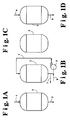
- Step 1 of the invention shown in Fig. 1A, a concentrated solution of Li Cl or other lithium salt, is passed in line 1 to zeolite bed 2 for passage downward therein.
- a mass transfer zone is developed in the bed, wherein Li + ions displace Na + ions from the zeolite material. This results in the formation of a tail brine that is removed from bed 2 through line 3.
- the total equivalents of Li + passed through the bed of zeolite must exceed the Na + displaced from the zeolite in order to attain complete conversion, as evidenced by the complete emergence of the adsorption front of adsorbed Li from the bed.
- the tail brine removed from the bed will, therefore, contain NaCl, but will also contain a considerable quantity of Li + Cl - .
- Techniques have been developed in the art for the recovery of such Li + for recycle and re-use in the overall process for producing mixed cation zeolites. Such techniques are not, however, an essential feature of the subject invention.
- Step 2 of the invention as illustrated in Fig. 1B of the drawings the flow of the concentrated LiCl solution is suspended, and a recirculation loop is established, wherein a Li-rich brine is rapidly circulated through recirculation line 4 containing pump 5 for passage downward through bed 2.
- a pulse containing a determined quantity of Ca ++ is injected into the recirculating fluid in said loop through Ca injection pulse feed line 6.
- Excess brine is discharged through line 7. Due to the high flow rate of the Li-rich brine, the Ca ++ ions are distributed throughout the zeolite bed, where they quickly displace Li + ions from the outer surfaces of all of the zeolite pellets or beads.
- the quantity of Ca ++ ions employed in the pulse is such as to be only slightly more than the amount required in the final product after complete equilibration.
- the quantity of Ca ++ ions employed in the pulse is such as to be only slightly more than the amount required in the final product after complete equilibration.
- essentially all of the Ca ++ enters the zeolite structure, and little Ca ++ remains in solution.
- the ion distribution within the zeolite particles is quite non-uniform.
- Step 3 as shown in Fig. 1C of the drawings, the recirculating flow is stopped, and the particles in zeolite bed 2 are allowed to equilibrate for an extended period of time in the presence of the Li-rich brine. While the diffusion process is slow, the diffusion distances are short, and the process is assisted by the high concentration of Li + ions that can exchange with and mobilize the Ca ++ ions on the surface of the zeolite particles. Step 3 is continued until a near equilibrium state is attained.
- Step 4 shown in Fig. 1D of the drawings, bed 2 is washed with water added through line 8 to remove dissolved salts from the bed, with liquid being discharged from the bottom bed 2 through line 9. During this step, some further equilibration will occur until the liquid in the beads becomes very dilute.
- heated air is passed through the bed, for convenience denoted by said line 8, to dry the zeolite beads. Following such drying, and removal of the heated air or other gas, again for convenience denoted by said line 9, the process is complete, and the desired mixed cation zeolite product can be removed from the ion-exchange system.
- the Na + zeolite is first converted to Li + zeolite by ion-exchange with a Li + solution in Step 1, with the Li + zeolite then being converted to Li + Ca ++ zeolite by a partial ion-exchange with a Ca ++ solution in Step 2.
- Step 1 requires an excess of Li + because the applicable equilibrium constant is small, and the zeolite has a greater affinity for Na + . If the Ca ++ -exchange were to be conducted first, a much greater excess of Li + would be needed for the Li + -Ca ++ exchange, making the overall process much less suitable for practical commercial operations.
- the conversion of the Na + zeolite to Li + zeolite, as in Step 1 above, is carried out in accordance with conventional procedures.
- the uniqueness of the process as herein described and claimed relates to the processing feature whereby quantities of alkaline earth ions, such as Ca ++ , are incorporated into the Li + zeolite.
- the solution used in Step 2 has an initial Ca ++ concentration of about 556 eq m -3 , and the bulk diffusivity of Ca ++ against Li + is 9 x 10 -10 m 2 s -1 .
- the diffusivity in the micropores is 2.13 x 10 -10 m 2 s -1 .
- a fluid flow rate of 2,000 mol m s pertains, corresponding to a linear velocity of 36 x 10 -3 m s -1 .
- the limit rate of the exchange can be calculated by assuming that the rate is limited by diffusion of the Ca ++ -ions inward through a film boundary layer and then through a spherical shell of that part of the particle that has already been calcium exchanged. Li + -ions move outward in a counterflow manner. In the limit, the concentration of Ca ++ drops to zero at the interface between the outer Ca ++ -exchanged shell and the inner Li + -exchanged core.
- the film thickness is estimated to be 12 x 10 -6 m ( ⁇ m).
- the mass flow resistivity has been calculated for a radius ratio of 0.99, where the particles would be 3% Ca ++ -exchanged and for a radius ratio of 0.5, where the particles would be 87.5% exchanged with Ca ++ ions.
- the resulting resistances to mass transfer are shown in the Table below, which also indicates the rates of diffusion into the particles and into a bed of particles having a 32% void fraction.
- HTU Height of a transfer unit
- compositional gradients can be avoided by employing an adsorbent bed that covers a large area, but has a shallow depth, preferably much smaller than the HTU. As the Table shows, this is easier to achieve when a large amount of calcium exchange is desired than when only a minor amount of calcium exchange is desired.
- Steps 2 and 3 are carried out in accordance with the following:
- the process as described above can be characterized as a "batch" process, as opposed to a continuous process where the zeolite and brine streams are both flowed in a countercurrent manner to each other.
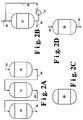
- a "simulated" continuous process can be carried out by adding steps or altering the step durations to form a cyclic process as illustrated in Fig. 2A, Fig. 2B, Fig. 2C, Fig. 2D, Fig. 2E of the drawings.
- Each zeolite bed goes through all of the steps in sequence.
- additional steps not shown, would be employed for loading the zeolite material into a suitable vessel and discharging mixed-cation zeolite product therefrom.
- Steps 3, 2 and 1 are carried out in beds 20, 21 and 22 as shown in Fig. 2A.
- feed brine i.e. LiCl
- the brine solution discharged from the bottom of said bed 20 is passed to the top of bed 21 through line 24 for Li/Na exchange therein in Step 2 of the process.
- the brine solution removed from the bottom of bed 21 is passed through line 25 to the top of bed 22 for passage therethrough with further Li/Na exchange, and with tail brine, comprising NaCl and LiCl, being discharged through line 26.
- Step 4 as shown in Fig. 2B, a feed brine of CaCl 2 is added to the top of bed 27 through line 28 for Ca/Li exchange, with a brine solution being removed from the bottom of said bed 27, and a portion being discharged from the system through line 29 and the remainder being recirculated through line 30, containing pump 31, to the top of said bed 27 for passage therethrough with fresh quantities of feed brine in line 28.
- Step 5 illustrated by Fig. 2C, is an equilibration step wherein the recirculating flow is stopped, and the adsorbent particles are allowed to equilibrate for a period of time in the presence of the Li-rich brine in adsorbent bed 32.
- Step 6 illustrated by Fig. 2D, in which first water and then dry air are passed to bed 33 through line 34, with first liquid and then air being withdrawn from bed 33 through line 35.
- the process of the invention employs a downflow of the indicated solutions through the zeolite bed.
- the resistance imposed by the bed limits the flow rate that can be employed in Step 2 as shown in Fig. 1B, in which brine is recycled to the top of the zeolite bed 2. Since the flow rate should be as high as practical in order to equitably distribute the Ca ++ ions, it is desirable, in some embodiments, to employ an upflow of the Ca ++ solution during this step.
- the solution fluid would tend to lift, expand and mix the zeolite bed, all of which would lead to a more uniform distribution of the Ca ++ ions in the bed. In considering the desirability of employing this approach, such benefits thereof need be balanced against the greater particle attrition that would occur during upflow in order to determine which flow pattern is preferable.
- the process of the invention can be used to produce any desired mixed-cation zeolite product, ranging from those containing predominately lithium ions with only a small concentration of calcium ions, i.e. about 2 ppm, to mixed-cation zeolites containing up to 99% calcium ions.
- a small concentration of calcium ions i.e. about 2 ppm
- mixed-cation zeolites containing up to 99% calcium ions As indicated above, it is most difficult to introduce small, trace amounts of calcium ions into a lithium exchanged zeolite material.
- the invention is, for practical commercial applications, most particularly suited for the preparation of mixed-cation zeolites having from trace amounts, e.g. said about 2 ppm, up to about 25% of calcium exchange.
- the mixed-cation zeolites produced in the practice of the invention can be used advantageously in the wide variety of pressure swing adsorption (PSA) processing cycles known in the art, particularly including vacuum pressure swing adsorption (VPSA) processing cycles, with the mixed-cation zeolites preferably comprising containing Li + ions together with modest amounts of Ca ++ , Mg ++ or other alkali earth metal ions.
- PSA pressure swing adsorption
- VPSA vacuum pressure swing adsorption
- the pulse of Ca ++ or other such cation injection will be seen from the above to be intended to introduce such cations into the recycle brine and into the adsorbent material as quickly as possible without rupture of the injection lines.
- the pulse can extend for as short a period of about 2 seconds up to about two minutes or more, depending on the flow rate and other factors pertaining to any particular embodiment.
- the shallow beds employed in the practice of the invention are most commonly vertical, cylindrical beds having a relatively large diameter and a relatively small depth, although other bed configurations having different cross sectional shapes can also be employed.
- the depth of the shallow bed will range from about 1/2 cm to about 2 cm, but can range up to a full meter depending on various factors, such as the particle size of the adsorbent material, which can be as small as about 1 1/2mm or can range up to about 1/2 meter to about 2 meters.
- the invention represents an important advance in the field of adsorption. It enables relatively uniform mixed cation adsorbents to be produced for use in enhanced pressure swing adsorption operations.
- the uniform product of desired composition thus produced, particularly at very low levels of Ca ++ concentration are readily produced with minimized breakage and loss of fragile but valuable zeolite pellets and beads.
Landscapes
- Chemical & Material Sciences (AREA)
- Inorganic Chemistry (AREA)
- Analytical Chemistry (AREA)
- Organic Chemistry (AREA)
- Chemical Kinetics & Catalysis (AREA)
- Silicates, Zeolites, And Molecular Sieves (AREA)
- Solid-Sorbent Or Filter-Aiding Compositions (AREA)
Applications Claiming Priority (2)
| Application Number | Priority Date | Filing Date | Title |
|---|---|---|---|
| US610017 | 1996-03-04 | ||
| US08/610,017 US5604169A (en) | 1996-03-04 | 1996-03-04 | Process for producing mixed-cation zeolites |
Publications (3)
| Publication Number | Publication Date |
|---|---|
| EP0794002A2 true EP0794002A2 (fr) | 1997-09-10 |
| EP0794002A3 EP0794002A3 (fr) | 1997-11-26 |
| EP0794002B1 EP0794002B1 (fr) | 2001-08-22 |
Family
ID=24443263
Family Applications (1)
| Application Number | Title | Priority Date | Filing Date |
|---|---|---|---|
| EP96119297A Expired - Lifetime EP0794002B1 (fr) | 1996-03-04 | 1996-12-02 | Procédé pour la production de zéolites cationiques mixtes |
Country Status (9)
| Country | Link |
|---|---|
| US (1) | US5604169A (fr) |
| EP (1) | EP0794002B1 (fr) |
| KR (1) | KR100297419B1 (fr) |
| CN (1) | CN1091658C (fr) |
| BR (1) | BR9605776A (fr) |
| CA (1) | CA2191812C (fr) |
| DE (1) | DE69614660T2 (fr) |
| ES (1) | ES2159674T3 (fr) |
| ID (1) | ID16078A (fr) |
Families Citing this family (5)
| Publication number | Priority date | Publication date | Assignee | Title |
|---|---|---|---|---|
| DE19647290A1 (de) * | 1996-11-15 | 1998-05-28 | Bayer Ag | Verfahren zur Herstellung eines mit Lithium-Ionen ausgetauschten, bindemittelfreien Zeolithgranulats und dessen Verwendung zur adsorptiven Lufttrennung |
| FR2775618B1 (fr) * | 1998-03-03 | 2000-05-05 | Air Liquide | Adsorbant a taux d'echange heterogene et procede psa mettant en oeuvre un tel adsorbant |
| US6642168B1 (en) * | 2001-04-27 | 2003-11-04 | Uop Llc | Method for metal loading of a multi-bed adsorbent system |
| FR2970184B1 (fr) * | 2011-01-07 | 2013-08-02 | Air Liquide | Composition zeolitique adaptee a l'epuration d'air |
| CN107486146B (zh) * | 2017-09-06 | 2020-10-23 | 洛阳建龙微纳新材料股份有限公司 | 一种混合阳离子LiCa-LSX分子筛制法及应用 |
Citations (1)
| Publication number | Priority date | Publication date | Assignee | Title |
|---|---|---|---|---|
| US5174979A (en) | 1989-10-06 | 1992-12-29 | Uop | Mixed ion-exchanged zeolites and processes for the use thereof in gas separations |
Family Cites Families (8)
| Publication number | Priority date | Publication date | Assignee | Title |
|---|---|---|---|---|
| DE229391C (fr) * | ||||
| US3542509A (en) * | 1968-02-27 | 1970-11-24 | Farbenfabrik Veb | Process for charging of ion-exchangers |
| US4557736A (en) * | 1984-10-29 | 1985-12-10 | Air Products And Chemicals, Inc. | Binary ion exchanged type X zeolite adsorbent |
| DD229391A1 (de) * | 1984-11-27 | 1985-11-06 | Bitterfeld Chemie | Verfahren zur herstellung gemischtioniger molekularsiebe |
| US4859217A (en) * | 1987-06-30 | 1989-08-22 | Uop | Process for separating nitrogen from mixtures thereof with less polar substances |
| US5152813A (en) * | 1991-12-20 | 1992-10-06 | Air Products And Chemicals, Inc. | Nitrogen adsorption with a Ca and/or Sr exchanged lithium X-zeolite |
| US5258058A (en) * | 1992-10-05 | 1993-11-02 | Air Products And Chemicals, Inc. | Nitrogen adsorption with a divalent cation exchanged lithium X-zeolite |
| US5268023A (en) * | 1992-10-05 | 1993-12-07 | Air Products And Chemicals, Inc. | Nitrogen adsorption with highly Li exchanged X-zeolites with low Si/Al ratio |
-
1996
- 1996-03-04 US US08/610,017 patent/US5604169A/en not_active Expired - Lifetime
- 1996-12-02 ES ES96119297T patent/ES2159674T3/es not_active Expired - Lifetime
- 1996-12-02 ID IDP963564A patent/ID16078A/id unknown
- 1996-12-02 BR BR9605776A patent/BR9605776A/pt active Search and Examination
- 1996-12-02 KR KR1019960060951A patent/KR100297419B1/ko not_active Expired - Fee Related
- 1996-12-02 CA CA002191812A patent/CA2191812C/fr not_active Expired - Fee Related
- 1996-12-02 EP EP96119297A patent/EP0794002B1/fr not_active Expired - Lifetime
- 1996-12-02 CN CN96118588A patent/CN1091658C/zh not_active Expired - Fee Related
- 1996-12-02 DE DE69614660T patent/DE69614660T2/de not_active Expired - Fee Related
Patent Citations (2)
| Publication number | Priority date | Publication date | Assignee | Title |
|---|---|---|---|---|
| US5174979A (en) | 1989-10-06 | 1992-12-29 | Uop | Mixed ion-exchanged zeolites and processes for the use thereof in gas separations |
| US5413625A (en) | 1989-10-06 | 1995-05-09 | Praxair, Inc. | Mixed ion-exchanged zeolites and processes for the use thereof in gas separations |
Also Published As
| Publication number | Publication date |
|---|---|
| KR100297419B1 (ko) | 2001-10-22 |
| CA2191812C (fr) | 1999-06-22 |
| CN1158755A (zh) | 1997-09-10 |
| EP0794002A3 (fr) | 1997-11-26 |
| ID16078A (id) | 1997-09-04 |
| EP0794002B1 (fr) | 2001-08-22 |
| DE69614660T2 (de) | 2002-07-04 |
| BR9605776A (pt) | 1998-08-25 |
| CA2191812A1 (fr) | 1997-09-05 |
| CN1091658C (zh) | 2002-10-02 |
| ES2159674T3 (es) | 2001-10-16 |
| US5604169A (en) | 1997-02-18 |
| DE69614660D1 (de) | 2001-09-27 |
Similar Documents
| Publication | Publication Date | Title |
|---|---|---|
| US5681477A (en) | Thermally-driven ion-exchange process for lithium recovery | |
| SU1126203A3 (ru) | Способ хроматографического разделени полиолов | |
| FI76593C (fi) | Selektiv adsorptioprocess foer separation av mannos ur dess blandningar med glukos och/eller galaktos. | |
| US2671714A (en) | Continuous method for concentrating ions in solutions | |
| JP3037574B2 (ja) | リチウムの回収方法 | |
| EP0794002B1 (fr) | Procédé pour la production de zéolites cationiques mixtes | |
| KR860001659B1 (ko) | 양이온교환수지에 흡착된 칼슘을 선택적으로 제거시키는 방법 | |
| US3378339A (en) | Method of removing the accompanying liquid of a continuously transferred ion exchange resin | |
| EP0128998B1 (fr) | Procédé de traitement de granules de commerce pour améliorer la cinétique de séparation de gaz | |
| CN1080140C (zh) | 单程离子交换生产混合阳离子吸附剂 | |
| JPS58880B2 (ja) | シヨ糖液から着色物を除去する能力の高い粒状活性炭と骨炭との混合物 | |
| Huang et al. | Enzyme purification and concentration by simulated moving bed chromatography: an experimental study | |
| GB2255916A (en) | Method of and device for counter-flow separation of mixture | |
| US4394178A (en) | Bulk lactulose/lactose separation by selective adsorption on zeolitic molecular sieves | |
| US4456774A (en) | Bulk separation of polyhydric alcohols by selective adsorption on zeolitic molecular sieves | |
| EP0237074A2 (fr) | Procédé pour la séparation d oxygène de l air | |
| JP3638624B2 (ja) | 混床式ショ糖液精製装置の再生法 | |
| EP0137063B1 (fr) | Séparation industrielle de polyalcools par adsorption sélective sur des tamis moléculaires de zéolites | |
| SU1261903A1 (ru) | Способ получени углеродного катионита | |
| SU1151506A1 (ru) | Способ получени алюмосиликатного адсорбента | |
| KR880010825A (ko) | 이온 교환 수지에 의한 용해에서 산과 염류를 얻기 위한 방법 | |
| US3505247A (en) | Selective stratification systems of regenerating anion exchange resins | |
| JPH02157117A (ja) | ゼオライト成形体のイオン交換方法 | |
| Glogau et al. | Separate sulfonic and sulfuric acids with an ion exchange resin | |
| HU184947B (en) | Process for preparing adsorbents for the separation of gaseous mixtures containing oxygen and nitrogen from rhyolite tuffs containing mordenite |
Legal Events
| Date | Code | Title | Description |
|---|---|---|---|
| PUAI | Public reference made under article 153(3) epc to a published international application that has entered the european phase |
Free format text: ORIGINAL CODE: 0009012 |
|
| AK | Designated contracting states |
Kind code of ref document: A2 Designated state(s): DE ES FR GB IT |
|
| PUAL | Search report despatched |
Free format text: ORIGINAL CODE: 0009013 |
|
| AK | Designated contracting states |
Kind code of ref document: A3 Designated state(s): DE ES FR GB IT |
|
| 17P | Request for examination filed |
Effective date: 19971204 |
|
| 17Q | First examination report despatched |
Effective date: 19990623 |
|
| GRAG | Despatch of communication of intention to grant |
Free format text: ORIGINAL CODE: EPIDOS AGRA |
|
| GRAG | Despatch of communication of intention to grant |
Free format text: ORIGINAL CODE: EPIDOS AGRA |
|
| GRAH | Despatch of communication of intention to grant a patent |
Free format text: ORIGINAL CODE: EPIDOS IGRA |
|
| GRAH | Despatch of communication of intention to grant a patent |
Free format text: ORIGINAL CODE: EPIDOS IGRA |
|
| GRAA | (expected) grant |
Free format text: ORIGINAL CODE: 0009210 |
|
| ITF | It: translation for a ep patent filed | ||
| AK | Designated contracting states |
Kind code of ref document: B1 Designated state(s): DE ES FR GB IT |
|
| REF | Corresponds to: |
Ref document number: 69614660 Country of ref document: DE Date of ref document: 20010927 |
|
| REG | Reference to a national code |
Ref country code: ES Ref legal event code: FG2A Ref document number: 2159674 Country of ref document: ES Kind code of ref document: T3 |
|
| PGFP | Annual fee paid to national office [announced via postgrant information from national office to epo] |
Ref country code: GB Payment date: 20011122 Year of fee payment: 6 |
|
| ET | Fr: translation filed | ||
| REG | Reference to a national code |
Ref country code: GB Ref legal event code: IF02 |
|
| PGFP | Annual fee paid to national office [announced via postgrant information from national office to epo] |
Ref country code: ES Payment date: 20020109 Year of fee payment: 6 |
|
| PLBE | No opposition filed within time limit |
Free format text: ORIGINAL CODE: 0009261 |
|
| STAA | Information on the status of an ep patent application or granted ep patent |
Free format text: STATUS: NO OPPOSITION FILED WITHIN TIME LIMIT |
|
| 26N | No opposition filed | ||
| PG25 | Lapsed in a contracting state [announced via postgrant information from national office to epo] |
Ref country code: GB Free format text: LAPSE BECAUSE OF NON-PAYMENT OF DUE FEES Effective date: 20021202 |
|
| PG25 | Lapsed in a contracting state [announced via postgrant information from national office to epo] |
Ref country code: ES Free format text: LAPSE BECAUSE OF NON-PAYMENT OF DUE FEES Effective date: 20021203 |
|
| PGFP | Annual fee paid to national office [announced via postgrant information from national office to epo] |
Ref country code: DE Payment date: 20021230 Year of fee payment: 7 |
|
| GBPC | Gb: european patent ceased through non-payment of renewal fee | ||
| PG25 | Lapsed in a contracting state [announced via postgrant information from national office to epo] |
Ref country code: DE Free format text: LAPSE BECAUSE OF NON-PAYMENT OF DUE FEES Effective date: 20040701 |
|
| REG | Reference to a national code |
Ref country code: ES Ref legal event code: FD2A Effective date: 20021203 |
|
| PGFP | Annual fee paid to national office [announced via postgrant information from national office to epo] |
Ref country code: FR Payment date: 20041217 Year of fee payment: 9 |
|
| PG25 | Lapsed in a contracting state [announced via postgrant information from national office to epo] |
Ref country code: IT Free format text: LAPSE BECAUSE OF NON-PAYMENT OF DUE FEES;WARNING: LAPSES OF ITALIAN PATENTS WITH EFFECTIVE DATE BEFORE 2007 MAY HAVE OCCURRED AT ANY TIME BEFORE 2007. THE CORRECT EFFECTIVE DATE MAY BE DIFFERENT FROM THE ONE RECORDED. Effective date: 20051202 |
|
| PG25 | Lapsed in a contracting state [announced via postgrant information from national office to epo] |
Ref country code: FR Free format text: LAPSE BECAUSE OF NON-PAYMENT OF DUE FEES Effective date: 20060831 |
|
| REG | Reference to a national code |
Ref country code: FR Ref legal event code: ST Effective date: 20060831 |