EP0770996A2 - Amorphe Legierung, bestehend aus einem leichten seltene Erde-Übergangsmetall und Halbmetall, magneto-optische Aufzeichnungsschicht und magneto-optische Platte damit - Google Patents
Amorphe Legierung, bestehend aus einem leichten seltene Erde-Übergangsmetall und Halbmetall, magneto-optische Aufzeichnungsschicht und magneto-optische Platte damit Download PDFInfo
- Publication number
- EP0770996A2 EP0770996A2 EP96307750A EP96307750A EP0770996A2 EP 0770996 A2 EP0770996 A2 EP 0770996A2 EP 96307750 A EP96307750 A EP 96307750A EP 96307750 A EP96307750 A EP 96307750A EP 0770996 A2 EP0770996 A2 EP 0770996A2
- Authority
- EP
- European Patent Office
- Prior art keywords
- magneto
- metal
- semi
- recording layer
- optical recording
- Prior art date
- Legal status (The legal status is an assumption and is not a legal conclusion. Google has not performed a legal analysis and makes no representation as to the accuracy of the status listed.)
- Granted
Links
Images


Classifications
-
- G—PHYSICS
- G11—INFORMATION STORAGE
- G11B—INFORMATION STORAGE BASED ON RELATIVE MOVEMENT BETWEEN RECORD CARRIER AND TRANSDUCER
- G11B5/00—Recording by magnetisation or demagnetisation of a record carrier; Reproducing by magnetic means; Record carriers therefor
- G11B5/62—Record carriers characterised by the selection of the material
-
- G—PHYSICS
- G11—INFORMATION STORAGE
- G11B—INFORMATION STORAGE BASED ON RELATIVE MOVEMENT BETWEEN RECORD CARRIER AND TRANSDUCER
- G11B11/00—Recording on or reproducing from the same record carrier wherein for these two operations the methods are covered by different main groups of groups G11B3/00 - G11B7/00 or by different subgroups of group G11B9/00; Record carriers therefor
- G11B11/10—Recording on or reproducing from the same record carrier wherein for these two operations the methods are covered by different main groups of groups G11B3/00 - G11B7/00 or by different subgroups of group G11B9/00; Record carriers therefor using recording by magnetic means or other means for magnetisation or demagnetisation of a record carrier, e.g. light induced spin magnetisation; Demagnetisation by thermal or stress means in the presence or not of an orienting magnetic field
- G11B11/105—Recording on or reproducing from the same record carrier wherein for these two operations the methods are covered by different main groups of groups G11B3/00 - G11B7/00 or by different subgroups of group G11B9/00; Record carriers therefor using recording by magnetic means or other means for magnetisation or demagnetisation of a record carrier, e.g. light induced spin magnetisation; Demagnetisation by thermal or stress means in the presence or not of an orienting magnetic field using a beam of light or a magnetic field for recording by change of magnetisation and a beam of light for reproducing, i.e. magneto-optical, e.g. light-induced thermomagnetic recording, spin magnetisation recording, Kerr or Faraday effect reproducing
- G11B11/10582—Record carriers characterised by the selection of the material or by the structure or form
- G11B11/10586—Record carriers characterised by the selection of the material or by the structure or form characterised by the selection of the material
-
- Y—GENERAL TAGGING OF NEW TECHNOLOGICAL DEVELOPMENTS; GENERAL TAGGING OF CROSS-SECTIONAL TECHNOLOGIES SPANNING OVER SEVERAL SECTIONS OF THE IPC; TECHNICAL SUBJECTS COVERED BY FORMER USPC CROSS-REFERENCE ART COLLECTIONS [XRACs] AND DIGESTS
- Y10—TECHNICAL SUBJECTS COVERED BY FORMER USPC
- Y10T—TECHNICAL SUBJECTS COVERED BY FORMER US CLASSIFICATION
- Y10T428/00—Stock material or miscellaneous articles
- Y10T428/26—Web or sheet containing structurally defined element or component, the element or component having a specified physical dimension
Definitions
- the present invention relates to a perpendicular magnetic anisotropy alloy, a magneto-optical recording layer made of the alloy and a magneto-optical disk adopting the layer, and more particularly, to an amorphous alloy of light rare earth-transition metal and a semi-metal (metalloid), a magneto-optical recording layer made of the amorphous alloy, which exhibits excellent magneto-optical characteristics in a short wavelength range, and a magneto-optical disk adopting the layer.
- a magneto-optical disk has high storage density compared to a conventional magnetic disk, and random access characteristics for facilitated searches.
- the magneto-optical disk is looked to as a high density recording medium which can replace the hard disk and the magnetic tape.
- the recording layer of the magneto-optical disk is manufactured by depositing a binary alloy of heavy rare earth-transition metal (HRE-TM) having a perpendicular magnetic easy axis with respect to the surface of the recording layer by using a sputtering or vapor deposition method.
- HRE-TM heavy rare earth-transition metal
- terbium iron (TbFe) or terbium cobalt (TbCo) is used as the binary RE-TM alloy, a strong coercive force and enough magneto-optical effects can be attained, however, corrosion resistance is low.
- an alloy of the above binary alloy and another metal has been used as the material for the magneto-optical recording layer, which will be described in detail with reference to FIG. 1.
- TbFeCo terbium iron cobalt
- amorphous TbFeCo alloy is used in the short wavelength region of 400nm for improving the magneto-optical recording density, Kerr rotation angle is decreased at the short wavelength region due to the transition of the electron of heavy rare earth metal Tb at a low energy level (i.e., long wavelength), from 4f to 5d, as shown in FIG. 1, thereby reducing the Kerr rotation angle.
- the amorphous alloy of TbFeCo is not desirable as the material for the recording layer of the recording medium in short wavelengths for high density recording.
- an alloy of light rare earth-transition metal (LRE-TM) of neodymium iron cobalt (NdFeCo) which increases the Kerr rotation angle in the short wavelength region as shown in FIG. 1 has attracted attention as the material for the recording layer of a magneto-optical recording medium in short wavelengths.
- LRE-TM light rare earth-transition metal
- NdFeCo neodymium iron cobalt
- the demagnetizing energy is high.
- the alloy of NdFeCo does not have perpendicular magnetic anisotropy to the surface of a recording layer, so that the alloy cannot be used as material for the recording layer of the magneto-optical recording medium in short wavelengths.
- the light rare earth metal has been partially substituted with a heavy rare earth metal. That is, an amorphous alloy of neodymium terbium iron cobalt (NdTbFeCo) has been developed in which the ferro-magnetic coupling is partially substituted by a ferri-magnetic coupling to decrease the demagnetizing energy, so that perpendicular magnetic anisotropy to the surface of a recording layer can be induced.
- NdTbFeCo neodymium terbium iron cobalt
- the Kerr rotation angle is reduced in the short wavelength region as much as the magnetic moment of the light rare earth metal substituted by the heavy rare earth metal, as shown in FIG. 1.
- an amorphous alloy of light rare earth-transition metal and semi-metal which can attain perpendicular magnetic anisotropy in a short wavelength region without decrease of magnetic moment, wherein light rare earth metal is at least one selected from the group consisting of cerium (Ce), praseodymium (Pr), neodymium (Nd), promethium (Pm), samarium (Sm), europium (Eu) and gadolinium (Gd), transition metal is at least one selected from the group consisting of iron (Fe), nickel (Ni) and cobalt (Co), and semi-metal is at least one selected from the group consisting of boron (B), silicon (Si) and phosphorus (P).
- light rare earth metal is at least one selected from the group consisting of cerium (Ce), praseodymium (Pr), neodymium (Nd), promethium (Pm), samarium (Sm), europium (Eu) and gad
- the content of the light rare earth metal is 20 ⁇ 30 atomic%, that of the transition metal is 65 ⁇ 79.5 at.%, and that of the semi-metal is 0.5 ⁇ 5 at.%.
- the magneto-optical recording layer is formed of the amorphous alloy.
- the magneto-optical disk of the present invention includes the magneto-optical recording layer made of the amorphous alloy of the light rare earth-transition metal and the semi-metal.
- an amorphous alloy of light rare earth-transition metal and semi-metal and a magneto-optical recording layer formed of the amorphous alloy, and a magneto-optical disk including the magneto-optical recording layer are provided.
- the magneto-optical disk includes a reflection preventing layer made of dielectric material, formed on a substrate, a magneto-optical recording layer formed on the reflection preventing layer, which is made of an amorphous alloy of light rare earth-transition metal and semi-metal, a protection layer formed on the magneto-optical recording layer, for protecting the magneto-optical recording layer, and a reflection layer formed on the protection layer.
- light rare earth metal is at least one selected from the group consisting of cerium (Ce), praseodymium (Pr), neodymium (Nd), promethium (Pm), samarium (Sm), europium (Eu) and gadolinium (Gd), transition metal is at least one selected from the group consisting of iron (Fe), nickel (Ni) and cobalt (Co), and semi-metal is at least one selected from the group consisting of boron (B), silicon (Si) and phosphorus (P).
- the content of the light rare earth metal is 20 ⁇ 30 at.%, and that of the transition metal is 65 ⁇ 79.5 at.%.
- the content of the semi-metal is preferably 0.5 ⁇ 5 at.% with respect to the alloy, particularly, about 2.5 ⁇ 5 at.% of boron (B), preferably, 0.03 at.%, about 1.5 ⁇ 5 at.% of silicon (Si), preferably, 0.02 at.% and about 0.5 ⁇ 5 at.% of phosphorous (P), preferably, 1 at.%, as the semi-metal.
- B boron
- Si silicon
- P phosphorous
- SiN is mainly used, however, Si 3 N 4 , SiO or SiO 2 may be used as well.
- SiN is mainly used, however, Si 3 N 4 , SiO or SiO 2 may be used as well.
- the reflection layer aluminum (Al) alloy or gold (Au) alloy is used.
- the thickness of the magneto-optical recording layer is 10 ⁇ 1 ⁇ m. That is, when the thickness of the magneto-optical recording layer is below 1 ⁇ m, perpendicular magneto anisotropy is maintained in a desirable level.
- an amorphous alloy is fabricated by adding a semi-metal to an amorphous alloy of light rare earth-transition metal, free electrons emitted from p orbit of the semi-metal shift to d orbit of the transition metal which is not fully filled, p-d electron orbit coupling between the semi-metal and the transition metal is induced, which decreases the magnitude of the saturation magnetization. As a result, the demagnetizing energy is decreased to induce a magnetic anisotropy. At this time, the Kerr rotation angle is not affected since the semi-metal does not affect unfilled 4f orbit which determines the magnetic moment of the light rare earth metal.
- the amorphous alloy of the light rare earth-transition metal and semi-metal is excellent as the material for the recording layer of the magneto-optical recording medium in a short wavelength range.
- FIG. 2 is a schematic cross-sectional view of a magneto-optical disk for a short wavelength according to a preferred embodiment of the present invention.
- the thickness of the magneto-optical recording layer 3 should be below 1 ⁇ m.
- a protection layer 4 made of a dielectric material such as silicon nitride (SiN) and a reflection layer 5 are stacked on the magneto-optical recording layer 3 in sequence.
- the alloy is fabricated, and then the magneto-optical recording layer using the alloy and the magneto-optical disk adopting the recording layer are fabricated.
- an alloy target for forming an amorphous magneto-optical recording layer is prepared by adding an amorphous alloy of light rare earth-transition metal to a semi-metal. Then, the obtained alloy is sputtered on the transparent substrate on which a SiN layer as a reflection preventing layer is formed.
- a physical vapor deposition (PVD) or chemical vapor deposition (CVD) method may be used instead of the sputtering method.
- Si 3 N 4 , SiO or SiO 2 may be used instead of SiN.
- SiN is again deposited on the amorphous magneto-optical recording layer to form the protection layer, and an aluminum (Al) reflection layer is then stacked on the resultant.
- Al aluminum
- Si 3 N 4 , SiO or SiO 2 may be used instead of SiN, and Al alloy or Au alloy may be used as a material of the reflection layer.
- FIGS. 3 through 8 are graphs showing the characteristics of the alloy for forming the magneto-optical recording layer of the present invention, the magneto-optical recording layer, and the magneto-optical disk, wherein an alloy of neodymium iron cobalt boron (NdfeCoB) as the amorphous alloy of the amorphous light rare earth-transition metal and semi-metal was used to form the magneto-optical recording layer.
- NdfeCoB neodymium iron cobalt boron
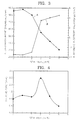
- FIG. 3 is a graph showing the saturation magnetization (line A ) and the perpendicular magnetic anisotropic energy (line B ) according to the content of semi-metal added to the amorphous alloy of light rare earth-transition metal.
- the saturation magnetization of the alloy is sharply decreased.
- the decrease in saturation magnetization induces a decrease in the demagnetizing energy.
- the perpendicular magnetic anisotropy is induced in the amorphous alloy of the light rare earth-transition metal to which the semi-metal is added.
- the alloy of the present invention comes to have perpendicular magnetic anisotropy, providing an excellent optical magnetic effect at the short wavelength region.
- FIG. 4 is a graph showing the coercive force of the alloy used for forming the magneto-optical recording layer according to the content of semi-metal added to the amorphous alloy of the light rare earth-transition metal.
- the content of semi-metal with respect to the alloy for forming the magneto-optical recording layer is 2 ⁇ 4 at.%, preferably, about 3 at.%
- the coercive force of the alloy is high. This is because the elastic energy of the amorphous alloy increases by the p-d electron orbit coupling. This increased coercive force is sufficient for stable storage of information, so that the amorphous alloy of the light rare earth-transition metal can be used as the material for the recording layer of a recording medium in a short wavelengths.
- FIG. 5 is a graph showing the Curie temperature of the alloy used for forming the magneto-optical recording layer according to the content of semi-metal added to the amorphous alloy of the light rare earth-transition metal. As shown in FIG. 5, when the content of semi-metal with respect to the alloy for forming the magneto-optical recording layer is 2 ⁇ 5 at.%, the Curie temperature of the alloy is not changed severely. That is, the Curie temperature is maintained in a proper range, near 180°C, for the magneto-optical recording.
- FIG. 6 is a graph showing the Kerr rotation angle in a short wavelength region (400nm) of a magneto-optical disk of the present invention, according to the content of semi-metal added to the amorphous alloy of the light rare earth-transition metal.
- the Kerr rotation angle greatly increases.
- the content of the semi-metal is 2 ⁇ 5 at.%, the Kerr rotation angle remains in a range of 1.4 ⁇ 1.6° which is suitable for the magneto-optical recording in the short wavelength. This is because the added semi-metal reacts on the transition metal without any effect on the light rare earth metal.
- the short wavelength laser beam of 400nm is irradiated on the magneto-optical recording layer of the disk to shift the electrons of light rare earth metal from the 4f orbit to the 5d orbit, so that the magneto-optical energy is emitted with high energy, resulting large Kerr rotation angle at the short wavelength region.
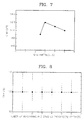
- FIG. 7 is a graph showing the carrier-to-noise ratio (CNR) of the magneto-optical disk of the present invention in the short wavelength region (400nm), according to the content of semi-metal added to the amorphous alloy of the light rare earth-transition metal, wherein the CNR represents a reproducing characteristic.
- the content of the semi-metal with respect to the alloy for forming the magneto-optical recording layer was increased up to 5 at.%, however, the CNR remains in the level of about 50dB.
- the CNR remains at a high level, thus the magneto-optical disk of the present invention can be used as a high density magneto-optical recording medium.
- FIG. 8 is a graph showing the CNR of the magneto-optical disk of the present invention according to the number of recording and erasing processes. As shown in FIG. 8, even after the recording and erasing processes are repeated to 10 6 times, the CNR does not decrease. That is, this graph shows the reliability and durability of the magneto-optical disk of the present invention as a magneto-optical recording medium.
- the result is preferable at about 1.5 ⁇ 5 at.% of Si, particularly, about 2 at.%, and about 0.5% ⁇ 5 at.% of P, particularly, about 1 at.%.
- the perpendicular magnetic anisotropy is induced from the amorphous alloy of the light rare earth-transition metal and semi-metal, so that the amorphous alloy can preferably be used as materials for the magneto-optical recording layer for a short wavelength, and for the magneto-optical disk adopting the recording layer.
- the magneto-optical recording layer of the present invention semi-metal is added to the amorphous alloy of the light rare earth-transition metal to induce the p-d electron orbit coupling between the transition metal of the amorphous alloy and the added semi-metal, thereby decreasing the demagnetizing energy of the amorphous alloy without any effect on the magnetic moment of the light rare earth metal.
- the magneto-optical disk of the present invention can attain perpendicular magnetic anisotropy to a recording layer in the short wavelength region and the large Kerr rotation angle can be maintained for used as a magneto-optical recording medium having excellent magneto-optical characteristics.
Applications Claiming Priority (6)
| Application Number | Priority Date | Filing Date | Title |
|---|---|---|---|
| KR9537773 | 1995-10-28 | ||
| KR19950037773 | 1995-10-28 | ||
| KR9539037 | 1995-10-31 | ||
| KR19950039037 | 1995-10-31 | ||
| KR9646847 | 1996-10-18 | ||
| KR1019960046847A KR0183938B1 (ko) | 1995-10-28 | 1996-10-18 | 비정질 경희토류-천이금속과 반금속의 합금,이로부터 형성되는 광자기 기록막 및 이 기록막을 채용한 광자기 디스크 |
Publications (3)
| Publication Number | Publication Date |
|---|---|
| EP0770996A2 true EP0770996A2 (de) | 1997-05-02 |
| EP0770996A3 EP0770996A3 (de) | 1998-01-28 |
| EP0770996B1 EP0770996B1 (de) | 2002-09-18 |
Family
ID=27349238
Family Applications (1)
| Application Number | Title | Priority Date | Filing Date |
|---|---|---|---|
| EP96307750A Expired - Lifetime EP0770996B1 (de) | 1995-10-28 | 1996-10-25 | Amorphe Legierung, bestehend aus einem leichten seltene Erde-Übergangsmetall und Halbmetall, magneto-optische Aufzeichnungsschicht und magneto-optische Platte damit |
Country Status (5)
| Country | Link |
|---|---|
| US (1) | US6331338B1 (de) |
| EP (1) | EP0770996B1 (de) |
| JP (1) | JP3235015B2 (de) |
| KR (1) | KR0183938B1 (de) |
| DE (1) | DE69623721T2 (de) |
Cited By (3)
| Publication number | Priority date | Publication date | Assignee | Title |
|---|---|---|---|---|
| GB2320606B (en) * | 1996-12-10 | 2001-01-31 | Peter Wachter | Devcice for magneto-optical recording |
| SG112882A1 (en) * | 2002-07-25 | 2005-07-28 | Toshiba Kk | Perpendicular magnetic recording medium and magnetic recording/reproduction apparatus |
| SG114492A1 (en) * | 2000-07-11 | 2005-09-28 | Fuji Electric Co Ltd | Perpendicular magnetic recording medium |
Families Citing this family (1)
| Publication number | Priority date | Publication date | Assignee | Title |
|---|---|---|---|---|
| CN119480318A (zh) * | 2024-11-15 | 2025-02-18 | 北京大学 | 一种磁性材料及其制备方法和应用 |
Family Cites Families (31)
| Publication number | Priority date | Publication date | Assignee | Title |
|---|---|---|---|---|
| US4693943A (en) * | 1982-05-10 | 1987-09-15 | Canon Kabushiki Kaisha | Magnetooptical recording medium |
| EP0319636B1 (de) * | 1982-12-15 | 1993-03-31 | Sharp Kabushiki Kaisha | Magneto-optischer Speicher |
| JPS6079702A (ja) * | 1983-10-06 | 1985-05-07 | Kokusai Denshin Denwa Co Ltd <Kdd> | 光磁気記録媒体 |
| JPS60128606A (ja) * | 1983-12-15 | 1985-07-09 | Seiko Instr & Electronics Ltd | 光磁気記録媒体 |
| JPS6122608A (ja) * | 1984-07-11 | 1986-01-31 | Hitachi Ltd | 光磁気記録材料 |
| US5529854A (en) * | 1984-09-12 | 1996-06-25 | Seiko Epson Corporation | Magneto-optic recording systems |
| EP0184034B1 (de) * | 1984-11-12 | 1991-01-16 | Sumitomo Special Metals Co., Ltd. | Senkrecht magnetisiertes Aufzeichnungsmedium und Verfahren zu seiner Herstellung |
| JPH0782670B2 (ja) * | 1985-07-12 | 1995-09-06 | 株式会社日立製作所 | 光磁気記録媒体 |
| NL8600647A (nl) * | 1986-03-13 | 1987-10-01 | Philips Nv | Magneto-optisch registratie-element en een magneto-optische registratie-inrichting. |
| JPS62226450A (ja) * | 1986-03-27 | 1987-10-05 | Seiko Epson Corp | 光磁気記録媒体 |
| JPS62239447A (ja) * | 1986-04-11 | 1987-10-20 | Oki Electric Ind Co Ltd | 光磁気記録用媒体 |
| JPS62246159A (ja) * | 1986-04-18 | 1987-10-27 | Seiko Epson Corp | 光磁気記録媒体 |
| JPS62262245A (ja) * | 1986-05-07 | 1987-11-14 | Seiko Epson Corp | 光磁気記録媒体 |
| JPH0746447B2 (ja) * | 1986-07-29 | 1995-05-17 | セイコーエプソン株式会社 | 光磁気記録媒体の製造法 |
| JPS6334753A (ja) * | 1986-07-29 | 1988-02-15 | Seiko Epson Corp | 光磁気記録媒体 |
| JPS63140058A (ja) * | 1986-12-03 | 1988-06-11 | Hitachi Ltd | 光磁気記録材料 |
| EP0289031A3 (de) * | 1987-05-01 | 1989-02-08 | Shin-Etsu Chemical Co., Ltd. | Magneto-optischer Aufzeichnungsträger |
| JPS63308750A (ja) * | 1987-06-10 | 1988-12-16 | Seiko Epson Corp | 光磁気記録媒体 |
| JPS63311643A (ja) * | 1987-06-15 | 1988-12-20 | Seiko Epson Corp | 光磁気記録媒体 |
| US4995923A (en) * | 1988-10-17 | 1991-02-26 | Mitsui Petrochemical Industries, Ltd. | Thin film of amorphous alloy |
| JPH0784658B2 (ja) * | 1988-10-26 | 1995-09-13 | 住友金属鉱山株式会社 | 光磁気記録用合金ターゲット |
| US4992095A (en) * | 1988-10-26 | 1991-02-12 | Sumitomo Metal Mining Company, Ltd. | Alloy target used for manufacturing magneto-optical recording medium |
| EP0368194B1 (de) * | 1988-11-07 | 1998-06-17 | Hitachi, Ltd. | Magneto-optisches Speichermedium |
| JPH02254648A (ja) * | 1989-03-28 | 1990-10-15 | Seiko Epson Corp | 光磁気ディスク |
| CA2017284C (en) * | 1989-07-04 | 1995-10-03 | Kazutomi Suzuki | Optical recording medium |
| CA2014751C (en) * | 1989-10-19 | 1996-01-23 | Kunihiko Mizumoto | Magnetooptical recording media |
| DE4029874A1 (de) * | 1990-09-21 | 1992-03-26 | Basf Ag | Magnetooptische datenplatte mit pt-haltiger leseschicht |
| DE4039919A1 (de) * | 1990-12-14 | 1992-06-17 | Basf Ag | Magnetooptische datenplatte mit korrosionsstabiler magnetooptischer doppelschicht |
| JP3029485B2 (ja) * | 1991-07-22 | 2000-04-04 | キヤノン株式会社 | 光磁気記録媒体 |
| JP2629505B2 (ja) * | 1991-11-14 | 1997-07-09 | 日本ビクター株式会社 | 垂直磁気記録媒体及びその製造方法 |
| JP2925424B2 (ja) * | 1992-09-09 | 1999-07-28 | 三菱電機株式会社 | オーバーライト可能な高密度光磁気記録媒体 |
-
1996
- 1996-10-18 KR KR1019960046847A patent/KR0183938B1/ko not_active Expired - Fee Related
- 1996-10-25 EP EP96307750A patent/EP0770996B1/de not_active Expired - Lifetime
- 1996-10-25 DE DE69623721T patent/DE69623721T2/de not_active Expired - Fee Related
- 1996-10-28 US US08/738,837 patent/US6331338B1/en not_active Expired - Fee Related
- 1996-10-28 JP JP28507696A patent/JP3235015B2/ja not_active Expired - Fee Related
Non-Patent Citations (1)
| Title |
|---|
| None |
Cited By (4)
| Publication number | Priority date | Publication date | Assignee | Title |
|---|---|---|---|---|
| GB2320606B (en) * | 1996-12-10 | 2001-01-31 | Peter Wachter | Devcice for magneto-optical recording |
| SG114492A1 (en) * | 2000-07-11 | 2005-09-28 | Fuji Electric Co Ltd | Perpendicular magnetic recording medium |
| SG112882A1 (en) * | 2002-07-25 | 2005-07-28 | Toshiba Kk | Perpendicular magnetic recording medium and magnetic recording/reproduction apparatus |
| US7132176B2 (en) | 2002-07-25 | 2006-11-07 | Kabushiki Kaisha Toshiba | Perpendicular magnetic recording medium and magnetic recording/reproduction apparatus |
Also Published As
| Publication number | Publication date |
|---|---|
| JPH09195018A (ja) | 1997-07-29 |
| DE69623721D1 (de) | 2002-10-24 |
| KR970023004A (ko) | 1997-05-30 |
| JP3235015B2 (ja) | 2001-12-04 |
| EP0770996A3 (de) | 1998-01-28 |
| KR0183938B1 (ko) | 1999-04-15 |
| US6331338B1 (en) | 2001-12-18 |
| EP0770996B1 (de) | 2002-09-18 |
| DE69623721T2 (de) | 2003-05-22 |
Similar Documents
| Publication | Publication Date | Title |
|---|---|---|
| Kryder | Magneto‐optic recording technology | |
| Hashimoto et al. | Co/Pt and Co/Pd multilayers as magneto-optical recording materials | |
| US4645722A (en) | Photo-thermo-magnetic recording medium and method of preparing same | |
| US5976688A (en) | Magneto-optical recording medium and method of manufacturing the same | |
| EP0184034A2 (de) | Senkrecht magnetisiertes Aufzeichnungsmedium und Verfahren zu seiner Herstellung | |
| EP0470546B1 (de) | Magnetooptischer Aufzeichnungsträger | |
| EP0770996B1 (de) | Amorphe Legierung, bestehend aus einem leichten seltene Erde-Übergangsmetall und Halbmetall, magneto-optische Aufzeichnungsschicht und magneto-optische Platte damit | |
| JPS6134744A (ja) | 磁気光学記録媒体 | |
| US4897320A (en) | Magneto-optical recording medium | |
| US6324127B1 (en) | Magneto-optical recording layer having double-layer structure and magneto-optical disk adopting the same | |
| US5958575A (en) | Magneto-optical recording medium | |
| US4992336A (en) | Magneto-optical recording medium | |
| EP0330394A2 (de) | Zweischichtiger magneto-optischer Aufzeichnungsträger mit einer Schicht niedriger Koerzitivkraft, bestehend aus Gd und mindestens Tb oder Dy | |
| EP0305185B1 (de) | Optomagnetischer Aufzeichnungsträger mit einer Mehrzahl von austauschgekoppelten magnetischen Schichten | |
| US5100741A (en) | Magneto-optic recording systems | |
| US5095350A (en) | Magneto-optic memory medium | |
| EP0233062A2 (de) | Magnetisch-optisches Gedächtnismedium | |
| JPS59201247A (ja) | 光磁気記録媒体 | |
| KR950003181B1 (ko) | 광자기 기록매체 | |
| US5225289A (en) | Opto-magnetic recording medium having plurality of exchange-coupled magnetic layers | |
| EP0713598A1 (de) | Magneto-optisches aufzeichnungsmedium | |
| CA2014158C (en) | Magneto-optic memory medium | |
| JP2528184B2 (ja) | 光磁気記録媒体 | |
| US5730846A (en) | Method of producing a magneto-optical recording medium | |
| JPS61296551A (ja) | 光磁気記録素子の製造方法 |
Legal Events
| Date | Code | Title | Description |
|---|---|---|---|
| PUAI | Public reference made under article 153(3) epc to a published international application that has entered the european phase |
Free format text: ORIGINAL CODE: 0009012 |
|
| AK | Designated contracting states |
Kind code of ref document: A2 Designated state(s): DE FR GB |
|
| RIN1 | Information on inventor provided before grant (corrected) |
Inventor name: KIM, JAI-YOUNG |
|
| 17P | Request for examination filed |
Effective date: 19970903 |
|
| PUAL | Search report despatched |
Free format text: ORIGINAL CODE: 0009013 |
|
| AK | Designated contracting states |
Kind code of ref document: A3 Designated state(s): DE FR GB |
|
| 17Q | First examination report despatched |
Effective date: 20000511 |
|
| GRAG | Despatch of communication of intention to grant |
Free format text: ORIGINAL CODE: EPIDOS AGRA |
|
| GRAG | Despatch of communication of intention to grant |
Free format text: ORIGINAL CODE: EPIDOS AGRA |
|
| GRAH | Despatch of communication of intention to grant a patent |
Free format text: ORIGINAL CODE: EPIDOS IGRA |
|
| GRAH | Despatch of communication of intention to grant a patent |
Free format text: ORIGINAL CODE: EPIDOS IGRA |
|
| GRAA | (expected) grant |
Free format text: ORIGINAL CODE: 0009210 |
|
| AK | Designated contracting states |
Kind code of ref document: B1 Designated state(s): DE FR GB |
|
| REG | Reference to a national code |
Ref country code: GB Ref legal event code: FG4D |
|
| REF | Corresponds to: |
Ref document number: 69623721 Country of ref document: DE Date of ref document: 20021024 |
|
| ET | Fr: translation filed | ||
| PLBE | No opposition filed within time limit |
Free format text: ORIGINAL CODE: 0009261 |
|
| STAA | Information on the status of an ep patent application or granted ep patent |
Free format text: STATUS: NO OPPOSITION FILED WITHIN TIME LIMIT |
|
| 26N | No opposition filed |
Effective date: 20030619 |
|
| PGFP | Annual fee paid to national office [announced via postgrant information from national office to epo] |
Ref country code: DE Payment date: 20061019 Year of fee payment: 11 |
|
| PGFP | Annual fee paid to national office [announced via postgrant information from national office to epo] |
Ref country code: GB Payment date: 20061025 Year of fee payment: 11 |
|
| GBPC | Gb: european patent ceased through non-payment of renewal fee |
Effective date: 20071025 |
|
| PG25 | Lapsed in a contracting state [announced via postgrant information from national office to epo] |
Ref country code: DE Free format text: LAPSE BECAUSE OF NON-PAYMENT OF DUE FEES Effective date: 20080501 |
|
| REG | Reference to a national code |
Ref country code: FR Ref legal event code: ST Effective date: 20080630 |
|
| PGFP | Annual fee paid to national office [announced via postgrant information from national office to epo] |
Ref country code: FR Payment date: 20061010 Year of fee payment: 11 |
|
| PG25 | Lapsed in a contracting state [announced via postgrant information from national office to epo] |
Ref country code: GB Free format text: LAPSE BECAUSE OF NON-PAYMENT OF DUE FEES Effective date: 20071025 |
|
| PG25 | Lapsed in a contracting state [announced via postgrant information from national office to epo] |
Ref country code: FR Free format text: LAPSE BECAUSE OF NON-PAYMENT OF DUE FEES Effective date: 20071031 |