EP0776768A2 - Aufzeichnungsschicht, die bei einem Elektrokoagulationsdruckverfahren verwendet wird - Google Patents
Aufzeichnungsschicht, die bei einem Elektrokoagulationsdruckverfahren verwendet wird Download PDFInfo
- Publication number
- EP0776768A2 EP0776768A2 EP96119086A EP96119086A EP0776768A2 EP 0776768 A2 EP0776768 A2 EP 0776768A2 EP 96119086 A EP96119086 A EP 96119086A EP 96119086 A EP96119086 A EP 96119086A EP 0776768 A2 EP0776768 A2 EP 0776768A2
- Authority
- EP
- European Patent Office
- Prior art keywords
- sheet
- boehmite
- images
- set forth
- filler
- Prior art date
- Legal status (The legal status is an assumption and is not a legal conclusion. Google has not performed a legal analysis and makes no representation as to the accuracy of the status listed.)
- Granted
Links
Images

Classifications
-
- B—PERFORMING OPERATIONS; TRANSPORTING
- B41—PRINTING; LINING MACHINES; TYPEWRITERS; STAMPS
- B41M—PRINTING, DUPLICATING, MARKING, OR COPYING PROCESSES; COLOUR PRINTING
- B41M5/00—Duplicating or marking methods; Sheet materials for use therein
- B41M5/50—Recording sheets characterised by the coating used to improve ink, dye or pigment receptivity, e.g. for ink-jet or thermal dye transfer recording
- B41M5/52—Macromolecular coatings
- B41M5/5218—Macromolecular coatings characterised by inorganic additives, e.g. pigments, clays
-
- B—PERFORMING OPERATIONS; TRANSPORTING
- B41—PRINTING; LINING MACHINES; TYPEWRITERS; STAMPS
- B41C—PROCESSES FOR THE MANUFACTURE OR REPRODUCTION OF PRINTING SURFACES
- B41C1/00—Forme preparation
- B41C1/10—Forme preparation for lithographic printing; Master sheets for transferring a lithographic image to the forme
- B41C1/105—Forme preparation for lithographic printing; Master sheets for transferring a lithographic image to the forme by electrocoagulation, by electro-adhesion or by electro-releasing of material, e.g. a liquid from a gel
-
- Y—GENERAL TAGGING OF NEW TECHNOLOGICAL DEVELOPMENTS; GENERAL TAGGING OF CROSS-SECTIONAL TECHNOLOGIES SPANNING OVER SEVERAL SECTIONS OF THE IPC; TECHNICAL SUBJECTS COVERED BY FORMER USPC CROSS-REFERENCE ART COLLECTIONS [XRACs] AND DIGESTS
- Y10—TECHNICAL SUBJECTS COVERED BY FORMER USPC
- Y10S—TECHNICAL SUBJECTS COVERED BY FORMER USPC CROSS-REFERENCE ART COLLECTIONS [XRACs] AND DIGESTS
- Y10S101/00—Printing
- Y10S101/29—Printing involving a color-forming phenomenon
Definitions
- the present invention relates to a record sheet used in the electro-coagulation printing method for forming an ink layer representing an image of desired characters, pictures, and so forth on a cylinder which constitutes an electrode using an ink which coagulates with electric charge, in particular, to a record sheet for allowing characters and images to be formed with high quality.
- the electro-coagulation printing method has been well known as disclosed in, for example, U.S. patents No. 3,892,645, No. 4,555,320 and No. 4,764,264, and JPA Hei 4-504688.
- An ink used in the electro-coagulation printing method is water ink.
- the water ink is composed of water, a polymer which electrolytically coagulates, a soluble electrolyte, and coloring agent.
- the polymer which electrolytically coagulates are albumin, gelatine, casein, agar, polyacrylate, polyacrylamide, and PVA.
- the soluble electrolyte are lithium chloride, sodium chloride, calcium chloride, potassium chloride, nickel chloride, copper chloride, and magnesium sulfate.
- the electro-coagulation process is basically performed in the following manner.
- colloid coagulates and adheres to the positive electrode.
- the coagulation takes place in the state that the colloid is colored with a coloring agent contained in the ink.
- the desired image can be reproduced.
- the desired image is recorded on the record sheet.
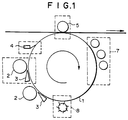
- Fig. 1 is a schematic diagram showing a structure of a printer for forming an image of a monochrome picture and transferring the image to a record sheet. When an image with a multiple colors is printed, a desired number of the same units are used corresponding to the number of the desired colors.
- reference numeral 1 depicts a metal cylinder which functions as a positive electrode.
- the metal cylinder is composed of a metal which is electrically inactive such as stainless steel.
- Two cylindrical electrodes 2 are independently disposed on the periphery of the positive electrode 1.
- the cylindrical electrodes 2 are insulated from the electrode 1.
- An amount of ink sprayed from an ink spraying device 3 is filled in a nip between the electrodes 1 and 2.
- the positive electrode 1 is continuously rotated in the clockwise direction in Fig. 1. With a potential difference between the positive electrode 1 and the negative electrodes 2, coagulated colloid portions and non-coagulated portions are formed in the ink filled between the positive electrode 1 and the negative electrodes 2.
- the coagulated colloid adheres to the positive electrode 1. Only the non-coagulated portion is selectively removed from the positive electrode by a wiper 4 or the like.
- a press roll 5 is pressed against the periphery of the positive electrode 1.
- a record sheet 6 is traveled by the positive electrode 1 and the press roll 5.
- the coagulated colloid held on the periphery of the press roll 5 is placed in the position of the press roll 5 as the positive electrode 1 rotates.
- the coagulated colloid is contacted and transferred to the record sheet 6.
- the nip pressure between the press roll 5 and the positive electrode 1 is in the range from 30 to 50 kg/cm.
- the positive electrode 1 is further rotated, and then cleaned by a cleaning device 7.
- a corrosion resisting agent is coated on the periphery of the positive electrode by a corrosion resisting agent coating device 8.
- the electro-coagulation printing method is categorized as so-called "non-plate printing method.”
- the non-plate printing method has many advantages over the conventional printing methods.
- a step for forming a printing plate is essential.
- the cost for the printing plate per one print sheet is usually very large.
- the non-plate printing method does not need the printing plate forming step, the cost is greatly reduced.
- the step for printing the same prints can be performed at high speed, it takes a long time to replace the plates.
- non-plate printing method data is received from a computer is read and printed.
- the preparing time for different prints is very shoot. Consequently, it can be considered that the electro-coagulation printing method is much superior to the conventional printing methods particularly in a small lot printing.
- the printer using the electro-coagulation printing method is composed of relatively rigid and simple parts.
- the printer can be operated at high speed.
- the upper limit of the printing speed depends on the information transmission speed of the computer rather than the printer. With a conventional computer, the printing speed on the order of several hundred meters per minute can be satisfactorily accomplished.
- the coloring agents used in the electro-coagulation printing method may be the same as those used for inks in the conventional printing methods.
- the shape and size of the coagulated colloid in the electro-coagulation printing method are almost the same as those of the negative electrodes.
- a so-called "dot gain” phenomenon does not take place on the record sheet. Thus, an image can be clearly reproduced with fine and sharp dots.
- the electro-coagulation printing method is an excellent printing method featuring high through-put and high picture quality available in the conventional printing methods.
- the electro-coagulation printing method has also features which are small lot printing and page variable that not available by the conventional printing methods.
- the electro-coagulation printing method is very excellent, when a normal record sheet is used, the characteristics of this method can be fully obtained.
- the transfer rate of coagulated colloid is low.
- the transfer rate decreases.
- the present invention is contemplated to provide an improved record media for the electro-coagulation printing. Intensively evaluated results conducted by the inventors of the present invention show that record sheets with particular characteristics can solve the above described problem.
- the present invention is a record sheet used in an electro-coagulation printing method of which the wet time obtained from a liquid absorption curve of pure water measured by a dynamic scanning absorptometer is 15 milliseconds or less.
- the record sheet according to the present invention can be in any form such as paper, film, or nonwoven fabric.
- the record sheet is suitable for any form such as magazines, posters, direct mail, fliers, and various publications, in particular, business form sheets, newspaper sheets, OCR sheets, MICR sheets, label sheets and map sheets, which are printed by a printer according to the electro-coagulation printing method.
- the present invention is also advantageously applicable to a kind of sheets used for a card so called "covered-up card".
- the covered-up card comprises a sheet of which surface is covered with a cover such as label and the like to hide characters form on the surface.
- the cover sheet is adhered to the sheet by a cold-type adhesive which generates adhesive property when compressed under a high pressure between metal rolls, so that the cover can be removed from the surface of the sheet, but cannot be attached again to the surface in a usual manner.
- paper is used to mean a sheet-like material composed of, for example, wood fibers beaten by a known beater, non-wood fiber, or sheet shaped substance of which a material of a solution of a filler and a particular chemical is formed by a known paper machine such as Fourdrinier paper machine, cylinder paper machine, inclined paper machine or twin-wire paper machine.
- film means a sheet shaped material of which an organic resin such as viscose, acetate, polyethylene, polypropylene, poly(vinyl chloride), polystyrene, nylon, polyacetal, polycarbonate, or polyethylene terephthalate is mixed with another filler or chemical when necessary and layered by a known method such as the melt extrusion method, the calender method, the stretching method, or the solution casting method.
- the film according to the present invention includes polymer paper.
- the nonwoven fabric is a sheet shaped substance made of a fiber material such as wood fiber, cotton, rayon, polyethylene terephthalate, acrylic resin, acetate, nylon, or polypropylene by a known method such as the span bond method, and the paper making method, or dry method using a card machine or a garnet machine.
- a fiber material such as wood fiber, cotton, rayon, polyethylene terephthalate, acrylic resin, acetate, nylon, or polypropylene by a known method such as the span bond method, and the paper making method, or dry method using a card machine or a garnet machine.
- the sheet shaped material may be composed of a single layer.
- the sheet shaped material may also have a coat layer formed on the surface of the sheet.
- the coat layer is composed of a filler and a binder.
- the wet time obtained from liquid absorption curve of pure water measured by a dynamic scanning absorptometer is a very important factor.
- the absorption coefficient obtained from the liquid absorption curve and the contact ratio measured by a specular reflection smoothness tester under the pressure of 40 kg/cm 2 with a ray of 0.5 ⁇ m are also important factors.
- the characteristics of the record sheet also vary depending on the required quality of prints.
- the wet time obtained from the liquid absorption curve of pure water measured by the dynamic scanning absorptometer should be 15 milliseconds or less.
- the wet time and absorption coefficient obtained from the liquid absorption curve of pure water measured by the dynamic scanning absorptometer are preferably 15 milliseconds or less and 5 ml/m 2 s -1/2 or more, respectively.
- the contact ratio measured by the specular reflection smoothness tester under the pressure of 40 kg/cm2 with a ray having a wavelength of 0.5 ⁇ m, the wet time and absorption coefficient obtained from the liquid absorption curve of pure water measured by the dynamic scanning absorptometer are preferably 40 % or more, 15 milliseconds or less, and 10 ml/m 2 s -1/2 or more, respectively.
- the liquid absorption curve is obtained from the amount of liquid absorption measured by a conventional dynamic scanning absorptometer and the traveling speed of the record sheet. Next, the liquid absorption curve will be described with reference to Fig. 2.
- the coordinate of the graph shown in Fig. 2 represents a liquid traveling amount (ml/m 2 ) obtained by dividing the liquid absorption amount (ml) by the sectional area (m 2 ) of the pipe of a supply head through which the liquid flows.
- the abscissa of the graph in Fig. 2 represents the square root of the contact time (s) in the unit of s -1/2 .
- the contact time is obtained by dividing the diameter (m) of the pipe of the supply head in which the liquid flows by the traveling speed (m/s) of the record sheet.
- t 0 is hereinafter referred to as a "wet time” and K a is an "absorption coefficient".
- the wet time t 0 is the time period until which the liquid starts permeating into the sheet, and is obtained by squaring the contact time read from the graph.
- the absorption coefficient K a is a coefficient of the speed at which the liquid permeates into the sheet.
- the coagulated colloid formed between the electrodes contains moisture of 25 to 65 %, the viscosity and elasticity thereof are higher than those of conventional offset inks.
- the coagulated colloid is frailer or weaker than the conventional offset inks. In this state, the transfer characteristic of the coagulated colloid is very low.
- the time for which the record sheet contacts the coagulated colloid should be 20 milliseconds or less and the amount of moisture absorbed from the coagulated colloid by the record sheet should be 1 g/m 2 per color at maximum.
- the record sheet according to the present invention comprises a sheet shaped material with a thickness in the range from 40 ⁇ m to 300 ⁇ m.
- Examples of the material of the record sheet are paper, film, polymer paper, and nonwoven fabric.
- the transfer rate is represented by the number of drops of coagulated colloid which are transferred to the record sheet at a nip pressure of 30 kg/cm in the case that a total of 100 drops of the coagulated colloid with a diameter of 1 mm are equally arranged in a square of 10 cm x 10 cm.
- the Bristow's method As a test method for measuring the dynamic liquid absorbency, the Bristow's method (Japan Tappi No. 51-87) is well known. However, this method includes various problems that the measuring accuracy for the track length is not high, that the sample amount necessary for the measurement is large, and that the time for obtaining the liquid absorption curve is long. In particular, the measurement accuracy is one of the most important problems. Evaluated results conducted by the inventors of the present invention show that the Bristow's method is not suitable for determining the characteristics of the problem.
- the absorptometer has an appearance similar to a conventional record player, and uses a turn table instead of a drum of the conventional Bristow's method.
- the absorptometer has an armed liquid supply head in the form of a pickup of the record player instead of a liquid supply pot.
- a record sheet to be tested is disposed on the turn table.
- the arm is slid on the record sheet in synchronization with the rotation of the turn table.
- the liquid is supplied from the supply head in a spiral shape.
- the liquid absorption amount is accurately and automatically measured by a meniscus connected to the supply head.
- the operations of the turn table and the arm are controlled by a computer, and the turn table and the arm are accelerated corresponding to a predetermine pattern, so that data on the order of 2 msec to 10 sec of the contact time can be obtained according to the liquid absorption amount and the traveling speed of the record sheet.
- the data shown in this specification was measured by the "KM350-D1" type dynamic scanning absorptometer produced and distributed by Kyowa Seiko Co., Ltd.
- the smoothness under pressure is also an important factor.
- the record sheet is contacted with the coagulated colloid under pressure.
- the contact area with the coagulated colloid becomes large.
- the liquid absorption performance becomes high.
- the adhering force with the coagulated colloid becomes strong.
- the probability of which the adhering force becomes stronger than the adhering force between the coagulated colloid and the positive electrode increases.
- the inventors of the present invention evaluated various smoothness testers. Evaluated results show that a specular reflection smoothness tester can be effectively used in the present invention.
- the specular reflection smoothness tester is a device for optically measuring the smoothness under pressure as with a Chapman smoothness tester.
- a glass surface and a sample surface are contacted under pressure.
- the smoothness of the sample under pressure is measured with the amount of specular reflection light radiated from the glass side at a predetermined angle.
- the predetermined angle in this case is more than or equal to the critical angle of the interface of the glass and the sample and more than or equal to the critical angle of the interface of the glass and air.
- the amount of specular reflection light in the range of the angles is reversely proportional to the contact ratio of the glass surface and the sample surface.
- the measurement theory of this method is the same as that of the Chapman type.
- the Chapman type since the measured wavelength is not considered, it is not a satisfactory method. In other words, even if the sample is not contacted with the glass surface, when they approaches on the order of a wavelength, the sample penetrates through the air layer.
- the Chapman type does not consider this phenomenon, whereas the specular reflection smoothness tester can select a wavelength.
- the inventors of the present invention selected a wavelength of 0.5 ⁇ m and performs various evaluations with many samples.
- the results of experiments using the dynamic scanning absorptometer and the specular reflection smoothness tester conducted by the inventors show that the wet time of a record sheet which requires the quality of characters and a not-fine monochrome image is 15 milliseconds or less, preferably, in the range from 7 to 10 milliseconds, the wet time being obtained from the liquid absorption curve of pure water measured by the dynamic scanning absorptometer.
- the liquid When the wet time of a record sheet is 15 milliseconds or more, the liquid is not absorbed into the record sheet while it is being placed between the press roll and the positive electrode. Even if the liquid is absorbed, it is not sufficient. Thus, the transfer characteristic of the coagulated colloid to the record sheet is not improved.
- the wet time obtained from the liquid absorption curve of pure water measured by the dynamic scanning absorptometer is preferably 15 milliseconds or less and the absorption coefficient obtained from the liquid absorption curve of pure water measured by the dynamic scanning absorptometer is 5 ml/m 2 s -1/2 or more, preferably, in the range from 8 to 15 ml/m 2 s -1/2 .
- the conditions of which the transfer ratio of the second color formed on the first color exceeds 90 % are that the contact ratio measured by the specular reflection smoothness tester under a pressure of 40 kg/cm 2 with a ray having a wavelength of 0.5 ⁇ m is 40 % or more and that the wet time and the absorption coefficient obtained from the liquid absorption curve of pure water measured by the dynamic scanning absorptometer are 15 milliseconds or less and 10 ml/m 2 s -1/2 or more, respectively.
- the contact ratio measured by the specular reflection smoothness tester under a pressure of 40 kg/cm 2 with a ray having a wavelength of 0.5 ⁇ m is 40 % or more, more preferably in the range from 45 to 53 % and that the wet time and the absorption coefficient obtained from the liquid absorption curve of pure water by the dynamic scanning liquid absorption coefficient are 15 milliseconds or less and 10 ml/m 2 s -1/2 or more, respectively.
- a record sheet such, for example, as paper, which is inherently liquid absorbent
- liquid absorbing filler in the body of the sheet.
- a record sheet which basically does not have a liquid absorbency for example, a film is provided with the liquid absorbency
- a coat layer is normally deposited on the front surface of the record sheet.
- a coat layer is formed on the front surface of a record sheet which has the liquid absorbency, it functions as a very good means for improving the printing quality.
- a full-color image is printed, since the luster and white color degree are also very important factors as the printing quality, in the known printing methods, a full-color image is normally printed on a print sheet with a coat layer.
- the inventors has evaluated a coat layer suitable for full-color images corresponding to the electro-coagulation printing method.
- a coat layer which satisfies the following conditions at the same time:
- An inorganic filler such as clay, kaolin, soft calcium carbide, hard calcium carbide, titanium dioxide, synthetic amorphous silica, silica sol, colloidal silica, satin white, diatomaceous earth, aluminum silicate, calcium silicate, alumina sol, colloidal alumina, boehmite or pseudo boehmite, or an organic filler such as polypropylene, polyethylene terephthalate (PET), or acrylic resin may be used as a single filler or as a mixture thereof.
- synthetic amorphous silica, silica sol, colloidal silica, alumina sol, colloidal alumina, boehmite, or pseudo boehmite is preferably used.
- such a filler can be contained therein.
- synthetic amorphous silica, silica sol, colloidal silica, alumina sol, colloidal alumina, boehmite, pseudo boehmite is preferably used.
- the coat layer is preferably transparent.
- the diameter of pores should be less than the half of the wavelength of the visible light. Since the diameter of pores of the coat layer mainly depends on the diameters of particles of the filler for use, when a very fine filler is used, the liquid absorbency and the transparency can be satisfied at the same time. Examples of the preferable very fine filler may includes colloidal silica, colloidal alumina, boehmite, and pseudo boehmite.
- binder examples include polyvinyl alcohol, a denatured substance thereof, starch, a denatured substance thereof, casein, NR, SBR, NBR, acrylic resin, polyvinyl pyrrolidone, a mixture thereof, or a copolymer thereof.
- Examples of the substance which represents the characteristics of cation include organic particles such as alumina sol, colloidal alumina, boehmite, and pseudo boehmite, water soluble salts of metals such as aluminum, iron, manganese, magnesium, and calcium, polyvinyl pyridium bromide, dimethyl allyl ammonium chloride, poly(ethyleneimine amido) ammonium salt condensation product, cationic colloidal silica, polyalkylene poly(amine dicyanadiamido) ammonium salt condensation product, quaternary ammonium salt polyelectrolyte, dialkanol amino modified alkyleneglycol derivatives, acrylamide diallyl dimethyl ammoniumchloride copolymer, and cationic resin reacted with secondary amide and epihalohydrine.
- organic particles such as alumina sol, colloidal alumina, boehmite, and pseudo boehmite
- water soluble salts of metals such as aluminum, iron, manganese, magnesium, and
- the substance which represents the characteristics of cation can be used in one of the following manners.
- the substance may be coated on the front surface of the sheet as it is.
- the substance may be contained in the sheet when it is formed.
- the substance may be added in a coat layer. Even if a small amount of such a substance is contained in the sheet contacted with the coagulated colloid, the effect thereof can be obtained.
- a known coating means such as air knife coater, gravure coater, blade coater, roll coater, gate roll coater, or bar coater may be properly used.
- business form sheets there are mail form sheets (postcard form sheets and envelop form sheets), label form sheets, bank transfer form sheets, and computer form sheets. These form sheets are commonly printed by the electrophotographic method and ink jet method. In particular, from view points of high through-put, high picture quality, small lot printing, and page variable characteristic, it is considered that the electro-coagulation printing method is most suitable for printing of business form sheets.
- the business form sheets according to the present invention are not limited as long as they are suitable for the electro-coagulation printing method. Print sheets and information sheets can be properly used.
- the material of newspaper sheets according to the present invention is deinked pulp, ground pulp, thermo-mechanical pulp, or craft pulp or a mixture thereof at a predetermined ratio with a weighing capacity of 41 g/m 2 to 49 g/m 2 .
- a filler such as white carbon, clay, silica, talc, titanium oxide, calcium carbonate, or synthetic resin can be properly added.
- a paper strength agent such as polyacrylamide type polymer, poly(vinyl alcohol) type polymer, starch, or urea-formalin resin may be properly added.
- yield improving agent, rosin size agent, synthetic size agent, water resisting agent, discoloration resisting agent, and/or ultraviolet ray resisting agent may be properly added.
- a surface treatment agent may be properly added so as to improve the paper strength and printing adaptivity, prevent sticking, and enhance the surface strength.
- the electro-coagulation printing method provides not only high through-put and high picture quality which are available in the conventional printing methods, but small lot printing and page variable characteristic which are not available in the conventional printing methods.
- NNKP breached needle-leaved tree craft pulp
- LKP breached broad-leaf tree craft pulp
- 20 parts by weight of breached needle-leaved tree craft pulp (NBKP) and 80 parts by weight of breached broad-leaf tree craft pulp (LBKP) were beaten to become 500 ml C.S.F., and then mixed with 10 parts by weight of clay, 0.3 part by weight of paper strength agent (trade name "POLYSTRON 191,” Arakawa chemical industries, Ltd.), 0.3 part by weight of size agent (trade name "SIZEPINE E,” Arakawa Chemical Industries, Ltd.), and 2.0 parts by weight of Alum.
- a paper material A with a weighing capacity of 100 g/m 2 was fabricated by a Fourdrinier paper machine in the conventional manner.
- NBKP and 80 parts by weight of LBKP were beaten to become 350 ml C.S.F.
- To the resultant material were added 10 parts by weight of clay, 0.3 part by weight of paper strength agent (ditto), 2.0 parts by weight of size agent (ditto), and 2.0 parts by weight of Alum.
- a paper material B with a weighing capacity of 100 g/m 2 was fabricated by the Fourdrinier paper machine in the conventional manner.
- the paper material A was used as it was.
- the paper material C was used as it was.
- Example 3 100 parts by weight of synthetic amorphous silica and 60 parts by weight of polyvinyl alcohol as used in Example 3 were mixed with 500 parts by weight of water. The resultant solution with a coat amount of 5 g/m 2 was coated on the front surface of the paper material B by a blade coater.
- silica sol trade name "SNOWTEX OUP,” Nissan Chemical Industries, LTD.
- polyvinyl alcohol dispersed in 450 parts by weight of water.
- the resultant solution with a coat amount of 5 g/m 2 was coated on the front surface of drawn polyethylene terephthalate film (Toray Co., Ltd.) by the air knife coater.
- the paper material B was used as it was.
- the contact ratio under a pressure of 40 kg/cm 2 and the wet time and absorption coefficient were measured by the specular reflection smoothness tester and the dynamic scanning absorptometer for the samples according to Examples 1 to 10 and Comparative Example 1.
- the transfer ratio of the first color and the transfer ratio of the second color after solid-printing of the first color by an electro-coagulation printer (ELCORSY Co.) were evaluated.
- the water resisting characteristic and the haze value of each sample were measured. These measured values are listed in Table 1. Table 1 Examples Wet time (msec) Absorption coeff. (ml/m 2 s -1/2 ) Contact ratio (%) 1st color trans. (%) 2nd color trans. (%) Water resisting charac.
- Example 1 Example 1 13 3 6 86 5 X - Example 2 11 6 6 95 13 X - Example 3 7 15 45 100 100 X - Example 4 7 12 45 100 98 X - Example 5 7 12 45 100 98 ⁇ - Example 6 15 3 6 85 5 ⁇ - Example 7 9 14 48 100 100 X 36.2
- Example 9 9 14 52 100 100 X 12.0
- Example 10 8 15 53 100 100 ⁇ 9.5 Comparative Example 1 17 3 4 40 3 X -
- the samples according to Examples 9 and 10 were transparent record sheets with haze values ranging from 9.5 to 12.0 %.
- a solution of polyvinyl alcohol with a coat amount of 0.5 g/m 2 was coated on both the surfaces of the paper material D by a gate roll coater.
- a solution of cationic starch with a coat amount of 0.5 g/m 2 was coated on both the surfaces of the paper material D by the gate roll coater.
- NNKP breached needle-leaved tree craft pulp
- LLKP broad-leaf tree craft pulp
- the resultant pulp was added with 8.5 % by weight of talc and 1.5 % by weight of titanium dioxide as fillers.
- the resultant pulp was added with 0.6 % by weight of rosin size agent and 2 % by weight of band.
- a paper material E with a weighing capacity of 70 g/m 2 was fabricated by the Fourdrinier paper machine.
- the paper material E was used as it was.
- Example 11 14 7 42 97 70 X Example 12 14 7 42 97 70 X Example 13 7 12 48 100 95 ⁇ Example 14 7 13 49 100 96 X Example 15 11 10 41 99 92 X Example 16 7 15 43 100 100 X Example 17 6 14 48 100 99 ⁇ Example 18 8 15 46 100 100 X Example 19 9 10 9 95 30 X Comparative Example 2 16 4 7 47 2 -
Landscapes
- Chemical & Material Sciences (AREA)
- Inorganic Chemistry (AREA)
- Dispersion Chemistry (AREA)
- Engineering & Computer Science (AREA)
- Manufacturing & Machinery (AREA)
- Paper (AREA)
- Ink Jet Recording Methods And Recording Media Thereof (AREA)
- Duplication Or Marking (AREA)
- Color Printing (AREA)
Applications Claiming Priority (6)
| Application Number | Priority Date | Filing Date | Title |
|---|---|---|---|
| JP31033695 | 1995-11-29 | ||
| JP310336/95 | 1995-11-29 | ||
| JP31033695 | 1995-11-29 | ||
| JP234097/96 | 1996-09-04 | ||
| JP23409796 | 1996-09-04 | ||
| JP23409796 | 1996-09-04 |
Publications (3)
| Publication Number | Publication Date |
|---|---|
| EP0776768A2 true EP0776768A2 (de) | 1997-06-04 |
| EP0776768A3 EP0776768A3 (de) | 1997-10-22 |
| EP0776768B1 EP0776768B1 (de) | 2000-03-01 |
Family
ID=26531366
Family Applications (1)
| Application Number | Title | Priority Date | Filing Date |
|---|---|---|---|
| EP96119086A Expired - Lifetime EP0776768B1 (de) | 1995-11-29 | 1996-11-28 | Aufzeichnungsschicht, die bei einem Elektrokoagulationsdruckverfahren verwendet wird |
Country Status (4)
| Country | Link |
|---|---|
| US (2) | US5888367A (de) |
| EP (1) | EP0776768B1 (de) |
| CA (1) | CA2191380C (de) |
| DE (1) | DE69606831T2 (de) |
Cited By (4)
| Publication number | Priority date | Publication date | Assignee | Title |
|---|---|---|---|---|
| WO1998029256A1 (en) * | 1996-12-30 | 1998-07-09 | Toyo Ink Manufacturing Co., Ltd. | Method and apparatus for rendering an electrocoagulation image water-fast |
| US5908541A (en) * | 1997-09-09 | 1999-06-01 | Elcorsy Technology Inc. | Multicolor electrocoagulation printing method and apparatus |
| EP0928686A1 (de) * | 1998-01-07 | 1999-07-14 | Tokushu Paper Manufacturing Co. Ltd | Aufzeichnungsschicht, die bei einem Elektrokoagulationsdruckverfahren verwendet wird |
| US6153074A (en) * | 1998-03-12 | 2000-11-28 | Oji Paper Co., Ltd. | Recording material for electro-coagulation printing and method for printing thereon |
Families Citing this family (9)
| Publication number | Priority date | Publication date | Assignee | Title |
|---|---|---|---|---|
| US6720041B2 (en) * | 1998-11-20 | 2004-04-13 | Canon Kabushiki Kaisha | Recording medium, and method for producing image using the same |
| GB0015928D0 (en) * | 2000-06-30 | 2000-08-23 | Printable Field Emitters Limit | Field emitters |
| JP3891546B2 (ja) * | 2000-07-19 | 2007-03-14 | 日本製紙株式会社 | インクジェット用記録媒体 |
| US6716495B1 (en) * | 2000-11-17 | 2004-04-06 | Canon Kabushiki Kaisha | Ink-jet recording apparatus and recording medium |
| US6528148B2 (en) | 2001-02-06 | 2003-03-04 | Hewlett-Packard Company | Print media products for generating high quality visual images and methods for producing the same |
| US6869647B2 (en) | 2001-08-30 | 2005-03-22 | Hewlett-Packard Development Company L.P. | Print media products for generating high quality, water-fast images and methods for making the same |
| KR100544126B1 (ko) * | 2003-08-26 | 2006-01-23 | 삼성에스디아이 주식회사 | 유기 전계 발광 소자 및 그 제조방법 |
| KR100647598B1 (ko) * | 2004-04-06 | 2006-11-23 | 삼성에스디아이 주식회사 | 유기 전계 발광 소자 및 그 제조방법 |
| TWI432381B (zh) * | 2005-12-12 | 2014-04-01 | Grace W R & Co | 氧化鋁粒子 |
Citations (4)
| Publication number | Priority date | Publication date | Assignee | Title |
|---|---|---|---|---|
| US3892645A (en) | 1973-06-06 | 1975-07-01 | Adrien Castegnier | Printing method and system by gelatin coagulation |
| US4555320A (en) | 1984-05-25 | 1985-11-26 | Elcorsy Inc. | Image reproduction by in plane electro-coagulation of a colloid |
| US4764264A (en) | 1984-05-11 | 1988-08-16 | Adrien Castegnier | Printing method by electrolytic colloid coagulation |
| JPH04504688A (ja) | 1989-04-12 | 1992-08-20 | エルコースイ テクノロジー インコーポレーテッド | 高速電気凝固印刷法および装置 |
Family Cites Families (5)
| Publication number | Priority date | Publication date | Assignee | Title |
|---|---|---|---|---|
| JPS61135785A (ja) * | 1984-12-07 | 1986-06-23 | Mitsubishi Paper Mills Ltd | インクジエツト記録媒体 |
| CA1279603C (en) * | 1986-02-20 | 1991-01-29 | Adrien Castegnier | Monochromic and polychromic printing of an image reproduced by electro-coagulation of a colloid |
| US4661222A (en) * | 1986-03-27 | 1987-04-28 | Elcorsy Inc. | Monochromic and polychromic printing of an image reproduced by electro-coagulation of a colloid |
| US4838940A (en) * | 1987-02-21 | 1989-06-13 | Canon Kabushiki Kaisha | Image recording ink |
| JP3134644B2 (ja) * | 1993-12-27 | 2001-02-13 | 富士ゼロックス株式会社 | インクジェット用記録紙 |
-
1996
- 1996-11-27 CA CA002191380A patent/CA2191380C/en not_active Expired - Fee Related
- 1996-11-27 US US08/756,398 patent/US5888367A/en not_active Expired - Fee Related
- 1996-11-28 DE DE69606831T patent/DE69606831T2/de not_active Expired - Fee Related
- 1996-11-28 EP EP96119086A patent/EP0776768B1/de not_active Expired - Lifetime
-
1998
- 1998-12-29 US US09/222,532 patent/US6086738A/en not_active Expired - Fee Related
Patent Citations (4)
| Publication number | Priority date | Publication date | Assignee | Title |
|---|---|---|---|---|
| US3892645A (en) | 1973-06-06 | 1975-07-01 | Adrien Castegnier | Printing method and system by gelatin coagulation |
| US4764264A (en) | 1984-05-11 | 1988-08-16 | Adrien Castegnier | Printing method by electrolytic colloid coagulation |
| US4555320A (en) | 1984-05-25 | 1985-11-26 | Elcorsy Inc. | Image reproduction by in plane electro-coagulation of a colloid |
| JPH04504688A (ja) | 1989-04-12 | 1992-08-20 | エルコースイ テクノロジー インコーポレーテッド | 高速電気凝固印刷法および装置 |
Cited By (4)
| Publication number | Priority date | Publication date | Assignee | Title |
|---|---|---|---|---|
| WO1998029256A1 (en) * | 1996-12-30 | 1998-07-09 | Toyo Ink Manufacturing Co., Ltd. | Method and apparatus for rendering an electrocoagulation image water-fast |
| US5908541A (en) * | 1997-09-09 | 1999-06-01 | Elcorsy Technology Inc. | Multicolor electrocoagulation printing method and apparatus |
| EP0928686A1 (de) * | 1998-01-07 | 1999-07-14 | Tokushu Paper Manufacturing Co. Ltd | Aufzeichnungsschicht, die bei einem Elektrokoagulationsdruckverfahren verwendet wird |
| US6153074A (en) * | 1998-03-12 | 2000-11-28 | Oji Paper Co., Ltd. | Recording material for electro-coagulation printing and method for printing thereon |
Also Published As
| Publication number | Publication date |
|---|---|
| DE69606831T2 (de) | 2000-08-17 |
| US5888367A (en) | 1999-03-30 |
| US6086738A (en) | 2000-07-11 |
| DE69606831D1 (de) | 2000-04-06 |
| EP0776768A3 (de) | 1997-10-22 |
| EP0776768B1 (de) | 2000-03-01 |
| CA2191380C (en) | 1999-09-28 |
| CA2191380A1 (en) | 1997-05-30 |
Similar Documents
| Publication | Publication Date | Title |
|---|---|---|
| EP0776768B1 (de) | Aufzeichnungsschicht, die bei einem Elektrokoagulationsdruckverfahren verwendet wird | |
| KR100268026B1 (ko) | 광택 표면층을 갖는 기록 매체 | |
| EP0997314B1 (de) | Tintenstrahlaufzeichnungsblatt, das Siliciumoxidteilchen enthält, und Verfahren zu seiner Verwendung | |
| US9242497B2 (en) | Inkjet recording medium | |
| JPS60219084A (ja) | インクジエツト用記録媒体 | |
| EP0914962B1 (de) | Tintenstrahlauftzeichnungsmaterial | |
| EP1484188B1 (de) | Tintenstrahlaufzeichnungsbogen | |
| JP3392649B2 (ja) | インクジェット記録用圧着葉書用紙 | |
| EP0787595A1 (de) | Empfangspapier für thermische Übertragungsaufzeichnung, das Kalziumkarbonat enthält | |
| US6231720B1 (en) | Record sheet for use in electro-coagulation method | |
| EP1108559B1 (de) | Aufzeichnungsmaterial, das auf der Rückseite bedruckt wird, für Tintenstrahldruck | |
| JP3058597B2 (ja) | 電気凝固印刷用の記録シート | |
| EP0941840B1 (de) | Aufzeichnungsmaterial für den Elektrokoagulationsdruck und damit verbundenes Verfahren | |
| EP1026003A2 (de) | Beschichtetes Blatt Papier für das Elektrokoagulationsdruckverfahren | |
| JP2000071611A (ja) | 電気凝固印刷用の記録シ―ト | |
| JP2000153668A (ja) | 電気凝固印刷用の記録シ―ト | |
| JPH11129612A (ja) | インクジェット記録用シート | |
| JP2000238430A (ja) | 電気凝固印刷用の記録シート | |
| JPH11342671A (ja) | 電気凝固印刷用の記録シート | |
| JP2012213930A (ja) | インクジェット記録用紙 | |
| HK1067102B (en) | Ink jet recording sheet | |
| JP2000033772A (ja) | 電気凝固印刷用の記録シ―ト | |
| JPH10166716A (ja) | インクジェット記録媒体 | |
| JP2004284282A (ja) | 多層抄インクジェット用紙 | |
| JPH11254819A (ja) | 電気凝固印刷用被記録体及び記録方法 |
Legal Events
| Date | Code | Title | Description |
|---|---|---|---|
| PUAI | Public reference made under article 153(3) epc to a published international application that has entered the european phase |
Free format text: ORIGINAL CODE: 0009012 |
|
| 17P | Request for examination filed |
Effective date: 19961128 |
|
| AK | Designated contracting states |
Kind code of ref document: A2 Designated state(s): DE FI FR GB NL SE |
|
| PUAL | Search report despatched |
Free format text: ORIGINAL CODE: 0009013 |
|
| AK | Designated contracting states |
Kind code of ref document: A3 Designated state(s): DE FI FR GB NL SE |
|
| GRAG | Despatch of communication of intention to grant |
Free format text: ORIGINAL CODE: EPIDOS AGRA |
|
| 17Q | First examination report despatched |
Effective date: 19990514 |
|
| GRAG | Despatch of communication of intention to grant |
Free format text: ORIGINAL CODE: EPIDOS AGRA |
|
| GRAH | Despatch of communication of intention to grant a patent |
Free format text: ORIGINAL CODE: EPIDOS IGRA |
|
| GRAH | Despatch of communication of intention to grant a patent |
Free format text: ORIGINAL CODE: EPIDOS IGRA |
|
| GRAA | (expected) grant |
Free format text: ORIGINAL CODE: 0009210 |
|
| AK | Designated contracting states |
Kind code of ref document: B1 Designated state(s): DE FI FR GB NL SE |
|
| REF | Corresponds to: |
Ref document number: 69606831 Country of ref document: DE Date of ref document: 20000406 |
|
| ET | Fr: translation filed | ||
| PLBE | No opposition filed within time limit |
Free format text: ORIGINAL CODE: 0009261 |
|
| STAA | Information on the status of an ep patent application or granted ep patent |
Free format text: STATUS: NO OPPOSITION FILED WITHIN TIME LIMIT |
|
| 26N | No opposition filed | ||
| REG | Reference to a national code |
Ref country code: GB Ref legal event code: IF02 |
|
| PGFP | Annual fee paid to national office [announced via postgrant information from national office to epo] |
Ref country code: GB Payment date: 20021028 Year of fee payment: 7 |
|
| PGFP | Annual fee paid to national office [announced via postgrant information from national office to epo] |
Ref country code: FR Payment date: 20021119 Year of fee payment: 7 |
|
| PGFP | Annual fee paid to national office [announced via postgrant information from national office to epo] |
Ref country code: SE Payment date: 20021125 Year of fee payment: 7 Ref country code: NL Payment date: 20021125 Year of fee payment: 7 Ref country code: FI Payment date: 20021125 Year of fee payment: 7 |
|
| PGFP | Annual fee paid to national office [announced via postgrant information from national office to epo] |
Ref country code: DE Payment date: 20030129 Year of fee payment: 7 |
|
| PG25 | Lapsed in a contracting state [announced via postgrant information from national office to epo] |
Ref country code: GB Free format text: LAPSE BECAUSE OF NON-PAYMENT OF DUE FEES Effective date: 20031128 Ref country code: FI Free format text: LAPSE BECAUSE OF NON-PAYMENT OF DUE FEES Effective date: 20031128 |
|
| PG25 | Lapsed in a contracting state [announced via postgrant information from national office to epo] |
Ref country code: SE Free format text: LAPSE BECAUSE OF NON-PAYMENT OF DUE FEES Effective date: 20031129 |
|
| PG25 | Lapsed in a contracting state [announced via postgrant information from national office to epo] |
Ref country code: NL Free format text: LAPSE BECAUSE OF NON-PAYMENT OF DUE FEES Effective date: 20040601 |
|
| PG25 | Lapsed in a contracting state [announced via postgrant information from national office to epo] |
Ref country code: DE Free format text: LAPSE BECAUSE OF NON-PAYMENT OF DUE FEES Effective date: 20040602 |
|
| EUG | Se: european patent has lapsed | ||
| GBPC | Gb: european patent ceased through non-payment of renewal fee |
Effective date: 20031128 |
|
| PG25 | Lapsed in a contracting state [announced via postgrant information from national office to epo] |
Ref country code: FR Free format text: LAPSE BECAUSE OF NON-PAYMENT OF DUE FEES Effective date: 20040730 |
|
| NLV4 | Nl: lapsed or anulled due to non-payment of the annual fee |
Effective date: 20040601 |
|
| REG | Reference to a national code |
Ref country code: FR Ref legal event code: ST |