EP0776924A2 - Composition de polyimide et procédé de production de préimpgregné et de peinture - Google Patents
Composition de polyimide et procédé de production de préimpgregné et de peinture Download PDFInfo
- Publication number
- EP0776924A2 EP0776924A2 EP96118647A EP96118647A EP0776924A2 EP 0776924 A2 EP0776924 A2 EP 0776924A2 EP 96118647 A EP96118647 A EP 96118647A EP 96118647 A EP96118647 A EP 96118647A EP 0776924 A2 EP0776924 A2 EP 0776924A2
- Authority
- EP
- European Patent Office
- Prior art keywords
- curing
- temperature
- polyimide resin
- heat resistance
- polyimide
- Prior art date
- Legal status (The legal status is an assumption and is not a legal conclusion. Google has not performed a legal analysis and makes no representation as to the accuracy of the status listed.)
- Granted
Links
Images



Classifications
-
- C—CHEMISTRY; METALLURGY
- C08—ORGANIC MACROMOLECULAR COMPOUNDS; THEIR PREPARATION OR CHEMICAL WORKING-UP; COMPOSITIONS BASED THEREON
- C08G—MACROMOLECULAR COMPOUNDS OBTAINED OTHERWISE THAN BY REACTIONS ONLY INVOLVING UNSATURATED CARBON-TO-CARBON BONDS
- C08G73/00—Macromolecular compounds obtained by reactions forming a linkage containing nitrogen with or without oxygen or carbon in the main chain of the macromolecule, not provided for in groups C08G12/00 - C08G71/00
- C08G73/06—Polycondensates having nitrogen-containing heterocyclic rings in the main chain of the macromolecule
- C08G73/10—Polyimides; Polyester-imides; Polyamide-imides; Polyamide acids or similar polyimide precursors
- C08G73/1003—Preparatory processes
- C08G73/1007—Preparatory processes from tetracarboxylic acids or derivatives and diamines
- C08G73/101—Preparatory processes from tetracarboxylic acids or derivatives and diamines containing chain terminating or branching agents
- C08G73/1014—Preparatory processes from tetracarboxylic acids or derivatives and diamines containing chain terminating or branching agents in the form of (mono)anhydrid
-
- C—CHEMISTRY; METALLURGY
- C09—DYES; PAINTS; POLISHES; NATURAL RESINS; ADHESIVES; COMPOSITIONS NOT OTHERWISE PROVIDED FOR; APPLICATIONS OF MATERIALS NOT OTHERWISE PROVIDED FOR
- C09D—COATING COMPOSITIONS, e.g. PAINTS, VARNISHES OR LACQUERS; FILLING PASTES; CHEMICAL PAINT OR INK REMOVERS; INKS; CORRECTING FLUIDS; WOODSTAINS; PASTES OR SOLIDS FOR COLOURING OR PRINTING; USE OF MATERIALS THEREFOR
- C09D179/00—Coating compositions based on macromolecular compounds obtained by reactions forming in the main chain of the macromolecule a linkage containing nitrogen, with or without oxygen, or carbon only, not provided for in groups C09D161/00 - C09D177/00
- C09D179/04—Polycondensates having nitrogen-containing heterocyclic rings in the main chain; Polyhydrazides; Polyamide acids or similar polyimide precursors
- C09D179/08—Polyimides; Polyester-imides; Polyamide-imides; Polyamide acids or similar polyimide precursors
Definitions
- the present invention relates to an addition type polyimide resin raw material composition having high heat resistance, or high heat resistance and high corrosion resistance, a composition and molded object containing a prepolymer, a prepolymer, a curing method thereof, and a coating material using the addition type polyimide resin, a polyimide resin paint, a prepreg for a fiber-reinforced resin composite material excellent in moldability and a method for producing and a method for curing a fiber-reinforced polyimide composite material.
- a polyimide resin is widely used in various fields such as a paint and coating material represented by a matrix resin for various fiber-reinforced resin composite material (FRP) since the polyimide resin has excellent heat resistance and excellent corrosion resistance against inorganic and organic strong acid, weak acid, strong alkali and weak alkali and the like.
- FRP fiber-reinforced resin composite material
- the polyimide resin usually has a defect regarding molding that it has a inferior flowability even at high temperature.
- the polyimide used as a matrix resin for a fiber-reinforced resin composite material is usually an addition reaction type polyimide which is cross-linked and cured in final process after impregnation of the fiber with the resin.
- the representative example of such polyimide includes PMR-15 [T. T. Serafini; JOURNAL OF APPLIED POLYMER SCIENCE, 16, 905(1972)].
- PMR-15 is a polyimide in which the terminal stopper is 5-norbornane-2,3-dicarboxylic anhydride (commonly known as a nadic anhydride) and the main chain is made by condensation of benzophenone tetracarboxylic anhydride and diaminodiphenylmethane, and the reaction in the final stage of curing process progresses by ring opening addition reaction of nadic acids at both ends, therefore, it is said that no volatile component is formed during the reaction, so PMR-15 is widely used as a matrix resin for a fiber-reinforced composite material.
- the terminal stopper is 5-norbornane-2,3-dicarboxylic anhydride (commonly known as a nadic anhydride) and the main chain is made by condensation of benzophenone tetracarboxylic anhydride and diaminodiphenylmethane
- PMR-15 has a problem that moldability and physical properties of the composite material decrease since pealing occurs between layers of a FRP plate due to cyclopentadiene generated by pyrolysis of the terminal stopper portion in the post process which is called as post cure and conducted after curing of the resin in which heat treatment is conducted at a temperature of not lower than 300 °C to enhance the heat resistance. Further, PMR-15 has also a problem that the pre-curing temperature can not lowered to not higher than 290 °C since nadic anhydride is used as the terminal stopper, and this problem also makes molding difficult.
- the polyimide resin has an excellent corrosion resistance against acids and alkalis, and is widely used in various fields which requires corrosion resistance.
- the polyimide resin has a problem that it does not have sufficient corrosion resistance against Lewis acid and Lewis base generated for example in plating field or the like which are defined by Lewis acid-base concept, particularly against non-aqueous Lewis acid and Lewis base such as molten aluminium salts (Al 3+ , Cl - ).
- a polyimide resin raw material composition by which a fiber-reinforced resin composite material or molded object is obtained which has low curing temperature and is excellent in molding feature, has no possibility that volatile components derived from pyrolysis is produced in post-curing, shows high heat resistance and excellent corrosion resistance also against Lewis acid and Lewis base, and further has high strength in moisture absorbed condition; its prepolymer and a composition containing the prepolymer; a coating material, paint and prepreg for fiber-reinforced polyimide composite material using the same; and a method for curing them.
- an addition type polyimide composition having high heat resistance and high corrosion resistance and low curing temperature which, when applied for a fiber-reinforced resin composite material, generates no volatile component derived from a pyrolysis product in post-curing, and shows excellent moldability since resin curing temperature in pre-curing is approximately 220 °C which is lower than that of the prior art; a molded object using the composition; and a method for curing a resin using the composition: an addition type polyimide resin raw material composition which also has high strength especially in moisture absorbed condition in addition to above-mentioned characteristics; a molded object using the composition; and a method for curing a resin using the composition: and a coating material, paint and method for producing a fiber-reinforced composite material, and the like.
- an addition type polyimide composition having high heat resistance and high corrosion resistance and low curing temperature which, when applied for a fiber-reinforced resin composite material, generates no volatile component derived from a pyrolysis product in post-curing,
- R 1 is hydrogen or a monovalent organic group having 1 to 8 carbon atoms
- the organic group may contain -O-, -S-, -SO-, -SO 2 - or -(CO)- alone or in combination, and a part or all of the hydrogen atoms may be substituted by a halogen atom or lower alkyl group.
- X is a tetravalent organic group carrying 3 to 30 carbon atoms having carbocyclic cyclic structure and/or heterocyclic cyclic structure, the tetravalent organic group may contain -O-, -S-, -SO-, -SO 2 -, -(CO)- or -CH 2 - alone or in combination, and a part or all of the hydrogen atoms may be substituted by a halogen atom or lower alkyl group.
- R 1 includes a straight-chain lower alkyl group such as a hydrogen, methyl group, ethyl group, propyl group, butyl group or the like; a branched-chain lower alkyl group such as an isopropyl group, sec-butyl group, tert-butyl group, isoamyl group, neopentyl group, 2-ethylhexyl group or the like; an aromatic group represented by a phenyl group; a heterocyclic group, and the like, and a part or all of the hydrogen atoms may be substituted by a halogen atom such as fluorine, chlorine, bromine, iodine or a lower alkyl group.
- a halogen atom such as fluorine, chlorine, bromine, iodine or a lower alkyl group.
- X may be a tetravalent organic group carrying 3 to 30 carbon atoms having carbocyclic cyclic structure and/or heterocyclic cyclic structure, and the preferable example includes tetra-substituted benzene represented by the formula (X1) such as 1,2,4,5- or 1,2,3,4-substituted compound or the like, tetra-substituted diphenylmethane represented by the formula (X2) such as 3,4,3',4'- or 3,5,3',5'-substituted compound or the like, tetra-substituted diphenylsulfide represented by the formula (X3) such as 3,4,3',4'- or 3,5,3',5'-substituted compound or the like, tetra-substituted diphenylsulfoxide represented by the formula (X4) such as 3,4,3',4'- or 3,5,3',5'-substituted compound or the like, te
- the other example than the above-mentioned compounds includes a carbocyclic organic tetra-substituted compound such as a naphthylene group, anthracenyl group, biphenyl group or the like; a heterocyclic organic tetra-substituted compound such as a pyridine group, carbazole group or the like, and also those in which a part or all of the hydrogen atoms is substituted by a halogen atom such as fluorine, chlorine, bromine, iodine or a lower alkyl group.
- a carbocyclic organic tetra-substituted compound such as a naphthylene group, anthracenyl group, biphenyl group or the like
- a heterocyclic organic tetra-substituted compound such as a pyridine group, carbazole group or the like, and also those in which a part or all of the hydrogen atoms is substituted by a halogen
- diamine compound of the present invention compounds represented by the following formula (B) can be used.
- Y includes a straight-chain alkylene group such as a methylene group, ethylene group, propylene group, butylene group or the like; a branched-chain alkyl group having a side chain such as a 1,2-propylene group, 2-methyl-1,2-propylene group or the like; an aromatic alkylene group such as a phenylene group, toluylene group or the like; a carbopolycyclic disubstituted organic group such as a naphthylene group, anthracenyl group, biphenyl group or the like; a heterocyclic disubstituted organic group such as a pyridine group, hydrazine group, carbazole group or the like; a substituent containing an ether group represented by -O-, sulfide group represented by -S-, sulfoxide group represented by -SO-, sulfonyl group represented by -SO 2 -, carbonyl group represented by
- exo-3,6-epoxy-1,2,3,6-tetrahydrophthalic anhydride or exo-3,6-epoxy-1,2,3,6-tetrahydrophthalic monoester compound which is used as a terminal stopper in the polyimide resin of the present invention is that which is represented by the following formula (C).
- R 2 is hydrogen or a monovalent organic group having 1 to 8 carbon atoms, the organic group may contain -O-, -S-, -SO-, -SO 2 - or -(CO)- alone or in combination, and a part or all of the hydrogen atoms may be substituted by a halogen atom or lower alkyl group.
- the prepolymer synthesized from the above-described compounds (A), (B) and (C) first becomes the polyamic acid prepolymer represented by the formula (D) in the first process, and further becomes the polyimide prepolymer represented by the formula (E) in the proceeded reaction.
- n indicates degree of polymerization, n ⁇ 5, preferably n is in the range from 1.5 to 3.5.
- R 1 and R 2 indicate respectively the same groups as described above.
- n is smaller in this range, crosslink density increases and heat resistances is improved.
- increase of the crosslink density makes the resin hard and fragile, the density is appropriately regulated according to the use.
- the present inventors have noticed that generation of the volatile component (cyclopentadiene) in post-curing PMR-15 is caused by pyrolysis of the terminal stopper portion and that pre-curing temperature of the addition reaction type polyimide prepolymer is determined by initiation temperature of the ring opening addition reaction of the terminal stopper, and have intensely studied with resect to a compound which does not lower excellent heat resistance of polyimide, does not generate pyrolysis products in post-curing and initiates ring opening reaction at a low temperature around 220 °C.
- exo-3,6-epoxy-1,2,3,6-tetrahydrophthalic anhydride is excellent as a terminal stopper and that an addition type polyimide prepolymer utilizable for a high heat resistant fiber-reinforced resin composite material is obtained by using a solvent and a composition comprising the above-mentioned compounds (A), (B) and (C).
- the present inventors have studied intensely about a compound which manifests high strength in moisture absorbed condition, and have found that when a composition comprises diaminodiphenylmethane as the diamine compound (B) in the above-described composition, namely comprises tetracarboxylic anhydride and/or tetracarboxylic diester, diaminodiphenylmethane, and exo-3,6-epoxy-1,2,3,6-tetrahydrophthalic anhydride and/or exo-3,6-epoxy-1,2,3,6-tetrahydrophthalic monoester compound, the compound has excellent strength in moisture absorbed condition in addition to the above-mentioned properties, and we have obtained a composition containing an addition type polyimide prepolymer using the above-described composition and a solvent, which can mold a fiber-reinforced composite material which has high heat resistance and shows high strength even in moisture absorbed condition.
- the solvent which can dissolve the composition composed of the compounds represented by the formulae (A), (B) and (C) or the prepolymer represented by the formula (D) or (E) used in the present invention or which is used to prepare a coating material and paint containing them includes, for example, hydrocarbon alcohols such as methanol, ethanol, propanol and the like; polar substances such as dimethylsulfoxide, dimethylformamide, N-methyl-2-pyrrolidone and the like; aromatic hydrocarbons such as toluene, xylene, benzene and the like; cellosolve hydrocarbons such as methyl cellosolve, ethyl cellosolve, cellosolve acetate and the like; ketone hydrocarbons such as methyl ethyl ketone, acetone, cyclohexanone, methyl isobutyl ketone and the like; hydrocarbons containing chlorine such as methylene chloride, ethylene chloride, tetrachloroe
- the composition containing a polyamic acid prepolymer or the composition containing a polyimide prepolymer of the present invention titanium oxide, iron oxide (III) or the like can be used.
- the amount to be added of the pigment is preferably from approximately 30 to 60 % based on volume.
- the addition type polyimide composition of the present invention particularly an excellent fiber-reinforced resin composite material which has high heat resistance, high corrosion resistance and easy moldability at low temperature
- resin curing method which utilizes feature of the resin composition of the present invention. Therefore, the feature of the resin composition of the present invention will be explained with comparative examples using PMR-15, and further, the curing method will be explained by exemplifying molding method of the fiber-reinforced resin composite material.
- the curing temperature and the like which will be described is not limited to molding of the fiber-reinforced resin composite material.
- addition reaction of the resin of the present invention initiates in the terminal stopper portion at not less than 200 °C, while, addition reaction initiation temperature of PMR-15 is about 280 °C which is rather high temperature. Further, there is almost no generation of a volatile component due to decomposition of the terminal stopper in addition reaction in the resin of the present invention, while, the terminal stopper is decomposed in addition reaction and cyclopentadiene is generated in PMR-15. Therefore, it is evident that initiation time and addition reaction temperature of the resin of the present invention are different from those of PMR-15.
- a fiber-reinforced resin composite material is molded using the resin of the present invention, or a paint, adhesive, electronic component such as a substrate and sealing component, varnish, corrosion resistant coating film and the like are molded using the resin of the present invention
- the solvent used for molding, by products generated and the volatile component (furan) due to partial pyrolysis of the terminal stopper are vaporized at a temperature of not more than 200 °C
- pre-curing is conducted at a temperature from 200 to 300 °C, for example at 220 °C
- curing is conducted at a temperature from 200 to 300 °C, in consideration of the above-mentioned feature of the resin of the present invention.
- post-curing is conducted at a temperature from 260 °C (not less than the pre-curing temperature, and not less than the curing temperature in the case of the other molded objects) to 380 °C, for example at 350 °C.
- a temperature from 260 °C (not less than the pre-curing temperature, and not less than the curing temperature in the case of the other molded objects) to 380 °C, for example at 350 °C.
- a fiber-reinforced resin composite material is molded using PMR-15
- the solvent used for molding and by products are vaporized at a temperature of not more than 200 °C
- pre-curing is conducted at a temperature from 270 to 320 °C, for example at 290 °C
- post-curing is conducted at a temperature from not less than the pre-curing temperature to 380 °C, for example at 350 °C.
- the volatile component cyclopentadiene
- heat curing is conducted at a temperature selected in accordance with use condition, in a range from not less than 200 °C which is the lower limit temperature for curing the resin to 350 °C which is the maximum temperature at which curing is saturated. Namely, in this temperature range, it is preferable that heating is conducted at a lower temperature if the resin is pre-cured at a lower temperature and may be further cured at the temperature when in use, and heating is conducted at a higher temperature if pre-curing at a higher temperature is advantageous as use condition.
- Condition of a prepolymer may be optionally selected according to form of a molded object and molding method and the like. Namely, when a molded object is made by using polyimide alone or by filling a chopped fiber, it is desirable to use a polyimide prepolymer. However, when the prepolymer is used as a matrix resin for a fiber-reinforced resin composite material, the prepolymer may be used for impregnation in the form of a polyimide prepolymer.
- the prepolymer in the form of a polyamic acid prepolymer which is a precursor of the polyimide prepolymer, and also when the resin is used as a coating material or is used as a paint by mixing a pigment, the polyamic acid prepolymer is more advantageous.
- the anhydride of the general formula (A) and the terminal stopper exo-3,6-epoxy-1,2,3,6-tetrahydrophthalic anhydride of the general formula (C) among raw material monomers are converted to monoesters, and these monoesters and the compound (B) are dissolved in a low boiling point solvent such as alcohol or the like and impregnated in a fiber in the form of monomers, if necessary they are converted to a polyamic acid prepolymer or optionally further to a polyimide prepolymer on the fiber to obtain a intermediate material for molding, or the polyamic acid prepolymer is dissolved in a low boiling point solvent such as alcohol, and the resulting solution is impregnated on a fiber to obtain a intermediate material for molding.
- a low boiling point solvent such as alcohol
- Selections of polymerization methods of the prepreg and conditions of the prepolymer can be optionally made according to molding method of the intermediate material and required specification of the intermediate material. In carrying out the present invention, there is no limitation regarding these method.
- any fiber which is used as a reinforcing fiber for an ordinary fiber-reinforced resin composite material such as a carbon fiber, glass fiber and various organic fibers can be used, and the reinforcing fiber may be used in any form such as a bundle oriented in one direction, a fabric, a knit and the like. Further, hybrid of a carbon fiber with glass fiber or a carbon fiber with them may be used, and there is no limitation.
- the above-described addition type polyimide resin raw material composition, composition containing a prepolymer or a prepolymer, molded object and method for curing a resin are not limited to a fiber-reinforced resin composite material, and also useful for a high heat resistant resin, or a high heat resistant and high corrosion resistant resin, a high heat resistant and high corrosion resistant resin which needs strength especially at high temperature and moisture absorbed condition, an adhesive, a resin component for a paint, an electronic component such as a substrate and sealing component, an insulating varnish, a corrosion resistant structural material, a corrosion resistant coating film and the like.
- Diaminodiphenylmethane (B1) was used as the diamine compound (B).
- the 50 % by weight methanol solution of (A1) (88.86 g), the compound (B1) (33.73 g), the 50 % by weight methanol solution of (C1) (43.68 g) and methanol (33.73 g) were blended so that molar ratio (A1) : (B1) : (C1) was 2.087 : 3.087 : 2.000 to prepare a 50 % by weight methanol solution of an addition type polyimide resin raw material composition for a prepreg (process III).
- Molding conditions are as follows. Namely, the temperature was raised from 50 °C to 199 °C at a rate of 0.5 °C/min. The temperature was kept at 199°C for 10 minutes, during this time, the pressure was raised up to 14 kgf/cm 2 at a rate of 1.4 kgf/(cm 2 ⁇ min).
- the pressure was kept at 14 kgf/cm 2 and the temperature was raised from 199 °C to 218 °C which was pre-curing temperature at a rate of 1°C/min, and the pre-curing temperature 218°C was kept for 90 minutes. After that, spontaneous cooling was conducted, when the temperature lowered to 60°C, pressure reduction was conducted down to 0 kgf/cm 2 , and when the temperature lowered to room temperature, the laminate was took out (process V).
- the temperature rising pattern model in pre-curing is shown in Fig. 2, and the molding conditions are shown in Table 1 together with those of the other examples.
- the pre-curing completed laminate was charged in an oven, and post-curing was conducted.
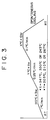
- the post-curing was conducted under no restriction, first the temperature was raised from room temperature to 110 °C at a rate of 1 °C/min and the temperature was kept at 110 °C for 3 hours, then the temperature was raised from 110 °C to 267 °C at a rate of 0.25 °C/min and the temperature was kept at 267 °C for 1 hour, then the temperature was raised from 267 °C to 347 °C at a rate of 0.1 °C/min and the temperature was kept at 347 °C for 12 hours, then spontaneous cooling was conducted down to room temperature and the sample was took out, to obtain a fiber-reinforced composite material (process VI).
- the temperature rising pattern model in pre-curing is shown in Fig. 3, and the post-curing conditions are shown in Table 1 together with those of the other examples.
- Example 1 The same procedure as the process (III) of Example 1 was conducted to prepare a 50 % by weight methanol solution of an addition type polyimide resin raw material composition for a prepreg containing A1, B1 and C1, and the resulting solution was stirred under reflux in a water bath kept at 90 °C for 5 hours to prepare a methanol solution of a polyamic acid prepolymer and polyimide prepolymer (a mixed solution of a polyamic acid prepolymer and polyimide prepolymer).
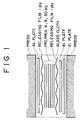
- Example 1 The same procedure as the process (IV) of Example 1 was conducted except that the methanol solution of the polyamic acid prepolymer and polyimide prepolymer was used instead of the 50 % by weight methanol solution of an addition type polyimide resin raw material composition for a prepreg, to produce prepregs, and 8 ply of thus produced prepregs were piled up all in 0°direction, and pre-curing molding was conducted using a hot press (see Fig. 1). For molding, the temperature was raised from 50 °C to 210 °C at a rate of 0.5 °C/min.
- the temperature was kept at 210 °C for 10 minutes, during this time, the pressure was raised up to 14 kgf/cm 2 at a rate of 1.4 kgf/(cm 2 ⁇ min).
- the pressure was kept at 14 kgf/cm 2 and the temperature was raised from 210 °C to 290 °C which was pre-curing temperature at a rate of 1 °C/min, and the pre-curing temperature 290 °C was kept for 60 minutes.
- spontaneous cooling was conducted, when the temperature lowered to 60 °C, pressure reduction was conducted down to 0 kgf/cm 2 , and when the temperature lowered to room temperature, the laminate was took out.
- the temperature rising pattern model in pre-curing molding is shown in Fig. 2, and the molding conditions are shown in Table 1.
- the pre-curing completed laminate was charged in an oven, and post-curing was conducted.
- the post-curing was conducted under no restriction, first the temperature was raised from room temperature to 110 °C at a rate of 1 °C/min and the temperature was kept at 110 °C for 3 hours, then the temperature was raised from 110 °C to 210 °C at a rate of 0.25 °C/min and the temperature was kept at 210 °C for 1 hour, then the temperature was raised from 210 °C to 350 °C at a rate of 0.1 °C/min and the temperature was kept at 350 °C for 12 hours, then spontaneous cooling was conducted down to room temperature and the sample was took out, to obtain a fiber-reinforced composite material.
- the temperature rising pattern model in post-curing is shown in Fig. 3, and the post-curing conditions are shown in Table 1.
- the 50 % by weight methanol solution of (A1) (88.86 g), the compound (B2) (18.56 g), the 50 % by weight methanol solution of (C1) (43.68 g) and methanol (18.56 g) were blended so that molar ratio (A1) : (B2) : (C1) was 2.087 : 3.087 : 2.000 to prepare a 50 % by weight methanol solution of an addition type polyimide resin raw material composition for a prepreg, the resulting solution was stirred under reflux in a water bath kept at 90 °C for 5 hours to prepare a methanol solution of a polyamic acid prepolymer and polyimide prepolymer.
- a prepreg was prepared using the methanol solution of the polyamic acid prepolymer and polyimide prepolymer in the same manner as that of Example 2. Molding was conducted in the same manner and temperature rising pattern as those of Example 2 and under conditions described in Table 1, to obtain a laminate which had completed pre-curing. Further, the same temperature rising pattern as that of Example 2 was conducted to obtain a fiber-reinforced resin composite material.
- the 50 % by weight methanol solution of (A1) (88.86 g), the compound (B3) (26.91 g), the 50 % by weight methanol solution of (C1) (43.68 g) and methanol (26.91 g) were blended so that molar ratio (A1) : (B3) : (C1) was 2.087 : 3.087 : 2.000 to prepare a 50 % by weight methanol solution of an addition type polyimide resin raw material composition for a prepreg, the resulting solution was stirred under reflux in a water bath kept at 90 °C for 5 hours to prepare a methanol solution of a polyamic acid prepolymer and polyimide prepolymer.
- a prepreg was prepared using the methanol solution of the polyamic acid prepolymer and polyimide prepolymer in the same manner as that of Example 2, and molding was conducted in the same manner and temperature rising pattern as those of Example 2 and under conditions described in Table 1, to obtain a laminate which had completed pre-curing. Further, the same temperature rising pattern as that of Example 2 was conducted to obtain a fiber-reinforced resin composite material.
- the 50 % by weight methanol solution of (A1) (888.59 g), the compound (B1) (337.29 g), the 50 % by weight methanol solution of (C1) (436.82 g) and methanol (337.29 g) were blended so that molar ratio (A1) : (B1) : (C1) was 2.087 : 3.087 : 2.000 to prepare a 50 % by weight methanol solution of an addition type polyimide resin raw material composition for a prepreg, the resulting solution was stirred under reflux in a water bath kept at 90°C for 5 hours to prepare a methanol solution of a polyamic acid prepolymer and polyimide prepolymer.
- a 300 ⁇ 300 mm prepreg was produced using the methanol solution of a polyamic acid prepolymer and polyimide prepolymer in the same manner as that of Example 2, and 50 ply of thus produced prepregs were piled up in 0°, ⁇ 45° and 90° direction, and pre-curing molding was conducted using a hot press. Inserted condition of the laminate in molding is shown in Fig. 1.
- the temperature was raised from 50 °C to 210 °C at a rate of 0.5 °C/min.
- the temperature was kept at 210 °C for 60 minutes, further, the pressure was raised up to 14 kgf/cm 2 at a rate of 1.4 kgf/(cm 2 ⁇ min) with keeping the temperature for 10 minutes.
- the pressure was kept at 14 kgf/cm 2 and the temperature was raised from 210 °C to 290 °C which was pre-curing temperature at a rate of 1 °C/min, and the pre-curing temperature 290 °C was kept for 60 minutes. After that, spontaneous cooling was conducted, when the temperature lowered to 60 °C, pressure reduction was conducted down to 0 kgf/cm 2 , and when the temperature lowered to room temperature, the laminate was took out.
- the pre-curing conditions are shown in Table 1.
- the pre-curing completed laminate was charged in an oven, and post-curing was conducted.
- the post-curing was conducted under no restriction, first the temperature was raised from room temperature to 110 °C at a rate of 1 °C/min and the temperature was kept at 110 °C for 3 hours, then the temperature was raised from 110 °C to 210 °C at a rate of 0.25 °C/min and the temperature was kept at 210 °C for 1 hour, then the temperature was raised from 210 °C to 350 °C at a rate of 0.1 °C/min and the temperature was kept at 350 °C for 12 hours, then spontaneous cooling was conducted down to room temperature and the sample was took out, to obtain a thick fiber-reinforced resin composite material.
- the temperature rising pattern in post-curing is shown in Fig. 3, and the post-curing conditions are shown in Table 1.
- Example 1 The same procedure as the process (III) of Example 1 was conducted to prepare a 50 % by weight methanol solution of an addition type polyimide resin raw material composition containing A1, B1 and C1, and the resulting solution was stirred under reflux in a water bath kept at 90 °C for 5 hours to prepare a methanol solution of a polyamic acid prepolymer and polyimide prepolymer (a mixed solution of a polyamic acid prepolymer and polyimide prepolymer).
- This solution was coated on a stainless plate, and was dried at room temperature to evaporate solvent methanol (residual solvent is not more than 1 %). Then, the stainless plate on which the coating film was formed was heated, to cure the coating film.
- the heating conditions were as follows.
- the temperature was raised from 50 °C to 210 °C at a rate of 0.5 °C/min and was raised from 210 °C to 267 °C at a rate of 0.25 °C/min, and the temperature was kept at 267 °C for 1 hour, then, the temperature was raised from 267 °C to 350 °C at a rate of 0.1 °C/min, and the temperature was kept at 350 °C for 12 hours, then spontaneous cooling was conducted down to room temperature and the sample was took out, to obtain a 30 ⁇ m thick sample of the coating film.
- Example 6 The same procedure as that of Example 6 was conducted to prepare a methanol solution of a polyamic acid prepolymer and polyimide prepolymer (a mixed solution of a polyamic acid prepolymer and polyimide prepolymer).
- methanol solution 100 g
- rutile titanium dioxide (1600 mesh) as a pigment was added to obtain a concentration of 30 % by volume, they were mixed, and the resulting mixture was painted on a stainless plate, and was dried at room temperature for 24 hours to evaporate solvent methanol (residual solvent is not more than 1 %).
- the stainless plate on which the painted film was formed was heated, to cure the painted film.
- the heating conditions were as follows.
- the temperature was raised from 50 °C to 210 °C at a rate of 0.5 °C/min and was raised from 210 °C to 267 °C at a rate of 0.25 °C/min, and the temperature was kept at 267 °C for 1 hour, then, the temperature was raised from 267 °C to 350 °C at a rate of 0.1 °C/min, and the temperature was kept at 350 °C for 12 hours, then spontaneous cooling was conducted down to room temperature and the sample was took out, to obtain a 30 ⁇ m thick sample of the painted film.
- Both of the coating film of Example 6 and the painted film of Example 7 showed excellent adhesion (in the tape peeling test using 100 2 mm square lattices, result was 100/100, namely no peeling), and had glass transition temperatures not less than 360 °C which mean excellent heat resistance.
- the 50 % by weight methanol solution of (A1) (89.05 g), the compound (B1) (33.80 g), the 50 % by weight methanol solution of 5-norbornene-2,3-dicarboxylic monomethyl ester (43.34 g) and methanol (33.80 g) were blended so that molar ratio (A1) : (B1) : 5-norbornane-2,3-dicarboxylic monomethyl ester (the composition of PMR-15) is 2.087 : 3.087 : 2.000 to prepare a 50 % by weight methanol solution of the PMR-15 raw material composition.
- a prepreg was produced in the same manner as that of Example 1 except that the 50 % by weight methanol solution of the PMR-15 raw material composition as a solution of a polyimide composition, and molding was conducted in the same manner as that of Example 1 to obtain a pre-curing completed laminate (see Fig. 2, Table 1).
- a fiber-reinforced composite material was obtained in the same manner as that of Example 1 (see Fig. 3, Table 1).
- a prepreg was produced using the methanol solution of the polyamic acid prepolymer and polyimide prepolymer in the same manner as that of Example 2. And 8 ply of thus produced prepregs were piled up all in 0° direction, and pre-curing molding was conducted using a hot press (see Fig. 1). For molding, the temperature was raised from 50 °C to 245 °C at a rate of 0.5 °C/min. The temperature was kept at 245 °C for 10 minutes, during this time, the pressure was raised up to 14 kgf/cm 2 at a rate of 1.4 kgf/(cm 2 ⁇ min).
- the pressure was kept at 14 kgf/cm 2 and the temperature was raised from 245 °C to 290 °C which was pre-curing temperature at a rate of 1 °C/min, and the pre-curing temperature 290 °C was kept for 60 minutes. After that, spontaneous cooling was conducted, when the temperature lowered to 60 °C, pressure reduction was conducted down to 0 kgf/cm 2 , and when the temperature lowered to room temperature, the laminate was took out (see Fig. 2, Table 1).
- the pre-curing completed laminate was charged in an oven, and post-curing was conducted.
- the post-curing was conducted under no restriction, first the temperature was raised from room temperature to 110 °C at a rate of 1 °C/min and the temperature was kept at 110 °C for 3 hours, then the temperature was raised from 110 °C to 267 °C at a rate of 0.25 °C/min and the temperature was kept at 267 °C for 1 hour, then the temperature was raised from 267 °C to 350 °C at a rate of 0.1 °C/min and the temperature was kept at 350 °C for 12 hours, then spontaneous cooling was conducted down to room temperature and the sample was took out, to obtain a fiber-reinforced composite material (see Fig. 3, Table 1).
- the 50 % by weight methanol solution of (A1) (89.05 g), the compound (B1) (33.80 g), the 50 % by weight methanol solution of maleic monomethyl ester(28.49 g) and methanol (33.80 g) were blended so that molar ratio (A1) : (B1) : maleic monomethyl ester is 2.087 : 3.087 : 2.000 to prepare a 50 % by weight methanol solution of the polyimide raw material composition.
- the resulting solution was stirred under reflux in a water bath kept at 90 °C for 5 hours to prepare a methanol solution of a polyamic acid prepolymer and polyimide prepolymer.
- a prepreg was produced using the methanol solution of the polyamic acid prepolymer and polyimide prepolymer in the same manner as that of Example 2. And 8 ply of thus produced prepregs were piled up all in 0° direction, and pre-curing molding was conducted using a hot press (see Fig. 1). For molding, the temperature was raised from 50 °C to 210 °C at a rate of 0.5 °C/min. The temperature was kept at 210 °C for 10 minutes, during this time, the pressure was raised up to 14 kgf/cm 2 at a rate of 1.4 kgf/(cm 2 ⁇ min).
- the pressure was kept at 14 kgf/cm 2 and the temperature was raised from 210 °C to 250 °C which was pre-curing temperature at a rate of 1 °C/min, and the pre-curing temperature 250 °C was kept for 60 minutes. After that, spontaneous cooling was conducted, when the temperature lowered to 60 °C, pressure reduction was conducted down to 0 kgf/cm 2 , and when the temperature lowered to room temperature, the laminate was took out (see Fig. 2, Table 1).
- the pre-curing completed laminate was charged in an oven, and post-curing was conducted.
- the post-curing was conducted under no restriction, first the temperature was raised from room temperature to 110 °C at a rate of 1 °C/min and the temperature was kept at 110 °C for 3 hours, then the temperature was raised from 110 °C to 267 °C at a rate of 0.25 °C/min and the temperature was kept at 267 °C for 1 hour, then the temperature was raised from 267 °C to 300 °C at a rate of 0.1 °C/min and the temperature was kept at 300 °C for 12 hours, then spontaneous cooling was conducted down to room temperature and the sample was took out, to obtain a fiber-reinforced composite material (see Fig. 3, Table 1).
- each sample was immersed in atmospheres (in the condition of molten salt) of the atmosphere (atmosphere 1) of metal Al 3 + , ligand Cl - , the atmosphere (atmosphere 2) of metal Ag + , ligand Cl - , the atmosphere (atmosphere 3) of metal Ag + , ligand CN - , the atmosphere (atmosphere 4) of metal Hg + , ligand Br - , respectively, change of the sample condition was observed.
- Table 5 The results are shown in Table 5.
- the corrosion resistance is evaluated by the term in which the condition before immersion can be maintained, and in Table 5, A indicates maintenance not less than 1 month, B indicates maintenance for about 1 month, C indicates maintenance for several days, D indicates maintenance for several hours.
- the post-curing temperature of Example 1 is different from that of Comparative Example 1 when the temperature is over 260 °C.
- the resin of the present invention has a feature that the addition reaction temperature range is wide.
- the result of the dynamic viscoelastic characteristic test indicates that curing of the resin of Comparative Example 1 is not complete since there are two peaks in tan ⁇ which means glass transition temperature (see Fig. 4). From the comparison, it is clear that regulations of temperature and time are important in curing the resin of the present invention.
- Example 1 Comparative Example 2 (PMR-15) teaches that when the same molding temperature (post-curing temperature) as that of the resin of the present invention is applied to Comparative Example 2 (PMR-15), an excellent molded object can not be obtained. From the result, low temperature molding feature (about 70 °C reduction of curing temperature) of the resin of the present invention is evident.
- Heat resistance strength was evaluated with respect to Example 2 and Comparative Example 3 that have approximately the same glass transition temperature.
- the results of the test for shear strength between layers are shown in Fig. 5 and Table 3, the results of the test for compression strength are shown in Table 4. These results indicate that the resin of Example 2 has higher heat resistance strength than that of PMR-13 used in Comparative Example 3 which is representative compound of the prior art, and the shear strength between layers in dry condition of the resin of Example 2 is about 1.21 times higher or more higher strength than that of Comparative Example 3.
- Example 5 show that the resin of the present invention has no problem such as void, crack, peeling between layers and has extremely excellent moldability.
- Example 8 The results of Example 8 are shown Table 5, and the results show that the resin of the present invention has excellent corrosion resistance not only against usual acid, alkali but also against Lewis acid, Lewis base such as molten metal salts. Table 5 Results of corrosion resistance evaluation test Sample Immersion atmosphere Atmosphere 1 Atmosphere 2 Atmosphere 3 Atmosphere 4 Example 1 A A A A Example 2 A A A A Example 3 B B B B Example 4 A A A B Example 6 A A A A A A Example 7 A A A A Comparative Example 3 D D D D D Comparative Example 4 C C C C A: maintenance not less than 1 month B: maintenance for about 1 month C: maintenance for several days D: maintenance for several hours.
Landscapes
- Chemical & Material Sciences (AREA)
- Organic Chemistry (AREA)
- Chemical Kinetics & Catalysis (AREA)
- Life Sciences & Earth Sciences (AREA)
- Polymers & Plastics (AREA)
- Medicinal Chemistry (AREA)
- Health & Medical Sciences (AREA)
- Engineering & Computer Science (AREA)
- Materials Engineering (AREA)
- Wood Science & Technology (AREA)
- Macromolecular Compounds Obtained By Forming Nitrogen-Containing Linkages In General (AREA)
- Reinforced Plastic Materials (AREA)
- Paints Or Removers (AREA)
- Manufacture Of Macromolecular Shaped Articles (AREA)
Applications Claiming Priority (6)
| Application Number | Priority Date | Filing Date | Title |
|---|---|---|---|
| JP31256795 | 1995-11-30 | ||
| JP312567/95 | 1995-11-30 | ||
| JP31256795 | 1995-11-30 | ||
| JP26283896A JP3448167B2 (ja) | 1995-11-30 | 1996-10-03 | ポリイミド樹脂コーティング被膜及び塗膜の形成方法並びにポリイミド樹脂塗料の製造方法 |
| JP262838/96 | 1996-10-03 | ||
| JP26283896 | 1996-10-03 |
Publications (3)
| Publication Number | Publication Date |
|---|---|
| EP0776924A2 true EP0776924A2 (fr) | 1997-06-04 |
| EP0776924A3 EP0776924A3 (fr) | 1997-07-30 |
| EP0776924B1 EP0776924B1 (fr) | 2003-09-24 |
Family
ID=26545735
Family Applications (1)
| Application Number | Title | Priority Date | Filing Date |
|---|---|---|---|
| EP19960118647 Expired - Lifetime EP0776924B1 (fr) | 1995-11-30 | 1996-11-20 | Composition de polyimide et procédé de production de préimprégné et de peinture |
Country Status (3)
| Country | Link |
|---|---|
| EP (1) | EP0776924B1 (fr) |
| JP (1) | JP3448167B2 (fr) |
| DE (1) | DE69630096T2 (fr) |
Cited By (3)
| Publication number | Priority date | Publication date | Assignee | Title |
|---|---|---|---|---|
| US5914385A (en) * | 1996-10-03 | 1999-06-22 | Mitsubishi Jukogyo Kabushiki Kaisha | Polyimide resin composition and method for producing prepreg and paint and method for curing resin using the same |
| CN113278185A (zh) * | 2021-05-28 | 2021-08-20 | 中国航发北京航空材料研究院 | 一种制备表面疏水聚酰亚胺复合材料的方法 |
| CN117325485A (zh) * | 2023-11-30 | 2024-01-02 | 乌镇实验室 | 一种用于风电叶片的碳纤维增强聚酰胺复合材料及其制备方法 |
Families Citing this family (5)
| Publication number | Priority date | Publication date | Assignee | Title |
|---|---|---|---|---|
| JP2001160508A (ja) * | 1999-09-24 | 2001-06-12 | Sumitomo Special Metals Co Ltd | R−Fe−B系永久磁石およびその製造方法 |
| JP2008063298A (ja) * | 2006-09-11 | 2008-03-21 | Mitsui Chemicals Inc | イミドオリゴマーおよびその製造方法 |
| WO2012147939A1 (fr) * | 2011-04-28 | 2012-11-01 | 日産化学工業株式会社 | Précurseur de polyimide modifié par un anhydride d'acide dicarboxylique, polyimide imidisé et agent de traitement d'alignement des cristaux liquides le contenant |
| KR102573595B1 (ko) * | 2021-07-30 | 2023-09-01 | 주식회사 한솔케미칼 | 폴리아마이드이미드 바니쉬 제조방법 및 이로부터 얻어진 필름 |
| KR102596071B1 (ko) * | 2022-01-20 | 2023-10-30 | 동우 화인켐 주식회사 | 폴리이미드 전구체 조성물, 이로부터 형성된 폴리이미드 필름, 및 이를 이용한 반도체 소자의 제조 방법 |
Citations (1)
| Publication number | Priority date | Publication date | Assignee | Title |
|---|---|---|---|---|
| EP0077294A1 (fr) | 1981-10-09 | 1983-04-20 | Battelle Development Corporation | Procédé d'agitation par un gaz sous forme d'un superjet |
Family Cites Families (2)
| Publication number | Priority date | Publication date | Assignee | Title |
|---|---|---|---|---|
| US4935523A (en) * | 1985-09-30 | 1990-06-19 | The Boeing Company | Crosslinking imidophenylamines |
| US5041528A (en) * | 1989-07-25 | 1991-08-20 | Rohr Industries, Inc. | New dimer for synthesis of high performance polymer matrix composites |
-
1996
- 1996-10-03 JP JP26283896A patent/JP3448167B2/ja not_active Expired - Fee Related
- 1996-11-20 EP EP19960118647 patent/EP0776924B1/fr not_active Expired - Lifetime
- 1996-11-20 DE DE69630096T patent/DE69630096T2/de not_active Expired - Fee Related
Patent Citations (1)
| Publication number | Priority date | Publication date | Assignee | Title |
|---|---|---|---|---|
| EP0077294A1 (fr) | 1981-10-09 | 1983-04-20 | Battelle Development Corporation | Procédé d'agitation par un gaz sous forme d'un superjet |
Non-Patent Citations (1)
| Title |
|---|
| T.T. SERAFINI, JOURNAL OF APPLIED POLYMER SCIENCE, vol. 16, 1972, pages 905 |
Cited By (4)
| Publication number | Priority date | Publication date | Assignee | Title |
|---|---|---|---|---|
| US5914385A (en) * | 1996-10-03 | 1999-06-22 | Mitsubishi Jukogyo Kabushiki Kaisha | Polyimide resin composition and method for producing prepreg and paint and method for curing resin using the same |
| CN113278185A (zh) * | 2021-05-28 | 2021-08-20 | 中国航发北京航空材料研究院 | 一种制备表面疏水聚酰亚胺复合材料的方法 |
| CN117325485A (zh) * | 2023-11-30 | 2024-01-02 | 乌镇实验室 | 一种用于风电叶片的碳纤维增强聚酰胺复合材料及其制备方法 |
| CN117325485B (zh) * | 2023-11-30 | 2024-03-08 | 乌镇实验室 | 一种用于风电叶片的碳纤维增强聚酰胺复合材料及其制备方法 |
Also Published As
| Publication number | Publication date |
|---|---|
| EP0776924B1 (fr) | 2003-09-24 |
| JP3448167B2 (ja) | 2003-09-16 |
| DE69630096D1 (de) | 2003-10-30 |
| DE69630096T2 (de) | 2004-06-03 |
| EP0776924A3 (fr) | 1997-07-30 |
| JPH09208698A (ja) | 1997-08-12 |
Similar Documents
| Publication | Publication Date | Title |
|---|---|---|
| US4414269A (en) | Solvent resistant polysulfone and polyethersulfone compositions | |
| EP0441047B1 (fr) | Composition thermodurcissable | |
| DE3587783T2 (de) | Polyamidsäuren, Polyimide, Poly(esterimide). | |
| EP0626412B1 (fr) | Oligomères de polyimide | |
| US5177180A (en) | High temperature mixed polyimides and composites formed therefrom | |
| WO1995017449A1 (fr) | POLYIMIDES A POINT Tg ELEVE APTES AU TRAITEMENT EN FUSION | |
| US4395514A (en) | Process for preparing a carbon fiber reinforced composite article which utilizes a polyimide matrix | |
| US4600769A (en) | Amine terminated bisaspartimide polymer | |
| US5914385A (en) | Polyimide resin composition and method for producing prepreg and paint and method for curing resin using the same | |
| EP0776924B1 (fr) | Composition de polyimide et procédé de production de préimprégné et de peinture | |
| US4568733A (en) | High performance mixed bisimide resins and composites based thereon | |
| Serafini et al. | Review of processable high temperature resistant addition-type laminating resins | |
| CN102356099A (zh) | 耐磷酸的聚马来酰亚胺预聚物组合物 | |
| PT1971634E (pt) | Oligómeros de poliimida com cura em dois estágios | |
| JPS60161429A (ja) | 耐熱性樹脂の製造方法 | |
| US4338430A (en) | Preparation of polyimide compositions with cyclic peroxyketal catalyst | |
| JP2003292619A (ja) | ポリイミド樹脂系組成物及びそれらを用いたプリプレグの製造方法並びに樹脂硬化方法 | |
| JPH03185066A (ja) | 熱硬化性樹脂組成物 | |
| US5708127A (en) | Polymerizable monomeric reactants (PMR) type resins | |
| Cano et al. | Polyimide Composites from Salt-Like Solution Precursors | |
| US5606013A (en) | Polyamic acids and polyimides | |
| JPS6250331A (ja) | 耐熱性樹脂組成物 | |
| Chen et al. | Polymer matrix materials | |
| KR900004221B1 (ko) | 변성비스말레이미드 수지의 제조방법 | |
| KR910003569B1 (ko) | 변성 비스말레이미드 수지 및 그의 제조방법 |
Legal Events
| Date | Code | Title | Description |
|---|---|---|---|
| PUAI | Public reference made under article 153(3) epc to a published international application that has entered the european phase |
Free format text: ORIGINAL CODE: 0009012 |
|
| AK | Designated contracting states |
Kind code of ref document: A2 Designated state(s): DE FR GB |
|
| PUAL | Search report despatched |
Free format text: ORIGINAL CODE: 0009013 |
|
| AK | Designated contracting states |
Kind code of ref document: A3 Designated state(s): DE FR GB |
|
| 17P | Request for examination filed |
Effective date: 19970813 |
|
| GRAH | Despatch of communication of intention to grant a patent |
Free format text: ORIGINAL CODE: EPIDOS IGRA |
|
| GRAS | Grant fee paid |
Free format text: ORIGINAL CODE: EPIDOSNIGR3 |
|
| GRAA | (expected) grant |
Free format text: ORIGINAL CODE: 0009210 |
|
| AK | Designated contracting states |
Kind code of ref document: B1 Designated state(s): DE FR GB |
|
| REG | Reference to a national code |
Ref country code: GB Ref legal event code: FG4D |
|
| REF | Corresponds to: |
Ref document number: 69630096 Country of ref document: DE Date of ref document: 20031030 Kind code of ref document: P |
|
| ET | Fr: translation filed | ||
| REG | Reference to a national code |
Ref country code: GB Ref legal event code: 746 Effective date: 20040615 |
|
| PLBE | No opposition filed within time limit |
Free format text: ORIGINAL CODE: 0009261 |
|
| STAA | Information on the status of an ep patent application or granted ep patent |
Free format text: STATUS: NO OPPOSITION FILED WITHIN TIME LIMIT |
|
| REG | Reference to a national code |
Ref country code: FR Ref legal event code: D6 |
|
| 26N | No opposition filed |
Effective date: 20040625 |
|
| PGFP | Annual fee paid to national office [announced via postgrant information from national office to epo] |
Ref country code: FR Payment date: 20041109 Year of fee payment: 9 |
|
| PGFP | Annual fee paid to national office [announced via postgrant information from national office to epo] |
Ref country code: GB Payment date: 20041117 Year of fee payment: 9 |
|
| PGFP | Annual fee paid to national office [announced via postgrant information from national office to epo] |
Ref country code: DE Payment date: 20041118 Year of fee payment: 9 |
|
| PG25 | Lapsed in a contracting state [announced via postgrant information from national office to epo] |
Ref country code: GB Free format text: LAPSE BECAUSE OF NON-PAYMENT OF DUE FEES Effective date: 20051120 |
|
| PG25 | Lapsed in a contracting state [announced via postgrant information from national office to epo] |
Ref country code: DE Free format text: LAPSE BECAUSE OF NON-PAYMENT OF DUE FEES Effective date: 20060601 |
|
| GBPC | Gb: european patent ceased through non-payment of renewal fee |
Effective date: 20051120 |
|
| PG25 | Lapsed in a contracting state [announced via postgrant information from national office to epo] |
Ref country code: FR Free format text: LAPSE BECAUSE OF NON-PAYMENT OF DUE FEES Effective date: 20060731 |
|
| REG | Reference to a national code |
Ref country code: FR Ref legal event code: ST Effective date: 20060731 |