EP0776950A2 - Encre pour l'enregistrement par système liquide de deux parties, et assortiment d'encres, réservoir d'encre, unité d'enregistrement, procédé d'enregistrement et appareil d'enregistrement - Google Patents
Encre pour l'enregistrement par système liquide de deux parties, et assortiment d'encres, réservoir d'encre, unité d'enregistrement, procédé d'enregistrement et appareil d'enregistrement Download PDFInfo
- Publication number
- EP0776950A2 EP0776950A2 EP19960119115 EP96119115A EP0776950A2 EP 0776950 A2 EP0776950 A2 EP 0776950A2 EP 19960119115 EP19960119115 EP 19960119115 EP 96119115 A EP96119115 A EP 96119115A EP 0776950 A2 EP0776950 A2 EP 0776950A2
- Authority
- EP
- European Patent Office
- Prior art keywords
- ink
- recording
- liquid composition
- water
- image
- Prior art date
- Legal status (The legal status is an assumption and is not a legal conclusion. Google has not performed a legal analysis and makes no representation as to the accuracy of the status listed.)
- Granted
Links
- 239000007788 liquid Substances 0.000 title claims abstract description 270
- 238000000034 method Methods 0.000 title claims description 81
- 230000008569 process Effects 0.000 title claims description 66
- 239000000203 mixture Substances 0.000 claims abstract description 213
- 239000000126 substance Substances 0.000 claims abstract description 109
- 229920003169 water-soluble polymer Polymers 0.000 claims abstract description 91
- 125000002091 cationic group Chemical group 0.000 claims abstract description 85
- 238000004040 coloring Methods 0.000 claims abstract description 67
- 239000000463 material Substances 0.000 claims abstract description 56
- 125000002723 alicyclic group Chemical group 0.000 claims abstract description 41
- 239000000976 ink Substances 0.000 claims description 440
- 238000009826 distribution Methods 0.000 claims description 41
- 238000005227 gel permeation chromatography Methods 0.000 claims description 35
- 125000000129 anionic group Chemical group 0.000 claims description 29
- 150000001875 compounds Chemical class 0.000 claims description 27
- -1 acrylic ester Chemical class 0.000 claims description 15
- 125000001495 ethyl group Chemical group [H]C([H])([H])C([H])([H])* 0.000 claims description 15
- 125000004432 carbon atom Chemical group C* 0.000 claims description 14
- 229910052739 hydrogen Inorganic materials 0.000 claims description 12
- 239000001257 hydrogen Substances 0.000 claims description 12
- 125000002496 methyl group Chemical group [H]C([H])([H])* 0.000 claims description 12
- 229920001577 copolymer Polymers 0.000 claims description 10
- 230000001747 exhibiting effect Effects 0.000 claims description 9
- 125000002947 alkylene group Chemical group 0.000 claims description 8
- 239000003086 colorant Substances 0.000 claims description 8
- 230000010287 polarization Effects 0.000 claims description 8
- IAYPIBMASNFSPL-UHFFFAOYSA-N Ethylene oxide Chemical compound C1CO1 IAYPIBMASNFSPL-UHFFFAOYSA-N 0.000 claims description 7
- UFHFLCQGNIYNRP-UHFFFAOYSA-N Hydrogen Chemical compound [H][H] UFHFLCQGNIYNRP-UHFFFAOYSA-N 0.000 claims description 6
- 125000000217 alkyl group Chemical group 0.000 claims description 6
- 238000007334 copolymerization reaction Methods 0.000 claims description 6
- 150000002431 hydrogen Chemical group 0.000 claims description 6
- SMZOUWXMTYCWNB-UHFFFAOYSA-N 2-(2-methoxy-5-methylphenyl)ethanamine Chemical compound COC1=CC=C(C)C=C1CCN SMZOUWXMTYCWNB-UHFFFAOYSA-N 0.000 claims description 5
- NIXOWILDQLNWCW-UHFFFAOYSA-N 2-Propenoic acid Natural products OC(=O)C=C NIXOWILDQLNWCW-UHFFFAOYSA-N 0.000 claims description 5
- YNAVUWVOSKDBBP-UHFFFAOYSA-N Morpholine Natural products C1COCCN1 YNAVUWVOSKDBBP-UHFFFAOYSA-N 0.000 claims description 5
- GOOHAUXETOMSMM-UHFFFAOYSA-N Propylene oxide Chemical compound CC1CO1 GOOHAUXETOMSMM-UHFFFAOYSA-N 0.000 claims description 5
- 150000002780 morpholines Chemical class 0.000 claims description 4
- 125000003178 carboxy group Chemical group [H]OC(*)=O 0.000 claims 3
- 229920001897 terpolymer Polymers 0.000 claims 2
- 239000002609 medium Substances 0.000 description 87
- 150000001768 cations Chemical class 0.000 description 43
- 239000000178 monomer Substances 0.000 description 35
- XLYOFNOQVPJJNP-UHFFFAOYSA-N water Substances O XLYOFNOQVPJJNP-UHFFFAOYSA-N 0.000 description 33
- 239000000975 dye Substances 0.000 description 32
- PEDCQBHIVMGVHV-UHFFFAOYSA-N Glycerine Chemical compound OCC(O)CO PEDCQBHIVMGVHV-UHFFFAOYSA-N 0.000 description 24
- 238000007639 printing Methods 0.000 description 19
- LYCAIKOWRPUZTN-UHFFFAOYSA-N Ethylene glycol Chemical compound OCCO LYCAIKOWRPUZTN-UHFFFAOYSA-N 0.000 description 17
- MTHSVFCYNBDYFN-UHFFFAOYSA-N diethylene glycol Chemical compound OCCOCCO MTHSVFCYNBDYFN-UHFFFAOYSA-N 0.000 description 17
- 230000000694 effects Effects 0.000 description 16
- KFZMGEQAYNKOFK-UHFFFAOYSA-N Isopropanol Chemical compound CC(C)O KFZMGEQAYNKOFK-UHFFFAOYSA-N 0.000 description 15
- LFQSCWFLJHTTHZ-UHFFFAOYSA-N Ethanol Chemical compound CCO LFQSCWFLJHTTHZ-UHFFFAOYSA-N 0.000 description 14
- 230000000740 bleeding effect Effects 0.000 description 14
- 239000003795 chemical substances by application Substances 0.000 description 13
- 230000015572 biosynthetic process Effects 0.000 description 12
- 238000010438 heat treatment Methods 0.000 description 12
- 238000006243 chemical reaction Methods 0.000 description 11
- 239000000047 product Substances 0.000 description 11
- 239000003960 organic solvent Substances 0.000 description 8
- 229920000642 polymer Polymers 0.000 description 8
- CERQOIWHTDAKMF-UHFFFAOYSA-N Methacrylic acid Chemical compound CC(=C)C(O)=O CERQOIWHTDAKMF-UHFFFAOYSA-N 0.000 description 7
- 235000019441 ethanol Nutrition 0.000 description 7
- 230000033001 locomotion Effects 0.000 description 7
- YODZTKMDCQEPHD-UHFFFAOYSA-N thiodiglycol Chemical compound OCCSCCO YODZTKMDCQEPHD-UHFFFAOYSA-N 0.000 description 7
- 229950006389 thiodiglycol Drugs 0.000 description 7
- RTZKZFJDLAIYFH-UHFFFAOYSA-N Diethyl ether Chemical compound CCOCC RTZKZFJDLAIYFH-UHFFFAOYSA-N 0.000 description 6
- OKKJLVBELUTLKV-UHFFFAOYSA-N Methanol Chemical compound OC OKKJLVBELUTLKV-UHFFFAOYSA-N 0.000 description 6
- ZMXDDKWLCZADIW-UHFFFAOYSA-N N,N-Dimethylformamide Chemical compound CN(C)C=O ZMXDDKWLCZADIW-UHFFFAOYSA-N 0.000 description 6
- LRHPLDYGYMQRHN-UHFFFAOYSA-N N-Butanol Chemical compound CCCCO LRHPLDYGYMQRHN-UHFFFAOYSA-N 0.000 description 6
- 239000002904 solvent Substances 0.000 description 6
- 238000010276 construction Methods 0.000 description 5
- 238000011835 investigation Methods 0.000 description 5
- 238000001454 recorded image Methods 0.000 description 5
- 239000007787 solid Substances 0.000 description 5
- SVTBMSDMJJWYQN-UHFFFAOYSA-N 2-methylpentane-2,4-diol Chemical compound CC(O)CC(C)(C)O SVTBMSDMJJWYQN-UHFFFAOYSA-N 0.000 description 4
- CSCPPACGZOOCGX-UHFFFAOYSA-N Acetone Chemical compound CC(C)=O CSCPPACGZOOCGX-UHFFFAOYSA-N 0.000 description 4
- 0 CN1C*CCC1 Chemical compound CN1C*CCC1 0.000 description 4
- SECXISVLQFMRJM-UHFFFAOYSA-N N-Methylpyrrolidone Chemical compound CN1CCCC1=O SECXISVLQFMRJM-UHFFFAOYSA-N 0.000 description 4
- WYURNTSHIVDZCO-UHFFFAOYSA-N Tetrahydrofuran Chemical compound C1CCOC1 WYURNTSHIVDZCO-UHFFFAOYSA-N 0.000 description 4
- 239000006185 dispersion Substances 0.000 description 4
- QFXZANXYUCUTQH-UHFFFAOYSA-N ethynol Chemical compound OC#C QFXZANXYUCUTQH-UHFFFAOYSA-N 0.000 description 4
- 239000011521 glass Substances 0.000 description 4
- 230000006872 improvement Effects 0.000 description 4
- 230000000704 physical effect Effects 0.000 description 4
- 229920000768 polyamine Polymers 0.000 description 4
- 238000002360 preparation method Methods 0.000 description 4
- 230000009257 reactivity Effects 0.000 description 4
- 238000012360 testing method Methods 0.000 description 4
- JBQAVGVARVDKDZ-UHFFFAOYSA-N 2-morpholin-4-yloxybutyl 2-methylprop-2-enoate Chemical compound CC(=C)C(=O)OCC(CC)ON1CCOCC1 JBQAVGVARVDKDZ-UHFFFAOYSA-N 0.000 description 3
- DAPOAZWBTKPDKN-UHFFFAOYSA-N 2-morpholin-4-yloxyethyl 2-methylprop-2-enoate Chemical compound CC(=C)C(=O)OCCON1CCOCC1 DAPOAZWBTKPDKN-UHFFFAOYSA-N 0.000 description 3
- QTBSBXVTEAMEQO-UHFFFAOYSA-N Acetic acid Chemical compound CC(O)=O QTBSBXVTEAMEQO-UHFFFAOYSA-N 0.000 description 3
- 239000002202 Polyethylene glycol Substances 0.000 description 3
- DNIAPMSPPWPWGF-UHFFFAOYSA-N Propylene glycol Chemical compound CC(O)CO DNIAPMSPPWPWGF-UHFFFAOYSA-N 0.000 description 3
- VBIIFPGSPJYLRR-UHFFFAOYSA-M Stearyltrimethylammonium chloride Chemical compound [Cl-].CCCCCCCCCCCCCCCCCC[N+](C)(C)C VBIIFPGSPJYLRR-UHFFFAOYSA-M 0.000 description 3
- DKGAVHZHDRPRBM-UHFFFAOYSA-N Tert-Butanol Chemical compound CC(C)(C)O DKGAVHZHDRPRBM-UHFFFAOYSA-N 0.000 description 3
- 230000009471 action Effects 0.000 description 3
- 239000000654 additive Substances 0.000 description 3
- 150000005215 alkyl ethers Chemical class 0.000 description 3
- 239000002280 amphoteric surfactant Substances 0.000 description 3
- 230000008901 benefit Effects 0.000 description 3
- 150000001767 cationic compounds Chemical class 0.000 description 3
- 230000008859 change Effects 0.000 description 3
- SWXVUIWOUIDPGS-UHFFFAOYSA-N diacetone alcohol Natural products CC(=O)CC(C)(C)O SWXVUIWOUIDPGS-UHFFFAOYSA-N 0.000 description 3
- 238000005259 measurement Methods 0.000 description 3
- 229920001223 polyethylene glycol Polymers 0.000 description 3
- 230000002265 prevention Effects 0.000 description 3
- 238000011084 recovery Methods 0.000 description 3
- 150000003839 salts Chemical class 0.000 description 3
- 150000005846 sugar alcohols Polymers 0.000 description 3
- 239000004094 surface-active agent Substances 0.000 description 3
- NNJPGOLRFBJNIW-HNNXBMFYSA-N (-)-demecolcine Chemical compound C1=C(OC)C(=O)C=C2[C@@H](NC)CCC3=CC(OC)=C(OC)C(OC)=C3C2=C1 NNJPGOLRFBJNIW-HNNXBMFYSA-N 0.000 description 2
- ZWVMLYRJXORSEP-UHFFFAOYSA-N 1,2,6-Hexanetriol Chemical compound OCCCCC(O)CO ZWVMLYRJXORSEP-UHFFFAOYSA-N 0.000 description 2
- CYSGHNMQYZDMIA-UHFFFAOYSA-N 1,3-Dimethyl-2-imidazolidinon Chemical compound CN1CCN(C)C1=O CYSGHNMQYZDMIA-UHFFFAOYSA-N 0.000 description 2
- RYHBNJHYFVUHQT-UHFFFAOYSA-N 1,4-Dioxane Chemical compound C1COCCO1 RYHBNJHYFVUHQT-UHFFFAOYSA-N 0.000 description 2
- IAZDPXIOMUYVGZ-UHFFFAOYSA-N Dimethylsulphoxide Chemical compound CS(C)=O IAZDPXIOMUYVGZ-UHFFFAOYSA-N 0.000 description 2
- VEXZGXHMUGYJMC-UHFFFAOYSA-N Hydrochloric acid Chemical compound Cl VEXZGXHMUGYJMC-UHFFFAOYSA-N 0.000 description 2
- 239000004721 Polyphenylene oxide Substances 0.000 description 2
- 239000004793 Polystyrene Substances 0.000 description 2
- QAOWNCQODCNURD-UHFFFAOYSA-N Sulfuric acid Chemical compound OS(O)(=O)=O QAOWNCQODCNURD-UHFFFAOYSA-N 0.000 description 2
- OMOVVBIIQSXZSZ-UHFFFAOYSA-N [6-(4-acetyloxy-5,9a-dimethyl-2,7-dioxo-4,5a,6,9-tetrahydro-3h-pyrano[3,4-b]oxepin-5-yl)-5-formyloxy-3-(furan-3-yl)-3a-methyl-7-methylidene-1a,2,3,4,5,6-hexahydroindeno[1,7a-b]oxiren-4-yl] 2-hydroxy-3-methylpentanoate Chemical compound CC12C(OC(=O)C(O)C(C)CC)C(OC=O)C(C3(C)C(CC(=O)OC4(C)COC(=O)CC43)OC(C)=O)C(=C)C32OC3CC1C=1C=COC=1 OMOVVBIIQSXZSZ-UHFFFAOYSA-N 0.000 description 2
- 239000002253 acid Substances 0.000 description 2
- 230000002776 aggregation Effects 0.000 description 2
- 238000004220 aggregation Methods 0.000 description 2
- 150000001408 amides Chemical class 0.000 description 2
- 150000001412 amines Chemical class 0.000 description 2
- 230000002421 anti-septic effect Effects 0.000 description 2
- 239000003963 antioxidant agent Substances 0.000 description 2
- 229940064004 antiseptic throat preparations Drugs 0.000 description 2
- 239000012736 aqueous medium Substances 0.000 description 2
- BTANRVKWQNVYAZ-UHFFFAOYSA-N butan-2-ol Chemical compound CCC(C)O BTANRVKWQNVYAZ-UHFFFAOYSA-N 0.000 description 2
- ZBNARPCCDMHDDV-UHFFFAOYSA-N chembl1206040 Chemical compound C1=C(S(O)(=O)=O)C=C2C=C(S(O)(=O)=O)C(N=NC3=CC=C(C=C3C)C=3C=C(C(=CC=3)N=NC=3C(=CC4=CC(=CC(N)=C4C=3O)S(O)(=O)=O)S(O)(=O)=O)C)=C(O)C2=C1N ZBNARPCCDMHDDV-UHFFFAOYSA-N 0.000 description 2
- 239000013626 chemical specie Substances 0.000 description 2
- 230000000052 comparative effect Effects 0.000 description 2
- 230000001276 controlling effect Effects 0.000 description 2
- 230000002950 deficient Effects 0.000 description 2
- 230000006866 deterioration Effects 0.000 description 2
- 230000002708 enhancing effect Effects 0.000 description 2
- 150000002170 ethers Chemical class 0.000 description 2
- 239000010408 film Substances 0.000 description 2
- 229940051250 hexylene glycol Drugs 0.000 description 2
- ZXEKIIBDNHEJCQ-UHFFFAOYSA-N isobutanol Chemical compound CC(C)CO ZXEKIIBDNHEJCQ-UHFFFAOYSA-N 0.000 description 2
- 150000002576 ketones Chemical class 0.000 description 2
- 239000012528 membrane Substances 0.000 description 2
- 230000005499 meniscus Effects 0.000 description 2
- 229910052751 metal Inorganic materials 0.000 description 2
- 239000002184 metal Substances 0.000 description 2
- 239000012046 mixed solvent Substances 0.000 description 2
- 238000012986 modification Methods 0.000 description 2
- 230000004048 modification Effects 0.000 description 2
- 229920001515 polyalkylene glycol Polymers 0.000 description 2
- 229920000570 polyether Polymers 0.000 description 2
- 229920001451 polypropylene glycol Polymers 0.000 description 2
- 229920002223 polystyrene Polymers 0.000 description 2
- 239000011148 porous material Substances 0.000 description 2
- 239000002244 precipitate Substances 0.000 description 2
- BDERNNFJNOPAEC-UHFFFAOYSA-N propan-1-ol Chemical compound CCCO BDERNNFJNOPAEC-UHFFFAOYSA-N 0.000 description 2
- 239000002994 raw material Substances 0.000 description 2
- KDYFGRWQOYBRFD-UHFFFAOYSA-N succinic acid Chemical compound OC(=O)CCC(O)=O KDYFGRWQOYBRFD-UHFFFAOYSA-N 0.000 description 2
- YLQBMQCUIZJEEH-UHFFFAOYSA-N tetrahydrofuran Natural products C=1C=COC=1 YLQBMQCUIZJEEH-UHFFFAOYSA-N 0.000 description 2
- JOXIMZWYDAKGHI-UHFFFAOYSA-N toluene-4-sulfonic acid Chemical compound CC1=CC=C(S(O)(=O)=O)C=C1 JOXIMZWYDAKGHI-UHFFFAOYSA-N 0.000 description 2
- 239000004034 viscosity adjusting agent Substances 0.000 description 2
- PUPZLCDOIYMWBV-UHFFFAOYSA-N (+/-)-1,3-Butanediol Chemical compound CC(O)CCO PUPZLCDOIYMWBV-UHFFFAOYSA-N 0.000 description 1
- KMFAQHYXCLRSIJ-UHFFFAOYSA-N 1-ethyl-2-heptadec-1-enyl-4,5-dihydroimidazol-4-ol Chemical compound CCCCCCCCCCCCCCCC=CC1=NC(O)CN1CC KMFAQHYXCLRSIJ-UHFFFAOYSA-N 0.000 description 1
- QAQSNXHKHKONNS-UHFFFAOYSA-N 1-ethyl-2-hydroxy-4-methyl-6-oxopyridine-3-carboxamide Chemical compound CCN1C(O)=C(C(N)=O)C(C)=CC1=O QAQSNXHKHKONNS-UHFFFAOYSA-N 0.000 description 1
- SBASXUCJHJRPEV-UHFFFAOYSA-N 2-(2-methoxyethoxy)ethanol Chemical compound COCCOCCO SBASXUCJHJRPEV-UHFFFAOYSA-N 0.000 description 1
- RAEHXSKHKLIQRE-UHFFFAOYSA-N 2-(aminomethyl)prop-2-enamide Chemical compound NCC(=C)C(N)=O RAEHXSKHKLIQRE-UHFFFAOYSA-N 0.000 description 1
- QVDLZEROFKISTC-UHFFFAOYSA-N 2-(octadecylamino)ethane-1,1-diol Chemical compound CCCCCCCCCCCCCCCCCCNCC(O)O QVDLZEROFKISTC-UHFFFAOYSA-N 0.000 description 1
- XNWFRZJHXBZDAG-UHFFFAOYSA-N 2-METHOXYETHANOL Chemical compound COCCO XNWFRZJHXBZDAG-UHFFFAOYSA-N 0.000 description 1
- WYGWHHGCAGTUCH-UHFFFAOYSA-N 2-[(2-cyano-4-methylpentan-2-yl)diazenyl]-2,4-dimethylpentanenitrile Chemical compound CC(C)CC(C)(C#N)N=NC(C)(C#N)CC(C)C WYGWHHGCAGTUCH-UHFFFAOYSA-N 0.000 description 1
- HVYJSOSGTDINLW-UHFFFAOYSA-N 2-[dimethyl(octadecyl)azaniumyl]acetate Chemical compound CCCCCCCCCCCCCCCCCC[N+](C)(C)CC([O-])=O HVYJSOSGTDINLW-UHFFFAOYSA-N 0.000 description 1
- RSWGJHLUYNHPMX-UHFFFAOYSA-N Abietic-Saeure Natural products C12CCC(C(C)C)=CC2=CCC2C1(C)CCCC2(C)C(O)=O RSWGJHLUYNHPMX-UHFFFAOYSA-N 0.000 description 1
- HRPVXLWXLXDGHG-UHFFFAOYSA-N Acrylamide Chemical compound NC(=O)C=C HRPVXLWXLXDGHG-UHFFFAOYSA-N 0.000 description 1
- GLUUGHFHXGJENI-UHFFFAOYSA-N C1NCCNC1 Chemical compound C1NCCNC1 GLUUGHFHXGJENI-UHFFFAOYSA-N 0.000 description 1
- SLPUTJFVMJPMKV-UHFFFAOYSA-N CN(CC1)CC1=O Chemical compound CN(CC1)CC1=O SLPUTJFVMJPMKV-UHFFFAOYSA-N 0.000 description 1
- HUUPVABNAQUEJW-UHFFFAOYSA-N CN(CC1)CCC1=O Chemical compound CN(CC1)CCC1=O HUUPVABNAQUEJW-UHFFFAOYSA-N 0.000 description 1
- GGYVTHJIUNGKFZ-UHFFFAOYSA-N CN(CCCC1)C1=O Chemical compound CN(CCCC1)C1=O GGYVTHJIUNGKFZ-UHFFFAOYSA-N 0.000 description 1
- 229920001661 Chitosan Polymers 0.000 description 1
- 235000013162 Cocos nucifera Nutrition 0.000 description 1
- 244000060011 Cocos nucifera Species 0.000 description 1
- QOSSAOTZNIDXMA-UHFFFAOYSA-N Dicylcohexylcarbodiimide Chemical compound C1CCCCC1N=C=NC1CCCCC1 QOSSAOTZNIDXMA-UHFFFAOYSA-N 0.000 description 1
- HMEKVHWROSNWPD-UHFFFAOYSA-N Erioglaucine A Chemical compound [NH4+].[NH4+].C=1C=C(C(=C2C=CC(C=C2)=[N+](CC)CC=2C=C(C=CC=2)S([O-])(=O)=O)C=2C(=CC=CC=2)S([O-])(=O)=O)C=CC=1N(CC)CC1=CC=CC(S([O-])(=O)=O)=C1 HMEKVHWROSNWPD-UHFFFAOYSA-N 0.000 description 1
- FXHOOIRPVKKKFG-UHFFFAOYSA-N N,N-Dimethylacetamide Chemical compound CN(C)C(C)=O FXHOOIRPVKKKFG-UHFFFAOYSA-N 0.000 description 1
- WHNWPMSKXPGLAX-UHFFFAOYSA-N N-Vinyl-2-pyrrolidone Chemical compound C=CN1CCCC1=O WHNWPMSKXPGLAX-UHFFFAOYSA-N 0.000 description 1
- REYJJPSVUYRZGE-UHFFFAOYSA-N Octadecylamine Chemical compound CCCCCCCCCCCCCCCCCCN REYJJPSVUYRZGE-UHFFFAOYSA-N 0.000 description 1
- SJEYSFABYSGQBG-UHFFFAOYSA-M Patent blue Chemical compound [Na+].C1=CC(N(CC)CC)=CC=C1C(C=1C(=CC(=CC=1)S([O-])(=O)=O)S([O-])(=O)=O)=C1C=CC(=[N+](CC)CC)C=C1 SJEYSFABYSGQBG-UHFFFAOYSA-M 0.000 description 1
- 229920003171 Poly (ethylene oxide) Polymers 0.000 description 1
- 239000004698 Polyethylene Substances 0.000 description 1
- JUJWROOIHBZHMG-UHFFFAOYSA-N Pyridine Chemical class C1=CC=NC=C1 JUJWROOIHBZHMG-UHFFFAOYSA-N 0.000 description 1
- KHPCPRHQVVSZAH-HUOMCSJISA-N Rosin Natural products O(C/C=C/c1ccccc1)[C@H]1[C@H](O)[C@@H](O)[C@@H](O)[C@@H](CO)O1 KHPCPRHQVVSZAH-HUOMCSJISA-N 0.000 description 1
- VYPSYNLAJGMNEJ-UHFFFAOYSA-N Silicium dioxide Chemical compound O=[Si]=O VYPSYNLAJGMNEJ-UHFFFAOYSA-N 0.000 description 1
- GSEJCLTVZPLZKY-UHFFFAOYSA-N Triethanolamine Chemical compound OCCN(CCO)CCO GSEJCLTVZPLZKY-UHFFFAOYSA-N 0.000 description 1
- 150000001242 acetic acid derivatives Chemical class 0.000 description 1
- 239000003377 acid catalyst Substances 0.000 description 1
- 239000000980 acid dye Substances 0.000 description 1
- 230000002378 acidificating effect Effects 0.000 description 1
- 150000001298 alcohols Chemical class 0.000 description 1
- 229910052783 alkali metal Inorganic materials 0.000 description 1
- 150000001340 alkali metals Chemical class 0.000 description 1
- 150000003973 alkyl amines Chemical group 0.000 description 1
- 125000005233 alkylalcohol group Chemical group 0.000 description 1
- 229910052782 aluminium Inorganic materials 0.000 description 1
- XAGFODPZIPBFFR-UHFFFAOYSA-N aluminium Chemical compound [Al] XAGFODPZIPBFFR-UHFFFAOYSA-N 0.000 description 1
- PNEYBMLMFCGWSK-UHFFFAOYSA-N aluminium oxide Inorganic materials [O-2].[O-2].[O-2].[Al+3].[Al+3] PNEYBMLMFCGWSK-UHFFFAOYSA-N 0.000 description 1
- 150000001413 amino acids Chemical class 0.000 description 1
- 239000003708 ampul Substances 0.000 description 1
- 239000012298 atmosphere Substances 0.000 description 1
- 229960000686 benzalkonium chloride Drugs 0.000 description 1
- JBIROUFYLSSYDX-UHFFFAOYSA-M benzododecinium chloride Chemical compound [Cl-].CCCCCCCCCCCC[N+](C)(C)CC1=CC=CC=C1 JBIROUFYLSSYDX-UHFFFAOYSA-M 0.000 description 1
- CADWTSSKOVRVJC-UHFFFAOYSA-N benzyl(dimethyl)azanium;chloride Chemical compound [Cl-].C[NH+](C)CC1=CC=CC=C1 CADWTSSKOVRVJC-UHFFFAOYSA-N 0.000 description 1
- VJGNLOIQCWLBJR-UHFFFAOYSA-M benzyl(tributyl)azanium;chloride Chemical compound [Cl-].CCCC[N+](CCCC)(CCCC)CC1=CC=CC=C1 VJGNLOIQCWLBJR-UHFFFAOYSA-M 0.000 description 1
- 230000005587 bubbling Effects 0.000 description 1
- 239000003054 catalyst Substances 0.000 description 1
- 229920006317 cationic polymer Polymers 0.000 description 1
- 239000000919 ceramic Substances 0.000 description 1
- 229960001927 cetylpyridinium chloride Drugs 0.000 description 1
- YMKDRGPMQRFJGP-UHFFFAOYSA-M cetylpyridinium chloride Chemical compound [Cl-].CCCCCCCCCCCCCCCC[N+]1=CC=CC=C1 YMKDRGPMQRFJGP-UHFFFAOYSA-M 0.000 description 1
- WOWHHFRSBJGXCM-UHFFFAOYSA-M cetyltrimethylammonium chloride Chemical compound [Cl-].CCCCCCCCCCCCCCCC[N+](C)(C)C WOWHHFRSBJGXCM-UHFFFAOYSA-M 0.000 description 1
- 239000007795 chemical reaction product Substances 0.000 description 1
- 238000004140 cleaning Methods 0.000 description 1
- 238000004891 communication Methods 0.000 description 1
- 239000002131 composite material Substances 0.000 description 1
- 239000008367 deionised water Substances 0.000 description 1
- 229910021641 deionized water Inorganic materials 0.000 description 1
- 239000000982 direct dye Substances 0.000 description 1
- DHQJMKJYFOHOSY-UHFFFAOYSA-L disodium 4-amino-3-[[4-[4-[(2,4-diaminophenyl)diazenyl]-3-methylphenyl]-2-methylphenyl]diazenyl]-5-oxido-6-phenyldiazenyl-7-sulfonaphthalene-2-sulfonate Chemical compound [Na+].[Na+].Cc1cc(ccc1N=Nc1ccc(N)cc1N)-c1ccc(N=Nc2c(N)c3c(O)c(N=Nc4ccccc4)c(cc3cc2S([O-])(=O)=O)S([O-])(=O)=O)c(C)c1 DHQJMKJYFOHOSY-UHFFFAOYSA-L 0.000 description 1
- DDXLVDQZPFLQMZ-UHFFFAOYSA-M dodecyl(trimethyl)azanium;chloride Chemical compound [Cl-].CCCCCCCCCCCC[N+](C)(C)C DDXLVDQZPFLQMZ-UHFFFAOYSA-M 0.000 description 1
- JRBPAEWTRLWTQC-UHFFFAOYSA-N dodecylamine Chemical compound CCCCCCCCCCCCN JRBPAEWTRLWTQC-UHFFFAOYSA-N 0.000 description 1
- 239000000428 dust Substances 0.000 description 1
- 229920001971 elastomer Polymers 0.000 description 1
- 239000000839 emulsion Substances 0.000 description 1
- 229940093476 ethylene glycol Drugs 0.000 description 1
- 238000001704 evaporation Methods 0.000 description 1
- 230000008020 evaporation Effects 0.000 description 1
- 239000004744 fabric Substances 0.000 description 1
- 239000000835 fiber Substances 0.000 description 1
- 238000005187 foaming Methods 0.000 description 1
- 230000006870 function Effects 0.000 description 1
- KWIUHFFTVRNATP-UHFFFAOYSA-N glycine betaine Chemical class C[N+](C)(C)CC([O-])=O KWIUHFFTVRNATP-UHFFFAOYSA-N 0.000 description 1
- JEGUKCSWCFPDGT-UHFFFAOYSA-N h2o hydrate Chemical compound O.O JEGUKCSWCFPDGT-UHFFFAOYSA-N 0.000 description 1
- 150000003840 hydrochlorides Chemical class 0.000 description 1
- MTNDZQHUAFNZQY-UHFFFAOYSA-N imidazoline Chemical compound C1CN=CN1 MTNDZQHUAFNZQY-UHFFFAOYSA-N 0.000 description 1
- 230000001771 impaired effect Effects 0.000 description 1
- 230000003993 interaction Effects 0.000 description 1
- 229940035429 isobutyl alcohol Drugs 0.000 description 1
- WFKAJVHLWXSISD-UHFFFAOYSA-N isobutyramide Chemical compound CC(C)C(N)=O WFKAJVHLWXSISD-UHFFFAOYSA-N 0.000 description 1
- 239000004816 latex Substances 0.000 description 1
- 229920000126 latex Polymers 0.000 description 1
- SXQCTESRRZBPHJ-UHFFFAOYSA-M lissamine rhodamine Chemical compound [Na+].C=12C=CC(=[N+](CC)CC)C=C2OC2=CC(N(CC)CC)=CC=C2C=1C1=CC=C(S([O-])(=O)=O)C=C1S([O-])(=O)=O SXQCTESRRZBPHJ-UHFFFAOYSA-M 0.000 description 1
- 230000007246 mechanism Effects 0.000 description 1
- 239000003595 mist Substances 0.000 description 1
- 229910001120 nichrome Inorganic materials 0.000 description 1
- 230000003287 optical effect Effects 0.000 description 1
- 150000002894 organic compounds Chemical class 0.000 description 1
- 230000000149 penetrating effect Effects 0.000 description 1
- 230000035515 penetration Effects 0.000 description 1
- 239000004033 plastic Substances 0.000 description 1
- 229920003023 plastic Polymers 0.000 description 1
- 229920000083 poly(allylamine) Polymers 0.000 description 1
- 229920000573 polyethylene Polymers 0.000 description 1
- 239000002685 polymerization catalyst Substances 0.000 description 1
- 238000006116 polymerization reaction Methods 0.000 description 1
- 229920000098 polyolefin Polymers 0.000 description 1
- 229920002635 polyurethane Polymers 0.000 description 1
- 239000004814 polyurethane Substances 0.000 description 1
- 150000003141 primary amines Chemical class 0.000 description 1
- 230000001681 protective effect Effects 0.000 description 1
- HNJBEVLQSNELDL-UHFFFAOYSA-N pyrrolidin-2-one Chemical compound O=C1CCCN1 HNJBEVLQSNELDL-UHFFFAOYSA-N 0.000 description 1
- 150000003242 quaternary ammonium salts Chemical class 0.000 description 1
- 239000011541 reaction mixture Substances 0.000 description 1
- 239000000985 reactive dye Substances 0.000 description 1
- 230000001105 regulatory effect Effects 0.000 description 1
- 230000004043 responsiveness Effects 0.000 description 1
- 239000011369 resultant mixture Substances 0.000 description 1
- 150000003335 secondary amines Chemical class 0.000 description 1
- 238000000926 separation method Methods 0.000 description 1
- 229910052814 silicon oxide Inorganic materials 0.000 description 1
- 230000000087 stabilizing effect Effects 0.000 description 1
- 238000010186 staining Methods 0.000 description 1
- 238000003756 stirring Methods 0.000 description 1
- 239000000758 substrate Substances 0.000 description 1
- 239000001384 succinic acid Substances 0.000 description 1
- HXJUTPCZVOIRIF-UHFFFAOYSA-N sulfolane Chemical compound O=S1(=O)CCCC1 HXJUTPCZVOIRIF-UHFFFAOYSA-N 0.000 description 1
- 150000003457 sulfones Chemical class 0.000 description 1
- 239000008399 tap water Substances 0.000 description 1
- 235000020679 tap water Nutrition 0.000 description 1
- SMBAGGHBUKLZPQ-UHFFFAOYSA-J tetrasodium 6-amino-4-hydroxy-3-[[7-sulfinato-4-[(4-sulfonatophenyl)diazenyl]naphthalen-1-yl]diazenyl]naphthalene-2,7-disulfonate Chemical compound C1=CC(=CC=C1N=NC2=C3C=CC(=CC3=C(C=C2)N=NC4=C(C5=CC(=C(C=C5C=C4S(=O)(=O)[O-])S(=O)(=O)[O-])N)O)S(=O)[O-])S(=O)(=O)[O-].[Na+].[Na+].[Na+].[Na+] SMBAGGHBUKLZPQ-UHFFFAOYSA-J 0.000 description 1
- 239000010409 thin film Substances 0.000 description 1
- KHPCPRHQVVSZAH-UHFFFAOYSA-N trans-cinnamyl beta-D-glucopyranoside Natural products OC1C(O)C(O)C(CO)OC1OCC=CC1=CC=CC=C1 KHPCPRHQVVSZAH-UHFFFAOYSA-N 0.000 description 1
- ZIBGPFATKBEMQZ-UHFFFAOYSA-N triethylene glycol Chemical compound OCCOCCOCCO ZIBGPFATKBEMQZ-UHFFFAOYSA-N 0.000 description 1
- JLGLQAWTXXGVEM-UHFFFAOYSA-N triethylene glycol monomethyl ether Chemical compound COCCOCCOCCO JLGLQAWTXXGVEM-UHFFFAOYSA-N 0.000 description 1
- UJMBCXLDXJUMFB-UHFFFAOYSA-K trisodium;5-oxo-1-(4-sulfonatophenyl)-4-[(4-sulfonatophenyl)diazenyl]-4h-pyrazole-3-carboxylate Chemical compound [Na+].[Na+].[Na+].[O-]C(=O)C1=NN(C=2C=CC(=CC=2)S([O-])(=O)=O)C(=O)C1N=NC1=CC=C(S([O-])(=O)=O)C=C1 UJMBCXLDXJUMFB-UHFFFAOYSA-K 0.000 description 1
- 239000002699 waste material Substances 0.000 description 1
- 239000002023 wood Substances 0.000 description 1
Images




Classifications
-
- C—CHEMISTRY; METALLURGY
- C09—DYES; PAINTS; POLISHES; NATURAL RESINS; ADHESIVES; COMPOSITIONS NOT OTHERWISE PROVIDED FOR; APPLICATIONS OF MATERIALS NOT OTHERWISE PROVIDED FOR
- C09D—COATING COMPOSITIONS, e.g. PAINTS, VARNISHES OR LACQUERS; FILLING PASTES; CHEMICAL PAINT OR INK REMOVERS; INKS; CORRECTING FLUIDS; WOODSTAINS; PASTES OR SOLIDS FOR COLOURING OR PRINTING; USE OF MATERIALS THEREFOR
- C09D11/00—Inks
- C09D11/30—Inkjet printing inks
-
- B—PERFORMING OPERATIONS; TRANSPORTING
- B41—PRINTING; LINING MACHINES; TYPEWRITERS; STAMPS
- B41J—TYPEWRITERS; SELECTIVE PRINTING MECHANISMS, i.e. MECHANISMS PRINTING OTHERWISE THAN FROM A FORME; CORRECTION OF TYPOGRAPHICAL ERRORS
- B41J2/00—Typewriters or selective printing mechanisms characterised by the printing or marking process for which they are designed
- B41J2/005—Typewriters or selective printing mechanisms characterised by the printing or marking process for which they are designed characterised by bringing liquid or particles selectively into contact with a printing material
- B41J2/01—Ink jet
- B41J2/21—Ink jet for multi-colour printing
- B41J2/2107—Ink jet for multi-colour printing characterised by the ink properties
-
- C—CHEMISTRY; METALLURGY
- C09—DYES; PAINTS; POLISHES; NATURAL RESINS; ADHESIVES; COMPOSITIONS NOT OTHERWISE PROVIDED FOR; APPLICATIONS OF MATERIALS NOT OTHERWISE PROVIDED FOR
- C09D—COATING COMPOSITIONS, e.g. PAINTS, VARNISHES OR LACQUERS; FILLING PASTES; CHEMICAL PAINT OR INK REMOVERS; INKS; CORRECTING FLUIDS; WOODSTAINS; PASTES OR SOLIDS FOR COLOURING OR PRINTING; USE OF MATERIALS THEREFOR
- C09D11/00—Inks
- C09D11/54—Inks based on two liquids, one liquid being the ink, the other liquid being a reaction solution, a fixer or a treatment solution for the ink
Definitions
- the present invention relates to a recording process adapted to conduct recording with an ink set comprising in combination two liquids of different compositions, and various apparatus and members, for example, a recording apparatus and an ink set, necessary for the recording process.
- this invention relates to an invention in which the epochal properties of a liquid composition, which have not been predictable to date, are applied rationally and synthetically to an image-forming system, and more particularly to a liquid composition, such as an ink, to be used in a field of recording with ink, and an image-forming process and apparatus, composite system, printing system, sales system and the like using such a liquid composition, or a printer, facsimile terminal equipment, communication system, display/exhibition system and the like using the same.
- the present invention also relates to an invention extremely effective for an ink-jet system using a system that an ink is ejected on a recording medium such as paper or paper for over-head projector (OHP).
- a recording medium such as paper or paper for over-head projector (OHP).
- image formation by recording with ink there have heretofore been mainly known image formation by contact- type inking, in which an ink supply means is brought into contact with a desired portion of a recording medium to form an image on this portion, and image formation by noncontact-type inking, in which an ink is applied to a desired portion of a recording medium in a state that an ink supply means is in no contact with the recording medium, thereby forming an image.
- image-forming process has come to be often used as an ink-jet system in recent years.
- This ink-jet system is roughly divided into a bubble ink-jet system making good use of thermal energy for the ejection of ink and a piezoelectric system making good use of mechanical change.
- inks used in these systems have been improved compositionally from a view point of the purpose of recording bright images on a recording medium such as paper or paper for OHP or of stabilizing their ejection state from an ink-jet head and their behavior in the head.
- a recording medium such as paper or paper for OHP
- stabilizing their ejection state from an ink-jet head and their behavior in the head With the application of the ink-jet systems to a wide variety of fields in recent years, high level of various demands have come to be made even on the performance of ink. Techniques for these improvements are also going to develop more highly.
- many of inks for ink-jet maintain their ink-jet properties by delicately balancing their various physical properties with one another. Therefore, when an improvement of a desired property is attempted, other properties may be often deteriorated.
- Japanese Patent Application Laid-Open No. 63-60783 discloses a method in which after a liquid containing a basic polymer is applied to a recording medium, an ink containing an anionic dye is applied thereto, thereby conducting recording.
- Japanese Patent Application Laid-Open No. 63-22681 discloses a recording method in which a first liquid containing a reactive chemical species and a second liquid containing a compound reacting with the reactive chemical species are mixed on a recording medium.
- Japanese Patent Application Laid-Open No. 63-299971 discloses a method in which a liquid containing an organic compound having two or more cationic groups per molecule is applied to a recording medium, and recording is then conducted with inks containing an anionic dye.
- Japanese Patent Application Laid-Open No. 64-9279 discloses a method in which after an acidic liquid containing succinic acid is applied to a recording medium, an ink containing an anionic dye is applied thereto, thereby conducting recording.
- Japanese Patent Application Laid-Open No. 64-63185 discloses a method of applying a liquid (insolubilizing agent), which insolubilizes a dye, to a recording medium prior to application of ink.
- a liquid insolubilizing agent
- EP-A-663299 to the present applicant discloses an image-recording method capable of forming high-quality images, in which a recording ink is used in combination with a liquid composition containing a cationic or nonionic substance as an insolubilizing agent.
- the following phenomenon has been observed. Namely, when an insolubilizing agent is applied to a recording medium, as in the prior art, and an ink is then applied to the recording medium so as to contact with the insolubilizing agent for the purpose of improving the water fastness of the resulting images, at the time an ink droplet is subsequently impacted on a droplet of the insolubilizing agent first applied to the recording medium, a splash is generated to a greater extent due to rebound of the droplets by their impact and attached to a recording head as the velocity of the ink droplet to be impacted is increased.
- the main range of this rebound has widely varied from 500 ⁇ m to 1,000 ⁇ m.
- this rebound phenomenon may form a cause of problems of defective ejection of ink from a head for the ink, ejection failure and the like in some cases. More specifically, if the insolubilizing agent is contained in this splash due to the rebound, it reacts with minute ink mist generated at the time the ink is ejected from a recording head for the ink, so as to be united.
- the insolubilized product of the ink component (mainly, a coloring material) formed by this reaction grows in the vicinity of an ink ejection orifice in the worst case to narrow or block the ink ejection orifice, whereby the ejecting direction of the ink is deflected in an undesirable direction, or the ejection of the ink is temporally interrupted.
- the present inventors have carried out a further investigation as to inks and insolubilizing agents therefor with a view toward solving the new problem in such a recording process of the two-part liquid system.
- no fully satisfactory results have been obtained from compositional changes within the range of various known components used as components for the conventional inks and insolubilizing agents.
- one of the present inventors had variously carried out an investigation as to the reactivity of two substances in water and then observed a phenomenon that when two kinds of reactive substances were placed in a beaker to form a stable turbid state, and this turbid solution was agitated by a glass rod, the turbid solution turned transparent, and a reaction product attached to the glass rod.
- the present inventors have got a hint to the effect that a substance, which is inert in ink, has no influence or little influence to an almost negligible extent on the physical properties and the like of ink, and rapidly causes an aggregation reaction of a coloring material upon contact with an insolubilizing agent, is effective for the solution of the above-described problem.
- the present inventors have carried out a still further investigation on the basis of this hint. As a result, the present inventors have been led to a new finding that water- soluble polymeric compounds having, for example, an alicyclic, nitrogen-containing heterocycle have such properties.
- the present invention has been completed on the basis of such a new finding by the present inventors.
- It is another object of the present invention to provide an image-forming process comprising applying a plurality of liquids, for example, an insolubilizing agent and an ink, or a plurality of inks to a recording medium to form a pixel of an image, which the process can prevent at least one liquid from splashing at the time the plurality of liquids is united on the recording medium, thereby stably recording high-quality images.
- a plurality of liquids for example, an insolubilizing agent and an ink, or a plurality of inks
- a further object of the present invention is to provide an image-forming apparatus which can stably record high-quality images, and an ink set to be used in such an apparatus.
- a recording ink suitable for use in image recording together with a liquid composition containing a cationic substance, wherein the recording ink comprises a coloring material and a water-soluble polymeric compound which exhibits nonionic properties in the ink and has an alicyclic, nitrogen-containing heterocycle.
- an ink set comprising in combination i) a liquid composition containing a cationic substance and ii) the above-described recording ink comprising a coloring material and a water-soluble polymeric compound which exhibits nonionic properties in the ink and has an alicyclic, nitrogen-containing heterocycle, wherein the recording ink is a color ink using, as the coloring material, a coloring material for yellow, magenta, cyan, black, red, blue or green, and at least one ink of these color inks is combined with the liquid composition.
- an image-recording apparatus comprising:
- an ink container comprising an ink-containing part which contains an ink, wherein the recording ink described above is contained as said ink in the ink-containing part.
- a recording unit comprising a recording ink-containing part which contains the recording ink described above and a recording ink-applying means for applying the recording ink to a recording medium.
- the above aspect of the present invention there are provided materials and means for applying the reaction of the cationic substance, coloring material and water-soluble polymeric compound to the recording of images.
- the water-soluble polymeric compound having an alicyclic, nitrogen-containing heterocycle is contained in the recording ink, and the insolubilization of the coloring material is effectively conducted by making good use of the reaction of these components, thereby permitting not only the recording of high-quality images fully prevented from causing bleeding and feathering while maintaining various recording characteristics within good limits, but also the solution of the problem newly elucidated by the present inventors and caused in the case where the conventional two-part liquid system is used, namely, the achievement of the object that the rebound of liquids on the side of a recording head at the time a liquid is applied in advance to a recording medium, and another liquid is further applied so as to overlap the first liquid is effectively prevented, thereby conducting stable recording of images for a long period of time.
- a recording ink suitable for use in a process of recording an image by applying an ink to a recording medium together with a liquid composition containing a cationic substance by means of an ink-jet recording system to form a pixel for the image
- the recording ink comprises a coloring material and a water-soluble polymeric compound
- the recording ink provides substantially no attachment of the liquid composition to a face of an ejection opening for the recording ink when applying the recording ink onto the liquid composition provided on the recording medium, even under conditions that the liquid composition is attached to the face of an ejection opening for recording ink due to a splash of the liquid composition generated by an impact of an application of a recording ink containing no water-soluble polymeric compound onto the liquid composition provided on the recording medium.
- an ink-jet recording process for recording an image by using a recording ink and a liquid composition containing a cationic substance in combination, comprising the steps of:
- an image-recording apparatus comprising:
- an ink set comprising in combination i) a liquid composition containing a cationic substance and ii) the recording ink described above, wherein the recording ink is a color ink using, as the coloring material, a coloring material for yellow, magenta, cyan, black, red, blue or green, and at least one ink of these color inks is combined with the liquid composition.
- an ink container comprising an ink-containing part, wherein the recording ink described above is contained as said ink in the ink-containing part.
- a recording unit comprising a recording ink-containing part which contains the recording ink described above and a recording ink-applying means for applying the recording ink to a recording medium.
- the recording ink or the liquid composition can be effectively prevented from failing to eject from a recording head of an ink-jet system, thereby permitting stable recording of images for a long period of time.
- the words “substantially prevents the liquid composition from attaching to a face of an ejection opening for recording ink” and the words “substantially no attachment of the liquid composition to a face having an ejection opening for the recording ink” mean that the liquid composition, for example, due to the splash, is not attached to the face of the ejection opening at all or that the liquid composition, for example, due to the splash, can be removed by a usual cleaning means if attached.
- a recording ink suitable for use in image recording using a bubble ink-jet system together with a liquid composition containing a cationic substance, wherein the recording ink comprises a coloring material and a water-soluble polymeric compound which exhibits nonionic properties in the ink and has an alicyclic, nitrogen-containing heterocycle.
- a process of recording an image by using a recording ink comprising a water-soluble polymeric compound having an alicyclic, nitrogen-containing heterocycle and a coloring material, and a liquid composition containing a cationic substance, which the process comprises the steps of:
- an image-recording apparatus comprising:
- the application of at least one of the recording ink and the liquid composition containing the cationic substance is conducted by means of the bubble ink-jet system, whereby the effects of the present invention can be still more enhanced.
- the later application step is conducted by means of the bubble ink-jet system, whereby the rebound-preventing effect can be still more enhanced.
- a recording ink suitable for use in image recording together with a liquid composition having fractions not higher than 1,000 in terms of molecular weight and higher than 1,000 in terms of molecular weight, respectively, when its molecular weight distribution is measured by means of gel permeation chromatography (GPC), said fractions not higher than 1,000 in terms of molecular weight and higher than 1,000 in terms of molecular weight each containing a cationic substance, wherein the recording ink comprises an anionic coloring matter and a water-soluble polymeric compound which has an alicyclic, nitrogen-containing heterocycle and exhibits nonionic properties in a liquid.
- GPC gel permeation chromatography
- a process of recording an image by using a recording ink comprising a water-soluble polymeric compound, which has an alicyclic, nitrogen-containing heterocycle and exhibits nonionic properties in a liquid, and an anionic coloring matter, and a liquid composition having fractions not higher than 1,000 in terms of molecular weight and higher than 1,000 in terms of molecular weight, respectively, when its molecular weight distribution is measured by means of gel permeation chromatography (GPC), said fractions not higher than 1,000 in terms of molecular weight and higher than 1,000 in terms of molecular weight each containing a cationic substance, which the process comprises the steps of:
- an ink set comprising in combination:
- an image-recording apparatus comprising:
- an ink container comprising a container part containing an ink, wherein the recording ink described above is contained as said ink.
- a recording ink suitable for use in image recording together with a liquid composition containing a compound having a first polarity, wherein the recording ink comprises a coloring material having a second polarity opposite to the first polarity and a water-soluble polymeric compound having a group, which causes intramolecular polarization, and exhibiting nonionic properties in a liquid.
- a process of recording an image on a recording medium by using in combination a liquid composition containing a compound having a first polarity, and a recording ink comprising a coloring material having a second polarity opposite to the first polarity and a water-soluble polymeric compound having a group, which causes intramolecular polarization, and exhibiting nonionic properties in a liquid which the process comprises the steps of:
- an image-recording apparatus comprising:
- an ink container comprising an ink-containing part which contains an ink, wherein the recording ink described above is contained as said ink in the ink-containing part.
- a recording unit comprising a recording ink-containing part which contains the recording ink described above and a means for applying the recording ink to a recording medium.
- an ink set comprising in combination:
- the effects of the present invention such as prevention of bleeding, prevention of feathering, enhancement of the water fastness of the resulting recorded images and prevention of rebound, can be achieved.
- Fig. 1 is a longitudinal cross-sectional view of a head of an ink-jet recording apparatus.
- Fig. 2 is a transverse cross-sectional view of the head of the ink-jet recording apparatus.
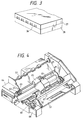
- Fig. 3 is a perspective view of the appearance of another head of the ink-jet recording apparatus.
- Fig. 4 is a perspective view of an illustrative ink-jet recording apparatus.
- Fig. 5 is a longitudinal cross-sectional view of an ink cartridge.
- Fig. 6 is a perspective view of a recording unit.
- Fig. 7 is a perspective view illustrating a recording part, in which plural recording heads are arranged.
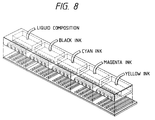
- Fig. 8 is a perspective view illustrating another construction of a recording head.
- Fig. 9 illustrates a pattern for evaluating bleeding.
- Fig. 10 diagrammatically illustrates an example of a molecular weight distribution of a liquid composition.
- Fig. 11 diagrammatically illustrates another example of a molecular weight distribution of a liquid composition.
- Fig. 12 diagrammatically illustrates a further example of a molecular weight distribution of a liquid composition.
- Fig. 13 diagrammatically illustrates a still further example of a molecular weight distribution of a liquid composition.
- one of the liquid composition containing a cationic substance (hereinafter referred to as "cation-containing liquid composition) and the recording ink is applied to a recording medium in advance, and the other is then applied so as to overlap the former.
- the above action in the present invention caused by using the water-soluble polymeric compound having an alicyclic, nitrogen-containing heterocycle and exhibiting nonionic properties in a liquid can be assumed from a phenomenon that when, for example, an anionic dye, the water-soluble polymeric compound having an alicyclic, nitrogen-containing heterocycle and a cationic substance are coexisted with one another, these components react at high speed, as follows.
- the water-soluble polymeric compound in the water-soluble polymeric compound, a site polarized into a positive polarity is produced in a branched chain to which the alicyclic, nitrogen-containing heterocycle is bonded.
- this polarization is weak, so that even when the anionic dye is somewhat localized on this positive site in the recording ink, the anionic dye is not bonded to the water-soluble polymeric compound.
- the water-soluble polymeric compound exhibits nonionic properties in a solution, the properties of the recording ink are not changed by the addition of the water-soluble polymeric compound.
- the cationic substance contained in the liquid composition and the anionic dye are ionically bonded, so that the motion of the anionic dye in the reaction mixture is regulated, and moreover the reactivity of the anionic dye in the state ionically bonded to the cationic substance is also changed. Therefore, the anionic dye becomes liable to react with the polarized site of the water-soluble polymeric compound. As a result, a giant, water-insoluble aggregate in the form that the cationic substance is bonded to the water-soluble polymeric compound via the anionic dye is formed.
- This aggregate-forming reaction is far faster than the formation of an aggregate in the conventional recording process of the two-part liquid system in which no water-soluble polymeric compound having an alicyclic, nitrogen-containing heterocycle is added to a recording ink. Therefore, when this reaction is applied to, for example, an image-recording process using an ink-jet system, this aggregate-forming reaction is started momentarily at the time the recording ink comes into contact with the cation-containing liquid composition at a contact interface between them.
- the aggregate formed forms the main cause of changes in liquid properties, such as viscosity increase and is an obstacle to the rebound itself, whereby the rebound can be effectively prevented.
- this water-insoluble aggregate causes rapid separation of the coloring material in the recording ink applied thereto from a liquid medium, whereby bleeding and feathering are effectively prevented, and so the formation of a high-quality image is made possible.
- this aggregate is insoluble in water, the water fastness of the resulting image is far excellent.
- the mechanism as to the still more enhanced effect for preventing the rebound, which is brought about by the application of a bubble ink-jet system as described above may also be assumed to be as follows.
- the viscosity of the liquid applied later is reduced due to its temperature rise.
- the surface of the liquid applied first is covered over a wider range with the liquid applied later, so that an contact area between the two liquids becomes wider, and the aggregate-forming reaction occurs in a wider range, thereby bringing about a still more enhanced effect for preventing the rebound.
- the combined use of two substances having a molecular weight not higher than 1,000 and having a molecular weight higher than 1,000 as the cationic substance is more effective.
- a reason for it is considered to be that the start-up of the aggregation reaction of the dye and the cationic substance by ionic interaction is accelerated by the presence of the cationic substance having a lower molecular weight, and the insolubilization of the aggregate due to its growth is accelerated by the cationic substance having a higher molecular weight.
- the recording ink according to an aspect of the present invention is composed of at least a water-soluble polymeric compound having an alicyclic, nitrogen- containing heterocycle and a coloring material.
- the recording ink may contain an aqueous medium composed of water, a mixed solvent of water and a water-soluble organic solvent, or the like from the viewpoint of maintaining its liquid properties. Further, the recording ink may contain various additives according to the kinds of processes for applying it to a recording medium. When it is used in, for example, an ink-jet system, various components routinely used in inks for ink-jet, for example, viscosity modifiers, pH adjustors, antiseptics, surfactants, antioxidants and the like, may be suitably selected for use.
- the water-soluble polymeric compound having an alicyclic, nitrogen-containing heterocycle which is added to the recording ink in the present invention, has a polarized part, its reactivity in the recording ink is low. Therefore, it usually does not react with other components of the ink to change the properties of the ink. However, there are some cases where they react with each other according to the kinds of the other components of the ink to greatly deteriorate the properties of the ink. In such a case, it is only necessary to avoid such a combination to change to another combination.
- any polymeric compound may be used without any particular limitation so far as it permits the rapid formation of the aggregate as described above while maintaining good recording characteristics.
- copolymers of (a) an acrylic ester of an ethylene oxide or propylene oxide adduct of a substituted morpholine, (b) acrylic acid and (c) a compound represented by the general formula wherein R 1 , R 2 , L 2 to L 4 , n, m and k have the same meaning as defined in the general formula (1), may be mentioned as more preferable compounds.
- a water-soluble polymeric compound having a repeating unit represented by the general formula that both R 1 and R 5 in the general formula (1) are a morpholine ring of the formula is more preferable, because the reactivity of the cationic substance contained in the cation-containing liquid composition with the water-soluble polymeric compound having an alicyclic, nitrogen-containing heterocycle and coloring material in the resulting recording ink becomes extremely good, and the stability of the recording ink itself also become far excellent.
- the water-soluble polymeric compound having an alicyclic, nitrogen-containing heterocycle those in which the upper limit of the molecular weight (weight average molecular weight) as determined by gel permeation chromatography (GPC) (GPC column: TSG-gel GMHXL, in terms of polystyrene) is 300,000, and the lower limit is 5,000 are preferred, with those the upper limit of the molecular weight of which is 50,000 being more preferred.
- GPC gel permeation chromatography
- the recording ink containing the polymeric compound within such a molecular weight range is applied to an ink-jet recording process using a heating element, i.e., a recording process by a bubble ink-jet system in which thermal energy is applied to eject a liquid
- a heating element i.e., a recording process by a bubble ink-jet system in which thermal energy is applied to eject a liquid
- the occurrence of problems that deposit attaches on the heating element, and ejection failure of the recording ink occurs due to this attachment can be more effectively prevented.
- the recording ink using the water-soluble polymeric compound within such a molecular weight range is particularly suitable for use in the ink-jet recording process using a heating element.
- the amount of the water-soluble polymeric compound having an alicyclic, nitrogen-containing heterocycle to be incorporated in the recording ink may be suitably selected according to the kind of a process for applying the resulting recording ink to a recording medium, and the like.
- the resulting recording ink has advantages that the formation of an aggregate at the time of the contact of the recording ink with the cation-containing liquid composition is more accelerated, and the recording ink is easy to be applied to the bubble ink-jet system using a heating element.
- any coloring material may be used without any limitation so far as it permits the above-described formation of aggregate by the reaction of the cationic substance with the water-soluble polymeric compound having an alicyclic, nitrogen-containing heterocycle and can give the desired recording characteristics.
- Various kinds of coloring matter may be used as such materials. Examples thereof include water-soluble acid dyes, direct dyes and reactive dyes, which are described in COLOR INDEX, and besides water-soluble dyes having anionic groups, for example, a sulfonic group and/or a carboxylic group, which are not described in COLOR INDEX.
- water-soluble dyes used herein those having dependence of solubility on pH are also included.
- anionic dyes are preferred as the coloring material.
- the coloring material may be selected and incorporated according to the desired color of the resulting recording ink.
- the selection of the coloring material permits the preparation of inks of yellow, magenta, cyan, black, red, blue and green colors. At least one of these color inks can be combined with the cation-containing liquid composition to use as an ink set.
- the content of the coloring material is preferably within a range of generally from 1 to 8 % by weight, or from 3 to 10 % by weight for using the resulting ink in recording on cloth, metal (alumite) and the like, or from 0.01 to 10 % by weight in the case where variable density is required of the resulting recorded image.
- aqueous media usable in the recording ink in the present invention may be mentioned water, mixed solvents of water and a water-soluble organic solvent, and the like.
- water it is preferable to use ion-exchanged water or deionized water.
- alkyl alcohols having 1 to 4 carbon atoms such as methyl alcohol, ethyl alcohol, n-propyl alcohol, isopropyl alcohol, n-butyl alcohol, sec-butyl alcohol and tert-butyl alcohol; amides such as dimethylformamide and dimethylacetamide; ketones and ketone alcohols such as acetone and diacetone alcohol; ethers such as tetrahydrofuran and dioxane; polyalkylene glycols such as polyethylene glycol and polypropylene glycol; alkylene glycols the alkylene group of which has 2 to 6 carbon atoms, such as ethylene glycol, thiodiglycol, hexylene glycol and diethylene glycol; 1,2,6-hexanetriol; glycerol; lower alkyl ethers of polyhydric alcohols, such as ethylene glycol monomethyl (or monoethyl)
- ethanol or isopropyl alcohol in an amount of 1 % by weight or more because the addition of these solvents is considered to permit more stable bubbling of the recording ink on a thin film resistor (heating element) when the application of the recording ink to a recording medium is conducted by an ink-jet recording process using a heating element.
- the addition of these solvents in excess involves a drawback that the print quality of the resulting print is impaired.
- the suitable concentration of these solvents is 3 to 10 % by weight.
- the content of the water-soluble organic solvent in the recording ink according to the present invention is generally within a range of from 3 to 50 % by weight, preferably from 3 to 40 % by weight based on the total weight of the recording ink, while the amount of water to be used is within a range of from 10 to 90 % by weight, preferably from 30 to 80 % by weight based on the total weight of the recording ink.
- the cation-containing liquid composition used in combination with the recording ink there is preferred a liquid composition having fractions, which each contain a cationic substance, in a molecular weight region of 1,000 or lower and a molecular weight region of higher than 1,000, respectively, when its molecular weight distribution is measured by means of gel permeation chromatography (GPC).
- GPC gel permeation chromatography
- Examples thereof include liquid compositions in which peaks of the molecular weight distribution separately exist in different molecular weight regions, specifically, in which a peak of the molecular weight distribution exists, for example, in both fractions not higher than 1,000 in terms of molecular weight and higher than 1,000 in terms of molecular weight as illustrated in Figs. 10 and 11, and the peaks are attributable to cationic substances, and liquid compositions having fractions not higher than 1,000 in terms of molecular weight and higher than 1,000 in terms of molecular weight, respectively, said fractions each containing a cationic substance as illustrated in Figs. 12 and 13.
- the liquid composition has advantages to ejection properties such as frequency responsiveness, stable ejection volume and stable ejection velocity when it is applied to a recording medium by means of an ink-jet recording head, in particular, an On-Demand type bubble ink-jet recording head.
- advantages that since there is no need to use any polyvalent metal salt, a problem of kagation also does not arise are mentioned as another effect of the present invention.
- the cation-containing liquid composition containing cationic substances of different molecular weights preferably has plural fractions, for example, fractions in a low molecular weight region and a high molecular weight region, said fractions each containing a cationic substance, when its molecular weight distribution is measured by GPC.
- examples thereof include liquid compositions in which at least one peak attributable to the cationic substance exists in both low molecular weight region and high molecular weight region as illustrated in Figs. 10 and 11, liquid compositions which have a single peak and show a wide molecular weight distribution from a low molecular weight region to a high molecular weight region as illustrated in Figs.
- the cationic substance contained in the fraction on the low molecular weight side among the plural fractions is preferably a substance contained in a fraction within a molecular weight region of not higher than 1,000, particularly from 200 to 800, more preferably from 300 to 800 in the molecular weight distribution of the liquid composition from the viewpoint of providing a high-quality image.
- a coloring material for example, a water-soluble dye having an anionic group, and a water-soluble polymeric compound having an alicyclic, nitrogen-containing heterocycle contained in the recording ink come into contact with the cation-containing liquid composition, whereby the mobility of the ink can be quickly restricted, the rebound can be prevented, and the coloring material can be prevented from diffusing and penetrating into a recording medium following the penetration of a solvent into the recording medium.
- the low molecular weight component a compound close to monodisperse in the molecular weight distribution, for example, that having a peak in a molecular weight region of 1,000 or lower is preferably used.
- the molecular weight found from its chemical formula is regarded as the position of a peak in the molecular weight distribution.
- the low molecular weight component of the cationic substance may be mentioned compounds of the primary, secondary and tertiary amine salt types, specifically, the hydrochlorides, acetates and the like of laurylamine, coconut amine, stearylamine, rosin amine and the like, and besides compounds of the quaternary ammonium salt type, specifically, lauryltrimethylammonium chloride, lauryldimethylbenzylammonium chloride, benzyltributyl-ammonium chloride, benzalkonium chloride, cetyltrimethyl-ammonium chloride and the like, pyridinium salt type compounds, specifically, cetylpyridinium chloride, cetylpyridinium bromide and the like, imidazoline type cationic compounds, specifically, 2-heptadecenylhydroxy-ethylimidazoline and the like, and ethylene oxide adducts of secondary alkylamines, specifically, dihydroxyethylamine salt types,
- amphoteric surfactants exhibiting cationic properties in a certain pH region may also be used. More specifically, there are mentioned amino acid type amphoteric surfactants, compounds of the RNHCH 2 -CH 2 COOH type, betaine type compounds, for example, stearyldimethylbetaine and lauryldihydroxyethylbetaine, and the like. If these amphoteric surfactants are used, it goes without saying that the cation-containing liquid composition is preferably adjusted either so as to have a pH not higher than their isoelectric point or so as to reach the pH not higher than the isoelectric point when mixed with the recording ink on a recording medium.
- cationic substances usable in the present invention are not always limited to these compounds.
- the high molecular weight component of the cationic substance is preferably a cationic substance contained in a fraction within a molecular weight region of higher than 1,000, particularly not lower than 1,500, more preferably from 1,500 to 10,000 when the molecular weight distribution of the cation-containing liquid composition is measured by GPC, from the viewpoints of fixing the recording ink at high speed and providing a high-quality image.
- the high molecular weight component of the cationic substance a compound close to monodisperse in the molecular weight distribution, such as that having a peak in a molecular weight region of, for example, 1,500 or higher, is preferably used.
- the high molecular weight component of the cationic substance may be mentioned polyallylamine, polyamine sulfone, polyvinylamine, chitosan, and neutralized products or partially neutralized products of these compounds with an acid such as hydrochloric acid or acetic acid. It goes without saying that the high molecular weight component is not limited to these substances.
- the effect of these polymeric substances in the practice of the present invention can be sufficiently exhibited so far as they have a molecular weight distribution in which at least one peak exists in a molecular weight region of higher than 1,000, for example, not lower than 1,500 but not higher than 10,000.
- the molecular weight of the polymeric substance in the present invention designates an average molecular weight determined by means of GPC and means a weight average molecular weight in terms of polyethylene oxide unless expressly noted.
- cationic polymeric substances usable in the present invention
- compounds obtained by partially cationizing a nonionic polymeric substance include copolymers of vinylpyrrolidone and an aminoalkylalkylate quaternary salt and copolymers of acrylamide and an aminomethylacrylamide quaternary salt.
- the polymeric substance is not limited to these compounds. If the above-described cationic polymeric substances are soluble in water, there is nothing to be said against them. However, they may be in the form of a dispersion such as latex or emulsion.
- the liquid composition having the molecular weight distribution illustrated in Fig. 12 according to an embodiment of the present invention is such that a peak of its molecular weight distribution exists in a molecular weight region of not higher than 1,000, a fraction is also present in a region of higher than 1,000, and the fractions in the molecular weight region of not higher than 1,000 and the molecular weight region of higher than 1,000 contain a cationic substance.
- a cationic substance used in such a cation-containing liquid composition there may be preferably used a substance the molecular weight of which widely distributes from a low molecular weight region to a high molecular weight region.
- a cationic compound which provides such a liquid composition that when the molecular weight distribution of this liquid composition is measured, a cationic substance is contained in a fraction not higher than 1,000 in terms of molecular weight, particularly in a fraction of about 800 in terms of molecular weight, or even in a fraction of about 300 in terms of molecular weight on the low molecular weight region, while a cationic substance is contained in a fraction higher than 1,000 in terms of molecular weight, particularly in a fraction not lower than 1,500 in terms of molecular weight, or even in a fraction of from 1,500 to 10,000 in terms of molecular weight on the high molecular weight region.
- Such a cationic compound may be obtained either from one kind of cationic polydisperse polymer having a single recurring unit or from a mixture of two or more cationic polymers of different structures.
- Examples of such a cationic substance include polymers which are the same polymers as those used as the high molecular weight component of the cationic substance and synthesized so as to widen its molecular weight distribution, and mixtures of a polymer and an oligomer.
- the mixing ratio of the low molecular weight component to the high molecular weight component of the cationic substance in the cation-containing liquid composition may be suitably selected according to the raw materials.
- the ratio is determined within a range of from 10:1 to 1:10, preferably from 5:1 to 1:5 by weight, more preferably from 1:1 to 1:5 by weight, the problem of ejection failure due to the rebound of the cation-containing liquid composition, the recording ink or a mixture thereof can be fully solved, and the water fastness of the resulting image can also be more enhanced.
- bleeding can be sufficiently prevented, and moreover the edge sharpness of the resulting image can be improved.
- the content of the cationic substance in the cation-containing liquid composition may also be suitably determined according to the raw materials so as to exhibit the above-described effects.
- the content is determined within a range of from 0.05 to 20 % by weight, particularly from 0.5 to 5 % by weight based on the total weight of the liquid composition, preference is given from the viewpoint of controlling the physical properties of the cation-containing liquid composition, such as viscosity and surface tension so as to be suited for ink-jet recording.
- the cation-containing liquid compositions may contain water, water-soluble organic solvents and other additives in addition to the above-described respective cationic substances.
- water-soluble organic solvents used include amides such as dimethylformamide and dimethylacetoamide; ketones such as acetone; ethers such as tetrahydrofuran and dioxane; polyalkylene glycols such as polyethylene glycol and polypropylene glycol; alkylene glycols such as ethylene glycol, propylene glycol, butylene glycol, triethylene glycol, thiodiglycol, hexylene glycol and diethylene glycol; lower alkyl ethers of polyhydric alcohols, such as ethylene glycol methyl ether, diethylene glycol monomethyl ether and triethylene glycol monomethyl ether; monohydric alcohols such as ethanol, isopropyl alcohol, n-butyl alcohol and isobutyl alcohol; and besides, 1,2,6-hexanetriol, glycerol, N-methyl-2-pyrrolidone, 1,3-dimethylimidazolidinone, triethanolamine, sulfolane
- the content of the water-soluble organic solvents may preferably be within a range of from 5 to 60 % by weight, more preferably from 5 to 40 % by weight based on the total weight of the cation-containing liquid composition.
- additives such as viscosity modifiers, pH adjustors, antiseptics, surfactants, antioxidants and evaporation accelerators may be incorporated as needed.
- the selection of the surfactants is particularly important from the viewpoint of controlling the penetrability of a liquid.
- any process may be used as the image-forming process in the present invention so far as it is a process in which the cation-containing liquid composition and the recording ink can be coexisted on a recording medium. No problem arises if either of the cation-containing liquid composition and the recording ink is first applied to the recording medium. According to an image-forming process in which the cation-containing liquid composition is first applied to a recording medium, and the recording ink is subsequently applied to the recording medium, however, the rebound-preventing effect can be brought about to an extremely great extent, and excellent image recording can hence be stably conducted.
- image-forming region means a region of a recording medium, to which dots of the recording ink are applied, while the term “the vicinity of the image-forming region” means an outside region about 1 to 5 dots away from the region to which dots of the recording ink are applied.
- the liquid composition is applied to the whole surface of the recording medium by a sprayer, roller or the like.
- No particular limitation is imposed on the time required from the time the cation-containing liquid composition is applied to the recording medium up to the time the recording ink is then applied.
- a method of applying the recording ink to the recording medium may also be suitably selected according to the intended image formation.
- an ink-jet system is adopted for the application of at least one of the recording ink and the cation-containing liquid composition to the recording medium
- various kinds of ink-jet systems may be used. Specific examples thereof include the so-called On-Demand type bubble ink-jet system in which bubbles generated by thermal energy are used to eject droplets, and an ink-jet system using a piezoelectric element.
- the bubble ink-jet system is particularly preferably used.
- the individual cationic substances may be subjected to GPC measurement in advance.
- the molecular weight distribution may be determined in the following manner. Namely, after the molecular weight distribution of the cation-containing liquid composition itself is determined, a sufficient amount of an ink containing a dye having at least an anionic group is mixed under stirring with the liquid composition in a beaker, and precipitate formed is removed.
- the GPC measurement is conducted again to compare the measurement results before the mixing of the ink and after the mixing of the ink and the removal of the precipitate with each other, whereby the molecular weight distribution of the cationic substance is found from the molecular weight distribution of the component precipitated by the dye in the ink and removed from the system.
- FIG. 1 A head 13 is formed by bonding a glass, ceramic, plastic plate or the like having an ink-passing channel to a heating head 15, which is used for thermal recording and has a heating resistor (the drawings show a head to which, however, the invention is not limited).
- the heating head 15 is composed of a protective film 16 made of silicon oxide or the like, aluminum electrodes 17-1 and 17-2, a heating resistor layer 18 made of nichrome or the like, a heat accumulating layer 19, and a substrate 20 made of alumina or the like having a good heat radiating property.
- a recording ink 21 comes up to an ejection orifice 22 and forms a meniscus 23 due to a pressure P.
- the heating head 15 rapidly generates heat at the region shown by n to form bubbles in the recording ink 21 which is in contact with this region.
- the meniscus 23 of the ink is projected by the action of the pressure thus produced, and the recording ink 21 is ejected from the orifice 22 to a recording medium 25 in the form of droplets 24 of the recording ink.
- Fig. 3 schematically illustrates a multi-head composed of an array of a number of heads as shown in Fig. 1.
- the multi-head is formed by closely bonding a glass plate or the like 27 having a number of channels to a heating head 28 similar to the head as illustrated in Fig. 1.
- Fig. 1 is a cross-sectional view of the head 13 taken along the flow path of the ink
- Fig. 2 is a cross-sectional view taken along line 2-2 in Fig. 1.
- Fig. 4 illustrates an exemplary ink-jet recording apparatus in which such a head has been incorporated.
- reference numeral 61 designates a blade serving as a wiping member, one end of which is a stationary end held by a blade-holding member to form a cantilever.
- the blade 61 is provided at a position adjacent to a region in which a recording head operates, and in this embodiment, is held in such a form that it protrudes into the course through which the recording head is moved.
- Reference numeral 62 indicates a cap, which is provided at a home position adjacent to the blade 61, and is so constituted that it moves in a direction perpendicular to a direction in which the recording head is moved and comes into contact with the face of ejection openings to cap it.
- Reference numeral 63 denotes an ink-absorbing member provided adjoiningly to the blade 61 and, similar to the blade 61, held in such a form that it protrudes into the course through which the recording head is moved.
- the above- described blade 61, cap 62 and absorbing member 63 constitute an ejection-recovery portion 64, where the blade 61 and absorbing member 63 remove water, dust and/or the like from the face of the ink-ejecting openings.
- Reference numeral 65 designates the recording head having an ejection-energy-generating means and serving to eject the recording ink onto a recording medium set in an opposing relation to the ejection opening face provided with ejection openings to conduct recording.
- Reference numeral 66 indicates a carriage on which the recording head 65 is mounted so that the recording head 65 can be moved.
- the carriage 66 is slidably interlocked with a guide rod 67 and is connected (not illustrated) at its part to a belt 69 driven by a motor 68.
- the carriage 66 can be moved along the guide rod 67 and hence, the recording head 65 can be moved from a recording region to a region adjacent thereto.
- Reference numerals 51 and 52 denote a feeding part from which the recording media are separately inserted, and feed rollers driven by a motor (not illustrated), respectively. With such a construction, the recording medium is fed to the position opposite to the ejection opening face of the recording head, and discharged from a discharge section provided with discharge rollers 53 with the progress of recording.
- the cap 62 in the head recovery portion 64 is receded from the path of motion of the recording head 65 when the recording head 65 is returned to its home position, for example, after completion of recording, and the blade 61 remains protruded into the path of motion.
- the ejection opening face of the recording head 65 is wiped.
- the cap 62 comes into contact with the ejection opening face of the recording head 65 to cap it, the cap 62 is moved so as to protrude into the path of motion of the recording head 65.
- the cap 62 and the blade 61 are at the same positions as the positions for the wiping as described above.
- the ejection opening face of the recording head 65 is also wiped at the time of this movement.
- the above movement of the recording head 65 to its home position is made not only when the recording is completed or the recording head 65 is recovered for ejection, but also when the recording head 65 is moved between recording regions for the purpose of recording, during which it is moved to the home position adjacent to each recording region at given intervals, where the ejection opening face is wiped in accordance with this movement.
- Fig. 5 illustrates an exemplary ink cartridge 45 in which a recording ink to be fed to the head through an ink-feeding member, for example, a tube is contained.
- reference numeral 40 designates an ink container part containing the recording ink to be fed, as exemplified by a bag for the ink. One end thereof is provided with a stopper 42 made of rubber. A needle (not illustrated) may be inserted into this stopper 42 so that the recording ink in the bag 40 for the ink can be fed to the head.
- Reference numeral 44 indicates an ink absorbing member for receiving a waste ink. It is preferable that the ink container part is formed of a polyolefin, in particular, polyethylene, at its surface with which the recording ink comes into contact.
- the ink-jet recording apparatus used in the present invention are not limited to the apparatus as described above in which the recording head and the ink cartridge are separately provided. Therefore, a device in which these members are integrally formed as shown in Fig. 6 can also be preferably used.
- reference numeral 70 designates a recording unit, in the interior of which an ink container part containing a recording ink, for example, an ink-absorbing member, is contained.
- the recording unit 70 is so constructed that the recording ink in such an ink-absorbing member is ejected in the form of ink droplets through a head 71 having a plurality of orifices.
- polyurethane may be used as a material for the ink-absorbing member.
- Reference numeral 72 indicates an air passage for communicating the interior of the recording unit 70 with the atmosphere.
- This recording unit 70 can be used in place of the recording head shown in Fig. 4, and is detachably installed on the carriage 66.
- the ink-jet recording apparatus in which thermal energy is applied to a recording ink to eject droplets of the recording ink has been described by way of example.
- the present invention can also be used in other ink-jet recording apparatus of a piezo-system using a piezoelectric element than the above apparatus.
- a recording apparatus in which five recording heads, each of which has been illustrated in Fig. 3, are arranged on a carriage 80, can be used.
- An example thereof is illustrated in Fig. 7.
- Reference numerals 81, 82, 83 and 84 indicate recording heads for ejecting recording inks of yellow, magenta, cyan and black colors, respectively.
- Reference numeral 85 designates a head for ejecting the cation-containing liquid composition, which is so constructed that droplets of the liquid composition are ejected by the same ink-jet system as the above-described head used for ejecting the recording ink.
- These heads are arranged in the above-described recording apparatus and eject the respective recording inks of the different colors according to recording signals.
- the cation-containing liquid composition is applied in advance to at least image-forming regions (portions to which the recording inks will be applied) before the application of the recording inks, or applied subsequently to the application of the recording inks.
- Fig. 7 shows the case where the five recording heads are used.
- the present invention is not limited thereto. Preference is given even to the case where the yellow, magenta, cyan and black inks and the cation-containing liquid composition are ejected from separate flow paths in one recording head as shown in Fig. 8. It goes without saying that construction of the head may be changed so as to reverse the recording order of the cation-containing liquid composition and the recording inks as described above.
- the inclusion of the water-soluble polymeric compound having an alicyclic, nitrogen-containing heterocycle in the recording ink brings about, for example, the following excellent effects.
- high-speed fixing is feasible, and images high in print quality, free of bleeding and higher in water fastness can be provided.
- the staining on the surface of a recording head due to the rebound of liquids at the time a liquid is applied to a recording medium so as to overlap another liquid applied first, in particular, defective ejection and ejection failure of ink due to the crusting of an aggregate on the recording head can be effectively prevented.
- Polymeric Substances A to F in Tables 1 to 6 are as follows. Incidentally, the molecular weight of each polymeric substance was determined by gel permeation chromatography (GPC column: TSG-gel GMHXL, in terms of polystyrene).
- the above-described polymeric substances were obtained in accordance with the following process. Namely, their corresponding three monomers (1), (2) and (3) for preparation of the respective polymeric substances were mixed in the determined weight ratios. Further, 0.1 part of 2,2'-azobis(2,4-dimethyl)- valeronitrile was mixed as a polymerization catalyst with each of the resultant mixtures. The mixture was placed in an ampule, frozen and deaerated, and then hermetically sealed to conduct polymerization at 60°C for 8 hours, thereby obtaining the intended polymeric substance.
- the monomers (2) (A-2, B-2, D-2, E-2 and F-2) were synthesized in accordance with the following process. Namely, alkylene oxides (ethylene oxide, propylene oxide and the like) were first added successively to a nitrogen-containing alicyclic compound in the presence of an alkali metal catalyst at 50 to 200°C and 1 to 10 atm, and ethylene oxide was further added to synthesize a polyether monool.
- alkylene oxides ethylene oxide, propylene oxide and the like
- the polyether monool was esterified with methacrylic acid or acrylic acid in the presence of an acid catalyst (sulfuric acid, p-toluene- sulfonic acid or the like) at 50 to 200°C and 1 to 10 atm, or esterified with an esterifying agent (dicyclohexyl carbodiimide) at -10 to 50°C under atmospheric pressure, thereby obtaining the intended monomer.
- an acid catalyst sulfuric acid, p-toluene- sulfonic acid or the like
- an esterifying agent dicyclohexyl carbodiimide
- Acetylenol is a trade name and available from Kawaken Fine Chemical Co., Ltd.
- Composition of Liquid Composition X Stearyltrimethylammonium chloride (Electrostripper QE, trade name, product of Kao Corporation, Mw: 340) 2 parts Polyamine sulfone hydrochloride (PAS-A-1, trade name, product of Nitto Boseki Co., Ltd., position of peak in molecular weight distribution: 2,000) 10 parts Thiodiglycol 10 parts Ion-exchanged water 78 parts.
- Electric QE Stearyltrimethylammonium chloride
- PAS-A-1 trade name, product of Nitto Boseki Co., Ltd., position of peak in molecular weight distribution: 2,000
- Liquid Composition Y Stearyltrimethylammonium chloride (Electrostripper QE, trade name, product of Kao Corporation, Mw: 340) 2 parts Polyamine sulfone hydrochloride (PAS-A-5, trade name, product of Nitto Boseki Co., Ltd., position of peak in molecular weight distribution: 3,500) 6 parts Thiodiglycol 10 parts Ion-exchanged water 82 parts.
- Electric QE Stearyltrimethylammonium chloride
- PAS-A-5 trade name, product of Nitto Boseki Co., Ltd., position of peak in molecular weight distribution: 3,500
- Liquid Composition Z Stearyltrimethylammonium chloride (Electrostripper QE, trade name, product of Kao Corporation, Mw: 340) 2 parts Polyamine sulfone hydrochloride (PAS-92, trade name, product of Nitto Boseki Co., Ltd., position of peak in molecular weight distribution: 5,000) 4 parts Thiodiglycol 10 parts Ion-exchanged water 84 parts.
- Electric QE Stearyltrimethylammonium chloride
- PAS-92 trade name, product of Nitto Boseki Co., Ltd., position of peak in molecular weight distribution: 5,000
- Thiodiglycol 10 parts Ion-exchanged water 84 parts.
- the recording ink sets and cation-containing liquid compositions prepared in Example 1 were used in a recording apparatus using a bubble ink-jet system in accordance with their corresponding printing processes shown in Table 7, thereby conducting recording.
- the application of the cation-containing liquid composition and the recording ink on a recording medium was performed at a volume ratio of the cation-containing liquid composition to the recording ink of 0.5:1 to 1:1.
- a pattern including 5 solid printed areas of 5 mm square was printed on an A4-sized paper sheet with a combination of the liquid composition and the recording ink of black (Bk) in each ink set. After the resultant print sample was left over for at least 30 minutes, optical densities of the individual solid printed areas thereof were measured by a Macbeth reflection densitometer RD915, and their average value was taken as an OD value of the sample and ranked in accordance with the following standard.
- the shot-in ink quantity of each recording ink in each solid printed area was 12 nl/mm 2 .
- a pattern illustrated in Fig. 9 was printed with the combinations of the liquid composition and the yellow, magenta, cyan and black inks in each ink set in accordance with the same printing mode as the printing mode E (1 pass, one-direction printing) in a Bubble Jet Printer BJC-820 (trade name, manufactured by Canon Inc.), thereby visually observing the degree of bleeding (color mixing) at boundaries between the inks of different colors.
- the resistance to bleeding was ranked in accordance with the following standard:
- Printing was continuously conducted throughout on a number of sheets of A4-sized paper with the combinations of the liquid composition and the yellow, magenta, cyan and black inks in each ink set under conditions of a volume ratio of the recording ink to the cation-containing liquid composition of 1:1 while conducting recovery operation by wiping a recording head of the recording apparatus as needed, thereby evaluating the level of occurrence of ejection failure and ranking it in accordance with the following standard:
Landscapes
- Chemical & Material Sciences (AREA)
- Life Sciences & Earth Sciences (AREA)
- Engineering & Computer Science (AREA)
- Materials Engineering (AREA)
- Wood Science & Technology (AREA)
- Organic Chemistry (AREA)
- Chemical Kinetics & Catalysis (AREA)
- Ink Jet Recording Methods And Recording Media Thereof (AREA)
- Inks, Pencil-Leads, Or Crayons (AREA)
- Particle Formation And Scattering Control In Inkjet Printers (AREA)
- Ink Jet (AREA)
Applications Claiming Priority (3)
| Application Number | Priority Date | Filing Date | Title |
|---|---|---|---|
| JP31439295A JP3984663B2 (ja) | 1995-12-01 | 1995-12-01 | 2液系記録用のインク、該インクを用いたインクセット及び該インクセットによる記録方法並びに該記録方法に用いる装置 |
| JP31439295 | 1995-12-01 | ||
| JP314392/95 | 1995-12-01 |
Publications (3)
| Publication Number | Publication Date |
|---|---|
| EP0776950A2 true EP0776950A2 (fr) | 1997-06-04 |
| EP0776950A3 EP0776950A3 (fr) | 1998-03-18 |
| EP0776950B1 EP0776950B1 (fr) | 2001-06-13 |
Family
ID=18052799
Family Applications (1)
| Application Number | Title | Priority Date | Filing Date |
|---|---|---|---|
| EP19960119115 Expired - Lifetime EP0776950B1 (fr) | 1995-12-01 | 1996-11-28 | Encre pour l'enregistrement par système liquide de deux parties, et assortiment d'encres, réservoir d'encre, unité d'enregistrement, procédé d'enregistrement et appareil d'enregistrement |
Country Status (4)
| Country | Link |
|---|---|
| US (1) | US5866638A (fr) |
| EP (1) | EP0776950B1 (fr) |
| JP (1) | JP3984663B2 (fr) |
| DE (1) | DE69613321T2 (fr) |
Cited By (5)
| Publication number | Priority date | Publication date | Assignee | Title |
|---|---|---|---|---|
| US6234625B1 (en) | 1998-06-26 | 2001-05-22 | Eastman Kodak Company | Printing apparatus with receiver treatment |
| EP1099731A3 (fr) * | 1999-11-12 | 2001-10-10 | Canon Kabushiki Kaisha | Procédé de formation d'une image, assortiment d'encre, enregistrement d'image par impression par jet d'encre, article imprimé, article dont la surface a été traitée et procédé de traitement de surface |
| US6322208B1 (en) | 1998-08-12 | 2001-11-27 | Eastman Kodak Company | Treatment for improving properties of ink images |
| EP1106658A3 (fr) * | 1999-11-12 | 2003-10-01 | Canon Kabushiki Kaisha | Composition liquide, assortiment d'encres, procédé de formation d'images et dispositif de formation d'images |
| US6841592B2 (en) | 2001-07-23 | 2005-01-11 | Baker Hughes Incorporated | Waterfastness additives for aqueous jet inks |
Families Citing this family (29)
| Publication number | Priority date | Publication date | Assignee | Title |
|---|---|---|---|---|
| US6720367B2 (en) * | 1997-03-25 | 2004-04-13 | Seiko Epson Corporation | Ink composition comprising cationic, water-soluble resin |
| JP4114227B2 (ja) * | 1998-02-17 | 2008-07-09 | コニカミノルタホールディングス株式会社 | インクジェット用液体組成物、画像形成用インクセット及び画像形成方法 |
| US7265164B2 (en) * | 1998-02-23 | 2007-09-04 | Seiko Epson Corporation | Ink composition containing cationic water-soluble polymer |
| US6790879B2 (en) * | 1998-09-30 | 2004-09-14 | Fuji Photo Film Co., Ltd. | Jet printing ink and ink-jet recording method |
| EP1048699B1 (fr) | 1999-04-27 | 2011-07-20 | Canon Kabushiki Kaisha | Assortiment d'encres, procédé d'impression, encre, article imprimé, appareil d'impression, cartouche d'encre, unité d'enregistrement, et procédé de préparation de films composites polymères |
| JP3893262B2 (ja) | 2000-09-14 | 2007-03-14 | キヤノン株式会社 | 水性光硬化型樹脂組成物、水性インク、インクカートリッジ、記録ユニット及びインクジェット記録装置 |
| US6821328B2 (en) * | 2001-05-10 | 2004-11-23 | Canon Kabushiki Kaisha | Liquid composition, ink set, method of forming colored portion in recording medium and ink-jet recording apparatus |
| ATE309915T1 (de) * | 2001-11-02 | 2005-12-15 | Ciba Sc Holding Ag | Tintenstrahlaufzeichnungsmaterial |
| JP2003205673A (ja) * | 2002-01-10 | 2003-07-22 | Ricoh Co Ltd | インクジェット記録方法及び装置及び処理液 |
| DE10203047A1 (de) * | 2002-01-26 | 2003-08-07 | Degussa | Kationische Mischoxid-Dispersion, Streichfarbe und tintenaufnehmendes Medium |
| US20040257417A1 (en) * | 2003-04-28 | 2004-12-23 | Christian Jackson | Inkjet printing method |
| US20070103529A1 (en) * | 2003-06-16 | 2007-05-10 | Kornit Digital Ltd. | Process and system for printing images on absorptive surfaces |
| WO2005092993A1 (fr) * | 2004-03-26 | 2005-10-06 | Canon Kabushiki Kaisha | Encre à base d’eau durcissable par radiation d'énergie active et utilisation de ladite encre, procédé d’enregistrement à jet d’encre, cartouche d’encre, unité d'enregistrement et appareil d'enregistrement à jet d'encre |
| EP1734088B1 (fr) * | 2004-03-26 | 2015-05-13 | Canon Kabushiki Kaisha | Composition d' encre a base d' eau durcissable par radiation d' energie active et utilisation de ladite composition, procede d' enregistrement a jet d' encre, cartouche d' encre, unite d' enregistrement et appareil d' enregistrement |
| US11447648B2 (en) | 2004-05-30 | 2022-09-20 | Kornit Digital Ltd. | Process and system for printing images on absorptive surfaces |
| US8092874B2 (en) | 2009-02-27 | 2012-01-10 | Eastman Kodak Company | Inkjet media system with improved image quality |
| US8419176B2 (en) | 2009-05-29 | 2013-04-16 | Eastman Kodak Company | Aqueous compositions with improved silicon corrosion characteristics |
| CN102656237B (zh) | 2009-08-10 | 2014-07-09 | 柯尼特数码有限公司 | 用于可拉伸基材的喷墨组合物及方法 |
| US8348411B2 (en) | 2009-09-30 | 2013-01-08 | Eastman Kodak Company | Pigment based inks for reliable high speed inkjet printing |
| US20110123714A1 (en) | 2009-11-24 | 2011-05-26 | Hwei-Ling Yau | Continuous inkjet printer aquous ink composition |
| US8398191B2 (en) | 2009-11-24 | 2013-03-19 | Eastman Kodak Company | Continuous inkjet printer aquous ink composition |
| US20120156375A1 (en) | 2010-12-20 | 2012-06-21 | Brust Thomas B | Inkjet ink composition with jetting aid |
| US20130186301A1 (en) | 2012-01-24 | 2013-07-25 | Thomas Nelson Blanton | Ink having antibacterial and antifungal protection |
| US20130189499A1 (en) | 2012-01-24 | 2013-07-25 | Thomas Nelson Blanton | Antibacterial and antifungal protection for ink jet image |
| US9012871B2 (en) | 2013-05-02 | 2015-04-21 | Delphax Technologies Inc. | Use of fluorescent inks for document authentication |
| EP2865527B1 (fr) * | 2013-10-22 | 2018-02-21 | Agfa Nv | Fabrication de surfaces décoratives par impression à jet d'encre |
| WO2018078634A1 (fr) | 2016-10-31 | 2018-05-03 | Kornit Digital Ltd. | Impression par jet d'encre par sublimation de colorant pour textile |
| JP6984154B2 (ja) * | 2017-03-31 | 2021-12-17 | ブラザー工業株式会社 | インクセット及び記録方法 |
| JP2021500437A (ja) | 2017-10-22 | 2021-01-07 | コーニット・デジタル・リミテッド | インクジェット印刷による低摩擦画像 |
Citations (1)
| Publication number | Priority date | Publication date | Assignee | Title |
|---|---|---|---|---|
| EP0663299A2 (fr) | 1993-12-20 | 1995-07-19 | Canon Kabushiki Kaisha | Composition liquide et assortiment d'encres, procédé pour la formation d'images et appareil utilisé pour ce procédé |
Family Cites Families (31)
| Publication number | Priority date | Publication date | Assignee | Title |
|---|---|---|---|---|
| JPS6042832B2 (ja) * | 1977-10-18 | 1985-09-25 | 富士写真フイルム株式会社 | インクジエツト記録用インク組成物 |
| DE3115532A1 (de) * | 1980-04-17 | 1982-01-28 | Canon K.K., Tokyo | Tintenstrahl-aufzeichnungsverfahren und aufzeichnungstinte fuer die aufzeichnung auf einem bildempfangsmaterial |
| JPS5813675A (ja) * | 1981-07-17 | 1983-01-26 | Konishiroku Photo Ind Co Ltd | インクジエツト記録用インク組成物および記録方法 |
| JPS6033145B2 (ja) * | 1982-10-27 | 1985-08-01 | 三菱化学株式会社 | 記録液 |
| JPS61101568A (ja) * | 1984-10-23 | 1986-05-20 | Ricoh Co Ltd | 水性インク |
| JPS6253377A (ja) * | 1985-08-31 | 1987-03-09 | Dainippon Ink & Chem Inc | 染色液 |
| US4680332A (en) * | 1986-01-24 | 1987-07-14 | Xerox Corporation | Ink jet compositions and process for preparation thereof |
| JPS62181372A (ja) * | 1986-02-04 | 1987-08-08 | Fujitsu Ltd | インクジエツト記録用インク |
| US4694302A (en) * | 1986-06-06 | 1987-09-15 | Hewlett-Packard Company | Reactive ink-jet printing |
| JPS6360783A (ja) * | 1986-09-02 | 1988-03-16 | Mitsubishi Chem Ind Ltd | インクジエツト記録方法 |
| JP2667401B2 (ja) * | 1987-05-30 | 1997-10-27 | 株式会社リコー | インクジェット記録方法 |
| JPS649279A (en) * | 1987-06-30 | 1989-01-12 | Ricoh Kk | Method of ink jet recording |
| JPH01272623A (ja) * | 1988-04-25 | 1989-10-31 | Matsushita Electric Works Ltd | エポキシ樹脂組成物 |
| US5378574A (en) * | 1988-08-17 | 1995-01-03 | Xerox Corporation | Inks and liquid developers containing colored silica particles |
| US5229786A (en) * | 1988-12-27 | 1993-07-20 | Canon Kabushiki Kaisha | Ink-jet recording method, recording unit, ink cartridge and recording apparatus employing recording liquid |
| US4963189A (en) * | 1989-08-24 | 1990-10-16 | Hewlett-Packard Company | Waterfast ink formulations with a novel series of anionic dyes containing two or more carboxyl groups |
| EP0425439B1 (fr) * | 1989-10-26 | 1995-08-02 | Ciba-Geigy Ag | Encre d'imprimerie aqueuse pour l'impression par jet d'encre |
| JP3089639B2 (ja) * | 1989-12-01 | 2000-09-18 | セイコーエプソン株式会社 | 画像記録用インク |
| JPH03240586A (ja) * | 1990-02-20 | 1991-10-25 | Seiko Epson Corp | 画像形成材料 |
| US5145518A (en) * | 1990-06-27 | 1992-09-08 | Xerox Corporation | Inks containing block copolymer micelles |
| US5100471A (en) * | 1990-06-27 | 1992-03-31 | Xerox Corporation | Liquid ink compositions |
| JP2899088B2 (ja) * | 1990-08-31 | 1999-06-02 | キヤノン株式会社 | インクジェット用インク及びその製造方法、かかるインクを用いたインクジェット記録方法 |
| JPH0723443B2 (ja) * | 1992-01-31 | 1995-03-15 | 三洋化成工業株式会社 | 熱可逆型増粘剤 |
| JP3323565B2 (ja) * | 1992-07-17 | 2002-09-09 | キヤノン株式会社 | インクジェット記録方法、インクセット、インクジェット記録ユニット、インクジェット記録用インクカートリッジ及びインクジェット記録装置 |
| JPH0649399A (ja) * | 1992-07-30 | 1994-02-22 | Canon Inc | インク、これを用いたインクジェット記録方法及びかかるインクを用いた機器 |
| JP3453399B2 (ja) * | 1992-07-30 | 2003-10-06 | キヤノン株式会社 | サーマルインクジェット記録方法 |
| JP3406923B2 (ja) * | 1992-09-01 | 2003-05-19 | キヤノン株式会社 | インクジェット用インク |
| US5254158A (en) * | 1992-09-17 | 1993-10-19 | Xerox Corporation | Ink jet ink compositions |
| DE69425599T2 (de) * | 1993-03-02 | 2001-04-19 | Canon K.K., Tokio/Tokyo | Aufzeichnungsgerät, welches ein Abfalltinte-absorbierendes Element enthält |
| DE69419337T2 (de) * | 1993-03-31 | 1999-11-25 | Canon K.K., Tokio/Tokyo | Tinte, Tintenstrahl-Aufzeichnungsverfahren und Vorrichtung unter Verwendung derselben |
| JP3387610B2 (ja) * | 1994-03-07 | 2003-03-17 | 京セラミタ株式会社 | インクおよびその製造方法 |
-
1995
- 1995-12-01 JP JP31439295A patent/JP3984663B2/ja not_active Expired - Fee Related
-
1996
- 1996-11-27 US US08/753,611 patent/US5866638A/en not_active Expired - Lifetime
- 1996-11-28 EP EP19960119115 patent/EP0776950B1/fr not_active Expired - Lifetime
- 1996-11-28 DE DE69613321T patent/DE69613321T2/de not_active Expired - Lifetime
Patent Citations (1)
| Publication number | Priority date | Publication date | Assignee | Title |
|---|---|---|---|---|
| EP0663299A2 (fr) | 1993-12-20 | 1995-07-19 | Canon Kabushiki Kaisha | Composition liquide et assortiment d'encres, procédé pour la formation d'images et appareil utilisé pour ce procédé |
Cited By (6)
| Publication number | Priority date | Publication date | Assignee | Title |
|---|---|---|---|---|
| US6234625B1 (en) | 1998-06-26 | 2001-05-22 | Eastman Kodak Company | Printing apparatus with receiver treatment |
| US6322208B1 (en) | 1998-08-12 | 2001-11-27 | Eastman Kodak Company | Treatment for improving properties of ink images |
| EP1099731A3 (fr) * | 1999-11-12 | 2001-10-10 | Canon Kabushiki Kaisha | Procédé de formation d'une image, assortiment d'encre, enregistrement d'image par impression par jet d'encre, article imprimé, article dont la surface a été traitée et procédé de traitement de surface |
| EP1106658A3 (fr) * | 1999-11-12 | 2003-10-01 | Canon Kabushiki Kaisha | Composition liquide, assortiment d'encres, procédé de formation d'images et dispositif de formation d'images |
| US7198837B1 (en) | 1999-11-12 | 2007-04-03 | Canon Kabushiki Kaisha | Image forming process, ink set, image by ink-jet recording, recorded article, surface-treated article and surface treating process |
| US6841592B2 (en) | 2001-07-23 | 2005-01-11 | Baker Hughes Incorporated | Waterfastness additives for aqueous jet inks |
Also Published As
| Publication number | Publication date |
|---|---|
| EP0776950A3 (fr) | 1998-03-18 |
| DE69613321T2 (de) | 2002-04-18 |
| EP0776950B1 (fr) | 2001-06-13 |
| DE69613321D1 (de) | 2001-07-19 |
| US5866638A (en) | 1999-02-02 |
| JP3984663B2 (ja) | 2007-10-03 |
| JPH09157561A (ja) | 1997-06-17 |
Similar Documents
| Publication | Publication Date | Title |
|---|---|---|
| EP0776950B1 (fr) | Encre pour l'enregistrement par système liquide de deux parties, et assortiment d'encres, réservoir d'encre, unité d'enregistrement, procédé d'enregistrement et appareil d'enregistrement | |
| US6794427B2 (en) | Liquid composition and ink set, and image-forming process and apparatus using the same | |
| US5792249A (en) | Liquid composition, ink set, image-forming method and apparatus using the same | |
| US5624484A (en) | Liquid composition and ink set, and image-forming process and apparatus using the same | |
| EP0675178B1 (fr) | Jeu d'encres, procédé et appareil pour la formation d'images en faisant usage | |
| CA2100201C (fr) | Encre, methode d'inscription par jet d'encre et appareil d'inscription par jet d'encre | |
| EP0675179B1 (fr) | Procédé de formation d'image, jeu d'encres et appareillage de jet d'encre utilises dans ce procédé | |
| US6238045B1 (en) | Image forming method, ink-jet recording method and instruments used in such methods | |
| US5985975A (en) | Liquid composition, ink set and method and apparatus for image by using the composition and ink set | |
| US5549740A (en) | Liquid composition, ink set and image forming method and apparatus using the composition and ink set | |
| EP0581135B1 (fr) | Procédé d'enregistrement à jet d'encre, assortiment d'encres et dispositif d'enregistrement à jet d'encre utilisé dans ce procédé | |
| EP0776951B1 (fr) | Assortiment d'encres et procédé d'enregistrement par jet d'encre en faisant usage | |
| US6174354B1 (en) | Ink, ink-jet recording process and apparatus using the same | |
| EP0822094B1 (fr) | Procédé pour l'enregistrement par jet d'encre utilisant une composition liquide contenant un polymère cationique et une encre en combinaison | |
| US5933164A (en) | Ink-jet recording method | |
| EP0940453B1 (fr) | Encre, réservoir d'encre, assortiment d'encre, unité d'enregistrement, procédé d'enregistrement de l'image et appareil d'enregistrement de l'image | |
| EP0585889B1 (fr) | Encre, méthode et dispositif d'enregistrement à jet d'encre | |
| US6299675B1 (en) | Printing method, image forming process, ink, ink set, recording unit, image forming apparatus and print | |
| US6281917B1 (en) | Image forming process employing liquid composition and ink in combination | |
| EP1106658A2 (fr) | Composition liquide ainsi qu'assortiment d'encres, procédé de formation d'image, appareillage à cet effet et procédé de réduction des bavures en faisant utilisation | |
| JPH1052908A (ja) | 記録媒体及び該記録媒体を用いた記録方法 | |
| AU722045B2 (en) | Liquid composition and ink set, and image-forming process and apparatus using the same | |
| JPH10219162A (ja) | インク組成物、インクセット、これを用いる画像記録方法及び記録装置 | |
| CA2312643C (fr) | Encre, methode d'inscription par jet d'encre et appareil d'inscription par jet d'encre |
Legal Events
| Date | Code | Title | Description |
|---|---|---|---|
| PUAI | Public reference made under article 153(3) epc to a published international application that has entered the european phase |
Free format text: ORIGINAL CODE: 0009012 |
|
| AK | Designated contracting states |
Kind code of ref document: A2 Designated state(s): DE FR GB IT |
|
| RTI1 | Title (correction) | ||
| PUAL | Search report despatched |
Free format text: ORIGINAL CODE: 0009013 |
|
| AK | Designated contracting states |
Kind code of ref document: A3 Designated state(s): DE FR GB IT |
|
| 17P | Request for examination filed |
Effective date: 19980917 |
|
| 17Q | First examination report despatched |
Effective date: 19990212 |
|
| GRAG | Despatch of communication of intention to grant |
Free format text: ORIGINAL CODE: EPIDOS AGRA |
|
| GRAG | Despatch of communication of intention to grant |
Free format text: ORIGINAL CODE: EPIDOS AGRA |
|
| GRAH | Despatch of communication of intention to grant a patent |
Free format text: ORIGINAL CODE: EPIDOS IGRA |
|
| GRAH | Despatch of communication of intention to grant a patent |
Free format text: ORIGINAL CODE: EPIDOS IGRA |
|
| GRAA | (expected) grant |
Free format text: ORIGINAL CODE: 0009210 |
|
| AK | Designated contracting states |
Kind code of ref document: B1 Designated state(s): DE FR GB IT |
|
| REF | Corresponds to: |
Ref document number: 69613321 Country of ref document: DE Date of ref document: 20010719 |
|
| ET | Fr: translation filed | ||
| ITF | It: translation for a ep patent filed | ||
| REG | Reference to a national code |
Ref country code: GB Ref legal event code: IF02 |
|
| PLBE | No opposition filed within time limit |
Free format text: ORIGINAL CODE: 0009261 |
|
| STAA | Information on the status of an ep patent application or granted ep patent |
Free format text: STATUS: NO OPPOSITION FILED WITHIN TIME LIMIT |
|
| 26N | No opposition filed | ||
| PGFP | Annual fee paid to national office [announced via postgrant information from national office to epo] |
Ref country code: DE Payment date: 20141130 Year of fee payment: 19 Ref country code: GB Payment date: 20141124 Year of fee payment: 19 |
|
| PGFP | Annual fee paid to national office [announced via postgrant information from national office to epo] |
Ref country code: FR Payment date: 20141126 Year of fee payment: 19 |
|
| PGFP | Annual fee paid to national office [announced via postgrant information from national office to epo] |
Ref country code: IT Payment date: 20141110 Year of fee payment: 19 |
|
| REG | Reference to a national code |
Ref country code: DE Ref legal event code: R119 Ref document number: 69613321 Country of ref document: DE |
|
| GBPC | Gb: european patent ceased through non-payment of renewal fee |
Effective date: 20151128 |
|
| PG25 | Lapsed in a contracting state [announced via postgrant information from national office to epo] |
Ref country code: IT Free format text: LAPSE BECAUSE OF NON-PAYMENT OF DUE FEES Effective date: 20151128 |
|
| REG | Reference to a national code |
Ref country code: FR Ref legal event code: ST Effective date: 20160729 |
|
| PG25 | Lapsed in a contracting state [announced via postgrant information from national office to epo] |
Ref country code: GB Free format text: LAPSE BECAUSE OF NON-PAYMENT OF DUE FEES Effective date: 20151128 Ref country code: DE Free format text: LAPSE BECAUSE OF NON-PAYMENT OF DUE FEES Effective date: 20160601 |
|
| PG25 | Lapsed in a contracting state [announced via postgrant information from national office to epo] |
Ref country code: FR Free format text: LAPSE BECAUSE OF NON-PAYMENT OF DUE FEES Effective date: 20151130 |