EP0777198A1 - Bildverarbeitungsvorrichtung - Google Patents
Bildverarbeitungsvorrichtung Download PDFInfo
- Publication number
- EP0777198A1 EP0777198A1 EP95118882A EP95118882A EP0777198A1 EP 0777198 A1 EP0777198 A1 EP 0777198A1 EP 95118882 A EP95118882 A EP 95118882A EP 95118882 A EP95118882 A EP 95118882A EP 0777198 A1 EP0777198 A1 EP 0777198A1
- Authority
- EP
- European Patent Office
- Prior art keywords
- image
- screen
- projected
- data
- deformed
- Prior art date
- Legal status (The legal status is an assumption and is not a legal conclusion. Google has not performed a legal analysis and makes no representation as to the accuracy of the status listed.)
- Withdrawn
Links
Images


Classifications
-
- G—PHYSICS
- G06—COMPUTING OR CALCULATING; COUNTING
- G06T—IMAGE DATA PROCESSING OR GENERATION, IN GENERAL
- G06T5/00—Image enhancement or restoration
- G06T5/80—Geometric correction
Definitions
- This invention relates to an image processing apparatus for use with an image projector employing a liquid crystal light valve having plural pixels disposed in a two-dimensional array and, in particular, relates to an image processing apparatus for generating a preliminarily deformed image on the liquid crystal light valve corresponding to an original image so as to allow the projector to project a magnified image similar to the original image on a screen by using the preliminarily deformed image without generating a trapezoid distortion or a keystone distortion even when an optical axis of a projection optical system of the projector is inclined to a normal line of the screen.
- the projector is generally installed on a place where the projector itself does not block the view of the audience, for instance, on a floor, or on a ceiling in a suspended state. In that case, there occurs the trapezoid distortion.
- various kinds of countermeasures for instance, an optical compensation method and an electric compensation method. Actually, the optical compensation method has been put into practical use.
- a general object of the present invention is to provide an image processing apparatus in which the above disadvantages have been eliminated.
- a more specific object of the present invention is to provide the image processing apparatus capable of realizing a projector having a low cost and capable of projecting a high quality image.
- Another more specific object of the present invention is to provide an image projection apparatus for projecting an image on a screen which is off perpendicular to an optical axis of an optical projection system of the apparatus, the apparatus comprising: light source for generating a beam of light; image forming means for forming a pre-distorted image thereon to be projected on the screen using the light source and the optical projection system; and means for producing a signal for the pre-distorted image to be formed on the image forming unit from an original signal of a geometrically normal picture inputted to the apparatus, the signal producing means calculating pixel information every a pixel of the pre-distorted image from picture information of a plurality of pixels included in the original signal of geometrically normal picture so that the pre-distorted image exhibits a normal picture substantially identical in geometrical proportion to the geometrically normal picture of the original signal when the pre-distorted image is projected on the screen.
- Another and more specific object of the present invention is to provide an image processing apparatus for use with an image projector for projecting an original image having a predetermined picture outline formed on an image forming section of the image projector on a screen by using a projection lens of the projector, the image forming section being composed of a plurality of pixels which are disposed in a two dimensional array, wherein the image processing apparatus generates a preliminarily deformed original image corresponding to an original image on the image forming section so that a picture outline of a first projected image projected on the screen by the projection lens of which an optical axis is declined to a normal line of the screen, becomes similar to a picture outline of a second projected image projected on the screen by the projection lens of which the optical axis accords with the normal line of the screen without a trapezoid distortion, the image processing apparatus comprising: analogue-digital converting means for converting image signal capable of forming an image having a predetermined picture outline to digital signals by a predetermined sampling interval so as to obtain digital
- Another and more specific object of the present invention is to provide an image processing apparatus for use with an image projector for projecting an original image having a predetermined picture outline formed on an image forming section of the image projector on a screen by using a projection lens of the projector, the image forming section being composed of a plurality of pixels which are disposed in a two dimensional array, wherein the image processing apparatus generates a preliminarily deformed original image corresponding to an original image on the image forming section so that a picture outline of a first projected image projected on the screen by the projection lens of which an optical axis is declined to a normal line of the screen, becomes similar to a picture outline of a second projected image projected on the screen by the projection lens of which the optical axis accords with the normal line of the screen without a trapezoid distortion, the image processing apparatus comprising: analogue-digital converting means for converting image signal capable of forming an image having a predetermined picture outline to digital signals by a predetermined sampling interval so as to obtain digital
- Another and more specific object of the present invention is to provide an image processing apparatus for use with an image projector for projecting an original image having a predetermined picture outline formed on an image forming section of the image projector on a screen by using a projection lens of the projector, the image forming section being composed of a plurality of pixels which are disposed in a two dimensional array, wherein the image processing apparatus generates a preliminarily deformed original image corresponding to an original image on the image forming section so that a picture outline of a first projected image projected on the screen by the projection lens of which an optical axis is declined to a normal line of the screen, becomes similar to a picture outline of a second projected image projected on the screen by the projection lens of which the optical axis accords with the normal line of the screen without a trapezoid distortion, the image processing apparatus comprising: analogue-digital converting means for converting image signal capable of forming an image having a predetermined picture outline to digital signals by a predetermined sampling interval so as to obtain digital
- an original image (not shown) formed on an image forming section 12 of the projector 13 is projected as a magnified projected image (not shown) on a first screen 16 shown with a dotted line of which a normal line accords with an optical axis 18 of a projection optical system (or a projection lens 15) of the projector 13, or is projected on a second screen 17 shown with a solid line of which a normal line 17n does not accord with the optical axis 18 of the projection lens 15.
- a numerical character 13 designates the projector, 12 an original image forming section (referred to as an image forming section) for forming an original image to be projected on a screen, 14 a light source, 15 a projection lens for projecting an original image (not shown) formed on the image forming section 12 onto the screen.
- the projection lens 15 is disposed so that the principal plane of thereof is parallel to the principal plane of the image forming section 12.
- the numeral 18 designates an optical axis of the projection optical system (or the projection lens) of the projector 13, 16 the first screen which is provided so that a normal line thereof accords with the optical axis 18 of the projection lens 15, and 17 the second screen which is provided so that the normal line 17n thereof is inclined to the optical axis 18 of the projection lens by a declined angle " ⁇ " in a perpendicular direction or in a counter-clockwise direction in the side view of Fig. 7.
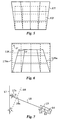
- a figure 12f having a net shape shown with dotted lines shows the original image formed on the image forming section 12
- a figure 17f having a trapezoid shape shown with solid lines shows the projected image having a trapezoid distortion on the second screen 17 from the original image.
- the state of the trapezoid distortion is varied.
- a deformed (pre-distorted) original image is utilized instead of the original image to be formed on the image forming section 12.
- the deformed original image can be obtained by preliminarily giving an inverse distortion of the trapezoid distortion which will be formed on the second screen 17, to the original image.
- the figure 12f having a net shape shown with dotted lines shows a figure of the original image to be formed on the image forming section 12 as well as the figure 12f shown in Fig. 5.
- This figure 12f of the original image is projected as a similar figure to the original image on the first screen 16.
- a trapezoid figure 12fm shown with solid lines shows a figure of a deformed original image.
- This deformed original image is preliminarily deformed to allow itself to be projected as a similar figure having the correct shape to the original image on the second screen 17.
- a figure 17fm shown with solid lines which is shown so as to contact with the figure 12f, shows a projected image of the deformed original image 12fm projected on the screen 17.
- the figure 17fm of the projected image is shown as large as the same magnification with respect to the original image projected on the first screen 16.
- the figure 12fm of the deformed original image is positioned within the figure 12f on the image forming section 12.
- the image forming section 12 is made of, for instance, the liquid crystal light valve, wherein predetermined number of pixels are arranged in a two-dimensional array
- the number of the pixels within the trapezoid figure 12fm of the deformed original image is determined in accordance with the area of the trapezoid figure 12fm, i.e., the value of of the inclined angle " ⁇ " because the number of the pixels provided within the figure 12f of the original image is a fixed value.
- the pixels of the image forming section 12 existing in an area interposed between an outline of the trapezoid figure 12fm of the deformed original image and an outline of the figure 12f of the the original image should be filled with black pixels because this area corresponds to an area other than the projected image 17fm of the deformed original image to be projected on the screen 17.
- the deformed original image having the trapezoid figure 12fm is projected by the projection lens 15 on the second screen 17 as the projected image having the picture outline shown with the figure 17fm.
- This projected image of the deformed original image shown in Fig. 6 has an identical proportion with the projected image of the original image which is projected on the screen 17 without the trapezoid distortion (projected normal to the screen 17).
- the pixel at the position "P" in the deformed image shown in the trapezoid figure 12fm is projected at the position "P'" in the pixel area of the figure 17fm which is projected in a magnified state.
- Figs. (4a) and (4b) there are shown the image forming section 12 of the projector 13, the projection lens 15, the first screen 16 (imaginary screen) and the second screen 17, wherein the optical axis 18 of the projection lens 15 is depicted as a horizontal line.
- Fig. (4a) is a side view
- Fig. 4(b) is a plan view of Fig. (4a).
- the first screen 16 is provided so that the normal line of the first screen 16 accords with the optical axis 18 of the projector 13
- the second screen 17 is provided so that the normal line 17n of the second screen 17 is declined by " ⁇ " to the optical axis 18 in the side view of the Fig. 4(a).
- the image information projected at the position "P" on the first screen 16 is also projected at the position "P'" on the second screen 17, wherein the position "P'" is defined as an intersecting point of a line passing through both a center of the projection lens 15 and the position "P", and the second screen 17.
- a positional relation (coordinate) between the position "P” and the position "P'” can be geometrically obtained by using the angles shown with ⁇ , ⁇ , ⁇ , ⁇ and distances shown with L, Yb, V, Vn, Vm, Xb, hn, hm, as follows.
- Xb hn ⁇ (L + Yb sin ⁇ )/L
- the formulas (1) and (2) can be used for obtaining a coordinate of the position "P'" on the second screen 17 by causing coordinates of pixels of the original image projected on the second screen 17 without trapezoid distortion to be a standard coordinate system.
- the projected image having no trapezoid distortion on the second screen 17 obtained by projecting the deformed original image is a magnified projected image of the deformed original image.
- the image forming section 12 is made of a liquid crystal panel, wherein predetermined numbers of pixels are respectively disposed at predetermined positions in a two-dimensional array thereon as shown in the figure 12f, the pixels used in the deformed original image are reduced within the area of the trapezoid figure 12fm corresponding to the deformed original image. These pixels are only used to obtain the magnified projected image having a rectangular picture outline on the screen 17.
- Respective pixels corresponding with respective pixel data on the basis of one to one display one pixel data on the basis of one unit.
- An identical part in the above two projected images on the second screen 17 may have a different pixel data to each other because the projected image of the deformed original image is made of the pixels in the area of the trapezoid figure 12fm, on the other hand, the projected image of the original image is made of the pixels in the area of the figure 12f.
- the projected image made of the deformed original image is degraded in the quality.
- Fig. 3 shows a figure of a pixel array for explaining the method to solve the above problem in the present invention, wherein # 11, # 12, ... # 33, #34 etc. show an example of a part of the pixel array on the second screen 17 when the pixel array consisting of the original image having a two-dimensional pattern is projected on the second screen 17 without the trapezoid distortion.
- the position (address) of the pixel on the image forming section 12 corresponding to the point "P'” is expressed with an integer part (X, Y) and a dismal fraction part ( ⁇ X, ⁇ Y) by using the formulas (1), (2) when it does not accord with the # 11 on the trapezoid figure 12fm on the image forming section 12.
- the integer part (X,Y) of the pixels is shown by using the coordinate of the pixel # 11, and the dismal part is shown as ⁇ X, ⁇ Y as shown in Fig. 3 when the origin of the coordinate is defined as the position of the pixel # 11.
- the image data "P's" of the position "P" on the deformed original image on the image forming section 12 corresponding to the position "P'", for instance, # 11 on the screen 17 can be obtained by 1 calculating the position (address) of the pixel # 11 on the image forming section 12 by using the formulas (1) and (2), and 2 by using X coordinates and Y coordinates of # 11 together with decimal fraction parts ⁇ X, ⁇ Y thereof by causing the upper left pixel, i.e., the pixel # 11, to be the origin (0,0), and 3 by using the four pixel data A, B, C, D designating respective pixel data of the pixels of # 11, # 12, # 21, # 22 nearby the position "P".
- the image data "P's" of the position "P" on the deformed original image on the image forming section 12 corresponding to the position "P'", for instance, # 12 on the screen 17 can be obtained by 1 calculating the position (address) of the pixel # 12 on the image forming section 12 by using the formulas (1) and (2), and 2 by using X coordinates and Y coordinates of # 12 together with decimal fraction parts ⁇ X, ⁇ Y thereof by causing the pixel # 11 to be the origin (0,0), and 3 by using the four pixel data A, B, C, D designating respective pixel data of the pixels of # 12, # 13, # 22, # 23 nearby the position "P".
- the calculation of the image data "P's" of position "P" on the deformed original image on the image forming section 12 corresponding to the position "P'” on the second screen 17 is performed by obtaining the average of sum of weight values on the basis of the distances from the four pixels (coordinate positions and the deviations from the coordinate positions).
- the number of the pixels to be used for obtaining the "P's" becomes substantially one, two, or four.
- the calculation is always performed on the basis of the four pixels.
- Fig. 1 is a diagram showing a construction of an image processing apparatus of a first embodiment in the present invention.
- a numerical character 1 designates an input terminal for image signals (analogue).
- the image signals inputted to the input terminal 1 is converted into digital image signals (digital image data) having a quantization level of predetermined bit number by an analogue-digital converter 2.
- numerals 3 and 4 denote selectors (data selectors), 5 a control section containing a calculation part, 6 to 9 memories (random access memory), 10 a signal processing and arithmetic section, 11 a digital-analogue converter, 12 an image forming section for forming an original optical image thereon by causing the deformed original image signals generated by the image processing apparatus of the present invention to input thereto, 27 a synch signal separation circuit and 28 an operation section having an input section of signals from the outside.
- the four memories 6 to 9 are random access memories (RAM) for storing the four pixel data which are used to calculate the image data of the pixel on the image forming section 12 corresponding to a specified position such as the position "P'" on the screen 17 on the basis of the distances from the four coordinates surrounding the specified position "P'" on the screen 17.
- RAM random access memories
- the control section 5 performs a control of switching operation of the selector 3 and control operations of writing and reading operations for the respective memories 6 to 9.
- the control section 5 is constructed so as to be equipped with, for instance, microprocessors, read-only memories (ROM), digital signal processors (DSP) and arithmetic units.
- ROM read-only memories
- DSP digital signal processors
- a control signal is outputted to the selector 3 for allowing the selector 3 to perform a selective operation in such a manner that the digital data of an image picture corresponding to the pixels of the two-dimensional array outputted from the analogue-digital converter 2 are distributed to the four memories 6 to 9 in the above mentioned manner.
- control section 5 performs a control operation as such that a set of the four pixel data, for instance, [# 11, # 12, # 21, # 22], [# 12, # 13, # 22, # 23], [# 13, # 14, # 23, # 24], nearby the position "P'” can be simultaneously read out from pixel data stored in the four memories 6 to 9 to obtain the pixel of the image data corresponding to the position "P'" on the screen 17 by giving a control signal to the selector 4.
- control section 5 is given horizontal scanning interval signals "Sh” and vertical scanning interval signals “Sv” synchronously separated from the image signal by the synch signal separation circuit 27 and such numerical information inputted from the input device (key board, mouse, switch) of the operation section 28 as the declined angle ⁇ between the optical axis 18 of the projection lens 15 and the normal line of the screen 17, and the distance "L" from the principal plane of the projection lens 15 to the screen 16.
- control section 5 performs the calculation of the pixel corresponding to the position "P'" using the formulas (1) and (2) about the respective pixels.
- control section 5 performs the calculating operations of the coordinates (address) of the data stored in the memories 6 to 9 corresponding to the position "P'".
- These calculating operations are performed in the control section 5, for instance, by using a counter for conducting counting operation in such a manner that the sampling pulses supplied to the analogue-digital converter 2 from the control section 5 is made as count pulses to be counted, and a address arithmetic circuit for conducting the coordinate (address) calculation using predetermined parameters by causing the count values from the counter to be as coordinate (address) values of the sequential respective pixels in respective images.
- the horizontal scanning interval signals "Sh" (horizontal synchronizing signals or horizontal driving signals) supplied to the input terminal 1 give the coordinate (address) information of the respective rows (horizontal scanning line) in the two-dimensional array of the respective image pictures.
- the vertical scanning cycle signals (vertical synchronizing signals or vertical driving signals) are used to reset the above counter after the counting operation corresponding to all the pixels of the respective image pictures has been finished.
- the count values outputted from the counter are such values as showing the coordinate (address) value of the respective pixels in the two-dimensional array of the respective image pictures.
- the respective coordinate (address) values are corresponding to # 11, # 12, # 13 ... which are used for distinguishing the values from each other in the horizontal scanning line.
- the count values outputted from the counter are supplied to the address arithmetic circuit.
- the address arithmetic circuit after determining the coordinates (address) of the pixels corresponding to the position "P'" by using such parameters inputted from the operation section 28 as the declined angle ⁇ between the optical axis 18 of the projection lens 15 and the normal line of the screen 17 (16), and the distance "L” from the principal plane of the projection lens 15 to the screen 16 and using the formulas (1) and (2), the coordinate (address) information of the pixel corresponding to the position "P'" is given to the signal processing and arithmetic section 10.
- the signal processing and arithmetic section 10 when the pixel on the image forming section 12 corresponding to the position "P'" is found out to be situated in the pixel area corresponding to outside of the picture outline of the projected image on the second screen 17, the signal processing and arithmetic section 10 outputs the image data to the digital-analogue converter 11 without another calculation so that the pixel corresponding to the position "P'” has the black data.
- the signal processing and arithmetic section 10 outputs the picture image data obtained on the basis of the formulas (3) to (5) to the digital-analogue converter 11.
- the calculation of the image data of the pixel corresponding to the position "P'" is performed by using the formulas (3) to (5) and a set of the four pixels read out from the four memories 6 to 9 on the basis of a predetermined relation.
- the calculation results from the signal processing and arithmetic section 10 are displayed on the image forming section 12 through the digital-analogue converter 11 as the deformed original image.
- the deformed original image on the image forming section 12 is projected on the screen 17 by the projection lens 15 of which the optical axis 18 is declined to the normal line 17n of the screen 17 by an acute angle, it is possible to form the projected image on the screen 17 without the trapezoid distortion.
- address input type random access memory are employed as the memories 6 to 9.
- RAM address input type random access memory
- a pair of RAMs per each memory are prepared for the respective memories 6 to 9.
- the pair of the RAMs are used in such a manner that they are alternately switched to perform a reading operation or a writing operation in order.
- it requires total eight RAMs for its construction.
- the liquid crystal panel to be used When the number of the pixels of the liquid crystal panel to be used is made 640 x 480, and the liquid crystal panel is operated under the vertical scanning frequency of 60 Hz, it requires 24 units of RAMs each having a high speed of 1 M bits (a cycle of not more than 30 nanoseconds).
- Fig. 2 is a block diagram of an image processing apparatus of a second embodiment of the present invention.
- an image signal (analogue signal) inputted to an analogue-digital converter (A-D converter) 2 through an input terminal 1 is converted into digital image signals (referred to as digital image data) each having a quantization level of predetermined bit number (8 bits in this embodiment)and are given to an interpolation arithmetic section 22 and a latch circuit 20 and a delay circuit 19 of 1-horizontal scanning period (referred to as 1H delay circuit 19).
- the digital image data outputted from the latch circuit 20 is given to the interpolation arithmetic section 22.
- the digital image data delayed by 1H by the 1H delay circuit 19 is given to the interpolation arithmetic section 22 and another latch circuit 21, and the digital image data outputted from the latch circuit 21 is given to the interpolation arithmetic section 22.
- the image processing apparatus of the second embodiment it is possible to construct the apparatus without such memories as required in the first embodiment shown in Fig. 1 by employing a circuit construction of the analogue-digital converter 2 and the 1H delay circuit 19 provided between the analogue-digital converter 2 and the interpolation arithmetic section 22 and the two latch circuits 20, 21 in such a manner that there are outputted at the same time to the interpolation arithmetic section 22 the four digital image data corresponding to a set of four pixels (for instance [# 11, # 12, # 21, #22], [# 12, # 13, # 22, #23],[# 13, # 14, # 23, #24]) which are established corresponding to each of the successive pixels (for instance, pixels # 11 ⁇ # 12 ⁇ # 13 ⁇ # 14 ... # 21 ⁇ # 22 ⁇ # 23 ⁇ # 24 ... # 31 ⁇ # 32 ⁇ # 33 ⁇ # 34 ... ) sequentially outputted from the analogue-digital converter 2 every sampling interval.
- the values of L, ⁇ , Vm in the formula (1) are predetermined values to be established, i.e., fixed values.
- the value of Yb to be obtained from the formula (1) is a function of Vn irrelative to hn.
- a ratio Dx of the largest width to the smallest width on the deformed original image is determined by the established values L, ⁇ , Vm.
- the values of Dx obtained for every horizontal line corresponding to every declined angle from the plural predetermined declined angles ⁇ are stored in a ROM 25.
- the value of Dx is read out from the ROM 25 and is given to a ⁇ X calculating section 26.
- ⁇ X is calculated and is given to the interpolation arithmetic section 22.
- the values of Dx for every horizontal line are read out form the ROM 25 and are given to the ⁇ X calculating section 26, wherein ⁇ X values are calculated with respect to every line of the pixel array. These values are given to the interpolation arithmetic section 22.
- the respective values ⁇ Y used for the interpolation arithmetic are determined as a specified value on a line of the pixel array corresponding to the established value of the declined angle ⁇ .
- the established declined angle ⁇ all the values of ⁇ Y determined every line of the pixel array are stored in the ROM 25 shown in Fig. 2. These values of ⁇ Y are read out from the ROM 25 and given to the interpolation arithmetic section 22 in accordance with the established value of the declined angle ⁇ .
- the deformed original image is deformed as such that a size of the projected image of the deformed original image is reduced.
- the number of the overall pixels corresponding to the position "P'" (address) calculated by using the formulas (1) and (2) are less than those of the original image.
- the pixels to be abandoned on the image forming section 12 without being used as the projected picture are preliminarily known, as will be understood from the deformed original image shown in Fig. 6.
- the four digital image data corresponding to each of the pixels to be abandoned are not necessary to be calculated in the interpolation arithmetic section 22.
- skip data there are prepared particular values (referred to as skip data) in accordance with the values of ⁇ X, ⁇ Y which does not require calculation.
- FIFO line memory 23 As a result of calculation for every line of the pixel array from the interpolation arithmetic section 22, significant digital image data are only stored in a first-in first-out type line memory (referred to as FIFO line memory) 23.
- FIFO line memory 23 effective digital image data to form the deformed original image are successively stored in an arrayed state without the skip data.
- the digital image data stored in the FIFO line memory 23 corresponding to a line (every canning line) of the pixel array are in a reduced state in a direction of the width as seen from the length of the width of the image figure 12fm shown with the solid line in Fig. 6.
- the digital image data stored in the FIFO line memory are transferred to and stored in the FIFO image memory 24 in such a time relation as the digital image data situated in the middle position are projected on the middle position of the projected image in the direction of the width on the screen 17.
- the digital image data corresponding to a line of the pixel array are successively read out and stored in the FIFO image memory 24.
- the memory pattern formed in the FIFO image memory 24 is similar to the figure 12fm shown in Fig. 6.
- the effective digital image data to form the deformed original image are only successively stored without the skip data as mentioned in the foregoing.
- the projected image of the deformed original image deviates upward on the screen 17.
- the digital image data are read out in such a time relation as the lowest position of the projected image is situated in a predetermined position.
- the deformed original image formed on the basis of the abovementioned digital image data on the image forming section 12 is projected on the screen 17 by the projection lens 15 as a projected image similar to that of the original image without the trapezoid distortion.
- the aspect ratio of the projected image is made an appropriate one by using the FIFO line memory 23 and the FIFO image memory 24.
- the projected image on the screen 17 becomes similar to the original image.
- the original image has a figure of a circle, it is projected as a projected image having the similar circle.
- such a simple type image processing apparatus as capable of projecting an image having a correct image outline but a slightly elongated shape upward may be desired because of reduction of cost.
- the digital image data outputted from the FIFO line memory 3 shown in Fig. 2 are directly given to a surface of the image forming section 12 as a deformed image preliminarily deformed with respect to the original image.
- the deformed image is projected on the screen 17 by the projection lens 15, wherein a projected image having a correct picture outline but slightly elongated upward is obtained.
- the image processing apparatus of the present invention it is possible to obtain an excellent projected image without the trapezoid or keystone distortion even when the apparatus is installed in a state where an optical axis of the projection optical system of the apparatus is declined by a declined angle ⁇ to the normal line of the screen.
- This allows the apparatus to be installed on the ceiling in a suspended state therefrom, or on the floor without preparing any table.
Landscapes
- Physics & Mathematics (AREA)
- General Physics & Mathematics (AREA)
- Engineering & Computer Science (AREA)
- Theoretical Computer Science (AREA)
- Transforming Electric Information Into Light Information (AREA)
- Projection Apparatus (AREA)
Priority Applications (2)
| Application Number | Priority Date | Filing Date | Title |
|---|---|---|---|
| US08/565,765 US5764311A (en) | 1995-11-30 | 1995-11-30 | Image processing apparatus |
| EP95118882A EP0777198A1 (de) | 1995-11-30 | 1995-11-30 | Bildverarbeitungsvorrichtung |
Applications Claiming Priority (2)
| Application Number | Priority Date | Filing Date | Title |
|---|---|---|---|
| US08/565,765 US5764311A (en) | 1995-11-30 | 1995-11-30 | Image processing apparatus |
| EP95118882A EP0777198A1 (de) | 1995-11-30 | 1995-11-30 | Bildverarbeitungsvorrichtung |
Publications (1)
| Publication Number | Publication Date |
|---|---|
| EP0777198A1 true EP0777198A1 (de) | 1997-06-04 |
Family
ID=26138950
Family Applications (1)
| Application Number | Title | Priority Date | Filing Date |
|---|---|---|---|
| EP95118882A Withdrawn EP0777198A1 (de) | 1995-11-30 | 1995-11-30 | Bildverarbeitungsvorrichtung |
Country Status (2)
| Country | Link |
|---|---|
| US (1) | US5764311A (de) |
| EP (1) | EP0777198A1 (de) |
Cited By (12)
| Publication number | Priority date | Publication date | Assignee | Title |
|---|---|---|---|---|
| EP0965945A1 (de) * | 1998-06-18 | 1999-12-22 | Matsushita Electric Industrial Co., Ltd. | Bildprozessor und Bildanzeige |
| WO2000036832A1 (en) * | 1998-12-17 | 2000-06-22 | Gateway, Inc. | System, method and software for correcting keystoning of a projected image |
| WO2001022070A1 (en) * | 1999-09-20 | 2001-03-29 | Matsushita Electric Industrial Co., Ltd. | Method and system of lcd inspection by pattern comparison |
| EP1193541A3 (de) * | 2000-09-27 | 2003-07-09 | Shadow Entertainment, Inc. | Projektionssystem und -Verfahren mit Korrektur von Bildverzerrungen |
| WO2002101443A3 (en) * | 2001-06-12 | 2003-07-10 | Silicon Optix Inc | System and method for correcting keystone distortion |
| FR2840491A1 (fr) * | 2002-05-31 | 2003-12-05 | Thales Sa | Dispositif de correction electronique des distorsions optiques d'une visualisation collimatee obtenue a partir d'un afficheur matriciel |
| EP1058452A4 (de) * | 1998-02-18 | 2005-05-11 | Seiko Epson Corp | Bildverarbeitungsvorrichtung und -verfahren |
| US7384158B2 (en) | 2003-01-08 | 2008-06-10 | Silicon Optix Inc | Image projection system and method |
| CN100394787C (zh) * | 1998-02-18 | 2008-06-11 | 精工爱普生株式会社 | 图象处理装置和图象处理方法 |
| EP1811766A3 (de) * | 1998-10-02 | 2008-11-05 | Magic Pixel, Inc. | Verfahren und Vorrichtung zur Verhinderung einer Trapezverzerrung und zum Helligkeitsausgleich |
| US7714943B2 (en) | 2002-06-12 | 2010-05-11 | Geo Semiconductor Inc. | Ultra-thin image projection system |
| CN107046636A (zh) * | 2017-02-22 | 2017-08-15 | 青岛海信宽带多媒体技术有限公司 | 投影设备的图像矫正方法及装置 |
Families Citing this family (25)
| Publication number | Priority date | Publication date | Assignee | Title |
|---|---|---|---|---|
| JP3688399B2 (ja) * | 1996-07-26 | 2005-08-24 | 株式会社東芝 | 歪補正回路 |
| TW385127U (en) * | 1998-06-01 | 2000-03-11 | Mustek Systems Inc | Digital keystone rectified correction circuit |
| KR100527982B1 (ko) * | 1998-06-11 | 2005-11-09 | 마츠시타 덴끼 산교 가부시키가이샤 | 영상표시장치 및 프로그램 기록매체 |
| US6456340B1 (en) * | 1998-08-12 | 2002-09-24 | Pixonics, Llc | Apparatus and method for performing image transforms in a digital display system |
| JP2002527953A (ja) * | 1998-10-02 | 2002-08-27 | マクロニクス インターナショナル カンパニー リミテッド | キーストーン歪みを防止する方法および装置 |
| US6191827B1 (en) * | 1998-12-01 | 2001-02-20 | Oplus Technologies Ltd. | Electronic keystone correction for electronic devices with a visual display |
| US6496231B1 (en) | 1999-06-30 | 2002-12-17 | Koninklijke Philips Electronics N.V. | Method and apparatus for correcting convergence and geometry errors in display devices |
| US6433840B1 (en) * | 1999-07-22 | 2002-08-13 | Evans & Sutherland Computer Corporation | Method and apparatus for multi-level image alignment |
| JP3530443B2 (ja) * | 2000-01-05 | 2004-05-24 | 三洋電機株式会社 | 表示装置 |
| US6563101B1 (en) | 2000-01-19 | 2003-05-13 | Barclay J. Tullis | Non-rectilinear sensor arrays for tracking an image |
| NO310490B1 (no) * | 2000-02-09 | 2001-07-09 | Johan Henrik Litleskare | Digital korreksjonsmodul for videoprojektor |
| US6491400B1 (en) | 2000-10-24 | 2002-12-10 | Eastman Kodak Company | Correcting for keystone distortion in a digital image displayed by a digital projector |
| US6977693B2 (en) * | 2001-06-11 | 2005-12-20 | Sun Microsystems, Inc. | Networked video projector apparatus and method of projecting a video frame on a video projector |
| JP3742027B2 (ja) * | 2002-04-08 | 2006-02-01 | Necビューテクノロジー株式会社 | 投射映像の歪補正方法、歪補正プログラム及び投射型映像表示装置 |
| JP3844076B2 (ja) * | 2003-03-07 | 2006-11-08 | セイコーエプソン株式会社 | 画像処理システム、プロジェクタ、プログラム、情報記憶媒体および画像処理方法 |
| JP4111190B2 (ja) * | 2004-12-24 | 2008-07-02 | コニカミノルタビジネステクノロジーズ株式会社 | 画像処理装置 |
| US7441906B1 (en) | 2005-07-05 | 2008-10-28 | Pixelworks, Inc. | Keystone correction system and method |
| US7787062B2 (en) * | 2006-05-19 | 2010-08-31 | Chunghwa Picture Tubes, Ltd. | Rear projection display and circuit and method for adjusting image thereof |
| CN101617354A (zh) | 2006-12-12 | 2009-12-30 | 埃文斯和萨瑟兰计算机公司 | 用于校准单个调制器投影仪中的rgb光的系统和方法 |
| US8358317B2 (en) | 2008-05-23 | 2013-01-22 | Evans & Sutherland Computer Corporation | System and method for displaying a planar image on a curved surface |
| US8702248B1 (en) | 2008-06-11 | 2014-04-22 | Evans & Sutherland Computer Corporation | Projection method for reducing interpixel gaps on a viewing surface |
| US20100023569A1 (en) * | 2008-07-22 | 2010-01-28 | Daw Shien Scientific Research & Development, Inc. | Method for computerized arithmetic operations |
| US8077378B1 (en) | 2008-11-12 | 2011-12-13 | Evans & Sutherland Computer Corporation | Calibration system and method for light modulation device |
| US9641826B1 (en) | 2011-10-06 | 2017-05-02 | Evans & Sutherland Computer Corporation | System and method for displaying distant 3-D stereo on a dome surface |
| US9734703B1 (en) * | 2016-06-23 | 2017-08-15 | Nxp B.V. | Sensor apparatuses and methods |
Citations (6)
| Publication number | Priority date | Publication date | Assignee | Title |
|---|---|---|---|---|
| WO1987003980A2 (en) * | 1985-12-19 | 1987-07-02 | General Electric Company | Comprehensive distortion correction in a real time imaging system |
| EP0308315A1 (de) * | 1987-09-16 | 1989-03-22 | Commissariat A L'energie Atomique | Interpolationsverfahren |
| JPH0380780A (ja) * | 1989-08-24 | 1991-04-05 | Victor Co Of Japan Ltd | 液晶ライトバルブを用いた画像投影機の台形歪補正回路 |
| GB2244887A (en) * | 1990-04-11 | 1991-12-11 | Rank Cintel Ltd | Spatial transformation of video images |
| GB2265064A (en) * | 1992-02-26 | 1993-09-15 | Rank Cintel Ltd | Distortion compensation in projection systems |
| US5465121A (en) * | 1993-03-31 | 1995-11-07 | International Business Machines Corporation | Method and system for compensating for image distortion caused by off-axis image projection |
Family Cites Families (8)
| Publication number | Priority date | Publication date | Assignee | Title |
|---|---|---|---|---|
| FR2579051B1 (fr) * | 1985-03-15 | 1988-06-24 | Loire Electronique | Dispositif de reglage de convergence pour videoprojecteur |
| US4656521A (en) * | 1985-04-01 | 1987-04-07 | The Singer Company | Digital distortion-correcting circuit for projection a flat image on a curved screen from a digital data source for a simulator projected-image visual system |
| IL79822A (en) * | 1985-12-19 | 1990-03-19 | Gen Electric | Method of comprehensive distortion correction for a computer image generation system |
| JPS6373782A (ja) * | 1986-09-16 | 1988-04-04 | Sony Corp | プロジエクタ |
| JP2903876B2 (ja) * | 1992-07-03 | 1999-06-14 | 松下電器産業株式会社 | 投写型表示装置 |
| JPH0638152A (ja) * | 1992-07-15 | 1994-02-10 | Sanyo Electric Co Ltd | あおり補正装置 |
| JP2911316B2 (ja) * | 1992-08-28 | 1999-06-23 | 三洋電機株式会社 | 液晶プロジェクタのあおり補正回路 |
| JP3157315B2 (ja) * | 1992-11-19 | 2001-04-16 | 三洋電機株式会社 | 垂直あおり補正装置 |
-
1995
- 1995-11-30 US US08/565,765 patent/US5764311A/en not_active Expired - Fee Related
- 1995-11-30 EP EP95118882A patent/EP0777198A1/de not_active Withdrawn
Patent Citations (6)
| Publication number | Priority date | Publication date | Assignee | Title |
|---|---|---|---|---|
| WO1987003980A2 (en) * | 1985-12-19 | 1987-07-02 | General Electric Company | Comprehensive distortion correction in a real time imaging system |
| EP0308315A1 (de) * | 1987-09-16 | 1989-03-22 | Commissariat A L'energie Atomique | Interpolationsverfahren |
| JPH0380780A (ja) * | 1989-08-24 | 1991-04-05 | Victor Co Of Japan Ltd | 液晶ライトバルブを用いた画像投影機の台形歪補正回路 |
| GB2244887A (en) * | 1990-04-11 | 1991-12-11 | Rank Cintel Ltd | Spatial transformation of video images |
| GB2265064A (en) * | 1992-02-26 | 1993-09-15 | Rank Cintel Ltd | Distortion compensation in projection systems |
| US5465121A (en) * | 1993-03-31 | 1995-11-07 | International Business Machines Corporation | Method and system for compensating for image distortion caused by off-axis image projection |
Non-Patent Citations (2)
| Title |
|---|
| PATENT ABSTRACTS OF JAPAN vol. 15, no. 254 (E - 1083) 27 June 1991 (1991-06-27) * |
| VANCE D W: "Image Distortions in Video Projection", PROCEEDINGS OF THE SPIE: LARGE SCREEN PROJECTION DISPLAYS, vol. 760, 15 January 1987 (1987-01-15), LOS ANGELEC, CA, USA, pages 54 - 59, XP000571019 * |
Cited By (18)
| Publication number | Priority date | Publication date | Assignee | Title |
|---|---|---|---|---|
| EP1711008A3 (de) * | 1998-02-18 | 2007-10-10 | Seiko Epson Corporation | Bildverarbeitungvorrichtung und -verfahren |
| CN100394787C (zh) * | 1998-02-18 | 2008-06-11 | 精工爱普生株式会社 | 图象处理装置和图象处理方法 |
| EP1058452A4 (de) * | 1998-02-18 | 2005-05-11 | Seiko Epson Corp | Bildverarbeitungsvorrichtung und -verfahren |
| KR100571988B1 (ko) * | 1998-02-18 | 2006-04-17 | 세이코 엡슨 가부시키가이샤 | 화상처리장치 및 화상처리방법 |
| EP0965945A1 (de) * | 1998-06-18 | 1999-12-22 | Matsushita Electric Industrial Co., Ltd. | Bildprozessor und Bildanzeige |
| US6756985B1 (en) | 1998-06-18 | 2004-06-29 | Matsushita Electric Industrial Co., Ltd. | Image processor and image display |
| EP1811766A3 (de) * | 1998-10-02 | 2008-11-05 | Magic Pixel, Inc. | Verfahren und Vorrichtung zur Verhinderung einer Trapezverzerrung und zum Helligkeitsausgleich |
| WO2000036832A1 (en) * | 1998-12-17 | 2000-06-22 | Gateway, Inc. | System, method and software for correcting keystoning of a projected image |
| WO2001022070A1 (en) * | 1999-09-20 | 2001-03-29 | Matsushita Electric Industrial Co., Ltd. | Method and system of lcd inspection by pattern comparison |
| EP1193541A3 (de) * | 2000-09-27 | 2003-07-09 | Shadow Entertainment, Inc. | Projektionssystem und -Verfahren mit Korrektur von Bildverzerrungen |
| WO2002101443A3 (en) * | 2001-06-12 | 2003-07-10 | Silicon Optix Inc | System and method for correcting keystone distortion |
| US7352913B2 (en) | 2001-06-12 | 2008-04-01 | Silicon Optix Inc. | System and method for correcting multiple axis displacement distortion |
| CN100465995C (zh) * | 2001-06-12 | 2009-03-04 | 奥普提克斯晶硅有限公司 | 一种将图像投射到屏幕表面的方法及系统 |
| WO2003102904A1 (fr) * | 2002-05-31 | 2003-12-11 | Thales | Dispositif de correction electronique des distorsions optiques d'une visualisation collimatee obtenue a partir d'un afficheur matriciel |
| FR2840491A1 (fr) * | 2002-05-31 | 2003-12-05 | Thales Sa | Dispositif de correction electronique des distorsions optiques d'une visualisation collimatee obtenue a partir d'un afficheur matriciel |
| US7714943B2 (en) | 2002-06-12 | 2010-05-11 | Geo Semiconductor Inc. | Ultra-thin image projection system |
| US7384158B2 (en) | 2003-01-08 | 2008-06-10 | Silicon Optix Inc | Image projection system and method |
| CN107046636A (zh) * | 2017-02-22 | 2017-08-15 | 青岛海信宽带多媒体技术有限公司 | 投影设备的图像矫正方法及装置 |
Also Published As
| Publication number | Publication date |
|---|---|
| US5764311A (en) | 1998-06-09 |
Similar Documents
| Publication | Publication Date | Title |
|---|---|---|
| US5764311A (en) | Image processing apparatus | |
| US5161013A (en) | Data projection system with compensation for nonplanar screen | |
| KR100567513B1 (ko) | 이미지 디스플레이 방법 및 시스템, 광 변조기를 이용한이미지 디스플레이 방법 및 이미지 프레임 디스플레이시스템 | |
| KR920001801B1 (ko) | 화상확대방법 및 장치 | |
| US5982342A (en) | Three-dimensional display station and method for making observers observe 3-D images by projecting parallax images to both eyes of observers | |
| US4402012A (en) | Two-dimensional digital linear interpolation system | |
| EP0397965A2 (de) | Anzeigevorrichtung | |
| EP0519774A1 (de) | Projektor | |
| CA2106244A1 (en) | Stereoscopic Display Apparatus | |
| HK98489A (en) | Image processing system | |
| JPS6160066A (ja) | デイジタル・イメージ記録投影処理方法 | |
| US4729017A (en) | Stereoscopic display method and apparatus therefor | |
| US5864639A (en) | Method and apparatus of rendering a video image | |
| EP0137619B1 (de) | Berührungspositionsanzeigevorrichtung für einen Bildschirm | |
| US4975779A (en) | Method of recording an image | |
| US3787619A (en) | Wide angle display system | |
| US4205310A (en) | Television titling apparatus and method | |
| JP3109392B2 (ja) | 画像処理装置 | |
| RU2090979C1 (ru) | Устройство для воспроизведения объемного изображения | |
| JPH0224073B2 (de) | ||
| EP0268359B1 (de) | Verfahren und Vorrichtung zur Verarbeitung von Fernsehbildsignalen | |
| JPH10191400A (ja) | 3次元画像表示装置 | |
| KR100586957B1 (ko) | 3차원 영상 디스플레이를 위한 화소셀 형성 방법 | |
| JPH0937197A (ja) | 画像投影装置 | |
| US6700572B1 (en) | Three-dimensional display |
Legal Events
| Date | Code | Title | Description |
|---|---|---|---|
| PUAI | Public reference made under article 153(3) epc to a published international application that has entered the european phase |
Free format text: ORIGINAL CODE: 0009012 |
|
| AK | Designated contracting states |
Kind code of ref document: A1 Designated state(s): DE FR GB |
|
| 17P | Request for examination filed |
Effective date: 19971117 |
|
| 17Q | First examination report despatched |
Effective date: 19990401 |
|
| STAA | Information on the status of an ep patent application or granted ep patent |
Free format text: STATUS: THE APPLICATION IS DEEMED TO BE WITHDRAWN |
|
| 18D | Application deemed to be withdrawn |
Effective date: 20000801 |