EP0778264B1 - Tertiäre Amine mit antimykotischer und cholesterinsenkender Wirkung - Google Patents

Tertiäre Amine mit antimykotischer und cholesterinsenkender Wirkung Download PDF

Info

Publication number
EP0778264B1
EP0778264B1 EP96118872A EP96118872A EP0778264B1 EP 0778264 B1 EP0778264 B1 EP 0778264B1 EP 96118872 A EP96118872 A EP 96118872A EP 96118872 A EP96118872 A EP 96118872A EP 0778264 B1 EP0778264 B1 EP 0778264B1
Authority
EP
European Patent Office
Prior art keywords
phenyl
methyl
amino
allyl
bromo
Prior art date
Legal status (The legal status is an assumption and is not a legal conclusion. Google has not performed a legal analysis and makes no representation as to the accuracy of the status listed.)
Expired - Lifetime
Application number
EP96118872A
Other languages
English (en)
French (fr)
Other versions
EP0778264A1 (de
Inventor
Johannes Aebi
Hans Lengsfeld
Henrietta Dehmlow
Olivier Morand
Jacques Himber
Gérard Schmid
Synèse Jolidon
Yu-Hua Ji
Current Assignee (The listed assignees may be inaccurate. Google has not performed a legal analysis and makes no representation or warranty as to the accuracy of the list.)
F Hoffmann La Roche AG
Original Assignee
F Hoffmann La Roche AG
Priority date (The priority date is an assumption and is not a legal conclusion. Google has not performed a legal analysis and makes no representation as to the accuracy of the date listed.)
Filing date
Publication date
Application filed by F Hoffmann La Roche AG filed Critical F Hoffmann La Roche AG
Publication of EP0778264A1 publication Critical patent/EP0778264A1/de
Application granted granted Critical
Publication of EP0778264B1 publication Critical patent/EP0778264B1/de
Anticipated expiration legal-status Critical
Expired - Lifetime legal-status Critical Current

Links

Classifications

    • CCHEMISTRY; METALLURGY
    • C07ORGANIC CHEMISTRY
    • C07CACYCLIC OR CARBOCYCLIC COMPOUNDS
    • C07C323/00Thiols, sulfides, hydropolysulfides or polysulfides substituted by halogen, oxygen or nitrogen atoms, or by sulfur atoms not being part of thio groups
    • C07C323/23Thiols, sulfides, hydropolysulfides or polysulfides substituted by halogen, oxygen or nitrogen atoms, or by sulfur atoms not being part of thio groups containing thio groups and nitrogen atoms, not being part of nitro or nitroso groups, bound to the same carbon skeleton
    • C07C323/24Thiols, sulfides, hydropolysulfides or polysulfides substituted by halogen, oxygen or nitrogen atoms, or by sulfur atoms not being part of thio groups containing thio groups and nitrogen atoms, not being part of nitro or nitroso groups, bound to the same carbon skeleton having the sulfur atoms of the thio groups bound to acyclic carbon atoms of the carbon skeleton
    • C07C323/25Thiols, sulfides, hydropolysulfides or polysulfides substituted by halogen, oxygen or nitrogen atoms, or by sulfur atoms not being part of thio groups containing thio groups and nitrogen atoms, not being part of nitro or nitroso groups, bound to the same carbon skeleton having the sulfur atoms of the thio groups bound to acyclic carbon atoms of the carbon skeleton the carbon skeleton being acyclic and saturated
    • AHUMAN NECESSITIES
    • A61MEDICAL OR VETERINARY SCIENCE; HYGIENE
    • A61PSPECIFIC THERAPEUTIC ACTIVITY OF CHEMICAL COMPOUNDS OR MEDICINAL PREPARATIONS
    • A61P3/00Drugs for disorders of the metabolism
    • A61P3/06Antihyperlipidemics
    • AHUMAN NECESSITIES
    • A61MEDICAL OR VETERINARY SCIENCE; HYGIENE
    • A61PSPECIFIC THERAPEUTIC ACTIVITY OF CHEMICAL COMPOUNDS OR MEDICINAL PREPARATIONS
    • A61P31/00Antiinfectives, i.e. antibiotics, antiseptics, chemotherapeutics
    • A61P31/04Antibacterial agents
    • AHUMAN NECESSITIES
    • A61MEDICAL OR VETERINARY SCIENCE; HYGIENE
    • A61PSPECIFIC THERAPEUTIC ACTIVITY OF CHEMICAL COMPOUNDS OR MEDICINAL PREPARATIONS
    • A61P31/00Antiinfectives, i.e. antibiotics, antiseptics, chemotherapeutics
    • A61P31/10Antimycotics
    • AHUMAN NECESSITIES
    • A61MEDICAL OR VETERINARY SCIENCE; HYGIENE
    • A61PSPECIFIC THERAPEUTIC ACTIVITY OF CHEMICAL COMPOUNDS OR MEDICINAL PREPARATIONS
    • A61P9/00Drugs for disorders of the cardiovascular system
    • CCHEMISTRY; METALLURGY
    • C07ORGANIC CHEMISTRY
    • C07CACYCLIC OR CARBOCYCLIC COMPOUNDS
    • C07C217/00Compounds containing amino and etherified hydroxy groups bound to the same carbon skeleton
    • C07C217/02Compounds containing amino and etherified hydroxy groups bound to the same carbon skeleton having etherified hydroxy groups and amino groups bound to acyclic carbon atoms of the same carbon skeleton
    • C07C217/04Compounds containing amino and etherified hydroxy groups bound to the same carbon skeleton having etherified hydroxy groups and amino groups bound to acyclic carbon atoms of the same carbon skeleton the carbon skeleton being acyclic and saturated
    • C07C217/06Compounds containing amino and etherified hydroxy groups bound to the same carbon skeleton having etherified hydroxy groups and amino groups bound to acyclic carbon atoms of the same carbon skeleton the carbon skeleton being acyclic and saturated having only one etherified hydroxy group and one amino group bound to the carbon skeleton, which is not further substituted
    • C07C217/14Compounds containing amino and etherified hydroxy groups bound to the same carbon skeleton having etherified hydroxy groups and amino groups bound to acyclic carbon atoms of the same carbon skeleton the carbon skeleton being acyclic and saturated having only one etherified hydroxy group and one amino group bound to the carbon skeleton, which is not further substituted the oxygen atom of the etherified hydroxy group being further bound to a carbon atom of a six-membered aromatic ring
    • C07C217/18Compounds containing amino and etherified hydroxy groups bound to the same carbon skeleton having etherified hydroxy groups and amino groups bound to acyclic carbon atoms of the same carbon skeleton the carbon skeleton being acyclic and saturated having only one etherified hydroxy group and one amino group bound to the carbon skeleton, which is not further substituted the oxygen atom of the etherified hydroxy group being further bound to a carbon atom of a six-membered aromatic ring the six-membered aromatic ring or condensed ring system containing that ring being further substituted
    • C07C217/20Compounds containing amino and etherified hydroxy groups bound to the same carbon skeleton having etherified hydroxy groups and amino groups bound to acyclic carbon atoms of the same carbon skeleton the carbon skeleton being acyclic and saturated having only one etherified hydroxy group and one amino group bound to the carbon skeleton, which is not further substituted the oxygen atom of the etherified hydroxy group being further bound to a carbon atom of a six-membered aromatic ring the six-membered aromatic ring or condensed ring system containing that ring being further substituted by halogen atoms, by trihalomethyl, nitro or nitroso groups, or by singly-bound oxygen atoms
    • CCHEMISTRY; METALLURGY
    • C07ORGANIC CHEMISTRY
    • C07CACYCLIC OR CARBOCYCLIC COMPOUNDS
    • C07C217/00Compounds containing amino and etherified hydroxy groups bound to the same carbon skeleton
    • C07C217/02Compounds containing amino and etherified hydroxy groups bound to the same carbon skeleton having etherified hydroxy groups and amino groups bound to acyclic carbon atoms of the same carbon skeleton
    • C07C217/46Compounds containing amino and etherified hydroxy groups bound to the same carbon skeleton having etherified hydroxy groups and amino groups bound to acyclic carbon atoms of the same carbon skeleton the carbon skeleton being acyclic and unsaturated
    • CCHEMISTRY; METALLURGY
    • C07ORGANIC CHEMISTRY
    • C07CACYCLIC OR CARBOCYCLIC COMPOUNDS
    • C07C217/00Compounds containing amino and etherified hydroxy groups bound to the same carbon skeleton
    • C07C217/52Compounds containing amino and etherified hydroxy groups bound to the same carbon skeleton having etherified hydroxy groups or amino groups bound to carbon atoms of rings other than six-membered aromatic rings of the same carbon skeleton
    • CCHEMISTRY; METALLURGY
    • C07ORGANIC CHEMISTRY
    • C07CACYCLIC OR CARBOCYCLIC COMPOUNDS
    • C07C235/00Carboxylic acid amides, the carbon skeleton of the acid part being further substituted by oxygen atoms
    • C07C235/70Carboxylic acid amides, the carbon skeleton of the acid part being further substituted by oxygen atoms having carbon atoms of carboxamide groups and doubly-bound oxygen atoms bound to the same carbon skeleton
    • C07C235/72Carboxylic acid amides, the carbon skeleton of the acid part being further substituted by oxygen atoms having carbon atoms of carboxamide groups and doubly-bound oxygen atoms bound to the same carbon skeleton with the carbon atoms of the carboxamide groups bound to acyclic carbon atoms
    • C07C235/76Carboxylic acid amides, the carbon skeleton of the acid part being further substituted by oxygen atoms having carbon atoms of carboxamide groups and doubly-bound oxygen atoms bound to the same carbon skeleton with the carbon atoms of the carboxamide groups bound to acyclic carbon atoms of an unsaturated carbon skeleton
    • C07C235/78Carboxylic acid amides, the carbon skeleton of the acid part being further substituted by oxygen atoms having carbon atoms of carboxamide groups and doubly-bound oxygen atoms bound to the same carbon skeleton with the carbon atoms of the carboxamide groups bound to acyclic carbon atoms of an unsaturated carbon skeleton the carbon skeleton containing rings
    • CCHEMISTRY; METALLURGY
    • C07ORGANIC CHEMISTRY
    • C07CACYCLIC OR CARBOCYCLIC COMPOUNDS
    • C07C235/00Carboxylic acid amides, the carbon skeleton of the acid part being further substituted by oxygen atoms
    • C07C235/70Carboxylic acid amides, the carbon skeleton of the acid part being further substituted by oxygen atoms having carbon atoms of carboxamide groups and doubly-bound oxygen atoms bound to the same carbon skeleton
    • C07C235/84Carboxylic acid amides, the carbon skeleton of the acid part being further substituted by oxygen atoms having carbon atoms of carboxamide groups and doubly-bound oxygen atoms bound to the same carbon skeleton with the carbon atom of at least one of the carboxamide groups bound to a carbon atom of a six-membered aromatic ring
    • CCHEMISTRY; METALLURGY
    • C07ORGANIC CHEMISTRY
    • C07CACYCLIC OR CARBOCYCLIC COMPOUNDS
    • C07C255/00Carboxylic acid nitriles
    • C07C255/49Carboxylic acid nitriles having cyano groups bound to carbon atoms of six-membered aromatic rings of a carbon skeleton
    • C07C255/56Carboxylic acid nitriles having cyano groups bound to carbon atoms of six-membered aromatic rings of a carbon skeleton containing cyano groups and doubly-bound oxygen atoms bound to the carbon skeleton
    • CCHEMISTRY; METALLURGY
    • C07ORGANIC CHEMISTRY
    • C07CACYCLIC OR CARBOCYCLIC COMPOUNDS
    • C07C311/00Amides of sulfonic acids, i.e. compounds having singly-bound oxygen atoms of sulfo groups replaced by nitrogen atoms, not being part of nitro or nitroso groups
    • C07C311/01Sulfonamides having sulfur atoms of sulfonamide groups bound to acyclic carbon atoms
    • C07C311/02Sulfonamides having sulfur atoms of sulfonamide groups bound to acyclic carbon atoms of an acyclic saturated carbon skeleton
    • C07C311/03Sulfonamides having sulfur atoms of sulfonamide groups bound to acyclic carbon atoms of an acyclic saturated carbon skeleton having the nitrogen atoms of the sulfonamide groups bound to hydrogen atoms or to acyclic carbon atoms
    • C07C311/04Sulfonamides having sulfur atoms of sulfonamide groups bound to acyclic carbon atoms of an acyclic saturated carbon skeleton having the nitrogen atoms of the sulfonamide groups bound to hydrogen atoms or to acyclic carbon atoms to acyclic carbon atoms of hydrocarbon radicals substituted by singly-bound oxygen atoms
    • CCHEMISTRY; METALLURGY
    • C07ORGANIC CHEMISTRY
    • C07CACYCLIC OR CARBOCYCLIC COMPOUNDS
    • C07C323/00Thiols, sulfides, hydropolysulfides or polysulfides substituted by halogen, oxygen or nitrogen atoms, or by sulfur atoms not being part of thio groups
    • C07C323/22Thiols, sulfides, hydropolysulfides or polysulfides substituted by halogen, oxygen or nitrogen atoms, or by sulfur atoms not being part of thio groups containing thio groups and doubly-bound oxygen atoms bound to the same carbon skeleton
    • CCHEMISTRY; METALLURGY
    • C07ORGANIC CHEMISTRY
    • C07DHETEROCYCLIC COMPOUNDS
    • C07D211/00Heterocyclic compounds containing hydrogenated pyridine rings, not condensed with other rings
    • C07D211/04Heterocyclic compounds containing hydrogenated pyridine rings, not condensed with other rings with only hydrogen or carbon atoms directly attached to the ring nitrogen atom
    • C07D211/06Heterocyclic compounds containing hydrogenated pyridine rings, not condensed with other rings with only hydrogen or carbon atoms directly attached to the ring nitrogen atom having no double bonds between ring members or between ring members and non-ring members
    • C07D211/36Heterocyclic compounds containing hydrogenated pyridine rings, not condensed with other rings with only hydrogen or carbon atoms directly attached to the ring nitrogen atom having no double bonds between ring members or between ring members and non-ring members with hetero atoms or with carbon atoms having three bonds to hetero atoms with at the most one bond to halogen, e.g. ester or nitrile radicals, directly attached to ring carbon atoms
    • C07D211/40Oxygen atoms
    • C07D211/44Oxygen atoms attached in position 4
    • C07D211/46Oxygen atoms attached in position 4 having a hydrogen atom as the second substituent in position 4
    • CCHEMISTRY; METALLURGY
    • C07ORGANIC CHEMISTRY
    • C07DHETEROCYCLIC COMPOUNDS
    • C07D211/00Heterocyclic compounds containing hydrogenated pyridine rings, not condensed with other rings
    • C07D211/04Heterocyclic compounds containing hydrogenated pyridine rings, not condensed with other rings with only hydrogen or carbon atoms directly attached to the ring nitrogen atom
    • C07D211/06Heterocyclic compounds containing hydrogenated pyridine rings, not condensed with other rings with only hydrogen or carbon atoms directly attached to the ring nitrogen atom having no double bonds between ring members or between ring members and non-ring members
    • C07D211/36Heterocyclic compounds containing hydrogenated pyridine rings, not condensed with other rings with only hydrogen or carbon atoms directly attached to the ring nitrogen atom having no double bonds between ring members or between ring members and non-ring members with hetero atoms or with carbon atoms having three bonds to hetero atoms with at the most one bond to halogen, e.g. ester or nitrile radicals, directly attached to ring carbon atoms
    • C07D211/56Nitrogen atoms
    • C07D211/58Nitrogen atoms attached in position 4
    • CCHEMISTRY; METALLURGY
    • C07ORGANIC CHEMISTRY
    • C07DHETEROCYCLIC COMPOUNDS
    • C07D213/00Heterocyclic compounds containing six-membered rings, not condensed with other rings, with one nitrogen atom as the only ring hetero atom and three or more double bonds between ring members or between ring members and non-ring members
    • C07D213/02Heterocyclic compounds containing six-membered rings, not condensed with other rings, with one nitrogen atom as the only ring hetero atom and three or more double bonds between ring members or between ring members and non-ring members having three double bonds between ring members or between ring members and non-ring members
    • C07D213/04Heterocyclic compounds containing six-membered rings, not condensed with other rings, with one nitrogen atom as the only ring hetero atom and three or more double bonds between ring members or between ring members and non-ring members having three double bonds between ring members or between ring members and non-ring members having no bond between the ring nitrogen atom and a non-ring member or having only hydrogen or carbon atoms directly attached to the ring nitrogen atom
    • C07D213/60Heterocyclic compounds containing six-membered rings, not condensed with other rings, with one nitrogen atom as the only ring hetero atom and three or more double bonds between ring members or between ring members and non-ring members having three double bonds between ring members or between ring members and non-ring members having no bond between the ring nitrogen atom and a non-ring member or having only hydrogen or carbon atoms directly attached to the ring nitrogen atom with hetero atoms or with carbon atoms having three bonds to hetero atoms with at the most one bond to halogen, e.g. ester or nitrile radicals, directly attached to ring carbon atoms
    • C07D213/62Oxygen or sulfur atoms
    • C07D213/63One oxygen atom
    • C07D213/64One oxygen atom attached in position 2 or 6
    • CCHEMISTRY; METALLURGY
    • C07ORGANIC CHEMISTRY
    • C07DHETEROCYCLIC COMPOUNDS
    • C07D333/00Heterocyclic compounds containing five-membered rings having one sulfur atom as the only ring hetero atom
    • C07D333/02Heterocyclic compounds containing five-membered rings having one sulfur atom as the only ring hetero atom not condensed with other rings
    • C07D333/04Heterocyclic compounds containing five-membered rings having one sulfur atom as the only ring hetero atom not condensed with other rings not substituted on the ring sulphur atom
    • C07D333/06Heterocyclic compounds containing five-membered rings having one sulfur atom as the only ring hetero atom not condensed with other rings not substituted on the ring sulphur atom with only hydrogen atoms, hydrocarbon or substituted hydrocarbon radicals, directly attached to the ring carbon atoms
    • C07D333/22Radicals substituted by doubly bound hetero atoms, or by two hetero atoms other than halogen singly bound to the same carbon atom
    • CCHEMISTRY; METALLURGY
    • C07ORGANIC CHEMISTRY
    • C07CACYCLIC OR CARBOCYCLIC COMPOUNDS
    • C07C2601/00Systems containing only non-condensed rings
    • C07C2601/02Systems containing only non-condensed rings with a three-membered ring

Definitions

  • the present invention relates to new tertiary amines, processes for their manufacture, pharmaceutical preparations containing such compounds included, as well as the use of these compounds in the manufacture pharmaceutical preparations.
  • Tertiary amines which have a related chemical structure, are from European Patent Applications Nos. 410 359, 464 465 and 636 367 known.
  • alkyl alkenyl
  • alkadienyl alkatrienyl
  • alkatrienyl straight-chain or branched groups with up to 20, in particular up to 13 Carbon atoms; furthermore with alkyl, alkenyl and alkadienyl up to 8 carbon atoms Alkyl and alkenyl up to 6, in particular up to 4 carbon atoms.
  • Alkyl is methyl, ethyl, propyl, isopropyl, n-, s- and t-butyl, pentyl, Hexyl, decyl and dodecyl, for alkanoyl: formyl and acetyl, for alkenyl: Vinyl, allyl, propenyl, butenyl, 3-methyl-2-butenyl, 4-methyl-3-pentenyl and Undodecenyl, for alkynyl: ethynyl, for alkadienyl: 4-methyl-1,3-pentadienyl; 3,7-dimethyl-2,6-octadienyl and 4,8-dimethyl-3,7-nonadienyl, for alkatrienyl: 4,8-dimethyl-1,3,7-nonatrienyl.
  • Alkylene alkenylene and Alkadienylene denotes the monovalent alkyl, Divalent groups corresponding to alkenyl or alkadienyl groups, such as Pentylene and 3-methyl-pentylene; Propenylene and 2,6-dimethyl-1-hexenylene; 1,5-dimethyl-1,5-hexadienylene; 2,6-dimethyl-1,5-hexadienylene; 2,6-dimethyl-1,5-octadienylene and 3,7-dimethyl-3,7-octadienylene.
  • Cycloalkyl and “cycloalkylene” alone or in combination preferably contain 3 to 6 carbon atoms, e.g. Cyclopropyl and cyclohexyl or cyclopropylene.
  • Examples of “thienylene” and “pyridylene” groups are 2,5-thienylene and 2,5- or 3,6-pyridylene.
  • a 1 is preferably methyl, ethyl or allyl;
  • a 2 for methyl, ethyl, allyl, hydroxy, hydroxypropyl, 2-methoxyethyl, 2-methylsulfanylethyl, carbamoylmethyl, 2-oxo-1-propyl, 2-cyanoethyl, cyclopropyl, cyclopropylmethyl;
  • N (A 1 , A 2 ) for imidazolyl, 4-hydroxy-piperidin-1-yl and 4-dimethylamino-piperidin-1-yl;
  • a 3 and A 4 are hydrogen or methyl;
  • Suitable pharmaceutically acceptable acid addition salts are salts of the compounds I with inorganic and organic acids, such as HCl, HBr, H 2 SO 4 , HNO 3 , citric acid, acetic acid, succinic acid, fumaric acid, tartaric acid, methanesulfonic acid and p-toluenesulfonic acid.
  • the compounds of formula I, the one or more asymmetric C atoms can contain as enantiomers, as diastereomers or as Mixtures thereof, e.g. as racemates.
  • the methylation of an amine III, in which A has the same meaning as A 2 in formula I, can be carried out in the presence of NaHPO 4 in a solvent, such as an ether, for example dioxane, using formaldehyde with heating.
  • a solvent such as an ether, for example dioxane
  • reaction of an amine III, in which A has the same meaning as A 1 in formula I, with a cycloalkyl-alkyl halide Hal-A o can be carried out in the presence of a base such as diisopropylethylamine in a solvent such as DMA , accomplish with warming.
  • the reaction of an ethanone IV with a halide Hal-R 7 and / or Hal-R 8 leads to the corresponding aminoketone I, in which T is for CO and Q for the group C (R 7 , R 7 ), C (R 8 , R 8 ) and / or C (R 7 , R 8 ).
  • the Aethanon IV can first with a solution of lithium hexamethyl disilazide (made from hexamethyldisilazane and butyl lithium) in THF and then with a solution of the halide, for example the bromide, the formula Hal-R 7 and / or Hal-R 8 in a solvent, such as an ether, for example THF, at low temperature.
  • the ethanone IV can first be mixed with a solution of lithium diisopropylamide (made from diisopropylamine and butyl -Lithium) in THF and then with a solution of the aldehyde HC (O) Q "in THF at low temperature.
  • a solution of lithium diisopropylamide made from diisopropylamine and butyl -Lithium
  • Process variant f) leads to a ⁇ -hydroxyketone I, in which TQ is a group: C (O) CH 2 CH (OH) Q 5 -N (R 9 , R 10 ) is.
  • TQ is a group: C (O) CH 2 CH (OH) Q 5 -N (R 9 , R 10 ) is.
  • a solution of a bromide V in DMA can be reacted with an amine HN (R 9 , R 10 ) while cooling.
  • the reaction g) of an amino alcohol VI with a compound of the formula HO-M 6 -TQ leads to an amino ether I, in which LM is a group L 5 -OM 6 , in which L 5 and M 6 are defined as indicated above. It can be accomplished by treating triphenylphosphine, the compound HO-M 6 -TQ and the amino alcohol VI in a solvent such as an ether, for example THF, with diethyl azodicarboxylate.
  • the reaction h) of an amino alcohol VI with a chloride VII leads to an ether I, in which LM is a group L 5 -O-pyridylene. They can be carried out in the presence of a base such as KOH and K 2 CO 3 in the presence of a crown ether such as dicyclohexano- [18] crown-6 in a solvent such as toluene with heating.
  • a base such as KOH and K 2 CO 3
  • a crown ether such as dicyclohexano- [18] crown-6 in a solvent such as toluene with heating.
  • reaction i) of an acid addition salt of amine VIII with an acid chloride ClC (O) -Q 6 leads to the corresponding aminoketone I, in which TQ stands for C (O) -Q 6 . It can be accomplished in the presence of aluminum chloride in carbon disulfide with heating.
  • reaction j) of a diamine IX with a halide ClS (O) 2 -Q, ClC (O) -Q or BrCH 2 C (O) -Q leads to the corresponding amine I, where TQ for S (O) 2 -Q, C (O) -Q or CH 2 C (O) -Q.
  • a solvent such as methylene chloride, in the presence of di-isopropylethylamine (Hünig base).
  • Process variant k) can be a Grignard reaction between an aldehyde X and a halide such as Q-MgBr. If Q optionally substituted phenyl, one can first use a halide, like Q-Br, in THF with butyl lithium in hexane and the resulting compound Li-Q with an aldehyde X at low temperature, such as -78 ° C, to implement the corresponding ketone I.
  • a halide like Q-Br
  • the starting materials II to X used in the above process and the starting materials necessary for its production are known or can in analogy to structurally closely related connections or how described in the examples below in a manner known per se getting produced.
  • a bromide II in which T is C (O) and L is bonded via an O atom to an optionally substituted phenyl group M, starting from an ether H 3 COM and an acid chloride ClC (O) -Q, via the ether H 3 COMC (O) -Q and the corresponding phenol HO-MC (O) -Q and reaction of this phenol with a dibromide BrCH 2 -L-Br.
  • a bromide II in which T is C (O) and L is bonded via a group N (alkanoyl) to an optionally substituted phenyl group M, can be started from a bromide of the formula alkanoyl-NH-M-Br and from a compound of Prepare formula N (CH 3 , OCH 3 ) C (O) -Q, via the compound of the formula alkanoyl-NH-MC (O) -Q and reaction of this compound with a dibromide BrCH 2 -L-Br.
  • Bromotoluene and bromothiophene are obtained via tolyl thiophene and Tolyl-thienylene-C (O) -Q, a compound II, wherein L is attached to a thienylene group M is phenylene.
  • a bromide II can be made from the corresponding tetrahydropyranyl ether by reaction in methylene chloride at about -50 ° C with Triphenylphosphine dibromide with cooling, preferably to -50 to 0 ° C, produce.
  • a corresponding bromide II can be used with a trifluoroacetamide F 3 CC (O) -NH-A in F 3 CC (O) -N (A) -CH 2 -L- (M) p -TQ and hydrolyze the trifluoroacetyl group from the latter.
  • a starting amine III for process variant c) is obtained starting from the corresponding bromide II, via the corresponding azide and the compounds F 3 CC (O) -NH-CH 2 -L- (M) p -TQ and F 3 CC (O) -N (A) -CH 2 -L- (M) p -TQ.
  • Aethanone IV in which A 3 and A 4 are H, is obtained by reacting a bromide BrCH 2 -LM 4 -C (O) -CH 3 with an amine (A 1 , A 2 ) NH in DMA.
  • a ⁇ -hydroxyketone V can be prepared starting from the corresponding ethanone IV and an aldehyde HC (O) -Q 5 -Br.
  • An amino alcohol VI in which A 3 and A 4 are H and L 5 is cycloalkylene-alkylene can be obtained from a diester of the formula alkyl-OC (O) -cycloalkylene-C (O) O-alkyl, via A 2 - NH-C (O) -cycloalkylene-C (O) O-alkyl and via (A 1 , A 2 ) -NC (O) -cycloalkylene-COO-alkyl and reduction of this amido ester to the amino alcohol VI: (A 1 , A 2 ) N-CH 2 -cycloalkylene-CH 2 OH obtained.
  • a chloride VII, in which T is C (O), is obtained from the corresponding Chloropyridinecarboxylic acid, via chlorine-N-methoxy-N-methylpyridinecarboxamide.
  • a bromide Br-L 6 -C 6 H 5 can be used to prepare an amine VIII, in which A 10 forms an alkylene group together with A 22 .
  • This can be converted, for example, with 5-methoxy-2H-3,4-dihydropyrrole into the 2H-3,4-dihydropyrrole substituted in the 5-position by -L 6 -C 6 H 5 , the latter to the pyrrolidine correspondingly substituted in the 2-position hydrogenated and this methylated to compound VIII, wherein (A 10 , A 22 ) NC (A 30 , A 4 ) is an N-methyl-2-pyrrolidinyl.
  • a diamine of the formula IX, in which A 3 and A 4 are H and L is alkenylene bonded to the piperidine ring via O, is obtained from the 4-hydroxy-piperidine-1-carboxylic acid tert-butyl ester, via the in the 4-position by a group of Br-alkylene-O-substituted piperidine.
  • An aldehyde X in which A 3 and A 4 are H, is obtained from an aldehyde HC (O) -L- (M) p -CH 2 -O-THP, via the amide of the formula (A 1 , A 2 ) NC (O) -L- (M) p -CH 2 -O-THP and the amino alcohol of the formula (A 1 , A 2 ) NCH 2 -L- (M) p -CH 2 OH by oxidation of the latter.
  • the invention relates to the compounds of formula I and their salts for use as therapeutic agents, furthermore antifungal effective and cholesterol-lowering medicinal product, containing one Compound of formula I or a salt thereof as an active ingredient, if appropriate in addition to a therapeutically inert carrier, and the use of Compounds of formula I and the salts thereof for the preparation of the above medicines.
  • Cholesterol is a major component of atherosclerotic plaques.
  • Atherosclerotic plaques can grow and become Closure of blood vessels result in ischemia or an infarction has the consequence.
  • Primary prophylaxis studies have shown that a Lowering the plasma LDL concentrations the frequency of non-fatal Seizures of CHD decreased while overall mortality remains unchanged. Decrease in LDL cholesterol levels in plasma of patients with clinically confirmed CHD (secondary intervention) reduces CHD-related mortality and morbidity; the meta-analysis Various studies show that this decrease is proportional to Reduce LDL cholesterol.
  • the clinical benefit of lowering cholesterol is for patients with confirmed CAD even greater than for asymptomatic people with hypercholesterolemia.
  • a lipid-lowering agent recommended, taking a concentration of LDL cholesterol of 2.6 mmol / l should be aimed for.
  • Preparations such as bile acid sequestering are used for the usual standard therapies Preparations, fibrates, nicotinic acid, probucol and the Statins (HMG-CoA reductase inhibitors) such as lovastatin and simvastatin, used.
  • HMG-CoA reductase inhibitors HMG-CoA reductase inhibitors
  • statins also have undesirable side effects. She inhibit cholesterol production in an early phase of the synthesis cascade, which also inhibits the formation of non-steric isoprenoids becomes. The latter are essential for cell functions. Regulation of the cell cycle, the modification of proteins and the transport of electrons in the respiratory chain can therefore be affected by statins.
  • the present compounds of formula I inhibit cholesterol synthesis and reduce the total cholesterol in the plasma. You can therefore in the therapy and prophylaxis of hypercholesterolemia, hyperlipemia and use atherosclerosis. They possess against known ones Connections better tolerability and greater effectiveness. They can also be used in the treatment of mycoses and hyperproliferative Find diseases use. To prove the effectiveness of Compounds of formula I and their salts were the following experiments carried out.
  • Liver microsomes from a healthy donor were prepared in sodium phosphate buffer (pH 7.4).
  • the OSC activity was measured in the same buffer, which additionally contained 1 mM EDTA and 1 mM dithiothreitol.
  • the microsomes were diluted to 0.8 mg / ml protein in cold phosphate buffer.
  • Dry [ 14 C] R, S-monooxidosqualen (MOS; 12.8 mCi / mmol) was diluted to 20 nCi / ⁇ l with ethanol and mixed with phosphate buffer-1% BSA (Bovine Serum Albumin).
  • a stock solution of 1 mM test substance in DMSO was diluted to the desired concentration with phosphate buffer-1% BSA.
  • 40 ⁇ l microsomes were mixed with 20 ⁇ l of the solution of the test substance and the reaction was then started with 20 ⁇ l of the [ 14 C] R, S-MOS solution.
  • the final conditions were: 0.4 mg / ml microsomal proteins and 30 ⁇ l [ 14 C] R, S-MOS in phosphate buffer, pH 7.4, containing 0.5% albumin, DMSO ⁇ 0.1% and ethanol ⁇ 2%, in a total volume of 80 ⁇ l.
  • the chromatographic Separation was carried out in hexane: ether (1: 1, v / v) as the eluent.
  • the Rf values for the substrate MOS and the product lanosterol were 0.91 and 0.54. After drying, radioactive MOS and lanosterol were on the Silica gel plate observed. The radioactive bands became that MOS to Lanosterin ratio determined to inhibit OSC too determine.
  • the test was carried out on the one hand with a constant concentration of the test substance of 100 nM and the percentage inhibition of the OSC compared to controls was calculated. Furthermore, the test was carried out with different concentrations of the test substance and then the IC 50 value was calculated, ie the concentration required to reduce the conversion of MOS to lanosterol to 50% of the control value. The results are shown in the table below:
  • mice Male golden hamsters kept alone were pretreated for 7 days with a grated coconut diet (40 cal.% Fat). The animals were then divided into groups of 5 animals. The animals were kept on the same diet during treatment. Each test substance was first homogenized in 9 ml of water and then mixed with the ground diet. The controls only received feed mixed with water. The animals were treated with a dose of the test substance of 200 ⁇ mol (about 70-120 mg / kg / day) for 10 days. Blood samples (200 ⁇ l) were taken under light anesthesia via the jugular vein, on the last day of pretreatment and one day after the last administration of the test substance. The concentration of cholesterol in the plasma was determined using a colorimetric enzyme method.
  • the plasma lipoproteins were separated by exclusion chromatography (Hennes et al., Science Tools, 36, 1992, 10-12). Total cholesterol in each fraction was determined using a fluorometric enzyme method (Gamble et al., J. Lipid Res., 19, 1978, 1068-1071) to calculate the amount of cholesterol in the LDL and HDL fractions.
  • fluorometric enzyme method Gibble et al., J. Lipid Res., 19, 1978, 1068-1071
  • the effect on the plasma cholesterol as well as the LDL and HDL cholesterol, expressed as a percentage of the control animals is shown in the table below. example 8a 12th Total cholesterol -30% -25% LDL cholesterol -51% -54% HDL cholesterol -18% -23%
  • the compounds of the formula I and their pharmaceutically acceptable acid addition salts also have valuable antifungal properties. They are effective against a variety of pathogenic fungi that cause topical and systemic infections, such as Candida albicans, Cryptococcus neoformans and As
  • the compounds were tested for antifungal activity against Candida albicans, Cryptococcus neoformans and Aspergillus fumigatus using a micro-dilution method on microtiter plates (96 wells per plate).
  • Yeast enriched with 1% glucose and 0.25% di-potassium phosphate was used for the three fungal strains.
  • the fungal cells were inoculated with 3x10 4 cfu (colony forming unit) in 1 ml medium per hole. The medium contained increasing concentrations of the test substance. After 24 and 48 hours of incubation at 27 ° C, the turbidity in each well was measured by a microtiter plate reader. The inhibition of growth was calculated in comparison to the control (without test substance).
  • the IC 50 is the concentration of the test substance at which growth is inhibited by 50%.
  • the compounds of formula I and their pharmaceutically acceptable Acid addition salts can be used as remedies e.g. in the form of pharmaceutical Preparations for enteral, parenteral or topical application, Find use.
  • You can, for example, orally, e.g. in shape of tablets, coated tablets, dragées, hard and soft gelatin capsules, Solutions, emulsions or suspensions, rectally, e.g. in the form of Suppositories, parenteral, e.g. in the form of solutions for injection or Infusion solutions, or topically, e.g. in the form of ointments, creams or Oils.
  • carrier materials organic carrier materials. So you can for tablets, coated tablets, Dragées and hard gelatin capsules, for example lactose, corn starch or Derivatives thereof, talc, stearic acid or their salts as carrier materials use.
  • Suitable carrier materials for soft gelatin capsules for example vegetable oils, waxes, fats and semi-solid and liquid Polyols (depending on the nature of the active ingredient, however, are soft gelatin capsules no straps required).
  • carrier materials for example water, Polyols, sucrose, invert sugar and glucose.
  • carrier materials for injection solutions are suitable as carrier materials, for example water, alcohols, polyols, Glycerin and vegetable oils.
  • Carrier materials such as natural or hardened oils, waxes, Fat and semi-liquid or liquid polyols.
  • Suitable for topical preparations themselves as carrier materials glycerides, semi-synthetic and synthetic Glycerides, hydrogenated oils, liquid waxes, liquid paraffins, liquid Fatty alcohols, sterols, polyethylene glycols and cellulose derivatives.
  • the usual stabilizers pharmaceutical stabilizers, Preservatives, wetting agents and emulsifiers, agents for improving the Consistency, flavor enhancer, change salts osmotic pressure, buffer substances, solubilizers, Coloring and coating agents and antioxidants in question.
  • the dosage of the compounds of formula I can, depending on the to fight pathogenic fungi, the age and the individual Condition of the patient and the mode of administration, within further Limits vary and is of course in each individual case the individual Adapt conditions.
  • a daily dose of about 0.01 g to about 4 g, in particular from about 0.05 g to about 2 g.
  • the daily dose is expediently between 1 and 1200 mg, preferably 5 to 100 mg, for the adult patient.
  • the pharmaceutical preparations expediently contain approximately 1-500 mg, preferably 2-200 mg of a compound of formula I.
  • Example 6 Analogously to Example 6, one obtains from 4- (6-bromohexyloxy) phenyl] - (4-bromo-phenyl) methanone and imidazole, the (4-bromo-phenyl) - [4- (6-imidazol-1-yl-hexyloxy) phenyl] -methanone as a white solid base, which is converted into the hydrochloride, MS: m / e 427 (M + H + , 1Br).
  • Example 19 Analogously to Example 19, one obtains: from (E) -1- [4- [4- (allyl-methylamino) but-2-enyloxy] -3-fluorophenyl] ethanone (ex. Fa) and 3,3-dimethylallyl bromide, the ( E) -1- [4- [4- (Allyl-methylamino) but-2-enyloxy] -3-fluorophenyl] -5-methyl-2- (3-methyl-but-2-enyl) hex -4-en-1-on • Fumarate (1: 1), MS: m / e 413 (M).
  • Example 29 Analogously to Example 29, one obtains: from N- [6- (allyl-methyl-amino) -hexyl] -N- [4- (4-bromo-benzoyl) -2-fluorophenyl] -acetamide (Ex. 28), the [4- [6- (allyl -methylamino) hexylamino] -3-fluorophenyl] - (4-bromophenyl) methanone • Hydrochloride (1: 1), MS: m / e 446 (M, 1Br).
  • the fumarate obtained is taken up in methylene chloride / saturated sodium bicarbonate solution, the organic phase is dried and concentrated. 3.09 g of the [4- [6- (allyl-methyl-amino) -hexyloxy] -2-methoxy-phenyl] - (4-bromophenyl) -methanone obtained in this way are dissolved in 13 ml of acetic acid / 7.7 ml of 62% HBr - Solution cooked at 90 ° C for 2 hours. The reaction mixture is concentrated and converted into the free base with methylene chloride / saturated sodium bicarbonate solution. The residue is mixed with 0.74 g of fumaric acid and oiled out of ethanol / ether.
  • compositions can be produced in a manner known per se:
  • Composition 1 tablet contains: Active ingredient 5.0 mg Milk sugar 148.0 mg Potato starch 65.0 mg Magnesium stearate 2.0 mg 220.0 mg
  • Example A The tablets of Example A are coated according to a known method with a shell which consists essentially of sugar and talc. The finished dragées are polished with the help of beeswax. Dragé weight: 300 mg
  • Composition 1 suppository contains: Active ingredient 5.0 mg Suppository mass (e.g. Witepsol W 45®) 1695.0 mg 1700.0 mg
  • Composition 1 capsule contains: Active ingredient 5.0 mg Lactose 82.0 mg Strength 82.0 mg Magnesium stearate 1.0 mg 170.0 mg

Landscapes

  • Chemical & Material Sciences (AREA)
  • Organic Chemistry (AREA)
  • Health & Medical Sciences (AREA)
  • Veterinary Medicine (AREA)
  • Public Health (AREA)
  • Chemical Kinetics & Catalysis (AREA)
  • General Chemical & Material Sciences (AREA)
  • Medicinal Chemistry (AREA)
  • Nuclear Medicine, Radiotherapy & Molecular Imaging (AREA)
  • Pharmacology & Pharmacy (AREA)
  • Life Sciences & Earth Sciences (AREA)
  • Animal Behavior & Ethology (AREA)
  • General Health & Medical Sciences (AREA)
  • Bioinformatics & Cheminformatics (AREA)
  • Engineering & Computer Science (AREA)
  • Oncology (AREA)
  • Communicable Diseases (AREA)
  • Cardiology (AREA)
  • Heart & Thoracic Surgery (AREA)
  • Diabetes (AREA)
  • Hematology (AREA)
  • Obesity (AREA)
  • Acyclic And Carbocyclic Compounds In Medicinal Compositions (AREA)
  • Organic Low-Molecular-Weight Compounds And Preparation Thereof (AREA)
  • Pharmaceuticals Containing Other Organic And Inorganic Compounds (AREA)
  • Steroid Compounds (AREA)
  • Pyrane Compounds (AREA)
  • Pyrrole Compounds (AREA)
  • Heterocyclic Compounds Containing Sulfur Atoms (AREA)
  • Hydrogenated Pyridines (AREA)
  • Pyridine Compounds (AREA)

Description

Die vorliegende Erfindung betrifft neue tertiäre Amine, Verfahren zu deren Herstellung, pharmazeutische Präparate, die solche Verbindungen enthalten, sowie die Verwendung dieser Verbindungen bei der Herstellung pharmazeutischer Präparate.
Tertiäre Amine, welche eine verwandte chemische Struktur aufweisen, sind aus den europäischen Patentanmeldungen Nr. 410 359, 464 465 und 636 367 bekannt.
Die Erfindung betrifft insbesondere tertiäre Amine der Formel
Figure 00010001
worin
A1
Alkyl oder Alkenyl und
A2
Cycloalkyl, Cycloalkyl-alkyl oder eine gegebenenfalls durch eine Gruppe R1, CONH2 oder CN substituierte Alkyl- oder Alkenylgruppe und, falls A1 Alkyl ist, A2 auch OH sein kann,
A3 und A4
Wasserstoff oder Alkyl sind oder
A1
zusammen mit A2 oder mit A3 eine gegebenenfalls durch R1 substituierte Alkylen-, Alkenylen- oder Alkadienylengruppe A1-A2 bzw. A1-A3 mit bis zu 5 C-Atomen bildet, wobei in einer Gruppe A1-A2 oder A1-A3 bis zu 2 C-Atome durch ein (oder zwei) N-Atom(e) und/oder durch eine Gruppe N-Alkyl ersetzt sein können,
R1
an einem gesättigten C-Atom von A2, A1-A2 oder A1-A3 gebundenes OH, Oxo, Alkyl (O oder S) oder Dialkylamino ist, wobei ein durch R1 substituiertes C-Atom bzw. ein in A1, A2, A1-A2 oder A1-A3 enthaltenes ungesättigtes C-Atom in einer anderen als der α-Stellung zu N(A1A2) gebunden sein sollen,
p = 1 und L
Phenylen oder direkt oder über O, NH oder N(Alkyl oder Alkanoyl) an M gebundenes Alkylen oder Alkenylen mit insgesamt bis zu 11 C-Atomen und zumindest 4 bzw. 3 C-Atomen zwischen den zwei freien Valenzen oder Cycloalkylen-alkylen oder
p = 0 und L an T
gebundenes C6-11-Alkenylen oder C6-11-Alkadienylen,
M
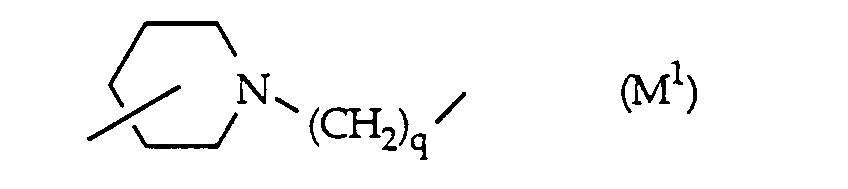
Thienylen, Pyridylen, 1,4-Phenylen, durch einen oder mehreren Substituenten aus der Gruppe von Alkyl, Halogen, N(R2,R21), CONH2, CN, NO2, CF3, OH, Alkyl (O oder S), 1,2,4-Triazol-1-yl oder Tetrazol-1-yl substituiertes 1,4-Phenylen oder eine Gruppe der Formel
Figure 00020001
q
1 oder 0,
R2 und R21
H, Alkyl, Alkenyl, Alkanoyl oder SO2-Alkyl,
T
CO, CH(R3), C(R4,R5) oder C=NOR6 und, falls M eine Gruppe M1 und q = 0 ist, T auch SO2 sein kann,
R3
OH, F, Alkoxy oder Alkanoyloxy,
R4 OH und R5
Alkyl, Alkenyl, Alkinyl, Cycloalkyl oder CF3 oder
R4 zusammen mit R5
die Gruppe CH2, CH2O oder CH2CH2,
R6
H, Alkyl oder Alkenyl,
Q
Cycloalkyl, C(R7,R8), durch einen oder mehreren Substituenten aus der Gruppe von Alkyl, Halogen, N(R9,R10), CONH2, CN, NO2, CF3, 1,2,4-Triazol-1-yl und Tetrazol-1-yl substituiertes Phenyl oder eine geradkettige Alkyl-, Alkenyl-, Alkadienyl- oder Alkatrienylgruppe Q' mit 0 bis 3 Methylsubstituenten und insgesamt 6 bis 13 C-Atomen ist, wobei eine solche Gruppe Q' durch OH und/oder durch N(R9,R10) substituiert sein kann,
R7 und R8
C5-11-Alkyl, C5-11-Alkenyl oder C5-11-Alkadienyl und
R9 und R10
H, Alkyl, Alkenyl oder Alkanoyl sind, mit den Massnahmen, dass a) in einer Verbindung der Formel I, in der T eine Gruppe CO oder CHOH, L Phenylen oder eine direkt oder über O oder N-Alkyl an M gebundene Alkylen- oder Alkenylengruppe, M 1,4-Phenylen oder durch Alkyl, Alkoxy, Halogen, CN, NO2 oder CF3 monosubstituiertes 1,4-Phenylen und Q substituiertes Phenyl, eine Alkenylgruppe oder eine gegebenenfalls durch OH substituierte Alkylgruppe ist, A2 nicht Alkyl oder Alkenyl sein soll oder A1 zusammen mit A2 nicht Alkylen sein soll,
  • b) in einer Verbindung der Formel I, in der A1 zusammen mit A2 Alkylen oder durch R1 substituiertes Alkylen, A2 Hydroxyalkyl oder A1 und A2 je eine Alkylgruppe sind, M nicht Pyridylen sein soll und
  • c) in einer Verbindung der Formel I, in der T eine Gruppe C(OH, R51), worin R51 Alkyl, Alkenyl, Alkinyl oder Cycloalkyl, M 1,4-Phenylen oder substituiertes 1,4-Phenylen und L eine über ein O-Atom an M gebundene Alkylengruppe ist, letztere zumindest 5 C-Atomen zwischen den 2 freien Valenzen und insgesamt bis zu 11 C-Atomen enthalten soll,
und Säureadditionssalze davon.
Im Rahmen der vorliegenden Erfindung bezeichnen Ausdrücke, wie "Alkyl", "Alkenyl", "Alkadienyl" und "Alkatrienyl" allein oder in Kombination, wie in Cycloalkyl-alkyl, einbindige und wenn nicht anders angegeben, geradkettige oder verzweigte Gruppen mit bis zu 20, insbesondere bis zu 13 C-Atomen; ferner bei Alkyl, Alkenyl und Alkadienyl bis zu 8 C-Atomen, bei Alkyl und Alkenyl bis zu 6, insbesondere bis zu 4 C-Atome. Beispiele für Alkyl sind Methyl, Aethyl, Propyl, Isopropyl, n-, s- und t-Butyl, Pentyl, Hexyl, Decyl und Dodecyl, für Alkanoyl: Formyl und Acetyl, für Alkenyl: Vinyl, Allyl, Propenyl, Butenyl, 3-Methyl-2-butenyl, 4-Methyl-3-pentenyl und Undodecenyl, für Alkinyl: Aethinyl, für Alkadienyl: 4-Methyl-1,3-pentadienyl; 3,7-Dimethyl-2,6-octadienyl und 4,8-Dimethyl-3,7-nonadienyl, für Alkatrienyl: 4,8-Dimethyl-1,3,7-nonatrienyl. "Alkylen", "Alkenylen" und "Alkadienylen" bezeichnen den weiter oben definierten einbindigen Alkyl-, Alkenyl- bzw. Alkadienylgruppen entsprechende zweibindige Gruppen, wie Pentylen und 3-Methyl-pentylen; Propenylen und 2,6-Dimethyl-1-hexenylen; 1,5-Dimethyl-1,5-hexadienylen; 2,6-Dimethyl-1,5-hexadienylen; 2,6-Dimethyl-1,5-octadienylen und 3,7-Dimethyl-3,7-octadienylen. "Cycloalkyl" und "Cycloalkylen" allein oder in Kombination enthalten vorzugsweise 3 bis 6 C-Atome, wie z.B. Cyclopropyl und Cyclohexyl bzw. Cyclopropylen. Beispiele von "Thienylen-" und "Pyridylen"-gruppen sind 2,5-Thienylen bzw. 2,5- oder 3,6-Pyridylen.
Vorzugsweise steht A1 für Methyl, Aethyl oder Allyl; A2 für Methyl, Aethyl, Allyl, Hydroxy, Hydroxypropyl, 2-Methoxyäthyl, 2-Methylsulfanyläthyl, Carbamoylmethyl, 2-Oxo-1-propyl, 2-Cyanäthyl, Cyclopropyl, Cyclopropylmethyl; N(A1,A2) für Imidazolyl, 4-Hydroxy-piperidin-1-yl und 4-Dimethylamino-piperidin-1-yl; A3 und A4 für Wasserstoff oder Methyl; (A1,A2)N-C(A3,A4)- für 1-Methylpyrrolidin-2-yl; L für (CH2)5O, CH=CHCH2O, 1,4-Phenylen, Cyclopropylen-methylenoxy, (CH2)5-NH, CH=CHCH2NH, (CH2)5N(Acetyl), CH=CHCH2N(Acetyl), CH=C(CH3)CH2CH2CH2CH(CH3), CH=C(CH3)CH2CH2CH=C(CH3), C(CH3)=CHCH2CH2C(CH3)=CH, CH=C(CH3)CH2CH2CH=C(CH3)CH2CH2 und CH2CH2C(CH3)=CHCH2CH2C(CH3)=CH; M für 1,4-Phenylen, das durch Fluor, OH, NH2, NHCH3, N(CH3)2, NH(CHO), NH(SO2CH3), SCH3 oder 1,2,4-Triazol-1-yl monosubstituiert, durch Fluor und Methyl substituiert oder durch Fluor di- oder tetrasubstituiert sein kann; T für CO, CHOH, SO2, C=CH2, C(CH2CH2), C(OH,Vinyl), CHF, C(OH,CH3), C(OH,CF3), C(OH,Cyclopropyl), C=NOH, C=NOCH3, C=NO-tert.Butyl oder C=NO-Allyl; Q für Bromphenyl, Cyanphenyl, Carbamoylphenyl, Difluorphenyl, durch F und N(CH3)2 substituiertes Phenyl, Cyclohexyl, 4-Methylpentyl, 3-Butenyl, 4-Methyl-3-pentenyl, 4-Methyl-1,3-pentadienyl; 4,8-Dimethyl-1,3,7-nonatrienyl, 10-Aminodecyl, 10-Acetaminodecyl, 2-Hydroxy-12-(allyl-methyl-amino)-dodecyl, 12-(Allyl-methyl-amino)-1-dodecenyl, 2-Hydroxy-4-methyl-3-pentenyl; 4,8-Dimethyl-2-hydroxy-3,7-nonadienyl, CH[CH2CH=C(CH3)2]2 oder CH[CH2CH=C(CH3)CH2CH2CH=C(CH3)2]2.
Als pharmazeutisch annehmbare Säureadditionssalze kommen Salze der Verbindungen I mit anorganischen und organischen Säuren, wie HCl, HBr, H2SO4, HNO3, Citronensäure, Essigsäure, Bernsteinsäure, Fumarsäure, Weinsäure, Methansulfonsäure und p-Toluolsulfonsäure, in Betracht.
Die Verbindungen der Formel I, die ein oder mehrere asymmetrische C-Atome enthalten, können als Enantiomere, als Diastereomere oder als Gemische davon, z.B. als Racemate, vorliegen.
Bevorzugte Verbindungen der Formel I sind
  • A) diejenigen, worin A2 Cycloalkyl oder Cycloalkyl-alkyl und T CO ist, speziell die Verbindungen der Formel
    Figure 00050001
    worin A10 Alkyl, A20 Cycloalkyl oder Cycloalkyl-alkyl, Lo Alkylen oder Alkenylen mit insgesamt bis zu 11 C-Atomen und zumindest 4 bzw. 3 C-Atomen zwischen den zwei freien Valenzen oder Cycloalkylen-alkylen, Mo gegebenenfalls halogeniertes 1,4-Phenylen und Qo durch Halogen oder CN substituiertes Phenyl, insbesondere worin A10 Methyl, A20 Cyclopropyl oder Cyclopropylmethyl, Lo n-Pentylen, n-Propenylen oder Cyclopropylenmethylen, Mo unsubstituiertes oder fluoriertes 1,4-Phenylen und Qo durch Br oder CN substituiertes Phenyl ist, speziell:
  • (4-Brom-phenyl)-[4-[6-(cyclopropyl-methyl-amino)-hexyloxy]-2-fluorphenyl] -methanon,
  • (E)-(4-Brom-phenyl)-[4-[4-(cyclopropyl-methyl-amino)-but-2-enyloxy]-phenyl] -methanon,
  • [6- [6-(Cyclopropyl-methyl-amino)-hexyloxy] -phenyl] -(4-brom-phenyl)-methanon,
  • (E)-4-[4-[4-(Cyclopropyl-methyl-amino)-but-2-enyloxy]-3-fluor-benzoyl]-benzonitril,
  • (4-Brom-phenyl)-[4-[6-(cyclopropylmethyl-methyl-amino)-hexyloxy]-phenyl] -methanon,
  • (1RS,2RS)-(4-Brom-phenyl)-[4-[2-[(cyclopropyl-methyl-amino)-methyl]-cyclopropylmethoxy] -phenyl] -methanon,
  • (1RS,2RS)-(4-Brom-phenyl)-[4-[2-[(cyclopropyl-methyl-amino)-methyl]-cyclopropylmethoxy] -3-fluor-phenyl] -methanon
  • sowie folgende Verbindungen:
    • 1-[4-[6-(Cyclopropylmethyl-methyl-amino)-hexyloxy]-2-fluor-phenyl]-5-methyl-hex-4-en-1-on,
    • 1-[4-[6-(Cyclopropyl-methyl-amino)-hexyloxy]-2-fluor-phenyl]-5-methyl-hex-4-en-1-on,
    • (E)-(4-Brom-phenyl)-[4-[4-(cyclopropylmethyl-methyl-amino)-but-2-enyloxy] -phenyl] -methanon,
    • (E)-4-[4-[4-(Cyclopropyl-methyl-amino)-but-2-enyloxy]-3-fluor-benzoyl]-benzamid,
    • (1RS,2RS)-4-[4-[2-[(Cyclopropyl-methyl-amino)-methyl]-cyclopropyl-methoxy]-3-fluor-benzoyl]-benzonitril,
    • (1RS,2RS)-(4-Brom-phenyl)- [4- [2- [(cyclopropylmethyl-methyl-amino)-methyl]-cyclopropylmethoxy]-phenyl]-methanon,
    • (1RS,2RS)-(4-Brom-phenyl)-[4-[2-[(cyclopropyl-methyl-amino)-methyl]-cyclopropylmethoxy]-2-fluor-phenyl]-methanon,
    • (1RS,2RS)-[4-[2-[(Allyl-cyclopropyl-amino)-methyl]-cyclopropylmethoxy]-phenyl]-(4-brom-phenyl)-methanon,
    • (1RS,2RS)-1-[4-[2-[(Cyclopropyl-methyl-amino)-methyl]-cyclopropyl-methoxy]-phenyl]-5-methyl-hexan-1-on,
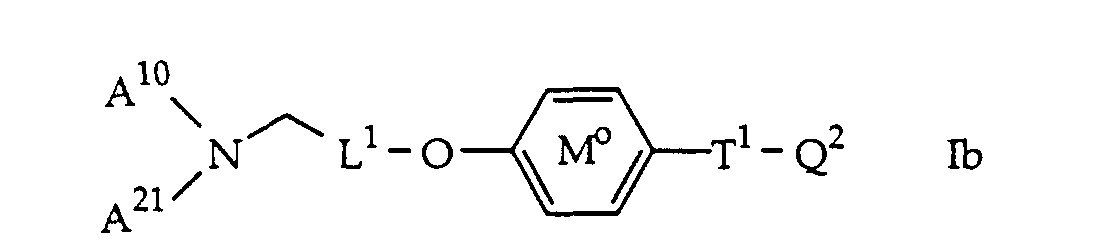
  • B) diejenigen, worin T eine Gruppe CHOH, CHF, C(R4,R5) oder C=NOR6 ist und R4, R5 und R6 die gleiche Bedeutung wie weiter oben angegeben, haben, insbesondere worin T eine Gruppe C(OH,Alkyl), C(OH, Alkenyl), C=CH2 oder C=NO-Alkyl ist, speziell die Verbindungen der Formel
    Figure 00060001
    worin A10 Alkyl, A21 Alkenyl, L1 Alkylen oder Alkenylen mit insgesamt bis zu 11 C-Atomen und zumindest 4 bzw. 3 C-Atomen zwischen den zwei freien Valenzen, Mo gegebenenfalls halogeniertes 1,4-Phenylen, T1 eine Gruppe C(OH, Alkyl), C(OH,Alkenyl), C=CH2 oder C=NO-Alkyl und Q2 Halophenyl oder Alkenyl mit 0 bis 3 Methylsubstituenten und insgesamt 6 bis 13 C-Atomen, insbesondere worin A10 Methyl, A21 Allyl, L1 n-Pentylen oder n-Propenylen, Mo unsubstituiertes oder fluoriertes 1,4-Phenylen und Q2 Bromophenyl oder 4-Methylpent-3-enyl, insbesondere:
  • (E)-(RS)-1-[4-[4-(Allyl-methyl-amino)-but-2-enyloxy]-phenyl]-(4-bromphenyl)-ethanol,
  • (E)-(RS)-1-[4-[4-(Allyl-methyl-amino)-but-2-enyloxy]-phenyl]-1-(4-bromphenyl)-prop-2-en-1-ol,
  • (E)-Allyl-[4-[4-[1-(4-brom-phenyl)-vinyl]-phenoxy]-but-2-enyl]-methylamin,
  • (RS)-1-[4-[6-(Allyl-methyl-amino)-hexyloxy]-2-fluor-phenyl]-1-(4-bromphenyl)-ethanol,
  • (E)-(RS)-2- [4- [4-(Allyl-methyl-amino)-but-2-enyloxy] -phenyl] -6-methyl-hept-5-en-2-ol
  • sowie folgende Verbindungen:
    • (E)-(RS)-[4-[4-(Allyl-methyl-amino)-but-2-enyloxy]-phenyl]-(4-bromphenyl)-cyclopropyl-methanol,
    • (E)-(RS)-1-[4-[4-(Allyl-methyl-amino)-but-2-enyloxy]-phenyl]-1-(4-bromphenyl)-2,2,2-trifluor-ethanol,
    • (RS)-1-[4-[6-(Allyl-methyl-amino)-hexyloxy]-phenyl]-1-(4-brom-phenyl)-2,2,2-trifluor-ethanol,
    • (E)-Allyl-[4-[4-[1-(4-brom-phenyl)-cyclopropyl]-phenoxy]-but-2-enyl]-methyl-amin,
    • (E)-(R oder S)-1-[4-[4-(Allyl-methyl-amino)-but-2-enyloxy]-phenyl]-(4-brom-phenyl)-ethanol,
    • (E)-(S oder R)-1-[4-[4-(Allyl-methyl-amino)-but-2-enyloxy]-phenyl]-(4-brom-phenyl)-ethanol,
    • Allyl-[6-[4-[1-(4-brom-phenyl)-vinyl]-3-fluor-phenoxy]-hexyl]-methylamin,
    • (E)-(RS)-1-[4-[4-(Allyl-methyl-amino)-but-2-enyloxy]-3-fluor-phenyl]-(4-brom-phenyl)-prop-2-en-1-ol,
    • (RS)-1-[4-[(Allyl-methyl-amino)-methyl]-biphenyl-4-yl]-1-(4-bromophenyl)-ethanol,
    • (RS)-5-[6-(Allyl-methyl-amino)-hexyloxy]-2-[1-(4-brom-phenyl)-1-hydroxy-allyl] -phenol,
    • (RS)-1-[4-[6-(Allyl-methyl-amino)-hexyloxy]-2-amino-phenyl]-1-(4-bromphenyl)-prop-2-en-1-ol,
    • (RS)-Allyl-[4'-[(4-brom-phenyl)-fluor-methyl]-biphenyl-4-ylmethyl]-methyl-amin,
    • (E)- und/oder (Z)-[4-[(E)-4-(Allyl-methyl-amino)-but-2-enyloxy]-phenyl]-(4-brom-phenyl)-methanon-O-methyl-oxim,
    • (E)- und/oder (Z)-[4-[(E)-4-(Allyl-methyl-amino)-but-2-enyloxy]-phenyl]-(4-brom-phenyl)-methanon-oxim,
    • (E)- und/oder (Z)-[4-[(E)-4-Allyl-methyl-amino)-but-2-enyloxy]-phenyl-(4-brom-phenyl)-methanon-O-tert-butyl-oxim,
    • (E)- und/oder (Z)-[4-[(E)-4-(Allyl-methyl-amino)-but-2-enyloxy]-phenyl]-(4-brom-phenyl)-methanon-O-allyl-oxim,
    • (E)- und/oder (Z)-[4-[6-(Allyl-methyl-amino)-hexyloxy]-2-fluor-phenyl]-(4-brom-phenyl)-methanon-oxim,
  • C) diejenigen, worin M gegebenenfalls durch Alkyl, Halogen, NH2, mono-oder di-alkyliertes Amino, Alkanoylamino, OH, Alkyl(O oder S) oder 1,2,4-Triazol-1-yl substituiertes 1,4-Phenylen, insbesondere worin M durch NH2, mono- oder di-alkyliertes Amino, OH, S-Alkyl oder zwei Halogenatomen substituiertes 1,4-Phenylen ist, speziell die Verbindungen der Formel
    Figure 00080001
    worin A10 Alkyl, A21 Alkenyl, L2 Alkylen mit bis zu 11 C-Atomen und zumindest 4 C-Atomen zwischen den zwei freien Valenzen, M2 durch NH2, mono- oder dialkyliertes Amino, OH, S-Alkyl oder zwei Halogenatomen substituiertes 1,4-Phenylen und Q3 halogeniertes Phenyl, insbesondere worin A10 Methyl, A21 Allyl, L2 n-Pentylen, M2 durch NH2, NHCH3, N(CH3)2, OH, SCH3 oder durch zwei F-Atomen substituiertes 1,4-Phenylen und Q3 Bromphenyl ist, insbesondere:
  • (E)-[4-[4-(Allyl-methyl-amino)-but-2-enyloxy]-2,5-difluor-phenyl]-(4-brom-phenyl)-methanon,
  • [4- [6-(Allyl-methyl-amino)-hexyloxy] -2-methylsulfanyl-phenyl] -(4-bromphenyl)-methanon,
  • [4-[6-(Allyl-methyl-amino)-hexyloxy]-2-methylamino-phenyl]-(4-bromphenyl)-methanon,
  • [4- [6-(Allyl-methyl-amino)-hexyloxy] -2-dimethylamino-phenyl] -(4-bromphenyl)-methanon,
  • [4-[6-(Allyl-methyl-amino)-hexyloxy]-2-hydroxy-phenyl]-(4-bromphenyl)-methanon,
  • [2-Amino-4-[6-(allyl-methyl-amino)-hexyloxy]-phenyl]-(4-brom-phenyl)-methanon
  • sowie folgende Verbindungen:
    • (E)-(4-Brom-phenyl)-[2,5-difluor-4-(4-dimethylamino-but-2-enyloxy]-methanon,
    • [4-[6-(Allyl-methyl-amino)-hexyloxy]-2,5-difluor-phenyl]-(4-bromphenyl)-methanon,
    • (E)-[4-[4-(Allyl-methyl-amino)-but-2-enyloxy]-2,5-difluor-phenyl]-(2,4-difluor-phenyl)-methanon,
    • (E)-[2,5-Difluor-4-(4-dimethylamino-but-2-enyloxy)-phenyl]-(2,4-difluorphenyl)-methanon,
    • [4-[6-(Allyl-methyl-amino)-hexyloxy]-2,5-difluor-phenyl]-(2,4-difluorphenyl)-methanon,
    • (2,4-Difluor-phenyl)-[4-(6-dimethylamino-hexyloxy)-2,5-difluorphenyl] methanon,
    • (E)-[4-[4-(Allyl-methyl-amino)-but-2-enyloxy]-2,3,5,6-tetrafluor-phenyl]-(4-brom-phenyl] -methanon,
    • (E)- [4- [4-(Allyl-methyl-amino)-but-2-enyloxy] -3-fluor-2-methyl-phenyl]-(4-brom-phenyl)-methanon,
    • (E)- [4- [4-(Allyl-methyl-amino)-but-2-enyloxy] -2-methylsulfanyl-phenyl]-(4-brom-phenyl)-methanon,
    • (E)-N-[11-[4- [4-(Allyl-methyl-amino)-but-2-enyloxy] -3-fluor-phenyl]-11-oxo-undecyl]-acetamid,
    • (E)-[4-(4-Allyl-methyl-amino-but-2-enyloxy)-2-hydroxy-phenyl]-(4-bromphenyl)-methanon,
    • (E)-1-[4-[4-(Allyl-methyl-amino)-but-2-enyloxy]-3-fluor-phenyl]-11-amino-undecan-1-on,
    • (E)-1-[4-[(E)-4-(Allyl-methyl-amino)-but-2-enyloxy]-3-fluor-phenyl]-2-[(E)-3,7-dimethyl-octa-2,6-dienyl]-5,9-dimethyl-deca-4,8-dien-1-on,
    • (E)-1-[4-[4-(Allyl-methyl-amino)-but-2-enyloxy]-3-fluor-phenyl]-5-methyl-2-(3-methyl-but-2-enyl)-hex-4-en-1-on,
    • (E)-(RS)-1-[4-[4-(Allyl-methyl-amino)-but-2-enyloxy]-3-fluor-phenyl]-3-hydroxy-5-methyl-hex-4-en-1-on,
    • (E)-(RS)-1- [4- [4-(Allyl-methyl-amino)-but-2-enyloxy] -2-fluor-phenyl] -3-hydroxy-5-methyl-hex-4-en-1-on,
    • (E)-(RS)-1- [4- [4-(Allyl-methyl-amino)-but-2-enyloxy] -phenyl] -3-hydroxy-5-methyl-hex-4-en-1-on,
    • (E)-(RS)-1-[4-[(E)-4-(Allyl-methyl-amino)-but-2-enyloxy]-3-fluor-phenyl]-3-hydroxy-5,9-dimethyl-deca-4,8-dien-1-on,
    • (E)-(RS)-13-(Allyl-methyl-amino)-1-[4-[4-(allyl-methyl-amino)-but-2-enyloxy]-3-fluor-phenyl]-3-hydroxy-tridecan-1-on,
    • (E)-1-[4-[(E)-4-(Allyl-methyl-amino)-but-2-enyloxy]-3-fluor-phenyl]-5-methyl-hexa-2,4-dien-1-on,
    • (E)-13-(Allyl-methyl-amino)-1-[4-[(E)-4-(allyl-methyl-amino)-but-2-enyloxy]-3-fluor-phenyl]-tridec-2-en-1-on,
    • (E)-1- [4- [(E)-4-(Allyl-methyl-amino)-but-2-enyloxy] -2-fluor-phenyl] -5-methyl-hexa-2,4-dien-1-on,
    • (E)-1-[4-[(E)-4-(Allyl-methyl-amino)-but-2-enyloxy]-phenyl]-5-methylhexa-2,4-dien-1-on,
    • (2E,4E)-1-[4-[(E)-4-(Allyl-methyl-amino)-but-2-enyloxy]-3-fluor-phenyl]-5,9-dimethyl-deca-2,4,8-trien-1-on,
    • [4-[6-(Allyl-methyl-amino)-hexyloxy]-2-1H-[1,2,4]triazol-1-yl-phenyl]-(4-brom-phenyl)-methanon,
    • 1-[4-[6-(Allyl-methyl-amino)-hexyloxy]-2-methylamino-pheny]-4-methylhex-5-en-1-on,
    • (E)-1-[4-[4-(Allyl-methyl-amino)-but-2-enyloxy]-2-methylsulfanylphenyl]-5-methyl-hex-4-en-1-on,
    • N- [5- [6-(Allyl-methyl-amino)-hexyloxy] -2-(4-brom-benzoyl)-phenyl]-methansulfonamid,
    • (4-Brom-phenyl)-(4'-dimethylaminomethyl-3-hydroxy-biphenyl-4-yl)-methanon,
    • N-[5-[6-(Allyl-m ethyl-amino)-hexyloxy] -2-(4-brom-benzoyl)-phenyl]-formamid,
  • D) diejenigen, worin L eine über NH oder N-Alkanoyl an M gebundene Alkylen- oder Alkenylengruppe mit insgesamt bis zu 11 C-Atomen und zumindest 4 bzw. 3 C-Atomen zwischen den zwei freien Valenzen, speziell die Verbindungen der Formel
    Figure 00100001
    worin A10 Alkyl, A21 Alkenyl, L1 Alkylen oder Alkenylen mit insgesamt bis zu 11 C-Atomen und zumindest 4 bzw. 3 C-Atomen zwischen den zwei freien Valenzen, M3 halogeniertes 1,4-Phenylen und Q3 halogeniertes Phenyl, insbesondere worin A10 Methyl, A21 Allyl, L1 n-Pentylen oder n-Propenylen, M3 Fluorphenylen und Q3 Bromphenyl, insbesondere:
  • (E)-[4-[4-(Allyl-methyl-amino)-but-2-enylamino]-3-fluor-phenyl]-(4-brom-phenyl)-methanon,
  • [4- [6-(Allyl-methyl-amino)-hexylamino] -3-fluor-phenyl] -(4-bromphenyl)-methanon
  • sowie folgende Verbindungen:
    • (E)-N-[4-(Allyl-methyl-amino)-but-2-enyl]-N-[4-(4-brom-benzoyl)-2-fluorphenyl]-acetamid,
    • N- [6-(Allyl-methyl-amino)-hexyl] -N- [4-(4-brom-benzoyl)-2-fluor-phenyl]-acetamid,
  • E) diejenigen, worin M eine Gruppe der Formel
    Figure 00110001
    und q 1 oder 0, insbesondere worin M zusammen mit T die Piperidin-1-yl-sulfonylgruppe bildet, speziell die Verbindungen der Formel
    Figure 00110002
    worin A10 Alkyl, A21 Alkenyl, L2 Alkylen mit bis zu 11 C-Atomen und zumindest 4 C-Atomen zwischen den zwei freien Valenzen und Q3 halogeniertes Phenyl, insbesondere worin A10 Methyl, A21 Allyl, L2 n-Pentylen und Q3 Bromphenyl ist, speziell
       Allyl-[6-[1-(4-brom-phenylsulfonyl)-piperidin-4-yloxy]-hexyl]-methylamin
    und die Verbindungen:
  • [4-[6-(Allyl-methyl-amino)-hexyloxy]-piperidin-1-yl]-1-(4-brom-phenyl) methanon,
  • 2-[4-[6-(Allyl-methyl-amino)-hexyloxy]-piperidin-1-yl]-1-(4-bromphenyl)-ethanon,
  • F) diejenigen, worin A1 Alkyl und A2 OH oder gegebenenfalls durch eine Gruppe R1, CONH2 oder CN substituiertes Alkyl ist oder
  • A1 zusammen mit A2 oder mit A3 eine gegebenenfalls durch R1 substituiertes Alkylen-, Alkenylen- oder Alkadienylengruppe A1-A2 bzw. A1-A3 mit bis zu 5 C-Atomen bildet, wobei in einer Gruppe A1-A2 oder A1-A3 ein C-Atom durch ein N-Atom ersetzt sein kann und
  • R1 an einem gesättigten C-Atom von A2, A1-A2 oder A1-A3 gebundenes OH, Oxo, Alkyl(O oder S) oder Dialkylamino ist,
  • wobei ein durch R1 substituiertes C-Atom bzw. ein in A2, A1-A2 oder A1-A3 enthaltenes ungesättigtes C-Atom in einer anderen als der α-Stellung zu N(A1A2) gebunden sein sollen,
  • speziell die Verbindungen, worin A1 zusammen mit A2 durch OH substituiertes Alkylen mit bis zu 5 C-Atomen ist, sowie die Verbindungen der Formel
    Figure 00120001
    worin A1 zusammen mit A2 eine durch OH substituierte Alkylengruppe mit bis zu 5 C-Atomen, L3 Alkenylen mit insgesamt bis zu 11 C-Atomen und zumindest 3 C-Atomen zwischen den zwei freien Valenzen und Q3 halogeniertes Phenyl, insbesondere worin A1 zusammen mit A2 4-Hydroxy-piperidin-1-yl, L3 n-Propenylen und Q3 Bromphenyl ist, speziell:
       (E)-(4-Brom-phenyl)-[4-[4-(4-hydroxy-piperidin-1-yl)-but-2-enyloxy]-phenyl]-methanon
    sowie folgende Verbindungen:
    • Cyclohexyl-p-[[(E)-4-(dimethylamino)-2-butenyl]oxy]phenyl-keton,
    • (E)-[[4-[4-(4-Brom-benzoyl)-phenoxy]-but-2-enyl]-methyl-amino]-acetonitril,
    • (E)-3-[[4-[4-(4-Brom-benzoyl)-phenoxy]-but-2-enyl]-methyl-amino]-propionitril,
    • (E)-(4-Brom-phenyl)-[4-[4-(4-dimethylamino-piperidin-1-yl)-but-2-enyloxy] -phenyl] -methanon,
    • (4-Brom-phenyl)-[4-[6-(hydroxy-methyl-amino)-hexyloxy]-phenyl]-methanon,
    • (E)-(4-Brom-phenyl)-[4-[4-(hydroxy-methyl-amino)-but-2-enyloxy]-phenyl]-methanon,
    • (E)-(4-Brom-phenyl)-[4-[4-[(2-methoxy-ethyl)-methyl-amino]-but-2-enyloxy]-phenyl]-methanon,
    • (E)-(4-Brom-phenyl)-[4-[4-[methyl-(2-methylsulfanyl-ethyl)-amino]-but-2-enyloxy] -phenyl] -methanon,
    • (E)-(4-Brom-phenyl)-[4-(4-imidazol-1-yl-but-2-enyloxy)-phenyl]-methanon,
    • (4-Brom-phenyl)-[4-(6-imidazol-1-yl-hexyloxy)-phenyl]-methanon,
    • (4-Brom-phenyl)-[4-[6-[(3-hydroxy-propyl)-methyl-amino]-hexyloxy]-phenyl]-methanon,
    • 1-[[6-[4-(4-Brom-benzoyl)-phenoxy]-hexyl]-methyl-amino]-propan-2-on,
    • (E)-2-[[4-[4-(4-Brom-benzoyl)-phenoxy]-but-2-enyl]-methyl-amino]-acetamid,
    • (±)(4-Brom-phenyl)-[4'-(1-methylpyrrolidin-2-yl)-biphenyl-4-yl]-methanon,
  • G) diejenigen, worin p = 0 und L an T gebundenes C6-11-Alkenylen oder C6-11-Alkadienylen ist, speziell die Verbindungen der Formel
    Figure 00130001
    worin A10 Alkyl, A21 Alkenyl, L4 C6-11-Alkadienylen und Q4 eine Alkenylgruppe mit 0 bis 3 Methylsubstituenten und insgesamt 6 bis 13 C-Atomen, insbesondere worin A10 Methyl, A21 Allyl, L4 Dimethyloctadienylen und Q4 4-Methyl-3-pentenyl ist, speziell:
    (9E,13E)-15-(Allyl-methyl-amino)-2,9,13-trimethyl-pentadeca-2,9,13-trien-6-on
    sowie folgende Verbindungen:

  • (4E,8E)-10-(Allyl-methyl-amino)-1-(4-brom-phenyl)-4,8-dimethyl-deca-4,8-dien-1-on,
  • (4E,8E)-1-(4-Brom-phenyl)-10-dimethylamino-4,8-dimethyl-deca-4,8-dien-1-on,
  • (7E,11E)-13-(Allyl-methyl-amino)-2,7,11-trimethyl-trideca-2,7,11-trien-6-on,
  • (7E,11E)- und (7Z,11E)-13-(Allyl-methyl-amino)-2,7,11-trimethyl-trideca-2,7,11-trien-6-on,
  • (2E,6E)-8-(Allyl-methyl-amino)-1-(4-brom-phenyl)-2,6-dimethyl-octa-2,6-dien-1-on,
  • (7E,11E)-13-(Allyl-methyl-amino)-7,11-dimethyl-trideca-1,7,11-trien-6-on,
  • (2E,6E)-(RS)-8-(Allyl-methyl-amino)-1-(4-brom-phenyl)-2,6-dimethyl-octa-2,6-dien-1-ol,
  • (E)-(RS)-8-(Allyl-methyl-amino)-1-(4-brom-phenyl)-2,6-dimethyl-oct-6-en-1-on,
  • (2E,6E)-(RS)-10-(Allyl-methyl-amino)-1-(4-brom-phenyl)-3,7-dimethyl-deca-2,6-dien-1-ol,
  • (2E,6E)-(RS)-8-(Allyl-methyl-amino)-1-(4-brom-phenyl)-3,7-dimethyl-octa-2,6-dien-1-ol,
  • (2E,6E)-10-(Allyl-methyl-amino)-1-(4-brom-phenyl)-3,7-dimethyl-deca-2,6-dien-1-on,
  • (2E,6E)-8-(Allyl-methyl-amino)-1-(4-brom-phenyl)-3,7-dimethyl-octa-2,6-dien-1-on,
  • H) diejenigen, worin M Thienylen oder Pyridylen, insbesondere die folgenden:
  • (E)-1-[6-[6-(Allyl-methyl-amino)-hexyloxy]-pyridin-3-yl]-5-methyl-hexa-2,4-dien-1-on,
  • 6-[6-(Allyl-methyl-amino)-hexyloxy]-pyridin-3-yl]-(4-brom-phenyl)-methanon,
  • (E)- [6- [4-(Allyl-methyl-amino)-but-2-enyloxy] -pyridin-3-yl] -(4-bromphenyl)-methanon,
  • [5-[6-(Allyl-methyl-amino)-hexyloxy]-pyridin-2-yl]-(4-brom-phenyl)-methanon,
  • 5-(4-[(Allyl-methylamino)-methyl]-phenyl)-thiophen-2-yl)-(4-bromphenyl)-methanon,
  • 5-(4-[Dimethylamino)-methyl]-phenyl)-thiophen-2-yl)-(4-bromophenyl)-methanon,
  • 5-(4-[(Allyl-methylamino)-methyl]-phenyl)-thiophen-2-yl)-(4-(2,4-difluorophenyl))-methanon,
  • (2-Dimethylamino-4-fluor-phenyl)-[5-(4-dimethylaminomethyl-phenyl)-thiophen-2-yl] -methanon,
  • I) diejenigen, worin L über ein O-Atom an M gebundenes Cycloalkylen-alkylen ist, speziell
  • (1RS,2RS)-(4-Brom-phenyl)-[4-[2-[(ethyl-methyl-amino)-methyl]-cyclopropylmethoxy]-phenyl]-methanon,
  • (1RS,2RS)-[4-[2-[(Allyl-methyl-amino)-methyl]-cyclopropylmethoxy]-phenyl]-(4-brom-phenyl)-methanon.
  • Die Erfindung betrifft ferner ein Verfahren zur Herstellung der Verbindungen der Formel I. Dieses Verfahren ist dadurch gekennzeichnet, dass man
  • a) ein Bromid der Formel
    Figure 00150001
    mit einem Amin HN(A1,A2) umsetzt,
  • b) ein Amin der Formel
    Figure 00150002
       worin A die gleiche Bedeutung wie A2 hat, methyliert,
  • c) ein Amin der Formel III, worin A die gleiche Bedeutung wie A1 hat, mit einem Halogenid der Formel Hal-Ao umsetzt, worin Hal Halogen und Ao Cycloalkyl-alkyl oder durch eine Gruppe R1, CONH2 oder CN substituiertes Alkyl oder Alkenyl ist,
  • d) ein Aethanon der Formel
    Figure 00150003
       worin M4 für 1,4-Phenylen, das wie weiter oben für eine 1,4-Phenylengruppe M angegeben substituiert sein kann, oder für Thienylen oder Pyridylen steht,
    mit einem Halogenid der Formel Hal-R7 zu einem Keton der Formel I umsetzt, worin T zusammen mit Q eine Gruppe C(O)C(R7)2 ist und R7 die gleiche Bedeutung wie in der Formel I hat,
  • e) ein Aethanon der Formel IV mit einem Aldehyd der Formel HC(O)Q"    worin Q" eine geradkettige Alkyl-, Alkenyl- oder Alkadienylgruppe mit 0 bis 3 Methylsubstituenten und insgesamt 4 bis 11 C-Atomen ist,
    umsetzt,
  • f) ein β-Hydroxyketon der Formel
    Figure 00160001
       worin M5 für 1,4-Phenylen, das wie weiter oben für eine 1,4-Phenylengruppe M angegeben substituiert sein kann, steht und Q5 eine der obigen einbindigen Gruppe Q" entsprechende zweibindige Gruppe ist,
    mit einem Amin HN(R9,R10) umsetzt,
  • g) ein Aminoalkohol der Formel
    Figure 00160002
       worin L5 Alkylen oder Alkenylen mit insgesamt bis zu 11 C-Atomen und zumindest 4 bzw. 3 C-Atomen zwischen den zwei freien Valenzen oder Cycloalkylen-alkylen ist,
    mit einer Verbindung der Formel HO-M6-T-Q umsetzt,
       worin M6 für 1,4-Phenylen, das wie in Anspruch 1 angegeben substituiert sein kann, oder für Thienylen steht,
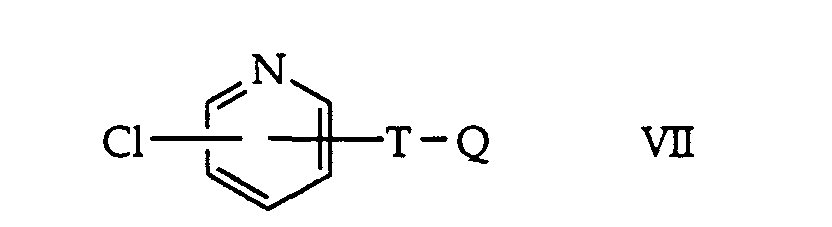
  • h) ein Aminoalkohol der Formel VI mit einem Chlorid der Formel
    Figure 00160003
    umsetzt,
  • i) ein Säureadditionssalz eines Amins der Formel
    Figure 00160004
    worin A10 Alkyl, A22 Cycloalkyl, Cycloalkyl-alkyl oder eine gegebenenfalls durch eine Gruppe R10 oder CN substituierte Alkylgruppe,
  • A30 und A4 Wasserstoff oder Alkyl sind oder
  • A10 zusammen mit A22 oder mit A30 eine gegebenenfalls durch
  • R11 substituierte Alkylengruppe bildet, wobei in einer solchen Alkylengruppe ein C-Atom durch N-Alkyl ersetzt sein kann,
  • R11 Oxo, Alkyl (O oder S) oder Dialkylamino und
  • L6 Phenylen oder direkt oder über O oder N-Alkyl an den Phenylring gebundenes Alkylen mit insgesamt bis zu 11 C-Atomen und zumindest 4 C-Atomen zwischen den zwei freien Valenzen ist,
  • mit einem Säurechlorid der Formel ClC(O)-Q6 umsetzt,
       worin Q6 Cycloalkyl, C(R70,R80), durch einen oder mehreren Substituenten aus der Gruppe von Alkyl, Halogen, Dialkylamino, CN, NO2, CF3, 1,2,4-Triazol-1-yl und Tetrazol-1-yl substituiertes Phenyl oder eine geradkettige Alkylgruppe mit 0 bis 3 Methylsubstituenten und insgesamt 6 bis 13 C-Atomen ist und R70 und R80 für C5-11-Alkyl stehen,
  • j) ein Diamin der Formel
    Figure 00170001
    mit einem Halogenid der Formel ClS(O)2-Q, ClC(O)-Q oder BrCH2C(O)-Q umsetzt,
  • k) ein Aldehyd der Formel
    Figure 00170002
    mit einem die Gruppe Q einführenden Mittel umsetzt, wobei Q Cycloalkyl, C(R7,R8), durch einen oder mehreren Substituenten aus der Gruppe von Alkyl, Halogen, N(R90,R100), CN, NO2, CF3, 1,2,4-Triazol-1-yl und Tetrazol-1-yl substituiertes Phenyl oder eine geradkettige Alkyl-, Alkenyl-, Alkadienyl-oder Alkatrienylgruppe Q10 mit 0 bis 3 Methylsubstituenten und insgesamt 6 bis 13 C-Atomen ist, wobei eine solche Gruppe Q10 durch N(R90,R100) substituiert sein kann und R90 und R100 Alkyl oder Alkenyl ist,
  • l) gewünschtenfalls eine in einer Verbindung der Formel I enthaltene reaktionsfähige Gruppe funktionell abwandelt und
  • m) gewünschtenfalls ein Amin der Formel I in ein physiologisch verträgliches Säureadditionssalz oder ein Säureadditionssalz einer Verbindung der Formel I in das Amin der Formel I überführt.
  • Dieses Verfahren kann in an sich bekannter Weise durchgeführt werden. So lässt sich die Umsetzung a) eines Bromids II mit einem Amin HN(A1,A2)
  • 1. in einem Lösungsmittel wie einem Alkohol, z.B. Aethanol, oder in Aceton, in Gegenwart einer Base, z.B. Kaliumcarbonat, bei erhöhter Temperatur,
  • 2. in Dimethylacetamid (DMA) bei Raumtemperatur oder unter Abkühlung oder
  • 3. in Gegenwart von NaH in einem Lösungsmittel, wie DMF, unter Erwärmen bewerkstelligen.
  • Die Methylierung eines Amins III, worin A die gleiche Bedeutung wie A2 in der Formel I hat, lässt sich in Gegenwart von NaHPO4 in einem Lösungsmittel, wie einem Aether, z.B. Dioxan, mittels Formaldehyd unter Erwärmen durchführen.
    Die Umsetzung eines Amins III, worin A die gleiche Bedeutung wie A1 in der Formel I hat, mit einem Cycloalkyl-alkylhalogenid Hal-Ao, z.B. einem Bromid, kann man in Gegenwart von einer Base, wie Diisopropylethylamin in einem Lösungsmittel, wie DMA, unter Erwärmen bewerkstelligen.
    Die Umsetzung eines Aethanons IV mit einem Halogenid Hal-R7 und/oder Hal-R8 führt zum entsprechenden Aminoketon I, worin T für CO und Q für die Gruppe C(R7,R7), C(R8,R8) und/oder C(R7,R8) steht. Man kann das Aethanon IV zunächst mit einer Lösung von Lithium-hexamethyl-disilazid (hergestellt aus Hexamethyldisilazan und Butyl-lithium) in THF und dann mit einer Lösung des Halogenids, z.B. des Bromids, der Formel Hal-R7 und/oder Hal-R8 in einem Lösungsmittel, wie einem Aether, z.B. THF, bei niedriger Temperatur umsetzen.
    Je nachdem M4 in einem Aethanon IV für Thienylen oder gegebenenfalls substituiertes Phenylen oder für Pyridylen steht, führt die Umsetzung e) des Aethanons IV mit einem Aldehyd HC(O)Q" zu einem Keton I, worin T-Q für C(O)CH=CH-Q" steht, oder zu einem β-Hydroxyketon I, worin T-Q für C(O)CH2CH(OH)Q" steht. Das Aethanon IV kann man zunächst mit einer Lösung von Lithium-diisopropylamid (hergestellt aus Diisopropylamin und Butyl-lithium) in THF und dann mit einer Lösung des Aldehyds HC(O)Q" in THF bei niedriger Temperatur umsetzen.
    Die Verfahrensvariante f) führt zu einem β-Hydroxyketon I, worin T-Q eine Gruppe: C(O)CH2CH(OH)Q5-N(R9,R10) ist. Zur Durchführung dieser Variante kann man eine Lösung eines Bromids V in DMA unter Abkühlung mit einem Amin HN(R9,R10) umsetzen.
    Die Umsetzung g) eines Aminoalkohols VI mit einer Verbindung der Formel HO-M6-T-Q führt zu einem Aminoäther I, worin L-M eine Gruppe L5-O-M6 ist, in der L5 und M6 wie weiter oben angegeben definiert sind. Sie kann dadurch bewerkstelligt werden, dass man Triphenylphosphin, die Verbindung HO-M6-T-Q und das Aminoalkohol VI in einem Lösungsmittel, wie einem Aether, z.B. THF, mit Diethylazodicarboxylat behandelt.
    Die Umsetzung h) eines Aminoalkohols VI mit einem Chlorid VII führt zu einem Aether I, worin L-M eine Gruppe L5-O-Pyridylen ist. Man kann sie in Gegenwart einer Base, wie KOH und K2CO3 in Gegenwart eines Kronenethers, wie die Dicyclohexano-[18]-krone-6, in einem Lösungsmittel, wie Toluol, unter Erhitzen durchführen.
    Die Umsetzung i) eines Säureadditionssalzes des Amins VIII mit einem Säurechlorid ClC(O)-Q6 führt zum entsprechenden Aminoketon I, worin T-Q für C(O)-Q6 steht. Sie kann in Gegenwart von Aluminiumchlorid in Schwefelkohlenstoff unter Erhitzen bewerkstelligt werden.
    Die Umsetzung j) eines Diamins IX mit einem Halogenid ClS(O)2-Q, ClC(O)-Q oder BrCH2C(O)-Q führt zum entsprechenden Amin I, worin T-Q für S(O)2-Q, C(O)-Q bzw. CH2C(O)-Q steht. Man kann sie in einem Lösungsmittel, wie Methylenchlorid, in Gegenwart von Di-isopropyl-äthylamin (Hünig-Base) durchführen.
    Die Verfahrensvariante k) kann eine Grignard-Reaktion zwischen einem Aldehyd X und einem Halogenid, wie Q-MgBr sein. Falls Q gegebenenfalls substituiertes Phenyl ist, kann man zunächst ein Halogenid, wie Q-Br, in THF mit Butyl-lithium in Hexan und die entstandene Verbindung Li-Q mit einem Aldehyd X bei tiefer Temperatur, wie etwa -78°C, zum entsprechenden Keton I umsetzen.
    Als funktionelle Abwandlungen von in einer Verbindung I enthaltenen reaktionsfähigen Gruppen können folgende genannt werden:
  • a) Die Umwandlung einer Cyanogruppe, die als Substituent einer Alkylgruppe A2 und/oder einer Phenylgruppe Q vorliegt, in die Carbamoylgruppe kann man in Gegenwart von Kaliumcarbonat in DMSO bei etwa 0°C mittels einer Wasserstoffperoxidlösung durchführen.
  • b) Die Hydrolyse einer Alkanoylaminogruppe, die als Substituent einer Gruppe Q' vorliegt, zur Aminogruppe kann mittels Salzsäure in Aethanol erfolgen.
  • c) Die Dehydratisierung eines β-Hydroxyketons I, worin T für C(O) steht und Q eine in β-Stellung zu C(O) hydroxylierte Gruppe Q' ist, zum entsprechenden Keton I, worin Q eine in α-Stellung zu C(O) ungesättigte Gruppe Q' ist, kann man in Toluol mittels p-Toluolsulfonsäure durchführen.
  • d) Ein Amid I, worin L über N(Alkanoyl) an M gebunden ist, kann mittels einer Lösung von KOH in Aethanol ins entsprechende Amin I, worin L über NH an M gebunden ist, übergeführt werden.
  • e) In einem Keton I, worin p = 0, die Gruppe T-Q substituiertes Benzoyl und L Alkenylen oder Alkadienylen ist, kann eine in L enthaltene Gruppe CH=CH, die in α-Stellung zur Carbonylgruppe T vorliegt, selektiv zu CH2CH2 hydriert werden. Man kann die Hydrierung in Benzol mit einem Phasentransfer-Katalysator, wie Tricaprylmethylammoniumchlorid, in Gegenwart von einer wässrigen Lösung von Natriumhydrogencarbonat und Natriumdithionit durchführen.
  • f) In einem Benzophenon I, worin Q substituiertes Phenyl ist und die Phenylengruppe M in o-Stellung zur Carbonylgruppe T durch Fluor substituiert ist, kann man dieses F-Atom
  • 1) durch Reaktion mit Methoxybenzylamin in Gegenwart einer Base, wie Kaliumcarbonat, in Toluol und dann Umsetzung mit Trifluoressigsäure in die Aminogruppe,
  • 2) durch Reaktion in DMA mit einem geeigneten Amin in Aethanol in eine alkylierte oder alkenylierte Aminogruppe oder in eine 1,2,4-Triazol-1-yl-oder Tetrazol-1-ylgruppe oder
  • 3) durch Reaktion mit einem Natrium-alkanolat oder einem Natriumthioalkanolat in Methanol bzw. in THF in die entsprechende Alkoxygruppe bzw. Alkylthiogruppe umwandeln.
  • g) Durch Aetherspaltung mittels wässriger Essigsäure/HBr-Lösung lässt sich ein Alkoxysubstituent in der Gruppe M in die Hydroxygruppe umwandeln.
  • h) In einer Verbindung I, worin M Aminophenylen ist, kann man die Aminogruppe durch Reaktion in Methylenchlorid mit einem Alkylsulfonylchlorid in die Alkylsulfonylaminogruppe umwandeln. Die Aminogruppe lässt mittels Ameisensäure und Formamid in die Formylaminogruppe umwandeln.
  • i) In an sich bekannter Weise lässt sich ein Keton I, worin T Carbonyl ist, in den entsprechenden Alkohol überführen, worin T eine Gruppe [Alkyl, Alkenyl, Alkinyl oder Cycloalkyl]-C(OH) ist. So kann man zur Umwandlung der Carbonylgruppe in die Gruppe C(CH3)OH das Keton I bei etwa -78°C mit LiCH3/CeCl3 in THF und zur Umwandlung der Carbonylgruppe in eine Gruppe Alkenyl-C(OH) das Keton I mit einer Lösung eines Alkenylmagnesiumhalogenids bei etwa 0°C in THF/Aether umsetzen.
  • j) Aus einem Säureadditionssalz eines Ketons I, worin T Carbonyl ist, kann man ein Oxim I, worin T für C=N(OR6) steht, durch Umsetzung mit H2N(OR6) in Gegenwart von Natriumacetat in Aethanol unter Erhitzen erhalten.
  • k) Ein Alkohol I, worin T die Gruppe CH(OH) ist, kann in Methylenchlorid bei etwa -78°C mittels Diäthylamino-schwefeltrifluorid zum Fluorid I, worin T die Gruppe CHF ist, fluoriert oder in Gegenwart von Natriumcarbonat mittels Mangan(IV)-oxid zum Keton, worin T C(O) ist, oxydiert werden.
  • Die im obigen Verfahren eingesetzten Ausgangsmaterialien II bis X und die zu dessen Herstellung notwendigen Edukten sind bekannt oder können in Analogie zu strukturell nahverwandten Verbindungen bzw. wie in den nachstehenden Beispielen beschrieben in an sich bekannter Weise hergestellt werden.
    So wird ein Bromid II, worin T für C(O) steht und L über ein O-Atom an eine gegebenenfalls substituierte Phenylgruppe M gebunden ist, ausgehend von einem Aether H3C-O-M und einem Säurechlorid ClC(O)-Q, via dem Aether H3C-O-M-C(O)-Q und dem entsprechenden Phenol HO-M-C(O)-Q und Reaktion dieses Phenols mit einem Dibromid BrCH2-L-Br hergestellt. Analog lassen sich Bromide II, worin T für C(OH,Alkyl), C=CH2 oder C(CH2CH2) steht via den entsprechenden Phenolen HO-M-T-Q herstellen.
    Ein Bromid II, worin T für C(O) steht und L über eine Gruppe N(Alkanoyl) an eine gegebenenfalls substituierte Phenylgruppe M gebunden ist, lässt sich ausgehend von einem Bromid der Formel Alkanoyl-NH-M-Br und von einer Verbindung der Formel N(CH3, OCH3)C(O)-Q, via der Verbindung der Formel Alkanoyl-NH-M-C(O)-Q und Reaktion dieser Verbindung mit einem Dibromid BrCH2-L-Br herstellen.
    Aus Bromtoluol und Bromthiophen erhält man via Tolyl-Thiophen und Tolyl-Thienylen-C(O)-Q, eine Verbindung II, worin L an eine Thienylengruppe M gebundenes Phenylen ist.
    Generell lässt sich ein Bromid II aus dem entsprechenden Tetrahydropyranyläther durch Reaktion in Methylenchlorid bei etwa -50°C mit Triphenylphosphindibromid unter Abkühlung, vorzugsweise auf -50 bis 0°C, herstellen.
    Zur Herstellung eines Ausgangsamins III, worin A3 und A4 für H stehen, kann man ein entsprechendes Bromid II mit einem Trifluoracetamid F3C-C(O)-NH-A in F3C-C(O)-N(A)-CH2-L-(M)p-T-Q überführen und aus letzterem die Trifluoracetylgruppe hydrolytisch abspalten.
    Ein Ausgangsamin III für die Verfahrensvariante c) erhält man ausgehend von dem entsprechenden Bromid II, via entsprechendem Azid und den Verbindungen F3C-C(O)-NH-CH2-L-(M)p-T-Q und F3C-C(O)-N(A)-CH2-L-(M)p-T-Q.
    Aethanone IV, worin A3 und A4 für H stehen, erhält man durch Reaktion eines Bromids BrCH2-L-M4-C(O)-CH3 mit einem Amin (A1,A2)NH in DMA.
    Ein β-Hydroxyketon V lässt sich ausgehend von dem entsprechenden Aethanon IV und einem Aldehyd HC(O)-Q5-Br herstellen.
    Ein Aminoalkohol VI, worin A3 und A4 für H stehen und L5 für Cycloalkylen-alkylen steht, kann man aus einem Diester der Formel Alkyl-O-C(O)-Cycloalkylen-C(O)O-alkyl, via A2-NH-C(O)-Cycloalkylen-C(O)O-alkyl und via (A1,A2)-N-C(O)-Cycloalkylen-COO-alkyl und Reduktion dieses Amidoesters zum Aminoalkohol VI: (A1,A2)N-CH2-Cycloalkylen-CH2OH erhalten.
    Ein Chlorid VII, worin T für C(O) steht, erhält man aus der entsprechenden Chlorpyridincarbonsäure, via Chlor-N-methoxy-N-methylpyridincarboxamid.
    Zur Herstellung eines Amins VIII, worin A10 zusammen mit A22 eine Alkylengruppe bildet, kann man von einem Bromid Br-L6-C6H5 ausgehen. Dieses kann z.B. mit 5-Methoxy-2H-3,4-dihydropyrrol in das in 5-Stellung durch -L6-C6H5 substituierte 2H-3,4-Dihydropyrrol überführt, letzteres zu dem in 2-Stellung entsprechend substituierten Pyrrolidin hydriert und dieses zur Verbindung VIII, worin (A10,A22)NC(A30,A4) eine N-Methyl-2-pyrrolidinyl ist, methyliert werden.
    Ein Diamin der Formel IX, worin A3 und A4 für H stehen und L über O an den Piperidinring gebundenes Alkenylen ist, erhält man aus dem 4-Hydroxy-piperidin-1-carbonsäure-tert-butylester, via dem in 4-Stellung durch eine Gruppe Br-Alkylen-O- substituierten Piperidin.
    Ein Aldehyd X, worin A3 und A4 für H stehen, erhält man ausgehend von einem Aldehyd H-C(O)-L-(M)p-CH2-O-THP, via dem Amid der Formel (A1,A2)NC(O)-L-(M)p-CH2-O-THP und dem Aminoalkohol der Formel (A1,A2)NCH2-L-(M)p-CH2OH durch Oxydation des letzteren.
    In den nachfolgenden Beispielen A bis G ist die Herstellung von einigen der weiter oben erwähnten Ausgangsmaterialien und Zwischenprodukten beschrieben.
  • A) Ausgangsverbindungen der Formel HO-M-C(O)-Q
  • Aa) Eine Lösung von 5.6 ml 2-Fluoranisol in 60 ml absolutem THF wird auf -78 °C gekühlt und innert 15 Min mit 31.3 ml 1.6 M Butyllithium in Hexan versetzt. Nach 15 Min werden 8.7 g 1,1,4,7,7 -Pentamethyldiethylentriamin und, nach weiteren 2 Std bei - 78 °C, 9.4 ml Methyliodid zugetropft. Über Nacht wird bei -78 °C gerührt, dann eingedampft und in Äther/1N Salzsäure aufgenommen. Die wässrige Phase wird mit Äther extrahiert, die organische Phase über Natriumsulfat getrocknet und eingedampft, um rohes 2-Fluor-3-methyl-anisol zu erhalten. 30 ml Nitrobenzol werden in einem Eisbad gekühlt und dann nacheinander mit 8.1 g Aluminiumchlorid und 11.9 g 4-Brombenzoylchlorid in 9 ml Nitrobenzol bei maximal 6 °C versetzt. Das Gemisch wird gerührt, wonach man das 2-Fluor-3-methyl-anisol so zugibt, dass die Temperatur nicht über 6 °C steigt. Die Lösung wird über Nacht auf Raumtemperatur aufwärmen gelassen, auf Eiswasser/Essigester gegossen und mit 10%-iger wässriger Natriumchlorid-Lösung gewaschen, getrocknet und eingeengt. Nach Chromatographie über Kieselgel mit Hexan/Äther (95/5) als Eluens und Kristallisation aus Hexan werden 4.0 g (4-Brom-phenyl)-(3-fluor-4-methoxy-2-methyl-phenyl)-methanon erhalten, Smp. 93-95 ° C.
  • Ab) Zu einer Lösung von 1.2 g 11-Acetylamino-undecansäure und 5 Tropfen DMF in 15 ml Methylenchlorid werden bei 0°C 0.5 ml Oxalylchlorid gegeben und 3 Std bei RT nachgerührt. Die Lösung des 11-Acetylamino-undecansäurechlorids wird unter Argon mit 0.6 g 2-Fluoranisol versetzt, auf -15 ° C abgekühlt und mit 1.4 g Alumiumchlorid versetzt. Nach 2 Std bei -15 ° C wird über Nacht auf Raumtemperatur aufwärmen gelassen. Die Lösung wird bei 0°C mit 15 ml 1 M Salzsäure und dann mit 20 ml Wasser versetzt. Die organische Phase wird abgetrennt und mit 1 M Salzsäure, mit Wasser und mit gesättigter Natriumbicarbonat-Lösung gewaschen, getrocknet und eingeengt. Man erhält 1.8 g N-[11-(3-Fluor-4-methoxy-phenyl)-11-oxo-undecyl]acetamid.
  • Eine Suspension von 21.1 g dieses Produkts in 120 ml Eisessig und 80 ml 62% ige wässrige HBr-Lösung wird unter Rückfluss gekocht, dann eingeengt und mit Toluol nachgedampft. Das Gemisch wird in 240 ml Methylenchlorid und 7.3 ml N-Methylmorpholin gelöst und bei 0 ° C mit 6.9 ml Essigsäure und 24.2 g N-(3-Dimethylaminopropyl)-N'-äthylcarbodiimide-hydrochlorid peracetyliert. Nach Aufarbeiten mit Methylenchlorid/10% iger Kaliumhydrogensulfatlösung, Trocknen der organischen Phase und Eindampfen, wird in 150 ml Methanol gelöst und mit 11.1 ml 5.4 M Natrium-methanolat bei Raumtemperatur gerührt. Die Lösung wird eingeengt, in Methylenchlorid aufgenommen und mit 8% iger Phophorsäurelösung, gesättigter Natriumbicarbonatlösung und 10% iger Natriumchloridlösung gewaschen. Nach Trocknen werden 17.0 g N-[11-(3-Fluor-4-hydroxy-phenyl)-11-oxo-undecyl]acetamid erhalten, MS: m/e 337 (M).
  • B) Ausgangsverbindung H3C-O-M-C(O)-Q Eine Lösung von 5.4 g 2,3,5,6-Tetrafluor-anisol in 80 ml absolutem THF wird auf - 78 ° C gekühlt und innert 15 Min mit 20.6 ml 1.6 M Butyllithium in Hexan versetzt. Nach 20 Min werden 7.4 g 4-Brom-N-methoxy-N-methylbenzamid (hergestellt aus 4-Brom-benzoylchlorid und N,O-Dimethylhydoxylamin•Hydrochlorid mit N-Methylmorpholin als Base) in 10 ml THF zugetropft und 2 Std bei - 78 ° C nachgerührt. Die Reaktionslösung wird auf kalte 10%-ige Kaliumhydrogensulfat-Lösung/Essigester gegossen, die organische Phase wird mit Wasser und 10% iger Natriumchloridlösung gewaschen und getrocknet. Nach Kristallisation aus Cyclohexan werden 5.8 g (4-Brom-phenyl)-(2,3,5,6-tetrafluor-4-methoxy-phenyl)-methanon, Smp. von 80-82 ° C erhalten.
  • C) Ausgangsverbindung H3C-O-M-C(O)-Q 1.45 g NaSCH3 (95%) werden in 80 ml THF suspendiert und über einen Zeitraum von 1.5h mit einer Lösung von 5.51 g (4-Brom-phenyl)-(2-fluor-4-methoxy-phenyl)-methanon in 100 ml THF versetzt. Die Lösung wird bei RT gerührt, erneut mit 264 mg NaSCH3 versetzt und 18 h gerührt. Es wird mit 50 ml ges. NH4Cl-Lösung und dann 100 ml ges. NaHCO3-Lösung versetzt. Die Phasen werden getrennt, die anorganische Phase wird mit CH2Cl2 extrahiert und die organische Phase mit ges. NaHCO3-Lösung sowie gesättigter Natriumchloridlösung gewaschen und getrocknet. Das Rohprodukt wird auf Kieselgel mit Essigester: Hexan 1:2 als Eluens gereinigt. Es werden 5.88 g (4-Brom-phenyl)-(4-methoxy-2-methylsulfanylphenyl)-methanon als gelbes Öl erhalten.
  • D) Ausgangsverbindung HO-M-C(O)-Q Eine Lösung von 52.0 ml Diisopropylamin in 600 ml THF wird bei 0 °C mit 230 ml 1.6 M Butyl-Lithium in Hexan tropfenweise versetzt. Nach 1.5 Std bei 0 °C wird auf -78 °C gekühlt und 26.8 g 2-Fluor-4-hydroxyacetophenon in 120 ml THF zugetropft. Nach 1 Std bei -78 °C wird 23.7 ml 3,3-Dimethylallylbromid in 24 ml THF zugetropft. Man lässt auf Raumtemperatur aufwärmen, worauf bei -78 °C 34 ml Essigsäure in 100 ml Äther zugespritzt werden. Die Lösung wird auf gesättigte Ammoniumchlorid-Lösung/Äther gegossen und mit 10% iger Natriumchlorid-Lösung gewaschen. Nach Trocknen und Eindampfen der organischen Phase werden aus Äther/ Pentan 33.8 g 1-(2-Fluor-4-hydroxy-phenyl)-5-methyl-hex-4-en-1-on, Smp. von 100-101 ° C erhalten.
  • E) Ausgangsverbindungen der Formel HO-M-T-Q
  • Ea) Ein Gemisch aus 2,77g 4-Hydroxyphenyl-(4-brom-phenyl)-methanon und 50ml Hexamethyldisilazan wird 4h unter Rückfluß erhitzt, dann eingeengt und getrocknet. Das erhaltene 4-Trimethylsilyloxyphenyl-(4-brom-phenyl)-methanon wird in 60 ml Toluol gelöst und unter Argon bei Raumtemperatur mit 11ml Methylmagnesiumchloridlösung (22% in THF) versetzt. Das Gemisch wird unter Rückfluß gekocht. Nach dem Abkühlen wird das Gemisch mit gesättigter wäßriger Ammoniumchloridlösung versetzt und mit Essigester extrahiert. Die organischen Phasen werden mit gesättigter Natriumchloridlösung gewaschen und getrocknet. Nach dem Eindampfen der Essigesterextrakte werden 3.36 g (RS)-4-[1-(4-Brom-phenyl)-1-hydroxyethyl]-phenol erhalten, MS: m/e 293 (M+H+, 1Br).
  • Eb) Zu einer Lösung von 5,58g 4-Trimethylsilyoxyphenyl-(4-brom-phenyl)methanon in 80 ml Toluol werden 30,2 ml 15% Vinylmagnesiumchlorid-lösung in THF bei 0°C zugetropft. Das Gemisch wird 2h bei 0°C, dann 2h bei Raumtemperatur gerührt, anschließend mit 40ml Ammoniumchloridlösung hydrolysiert und mit Methylenchlorid extrahiert. Die Extrakte werden getrocknet, eingedampft und über Kieselgel mit Toluol-Aceton als Eluens gereinigt. Es werden 2.8 g (RS)-4-[1-(4-Brom-phenyl)-1-hydroxy-allyl]-phenol erhalten, MS: m/e 304 (M+H+, 1Br).
  • Ec) Analog Eb) erhält man aus einer Lösung von 4-Trimethylsilyloxyphenyl-(4-brom-phenyl)-methanon und Cyclopropylmagnesiumbromid, das zuvor aus Bromcyclopropan und Magnesium in Ether hergestellt wird, das (RS)-4-[1-(4-Brom-phenyl)-1-hydroxy-cyclopropyl-methyl]-phenol, MS: m/e 300 (M-H2O, 1Br).
  • Ed) Zu einer einer Lösung von 3.1g 4-Trimethylsilyloxyphenyl-(4-bromphenyl)-methanon in 60 ml THF wird bei 0°C unter Argon 4ml Trifluormethyltrimethylsilan gegeben. Nach 30 min Rühren bei 0°C werden 69.3 ml 1M Tetrabutylammoniumfluoridlösung in THF zugetropft. Das Reaktionsgemisch wird auf Raumtemperatur erwärmt und gerührt, anschließend mit 40 ml Wasser versetzt, nochmals gerührt und dann mit Methylenchlorid extrahiert. Die Extrakte werden mit gesättigter Natriumchlorid-lösung gewaschen, getrocknet und eingedampft. Das Rohprodukt wird über Kieselgel mit Toluol/Aceton (98:2) als Eluens gereinigt. Es werden 3.0 g (RS)-4-[1-(4-Brom-phenyl)-2,2,2-trifluor-1-hydroxyl-ethyl]-phenol erhalten, MS: m/e 290 (M-CO, 1 Br).
  • Ef) 6,6g (RS)-4-[1-(4-Brom-phenyl)-1-hydroxy-ethyl]-phenol (Bsp. Ea) werden in 50 ml Ethanol gelöst, mit 0,34g p-Toluolsulfonsäure unter Rückfluß gekocht und dann bei 30°C eingedampft. Der Rückstand wird mit 150 ml gesättigter Natriumcarbonatlösung versetzt und mit Essigester extrahiert. Die organischen Phasen werden mit gesättigter Natriumchloridlösung gewaschen, getrocknet und eingedampft. Die Reinigung auf Kieselgel mit Essigester-Hexan (20 : 80) als Eluens gibt 4.1 g 4-[1-(4-Brom-phenyl)-vinyl]-phenol MS: m/e 274 (M+H+, 1Br).
  • Eg) Ein Gemisch aus 457mg Zinkstaub und 692mg CuCl in 15ml Äther wird unter Argon unter Rückfluß erhitzt. Anschließend wird eine Lösung von 934mg [4-[1-(4-Brom-phenyl)-vinyl]-phenoxy]-trimethyl-silan in 15 ml Äther, die aus 748 mg 4-[1-(4-Brom-phenyl)-vinyl]-phenol (Bsp. Ef) und 14ml Hexamethyldisilazan unter Rückfluß hergestellt wurde, zugetropft und danach 0.56ml Methyleniodid zugegeben. Das Reaktionsgemisch wird unter Rückfluß erhitzt und mit Ether verdünnt. Der Rückstand wird mit Ether gewaschen und das Filtrat mit Wasser gewaschen, getrocknet und eingeengt. Der Rohprodukt wird über Kieselgel mit Essigester-Hexan als Eluens gereinigt. Es wird 4-(1-(4-Brom-phenyl)-cyclopropyl)-phenol als braunes Öl erhalten, MS: m/e 288 (M+H+, 1Br).
  • F) Analog nachstehendem Beispiel 3 erhält man folgende Zwischenprodukte:
  • a) aus 3-Fluor-4-hydroxy-acetophenon, (E)-1,4-Dibrom-2-buten und N-Allyl-methyl-amin das (E)-1-[4-[4-(Allyl-methyl-amino)-but-2-enyloxy]-3-fluorphenyl]-ethanon, MS: m/e 278 (M+H+)
  • b) aus 2-Fluor-4-hydroxy-acetophenon, (E)-1,4-Dibrom-2-buten und N-Allyl-methyl-amin das (E)-1-[4-[4-(Allyl-methyl-amino)-but-2-enyloxy]-2-fluor-phenyl]-ethanon, MS: m/e 278 (M+H+).
  • c) aus 4-Hydroxy-acetophenon, (E)-1,4-Dibrom-2-buten und N-Allyl-methyl-amin das (E)-1-[4-[4-(Allyl-methyl-amino)-but-2-enyloxy]-phenyl]-ethanon, MS: m/e 260 (M+H+)
  • d) aus 1-(2-Fluor-4-hydroxy-phenyl)-5-methyl-hex-4-en-1-on (Bsp. D), (E)-1,4-Dibrom-2-buten und N-Allyl-methyl-amin das (E)-1-[4-[(E)-4-(Allyl-methylamino)-but-2-enyloxy]-2-fluor-phenyl]-5-methyl-4-hexen-1-on, welches in das Fumarat (1:1) überführt wird, MS: m/e 345 (M)
  • e) aus 1-(2-Fluor-4-hydroxy-phenyl)-5-methyl-hex-4-en-1-on (Bsp. D), 1,6-Dibromhexan und N-Allyl-methyl-amin das 1-[4-[6-(Allyl-methyl-amino)-hexyloxy]-2-fluor-pheny]-5-methyl-hex-5-en-1-on, welches in das Fumarat (1:1) überführt wird, MS: m/e 375 (M),
  • f) aus [4-(6-Brom-hexyloxy)-phenyl]-(4-brom-phenyl)-methanon und 3-Aminopropanol das (4-Brom-phenyl)-[4-[6-[(3-hydroxy-propyl)-amino]-hexyloxy]-phenyl]-methanon, MS: m/e 434 (M+H+, 1Br).
  • G) 490 mg 6-(Allyl-methyl-amino)-hexan-1-ol (Bsp 42.B) in 5 ml THF werden im Abstand von 1.5 h mit 240 mg NaH (55-60% Dispersion in Mineralöl) und mit 410 mg 1-(6-Chlor-pyridin-3-yl)-ethanon (Bsp 42.D.a) in 4 ml THF versetzt. Die Lösung wird bei RT gerührt, mit Wasser versetzt und filtriert und der Rückstand mit Methylenchlorid gewaschen. Die Phasen werden getrennt, die anorganische Phase wird mit Methylenchlorid und dann mit Essigester extrahiert. Die organischen Phasen werden eingeengt, in Methylenchlorid aufgenommen und mit IM HCl extrahiert. Die saure wäßrige Phase wird mit Methylenchlorid gewaschen, mit NaOH basisch gestellt und mit Methylenchlorid extrahiert. Die organische Phase wird mit NaHCO3-Lösung und gesättigter Natriumchloridlösung gewaschen und getrocknet. Das Rohprodukt wird auf Kieselgel mit Methylenchlorid: Methanol (9:1) gereinigt. Es werden 177.8 mg 1-[6-[6-(Allyl-methyl-amino)-hexyloxy]-pyridin-3-yl]-ethanon als Öl erhalten. 176.4 mg davon werden mit 70 mg Fumarsäure in 1-[6-[6-(Allyl-methyl-amino)-hexyloxy]-pyridin-3-yl]-ethanon•Fumarat (1:1) überführt, MS: m/e 291 (M+H+).
  • Die Erfindung betrifft die Verbindungen der Formel I und deren Salze zur Verwendung als therapeutische Wirkstoffe, ferner antimykotisch wirksame und Cholesterin senkende Arzneimittel, enthaltend eine Verbindung der Formel I oder ein Salz davon als Wirkstoff, gegebenenfalls neben einem therapeutisch inerten Träger, sowie die Verwendung der Verbindungen der Formel I und der Salze davon für die Herstellung von den oben genannten Arzneimittel.
    Cholesterin ist ein Hauptbestandteil der atherosklerotischen Plaques. Der Zusammenhang zwischen koronarer Herzkrankheit (KHK) und hohen LDL-Cholesterinkonzentrationen im Plasma (LDL = Lipoproteine niedriger Dichte) und der therapeutische Nutzen der Senkung erhöhter LDL-Konzentrationen werden heute allgemein anerkannt (Gotto et al., Circulation 81, 1990, 1721-1733; Stein et al., Nutr. Metab. Cardiovasc. Dis. 2, 1992, 113-156). Atherosklerotische Plaques können wachsen und zum Verschluss von Blutgefässen führen, was eine Ischämie oder einen Infarkt zur Folge hat. Studien zur Primärprophylaxe haben ergeben, dass eine Senkung der LDL-Konzentrationen im Plasma die Häufigkeit der nichttödlichen Anfälle von KHK verringert, während die Gesamtsterblichkeit unverändert bleibt. Die Senkung des LDL-Cholesterinspielgels im Plasma von Patienten mit klinisch bestätigter KHK (sekundäre Intervention) reduziert die KHK-bedingte Sterblichkeit und Morbidität; die Metaanalyse verschiedener Studien zeigt, dass diese Abnahme proportional ist zur Verringerung des LDL-Cholesterins.
    Der klinische Nutzen der Cholesterinsenkung ist für Patienten mit bestätigter KHK noch grösser als für asymptomatische Personen mit Hypercholesterinämie. Für die meisten Patienten, die einen Myokardinfarkt überlebt haben, sowie für die Patienten, die an Angina pectoris oder einer anderen atherosklerotischen Erkrankung leiden, ist die Behandlung mit einem Lipidsenker zu empfehlen, wobei eine Konzentration des LDL-Cholesterins von 2,6 mmol/l angestrebt werden sollte.
    Für die üblichen Standardtherapien werden Präparate, wie gallensäuresequestrierende Präparate, Fibrate, Nicotinsäure, Probucol sowie die Statine (HMG-CoA-Reduktasehemmer), wie Lovastatin und Simvastatin, verwendet. Für an KHK leidende Patienten, die hohe LDL-Cholesterinspiegel aufweisen und bei denen sich der angestrebte Wert von 2,5 bis 3,0 mmol/l mit Statinen nicht erreichen lässt, wäre ein neues cholesterinsenkendes Medikament von beträchtlichem Nutzen.
    Ferner weisen die Statine unerwünschte Nebenwirkungen auf. Sie hemmen die Cholesterinproduktion in einer frühen Phase der Synthesekaskade, wodurch auch die Bildung nicht-steriner Isoprenoide gehemmt wird. Letztere sind für Zellfunktionen unerlässlich. Die Regulation des Zellcyclus, die Modifikation von Eiweissen und der Transport von Elektronen in der Atmungskette können daher durch Statine beeinträchtigt werden.
    Aus diesem Grund wurden mehrere Versuche unternommen, plasmacholesterinsenkende Medikamente zu finden, welche die Cholesterinsynthese einerseits nach der Stufe des Farnesyl-Pyrophosphates hemmen, damit die Bildung nicht-steriner Isoprenoide nicht gehemmt wird, und anderseits vor dem Lanosterin, damit es nicht zur Akkumulation von Sterinzwischenprodukten kommt. Zu diesen Substanzen gehören die in der europäischen Patentanmeldung Nr. 636 367 beschriebenen Verbindungen, die die 2,3-Oxidosqualen-lanosterincyclase (OSC) hemmen und das Gesamtcholesterin im Plasma senken.
    Die vorliegenden Verbindungen der Formel I hemmen die Cholesterinsynthese und verringern das Gesamtcholesterin im Plasma. Man kann sie daher bei der Therapie und Prophylaxe von Hypercholesterinämie, Hyperlipämie und Arteriosklerose verwenden. Sie besitzen gegenüber bekannten Verbindungen eine bessere Verträglichkeit und stärkere Wirksamkeit. Ferner können sie in der Therapie von Mykosen und hyperproliferativen Erkrankungen Verwendung finden. Zum Beweis der Wirksamkeit der Verbindungen der Formel I und ihrer Salze wurden folgende Versuche durchgeführt.
    Hemmung der humanlebermikrosomalen 2,3-Oxidosqualenlanosterincyclase(OSC)
    Lebermikrosomen eines gesunden Spenders wurden in Natriumphosphatpuffer(pH 7.4) zubereitet. Die OSC-Aktivität wurde im selben Puffer, der zusätzlich 1 mM EDTA und 1 mM Dithiothreitol enthielt, gemessen. Die Mikrosomen wurden in kaltem Phosphatpuffer auf 0.8 mg/ml Protein verdünnt. Trockenes [14C]R,S-Monooxidosqualen (MOS; 12.8 mCi/mmol) wurde mit Aethanol auf 20 nCi/µl verdünnt und mit Phosphatpuffer-1% BSA (Bovine Serum Albumin) gemischt. Eine Stammlösung von 1 mM Testsubstanz in DMSO wurde mit Phosphatpuffer-1% BSA auf die gewünschte Konzentration verdünnt. Es wurden 40 µl Mikrosomen mit 20 µl der Lösung der Testsubstanz gemischt und die Reaktion anschliessend mit 20 µl der [14C]R,S-MOS-Lösung gestartet. Die Endbedingungen waren: 0,4 mg/ml mikrosomalen Proteine und 30 µl [14C]R,S-MOS in Phosphatpuffer, pH 7.4, enthaltend 0.5% Albumin, DMSO <0.1% und Aethanol <2%, in einem Gesamtvolumen von 80 µl.
    Nach 1 Stunde bei 37°C wurde die Reaktion gestoppt durch Zugabe von 0,6 ml 10% KOH-Methanol, 0,7 ml Wasser und 0,1 ml Hexan:Aether (1:1, v/v), die je 25 µg nicht-radioaktives MOS und Lanosterin als Träger enthielten. Nach Schütteln wurde jedem Röhrchen 1 ml Hexan:Aether (1:1, v/v) zugegeben, nochmals geschüttelt und dann zentrifugiert. Die obere Phase wurde in ein Glasröhrchen transferiert, die untere Phase nochmals mit Hexan:Aether extrahiert, und mit dem ersten Extrakt vereint. Der gesamte Extrakt wurde mit Stickstoff zur Trockene eingedampft, in 50 µl Hexan: Aether suspendiert und auf eine Kieselgelplatte aufgetragen. Die chromatographische Trennung erfolgte in Hexan:Aether (1:1, v/v) als Eluens. Die Rf-Werte für das Substrat MOS und das Produkt Lanosterin betrugen 0,91 bzw. 0,54. Nach dem Trocknen wurden radioaktives MOS und Lanosterin auf der Kieselgelplatte beobachtet. Aus den radioaktiven Banden wurde das Verhältnis von MOS zu Lanosterin ermittelt, um die Hemmung der OSC zu bestimmen.
    Der Test wurde einerseits mit einer konstanten Konzentration der Testsubstanz von 100 nM durchgeführt und die prozentuale Hemmung der OSC gegenüber Kontrollen berechnet. Ferner wurde der Test mit verschiedenen Konzentrationen der Testsubstanz durchgeführt und anschliessend der IC50-Wert berechnet, d.h. die Konzentration, die erforderlich ist, um die Umwandlung von MOS in Lanosterin auf 50% des Kontrollwertes zu verringern. Die Resultate sind in der nachstehenden Tabelle angegeben:
    Figure 00320001
    Cholesterinsenkung in fettgefütterten Hamstern
    Männliche Goldhamster in Einzelhaltung wurden während 7 Tagen mit Kokosnussraspel haltiger Diät (40 cal.% Fett) vorbehandelt. Die Tiere wurden dann in Gruppen von 5 Tieren eingeteilt. Während der Behandlung wurden die Tiere auf derselben Diät gehalten. Jede Testsubstanz wurde zuerst in 9 ml Wasser homogenisiert und anschliessend mit der gemahlenen Diät vermischt. Die Kontrollen erhielten lediglich mit Wasser angeteigtes Futter. Die Tiere wurden mit einer Dosis der Testsubstanz von 200 µmol (etwa 70-120 mg/kg/Tag) während 10 Tagen behandelt. Blutproben (200 µl) wurden unter leichter Anästhesie via Jugular-Vene genommen, und zwar je am letzten Tag der Vorbehandlung und einen Tag nach der letzten Verabreichung der Testsubstanz. Die Konzentration des Cholesterins im Plasma wurde mit einer kolorimetrischen Enzymmethode bestimmt. Die Plasmalipoproteine wurden durch Ausschlusschromatographie (Hennes et al., Science Tools, 36, 1992, 10-12) getrennt. Das Gesamtcholesterin wurde in jeder Fraktion mit einer fluorometrischen Enzymmmethode bestimmt (Gamble et al., J. Lipid Res., 19, 1978, 1068-1071), um die Menge des Cholesterins in den LDL- und HDL-Fraktionen zu berechnen. Für die Produkte der Beispiele 8a und 12 ist die Wirkung auf das Plasmacholesterin sowie das LDL- und HDL-Cholesterin, ausgedrückt in Prozent der Kontroll-Tiere, in der nachstehenden Tabelle wiedergegeben.
    Beispiel 8a 12
    Gesamtcholesterin -30% -25%
    LDL-Cholesterin -51% -54%
    HDL-Cholesterin -18% -23%
    Wie bereits erwähnt besitzen die Verbindungen der Formel I und ihre pharmazeutisch annehmbaren Säureadditionssalze ausserdem wertvolle antifungale Eigenschaften. Sie sind wirksam gegen eine Vielzahl von pathogenen Pilzen, die topische und systemische Infektionen hervorrufen, wie Candida albicans, Cryptococcus neoformans und Aspergillus fumigatus.
    Antifungale Aktivität in vitro
    Die Verbindungen wurden auf antifungale Aktivität gegen Candida albicans, Cryptococcus neoformans und Aspergillus fumigatus mittels einer Mikroverdünnungsmethode auf Mikrotiterplatten (96 Löcher pro Platte) getestet. Mit 1% Glukose und 0,25% di-Kaliumphosphat angereicherte Hefe wurde für die drei Pilzstämme verwendet. Die Pilzzellen wurden mit 3x10⁴ cfu (colony forming unit) in 1 ml Medium pro Loch angeimpft. Das Medium enthielt steigende Konzentrationen des Testsubstanz. Nach 24 bzw. 48 Stunden Inkubation bei 27°C wurde die Trübung in jedem Loch durch einen Mikrotiterplatten-Leser gemessen. Die Hemmung des Wachstums wurde im Vergleich zur Kontrolle (ohne Testsubstanz) berechnet. Die IC50 ist die Konzentration der Testsubstanz, bei der das Wachstum um 50% gehemmt wird.
    Verbindung I Beispiel Nr. IC50 (mg/ml) bei: C. albicans C. neoformans 48 Stunden A. fumigatus 48 Stunden
    nach: 24 Std. 48 Std.
    25 0,32 <0,32 1,00 0,82
    26c 0,49 5,70 2,70 8,40
    29 0,71 21,00 <0,32 0,71
    36 <0,32 1,10 <0,32 2,40
    43b <0,32 5,00 <0,32 6,40
    48 <0,32 <0,32 0,47 18,00
    54b <0,32 6,50 0,69 6,10
    Die Verbindungen der Formel I und ihre pharmazeutisch annehmbaren Säureadditionssalze können als Heilmittel, z.B. in Form pharmazeutischer Präparate zur enteralen, parenteralen oder topischen Applikation, Verwendung finden. Sie können beispielsweise peroral, z.B. in Form von Tabletten, Lacktabletten, Dragées, Hart- und Weichgelatinekapseln, Lösungen, Emulsionen oder Suspensionen, rektal, z.B. in Form von Suppositorien, parenteral, z.B. in Form von Injektionslösungen oder Infusionslösungen, oder topisch, z.B. in Form von Salben, Crèmen oder Oelen, verabreicht werden.
    Die Herstellung der pharmazeutischen Präparate kann in jedem Fachmann geläufiger Weise dadurch erfolgen, dass man die beschriebenen Verbindungen der Formel I und ihre pharmazeutisch annehmbaren Säureadditionssalze, gegebenenfalls in Kombination mit anderen therapeutisch wertvollen Stoffen, zusammen mit geeigneten, nicht-toxischen, inerten, therapeutisch verträglichen festen oder flüssigen Trägermaterialien und gegebenenfalls den üblichen pharmazeutischen Hilfsstoffen in eine galenische Darreichungsform bringt.
    Als Trägermaterialien eignen sich sowohl anorganische als auch organische Trägermaterialien. So kann man für Tabletten, Lacktabletten, Dragées und Hartgelatinekapseln beispielsweise Lactose, Maisstärke oder Derivate davon, Talk, Stearinsäure oder deren Salze als Trägermaterialien verwenden. Für Weichgelatinekapseln eignen sich als Trägermaterialien beispielsweise pflanzliche Oele, Wachse, Fette und halbfeste und flüssige Polyole (je nach Beschaffenheit des Wirkstoffes sind jedoch bei Weichgelatinekapseln keine Träger erforderlich). Zur Herstellung von Lösungen und Sirupen eignen sich als Trägermaterialien beispielsweise Wasser, Polyole, Saccharose, Invertzucker und Glucose. Für Injektionslösungen eignen sich als Trägermaterialien beispielsweise Wasser, Alkohole, Polyole, Glycerin und pflanzliche Oele. Für Suppositorien eignen sich als Trägermaterialien beispielsweise natürliche oder gehärtete Oele, Wachse, Fette und halbflüssige oder flüssige Polyole. Für topische Präparate eignen sich als Trägermaterialien Glyceride, halbsynthetische und synthetische Glyceride, hydrierte Oele, flüssige Wachse, flüssige Paraffine, flüssige Fettalkohole, Sterole, Polyäthylenglykole und Cellulosederivate.
    Als pharmazeutische Hilfsstoffe kommen die üblichen Stabilisierungs-, Konservierungs-, Netz- und Emulgiermittel, Mittel zur Verbesserung der Konsistenz, Mittel zur geschmacklichen Verbesserung, Salze zur Veränderung des osmotischen Druckes, Puffersubstanzen, Lösungsvermittler, Färbe- und Ueberzugsmittel und Antioxidantien in Frage.
    Die Dosierung der Verbindungen der Formel I kann, abhängig von den zu bekämpfenden pathogenen Pilzen, dem Alter und dem individuellen Zustand des Patienten und von der Applikationsweise, innerhalb weiter Grenzen variieren und ist natürlich in jedem einzelnen Fall den individuellen Gegebenheiten anzupassen. Zur Verhütung und Bekämpfung von topischen und systemischen Infektionen durch pathogene Pilze kommt für den erwachsenen Patienten eine tägliche Dosis von etwa 0,01 g bis etwa 4 g, insbesondere etwa 0,05 g bis etwa 2 g in Betracht. Für die Cholesterinsenkung beträgt die Tagesdosis zweckmässigerweise zwischen 1 und 1200 mg, vorzugsweise 5 bis 100 mg, für den erwachsenen Patienten. Je nach Dosierung ist es dabei zweckmässig, die Tagesdosis in mehreren Dosierungseinheiten zu verabreichen.
    Die pharmazeutischen Präparate enthalten zweckmässigerweise etwa 1-500 mg, vorzugsweise 2-200 mg einer Verbindung der Formel I.
    Die nachfolgenden Beispiele dienen der näheren Erläuterung der vorliegenden Erfindung. Sie sollen deren Umfang jedoch in keiner Weise beschränken. Sämtliche Temperaturen sind in Celsiusgraden angegeben.
    Beispiel 1
  • a) 75 ml Nitrobenzol werden in einem Eisbad gekühlt und nacheinander mit 17.3 g Aluminiumchlorid und 4-Brombenzoylchlorid in 25 ml Nitrobenzol bei maximal 6 °C versetzt. Das Gemisch wird 10 Min gerührt, wonach man 15.7 g 2,5-Difluoranisol so zugibt, dass die Temperatur 6°C nicht übersteigt. Die Lösung wird über Nacht auf Raumtemperatur aufwärmen gelassen, dann auf Eiswasser gegossen und mit Methylenchlorid extrahiert. Die organische Phase wird mit Wasser und 10% Natriumchlorid-Lösung gewaschen, über Natriumsulfat getrocknet und eingeengt. Nach Kristallisation aus Cyclohexan werden 28.4 g (4-Brom-phenyl)-(2,5-difluor-4-methoxy-phenyl)-methanon erhalten.
  • b) Eine Lösung von 22.9 g (4-Brom-phenyl)-(2,5-difluor-4-methoxy-phenyl)-methanon in 140 ml Essigsäure und 100 ml 62%-iger wässriger HBr-Lösung wird während 13 Std unter Rückfluss gekocht, anschliessend eingedampft, mit Toluol nachgedampft und in Essigester aufgenommen. Die anorganische Phase wird mit gesättigter Natriumhydrogencarbonat-Lösung und 10% iger Natriumchlorid-Lösung gewaschen und getrocknet. Nach Kristallisation aus Methylenchlorid/Äther/Pentan werden 20.8 g (4-Brom-phenyl)-(2,5-difluor-4-hydroxy-phenyl)-methanon erhalten.
  • c) Zu einer Lösung von 45.8 g (E)-1,4-Dibrom-2-buten, 20.8 g (4-Bromphenyl)-(2,5-difluor-4-hydroxy-phenyl)-methanon und 1.2 g Tetrabutylammoniumbromid in 150 ml Methylenchlorid gibt man 150 ml 10%ige Natronlauge. Das Gemisch wird während 4 Std bei Raumtemperatur gerührt, auf Wasser gegossen und mit Essigester extrahiert. Die organische Phase wird mit 10% iger Natriumchlorid-Lösung gewaschen, getrocknet, abfiltriert und eingedampft. Die Kristallmasse wird über Kieselgel mit Methylenchlorid als Eluens gereinigt, wobei 15.3 g (E)-[4-(4-Brom-but-2-enyloxy)-2,5-difluor-phenyl]-(4-brom-phenyl)-methanon erhalten werden.
  • d) Das oben erhaltene (E)-[4-(4-Brom-but-2-enyloxy)-2,5-difluor-phenyl]-(4-brom-phenyl)-methanon wird in 170 ml Äthanol gelöst und mit 17.2 ml N-Allyl-methyl-amin und 12 g Kaliumcarbonat während 3 Std gekocht, eingeengt, mit Wasser versetzt, mit Methylenchlorid extrahiert, mit 10% iger Natriumchlorid-Lösung gewachen, getrocknet, filtriert und eingeengt. Der Rückstand wird in Methylenchlorid gelöst, auf 0°C gekühlt und mit 7.2 ml 4.8M Salzsäure-Lösung in Äther versetzt. Kristallisation aus Methylenchlorid/Essigester ergibt 8.9 g (E)-[4-[4-(Allyl-methyl-amino)-but-2-enyloxy]-2,5-difluor-phenyl]-(4-brom-phenyl)-methanon•Hydrochlorid (1:1), Smp. 150°C.
  • Beispiel 2
    Analog Beispiel 1 erhält man:
  • a) aus (E)-[4-(4-Brom-but-2-enyloxy)-2,5-difluor-phenyl]-(4-brom-phenyl)-methanon (Bsp 1c) und einer 33%-Lösung Dimethylamin in Äthanol, das (E)-(4-Brom-phenyl)-[2,5-difluor-4-(4-dimethylamino-but-2-enyloxy]-methanon•Hydrochlorid (1;1), Smp. 172 °C,
  • b) aus (4-Brom-phenyl)-(2,5-difluor-4-hydroxy-phenyl)-methanon (Bsp 1b) und 1,6-Dibromhexan, via 4-(6-Brom-hexyloxy)-2,5-difluor-phenyl]-(4-bromphenyl)-methanon, welches man mit N-Allyl-methyl-amin umsetzt, das [4-[6-(Allyl-methyl-amino)-hexyloxy]-2,5-difluor-phenyl]-(4-brom-phenyl)-methanon•Hydrochlorid (1:1), Smp. 134 °C,
  • c) aus 2,4-Difluorbenzoylchlorid und 2,5-Difluoranisol, via (2,4-Difluorphenyl)-(2,5-difluor-4-methoxy-phenyl)-methanon, welches man mit Bromwasserstoff entschützt und mit (E)-1,4-Dibrom-2-buten und N-Allyl-methyl-amin umsetzt, das (E)-[4-[4-(Allyl-methyl-amino)-but-2-enyloxy]-2,5-difluor-phenyl]-(2,4-difluor-phenyl)-methanon•Hydrochlorid (1:1), Smp. 141°C,
  • d) aus 2,4-Difluorbenzoylchlorid und 2,5-Difluoranisol, via (2,4-Difluorphenyl)-(2,5-difluor-4-methoxy-phenyl)-methanon, welches man mit Bromwasserstoff entschützt und mit (E)-1,4-Dibrom-2-buten und einer 33%-Lösung Dimethylamin in Äthanol umsetzt, das (E)-[2,5-Difluor-4-(4-dimethylamino-but-2-enyloxy)-phenyl]-(2,4-difluor-phenyl)-methanon• Hydrochlorid (1:1), Smp. 159 °C,
  • e) aus 2,4-Difluorbenzoylchlorid und 2,5-Difluoranisol, via (2,4-Difluorphenyl)-(2,5-difluor-4-methoxy-phenyl)-methanon, welches man mit Bromwasserstoff entschützt und mit 1,6-Dibromhexan und N-Allyl-methyl-amin umsetzt, das [4-[6-(Allyl-methyl-amino)-hexyloxy]-2,5-difluor-phenyl]-(2,4-difluor-phenyl)-methanon•Hydrochlorid (1:1), MS: m/e 423 (M),
  • f) aus 2,4-Difluorbenzoylchlorid und 2,5-Difluoranisol, via (2,4-Difluorphenyl)-(2,5-difluor-4-methoxy-phenyl)-methanon, welches man mit Bromwasserstoff entschützt und mit 1,6-Dibromhexan und einer 33%-Lösung Dimethylamin in Äthanol umsetzt, das (2,4-Difluor-phenyl)-[4-(6-dimethylamino-hexyloxy)-2,5-difluor-phenyl] methanon •Hydrochlorid (1:1), MS: m/e 396 (M),
  • g) aus Cyclohexyl-4-hydroxyphenyl-methanon mit (E)-1,4-Dibrom-2-buten und einer 33%-Lösung Dimethylamin in Äthanol, das Cyclohexyl-p-[[(E)-4-(dimethylamino)-2-butenyl]oxy]phenyl-methanon, MS: m/e 382 (M),
  • h) aus (4-Brom-phenyl)-(2,3,5,6-tetrafluor-4-methoxy-phenyl)-methanon (Bsp. B), welches man mit Bromwasserstoff entschützt, mit (E)-1,4-Dibrom-2-buten und N-Allyl-methyl-amin umsetzt, das (E)-[4-[4-(Allyl-methylamino)-but-2-enyloxy] -2,3,5,6-tetrafluor-phenyl] -(4-brom-phenyl]-methanon•Hydrochlorid (1:1), MS: m/e 444 (M-C2H5, 1Br).
  • i) aus (4-Brom-phenyl)-(3-fluor-4-methoxy-2-methyl-phenyl)-methanon (Bsp. Aa), welches man mit Bromwasserstoff entschützt, mit (E)-1,4-Dibrom-2-buten und N-Allyl-methyl-amin umsetzt, das (E)-[4-[4-(Allylmethyl-amino)-but-2-enyloxy]-3-fluor-2-methyl-phenyl]-(4-brom-phenyl)-methanon•Hydrochlorid (1:1), MS: m/e 432 (M+H+, 1Br),
  • j) aus (E)-[4-(4-Brom-but-2-enyloxy)-phenyl]-(4-brom-phenyl)-methanon und Methylaminoacetonitril•Hydrochlorid, mit Triethylamin in Ethanol, das (E)-[[4-[4-(4-Brom-benzoyl)-phenoxy]-but-2-enyl]-methyl-amino]-acetonitril, das in das Hydrochlorid überführt wird, MS: m/e 399 (M+H+, 1Br),
  • k) aus (E)-[4-(4-Brom-but-2-enyloxy)-phenyl]-(4-brom-phenyl)-methanon und 3-Methylaminopropionitril, das (E)-3-[[4-[4-(4-Brom-benzoyl)-phenoxy]-but-2-enyl]-methyl-amino]-propionitril, das in das Fumarat überführt wird, MS: m/e 413 (M+H+, 1Br),
  • l) aus (E)-[4-(4-Brom-but-2-enyloxy)-phenyl]-(4-brom-phenyl)-methanon und 4-Hydroxypiperidin in Ethanol, das (E)-(4-Brom-phenyl)-[4-[4-(4-hydroxypiperidin-1-yl)-but-2-enyloxy]-phenyl]-methanon, das in das Fumarat überführt wird, MS: m/e 429 (M+H+, 1Br),
  • m) aus (E)-[4-(4-Brom-but-2-enyloxy)-phenyl]-(4-brom-phenyl)-methanon und 4-Dimethylamino-piperidin in CH2Cl2, das (E)-(4-Brom-phenyl)-[4-[4-(4-dimethylamino-piperidin-1-yl)-but-2-enyloxy]-phenyl]-methanon, das in das (E)-(4-Brom-phenyl)-[4-[4-(4-dimethylamino-piperidin-1-yl)-but-2-enyloxy]-phenyl]-methanon•Hydrochlorid überführt wird, MS: m/e 457 (M+H+),
  • n) aus [4-(4-Brom-hexyloxy)-phenyl]-(4-brom-phenyl)-methanon und N-Methylhydroxylamin•Hydrochlorid, das (4-Brom-phenyl)-[4-[6-(hydroxymethyl-amino)-hexyloxy]-phenyl]-methanon, MS: m/e 406 (M+H+, 1Br),
  • o) aus (E)-[4-(4-Brom-but-2-enyloxy)-phenyl]-(4-brom-phenyl)-methanon und N-Methylhydroxylamin•Hydrochlorid, das (E)-(4-Brom-phenyl)-[4- [4-(hydroxy-methyl-amino)-but-2-enyloxy]-phenyl]-methanon, MS: m/e 376 (M+H+, 1Br),
  • p) aus [4-(6-Brom-hexyloxy)-2-fluor-phenyl]-(4-brom-phenyl)-methanon und N-Methylcyclopropylamin•Hydrochlorid, das (4-Brom-phenyl)- [4- [6-(cyclopropyl-methyl-amino)-hexyloxy]-2-fluor-phenyl]-methanon, das in das Hydrochlorid überführt wird, MS: m/e 447 (M, 1Br).
  • Beispiel 3
  • a) 1.0 g (4-Brom-phenyl)-(4-methoxy-2-methylsulfanyl-phenyl)-methanon (Bsp. C) werden in 6 ml Essigsäure und 3.5 ml 62% ige HBr suspendiert und über Nacht bei 125°C gerührt. Die Suspension wird auf ges. NaHCO3-Lösung gegeben, die Phasen werden getrennt und die anorganische Phase wird mit Essigester extrahiert. Die organischen Phasen werden mit ges. NaHCO3-Lösung sowie gesättigter Natriumchloridlösung gewaschen und getrocknet. Es werden 920 mg (4-Brom-phenyl)-(4-hydroxy-2-methylsulfanylphenyl)-methanon als braune Kristalle erhalten.
  • b) 450 mg (4-Brom-phenyl)-(4-hydroxy-2-methylsulfanyl-phenyl)-methanon werden in 7 ml Aceton aufgenommen und mit 1.24 g K2CO3 und 530 µl 1,6-Dibromhexan versetzt. Die Suspension wird über Nacht unter Rückfluß erhitzt, abgekühlt, filtriert und eingeengt. Nach dem Entfernen des überschüßigen 1,6-Dibromhexans werden 710 mg [4-[6-(Brom)-hexyloxy]-2-methylsulfanyl-phenyl]-(4-brom-phenyl)-methanon als braunes Öl erhalten.
  • c) Das Produkt von b) wird in 7 ml DMA aufgenommen und mit 420 µl N-Allyl-methyl-amin über Nacht bei RT gerührt. Das Gemisch wird eingeengt und das zurückbleibende Öl in CH2Cl2 aufgenommen, mit ges.NaHCO3-Lösung und ges. Natriumchloridlösung gewaschen und getrocknet. Das nach dem Abziehen und Reinigen an Kieselgel mit CH2Cl2:Methanol 95:5 erhaltene gelbe Öl (506 mg) [4-[6-(Allyl-methyl-amino)-hexyloxy]-2-methylsulfanyl-phenyl]-(4-brom-phenyl)-methanon wird in Ethanol aufgenommen und mit 111.6 mg Fumarsäure versetzt. Nach dem Rühren wird die Lösung eingeengt, in Essigester aufgenommen, eingeengt und anschließend lyophilisiert. Es werden 695 mg [4-[6-(Allyl-methyl-amino)-hexyloxy]-2-methylsulfanyl-phenyl]-(4-brom-phenyl)-methanon• Fumarat (1:1) als klebriges Öl erhalten, MS: m/e 476 (M+H+, 1Br).
  • Beispiel 4
    Analog Beispiel 3 erhält man
  • a) aus (4-Brom-phenyl)-(4-methoxy-2-methylsulfanyl-phenyl)-methanon (Bsp. C), via (E)-[4-[4-(Brom)-but-2-enyloxy]-2-methylsulfanyl-phenyl]-(4-brom-phenyl)-methanon, das (E)-[4-[4-(Allyl-methyl-amino)-but-2-enyloxy]-2-methylsulfanyl-phenyl]-(4-brom-phenyl)-methanon•Fumarat (1:1), MS: m/e 446 (M+H+, 1Br),
  • b) aus (E)-[4-(4-Brom-but-2-enyloxy)-phenyl]-(4-brom-phenyl)-methanon und (2-Methoxy-ethyl)-methyl-amin, das (E)-(4-Brom-phenyl)-[4-[4-[(2-methoxyethyl)-methyl-amino]-but-2-enyloxy]-phenyl]-methanon•Fumarat (1:1), Smp. 92-98 °C,
  • c) aus N-[11-(3-Fluoro-4-hydroxy)-11-oxo-undecyl]acetamid] (Bsp. Ab), (E)-1,4-Dibrom-2-buten und N-Allyl-methyl-amin, das (E)-N-[11-[4-[4-(Allyl-methylamino)-but-2-enyloxy] -3-fluor-phenyl]-11-oxo-undecyl] -acetamid•Fumarat (1:1), Smp. 69-71° C,
  • d) aus 1-(2-Fluor-4-hydroxy-phenyl)-5-methyl-hex-4-en-1-on (Bsp. D), 1,6-Dibromhexan und Cyclopropylmethyl-methylamin, das 1-[4-[6-(Cyclopropylmethyl-methyl-amino)-hexyloxy]-2-fluor-phenyl]-5-methyl-hex-4-en-1-on, MS: m/e 390 (M+H+),
  • e) aus 1-(2-Fluor-4-hydroxy-phenyl)-5-methyl-hex-4-en-1-on (Bsp. D), 1,6-Dibromhexan und Cyclopropyl-methylamin•Hydrochlorid, das 1-[4-[6-(Cyclopropyl-methyl-amino)-hexyloxy]-2-fluor-phenyl]-5-methyl-hex-4-en-1-on, MS: m/e 376 (M+H+),
  • f) aus (4-Brom-phenyl)-(4-hydroxy-phenyl)-methanon, (E)-1,4-Dibrom-2-buten und 1-Methylamino-2-methylthio-äthan, das (E)-(4-Brom-phenyl)-[4-[4-[methyl-(2-methylsulfanyl-ethyl)-amino]-but-2-enyloxy]-phenyl]-methanon•Fumarat (1:1), MS: m/e 434 (M+H+, 1Br).
  • Beispiel 5
    Eine Lösung von 0.88 g (4-Brom-phenyl)-(2,4-dihydroxy-phenyl)-methanon und (E)-1,4-Dibrom-2-buten in 7.5 ml DMF und 0.56 g Lithiumcarbonat wird 48 Std bei 40°C gerührt. Nach Aufarbeitung mit Methylenchlorid/0.5 M Salzsäure und Reinigung über Kieselgel mit Hexan/Essigester (9:1) erhält man 0.14 g (E)-[4-(4-Brom-but-2-enyloxy)-2-hydroxy-phenyl]-(4-brom-phenyl)-methanon, welches analog Beispiel 3c) mit N-Allyl-methyl-amin das (E)-[4-(4-Allyl-methyl-amino-but-2-enyloxy)-2-hydroxy-phenyl]-(4-brom-phenyl)-methanon ergibt, das in das Hydrochlorid überführt wird, MS: m/e 416 (M+H+, 1Br).
    Beispiel 6
    Zu einer Suspension von 44 mg 55% igem Natriumhydrid in 4 ml DMF, wird eine Lösung von 68 mg Imidazol in 4 ml DMF zugetropft. Nach dem Erwärmen des Gemisches auf 70° C, wird eine Lösung von 441mg (E)-[4-(4-Brom-but-2-enyloxy)-phenyl]-(4-brom-phenyl)-methanon in 12 ml DMF zugetropft. Dann wird das Gemisch noch 1 h bei 70° C gerührt und nach dem Abkühlen auf 5 ml Wasser gegossen und konzentriert. Der Rückstand wird mit Wasser versetzt und mit Methylenchlorid extrahiert. Die organischen Phasen werden mit gesättigter Natriumchloridlösung gewaschen, getrocknet und eingedampft. Der Rückstand wird mit Toluol/Aceton/Triethylamin (70 : 29: 1) auf Kieselgel gereinigt. Das (E)-(4-Brom-phenyl)-[4-(4-imidazol-1-yl-but-2-enyloxy)-phenyl]-methanon (140 mg) wird als beige feste Base erhalten, die in das Hydrochlorid übergeführt wird, MS: m/e 397 (M, 1Br).
    Beispiel 7
    Analog Beispiel 6 erhält man
       aus 4-(6-Bromhexyloxy)-phenyl]-(4-brom-phenyl)-methanon und Imidazol, das (4-Brom-phenyl)-[4-(6-imidazol-1-yl-hexyloxy)-phenyl]-methanon als weiße feste Base, die in das Hydrochlorid überführt wird, MS: m/e 427 (M+H+, 1Br).
    Beispiel 8
    Analog Beispiel 3 erhält man:
  • a) aus (RS)-4-(1-(4-Brom-phenyl)-1-hydroxy-ethyl)-phenol (Bsp. Ea), (E)-1,4-Dibrom-2-buten und N-Allyl-methyl-amin, das (E)-(RS)-1-[4-[4-(Allyl-methylamino)-but-2-enyloxy]-phenyl]-(4-brom-phenyl)-ethanol, welches in das Fumarat überführt wird, MS: m/e 416 (M+H+, 1Br).
  • b) aus (RS)-4-(1-(4-Brom-phenyl)-1-hydroxy-allyl)-phenol (Bsp. Eb), (E)-1,4-Dibrom-2-buten und N-Allyl-methyl-amin, das (E)-(RS)-1-[4-[4-(Allyl-methylamino)-but-2-enyloxy]-phenyl]-1-(4-brom-phenyl)-prop-2-en-1-ol, das in das Fumarat übergeführt wird, MS: m/e 428 (M+H+, 1Br),
  • c) aus (RS)-4-(1-(4-Brom-phenyl)-1-hydroxy-cyclopropyl-methyl)-phenol (Bsp. Ec), (E)-1,4-Dibrom-2-buten und N-Allyl-methyl-amin, das (E)-(RS)-[4-[4-(Allyl-methyl-amino)-but-2-enyloxy]-phenyl]-(4-brom-phenyl)-cyclopropylmethanol als Hydrobromid, Smp 143-144°C,
  • d) aus (RS)-4-(1-(4-Brom-phenyl)-2,2,2-trifluor-1-hydroxyl-ethyl)-phenol (Bsp. Ed), (E)-1,4-Dibrom-2-buten und N-Allyl-methyl-amin, das (E)-(RS)-1-[4-[4-(Allyl-methyl-amino)-but-2-enyloxy]-phenyl]-1-(4-brom-phenyl)-2,2,2-trifluor-ethanol, das in das Fumarat übergeführt wird, MS: m/e 470 (M+H+, 1Br),
  • e) aus (RS)-4-(1-(4-Brom-phenyl)-2,2,2-trifluor-1-hydroxyl-ethyl)-phenol (Bsp. Ed), 1,6-Dibromhexan und N-Allyl-methyl-amin, das (RS)-1-[4-[6-(Allyl-methyl-amino)-hexyloxy]-phenyl]-1-(4-brom-phenyl)-2,2,2-trifluorethanol, das in das Fumarat übergeführt wird, MS: m/e 500 (M+H+, 1Br).,
  • f) aus (RS)-4-(1-(4-Brom-phenyl)-vinyl)-phenol (Bsp. Ef), (E)-1,4-Dibrom-2-buten und N-Allyl-methyl amin, das (E)-Allyl-[4-[4-[1-(4-brom-phenyl)-vinyl]-phenoxy]-but-2-enyl]-methyl-amin, das in das Fumarat übergeführt wird, MS: m/e 398 (M+H+, 1Br).
  • g) aus 4-(1-(4-Brom-phenyl)-cyclopropyl)-phenol (Bsp. Eg) und (E)-1,4-Dibrom-2-buten, via (E)-1-[4-(4-Brom-but-2-enyloxy)-phenyl]-1-(4-bromphenyl)-cyclopropan und Reaktion mit N-Allyl-methyl-amin, das (E)-Allyl-[4-[4-[1-(4-brom-phenyl)-cyclopropyl]-phenoxy]-but-2-enyl]-methyl-amin, das in das Fumarat übergeführt wird, MS: m/e 412 (M+H+, 1Br).
  • Beispiel 9
    Die zwei Enantiomere des (E)-(RS)-1-[4-[4-(Allyl-methyl-amino)-but-2-enyloxy]-phenyl]-(4-brom-phenyl)-ethanol (Bsp 8a) werden durch Super Critical Fluid Chromatography über mit einem Amylosederivat beschichteten Silicagel mit 30% Methanol und 0.5% Butylamin in CO2 als Eluens getrennt. Man erhält
  • a) das (E)-(R oder S)-1-[4-[4-(Allyl-methyl-amino)-but-2-enyloxy]-phenyl]-(4-brom-phenyl)-ethanol und
  • b) das (E)-(S oder R)-1-[4-[4-(Allyl-methyl-amino)-but-2-enyloxy]-phenyl]-(4-brom-phenyl)-ethanol, MS: m/e 416 (M+H+, 1Br).
  • Beispiel 10
    Analog Beispiel 3 erhält man das Allyl-[6-[4-[1-(4-brom-phenyl)-vinyl]-3-fluor-phenoxy]-hexyl]-methyl-amin, das in das Fumarat überführt wird, MS: m/e 423 (M, 1Br).
    Beispiel 11
    Eine Lösung von 1.84 g (E)-N-[11-[4-[4-(Allyl-methyl-amino)-but-2-enyloxy]-3-fluor-phenyl]-11-oxo-undecyl]-acetamid (Bsp 4c) in 30 ml Äthanol/5 ml 18% iger wässriger Salzsäure wird während 7 Std gekocht, und nach Zusatz von 4 ml konzentrierter Salzsäure während 24 Std und nach Zusatz von weiteren 4 ml konzentrierter Salzsäure 30 Std gekocht. Nach dem Einengen wird in 10% iger Kaliumhydrogensulfatlösung/ Methylenchlorid aufgenommen, die wässrige Phase mit 10%iger Natriumhydroxid-Lösung basich gestellt und mit Methylenchlorid extrahiert. Die orgnische Phase wird getrocknet und eingeengt. Man erhält 1.48 g (E)-1-[4-[4-(Allyl-methyl-amino)-but-2-enyloxy]-3-fluor-phenyl]-11-amino-undecan-1-on, welches in das Fumarat überführt wird, MS: m/e 419 (M+H+).
    Beispiel 12
  • a) Eine Suspension aus 10g (E)-[4-(4-Brom-but-2-enyloxy)-phenyl]-(4-bromphenyl)-methanon, 7.47g N-Cyclopropyl-2,2,2-trifluor-acetamid, 6.7g Kaliumcarbonat und 0,55g Benzyltriethylammoniumbromid in 200ml Acetonitril wird 7h unter Rühren zum Sieden erhitzt. Nach dem Abkühlen auf Raumtemperatur wird die Suspension filtriert. Das Filtrat wird eingeengt; der Rückstand in einem Gemisch aus 500ml Methylenchlorid und 50ml Methanol gelöst und mit 50g eines stark sauren und stark basischen Ionenaustauschers gerührt, anschließend filtriert und mit Methylenchlorid gewaschen, wobei sich zwei Phasen bilden. Die organische Phase wird getrocknet und eingeengt. Es werden 11,5g N-[4-[4-(4-Brombenzoyl)-phenoxy]-but-2-enyl]-N-cyclopropyl-2,2,2-trifluoracetamid als gelblicher Feststoff erhalten, MS: m/e 412 (M+-CF3, 1Br).
  • b) Eine Lösung aus 11,5g N-[4-[4-(4-Brom-benzoyl)-phenoxy]-but-2-enyl)-N-cyclopropyl-2,2,2-trifluoracetamid in 150ml Methanol und 50ml Tetrahydrofuran wird unter Eiskühlung mit 5ml 20% wäßriger Kalilauge versetzt. Das Gemisch wird auf Raumtemperatur gebracht und eine Stunde gerührt, unter vermindertem Druck konzentriert und mit 100ml Wasser versetzt. Die Phasen werden getrennt, und die anorganische Phase wird mit Methylenchlorid extrahiert. Die organischen Auszüge werden mit gesättigter Natriumchloridlösung gewaschen, getrocknet und eingedampft. Nach der Reinigung des Rückstandes über Kieselgel mit Essigester-Hexan-Triethylamin (50/49/1), werden 7,0g (4-Brom-phenyl)-[4-(4-cyclopropylamino-but-2-enyloxy)-phenyl]-methanon erhalten, MS: m/e 386 (M+H+, 1Br),
  • c) Das Produkt von b) wird in 100ml einer IN NaH2PO4-Lösung aufgenommen und mit 100ml Dioxan versetzt. Nach Zugabe von 10ml einer 37% wäßrigen Formaldehydlösung wird 3 Stunden auf 65°C erwärmt. Zur Aufarbeitung wird mit 10% wäßriger Natronlauge auf pH>11 gestellt und mit Ether extrahiert. Nach dem Eindampfen der etherischen Extrakte und Chromatographie des Rückstandes an Kieselgel mit Essigester-Hexan-Triethylamin (von 19/80/1 bis 29/70/1), werden 5.0g (E)-(4-Brom-phenyl)-[4-[4-(cyclopropyl-methyl-amino)-but-2-enyloxy]-phenyl]-methanon erhalten, das ins Hydrochlorid überführt wird, MS: m/e 400 (M+H+, 1Br).
  • Beispiel 13
    Analog Beispiel 12 erhält man:
  • a) aus [4-(6-Brom-hexyloxy)-phenyl]-(4-brom-phenyl)-methanon, das [6-[6-(Cyclopropyl-methyl-amino)-hexyloxy]-phenyl]-(4-brom-phenyl)-methanon, das in das Hydrochlorid überführt wird, MS: m/e 430, (M+H+, 1Br),
  • b) aus (E)-4-[4-(4-Brom-but-2-enyloxy)-3-fluor-benzoyl]-benzonitril, das (E)-4-[4-[4-(Cyclopropyl-methyl-amino)-but-2-enyloxy]-3-fluor-benzoyl]-benzonitril, das mit Fumarsäure in das Fumarat oder mit 4 M Salzsäure in Äther in das Hydrochlorid überführt wird, MS: m/e 365 (M+H+, 1Br).
  • Beispiel 14
    Aus (4-Brom-phenyl)-[4-[6-[(3-hydroxy-propyl)-amino]-hexyloxy]-phenyl]-methanon (Bsp. Ff) und anschließender N-Methylierung (analog Bsp 12c) erhält man das (4-Brom-phenyl)-[4-[6-[(3-hydroxy-propyl)-methylamino]-hexyloxy]-phenyl]-methanon, das in das Fumarat überführt wird, MS: m/e 448 (M+H+, 1Br).
    Beispiel 15
  • a) 10g [4-(6-Brom-hexyloxy)-phenyl]-(4-brom-phenyl)-methanon werden in 200ml DMF gelöst und nach Zugabe von 14,7g Natriumazid wird 24 Stunden bei 90°C gerührt, abfiltriert und die Filtrate werden unter vermindertem Druck konzentriert. Der Rückstand wird in 200ml Essigester aufgenommen und mit 10% wäßriger Natriumhydrogencarbonatlösung gewaschen. Die organische Phase wird getrocknet und eingeengt. Es werden 9.2g [4-(6-Azido-hexyloxy)-phenyl]-(4-brom-phenyl)-methanon erhalten, MS: m/e 401 (M+H+, 1Br).
  • b) Zu einer Lösung aus 8,7g [4-(6-Azido-hexyloxy)-phenyl]-(4-brom-phenyl)-methanon in 100 ml Tetrahydrofuran-Wasser (4:1) werden 7,1g Triphenylphosphin gegeben, und das Gemisch wird 5 Stunden bei Raumtemperatur gerührt und anschließend eingedampft. Der Rückstand wird in Methylenchlorid aufgenommen und mit etherischer Salzsäurelösung versetzt. Das ausgefallene Hydrochlorid wird abfiltriert und mit Ether gewaschen. Es werden 8,0g [4-(6-Amino-hexyloxy)-phenyl]-(4-brom-phenyl)-methanon• Hydrochlorid erhalten, MS: m/e 376, (M+H+, 1Br).
  • c) 1,1g [4-(6-Amino-hexyloxy)-phenyl]-(4-brom-phenyl)-methanon werden in 30ml Ether suspendiert und bei 4°C werden 1,25ml Trifluoressigsäureanhydrid langsam zugetropft. Dann wird das Eisbad entfernt und das Reaktiongemisch 24 Stunden bei Raumtemperatur weitergerührt, dann auf 100ml Wasser gegossen und mit gesättigter Natriumhydrogencarbonat-lösung neutralisiert. Die wäßrige Phase wird abgetrennt und mit Essigester extrahiert. Die organischen Phasen werden mit gesättigter Natriumchloridlösung gewaschen, getrocknet und eingedampft. Der Rückstand wird in Methylenchlorid aufgenommen und abfiltriert. Das Filtrat wird eingeengt, in Methylenchlorid gelöst und mit Hexan versetzt. Nach dem Abfiltrieren der ausgefallenen Kristalle werden 0,8g N-[6-[4-(4-Brombenzoyl)-phenoxy)]-hexyl]-2,2,2-trifluoracetamid erhalten, MS: m/e 471 (M+H+, 1Br).
  • d) Zu einer Suspension von 0,08g 55% igem Natriumhydrid in 20ml DMF werden bei -20°C 0,65g N-[6-[4-(4-Brom-benzoyl)-phenoxy)]-hexyl]-2,2,2-trifluoracetamid gegeben. Das Gemisch wird 30 Minuten gerührt und die Reaktiontemperatur auf Raumtemperatur gebracht. Anschließend wird 0,24g Methyliodid zugegeben und 1 Stunde bei Raumtemperatur weitergerührt. Das Reaktiongemisch wird mit gesättiger Ammoniumchloridlösung versetzt, mit IN Salzsäurelösung auf pH ∼4 gestellt und mit Methylenchlorid extrahiert. Die organischen Auszüge werden getrocknet und eingeengt. Nach der Chromatographie des Rückstandes an Kieselgel mit Essigester-Hexan (2:8) werden 0,45g N-[6-[4-(4-Brom-benzoyl)-phenoxy)]-hexyl]-N-methyl-2,2,2-trifluoracetamid erhalten, MS: m/e 485 (M+H+, 1Br).
  • e) Analog Beispiel 12b) erhält man aus N-[6-[4-(4-Brom-benzoyl)-phenoxy)]-hexyl]-N-methyl-2,2,2-trifluoracetamid das (4-Brom-phenyl)-[4-(6-methylamino-hexyloxy)-phenyl]-methanon, MS: m/e 389 (M+H+, 1Br).
  • f) Ein Gemisch aus 0,1g (4-Brom-phenyl)-[4-(6-methylamino-hexyloxy)-phenyl]-methanon, 0,13ml Diisopropylethylamin und 0,06ml Brommethylcyclopropan in 20 ml Dimethylacetamid wird 24 bei 50°C gerührt, eingeengt, mit Natriumhydrogencarbonatlösung versetzt und mit Methylenchlorid extrahiert. Die organischen Phasen werden mit gesättigter Natriumchlorid-lösung gewaschen, getrocknet und eingedampft. Der Rückstand wird über Kieselgel mit CH2Cl2/MeOH/NH4OH (94/5,4/0,6 bis 85/12,5/2,5) gereinigt. 0,68g (4-Brom-phenyl)-[4-[6-(cyclopropylmethyl-methyl-amino)-hexyloxy]-phenyl]-methanon werden erhalten, die in das Fumarat überführt werden, MS: m/e 443 (M+H+, 1Br).
  • Beispiel 16 Ausgangsverbindung
    Analog Beispiel 12a erhält man aus (E)-[4-(4-Brom-but-2-enyloxy)-phenyl]-(4-brom-phenyl)-methanon und 2,2,2-Trifluoracetamid das N-[4-[4-(4-Brom-benzoyl)-phenoxy]-but-2-enyl]-2,2,2-trifluoracetamid, MS: m/e 441 (M, 1Br)
    Produkt
    Analog Beispiel 15 erhält man:
  • a) aus N-[4-[4-(4-Brom-benzoyl)-phenoxy]-but-2-enyl]-2,2,2-trifluoracetamid via N- [4- [4-(4-Brom-benzoyl)-phenoxy] -but-2-enyl] -N-methyl-2,2,2-trifluoracetamid und (4-Brom-phenyl)-[4-(4-methylamino-but-2-enyloxy)-phenyl]-methanon, das (E)-(4-Brom-phenyl)-[4-[4-(cyclopropylmethyl-methyl-amino)-but-2-enyloxy]-phenyl]-methanon, das in das Fumarat übergeführt wird, MS: m/e 413 (M+H+, 1Br),
  • b) aus (4-Brom-phenyl)-[4-(6-methylamino-hexyloxy)-phenyl]-methanon und 1-Bromaceton in Dimethylacetamid bei Raumtemperatur, das 1-[[6-[4-(4-Brom-benzoyl)-phenoxy]-hexyl]-methyl-amino]-propan-2-on, das in das Fumarat übergeführt wird, MS: m/e 446 (M+H+, 1Br).
  • Beispiel 17
    Eine Suspension aus 0,4g (E)-[[4-[4-(4-Brom-benzoyl)-phenoxy]-but-2-enyl]-methyl-amino]-acetonitril (Bsp 2j) und 0,04g Kaliumcarbonat in 3ml Dimethylsulfoxid wird auf 0°C abgekühlt und mit 1 ml 30% Wasserstoffperoxidlösung versetzt. Das Reaktiongemisch wird auf Raumtemperatur erwärmt und über Nacht gerührt. Zur Aufarbeitung wird mit 10 ml Wasser versetzt, und die ausgefallenen Kristalle werden abfiltriert und mit Wasser gewaschen. Es werden 0,38g (E)-2-[[4-[4-(4-Brom-benzoyl)-phenoxy]-but-2-enyl]-methyl-amino]-acetamid erhalten, MS: m/e 372 (M+- H2NCO, 1Br).
    Beispiel 18
    Analog Beispiel 17 erhält man:
       aus (E)-4-[4-[4-(Cyclopropyl-methyl-amino)-but-2-enyloxy]-3-fluorbenzoyl]-benzonitril (Bsp 13b) das (E)-4-[4-[4-(Cyclopropyl-methyl-amino)-but-2-enyloxy]-3-fluor-benzoyl]-benzamid, das in das Fumarat übergeführt wird, MS: m/e 383 (M+H+, 1Br).
    Beispiel 19
    Eine Lösung von 0.92 ml Hexamethyldisilazan in 2.5 ml THF wird bei 0°C mit 2.63 ml 1.6 M Butyl-Lithium in Hexan tropfenweise versetzt. Nach 15 Min wird auf -78 °C gekühlt und 0.6 g (Bsp. Fa) (E)-1-[4-[4-(Allyl-methylamino)-but-2-enyloxy]-3-fluor-phenyl]-ethanon (Ha) in 1.9 ml THF zugetropft. Nach 1 Std bei -78 ° C wird 0.5 ml Geranylbromid in 1 ml THF zugetropft. Man lässt auf Raumtemperatur aufwärmen, rührt 1 Std und giesst auf gesättigte Natriumbicarbonat-Lösung/Äther. Die organische Phase wird mit 10% iger Natriumchlorid-Lösung gewaschen, getrocknet und eingedampft. Nach Kieselgelchromatographie mit (97.5%) Methylenchlorid/Methanol wird der Rückstand in Äthanol mit 0.87 g Fumarsäure gelöst, eingedampft und aus Äther mit Pentan gefällt. Es wird 0.24 g (E)-1-[4-[(E)-4-(Allyl-methyl-amino)-but-2-enyloxy]-3-fluor-phenyl]-2-[(E)-3,7-dimethylocta-2,6-dienyl]-5,9-dimethyl-deca-4,8-dien-1-on•Fumarat (1:2), MS: m/e 549 (M) erhalten.
    Beispiel 20
    Analog Beispiel 19 erhält man:
       aus (E)-1-[4-[4-(Allyl-methyl-amino)-but-2-enyloxy]-3-fluor-phenyl]-ethanon (Bsp. Fa) und 3,3-Dimethylallylbromid, das (E)-1-[4-[4-(Allyl-methylamino)-but-2-enyloxy]-3-fluor-phenyl]-5-methyl-2-(3-methyl-but-2-enyl)-hex-4-en-1-on•Fumarat (1:1), MS: m/e 413 (M).
    Beispiel 21
    Eine Lösung von 0.86 ml Diisopropylamin in 5 ml THF wird bei 0 ° C mit 3.5 ml 1.6 M Butyllithium in Hexan tropfenweise versetzt. Nach 15 Min wird auf -78 ° C gekühlt und 1.1 g (E)-1-[4-[4-(Allyl-methyl-amino)-but-2-enyloxy]-3-fluor-phenyl]-ethanon (Bsp. Fa) in 3.9 ml THF zugetropft. Nach 1 Std bei -78 ° C wird 0.7 ml 3-Methyl-2-butenal in 0.8 ml THF zugetropft. Nach 20 Min bei -78 °C werden 0.86 ml Essigsäure in 4.6 ml Äther zugetropft und auf gesättigte Natriumbicarbonat-Lösung/Methylenchlorid gegossen. Die organische Phase wird getrocknet und eingedampft. Nach Kieselgelchromatographie mit (97.5%) Methylenchlorid/Methanol wird der Rückstand in Äthanol mit 0.24 g Fumarsäure gelöst, eingedampft und aus Methylenchlorid mit Essigester/Äther gefällt. Es wird 0.64 g (E)-(RS)-1-[4-[4-(Allyl-methyl-amino)-but-2-enyloxy]-3-fluor-phenyl]-3-hydroxy-5-methyl-hex-4-en-1-on•Fumarat (1:1), MS: m/e 362 (M+H+) erhalten.
    Beispiel 22
    Analog Beispiel 21 erhält man:
  • a) aus (E)-1-[4-[4-(Allyl-methyl-amino)-but-2-enyloxy]-2-fluor-phenyl]-ethanon (Bsp. Fb) und 3-Methyl-2-butenal, das (E)-(RS)-1-[4-[4-(Allyl-methylamino)-but-2-enyloxy]-2-fluor-phenyl]-3-hydroxy-5-methyl-hex-4-en-1-on, MS: m/e 362 (M+H+),
  • b) aus (E)-1-[4-[4-(Allyl-methyl-amino)-but-2-enyloxy]-phenyl]-ethanon (Bsp. Fc) und 3-Methyl-2-butenal, das (E)-(RS)-1-[4-[4-(Allyl-methyl-amino)-but-2-enyloxy]-phenyl]-3-hydroxy-5-methyl-hex-4-en-1-on•Fumarat (1:1), MS: m/e 344 (M+H+),
  • c) aus (E)-1-[4-[4-(Allyl-methyl-amino)-but-2-enyloxy]-3 fluor-phenyl]-ethanon (Bsp. Fa) und (E)-Citral, das (E)-(RS)-1-[4-[(E)-4-(Allyl-methyl-amino)-but-2-enyloxy]-3-fluor-phenyl]-3-hydroxy-5,9-dimethyl-deca-4,8-dien-1-on•Fumarat (1:1), MS: m/e 430 (M+H+).
  • Beispiel 23
    Aus (E)-1-[4-[4-(Allyl-methyl-amino)-but-2-enyloxy]-3-fluor-phenyl]-ethanon (Bsp. Fa) und 11-Brom-1-undecanal erhält man analog Beispiel 21 das (E)-(RS)-1-[4-[4-(Allyl-methyl-amino)-but-2-enyloxy]-3-fluor-phenyl]-13-brom-3-hydroxy-tridecan-1-on. 0.53 g des erhaltenen Bromids werden in 3.4 ml DMA gelöst, bei 0 °C mit 0.19 ml N-Allyl-methyl-amin versetzt und nach 20 Std bei Raumtemperatur eingedampft. Der Rückstand wird in Methylenchlorid/gesättigter Natriumbicarbonat-Lösung aufgenommen, die organische Phase getrocknet und abfiltriert. Nach dem Eindampfen wird über Kieselgel mit Methylenchlorid /Methanol (95:5 bis 6:1)gereinigt. Die 0.39 g (E)-(RS)-13-(Allyl-methyl-amino)-1-[4-[4-(allyl-methyl-amino)-but-2-enyloxy]-3-fluor-phenyl]-3-hydroxy-tridecan-1-on werden mit Fumarsäure in das (E)-(RS)-13-(Allyl-methyl-amino)-1-[4-[4-(allyl-methyl-amino)-but-2-enyloxy] -3-fluor-phenyl] -3-hydroxy-tridecan-1-on•Fumarat (1:2) überführt, MS: m/e 517 (M+H+).
    Beispiel 24
    Aus 1-[6-[6-(Allyl-methyl-amino)-hexyloxy]-pyridin-3-yl]-ethanon und 3-Methyl-2-butenal wird analog Beispiel 21 direkt das dehydratisierte (E)-1-[6-[6-(Allyl-methyl-amino)-hexyloxy]-pyridin-3-yl]-5-methyl-hexa-2,4-dien-1-on•Fumarat (1:1) erhalten, MS: m/e 356 (M+).
    Beispiel 25
    Eine Lösung von 4.1 g (E)-(RS)-1-[4-[4-(Allyl-methyl-amino)-but-2-enyloxy]-3-fluor-phenyl]-3-hydroxy-5-methyl-hex-4-en-1-on (Bsp 21) in 280 ml Toluol wird zu 2.6 g p-Toluolsulfonsäure gegeben und während 2.5 Std bei Raumtemperatur gerührt. Das Reaktionsgemisch wird eingeengt, in Methylenchlorid gelöst, mit gesättigter Natriumbicarbonat-Lösung extrahiert, getrocknet, eingeengt und über Kieselgel mit 97.5% Methylenchlorid/Methanol gereinigt. Das freie Amin wird mit 0.75 g Fumarsäure in Methylenchlorid/Methanol gelöst, eingedampft und aus Essigester/Methanol/Äther umkristallisiert. Man erhält 2.77 g (E)-1-[4-[(E)-4-(Allyl-methyl-amino)-but-2-enyloxy]-3-fluor-phenyl]-5-methyl-hexa-2,4-dien-1-on•Fumarat (1:1), MS: m/e 344 (M+H+).
    Beispiel 26
    Analog Beispiel 25 erhält man:
  • a) aus (E)-(RS)-13-(Allyl-methyl-amino)-1-[4-[4-(allyl-methyl-amino)-but-2-enyloxy]-3-fluor-phenyl]-3-hydroxy-tridecan-1-on (Bsp 23), das (E)-13-(Allylmethyl-amino)-1-[4-[(E)-4-(allyl-methyl-amino)-but-2-enyloxy]-3-fluorphenyl]-tridec-2-en-1-on•Fumarat (1:2), MS: m/e 499 (M+H+),
  • b) aus (E)-(RS)-1-[4-[4-(Allyl-methyl-amino)-but-2-enyloxy]-2-fluor-phenyl]-3-hydroxy-5-methyl-hex-4-en-1-on (Bsp 22a), das (E)-1-[4-[(E)-4-(Allyl-methylamino)-but-2-enyloxy]-2-fluor-phenyl]-5-methyl-hexa-2,4-dien-1-on•Fumarat (1:1), MS: m/e 344 (M+H+),
  • c) aus (E)-(RS)-1-[4-[4-(Allyl-methyl-amino)-but-2-enyloxy]-phenyl]-3-hydroxy-5-methyl-hex-4-en-1-on (Bsp 22b), das (E)-1-[4-[(E)-4-(Allyl-methyl-amino)-but-2-enyloxy]-phenyl]-5-methyl-hexa-2,4-dien-1-on•Fumarat (1:1), Smp. 120-123 ° C,
  • d) aus (E)-(RS)-1-[4-[(E)-4-(Allyl-methyl-amino)-but-2-enyloxy]-3-fluorphenyl]-3-hydroxy-5,9-dimethyl-deca-4,8-dien-1-on (Bsp 22c), das (2E,4E)-1-[4-[(E)-4-(Allyl-methyl-amino)-but-2-enyloxy]-3-fluor-phenyl]-5,9-dimethyl-deca-2,4,8-trien-1-on•Fumarat (1:1), MS: m/e 412 (M+H+).
  • Beispiel 27 27.1. Ausgangsverbindung
    Eine Lösung von 2.4 g 4-Brom-2-fluoracetanilid in 30 ml absolutem THF wird auf- 78 °C gekühlt und innert 20 Min mit 13.8 ml 1.6 M Butyllithium in Hexan versetzt. Nach 15 Min werden 2.6 g 4-Brom-N-methoxy-N-methylbenzamid (hergestellt aus 4-Brom-benzoylchlorid und N,O-Dimethyl-hydoxylamin-hydrochlorid mit N-Methylmorpholin) in 5 ml THF zugetropft. Nach 20 Std Rühren bei -78 ° C wird die Reaktionslösung auf kalte 10% ige Kaliumhydrogensulfat-Lösung/Äther gegossen, die organische Phase wird mit 10% ige Natriumchloridlösung gewaschen und getrocknet. Nach Kristallisation aus Methylenchlorid/Äther werden 1.2 g N-[4-(4-Brombenzoyl)-(2-fluor-phenyl)-acetamid erhalten, MS: m/e 335 (M, 1Br).
    27.2. Produkt
    5.0 g N-[4-(4-Brom-benzoyl)-(2-fluor-phenyl)-acetamid (Bsp 27.1) werden in THF mit 9.6 g (E)-1,4-Dibrombuten gelöst und bei -22 °C mit 1.3 g 55 % igem Natriumhydrid versetzt. Nach 30 Min wird über Nacht auf RT aufwärmen gelassen. Die Reaktion wird durch Zusatz von Essigester und Wasser beendet und das Reaktionsgemisch mit 10% iger Kaliumhydrogensulfat-Lösung/Essigester aufgearbeitet. Die organische Phase wird mit 10 % iger Natriumchlorid Lösung gewaschen, getrocknet und eingeengt. Nach Chromatographie über Kieselgel mit Methylenchlorid/Essigester (99:1 bis 98:2) werden 4.8 g (E)-N-(4-Brom-but-2-enyl)-N-[4-(4-bromo-benzoyl)-2-fluorphenyl]-acetamid erhalten, welches in 35 ml N,N-Dimethylacetamid gelöst bei Raumtemperatur mit 2.0 ml N-Allyl-methyl-amin versetzt wird. Nach 3 Std wird eingedampft, in Methylenchlorid aufgenommen und mit ges. Natriumbicarbonat-Lösung /10% iger Natriumchloridösung gewaschen, getrocknet und eingeengt. Nach Reinigung über Kieselgel mit Methylenchlorid/Methanol (0.2% bis 5%) wird in Methylenchlorid/Äther mit 4.8 M Salzsäure-Lösung in Äther versetzt und mit Essigester/Äther gefällt. Man erhält 3.5 g (E)-N-[4-(Allyl-methyl-amino)-but-2-enyl]-N-[4-(4-brom-benzoyl)-2-fluor-phenyl]-acetamid•Hydrochlorid (1:1), MS: m/e 458 (M, 1Br).
    Beispiel 28
    Analog Beispiel 27 erhält man:
       aus N-[4-(4-Brom-benzoyl)-(2-fluor-phenyl)-acetamid (Bsp 27.1) mit 1,6-Dibromhexan, N- [6-(Allyl-methyl-amino)-hexyl] -N- [4-(4-bromo-benzoyl)-2-fluor-phenyl]-acetamid•Hydrobromid (1:1), MS: m/e 488 (M, 1Br).
    Beispiel 29
    2.0 g (E)-N-[4-(Allyl-methyl-amino)-but-2-enyl)-N-[4-(4-brom-benzoyl)-2-fluor-phenyl]-acetamid (Bsp 27) werden zu einer Lösung von 0.4 g KOH in Äthanol gegeben und während 5 Std unter Rückfluss gekocht. Nach Eindampfen wird der Rückstand in einer 10% igen Natriumchloridlösung in Essigester aufgenommen und die organische Phase getrocknet und eingeengt. Nach Reinigung über Kieselgel mit Methylenchlorid/Methanol (0.5% bis 2%) wird in Methylenchlorid gelöst und bei 0 °C mit einem Equivalent Salzsäure in Äther versetzt. Fällen mit Essigester/Äther ergibt 1.2 g (E)-[4-[4-(Allyl-methyl-amino)-but-2-enylamino]-2-fluor-phenyl]-(4-brom-phenyl)-methanon•Hydrochlorid (1:1), MS: m/e 416 (M, 1Br).
    Beispiel 30
    Analog Beispiel 29 erhält man:
       aus N- [6-(Allyl-methyl-amino)-hexyl] -N- [4-(4-bromo-benzoyl)-2-fluorphenyl]-acetamid (Bsp 28), das [4-[6-(Allyl-methyl-amino)-hexylamino]-3-fluor-phenyl]-(4-brom-phenyl)-methanon•Hydrochlorid (1:1), MS: m/e 446 (M, 1Br).
    Beispiel 31 31.1. Ausgangsverbindungen
  • A.a) Zu einer Lösung von 5.0 g (1RS,2RS)-1,2-Cyclopropandicarbonsäurediäthylester in 9 ml Methanol wird 13.4 ml 2 M Kaliumhydroxid in Methanol zugetropft. Nach 2.5 Std wird mit 8% iger Phosphorsäure angesäuert und mit gesättigter Natriumchlorid-Lösung/Methylenchlorid extrahiert, getrocknet und eingeengt, wobei man 5.1 g (1RS,2RS)-1,2-Cyclopropandicarbonsäure-monomethylester erhält.
  • A.b) Eine Lösung von 9.3 g (1RS,2RS)-1,2-Cyclopropandicarbonsäuremonomethylester, 4.0 ml N-Cyclopropanamin und 11.6 g N-(3-Dimethylaminopropyl)-N'-äthylcarbodiimide-hydrochlorid in 210 ml Methylenchlorid wird bei 0 °C mit 0.7 g Dimethylaminopyridin versetzt und anschliessend 2 Std bei Raumtemperatur gerührt. Die Reaktionslösung wird mit Methylenchlorid/10%iger Kaliumhydrogensulfat-Lösung aufgearbeitet. Die organische Phase wird mit gesättigter Natriumbicarbonat-Lösung gewaschen, getrocknet und eingeengt, wobei man 10.6 g (1RS,2RS)-2-Cyclopropylcarbamoyl-cyclopropancarbonsäure-methylester erhält.
  • A.c) Eine Lösung von 4.9 g (1RS,2RS)-2-Cyclopropylcarbamoyl-cyclopropancarbonsäure-methylester und 10.8 ml Methyliodid in 120 ml 1,2-Dimethoxyäthan wird bei 0 °C mit 1.2 g 55% igem Natriumhydrid behandelt und während 22 Std bei 0 °C gerührt. Nach Zugabe von Wasser wird eingedampft und mit 10% iger Kaliumhydrogensulfatlösung/Äther /Äther extrahiert, mit gesättigter Natriumchloridlösung gewaschen und die organische Phase getrocknet.
  • A.d) Der rohe (1RS,2RS)-2-(Cyclopropyl-methyl-carbamoyl)-cyclopropancarbonsäure-methylester wird in 9 ml THF gelöst und in eine siedende Suspension von 1.4g Lithiumaluminiumhydrid in 40 ml THF getropft. Das Reaktionsgemisch wird weitere 24 Std gekocht, auf 0 °C gekühlt und mit 9 ml Wasser versetzt, getrocknet, abfiltriert und eingeengt. Das Öl wird in Methylenchlorid gelöst, getrocknet und eingeengt, wobei man 4.2 g (1RS,2RS)-[2-[(Cyclopropyl-methyl-amino)-methyl]-cyclopropyl]-methanol erhält, MS: m/e 156 (M+H+).
  • B) Analog Beispiel 31.1.A) erhält man:
    • B.a) aus (1RS,2RS)-1,2-Cyclopropandicarbonsäure-diäthylester, via (1RS,2RS)-1,2-Cyclopropandicarbonsäure-monomethylester und (1RS,2RS)-2-Allyl- methylcarbamoyl-cyclopropancarbonsäure-methylester, das (1RS,2RS)-[2-[(Allyl-methyl-amino)-methyl]-cyclopropyl]-methanol, MS: m/e 156 (M+H+),
    • B.b) aus (1RS,2RS)-1,2-Cyclopropandicarbonsäure-diäthylester, via (1RS,2RS)-1,2-Cyclopropandicarbonsäure-monomethylester und (1RS,2RS)-2-Äthyl-methylcarbamoyl-cyclopropancarbonsäure-methylester, das (1RS,2RS)-[2-[(Äthyl-methyl-amino)-methyl]-cyclopropyl]-methanol,
    • B.c) aus (1RS,2RS)-1,2-Cyclopropandicarbonsäure-diäthylester, via (1RS,2RS)-1,2-Cyclopropandicarbonsäure-monomethylester, (1RS,2RS)-2-Cyclopropylmethylcarbamoyl-cyclopropancarbonsäure-methylester und (1RS,2RS)-2-(Cyclopropylmethyl-methyl-carbamoyl)-cyclopropancarbonsäure-methylester, das (1RS,2RS)-[2-[(Cyclopropylmethyl-methyl-amino)-methyl] -cyclopropyl] -methanol,
    • B.d) aus (1RS,2RS)-1,2-Cyclopropandicarbonsäure-diäthylester, via (1RS,2RS)-1,2-Cyclopropandicarbonsäure-monomethylester, (1RS,2RS)-2-Cyclopropylcarbamoyl-cyclopropancarbonsäure-methylester und (1RS,2RS)-2-(Allyl-cyclopropyl-carbamoyl)-cyclopropancarbonsäure-methylester, das (1RS,2RS)-[2- [(Allyl-cyclopropyl-amino)-methyl] -cyclopropyl] -methanol.
    31.2. Produkt
    Eine Lösung von 6.2 g Triphenylphosphin, 6.5 g (4-Brom-phenyl)-(4-hydroxy-phenyl)-methanon und 3.64 g (1RS,2RS)-[2-[(Cyclopropyl-methylamino)-methyl]-cyclopropyl]-methanol (Bsp 31.1.A.d) in 190 ml THF wird bei Raumtemperatur während 1 Std mit 4.03 ml Diäthylazodicarboxylat in 18 ml THF behandelt. Nach 3 Std Nachrühren wird eingeengt, in Äther aufgenommen und mit gesättigter Natriumbicarbonat-Lösung und 10% iger Natriumchlorid-Lösung gewaschen, getrocknet und eingeengt. Der Rückstand wird in Äther gelöst und mit Hexan gefällt. Die Mutterlauge wird eingeengt und das rohe (1RS,2RS)-(4-Brom-phenyl)-[4-[2-[(cyclopropylmethyl-amino)-methyl]-cyclopropylmethoxy]-phenyl]-methanon in Äthanol gelöst, mit 2.7 g Fumarsäure versetzt und auskristallisiert. Man erhält 4.1 g (1RS,2RS)-(4-Brom-phenyl)-[4-[2-[(cyclopropyl-methyl-amino)-methyl]-cyclopropylmethoxy]-phenyl]-methanon•Fumarat (1:1), Smp. von 136-137 °C.
    Kristallisation von (1RS,2RS)-(4-Brom-phenyl)-[4-[2-[(cyclopropylmethyl-amino)-methyl]-cyclopropylmethoxy]-phenyl]-methanon aus Methylenchlorid mit 4 M Salzsäure in Äther ergibt (1RS,2RS)-(4-Bromphenyl)- [4- [2- [(cyclopropyl-methyl-amino)-methyl] -cyclopropylmethoxy]-phenyl]-methanon•Hydrochlorid (1:1), Smp. von 93-95 °C.
    Beispiel 32
    Analog Beispiel 31.2 erhält man:
  • a) aus (1RS,2RS)-[2-[(Cylcopropyl-methyl-amino)-methyl]-cyclopropyl]methanol (Bsp 31.1.A.d) und (4-Brom-phenyl)-(3-fluor-4-hydroxy-phenyl)-methanon, das (1RS,2RS)-(4-Brom-phenyl)-[4-[2-[(cyclopropyl-methylamino)-methyl]-cyclopropylmethoxy]-3-fluor-phenyl]-methanon•Fumarat (1:1), Smp. 152-154 °C,
  • b) aus (1RS,2RS)-[2-[(Cylcopropyl-methyl-amino)-methyl]-cyclopropyl]-methanol (Bsp 31.1.A.d) und (3-Fluor-4-hydroxy-benzoyl)-benzonitril , das (1RS,2RS)-4-[4-[2-[(Cyclopropyl-methyl-amino)-methyl]-cyclopropylmethoxy]-3-fluor-benzoyl]-benzonitril •Fumarat (1:1), Smp. 116-117 °C,
  • c) aus (1RS,2RS)-[2-[(Cyclopropylmethyl-methyl-amino)-methyl]-cyclopropyl]-methanol (Bsp 31.1.Bc) und (4-Brom-phenyl)-(4-hydroxyphenyl)-methanon, das (1RS,2RS)-(4-Brom-phenyl)-[4-[2-[(cyclopropylmethyl-methyl-amino)-methyl]-cyclopropylmethoxy]-phenyl]-methanon•Fumarat (1:1), Smp. 128-131 °C,
  • d) aus (1RS,2RS)-[2-[(Cylcopropyl-methyl-amino)-methyl]-cyclopropyl]-methanol (Bsp 31.1.A.d) und (4-Brom-phenyl)-(2-fluor-4-hydroxy-phenyl)-methanon, das (1RS,2RS)-(4-Brom-phenyl)-[4-[2-[(cyclopropyl-methylamino)-methyl] -cyclopropylmethoxy] -2-fluor-phenyl]-methanon •Fumarat (1:1), Smp. 133-135 °C,
  • e) aus (1RS,2RS)-[2-[(Allyl-cyclopropyl-amino)-methyl]-cyclopropyl]-methanol (Bsp 31.1.Bd) und (4-Brom-phenyl)-(4-hydroxy-phenyl)-methanon, das (1RS,2RS)-[4-[2-[(Allyl-cyclopropyl-amino)-methyl]-cyclopropylmethoxy]-phenyl]-(4-brom-phenyl)-methanon•Hydrochlorid (1:1), Smp. 120-122°C,
  • f) aus (1RS,2RS)-[2-[(Cylcopropyl-methyl-amino)-methyl]-cyclopropyl]-methanol (Bsp 31.1.A) und 1-(4-Hydroxy-phenyl)-5-methyl-hexan-1-on, das (1RS,2RS)-1-[4-[2-[(Cyclopropyl-methyl-amino)-methyl]-cyclopropylmethoxy]-phenyl]-5-methyl-hexan-1-on•Hydrochlorid (1:1), Smp. 110-112 °C,
  • g) aus (1RS,2RS)-[2-[(Äthyl-methyl-amino)-methyl]-cyclopropyl]-methanol (Bsp 31.1.Bb) und (4-Brom-phenyl)-(4-hydroxy-phenyl)-methanon, das (1RS,2RS)-(4-Brom-phenyl)-[4-[2-[(ethyl-methyl-amino)-methyl]-cyclopropylmethoxy]-phenyl]-methanon•Fumarat (1:1), Smp. 136-138 °C,
  • h) aus (1RS,2RS)-[2-[(Allyl-methyl-amino)-methyl]-cyclopropyl]-methanol (Bsp 31.1.Ba) und (4-Brom-phenyl)-(4-hydroxy-phenyl)-methanon, das (1RS,2RS)-[4-[2-[(Allyl-methyl-amino)-methyl]-cyclopropylmethoxy]-phenyl]-(4-brom-phenyl)-methanon, welches in das Hydrochlorid überführt wird, Smp. 112 °C (unter Zersetzung).
  • Beispiel 33
    Eine Lösung von 2.6 g [4-[6-(Allyl-methyl-amino)-hexyloxy]-2-fluorphenyl]-(4-brom-phenyl)-methanon in 115 ml Dimethylacetamid wird mit 7.2 ml 8.03M Methylamin in Ethanol während 3 Std bei 120 °C gekocht, eingeengt und über Kieselgel mit Methylenchlorid/ Methanol (2.5%-10%) chromatographiert. Das erhaltene Öl wird in Methylenchlorid gelöst und über Nacht mit 0.5 g Fumarsäure gerührt, wobei man 1.5 g [4-[6-(Allylmethyl-amino)-hexyloxy]-2-methylamino-phenyl]-(4-brom-phenyl)-methanon•Fumarat, Smp. von 72 °C erhält.
    Beispiel 34
    Analog Beispiel 33 erhält man:
  • a) aus [4-[6-(Allyl-methyl-amino)-hexyloxy]-2-fluor-phenyl]-(4-brom-phenyl)-methanon mit Dimethylamin, [4-[6-(Allyl-methyl-amino)-hexyloxy]-2-dimethylamino-phenyl]-(4-brom-phenyl)-methanon•Hydrochlorid (1:2), MS: m/e 473 (M+H+, 1Br),
  • b) aus [4-[6-(Allyl-methyl-amino)-hexyloxy]-2-fluor-phenyl]-(4-brom-phenyl)-methanon mit 1,2,4-Triazol, [4-[6-(Allyl-methyl-amino)-hexyloxy]-2-1H-[1,2,4]triazol-1-yl-phenyl]-(4-brom-phenyl)-methanon•Hydrochlorid (1:1), MS: m/e 496 (M, 1Br),
  • c) aus 1-[4-[6-(Allyl-methyl-amino)-hexyloxy]-2-fluor-phenyl]-5-methyl-hex-5-en-1-on (Bsp. F.e) mit Methylamin in Ethanol, das 1-[4-[6-(Allyl-methylamino)-hexyloxy]-2-methylamino-pheny]-4-methyl-hex-5-en-1-on, MS: m/e 487 (M+H+),
  • d) aus (E)-1-[4-[4-(Allyl-methyl-amino)-but-2-enyloxy]-2-fluor-phenyl]-5-methyl-hex-4-en-1-on (Bsp. Fd) mit Natrium-thiomethanolat in THF, (E)-1-[4-[4-(Allyl-methyl-amino)-but-2-enyloxy]-2-methylsulfanyl-phenyl]-5-methyl-hex-4-en-1-on•Fumarat (1:1), MS: m/e 374 (M+).
  • Beispiel 35
    Analog Beispiel 33 wird 8.97 g [4-[6-(Allyl-methyl-amino)-hexyloxy]-2-fluor-phenyl]-(4-brom-phenyl)-methanon in 450 ml THF mit 37 ml 5.4M Natrium-methanolat in Methanol 14 Std bei Raumtemperatur und 1 Std unter Rückfluss gerührt. Die Lösung wird eingedampft und in Methylenchlorid/10%iger Natriumchlorid-Lösung aufgenommen. Die organische Phase wird getrocknet, in Äther gelöst und mit 2.08 g Fumarsäure über Nacht gerührt. Man erhält 8.17 g [4-[6-(Allyl-methyl-amino)-hexyloxy]-2-methoxy-phenyl]-(4-brom-phenyl)-methanon•Fumarat (Smp. 108-113 °C).
    Das erhaltene Fumarat wird in Methylenchlorid/gesättigter Natriumbicarbonat-Lösung aufgenommen, die organische Phase wird getrocknet und eingeengt. 3.09 g des so erhaltenen [4-[6-(Allyl-methyl-amino)-hexyloxy]-2-methoxy-phenyl]-(4-brom-phenyl)-methanon werden in 13 ml Essigsäure/7.7 ml 62%iger HBr-Lösung 2 Std bei 90 °C gekocht. Das Reaktionsgemisch wird eingeengt und mit Methylenchlorid/gesättigter Natriumbicarbonat-Lösung in die freie Base umgewandelt. Der Rückstand wird mit 0.74 g Fumarsäure versetzt und aus Äthanol/Äther ausgeölt. Es werden 2.05 g [4-[6-(Allyl-methyl-amino)-hexyloxy]-2-hydroxy-phenyl]-(4-brom-phenyl)-methanon ·Fumarat erhalten, MS: m/e 446 (M+H+, 1Br).
    Beispiel 36
    Analog Beispiel 33 werden 17.55 g [4-[6-(Allyl-methyl-amino)-hexyloxy]-2-fluor-phenyl]-(4-brom-phenyl)-methanon mit 50.7 ml 4-Methoxybenzylamin und 6.5 g Kaliumcarbonat in 600 ml Toluol 23 Std unter Rückfluss gekocht. Nach Abfiltrieren, Eindampfen und Reinigung über Kieselgel mit Methylenchlorid/Methanol (2.5% bis 10%) werden 17.43 g [4-[6-(Allyl-methylamino)-hexyloxy]-2-(4-methoxy-benzylamino)-phenyl]-(4-brom-phenyl)-methanon erhalten. Eine Lösung von diesem Material in 200 ml Trifluoressigsäure wird während 45 Std bei Raumtemperatur gerührt, eingedampft und mit Methylenchlorid/gesättigter Natriumbicarbonat-Lösung in die frei Base überführt. Nach Reinigung über Kieselgel mit Methylenchlorid/ Methanol (9:1) werden 13.23 g [2-Amino-4-[6-(allyl-methyl-amino)-hexyloxy]-phenyl]-(4-brom-phenyl)-methanon erhalten.
    9.1 g der freien Base werden in Methylenchlorid/Äther gelöst, mit 2.25 g Fumarsäure und durch Rühren über Nacht in 7.28 g [2-Amino-4-[6-(allylmethyl-amino)-hexyloxy]-phenyl]-(4-brom-phenyl)-methanon•Fumarat (1:1) überführt, Smp. von 78 °C (unter Zersetzung).
    Beispiel 37
    Eine Lösung von 0.9 g [2-Amino-4-[6-(allyl-methyl-amino)-hexyloxy]-phenyl]-(4-brom-phenyl)-methanon (Bsp. 36) wird in 20 ml Methylenchlorid bei 0°C mit 0.17 ml Methansulfonylchlorid in 0.8 ml Methylenchlorid und mit 24,4 mg Dimethylaminopyridin versetzt. Die Reaktion wird über Nacht auf Raumtemperatur aufwärmen gelassen, eingeengt und in Methylenchlorid/ gesättigter Natriumbicarbonat-Lösung aufgenommen. Die organische Phase wird getrocknet und eingeengt. Reinigung über Kieselgel mit Methylenchlorid/Methanol (95:5) als Eluens ergibt 0.57 g N-[5-[6-(Allylmethyl-amino)-hexyloxy]-2-(4-brom-benzoyl)-phenyl]-methansulfonamid, welches ins Fumarat überführt wird, MS: m/e 523 (M+H+, 1 Br).
    Beispiel 38
    2.8 g Cer(III)chlorid werden getrocknet, dann in 45 ml THF aufgenommen und während 1 Std bei Raumtemperatur gerührt. Bei -78 °C werden dann 7.2 ml 1.6M Methyllithium in Äther zugegeben und nach einer weiteren Std 4.0 g [4-[6-(Allyl-methyl-amino)-hexyloxy]-2-fluor-phenyl]-(4-brom-phenyl)-methanon in 18 ml THF zugetropft. Nach 2.5 Std bei -78 °C und 1 Std bei 0 °C wird mit gesättigter Ammoniumchlorid-Lösung/Methylenchlorid aufgearbeitet. Die organische Phase wird getrocknet und eingeengt. Der Rückstand wird mit 0.9 g Fumarsäure in Äthanol gelöst, wobei man nach dem Eindampfen 5.1 g (RS)-1-[4-[6-(Allyl-methyl-amino)-hexyloxy]-2-fluor-phenyl]-1-(4-brom-phenyl)-ethanol•Fumarat (1:1) erhält, MS: m/e 463 (M, 1Br).
    Beispiel 39
    Analog Beispiel 38 erhält man:
  • a) aus (E)-[4-[4-(Allyl-methyl-amino)-but-2-enyloxy]-phenyl]-5-methyl-hex-4-en-1-on, das (E)-(RS)-2-[4-[4-(Allyl-methyl-amino)-but-2-enyloxy]-phenyl]-6-methyl-hept-5-en-2-ol •Fumarat (1:1), MS: m/e 344 (M+H+),
  • b) aus (E)-[4-[4-(Allyl-methyl-amino)-but-2-enyloxy]-3-fluor-phenyl]-(4-bromphenyl)-methanon und Vinylmagnesiumchlorid, das (E)-(RS)-1-[4-[4-(Allylmethyl-amino)-but-2-enyloxy]-3-fluor-phenyl]-(4-brom-phenyl)-prop-2-en-1-ol•Fumarat (1:1), MS: m/e 446 (M+H+, 1Br),
  • c) aus [4-[(Allyl-methyl-amino)-methyl]-biphenyl-4-yl]-(4-bromo-phenyl)-methanon und Methylmagnesiumchlorid-Lösung, das (RS)-1-[4-[(Allylmethyl-amino)-methyl]-biphenyl-4-yl]-1-(4-bromo-phenyl)-ethanol, das in das Fumarat übergeführt wird, MS: m/e 436 (M+H+, 1Br).
  • Beispiel 40
    Zu 4.8 ml (1.7 M in THF) Vinylmagnesiumchlorid-Lösung werden bei 0°C 1.0g [4-[6-(Allyl-methyl-amino)-hexyloxy]-2-hydroxy-phenyl]-(4-bromophenyl)-methanon (Bsp 35) in 9 ml THF/Äther (1:1) während 45 Min getropft. Die Reaktionslösung wird über Nacht auf Raumtemperatur aufwärmen gelassen, mit 3 ml Essigsäure/Wasser (1:1) versetzt und mit gesättigter Natriumbicarbonat-Lösung/Methylenchlorid aufgearbeitet. Nach dem Trocknen der organischen Phase wird eingeengt und über Kieselgel mit Methylenchlorid/Methanol (95:5) gereinigt. Man erhält 0.64 g (RS)-5-[6-(Allyl-methyl-amino)-hexyloxy]-2-[1-(4-brom-phenyl)-1-hydroxy-allyl]-phenol, MS: m/e 474 (M+H+, 1Br).
    Beispiel 41
    Analog Beispiel 40 erhält man:
       aus [2-Amino-4-[6-(allyl-methyl-amino)-hexyloxy]-phenyl]-(4-bromphenyl)-methanon (Bsp 36), das (RS)-1-[4-[6-(Allyl-methyl-amino)-hexyloxy]-2-amino-phenyl]-1-(4-brom-phenyl)-prop-2-en-1-ol, MS: m/e 473 (M+H+, 1Br).
    Beispiel 42 42.1. Ausgangsverbindungen
  • A) 3.58 g (E)-4-Brom-2-buten-1-ol werden in 100 ml Aceton gelöst und mit 9.84 g K2CO3 und 3.4 ml N-Allyl-methyl-amin versetzt. Die Suspension wird 40h bei RT gerührt, filtriert und das nach dem Einengen erhaltene Rohprodukt an Kieselgel mit Methylenchlorid:Methanol (Gradient 9:1 - 3:1) gereinigt. Es werden 1.52 g (E)-4-(Allyl-methyl-amino)-but-2-en-1-ol als farblose Flüssigkeit erhalten, MS: m/e 141 (M).
  • B) 1 ml 1-Brom-6-hexanol werden in DMA aufgenommen, mit 1.47 ml N-Allyl-methyl-amin versetzt und 16 h bei RT gerührt. Das Reaktionsgemisch wird eingeengt und über Nacht lyophilisiert. Es werden 1.9 g 6-(Allylmethyl-amino)-hexan-1-ol•Hydrobromid als Rohprodukt erhalten, MS: m/e 171 (M).
  • C) 10 g 6-Chlor-pyridin-2-carbonsäure werden in 50 ml Thionylchlorid gelöst und 3.5 h unter Rückfluß erhitzt. Die Lösung wird abgekühlt und unter vermindertem Druck vom überschüßigen Thionylchlorid befreit. Das Rohprodukt wird in 60 ml Methylenchlorid aufgenommen und mit 7.22g N,O-Dimethylhydroxylamin•Hydrochlorid versetzt. Unter Eiskühlung werden 25 ml NEt3 in 30 ml CH2Cl2 hinzugegeben und die Lösung wird 1.5 h bei RT gerührt, die Suspension wird filtriert und das Filtrat mit verdünnter Natronlauge und gesättigter Natriumchloridlösung gewaschen und getrocknet. Nach dem Einengen der Lösung werden 13.12 g 6-Chlor-pyridin-2-carbonsäure-methoxy-methyl-amid als Rohprodukt erhalten. 6.7 g von diesem Amid in 40 ml THF werden bei -78°C zu einer Lösung aus 40 ml n-BuLi (1.6 M in Hexan) und 15 g 1,4-Dibrombenzol in 140 ml THF getropft. Die Lösung wird 2h bei -78°C, 1h bei 0°C gerührt und dann mit 60 ml 2M HCl versetzt. Die Phasen werden getrennt, die anorganische Phase wird mit 50 ml Ether extrahiert, die organischen Phasen werden mit ges. NaHCO3-Lösung und gesättigter Natriumchloridlösung gewaschen und getrocknet. Das Rohprodukt wird über Kieselgel mit Essigester:Hexan (6:1) gereinigt und aus Essigester/ Hexan kristallisiert. Es werden 6.75 g (4-Brom-phenyl)-(6-chlor-pyridin-3-yl)-methanon, Smp von 127.4°C erhalten, MS: m/e 295 (M, 1Br).
  • D) Analog Bsp. 42.1.C) erhält man:
  • a) aus 6-Chlor-pyridin-2-carbonsäure, via 6-Chlor-pyridin-2-carbonsäure-methoxy-methyl-amid mit Methylmagnesiumbromid in THF, das 1-(6-Chlor-pyridin-3-yl)-ethanon, MS: m/e 155 (M),
  • b) aus 5-Chlor-pyridin-2-carbonsäure, via 5-Chlor-pyridin-2-carbonsäure-methoxy-methyl-amid mit 1,4-Dibrombenzol/n-Butyllithium, das (4-Bromphenyl)-(5-chlor-pyridinyl-2-yl)-methanon, Smp. 117.5-119.5°C, MS: m/e 296 (M, 1Br).
  • 42.2. Produkt
    1.11 g (4-Brom-phenyl)-(6-chlor-pyridin-3-yl)-methanon (Bsp 42.1.C), 696 mg 6-(Allyl-methyl-amino)-hexan-1-ol (Bsp 42.1.B), 880 mg KOH, 552 mg K2CO3 und 200 mg Dicyclohexano-[18]krone-6 werden unter Argon in 50 ml Toluol gelöst und über Nacht auf 80°C erhitzt. Die Suspension wird erneut mit 323 mg 6-(Allyl-methyl-amino)-hexan-1-ol versetzt und weitere 5h erhitzt. Das Reaktionsgemisch wird mit H2O versetzt und mit CH2Cl2 extrahiert. Die organischen Phasen werden mit ges. NaHCO3-Lösung und ges. Natriumchloridlösung gewaschen und getrocknet. Das erhaltene Rohprodukt wird in CH2Cl2:MeOH (95:5) chromatographiert. Es werden 1.02 g gelbbraunes Öl [6-[6-(Allyl-methyl-amino)-hexyloxy]-pyridin-3-yl]-(4-bromphenyl)-methanon erhalten, die in 15 ml Ethanol gelöst und mit 261 mg Fumarsäure in 5 ml Ethanol versetzt werden. Die Lösung wird 1h bei RT gerührt, eingeengt und das Öl mehrfach abgedampft und lyophilisiert. Es werden 1.2 g 6-[6-(Allyl-methyl-amino)-hexyloxy]-pyridin-3-yl]-(4-bromphenyl)-methanon•Fumarat (1:1) als gelbes Öl erhalten, MS: m/e 430 (M).
    Beispiel 43
    Analog Beispiel 42.2 erhält man:
  • a) aus (4-Brom-phenyl)-(6-chlor-pyridin-3-yl)-methanon (Bsp 42.1.C) und (E)-4-(Allyl-methyl-amino)-but-2-en-1-ol (Bsp 42.1.A) in Gegenwart von KOH und K2CO3 inToluol, das (E)-[6-[4-(Allyl-methyl-amino)-but-2-enyloxy]-pyridin-3-yl]-(4-brom-phenyl)-methanon•Fumarat (1:1) erhalten, MS: m/e 401 (M+, 1Br),
  • b) aus (4-Brom-phenyl)-(5-chlor-pyridinyl-2-yl)-methanon (Bsp 42.1.Db) und (Allyl-methyl-amino)-hexan-1-ol (Bsp 42.1.B) in Gegenwart von KOH, K2CO3 und Dicyclohexano-[18]krone-6 in Toluol, das [5-[6-(Allyl-methyl-amino)-hexyloxy]-pyridin-2-yl]-(4-brom-phenyl)-methanon•Fumarat (1:1), MS: m/e 431 (M+H+, 1Br).
  • Beispiel 44
  • a) Aus 22.6 g 4-Brombiphenyl wird mit 2.36 g Magnesium in 75 ml THF die entsprechende Grignard-Verbindung hergestellt. Zu dieser Lösung tropft man eine Lösung von 8.0g 5-Methoxy-2H-3,4-dihydropyrrol in 25ml THF. Das Gemisch wird 5 Std. am Rückfluss gekocht, dann auf eine gesättigte Lösung von Ammoniumchlorid gegossen, mit Essigester extrahiert, getrocknet und eingeengt. Der Rückstand wird aus Isopropanol umkristallisiert, wodurch 1.93g 5-Biphenylyl-2H-3,4-dihydropyrrol isoliert werden, Smp. 230 °C.
  • b) 1.85g 5-Biphenylyl-2H-3,4-dihydropyrrol wird in 50ml Methanol gelöst und mit 0.38g Natriumborhydrid versetzt. Es wird eine Stunde bei Raumtemperatur gerührt, dann eingeengt, mit Wasser versetzt, mit Essigester extrahiert, getrocknet und eingeengt. Man isoliert so 1.48g 2-Biphenylylpyrrolidin, Smp. 50-53 °C.
  • c) 1.40g 2-Biphenylyl-pyrrolidin werden in 40ml Methanol gelöst und mit 1.5ml einer 36%igen wässrigen Formaldehyd-Lösung versetzt. Das Gemisch wird mit 0.38g Natriumborhydrid versetzt und 15 Min im Eisbad gerührt, eingeengt, mit Essigester extrahiert, getrocknet und eingeengt. Der Rückstand wird in wenig Aether gelöst und mit einer ges. Lösung von HCl-Gas in Aether versetzt. Der farblose Niederschlag wird abgenutscht und getrocknet. Man isoliert 1.57g N-Methyl-2-biphenylyl-pyrrolidin-hydrochlorid.
  • d) 350mg des N-Methyl-2-biphenylyl-pyrrolidin-hydrochlorids werden in 10ml Schwefelkohlenstoff aufgeschlämmt und mit 341mg Aluminiumchlorid versetzt. Zu dieser klebrigen Masse wird eine Lösung von 842 mg 4-Brom-benzoylchlorid in 3ml Schwefelkohlenstoff zugetropft. Das Gemisch wird 2 Stunden am Rückfluss gehalten und eingedampft. Der Rückstand wird in Toluol, dann in Essigester verrührt, wobei man 90 mg (±)(4-Bromphenyl)-[4'-(1-methylpyrrolidin-2-yl)-biphenyl-4-yl]-methanon•Hydrochlorid, Smp. 225 °C erhält.
  • Beispiel 45
  • a) Aus 16g 4-Bromtoluol und 2.23g Magnesium in 150ml THF wird die entsprechende Grignard-Verbindung hergestellt. Diese wird tropfenweise bei Raumtemperatur zu einer Lösung von 10g 2-Bromthiophen, 3g Palladiumacetat und 1.27g Triphenylphosphin in 150 ml THF gegeben. Das Gemisch wird 3.5 Std unter Argon am Rückfluss gekocht, dann auf Eiswasser gegossen und mit Essigester extrahiert. Chromatographie an Kieselgel (Toluol) ergibt 9.06g 2-p-Tolyl-thiophen.
  • b) Aus 1.0 g 2-p-Tolyl-thiophen, 840mg Aluminiumchlorid und 1.46g 4-Bromobenzoylchlorid in 20ml Schwefelkohlenstoff erhält man in einer Friedel-Crafts-Reaktion nach Chromatographie an Kieselgel (Methylenchlorid) 1.02g (4-Bromphenyl)-(5-p-tolyl-thiophen-2-yl)-methanon, Smp. 172-174°C.
  • c) 0.5g (4-Bromphenyl)-(5-p-tolyl-thiophen-2-yl)-methanon und 262 mg N-Bromsuccinimid in 20ml Tetrachlorkohlenstoff werden nach Zugabe einer Spatelspitze Azaisobutyronitril 19 Std. am Rückfluss gehalten, eingeengt und an Kieselgel chromatographiert (Methylenchlorid/Hexan). Man isoliert 517 mg [5-(4-Bromomethyl-phenyl)-thiophen- 2-yl]-4-bromophenyl-methanon, Smp. 184 °C (Zersetzung).
  • d) 435mg [5-(4-Brommethyl-phenyl)-thiophen- 2-yl]-4-bromophenylmethanon werden in 25ml Aceton gelöst, 300 mg Kaliumcarbonat und 0.15ml N-Allyl-methyl-amin zugesetzt und das Gemisch wird unter Argon 4 Std. am Rückfluss gehalten, mit Eiswasser versetzt, mit Essigester extrahiert, getrocknet und an Kieselgel (Essigester/Hexan) chromatographiert. Man isoliert 219 mg 5-(4-[(Allyl-methylamino)-methyl]-phenyl)-thiophen-2-yl)-(4-bromphenyl)-methanon, Smp. 131-133 °C.
  • Beispiel 46
    Analog zu Beispiel 45 erhält man:
  • a) aus [5-(4-Brommethyl-phenyl)-thiophen- 2-yl]-4-brom-phenyl-methanon mit Dimethylamin in Äthanol, das 5-(4-[Dimethylamino)-methyl]-phenyl)-thiophen-2-yl)-(4-brom-phenyl)-methanon, Smp. von 149-152°,
  • b) aus 2-p-Tolyl-thiophen und 2,4-Difluor-benzoylchlorid, via (2,4-Difluorphenyl)-5-p-tolyl-thiophen-2-yl)-methanon und [5-(4-Brom-methyl-phenyl)-thiophen-2-yl]-4-(2,4-difluor-phenyl)-methanon mit N-Allyl-methyl-amin, das 5-(4-[(Allyl-methylamino)-methyl]-phenyl)-thiophen-2-yl)-(4-(2,4-difluorophenyl))-methanon, Smp. von 82-84 °C,
  • c) aus 2-p-Tolyl-thiophen und 2,4-Difluor-benzoylchlorid, via (2,4-Difluorphenyl)-5-p-tolyl-thiophen-2-yl)-methanon und [5-(4-Brommethyl-phenyl)-thiophen-2-yl]-4-(2,4-difluor-phenyl)-methanon mit Kaliumcarbonat und Dimethylaminlösung in Aethanol, das (2-Dimethylamino-4-fluorphenyl)-[5-(4-dimethylaminomethyl-phenyl)-thiophen-2-yl]-methanon, MS: m/e 382 (M)
  • Beispiel 47 47.1. Ausgangsverbindung
    Analog Beispiel 45 erhält man aus 4-Brom-toluol und 3-Brom-anisol, via 3-Methoxy-4'-methyl-biphenyl, (4-Brom-phenyl)-(3-methoxy-4'-methylbiphenyl-4-yl)-methanon und(4'-Brommethyl-3-methoxy-biphenyl-4-yl)-(4-brom-phenyl)-methanon mit Dimethylamin in Äthanol, das (4-Bromphenyl)-(4'-dimethylaminomethyl-3-methoxy-biphenyl-4-yl)-methanon, Smp. des Hydrochlorids 252-255°C.
    47.2. Produkt
    700 mg (4-Brom-phenyl)-(4'-dimethylaminomethyl)-3-methoxy-biphenyl-4-yl)-methanon werden in 15ml einer 62 proz. HBr Lösung 18 Std. am Rückfluss gehalten, mit Eiswasser versetzt, mit Essigester extrahiert und an Kieselgel chromatographiert (Methylenchlorid/Methanol). Man isoliert 205mg (4-Bromophenyl)-(4'-dimethylaminomethyl-3-hydroxy-biphenyl-4-yl)-methanon, Smp. 85-88 °C.
    Beispiel 48
    Eine Lösung von 211 mg (RS)-[4'-[(Allyl-methyl-amino)-methyl]-biphenyl-4-yl]-(4-bromo-phenyl)-methanol wird in 3 ml Methylenchlorid bei -78 °C mit 0.065 ml Diäthylamino-schwefeltrifluorid behandelt. Nach 3 Std bei Raumtemperatur wird noch einmal auf -78 °C gekühlt und 0.065 ml Diäthylamino-schwefeltrifluorid zugegeben. Nach 16 Std bei Raumtemperatur wird auf eiskalte gesättigte Natriumhydrogencarbonat-Lösung gegossen und mit Methylenchlorid extrahiert. Nach Chromatographie über Kieselgel mit Methylenchlorid/Methanol (2%-5%), Auflösen des Rückstandes in Äthanol und Umsetzung mit 108 mg Fumarsäure erhält man (RS)-Allyl-[4'-[(4-brom-phenyl)-fluor-methyl]-biphenyl-4-ylmethyl]-methylamin•Fumarat (1:1), MS: m/e 423 (M, 1Br).
    Beispiel 49 49.1. Ausgangsverbindung
  • a) Ein Gemisch aus 7g (4-Hydroxy)-piperidin-1-carbonsäure-tert-butyl ester und 210 ml 1,6-Dibromhexan wird zuerst mit 3.5g Tetrabutylammoniumhydrogensulfat und dann mit 210ml 50% wäßriger Natronlauge versetzt. Nach 5 tägigem Rühren bei Raumtemperatur wird das Reaktiongemisch mit Methylenchlorid verdünnt, die organische Phase abgetrennt und die wäßrige Phase mit Methylenchlorid extrahiert. Die vereinigten organischen Phasen werden mit gesättigter Natriumchloridlösung gewaschen, getrocknet und eingeengt. Das braune Öl wird auf Kieselgel mit Essigster-Hexan chromatigraphiert . Es werden 10,9g 4-(6-Brom-hexyloxy)-piperidin-1-carbonsäure-tert-butylester erhalten.
  • b) Der erhaltene Ester wird mit 2,9ml N-Allyl-methyl-amin, 4.1g Kaliumcarbonat und 30 ml Aceton versetzt. Das Gemisch wird 2 Tage bei Raumtemperatur gerührt, abfiltriert und eingedampft. Anschließend wird die Boc-gruppe mit 34ml Trifluoressigsäure in 100ml Methylenchlorid abgespalten. Nach Einengen, azeotropen Destillation der Trifluoressigsäure mit Toluol und Trocknen werden 14g Allyl-methyl-[6-(piperidin-4-yloxy)-hexyl]-amin erhalten. MS: m/e 255 (M+H+).
  • 49.2. Produkt
    3g Allyl-methyl-[6-(piperidin-4-yloxy)-hexyl]-amin (Bsp. 49.1) werden in 50ml Methylenchlorid gelöst und mit 5,3ml Hünig-Base (Di-isopropyl-äthylamin) und 1,9g 4-Brom-phenylsulfonylchlorid versetzt. Das Reaktionsgemisch wird 3 Stunden bei Raumtemperatur gerührt, mit wäßriger Natriumhydrogencarbonat-Lösung versetzt und mit Methylenchlorid extrahiert. Die organischen Phasen werden mit gesättigter Natriumchloridlösung gewaschen, getrocknet und eingeengt. Das braune Öl wird an Kieselgel mit Essigester/Methanol (9:1) gereinigt. Es werden 2,6g Allyl-[6-[1-(4-brom-phenylsulfonyl)-piperidin-4-yloxy]-hexyl]-methyl-amin erhalten, die in das Fumarat überführt werden, MS: m/e 473 (M+H+, 1Br).
    Beispiel 50
    Analog Beispiel 49.2 erhält man
  • a) aus Allyl-methyl-[6-(piperidin-4-yloxy)-hexyl]-amin und 4-Brombenzoylchlorid, das [4-[6-(Allyl-methyl-amino)-hexyloxy]-piperidin-1-yl]-1-(4-bromphenyl) methanon, das mit 4 M Salzsäure-Lösung in Äther in das Hydrochlorid überführt wird, MS: m/e 437 (M+H+, 1Br).
  • b) aus Allyl-methyl-[6-(piperidin-4-yloxy)-hexyl]-amin und 4-Bromphenacylbromid, das 2-[4-[6-(Allyl-methyl-amino)-hexyloxy]-piperidin-1-yl]-1-(4-brom-phenyl)-ethanon, das mit 4 M Salzsäure-Lösung in Äther in das 2-[4-[6-(Allyl-methyl-amino)-hexyloxy]-piperidin-1-yl]-1-(4-brom-phenyl)-ethanon•Hydrochlorid (1:2) überführt wird, MS: m/e 451 (M+H+, 1Br).
  • Beispiel 51
    Ein Gemisch aus 3,0g [4-[(E)-4-(Allyl-methyl-amino)-but-2-enyloxy]-phenyl] -(4-brom-phenyl)-methanon•Hydrobromid, 0.77g O-Methylhydroxylamin•Hydrochlorid und 1,07g Natriumacetat in 100 ml Ethanol wird 3 Tage unter Rückfluß erhitzt. Das Reaktionsgemisch wird eingeengt, mit 100 ml gesättigter wäßriger NaHCO3-Lösung versetzt und mit Essigester extrahiert. Die organischen Auszüge werden mit gesättigter Natriumchlorid-lösung gewaschen, getrocknet und eingedampft. Der Rückstand wird über Kieselgel mit Essigester-Hexan-Triethylamin (39: 60 : 1) gereinigt. Es werden 2,22g (E)- und/oder (Z)-[4-[(E)-4-(Allyl-methyl-amino)-but-2-enyloxy]-phenyl]-(4-brom-phenyl)-methanon O-methyl-oxim erhalten, die mit mit 103 ml 0.05M Fumarsäurelösung versetzt werden. Nach Rühren wird die Lösung lyophilisiert. Es werden (E)- und/oder (Z)-[4-[(E)-4-(Allyl-methylamino)-but-2-enyloxy]-phenyl]-(4-brom-phenyl)-methanon-O-methyloxim•Fumarat (1:1) als Öl erhalten. MS: m/e 429 (M+H+, 1Br).
    Beispiel 52
    Analog Beispiel 51 erhält man:
  • a) aus [4-[(E)-4-(Allyl-methyl-amino)-but-2-enyloxy]-phenyl]-(4-brom-phenyl)-methanon•Hydrobromid und Hydroxylamin•Hydrochlorid, das (E)-und/oder (Z)-[4-[(E)-4-(Allyl-methyl-amino)-but-2-enyloxy]-phenyl]-(4-bromphenyl)-methanon-oxim, MS: m/e 414 (M+, 1Br),
  • b) aus [4-[(E)-4-(Allyl-methyl-amino)-but-2-enyloxy]-phenyl]-(4-brom-phenyl)-methanon•Hydrobromid und O-tert-Butylhydroxylamin•Hydrochlorid, das (E)- und/oder (Z)-[4-[(E)-4-Allyl-methyl-amino)-but-2-enyloxy]-phenyl-(4-brom-phenyl)-methanon-O-tert-butyl-oxim, das in das Fumarat überführt wird, MS: m/e 397 [M- OC(CH3)3, 1 Br],
  • c) aus [4-[(E)-4-(Allyl-methyl-amino)-but-2-enyloxy]-phenyl]-(4-brom-phenyl)-methanon•Hydrobromid und O-Allylhydroxylamin•Hydrochlorid, das (E)-und/oder (Z)-[4-[(E)-4-(Allyl-methyl-amino)-but-2-enyloxy]-phenyl]-(4-bromphenyl)-methanon-O-allyl-oxim, das ins Fumarat überführt wird, MS: m/e 455 (M+H+, 1 Br),
  • d) aus [4-[6-(Allyl-methyl-amino)-hexyloxy]-2-fluor-phenyl]-(4-brom-phenyl)-methanon•Hydrobromid und Hydroxylamin•Hydrochlorid, das (E)-und/oder (Z)-[4-[6-(Allyl-methyl-amino)-hexyloxy]-2-fluor-phenyl]-(4-bromphenyl)-methanon-oxim, das ins Fumarat überführt wird, MS: m/e 463 (M+H+, 1 Br).
  • Beispiel 53
  • a) Eine Lösung von 10.7 g 1,4-Dibrombenzol in 80 ml absolutem THF wird auf -78 °C gekühlt und innert 30 Min mit 25.6 ml 1.6 M Butyllithium in Hexan versetzt. Nach 30 Min werden 6.08 g (4E,8E)-(RS)-4,8-Dimethyl-10-(tetrahydro-pyran-2-yloxy)-deca-4,8-dienal in 20 ml THF zugetropft. Nach 1 Std bei - 78 ° C wird das Bad entfernt, bis die Suspension sich auflöst, bei -78 °C werden anschliessend 7.2 ml Essigsäure in 10 ml Äther zugetropft. Die Lösung wird auf gesättigte Ammoniumchlorid-Lösung/Essigester gegossen. Die organische Phase wird mit gesättigter Natriumbicarbonat-Lösung und 10% iger Natriumchlorid-Lösung gewaschen, getrocknet und eingedampft. Nach Kieselgelchromatographie mit Hexan/Essigester 95:5 werden 4.3 g (4E,8E)-1-(4-Brom-phenyl)-4,8-dimethyl-10-(tetrahydro-pyran-2-yloxy]-deca-4,8-dien-1-ol erhalten.
  • b) Eine Lösung von 3.4 g (4E,8E)-1-(4-Brom-phenyl)-4,8-dimethyl-10-(tetrahydro-pyran-2-yloxy]-deca-4,8-dien-1-ol in 60 ml Methylenchlorid werden nacheinander mit 0.29 g Natriumcarbonat und 7.5 g Mangan(IV)-oxid behandelt. Nach 3 Std Rühren wird abfiltriert und noch einmal in Methylenchlorid mit 0.29 g Natriumcarbonat und 7.5 g Mangan(IV)-oxid versetzt. Nach Filtration und Kieselgelchromatographie mit Hexan/Essigester (9:1) werden 1.98 g (4E,8E)-(RS)-1-(4-Brom-phenyl)-4,8-dimethyl-10-(tetrahydro-pyran-2-yloxy]-deca-4,8-dien-1-on erhalten.
  • c) Eine Lösung von 1.98 g (4E,8E)-(RS)-1-(4-Brom-phenyl)-4,8-dimethyl-10-(tetrahydro-pyran-2-yloxy]-deca-4,8-dien-1-on in 4 ml Methylenchlorid wird unter Argon bei - 50 °C mit 2.22 g Triphenylphosphindibromid versetzt. Nach 10 Min wird auf 0 °C aufwärmen gelassen, dann bei 0 °C gerührt und eingedampft. Der Rückstand wird in 16 ml Dimethylacetamid gelöst und bei 0 °C mit 0.87 ml N-Allyl-methyl-amin tropfenweise versetzt. Dann wird das Lösungsmittel abgezogen, der Rückstand in Methylenchlorid/gesättigter Natriumbicarbonat aufgenommen, die organische Phase getrocknet, eingeengt und über Kieselgel mit Methylenchlorid/Methanol (2.5% bis 5%) gereinigt. Reines (4E,8E)-10-(Allyl-methyl-amino)-1-(4-brom-phenyl)-4,8-dimethyl-deca-4,8-dien-1-on wird mit 0.17 g Fumarsäure in Äthanol gelöst, eingeengt und aus Essigester mit Pentan ausgeölt. Man erhält 0.78 g (4E,8E)-10-(Allyl-methyl-amino)-1-(4-brom-phenyl)-4,8-dimethyl-deca-4,8-dien-1-on•Fumarat (1:1), MS: m/e 404 (M+H+, 1Br).
  • Beispiel 54
    Analog Beispiel 53 erhält man:
  • a) aus (4E,8E)-(RS)-4,8-Dimethyl-10-(tetrahydro-pyran-2-yloxy)-deca-4,8-dienal, via (4E,8E)-1-(4-Brom-phenyl)-4,8-dimethyl-10-(tetrahydro-pyran-2-yloxy]-deca-4,8-dien-1-ol und (4E,8E)-(RS)-1-(4-Brom-phenyl)-4,8-dimethyl-10-(tetrahydro-pyran-2-yloxy]-deca-4,8-dien-1-on mit Dimethylamin, das (4E,8E)-1-(4-Brom-phenyl)-10-dimethylamino-4,8-dimethyl-deca-4,8-dien-1-on•Fumarat (1:1), MS: m/e 377 (M, 1Br).
  • b) aus (4E,8E)-(RS)-4,8-Dimethyl-10-(tetrahydro-pyran-2-yloxy)-deca-4,8-dienal mit Magnesium 4-methyl-pent-3-enyl bromid, via (9E,13E)-2,9,13-Trimethyl-15-(tetrahydro-pyran-2-yloxy)-pentadeca-2,9,13-trien-6-ol und (9E,13E)-(RS)-2,9,13-Trimethyl-15-(tetrahydro-pyran-2-yloxy)-pentadeca-2,9,13-trien-6-on, das (9E,13E)-15-(Allyl-methyl-amino)-2,9,13-trimethylpentadeca-2,9,13-trien-6-on•Fumarat (1:1), MS: m/e 331 (M).
  • c) aus (2E,6E)-(RS)-2,6-Dimethyl-8-(tetrahydro-pyran-2-yloxy)-octa-2,6-dienal mit Magnesium 4-methyl-pent-3-enyl bromid, via (7E,11E)-2,7,11-Trimethyl-13-(tetrahydro-pyran-2-yloxy)-trideca-2,7,11-trien-6-ol und (7E,11E)-(RS)-2,7,11-Trimethyl-13-(tetrahydro-pyran-2-yloxy)-trideca-2,7,11-trien-6-on, das (7E,11E)-13-(Allyl-methyl-amino)-2,7,11-trimethyl-trideca-2,7,11-trien-6-on•Fumarat (1:1), MS: m/e 303 (M).
  • d) aus (2E,6E)-(RS)-2,6-Dimethyl-8-(tetrahydro-pyran-2-yloxy)-octa-2,6-dienal mit Magnesium 4-methyl-pent-3-enyl bromid, via (7E,llE)-2,7,11-Trimethyl-13-(tetrahydro-pyran-2-yloxy)-trideca-2,7,11-trien-6-ol und (7E,11E)-(RS)-2,7,11-Trimethyl-13-(tetrahydro-pyran-2-yloxy)-trideca-2,7,11-trien-6-on, das (7E,11E)-13-(Allyl-methyl-amino)-2,7,11-trimethyl-trideca-2,7,11-trien-6-on, das nach Behandlung mit 4M Salzsäure in Äther ein Gemisch aus (7E,11E)-und (7Z,11E)-13-(Allyl-methyl-amino)-2,7,11-trimethyl-trideca-2,7,11-trien-6-on•Hydrochlorid (1:1) erhalten, MS: m/e 303 (M).
  • e) aus (2E,6E)-(RS)-2,6-Dimethyl-8-(tetrahydro-pyran-2-yloxy)-octa-2,6-dienal, via (2E,6E)-(RS)-1-(4-Brom-phenyl)-2,6-dimethyl-8-(tetrahydro-pyran-2-yloxy)-octa-2,6-dien-1-ol und (2E,6E)-(RS)-1-(4-Bromo-phenyl)-2,6-dimethyl-8-(tetrahydro-pyran-2-yloxy)-octa-2,6-dien-1-on, das (2E,6E)-8-(Allyl-methylamino)-1-(4-bromo-phenyl)-2,6-dimethyl-octa-2,6-dien-1-on•Fumarat (1:1), MS: m/e 376 (M+H+, 1Br).
  • f) aus (2E,6E)-(RS)-2,6-Dimethyl-8-(tetrahydro-pyran-2-yloxy)-octa-2,6-dienal mit Magnesium pent-4-enyl bromid, via (7E,11E)-(RS)-7,11-Dimethyl-13-(tetrahydro-pyran-2-yloxy)-trideca-1,7,11-trien-6-ol und (7E, 11E)-(RS)-7,11-Dimethyl-13-(tetrahydro-pyran-2-yloxy)-trideca-1,7,11-trien-6-on, das (7E,11E)-13-(Allyl-methyl-amino)-7,11-dimethyl-trideca-1,7,11-trien-6-on•Hydrochlorid (1:1), MS: m/e 289 (M).
  • Beispiel 55
    Aus (2E,6E)-(RS)-2,6-Dimethyl-8-(tetrahydro-pyran-2-yloxy)-octa-2,6-dienal erhält man via (2E,6E)-1-(4-Brom-phenyl)-2,6-dimethyl-8-(tetrahydropyran-2-yloxy)-octa-2,6-dien-1-ol (ohne Oxidation), das (2E,6E)-(RS)-8-(Allylmethyl-amino)-1-(4-brom-phenyl)-2,6-dimethyl-octa-2,6-dien-1-ol•Fumarat (1:1), MS: m/e 376 (M-H, 1Br).
    Beispiel 56
    Eine Lösung von 188 mg (2E,6E)-8-(Allyl-methyl-amino)-1-(4-bromphenyl)-2,6-dimethyl-octa-2,6-dien-1-on in 4 ml Benzol wird mit einer Lösung von 210 mg Natriumhydrogencarbonat, 61 mg Tricaprylylmethylammoniumchlorid und 245 mg Natriumdithionit in 4ml Wasser versetzt und 20 Min bei 80 °C gekocht. Es werden nocheinmal 245 mg Natriumdithionit zugegeben und nach weiteren 20 Min bei 80 °C, mit Wasser/Äther aufgearbeitet. Der Rückstand wird über Kieselgel mit Methylenchlorid/ Methanol (2%) gereinigt, in Äthanol mit 22 mg Fumarsäure versetzt und eingeengt. Man erhält 102 mg (E)-(RS)-8-(Allyl-methyl-amino)-1-(4-bromphenyl)-2,6-dimethyl-oct-6-en-1-on•Fumarat (1:1), MS: m/e 376 (M-H, 1Br).
    Beispiel 57 57.1. Ausgangsverbindungen
  • A.
  • a) Eine Lösung von 105 g 80% ige Natriumchlorit und 100 g Natriumdihydrogenphosphat in 1l Wasser wird zu 50 g (4E,8E)-(RS)-4,8-Dimethyl-10-(tetrahydro-pyran-2-yloxy)-deca-4,8-dienal in 1.51 tert-Butanol und 1.5 l 2-Methyl-2-buten innert 30 Min zugegeben. Nach 2 1/2 Std bei Raumtemperatur wird eingeengt und der Rückstand in Methylenchlorid aufgenommen, mit Eiswasser und 10% iger Kaliumhydrogensulfat-Lösung gewaschen und getrocknet. Man erhält 46.5 g (4E,8E)-(RS)-4,8-Dimethyl-10-(tetrahydro-pyran-2-yloxy])-deca-4,8-diensäure. Die erhaltene Säure wird in 590 ml Methylenchlorid gelöst und bei 0 °C mit 14.9ml N-Allyl-methyl-amin, 32.0 g N-(3-Dimethylaminopropyl)-N'-äthylcarbodiimide-hydrochlorid und 1.88 g Dimethylaminopyridin versetzt. Nach 3 Std bei Raumtemperatur und Aufarbeiten mit Methylenchlorid/10%iger Kaliumhydrogensulfat und anschliessend gesättigter Natriumhydogencarbonat-Lösung wird die organische Phase getrocknet und eingeengt. Man erhält 52.3 g rohes (4E,8E)-(RS)-4,8-Dimethyl-10-(tetrahydro-pyran-2-yloxy)-deca-4,8-diensäure allyl-methylamid.
  • b) Das Allyl-methylamid wird in 15 ml Methanol gelöst und zu einer Suspension von 80 g eines sauren Ionenaustauschers in 550 ml Methanol getropft. Nach 5 Min Rühren wird abfiltriert, eingeengt und über Kieselgel mit Methylenchlorid/Methanol /Methanol (9:1) gereinigt. Es werden 29.1 g (4E,8E)-10-Hydroxy-4,8-Dimethyl-deca-4,8-diensäure-allyl-methylamid erhalten. 23,6 g des rohen Amids werden in 20 ml THF gelöst und so zu 3.5 g Lithiumaluminiumhydrid in 165 ml THF getropft, dass die Temperatur nicht über 28 °C steigt. Das Reaktionsgemisch wird nach 2 Std mit 10 ml Wasser versetzt, getrocknet, abfiltriert und eingeengt. Das Öl wird in 10% iger Kaliumhydrogensulfat/Äther aufgenommen, die Wasserphase mit gesättigter Natriumcarbonat-Lösung auf pH 10 gestellt und mit Methylenchlorid extrahiert. Nach Trocknung und Einengen der organischen Phase erhält man 6.9 g (4E,8E)-10-(Allylmethyl-amino)-3,7-dimethyl-deca-2,6-dien-1-ol, MS: m/e 234 (M-OH).
  • c) Der erhaltene Alkohol wird in 130 ml Toluol gelöst und mit 22g Mangan(IV)-oxid versetzt. Dann wird abfiltriert und noch zweimal in Toluol mit Mangan(IV)-oxid versetzt. Nach Filtration erhält man 5.5 g (2E,6E)-10-(Allylmethyl-amino)-3,7-dimethyl-deca-2,6-dienal.
  • B) Analog Beispiel 57.1.A) erhält man
    aus (2E,6E)-(RS)-2,6-Dimethyl-8-(tetrahydro-pyran-2-yloxy)-octa-2,6-dienal via (2E,6E)-(RS)-2,6-Dimethyl-8-(tetrahydro-pyran-2-yloxy)-octa-2,6-diensäure allyl-methylamid und (2E,6E)-8-(Allyl-methyl-amino)-3,7-dimethyl-octa-2,6-dien-1-ol, das (2E,6E)-8-(Allyl-methyl-amino)-3,7-dimethyl-octa-2,6-dienal, welches direkt eingesetzt wird.
  • 57.2. Produkt
    Eine Lösung von 6,4 g 1,4-Dibrombenzol in 50 ml absolutem THF wird auf - 78 °C gekühlt und innert 30 Min mit 15.3 ml 1.6 M Butyllithium in Hexan versetzt. Nach 1 Std werden 3.0 g (2E,6E)-10-(Allyl-methyl-amino)-3,7-dimethyl-deca-2,6-dienal (Bsp 57.1.A) in 12 ml THF zugetropft. Nach 1 1/2 Std bei - 78 ° C wird das Bad entfernt, bis die Suspension sich auflöst.Bei -78 °C werden anschliessend 4.5 ml Essigsäure in 6 ml Äther zugetropft . Dann wird auf gesättigte Ammoniumchlorid-Lösung/Essigester gegossen. Die organische Phase wird mit gesättigter Natriumbicarbonat-Lösung und 10%iger Natriumchlorid-Lösung gewaschen, getrocknet und eingedampft. Nach Kieselgelchromatographie mit Methylenchlorid/Methanol (95:5) werden 1.14 g (2E,6E)-(RS)-10-(Allyl-methyl-amino)-1-(4-bromo-phenyl)-3,7-dimethyl-deca-2,6-dien-1-ol erhalten. Dieses wird in Äthanol mit 0.29 g Fumarsäure gelöst, eingedampft und mit Essigester/Äther zu 0.91g (2E,6E)-(RS)-10-(Allyl-methyl-amino)-1-(4-brom-phenyl)-3,7-dimethyl-deca-2,6-dien-1-ol•Fumarat (1:1) umgesetzt, MS: m/e 406 (M+H+, 1Br).
    Beispiel 58
    Analog Beispiel 57.2. erhält man:
    aus (2E,6E)-8-(Allylmethyl-amin)-3,7-dimethyl-octa-2,6-dienal (Bsp 57.1.B) und Butyllithium/1,4-Dibrombenzol, das (2E,6E)-(RS)-8-(Allyl-methylamino)-1-(4-brom-phenyl)-3,7-dimethyl-octa-2,6-dien-1-ol•Fumarat (1:1), MS: m/e 378 (M+H+, 1Br).
    Beispiel 59
    Eine Lösung von 162 mg (2E,6E)-(RS)-10-(Allyl-methyl-amino)-1-(4-brom-phenyl)-3,7-dimethyl-deca-2,6-dien-1-ol (Bsp 57.2) in 6 ml Methylenchlorid wird nacheinander mit 28 mg Natriumcarbonat und 730 mg Mangan(IV)-oxid behandelt. Nach 2 Std Rühren wird abfiltriert, eingeengt und in Äthanol mit 28 mg Fumarsäure gelöst, eingedampft und mit Essigester/ Äther gefällt. Es werden 87 mg (2E,6E)-10-(Allyl-methyl-amino)-1-(4-brom-phenyl)-3,7-dimethyl-deca-2,6-dien-1-on•Fumarate (1:1) , MS: m/e 404 (M+H+, 1Br) erhalten.
    Beispiel 60
    Analog Beispiel 59 erhält man:
    aus (2E,6E)-(RS)-8-(Allyl-methyl-amino)-1-(4-brom-phenyl)-3,7-dimethyl-octa-2,6-dien-1-ol (Bsp 58), das (2E,6E)-8-(Allyl-methyl-amino)-1-(4-brom-phenyl)-3,7-dimethyl-octa-2,6-dien-1-on•Fumarat (1:1) , MS: m/e 376 (M+H+, 1Br).
    Beispiel 61
    Eine Lösung von 230 mg [2-Amino-4-[6-(allyl-methyl-amino)-hexyloxy]-phenyl]-(4-brom-phenyl)-methanon (Bsp 36) in 0.5 ml Ameisensäure und 2 ml Formamid wird während 5 Min bei 165 °C gekocht, am Kugelrohr bei 170°C/0.1 Torr eingeengt und mit Methylenchlorid/gesättigter Natriumbicarbonat-Lösung in das freie Amin überführt. Nach der Reinigung über Kieselgel mit Methylenchlorid/Methanol (2.5%) als Eluens werden 30 mg N-[5-[6-(Allyl-methyl-amino)-hexyloxy]-2-(4-brom-benzoyl)-phenyl]-formamid erhalten, MS: m/e 473 (M+H+, 1Br).
    Pharmazeutische Anwendungsformen folgender Zusammensetzung können in an sich bekannter Weise hergestellt werden:
    Beispiel A Tabletten mit 5 mg (E)-(RS)-1-[4-[4-(Allyl-methyl-amino)-but-2-enyloxylphenyl]-(4-brom-phenyl)-ethanol als Wirkstoff
    Zusammensetzung: 1 Tablette enthält:
    Wirkstoff 5,0 mg
    Milchzucker 148,0 mg
    Kartoffelstärke 65,0 mg
    Magnesiumstearat 2,0 mg
    220,0 mg
    Beispiel B Dragées mit 5 mg (E)-(RS)-1-[4-[4-(Allyl-methyl-amino)-but-2-enyloxylphenyl]-(4-brom-phenyl)-ethanol
    Die Tabletten von Bsp. A werden nach bekanntem Verfahren mit einer Hülle überzogen, die im wesentlichen aus Zucker und Talkum besteht. Die fertigen Dragées werden mit Hilfe von Bienenwachs poliert.
    Dragéegewicht: 300 mg
    Beispiel C Suppositorien mit 5 mg (E)-(RS)-1-[4-[4-(Allyl-methyl-amino)-but-2-enyloxy]-phenyl]-(4-brom-phenyl)-ethanol als Wirkstoff
    Zusammensetzung: 1 Zäpfchen enthält:
    Wirkstoff 5,0 mg
    Zäpfchenmasse (z.B. Witepsol W 45® ) 1695,0 mg
    1700,0 mg
    Beispiel D Kapseln mit 5 mg (E)-(RS)-1-[4-[4-(Allyl-methyl-amino)-but-2-enyloxylphenyl]-(4-brom-phenyl)-ethanol als Wirkstoff
    Zusammensetzung: 1 Kapsel enthält:
    Wirkstoff 5,0 mg
    Lactose 82,0 mg
    Stärke 82,0 mg
    Magnesiumstearat 1,0 mg
    170,0 mg

    Claims (29)

    1. Tertiäre Amine der Formel
      Figure 00740001
      worin
      A1
      Alkyl oder Alkenyl und
      A2
      Cycloalkyl, Cycloalkyl-alkyl oder eine gegebenenfalls durch eine Gruppe R1, CONH2 oder CN substituierte Alkyl- oder Alkenylgruppe und, falls A1 Alkyl ist, A2 auch OH sein kann,
      A3 und A4
      Wasserstoff oder Alkyl sind oder
      A1 zusammen mit A2 oder mit A3
      eine gegebenenfalls durch R1 substituierte Alkylen-, Alkenylen- oder Alkadienylengruppe A1-A2 bzw. A1-A3 mit bis zu 5 C-Atomen bildet, wobei in einer Gruppe A1-A2 oder A1-A3 bis zu 2 C-Atome durch ein (oder zwei) N-Atom(e) und/oder durch eine Gruppe N-Alkyl ersetzt sein können,
      R1
      an einem gesättigten C-Atom von A2, A1-A2 oder A1-A3 gebundenes OH, Oxo, Alkyl (O oder S) oder Dialkylamino ist, wobei ein durch R1 substituiertes C-Atom bzw. ein in A1, A2, A1-A2 oder A1-A3 enthaltenes ungesättigtes C-Atom in einer anderen als der α-Stellung zu N(A1A2) gebunden sein sollen,
      p = 1 und L
      Phenylen oder direkt oder über O, NH oder N(Alkyl oder Alkanoyl) an M gebundenes Alkylen oder Alkenylen mit insgesamt bis zu 11 C-Atomen und zumindest 4 bzw. 3 C-Atomen zwischen den zwei freien Valenzen oder Cycloalkylen-alkylen oder
      p = 0 und L an T
      gebundenes C6-11-Alkenylen oder C6-11-Alkadienylen,
      M
      Thienylen, Pyridylen, 1,4-Phenylen, durch einen oder mehreren Substituenten aus der Gruppe von Alkyl, Halogen, N(R2,R21), CONH2, CN, NO2, CF3, OH, Alkyl (O oder S), 1,2,4-Triazol-1-yl oder Tetrazol-1-yl substituiertes 1,4-Phenylen oder eine Gruppe der Formel
      Figure 00750001
      q
      1 oder 0,
      R2 und R21
      H, Alkyl, Alkenyl, Alkanoyl oder SO2-Alkyl,
      T
      CO, CH(R3), C(R4,R5) oder C=NOR6 und, falls M eine Gruppe M1 und q = 0 ist, T auch SO2 sein kann,
      R3
      OH, F, Alkoxy oder Alkanoyloxy,
      R4 OH und R5
      Alkyl, Alkenyl, Alkinyl, Cycloalkyl oder CF3 oder
      R4 zusammen mit R5
      die Gruppe CH2, CH2O oder CH2CH2,
      R6
      H, Alkyl oder Alkenyl,
      Q
      Cycloalkyl, C(R7,R8), durch einen oder mehreren Substituenten aus der Gruppe von Alkyl, Halogen, N(R9,R10), CONH2, CN, NO2, CF3, 1,2,4-Triazol-1-yl und Tetrazol-1-yl substituiertes Phenyl oder eine geradkettige Alkyl-, Alkenyl-, Alkadienyl- oder Alkatrienylgruppe Q' mit 0 bis 3 Methylsubstituenten und insgesamt 6 bis 13 C-Atomen ist, wobei eine solche Gruppe Q' durch OH und/oder durch N(R9,R10) substituiert sein kann,
      R7 und R8
      C5-11-Alkyl, C5-11-Alkenyl oder C5-11-Alkadienyl und
      R9 und R10
      H, Alkyl, Alkenyl oder Alkanoyl sind,
      mit den Massnahmen, dass a) in einer Verbindung der Formel I, in der T eine Gruppe CO oder CHOH, L Phenylen oder eine direkt oder über O oder N-Alkyl an M gebundene Alkylen- oder Alkenylengruppe, M 1,4-Phenylen oder durch Alkyl, Alkoxy, Halogen, CN, NO2 oder CF3 monosubstituiertes 1,4-Phenylen und Q substituiertes Phenyl, eine Alkenylgruppe oder eine gegebenenfalls durch OH substituierte Alkylgruppe ist, A2 nicht Alkyl oder Alkenyl sein soll oder A1 zusammen mit A2 nicht Alkylen sein soll,
      • b) in einer Verbindung der Formel I, in der A1 zusammen mit A2 Alkylen oder durch R1 substituiertes Alkylen, A2 Hydroxyalkyl oder A1 und A2 je eine Alkylgruppe sind, M nicht Pyridylen sein soll und
      • c) in einer Verbindung der Formel I, in der T eine Gruppe C(OH, R51), worin R51 Alkyl, Alkenyl, Alkinyl oder Cycloalkyl, M 1,4-Phenylen oder substituiertes 1,4-Phenylen und L eine über ein O-Atom an M gebundene Alkylengruppe ist, letztere zumindest 5 C-Atomen zwischen den 2 freien Valenzen und insgesamt bis zu 11 C-Atomen enthalten soll,
      und Säureadditionssalze davon.
    2. Verbindungen nach Anspruch 1, worin A2 Cycloalkyl oder Cycloalkyl-alkyl und T CO ist.
    3. Verbindungen nach Anspruch 1 oder 2 der Formel
      Figure 00760001
      worin A10 Alkyl, A20 Cycloalkyl oder Cycloalkyl-alkyl, Lo Alkylen oder Alkenylen mit insgesamt bis zu 11 C-Atomen und zumindest 4 bzw. 3 C-Atomen zwischen den zwei freien Valenzen oder Cycloalkylen-alkylen, Mo gegebenenfalls halogeniertes 1,4-Phenylen und Qo durch Halogen oder CN substituiertes Phenyl, insbesondere worin A10 Methyl, A20 Cyclopropyl oder Cyclopropylmethyl, Lo n-Pentylen, n-Propenylen oder Cyclopropylenmethylen, Mo unsubstituiertes oder fluoriertes 1,4-Phenylen und Qo durch Br oder CN substituiertes Phenyl ist, speziell
      (4-Brom-phenyl)-[4-[6-(cyclopropyl-methyl-amino)-hexyloxy]-2-fluorphenyl] -methanon,
      (E)-(4-Brom-phenyl)- [4- [4-(cyclopropyl-methyl-amino)-but-2-enyloxy]-phenyl]-methanon,
      [6-[6-(Cyclopropyl-methyl-amino)-hexyloxy]-phenyl]-(4-brom-phenyl)-methanon,
      (E)-4-[4-[4-(Cyclopropyl-methyl-amino)-but-2-enyloxy]-3-fluor-benzoyl]-benzonitril,
      (4-Brom-phenyl)-[4-[6-(cyclopropylmethyl-methyl-amino)-hexyloxy]-phenyl]-methanon,
      (1RS,2RS)-(4-Brom-phenyl)-[4-[2-[(cyclopropyl-methyl-amino)-methyl]-cyclopropylmethoxy]-phenyl]-methanon,
      (1RS,2RS)-(4-Brom-phenyl)-[4-[2-[(cyclopropyl-methyl-amino)-methyl]-cyclopropylmethoxy]-3-fluor-phenyl]-methanon.
    4. Verbindungen nach Anspruch 1 oder 2 aus der Gruppe der folgenden:
      1-[4-[6-(Cyclopropylmethyl-methyl-amino)-hexyloxy]-2-fluor-phenyl]-5-methyl-hex-4-en-1-on,
      1-[4-[6-(Cyclopropyl-methyl-amino)-hexyloxy]-2-fluor-phenyl]-5-methyl-hex-4-en-1-on,
      (E)-(4-Brom-phenyl)-[4-[4-(cyclopropylmethyl-methyl-amino)-but-2-enyloxy]-phenyl]-methanon,
      (E)-4-[4-[4-(Cyclopropyl-methyl-amino)-but-2-enyloxy]-3-fluor-benzoyl]-benzamid,
      (1RS,2RS)-4-[4-[2-[(Cyclopropyl-methyl-amino)-methyl]-cyclopropylmethoxy] -3-fluor-benzoyl] -benzonitril,
      (1RS,2RS)-(4-Brom-phenyl)-[4-[2-[(cyclopropylmethyl-methyl-amino)-methyl]-cyclopropylmethoxy]-phenyl] -methanon,
      (1RS,2RS)-(4-Brom-phenyl)-[4-[2-[(cyclopropyl-methyl-amino)-methyl]-cyclopropylmethoxy] -2-fluor-phenyl]-methanon,
      (1RS,2RS)-[4-[2-[(Allyl-cyclopropyl-amino)-methyl]-cyclopropylmethoxy]-phenyl] -(4-brom-phenyl)-methanon,
      (1RS,2RS)-1-[4-[2-[(Cyclopropyl-methyl-amino)-methyl]-cyclopropyl-methoxy]-phenyl]-5-methyl-hexan-1-on.
    5. Verbindungen nach Anspruch 1, worin T eine Gruppe CHOH, CHF, C(R4,R5) oder C=NOR6 ist und R4, R5 und R6 die gleiche Bedeutung wie in Anspruch 1 haben, insbesondere worin T eine Gruppe C(OH,Alkyl), C(OH, Alkenyl), C=CH2 oder C=NO-Alkyl ist.
    6. Verbindungen nach Anspruch 1 oder 5 der Formel
      Figure 00770001
      worin A10 Alkyl, A21 Alkenyl, L1 Alkylen oder Alkenylen mit insgesamt bis zu 11 C-Atomen und zumindest 4 bzw. 3 C-Atomen zwischen den zwei freien Valenzen, Mo gegebenenfalls halogeniertes 1,4-Phenylen, T1 eine Gruppe C(OH, Alkyl), C(OH,Alkenyl), C=CH2 oder C=NO-Alkyl und Q2 Halophenyl oder Alkenyl mit 0 bis 3 Methylsubstituenten und insgesamt 6 bis 13 C-Atomen, insbesondere worin A10 Methyl, A21 Allyl, L1 n-Pentylen oder n-Propenylen, Mo unsubstituiertes oder fluoriertes 1,4-Phenylen und Q2 Bromphenyl oder 4-Methylpent-3-enyl, speziell
      (E)-(RS)-1-[4-[4-(Allyl-methyl-amino)-but-2-enyloxy]-phenyl]-(4-bromphenyl)-ethanol,
      (E)-(RS)-1-[4-[4-(Allyl-methyl-amino)-but-2-enyloxy]-phenyl]-1-(4-bromphenyl)-prop-2-en-1-ol,
      (E)-Allyl-[4-[4-[1-(4-brom-phenyl)-vinyl]-phenoxy]-but-2-enyl]-methylamin,
      (RS)-1- [4- [6-(Allyl-methyl-amino)-hexyloxy] -2-fluor-phenyl] -1-(4-bromphenyl)-ethanol,
      (E)-(RS)-2-[4-[4-(Allyl-methyl-amino)-but-2-enyloxy]-phenyl]-6-methyl-hept-5-en-2-ol.
    7. Verbindungen nach Anspruch 1 oder 5 aus der Gruppe der folgenden:
      (E)-(RS)-[4-[4-(Allyl-methyl-amino)-but-2-enyloxy]-phenyl]-(4-bromphenyl)-cyclopropyl-methanol,
      (E)-(RS)-1-[4-[4-(Allyl-methyl-amino)-but-2-enyloxy]-phenyl]-1-(4-bromphenyl)-2,2,2-trifluor-ethanol,
      (RS)-1-[4-[6-(Allyl-methyl-amino)-hexyloxy]-phenyl]-1-(4-brom-phenyl)-2,2,2-trifluor-ethanol,
      (E)-Allyl-[4-[4-[1-(4-brom-phenyl)-cyclopropyl]-phenoxy]-but-2-enyl]-methyl-amin,
      (E)-(R oder S)-1-[4-[4-(Allyl-methyl-amino)-but-2-enyloxy]-phenyl]-(4-brom-phenyl)-ethanol,
      (E)-(S oder R)-1-[4-[4-(Allyl-methyl-amino)-but-2-enyloxy]-phenyl]-(4-brom-phenyl)-ethanol,
      Allyl-[6-[4-[1-(4-brom-phenyl)-vinyl]-3-fluor-phenoxy]-hexyl]-methylamin,
      (E)-(RS)-1-[4-[4-(Allyl-methyl-amino)-but-2-enyloxy]-3-fluor-phenyl]-(4-brom-phenyl)-prop-2-en-1-ol,
      (RS)-1-[4-[(Allyl-methyl-amino)-methyl]-biphenyl-4-yl]-1-(4-bromophenyl)-ethanol,
      (RS)-5-[6-(Allyl-methyl-amino)-hexyloxy]-2-[1-(4-brom-phenyl)-1-hydroxy-allyl]-phenol,
      (RS)-1-[4-[6-(Allyl-methyl-amino)-hexyloxy]-2-amino-phenyl]-1-(4-bromphenyl)-prop-2-en-1-ol,
      (RS)-Allyl-[4'-[(4-brom-phenyl)-fluor-methyl]-biphenyl-4-ylmethyl]-methyl-amin,
      (E)- und/oder (Z)-[4-[(E)-4-(Allyl-methyl-amino)-but-2-enyloxy]-phenyl]-(4-brom-phenyl)-methanon-O-methyl-oxim,
      (E)- und/oder (Z)-[4-[(E)-4-(Allyl-methyl-amino)-but-2-enyloxy]-phenyl]-(4-brom-phenyl)-methanon-oxim,
      (E)- und/oder (Z)-[4-[(E)-4-Allyl-methyl-amino)-but-2-enyloxy]-phenyl-(4-brom-phenyl)-methanon-O-tert-butyl-oxim,
      (E)- und/oder (Z)-[4-[(E)-4-(Allyl-methyl-amino)-but-2-enyloxy]-phenyl]-(4-brom-phenyl)-methanon-O-allyl-oxim,
      (E)- und/oder (Z)-[4-[6-(Allyl-methyl-amino)-hexyloxy]-2-fluor-phenyl]-(4-brom-phenyl)-methanon-oxim.
    8. Verbindungen nach Anspruch 1, worin M gegebenenfalls durch Alkyl, Halogen, NH2, mono- oder di-alkyliertes Amino, Alkanoylamino, Alkylsulfonylamino, OH, Alkyl(O oder S) oder 1,2,4-Triazol-1-yl substituiertes 1,4-Phenylen, insbesondere worin M durch NH2, mono- oder di-alkyliertes Amino, OH, S-Alkyl oder zwei Halogenatomen substituiertes 1,4-Phenylen ist.
    9. Verbindungen nach Anspruch 1 oder 8 der Formel
      Figure 00790001
      worin A10 Alkyl, A21 Alkenyl, L2 Alkylen mit bis zu 11 C-Atomen und zumindest 4 C-Atomen zwischen den zwei freien Valenzen, M2 durch NH2, mono- oder dialkyliertes Amino, OH, S-Alkyl oder zwei Halogenatomen substituiertes 1,4-Phenylen und Q3 halogeniertes Phenyl, insbesondere worin A10 Methyl, A21 Allyl, L2 n-Pentylen, M2 durch NH2, NHCH3, N(CH3)2, OH, SCH3 oder durch zwei F-Atomen substituiertes 1,4-Phenylen und Q3 Bromphenyl ist, speziell
      (E)-[4-[4-(Allyl-methyl-amino)-but-2-enyloxy]-2,5-difluor-phenyl]-(4-brom-phenyl)-methanon,
      [4- [6-(Allyl-methyl-amino)-hexyloxy] -2-methylsulfanyl-phenyl] -(4-bromphenyl)-methanon,
      [4-[6-(Allyl-methyl-amino)-hexyloxy]-2-methylamino-phenyl]-(4-bromphenyl)-methanon,
      [4-[6-(Allyl-methyl-amino)-hexyloxy]-2-dimethylamino-phenyl]-(4-bromphenyl)-methanon,
      [4- [6-(Allyl-methyl-amino)-hexyloxy] -2-hydroxy-phenyl] -(4-bromophenyl)-methanon,
      [2-Amino-4-[6-(allyl-methyl-amino)-hexyloxy]-phenyl]-(4-brom-phenyl)-methanon.
    10. Verbindungen nach Anspruch 1 oder 8 aus der Gruppe der folgenden:
      (E)-(4-Brom-phenyl)-[2,5-difluor-4-(4-dimethylamino-but-2-enyloxy]-methanon,
      [4-[6-(Allyl-methyl-amino)-hexyloxy]-2,5-difluor-phenyl]-(4-bromphenyl)-methanon,
      (E)-[4-[4-(Allyl-methyl-amino)-but-2-enyloxy]-2,5-difluor-phenyl]-(2,4-difluor-phenyl)-methanon,
      (E)-[2,5-Difluor-4-(4-dimethylamino-but-2-enyloxy)-phenyl]-(2,4-difluorphenyl)-methanon,
      [4-[6-(Allyl-methyl-amino)-hexyloxy]-2,5-difluor-phenyl]-(2,4-difluorphenyl)-methanon,
      (2,4-Difluor-phenyl)-[4-(6-dimethylamino-hexyloxy)-2,5-difluorphenyl]methanon,
      (E)-[4-[4-(Allyl-methyl-amino)-but-2-enyloxy]-2,3,5,6-tetrafluor-phenyl]-(4-brom-phenyl]-methanon,
      (E)-[4-[4-(Allyl-methyl-amino)-but-2-enyloxy]-3-fluor-2-methyl-phenyl]-(4-brom-phenyl)-methanon,
      (E)-[4-[4-(Allyl-methyl-amino)-but-2-enyloxy]-2-methylsulfanyl-phenyl]-(4-brom-phenyl)-methanon,
      (E)-N-[11-[4-[4-(Allyl-methyl-amino)-but-2-enyloxy]-3-fluor-phenyl]-11-oxo-undecyl] -acetamid,
      (E)-[4-(4-Allyl-methyl-amino-but-2-enyloxy)-2-hydroxy-phenyl]-(4-bromphenyl)-methanon,
      (E)-1-[4- [4-(Allyl-methyl-amino)-but-2-enyloxy] -3-fluor-phenyl]-11-amino-undecan- 1-on,
      (E)-1-[4-[(E)-4-(Allyl-methyl-amino)-but-2-enyloxy]-3-fluor-phenyl]-2-[(E)-3,7-dimethyl-octa-2,6-dienyl]-5,9-dimethyl-deca-4,8-dien-1-on,
      (E)-1-[4-[4-(Allyl-methyl-amino)-but-2-enyloxy]-3-fluor-phenyl]-5-methyl-2-(3-methyl-but-2-enyl)-hex-4-en-1-on,
      (E)-(RS)-1-[4-[4-(Allyl-methyl-amino)-but-2-enyloxy]-3-fluor-phenyl]-3-hydroxy-5-methyl-hex-4-en-1-on,
      (E)-(RS)-1-[4-[4-(Allyl-methyl-amino)-but-2-enyloxy]-2-fluor-phenyl]-3-hydroxy-5-methyl-hex-4-en-1-on,
      (E)-(RS)-1- [4-[4-(Allyl-methyl-amino)-but-2-enyloxy]-phenyl]-3-hydroxy-5-methyl-hex-4-en-1-on,
      (E)-(RS)-1-[4-[(E)-4-(Allyl-methyl-amino)-but-2-enyloxy]-3-fluor-phenyl]-3-hydroxy-5,9-dimethyl-deca-4,8-dien-1-on,
      (E)-(RS)-13-(Allyl-methyl-amino)-1-[4-[4-(allyl-methyl-amino)-but-2-enyloxy]-3-fluor-phenyl]-3-hydroxy-tridecan-1-on,
      (E)-1-[4-[(E)-4-(Allyl-methyl-amino)-but-2-enyloxy]-3-fluor-phenyl]-5-methyl-hexa-2,4-dien-1-on,
      (E)-13-(Allyl-methyl-amino)-1-[4-[(E)-4-(allyl-methyl-amino)-but-2-enyloxy]-3-fluor-phenyl]-tridec-2-en-1-on,
      (E)-1-[4-[(E)-4-(Allyl-methyl-amino)-but-2-enyloxy]-2-fluor-phenyl]-5-methyl-hexa-2,4-dien-1-on,
      (E)-1-[4-[(E)-4-(Allyl-methyl-amino)-but-2-enyloxy]-phenyl]-5-methyl-hexa-2,4-dien-1-on,
      (2E,4E)-1-[4-[(E)-4-(Allyl-methyl-amino)-but-2-enyloxy]-3-fluor-phenyl]-5,9-dimethyl-deca-2,4,8-trien-1-on,
      [4-[6-(Allyl-methyl-amino)-hexyloxy]-2-1H-[1,2,4] triazol-1-yl-phenyl]-(4-brom-phenyl)-methanon,
      1-[4-[6-(Allyl-methyl-amino)-hexyloxy]-2-methylamino-pheny]-4-methyl-hex-5-en-1-on,
      (E)-1-[4-[4-(Allyl-methyl-amino)-but-2-enyloxy]-2-methylsulfanylphenyl]-5-methyl-hex-4-en-1-on,
      N-[5-[6-(Allyl-methyl-amino)-hexyloxy]-2-(4-brom-benzoyl)-phenyl]-methansulfonamid,
      (4-Bromphenyl)-(4'-dimethylaminomethyl-3-hydroxy-biphenyl-4-yl)-methanon,
      N-[5-[6-(Allyl-methyl-amino)-hexyloxy]-2-(4-brom-benzoyl)-phenyl]-formamid.
    11. Verbindungen nach Anspruch 1, worin L eine über NH oder N-Alkanoyl an M gebundene Alkylen- oder Alkenylengruppe mit insgesamt bis zu 11 C-Atomen und zumindest 4 bzw. 3 C-Atomen zwischen den zwei freien Valenzen.
    12. Verbindungen nach Anspruch 1 oder 11 der Formel
      Figure 00810001
      worin A10 Alkyl, A21 Alkenyl, L1 Alkylen oder Alkenylen mit insgesamt bis zu 11 C-Atomen und zumindest 4 bzw. 3 C-Atomen zwischen den zwei freien Valenzen, M3 halogeniertes 1,4-Phenylen und Q3 halogeniertes Phenyl, insbesondere worin A10 Methyl, A21 Allyl, L1 n-Pentylen oder n-Propenylen, M3 Fluorophenylen und Q3 Bromphenyl, speziell
      (E)-[4-[4-(Allyl-methyl-amino)-but-2-enylamino]-3-fluor-phenyl]-(4-brom-phenyl)-methanon,
      [4-[6-(Allyl-methyl-amino)-hexylamino]-3-fluor-phenyl]-(4-bromphenyl)-methanon.
    13. Verbindungen nach Anspruch 1 oder 11 aus der Gruppe der folgenden:
      (E)-N-[4-(Allyl-methyl-amino)-but-2-enyl]-N-[4-(4-brom-benzoyl)-3-fluorphenyl]-acetamid,
      N-[6-(Allyl-methyl-amino)-hexyl]-N-[4-(4-bromo-benzoyl)-2-fluorphenyl]-acetamid.
    14. Verbindungen nach Anspruch 1, worin M eine Gruppe der Formel
      Figure 00820001
      und q 1 oder 0, insbesondere worin M zusammen mit T die Piperidin-1-yl-sulfonylgruppe bildet.
    15. Verbindungen nach Anspruch 1 oder 14 der Formel
      Figure 00820002
      worin A10 Alkyl, A21 Alkenyl, L2 Alkylen mit bis zu 11 C-Atomen und zumindest 4 C-Atomen zwischen den zwei freien Valenzen und Q3 halogeniertes Phenyl, insbesondere worin A10 Methyl, A21 Allyl, L2 n-Pentylen und Q3 Bromphenyl ist, speziell
         Allyl-[6-[1-(4-brom-phenylsulfonyl)-piperidin-4-yloxy]-hexyl]-methylamin.
    16. Verbindungen nach Anspruch 1 oder 14 aus der Gruppe von
      [4-[6-(Allyl-methyl-amino)-hexyloxy]-piperidin-1-yl]-1-(4-brom-phenyl) methanon,
      2-[4-[6-(Allyl-methyl-amino)-hexyloxy]-piperidin-1-yl]-1-(4-bromphenyl)-ethanon.
    17. Verbindungen nach Anspruch 1, worin A1 Alkyl und A2 OH oder gegebenenfalls durch eine Gruppe R1, CONH2 oder CN substituiertes Alkyl ist oder
      A1 zusammen mit A2 oder mit A3 eine gegebenenfalls durch R1 substituiertes Alkylen-, Alkenylen- oder Alkadienylengruppe A1-A2 bzw. A1-A3 mit bis zu 5 C-Atomen bildet,
      wobei in einer Gruppe A1-A2 oder A1-A3 ein C-Atom durch ein N-Atom ersetzt sein kann und
      R1 an einem gesättigten C-Atom von A2, A1-A2 oder A1-A3 gebundenes OH, Oxo, Alkyl(O oder S) oder Dialkylamino ist,
      wobei ein durch R1 substituiertes C-Atom bzw. ein in A2, A1-A2 oder A1-A3 enthaltenes ungesättigtes C-Atom in einer anderen als der α-Stellung zu N(A1A2) gebunden sein sollen.
    18. Verbindungen nach Anspruch 1 oder 17, worin A1 zusammen mit A2 durch OH substituiertes Alkylen mit bis zu 5 C-Atomen ist.
    19. Verbindungen nach Anspruch 1, 17 oder 18 der Formel
      Figure 00830001
         worin A1 zusammen mit A2 eine durch OH substituierte Alkylengruppe mit bis zu 5 C-Atomen, L3 Alkenylen mit insgesamt bis zu 11 C-Atomen und zumindest 3 C-Atomen zwischen den zwei freien Valenzen und Q3 halogeniertes Phenyl, insbesondere worin A1 zusammen mit A2 4-Hydroxy-piperidin-1-yl, L3 n-Propenylen und Q3 Bromphenyl ist, speziell
         (E)-(4-Brom-phenyl)-[4-[4-(4-hydroxy-piperidin-1-yl)-but-2-enyloxy]-phenyl] -methanon.
    20. Verbindungen nach Anspruch 1 oder 17 aus der Gruppe der folgenden:
      Cyclohexyl-p-[[(E)-4-(dimethylamino)-2-butenyl]oxy]phenyl-keton,
      (E)-[[4-[4-(4-Brom-benzoyl)-phenoxy]-but-2-enyl]-methyl-amino]-acetonitril,
      (E)-3-[[4-[4-(4-Brom-benzoyl)-phenoxy]-but-2-enyl]-methyl-amino]-propionitril,
      (E)-(4-Brom-phenyl)-[4-[4-(4-dimethylamino-piperidin-1-yl)-but-2-enyloxy] -phenyl] -methanon,
      (4-Brom-phenyl)-[4-[6-(hydroxy-methyl-amino)-hexyloxy]-phenyl]-methanon,
      (E)-(4-Brom-phenyl)-[4-[4-(hydroxy-methyl-amino)-but-2-enyloxy]-phenyl] -methanon,
      (E)-(4-Brom-phenyl)-[4-[4-[(2-methoxy-ethyl)-methyl-amino]-but-2-enyloxy] -phenyl] -methanon,
      (E)-(4-Brom-phenyl)-[4-[4-[methyl-(2-methylsulfanyl-ethyl)-amino]-but-2-enyloxy] -phenyl] -methanon,
      (E)-(4-Brom-phenyl)-[4-(4-imidazol-1-yl-but-2-enyloxy)-phenyl]-methanon,
      (4-Brom-phenyl)-[4-(6-imidazol-1-yl-hexyloxy)-phenyl]-methanon,
      (4-Brom-phenyl)-[4-[6-[(3-hydroxy-propyl)-methyl-amino]-hexyloxy]-phenyl] -methanon,
      1-[[6-[4-(4-Brom-benzoyl)-phenoxy] -hexyl] -methyl-amino] -propan-2-on,
      (E)-2-[[4- [4-(4-Brom-benzoyl)-phenoxy] -but-2-enyl] -methyl-amino]-acetamid,
      (±)(4-Brom-phenyl)-[4'-(1-methylpyrrolidin-2-yl)-biphenyl-4-yl]-methanon.
    21. Verbindungen nach Anspruch 1, worin p = 0 und L an T gebundenes C6-11-Alkenylen oder C6-11-Alkadienylen ist.
    22. Verbindungen nach Anspruch 1 oder 21 der Formel
      Figure 00840001
         worin A10 Alkyl, A21 Alkenyl, L4 C6-11-Alkadienylen und Q4 eine Alkenylgruppe mit 0 bis 3 Methylsubstituenten und insgesamt 6 bis 13 C-Atomen, insbesondere worin A10 Methyl, A21 Allyl, L4 Dimethyloctadienylen und Q4 4-Methyl-3-pentenyl ist, speziell
         (9E,13E)-15-(Allyl-methyl-amino)-2,9,13-trimethyl-pentadeca-2,9,13-trien-6-on.
    23. Verbindungen nach Anspruch 1 oder 21 aus der Gruppe der folgenden:
      (4E,8E)-10-(Allyl-methyl-amino)-1-(4-brom-phenyl)-4,8-dimethyl-deca-4,8-dien-1-on,
      (4E,8E)-1-(4-Brom-phenyl)-10-dimethylamino-4,8-dimethyl-deca-4,8-dien-1-on,
      (7E,11E)-13-(Allyl-methyl-amino)-2,7,11-trimethyl-trideca-2,7,11-trien-6-on,
      (7E,11E)- und (7Z,11E)-13-(Allyl-methyl-amino)-2,7,11-trimethyl-trideca-2,7,11-trien-6-on,
      (2E,6E)-8-(Allyl-methyl-amino)-1-(4-brom-phenyl)-2,6-dimethyl-octa-2,6-dien-1-on,
      (7E,11E)-13-(Allyl-methyl-amino)-7,11-dimethyl-trideca-1,7,11-trien-6-on,
      (2E,6E)-(RS)-8-(Allyl-methyl-amino)-1-(4-brom-phenyl)-2,6-dimethyl-octa-2,6-dien-1-ol,
      (E)-(RS)-8-(Allyl-methyl-amino)-1-(4-brom-phenyl)-2,6-dimethyl-oct-6-en-1-on,
      (2E,6E)-(RS)-10-(Allyl-methyl-amino)-1-(4-brom-phenyl)-3,7-dimethyl-deca-2,6-dien-1-ol,
      (2E,6E)-(RS)-8-(Allyl-methyl-amino)-1-(4-brom-phenyl)-3,7-dimethyl-octa-2,6-dien-1-ol,
      (2E,6E)-10-(Allyl-methyl-amino)-1-(4-brom-phenyl)-3,7-dimethyl-deca-2,6-dien-1-on,
      (2E,6E)-8-(Allyl-methyl-amino)-1-(4-brom-phenyl)-3,7-dimethyl-octa-2,6-dien-1-on.
    24. Verbindungen nach Anspruch 1, worin M Thienylen oder Pyridylen, speziell aus der Gruppe der folgenden:
      (E)-1-[6-[6-(Allyl-methyl-amino)-hexyloxy]-pyridin-3-yl]-5-methyl-hexa-2,4-dien-1-on,
      6-[6-(Allyl-methyl-amino)-hexyloxy]-pyridin-3-yl]-(4-brom-phenyl)-methanon,
      (E)-[6-[4-(Allyl-methyl-amino)-but-2-enyloxy]-pyridin-3-yl]-(4-bromphenyl)-methanon,
      [5- [6-(Allyl-methyl-amino)-hexyloxy] -pyridin-2-yl] -(4-brom-phenyl)-methanon,
      5-(4-[(Allyl-methylamino)-methyl]-phenyl)-thiophen-2-yl)-(4-bromphenyl)-methanon,
      5-(4-[Dimethylamino)-methyl]-phenyl)-thiophen-2-yl)-(4-brom-phenyl)-methanon,
      5-(4-[(Allyl-methylamino)-methyl]-phenyl)-thiophen-2-yl)-(4-(2,4-difluorphenyl))-methanon,
      (2-Dimethylamino-4-fluor-phenyl)-[5-(4-dimethylaminomethyl-phenyl)-thiophen-2-yl] -methanon.
    25. Verbindungen nach Anspruch 1, worin L über ein O-Atom an M gebundenes Cycloalkylen-alkylen ist, speziell
      (1RS,2RS)-(4-Brom-phenyl)-[4-[2-[(ethyl-methyl-amino)-methyl]-cyclopropylmethoxy]-phenyl] -methanon,
      (1RS,2RS)-[4-[2-[(Allyl-methyl-amino)-methyl]-cyclopropylmethoxy]-phenyl]-(4-brom-phenyl)-methanon.
    26. Verbindungen nach einem der Ansprüche 1-25 zur Verwendung als therapeutische Wirkstoffe.
    27. Verfahren zur Herstellung der Verbindungen nach Anspruch 1, dadurch gekennzeichnet, dass man
      a) ein Bromid der Formel
      Figure 00860001
      mit einem Amin HN(A1,A2) umsetzt,
      b) ein Amin der Formel
      Figure 00860002
         worin A die gleiche Bedeutung wie A2 im Anspruch 1 hat, methyliert,
      c) ein Amin der Formel III, worin A die gleiche Bedeutung wie A1 im Anspruch 1 hat, mit einem Halogenid der Formel Hal-Ao umsetzt, worin Hal Halogen und Ao Cycloalkyl-alkyl oder durch eine Gruppe R1, CONH2 oder CN substituiertes Alkyl oder Alkenyl ist,
      d) ein Aethanon der Formel
      Figure 00870001
         worin M4 für 1,4-Phenylen, das wie in Anspruch 1 angegeben substituiert sein kann, oder für Thienylen oder Pyridylen steht,
      mit einem Halogenid der Formel Hal-R7 zu einem Keton der Formel I umsetzt, worin T zusammen mit Q eine Gruppe C(O)C(R7)2 ist und R7 die gleiche Bedeutung wie in Anspruch 1 hat,
      e) ein Aethanon der Formel IV mit einem Aldehyd der Formel HC(O)Q"    worin Q" eine geradkettige Alkyl-, Alkenyl- oder Alkadienylgruppe mit 0 bis 3 Methylsubstituenten und insgesamt 4 bis 11 C-Atomen ist,
      umsetzt,
      f) ein β-Hydroxyketon der Formel
      Figure 00870002
         worin M5 für 1,4-Phenylen, das wie in Anspruch 1 angegeben substituiert sein kann, steht und Q5 eine der obigen einbindigen Gruppe Q" entsprechende zweibindige Gruppe ist,
      mit einem Amin HN(R9,R10) umsetzt,
      g) ein Aminoalkohol der Formel
      Figure 00870003
         worin L5 Alkylen oder Alkenylen mit insgesamt bis zu 11 C-Atomen und zumindest 4 bzw. 3 C-Atomen zwischen den zwei freien Valenzen oder Cycloalkylen-alkylen ist,
      mit einer Verbindung der Formel HO-M6-T-Q umsetzt,
         worin M6 für 1,4-Phenylen, das wie in Anspruch 1 angegeben substituiert sein kann, oder für Thienylen steht,
      h) ein Aminoalkohol der Formel VI mit einem Chlorid der Formel
      Figure 00880001
      umsetzt,
      i) ein Säureadditionssalz eines Amins der Formel
      Figure 00880002
         worin A10 Alkyl, A22 Cycloalkyl, Cycloalkyl-alkyl oder eine gegebenenfalls durch eine Gruppe R10 oder CN substituierte Alkylgruppe,
      A30 und A4 Wasserstoff oder Alkyl sind oder
      A10 zusammen mit A22 oder mit A30 eine gegebenenfalls durch R11 substituierte Alkylengruppe bildet, wobei in einer solchen Alkylengruppe ein C-Atom durch N-Alkyl ersetzt sein kann, R11 Oxo, Alkyl (O oder S) oder Dialkylamino und
      L6 Phenylen oder direkt oder über O oder N-Alkyl an den Phenylring gebundenes Alkylen mit insgesamt bis zu 11 C-Atomen und zumindest 4 C-Atomen zwischen den zwei freien Valenzen ist,
      mit einem Säurechlorid der Formel ClC(O)-Q6 umsetzt,
      worin Q6 Cycloalkyl, C(R70,R80), durch einen oder mehreren Substituenten aus der Gruppe von Alkyl, Halogen, Dialkylamino, CN, NO2, CF3, 1,2,4-Triazol-1-yl und Tetrazol-1-yl substituiertes Phenyl oder eine geradkettige Alkylgruppe mit 0 bis 3 Methylsubstituenten und insgesamt 6 bis 13 C-Atomen ist und R70 und R80 für C5-11-Alkyl stehen,
      j) ein Diamin der Formel
      Figure 00890001
      mit einem Halogenid der Formel ClS(O)2-Q, ClC(O)-Q oder BrCH2C(O)-Q umsetzt,
      k) ein Aldehyd der Formel
      Figure 00890002
      mit einem die Gruppe Q einführenden Mittel umsetzt, wobei Q Cycloalkyl, C(R7,R8), durch einen oder mehreren Substituenten aus der Gruppe von Alkyl, Halogen, N(R90,R100), CN, NO2, CF3, 1,2,4-Triazol-1-yl und Tetrazol-1-yl substituiertes Phenyl oder eine geradkettige Alkyl-, Alkenyl-, Alkadienyl-oder Alkatrienylgruppe Q10 mit 0 bis 3 Methylsubstituenten und insgesamt 6 bis 13 C-Atomen ist, wobei eine solche Gruppe Q10 durch N(R90,R100) substituiert sein kann und R90 und R100 Alkyl oder Alkenyl ist,
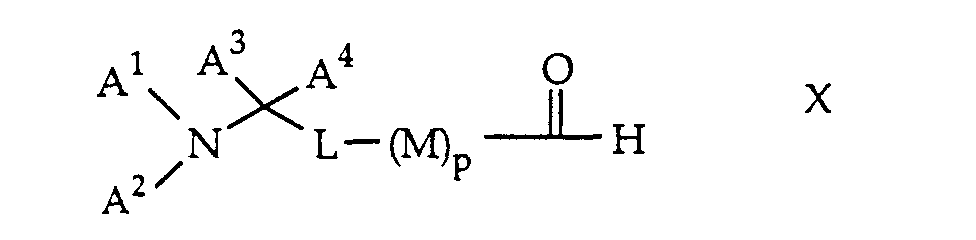
      l) gewünschtenfalls eine in einer Verbindung der Formel I enthaltene reaktionsfähige Gruppe funktionell abwandelt und
      m) gewünschtenfalls ein Amin der Formel I in ein physiologisch verträgliches Säureadditionssalz oder ein Säureadditionssalz einer Verbindung der Formel I in das Amin der Formel I überführt.
    28. Antimykotisch wirksame und Cholesterin senkende Mittel, enthaltend eine Verbindung nach einem der Ansprüche 1-25 als Wirkstoff gegebenenfalls neben einem therapeutisch inerten Träger.
    29. Verwendung der Verbindungen nach einem der Ansprüche 1-25 für die Herstellung von antimykotisch wirksamen und Cholesterin senkenden Mittel.
    EP96118872A 1995-12-08 1996-11-26 Tertiäre Amine mit antimykotischer und cholesterinsenkender Wirkung Expired - Lifetime EP0778264B1 (de)

    Applications Claiming Priority (3)

    Application Number Priority Date Filing Date Title
    CH347995 1995-12-08
    CH3479/95 1995-12-08
    CH347995 1995-12-08

    Publications (2)

    Publication Number Publication Date
    EP0778264A1 EP0778264A1 (de) 1997-06-11
    EP0778264B1 true EP0778264B1 (de) 2001-07-11

    Family

    ID=4256868

    Family Applications (1)

    Application Number Title Priority Date Filing Date
    EP96118872A Expired - Lifetime EP0778264B1 (de) 1995-12-08 1996-11-26 Tertiäre Amine mit antimykotischer und cholesterinsenkender Wirkung

    Country Status (15)

    Country Link
    US (2) US6034275A (de)
    EP (1) EP0778264B1 (de)
    JP (1) JPH09221458A (de)
    CN (1) CN1158844A (de)
    AR (1) AR004990A1 (de)
    AT (1) ATE203009T1 (de)
    BR (1) BR9605864A (de)
    CA (1) CA2190699A1 (de)
    DE (1) DE59607267D1 (de)
    DK (1) DK0778264T3 (de)
    ES (1) ES2161321T3 (de)
    GR (1) GR3036869T3 (de)
    MX (1) MX9606175A (de)
    PT (1) PT778264E (de)
    TR (1) TR199600960A2 (de)

    Cited By (1)

    * Cited by examiner, † Cited by third party
    Publication number Priority date Publication date Assignee Title
    AU2002366732B2 (en) * 2001-12-20 2006-11-02 F. Hoffmann-La Roche Ag Heteroaryl-substituted aminocyclohexane derivatives

    Families Citing this family (13)

    * Cited by examiner, † Cited by third party
    Publication number Priority date Publication date Assignee Title
    CA2283981A1 (en) * 1997-03-20 1998-10-01 Basf Aktiengesellschaft Substituted 2-benz(o)ylpyridines, their preparation and their use as herbicides
    US6403576B1 (en) * 1998-08-24 2002-06-11 The United States Of America As Represented By The Secretary Of The Navy Antifungal and antiparasitic compounds
    FR2810664B1 (fr) * 2000-06-27 2004-12-24 Adir Nouveaux composes cyclopropaniques 1,1 et 1,2-dissubstitues, leur procede de preparation et les compositions pharmaceutiques qui les contiennent
    KR100594665B1 (ko) * 2000-07-18 2006-06-30 에프. 호프만-라 로슈 아게 신규한 아닐린 유도체
    KR100566175B1 (ko) * 2000-08-16 2006-03-29 에프. 호프만-라 로슈 아게 신규한 아미노사이클로헥산 유도체
    US6964974B2 (en) * 2000-09-08 2005-11-15 Hoffmann-La Roche Inc. 2,3-oxidosqualene-lanosterol cyclase inhibitors
    ES2233703T3 (es) * 2000-11-02 2005-06-16 F. Hoffmann-La Roche Ag Benzo(b)tiofenos y benzo (d)isotiazoles hipocolesterolemiantes..
    ATE348799T1 (de) * 2001-12-12 2007-01-15 Hoffmann La Roche Substituierte cyclohexanderivate
    TW200637839A (en) 2005-01-07 2006-11-01 Taisho Pharmaceutical Co Ltd 1-thio-d-glucitol derivatives
    CN101384568B (zh) * 2006-02-15 2012-12-12 雅培制药有限公司 乙酰辅酶a羧化酶(acc)抑制剂及其在糖尿病、肥胖症和代谢综合征中的应用
    US8748627B2 (en) * 2006-02-15 2014-06-10 Abbvie Inc. Acetyl-CoA carboxylase (ACC) inhibitors and their use in diabetes, obesity and metabolic syndrome
    US8884061B2 (en) * 2006-03-03 2014-11-11 Colorado State University Research Foundation Compositions and methods of use of electron transport system inhibitors
    JP5669387B2 (ja) * 2009-12-28 2015-02-12 キヤノン株式会社 含ヘテロ芳香族化合物、光学材料および光学素子

    Family Cites Families (6)

    * Cited by examiner, † Cited by third party
    Publication number Priority date Publication date Assignee Title
    HU187208B (en) * 1982-12-28 1985-11-28 Richter Gedeon Vegyeszet Process for production of new dialcil-amino-alcoxi-benzoalcohole derivates, their acid additional and quaterner soils and medical preparates consisting of them
    CA1339423C (en) * 1988-09-14 1997-09-02 Yuji Ono Pyridine compounds and pharmaceutical use thereof
    CA2016738A1 (en) * 1989-06-08 1990-12-08 Philippe Guerry Substituted aminoalkylbenzene derivatives
    CA2020888A1 (en) * 1989-07-27 1991-01-28 Philippe Guerry Substituted aminoalkoxybenzene derivatives
    CA2044533A1 (en) * 1990-06-29 1991-12-30 Philippe Guerry Substituted aminoalkylbiphenyl derivatives
    TW438774B (en) * 1993-07-14 2001-06-07 Hoffmann La Roche Pharmaceutical composition for lowering cholesterol containing phenalkylamines and certain novel phenalkylamines

    Cited By (1)

    * Cited by examiner, † Cited by third party
    Publication number Priority date Publication date Assignee Title
    AU2002366732B2 (en) * 2001-12-20 2006-11-02 F. Hoffmann-La Roche Ag Heteroaryl-substituted aminocyclohexane derivatives

    Also Published As

    Publication number Publication date
    GR3036869T3 (en) 2002-01-31
    EP0778264A1 (de) 1997-06-11
    BR9605864A (pt) 1998-08-25
    ES2161321T3 (es) 2001-12-01
    CA2190699A1 (en) 1997-06-09
    JPH09221458A (ja) 1997-08-26
    US6034275A (en) 2000-03-07
    US6441177B1 (en) 2002-08-27
    ATE203009T1 (de) 2001-07-15
    CN1158844A (zh) 1997-09-10
    TR199600960A2 (tr) 1997-06-21
    AR004990A1 (es) 1999-04-07
    MX9606175A (es) 1997-06-28
    DK0778264T3 (da) 2001-11-05
    PT778264E (pt) 2001-12-28
    DE59607267D1 (de) 2001-08-16

    Similar Documents

    Publication Publication Date Title
    EP0778264B1 (de) Tertiäre Amine mit antimykotischer und cholesterinsenkender Wirkung
    EP0464465B1 (de) Substituierte Aminoalkylbiphenylderivate, antimykotische Präparate damit und Zwischenprodukte für ihre Herstellung
    DE69920472T2 (de) Therapeutische verwendung als histamin-h3-rezeptor liganden von alkylaminen, die kein imidazole enthalten
    DE69314718T2 (de) Oxamidsäure-Derivate als hypocholesterämische Mittel
    EP1216225B1 (de) Neuartige aminodicarbonsäurederivate mit pharmazeutischen eigenschaften
    EP0778271A2 (de) Aminoalkyl-substituierte benzo-heterocyclische Verbindungen
    DE10110750A1 (de) Neuartige Aminodicarbonsäurederivate mit pharmazeutischen Eigenschaften
    DE10110749A1 (de) Substituierte Aminodicarbonsäurederivate
    EP1286957B1 (de) Diphenylmethanderivate
    DE19636689A1 (de) Neue Benzamidinderivate
    EP0636367B1 (de) Verwendung von Phenalkylaminen zur Herstellung von cholesterinsenkenden Arzneimitteln
    JPH0474345B2 (de)
    EP0599203A1 (de) N,n,-Disubstituierte Arylcycloalkylamine, deren Salze, diese Verbindungen enthaltende Arzneimittel und deren Verwendung sowie Verfahren zu iher Herstellung
    US5239084A (en) Substituted aminoalkyl biphenyl compounds
    EP0155653B1 (de) Substituierte Iminophenole-(Azacycloalk-2-yl) und deren Ester
    US5972962A (en) Treatment of pruritus
    DE60216319T2 (de) Heteroaryl-substituierte aminocyclohexan-derivate
    DE69717969T2 (de) Substituierte n-methyl-n-(4-(piperidin-1-yl)-2-arylbutyl)-benzamide zur behandlung von allergischen erkrankungen
    DE60103034T2 (de) Neue phenylheteroalkylamin-derivate
    EP0401798B1 (de) Substituierte Aminoalkylbenzolderivate
    DE10132686A1 (de) Heteroarylcarbonsäureamide, ihre Herstellung und ihre Verwendung als Arzneimittel
    DE3634974A1 (de) Dichloranilinderivate
    EP1363885B1 (de) Substituierte propan- 1,3-diamin-derivate und ihre pharmazeutische verwendung
    EP1332128A1 (de) Benzamidin-derivate mit einer sulfat-gruppe als ltb4-antagonisten
    EP0377896A2 (de) Cyclooxygenase- und 5-Lipoxygenase-inhibierende Hydroxansäurederivate

    Legal Events

    Date Code Title Description
    PUAI Public reference made under article 153(3) epc to a published international application that has entered the european phase

    Free format text: ORIGINAL CODE: 0009012

    17P Request for examination filed

    Effective date: 19961126

    AK Designated contracting states

    Kind code of ref document: A1

    Designated state(s): AT BE CH DE DK ES FI FR GB GR IE IT LI LU NL PT SE

    17Q First examination report despatched

    Effective date: 19990618

    GRAG Despatch of communication of intention to grant

    Free format text: ORIGINAL CODE: EPIDOS AGRA

    GRAG Despatch of communication of intention to grant

    Free format text: ORIGINAL CODE: EPIDOS AGRA

    GRAH Despatch of communication of intention to grant a patent

    Free format text: ORIGINAL CODE: EPIDOS IGRA

    GRAH Despatch of communication of intention to grant a patent

    Free format text: ORIGINAL CODE: EPIDOS IGRA

    GRAA (expected) grant

    Free format text: ORIGINAL CODE: 0009210

    AK Designated contracting states

    Kind code of ref document: B1

    Designated state(s): AT BE CH DE DK ES FI FR GB GR IE IT LI LU NL PT SE

    REF Corresponds to:

    Ref document number: 203009

    Country of ref document: AT

    Date of ref document: 20010715

    Kind code of ref document: T

    REG Reference to a national code

    Ref country code: CH

    Ref legal event code: EP

    REF Corresponds to:

    Ref document number: 59607267

    Country of ref document: DE

    Date of ref document: 20010816

    REG Reference to a national code

    Ref country code: IE

    Ref legal event code: FG4D

    Free format text: GERMAN

    GBT Gb: translation of ep patent filed (gb section 77(6)(a)/1977)

    Effective date: 20010911

    REG Reference to a national code

    Ref country code: DK

    Ref legal event code: T3

    REG Reference to a national code

    Ref country code: ES

    Ref legal event code: FG2A

    Ref document number: 2161321

    Country of ref document: ES

    Kind code of ref document: T3

    ET Fr: translation filed
    REG Reference to a national code

    Ref country code: PT

    Ref legal event code: SC4A

    Free format text: AVAILABILITY OF NATIONAL TRANSLATION

    Effective date: 20011009

    REG Reference to a national code

    Ref country code: GB

    Ref legal event code: IF02

    REG Reference to a national code

    Ref country code: GR

    Ref legal event code: EP

    Ref document number: 20010401732

    Country of ref document: GR

    PLBE No opposition filed within time limit

    Free format text: ORIGINAL CODE: 0009261

    STAA Information on the status of an ep patent application or granted ep patent

    Free format text: STATUS: NO OPPOSITION FILED WITHIN TIME LIMIT

    26N No opposition filed
    PGFP Annual fee paid to national office [announced via postgrant information from national office to epo]

    Ref country code: SE

    Payment date: 20021106

    Year of fee payment: 7

    PGFP Annual fee paid to national office [announced via postgrant information from national office to epo]

    Ref country code: PT

    Payment date: 20021107

    Year of fee payment: 7

    PGFP Annual fee paid to national office [announced via postgrant information from national office to epo]

    Ref country code: FR

    Payment date: 20021108

    Year of fee payment: 7

    PGFP Annual fee paid to national office [announced via postgrant information from national office to epo]

    Ref country code: FI

    Payment date: 20021113

    Year of fee payment: 7

    Ref country code: DK

    Payment date: 20021113

    Year of fee payment: 7

    Ref country code: AT

    Payment date: 20021113

    Year of fee payment: 7

    PGFP Annual fee paid to national office [announced via postgrant information from national office to epo]

    Ref country code: IE

    Payment date: 20021120

    Year of fee payment: 7

    Ref country code: GB

    Payment date: 20021120

    Year of fee payment: 7

    PGFP Annual fee paid to national office [announced via postgrant information from national office to epo]

    Ref country code: LU

    Payment date: 20021127

    Year of fee payment: 7

    Ref country code: ES

    Payment date: 20021127

    Year of fee payment: 7

    PGFP Annual fee paid to national office [announced via postgrant information from national office to epo]

    Ref country code: GR

    Payment date: 20021128

    Year of fee payment: 7

    Ref country code: DE

    Payment date: 20021128

    Year of fee payment: 7

    PGFP Annual fee paid to national office [announced via postgrant information from national office to epo]

    Ref country code: NL

    Payment date: 20021129

    Year of fee payment: 7

    Ref country code: CH

    Payment date: 20021129

    Year of fee payment: 7

    PGFP Annual fee paid to national office [announced via postgrant information from national office to epo]

    Ref country code: BE

    Payment date: 20030121

    Year of fee payment: 7

    PG25 Lapsed in a contracting state [announced via postgrant information from national office to epo]

    Ref country code: LU

    Free format text: LAPSE BECAUSE OF NON-PAYMENT OF DUE FEES

    Effective date: 20031126

    Ref country code: IE

    Free format text: LAPSE BECAUSE OF NON-PAYMENT OF DUE FEES

    Effective date: 20031126

    Ref country code: GB

    Free format text: LAPSE BECAUSE OF NON-PAYMENT OF DUE FEES

    Effective date: 20031126

    Ref country code: FI

    Free format text: LAPSE BECAUSE OF NON-PAYMENT OF DUE FEES

    Effective date: 20031126

    Ref country code: AT

    Free format text: LAPSE BECAUSE OF NON-PAYMENT OF DUE FEES

    Effective date: 20031126

    PG25 Lapsed in a contracting state [announced via postgrant information from national office to epo]

    Ref country code: SE

    Free format text: LAPSE BECAUSE OF NON-PAYMENT OF DUE FEES

    Effective date: 20031127

    Ref country code: ES

    Free format text: LAPSE BECAUSE OF NON-PAYMENT OF DUE FEES

    Effective date: 20031127

    PG25 Lapsed in a contracting state [announced via postgrant information from national office to epo]

    Ref country code: LI

    Free format text: LAPSE BECAUSE OF NON-PAYMENT OF DUE FEES

    Effective date: 20031130

    Ref country code: CH

    Free format text: LAPSE BECAUSE OF NON-PAYMENT OF DUE FEES

    Effective date: 20031130

    Ref country code: BE

    Free format text: LAPSE BECAUSE OF NON-PAYMENT OF DUE FEES

    Effective date: 20031130

    PG25 Lapsed in a contracting state [announced via postgrant information from national office to epo]

    Ref country code: DK

    Free format text: LAPSE BECAUSE OF NON-PAYMENT OF DUE FEES

    Effective date: 20031201

    BERE Be: lapsed

    Owner name: F. *HOFFMANN-LA ROCHE A.G.

    Effective date: 20031130

    PG25 Lapsed in a contracting state [announced via postgrant information from national office to epo]

    Ref country code: PT

    Free format text: LAPSE BECAUSE OF NON-PAYMENT OF DUE FEES

    Effective date: 20040531

    PG25 Lapsed in a contracting state [announced via postgrant information from national office to epo]

    Ref country code: NL

    Free format text: LAPSE BECAUSE OF NON-PAYMENT OF DUE FEES

    Effective date: 20040601

    PG25 Lapsed in a contracting state [announced via postgrant information from national office to epo]

    Ref country code: DE

    Free format text: LAPSE BECAUSE OF NON-PAYMENT OF DUE FEES

    Effective date: 20040602

    PG25 Lapsed in a contracting state [announced via postgrant information from national office to epo]

    Ref country code: GR

    Free format text: LAPSE BECAUSE OF NON-PAYMENT OF DUE FEES

    Effective date: 20040603

    EUG Se: european patent has lapsed
    REG Reference to a national code

    Ref country code: DK

    Ref legal event code: EBP

    GBPC Gb: european patent ceased through non-payment of renewal fee

    Effective date: 20031126

    REG Reference to a national code

    Ref country code: CH

    Ref legal event code: PL

    PG25 Lapsed in a contracting state [announced via postgrant information from national office to epo]

    Ref country code: FR

    Free format text: LAPSE BECAUSE OF NON-PAYMENT OF DUE FEES

    Effective date: 20040730

    NLV4 Nl: lapsed or anulled due to non-payment of the annual fee

    Effective date: 20040601

    REG Reference to a national code

    Ref country code: IE

    Ref legal event code: MM4A

    REG Reference to a national code

    Ref country code: PT

    Ref legal event code: MM4A

    Free format text: LAPSE DUE TO NON-PAYMENT OF FEES

    Effective date: 20040531

    REG Reference to a national code

    Ref country code: FR

    Ref legal event code: ST

    REG Reference to a national code

    Ref country code: ES

    Ref legal event code: FD2A

    Effective date: 20031127

    PG25 Lapsed in a contracting state [announced via postgrant information from national office to epo]

    Ref country code: IT

    Free format text: LAPSE BECAUSE OF NON-PAYMENT OF DUE FEES;WARNING: LAPSES OF ITALIAN PATENTS WITH EFFECTIVE DATE BEFORE 2007 MAY HAVE OCCURRED AT ANY TIME BEFORE 2007. THE CORRECT EFFECTIVE DATE MAY BE DIFFERENT FROM THE ONE RECORDED.

    Effective date: 20051126