EP0779509A2 - Röntgenspektrometer - Google Patents
Röntgenspektrometer Download PDFInfo
- Publication number
- EP0779509A2 EP0779509A2 EP96309146A EP96309146A EP0779509A2 EP 0779509 A2 EP0779509 A2 EP 0779509A2 EP 96309146 A EP96309146 A EP 96309146A EP 96309146 A EP96309146 A EP 96309146A EP 0779509 A2 EP0779509 A2 EP 0779509A2
- Authority
- EP
- European Patent Office
- Prior art keywords
- arcuate
- ray
- crystal
- rays
- crystals
- Prior art date
- Legal status (The legal status is an assumption and is not a legal conclusion. Google has not performed a legal analysis and makes no representation as to the accuracy of the status listed.)
- Withdrawn
Links
- 239000013078 crystal Substances 0.000 claims abstract description 198
- 230000003595 spectral effect Effects 0.000 claims abstract description 69
- 238000001514 detection method Methods 0.000 claims description 9
- 230000004075 alteration Effects 0.000 description 41
- 238000010183 spectrum analysis Methods 0.000 description 6
- 238000010894 electron beam technology Methods 0.000 description 4
- PQXKHYXIUOZZFA-UHFFFAOYSA-M lithium fluoride Chemical compound [Li+].[F-] PQXKHYXIUOZZFA-UHFFFAOYSA-M 0.000 description 3
- 238000001228 spectrum Methods 0.000 description 3
- 239000002131 composite material Substances 0.000 description 2
- 238000004904 shortening Methods 0.000 description 2
- 238000002441 X-ray diffraction Methods 0.000 description 1
- 238000000441 X-ray spectroscopy Methods 0.000 description 1
- 238000004458 analytical method Methods 0.000 description 1
- 230000001419 dependent effect Effects 0.000 description 1
- 238000005259 measurement Methods 0.000 description 1
- 230000003287 optical effect Effects 0.000 description 1
- 230000035945 sensitivity Effects 0.000 description 1
Images




Classifications
-
- G—PHYSICS
- G01—MEASURING; TESTING
- G01N—INVESTIGATING OR ANALYSING MATERIALS BY DETERMINING THEIR CHEMICAL OR PHYSICAL PROPERTIES
- G01N23/00—Investigating or analysing materials by the use of wave or particle radiation, e.g. X-rays or neutrons, not covered by groups G01N3/00 – G01N17/00, G01N21/00 or G01N22/00
- G01N23/22—Investigating or analysing materials by the use of wave or particle radiation, e.g. X-rays or neutrons, not covered by groups G01N3/00 – G01N17/00, G01N21/00 or G01N22/00 by measuring secondary emission from the material
-
- G—PHYSICS
- G01—MEASURING; TESTING
- G01T—MEASUREMENT OF NUCLEAR OR X-RADIATION
- G01T1/00—Measuring X-radiation, gamma radiation, corpuscular radiation, or cosmic radiation
- G01T1/36—Measuring spectral distribution of X-rays or of nuclear radiation spectrometry
-
- G—PHYSICS
- G01—MEASURING; TESTING
- G01N—INVESTIGATING OR ANALYSING MATERIALS BY DETERMINING THEIR CHEMICAL OR PHYSICAL PROPERTIES
- G01N23/00—Investigating or analysing materials by the use of wave or particle radiation, e.g. X-rays or neutrons, not covered by groups G01N3/00 – G01N17/00, G01N21/00 or G01N22/00
- G01N23/22—Investigating or analysing materials by the use of wave or particle radiation, e.g. X-rays or neutrons, not covered by groups G01N3/00 – G01N17/00, G01N21/00 or G01N22/00 by measuring secondary emission from the material
- G01N23/225—Investigating or analysing materials by the use of wave or particle radiation, e.g. X-rays or neutrons, not covered by groups G01N3/00 – G01N17/00, G01N21/00 or G01N22/00 by measuring secondary emission from the material using electron or ion
- G01N23/2251—Investigating or analysing materials by the use of wave or particle radiation, e.g. X-rays or neutrons, not covered by groups G01N3/00 – G01N17/00, G01N21/00 or G01N22/00 by measuring secondary emission from the material using electron or ion using incident electron beams, e.g. scanning electron microscopy [SEM]
- G01N23/2252—Measuring emitted X-rays, e.g. electron probe microanalysis [EPMA]
Definitions
- the present invention relates to an X-ray spectroscope suitably used for an X-ray analyzer such as an electron microanalyzer or the like.
- an electron beam or the like is irradiated to a sample, the energy spectrum of characteristic X-rays emitted from the sample surface is measured and, based on the measurement result, the component elements of the sample are identified.
- the energy spectrum of the characteristic X-rays is measured by an X-ray spectroscope.
- Such an X-ray spectroscope of prior art has an arrangement as shown in a schematic view in Fig. 11.
- an X-ray source 2 serving as an irradiation point where an electron beam or the like is irradiated to a sample, a spectral crystal 1 and a detector 3 are disposed along a Rowland circle 4 on a reference plane 7.
- the X-ray source 2 is stationary while the spectral crystal 1 and the detector 3 are movable on the Rowland circle 4 by a link mechanism or the like with the distance between the X-ray source 2 and the spectral crystal 1 maintained equal to the distance between the spectral crystal 1 and the detector 3.
- Such movement of the spectral crystal 1 and the detector 3 continuously changes the wavelength of X-rays incident upon the detector 3.
- the spectral crystal 1 is spectrally scanned and the X-ray energy spectrum can be obtained as an output of the detector 3.
- the positional relationship among the X-ray source 2, the spectral crystal 1 and the detector 3 is suitably changed dependent on the type of an element to be analyzed.
- an X-ray analyzing apparatus arranged such that there is used, as the spectral crystal, a composite crystal unit in which spectral crystals of different types are being joined, that the X-rays emitted from a linear X-ray source are irradiated to the composite crystal unit, and that outputs of the detector are discriminated by window-type level selectors disposed as respectively corresponding to the spectral crystals.
- a linear X-ray source in order that X-rays are simultaneously incident upon the whole spectral crystals of different types under equal diffraction conditions. This prevents such apparatus from being applied to a point-like X-ray source.
- it is required to adjust, according to the types of elements to be analyzed, the selection levels of the window-type level selectors corresponding to the spectral crystals.
- the present invention provides an X-ray spectroscope in which a point-like X-ray source, a spectral crystal and X-ray detector means are disposed along a Rowland circle and in which, with the distance between the X-ray source and the spectral crystal maintained equal to the distance between the spectral crystal and the X-ray detector means, this distance is continuously changed such that the wavelength of X-rays to be spectrally analyzed is continuously changed, and this X-ray spectroscope is characterized in that the spectral crystal is formed of a plurality of arcuate crystals for spectrally analyzing respective X-rays different in wavelength, that at least one of the arcuate crystals is located at a position apart from a reference plane including the Rowland circle and that the X-ray detector means is at least one X-ray detector for detecting the X-rays diffracted by the arcuate crystals.
- X-rays emitted from the point-like X-ray source are diffracted by the spectral crystal comprising a plurality of arcuate crystals and, diffracted X-rays having wavelengths respectively corresponding to the diffraction angles are irradiated to the X-ray detector means. While the spectral crystal and the X-ray detector means are moved along the Rowland circle with the X-ray source fixed, the X-rays are diffracted according to the wavelength ranges for which the arcuate crystals can conduct a spectral analysis, and the wavelengths of X-rays to be spectrally analyzed are continuously changed.
- X-rays in a plurality of wavelength ranges can be simultaneously spectrally analyzed.
- aberration is generated due to deviation from the diffraction conditions.
- such aberration is too small to exert a considerable influence to a reduction in sensitivity of the X-ray spectroscope of the present invention.
- the X-ray detector means comprises a plurality of X-ray detectors disposed as respectively corresponding to the arcuate crystals and, out of the X-ray detectors, the X-ray detector for the arcuate crystal disposed at a position apart from the reference plane, is disposed at a position apart from the reference plane.
- the arcuate crystal for spectrally analyzing X-rays short in wavelength and the X-ray detector for detecting the X-rays diffracted by this arcuate crystal are disposed on the Rowland circle in the reference plane while the arcuate crystal for spectrally analyzing X-rays long in wavelength and the X-ray detector for detecting the X-rays diffracted by this arcuate crystal, are positionally shifted from the Rowland circle and disposed at positions apart from the reference plane.
- the X-ray detector means may be formed of a single tandem-type X-ray detector. According to this arrangement, a detection output for diffracted X-rays long in wavelength and a detection output for diffracted X-rays short in wavelength are separately supplied by this single X-ray detector.
- the X-ray detector means may be formed of a single X-ray detector of which outputs are introduced into pulse-height discriminator circuit means, by which a detection output for diffracted X-rays long in wavelength and a detection output for diffracted X-rays short in wavelength are separately supplied according to wavelength ranges.
- the X-ray spectroscope may be arranged such that one of the arcuate crystals is disposed on the Rowland circle on the reference plane or that the number of the arcuate crystals to be put one upon another forming the spectral crystal is not limited to two, but may be optional as far as each aberration is within the allowable range.
- At least one arcuate crystal disposed at a position apart from the reference plane may be inclined with respect to the reference plane.
- first and second arcuate crystals forming the spectral crystal and first and second X-ray detectors forming the X-ray detector means are disposed at positions apart from the reference plane.
- the first arcuate crystal is inclined with respect to the reference plane.
- This first arcuate crystal and the first X-ray detector for detecting the X-rays diffracted by the first arcuate crystal are disposed at one side with respect to the reference plane while the second arcuate crystal and the second X-ray detector for detecting the X-rays diffracted by the second arcuate crystal are disposed at the other side with respect to the reference plane.
- aberration is generated in the spectral crystal due to a difference between the curvature radius of the spectral crystal and the optical radius formed from the fact that the spectral crystal is disposed apart from the reference plane.
- the X-ray source, the arcuate crystals and the X-ray detector means are located along circles which pass through the X-ray source, which are inclined, with respect to the reference plane, at an angle identical with the inclination angle of the arcuate crystals and which respectively come in contact with the arcuate crystals at points on the line connecting the centers of the arcuate crystals.
- each of the circles is different in radius from the Rowland circle.
- the curvature radius of the lattice plane of each arcuate crystal is required to be twice the radius of each of the circles above-mentioned.
- the curvature radius of the lattice plane of each arcuate crystal is twice the radius of the Rowland circle.
- the arcuate crystals are arranged movably in the direction away from the X-ray source, enabling this aberration to be reduced.
- Figs. 1 to 3 are views schematically illustrating the arrangement of an embodiment of the present invention; in which Fig. 1 is a plan view, Fig. 2 is a view as seen in the direction of an arrow Z in Fig. 1, and Fig. 3 is a perspective view.
- an X-ray spectroscope comprises a point-like X-ray source 2 where characteristic X-rays are generated from a sample when an electron beam 5 released from an electron beam device (not shown) is irradiated to the sample, a spectral crystal 1 and a detector 3 which are disposed along a Rowland circle 4.
- the plane containing the Rowland circle 4 is defined as a reference plane 7.
- the spectral crystal 1 comprises a first arcuate crystal 11 and a second arcuate crystal 12 each of which is formed of a Johann- or Johannson-type arcuate crystal.
- the first arcuate crystal 11 comes in contact with the Rowland circle 4, and the second arcuate crystal 12 is put on the first arcuate crystal 11 vertically of the reference plane 7.
- the first arcuate crystal 11 is an arcuate crystal for spectrally analyzing X-rays short in wavelength
- the second arcuate crystal 12 is an arcuate crystal for spectrally analyzing X-rays long in wavelength.
- the arcuate crystal for spectrally analyzing X-rays short in wavelength there may be used for example RAP (C 8 H 5 O 4 Rb) with which the range from Al K ⁇ (8.34 ⁇ ) to OK ⁇ (23.6 ⁇ ) can be spectrally analyzed.
- RAP C 8 H 5 O 4 Rb
- the arcuate crystal for spectrally analyzing X-rays long in wavelength there may be used for example LSA (Layered Structure Analyzer) with which the ranges of OK ⁇ (23.6 ⁇ ), NK ⁇ (31.6 ⁇ ), CK ⁇ (44.7 ⁇ ) can be spectrally analyzed.
- LSA Layered Structure Analyzer
- a Johann-type arcuate crystal is used.
- the detector unit 3 comprises a first X-ray detector 31 for detecting the diffracted X-rays from the first arcuate crystal 11, and a second X-ray detector 32 for detecting the diffracted X-rays from the second arcuate crystal 12.
- the X-ray source 2 is fixed at a point on the Rowland circle 4.
- a drive control unit (not shown) controls such that the first arcuate crystal 11 and the first X-ray detector 31 are moved on the Rowland circle 4 with the distance between the X-ray source 2 and the first arcuate crystal 11 maintained equal to the distance between the first arcuate crystal 11 and the first X-ray detector 31.
- the second arcuate crystal 12 and the second X-ray detector 32 disposed at positions apart from the reference plane 7 are so arranged as to follow the movement of the first arcuate crystal 11 and the first X-ray detector 31.
- the first arcuate crystal 11 and the first X-ray detector 31 are disposed on the Rowland circle 4 and therefore the Bragg diffraction conditions are satisfied substantially to an extent as in an X-ray spectroscope of prior art.
- the second arcuate crystal 12 and the second X-ray detector 32 are disposed at positions apart from the reference plane 7, the Bragg diffraction conditions are satisfied with difficulty.
- the detected peaks of the X-rays diffracted by an arcuate crystal appear in a certain range of wavelength. Such a range can generally be evaluated by a half-width represented by the angle of X-rays incident upon the arcuate crystal.
- the half-width of an arcuate crystal is greater as the wavelength of X-rays which the arcuate crystal can spectrally analyze is longer. Therefore, as the wavelength of X-rays which the arcuate crystal can spectrally analyze is longer, the allowable range of the angle of X-rays incident upon the arcuate crystal is greater.
- the second arcuate crystal 12 is formed of an arcuate crystal for spectrally analyzing X-rays longer in wavelength than the X-rays to be spectrally analyzed by the first arcuate crystal 11. This restrains a reduction in output of X-rays diffracted by the second arcuate crystal 12 due to its positional shift from the Rowland circle 4. It is therefore possible to conduct a spectral analysis in which the first and second arcuate crystals 11, 12 are simultaneously scanned.
- aberration generated in the second arcuate crystal 12 is to the extent that spectral analysis can be conducted without hindrance.
- aberration in a Johann-type arcuate crystal will be discussed.
- the description of aberration in a Johannson-type arcuate crystal will be omitted because it is smaller than in a Johann-type arcuate crystal.
- the aberration generated in the second arcuate crystal 12 comprises geometric aberration generated due to the fact that the second arcuate crystal 12 is of the Johann type (hereinafter referred to as ⁇ 1) and geometric aberration generated due to the fact that the second arcuate crystal 12 is disposed at a position apart from the reference plane 7 (hereinafter referred to as ⁇ 2).
- the aberration ⁇ 1 is represented by the vertical angle A in the triangle ABC formed by connecting, to one another, an end point B of the Johann-type spectral crystal 1, that point C on the Rowland circle 4 opposite to the end point B and the point A where the X-ray source 2 is located.
- the distance between the end point B and the point C or shift amount y1 can be represented by the following equation (1): wherein R is the radius of the Rowland circle 4.
- the following description will discuss the geometric aberration ⁇ 2 generated due to the fact that the second arcuate crystal 12 is located at a position apart from the reference plane.
- the angle of X-rays incident upon the first arcuate crystal 11 is defined as ⁇
- the angle of X-rays incident upon the second arcuate crystal 12 is defined as ⁇ '
- the aberration ⁇ 2 is represented by the following equation (5).
- the aberration ⁇ 2 is represented by the following equation (11): ⁇ 2 ⁇ -tan ⁇ ⁇ ⁇ (3H/2)/2Rsin ⁇ ⁇ 2 /2
- the values of aberration ⁇ are in the range from about 0.5° to about 1.1° and the values of diffraction half-width are in the range from about 0.8° to about 2° .
- X-rays in a plurality of wavelength ranges can be simultaneously spectrally analyzed with a single spectral scanning, thus shortening the measuring period of time.
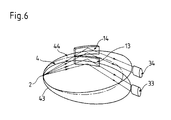
- Figs. 4 to 6 are views schematically illustrating the arrangement of another embodiment of the present invention; in which Fig. 4 is a plan view, Fig. 5 is a view as seen in the direction of an arrow Z in Fig. 4, and Fig. 6 is a perspective view.
- a two-dot chain line shows the arrangement of an X-ray spectroscope of prior art in which an X-ray source 2, a spectral crystal 1 and a detector unit are disposed on a Rowland circle 4 such that the distance between the X-ray source 2 and the spectral crystal 1 is equal to the distance between the spectral crystal 1 and the detector unit.
- the center position of the detector unit window is shown by a point F.
- two pairs of arcuate crystals and detectors that is, the first pair of an arcuate crystal 13 and a detector 33 and the second pair of other arcuate crystal 14 and other detector 34, are disposed at the opposite side to each other with respect to a plane involving the Rowland circle 4 defined as a reference plane 7.
- the disposals of the first and second pairs are determined with the following manner to rotate and move the spectral crystal 1 and the detector unit of the above-mentioned arrangement of the X-ray spectroscope of prior art, respectively.
- the crystal plane of the spectral crystal 1 is inclined at an angle ⁇ as clockwise or countercrockwise rotated around the axis C-O extending from the crystal center C to the center O of the Rowland circle 4, and then the center position C of the spectral crystal 1 is moved to a position C'' in the lower or upper position in Fig.5, causing each of the arcuate crystals to be disposed at a position apart from the reference plane 7 in the lower or upper direction.
- the X-ray detector unit is located as positionally vertically shifted from the reference plane 7 in the lower or upper direction, and inclined clockwise or counterclockwise in the plane which contains the virtual line CF and which is vertical with respect to the reference plane 7 (hereinafter referred to the plane CF).
- the spectral crystal 1 and the X-ray detector unit are disposed at positions apart from the reference plane 7 in the lower or upper direction, which give the disposal of the arcuate crystal 13 and the detector 33 or the disposal of the arcuate crystal 14 and the detector 34.
- the spectral crystal 1 comprises first and second arcuate crystals 13, 14 and the X-ray detector unit comprises first and second X-ray detectors 33, 34.
- the X-ray source 2, the first arcuate crystal 13 and the first X-ray detector 33 are disposed along a circle 43 which passes through the X-ray source 2, which comes in contact with the first arcuate crystal 13 at a point C' on the center line P and which is inclined at an angle ⁇ with respect to the reference plane 7.
- the X-ray source 2, the second arcuate crystal 14 and the second X-ray detector 34 are disposed along a circle 44 which passes through the X-ray source 2, which comes in contact with the second arcuate crystal 14 at a point C' on the center line P and which is inclined at the angle ⁇ with respect to the reference plane 7. It is noted, however, that the centers C'' on the center lines P of the arcuate crystals 13, 14 are not always located on the circles 43, 44, respectively.
- each detector window has a width, which can be sufficiently large as compared with the distance F'G between the point F' and the plane FG. Accordingly, even though the detector window center is located in the plane FG, the diffracted X-rays can be detected without hindrance.
- the spectral crystal 1 comprises two arcuate crystals for spectrally analyzing respective X-rays different in wavelength and may be formed of Johann- or Johannson-type arcuate crystals.
- the first arcuate crystal 13 may be formed of an arcuate crystal for spectrally analyzing X-rays short in wavelength while the second arcuate crystal 14 may be formed of an arcuate crystal for spectrally analyzing X-rays long in wavelength. That is, one of the arcuate crystals 13, 14 may be formed of an arcuate crystal for spectrally analyzing X-rays short in wavelength, and the other may be formed of an arcuate crystal for spectrally analyzing X-rays long in wavelength.
- the two sets each including an arcuate crystal and an X-ray detector are respectively disposed at both sides with respect to the reference plane. Characteristic X-rays emitted from the point-like X-ray source are simultaneously incident upon the arcuate crystals and then diffracted thereby, and the diffracted X-rays are incident upon the corresponding X-ray detectors. With the distance between the X-ray source and the unit of the first and second arcuate crystals (defined as CS in Fig.4) and the distance between the unit of the first and second arcuate crystals and the unit of the corresponding X-ray detectors maintained (defined as CF in Fig.4) equal to each other on the Rowland circle 4, this distance is continuously changed.
- the diffracted X-rays different in wavelength from the respective arcuate crystals can spectrally be analyzed with a single spectral scanning.
- this embodiment is arranged such that the two sets each including an arcuate crystal and an X-ray detector are respectively disposed at both sides with respect to the reference plane.
- the radius R' of the circle 40 (43, 44) is slightly different from R due to the inclination and parallel movement of the arcuate crystals.
- the parallel movement of the spectral crystal from C to C'' is achieved, for example, by a movement vertical with respect to the plane including the circle 40 (C ⁇ T) and a movement along the circle 40 or a movement in the direction away from the X-ray source (T ⁇ C'').
- e refers to the distance of movement from T to C''.
- the first and second arcuate crystals 13, 14 may be formed of arcuate crystals of different types.
- lithium fluoride (LiF) is used as the arcuate crystal for spectrally analyzing X-rays short in wavelength
- ADP NH 4 H 2 PO 4
- the radius R' is supposed to be equal to R + ⁇ R and this R' is put in the equation (13) to obtain an equation.
- the following equation (16) is obtained.
- This equation (25) shows that the aberration ⁇ can be reduced by adjusting the coefficient K.
- the Rowland circle has a radius R of 101.6 mm and in which there are used arcuate crystals each of which length 2L is 38 mm, each of which inclination angle ⁇ is 5° and each of which parallel moving distance e is 0.23mm.
- Fig. 7 shows, with K serving as a parameter, variations of the value of ⁇ - (cos ⁇ ) 2 + Kcot ⁇ ⁇ in the equation (25) representing the aberration ⁇ , with respect to the diffraction angle ⁇ .
- the value of aberration ⁇ becomes about 1/100° at most.
- the X-ray reflection angle of an arcuate crystal to be usually used is at least about 0.1 ° . Accordingly, this expected aberration is so small as to be disregarded.
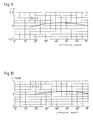
- Fig. 9 shows the values of diffraction angle shift amount ⁇ ⁇ with respect to diffraction angle ⁇ .
- the X-ray incidence angle of the spectral crystal can be set with this diffraction angle shift amount ⁇ ⁇ taken into consideration.
- Fig. 10 shows the values of X-ray detection positional shift amount ⁇ d with respect to diffraction angle ⁇ .
- This positional shift amount ⁇ d can be obtained by using the equation (27).
- the values of X-ray detection positional shift amount ⁇ d are about 0.2 mm at most which is sufficiently small as compared with the window width of an X-ray detector to be usually used. It is therefore not required to move the center position of the X-ray detector with respect to the X-ray detection positional shift amount ⁇ d.
- lithium fluoride and ADP are respectively used as the first and second arcuate crystals, but arcuate crystals of another types may also be used.
- the X-ray detector unit may be arranged such that each X-ray detector is disposed as corresponding to each arcuate crystal. Also, as the X-ray detector unit, a single tandem-type X-ray detector may be used. Also, the X-ray detector unit may comprise, in a unitary structure, a single X-ray detector and a pulse-height discriminator circuit for receiving an output of the X-ray detector. Such a single-type X-ray detector may be used when the ranges of the wavelengths of X-rays to be spectrally analyzed by the arcuate crystals, do not overlap one another.
- the X-ray spectroscope of this embodiment is also capable of spectrally analyze X-rays in a plurality of wavelength ranges with a single spectral scanning, thus shortening the measuring period of time.
Landscapes
- Physics & Mathematics (AREA)
- Health & Medical Sciences (AREA)
- Life Sciences & Earth Sciences (AREA)
- General Physics & Mathematics (AREA)
- Spectroscopy & Molecular Physics (AREA)
- Biochemistry (AREA)
- Chemical & Material Sciences (AREA)
- Analytical Chemistry (AREA)
- General Health & Medical Sciences (AREA)
- Immunology (AREA)
- Pathology (AREA)
- Molecular Biology (AREA)
- High Energy & Nuclear Physics (AREA)
- Analysing Materials By The Use Of Radiation (AREA)
- Spectrometry And Color Measurement (AREA)
Applications Claiming Priority (2)
| Application Number | Priority Date | Filing Date | Title |
|---|---|---|---|
| JP7324490A JPH09166488A (ja) | 1995-12-13 | 1995-12-13 | X線分光器 |
| JP324490/95 | 1995-12-13 |
Publications (2)
| Publication Number | Publication Date |
|---|---|
| EP0779509A2 true EP0779509A2 (de) | 1997-06-18 |
| EP0779509A3 EP0779509A3 (de) | 1998-03-18 |
Family
ID=18166395
Family Applications (1)
| Application Number | Title | Priority Date | Filing Date |
|---|---|---|---|
| EP96309146A Withdrawn EP0779509A3 (de) | 1995-12-13 | 1996-12-13 | Röntgenspektrometer |
Country Status (5)
| Country | Link |
|---|---|
| US (1) | US5790628A (de) |
| EP (1) | EP0779509A3 (de) |
| JP (1) | JPH09166488A (de) |
| KR (1) | KR970048414A (de) |
| CN (1) | CN1160203A (de) |
Cited By (1)
| Publication number | Priority date | Publication date | Assignee | Title |
|---|---|---|---|---|
| CN109799612A (zh) * | 2019-03-15 | 2019-05-24 | 重庆大学 | 曲面反射镜制造方法及变曲率半径点光源线聚焦成像系统 |
Families Citing this family (24)
| Publication number | Priority date | Publication date | Assignee | Title |
|---|---|---|---|---|
| US20060104414A1 (en) * | 2002-01-30 | 2006-05-18 | Mayo William E | Combinatorial contraband detection using energy dispersive x-ray diffraction |
| AU2003256831A1 (en) * | 2002-08-02 | 2004-02-23 | X-Ray Optical Systems, Inc. | An optical device for directing x-rays having a plurality of optical crystals |
| JP2007093581A (ja) * | 2005-09-01 | 2007-04-12 | Jeol Ltd | 波長分散型x線分光器 |
| RU2361194C2 (ru) * | 2006-10-16 | 2009-07-10 | Святослав Михайлович Сергеев | Многоканальный рентгеновский спектрометр |
| US9080947B2 (en) * | 2010-03-31 | 2015-07-14 | National Institute For Materials Science | X-ray irradiation device and analysis device |
| WO2017117197A1 (en) * | 2015-12-28 | 2017-07-06 | University Of Washington | Methods for aligning a spectrometer |
| JP6862710B2 (ja) * | 2016-08-04 | 2021-04-21 | 株式会社島津製作所 | X線回折装置 |
| US11054375B2 (en) * | 2016-09-15 | 2021-07-06 | University Of Washington | X-ray spectrometer and methods for use |
| FR3079035B1 (fr) * | 2018-03-14 | 2022-10-28 | Alpyx | Dispositif optique pour rayons x |
| CN115667896B (zh) * | 2020-05-18 | 2024-06-21 | 斯格瑞公司 | 使用晶体分析器和多个检测元件的x射线吸收光谱的系统和方法 |
| CN111678600B (zh) * | 2020-08-10 | 2020-10-30 | 中国工程物理研究院激光聚变研究中心 | 一种平响应的霍尔晶体 |
| US12480892B2 (en) | 2020-12-07 | 2025-11-25 | Sigray, Inc. | High throughput 3D x-ray imaging system using a transmission x-ray source |
| KR102927910B1 (ko) | 2020-12-07 | 2026-02-19 | 시그레이, 아이엔씨. | 투과 x-선 소스를 이용한 고처리량 3D x-선 이미징 시스템 |
| US11796491B2 (en) * | 2021-01-05 | 2023-10-24 | Shimadzu Corporation | X-ray spectroscopic analysis apparatus and elemental analysis method |
| CN113030139B (zh) * | 2021-05-31 | 2021-08-13 | 中国工程物理研究院激光聚变研究中心 | 一种新型晶体及紧凑型成像装置 |
| US12360067B2 (en) | 2022-03-02 | 2025-07-15 | Sigray, Inc. | X-ray fluorescence system and x-ray source with electrically insulative target material |
| DE112023001408T5 (de) | 2022-03-15 | 2025-02-13 | Sigray, Inc. | System und verfahren für die kompakte laminographie unter verwendung einer mikrofokus-transmissionsröntgenquelle und eines röntgendetektors mit variabler vergrösserung |
| WO2024173256A1 (en) | 2023-02-16 | 2024-08-22 | Sigray, Inc. | X-ray detector system with at least two stacked flat bragg diffractors |
| EP4735873A1 (de) * | 2023-06-27 | 2026-05-06 | University of Washington | Verfahren zum betrieb eines spektrometers |
| US12181423B1 (en) | 2023-09-07 | 2024-12-31 | Sigray, Inc. | Secondary image removal using high resolution x-ray transmission sources |
| WO2025101530A1 (en) | 2023-11-07 | 2025-05-15 | Sigray, Inc. | System and method for x-ray absorption spectroscopy using spectral information from two orthogonal planes |
| WO2025151383A1 (en) | 2024-01-08 | 2025-07-17 | Sigray, Inc. | X-ray analysis system with focused x-ray beam and non-x-ray microscope |
| WO2025155719A1 (en) | 2024-01-18 | 2025-07-24 | Sigray, Inc. | Sequential array of x-ray imaging detectors |
| WO2025174966A1 (en) | 2024-02-15 | 2025-08-21 | Sigray, Inc. | System and method for generating a focused x‑ray beam |
Family Cites Families (7)
| Publication number | Priority date | Publication date | Assignee | Title |
|---|---|---|---|---|
| NL252217A (de) * | 1960-06-01 | |||
| US3980568A (en) * | 1975-10-17 | 1976-09-14 | Hankison Corporation | Radiation detection system |
| US4134012A (en) * | 1977-10-17 | 1979-01-09 | Bausch & Lomb, Inc. | X-ray analytical system |
| US4472825A (en) * | 1982-05-26 | 1984-09-18 | U.S. Philips Corporation | Double crystal X-ray spectrometer |
| US4796284A (en) * | 1984-12-31 | 1989-01-03 | North American Philips Corporation | Polycrystalline X-ray spectrometer |
| GB2208925A (en) * | 1987-08-25 | 1989-04-19 | Le N Proizv Ob Burevestnik | Multichannel x-ray spectrometer |
| JP3094437B2 (ja) * | 1990-10-30 | 2000-10-03 | 株式会社島津製作所 | X線分光装置 |
-
1995
- 1995-12-13 JP JP7324490A patent/JPH09166488A/ja not_active Withdrawn
-
1996
- 1996-12-06 US US08/761,207 patent/US5790628A/en not_active Expired - Fee Related
- 1996-12-12 KR KR1019960064827A patent/KR970048414A/ko not_active Withdrawn
- 1996-12-13 EP EP96309146A patent/EP0779509A3/de not_active Withdrawn
- 1996-12-13 CN CN96121550A patent/CN1160203A/zh active Pending
Non-Patent Citations (1)
| Title |
|---|
| None |
Cited By (1)
| Publication number | Priority date | Publication date | Assignee | Title |
|---|---|---|---|---|
| CN109799612A (zh) * | 2019-03-15 | 2019-05-24 | 重庆大学 | 曲面反射镜制造方法及变曲率半径点光源线聚焦成像系统 |
Also Published As
| Publication number | Publication date |
|---|---|
| JPH09166488A (ja) | 1997-06-24 |
| US5790628A (en) | 1998-08-04 |
| EP0779509A3 (de) | 1998-03-18 |
| KR970048414A (ko) | 1997-07-29 |
| CN1160203A (zh) | 1997-09-24 |
Similar Documents
| Publication | Publication Date | Title |
|---|---|---|
| EP0779509A2 (de) | Röntgenspektrometer | |
| US7076024B2 (en) | X-ray apparatus with dual monochromators | |
| EP0117293B1 (de) | Verfahren zur Spannungsmessung durch Röntgenstrahlendiffraktometrie | |
| US11112371B2 (en) | X-ray spectrometer | |
| EP2233918B1 (de) | Röntgenbeugungsverfahren und Röntgenbeugungsvorrichtung | |
| US7864922B2 (en) | Wavelength-dispersive X-ray spectrometer | |
| US7801272B2 (en) | X-ray diffraction apparatus and X-ray diffraction method | |
| EP2772752B1 (de) | Detektorvorrichtung für die röntgenspektrometrie | |
| JP3729203B2 (ja) | 蛍光x線分析装置 | |
| JP5127976B2 (ja) | 可変コリメータを有する放射分析用装置 | |
| EP1653226A1 (de) | Scanzeilendetektor für zweidimensionales Röntgendiffraktometer | |
| US7075073B1 (en) | Angle resolved x-ray detection | |
| Berthold et al. | Performance of a versatile instrumentation for inelastic X-ray scattering spectroscopy (IXSS) with synchrotron radiation | |
| JP2922758B2 (ja) | X線分光器 | |
| JP2003294659A (ja) | X線分析装置 | |
| JPH11502312A (ja) | 回転可能な一次コリメータを含むx線分析装置 | |
| JP3968452B2 (ja) | X線分析装置 | |
| SU918827A1 (ru) | Рентгеновский спектрометр | |
| JPS6182149A (ja) | X線分光器 | |
| JPS6243160B2 (de) | ||
| JPH04178547A (ja) | 単色x線回折装置 | |
| JPH04174350A (ja) | X線分析装置 | |
| JPS63225159A (ja) | 電磁線回折装置 | |
| JPH0395445A (ja) | 格子定数の測定装置及び測定方法 |
Legal Events
| Date | Code | Title | Description |
|---|---|---|---|
| PUAI | Public reference made under article 153(3) epc to a published international application that has entered the european phase |
Free format text: ORIGINAL CODE: 0009012 |
|
| AK | Designated contracting states |
Kind code of ref document: A2 Designated state(s): DE FR GB |
|
| PUAL | Search report despatched |
Free format text: ORIGINAL CODE: 0009013 |
|
| AK | Designated contracting states |
Kind code of ref document: A3 Designated state(s): DE FR GB |
|
| 17P | Request for examination filed |
Effective date: 19980629 |
|
| STAA | Information on the status of an ep patent application or granted ep patent |
Free format text: STATUS: THE APPLICATION IS DEEMED TO BE WITHDRAWN |
|
| 18D | Application deemed to be withdrawn |
Effective date: 20010703 |