EP0779651A2 - Verfahren und Vorrichtung zur Plasmabehandlung - Google Patents
Verfahren und Vorrichtung zur Plasmabehandlung Download PDFInfo
- Publication number
- EP0779651A2 EP0779651A2 EP96307204A EP96307204A EP0779651A2 EP 0779651 A2 EP0779651 A2 EP 0779651A2 EP 96307204 A EP96307204 A EP 96307204A EP 96307204 A EP96307204 A EP 96307204A EP 0779651 A2 EP0779651 A2 EP 0779651A2
- Authority
- EP
- European Patent Office
- Prior art keywords
- etching
- sample
- plasma
- wiring
- layered
- Prior art date
- Legal status (The legal status is an assumption and is not a legal conclusion. Google has not performed a legal analysis and makes no representation as to the accuracy of the status listed.)
- Withdrawn
Links
Images


Classifications
-
- H—ELECTRICITY
- H01—ELECTRIC ELEMENTS
- H01J—ELECTRIC DISCHARGE TUBES OR DISCHARGE LAMPS
- H01J37/00—Discharge tubes with provision for introducing objects or material to be exposed to the discharge, e.g. for the purpose of examination or processing thereof
- H01J37/32—Gas-filled discharge tubes
- H01J37/32431—Constructional details of the reactor
- H01J37/32458—Vessel
- H01J37/32477—Vessel characterised by the means for protecting vessels or internal parts, e.g. coatings
-
- H—ELECTRICITY
- H10—SEMICONDUCTOR DEVICES; ELECTRIC SOLID-STATE DEVICES NOT OTHERWISE PROVIDED FOR
- H10P—GENERIC PROCESSES OR APPARATUS FOR THE MANUFACTURE OR TREATMENT OF DEVICES COVERED BY CLASS H10
- H10P50/00—Etching of wafers, substrates or parts of devices
-
- C—CHEMISTRY; METALLURGY
- C23—COATING METALLIC MATERIAL; COATING MATERIAL WITH METALLIC MATERIAL; CHEMICAL SURFACE TREATMENT; DIFFUSION TREATMENT OF METALLIC MATERIAL; COATING BY VACUUM EVAPORATION, BY SPUTTERING, BY ION IMPLANTATION OR BY CHEMICAL VAPOUR DEPOSITION, IN GENERAL; INHIBITING CORROSION OF METALLIC MATERIAL OR INCRUSTATION IN GENERAL
- C23F—NON-MECHANICAL REMOVAL OF METALLIC MATERIAL FROM SURFACE; INHIBITING CORROSION OF METALLIC MATERIAL OR INCRUSTATION IN GENERAL; MULTI-STEP PROCESSES FOR SURFACE TREATMENT OF METALLIC MATERIAL INVOLVING AT LEAST ONE PROCESS PROVIDED FOR IN CLASS C23 AND AT LEAST ONE PROCESS COVERED BY SUBCLASS C21D OR C22F OR CLASS C25
- C23F4/00—Processes for removing metallic material from surfaces, not provided for in group C23F1/00 or C23F3/00
-
- H—ELECTRICITY
- H01—ELECTRIC ELEMENTS
- H01J—ELECTRIC DISCHARGE TUBES OR DISCHARGE LAMPS
- H01J37/00—Discharge tubes with provision for introducing objects or material to be exposed to the discharge, e.g. for the purpose of examination or processing thereof
- H01J37/32—Gas-filled discharge tubes
- H01J37/32009—Arrangements for generation of plasma specially adapted for examination or treatment of objects, e.g. plasma sources
- H01J37/32192—Microwave generated discharge
-
- H—ELECTRICITY
- H10—SEMICONDUCTOR DEVICES; ELECTRIC SOLID-STATE DEVICES NOT OTHERWISE PROVIDED FOR
- H10P—GENERIC PROCESSES OR APPARATUS FOR THE MANUFACTURE OR TREATMENT OF DEVICES COVERED BY CLASS H10
- H10P50/00—Etching of wafers, substrates or parts of devices
- H10P50/20—Dry etching; Plasma etching; Reactive-ion etching
- H10P50/26—Dry etching; Plasma etching; Reactive-ion etching of conductive or resistive materials
- H10P50/264—Dry etching; Plasma etching; Reactive-ion etching of conductive or resistive materials by chemical means
- H10P50/266—Dry etching; Plasma etching; Reactive-ion etching of conductive or resistive materials by chemical means by vapour etching only
- H10P50/267—Dry etching; Plasma etching; Reactive-ion etching of conductive or resistive materials by chemical means by vapour etching only using plasmas
Definitions
- This invention relates to a method and an apparatus, for processing a sample by generating plasma by an electromagnetic wave. More particularly, the present invention relates to a semiconductor fabrication process, and can be suitably applied to an etching process of a metal wiring film.
- Al wirings of LSls mostly employ a three-layered structure comprising a TiN cap layer/an Al-Cu alloy / a TiN barrier layer. Dry etching by a BCl 3 /Cl 2 gas has been widely employed for patterning this wiring.
- BCl 3 /Cl 2 type etching an etching rate of the Al-Cu alloy is higher than that of TiN. Therefore, there occur the problems that side etching 305 occurs on the Al-Cu alloy layer 303 and notches 306 occur in the Al-Cu alloy layer 303 immediately below the TiN cap layer 303 as shown in Fig. 7 which shows the sectional shape of the multi-layered Al wiring according to the prior art.
- etching of the Al wiring must be carried out while controlling the formation of a side wall protective film.
- reduction of the notches 306 and anisotropic processing of the Al-Cu alloy layer 303 are attained by adding N2 to the BCl 3 /Cl 2 type gas as described, for example, in "Journal of Vacuum Science & Technology", Vol. A10, No. 4, pp. 1232-1237.
- the side wall protective film by this means contains BN compounds resulting from the reaction between B from BCl 3 and N of the TiN layer, and the side wall protective film is more effective for controlling the shape than conventional BCl 3 /Cl 2 type etching.
- the side wall protective film containing the BN compound involves the problem that it can not be removed easily by the ashing step and the solution treatment carried out in succession to the etching step because it has chemically strong bonds. Since the formation/ deposition reaction of the BN compound occurs on the inner wall of the etching chamber, foreign matters tend to develop in the etching apparatus, and the problem occurs when this method is applied to the mass-production of the LSls. Therefore, means for forming the side wall protective film in place of the BN compound, which is strong and firm and yet can not be easily removed after etching becomes necessary.
- Japanese Laid-Open No. 169140 / 1985 shows plasma etching method of aluminium or aluminium alloy under reduced pressure as a conventional art.
- This conventional art discloses that R.F. power of 13.45MHz frequency is applied to an electrode on which a wafer is set , and etching gases including BCl 3 , Cl 2 and CH 4 are supplied to an eching pparatus so that fast and anisotropic etching can be achieved without damaging photoresisit using low R.F power.
- a technology of forming side wall protective film has been employed in an etching process of a laminate metal wiring in order to conduct vertical processing.
- a material forming a side wall protective film is mainly supplied from a photoresist. Therefore, when a selection ratio to the photoresist is increased, the supply of the material forming the side wall protective film becomes insufficient and etching in the transverse direction proceeds, so that vertical processing becomes difficult to conduct.
- the material forming the side wall protective film is supplied sufficiently so as to conduct vertical processing, on the contrary, the etching speed of the photoresist must be unavoidably increased, and the selection ratio to the photoresist becomes small. In this way, processing accuracy and the processing shape have mutually trade-off relation with the selection ratio.
- plasma also etch the photoresist using a plasma etching, the etched photoresist attached to side walls of a sample, and it acts as a protective layer of the side walls.
- the area of photoresist layer is comparatively smaller than that of entire etched surface, for example ASIC or logic semiconductor devices.
- a wafer is covered with an area of photoresist having 30% or smaller than 30% of entire wafer surface area.
- the wafer is etched with an area of exposed surface having 70% or larger than 70% of entire wafer surface area.
- the quantity of the ethed photoresist is smal Therefore the quantity of etched photoresist is not sufficient to form ptotective layers of side walls for controlling a shape.
- the supply of a material (mainly, carbon) as the material of the side wall protective film may be supplied from sources other than the photoresist. If a material serving as the material of the side wall protective film exists in plasma in an amount necessary for conducting vertical processing of an object article for processing, the photoresist need not be positively etched. Therefore, the selection ratio to the resist can be increased to a large value.
- a method which disposes a carbon-containing material such as silicon carbide (SiC) at at least a part of the inside of a vacuum container serving as a discharge region a method which covers the wall of the vacuum container with a carbon-containing material such as silicon carbide (SiC), etc, a method which covers the surface of a sample table with a carbon- containing material such as silicon carbide (SiC), and so forth.
- a carbon-containing material such as silicon carbide (SiC)
- a plasma processing apparatus for processing a sample by generating plasma by an electromagnetic wave
- the surface of a material placed inside a vacuum container functioning as a discharge region is exposed to the resulting plasma and is etched by the plasma, so that materials constituting the surface of the vacuum container are emitted into the plasma.
- the invention also provides a method of etching a sample with the plasmatized eching gases comprising an organic component, wherein 30 % or below 30 % of the sample's entire surface is covered with photoresist area. And it also provides etching a sample with the plasmatizied etching gases comprising an organic component, wherein 70 % or above 70 % of the sample's entire surface is exposed without any photoresist thereon.
- the invention also provides forming a side wall protective film of an organic material. Therefore, after an etching chamber of an etching apparatus in which a sample is processed one by one is cleaned by O 2 plasma to remove organic matters, the multi-layered Al wiring is etched by plasma by using a mixed gas of BCl 3 , Cl 2 , CH4 and Ar and using an organic resist film as a mask while the wall surface temperature of the chamber is controlled to a predetermined temperature within the range of 80 to 250°C. Gas mass flow rate ratios at this time with respect to Cl 2 of 100 are 5 to 50, 1 to 20 and 50 to 500 for BCl 3 , CH 4 and Ar, respectively.
- the O 2 plasma cleaning described above may be carried out either continuously for a plurality of wafers or on a per-wafer basis.
- the organic components isolated from CH 4 efficiently form the side wall protective film. Therefore, side etching and the nothces can be restricted, and the multi-layered Al wiring can be etched with an excellent processing shape. Since Ar is added, the thickness of the side wall protective film can be controlled by its sputtering effect and controllability of the processing shape can be further improved.
- the side wall protective film formed by the system described above can be easily removed by ordinary post-treatment steps. Further, the addition of CH 4 does not affect the maintenance property of the etching apparatus.
- the present invention makes it possible to apply the system to the mass production by periodically removing the organic matters inside the chamber by O 2 cleaning and controlling the wall surface temperature to accomplish stability of the etching atmosphere and its reproducibility.
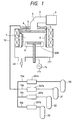
- Fig. 1 shows an embodiment of the present invention wherein a cylinder made of silicon carbide (SiC) is disposed along the inner surface of a vacuum container of a semiconductor production apparatus.
- SiC silicon carbide
- Fig. 2 is a conceptual view of the etching reaction occurring on the surface of an object article to be processed (metal wiring film) placed inside the semiconductor production apparatus shown in Fig. 1.
- Fig. 3 shows another embodiment of the present invention wherein a sample table of a semiconductor production apparatus is covered with silicon carbide (SiC).
- Fig. 4 shows another embodiment of the present invention wherein a cylinder made of silicon carbide (SiC) is disposed along the inner surface of a vacuum container of a semiconductor production apparatus.
- SiC silicon carbide
- Fig. 5(a),(b), (c) respectively shows the section view of a sample when using etching gases as the embodiment of the present invention.
- Fig. 6 is a schematic view of an etching apparatus when using etching gases as the emodiment of the present invention.
- Fig. 7 shows the sectional shape of a conventional Al wiring.
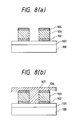
- Fig. 8 shows the section view of a example of a semiconductor device manufactured using the present invention.
- FIG. 1 is a conceptual view of the construction of the apparatus and Fig. 2 is a conceptural view of etching of the metal wiring film TiN/Al/TiN placed on a sample table inside the apparatus.
- reference numeral 1 denotes a magnetron for generating a microwave
- reference numeral 2 a waveguide for transmitting the microwave
- reference numeral 3 denotes a circle-to-rectangle conversion waveguide
- reference numeral 4 denotes a hollow portion for resonating and exciting the microwave
- reference numeral 5 denotes a solenoid coil for generating a magnetic field
- reference numeral 6 denotes an electromagnetic wave transmission member (for example, a quartz flat plate)
- reference numeral 7 denotes a vacuum container
- reference numeral 8 denotes a holder for mounting an article to be treated
- reference numeral 9 denotes an inner cylinder made of silicon carbide (SiC)
- reference numeral 10 denotes a gas introduction passage
- reference numeral 40 denotes a direction for evacuating the vacuum container 7 to vacuum
- a variable valve for regulating the pressure of the vacuum container and a vacuum pump for rough suction are conected to the vacuum container 7 and they are not described in Fig
- reference numeral 9 denotes an inner cylinder made of silicon carbide (SiC)
- reference numeral 15 denotes the generated plasma
- reference numeral 16 denotes a Si substrate as the sample supported by the holder 8
- reference numeral 17 denotes a TiN barrier layer of a laminate metal wiring film
- reference numeral 18 denotes an Al layer of the laminate metal wiring film
- reference numeral 19 denotes a TiN cap layer of the laminate metal wiring film
- reference numeral 20 denotes a photoresist.
- the microwave generated by the magnetron 1 passes through the waveguide 2 and the circle-to-rectangle conversion waveguide 3, and is guided into the vacuum container 7 through the hollow portion 4 and the electromagnetic wave transmission member 6.
- the inside of the vacuum container 7 is evacuated to vacuum by the turbo molecular pump 11 and the vacuum pump 13 for rough suction.
- the process gas is introduced into the vacuum container 7 through the gas introduction passage 10.
- the variable valve 12 is disposed so as to regulate the internal pressure of the vacuum container 7.
- the solenoid coil 5 is disposed round the vacuum container 7, and the magnetic field exists inside the vacuum container 7. The electron is efficiently accelerated by the interaction between the magnetic field and the electromagnetic wave, impinges against the ion and generates the plasma 15.
- the plasma 15 generated inside the vacuum container 7 diffuses towards the wall and impinges against the surface of the inner cylinder 9 of silicon carbide (SiC).
- SiC silicon carbide
- the surface of the inner cylinder 9 made of silicon carbide (SiC) is etched, and carbon (C) is isolated into the plasma 15.
- Etching of Al 18, TiN 17 and 19 of the laminate metal wiring film is carried out by chlorine (Cl) in the plasma.
- chlorine (Cl) is isotropic but because carbon (C) supplied from the surface of the inner cylinder 9 made of silicon carbide (SiC) adequately exists in the plasma 15, carbon (C) covers the surface of Al 18 and functions as a protective film. In consequence, etching does not proceed.
- the RF bias is applied to the plane parallel to the Si substrate 16, carbon (C) is removed from the surface of Al 18 and etching proceeds.
- SiC sintered body having a thickness of about 1 to about 30 mm or a carbon cylinder coated with high purity SiC having a thickness of dozens of microns to several millimeters, as the inner cylinder made of silicon carbide (SiC).
- the material and the structure of the object article to be etched are not limited thereto.
- the present invention is effective for an Al alloy film containing Si, Cu, etc, in place of Al Or films containing Ti, W, Si, etc, in place of TiN of the upper/lower layers (e.g. TiW, WSi, Ti, W, amorphous silicon).
- TiW, WSi, Ti, W, amorphous silicon e.g. TiW, WSi, Ti, W, amorphous silicon.
- the effect described above is particularly remarkable in two or more multi-layered films in comparison with a single layered film of metals.
- the gas to be used is not limited to the chlorine single gas, and similar effects can be obtained by using gases containing chlorine.
- the mass flow controllers 207a, 207b, 207c, 207d can adjust the flow rate of respective gas from BCl 3 bomb 30, Cl 2 bomb 31, CH 4 bomb32, Ar bomb 33, synergic effect can be obtained about metal wiring shape therefore when using the etching gases which will be mentioned later.
- reference numeral 21 denotes a cover of silicon carbide (SiC).
- SiC silicon carbide
- This example is similar to Example 1 with the exception that the supply of carbon (C) is made from the cover 21 of silicon carbide (SiC). However, this example can be made more effectively because the supply of carbon (C) is made from a point closer to the periphery of the sample.
- carbon or silicon carbide (SiC) has electrical conductivity. Therefore, when an electrostatic absorption film is used for the sample table, an insulator is preferably disposed between the cover 21 and the sample table so as to eliminate D.C. leak between the sample table and the plasma.
- Figs. 1 and 3 represent the examples where the plasma is generated by microwave power and the magnetic field, but the method of generating the plasma is not at all limited thereto.
- Fig. 4 shows an example where the plasma 15 is generated by applying the output of an RF power source 23 of 1 to 20 MHz to a coil 22. An object article 26 is placed on a holder 8. RF power is applied into the plasma through a dielectric 24. An inner cylinder 9 of a carbon- containing material such as silicon carbide (SiC) is disposed inside a vacuum container comprising the dielectric 24 and a metallic container 25, and the effect similar to that of Fig. 1 can be obtained.
- SiC silicon carbide
- FIG. 5 is a sectional view of a sample
- Fig. 6 is a schematic view of an etching apparatus.
- the micro-wave ( ⁇ wave) generated by a magnetron 1 inside the etching apparatus is transmitted through a waveguide 2 and an introduction window 6 into the etching chamber 7, as shown in Fig. 6, where it undergoes electron-cyclotron resonance with the magentic field generated by a magnetic field control coil 5 and generates a high density plasma.
- a radio frequency (RF) power source 14 is connected to a sample holder 8, and an RF bias can be applied independently.
- O 2 cleaning processing is carried out so as to remove organic matters inside the etching chamber.
- the cleaning conditions include an O2 flow rate of 100 sccm, a total gas pressure of 2 Pa and a micro-wave ( ⁇ wave) output of 800 W.
- the sample is conveyed into the etching chamber 7, and the TiN cap layer 104, the Al-Cu alloy layer 103 and the TiN barrier layer 102 are serially etched by using the resist film 105 as a pattern mask.
- the main etching condition at this time is the gas flow rates of BCl 3 : 20 sccm, Cl 2 : 80 sccm, CH 4 : 4 sccm, a total gas pressure of 2 Pa, a microwave output of 800 W, RF power of 60 W and a substrate temperature of 40°C as the case (1), the result shown in Fig. 5(b) can be obtained.
- the sectional shape of the sample after completion of the etching treatment is shown in Fig. 5(b) as to the case (1), that is, the side wall protective layers are formed, and it is understood that the etched shape can be controlled .
- the side wall protective layers are made from organic components, like C, CH etc. which are included in plasma of CH 4 gas as treatment gas.
- the component of the protective layers are the same as that of organic resist mask. Therefore the protective layers can be removed by the same process as resist ashing process.
- Fig. 5(b) The sectional shape of the sample after completion of the etching treatment is shown in Fig. 5(b) as to the case (1), that is, the side wall protective layers are formed, and it is understood that the etched shape can be controlled .
- the side wall protective layers are made from organic components, like C, CH etc. which are included in plasma of CH 4 gas as treatment gas.
- the component of the protective layers are the same as that of organic resist mask. Therefore the protective layers can be removed by the same process as resist a
- the sectional shape is forwardly tapered (downwardly expanding taper as shown in the drawing) because the side wall protective film due to CH 4 is too thick, that is , organic components like C, CH in the plasma attach side walls, the organic components becomes a mask which expands as a tapered shape due to excessive organic components.
- the thickness of side wall protective layer can be controlled by changing a flow rate of CH 4 gas. Vertical etching can be accomplished by adjusting the flow rate of CH 4 gas.
- the resist mask area is 30% or more than of the entire sample surface, for example, when the resist mask is 40 % of the entire sample surface, part of resist mask is sputtered by the action of ions in the plasma, part of the sputtered resist attach side walls to form protective layers.
- the above process can accomplish the vertical etching under minimum side wall protective layer, for example, the dimensions of the multi-layered wiring structure as follows can be accomplished by the above etching process, the width of the wiring layer is 0.5 ⁇ m or less than 0.5 ⁇ m, the width of pattern is 0.5 ⁇ m or less than 0.5 ⁇ m, the depth of the wiring layer is 0.5 ⁇ m or more than 0.5 ⁇ m, as shown Fig. 8(a).
- semiconductor devices can be manufactured by forming insulator 107 on the minute etched portion.
- the case (2) is that Ar is added the etching gases of the case (1) and vertival etching is carried out as shown in Fig. 5(c), the thickness of the side wall protective film is limited by sputtering property of Ar and the side surface of each of the TiN cap layer 104, the Al-Cu alloy layer 103 and the TiN barrier layer 102 is processed vertically, and is covered with a side wall protective film 106 of byproducts of etching, that is, organic components like C, CH etc. Therefore the side wall protective film 106 can be easily removed during post-etch treatment like a resist ashing etc.
- the thickness of the side wall protective film can be controlled with easier way than that of the case (1) because of the addition of Ar gas. That is to say, it is difficult to control the quantity of Ar gas becaude the quantity of Ar is initially small when using the case (1), however in the case (2), the quantity of Ar is large so that optimum gas ratio can be set easily. Therefore a desired etching shape can be obtained easily.
- the case (2) process is suitable to the samples that are as follows.
- the case is that mask area of the sample is 30 % or below 30 % of the whole upper surface of the sample ,
- the thickness of the resist is thin, for example the case is that the thickness is 1 ⁇ m or below 1 ⁇ m.
- a good shape of multi-layered metal wiring can be obtained without generating a notch of Al-Cu alloy layer under a TiN cap layer.
- the change of the processing shape hardly occurs even when 25 samples are continuously etched following the O 2 cleaning processing.
- the present invention can provide an etching method suitable for mass fabrication of the multi-layered Al wirings by carrying out periodically the O 2 cleaning processing.
- the present invention is effective for the continuous processing of samples of not greater than 25 sheets, such as 15 or 10 sheets.
- the inner wall temperature of the etching chamber is set and controlled to 100°C, the similar effect can be obtained at a temperature within the range of 80 to 250°C by suitably adjusting the BCl 3 /Cl 2 /CH 4 /Ar flow rate ratios.
- the guideline for the suitable mass flow rate ratios are 5 to 50 for BCl 3 , 1 to 20 for CH 4 and 50 to 500 for Ar with respect to 100 for Cl 2 .
- This embodiment represents the case where the CH 4 and Ar gases are added to BCl 3 / Cl 2 .
- the upper and lower films of the Al-Cu alloy layer may be Ti/TiN film, a TiW film or a W film. Similar effects can be obtained in the case of an Al single-layered film (single-layered film of Al or Al alloy film) besides the laminate film.
- this embodiment uses an ECR type etching apparatus, other plasma etching apparatus such as an ICP (Inductively Coupled Plasma) etching apparatus can be used to obtain similar effects.
- ICP Inductively Coupled Plasma
- the material containing carbon such as silicon carbide (SiC) is disposed inside the vacuum container serving as the discharge region and carbon (C) to be used as the material of the side wall protective film for vertical processing of the object article is supplied into the plasma from a source other than the photoresist. Therefore, the etching rate of the photoresist can be lowered and the selection ratio to the photoresist can be improved. For this reason, when the present invention is applied to the semiconductor production apparatus, particularly to the etching process of the metal wiring film, it becomes possible to eliminate the trade-off relation of processing accuracy and the processing shape with respect to the selection ratio, and to simultaneously satisfy processing accuracy, processing shape and selection ratio.
- SiC silicon carbide
- the multi-layered Al wiring can be etched into an excellent shape without generating the notches on the Al-Cu alloy layer 103 immediately below the TiN cap layer 104. Further, the resist film 105 and the side wall protective film 106 can be easily removed in the post-process of etching. Even when the present invention is applied to mass production, the change with time does not occur in the processing shape of the multi-layered Al wiring, and no problem is imparted to the maintenance property of the apparatus.
Landscapes
- Chemical & Material Sciences (AREA)
- Engineering & Computer Science (AREA)
- Physics & Mathematics (AREA)
- Plasma & Fusion (AREA)
- Analytical Chemistry (AREA)
- Materials Engineering (AREA)
- Mechanical Engineering (AREA)
- Metallurgy (AREA)
- Organic Chemistry (AREA)
- Drying Of Semiconductors (AREA)
- Internal Circuitry In Semiconductor Integrated Circuit Devices (AREA)
Applications Claiming Priority (4)
| Application Number | Priority Date | Filing Date | Title |
|---|---|---|---|
| JP255972/95 | 1995-10-03 | ||
| JP7255972A JPH09102484A (ja) | 1995-10-03 | 1995-10-03 | プラズマ処理方法及び装置 |
| JP8104951A JPH09293725A (ja) | 1996-04-25 | 1996-04-25 | 配線材のエッチング方法 |
| JP104951/96 | 1996-04-25 |
Publications (2)
| Publication Number | Publication Date |
|---|---|
| EP0779651A2 true EP0779651A2 (de) | 1997-06-18 |
| EP0779651A3 EP0779651A3 (de) | 1997-08-06 |
Family
ID=26445313
Family Applications (1)
| Application Number | Title | Priority Date | Filing Date |
|---|---|---|---|
| EP96307204A Withdrawn EP0779651A3 (de) | 1995-10-03 | 1996-10-02 | Verfahren und Vorrichtung zur Plasmabehandlung |
Country Status (4)
| Country | Link |
|---|---|
| US (1) | US6156663A (de) |
| EP (1) | EP0779651A3 (de) |
| KR (1) | KR100369789B1 (de) |
| TW (1) | TW318265B (de) |
Cited By (5)
| Publication number | Priority date | Publication date | Assignee | Title |
|---|---|---|---|---|
| WO1999017350A1 (en) * | 1997-09-30 | 1999-04-08 | Infineon Technologies Ag | Method for patterning integrated circuit conductors |
| WO1999050886A1 (en) * | 1998-03-31 | 1999-10-07 | Lam Research Corporation | Contamination controlling method and plasma processing chamber |
| WO2000029640A1 (en) * | 1998-11-12 | 2000-05-25 | Applied Materials, Inc. | Method for residue-free anisotropic etching of aluminum and its alloys |
| RU2163409C1 (ru) * | 2000-07-21 | 2001-02-20 | Санкт-Петербургский государственный электротехнический университет | СПОСОБ МИКРОПРОФИЛИРОВАНИЯ КОМПОЗИЦИИ "SiC-AlN" |
| US6464843B1 (en) | 1998-03-31 | 2002-10-15 | Lam Research Corporation | Contamination controlling method and apparatus for a plasma processing chamber |
Families Citing this family (14)
| Publication number | Priority date | Publication date | Assignee | Title |
|---|---|---|---|---|
| US6902683B1 (en) * | 1996-03-01 | 2005-06-07 | Hitachi, Ltd. | Plasma processing apparatus and plasma processing method |
| US6350697B1 (en) * | 1999-12-22 | 2002-02-26 | Lam Research Corporation | Method of cleaning and conditioning plasma reaction chamber |
| US6564810B1 (en) * | 2000-03-28 | 2003-05-20 | Asm America | Cleaning of semiconductor processing chambers |
| JP3733021B2 (ja) * | 2000-12-15 | 2006-01-11 | シャープ株式会社 | プラズマプロセス方法 |
| KR100393967B1 (ko) * | 2000-12-29 | 2003-08-06 | 주식회사 하이닉스반도체 | 반도체 소자의 금속배선 형성방법 |
| JP2002343777A (ja) * | 2001-03-12 | 2002-11-29 | Hitachi Ltd | 半導体装置の製造方法 |
| US20040226911A1 (en) * | 2003-04-24 | 2004-11-18 | David Dutton | Low-temperature etching environment |
| TWI240988B (en) * | 2004-01-07 | 2005-10-01 | Powerchip Semiconductor Corp | Method for fabricating a through hole on a semiconductor substrate |
| CN1303667C (zh) * | 2004-03-25 | 2007-03-07 | 力晶半导体股份有限公司 | 制作通孔的方法 |
| US20060051965A1 (en) * | 2004-09-07 | 2006-03-09 | Lam Research Corporation | Methods of etching photoresist on substrates |
| KR100755804B1 (ko) | 2005-12-27 | 2007-09-05 | 주식회사 아이피에스 | 알루미늄 함유 금속막 및 알루미늄 함유 금속 질화막을증착하는 박막 증착 장치의 세정방법 |
| CN101459039B (zh) * | 2007-12-13 | 2012-01-25 | 中芯国际集成电路制造(上海)有限公司 | 等离子体刻蚀的终点监测方法 |
| JP5238615B2 (ja) * | 2009-06-04 | 2013-07-17 | 株式会社東芝 | 半導体装置の製造方法 |
| US8076778B2 (en) * | 2009-09-30 | 2011-12-13 | Macronix International Co., Ltd. | Method for preventing Al-Cu bottom damage using TiN liner |
Family Cites Families (10)
| Publication number | Priority date | Publication date | Assignee | Title |
|---|---|---|---|---|
| JPS60169140A (ja) * | 1984-02-13 | 1985-09-02 | Hitachi Ltd | ドライエツチング方法 |
| JPS63107024A (ja) * | 1986-07-18 | 1988-05-12 | Anelva Corp | エツチング装置 |
| US4960488A (en) * | 1986-12-19 | 1990-10-02 | Applied Materials, Inc. | Reactor chamber self-cleaning process |
| JPH0741153Y2 (ja) * | 1987-10-26 | 1995-09-20 | 東京応化工業株式会社 | 試料処理用電極 |
| EP0414372A3 (en) * | 1989-07-21 | 1991-04-24 | Sony Corporation | Dry etching methods |
| US5085727A (en) * | 1990-05-21 | 1992-02-04 | Applied Materials, Inc. | Plasma etch apparatus with conductive coating on inner metal surfaces of chamber to provide protection from chemical corrosion |
| US5423945A (en) * | 1992-09-08 | 1995-06-13 | Applied Materials, Inc. | Selectivity for etching an oxide over a nitride |
| KR100281345B1 (ko) * | 1992-12-01 | 2001-03-02 | 조셉 제이. 스위니 | 전자기 결합성 플래너 플라즈마 장치에서의 산화물 에칭 공정 |
| EP0648858A1 (de) * | 1993-10-15 | 1995-04-19 | Applied Materials, Inc. | Methoden zum Beschichten von Plasmaätzkammern, sowie Vorrichtung zum Plasmaätzen von Werkstücken |
| US5624529A (en) * | 1995-05-10 | 1997-04-29 | Sandia Corporation | Dry etching method for compound semiconductors |
-
1996
- 1996-09-27 US US08/721,732 patent/US6156663A/en not_active Expired - Fee Related
- 1996-10-01 TW TW085111969A patent/TW318265B/zh not_active IP Right Cessation
- 1996-10-02 EP EP96307204A patent/EP0779651A3/de not_active Withdrawn
- 1996-10-02 KR KR1019960043707A patent/KR100369789B1/ko not_active Expired - Fee Related
Cited By (5)
| Publication number | Priority date | Publication date | Assignee | Title |
|---|---|---|---|---|
| WO1999017350A1 (en) * | 1997-09-30 | 1999-04-08 | Infineon Technologies Ag | Method for patterning integrated circuit conductors |
| WO1999050886A1 (en) * | 1998-03-31 | 1999-10-07 | Lam Research Corporation | Contamination controlling method and plasma processing chamber |
| US6464843B1 (en) | 1998-03-31 | 2002-10-15 | Lam Research Corporation | Contamination controlling method and apparatus for a plasma processing chamber |
| WO2000029640A1 (en) * | 1998-11-12 | 2000-05-25 | Applied Materials, Inc. | Method for residue-free anisotropic etching of aluminum and its alloys |
| RU2163409C1 (ru) * | 2000-07-21 | 2001-02-20 | Санкт-Петербургский государственный электротехнический университет | СПОСОБ МИКРОПРОФИЛИРОВАНИЯ КОМПОЗИЦИИ "SiC-AlN" |
Also Published As
| Publication number | Publication date |
|---|---|
| EP0779651A3 (de) | 1997-08-06 |
| KR100369789B1 (ko) | 2003-03-26 |
| KR970072118A (ko) | 1997-11-07 |
| US6156663A (en) | 2000-12-05 |
| TW318265B (de) | 1997-10-21 |
Similar Documents
| Publication | Publication Date | Title |
|---|---|---|
| US6156663A (en) | Method and apparatus for plasma processing | |
| US5662819A (en) | Plasma processing method with controlled ion/radical ratio | |
| JP3279038B2 (ja) | プラズマ装置およびこれを用いたプラズマ処理方法 | |
| US5627105A (en) | Plasma etch process and TiSix layers made using the process | |
| US4874494A (en) | Semiconductor manufacturing apparatus | |
| US6069092A (en) | Dry etching method and semiconductor device fabrication method | |
| US4444618A (en) | Processes and gas mixtures for the reactive ion etching of aluminum and aluminum alloys | |
| US5270263A (en) | Process for depositing aluminum nitride (AlN) using nitrogen plasma sputtering | |
| US5759360A (en) | Wafer clean sputtering process | |
| JP4566789B2 (ja) | プラズマ処理方法およびプラズマ処理装置 | |
| US5401356A (en) | Method and equipment for plasma processing | |
| EP1100119A1 (de) | Verfahren zur plasmabearbeitung | |
| US5314575A (en) | Etching method and apparatus | |
| JP2007005381A (ja) | プラズマエッチング方法、及びプラズマエッチング装置 | |
| US5983829A (en) | Microwave plasma etching apparatus | |
| US6547934B2 (en) | Reduction of metal oxide in a dual frequency etch chamber | |
| US20040222188A1 (en) | Method of cleaning a deposition chamber and apparatus for depositing a metal on a substrate | |
| US6815369B2 (en) | Method for monitoring deposition reaction during processing the surface of a semiconductor substrate | |
| US6008132A (en) | Dry etching suppressing formation of notch | |
| US20050011612A1 (en) | Plasma etching apparatus and plasma etching method | |
| JP3258240B2 (ja) | エッチング方法 | |
| US20030062064A1 (en) | Method of removing PECVD residues of fluorinated plasma using in-situ H2 plasma | |
| JPH10116822A (ja) | ドライエッチング装置およびドライエッチング方法 | |
| JP4141021B2 (ja) | プラズマ成膜方法 | |
| JPH09312280A (ja) | ドライエッチング方法 |
Legal Events
| Date | Code | Title | Description |
|---|---|---|---|
| PUAI | Public reference made under article 153(3) epc to a published international application that has entered the european phase |
Free format text: ORIGINAL CODE: 0009012 |
|
| 17P | Request for examination filed |
Effective date: 19961022 |
|
| AK | Designated contracting states |
Kind code of ref document: A2 Designated state(s): DE GB IT |
|
| PUAL | Search report despatched |
Free format text: ORIGINAL CODE: 0009013 |
|
| AK | Designated contracting states |
Kind code of ref document: A3 Designated state(s): DE GB IT |
|
| 17Q | First examination report despatched |
Effective date: 20000201 |
|
| STAA | Information on the status of an ep patent application or granted ep patent |
Free format text: STATUS: THE APPLICATION IS DEEMED TO BE WITHDRAWN |
|
| 18D | Application deemed to be withdrawn |
Effective date: 20000614 |