EP0780246B1 - Bandage pneumatique radial - Google Patents
Bandage pneumatique radial Download PDFInfo
- Publication number
- EP0780246B1 EP0780246B1 EP96120690A EP96120690A EP0780246B1 EP 0780246 B1 EP0780246 B1 EP 0780246B1 EP 96120690 A EP96120690 A EP 96120690A EP 96120690 A EP96120690 A EP 96120690A EP 0780246 B1 EP0780246 B1 EP 0780246B1
- Authority
- EP
- European Patent Office
- Prior art keywords
- notches
- iii
- tread strip
- grooves
- width
- Prior art date
- Legal status (The legal status is an assumption and is not a legal conclusion. Google has not performed a legal analysis and makes no representation as to the accuracy of the status listed.)
- Expired - Lifetime
Links
- 239000011295 pitch Substances 0.000 claims 1
- 230000005855 radiation Effects 0.000 description 17
- 230000009467 reduction Effects 0.000 description 8
- 230000008901 benefit Effects 0.000 description 6
- 238000013461 design Methods 0.000 description 6
- 238000001228 spectrum Methods 0.000 description 6
- 230000000694 effects Effects 0.000 description 5
- 238000005299 abrasion Methods 0.000 description 4
- 239000006096 absorbing agent Substances 0.000 description 4
- 238000005096 rolling process Methods 0.000 description 4
- 239000011324 bead Substances 0.000 description 3
- 230000002349 favourable effect Effects 0.000 description 3
- 229910000831 Steel Inorganic materials 0.000 description 2
- 238000011161 development Methods 0.000 description 2
- 230000018109 developmental process Effects 0.000 description 2
- 239000000835 fiber Substances 0.000 description 2
- 238000005259 measurement Methods 0.000 description 2
- 239000010959 steel Substances 0.000 description 2
- 239000004677 Nylon Substances 0.000 description 1
- 238000010521 absorption reaction Methods 0.000 description 1
- 230000009471 action Effects 0.000 description 1
- 230000003321 amplification Effects 0.000 description 1
- 239000004760 aramid Substances 0.000 description 1
- 229920003235 aromatic polyamide Polymers 0.000 description 1
- 230000009286 beneficial effect Effects 0.000 description 1
- 230000008033 biological extinction Effects 0.000 description 1
- 230000015572 biosynthetic process Effects 0.000 description 1
- 230000008859 change Effects 0.000 description 1
- 238000010276 construction Methods 0.000 description 1
- 230000008878 coupling Effects 0.000 description 1
- 238000010168 coupling process Methods 0.000 description 1
- 238000005859 coupling reaction Methods 0.000 description 1
- 230000001419 dependent effect Effects 0.000 description 1
- 230000001066 destructive effect Effects 0.000 description 1
- 238000010586 diagram Methods 0.000 description 1
- 238000005538 encapsulation Methods 0.000 description 1
- 238000009434 installation Methods 0.000 description 1
- 238000000034 method Methods 0.000 description 1
- 238000003199 nucleic acid amplification method Methods 0.000 description 1
- 229920001778 nylon Polymers 0.000 description 1
- 229920000728 polyester Polymers 0.000 description 1
- 239000011148 porous material Substances 0.000 description 1
- 230000002787 reinforcement Effects 0.000 description 1
- 239000004575 stone Substances 0.000 description 1
- 239000000758 substrate Substances 0.000 description 1
- 230000003319 supportive effect Effects 0.000 description 1
- 238000012360 testing method Methods 0.000 description 1
- 230000007704 transition Effects 0.000 description 1
Images



Classifications
-
- B—PERFORMING OPERATIONS; TRANSPORTING
- B60—VEHICLES IN GENERAL
- B60C—VEHICLE TYRES; TYRE INFLATION; TYRE CHANGING; CONNECTING VALVES TO INFLATABLE ELASTIC BODIES IN GENERAL; DEVICES OR ARRANGEMENTS RELATED TO TYRES
- B60C11/00—Tyre tread bands; Tread patterns; Anti-skid inserts
- B60C11/03—Tread patterns
- B60C11/0318—Tread patterns irregular patterns with particular pitch sequence
-
- B—PERFORMING OPERATIONS; TRANSPORTING
- B60—VEHICLES IN GENERAL
- B60C—VEHICLE TYRES; TYRE INFLATION; TYRE CHANGING; CONNECTING VALVES TO INFLATABLE ELASTIC BODIES IN GENERAL; DEVICES OR ARRANGEMENTS RELATED TO TYRES
- B60C11/00—Tyre tread bands; Tread patterns; Anti-skid inserts
- B60C11/03—Tread patterns
- B60C11/0302—Tread patterns directional pattern, i.e. with main rolling direction
-
- B—PERFORMING OPERATIONS; TRANSPORTING
- B60—VEHICLES IN GENERAL
- B60C—VEHICLE TYRES; TYRE INFLATION; TYRE CHANGING; CONNECTING VALVES TO INFLATABLE ELASTIC BODIES IN GENERAL; DEVICES OR ARRANGEMENTS RELATED TO TYRES
- B60C11/00—Tyre tread bands; Tread patterns; Anti-skid inserts
- B60C11/03—Tread patterns
- B60C11/11—Tread patterns in which the raised area of the pattern consists only of isolated elements, e.g. blocks
-
- B—PERFORMING OPERATIONS; TRANSPORTING
- B60—VEHICLES IN GENERAL
- B60C—VEHICLE TYRES; TYRE INFLATION; TYRE CHANGING; CONNECTING VALVES TO INFLATABLE ELASTIC BODIES IN GENERAL; DEVICES OR ARRANGEMENTS RELATED TO TYRES
- B60C11/00—Tyre tread bands; Tread patterns; Anti-skid inserts
- B60C11/03—Tread patterns
- B60C11/13—Tread patterns characterised by the groove cross-section, e.g. for buttressing or preventing stone-trapping
- B60C11/1376—Three dimensional block surfaces departing from the enveloping tread contour
- B60C11/1384—Three dimensional block surfaces departing from the enveloping tread contour with chamfered block corners
-
- B—PERFORMING OPERATIONS; TRANSPORTING
- B60—VEHICLES IN GENERAL
- B60C—VEHICLE TYRES; TYRE INFLATION; TYRE CHANGING; CONNECTING VALVES TO INFLATABLE ELASTIC BODIES IN GENERAL; DEVICES OR ARRANGEMENTS RELATED TO TYRES
- B60C11/00—Tyre tread bands; Tread patterns; Anti-skid inserts
- B60C11/03—Tread patterns
- B60C2011/0337—Tread patterns characterised by particular design features of the pattern
- B60C2011/0386—Continuous ribs
- B60C2011/0388—Continuous ribs provided at the equatorial plane
Definitions
- the present invention relates to a radial tire, in particular for the Drive wheels of trucks or buses with a tread pattern according to the preamble of claim 1
- Radial tires particularly suitable for the drive wheels of trucks are generally have a tread pattern with a pronounced Log structure on.
- One of these well-known truck tires for example in AT-B-394 337 is described has a tread pattern which can be found in essentially from a central one running along the tire equator line Row of blocks, two middle and one shoulder row of blocks composed by circumferential grooves in the circumferential direction are separated from each other. The blocks in the individual rows of blocks are through transverse grooves inclined relative to the circumferential direction from one another Cut.
- Another typical traction profile from the prior art known truck tire shows Fig. 1, where the scaled-down pint print this Tire is shown.
- This profile has four rows of blocks, with the blocks through the formation of wide grooves 20 running obliquely over the tread as well through narrow grooves 21 which run obliquely in the same direction and in opposite directions to these running narrow grooves 22 have an approximately V-shaped basic shape.
- a tire with a tread pattern of the type mentioned is from GB-A-738 143 known.
- the main thing here is the grip properties of a To improve profile in the lateral direction and in the circumferential direction, including the Noise development and abrasion behavior should be taken into account.
- At a of the illustrated and described embodiments are in the central region of the Tread two rows of blocks, their adjacent circumferential blocks are separated from each other by grooves running in the transverse direction, and in each side area a further row of blocks, whose blocks through diagonally running grooves are separated from each other.
- the diagonally running grooves form an angle of 45 with the circumferential direction of the tire up to 70 °.
- the The applicant is also a device to be preferably attached to the wheel arch disclosed, which has a system of sound absorbers that respond to certain noise components in tire / road noise, the frequencies of which are proportional to Change wheel speed, is tuned and can be actively adjusted.
- the present invention begins, the task of which is to Tires, especially on the tread pattern, to take measures on the one hand the effectiveness of passive or active sound absorbing devices on Motor vehicle, especially on the wheel arch, help improve and on the other hand also the tire / road noise, both in terms of the emitted Frequency spectrum as well as in terms of sound pressure level, cheap influence.
- the energy distribution in the excited resonances is depending on the driving speed and the number of blocks, road-dependent parameters, such as roughness and pore volume the road surface, and specific eigenmodes of the tire structure. Since both radiate the open ends of such a channel coherently, a spatial one is formed Interference pattern from with radiation directions with constructive interference what a sound amplification, and destructive interference, which is a sound cancellation corresponds. In a tread pattern designed according to the invention forms the interference pattern is approximately such that sound radiation primarily in and against the direction of travel, but to the side of the tire is greatly reduced Sound radiation. Due to the longitudinal grooves, the profile according to the invention has good Abrasion and aquaplaning properties.
- the two are Tread areas through a circumferential groove in the circumferential direction separated from each other, into which the diagonal grooves of both Open sides, this circumferential groove preferably along the Circumferential center line of the profile runs.
- the arrangement of a circumferential groove in The central area of the tread supports the physical described above Effect and is therefore overall favorable for a reduction in sound radiation in the lateral direction and bundling the sound radiation in or against the Direction of travel.
- they are in one Tread area grooves running in opposite directions to those in the other Tread area arranged trending.
- This variant is thus with a directional and swept profile opposite slope of the grooves.
- the desired and achievable Sound radiation characteristics can therefore favorably with the advantages a directional profile, such as an improved one Aquaplaning behavior.
- they have in the two Tread areas running grooves matching course or the same Pitch.
- Another advantageous embodiment provides that the in the one tread area running grooves from those in the second Tread area extending are offset in the circumferential direction. This Measure has a certain supportive effect on those with the object invention achievable sound radiation characteristics.
- the course or the arrangement of the longitudinal grooves can vary from the exact one Circumferential direction, which for certain profile properties, for example, the traction and braking behavior is an advantage.
- the desired sound radiation characteristics as much as possible to ensure it is favorable if the longitudinal grooves have a course that around deviates up to 10 °, in particular up to 5 °, from the circumferential direction.
- FIG. 1 is a scaled-down pint print Tread pattern of a tire from the prior art
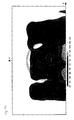
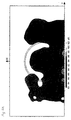
- Fig. 1a, 2a and 5a Images of sound field measurements
- the tread patterns designed according to the invention are particularly for Drive axle tires provided for trucks.
- the other structure of the truck tires can done in a conventional manner and includes in particular in addition to the Tread a pair of bead areas with bead cores, a pair of Sidewalls, a radial carcass, the free ends of which around the bead cores and a multi-layer belt.
- a reinforcement cord for the or multi-ply carcass is generally considered steel cord, also organic fiber, such as nylon or polyester or a aromatic polyamide.
- the belt comprises three to four layers, which in each layer parallel cords made of steel or also organic Have fiber cord with respect to the tire equator at certain angles run.
- the present invention is basically concerned with tread patterns for To design tires so that on the one hand the tire / road noise both regarding sound pressure level as well as distribution of the occurring frequencies is influenced favorably overall and on the other hand one in and against the the direction of travel (rolling direction) of the tire is largely directed Sound radiation and a reduction in sound radiation in the side Direction is supported.
- the tire according to the invention should above all Motor vehicles, especially on trucks or buses, can be used on the Wheel housings are provided with suitable devices for sound absorption.
- the Measures taken to achieve this goal are now based on the basic design variants explained in more detail.
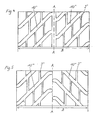
- the embodiment according to FIG. 2 is an arrowed, Directional tread pattern. It is along the Tire circumferential center line A-A arranged a wide circumferential groove 2 which, like shown, can be designed as a straight circumferential groove. In every Half of the tread are broad, diagonal grooves 10 as main grooves arranged, in this embodiment, except for the area of their Openings in the circumferential groove 2 or their transition areas on the Tread edges where the grooves 10 each in the transverse direction of the tread pattern have curved end portions, at least substantially straight run.
- the grooves 10 running in one tread half are through the arrowed arrangement to the grooves running in the other half of the tread 10 mutually inclined and close an angle with the circumferential center line A-A ⁇ , which is chosen between 35 +/- 20 °, in particular between 35 +/- 10 °.
- the grooves 10 are in one tread half arranged offset in relation to the grooves 10 in the second tread half. This offset can be up to half the mutual distance between adjacent grooves 10 be performed.
- Such a tire is arranged on the vehicle such that the tread end regions of the grooves 10 first into the Enter the contact surface with the substrate.
- the grooves 10 are in each tread half by relatively narrow, at least substantially longitudinal grooves 3 running in the circumferential direction connected to each other, creating a block structure.
- the average width of the narrow longitudinal grooves 3 is between 10 and 60%, in particular 20 to 40%, of Width of the grooves 10 selected.
- the course of the longitudinal grooves 3 can be +/- 10 °, in particular +/- 5 °, deviate from the circumferential direction.
- the wide grooves 10 are acoustically coupled by the narrow longitudinal grooves 3. It is therefore advantageous to close the longitudinal grooves 3 in the transverse direction of the tire move so that there is no aligned arrangement of longitudinal grooves 3.
- the offset of the longitudinal grooves 3 creates a block structure in which the number of Blocks 4 between adjacent grooves 10 differs from each other, so that illustrated embodiment in each tread half between adjacent grooves 10 alternately three blocks 4 and four blocks 4 available.
- This profile design has 3 good abrasion and through the longitudinal grooves Aquaplaning properties. At the same time it is ensured that an in and sound radiation directed against the direction of travel and a reduction of the lateral sound radiation is achieved.
- the described offset of the longitudinal grooves 3 additionally causes that during the When the tire rolls off, the energy of the blocks hitting the ground over time is distributed, which has an overall favorable effect on the sound pressure level.
- the offset shown in the one Half of tread grooves 10 against those in the other Half of tread grooves 10 are dispensed with, so that the grooves 10 in open the circumferential groove 2 without mutual offset.
- the tread pattern is designed such that, when viewed in the transverse direction of the profile, the number of grooves 10, depending on the tire dimension, is between 6 and 12, in particular between 8 and 10.
- the width of the grooves 10 is kept at least substantially constant, all grooves 10 in particular having the same width.
- the cross section of the grooves 10 can be U-shaped, V-shaped or the like, symmetrical or asymmetrical.
- known measures for stone rejection can be taken, such as raising the base of the groove.
- the circumferential groove 2 can deviate from the embodiment shown also designed wave-shaped or zigzag become.
- Fig. 3 shows a variant of the embodiment shown in Fig. 2, in which in addition to a central circumferential groove 2 ', grooves 10' in each tread half are arranged, each corresponding over a large part of their lengths Own slope. Accordingly, this profile variant is not directional.
- the mouth areas of the grooves 10 ', both in the area of the circumferential groove 2 'and the tread edges are in turn designed such that the Grooves 10 'in each case via a rounded kink in the middle into the circumferential groove 2' open out or run out into the shoulder areas at the edge of the tread.
- the further configuration of the profile with longitudinal grooves 3 ' corresponds to that according to FIG. 2, as well as the angulation of the grooves 10 'and their other configuration.
- Fig. 4 differs from that 3 only in that the grooves 10 "in one tread half opposite the grooves 10 "in the other tread half in the circumferential direction are offset.
- the longitudinal grooves 3 are provided analogously.
- 5 to 7 show further exemplary embodiments which show further variants of the in 2 to 4 are examples shown.
- FIG. 5 corresponds to that of FIG. 2 except for the design of the central region.
- there are grooves 10 III longitudinal grooves 3 III in each tread half, each with the appropriate angulation and offset, arranged.
- No circumferential groove is now provided in the central area of the tread so that the grooves 10 III end there as pocket grooves, preferably and as shown to form a rounded kink at the respective ends.
- the central tread area is thus more closed than in the embodiment variants according to FIGS. 2 to 4, which results in a certain reduction in the effectiveness of the physical principle of action on which these embodiments are based.
- the closed grooves 10 III emit a little more noise, mutual extinction is mainly possible in the inlet and outlet.
- the advantage of this tread pattern lies primarily in the fact that in the central region of the tread a rib structure is created by the runout of the grooves 10 III there, which significantly improves the abrasion behavior.
- FIG. 6 shows a variant essentially corresponding to FIG. 4, which accordingly has grooves 10 IV that are the same in both tread halves, the central region of the tread profile is designed analogously to the variant according to FIG. 4, with no offset of the grooves 10 running in one tread half IV compared to those of the grooves 10 IV running in the second tread half.
- FIG. 7 A variant with an offset of the grooves 10 V in one tread half compared to the grooves 10 V in the second tread half is shown in FIG. 7.
- the other configuration of the variants shown in FIGS. 6 and 7 basically corresponds to that according to FIG. 5.
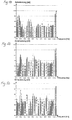
- 1a, 1b, 2a, 2b and 5a, 5b illustrate with the aid of illustrations of measured sound fields and determined frequency spectra the effectiveness of the subject invention.
- 1a, 2a and 5a show in gray-coded, three-dimensional representations of the tire in the lateral direction, through a Plane parallel to the tire running direction, perpendicular to the ground and in approx. 20 cm sound intensity radiated from the side of the tire or Sound power.
- the measurements were carried out on a drum test bench at a Speed of 70 km / h.
- the Line markings on the rectangle enclosing the representations show this Measuring grid. At each crossing point of these markings vertical and horizontal line, the sound intensity was perpendicular to Drawing level determined and shown as a gray value.
- the scale at the foot of the The diagrams show the sound power assigned to each gray level in dB.
- Fig. 1a now shows the extent and type of the measured from the side Sound field of a truck tire with a state of the art executed traction profile.
- the tire measured had the one shown in FIG. 1 Profile design with a distinctive block structure.
- the sound field of this known tire is clearly spread with the intensity distribution characterized by the different shades of gray.
- the frequency spectrum shown in Fig. 1 b shows pronounced peaks in certain frequency ranges and a high sound pressure level.
- Fig. 2a That measured with a tire whose profile was equipped according to FIG. 2 Sound field is shown in Fig. 2a.
- the sound radiation is in the lateral direction significantly reduced.
- the frequency spectrum (Fig. 2b) shows less pronounced Peaks and a significantly reduced sound power.
- the profile is through Circumferential centerline divided into two tread areas, which are the two Tread halves are. Deviating from this can be an outline of the profile also take place in tread areas that are not the two tread halves, by, for example, the circumferential groove offset from the circumferential center line is arranged. This results in asymmetrical profile configurations, which are also within the scope of the present invention.
Landscapes
- Engineering & Computer Science (AREA)
- Mechanical Engineering (AREA)
- Tires In General (AREA)
- Valve-Gear Or Valve Arrangements (AREA)
- Mechanical Operated Clutches (AREA)
- Yarns And Mechanical Finishing Of Yarns Or Ropes (AREA)
Claims (11)
- Pneumatique radial, en particulier pour les roues motrices d'un camion ou d'un autobus, présentant un profil de bande de roulement qui possède une structure de blocs qui est formée par des cannelures (10, 10I, 10II, 10III, 10IV, 10V) orientées diagonalement sur au moins une partie de la bande de roulement et de cannelures longitudinales (3, 3', 3'', 3''') qui sont orientées au moins sensiblement selon la direction périphérique, qui, pour former la structure de blocs, courent chacune entre deux cannelures (10, 10I, 10II, 10III, 10IV, 10V) voisines selon la direction périphérique et qui, vu pour des cannelures (10, 10I, 10II, 10III, 10IV, 10V) voisines selon la direction périphérique, sont chacune décalées l'une par rapport à l'autre selon la direction transversale, caractérisé par le fait que le profil de la bande de roulement se compose de deux zones de bande de roulement dans chacune desquelles les cannelures (10, 10I, 10II, 10III, 10IV, 10V) orientées diagonalement s'étendent, en tant que cannelures principales, sur au moins une grande partie de la largeur de la zone de bande de roulement en question, sous un angle (α) de 35 +/- 20°, en particulier 35 +/- 10°, par rapport à la direction périphérique, la largeur des cannelures longitudinales (3, 3', 3'', 3''') étant inférieure à la largeur des cannelures (10, 10I, 10II, 10III, 10IV, 10V) orientées diagonalement et correspondant au moins à 10 %, en particulier au moins 20 % et au plus à 60 %, en particulier au plus à 50 % de la largeur des cannelures (10, 10I, 10II, 10III, 10IV, 10V).
- Pneumatique radial selon la revendication 1, caractérisé par le fait que les deux zones de la bande de roulement sont séparées l'une de l'autre par une rainure périphérique (2, 2') qui fait le tour du pneumatique selon la direction périphérique et dans laquelle les cannelures(10, 10I, 10II) orientées diagonalement débouchent des deux côtés, cette rainure périphérique (2, 2') courant de préférence le long de l'axe périphérique (A-A) du profil.
- Pneumatique radial selon la revendication 1 ou 2, caractérisé par le fait que les cannelures (10III, 10IV, 10V) courant dans les deux zones de la bande de roulement se terminent, du côté intérieur de la bande de roulement, sous forme de rainures non débouchantes, les cannelures (10III, 10IV, 10V) de l'une des zones de la bande de roulement n'étant pas reliées avec les cannelures (10III, 10IV, 10V) de l'autre zone de la bande de roulement.
- Pneumatique radial selon l'une des revendications 1 à 3, caractérisé par le fait que les cannelures (10, 10III) courant dans l'une des zones de la bande de roulement sont disposées en sens inverse de celles courant dans l'autre zone de la bande de roulement.
- Pneumatique radial selon l'une des revendications 1 à 3, caractérisé par le fait que les cannelures (10, 10I, 10II, 10IV, 10V) courant dans les deux zones de la bande de roulement possèdent une allure en coïncidence ou une pente identique.
- Pneumatique radial selon l'une des revendications 1 à 5, caractérisé par le fait que les cannelures (10, 10I, 10II, 10IV, 10V) courant dans l'une des zones de la bande de roulement sont décalées selon la direction périphérique par rapport à celles courant dans l'autre zone de la bande de roulement.
- Pneumatique radial selon l'une des revendications 1 à 6, caractérisé par le fait que les cannelures longitudinales '3, 3') possèdent une allure qui s'écarte de jusqu'à 10°, en particulier jusqu'à 5°, de la direction périphérique.
- Pneumatique radial selon l'une des revendications 1 à 7, caractérisé par le fait que les zones d'extrémité libres des cannelures (10, 10I, 10II, 10III, 10IV, 10V) ou leurs zones dans lesquelles elles débouchent dans la rainure périphérique ou leurs zones dans lesquelles elles débouchent sur les bords de la bande de roulement sont légèrement incurvées en forme d'arc.
- Pneumatique radial selon l'une des revendications 1 à 8, caractérisé par le fait que la largeur des cannelures (10, 10I, 10II, 10III, 10IV, 10V) en mm se détermine à partir de : largeur de la cannelure = √ B/y2 avec B comme largeur du pneumatique et avec 1,4 ≤ y ≤ 2,6, en particulier 1,6 ≤ y ≤ 2,1, la largeur du pneumatique étant déterminée en millimètres et intervenant dans le calcul de la largeur des cannelures sous forme d'un nombre sans dimension.
- Pneumatique radial selon l'une des revendications 1 à 9, caractérisé par le fait que les cannelures (10, 10I, 10II, 10III, 10IV, 10V) possèdent sur leur parcours une largeur constante qui de préférence coïncide pour toutes les cannelures (10, 10I, 10II, 10III, 10IV, 10V).
- Pneumatique radial selon l'une des revendications 1 à 10, caractérisé par le fait que, vu selon la direction transversale du profil, le nombre des cannelures (10, 10I, 10II, 10III, 10IV, 10V) vaut entre 6 et 12, en particulier entre 8 et 10.
Applications Claiming Priority (2)
| Application Number | Priority Date | Filing Date | Title |
|---|---|---|---|
| DE19548731A DE19548731C2 (de) | 1995-12-23 | 1995-12-23 | Radialreifen |
| DE19548731 | 1995-12-23 |
Publications (2)
| Publication Number | Publication Date |
|---|---|
| EP0780246A1 EP0780246A1 (fr) | 1997-06-25 |
| EP0780246B1 true EP0780246B1 (fr) | 2001-05-23 |
Family
ID=7781419
Family Applications (1)
| Application Number | Title | Priority Date | Filing Date |
|---|---|---|---|
| EP96120690A Expired - Lifetime EP0780246B1 (fr) | 1995-12-23 | 1996-12-20 | Bandage pneumatique radial |
Country Status (3)
| Country | Link |
|---|---|
| EP (1) | EP0780246B1 (fr) |
| AT (1) | ATE201355T1 (fr) |
| DE (2) | DE19548731C2 (fr) |
Families Citing this family (1)
| Publication number | Priority date | Publication date | Assignee | Title |
|---|---|---|---|---|
| JP4545565B2 (ja) * | 2004-11-25 | 2010-09-15 | 東洋ゴム工業株式会社 | 空気入りタイヤ |
Family Cites Families (12)
| Publication number | Priority date | Publication date | Assignee | Title |
|---|---|---|---|---|
| BE524246A (fr) * | 1952-11-13 | |||
| GB738143A (en) * | 1953-06-15 | 1955-10-05 | Sigurd Ingemann Olsen | Improvements in the treads of tyres for motor vehicles |
| CA1104479A (fr) * | 1978-02-14 | 1981-07-07 | Harold D. Fetty | Traduction non-disponible |
| JPS61115704A (ja) * | 1984-11-09 | 1986-06-03 | Sumitomo Rubber Ind Ltd | 自動二輪車用タイヤ |
| JPS62175204A (ja) * | 1986-01-29 | 1987-07-31 | Yokohama Rubber Co Ltd:The | 乗用車用空気入りラジアルタイヤ |
| JPH03143706A (ja) * | 1989-10-30 | 1991-06-19 | Yokohama Rubber Co Ltd:The | 空気入りタイヤの装着方法 |
| DE4039261A1 (de) * | 1989-12-29 | 1991-07-04 | Continental Ag | Laufflaechenprofil fuer fahrzeugreifen |
| EP0434967B1 (fr) * | 1989-12-29 | 1994-07-27 | Continental Aktiengesellschaft | Profil de bande de roulement pour pneumatiques |
| US5318085A (en) * | 1990-10-22 | 1994-06-07 | General Tire | Radial tire having reduced treadwear |
| US5435364A (en) * | 1990-12-28 | 1995-07-25 | Sumitomo Rubber Industries, Ltd. | Pneumatic radial tire with four main grooves |
| DE4306483C2 (de) * | 1993-03-02 | 2000-05-04 | Pirelli Reifenwerke | Laufflächenprofil für Winterreifen |
| JP3380605B2 (ja) * | 1993-05-20 | 2003-02-24 | 株式会社ブリヂストン | 空気入りタイヤ |
-
1995
- 1995-12-23 DE DE19548731A patent/DE19548731C2/de not_active Expired - Fee Related
-
1996
- 1996-12-20 AT AT96120690T patent/ATE201355T1/de not_active IP Right Cessation
- 1996-12-20 EP EP96120690A patent/EP0780246B1/fr not_active Expired - Lifetime
- 1996-12-20 DE DE59606952T patent/DE59606952D1/de not_active Expired - Lifetime
Also Published As
| Publication number | Publication date |
|---|---|
| DE59606952D1 (de) | 2001-06-28 |
| ATE201355T1 (de) | 2001-06-15 |
| DE19548731A1 (de) | 1997-06-26 |
| EP0780246A1 (fr) | 1997-06-25 |
| DE19548731C2 (de) | 2001-09-27 |
Similar Documents
| Publication | Publication Date | Title |
|---|---|---|
| DE69503938T2 (de) | Luftreifen | |
| DE60207836T2 (de) | Laufflächenprofil für einen fahrzeugreifen | |
| EP0669216B1 (fr) | Bandage pneumatique pour véhicule | |
| AT402179B (de) | Laufstreifen für einen fahrzeugluftreifen | |
| DE69502123T2 (de) | LKW-Reifen mit einer universellen Lauffläche | |
| DE69401180T2 (de) | Luftreifen | |
| DE69904634T2 (de) | Reifen und dessen lauffläche | |
| DE3737264A1 (de) | Luftradialreifen | |
| DE69601137T2 (de) | Luftreifen | |
| EP0325905B1 (fr) | Dessin de bande de roulement pour bandages pneumatiques | |
| DE19548733C2 (de) | Radialreifen | |
| DE19702675C2 (de) | Profil für PKW-Luftreifen | |
| EP0715972B1 (fr) | Bandage pneumatique pour véhicule | |
| DE19957914C2 (de) | Fahrzeugluftreifen | |
| EP1533140B1 (fr) | Profil de la bande de roulement d'un pneumatique pour véhicules | |
| DE19548731C2 (de) | Radialreifen | |
| DE4007760C2 (de) | Fahrzeugluftreifen | |
| EP3551475B1 (fr) | Pneumatique de véhicule | |
| EP4347276B1 (fr) | Pneu pour véhicule | |
| AT394002B (de) | Radialreifen fuer raeder von lkw-antriebsachsen | |
| EP0718123B1 (fr) | Bandage pneumatique pour véhicule | |
| EP0780247B1 (fr) | Bandage pneumatique radial | |
| AT402385B (de) | Profilierter laufstreifen für einen fahrzeugluftreifen | |
| DE3603899C2 (de) | Luftreifen | |
| DE19548734C2 (de) | Radialreifen |
Legal Events
| Date | Code | Title | Description |
|---|---|---|---|
| PUAI | Public reference made under article 153(3) epc to a published international application that has entered the european phase |
Free format text: ORIGINAL CODE: 0009012 |
|
| AK | Designated contracting states |
Kind code of ref document: A1 Designated state(s): AT DE FR GB IT |
|
| 17P | Request for examination filed |
Effective date: 19971229 |
|
| 17Q | First examination report despatched |
Effective date: 19991109 |
|
| GRAG | Despatch of communication of intention to grant |
Free format text: ORIGINAL CODE: EPIDOS AGRA |
|
| GRAG | Despatch of communication of intention to grant |
Free format text: ORIGINAL CODE: EPIDOS AGRA |
|
| GRAH | Despatch of communication of intention to grant a patent |
Free format text: ORIGINAL CODE: EPIDOS IGRA |
|
| GRAH | Despatch of communication of intention to grant a patent |
Free format text: ORIGINAL CODE: EPIDOS IGRA |
|
| GRAA | (expected) grant |
Free format text: ORIGINAL CODE: 0009210 |
|
| AK | Designated contracting states |
Kind code of ref document: B1 Designated state(s): AT DE FR GB IT |
|
| REF | Corresponds to: |
Ref document number: 201355 Country of ref document: AT Date of ref document: 20010615 Kind code of ref document: T |
|
| REF | Corresponds to: |
Ref document number: 59606952 Country of ref document: DE Date of ref document: 20010628 |
|
| ITF | It: translation for a ep patent filed | ||
| GBT | Gb: translation of ep patent filed (gb section 77(6)(a)/1977) |
Effective date: 20010816 |
|
| ET | Fr: translation filed | ||
| REG | Reference to a national code |
Ref country code: GB Ref legal event code: IF02 |
|
| PLBE | No opposition filed within time limit |
Free format text: ORIGINAL CODE: 0009261 |
|
| STAA | Information on the status of an ep patent application or granted ep patent |
Free format text: STATUS: NO OPPOSITION FILED WITHIN TIME LIMIT |
|
| 26N | No opposition filed | ||
| PGFP | Annual fee paid to national office [announced via postgrant information from national office to epo] |
Ref country code: GB Payment date: 20041213 Year of fee payment: 9 |
|
| PG25 | Lapsed in a contracting state [announced via postgrant information from national office to epo] |
Ref country code: IT Free format text: LAPSE BECAUSE OF NON-PAYMENT OF DUE FEES;WARNING: LAPSES OF ITALIAN PATENTS WITH EFFECTIVE DATE BEFORE 2007 MAY HAVE OCCURRED AT ANY TIME BEFORE 2007. THE CORRECT EFFECTIVE DATE MAY BE DIFFERENT FROM THE ONE RECORDED. Effective date: 20051220 Ref country code: GB Free format text: LAPSE BECAUSE OF NON-PAYMENT OF DUE FEES Effective date: 20051220 |
|
| GBPC | Gb: european patent ceased through non-payment of renewal fee |
Effective date: 20051220 |
|
| PGFP | Annual fee paid to national office [announced via postgrant information from national office to epo] |
Ref country code: AT Payment date: 20061213 Year of fee payment: 11 |
|
| PG25 | Lapsed in a contracting state [announced via postgrant information from national office to epo] |
Ref country code: AT Free format text: LAPSE BECAUSE OF NON-PAYMENT OF DUE FEES Effective date: 20071220 |
|
| PGFP | Annual fee paid to national office [announced via postgrant information from national office to epo] |
Ref country code: DE Payment date: 20101202 Year of fee payment: 15 |
|
| PGFP | Annual fee paid to national office [announced via postgrant information from national office to epo] |
Ref country code: FR Payment date: 20120102 Year of fee payment: 16 |
|
| REG | Reference to a national code |
Ref country code: DE Ref legal event code: R119 Ref document number: 59606952 Country of ref document: DE Effective date: 20120703 |
|
| PG25 | Lapsed in a contracting state [announced via postgrant information from national office to epo] |
Ref country code: DE Free format text: LAPSE BECAUSE OF NON-PAYMENT OF DUE FEES Effective date: 20120703 |
|
| REG | Reference to a national code |
Ref country code: FR Ref legal event code: ST Effective date: 20130830 |
|
| PG25 | Lapsed in a contracting state [announced via postgrant information from national office to epo] |
Ref country code: FR Free format text: LAPSE BECAUSE OF NON-PAYMENT OF DUE FEES Effective date: 20130102 |