EP0780335A2 - Dispositif pour transporter des personnes ou des charges dans un avion multi-ponts - Google Patents
Dispositif pour transporter des personnes ou des charges dans un avion multi-ponts Download PDFInfo
- Publication number
- EP0780335A2 EP0780335A2 EP96115994A EP96115994A EP0780335A2 EP 0780335 A2 EP0780335 A2 EP 0780335A2 EP 96115994 A EP96115994 A EP 96115994A EP 96115994 A EP96115994 A EP 96115994A EP 0780335 A2 EP0780335 A2 EP 0780335A2
- Authority
- EP
- European Patent Office
- Prior art keywords
- stairs
- transport platform
- stair
- deck
- transport
- Prior art date
- Legal status (The legal status is an assumption and is not a legal conclusion. Google has not performed a legal analysis and makes no representation as to the accuracy of the status listed.)
- Granted
Links
- 239000000872 buffer Substances 0.000 claims description 2
- 230000006735 deficit Effects 0.000 abstract description 2
- 238000000034 method Methods 0.000 description 3
- 230000003313 weakening effect Effects 0.000 description 3
- 101100390736 Danio rerio fign gene Proteins 0.000 description 2
- 101100390738 Mus musculus Fign gene Proteins 0.000 description 2
- 108010066057 cabin-1 Proteins 0.000 description 2
- 208000035657 Abasia Diseases 0.000 description 1
- 230000004308 accommodation Effects 0.000 description 1
- 108010066114 cabin-2 Proteins 0.000 description 1
- 238000005253 cladding Methods 0.000 description 1
- 238000011109 contamination Methods 0.000 description 1
- 238000011161 development Methods 0.000 description 1
- 230000018109 developmental process Effects 0.000 description 1
- 230000000414 obstructive effect Effects 0.000 description 1
- 230000007704 transition Effects 0.000 description 1
Images


Classifications
-
- B—PERFORMING OPERATIONS; TRANSPORTING
- B66—HOISTING; LIFTING; HAULING
- B66B—ELEVATORS; ESCALATORS OR MOVING WALKWAYS
- B66B9/00—Kinds or types of lifts in, or associated with, buildings or other structures
- B66B9/06—Kinds or types of lifts in, or associated with, buildings or other structures inclined, e.g. serving blast furnaces
- B66B9/08—Kinds or types of lifts in, or associated with, buildings or other structures inclined, e.g. serving blast furnaces associated with stairways, e.g. for transporting disabled persons
Definitions
- the invention relates to a device for transporting people or loads in an aircraft with a plurality of decks intended for passenger use in a multi-deck aircraft, which has a transport platform which can be moved in the working position by means of a conveyor between an upper and a lower deck in the direction of the stairs .
- a disadvantage of the proposed conveyor is that the transport platform arranged on the stairs is a hindrance to normal passenger traffic. It is known from the prior art that the transport platform can be folded up vertically on the side wall of the stairs or is designed to be removable in order to make the stairs accessible again for normal passenger traffic. With the foldable solution of the transport platform there is a not insignificant disability for passenger traffic.
- the entire width of the staircase is not available, since the folded-up transport platform, together with parts of the conveying device, can be arranged in the side area of the staircase in a disruptive manner. In particular, congestion can then occur when the passengers get on or off the traffic route or passengers can get dirty on the outstanding transport platform.
- the object of the invention is to design a generic device in a simple and space-saving manner, the transport platform being able to be put into use and put down again with a minimal amount of handling and obstructions in the traffic route of the passengers being avoided.
- the transport platform is not obstructed in the traffic route for the passengers and that there are no impairments for the passengers using the stairs.
- the handling effort to put the transport device into operation is minimal, since the transport platform is also in operative connection with the other components of the transport device in the rest position and does not have to be additionally attached or removed by the flight personnel.
- the floor area of the lower deck in front of the stairs can be implemented without additional elements or structurally weakening interventions, and the transport platform is space-saving and not obstructed.
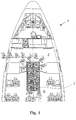
- Figs. 1 to 3 each show an aircraft longitudinal section in the front area of a passenger cabin 1 of an aircraft.
- a staircase 2 is provided as a connecting device between an upper deck 3 and a lower deck 4 of the aircraft and enables the passengers to move between decks 3 and 4.
- the boarding of the passengers is shown in FIG. 1.
- the full width of the staircase 2 can be used and thus the boarding of the passengers can be made possible without large congestion.
- several passenger stairs preferably one in the front and one in the rear cabin area, can be provided in order to avoid backlogs and not to unnecessarily annoy passengers who are seated in the area of the stairs and their Reduce comfort.
- Figs. 1 to 3 each show an aircraft longitudinal section in the front area of a passenger cabin 1 of an aircraft.
- a staircase 2 is provided as a connecting device between an upper deck 3 and a lower deck 4 of the aircraft and enables the passengers to move between decks 3 and 4.
- the boarding of the passengers is shown in FIG. 1.
- a device for transporting 5 people or loads is shown, which is arranged on the stairs 2.
- the transport device 5 In order to keep the space requirement within the passenger cabin 1 for the transport device 5 as small as possible, the use of the existing stairs 2 is also proposed for the transport device 5.
- the transport device 5 can be put into operation. If the transport device 5 is not used, the full width of the stairs is available again. With this combination, a separate freight elevator can be avoided. It is thus possible to use the space for stairs and elevator available in the aircraft for a wide range of passenger stairs. Passengers can get on and off in a short time.
- the transport device can either be used by wheelchair users 16 in wheelchairs 16, as shown in FIG. 2, or loads, for example trolleys 18 for passenger care, as shown in FIG. 3, between the decks 3 and 4 can be transported.
- a first embodiment of the transport device 5 on the stairs 2 is shown.
- the transport device 5 is on one side of the staircase 2 is arranged in such a way that the stairway 2 can be used by passengers - albeit to a limited extent - even when the transport device 5 is in operation.
- the conveying device 5 arranged on the stairs 2 is shown in FIG. 4A in a top view, in FIG. 4B in a side view and in FIG. 4C in a front view according to the direction of the arrow shown in FIG. 3.
- a transport platform 6 can be moved by means of a conveyor device on a guide rail 7 between an upper deck 3 and a lower deck 4.
- the conveyor is designed as an electric drive and thus runs relatively quietly. Other known drive types for stairlifts are also possible.
- the guide rail 7 is arranged on the side wall 8 of the stairs in the area of the steps along the walking direction of the passengers.
- the transport direction of the transport platform 6 also corresponds to this direction.
- the transport platform 6 has its upper stopping point 9 at the top edge of the stairs 10 at almost the same height as the floor of the upper deck 3.
- the lower stopping point 11 is provided at almost the same height as the floor of the lower deck 4.
- the lower position of the transport platform 6 with a wheelchair 16 is shown with dashed lines.
- the transport platform 6 is also supported on the side facing the middle of the stairs. It is intended to use the handrail on a banister 12 located in the middle of the stairs 2 or to use a holding rail which is attached to the banister 12.
- the transport platform 6 is pulled to the front edge of the stair step at the upper stopping point 9 in the stopping position in order to enable the transition between the stair step and platform 6 to be passed over without any problems.
- the transport platform 6 is transported to the corresponding deck 3 or 4 by means of the drive.
- the transport device is operated via control elements which are provided in the entrance area of the stairs 2 of each deck and also on the transport platform 6.
- the wheelchair 16 After the wheelchair 16 has been moved onto the transport platform 6, the wheelchair 16 is secured for transport by means of a safety bracket.
- the operation of the conveying device 5 can be indicated acoustically or optically by a warning system 17, which makes sense as a safety measure for the passengers who want to use the stairs and focuses their attention on a possible danger.
- the transport platform 6 If the transport platform 6 is not used, it can be sunk in the lower deck 4 in a floor recess 13 in order not to hinder normal passenger traffic.
- a floor insert element 14 with spring-loaded buffers is provided in the floor of the lower deck 4. The floor insert element 14 covers the floor recess 13.
- the platform 6 is stored in the floor recess 13 in such a way that it presses the floor insert element 14 lower and is locked to the floor by means of a lock in the same plane. In this position, the transport platform 6 can be walked on by the passengers as part of the floor. As an alternative, the accommodation of the transport platform 6 can be carried out in the same way in the floor of the upper deck. Another possibility, not shown, is to place the transport platform 6 in the floor recess 13 and to provide it with a cover which is moved out of the bottom step.
- the floor area of the decks in front of the stairs can be designed without additional elements or structurally weakening interventions and the transport platform 6 is placed in the rest position in a space-saving and non-obstructive manner.
- the transport platform 6 is guided on both sides by means of guide rails 7 and 7 '.
- the guide rails 7 and 7 ' are advantageously arranged concealed on the respective side wall of the staircase, ie they run next to the stairs 2 or are covered by a cladding, so that passengers do not get dirty on the components of the transport device 5 can and the functionality of the conveyor 5 is not affected due to dirt and contamination.
- the transport platform 6 can be stored in the area below the lowest step of the stairs 2. If necessary, it is extended like a "drawer" (see arrow direction) and can then be used to transport wheelchair users or loads.
- the transport platform 6 can be moved out, for example, via rollers or laterally arranged rails.
- usually known types of drive on an electrical, pneumatic or hydraulic basis can also be used.
- FIG. 6 shows a lower staircase area as a detail with the conveying device 5 in a third embodiment. If the transport device 5 is not used, the transport platform 6 is stored below the stairs 2. This storage position 25 is shown in broken lines in FIG. 6.
- the third embodiment of the transport device 5 is characterized by a transport platform 6, which does not run over the entire width of the stairs. Here, one-sided guidance is realized in only one guide rail 7. For the working position, the transport platform 6 can be provided with spring-loaded brackets 15, 15 'which can be folded out and are provided for securing the loads or the wheelchair. This design of the transport platform 6 as a detail can be seen in FIG. 6A.
- the lower area of the stair steps is designed as an entire stair segment 22, which is horizontally displaceable in the direction of stair 2.
- the stair segment 22 is moved into the space 21 below the stair 2.
- rollers 23 are preferably arranged on the stair segment 22, as can be seen from the detail in FIG. 7A.
- the Movement of the stair segment 22 can be realized, for example, by means of electrical drives. However, drives of pneumatic, hydraulic or electrohydraulic type are also possible.
- the stair segment 22 must have such a depth that a sufficient space is released for the transport platform 6.
- the transport platform 6 is stored in the rest position below the stair segment 22. After the stair segment 22 has been pushed in and, if necessary, the segment 22 has been locked, the transport platform 6 is accessible and in the working position, with brackets 15, 15 'which are preferably also folded out to secure the loads or the wheelchair.
- 7 shows the transport platform 6, which is positioned in the upper deck 3 for the loading process and for which the safety bar 15 'has been folded down.
- 7A that guide elements 24A and 24B are arranged on the sides of the transport platform 6, which enable the transport platform 6 to be guided along the guide rails 7A, 7A 'and 7B, 7B'.
- the transport platform 6 does not extend beyond the step edge of the lowest step into the traffic area of the lower deck 4. This means that no additional space in the passenger cabin 2 is required for the entire stairwell with the transport device 5.
- FIG. 8 shows a fifth embodiment of the transport device 5 on the stairs 2, which does not require any recesses in the floor area of the passenger decks.
- the lower area of the steps is movable in this embodiment.
- the transport platform 6 for the rest position can be stored below this area.
- Individual, movable stair plates 19 can be inserted into a space 21 below the stairs 2.
- a roller blind box 20 can preferably be provided, into which the stair plates 19 can roll like a roller shutter, as shown schematically in FIG. 9.
- An alternative solution provides for the possibility of folding in the stair plates 19. A region of the stairs 2 can thus be released, which in the rest position covers the transport platform 6 of the transport device 5 when it is not required.
- the transport platform 6 can be moved in the guide rails 7A, 7A 'and 7B, 7B' arranged on the wall in the direction of the stairs 2. 8 shows the transport platform 6 in the working position at the upper stopping point on the upper deck 3. When the platform 6 reaches the lower position, it also does not protrude beyond the step edge of the lowest step into the traffic area of the lower deck 4 in this embodiment The area in front of the stairs 2 is therefore not structurally changed for storing the transport platform 6.
Landscapes
- Engineering & Computer Science (AREA)
- Transportation (AREA)
- Automation & Control Theory (AREA)
- Structural Engineering (AREA)
- Escalators And Moving Walkways (AREA)
Applications Claiming Priority (2)
| Application Number | Priority Date | Filing Date | Title |
|---|---|---|---|
| DE19548193 | 1995-12-22 | ||
| DE19548193 | 1995-12-22 |
Publications (3)
| Publication Number | Publication Date |
|---|---|
| EP0780335A2 true EP0780335A2 (fr) | 1997-06-25 |
| EP0780335A3 EP0780335A3 (fr) | 1998-02-04 |
| EP0780335B1 EP0780335B1 (fr) | 2002-04-03 |
Family
ID=7781050
Family Applications (1)
| Application Number | Title | Priority Date | Filing Date |
|---|---|---|---|
| EP96115994A Expired - Lifetime EP0780335B1 (fr) | 1995-12-22 | 1996-10-05 | Dispositif pour transporter des personnes ou des charges dans un avion multi-ponts |
Country Status (2)
| Country | Link |
|---|---|
| EP (1) | EP0780335B1 (fr) |
| DE (1) | DE59609006D1 (fr) |
Cited By (4)
| Publication number | Priority date | Publication date | Assignee | Title |
|---|---|---|---|---|
| WO1998002628A1 (fr) * | 1996-07-15 | 1998-01-22 | Charles Thomas Lyons | Systeme combine d'escaliers et d'ascenseur, et escalier escamotable |
| US6050366A (en) * | 1996-07-15 | 2000-04-18 | Hydraulic Technical Services (Consultants) Ltd. | Combined stairway and lift installation and a retractable stairway |
| DE19752390C2 (de) * | 1997-11-26 | 2000-04-20 | Rainer Gartelmann | Aufzug, insbesondere für Großraum-Passagierflugzeuge |
| EP2583894A2 (fr) | 2011-10-19 | 2013-04-24 | Airbus | Cabine d'aéronef permettant d'accueillir des passagers sur plusieurs niveaux et aéronef correspondant |
Families Citing this family (1)
| Publication number | Priority date | Publication date | Assignee | Title |
|---|---|---|---|---|
| DE102008002049A1 (de) * | 2008-05-28 | 2009-12-10 | Schneider+Schumacher Kinetik Gbr (Vertretungsberechtigte Gesellschafter: Till Schneider | Treppenlift mit versenkten Führungsschienen |
Family Cites Families (5)
| Publication number | Priority date | Publication date | Assignee | Title |
|---|---|---|---|---|
| US2674347A (en) * | 1946-05-25 | 1954-04-06 | Lloyd C Schwartz | Stair elevator |
| US2516726A (en) * | 1949-01-08 | 1950-07-25 | Stanley L Saxton | Stairway elevator |
| US5125481A (en) * | 1990-09-26 | 1992-06-30 | Hideaki Shibata | Diagonal elevation apparatus |
| DE9107523U1 (de) * | 1991-06-14 | 1991-08-08 | Georgiew, Wladimir, O-1136 Berlin | Treppenwippe |
| US5234078A (en) * | 1992-06-29 | 1993-08-10 | Daniel K. Roth | Collapsing stair lift |
-
1996
- 1996-10-05 DE DE59609006T patent/DE59609006D1/de not_active Expired - Lifetime
- 1996-10-05 EP EP96115994A patent/EP0780335B1/fr not_active Expired - Lifetime
Cited By (4)
| Publication number | Priority date | Publication date | Assignee | Title |
|---|---|---|---|---|
| WO1998002628A1 (fr) * | 1996-07-15 | 1998-01-22 | Charles Thomas Lyons | Systeme combine d'escaliers et d'ascenseur, et escalier escamotable |
| US6050366A (en) * | 1996-07-15 | 2000-04-18 | Hydraulic Technical Services (Consultants) Ltd. | Combined stairway and lift installation and a retractable stairway |
| DE19752390C2 (de) * | 1997-11-26 | 2000-04-20 | Rainer Gartelmann | Aufzug, insbesondere für Großraum-Passagierflugzeuge |
| EP2583894A2 (fr) | 2011-10-19 | 2013-04-24 | Airbus | Cabine d'aéronef permettant d'accueillir des passagers sur plusieurs niveaux et aéronef correspondant |
Also Published As
| Publication number | Publication date |
|---|---|
| EP0780335A3 (fr) | 1998-02-04 |
| EP0780335B1 (fr) | 2002-04-03 |
| DE59609006D1 (de) | 2002-05-08 |
Similar Documents
| Publication | Publication Date | Title |
|---|---|---|
| DE19911879C1 (de) | Fluggastbrückenkabine | |
| DE102017113571A1 (de) | Aufzugsystem | |
| DE3245986A1 (de) | Verpflegungseinrichtung in einem flugzeug mit auf zwei decks angeordneten vorratswagen | |
| DE102018219168A1 (de) | Aufzugsanlage und Verfahren zum Betrieb einer Aufzugsanlage mit einer Hilfseinrichtung | |
| EP3248853B1 (fr) | Véhicule de transport de personnes | |
| EP3538410B1 (fr) | Véhicule ferroviaire à sections d'espace intérieur situées à différentes hauteurs de plancher | |
| DE3738302A1 (de) | Fahrzeug fuer die personenbefoerderung | |
| DE9421209U1 (de) | Doppelstöckiges Schienenfahrzeug zur Beförderung von Personen im Nah- und Fernverkehr auf Strecken mit unterschiedlichen Bahnsteighöhen | |
| DE69927010T2 (de) | Hebevorrichtung für eisenbahnfahrzeuge | |
| EP0780335B1 (fr) | Dispositif pour transporter des personnes ou des charges dans un avion multi-ponts | |
| DE102007055371A1 (de) | Doppelstock-Schienenfahrzeug | |
| DE102007022387A1 (de) | Ein- und Ausstiegshilfe für Fahrzeuge des Personenverkehrs,insbesondere Straßenbahnen | |
| DE69523583T2 (de) | Hebestufeneinrichtung | |
| DE3149566A1 (de) | Versorgungsfahrzeug mit hubplattform, insbesondere zur versorgung der bordkuechen von grossraumflugzeugen | |
| DE8816941U1 (de) | Rollstuhl-Einstieg im Bereich des Fahrerplatzes von Fahrzeugen zur Personenbeförderung, insbesondere Linienbusse | |
| EP1808352A1 (fr) | Véhicule ferroviaire ayant au moins une zone de l'accès et une construction de plancher modulaire | |
| DE8630827U1 (de) | Fahrzeug für die Personenbeförderung | |
| EP1541107A2 (fr) | Véhicule comprenant une rampe pour faciliter la montée et la descente d'une personne à mobilité réduite | |
| DE20219336U1 (de) | Fahrzeug | |
| AT506914B1 (de) | Seilbahn, seilbahnkabine und kabinenboden hiefür | |
| EP1914187A1 (fr) | Ascenseur vertical | |
| EP3461709B1 (fr) | Véhicule de transport de personnes | |
| DE60013762T2 (de) | Treppenanordnung mit einem Personenförderer parallel zu einer Treppe | |
| DE19757025A1 (de) | Ausstiegsvorrichtung für ein Passagierflugzeug | |
| EP0791516B1 (fr) | Ascenseur dans un véhicule ferroviaire à plusieurs niveaux |
Legal Events
| Date | Code | Title | Description |
|---|---|---|---|
| PUAI | Public reference made under article 153(3) epc to a published international application that has entered the european phase |
Free format text: ORIGINAL CODE: 0009012 |
|
| AK | Designated contracting states |
Kind code of ref document: A2 Designated state(s): DE ES FR GB IT NL SE |
|
| PUAL | Search report despatched |
Free format text: ORIGINAL CODE: 0009013 |
|
| AK | Designated contracting states |
Kind code of ref document: A3 Designated state(s): DE ES FR GB IT NL SE |
|
| 17P | Request for examination filed |
Effective date: 19980804 |
|
| RAP3 | Party data changed (applicant data changed or rights of an application transferred) |
Owner name: DAIMLERCHRYSLER AEROSPACE AIRBUS GESELLSCHAFT MIT |
|
| 17Q | First examination report despatched |
Effective date: 20000602 |
|
| RAP1 | Party data changed (applicant data changed or rights of an application transferred) |
Owner name: EADS AIRBUS GMBH |
|
| GRAG | Despatch of communication of intention to grant |
Free format text: ORIGINAL CODE: EPIDOS AGRA |
|
| GRAG | Despatch of communication of intention to grant |
Free format text: ORIGINAL CODE: EPIDOS AGRA |
|
| GRAH | Despatch of communication of intention to grant a patent |
Free format text: ORIGINAL CODE: EPIDOS IGRA |
|
| GRAH | Despatch of communication of intention to grant a patent |
Free format text: ORIGINAL CODE: EPIDOS IGRA |
|
| REG | Reference to a national code |
Ref country code: GB Ref legal event code: IF02 |
|
| RAP1 | Party data changed (applicant data changed or rights of an application transferred) |
Owner name: AIRBUS DEUTSCHLAND GMBH |
|
| GRAA | (expected) grant |
Free format text: ORIGINAL CODE: 0009210 |
|
| AK | Designated contracting states |
Kind code of ref document: B1 Designated state(s): DE ES FR GB IT NL SE |
|
| PG25 | Lapsed in a contracting state [announced via postgrant information from national office to epo] |
Ref country code: NL Free format text: LAPSE BECAUSE OF FAILURE TO SUBMIT A TRANSLATION OF THE DESCRIPTION OR TO PAY THE FEE WITHIN THE PRESCRIBED TIME-LIMIT Effective date: 20020403 Ref country code: IT Free format text: LAPSE BECAUSE OF FAILURE TO SUBMIT A TRANSLATION OF THE DESCRIPTION OR TO PAY THE FEE WITHIN THE PRE;WARNING: LAPSES OF ITALIAN PATENTS WITH EFFECTIVE DATE BEFORE 2007 MAY HAVE OCCURRED AT ANY TIME BEFORE 2007. THE CORRECT EFFECTIVE DATE MAY BE DIFFERENT FROM THE ONE RECORDED.SCRIBED TIME-LIMIT Effective date: 20020403 |
|
| REF | Corresponds to: |
Ref document number: 59609006 Country of ref document: DE Date of ref document: 20020508 |
|
| PG25 | Lapsed in a contracting state [announced via postgrant information from national office to epo] |
Ref country code: SE Free format text: LAPSE BECAUSE OF FAILURE TO SUBMIT A TRANSLATION OF THE DESCRIPTION OR TO PAY THE FEE WITHIN THE PRESCRIBED TIME-LIMIT Effective date: 20020703 |
|
| GBT | Gb: translation of ep patent filed (gb section 77(6)(a)/1977) |
Effective date: 20020708 |
|
| ET | Fr: translation filed | ||
| NLV1 | Nl: lapsed or annulled due to failure to fulfill the requirements of art. 29p and 29m of the patents act | ||
| PG25 | Lapsed in a contracting state [announced via postgrant information from national office to epo] |
Ref country code: ES Free format text: LAPSE BECAUSE OF FAILURE TO SUBMIT A TRANSLATION OF THE DESCRIPTION OR TO PAY THE FEE WITHIN THE PRESCRIBED TIME-LIMIT Effective date: 20021030 |
|
| PLBE | No opposition filed within time limit |
Free format text: ORIGINAL CODE: 0009261 |
|
| STAA | Information on the status of an ep patent application or granted ep patent |
Free format text: STATUS: NO OPPOSITION FILED WITHIN TIME LIMIT |
|
| 26N | No opposition filed |
Effective date: 20030106 |
|
| PGFP | Annual fee paid to national office [announced via postgrant information from national office to epo] |
Ref country code: FR Payment date: 20101104 Year of fee payment: 15 |
|
| PGFP | Annual fee paid to national office [announced via postgrant information from national office to epo] |
Ref country code: DE Payment date: 20101022 Year of fee payment: 15 |
|
| PGFP | Annual fee paid to national office [announced via postgrant information from national office to epo] |
Ref country code: GB Payment date: 20101021 Year of fee payment: 15 |
|
| REG | Reference to a national code |
Ref country code: FR Ref legal event code: CD Owner name: AIRBUS OPERATIONS GMBH Effective date: 20111118 |
|
| GBPC | Gb: european patent ceased through non-payment of renewal fee |
Effective date: 20111005 |
|
| REG | Reference to a national code |
Ref country code: FR Ref legal event code: ST Effective date: 20120629 |
|
| PG25 | Lapsed in a contracting state [announced via postgrant information from national office to epo] |
Ref country code: FR Free format text: LAPSE BECAUSE OF NON-PAYMENT OF DUE FEES Effective date: 20111102 Ref country code: GB Free format text: LAPSE BECAUSE OF NON-PAYMENT OF DUE FEES Effective date: 20111005 |
|
| PG25 | Lapsed in a contracting state [announced via postgrant information from national office to epo] |
Ref country code: DE Free format text: LAPSE BECAUSE OF NON-PAYMENT OF DUE FEES Effective date: 20130501 |
|
| REG | Reference to a national code |
Ref country code: DE Ref legal event code: R119 Ref document number: 59609006 Country of ref document: DE Effective date: 20130501 |