EP0780357B1 - Préparation de la vitamine K1 - Google Patents
Préparation de la vitamine K1 Download PDFInfo
- Publication number
- EP0780357B1 EP0780357B1 EP96119937A EP96119937A EP0780357B1 EP 0780357 B1 EP0780357 B1 EP 0780357B1 EP 96119937 A EP96119937 A EP 96119937A EP 96119937 A EP96119937 A EP 96119937A EP 0780357 B1 EP0780357 B1 EP 0780357B1
- Authority
- EP
- European Patent Office
- Prior art keywords
- phase
- dihydrovitamin
- solution
- aqueous
- petroleum ether
- Prior art date
- Legal status (The legal status is an assumption and is not a legal conclusion. Google has not performed a legal analysis and makes no representation as to the accuracy of the status listed.)
- Expired - Lifetime
Links
- 0 Cc1c(*)c(*=*)c(cccc2)c2c1* Chemical compound Cc1c(*)c(*=*)c(cccc2)c2c1* 0.000 description 2
Classifications
-
- C—CHEMISTRY; METALLURGY
- C07—ORGANIC CHEMISTRY
- C07C—ACYCLIC OR CARBOCYCLIC COMPOUNDS
- C07C46/00—Preparation of quinones
-
- C—CHEMISTRY; METALLURGY
- C07—ORGANIC CHEMISTRY
- C07C—ACYCLIC OR CARBOCYCLIC COMPOUNDS
- C07C46/00—Preparation of quinones
- C07C46/02—Preparation of quinones by oxidation giving rise to quinoid structures
Definitions
- the oxidizing agent is selected depending on the stability of the quinone to be produced, and silver (I) oxide in diethyl ether or benzene in the presence of a mild drying agent, for example sodium sulfate, is the reagent of choice for the production of particularly sensitive quinones.
- a mild drying agent for example sodium sulfate
- Other commonly used oxidizing agents are, for example, iron (III) chloride in water or aqueous ethanol, sodium chlorate or potassium bromate in dilute sulfuric acid, chromium (VI) oxide in sulfuric acid or acetic acid, manganese (IV) oxide in dilute sulfuric acid, potassium nitrosodisulfonate and thallium ( III) trifluoroacetate.
- the aim of the present invention is based on the previously used dihydrovitamin K 1 monoacetate monobenzoate (hereinafter "dihydrovitamin K 1 acetate benzoate”) or an analog diester (monoalkanoylate monoaroylate) while avoiding as far as possible the above-mentioned disadvantages of the prior art (in particular by reduction of the solvent-bearing exhaust air and reducing the content of vitamin K 1 epoxide) and produce in large yield as possible vitamin K.
- dihydrovitamin K 1 monoacetate monobenzoate hereinafter "dihydrovitamin K 1 acetate benzoate”
- an analog diester monoalkanoylate monoaroylate
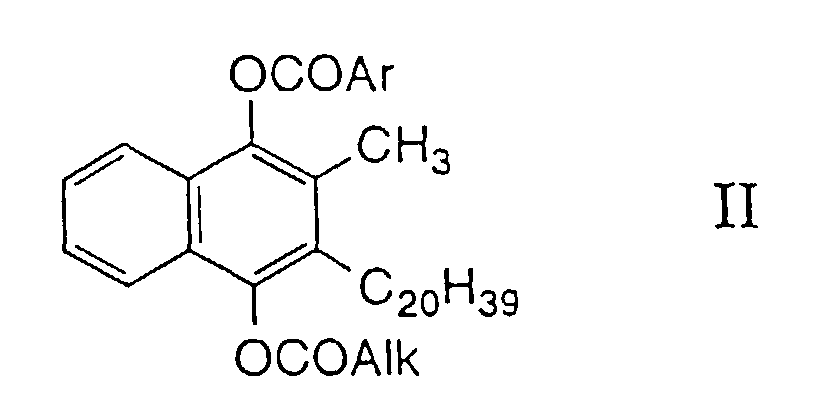
- the further aspect of the present invention consists in that a dihydrovitamin K 1 diester of the general formula is used to produce the dihydrovitamin K 1 alkali metal salt used in the oxidation process according to the invention, in particular the sodium or potassium salt wherein Ar is an aryl group, Alk is a C 1-4 alkyl group and C 20 H 39 denote 3,7,11,15-tetramethylhexadec-2-enyl group, saponified with sodium or potassium hydroxide.
- the oxidation process according to the invention expediently follows the saponification of the dihydrovitamin K 1 diester without the saponification product (dihydrovitamin K 1 sodium salt or potassium salt) being isolated first.
- this two-step process can be carried out as follows:
- the dihydrovitamin K 1 diester of the formula II is saponified with an excess of sodium or potassium hydroxide in a two-phase aqueous-organic solvent mixture.
- This solvent mixture expediently consists of an aqueous alcoholic phase and an organic phase which is essentially immiscible or insoluble in this phase, and if desired, each phase can be treated beforehand with a brightening agent, for example an aqueous solution of sodium dithionite.
- saponification which can expediently be carried out with stirring at room temperature or not so much elevated temperature, the dihydrovitamin K 1 alkali metal salt thus prepared is largely in the aqueous-alcoholic phase.
- any mineral acid or organic acid such as aqueous hydrochloric acid or sulfuric acid or Formic acid or acetic acid, but preferably acetic acid, is given until a pH of the aqueous-alcoholic phase of about 14 (in the range from 13.7 to 14.3) has been reached.
- Vitamin K 1 conveniently of the iron used as the catalyst (III) salt [eg Fe 2 (SO 4) 3; in practice, however, in view of its availability, the pentahydrate of ferric sulfate is preferably used in this case in order to provide the aqueous solution, so that the amount of this pentahydrate used, based on vitamin K 1, is correspondingly higher].
- the catalyst (III) salt eg Fe 2 (SO 4) 3
- the pentahydrate of ferric sulfate is preferably used in this case in order to provide the aqueous solution, so that the amount of this pentahydrate used, based on vitamin K 1, is correspondingly higher.
- the aqueous hydrogen peroxide solution used is advantageously one which has a concentration of 30% by weight (% by weight) to 40% by weight, preferably a concentration of 35% by weight.
- aqueous hydrogen peroxide solution for example 35% strength, is advantageously used in the case of dihydrovitamin K 1 acetate benzoate aqueous hydrogen peroxide solution, per part by weight of diester.
- equivalents 1.5 to 2.5 equivalents of hydrogen peroxide as such (H 2 O 2 ), preferably 1.85 to 2.13 equivalents, are expediently used per equivalent of diester.
- aqueous hydrogen peroxide solution 35% strength, as an example
- the oxidation process according to the invention expediently takes place in a two-phase aqueous-organic solvent mixture which consists on the one hand of an aqueous-alcoholic phase and on the other hand of an organic phase.
- a C 1-3 alkanol ie methanol, ethanol, n-propanol or isopropanol, is generally suitable as the alcohol.
- methanol is preferably used.
- the organic phase is suitably an aliphatic hydrocarbon, for example hexane, heptane or a mixture of hydrocarbons, for example petroleum ether; a halogenated hydrocarbon, eg methylene chloride; an aromatic hydrocarbon, for example benzene or toluene; or gasoline or a fraction thereof, for example ligroin.
- Petroleum ether is preferably used as the organic phase.
- the volume ratio of alcohol: water in the aqueous-alcoholic phase is expediently 3: 1 to 7: 1. In the case of the use of the preferred alcohol methanol, this volume ratio is generally 3: 1 to 7: 1, preferably 4: 1 to 6: 1. With respect to the two-phase solvent mixture, the volume ratio aqueous-alcoholic phase: organic phase is generally 3: 2 to 2: 3, preferably 10: 8 to 1: 1.
- K 1 alkali metal salt for example potassium salt
- K 1 alkali metal salt is advantageously used from 0.001 to 0.01 liters or 10 to 25 liters of a two-phase solvent mixture, preferably 0.002 to 0.006 liters or 15 to 20 liters.
- the oxidation is expediently at temperatures in the range from about 15 ° C to about 40 ° C, preferably at room temperature, carried out.
- the saponification preceding the oxidation process approximately 22 to 30 equivalents of sodium or potassium hydroxide, preferably 25 to 27 equivalents of this base, are expediently used per equivalent of dihydrovitamin K 1 diester of the formula II.
- Potassium hydroxide is preferably used as the base.
- the concentration of the aqueous sodium or potassium hydroxide solution used is advantageously 40% by weight (% by weight) to 60% by weight, preferably 55 to 58% by weight.
- the saponification also expediently takes place in a two-phase aqueous-organic solvent mixture which, on the one hand, consists of an aqueous-alcoholic phase and, on the other hand, of an organic phase.
- the above-mentioned information relating to the nature and the relative volume ratios of the constituents of this solvent mixture in relation to the oxidation process also essentially apply to the saponification.
- 0.01 to 0.05 liters or 10 to 25 liters of a two-phase solvent mixture preferably 0.02 to 10 liters
- 0.02 to 10 liters is expediently used per gram or equivalent of the dihydrovitamin K 1 diester of the formula II (for example the acetate benzoate) to be saponified 0.04 liters or 15 to 20 liters.
- the saponification is expediently carried out at temperatures in the range from about 15 ° C. to about 30 ° C., preferably at room temperature, and generally lasts from one to three hours, in particular about 2 hours.
- the brightening which may be used both in the saponification and in the subsequent oxidation, for example by means of an aqueous solution of sodium dithionite, serves to make the reaction mixture, which tends to darken during the relevant reaction, brighter and clearer, so that the respective reaction can be followed optically more easily .
- the vitamin K 1 finally obtained has a better quality by using the lightening agent.
- the mixture is then left to stand for a sufficient period of time for phase separation, and then the upper petroleum ether phase is pressed off using a glass tube and nitrogen and the lower methanolic phase is washed four times with 195 ml of high-boiling petroleum ether treated beforehand with 10% aqueous sodium dithionite solution. During this washing, the methanolic solution should be yellow, so that any darkening solution is immediately brightened with sufficient 10% aqueous sodium dithionite solution. The petroleum ether extracts are discarded. In this way (saponification), a yellow methanolic solution of dihydrovitamin K 1 potassium salt is obtained.
- the yellow solution of the precursor is 500 ml in advance with 20 ml 10% aqueous sodium dithionite solution treated, high-boiling Petroleum ether added. About 50-52 ml are added dropwise with vigorous stirring Glacial acetic acid, the last 5-7 ml particularly slowly, too. Because the reaction is exothermic, this addition is carried out with ice bath cooling at 10 ° C such that the reaction temperature does not exceed 30 ° C. In addition, the reaction solution when darkening by adding 10% aqueous sodium dithionite solution be lightened again. At a pH of 14 that is Solution greenish yellow, and the addition of glacial acetic acid is then stopped.
- the solution is left to stand for a sufficiently long time for phase separation.
- the yellow petroleum ether phase is then separated off and washed in succession with 200 ml of dilute acetic acid (50 mg of glacial acetic acid in 200 ml of water) until the pH of the acetic acid phase is approximately 6-7, and twice with 200 ml of water each.
- the petroleum ether phase is dried over 19 g of anhydrous sodium sulfate and then filtered.
- a solution of about 1.4 kg of sodium dithionite in about 10 l of water is added to a solution of about 30 kg of dihydrovitamin K 1 acetate benzoate in about 550 l of petroleum ether under nitrogen at room temperature.
- the result is a yellow solution, which is lightened when darkening before the next step by adding further sodium dithionite solution.
- a solution of about 75 kg of potassium hydroxide in about 56 kg of water and about 253 kg of methanol is then added to the solution, and the mixture is stirred for about 2 hours.
- the methanolic solution is separated off and washed several times with petroleum ether, after which the methanolic solution is diluted with about 280 kg of petroleum ether and about 74 kg of methanol and brightened as required by adding aqueous sodium dithionite solution.
- the pH is adjusted to 14 by adding 52-60 kg of acetic acid and, if necessary, further sodium dithionite solution.
- a solution of about 0.15 kg of ferric sulfate in about 15 kg of water is added to the mixture, followed by 7-10 kg of 35% aqueous hydrogen peroxide solution.
- the separated methanolic phase is extracted with petroleum ether, and the petroleum ether phase is first washed with very dilute aqueous acetic acid solution and then dried with anhydrous sodium sulfate, which is subsequently separated off.
- the decolorants are separated off by filtration and washed with petroleum ether.
- the combined petroleum ether filtrates are then concentrated under reduced pressure. The residue is deodorized with steam and the precipitate of vitamin K 1 is filtered off. In this way, an 80-92% yield of vitamin K 1 is obtained .
- Dihydrovitamin K 1 acetate benzoate is dissolved in petroleum ether and the solution is decolorized with aqueous sodium dithionite solution.
- the mixture is then saponified with an aqueous methanolic potassium hydroxide solution for 2 hours and the methanolic phase is extracted with petroleum ether and, if necessary, decolorized again.
- the pH is adjusted to 14 by adding glacial acetic acid.
- iron (III) sulfate as catalyst, the mixture is then oxidized below 30 ° C. with hydrogen peroxide.
- the petroleum ether phase is washed with water, dried with anhydrous sodium sulfate and decolorized with activated carbon together with aluminum oxide.
- the filtrate is concentrated under reduced pressure and purified by steam distillation. Finally, the vitamin K 1 thus obtained is filtered off.
- the color of the saponification solution is checked continuously during the stirring period: if the color deviates from yellow (darkens), the solution must be lightened by adding further aqueous sodium dithionite solution (0.3 kg / 5 l). After the hydrolysis has ended, the solution (c) is left to stand for 20 to at most 30 minutes.
- the methanolic phase (e) is added to 100 l (67 kg) of the petroleum ether phase (f) in a stirred kettle for further extraction, and after the petroleum ether phase has been separated off, the methanolic phase [(g)] remains, which consists of a methanolic solution of dihydrovitamin K 1 potassium salt exists.
- Glacial acetic acid is slowly added to the solution in the oxidation kettle until a pH value is reached out of 14 has been reached. If the solution is no longer lemon yellow is again 0.1-5 l (0.1-5.4 kg) of aqueous sodium dithionite solution slowly admitted.
- the iron sulfate solution then becomes the solution in the oxidation kettle added, followed by 5 l of water.
- the petroleum ether phase still in the oxidation kettle is cleaned with 200 l of water and extracted after adding 0.5-0.8 l (0.52-0.84 kg) of glacial acetic acid at pH 3.6-4.0. Then the separated petroleum ether phase, together with rinses, is transferred to a pointed kettle with 100 l (67 kg) of high-boiling petroleum ether and is cleaned there with 200 l of water. After the lower aqueous phase has been separated off, it is extracted in a further kettle with 100 l (67 kg) of high-boiling petroleum ether and its pH is measured. If it is greater than 6, the petroleum ether phase in the pointed kettle is cleaned again with 200 l of water and the lower aqueous phase is separated off and its pH is measured. This procedure is repeated until the measured pH of the aqueous phase is less than 6, possibly four times.
- the petroleum ether phase cleaned in this way consists almost exclusively of vitamin K 1 and solvent.
- the decolorization with activated carbon and aluminum oxide is repeated and checked a sample of the filtrate for color and fluorescence. Depending on The result is the process with activated carbon alone (for decolorization) or with Aluminum oxide alone (to remove fluorescent components) repeated, until the petroleum ether solution is decolorized.
- the decolorized petroleum ether solution is continuously evaporated at 85-90 ° C (steam outlet) and a flow rate of 120-130 l / h while stirring.
- the concentrated vitamin K 1 solution is then transferred to a kettle and overlaid under nitrogen at a pressure of 30 kPa (0.3 bar).
- the evaporation and subsequent superposition (under a nitrogen pressure of 30 kPa (0.3 bar) of the concentrated vitamin K 1 solution are repeated twice (1st repetition: 3-4 kPa (30-40 mbar), steam outlet 70-80 ° C , Throughput speed 30-40 l / h; 2nd repetition: ⁇ 2.5 kPa (25 mbar), steam outlet 55-65 ° C, throughput speed 80-110 l / h).
- the contents of the last overlay boiler are subjected to steam distillation at less than 2.5 kPa (25 mbar) and a jacket temperature of 68-74 ° C.
- the captured vitamin K 1 is then superimposed under nitrogen at a pressure of 30 kPa (0.3 bar).
- the good quality (purity) vitamin K 1 thus obtained can be filled into bidons and blanketed with nitrogen. The bids are then closed and labeled.
Landscapes
- Chemical & Material Sciences (AREA)
- Organic Chemistry (AREA)
- Organic Low-Molecular-Weight Compounds And Preparation Thereof (AREA)
- Low-Molecular Organic Synthesis Reactions Using Catalysts (AREA)
- Catalysts (AREA)
- Pharmaceuticals Containing Other Organic And Inorganic Compounds (AREA)
Claims (9)
- Procédé de préparation de vitamine K1 , caractérisé en ce qu'on oxyde un sel de métal alcalin de dihydrovitamine K1 avec du peroxyde d'hydrogène en présence d'un sel de fer(III) et à un pH de 13,7 à 14,3.
- Procédé selon la revendication 1, caractérisé en ce que pour préparer le sel de métal alcalin de dihydrovitamine K1, en particulier le sel de sodium ou de potassium, on saponifie avec de l'hydroxyde de sodium ou selon les cas de potassium un diester de dihydrovitamine K1 de formule généraledans laquelle Ar représente un groupe aryle, alk représente un groupe alkyle en C1 à C4 et C20H39 représente le groupe 3,7,11,15-tétraméthylhexadéc-2-ényle.
- Procédé selon les revendications 1 et 2, caractérisé en ce que le procédé selon la revendication 1 s'ajoute au procédé selon la revendication 2, sans qu'on n'isole tout d'abord le produit de saponification sel de sodium ou de potassium de dihydrovitamine K1.
- Procédé selon la revendication 2 ou 3, caractérisé en ce qu'on utilise comme diester de dihydrovitamine K1 l'acétate-benzoate.
- Procédé selon l'une des revendications 1 à 4, caractérisé en ce que le procédé en question se déroule dans un mélange de solvants aqueux-organique à deux phases.
- Procédé selon la revendication 5, caractérisé en ce que le mélange de solvants aqueux-organique se compose d'une phase aqueuse-alcoolique et d'une phase organique essentiellement non miscible avec cette phase ou qui n'y est pas soluble.
- Procédé selon la revendication 6, caractérisé en ce que la phase aqueuse-organique est le méthanol aqueux et la phase organique l'éther de pétrole.
- Procédé selon l'une des revendications 1 à 7, caractérisé en ce qu'on utilise comme sel de fer (III) le sulfate de fer (III).
- Procédé selon l'une des revendications 1 à 8, caractérisé en ce qu'on atteint le pH auquel le sel de métal alcalin de dihydrovitamine K1 est oxydé en vitamine K1 par addition d'acide acétique.
Applications Claiming Priority (3)
| Application Number | Priority Date | Filing Date | Title |
|---|---|---|---|
| CH359695 | 1995-12-20 | ||
| CH359695 | 1995-12-20 | ||
| CH3596/95 | 1995-12-20 |
Publications (2)
| Publication Number | Publication Date |
|---|---|
| EP0780357A1 EP0780357A1 (fr) | 1997-06-25 |
| EP0780357B1 true EP0780357B1 (fr) | 2000-10-18 |
Family
ID=4259402
Family Applications (1)
| Application Number | Title | Priority Date | Filing Date |
|---|---|---|---|
| EP96119937A Expired - Lifetime EP0780357B1 (fr) | 1995-12-20 | 1996-12-12 | Préparation de la vitamine K1 |
Country Status (8)
| Country | Link |
|---|---|
| US (1) | US5744624A (fr) |
| EP (1) | EP0780357B1 (fr) |
| JP (1) | JP3856884B2 (fr) |
| CN (1) | CN1113843C (fr) |
| AT (1) | ATE197037T1 (fr) |
| DE (1) | DE59606023D1 (fr) |
| DK (1) | DK0780357T3 (fr) |
| ES (1) | ES2151985T3 (fr) |
Family Cites Families (11)
| Publication number | Priority date | Publication date | Assignee | Title |
|---|---|---|---|---|
| US1984511A (en) * | 1933-09-09 | 1934-12-18 | New Haven Dispensary | Method of making hydroxyquinone compounds |
| US2376984A (en) * | 1940-04-06 | 1945-05-29 | Merck & Co Inc | Substituted benzoquinones and process for their production |
| CH320582A (de) * | 1953-08-12 | 1957-03-31 | Hoffmann La Roche | Verfahren zur Herstellung von Kondensationsprodukten |
| DE1054085B (de) * | 1955-05-14 | 1959-04-02 | Dr Jaroslav Weichet | Verfahren zur Herstellung von synthetischem Vitamin K oder von dessen Analogen |
| US3076004A (en) * | 1959-01-21 | 1963-01-29 | Merck & Co Inc | Preparation of 2-methyl-3-phytyl-1, 4-naphthohydroquinone ester |
| JPS5110229B2 (fr) * | 1971-10-27 | 1976-04-02 | ||
| JPS4876854A (fr) * | 1972-01-22 | 1973-10-16 | ||
| US3948958A (en) * | 1975-04-07 | 1976-04-06 | The Regents Of The University Of California | Process for making 3-prenylated menaquinones and ether intermediates |
| JPS57212142A (en) * | 1981-06-25 | 1982-12-27 | Nisshin Flour Milling Co Ltd | Purification of dihydrovitamin k derivative |
| JPS62294636A (ja) * | 1986-05-21 | 1987-12-22 | Eisai Co Ltd | 2−メチル−1,4−ナフトキノンの製造法 |
| US5075463A (en) * | 1990-10-05 | 1991-12-24 | Eastman Kodak Company | Preparation of quinones |
-
1996
- 1996-12-12 EP EP96119937A patent/EP0780357B1/fr not_active Expired - Lifetime
- 1996-12-12 DE DE59606023T patent/DE59606023D1/de not_active Expired - Fee Related
- 1996-12-12 DK DK96119937T patent/DK0780357T3/da active
- 1996-12-12 US US08/764,289 patent/US5744624A/en not_active Expired - Lifetime
- 1996-12-12 ES ES96119937T patent/ES2151985T3/es not_active Expired - Lifetime
- 1996-12-12 AT AT96119937T patent/ATE197037T1/de not_active IP Right Cessation
- 1996-12-17 JP JP33648496A patent/JP3856884B2/ja not_active Expired - Lifetime
- 1996-12-18 CN CN96121569A patent/CN1113843C/zh not_active Expired - Lifetime
Also Published As
| Publication number | Publication date |
|---|---|
| EP0780357A1 (fr) | 1997-06-25 |
| JPH09183750A (ja) | 1997-07-15 |
| DK0780357T3 (da) | 2001-01-02 |
| CN1113843C (zh) | 2003-07-09 |
| ES2151985T3 (es) | 2001-01-16 |
| JP3856884B2 (ja) | 2006-12-13 |
| DE59606023D1 (de) | 2000-11-23 |
| US5744624A (en) | 1998-04-28 |
| ATE197037T1 (de) | 2000-11-15 |
| CN1158837A (zh) | 1997-09-10 |
Similar Documents
| Publication | Publication Date | Title |
|---|---|---|
| DE2505869B2 (de) | Verfahren zur herstellung von symmetrischen carotinoiden | |
| DE69916090T2 (de) | Verfahren zur herstellung des alpha-tocopherol acetats | |
| EP0015436A1 (fr) | Procédé de fabrication stéréospécifique de composés appartenant à la famille des vitamines K1 et K2 ainsi que des produits de départ pour ce procédé | |
| EP0644186B1 (fr) | Procédé pour la préparation d'acide 13-(Z)-retinoique. | |
| DE69704475T2 (de) | Verfahren zur Herstellung von 13-cis-Retinsäure | |
| EP0627405B1 (fr) | Procédé de préparation d'ester méthylique de l'acide 5-bromo-6-méthoxy-1-naphtoique | |
| DE2365131A1 (de) | Verfahren zur herstellung von p-nitrobenzoesaeure | |
| EP0780357A1 (fr) | Préparation de la vitamine K1 | |
| DE3703113A1 (de) | Verfahren zur herstellung von substituierten 3-alkyl-chinolin-8-carbonsaeuren | |
| EP1169281A1 (fr) | Oxydation d'oxygene singulet de substrats organiques | |
| DE1793308B1 (de) | Herstellung von Canthaxanthin | |
| DE2809496A1 (de) | Verfahren zur herstellung von 2-methyl-3-phenyl-4,5,6-trimethoxyphenol | |
| EP0285972B1 (fr) | Procédé de préparation de l'acide 2,4-diaminobenzène sulfonique | |
| EP0278377B1 (fr) | Procédé pour la fabrication de tétrachloro-1,4-benzoquinone d'haute pureté | |
| DE2321003C2 (de) | Verfahren zur Herstellung von 5- Nitro-naphthochinon-(1,4) | |
| EP0087576A1 (fr) | Procédé pour préparer de l'acétate de tocophérol ou du propionate de tocophérol | |
| EP0093880A1 (fr) | Procédé de préparation de 2,3,5-triméthyl-p-benzoquinone | |
| EP0036651B1 (fr) | Préparation de 3-oxo-alpha-ionone | |
| DE2751662C2 (de) | Verfahren zur Herstellung von 1,4-Dihydroanthrachinonen | |
| DE2642672A1 (de) | Selektive oxidation von chrysanthemylalkohol | |
| EP0498847A1 (fr) | Procede de preparation de 1,4-bis-(4-hydroxybenzoyl)-benzol. | |
| DE19654038A1 (de) | Verfahren zur Herstellung von alpha-Tocopherol oder alpha-Tocopherylacetat durch Umsetzen von Trimethylhydrochinon und Phytol oder Isophytol unter Rückführung des Kondensationskatalysators Zinkchlorid | |
| EP0181409B1 (fr) | Derives de 15(r+s)-fluor-11,15-didesoxyprostaglandine e 1? | |
| DE2217135C3 (de) | Verfahren zur fotosensibilisierten Oxidation von Lupulonen | |
| DE2413189C2 (de) | Verfahren zur Herstellung von Benzohydrochinonen |
Legal Events
| Date | Code | Title | Description |
|---|---|---|---|
| PUAI | Public reference made under article 153(3) epc to a published international application that has entered the european phase |
Free format text: ORIGINAL CODE: 0009012 |
|
| 17P | Request for examination filed |
Effective date: 19961212 |
|
| AK | Designated contracting states |
Kind code of ref document: A1 Designated state(s): AT BE CH DE DK ES FR GB IT LI NL |
|
| 17Q | First examination report despatched |
Effective date: 19981218 |
|
| GRAG | Despatch of communication of intention to grant |
Free format text: ORIGINAL CODE: EPIDOS AGRA |
|
| GRAG | Despatch of communication of intention to grant |
Free format text: ORIGINAL CODE: EPIDOS AGRA |
|
| GRAH | Despatch of communication of intention to grant a patent |
Free format text: ORIGINAL CODE: EPIDOS IGRA |
|
| GRAH | Despatch of communication of intention to grant a patent |
Free format text: ORIGINAL CODE: EPIDOS IGRA |
|
| GRAA | (expected) grant |
Free format text: ORIGINAL CODE: 0009210 |
|
| AK | Designated contracting states |
Kind code of ref document: B1 Designated state(s): AT BE CH DE DK ES FR GB IT LI NL |
|
| REF | Corresponds to: |
Ref document number: 197037 Country of ref document: AT Date of ref document: 20001115 Kind code of ref document: T |
|
| REG | Reference to a national code |
Ref country code: CH Ref legal event code: EP |
|
| GBT | Gb: translation of ep patent filed (gb section 77(6)(a)/1977) |
Effective date: 20001018 |
|
| REF | Corresponds to: |
Ref document number: 59606023 Country of ref document: DE Date of ref document: 20001123 |
|
| PGFP | Annual fee paid to national office [announced via postgrant information from national office to epo] |
Ref country code: GB Payment date: 20001206 Year of fee payment: 5 |
|
| PGFP | Annual fee paid to national office [announced via postgrant information from national office to epo] |
Ref country code: AT Payment date: 20001213 Year of fee payment: 5 |
|
| PGFP | Annual fee paid to national office [announced via postgrant information from national office to epo] |
Ref country code: ES Payment date: 20001220 Year of fee payment: 5 |
|
| PGFP | Annual fee paid to national office [announced via postgrant information from national office to epo] |
Ref country code: NL Payment date: 20001231 Year of fee payment: 5 |
|
| REG | Reference to a national code |
Ref country code: DK Ref legal event code: T3 |
|
| ITF | It: translation for a ep patent filed | ||
| REG | Reference to a national code |
Ref country code: ES Ref legal event code: FG2A Ref document number: 2151985 Country of ref document: ES Kind code of ref document: T3 |
|
| ET | Fr: translation filed | ||
| PGFP | Annual fee paid to national office [announced via postgrant information from national office to epo] |
Ref country code: BE Payment date: 20010315 Year of fee payment: 5 |
|
| PLBE | No opposition filed within time limit |
Free format text: ORIGINAL CODE: 0009261 |
|
| STAA | Information on the status of an ep patent application or granted ep patent |
Free format text: STATUS: NO OPPOSITION FILED WITHIN TIME LIMIT |
|
| 26N | No opposition filed | ||
| PG25 | Lapsed in a contracting state [announced via postgrant information from national office to epo] |
Ref country code: GB Free format text: LAPSE BECAUSE OF NON-PAYMENT OF DUE FEES Effective date: 20011212 Ref country code: AT Free format text: LAPSE BECAUSE OF NON-PAYMENT OF DUE FEES Effective date: 20011212 |
|
| PG25 | Lapsed in a contracting state [announced via postgrant information from national office to epo] |
Ref country code: BE Free format text: LAPSE BECAUSE OF NON-PAYMENT OF DUE FEES Effective date: 20011231 |
|
| REG | Reference to a national code |
Ref country code: GB Ref legal event code: IF02 |
|
| BERE | Be: lapsed |
Owner name: F. HOFFMANN-LA ROCHE A.G. Effective date: 20011231 |
|
| PG25 | Lapsed in a contracting state [announced via postgrant information from national office to epo] |
Ref country code: NL Free format text: LAPSE BECAUSE OF NON-PAYMENT OF DUE FEES Effective date: 20020701 |
|
| GBPC | Gb: european patent ceased through non-payment of renewal fee |
Effective date: 20011212 |
|
| NLV4 | Nl: lapsed or anulled due to non-payment of the annual fee |
Effective date: 20020701 |
|
| PG25 | Lapsed in a contracting state [announced via postgrant information from national office to epo] |
Ref country code: ES Free format text: LAPSE BECAUSE OF NON-PAYMENT OF DUE FEES Effective date: 20021213 |
|
| REG | Reference to a national code |
Ref country code: CH Ref legal event code: PUE Owner name: DSM IP ASSETS B.V. Free format text: F. HOFFMANN-LA ROCHE AG#124 GRENZACHERSTRASSE#4070 BASEL (CH) -TRANSFER TO- DSM IP ASSETS B.V.#HET OVERLOON 1#6411 TE HEERLEN (NL) |
|
| REG | Reference to a national code |
Ref country code: ES Ref legal event code: FD2A Effective date: 20030113 |
|
| REG | Reference to a national code |
Ref country code: FR Ref legal event code: TP |
|
| PG25 | Lapsed in a contracting state [announced via postgrant information from national office to epo] |
Ref country code: IT Free format text: LAPSE BECAUSE OF NON-PAYMENT OF DUE FEES Effective date: 20051212 |
|
| PGFP | Annual fee paid to national office [announced via postgrant information from national office to epo] |
Ref country code: DK Payment date: 20071231 Year of fee payment: 12 |
|
| PGFP | Annual fee paid to national office [announced via postgrant information from national office to epo] |
Ref country code: FR Payment date: 20071217 Year of fee payment: 12 |
|
| PGFP | Annual fee paid to national office [announced via postgrant information from national office to epo] |
Ref country code: DE Payment date: 20090202 Year of fee payment: 13 |
|
| REG | Reference to a national code |
Ref country code: DK Ref legal event code: EBP |
|
| REG | Reference to a national code |
Ref country code: FR Ref legal event code: ST Effective date: 20090831 |
|
| PG25 | Lapsed in a contracting state [announced via postgrant information from national office to epo] |
Ref country code: DK Free format text: LAPSE BECAUSE OF NON-PAYMENT OF DUE FEES Effective date: 20090105 |
|
| PG25 | Lapsed in a contracting state [announced via postgrant information from national office to epo] |
Ref country code: FR Free format text: LAPSE BECAUSE OF NON-PAYMENT OF DUE FEES Effective date: 20081231 |
|
| PG25 | Lapsed in a contracting state [announced via postgrant information from national office to epo] |
Ref country code: DE Free format text: LAPSE BECAUSE OF NON-PAYMENT OF DUE FEES Effective date: 20100701 |
|
| PGFP | Annual fee paid to national office [announced via postgrant information from national office to epo] |
Ref country code: CH Payment date: 20151211 Year of fee payment: 20 |
|
| REG | Reference to a national code |
Ref country code: CH Ref legal event code: PL |