EP0780962A2 - Moteur commuté électroniquement - Google Patents
Moteur commuté électroniquement Download PDFInfo
- Publication number
- EP0780962A2 EP0780962A2 EP96119750A EP96119750A EP0780962A2 EP 0780962 A2 EP0780962 A2 EP 0780962A2 EP 96119750 A EP96119750 A EP 96119750A EP 96119750 A EP96119750 A EP 96119750A EP 0780962 A2 EP0780962 A2 EP 0780962A2
- Authority
- EP
- European Patent Office
- Prior art keywords
- motor
- microprocessor
- reset
- input
- hall
- Prior art date
- Legal status (The legal status is an assumption and is not a legal conclusion. Google has not performed a legal analysis and makes no representation as to the accuracy of the status listed.)
- Granted
Links
- 230000006870 function Effects 0.000 claims abstract description 9
- 230000010355 oscillation Effects 0.000 claims abstract description 3
- 230000004913 activation Effects 0.000 claims abstract 2
- 239000003990 capacitor Substances 0.000 claims description 39
- 238000000034 method Methods 0.000 claims description 26
- 230000008569 process Effects 0.000 claims description 25
- 230000001419 dependent effect Effects 0.000 claims description 3
- 230000001771 impaired effect Effects 0.000 claims 1
- 125000004122 cyclic group Chemical group 0.000 description 6
- 238000010586 diagram Methods 0.000 description 5
- 230000009471 action Effects 0.000 description 3
- 238000013021 overheating Methods 0.000 description 3
- 230000008901 benefit Effects 0.000 description 2
- 238000012986 modification Methods 0.000 description 2
- 230000004048 modification Effects 0.000 description 2
- 238000004804 winding Methods 0.000 description 2
- 230000003213 activating effect Effects 0.000 description 1
- 239000000919 ceramic Substances 0.000 description 1
- 230000008859 change Effects 0.000 description 1
- 230000007423 decrease Effects 0.000 description 1
- 230000007547 defect Effects 0.000 description 1
- 230000002950 deficient Effects 0.000 description 1
- 230000003111 delayed effect Effects 0.000 description 1
- 238000011161 development Methods 0.000 description 1
- 230000018109 developmental process Effects 0.000 description 1
- 230000004069 differentiation Effects 0.000 description 1
- 230000008030 elimination Effects 0.000 description 1
- 238000003379 elimination reaction Methods 0.000 description 1
- 230000003993 interaction Effects 0.000 description 1
- 230000007257 malfunction Effects 0.000 description 1
- 230000001681 protective effect Effects 0.000 description 1
- 230000001052 transient effect Effects 0.000 description 1
- 230000001960 triggered effect Effects 0.000 description 1
Images


Classifications
-
- H—ELECTRICITY
- H02—GENERATION; CONVERSION OR DISTRIBUTION OF ELECTRIC POWER
- H02P—CONTROL OR REGULATION OF ELECTRIC MOTORS, ELECTRIC GENERATORS OR DYNAMO-ELECTRIC CONVERTERS; CONTROLLING TRANSFORMERS, REACTORS OR CHOKE COILS
- H02P23/00—Arrangements or methods for the control of AC motors characterised by a control method other than vector control
- H02P23/0077—Characterised by the use of a particular software algorithm
-
- H—ELECTRICITY
- H02—GENERATION; CONVERSION OR DISTRIBUTION OF ELECTRIC POWER
- H02P—CONTROL OR REGULATION OF ELECTRIC MOTORS, ELECTRIC GENERATORS OR DYNAMO-ELECTRIC CONVERTERS; CONTROLLING TRANSFORMERS, REACTORS OR CHOKE COILS
- H02P6/00—Arrangements for controlling synchronous motors or other dynamo-electric motors using electronic commutation dependent on the rotor position; Electronic commutators therefor
- H02P6/34—Modelling or simulation for control purposes
-
- H—ELECTRICITY
- H02—GENERATION; CONVERSION OR DISTRIBUTION OF ELECTRIC POWER
- H02H—EMERGENCY PROTECTIVE CIRCUIT ARRANGEMENTS
- H02H7/00—Emergency protective circuit arrangements specially adapted for specific types of electric machines or apparatus or for sectionalised protection of cable or line systems, and effecting automatic switching in the event of an undesired change from normal working conditions
- H02H7/08—Emergency protective circuit arrangements specially adapted for specific types of electric machines or apparatus or for sectionalised protection of cable or line systems, and effecting automatic switching in the event of an undesired change from normal working conditions for dynamo-electric motors
- H02H7/093—Emergency protective circuit arrangements specially adapted for specific types of electric machines or apparatus or for sectionalised protection of cable or line systems, and effecting automatic switching in the event of an undesired change from normal working conditions for dynamo-electric motors against increase beyond, or decrease below, a predetermined level of rotational speed
Definitions
- the invention relates to an electronically commutated motor with control of functions by a microprocessor or microcontroller, hereinafter called the microprocessor.
- German patent application P 44 42 450.7 is concerned with this problem.
- This uses motor-controlled reset processes which are distinguished from the reset process which occurs when the device is switched on by an additional signal at an input of the microprocessor, which is provided there by a memory cell. This allows the motor to run safely.
- the microprocessor becomes defective, the motor stator windings will continue to receive current and become overheated.
- a free input of the microprocessor to which such an external memory cell can be connected is not always available, since in some cases all inputs of the microprocessor are required for the desired additional functions of the motor.
- this object is achieved by an electronically commutated motor with control of functions by a microprocessor or microcontroller, hereinafter referred to as the microprocessor, and with a watchdog timer arranged outside the microprocessor, which receives its reset pulses from a rotor position sensor of the motor, or another by the rotation of the motor directly actuated sensor, in order to prevent triggering of this timing element at least above a predetermined motor speed during operation of the motor.
- Watchdog timers are known in the context of microprocessors and it is common to provide reset pulses from the microprocessor as long as it is functioning properly. However, this does not provide security against malfunctions of the microprocessor, because it may very well be that the microprocessor continues to emit reset pulses, but that there is a defect at one of its outputs, which then leads to overheating of the motor controlled by this output.
- the motor is advantageously designed such that the watchdog timer contains a multivibrator with a low oscillation frequency, which is kept in the deactivated state when the motor is running, by signals generated when the motor rotates, at least above a predetermined motor speed.
- the watchdog timer therefore only comes into action when the engine speed falls below the specified value or when the engine has come to a standstill.
- a particularly advantageous embodiment of the invention is distinguished characterized in that the multivibrator periodically discharges a capacitor in the activated state, which belongs to a power-up reset circuit of the microprocessor and is connected to a reset input of this microprocessor, and in that the multivibrator is periodically activated when it is activated and without the microprocessor being switched on , interrupts the stator current of the motor, especially with a low duty cycle.
- the fact that the watchdog timer interrupts the stator current of the motor when it responds, i.e. not via the microprocessor, provides a high level of security against failure of the microprocessor, since the remaining parts of the motor circuit continue to function in this case and ensure that the engine does not overheat.
- the low duty cycle creates long pauses in which no current flows in the motor, so that there is no risk of the motor overheating.
- ECM electronically commutated motor
- the invention is suitable for any type of motor, and this motor can also be a collector motor, provided that it generates control impulses during its rotation, for example by a tachometer generator or a Hall generator arranged in or on the motor.
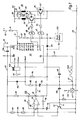
- the permanent magnetic rotor of the motor 20 is indicated schematically at 22 and the two strands of its stator winding have the reference numerals 24 and 26. As shown, these are connected to a positive line 28, which e.g. + 12 V, + 24 V or + 48 V compared to the potential of a negative lead 30.
- An npn Darlington transistor 32 is used to control the current i 1 in the strand 24, and a corresponding transistor 34 for controlling the current i 2 in the strand 26, both of which are provided with a free-wheeling diode 32 'and 34'.
- the emitters of both transistors 32, 34 are connected to the negative line 30, their collectors to the strands 24 and 26, respectively.
- the base of the transistor 32 is controlled by an AND gate 38 via a resistor 40, as is the base of the transistor 34 by an AND gate 42 via a resistor 44.
- An input of the AND gate 38, which in FIG. 1 is P1 is connected to the output C1 of a microprocessor 50, the other via a resistor 48 with a positive supply line 52 of, for example, + 5 V, as well corresponding input of the AND gate 42, and the anode of a diode 54, the cathode of which is connected to the output 58 of an operational amplifier 56.
- the other input of the AND gate 42 is connected to the output C2 of the microprocessor 50.
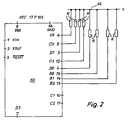
- the individual connections of the microprocessor 50 here a 4-bit microprocessor of type 17P103 (manufacturer NEC), are shown schematically in FIG. As can be seen, the connections B0, B1, B2, C0, C3, D0, D1, D2 are each connected via a resistor R to the positive line 52 (+5 V). This resistance R can e.g. have a value of 47 k ⁇ .
- a Hall IC 60 is arranged in the vicinity of the rotor 22, which is shown again on the lower left in FIG. 1 and which generates rectangular "Hall" pulses during operation, which are shown schematically in FIG. 1. These are fed via a resistor 62 to the input D3 of the microprocessor 50, further via a first differentiating element (resistor 64 and capacitor 66) to the reset input RESET / of the microprocessor 50, and via a second differentiating element (capacitor 68, resistor 70) of the base 71 NPN transistor 72, the emitter of which is connected to the negative line 30 and the collector of which is connected to the negative input 74 of the operational amplifier 56.
- a capacitor 76 is arranged between this input 74 and the negative line 30, and a resistor 78 between this input 74 and the output 58.
- a resistor 80 is arranged between the plus input 82 of the operational amplifier 56 and its output 58, and this plus input 82 is located at the connection point 84 of two resistors 86, 88, of which the former is connected to the plus line 52 and the latter to the minus line 30.
- a resistor 90 lies between the output 58 and the positive line 52.
- a resistor 92 connects this output to a node 94, which is connected to the negative line 30 via a capacitor 96 and to the reset input 3 of the microprocessor 50 via a resistor 98 is.
- the input 3 is also connected to the anode of a diode 100, the cathode of which is connected to the positive line 52. This prevents the reset input RESET / from adopting a higher potential than the positive line 52.
- a ceramic resonator 102 (8 MHz) is connected to the inputs XIN and XOUT of the microprocessor 50 as the clock generator. Between the input V 00 of the microprocessor 50 and its input GND there is a capacitor 104 which prevents interference pulses from reaching the microprocessor 50 via the positive line 52.
- the Hall signal is fed to the input D3 of the microprocessor 50 via the resistor 62, so that the microprocessor can properly control the commutation signals at the outputs C1 and C2, as will be explained below of the flowchart of FIG. 7 is described and explained in detail.
- the resistor 62 prevents the Hall signal from being short-circuited in the event of an internal short circuit or a fault in the microprocessor 50 and therefore represents an important safety feature, because without this resistor 62 the cyclical reset process would no longer be possible in this case.
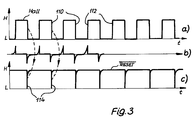
- the Hall signal (FIG. 3a) is differentiated via the capacitor 66 and supplied in a differentiated form (FIG. 3b) to the RESET / microprocessor 50 input.
- this input On every negative edge 110 of the Hall signal, this input is briefly pulled to 0 V, that is to the potential of the negative line 30, and on every positive edge 112 this RESET input receives a more positive potential for a short time, but as soon as it is 5.7 V exceeds, is derived via the diode 100 and buffered by the capacitor 104 so that the microprocessor 50 is not damaged or destroyed by this signal.
- the Hall IC 60 Since the Hall IC 60 has an open collector output, it has a pull-up resistor 64 which makes the output 61 of the Hall IC 60 positive when its internal output transistor is turned off.
- the capacitor 68 and the resistor 70 form a differentiator, which generates a positive pulse on each positive edge 112 of the Hall signal, which briefly renders the transistor 72 conductive, causing it to briefly pull the minus input 74 of the operational amplifier 56 to 0 V and thereby the capacitor 76 discharges.
- the operational amplifier 56 forms, together with its passive components, a so-called watchdog timer 120, which is referred to below as a WD timer.
- a watchdog timer 120 This term is used to denote a circuit which is intended to prevent a microprocessor 50 from "hanging up” due to interference pulses or the like, that is to say it stops somewhere in its program and refuses to work.
- the WD timer 120 only does not take action if it is continuously supplied with so-called refresh pulses which prevent it from becoming active, and in the present case it receives these refresh pulses via the differentiator 68, 70 and the transistor 72.
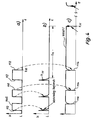
- Fig. 4 shows the procedure just described.
- the Hall signals are shown as the speed decreases. Their positive edges 112 cause the positive pulses u 71 shown in FIG. 4b at the base 71 of the transistor 72, and these pulses cause the capacitor 76 to be continuously discharged as long as the motor 20 is running, ie the motor 20 as long as it is running the refresh signals for the WD timer 120, so that it cannot be activated while the engine 20 is running.
- This change in potential is delayed by the resistor 92 and the capacitor 96 and fed to the microprocessor 50 as a watchdog reset signal via the resistor 98.
- the microprocessor 50 in this case carries out a power-up reset, just as when switching on: when switching on, the capacitor 96 is discharged, ie the RESET / input initially has the potential 0 V, and Only when the capacitor 96 has charged via the resistors 90 and 92 does this input receive the signal high. This automatically creates a power-up reset process when the motor 20 is switched on.
- the diode 54 becomes conductive, so that the corresponding inputs of the AND gates 38 and 42 receive a correspondingly low potential and both transistors 32 and 34 are blocked as long as the output 58 is low.
- the capacitor 76 is discharged via the resistor 78, and therefore after some time the potential at the minus input 74 again becomes more negative than the potential at the plus input 82, as a result of which the output 58 becomes high again. As a result, that of the transistors 32, 34 which receives a corresponding commutation signal from the microprocessor 50 becomes conductive again and the motor 20 tries to start again.
- the pulses Hall arise again, which periodically discharge the capacitor 76 and deactivate the WD timer 120.
- the cycle described is repeated, i.e. the WD timer 120 oscillates at a very low frequency, e.g. 0.2 Hz, continuously gives reset pulses to the microprocessor 50, and switches the transistor 32 or 34, e.g. one second and four seconds off, so that the motor 20 cannot overheat, but will start again if the blockage is no longer present. This is called an anti-lock device with automatic restart.
- the motor 20 is completely switched off by the process described, which is advantageous because during the reset process, possibly undefined states at the outputs C1 and C2 of the Microprocessor 50 could occur. However, since the motor 20 cannot receive any current during this reset process, this does not interfere, which is a further advantage of the invention.
- a PWM signal from a PWM actuator 122 at point P1 that is to say the anode of diode 54, and the pulse duty factor of this PWM actuator 122 would then be set to 0% if the potential at output 58 became 0 V will.
- This variant is indicated in Fig. 1 with dashed lines; in this case the diode 54 would be omitted.
- the PWM controller 122 can be part of a current controller or a speed controller (not shown).
- full-bridge circuit (not shown) is used to control the motor 20, its switching elements must be latched to one another in a known manner, so that a short circuit in this full-bridge circuit is reliably avoided even if a fault occurs in the microprocessor 50.
- Corresponding circuits for full bridge circuits are known.
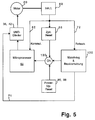
- FIG. 5 shows the basic structure of the circuit according to FIG. 1 in the form of a block diagram.
- the Hall IC 60 is coupled to the motor 20 and, when the motor 20 rotates, it supplies refresh pulses to the WD timer 120 via the transistor 72, so that the latter is kept in the non-activated state.
- Hall IC 60 also provides cyclic reset signals to microprocessor 50 (via capacitor 66) and a power-up reset occurs via capacitor 96 and resistor 98 at startup.
- the AND gates 38, 42 are controlled via the signal at point P1, which is supplied by the WD timer 120.
- the microprocessor 50 itself is periodically reset when the motor 20 is running by means of a cyclical reset process 66, or - when switched on - via the power-up reset 96, 98, or - when the motor 20 is blocked - via the WD timer 120. These alternative possibilities are symbolized by an OR symbol 130.
- the microprocessor 50 receives the Hall commutation signals from the Hall IC 60 so that it controls the motor 20 correctly.
- step S130 the program, controlled by the address counter of the microprocessor 50, jumps to step S130, where a brief initialization can be carried out if necessary.
- step S132 a query is made as to whether the memory cell RES_Bit1 in the microprocessor 50 is set. If this is the case, the program goes to step S134, where the same query for the internal memory cell RES_Bit2 takes place. If the answer is also positive here, the program goes to step S136, where it is queried whether the memory cells for the byte RES_Byte contain the value wxyz.
- step S138 a query is made as to whether the Hall signal is high. 3, since a cyclic reset process takes place only on the negative edge 110 of a Hall signal, the Hall signal must be low after a cyclic reset process, ie a high Hall signal means that there is no cyclical reset process may have taken place and it must be a power-up reset. Step S138 may also be omitted if steps S132, 134, 136 already provide a sufficiently high level of security.
- step S140 a cyclic reset process is carried out in step S140, and in this case no detailed initialization (step S142) is carried out, but only the program counter is reset to a specific value and started again, and the flowchart in this case continues to step S144, that is to say to the main program with commutation (if it is not a collector motor) and possibly speed control; Step S144 is explained below with reference to FIG. 7.
- Steps S132, 134, 136, and possibly 138, Fig. 6 are a key system, i.e. the program can only proceed to step S140 if it has the correct keys for the internal memory cells RES_Bit 1, 2 and the RES_Byte, and this is only the case if certain values have been loaded into these memory cells beforehand. This is not the case immediately after switching on, but then these memory cells have random values, so that immediately after switching on, the answer will always be NO in at least one of steps S132 to S136. With such a negative answer, the program goes to step S145, i.e. in this case, the program automatically recognizes that it must be a power-up reset.
- step S145 the internal memory cells RES_Bit1 and 2 are set, and the information wxyz is loaded into the RES_Byte, so that with each subsequent reset operation, the queries S132 to S136 are answered with YES and consequently only a cyclic reset operation is carried out.
- Step S145 is followed by step S142, where a detailed initialization is carried out after switching on, for example loading a rotational speed setpoint, querying registers, etc. Then the program also goes to step S144, that is to say the main program, which is in the form here a loop S146 is set up, for the passage of which a constant time is required, for example 80 ⁇ s, and which is run continuously during operation, but is interrupted by the cyclic reset processes (S140) on the negative edges 110 of the Hall signal.
- step S144 that is to say the main program, which is in the form here a loop S146 is set up, for the passage of which a constant time is required, for example 80 ⁇ s, and which is run continuously during operation, but is interrupted by the cyclic reset processes (S140) on the negative edges 110 of the Hall signal.
- Fig. 7 shows the structure of the main program.
- the main program is entered, following step S140 or S142 of FIG. 6.
- step S158 e.g. a speed control can take place, or other engine-specific functions.
- the program then goes back to step S152 via loop S146, and this loop S146 is continuously run through during operation, interrupted only by the cyclical reset processes (S140) on the negative edges 110 of the Hall signal, by interrupt processes, or by disturbances which occur Trigger WD timer 120.
- S140 cyclical reset processes
- the capacitor 76 of the WD timer 120 is discharged and does not start to charge until the motor 20 starts up. As soon as the motor 20 is running, the capacitor 76 is discharged again and again via the transistor 72 in the manner described. As a result, the motor 20 can be started normally without the WD timer 120 being activated.
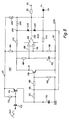
- FIG. 8 shows a variant for the WD timer 120 of FIG. 1.
- This WD timer 170 is activated even at low speeds, the stronger the lower the speed becomes, the stronger. It is not activated at normal engine speeds.
- the Hall signals are supplied to the base of a pnp transistor 174 via a differentiator consisting of a capacitor 172 and a resistor 173, i.e. on the negative edges 110 of the Hall signal (cf. FIG. 3a), the transistor 174 becomes briefly conductive and supplies a charging pulse to a capacitor 176 (e.g. 10 nF) which is connected between its collector and the negative line 30.
- a capacitor 176 e.g. 10 nF
- npn transistor 178 The base of an npn transistor 178 is connected to the collector of transistor 174, the emitter of which is connected to positive line 52, via two resistors 180, 182, the connection point of which is designated 184. Furthermore, there is a resistor 186 between the base of the transistor 178 and the negative line 30. The emitter of the transistor 178 is connected to the negative line 30, its collector via a resistor 188 (for example 10 k) to the negative input 189 of a comparator 190.
- a capacitor 192 (eg 3.3 .mu.F) lies between the minus input 189 and the minus line 30. It has the same function as the capacitor 76 in FIG. 1.
- the plus input 194 of the comparator 190 is connected to the positive line 52 via a resistor 196 (e.g. 100 k) and to the minus line 30 via a resistor 198 (e.g. 100 k).
- a resistor 202 (eg 47 k) leads to the plus input 194, a resistor 204 (eg 2 k) to the plus line 52, and a resistor 206 (eg 470 k) to a node 208.
- a diode 210 lies between output 200 and node 208 (anode at output 200).
- a resistor 212 (e.g., 100 k) lies between node 208 and the collector of transistor 178.
- the WD timer 170 replaces the transistor 72 and the WD timer 120 in FIG. 1.
- the corresponding connecting elements are therefore indicated in FIG. 8, that is to say the resistor 92 and the diode 54.
- transistor 174 is briefly switched on by each differentiated negative edge 110 of Hall signal, as a result of which capacitor 176 is charged.
- a switch-on pulse of defined length is generated at transistor 178, which switches point B to the potential of negative line 30.
- the capacitor 192 discharges through the resistor 188.
- capacitor 192 is charged through resistor 204, diode 210, and resistors 212 and 188.
- the Hall signal has a high frequency, so that the capacitor 192 is only slightly charged since it is discharged again and again via the transistor 178 and the resistor 188. Consequently, the minus input 189 of the comparator 190 has a more negative potential than the plus input 194, and the comparator 190 has a high impedance at its output 200, so that it does not initiate a reset process and the diode 54 remains blocked, ie the motor 20 runs normally.
- the potential at the positive input 194 should expediently be set so high (by selecting the resistors 196, 198) that the voltage at the capacitor 192 can cover a large voltage range.
- the point B is less often connected by the transistor 178 to the negative line 30, and the charging of the capacitor 192 via the resistor 204, the diode 210 and the resistors 212 and 188 now prevails, so that the The minus input 189 of the comparator 190 becomes more positive than the plus input 194. This switches the output 200 to 0 V, there is a WD reset, and the output stage transistors 32 and 34 (FIG. 1) are blocked via the diode 54.
- the capacitor 192 discharges through the resistors 188, 212 and 206, and additionally by the pulses that continue to come from the Hall IC 60 (Fig. 1) of the motor still running, so that the OFF time, during which the comparator 190 has the potential 0 V at its output, which depends on the speed still present. The lower this becomes, the longer this OFF time, i.e. it is a dynamic overload protection for the motor 20.
- the OFF time is constant, since it is then only determined by the resistors 188, 212 and 206, via which the capacitor 192 discharges.
- the WD timer 170 according to FIG. 8 has particular advantages when starting up an engine. It may be that the motor is inhibited during start-up, but starts, but increases its speed only slowly. In this case, the timer 170 gives it more time to reach its operating speed because the capacitor 192 is partially discharged again and again as long as the motor is rotating.
- the timer 170 switches off the motor at some point so that it is not overloaded.
- the timer 170 switches the motor on again after a predetermined pause, and it is usually easier to start up the second time because the motor has already rotated. In addition, the timer 170 automatically shortens its OFF time when the engine is running.
- the switch-on time of the timer 170 is short and the switch-off time is long, which protects the motor against overheating but nevertheless ensures a restart if the motor has not been blocked.
- FIG. 9 shows a variant 170 '.
- the output 200 of the comparator 190 is connected to the point 184 via a diode 220, its anode being connected to this point. If the output 200 assumes the potential 0 V, the point 184 is also set to approximately 0 V, so that the transistor 178 can no longer be turned on. In this case, the OFF time is not dependent on the engine speed, but constant.
- timers 170, 170 'shown in FIGS. 8 and 9 can also be used in motors which are not controlled by a microprocessor, but by conventional commutation circuits.
Landscapes
- Engineering & Computer Science (AREA)
- Power Engineering (AREA)
- Control Of Motors That Do Not Use Commutators (AREA)
Applications Claiming Priority (2)
| Application Number | Priority Date | Filing Date | Title |
|---|---|---|---|
| DE19547216 | 1995-12-18 | ||
| DE19547216 | 1995-12-18 |
Publications (3)
| Publication Number | Publication Date |
|---|---|
| EP0780962A2 true EP0780962A2 (fr) | 1997-06-25 |
| EP0780962A3 EP0780962A3 (fr) | 1998-04-08 |
| EP0780962B1 EP0780962B1 (fr) | 2001-02-28 |
Family
ID=7780435
Family Applications (1)
| Application Number | Title | Priority Date | Filing Date |
|---|---|---|---|
| EP96119750A Expired - Lifetime EP0780962B1 (fr) | 1995-12-18 | 1996-12-10 | Moteur commuté électroniquement |
Country Status (2)
| Country | Link |
|---|---|
| EP (1) | EP0780962B1 (fr) |
| DE (2) | DE19650907A1 (fr) |
Cited By (1)
| Publication number | Priority date | Publication date | Assignee | Title |
|---|---|---|---|---|
| WO2000072098A1 (fr) * | 1999-05-21 | 2000-11-30 | Papst-Motoren Gmbh & Co. Kg | Procede pour la sauvegarde non volatile d'au moins une valeur de donnees de fonctionnement d'un moteur electrique et moteur electrique pour l'execution d'un tel procede |
Citations (1)
| Publication number | Priority date | Publication date | Assignee | Title |
|---|---|---|---|---|
| DE4442450A1 (de) | 1993-12-03 | 1995-08-03 | Papst Motoren Gmbh & Co Kg | Elektromotor, und Verfahren zum Betreiben desselben |
Family Cites Families (2)
| Publication number | Priority date | Publication date | Assignee | Title |
|---|---|---|---|---|
| GB9016508D0 (en) * | 1990-07-27 | 1990-09-12 | Papst Motors Limited | Brushless d.c.motors |
| FR2683406B1 (fr) * | 1991-10-31 | 1997-07-18 | Valeo Thermique Habitacle | Dispositif de protection contre les surcharges pour moteur electrique a commutation electronique. |
-
1996
- 1996-12-07 DE DE19650907A patent/DE19650907A1/de not_active Withdrawn
- 1996-12-10 EP EP96119750A patent/EP0780962B1/fr not_active Expired - Lifetime
- 1996-12-10 DE DE59606505T patent/DE59606505D1/de not_active Expired - Lifetime
Patent Citations (1)
| Publication number | Priority date | Publication date | Assignee | Title |
|---|---|---|---|---|
| DE4442450A1 (de) | 1993-12-03 | 1995-08-03 | Papst Motoren Gmbh & Co Kg | Elektromotor, und Verfahren zum Betreiben desselben |
Cited By (1)
| Publication number | Priority date | Publication date | Assignee | Title |
|---|---|---|---|---|
| WO2000072098A1 (fr) * | 1999-05-21 | 2000-11-30 | Papst-Motoren Gmbh & Co. Kg | Procede pour la sauvegarde non volatile d'au moins une valeur de donnees de fonctionnement d'un moteur electrique et moteur electrique pour l'execution d'un tel procede |
Also Published As
| Publication number | Publication date |
|---|---|
| DE19650907A1 (de) | 1997-06-19 |
| EP0780962B1 (fr) | 2001-02-28 |
| EP0780962A3 (fr) | 1998-04-08 |
| DE59606505D1 (de) | 2001-04-05 |
Similar Documents
| Publication | Publication Date | Title |
|---|---|---|
| EP0744807B1 (fr) | Procédé de limitation du courant d'un moteur à courant continu, et moteur à courant continu pour mettre en oeuvre un tel procédé | |
| EP0658973B1 (fr) | Moteur électrique à commutation électronique et méthode pour le commander | |
| EP1471628B1 (fr) | Moteur à commutation électronique et procédé de commande de celui-ci | |
| EP0895345B1 (fr) | Méthode pour surveiller un moteur à courant continu sans collecteur et moteur pour la mise en oeuvre d'une telle méthode | |
| EP0739084B1 (fr) | Procédé de commande ou réglage d'un moteur électrique et dispositif pour mettre en oeuvre ce procédé | |
| EP1837986B1 (fr) | Procédé et agencement destinés au fonctionnement d'un moteur commuté électroniquement | |
| EP1314894B2 (fr) | Ventilateur | |
| EP1105960B1 (fr) | Contrôle de vitesse dependent de temperature avec microprocesseur pour un moteur electrique | |
| EP1467476A2 (fr) | Dispositif comportant un moteur électrique | |
| DE19647983A1 (de) | Verfahren zum Regeln einer physikalischen Größe und Anordnung zur Durchführung eines solchen Verfahrens | |
| CH662907A5 (de) | Elektronische kupplung fuer elektrowerkzeuge mit waehlbarer drehzahl. | |
| EP1675757B1 (fr) | Dispositif et procede pour reguler une tension continue | |
| EP2603971B1 (fr) | Moteur à commutation électronique | |
| DE19518991A1 (de) | Verfahren zum Betrieb eines elektronisch kommutierten Motors, und Motor zur Durchführung eines solchen Verfahrens | |
| EP0741449A1 (fr) | Moteur de commutation électronique et procédé de commande pour un tel moteur | |
| EP1107441A2 (fr) | Moteur à courant continu à communication électronique | |
| EP0782787B1 (fr) | Procede et circuit de regulation de ventilateurs | |
| DE3044027C2 (de) | Stromregler für einen Gleichstrommotor | |
| EP2149974A2 (fr) | Moteur électrique | |
| EP0780962B1 (fr) | Moteur commuté électroniquement | |
| EP0427043B1 (fr) | Procédé et dispositif pour élargir une fonction de protection contre blocage pour moteurs électriques | |
| EP1915653A1 (fr) | Dispositif de commande et dispositif de reglage pour une automobile | |
| DE19517665A1 (de) | Elektronisch kommutierter Motor, und Verfahren zur Ansteuerung eines drei- oder mehrsträngigen, elektronisch kommutierten Motors | |
| EP0713280B1 (fr) | Moteur de commutation électronique | |
| CH656992A5 (en) | Rotation speed regulating arrangement for a DC motor, and a fan having such an arrangement |
Legal Events
| Date | Code | Title | Description |
|---|---|---|---|
| PUAI | Public reference made under article 153(3) epc to a published international application that has entered the european phase |
Free format text: ORIGINAL CODE: 0009012 |
|
| AK | Designated contracting states |
Kind code of ref document: A2 Designated state(s): DE FR GB SE |
|
| RTI1 | Title (correction) | ||
| PUAL | Search report despatched |
Free format text: ORIGINAL CODE: 0009013 |
|
| AK | Designated contracting states |
Kind code of ref document: A3 Designated state(s): DE FR GB SE |
|
| 17P | Request for examination filed |
Effective date: 19980403 |
|
| 17Q | First examination report despatched |
Effective date: 19990603 |
|
| GRAG | Despatch of communication of intention to grant |
Free format text: ORIGINAL CODE: EPIDOS AGRA |
|
| GRAG | Despatch of communication of intention to grant |
Free format text: ORIGINAL CODE: EPIDOS AGRA |
|
| GRAH | Despatch of communication of intention to grant a patent |
Free format text: ORIGINAL CODE: EPIDOS IGRA |
|
| GRAH | Despatch of communication of intention to grant a patent |
Free format text: ORIGINAL CODE: EPIDOS IGRA |
|
| GRAA | (expected) grant |
Free format text: ORIGINAL CODE: 0009210 |
|
| AK | Designated contracting states |
Kind code of ref document: B1 Designated state(s): DE FR GB SE |
|
| PG25 | Lapsed in a contracting state [announced via postgrant information from national office to epo] |
Ref country code: SE Free format text: LAPSE BECAUSE OF FAILURE TO SUBMIT A TRANSLATION OF THE DESCRIPTION OR TO PAY THE FEE WITHIN THE PRESCRIBED TIME-LIMIT Effective date: 20010228 |
|
| REF | Corresponds to: |
Ref document number: 59606505 Country of ref document: DE Date of ref document: 20010405 |
|
| GBT | Gb: translation of ep patent filed (gb section 77(6)(a)/1977) |
Effective date: 20010327 |
|
| ET | Fr: translation filed | ||
| REG | Reference to a national code |
Ref country code: GB Ref legal event code: IF02 |
|
| PLBE | No opposition filed within time limit |
Free format text: ORIGINAL CODE: 0009261 |
|
| STAA | Information on the status of an ep patent application or granted ep patent |
Free format text: STATUS: NO OPPOSITION FILED WITHIN TIME LIMIT |
|
| 26N | No opposition filed | ||
| PGFP | Annual fee paid to national office [announced via postgrant information from national office to epo] |
Ref country code: GB Payment date: 20091223 Year of fee payment: 14 Ref country code: FR Payment date: 20091113 Year of fee payment: 14 |
|
| PGFP | Annual fee paid to national office [announced via postgrant information from national office to epo] |
Ref country code: DE Payment date: 20091201 Year of fee payment: 14 |
|
| GBPC | Gb: european patent ceased through non-payment of renewal fee |
Effective date: 20101210 |
|
| REG | Reference to a national code |
Ref country code: FR Ref legal event code: ST Effective date: 20110831 |
|
| PG25 | Lapsed in a contracting state [announced via postgrant information from national office to epo] |
Ref country code: FR Free format text: LAPSE BECAUSE OF NON-PAYMENT OF DUE FEES Effective date: 20110103 |
|
| REG | Reference to a national code |
Ref country code: DE Ref legal event code: R119 Ref document number: 59606505 Country of ref document: DE Effective date: 20110701 |
|
| PG25 | Lapsed in a contracting state [announced via postgrant information from national office to epo] |
Ref country code: DE Free format text: LAPSE BECAUSE OF NON-PAYMENT OF DUE FEES Effective date: 20110701 Ref country code: GB Free format text: LAPSE BECAUSE OF NON-PAYMENT OF DUE FEES Effective date: 20101210 |