EP0784009A1 - Tuba pour appareil respiratoire de plongee - Google Patents
Tuba pour appareil respiratoire de plongee Download PDFInfo
- Publication number
- EP0784009A1 EP0784009A1 EP95927976A EP95927976A EP0784009A1 EP 0784009 A1 EP0784009 A1 EP 0784009A1 EP 95927976 A EP95927976 A EP 95927976A EP 95927976 A EP95927976 A EP 95927976A EP 0784009 A1 EP0784009 A1 EP 0784009A1
- Authority
- EP
- European Patent Office
- Prior art keywords
- breathing
- air hose
- mouthpiece
- hose
- inhalation
- Prior art date
- Legal status (The legal status is an assumption and is not a legal conclusion. Google has not performed a legal analysis and makes no representation as to the accuracy of the status listed.)
- Withdrawn
Links
- 230000029058 respiratory gaseous exchange Effects 0.000 title claims abstract description 66
- 230000009189 diving Effects 0.000 title abstract description 7
- 239000004721 Polyphenylene oxide Substances 0.000 claims description 6
- 229920000570 polyether Polymers 0.000 claims description 6
- 230000002093 peripheral effect Effects 0.000 claims description 5
- 229920003225 polyurethane elastomer Polymers 0.000 claims description 5
- 238000000071 blow moulding Methods 0.000 claims description 4
- 244000052616 bacterial pathogen Species 0.000 abstract description 4
- 239000007789 gas Substances 0.000 description 52
- 230000001055 chewing effect Effects 0.000 description 30
- CURLTUGMZLYLDI-UHFFFAOYSA-N Carbon dioxide Chemical compound O=C=O CURLTUGMZLYLDI-UHFFFAOYSA-N 0.000 description 18
- 210000000214 mouth Anatomy 0.000 description 15
- XLYOFNOQVPJJNP-UHFFFAOYSA-N water Substances O XLYOFNOQVPJJNP-UHFFFAOYSA-N 0.000 description 11
- 229910002092 carbon dioxide Inorganic materials 0.000 description 9
- 239000001569 carbon dioxide Substances 0.000 description 9
- 238000010586 diagram Methods 0.000 description 7
- 238000001179 sorption measurement Methods 0.000 description 7
- 238000012549 training Methods 0.000 description 7
- 230000000903 blocking effect Effects 0.000 description 6
- 229920001971 elastomer Polymers 0.000 description 6
- 230000008878 coupling Effects 0.000 description 5
- 238000010168 coupling process Methods 0.000 description 5
- 238000005859 coupling reaction Methods 0.000 description 5
- 230000007246 mechanism Effects 0.000 description 5
- 239000000806 elastomer Substances 0.000 description 4
- 239000012530 fluid Substances 0.000 description 4
- 239000002994 raw material Substances 0.000 description 4
- 210000003128 head Anatomy 0.000 description 3
- 239000000463 material Substances 0.000 description 3
- 229920005989 resin Polymers 0.000 description 3
- 239000011347 resin Substances 0.000 description 3
- 230000008901 benefit Effects 0.000 description 2
- 238000004891 communication Methods 0.000 description 2
- 230000007423 decrease Effects 0.000 description 2
- 229940100563 gas for inhalation Drugs 0.000 description 2
- 238000004519 manufacturing process Methods 0.000 description 2
- 238000000034 method Methods 0.000 description 2
- -1 polyethylene Polymers 0.000 description 2
- 229920002635 polyurethane Polymers 0.000 description 2
- 239000004814 polyurethane Substances 0.000 description 2
- 229920000915 polyvinyl chloride Polymers 0.000 description 2
- 239000004800 polyvinyl chloride Substances 0.000 description 2
- 230000001902 propagating effect Effects 0.000 description 2
- 238000010926 purge Methods 0.000 description 2
- 239000005060 rubber Substances 0.000 description 2
- JOYRKODLDBILNP-UHFFFAOYSA-N Ethyl urethane Chemical compound CCOC(N)=O JOYRKODLDBILNP-UHFFFAOYSA-N 0.000 description 1
- 241000238413 Octopus Species 0.000 description 1
- 239000004698 Polyethylene Substances 0.000 description 1
- 230000009471 action Effects 0.000 description 1
- 239000003463 adsorbent Substances 0.000 description 1
- QVGXLLKOCUKJST-UHFFFAOYSA-N atomic oxygen Chemical compound [O] QVGXLLKOCUKJST-UHFFFAOYSA-N 0.000 description 1
- 238000005452 bending Methods 0.000 description 1
- 230000015556 catabolic process Effects 0.000 description 1
- 239000003795 chemical substances by application Substances 0.000 description 1
- 229920006026 co-polymeric resin Polymers 0.000 description 1
- 238000006731 degradation reaction Methods 0.000 description 1
- 238000002474 experimental method Methods 0.000 description 1
- 230000007062 hydrolysis Effects 0.000 description 1
- 238000006460 hydrolysis reaction Methods 0.000 description 1
- 239000000203 mixture Substances 0.000 description 1
- 238000012544 monitoring process Methods 0.000 description 1
- 229910052760 oxygen Inorganic materials 0.000 description 1
- 239000001301 oxygen Substances 0.000 description 1
- 230000000704 physical effect Effects 0.000 description 1
- 229920000573 polyethylene Polymers 0.000 description 1
- 229920013716 polyethylene resin Polymers 0.000 description 1
- 229920001296 polysiloxane Polymers 0.000 description 1
- 238000003825 pressing Methods 0.000 description 1
- 229920002379 silicone rubber Polymers 0.000 description 1
- 239000004945 silicone rubber Substances 0.000 description 1
- 229920002554 vinyl polymer Polymers 0.000 description 1
Images




Classifications
-
- B—PERFORMING OPERATIONS; TRANSPORTING
- B63—SHIPS OR OTHER WATERBORNE VESSELS; RELATED EQUIPMENT
- B63C—LAUNCHING, HAULING-OUT, OR DRY-DOCKING OF VESSELS; LIFE-SAVING IN WATER; EQUIPMENT FOR DWELLING OR WORKING UNDER WATER; MEANS FOR SALVAGING OR SEARCHING FOR UNDERWATER OBJECTS
- B63C11/00—Equipment for dwelling or working underwater; Means for searching for underwater objects
- B63C11/02—Divers' equipment
- B63C11/18—Air supply
- B63C11/22—Air supply carried by diver
-
- B—PERFORMING OPERATIONS; TRANSPORTING
- B63—SHIPS OR OTHER WATERBORNE VESSELS; RELATED EQUIPMENT
- B63C—LAUNCHING, HAULING-OUT, OR DRY-DOCKING OF VESSELS; LIFE-SAVING IN WATER; EQUIPMENT FOR DWELLING OR WORKING UNDER WATER; MEANS FOR SALVAGING OR SEARCHING FOR UNDERWATER OBJECTS
- B63C11/00—Equipment for dwelling or working underwater; Means for searching for underwater objects
- B63C11/02—Divers' equipment
- B63C11/18—Air supply
- B63C11/22—Air supply carried by diver
- B63C11/24—Air supply carried by diver in closed circulation
-
- B—PERFORMING OPERATIONS; TRANSPORTING
- B63—SHIPS OR OTHER WATERBORNE VESSELS; RELATED EQUIPMENT
- B63C—LAUNCHING, HAULING-OUT, OR DRY-DOCKING OF VESSELS; LIFE-SAVING IN WATER; EQUIPMENT FOR DWELLING OR WORKING UNDER WATER; MEANS FOR SALVAGING OR SEARCHING FOR UNDERWATER OBJECTS
- B63C11/00—Equipment for dwelling or working underwater; Means for searching for underwater objects
- B63C11/02—Divers' equipment
- B63C11/18—Air supply
- B63C11/186—Mouthpieces
Definitions
- This invention relates to an improved flexible breathing air hose used in underwater breathing apparatus.
- Underwater breathing apparatus can generally be divided into two types: open-circuit breathing apparatus and closed-circuit or semiclosed-circuit breathing apparatus.
- open-circuit breathing apparatus gas that has been breathed once is all expelled from the apparatus, but a closed-circuit or semiclosed-circuit breathing apparatus includes an apparatus by which gas that has been breathed once can be breathed again.
- closed-circuit or semiclosed-circuit breathing apparatus has the advantages of being lighter than open-circuit breathing apparatus and permitting longer dives to deeper depths.
- conventional closed-circuit or semiclosed-circuit breathing apparatus was developed for purposes of specialized types of diving or military use, so it provided only a minimum of safety mechanisms, and had no mechanisms for handling emergency situations that occur relatively easily. For this reason, extremely thorough training was required in order to use this type of apparatus, and thus it could not be used easily by the leisure diver.
- closed-circuit breathing apparatus is equipped with oxygen concentration sensors and the like, thus requiring considerable training in its handling, control and monitoring.
- semiclosed-circuit breathing apparatus has no such equipment and therefore there is no need for training in its operation, so it can be handled relatively easily by even a non-expert.
- This type of semiclosed-circuit breathing apparatus has become simpler than in the past, can be used easily and is extremely convenient.
- the semiclosed-circuit breathing apparatus 1 of this example is equipped with a hollow housing 2 and the component parts of the device to be described later are built into this hollow housing 2.
- One side of this hollow housing 2 forms the back-resting surface 2a which rests against the back of the diver, and in the center of the opposing surface is formed an opening used for replacing the breathing gas cylinder, and attached to the opening is a removable cover 2b.
- Attached to the top edge of the hollow housing 2 is a canister 3 with a built-in horizontal carbon dioxide adsorption apparatus.
- This canister takes an overall cylindrical shape, and connected to its exterior on either side are two flexible hoses, an exhalation air hose 4 and an inhalation air hose 5. Connected to the ends of the exhalation air hose 4 and the inhalation air hose 5 is a mouthpiece unit 6.
- the inhaled/exhaled air circulation chamber 61 within the mouthpiece unit 6 communicates with the exhalation air hose 4 and inhalation air hose 5.
- the other ends of the exhalation air hose 4 and inhalation air hose 5 communicate with either side of the cylindrical canister 3 with a built-in carbon dioxide adsorption apparatus 7.
- the carbon dioxide adsorption apparatus 7 with an annular cross-section is built into the center of this canister 3 and an exhalation air passage 31 and inhalation air passage 32 are formed on either side.
- a breathing gas cylinder 8 is placed vertically in the center of the hollow housing 2 below the canister 3 with the built-in carbon dioxide adsorption apparatus 7, and on either side of the cylinder are placed an exhalation air bag 9 and an inhalation air bag 11.
- the exhalation air bag 9 communicates with the exhalation air passage 31 of the canister 3 and the inhalation air bag 11 communicates with the inhalation air passage 32 of the canister 3.
- the breathing gas cylinder 8 is arranged such that its gas discharge outlet 81 is positioned at the bottom, and this gas discharge outlet 81 is connected via an on/off valve 82 to a regulator 83.
- the regulator 83 reduces the gas pressure to roughly 8 to 9 kg/cm 2 .
- Connected to the regulator 83 are six gas supply lines, and of these, three are used for the remaining-pressure gage, the buoyancy compensator and the octopus rig (not shown).
- the remaining line branches into three lines in the middle, and one of these lines, gas supply line 84, passes through the inhalation air passage 32 of the canister 3 with built-in carbon dioxide adsorption apparatus and through the inhalation air hose 5, extending to the middle of the mouthpiece.
- a flow rate adjustment orifice 84a by which the flow rate is adjusted to 4 to 5 liters/minute when converted to atmospheric pressure and supplied to the interior of the mouthpiece.
- gas supply line 85 is a purge gas supply line used to purge water from the interior of the mouthpiece unit 6, extending to the interior of the mouthpiece unit 6 in the same manner as gas supply line 84 described above.
- the remaining line, gas supply line 86 is used to supply air during emergencies, and its end is positioned within the inhalation air passage 32 of canister 3.
- an auto-valve mechanism 12 mounted to the end of the inhalation side of the canister 3 with built-in carbon dioxide adsorption apparatus is an auto-valve mechanism 12. This mechanism 12 controls the opening and closing of the gas supply line 86 and controls the automatic release of excess gas.
- the overall flow of gas is as follows. Exhaled air from the mouthpiece 62 of the mouthpiece unit 6 passes through the exhalation air hose 4 and exhalation air passage 31 and accumulates in the exhalation air bag 9. At the time of the inhalation action, the exhaled air accumulated here is passed through the carbon dioxide adsorption apparatus 7 where carbon dioxide is removed and the air is purified and flows into the inhalation air passage 32. The purified exhaled air accumulates in the inhalation air bag 11 and is also supplied to the interior of the mouthpiece unit 6 via the inhalation air hose 5 for use in inhalation. Inside the mouthpiece unit 6, a constant flow of new gas for inhalation is introduced from the cylinder 8 through the gas supply line 84, so a mixture of these gases is supplied as the gas for inhalation.
- FIGS 11, 12 and 13 show the mouthpiece unit.
- the mouthpiece unit 6 consists of a breath circulation chamber 61 formed within a case 63 that takes an overall rectangular shape and a mouthpiece 62 attached to an opening 63a opened in one side of the case 63.
- On either side (left and right) of the case 63 are opened an exhalation opening 64 and an inhalation opening 65, respectively.
- the exhalation air hose 4 is connected to the exhalation opening 64 via a check valve 66 that permits the passage of fluid only toward the exhalation air hose 4.
- the inhalation air hose 5 is connected to the inhalation opening 65 via a check valve 67 that permits the passage of fluid only away from the inhalation air hose 5.
- the two gas supply lines 84 and 85 placed therein extend through the inhalation opening 65 into the interior of the breath circulation chamber 61 within the mouthpiece unit.
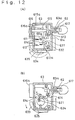
- on/off valves 611 and 612 are attached to the inside surface of its end wall 61a.
- On/off valve 611 is connected to gas supply line 84 and on/off valve 612 is connected to gas supply line 85.
- These on/off valves 611 and 612 are opened by pressing their actuation rods 611a and 612a, resulting in gas being supplied to the interior of the breath circulation chamber 61.
- a swivel plate 613 used to move the rod.
- This swivel plate 613 is supported by a rotating shaft 614 at a position at its center in the up and down direction.
- This rotating shaft 614 spans the space between the side walls 61b and 61c of the case 63 in such manner that it is free to rotate.
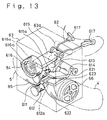
- the top end of this swivel plate 613 is coupled to the root end of a horizontal travel plate 615 in such manner that it is free to rotate.
- This horizontal travel plate 615 is placed at a position at the height of the opening 63a and a cylindrical protrusion 615a portion at its tip penetrates the end wall 61a of the case, extending to the outside. Attached to the this protruding portion is a disk-shaped pushbutton 616. Note that elastic force is constantly applied to this horizontal travel plate 615 in the direction of the end wall 61a by a spring member (not shown), and thus the pushbutton 616 attached to its tip is kept in contact with a pushbutton stop 616a attached to the case end wall 61a.
- the root end of the horizontal travel plate 615 connected to the root end of the horizontal travel plate 615 is the root end of a pair of chewing pieces 617.
- the tip ends of these chewing pieces 617 protrude through the opening 63a to a position on the outside surface of the mouthpiece 62.
- This protruding part is formed with thick walls so that it can be easily held in the teeth of the diver.
- an exhalation air hose blocking valve 621 attached to the exhalation air hose connection side of the rotating shaft 614 is an exhalation air hose blocking valve 621.
- an opening 623 of an exhalation air passage 622 that communicates to the exhalation opening 64.
- a spring member 624 is stretched across the space between valve 621 and the interior of this opening 623. Therefore, in the normal state, this opening 623 is blocked by valve 621 due to the spring force of this spring member and the spring force of the aforementioned spring member pushing against swivel plate 613.
- the exhalation air hose blocking valve 621 swivels upward in a motion linked to this rotation, opening the opening 623 of the exhalation air passage, creating a state of communication with the breath circulation chamber 61 within the mouth piece unit.
- the root end of the horizontal travel plate 615 also causes the swivel plate 613 to rotate in the direction of the arrow on Figure 12(A) about rotating shaft 614 as its center, and its lower end pushes in the actuation rod 611a.
- valve 611 opens and the supply of inhalation gas is started.
- the pushbutton and horizontal travel plate 615 are pushed by the elastic force to move back to their original state, but in the state in which the diver is biting down on the chewing pieces 617 with the mouthpiece 62 inside his oral cavity with his mouth closed, this state is maintained as is. Therefore, the supply of a constant flow of inhalation gas will continue.
- the exhalation air hose blocking valve 621 similarly swivels in the direction of the arrows, opening the opening 623 of the exhalation air passage 622.
- the exhalation air hose 4 is put into the state of communication with the breath circulation chamber 61 of the mouthpiece unit via check valve 66.
- the breathing action can be performed.
- the supply of inhalation gas can be started by the simple operation of pushing the pushbutton 616 and biting down on the chewing pieces 617 with the teeth.
- the supply of inhalation gas is automatically halted. Therefore, the supply of inhalation gas can be controlled without the need for complex operation.
- the exhalation air hose can be automatically closed by a linked motion, preventing water from passing through the exhalation air hose and entering the interior.
- the mouthpiece 62 communicates with the exhalation air passage 31 and inhalation air passage 32 via an exhalation air hose 4 and inhalation air hose 5, respectively.
- the exhalation air hose 4 and inhalation air hose 5 must flex freely to follow the motion of the head of the diver, and must also be provided with a certain degree of elasticity. For this reason, bellows hose 40 as shown in Figures 3 and 4 is typically used.
- this bellows hose 40 has a large number of curved pleats 40b, and dirt and water accumulates easily in these areas. For this reason, germs tend to propagate in these portions so this is a problem in that this is undesirable from the standpoint of hygiene.
- the object of the present invention is to provide a breathing air hose for underwater breathing apparatus wherein dirt and the like does not accumulate on its inside surface, yet it is provided with the required flexibility and the like.
- the breathing air hose for underwater breathing apparatus of the present invention is characterized in that it has a peripheral wall with a cross-sectional shape, which if viewed when cut lengthwise, consists of alternating thick-walled portions in which the inside is a flat surface and the outside protrudes and thin-walled portions that are curved toward the inside with a small curvature, so that the inside surface essentially assumes a flat state.
- the breathing air hose is preferably molded of polyether-based polyurethane rubber. Moreover it is preferably molded by blow molding.
- Figure 1 is a plan view of the breathing air hose of a preferred embodiment of the present invention in half section.
- Figure 2 is an enlarged sectional view of a portion of the cross section of the hose of Figure 1.
- Figure 3 is a plan view of a bellows hose.
- Figure 4 is an enlarged sectional view of the circled portion of the hose of Figure 3.
- Figure 5 is a sectional view of one example of breathing air hose.
- Figure 6 is an explanatory diagram showing a variable-geometry mouthpiece, where (a) is an explanatory diagram of the state in which the chewing pieces are extended, and (b) is an explanatory diagram of the state in which the chewing pieces are pulled back into the retracted position.
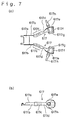
- Figure 7 is a diagram of the chewing pieces of Figure 6, where (a) is a plan view and (b) is a side view.
- Figure 8 is a diagram of the mouth piece of Figure 6, where (a) is a half-section plan view, (b) is a half-section side view and (c) is a front view.
- Figure 9 is a view of the outside of a semiclosed-circuit breathing apparatus.
- Figure 10 is a diagram of the internal structure of the apparatus of Figure 9.
- Figure 11 is a schematic cross section of the mouthpiece of the apparatus of Figure 9 showing its top wall cut away.
- Figure 12 is a cross section of the mouthpiece unit of Figure 11, where (A) is a schematic cross section of the portion when cut along the line A-A, and (B) a schematic cross section of the portion when cut along the line B-B.
- Figure 13 is an explanatory diagram showing major areas of the structure in the upper half of the mouthpiece unit of Figure 11.
- FIGS 1 and 2 show a breathing air hose constituted according to the present invention.
- the breathing air hose 50 of this example consists of polyether-based polyurethane rubber, and is molded by means of blow molding.
- the peripheral wall 51 of the breathing air hose 50 of this example has a cross-sectional shape consisting of alternating thick-walled portions 52 in which the outside protrudes and thin-walled portions 53 that are curved toward the inside with a small curvature.
- the inside surface 52a of the thick-walled portions 52 has a flat surface if viewed when cut along the hose axis line 50a, and the subsequent inside surface 53a of the thin-walled portions 53 are slightly curved toward the inside. Therefore, the inside surface 51a of the hose in this example is essentially flat.
- the breathing air hose 50 of this example constituted as such has formed thin-walled portions 53 that are curved with a small amount of curvature toward the inside, so the hose has good flexibility overall due to the flexing of these portions.
- the hose is also provided with the necessary elasticity overall due to the elasticity of these portions.
- the inside surface 51a is essentially flat. Therefore, when the hose of this example is used, it can freely follow the motion of the head of the diver and moreover, no dirt or the like will accumulate on its inside surface and no germs will grow.
- the thick-walled portions 52 also function as buckling-prevention portions to prevent the hose 50 from bending and increasing the air flow resistance.
- the hose 50 of this example is made of polyether-based polyurethane rubber, it is superior with respect its tear strength and other aspects.
- it since it is polyether-based, it has an advantage in that it is more resistant to degradation of its physical properties due to hydrolysis and the like than urethane-based types.
- it in place of the methods based on fired molds for manufacturing conventional bellows hose, it is possible to adopt the blow forming method that is highly suited to mass production.
- a mildew-proofing agent may be added in order to prevent mildew and other germs from propagating.
- polyether-based polyurethane rubber as the material for the hose 50 of this example, for example, flexible polyethylene, polyvinyl acetate-polyethylene copolymer resin, flexible polyvinyl chloride, various elastomer resins, silicone rubber, rubber or other materials may be used.
- the chewing pieces are manually made to protrude from the mouthpiece and their tips are taken between the teeth. If the chewing pieces are held in this state, the supply of a constant mass flow of breathing gas from the gas cylinder can be started and the inhalation air hose can be held in the open state. Therefore, the supply of inhalation gas can be started by a simple operation and if the mouthpiece comes out of the mouth during diving, the chewing pieces return to the retracted position and the inhalation air hose is blocked by a linked motion, so the entry of water can be prevented automatically.
- the mouthpiece and chewing pieces described above are set to a shape and size corresponding to the shape and dimensions of the gums of an average Japanese person. However, there are differences among individuals in the shape of their gums.
- variable-geometry mouthpiece that can be worn in the mouths of various divers in the appropriate state and that the various divers can bite down on the chewing pieces securely.
- the mouthpiece can have a constitution comprising: a breath circulation chamber provided with an exhalation air hose connection portion that communicates with an exhalation air hose through which exhaled air passes, an inhalation air hose connection portion that communicates with an inhalation air hose through which inhalation gas passes and an external opening that communicates with the outside; within this breath circulation chamber, a gas supply port that supplies new inhalation gas at a constant mass flow rate supplied from said inhalation gas cylinder; a mouthpiece attached to said external opening; a check valve placed at said exhalation air hose connection portion that permits the flow of fluid only from said breath circulation chamber toward said exhalation air hose; a check valve placed at said inhalation air hose connection portion that permits the flow of fluid only from said inhalation air hose toward said breath circulation chamber; opening/closing means attached to said gas supply port; pushing means that applies elastic force to maintain this opening/closing means in the closed state;
- an easily flexible hinged portion is formed in the peripheral wall of the portion on its tip, and the tip portion further toward the tip from this hinged portion is able to deform depending on the size and shape of the gums of the wearer.
- these chewing pieces are constituted in the state wherein they are connected such that they deform as a single piece together with the tip of the mouthpiece.
- the tip of the mouthpiece is easily flexible so that the mouthpiece can be worn in the appropriate state either by divers that have gums of a size larger than those of an average Japanese person or by those of a smaller gum size.
- the chewing pieces also deform together with the mouthpiece, so they can be gripped between the teeth reliably in the appropriate state.
- This mouthpiece is an example of applying the present invention to the mouthpiece 62 of the semiclosed-circuit breathing apparatus shown in Figures 9 through 13, and therefore, the same numbers are applied to corresponding portions and the explanation of them is omitted.
- the mouthpiece 62A of this example is molded from elastomer raw materials, and it is formed from a cylindrical base part 62a with an elliptical cross section, and a tip part 62b formed on the tip of the base.
- the tip part 62b flares out toward its tip and its tip edge is formed in a contour approximating the shape of the human gums.
- the boundary portion between the base part 62a and the tip part 62b is formed as a thin-walled portion. As shown in Figure 6(b), centered around this area, the tip part 62b can be extremely easily flexed toward the inside and outside. To wit, this thin-walled portion functions as a hinge part 62c.
- the chewing pieces 617 of this example are attached via a connecting member 617b to a support plate 617a attached to the top edge of the swivel plate 613.
- These chewing pieces 617 are formed from polyurethane raw materials, and are provided with a base part 617c and a binding part 617d formed on its tip along with a tip portion 617e that flares out along the inside surface of the tip part 62b of the mouthpiece 62. Therefore, as shown in Figure 6(b), these chewing pieces 617 also can be flexed easily toward the inside and the outside centered around the binding part 617d.
- a bite-down portion 617f protruding from the tip portion 617e in a horizontal direction from its inside surface is a bite-down portion 617f upon which the top and bottom teeth bite down, and formed on the inside edge of this bite-down portion 617f is a contact portion 617g that comes into contact with the back of the gums.
- a pair of coupling holes 62d is formed on the left and right of the tip part 62b of the mouthpiece 62A of the above constitution. As shown on Figures 6 and 8, these coupling holes 62d are variable-diameter holes in which the inside is smaller in diameter and the outside is larger in diameter.
- a corresponding pair of coupling protrusions 617h is formed on the side of the chewing pieces 617 on the outside surface of their tip portion 617e. These protrusions 617h are formed with a conical portion at their tips and a small-diameter neck portion at their bases. As shown in Figure 6, these coupling protrusions 617h penetrate the coupling holes 62d on the side of the mouthpiece 62, and protrude toward their outside. The protrusions and holes engage each other so that the protrusions do not come out of the holes. Note that the protrusions 617h are thereafter cut along the outside contour of the mouthpiece 62.
- the maximum amount of motion of the aforementioned chewing pieces 617 is set to approximately 5 mm. From an anatomical standpoint, the maximum amount of motion should be determined based on the gum shape of an average human model. In addition, the shape and size of the tip edge of the aforementioned mouthpiece 62 are determined based on the shape and dimensions of the gums of an average person.
- variable-geometry mouthpiece of this example constituted as such can flex extremely easily toward the inside and outside centered around the hinge part 62c. Thus, even in the event of different shapes and sizes of gums, it can flex to a corresponding state, so it can be worn in a state that fits the mouth of the wearer.
- the mouthpiece 62 is formed from elastomer raw materials, so it is durable, harmless to the body and has a good feel.
- polyurethane raw materials are used for the chewing pieces, they are not easily damaged even when bitten down upon hard and their feel is good.
- these portions can also be molded from other resins.
- they can be molded from flexible polyvinyl chloride, polyethylene resin, rubber, silicone, various elastomer resins or other materials.
- mouthpiece of the above configuration can also be applied in the same manner to closed-circuit breathing apparatus or other types of underwater breathing apparatus.
- variable-geometry mouthpiece 62A has a constitution such that its tip portions can easily flex toward the inside and outside in motion linked to the chewing pieces. Therefore, it can be worn in the appropriate state by divers with gums of differing shapes and dimensions. In addition, in the state in which air for inhalation is not being supplied, the chewing pieces in the retracted position will cause the tip of the mouth piece to flex toward the inside and so it is not possible to bite down on the chewing pieces, which are covered by the tip of the mouth piece.
- the breathing air hose for underwater breathing apparatus of the present invention is characterized in that it has a peripheral wall with a cross-sectional shape, which if viewed when cut lengthwise, consists of alternating thick-walled portions in which the inside is a flat surface and the outside protrudes and thin-walled portions that are curved toward the inside with a small curvature. Therefore, the inside surface can be made essentially flat while maintaining the necessary flexibility and the like, yet there are no depressions such as those on a bellows hose in which dirt and the like easily accumulate, so it is possible to prevent mildew and the like from propagating.
Landscapes
- Health & Medical Sciences (AREA)
- General Health & Medical Sciences (AREA)
- Pulmonology (AREA)
- Engineering & Computer Science (AREA)
- Mechanical Engineering (AREA)
- Ocean & Marine Engineering (AREA)
- Respiratory Apparatuses And Protective Means (AREA)
- Injection Moulding Of Plastics Or The Like (AREA)
- Moulds For Moulding Plastics Or The Like (AREA)
Applications Claiming Priority (1)
| Application Number | Priority Date | Filing Date | Title |
|---|---|---|---|
| PCT/JP1995/001560 WO1997006052A1 (fr) | 1995-08-03 | 1995-08-03 | Tuba pour appareil respiratoire de plongee |
Publications (1)
| Publication Number | Publication Date |
|---|---|
| EP0784009A1 true EP0784009A1 (fr) | 1997-07-16 |
Family
ID=14126154
Family Applications (1)
| Application Number | Title | Priority Date | Filing Date |
|---|---|---|---|
| EP95927976A Withdrawn EP0784009A1 (fr) | 1995-08-03 | 1995-08-03 | Tuba pour appareil respiratoire de plongee |
Country Status (4)
| Country | Link |
|---|---|
| EP (1) | EP0784009A1 (fr) |
| KR (1) | KR970706167A (fr) |
| AU (1) | AU3191395A (fr) |
| WO (1) | WO1997006052A1 (fr) |
Family Cites Families (6)
| Publication number | Priority date | Publication date | Assignee | Title |
|---|---|---|---|---|
| JPS4713973Y1 (fr) * | 1967-12-08 | 1972-05-20 | ||
| JPS6342232Y2 (fr) * | 1981-02-23 | 1988-11-04 | ||
| JPH0648226Y2 (ja) * | 1988-07-20 | 1994-12-12 | 日本酸素株式会社 | 呼吸装置用フレキシブルチューブ |
| JPH0287195U (fr) * | 1988-12-23 | 1990-07-10 | ||
| JPH082076Y2 (ja) * | 1989-07-11 | 1996-01-24 | 日本酸素株式会社 | 呼吸装置 |
| JPH07215284A (ja) * | 1994-02-03 | 1995-08-15 | Grand Blue:Kk | 潜水用呼吸装置の呼吸用ホース |
-
1995
- 1995-08-03 EP EP95927976A patent/EP0784009A1/fr not_active Withdrawn
- 1995-08-03 WO PCT/JP1995/001560 patent/WO1997006052A1/fr not_active Ceased
- 1995-08-03 AU AU31913/95A patent/AU3191395A/en not_active Abandoned
- 1995-08-03 KR KR1019970702171A patent/KR970706167A/ko not_active Withdrawn
Non-Patent Citations (1)
| Title |
|---|
| See references of WO9706052A1 * |
Also Published As
| Publication number | Publication date |
|---|---|
| WO1997006052A1 (fr) | 1997-02-20 |
| AU3191395A (en) | 1997-03-05 |
| KR970706167A (ko) | 1997-11-03 |
Similar Documents
| Publication | Publication Date | Title |
|---|---|---|
| KR970010827B1 (ko) | 호흡기 | |
| US6626178B2 (en) | Full face mask with face seal and removable adaptors allowing full access to separate spaces | |
| US4821712A (en) | Breathing apparatus | |
| US5947116A (en) | Underwater breathing apparatus with pressurized snorkel | |
| AU2002253853A1 (en) | Full face mask with face seal and removable adaptors allowing full access to separate spaces | |
| US4489723A (en) | Swimming apparatus | |
| US6435178B1 (en) | Swim mask with floating air-suction device | |
| WO1994029167A1 (fr) | Appareil de plongee sous-marine | |
| US7854568B2 (en) | Diving equipment | |
| EP0278598B1 (fr) | Appareil respiratoire autonome pour plongée sous-marine | |
| CN107434014B (zh) | 一种可自由呼吸的浮潜游泳面罩 | |
| US5438977A (en) | Snorkel and buoyancy control apparatus | |
| WO1997024259A1 (fr) | Embout destine a un dispositif respiratoire pour la plongee | |
| US5408993A (en) | Snorkel and buoyancy vest with manual controls | |
| US5839435A (en) | Mouthpiece unit for semiclosed-circuit breathing apparatus | |
| JPH07215286A (ja) | 潜水用呼吸装置の可変式マウスピース | |
| WO1997006052A1 (fr) | Tuba pour appareil respiratoire de plongee | |
| EP0318157B1 (fr) | Soupape de débit automatique | |
| JPH082075Y2 (ja) | 呼吸装置 | |
| GB2298141A (en) | Counterlung breathing apparatus | |
| JPH07215291A (ja) | 半閉鎖式呼吸装置のエアーバッグ | |
| JPH0746638Y2 (ja) | 呼吸器 | |
| JPH07257482A (ja) | 半閉鎖式呼吸装置の排水装置 | |
| JPH0734794Y2 (ja) | 呼吸器 | |
| JPH085120Y2 (ja) | ベスト付き呼吸装置 |
Legal Events
| Date | Code | Title | Description |
|---|---|---|---|
| PUAI | Public reference made under article 153(3) epc to a published international application that has entered the european phase |
Free format text: ORIGINAL CODE: 0009012 |
|
| 17P | Request for examination filed |
Effective date: 19970502 |
|
| AK | Designated contracting states |
Kind code of ref document: A1 Designated state(s): DE ES FR GB GR IT SE |
|
| STAA | Information on the status of an ep patent application or granted ep patent |
Free format text: STATUS: THE APPLICATION IS DEEMED TO BE WITHDRAWN |
|
| 18D | Application deemed to be withdrawn |
Effective date: 19980301 |