EP0784452B1 - Dispositif pour stopper le saignement de tissus vivants chez l'homme et chez les animaux - Google Patents
Dispositif pour stopper le saignement de tissus vivants chez l'homme et chez les animaux Download PDFInfo
- Publication number
- EP0784452B1 EP0784452B1 EP94929701A EP94929701A EP0784452B1 EP 0784452 B1 EP0784452 B1 EP 0784452B1 EP 94929701 A EP94929701 A EP 94929701A EP 94929701 A EP94929701 A EP 94929701A EP 0784452 B1 EP0784452 B1 EP 0784452B1
- Authority
- EP
- European Patent Office
- Prior art keywords
- plasma
- sections
- tissue
- channel
- gas
- Prior art date
- Legal status (The legal status is an assumption and is not a legal conclusion. Google has not performed a legal analysis and makes no representation as to the accuracy of the status listed.)
- Expired - Lifetime
Links
- 230000000740 bleeding effect Effects 0.000 title claims abstract description 49
- 241001465754 Metazoa Species 0.000 title claims description 4
- QCWXUUIWCKQGHC-UHFFFAOYSA-N Zirconium Chemical compound [Zr] QCWXUUIWCKQGHC-UHFFFAOYSA-N 0.000 claims abstract description 4
- 229910052726 zirconium Inorganic materials 0.000 claims abstract description 4
- 229910052735 hafnium Inorganic materials 0.000 claims abstract description 3
- VBJZVLUMGGDVMO-UHFFFAOYSA-N hafnium atom Chemical group [Hf] VBJZVLUMGGDVMO-UHFFFAOYSA-N 0.000 claims abstract description 3
- 238000002844 melting Methods 0.000 claims abstract description 3
- 238000010438 heat treatment Methods 0.000 claims description 16
- 229910045601 alloy Inorganic materials 0.000 claims description 3
- 239000000956 alloy Substances 0.000 claims description 3
- WFKWXMTUELFFGS-UHFFFAOYSA-N tungsten Chemical compound [W] WFKWXMTUELFFGS-UHFFFAOYSA-N 0.000 claims description 3
- 239000000498 cooling water Substances 0.000 claims description 2
- 229910052751 metal Inorganic materials 0.000 claims description 2
- 239000002184 metal Substances 0.000 claims description 2
- 238000007789 sealing Methods 0.000 claims description 2
- 239000000110 cooling liquid Substances 0.000 claims 1
- 230000008018 melting Effects 0.000 abstract 1
- 210000001519 tissue Anatomy 0.000 description 80
- 208000032843 Hemorrhage Diseases 0.000 description 47
- 208000034158 bleeding Diseases 0.000 description 47
- 231100000319 bleeding Toxicity 0.000 description 46
- 239000007789 gas Substances 0.000 description 44
- 238000000034 method Methods 0.000 description 30
- XKRFYHLGVUSROY-UHFFFAOYSA-N Argon Chemical compound [Ar] XKRFYHLGVUSROY-UHFFFAOYSA-N 0.000 description 28
- 230000017074 necrotic cell death Effects 0.000 description 24
- 229910052786 argon Inorganic materials 0.000 description 14
- 238000009834 vaporization Methods 0.000 description 14
- 230000008016 vaporization Effects 0.000 description 14
- 206010052428 Wound Diseases 0.000 description 13
- 208000027418 Wounds and injury Diseases 0.000 description 13
- 239000007788 liquid Substances 0.000 description 12
- 239000003570 air Substances 0.000 description 10
- 238000011835 investigation Methods 0.000 description 9
- 238000000859 sublimation Methods 0.000 description 8
- 230000008022 sublimation Effects 0.000 description 8
- 239000012530 fluid Substances 0.000 description 7
- 239000011148 porous material Substances 0.000 description 7
- 230000017531 blood circulation Effects 0.000 description 6
- 210000004185 liver Anatomy 0.000 description 6
- 208000002847 Surgical Wound Diseases 0.000 description 5
- 239000001307 helium Substances 0.000 description 5
- 229910052734 helium Inorganic materials 0.000 description 5
- SWQJXJOGLNCZEY-UHFFFAOYSA-N helium atom Chemical compound [He] SWQJXJOGLNCZEY-UHFFFAOYSA-N 0.000 description 5
- 210000000952 spleen Anatomy 0.000 description 5
- 239000008280 blood Substances 0.000 description 4
- 210000004369 blood Anatomy 0.000 description 4
- 230000008859 change Effects 0.000 description 4
- 230000015271 coagulation Effects 0.000 description 4
- 238000005345 coagulation Methods 0.000 description 4
- 230000000694 effects Effects 0.000 description 4
- 238000010891 electric arc Methods 0.000 description 4
- 230000003628 erosive effect Effects 0.000 description 4
- 230000023597 hemostasis Effects 0.000 description 4
- 230000003993 interaction Effects 0.000 description 4
- 210000003734 kidney Anatomy 0.000 description 4
- 210000004072 lung Anatomy 0.000 description 4
- 229910052754 neon Inorganic materials 0.000 description 4
- GKAOGPIIYCISHV-UHFFFAOYSA-N neon atom Chemical compound [Ne] GKAOGPIIYCISHV-UHFFFAOYSA-N 0.000 description 4
- 210000000056 organ Anatomy 0.000 description 4
- 230000035515 penetration Effects 0.000 description 4
- 238000001356 surgical procedure Methods 0.000 description 4
- 238000012546 transfer Methods 0.000 description 4
- 208000005189 Embolism Diseases 0.000 description 3
- 206010051814 Eschar Diseases 0.000 description 3
- 230000015572 biosynthetic process Effects 0.000 description 3
- 231100000333 eschar Toxicity 0.000 description 3
- 230000035876 healing Effects 0.000 description 3
- 230000002439 hemostatic effect Effects 0.000 description 3
- 230000037361 pathway Effects 0.000 description 3
- 241000894007 species Species 0.000 description 3
- XLYOFNOQVPJJNP-UHFFFAOYSA-N water Chemical compound O XLYOFNOQVPJJNP-UHFFFAOYSA-N 0.000 description 3
- IJGRMHOSHXDMSA-UHFFFAOYSA-N Atomic nitrogen Chemical compound N#N IJGRMHOSHXDMSA-UHFFFAOYSA-N 0.000 description 2
- 241000282472 Canis lupus familiaris Species 0.000 description 2
- 238000013461 design Methods 0.000 description 2
- 230000005684 electric field Effects 0.000 description 2
- 230000008030 elimination Effects 0.000 description 2
- 238000003379 elimination reaction Methods 0.000 description 2
- 238000002474 experimental method Methods 0.000 description 2
- 239000011261 inert gas Substances 0.000 description 2
- 230000008569 process Effects 0.000 description 2
- 210000003660 reticulum Anatomy 0.000 description 2
- 238000009827 uniform distribution Methods 0.000 description 2
- AANMVENRNJYEMK-UHFFFAOYSA-N 4-propan-2-ylcyclohex-2-en-1-one Chemical compound CC(C)C1CCC(=O)C=C1 AANMVENRNJYEMK-UHFFFAOYSA-N 0.000 description 1
- 208000032544 Cicatrix Diseases 0.000 description 1
- 206010051373 Wound haemorrhage Diseases 0.000 description 1
- 238000010521 absorption reaction Methods 0.000 description 1
- 230000009471 action Effects 0.000 description 1
- 230000004071 biological effect Effects 0.000 description 1
- 230000031018 biological processes and functions Effects 0.000 description 1
- 230000033228 biological regulation Effects 0.000 description 1
- 230000015556 catabolic process Effects 0.000 description 1
- 238000006243 chemical reaction Methods 0.000 description 1
- 210000002808 connective tissue Anatomy 0.000 description 1
- 238000007796 conventional method Methods 0.000 description 1
- 238000001816 cooling Methods 0.000 description 1
- 239000012809 cooling fluid Substances 0.000 description 1
- 238000005336 cracking Methods 0.000 description 1
- 230000006378 damage Effects 0.000 description 1
- 230000007423 decrease Effects 0.000 description 1
- 230000036425 denaturation Effects 0.000 description 1
- 238000004925 denaturation Methods 0.000 description 1
- 230000001419 dependent effect Effects 0.000 description 1
- 238000011161 development Methods 0.000 description 1
- 238000006073 displacement reaction Methods 0.000 description 1
- 238000001914 filtration Methods 0.000 description 1
- 230000009931 harmful effect Effects 0.000 description 1
- 208000019622 heart disease Diseases 0.000 description 1
- 230000002452 interceptive effect Effects 0.000 description 1
- 230000004807 localization Effects 0.000 description 1
- 229910052757 nitrogen Inorganic materials 0.000 description 1
- 230000000149 penetrating effect Effects 0.000 description 1
- 230000000737 periodic effect Effects 0.000 description 1
- 238000004157 plasmatron Methods 0.000 description 1
- 102000004169 proteins and genes Human genes 0.000 description 1
- 108090000623 proteins and genes Proteins 0.000 description 1
- 230000005855 radiation Effects 0.000 description 1
- 230000009467 reduction Effects 0.000 description 1
- 230000001105 regulatory effect Effects 0.000 description 1
- 238000002271 resection Methods 0.000 description 1
- 231100000241 scar Toxicity 0.000 description 1
- 230000037387 scars Effects 0.000 description 1
- 229910052724 xenon Inorganic materials 0.000 description 1
- FHNFHKCVQCLJFQ-UHFFFAOYSA-N xenon atom Chemical compound [Xe] FHNFHKCVQCLJFQ-UHFFFAOYSA-N 0.000 description 1
Images




Classifications
-
- A—HUMAN NECESSITIES
- A61—MEDICAL OR VETERINARY SCIENCE; HYGIENE
- A61B—DIAGNOSIS; SURGERY; IDENTIFICATION
- A61B18/00—Surgical instruments, devices or methods for transferring non-mechanical forms of energy to or from the body
- A61B18/04—Surgical instruments, devices or methods for transferring non-mechanical forms of energy to or from the body by heating
- A61B18/042—Surgical instruments, devices or methods for transferring non-mechanical forms of energy to or from the body by heating using additional gas becoming plasma
-
- A—HUMAN NECESSITIES
- A61—MEDICAL OR VETERINARY SCIENCE; HYGIENE
- A61B—DIAGNOSIS; SURGERY; IDENTIFICATION
- A61B18/00—Surgical instruments, devices or methods for transferring non-mechanical forms of energy to or from the body
- A61B18/04—Surgical instruments, devices or methods for transferring non-mechanical forms of energy to or from the body by heating
- A61B18/12—Surgical instruments, devices or methods for transferring non-mechanical forms of energy to or from the body by heating by passing a current through the tissue to be heated, e.g. high-frequency current
- A61B18/1206—Generators therefor
- A61B2018/1213—Generators therefor creating an arc
Definitions
- the subject invention concerns a device to stop bleeding in live human and animal tissue and to form a crust by means of a plasma jet.
- the invention relates to plasma surgery and more particularly to a new and improved plasma surgical technique of achieving coagulation or a hemostatic effect, i.e. desiccation and coagulation by weak supply of plasma jet power to a layer of tissue and intense supply of jet power to the fluid component of the biological tissue.
- the purpose of the invention resides in plasma dynamic desiccation of a surgical site and in the creation in said site of an area of thermal necrosis at a rate highly exceeding the rate of medium or intense bleeding with the aid of direct application of a plasma jet having definite thermo-dynamic characteristics.
- Plasma flow, laser irradiation and electrosurgery are methods used in surgery for clean-cutting purposes, for combined cutting and hemostasis effect as well as for obtaining hemostasis of a surgical wound.
- thermochemical The dominant reactions induced by intense energy application on tissue are thermochemical in nature as a result of the energy absorption by the biological object. The major part of the energy is converted into heat.
- ATC area of thermal changes
- the use of this method allows the spongy necrosis layer to be obtained only during weak and rather moderate bleeding.
- This may be understood by the following example.
- the thermal flow at the boundary of vaporization of the liquid component in the tissue must exceed 4.6 x 10 6 W/m 2 .
- the thickness of the desiccation layer is close to 0.25 mm the quantity of thermal flow at the boundary of liquid vaporization of the liquid component does not exceed 4 x 10 5 W/m 2 .
- energy is supplied to a tissue and allow to penetrate into it.
- a YAG (Nd-YAG) laser beam in the visible and the near-infrared region is used as well as electrosurgical application.
- the energy is absorbed into the tissue to a depth of 1.0 mm.
- the amount of thermal energy penetrating into the unit volume of tissue must slightly exceed the energy required to vaporize the blood flow in the tissue and the application must be terminated at the moment of achieving desiccation.
- the energy supply to the tissue is effected by application of high-frequency current to the tissue.
- desiccation As soon as desiccation is achieved, its impedence increases considerably, resulting in termination of the application and the achievement of a desiccated layer.
- this method involves feedback during the application because the energy supply stops at the moment of tissue surface desiccation, i.e. after the final creation of the spongy necrosis layer. This deminishes the generally harmful effect of the method and provides an opportunity to chose determined regimes with guaranteed power amounts and hence with guaranteed achievement of arresting intensive bleeding.
- the main disadvantages of electrosurgical application on biological tissue are the following. In order to stop intensive bleeding it is necessary to increase the amount of energy of the application, which is carried out at the expense of the regime of the microarc generation between the tissue and the surgical instrument.
- the emission of energy in biological tissue involves passing current through a patient, which may limit its usage (for instance in the case of heart diseases). This method does not allow precise incision to be made in tissue in contrast to the characteristics of the laser beam method.
- WO 92/19166 discloses a device having a plasma generating device having an electrically conductive body with a tip shaped to provide a plasma jet, connected to a gas source, an electrode and a cylinder channel for heating the plasma generating gas.
- the invention provides a device to stop bleeding in live human and animal tissue by means of which the disadvantages found in prior-art devices of various kinds have been eliminated.
- the principal characteristics of the device appear from the appended claim 1.
- Fig. 1 is sectional view through a treated wound in a tissue.
- Numeral reference 1 designates a spongy desiccated layer showing locally dead cells (necrosis). This layer 1 is covered by a carbonized layer 2. Owing to heat transfer a compact necrosis layer 3 has formed underneath the spongy desiccated layer 1. The necrosis layer is formed between the spongy layer 1 and the unaffected, live tissue 4.
- Fig. 2 shows a wound treated with the aid of electrosurgical technique.
- the spongy layer 1 is characterized by an external, essentially uniform-depth supporting tissue (reticulum) having holes 5 created by means of a light arc.
- the holes are essentially of identical cross-sectional area and are essentially evenly distributed across the eschar surface.
- the tissue intermediate adjacent holes 5 confers pliability to the eschar, preventing cracking.
- generally uniform-depth thermally desiccated layer 3 separates the arc hole reticulum from the unaffected tissue.
- the high porosity of the necrosis layer (as will be shown below it amounts to approximately the percentage of fluid component in the tissue -75-85%) makes it possible to use the essentially novel method of plasma flow to obtain this layer under extensive bleeding conditions.
- the presence of various forms of energy resources is typical of plasma jet.
- the plasma flow energy is concentrated as a form of plasma enthalpi, a dynamic component of jet energy and broadband emission of ionized gas.
- the cross-sectional area of the plasma jet and its temperature it becomes possible to control the dynamic pressure of the plasma flow. Consequently, it becomes possible to establish interaction between the plasma jet and the spongy necrosis layer when the plasma jet penetrates this layer completely or partly.
- the plasma jet is partly cooled while heating the spongy necrosis layer and the remaining part of the jet energy is absorbed at the boundary of the vaporization of the tissue fluid component.
- the filtration of the cooled plasma-generating gas and of the vapour flow takes place through the low pressure area of the plasma jet.
- This analysis points out a new principal possibility of conducting energy to tissues by making use of a plasma-dynamic effect of an ionized gas flow.
- the high porosity of the spongy necrosis layer established by predetermined thermo-physical and gasodynamical parameters in the plasma flow results in gasodynamical and thermal penetration by the plasma jet in this layer 3b.
- the maximum cross-section of a plasma jet that realizes penetration of plasma flow in the spongy necrosis layer to a depth of about 0.25 mm equals 3.5 mm in lungs, 3.0 mm in the spleen, 2.5 mm in the liver and 1.5 mm in kidneys.
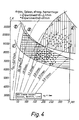
- Figs. 4 and 5 The results of these investigations are shown in Figs. 4 and 5.
- the black dots correspond to the values of the thermal power and plasma jet temperatures that provide reliable arrest of intensive bleeding.
- Lines I, II, III illustrate the parameters of the plasma jet boundaries beyond which it was not possible to stop bleeding.
- This model comprises:
- the gas providing the widest range of change of the plasma parameters and able to arrest heavy bleeding is argon.
- the use of air as the plasma generating gas could also make it possible to stop intensive bleeding but within a much narrower range of plasma parameters compared with argon.
- some limitations of the plasma surgical instrument must be respected.
- surgical microplasmatrons must generate plasma flows having an average mass temperature valid for the given type of gas (argon or air) of a necessarily comparatively high value (argon 7500 - 10 500° K, air 4500 - 5000° K) and that must change only insignificantly during fluctuations of consumption of the plasma-generating gas (between the limits 1.0-2.0 l/min).
- the above parameters of plasma flow must be achieved with limitation of the value of the discharge current at a level near 30 A, excluding erosion of the electrodes of the microplasmatron.
- the plasma-surgical instrument In order to obtain a guaranteed hemostatic effect in the wound surface during a significant change of the bleeding intensity it is necessary that the plasma-surgical instrument generates a plasma jet at a stable and comparatively high level of its temperature.
- the jet temperature must not change significantly during the regulation of the consumption of the plasma-generating gas.
- To attain high-level plasma flow temperature it is necessary to diminish the cross-section size of the electric arc that heats the gas. This means that the chamber channel for heating the plasma-generating gas by means of an electric arc must have a reduced cross-sectional size.
- the minimum cross-sectional area of the chamber channel for heating the plasma-generating gas must be 0.5 mm and according to the investigation the optimal size thereof falls within the range of 0.7-1.0 mm in the case of air and 1.0-1.5 mm in the case of argon.
- This cross-section of the electrical arc results in a high value of the electrical field strength in the channel and the length of the channel that is necessary to heat the argon at the consumption rate of 2.0 l/min is insufficient to provide the electric discharge-distance strength.
- a voltage drop in the plasma of the electric arc increases above 15-16 V (total value of voltage step input) and in consequence thereof instead of one long arc two sequential arcs appear, burning at a lower voltage and not providing gas heating to a high temperature.
- this channel is designed as electrically isolated sections. Its number must not be less than three.
- the highest electrical field strength is generated by the initial field of the electric arc at the cathode where a cooled gas enters into the arc.
- the length of the channel sections must be increased at a distance from the cathode since the field strength decreases.
- the sections are interconnected via non-electrically conductive gaskets.
- the first channel section is connected to the positive pole of a pulse periodic energy accumulator and to a high-voltage spark gap (triggering system of a surgical microplasmatron).
- the last section is connected to the positive pole of a main power source in the surgical microplasmatron.
- a suitable length of this section is two to three times the diameter of channel d, All-channel sections with the exception of the last one have the same cross-sectional dimensions.
- the last section should, for the purpose of dissecting tissues in optimal modes of operations, have a channel width of 0.4-0.6 mm. Its design when employed for this purpose does not depend on the kind of plasma-generating gas used.
- the cross-sectional size of the last channel section does, however, depend on both tissue species and type of plasma-generating gas.
- the cross-sectional dimensions of the last channel sections should be 2.5 mm and in the case of kidneys 1.5 mm.
- a plasma surgical unit consisting of an electrically conductive body 6 similar to a pencil with a tip 7 for forming a plasma jet having the required cross-section and connected to a positive pole of a gas power source having a positive potential.
- the body 6 comprises a cylindrical channel for heating the plasma-generating gas and it is formed from channel sections 8, 9, 10 which are electrically isolated from each other and which are connected too the body 6 through an electrically isolated concentric bush 11 having channels 12 for conveyance of cooling fluid to and from the gas heat-ing channel.
- the sections 8, 9, 10 are inter-connected by means of non-electrically conductive sleeves 22.
- Sections 8, 9 and 10 each have a channel length l n , n being the number of sections as calculated from the cathode 13, and illustrated as l 1 , l 2 and l 3 respectively in figure 7.
- Sections 8 and 9 have an equal diameter d c .
- the channel cross-section d f at the exit hole 18 stops bleedings from large surgical wounds.
- the channel cross-section depends on the kind of plasma-generating gas and the species of the biological tissue.
- the first section 8 is configured as a hollow cylindrical electrode which is connected with the body 6 via the electrically isolated bush 11 and with the cathode 13, 14 via the electrically isolated sealing bush 15.
- the sections are mutually interconnected via electrically insulated gaskets 22.
- the cathode consists of an electrically conductive tube 14 on one end of which the electrode 13 from a high-melting metal is fixed, providing the required level of current for thermal-electronic emission within the working range of discharged currents.
- the opposite end of the tube serves as a connection to the gas supply unit and is connected with the negative poles of the basic energy source and of the trigger system of the microplasmatron.
- the electrically conductive tube 14 is formed with holes 16 for input and uniform distribution of the plasma-generating gas to the discharge chamber of the micro-plasmatron.
- the electrode of the cathode 13 is made from wolfram or its alloys.
- the electrode of the cathode 13 is made from zirconium or hafnium (Figs. 7, 8).
- the second last and the last sections 9 and 10 are formed at the beginning and the ends respectively, with tangentially positioned channels 19 (see Fig. 8 and 8a) which are connected to the channel heating the plasma-generating gas and having the volume separated from the cooling water by means of inserts 20 formed with pores positioned inside a heat insulated cylindrical sleeve 21.
- the porous inserts 20 cover at least half of the external surface of the second last and the last sections 9 and 10.
- the water-filled cavity is connected to a system regulating the water pressure in order to control the quantity of steam consumption.
- the discharge current provides the required temperature of the plasma flows and the size of the steam consumption is between 3.0 and 8.0 A.
- the eschar resulting from the use of the device proposed in accordance with the subject invention has a well defined spongy necrosis layer having a thickness of 0.15-0.25 mm, which corresponds to between 3 and 5 characteristic cross-sections of pores therein.
- the porous layer in accordance with the invention has a well defined boundary towards the subjacent tissue, which indicates the highly restricted heat penetration into the tissue and the localisation in this area of the boundary of vaporization of the liquid component of the tissue.
- SNL spongy necrosis layer
- the pore size upon plasma exposure is 1.5 times less that upon laser exposure and the thickness of tissue intermediate the pores is 1.3 times larger. This indicates that the permiability of a spongy dessicated layer is approximately similar to that of a dessicated tissue obtained by means of methods involving slow heating at a temperature which only slightly exceeds that of vaporization of the tissue liquid component of the tissue.
Landscapes
- Health & Medical Sciences (AREA)
- Surgery (AREA)
- Engineering & Computer Science (AREA)
- Life Sciences & Earth Sciences (AREA)
- Medical Informatics (AREA)
- Molecular Biology (AREA)
- Nuclear Medicine, Radiotherapy & Molecular Imaging (AREA)
- Plasma & Fusion (AREA)
- Biomedical Technology (AREA)
- Heart & Thoracic Surgery (AREA)
- Physics & Mathematics (AREA)
- Otolaryngology (AREA)
- Animal Behavior & Ethology (AREA)
- General Health & Medical Sciences (AREA)
- Public Health (AREA)
- Veterinary Medicine (AREA)
- Surgical Instruments (AREA)
- Materials For Medical Uses (AREA)
- Medicines Containing Material From Animals Or Micro-Organisms (AREA)
- Investigating Or Analysing Biological Materials (AREA)
Claims (6)
- Dispositif pour arrêter le saignement d'un tissu vivant humain et animal et pour former un escarre au moyen d'un jet de plasma,
le dispositif comprenant un moyen destiné à la production de plasma comprenant un corps conducteur de l'électricité (6) et une source d'énergie sous forme de gaz, ledit corps conducteur de l'électricité (6) ayant l'apparence d'un crayon et étant formé avec une pointe (7) servant à obtenir la section transversale voulue du jet de plasma, ledit corps (6) étant connecté à un pôle positif de ladite source d'énergie sous forme de gaz ayant un potentiel positif,
le corps (6) comprenant un canal cylindrique (17) destiné à chauffer le gaz de production de plasma, lequel canal est formé d'un nombre de sections (8, 9, 10) dont chacune est reliée au corps (6) via des douilles isolées électriquement (11) qui sont concentriques aux sections (8, 9, 10), caractérisé en ce que les plusieurs sections (8, 9, 10) sont séparées longitudinalement et sont isolées électriquement les unes des autres, les douilles isolées électriquement (11) sont formées avec des canaux (12) pour conduire un liquide de refroidissement vers le canal (17) et à l'écart de celui-ci, et en ce que
lesdites sections (8, 9, 10) ont une longueur de canal ln, n étant le nombre de sections calculé à partir de l'extrémité proximale, le nombre total desdites sections étant d'au moins trois, toutes les sections (8, 9), à l'exception de la section la plus distale à la cathode (13), ayant un diamètre égal dc et, de plus, la longueur de toutes les sections qui se suivent (8, 9, 10) séparées de la cathode (13) étant ln = n x dc. - Dispositif selon la revendication 1, dans lequel la section la plus distale (10) est reliée à la partie (7) de pointe du corps (6) et est formée comme deux alésages cylindriques coaxiaux (17, 18) dont le diamètre d'entrée est égal au diamètre dc de toutes les sections précédentes (8, 9) et au diamètre df de son trou (18) de sortie, lequel diamètre df est égal à 0,4 - 0,6 mm, et dont la longueur L est égale à (1,5 - 2,0) x df.
- Dispositif selon la revendication 1 ou 2, dans lequel la section proximale (8) a la forme d'une électrode cylindrique creuse qui est reliée au corps (6) au moyen d'une douille isolée électriquement (11), et comprend la cathode (13, 14) qui est reliée à la section (8) par l'intermédiaire d'un joint d'étanchéité isolé électriquement (15).
- Dispositif selon la revendication 1, 2 ou 3, dans lequel la cathode (13, 14) est un tube conducteur de l'électricité (14) à une extrémité duquel est fixée une électrode métallique à haut point de fusion (13) comprenant, par exemple, du tungstène ou un de ses alliages, du zirconium ou de l'hafnium, ladite électrode délivrant un niveau de courant, lors d'une émission thermoélectronique, dans le but de chauffer le plasma à une température entre 4 500 °K et 10 500 °K, et dans lequel l'extrémité opposée dudit tube (14) sert de raccord pour un transport de gaz et de pôle négatif pour une source d'énergie de base et de pôle négatif pour le système de déclencheur du dispositif, et caractérisé en ce que le tube conducteur de l'électricité (14) est formé avec des trous (16) servant à transporter et distribuer régulièrement le gaz de production de plasma dans la chambre d'écoulement dudit dispositif.
- Dispositif selon la revendication 3, dans lequel l'électrode (13) de la cathode (13, 14) est constituée de tungstène ou de ses alliages, de zirconium, ou d'hafnium.
- Dispositif selon l'une quelconque des revendications 1 à 5, dans lequel la seconde section la plus distale et les sections les plus distales (9, 10) sont formées, au niveau de leurs parties avant et arrière, avec des canaux placés de manière tangentielle (19) qui sont raccordés au canal (12) pour chauffer le gaz de production de plasma, et dans lequel le canal (12) est séparé de l'eau de refroidissement par des inserts poreux disposés dans une douille cylindrique thermo-isolante (21), et caractérisé en ce que lesdits inserts poreux couvrent au moins la moitié de la surface extérieure de la seconde section la plus à l'extérieur et des sections les plus à l'extérieur (9, 10).
Applications Claiming Priority (1)
| Application Number | Priority Date | Filing Date | Title |
|---|---|---|---|
| PCT/SE1994/000790 WO1996006572A1 (fr) | 1993-06-01 | 1994-08-29 | Dispositif pour stopper le saignement de tissus vivants chez l'homme et chez les animaux |
Publications (2)
| Publication Number | Publication Date |
|---|---|
| EP0784452A1 EP0784452A1 (fr) | 1997-07-23 |
| EP0784452B1 true EP0784452B1 (fr) | 2003-10-22 |
Family
ID=20393211
Family Applications (1)
| Application Number | Title | Priority Date | Filing Date |
|---|---|---|---|
| EP94929701A Expired - Lifetime EP0784452B1 (fr) | 1994-08-29 | 1994-08-29 | Dispositif pour stopper le saignement de tissus vivants chez l'homme et chez les animaux |
Country Status (7)
| Country | Link |
|---|---|
| US (1) | US5843079A (fr) |
| EP (1) | EP0784452B1 (fr) |
| JP (1) | JP3565561B2 (fr) |
| AT (1) | ATE252348T1 (fr) |
| DE (1) | DE69433269T2 (fr) |
| DK (1) | DK0784452T3 (fr) |
| ES (1) | ES2207640T3 (fr) |
Families Citing this family (38)
| Publication number | Priority date | Publication date | Assignee | Title |
|---|---|---|---|---|
| SE518902C2 (sv) | 1998-06-24 | 2002-12-03 | Plasma Surgical Invest Ltd | Plasmakniv |
| US6475215B1 (en) * | 2000-10-12 | 2002-11-05 | Naim Erturk Tanrisever | Quantum energy surgical device and method |
| AU2003204068B2 (en) * | 2000-10-12 | 2006-04-27 | Naim Erturk Tanrisever | Quantum energy surgical device and method |
| SE524441C2 (sv) * | 2002-10-04 | 2004-08-10 | Plasma Surgical Invest Ltd | Plasmakirurgisk anordning för reducering av blödning i levande vävnad med hjälp av ett gasplasma |
| DE10324926B3 (de) * | 2003-06-03 | 2005-02-03 | Fachhochschule Hildesheim/Holzminden/Göttingen | Vorrichtung zur Behandlung eines lebende Zellen enthaltenden biologischen Materials mit einem durch eine Gasentladung erzeugten Plasma |
| US8308682B2 (en) | 2003-07-18 | 2012-11-13 | Broncus Medical Inc. | Devices for maintaining patency of surgically created channels in tissue |
| US8409167B2 (en) | 2004-07-19 | 2013-04-02 | Broncus Medical Inc | Devices for delivering substances through an extra-anatomic opening created in an airway |
| SE529058C2 (sv) | 2005-07-08 | 2007-04-17 | Plasma Surgical Invest Ltd | Plasmaalstrande anordning, plasmakirurgisk anordning, användning av en plasmakirurgisk anordning och förfarande för att bilda ett plasma |
| SE529056C2 (sv) | 2005-07-08 | 2007-04-17 | Plasma Surgical Invest Ltd | Plasmaalstrande anordning, plasmakirurgisk anordning och användning av en plasmakirurgisk anordning |
| SE529053C2 (sv) | 2005-07-08 | 2007-04-17 | Plasma Surgical Invest Ltd | Plasmaalstrande anordning, plasmakirurgisk anordning och användning av en plasmakirurgisk anordning |
| ES2456327T3 (es) * | 2006-04-12 | 2014-04-22 | Lumenis Ltd. | Sistema para la microablación de tejido |
| US9078680B2 (en) * | 2006-04-12 | 2015-07-14 | Lumenis Ltd. | System and method for microablation of tissue |
| US7928338B2 (en) | 2007-02-02 | 2011-04-19 | Plasma Surgical Investments Ltd. | Plasma spraying device and method |
| US8735766B2 (en) | 2007-08-06 | 2014-05-27 | Plasma Surgical Investments Limited | Cathode assembly and method for pulsed plasma generation |
| US7589473B2 (en) | 2007-08-06 | 2009-09-15 | Plasma Surgical Investments, Ltd. | Pulsed plasma device and method for generating pulsed plasma |
| JP2011521735A (ja) | 2008-05-30 | 2011-07-28 | コロラド ステート ユニバーシティ リサーチ ファンデーション | プラズマを発生させるためのシステム、方法、および装置 |
| WO2009146432A1 (fr) | 2008-05-30 | 2009-12-03 | Colorado State University Research Foundation | Dispositif de source chimique à base de plasma et procédé d'utilisation de celle-ci |
| US8994270B2 (en) | 2008-05-30 | 2015-03-31 | Colorado State University Research Foundation | System and methods for plasma application |
| DE102009044512B4 (de) * | 2009-09-11 | 2021-08-12 | Erbe Elektromedizin Gmbh | Karbonisierungsverhinderungsvorrichtung |
| DE102009041167B4 (de) * | 2009-09-11 | 2021-08-12 | Erbe Elektromedizin Gmbh | Multifunktionsinstrument und Verfahren zur Verhinderung der Karbonisierung von Gewebe mittels eines Multifunktionsinstrument |
| US8222822B2 (en) | 2009-10-27 | 2012-07-17 | Tyco Healthcare Group Lp | Inductively-coupled plasma device |
| WO2011091855A1 (fr) | 2010-01-29 | 2011-08-04 | Plasma Surgical Investments Limited | Procédés destinés à sceller des récipients en utilisant un plasma |
| US8613742B2 (en) * | 2010-01-29 | 2013-12-24 | Plasma Surgical Investments Limited | Methods of sealing vessels using plasma |
| JP2013529352A (ja) | 2010-03-31 | 2013-07-18 | コロラド ステート ユニバーシティー リサーチ ファウンデーション | 液体−気体界面プラズマデバイス |
| EP2552340A4 (fr) | 2010-03-31 | 2015-10-14 | Univ Colorado State Res Found | Dispositif à plasma à interface liquide-gaz |
| US9089319B2 (en) | 2010-07-22 | 2015-07-28 | Plasma Surgical Investments Limited | Volumetrically oscillating plasma flows |
| US8709034B2 (en) | 2011-05-13 | 2014-04-29 | Broncus Medical Inc. | Methods and devices for diagnosing, monitoring, or treating medical conditions through an opening through an airway wall |
| WO2012158530A1 (fr) * | 2011-05-13 | 2012-11-22 | Broncus Technologies, Inc. | Procédés et dispositifs d'ablation de tissu |
| WO2013078235A1 (fr) | 2011-11-23 | 2013-05-30 | Broncus Medical Inc | Procédés et dispositifs pour le diagnostic, la surveillance ou le traitement d'affections médicales par une ouverture à travers une paroi des voies aériennes |
| DE102012003563B4 (de) * | 2012-02-23 | 2017-07-06 | Drägerwerk AG & Co. KGaA | Einrichtung zur desinfizierenden Wundbehandlung |
| US9532826B2 (en) | 2013-03-06 | 2017-01-03 | Covidien Lp | System and method for sinus surgery |
| US9555145B2 (en) | 2013-03-13 | 2017-01-31 | Covidien Lp | System and method for biofilm remediation |
| RU2017102681A (ru) | 2014-06-30 | 2018-07-30 | Ориджин, Инк. | Аппарат для применения оксида азота в месте лечения |
| EP3554995B1 (fr) | 2016-12-14 | 2023-07-12 | Origin, Inc. | Dispositif et méthode de production d'oxyde nitrique à haute concentration et basse température |
| KR101925001B1 (ko) | 2017-12-21 | 2018-12-04 | 아프로코리아(주) | 온도조절식 분사 플라즈마를 이용한 의료기기 |
| US20190290300A1 (en) * | 2018-03-23 | 2019-09-26 | SPIRATION, INC., d/b/a OLYMPUS RESPIRATORY AMERICA | Rf bipolar steam generation ablation device |
| CN108718476A (zh) * | 2018-08-15 | 2018-10-30 | 烟台海灵健康科技有限公司 | 一种安装等离子体降温装置的电弧等离子体发生器 |
| EP4205515A2 (fr) | 2020-08-28 | 2023-07-05 | Plasma Surgical Investments Limited | Systèmes, procédés et dispositifs pour générer un flux de plasma étendu principalement radialement |
Family Cites Families (5)
| Publication number | Priority date | Publication date | Assignee | Title |
|---|---|---|---|---|
| US3991764A (en) * | 1973-11-28 | 1976-11-16 | Purdue Research Foundation | Plasma arc scalpel |
| US4901720A (en) * | 1986-04-08 | 1990-02-20 | C. R. Bard, Inc. | Power control for beam-type electrosurgical unit |
| DE3670022D1 (de) * | 1986-08-11 | 1990-05-10 | Mo Med Inst Pirogova | Vorrichtung zum schneiden von biologischen geweben mit plasmaboegen. |
| US4788408A (en) * | 1987-05-08 | 1988-11-29 | The Perkin-Elmer Corporation | Arc device with adjustable cathode |
| WO1992019166A1 (fr) * | 1991-04-15 | 1992-11-12 | Nauchno-Issledovatelsky Institut Energeticheskogo Mashinostroenia Moskovskogo Gosudarstvennogo Tekhnicheskogo Universiteta Imeni N.E.Baumana | Dispositif de traitement chirurgical au plasma de tissus biologiques |
-
1994
- 1994-08-29 EP EP94929701A patent/EP0784452B1/fr not_active Expired - Lifetime
- 1994-08-29 DE DE69433269T patent/DE69433269T2/de not_active Expired - Lifetime
- 1994-08-29 JP JP50865196A patent/JP3565561B2/ja not_active Expired - Lifetime
- 1994-08-29 US US08/809,203 patent/US5843079A/en not_active Expired - Lifetime
- 1994-08-29 DK DK94929701T patent/DK0784452T3/da active
- 1994-08-29 ES ES94929701T patent/ES2207640T3/es not_active Expired - Lifetime
- 1994-08-29 AT AT94929701T patent/ATE252348T1/de not_active IP Right Cessation
Also Published As
| Publication number | Publication date |
|---|---|
| DK0784452T3 (da) | 2004-02-16 |
| ATE252348T1 (de) | 2003-11-15 |
| EP0784452A1 (fr) | 1997-07-23 |
| ES2207640T3 (es) | 2004-06-01 |
| DE69433269D1 (de) | 2003-11-27 |
| US5843079A (en) | 1998-12-01 |
| JP3565561B2 (ja) | 2004-09-15 |
| JPH10504751A (ja) | 1998-05-12 |
| DE69433269T2 (de) | 2004-08-05 |
Similar Documents
| Publication | Publication Date | Title |
|---|---|---|
| EP0784452B1 (fr) | Dispositif pour stopper le saignement de tissus vivants chez l'homme et chez les animaux | |
| US8057468B2 (en) | Method to generate a plasma stream for performing electrosurgery | |
| US7316682B2 (en) | Electrosurgical device to generate a plasma stream | |
| US7238185B2 (en) | Method and apparatus for plasma-mediated thermo-electrical ablation | |
| US6264650B1 (en) | Methods for electrosurgical treatment of intervertebral discs | |
| KR100466866B1 (ko) | 생체조직을 응고괴사시키는 고주파 전기수술기용 전극 | |
| US8308724B2 (en) | Bipolar electrosurgical device with floating-potential electrodes | |
| US7758537B1 (en) | Systems and methods for electrosurgical removal of the stratum corneum | |
| US8043286B2 (en) | Method and apparatus for plasma-mediated thermo-electrical ablation | |
| US6432103B1 (en) | System for electrosurgical treatment of submucosal tissue | |
| US7819864B2 (en) | Electrosurgery devices | |
| EP0895755A1 (fr) | Dispositif et méthode pour traitement de tissus corporels | |
| US6921399B2 (en) | High efficiency electrosurgery probe | |
| US7357799B2 (en) | Thermal coagulation using hyperconductive fluids | |
| US20020193789A1 (en) | Systems and methods for electrosurgical assisted lipectomy | |
| US20030153908A1 (en) | Electrosurgery system | |
| US20130237978A1 (en) | Medical instrument and method of use | |
| CA2198000C (fr) | Dispositif pour arreter le saignement de tissus d'humains ou d'animaux vivants | |
| RU2195226C2 (ru) | Способ высокочастотного электрохирургического воздействия на биологические ткани | |
| CN120458708B (zh) | 氩氧混合等离子体射流凝血装置 | |
| CN120093414A (zh) | 联合不可逆电穿孔与冷大气压等离子体射流治疗中央型肺癌的球囊导管装置 | |
| CZ35024U1 (cs) | Zařízení na výrobu plazmy s oxidem dusnatým | |
| Brill | Principles and practice of electrosurgery |
Legal Events
| Date | Code | Title | Description |
|---|---|---|---|
| PUAI | Public reference made under article 153(3) epc to a published international application that has entered the european phase |
Free format text: ORIGINAL CODE: 0009012 |
|
| 17P | Request for examination filed |
Effective date: 19970226 |
|
| AK | Designated contracting states |
Kind code of ref document: A1 Designated state(s): AT BE CH DE DK ES FR GB GR IE IT LI LU MC NL PT SE |
|
| 17Q | First examination report despatched |
Effective date: 20010904 |
|
| RAP1 | Party data changed (applicant data changed or rights of an application transferred) |
Owner name: PLASMA SURGICAL INVESTMENTS LIMITED |
|
| GRAH | Despatch of communication of intention to grant a patent |
Free format text: ORIGINAL CODE: EPIDOS IGRA |
|
| RIC1 | Information provided on ipc code assigned before grant |
Ipc: 7B 23K 10/00 B Ipc: 7A 61B 18/00 A |
|
| GRAS | Grant fee paid |
Free format text: ORIGINAL CODE: EPIDOSNIGR3 |
|
| GRAA | (expected) grant |
Free format text: ORIGINAL CODE: 0009210 |
|
| AK | Designated contracting states |
Kind code of ref document: B1 Designated state(s): AT BE CH DE DK ES FR GB GR IE IT LI LU MC NL PT SE |
|
| PG25 | Lapsed in a contracting state [announced via postgrant information from national office to epo] |
Ref country code: NL Free format text: LAPSE BECAUSE OF FAILURE TO SUBMIT A TRANSLATION OF THE DESCRIPTION OR TO PAY THE FEE WITHIN THE PRESCRIBED TIME-LIMIT Effective date: 20031022 Ref country code: LI Free format text: LAPSE BECAUSE OF FAILURE TO SUBMIT A TRANSLATION OF THE DESCRIPTION OR TO PAY THE FEE WITHIN THE PRESCRIBED TIME-LIMIT Effective date: 20031022 Ref country code: CH Free format text: LAPSE BECAUSE OF FAILURE TO SUBMIT A TRANSLATION OF THE DESCRIPTION OR TO PAY THE FEE WITHIN THE PRESCRIBED TIME-LIMIT Effective date: 20031022 Ref country code: BE Free format text: LAPSE BECAUSE OF FAILURE TO SUBMIT A TRANSLATION OF THE DESCRIPTION OR TO PAY THE FEE WITHIN THE PRESCRIBED TIME-LIMIT Effective date: 20031022 Ref country code: AT Free format text: LAPSE BECAUSE OF FAILURE TO SUBMIT A TRANSLATION OF THE DESCRIPTION OR TO PAY THE FEE WITHIN THE PRESCRIBED TIME-LIMIT Effective date: 20031022 |
|
| REG | Reference to a national code |
Ref country code: GB Ref legal event code: FG4D |
|
| REG | Reference to a national code |
Ref country code: CH Ref legal event code: EP |
|
| REG | Reference to a national code |
Ref country code: IE Ref legal event code: FG4D |
|
| REF | Corresponds to: |
Ref document number: 69433269 Country of ref document: DE Date of ref document: 20031127 Kind code of ref document: P |
|
| PG25 | Lapsed in a contracting state [announced via postgrant information from national office to epo] |
Ref country code: SE Free format text: LAPSE BECAUSE OF FAILURE TO SUBMIT A TRANSLATION OF THE DESCRIPTION OR TO PAY THE FEE WITHIN THE PRESCRIBED TIME-LIMIT Effective date: 20040122 Ref country code: GR Free format text: LAPSE BECAUSE OF FAILURE TO SUBMIT A TRANSLATION OF THE DESCRIPTION OR TO PAY THE FEE WITHIN THE PRESCRIBED TIME-LIMIT Effective date: 20040122 |
|
| REG | Reference to a national code |
Ref country code: DK Ref legal event code: T3 |
|
| NLV1 | Nl: lapsed or annulled due to failure to fulfill the requirements of art. 29p and 29m of the patents act | ||
| REG | Reference to a national code |
Ref country code: CH Ref legal event code: PL |
|
| REG | Reference to a national code |
Ref country code: ES Ref legal event code: FG2A Ref document number: 2207640 Country of ref document: ES Kind code of ref document: T3 |
|
| ET | Fr: translation filed | ||
| PLBE | No opposition filed within time limit |
Free format text: ORIGINAL CODE: 0009261 |
|
| STAA | Information on the status of an ep patent application or granted ep patent |
Free format text: STATUS: NO OPPOSITION FILED WITHIN TIME LIMIT |
|
| PG25 | Lapsed in a contracting state [announced via postgrant information from national office to epo] |
Ref country code: LU Free format text: LAPSE BECAUSE OF NON-PAYMENT OF DUE FEES Effective date: 20040829 |
|
| PG25 | Lapsed in a contracting state [announced via postgrant information from national office to epo] |
Ref country code: IE Free format text: LAPSE BECAUSE OF NON-PAYMENT OF DUE FEES Effective date: 20040830 |
|
| PG25 | Lapsed in a contracting state [announced via postgrant information from national office to epo] |
Ref country code: MC Free format text: LAPSE BECAUSE OF NON-PAYMENT OF DUE FEES Effective date: 20040831 |
|
| 26N | No opposition filed |
Effective date: 20040723 |
|
| REG | Reference to a national code |
Ref country code: IE Ref legal event code: MM4A |
|
| PG25 | Lapsed in a contracting state [announced via postgrant information from national office to epo] |
Ref country code: PT Free format text: LAPSE BECAUSE OF NON-PAYMENT OF DUE FEES Effective date: 20040322 |
|
| PGFP | Annual fee paid to national office [announced via postgrant information from national office to epo] |
Ref country code: ES Payment date: 20130711 Year of fee payment: 20 Ref country code: DK Payment date: 20130812 Year of fee payment: 20 Ref country code: DE Payment date: 20130821 Year of fee payment: 20 |
|
| PGFP | Annual fee paid to national office [announced via postgrant information from national office to epo] |
Ref country code: GB Payment date: 20130828 Year of fee payment: 20 Ref country code: FR Payment date: 20130808 Year of fee payment: 20 |
|
| PGFP | Annual fee paid to national office [announced via postgrant information from national office to epo] |
Ref country code: IT Payment date: 20130819 Year of fee payment: 20 |
|
| REG | Reference to a national code |
Ref country code: DE Ref legal event code: R071 Ref document number: 69433269 Country of ref document: DE |
|
| REG | Reference to a national code |
Ref country code: DK Ref legal event code: EUP Effective date: 20140829 |
|
| REG | Reference to a national code |
Ref country code: GB Ref legal event code: PE20 Expiry date: 20140828 |
|
| PG25 | Lapsed in a contracting state [announced via postgrant information from national office to epo] |
Ref country code: DE Free format text: LAPSE BECAUSE OF EXPIRATION OF PROTECTION Effective date: 20140830 |
|
| PG25 | Lapsed in a contracting state [announced via postgrant information from national office to epo] |
Ref country code: GB Free format text: LAPSE BECAUSE OF EXPIRATION OF PROTECTION Effective date: 20140828 |
|
| REG | Reference to a national code |
Ref country code: ES Ref legal event code: FD2A Effective date: 20150108 |
|
| PG25 | Lapsed in a contracting state [announced via postgrant information from national office to epo] |
Ref country code: ES Free format text: LAPSE BECAUSE OF EXPIRATION OF PROTECTION Effective date: 20140830 |