EP0794560A2 - Procédé pour la production d'un dispositif semi-conducteur isolé - Google Patents
Procédé pour la production d'un dispositif semi-conducteur isolé Download PDFInfo
- Publication number
- EP0794560A2 EP0794560A2 EP97103714A EP97103714A EP0794560A2 EP 0794560 A2 EP0794560 A2 EP 0794560A2 EP 97103714 A EP97103714 A EP 97103714A EP 97103714 A EP97103714 A EP 97103714A EP 0794560 A2 EP0794560 A2 EP 0794560A2
- Authority
- EP
- European Patent Office
- Prior art keywords
- leads
- lead portions
- resin
- semiconductor device
- hoop frame
- Prior art date
- Legal status (The legal status is an assumption and is not a legal conclusion. Google has not performed a legal analysis and makes no representation as to the accuracy of the status listed.)
- Withdrawn
Links
Images






Classifications
-
- H—ELECTRICITY
- H10—SEMICONDUCTOR DEVICES; ELECTRIC SOLID-STATE DEVICES NOT OTHERWISE PROVIDED FOR
- H10W—GENERIC PACKAGES, INTERCONNECTIONS, CONNECTORS OR OTHER CONSTRUCTIONAL DETAILS OF DEVICES COVERED BY CLASS H10
- H10W72/00—Interconnections or connectors in packages
-
- H—ELECTRICITY
- H10—SEMICONDUCTOR DEVICES; ELECTRIC SOLID-STATE DEVICES NOT OTHERWISE PROVIDED FOR
- H10W—GENERIC PACKAGES, INTERCONNECTIONS, CONNECTORS OR OTHER CONSTRUCTIONAL DETAILS OF DEVICES COVERED BY CLASS H10
- H10W74/00—Encapsulations, e.g. protective coatings
- H10W74/01—Manufacture or treatment
- H10W74/016—Manufacture or treatment using moulds
-
- H—ELECTRICITY
- H10—SEMICONDUCTOR DEVICES; ELECTRIC SOLID-STATE DEVICES NOT OTHERWISE PROVIDED FOR
- H10W—GENERIC PACKAGES, INTERCONNECTIONS, CONNECTORS OR OTHER CONSTRUCTIONAL DETAILS OF DEVICES COVERED BY CLASS H10
- H10W70/00—Package substrates; Interposers; Redistribution layers [RDL]
- H10W70/40—Leadframes
- H10W70/481—Leadframes for devices being provided for in groups H10D8/00 - H10D48/00
-
- H—ELECTRICITY
- H10—SEMICONDUCTOR DEVICES; ELECTRIC SOLID-STATE DEVICES NOT OTHERWISE PROVIDED FOR
- H10W—GENERIC PACKAGES, INTERCONNECTIONS, CONNECTORS OR OTHER CONSTRUCTIONAL DETAILS OF DEVICES COVERED BY CLASS H10
- H10W72/00—Interconnections or connectors in packages
- H10W72/01—Manufacture or treatment
- H10W72/0198—Manufacture or treatment batch processes
-
- H—ELECTRICITY
- H10—SEMICONDUCTOR DEVICES; ELECTRIC SOLID-STATE DEVICES NOT OTHERWISE PROVIDED FOR
- H10W—GENERIC PACKAGES, INTERCONNECTIONS, CONNECTORS OR OTHER CONSTRUCTIONAL DETAILS OF DEVICES COVERED BY CLASS H10
- H10W72/00—Interconnections or connectors in packages
- H10W72/50—Bond wires
- H10W72/531—Shapes of wire connectors
- H10W72/536—Shapes of wire connectors the connected ends being ball-shaped
-
- H—ELECTRICITY
- H10—SEMICONDUCTOR DEVICES; ELECTRIC SOLID-STATE DEVICES NOT OTHERWISE PROVIDED FOR
- H10W—GENERIC PACKAGES, INTERCONNECTIONS, CONNECTORS OR OTHER CONSTRUCTIONAL DETAILS OF DEVICES COVERED BY CLASS H10
- H10W72/00—Interconnections or connectors in packages
- H10W72/50—Bond wires
- H10W72/531—Shapes of wire connectors
- H10W72/5363—Shapes of wire connectors the connected ends being wedge-shaped
-
- H—ELECTRICITY
- H10—SEMICONDUCTOR DEVICES; ELECTRIC SOLID-STATE DEVICES NOT OTHERWISE PROVIDED FOR
- H10W—GENERIC PACKAGES, INTERCONNECTIONS, CONNECTORS OR OTHER CONSTRUCTIONAL DETAILS OF DEVICES COVERED BY CLASS H10
- H10W72/00—Interconnections or connectors in packages
- H10W72/50—Bond wires
- H10W72/541—Dispositions of bond wires
- H10W72/5445—Dispositions of bond wires being orthogonal to a side surface of the chip, e.g. parallel arrangements
-
- H—ELECTRICITY
- H10—SEMICONDUCTOR DEVICES; ELECTRIC SOLID-STATE DEVICES NOT OTHERWISE PROVIDED FOR
- H10W—GENERIC PACKAGES, INTERCONNECTIONS, CONNECTORS OR OTHER CONSTRUCTIONAL DETAILS OF DEVICES COVERED BY CLASS H10
- H10W72/00—Interconnections or connectors in packages
- H10W72/50—Bond wires
- H10W72/541—Dispositions of bond wires
- H10W72/5449—Dispositions of bond wires not being orthogonal to a side surface of the chip, e.g. fan-out arrangements
-
- H—ELECTRICITY
- H10—SEMICONDUCTOR DEVICES; ELECTRIC SOLID-STATE DEVICES NOT OTHERWISE PROVIDED FOR
- H10W—GENERIC PACKAGES, INTERCONNECTIONS, CONNECTORS OR OTHER CONSTRUCTIONAL DETAILS OF DEVICES COVERED BY CLASS H10
- H10W74/00—Encapsulations, e.g. protective coatings
-
- H—ELECTRICITY
- H10—SEMICONDUCTOR DEVICES; ELECTRIC SOLID-STATE DEVICES NOT OTHERWISE PROVIDED FOR
- H10W—GENERIC PACKAGES, INTERCONNECTIONS, CONNECTORS OR OTHER CONSTRUCTIONAL DETAILS OF DEVICES COVERED BY CLASS H10
- H10W90/00—Package configurations
- H10W90/701—Package configurations characterised by the relative positions of pads or connectors relative to package parts
- H10W90/751—Package configurations characterised by the relative positions of pads or connectors relative to package parts of bond wires
- H10W90/756—Package configurations characterised by the relative positions of pads or connectors relative to package parts of bond wires between a chip and a stacked lead frame, conducting package substrate or heat sink
Definitions
- This invention relates to a production method for an insulated semiconductor device.
- FIG. 12 illustrates a manner in which it is produced in six different steps A to F.
- a flat hoop frame having sets of lead portions having inner lead portions 3 is successively supplied from a frame supply apparatus to a die bonding apparatus (step A), and die bonding of a semiconductor pellet 11 on an island 10 of one of the inner lead portions 3 of each set of lead portions is performed (step B). Then, the flat hoop frame is supplied to a wire bonding apparatus via a buffer.
- the wire bonding apparatus performs wire bonding for a pad (not shown) of the semiconductor pellet 11 and the other inner lead portion 3 of the set of lead portions using wires 18 (step C). Then, the flat hoop frame is supplied to a resin filling apparatus via another buffer.
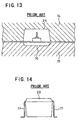
- the resin filling apparatus holds and pressurises the flat hoop frame between an upper metallic mold 14 and a lower metallic mold 15 as seen in FIG. 13, fills a resin into an upper metallic mold cavity 24 and a lower metallic mold cavity 16 above and below the flat hoop frame to embed the inner lead portions 3 of each set of lead portions in the resin (step D of FIG. 12), and then accommodates the flat hoop frame with the inner lead portions 3 embedded in the resin into a frame take-up apparatus.
- the flat hoop frame taken up by the frame take-up apparatus is then solder plated by a solder plating machine, whereafter it is supplied to and worked by, in the following steps E and F illustrated in FIG. 12, a composite apparatus (including a lead cutting apparatus, a lead shaping apparatus, a selection apparatus, a printing apparatus and a taping apparatus), by which it is taken up by a predetermined amount onto a shipment reel.
- such a semiconductor device 20 as shown in FIG. 14 is produced by the steps that, for a flat hoop frame supplied from a frame supply apparatus, a semiconductor pellet is die bonded to an island of a flat inner lead portion by a die bonding apparatus and then a pad of the semiconductor pellet and the other inner lead portions are wire bonded by a wire bonding apparatus, whereafter a resin is filled into upper and lower metallic mold cavities (24 and 16 in FIG. 13) by a resin filling apparatus and then solder plating is performed by a solder plating apparatus, and then the flat hoop frame is supplied to a composite apparatus.
- outer leads 17 are cut such that they have different lengths on the left side and the right side of the semiconductor device. Consequently, upon shaping of the outer leads 17 (refer to FIG. 14), they are not shaped in specified dimensions in terms of the vertical or height position, the lead width and the length of a flat face.
- the conventional method is disadvantageous also in that waste solder produced upon soldering sticks to and disturbs accurate positioning by a positioning stage or a positioning clamper.
- the conventional method is further disadvantageous in that, in the selection step, accurate measurement is disturbed by a dispersion in length of a flat face or inaccurate positioning.
- the conventional method is disadvantageous also in that, when the winding diameter on a reel increases, the operability is deteriorated, and the operation cannot be performed.
- leads of a flat hoop frame are shaped so that outer lead portions may be positioned at predetermined positions with respect to an outer profile of a semiconductor device after a resin is filled.
- a production method for an insulated semiconductor device comprising the steps of forming a flat hoop frame having a plurality of rows of sets of leads such that inner lead portions of the leads extend farther than corresponding resin filling centers so that outer lead portions of the leads may be positioned at predetermined positions with respect to outer profiles of semiconductor devices after resin is filled and supplying the flat hoop frame from a frame supply apparatus, shaping the inner lead portions of the leads of the flat hoop frame simultaneously for the plurality of rows and for a plurality of pitches by a lead shaping apparatus, performing die bonding of semiconductor pellets and wire bonding for the flat hoop frame, and filling, for each set of leads, resin into one of two cavities by a resin filling apparatus so that the outer lead portions of the leads of the flat hoop frame may be positioned at the predetermined positions with respect to the outer profiles of the semiconductor devices after the resin is filled.
- the production method for an insulated semiconductor device eliminates lead shaping processing by a composite apparatus. Consequently, various problems which otherwise originate from lead shaping by a composite apparatus including failure in shaping of outer lead portions with accurate dimensions, production of a gap between an outer lead portion and a portion of a resin block at which the outer lead portion is attached upon lead shaping, production of waster solder, inaccurate measurement of an outer lead foot portion by elongation upon selection and so forth are eliminated, and augmentation in quality, productivity and maintenance feasibility can be achieved.
- the inner lead portions of the leads of the flat hoop frame extend by a predetermined additional length farther than the positions of the individual resin filling centers.
- FIG. 2 illustrates different steps of a production process for an insulated semiconductor device to which the present invention is applied
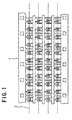
- FIG. 1 shows a flat hoop frame used for the production method illustrated in FIG. 2.
- the flat hoop frame is generally denoted at 1 and includes a large number of sets of leads having inner and outer lead portions arranged in a plurality of (four in FIG. 1) rows.
- the flat hoop frame 1 is formed such that, in each set of leads, inner lead portions extend farther than the position of a corresponding one of resin filling centers 2 for the individual rows with a lead shaping amount determined taking a semiconductor pellet thickness and a bonding wire height into consideration so that the outer lead portions may be positioned at predetermined positions with respect to the semiconductor device of the set.
- the flat hoop frame 1 supplied from a frame supply apparatus (refer to step A of FIG. 2) is successively subject, prior to the step of die bonding a semiconductor pellet to it, to simultaneous shaping of the inner lead portions 3 thereof for the plurality of rows (in the lateral direction) at a plurality of pitches (in the longitudinal direction) by a lead shaping apparatus mounted on the frame supply apparatus or on a die bonding apparatus (refer to step B of FIG. 2).
- the lead shaping apparatus may naturally be provided as a single machine.
- step C of FIG. 2 die bonding of a semiconductor pellet to each island 10
- wire bonding wire bonding
- step D of FIG. 2 resin is filled into only one of upper and lower metallic mold cavities by a resin filling apparatus so that the outer lead portions of the flat hoop frame may be positioned at predetermined positions with respect to the outer profiles of the semiconductor devices after the resin is filled (refer to step E of FIG. 2).
- the outer leads 17 are cut by a lead cutting apparatus (refer to step F of FIG. 2).
- the flat hoop frame 1 is formed such that the inner lead portions 3 in each set of leads extend farther than the position of the corresponding resin filling center 2 taking a lead shaping amount into consideration.
- the inner lead portions 3 in each set of leads and the island 10 extend farther than the resin filling center 2 by an amount corresponding to the lead shaping amount which is determined taking a semiconductor pellet thickness and a bonding wire height upon lead formation into consideration.
- FIG. 6 illustrates details of the steps performed by the frame supply apparatus, lead shaping apparatus and die bonding apparatus.
- the flat hoop frame 1 is fed from the frame supply apparatus 4 to the lead shaping apparatus 6 mounted at a location of the die bonding apparatus 5.
- the inner lead portions 3 of the flat hoop frame 1 are shaped downwardly into an L-shape simultaneously for the plurality of rows and the plurality of pitches by lead shaping punches 7 and a die 8 as seen in FIGS. 7(A) and 7(B) which illustrate a manner of lead shaping.
- the flat hoop frame 1 is supplied via a buffer 9 to the die bonding apparatus 5.
- FIG. 4(B) illustrates a manner in which the inner lead portions 3 are shaped downwardly into an L-shape by the lead shaping apparatus 6.
- step C of FIG. 2 die bonding of semiconductor pellets 11 on the islands 10 of the inner lead portions 3 of the flat hoop frame 1 supplied thereto is performed (refer to step C of FIG. 2).
- the flat hoop frame 1 is supplied to a wire bonding apparatus via another buffer.
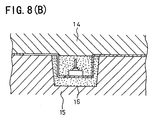
- the flat hoop frame 1 supplied to the wire bonding apparatus pads of the semiconductor pellets 11 and the inner lead portions 3 are bonded using wires 18 by the wire bonding apparatus (refer to step E of FIG. 2 and also to FIG. 8(A)). After completion of the wire bonding, the flat hoop frame 1 is supplied to a resin filling apparatus via a further buffer.
- the flat hoop frame 1 supplied to the resin filling apparatus is held between and pressurized by an upper metallic mold 14 and a lower metallic mold 15 as seen in FIG. 8(B), and then resin is filled only into lower metallic mold cavities 16. Thereafter, the flat hoop frame 1 is accommodated into a frame take-up machine.
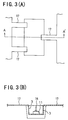
- a manner of a semiconductor device and outer leads of it after the resin is filled is shown in plan view in FIG. 3(A) and in sectional view taken along line A-A' of FIG. 3(A) in FIG. 3(B).
- the outer leads 17 of the semiconductor device filled with the resin are bent at an end face of the semiconductor device and then extend in the outward directions (leftward and rightward directions in FIGS. 3(A) and 3(B)) along the end face.
- the flat hoop frame 1 After taken up onto the frame take-up machine, the flat hoop frame 1 is solder plated by a solder plating apparatus. After the solder plating, the flat hoop frame 1 is supplied to and worked by a composite apparatus (refer to step F of FIG. 2) which includes a lead cutting apparatus, a selection apparatus, a printing apparatus and a taping apparatus, by which it is finally taken up by a predetermined amount onto a shipment reel. It is to be noted that the outer leads 17 are cut by the composite apparatus so that the outer leads 17 (foot portions) extends along the lower face of the semiconductor device 20 and project by a predetermined amount outwardly from the lower face as seen in FIG. 5.
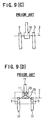
- FIG. 9(A) shows details of lead portions of a flat hoop frame which is employed for a production method for an insulated semiconductor device according to another embodiment of the present invention
- FIG. 9(B) shows details of the lead portions after inner lead shaping is performed using the production method for an insulated semiconductor device of the second embodiment
- FIG. 9(C) shows details of lead portions of a conventional flat hop frame
- FIG. 9(D) shows details of the lead portions of the flat hop frame of FIG. 9(C) after inner lead shaping is performed using a conventional method.
- FIGS. 10(A) and 10(B) show details of a resin filling metallic mold employed in the production method of the present embodiment.
- inner lead portions 3 are formed, taking a lead shaping amount into consideration, such that they are elongated farther than the position of a corresponding resin filling center 2.
- the inner lead portions 3 are shaped upwardly into an L-shape simultaneously for a plurality of rows and a plurality of pitches by a lead shaping apparatus (refer to FIG. 9(B)).
- the production method of the present embodiment is advantageous in that, by boding wires 18 obliquely in the wire bonding step, lead shaping (refer to FIG. 9(D) can be performed for the conventional flat hoop frame 1 (refer to FIG. 9(C)).
Landscapes
- Encapsulation Of And Coatings For Semiconductor Or Solid State Devices (AREA)
- Lead Frames For Integrated Circuits (AREA)
Applications Claiming Priority (2)
| Application Number | Priority Date | Filing Date | Title |
|---|---|---|---|
| JP8080777A JP2828016B2 (ja) | 1996-03-08 | 1996-03-08 | 絶縁型半導体装置の製造方法 |
| JP80777/96 | 1996-03-08 |
Publications (2)
| Publication Number | Publication Date |
|---|---|
| EP0794560A2 true EP0794560A2 (fr) | 1997-09-10 |
| EP0794560A3 EP0794560A3 (fr) | 1998-03-18 |
Family
ID=13727878
Family Applications (1)
| Application Number | Title | Priority Date | Filing Date |
|---|---|---|---|
| EP97103714A Withdrawn EP0794560A3 (fr) | 1996-03-08 | 1997-03-06 | Procédé pour la production d'un dispositif semi-conducteur isolé |
Country Status (4)
| Country | Link |
|---|---|
| US (1) | US5705431A (fr) |
| EP (1) | EP0794560A3 (fr) |
| JP (1) | JP2828016B2 (fr) |
| KR (1) | KR100246694B1 (fr) |
Families Citing this family (4)
| Publication number | Priority date | Publication date | Assignee | Title |
|---|---|---|---|---|
| JP2781783B2 (ja) * | 1996-07-30 | 1998-07-30 | 山形日本電気株式会社 | 半導体装置用パッケージ |
| JP3012816B2 (ja) * | 1996-10-22 | 2000-02-28 | 松下電子工業株式会社 | 樹脂封止型半導体装置およびその製造方法 |
| EP1324386B1 (fr) * | 2001-12-24 | 2011-06-15 | ABB Research Ltd. | Module semi-conductreur et méthode de fabrication d'un module semi-conducteur |
| JP5771480B2 (ja) * | 2011-08-31 | 2015-09-02 | 新電元工業株式会社 | リードフレーム、及び半導体装置の製造方法 |
Family Cites Families (11)
| Publication number | Priority date | Publication date | Assignee | Title |
|---|---|---|---|---|
| FR1471243A (fr) * | 1966-01-19 | 1967-03-03 | Radiotechnique | Perfectionnements aux dispositifs semi-conducteurs enrobés dans un revêtement protecteur isolant moulé |
| JPS5550648A (en) * | 1978-10-06 | 1980-04-12 | Mitsubishi Electric Corp | Resin sealing type semiconductor device |
| DE3421539A1 (de) * | 1984-06-08 | 1985-12-19 | Siemens AG, 1000 Berlin und 8000 München | Halbleiterbauelement fuer smd-technik |
| JPS6175553A (ja) * | 1984-09-21 | 1986-04-17 | Hitachi Tobu Semiconductor Ltd | 電子部品 |
| JPS62298146A (ja) * | 1986-06-18 | 1987-12-25 | Hitachi Micro Comput Eng Ltd | 電子装置 |
| US5202288A (en) * | 1990-06-01 | 1993-04-13 | Robert Bosch Gmbh | Method of manufacturing an electronic circuit component incorporating a heat sink |
| US5172214A (en) * | 1991-02-06 | 1992-12-15 | Motorola, Inc. | Leadless semiconductor device and method for making the same |
| DE69231290D1 (de) * | 1991-12-27 | 2000-08-31 | Fujitsu Ltd | Halbleitervorrichtung und Verfahren zu ihrer Herstellung |
| US5436492A (en) * | 1992-06-23 | 1995-07-25 | Sony Corporation | Charge-coupled device image sensor |
| JP2747634B2 (ja) * | 1992-10-09 | 1998-05-06 | ローム株式会社 | 面実装型ダイオード |
| US5327008A (en) * | 1993-03-22 | 1994-07-05 | Motorola Inc. | Semiconductor device having universal low-stress die support and method for making the same |
-
1996
- 1996-03-08 JP JP8080777A patent/JP2828016B2/ja not_active Expired - Fee Related
-
1997
- 1997-03-04 US US08/808,036 patent/US5705431A/en not_active Expired - Fee Related
- 1997-03-06 EP EP97103714A patent/EP0794560A3/fr not_active Withdrawn
- 1997-03-08 KR KR1019970007861A patent/KR100246694B1/ko not_active Expired - Fee Related
Also Published As
| Publication number | Publication date |
|---|---|
| US5705431A (en) | 1998-01-06 |
| JP2828016B2 (ja) | 1998-11-25 |
| KR100246694B1 (ko) | 2000-03-15 |
| KR970067813A (ko) | 1997-10-13 |
| EP0794560A3 (fr) | 1998-03-18 |
| JPH09246305A (ja) | 1997-09-19 |
Similar Documents
| Publication | Publication Date | Title |
|---|---|---|
| US6709892B2 (en) | Electronic device fabrication method comprising twofold cutting of conductor member | |
| KR20030082571A (ko) | 반도체장치 및 그 제조방법 | |
| JP2003209216A (ja) | リードフレーム、樹脂封止金型およびそれらを用いた半導体装置の製造方法 | |
| US6429514B2 (en) | Integrated circuit chip and method for fabricating the same | |
| US6979886B2 (en) | Short-prevented lead frame and method for fabricating semiconductor package with the same | |
| JP2011100828A (ja) | 半導体装置及びその製造方法 | |
| US5705431A (en) | Production method for insulated semiconductor device | |
| US5989474A (en) | Method for fabricating resin-sealed semiconductor device using leadframe provided with resin dam bar | |
| US6303983B1 (en) | Apparatus for manufacturing resin-encapsulated semiconductor devices | |
| KR100334699B1 (ko) | 와이어 본딩방법 | |
| US5406700A (en) | Method for producing pin integrated circuit lead frame | |
| US10937728B2 (en) | Preformed lead frame and lead frame package made from the same | |
| JPS63187657A (ja) | 半導体装置の製造方法 | |
| US5473199A (en) | Semiconductor device having a body with a carrier ring connected thereto | |
| JP3028167B2 (ja) | リードフレームの製造方法およびリードフレーム製造装置 | |
| JPH08172153A (ja) | 半導体装置のリード加工方法及びリード加工用金型 | |
| JPH0738036A (ja) | 半導体装置の製造方法 | |
| JP2555989B2 (ja) | 樹脂封止型半導体装置およびリードフレーム | |
| JPH1126669A (ja) | タイバー切断金型 | |
| KR100571558B1 (ko) | 인쇄회로기판의 펀칭공정시 윈도우슬릿의 버를 방지할 수있는 방법 | |
| JPH0645497A (ja) | 半導体装置およびその製造方法 | |
| JPH0653399A (ja) | 樹脂封止型半導体装置 | |
| JP2712957B2 (ja) | 樹脂封止型半導体装置の製造方法 | |
| JP2743876B2 (ja) | 半導体装置の製造方法 | |
| JPH06350013A (ja) | リードフレーム及び半導体装置並びに半導体装置の製造方法 |
Legal Events
| Date | Code | Title | Description |
|---|---|---|---|
| PUAI | Public reference made under article 153(3) epc to a published international application that has entered the european phase |
Free format text: ORIGINAL CODE: 0009012 |
|
| AK | Designated contracting states |
Kind code of ref document: A2 Designated state(s): DE FR GB |
|
| PUAL | Search report despatched |
Free format text: ORIGINAL CODE: 0009013 |
|
| AK | Designated contracting states |
Kind code of ref document: A3 Designated state(s): DE FR GB |
|
| 17P | Request for examination filed |
Effective date: 19980629 |
|
| RAP1 | Party data changed (applicant data changed or rights of an application transferred) |
Owner name: NEC ELECTRONICS CORPORATION |
|
| 17Q | First examination report despatched |
Effective date: 20030417 |
|
| STAA | Information on the status of an ep patent application or granted ep patent |
Free format text: STATUS: THE APPLICATION IS DEEMED TO BE WITHDRAWN |
|
| 18D | Application deemed to be withdrawn |
Effective date: 20051220 |