EP0794585A1 - Element secondaire au lithium - Google Patents
Element secondaire au lithium Download PDFInfo
- Publication number
- EP0794585A1 EP0794585A1 EP95937179A EP95937179A EP0794585A1 EP 0794585 A1 EP0794585 A1 EP 0794585A1 EP 95937179 A EP95937179 A EP 95937179A EP 95937179 A EP95937179 A EP 95937179A EP 0794585 A1 EP0794585 A1 EP 0794585A1
- Authority
- EP
- European Patent Office
- Prior art keywords
- positive electrode
- lithium
- secondary battery
- active material
- negative electrode
- Prior art date
- Legal status (The legal status is an assumption and is not a legal conclusion. Google has not performed a legal analysis and makes no representation as to the accuracy of the status listed.)
- Withdrawn
Links
Images


Classifications
-
- H—ELECTRICITY
- H01—ELECTRIC ELEMENTS
- H01M—PROCESSES OR MEANS, e.g. BATTERIES, FOR THE DIRECT CONVERSION OF CHEMICAL ENERGY INTO ELECTRICAL ENERGY
- H01M4/00—Electrodes
- H01M4/02—Electrodes composed of, or comprising, active material
- H01M4/36—Selection of substances as active materials, active masses, active liquids
- H01M4/58—Selection of substances as active materials, active masses, active liquids of inorganic compounds other than oxides or hydroxides, e.g. sulfides, selenides, tellurides, halogenides or LiCoFy; of polyanionic structures, e.g. phosphates, silicates or borates
- H01M4/5825—Oxygenated metallic salts or polyanionic structures, e.g. borates, phosphates, silicates, olivines
-
- H—ELECTRICITY
- H01—ELECTRIC ELEMENTS
- H01M—PROCESSES OR MEANS, e.g. BATTERIES, FOR THE DIRECT CONVERSION OF CHEMICAL ENERGY INTO ELECTRICAL ENERGY
- H01M10/00—Secondary cells; Manufacture thereof
- H01M10/05—Accumulators with non-aqueous electrolyte
- H01M10/052—Li-accumulators
- H01M10/0525—Rocking-chair batteries, i.e. batteries with lithium insertion or intercalation in both electrodes; Lithium-ion batteries
-
- H—ELECTRICITY
- H01—ELECTRIC ELEMENTS
- H01M—PROCESSES OR MEANS, e.g. BATTERIES, FOR THE DIRECT CONVERSION OF CHEMICAL ENERGY INTO ELECTRICAL ENERGY
- H01M4/00—Electrodes
- H01M4/02—Electrodes composed of, or comprising, active material
- H01M4/36—Selection of substances as active materials, active masses, active liquids
- H01M4/38—Selection of substances as active materials, active masses, active liquids of elements or alloys
-
- H—ELECTRICITY
- H01—ELECTRIC ELEMENTS
- H01M—PROCESSES OR MEANS, e.g. BATTERIES, FOR THE DIRECT CONVERSION OF CHEMICAL ENERGY INTO ELECTRICAL ENERGY
- H01M4/00—Electrodes
- H01M4/02—Electrodes composed of, or comprising, active material
- H01M4/36—Selection of substances as active materials, active masses, active liquids
- H01M4/38—Selection of substances as active materials, active masses, active liquids of elements or alloys
- H01M4/40—Alloys based on alkali metals
-
- H—ELECTRICITY
- H01—ELECTRIC ELEMENTS
- H01M—PROCESSES OR MEANS, e.g. BATTERIES, FOR THE DIRECT CONVERSION OF CHEMICAL ENERGY INTO ELECTRICAL ENERGY
- H01M4/00—Electrodes
- H01M4/02—Electrodes composed of, or comprising, active material
- H01M4/36—Selection of substances as active materials, active masses, active liquids
- H01M4/48—Selection of substances as active materials, active masses, active liquids of inorganic oxides or hydroxides
- H01M4/52—Selection of substances as active materials, active masses, active liquids of inorganic oxides or hydroxides of nickel, cobalt or iron
- H01M4/525—Selection of substances as active materials, active masses, active liquids of inorganic oxides or hydroxides of nickel, cobalt or iron of mixed oxides or hydroxides containing iron, cobalt or nickel for inserting or intercalating light metals, e.g. LiNiO2, LiCoO2 or LiCoOxFy
-
- H—ELECTRICITY
- H01—ELECTRIC ELEMENTS
- H01M—PROCESSES OR MEANS, e.g. BATTERIES, FOR THE DIRECT CONVERSION OF CHEMICAL ENERGY INTO ELECTRICAL ENERGY
- H01M4/00—Electrodes
- H01M4/02—Electrodes composed of, or comprising, active material
- H01M4/36—Selection of substances as active materials, active masses, active liquids
- H01M4/38—Selection of substances as active materials, active masses, active liquids of elements or alloys
- H01M4/40—Alloys based on alkali metals
- H01M4/405—Alloys based on lithium
-
- H—ELECTRICITY
- H01—ELECTRIC ELEMENTS
- H01M—PROCESSES OR MEANS, e.g. BATTERIES, FOR THE DIRECT CONVERSION OF CHEMICAL ENERGY INTO ELECTRICAL ENERGY
- H01M4/00—Electrodes
- H01M4/02—Electrodes composed of, or comprising, active material
- H01M4/36—Selection of substances as active materials, active masses, active liquids
- H01M4/48—Selection of substances as active materials, active masses, active liquids of inorganic oxides or hydroxides
- H01M4/485—Selection of substances as active materials, active masses, active liquids of inorganic oxides or hydroxides of mixed oxides or hydroxides for inserting or intercalating light metals, e.g. LiTi2O4 or LiTi2OxFy
-
- H—ELECTRICITY
- H01—ELECTRIC ELEMENTS
- H01M—PROCESSES OR MEANS, e.g. BATTERIES, FOR THE DIRECT CONVERSION OF CHEMICAL ENERGY INTO ELECTRICAL ENERGY
- H01M6/00—Primary cells; Manufacture thereof
- H01M6/04—Cells with aqueous electrolyte
- H01M6/06—Dry cells, i.e. cells wherein the electrolyte is rendered non-fluid
- H01M6/10—Dry cells, i.e. cells wherein the electrolyte is rendered non-fluid with wound or folded electrodes
-
- Y—GENERAL TAGGING OF NEW TECHNOLOGICAL DEVELOPMENTS; GENERAL TAGGING OF CROSS-SECTIONAL TECHNOLOGIES SPANNING OVER SEVERAL SECTIONS OF THE IPC; TECHNICAL SUBJECTS COVERED BY FORMER USPC CROSS-REFERENCE ART COLLECTIONS [XRACs] AND DIGESTS
- Y02—TECHNOLOGIES OR APPLICATIONS FOR MITIGATION OR ADAPTATION AGAINST CLIMATE CHANGE
- Y02E—REDUCTION OF GREENHOUSE GAS [GHG] EMISSIONS, RELATED TO ENERGY GENERATION, TRANSMISSION OR DISTRIBUTION
- Y02E60/00—Enabling technologies; Technologies with a potential or indirect contribution to GHG emissions mitigation
- Y02E60/10—Energy storage using batteries
Definitions
- the present invention relates to a lithium secondary battery having high capacity and superior cycle property, a positive electrode active material to be used for lithium secondary battery, and to a positive electrode material compound.
- a lithium secondary battery is required to have (1) high energy density (2) high output density (3) small self discharge ratio (4) economical aspect (5) high energy efficiency and (6) long cycle life.
- lithium secondary battery As a secondary battery having such properties, a nonaqueous electrolyte battery utilizing an electric energy produced by the migration of lithium ions, i.e., so-called lithium secondary battery, is known to have high voltage and high energy density.
- a lithium secondary battery comprising pure lithium as a negative electrode material can achieve high energy density of the negative electrode, whereas it suffers from a tendency to grow dendrite.
- An electrodeposition of metals generally proceeds in two steps of migration of metallic ions to the electrode surface (i.e. diffusion) and receipt and release of electrons at the electrode (i.e. electrode reaction).
- the electrode reaction proceeds quickly and the speed of lithium diffusing toward the electrode surface determines the rate of electrodeposition.
- An electrodeposition wherein the rate is determined by such mass migration often suffers from the growth of dendrite.
- the dendrite is a branch-like crystal which grows quickly once formed, and penetrates a separator, as a result of which it causes short-circuit between the negative electrode and the positive electrode. Consequently, problems are caused which are undesirable in terms of safety, such as combustion, markedly short cycle life of the battery and poor cycle property.
- a negative electrode composed of a lithium alloy comprising an intermetallic compound of Li and Al, Bi, Pb, Sn, In or the like is known to suppress deposition of lithium in a dendrite state, since the speed of absorption of lithium in the negative electrode becomes higher.
- this also poses problems in that the negative electrode becomes weak, so that it develops cracks through swelling and contraction in volume which occur along with the absorption and release of lithium, to ultimately result in pulverulent negative electrode, and that the electromotive force of the battery decreases due to a higher potential of the electrode than that possessed by the negative electrode composed of pure lithium.
- a variety of materials have been conventionally considered to be potential positive electrode active materials for lithium secondary batteries, and typically included therein are inorganic compounds capable of reversely inserting and eliminating lithium ions.
- inorganic compounds chalcogen compounds such as oxides and sulfides have been mostly studied, and oxides having high potential, which are capable of achieving a high energy density of batteries, have been found to be particularly promising.
- LiCoO 2 is a 4V class positive electrode active material reported by Mizushima et al. in 1980 (Mat. Res. Bull., Vol. 15, pp 783-789) and mainly used as a positive electrode active material for lithium secondary batteries which are being used as a main power source of portable equipments currently put to use. Again, a positive electrode active material using such LiCoO 2 is inferior in the supply of materials since Co is expensive.
- an object of the present invention is to solve the above-mentioned problems and provide a lithium secondary battery having great charge-discharge capacity and superior cycle property.
- Another object of the present invention is to provide a positive electrode active material for lithium secondary battery and a positive electrode material compound, which are free of the above-mentioned problems and which are economical, superior in suppliability, have great charge-discharge capacity and superior in cycle property.
- the present inventors have conducted various studies taking note of the materials of positive and negative electrodes of lithium secondary battery, and found that the above-mentioned problems can be solved by using, as a positive electrode active material, an oxide compound containing at least lithium and nickel, and an Li-Ag-Te alloy as a negative electrode material.
- a positive electrode active material an oxide compound containing at least lithium and nickel
- an Li-Ag-Te alloy as a negative electrode material.
- Al and P to an LiNiO 2 substance to afford the substance a specific ratio of Ni, Al and P results in the provision of a positive electrode active material superior in capacity and cycle property.
- the present invention has been made based on this finding.
- the present invention relates to a lithium secondary battery comprising a positive electrode composed of a positive electrode active material comprising an oxide compound which comprises at least Li and Ni, and a negative electrode comprising an Li-Ag-Te alloy;
- the present invention also relates to a positive electrode active material for lithium secondary battery, which is composed of an oxide compound represented by the formula : LiNi w Al x P y O z wherein 0.80 ⁇ w ⁇ 1.10, 0 ⁇ x ⁇ 0.015, 0 ⁇ y ⁇ 0.03 and 1.8 ⁇ z ⁇ 2.2, a positive electrode material compound comprising the above-mentioned positive electrode active material, a conductive agent and a binder, and a lithium secondary battery comprising the above-mentioned positive electrode active material.
- a positive electrode active material for lithium secondary battery which is composed of an oxide compound represented by the formula : LiNi w Al x P y O z wherein 0.80 ⁇ w ⁇ 1.10, 0 ⁇ x ⁇ 0.015, 0 ⁇ y ⁇ 0.03 and 1.8 ⁇ z ⁇ 2.2, a positive electrode material compound comprising the above-mentioned positive electrode active material, a conductive agent and a binder, and a lithium secondary battery comprising the above-mentioned positive electrode active material.
- the present invention further relates to a lithium secondary battery comprising a positive electrode composed of a positive electrode active material comprising an oxide compound represented by the formula : LiNi w Al x P y O z wherein 0.80 ⁇ w ⁇ 1.10, 0 ⁇ x ⁇ 0.015, 0 ⁇ y ⁇ 0.03 and 1.8 ⁇ z ⁇ 2.2, a negative electrode composed of an Li-Ag-M1-M2-Te alloy wherein M1 is at least one member selected from the metals of 3B, 4B and 5B group metals in the periodic table (long period), and M2 is at least one member selected from transition metals except Ag, and a nonaqueous electrolyte.
- a positive electrode composed of a positive electrode active material comprising an oxide compound represented by the formula : LiNi w Al x P y O z wherein 0.80 ⁇ w ⁇ 1.10, 0 ⁇ x ⁇ 0.015, 0 ⁇ y ⁇ 0.03 and 1.8 ⁇ z ⁇ 2.2
- a negative electrode composed of an Li-Ag-M1-
- the positive electrode active material in the present invention is exemplified by those composed of an oxide compound containing at least Li and Ni.
- Said oxide compound may be a known compound, with preference given to those represented by the following formulas: Li p Ni q O 2 (0 ⁇ p ⁇ 1, 0 ⁇ q ⁇ 1) (1) LiNi 1-r M r O 2 (0 ⁇ r ⁇ 1) (e.g. LiNi 1-r Co r O 2 wherein 0 ⁇ r ⁇ 1) (2) Li s NiM t O 2 (0.1 ⁇ s ⁇ 1.2, 0.001 ⁇ t ⁇ 0.2) (e.g.
- LiNiM t O 2 (3) wherein 0.001 ⁇ t ⁇ 0.2) and Li u Ni 1-v M v O 2 (0.1 ⁇ u ⁇ 1.2, 0.001 ⁇ v ⁇ 0.2) (e.g. LiNi 1-v M v O 2 wherein 0.001 ⁇ v ⁇ 0.2).
- M is one or more metals selected from the group of Co, Fe, Cr, V, Mn, P, Al, In, Sn, Ti, Cu, Ga, Ag and Zn.
- the oxide compound examples include LiNiO 2 , LiNi 0.5 Co 0.5 O 2 , LiNi 0.75 Co 0.25 O 2 , LiNi 0.25 Co 0.75 O 2 , LiNi 0.995 Fe 0.005 O 2 , LiNi 0.99 Cr 0.01 O 2 , LiNi 0.95 V 0.05 O 2 , LiNi 0.92 Mn 0.08 O 2 , LiNiP 0.05 O 2 , LiNiAl 0.08 O 2 , LiNiIn 0.005 O 2 , LiNi 0.95 Sn 0.05 O 2 , LiNi 0.99 Ti 0.01 O 2 , LiNi 0.95 Cu 0.05 O 2 , LiNiGa 0.005 O 2 , LiNiAg 0.1 O 2 and LiNiZn 0.15 O 2 .
- the above-mentioned oxide compound can be obtained by mixing a predetermined amount of lithium salt (e.g. lithium carbonate, lithium sulfate and lithium nitrate), lithium oxide, or lithium hydroxide and the like, and nickel salt (e.g. nickel carbonate, nickel sulfate, nickel nitrate and nickel oxyhydroxide), nickel oxide or nickel hydroxide and the like, and where necessary, one or more salts (e.g.
- lithium salt e.g. lithium carbonate, lithium sulfate and lithium nitrate
- lithium oxide lithium hydroxide and the like
- nickel salt e.g. nickel carbonate, nickel sulfate, nickel nitrate and nickel oxyhydroxide
- nickel oxide or nickel hydroxide and the like e.g.
- oxides or hydroxides of metal selected from cobalt, iron, chromium, vanadium, manganese, phosphorus, aluminum, indium, tin, titanium, copper, gallium, silver and zinc, and heat-sintering the mixture at 600-900°C, preferably 650-800°C.
- oxide compound can be also prepared using halides besides salts, oxides and hydroxides of metal such as lithium and nickel.
- Particularly preferable positive electrode active material is that composed of a novel oxide compound represented by the formula : LiNi w Al x P y O z wherein 0.80 ⁇ w ⁇ 1.10, 0 ⁇ x ⁇ 0.015, 0 ⁇ y ⁇ 0.03 and 1.8 ⁇ z ⁇ 2.2.
- the range of w is 0.80 ⁇ w ⁇ 1.10, preferably 0.95 ⁇ w ⁇ 1.05.
- the range of x is 0 ⁇ x ⁇ 0.015, preferably 0.001 ⁇ x ⁇ 0.010.
- the range of y is 0 ⁇ y ⁇ 0.03, preferably 0.001 ⁇ y ⁇ 0.015.
- the range of z is 1.8 ⁇ z ⁇ 2.2, preferably 1.9 ⁇ z ⁇ 2.1.
- z is in the above-mentioned range, the battery suffers less from oxygen deficiency or products from side reaction, and the battery becomes more superior in capacity and cycle property.
- the oxide compound represented by the formula : LiNi w Al x P y O z is obtained by, for example, subjecting a predetermined amount of a mixture of single unit compounds of lithium, nickel, aluminum and phosphorus, or salts thereof (e.g. carbonate, sulfate and nitrate), oxides thereof or hydroxides thereof, and metallic organic compounds to sintering (e.g. heating temperature: about 600-900°C, preferably 650-800°C), solid phase method, sol-gel method, CVD, PVD, thermal spraying, thermal decomposition or the like.
- the respective oxide compounds thus obtained are generally pulverized in mortar, ball mill, hammer mill, jet mill and the like to prepare powders of about 0.1-20 ⁇ m in average particle size, and used as positive electrode active materials.
- a positive electrode for lithium secondary battery can be prepared as in the following using the above-mentioned positive electrode active material.
- a binder such as fluorocarbon resin (e.g. polyvinylidene fluoride and polytetrafluoroe thylene), polyethylene and ethylene-propylene-diene polymer (EPDM) and conductive material such as acetylene black, ketzen black and graphite are added to the above-mentioned positive electrode active material to give a positive electrode material compound.
- This material compound can be formed into a suitable shape and size by an optional method such as doctor blade method, cast forming, compression forming and roll forming to give a positive electrode for lithium secondary battery.
- a positive electrode having a layer or tunnel crystal structure allowing entrance and exit of lithium ions can be prepared.
- a positive electrode sheet it preferably has a thickness of 50-500 ⁇ m.
- the binder is preferably a fluorocarbon resin.
- a solvent such as N-methyl-2-pyrrolidone, propylene carbonate, dimethylformamide (DMF), dimethyl sulfoxide (DMSO), xylene and cyclohexane is mixed with 100 parts by weight of the above-mentioned positive electrode material compound to give a positive electrode paste.
- the material for the negative electrode of the lithium secondary battery of the present invention may be a conventionally-known material for negative electrodes.
- examples thereof include lithium, alloy thereof, carbon material and oxides such as Nb 2 O 5 and Fe 2 O 3 , with preference given to lithium alloy.
- a lithium alloy When a lithium alloy is used, it is preferably contained in an atomic proportion of 10% or more, more preferably 10-50%. When the content of lithium is not less than 10%, a decrease in capacity or battery voltage caused by alloying can be suppressed.
- lithium alloys examples include Li-Ag-Te alloys, namely, Li-Ag-Te alloys containing at least Li, Ag and Te.
- intermetallic compounds make crystal particles of negative electrode alloy extremely fine, thereby markedly increasing the area of grain boundary.
- the speed of the diffusion of lithium in the grain boundary reaches not less than several dozen times higher than transgranular speed, so that the lithium electrodeposition is less rate-determined by diffusion of Li, whereby growth of dendrite is suppressed. This also results in an enhanced efficiency of absorption and release of lithium.
- intermetallic compounds accumulate in grain boundary to form a three-dimensional shell.
- Ag a Te b functions as an aggregate to retain the strength of the shell, or a binder of Li 2 Te.
- the speed of lithium diffusing in Li 2 Te is notably high, so that Li 2 Te functions as a high speed diffusion path of lithium, whereby the absorption and release of Li during charging and discharging of the battery proceed through said shell.
- the growth of dendrite is suppressed, since said shell is formed from the above-mentioned intermetallic compound.
- the shell also functions as a barrier of Ag diffusion, whereby fallout of Ag from the electrode during discharge can be prevented.
- the equivalent electrode potential of Li 2 Te and lithium leads to an equivalent electromotive force of a battery comprising Li 2 Te and a battery comprising pure lithium.
- An atomic ratio of Ag within the above-mentioned range relative to the atomic ratio of Li is preferable in that crystal particles can be made sufficiently fine; sufficient strength of the shell composed of the intermetallic compounds can be achieved; the alloy is easily processed into a sheet; and the battery is afforded a high electromotive force.
- a Te having an atomic ratio within the above-mentioned range relative to the atomic ratio of Li is preferable in that dendrite can be sufficiently suppressed; crystal particles can be made sufficiently fine; the alloy is easily processed into a sheet; and the battery is afforded a high electromotive force.
- Li-Ag-Te alloys an Li-Ag-M1-M2-Te alloy wherein M1 is at least one member selected from 3B, 4B and 5B group metals in the periodic table (long period), and M2 is at least one member selected from transition metals except Ag, is particularly preferable.
- transition metal includes 3A-7A, 8, 1B and 2B group metals in the periodic table (long period).
- the Li-Ag-M1-M2-Te alloy has the same advantages as those possessed by the above-mentioned Li-Ag-Te alloy, and respective alloy components of M1 and M2 function as an Li diffusion promoter and a binder, respectively, to more effectively suppress the growth of dendrite and degradation caused by the swelling and contraction of negative electrode along with absorption and release of lithium, as a result of which the cycle life of the battery is prolonged.
- M1 in the above-mentioned Li-Ag-M1-M2-Te alloy is preferably one or more members selected from Al, Si, In, Sn, Bi and Pb, more preferably one or more members selected from In, Sn, Bi and Pb.
- M2 is preferably one or more members selected from Zn, Fe, Co, Ni, Mn, Mo and W, more preferably one or more members selected from Zn, Fe and Ni.
- the aforementioned Li-Ag-M1-M2-Te alloy preferably has an atomic ratio of Li:Ag:M1:M2:Te of 10-120 : 1-30 : 1-100 : 1-30 : 0.001-2, more preferably 10-80 : 10-30 : 10-100 : 1-20 : 0.01-0.5.
- An Li-Ag-M1-M2-Te alloy having an atomic ratio of Ag within the above range relative to the atomic ratio of Li is advantageous in that the battery tends to achieve superior cycle property, high speed of Li diffusion and high electromotive force.
- the atomic ratios of M1 and M2 are in the above-mentioned range relative to the atomic ratio of Li, the respective alloy components of M1 and M2 exert sufficient Li diffusion promoting effect and binding effect, thus leading to an improved cycle life, charge-discharge capacity, electromotive force and energy density of the battery.
- the atomic ratio of Te is within the above-mentioned range relative to the atomic ratio of Li, the diffusion of Li is promoted and the cycle life of the battery desirably becomes longer.
- the lithium alloys such as the above-mentioned Li-Ag-Te alloy and Li-Ag-M1-M2-Te alloy are prepared, for example, according to a suitable known alloying method such as reaction of respective molten alloy components in a predetermined ratios (melting method) and reaction on evaporation.
- the alloy components are heated and melted in an inert gas atmosphere for alloying.
- the heating-melting is preferably performed at a temperature not less than the melting point of Li alloy to allow quick progress of the alloying reaction.
- the alloying by evaporation comprises evaporating the alloy components to solidify same on the surface of other kinds of metals.
- This method allows production of a non-equilibrium phase alloy of high melting point metals which cannot be alloyed by the above-mentioned melting method, and low melting point metals.
- usable methods include various sputterings such as ion beam sputtering, electron beam evaporation, various ion platings, flash plasma evaporation, pulse plasma evaporation and CVD.
- a method comprising accelerating atoms or ions in the direction of substrate for evaporation, such as ion plating and sputtering, is preferable.
- the method of forming the negative electrode is not particularly limited, and conventional methods can be employed.
- an optional method such as doctor blade method, cast forming, compression forming and roll forming is employed to form a negative electrode in a known form, such as sheet, tape, thin film and substrate (hereinafter these forms are generally referred to as sheet form).
- a negative electrode sheet preferably has a thickness of 10-300 ⁇ m.
- a metallic material such as lithium and alloy thereof
- a method for forming a negative electrode material into a sheet by hot rolling or hot extrusion and a method for forming a negative electrode material layer on a collector by hot dipping or low pressure plasma spraying may be used.
- the latter method of forming a negative electrode material layer on a collector is advantageous for forming a negative electrode sheet wherein such negative electrode material layer can be formed on one or both sides of the collector.
- the hot rolling comprises heating the metallic materials for good processability and press-rolling the material
- the hot extrusion comprises heating the metallic materials for good processability and extruding the material.
- the hot dipping comprises melting the metal in an inert gas and immersing a collector therein for plating
- the low pressure plasma spraying comprises spraying a molten metal on a collector under a reduced pressure inert gas atmosphere (preferably about 10-100 Torr).
- a negative electrode sheet can be also formed by, for example, setting negative electrode material components onto a collector sheet by the aforementioned evaporation.
- a negative electrode sheet material may be bonded to a collector sheet by a suitable method such as brazing, soldering, ultrasonic welding, spot welding, press-adhesion and roll press-rolling, whereby a negative electrode sheet can be formed.
- the collector sheet refers to that composed of suitable conductors such as Ni, Al, Cu, Ag and Fe. Specific examples thereof include metal foil sheet, metal mesh sheet and metal porous sheet.
- a carbon material containing no Li can be directly used as a negative electrode, since the positive electrode active material contains Li in the present invention.
- a combination of a positive electrode comprising a positive electrode active material composed of an oxide compound of the formula : LiNi w Al x P y O z and a negative electrode composed of an Li-Ag-M1-M2-Te alloy is particularly preferable.
- the lithium secondary battery of the present invention comprises an electrolyte.
- the electrolyte is generally a nonaqueous one, which is exemplified by electrolyte solutions obtained by dissolving various salts conventionally used for lithium batteries, in nonaqueous solvent, and solid electrolyte.
- Examples of the above-mentioned salt include LiClO 4 , LiBF 4 , LiPF 4 , LiPF 6 , LiAsF 3 , LiAsF 6 , LiAlCl 4 , Li(CF 2 SO 2 ) 2 and Li(CF 3 SO 2 ) 2 N.
- nonaqueous solvent examples include ethylene carbonate, propylene carbonate, dimethyl sulfoxide, sulfolane, ⁇ -butyrolactone, 1,2-dimethoxyethane, N,N-dimethylformamide, tetrahydrofuran, 1,3-dioxolane, 2-methyltetrahydrofuran, diethyl ether, dimethyl carbonate, diethyl carbonate, methyl formate, methyl acetate, acetonitrile, 3-methyl-2-oxazolidinone, ethylene glycol sulfite, dimethyl sulfite, nitromethane, N-methylpyrrolidinone and mixtures thereof.
- the above-mentioned salts are dissolved in the above-mentioned nonaqueous solvent to a concentration of about 0.1-3 moles/L and used as an electrolyte solution.
- an organic additive such as 2-methylfuran, thiophene, pyrrole and crown ether may be dissolved in said electrolyte solution.
- the electrolyte solution is generally used upon impregnating or filling a separator such as porous polymer, glass filter and nonwoven fabric with the same.
- the nonaqueous electrolyte is a solid electrolyte
- the above-mentioned salts are mixed with a polymer such as polyethylene oxide, polyphosphazene, polyaziridine, polyethylene sulfide, polyvinyl alcohol, and derivatives, mixtures and compounds thereof.
- a polymer such as polyethylene oxide, polyphosphazene, polyaziridine, polyethylene sulfide, polyvinyl alcohol, and derivatives, mixtures and compounds thereof.
- the above-mentioned nonaqueous solvent may be incorporated into polymers.
- Such solid electrolyte may also act as a separator between the positive electrode and the negative electrode.
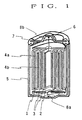
- Fig. 1 is a cross section of one embodiment of the lithium secondary battery of the present invention.
- Fig. 2 is a cross section of another embodiment of the lithium secondary battery of the present invention.
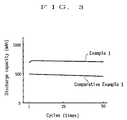
- Fig. 3 shows the relationship between the number of cycles and discharge capacity in the charge-discharge test with regard to the respective batteries obtained in Example 1 and Comparative Example 1.
- Fig. 4 shows discharge property curves with regard to the respective batteries obtained in Examples 1-17 and Comparative Example 1.
- 1 is a negative electrode tape
- 2 is a positive electrode sheet
- 3 is a separator
- 4a is a negative electrode collector
- 4b is a positive electrode collector
- 5 is a battery case
- 6 is a positive electrode cap
- 7 is a gasket
- 8a is a negative electrode lead wire
- 8b is a positive electrode lead wire.
- Fig. 2 11 is a positive electrode, 12 is a negative electrode, 13 is a separator, 14a and 14b are collectors, 15 is a positive electrode can, 16 is a negative electrode cap and 17 is an insulator.
- the lithium secondary battery of Fig. 1 has a structure wherein a separator 3, a negative electrode tape 1, a separator 3 and a positive electrode sheet 2 are overlapped in this order, the obtained laminate is wound to form a spiral pattern with the positive electrode sheet 2 located inside thereof and set in the battery case 5, and the battery case 5 is applied with a positive electrode cap 6 and sealed with a gasket 7.
- the lithium secondary battery of Fig. 2 has a structure wherein a separator 13 is interposed between the positive electrode 11 and the negative electrode 12, and the positive electrode can 15 pressure-welded to the outside of the positive electrode 11, and the negative electrode cap 16 pressure-welded to the outside of the negative electrode 12 are sealed with an insulator 17.
- the shape of the lithium secondary battery of the present invention can be determined as appropriate according to the object of use, and can be a tube type battery as shown in Fig. 1, a coin type battery as shown in Fig. 2, of a button type, square type, sheet type or paper type.
- the materials of the elements besides the above-mentioned positive electrode and negative electrode may be conventional ones and are subject to no particular limitation.
- Examples of the material of the positive electrode cap and positive electrode can include stainless copper and aluminum.
- Examples of the material of the battery case and negative electrode cap include stainless copper, nickel and nickel-plated iron.
- Examples of the material of the gasket and insulator include polypropylene and polyethylene.
- Examples of the material of negative electrode lead wire include nickel and stainless steel, and examples of the material of the positive electrode lead wire include aluminum and stainless steel.
- the method for producing the afore-said lithium secondary battery is not subject to particular limitation, and can be prepared by a known method.
- a winding type tubular lithium secondary battery can be manufactured by winding the above-mentioned positive electrode and the negative electrode with a separator interposed between the two electrodes, housing same in a battery can, injecting an electrolyte solution and applying an insulation sealant at the edge of the battery can.
- the coin type and button type lithium secondary batteries can be manufactured in the same manner as above except that the positive electrode and the negative electrode with a separator interposed between the two electrodes are housed in a battery can without winding.
- the above-mentioned positive electrode active material (90 parts by weight), acetylene black (7 parts by weight) as a conductive material, polyvinilidene fluoride (PVDF, 3 parts by weight) as a binder and N-methyl-2-pyrrolidone (NMP, 97 parts by weight) as a solvent were thoroughly mixed to give a paste.
- the paste was coated on one side of a 20 ⁇ m thick, 39.5 mm wide aluminum sheet, dried in an electric furnace at 200°C, from which an electrode sheet was continuously prepared. The same paste was coated on the other side of the sheet and dried to make the total thickness 400 ⁇ m.
- the obtained electrode sheet was cut into a 400 mm long piece and press-rolled to make the thickness 200 ⁇ m.
- a 20 mm long coating layer was peeled off from one side and a lead wire was welded thereto.
- the electrode was dried in a vacuum drier at 120°C for 3 hours to give a positive electrode sheet.
- a 2 ⁇ m thick Ni plating layer and then a 0.5 ⁇ m thick Ag plating layer were formed on the entirety of a 41 mm wide, 10 ⁇ m thick copper tape by electric plating, and a 20 ⁇ m thick Li-Ag-Te alloy layer was formed on the obtained tape by melt-plating.
- the starting material mixed at the above-mentioned atomic ratio was weighed in a stainless container, melted at 250°C in an argon atmosphere and subjected to plating using a squeezing type film thickness controller.
- the obtained tape of the starting material was cut into 420 mm long tape and used as a negative electrode tape.
- a size AA tubular lithium secondary battery as shown in Fig. 1 was prepared in the following manner using the above-mentioned negative electrode tape, a 25 ⁇ m thick separator composed of a film with fine pores made from polypropylene, and the above-mentioned positive electrode sheet.
- a separator 3, a negative electrode tape 1, a separator 3 and a positive electrode sheet 2 were overlapped in this order, and wound to form a spiral pattern with the positive electrode sheet 2 located inside thereof.
- the spiral product was placed in a size AA nickel-plated Fe battery case 5.
- a negative electrode lead wire 8a connected to a negative electrode collector 4a in the negative electrode tape 1, which collector being composed of a copper tape applied with silver and nickel platings was welded to the inside bottom surface of the above-mentioned battery case 5, and a positive electrode lead wire 8b connected to a positive electrode collector 4b in the positive electrode sheet 2, which collector being composed of aluminum sheet, was welded to the positive electrode cap 6 in the above-mentioned battery case 5.
- an electrolyte solution (3 ml) was injected into the battery case 5.
- a positive electrode cap 6 was applied onto the battery case 5, and the battery was sealed with a gasket 7.
- the electrolyte solution a solution obtained by dissolving one mole of LiPF 6 in a mixture of ethylene carbonate and diethyl carbonate (volume ratio 1:1) was used.
- the above-mentioned size AA lithium secondary battery allows, upon conversion of the chemical energy produced inside, use of electric energy from the both terminals at the positive electrode cap 6 and the bottom surface of the battery case 5.
- Example 2 In the same manner as in Example 1 except that the below-noted positive electrode and negative electrode were used, a size AA lithium secondary battery was prepared.
- a positive electrode sheet was prepared except that the length was set to 300 mm.
- Natural graphite (93 parts by weight), PVDF (7 parts by weight) as a binder, and NMP (93 parts by weight) as a solvent were thoroughly mixed to give a paste.
- a 180 ⁇ m thick, 41 mm wide and 300 mm long negative electrode sheet was prepared, except that a 10 ⁇ m thick copper sheet was used instead of the aluminum collector sheet.
- Example 1 Using the respective batteries obtained in Example 1 and Comparative Example 1 above, a charge-discharge test was repeated as noted below. Charging was done according to the constant voltage method using 500 mA current for 3 hours wherein the highest voltage limit was 4.2 V. Discharging was done until the lowest limit voltage became 2.75 V using 100 mA current, and the capacity of each battery was determined. A combination of one charging and one discharging was considered one cycle and the test included 50 cycles thereof.
- the battery of Example 1 showed higher capacity than did the battery of Comparative Example 1 using a carbon material for the negative electrode. That is, the discharge capacity of the battery of Example 1 was about 40% higher than that possessed by the battery of Comparative Example 1.
- the discharge capacity of the battery of Example 1 scarcely changed even after 50 cycles of repetitive charging and discharging.
- the average discharge voltage then was 3.6 V in Example 1 and 3.5 V in Comparative Example 1, showing higher discharge voltage of the battery of Example 1.
- the battery of Example 1 was disassembled to examine the occurrence of dendrite in the negative electrode. As a result, no dendrite was found.
- Positive electrode active material Material of positive electrode active material 2 LiNi 0.75 Co 0.25 O 2 lithium nitrate, nickel hydroxide, basic cobalt carbonate 3 LiNi 0.5 Co 0.5 O 2 same as above 4 LiNi 0.25 Co 0.75 O 2 same as above 5 LiNi 0.995 Fe 0.005 O 2 lithium nitrate, nickel hydroxide, Fe(OH) 3 6 LiNi 0.99 Cr 0.01 O 2 lithium nitrate, nickel hydroxide, Cr(NO 3 ) 3 ⁇ 9H 2 O 7 LiNi 0.95 V 0.05 O 2 lithium nitrate, nickel hydroxide, NH 4 VO 3 8 LiNi 0.92 Mn 0.08 O 2 lithium nitrate, nickel hydroxide, MnCO 3 9 LiNiP 0.05 O 2 lithium nitrate, nickel hydroxide, phosphoric acid 10 LiNiAl 0.08 O 2 lithium nitrate, nickel hydroxide, Al(NO 3 ) 3 ⁇ 9H 2 O 11 LiNiIn 0.005 O 2 lithium
- the average discharge voltage of the respective batteries of Examples was about 3.6 V and the batteries can be incorporated into the equipments already in use.
- Example 2 In the same manner as in Example 1 except that pure lithium was used for the negative electrode, a size AA tubular lithium secondary battery was prepared.
- the battery of Comparative Example 2 was subjected to 50 cycles of charge-discharge test and disassembled to examine the negative electrode. As a result, dendrite was found.
- the lithium secondary battery of the present invention comprises a positive electrode composed of a positive electrode active material comprising an oxide compound containing at least lithium and nickel. Consequently, the positive electrode has an ⁇ -NaFeO 2 type crystal structure which enables repetition of reversible release and absorption of lithium ions by charge-discharge of the battery to result in high energy density, as in the case of a known oxide compound (LiCoO 2 ) of lithium and cobalt which has been known to have high energy density.
- the negative electrode composed of a solid-solution type alloy containing Li-Ag-Te alloy functions to absorb and release Li during charging and discharging to promote diffusion of Li during charging and discharging, and suppresses growth of dendrite.
- the lithium secondary battery of the present invention comprises, in combination, a high capacity positive electrode composed of a positive electrode active material comprising an oxide compound containing at least lithium and nickel and a negative electrode composed of an Li-Ag-Te alloy capable of suppressing growth of dendrite, the battery has high charge-discharge capacity, high energy density and superior cycle property with less degradation caused by repetitive charging and discharging.
- Lithium hydroxide monohydrate LiOH ⁇ H 2 O
- nickel hydroxide Ni(OH) 2
- aluminum hydroxide Al(OH) 3
- lithium phosphate Li 3 PO 4
- the mixture was placed in an aluminum crucible and subjected to heat treatment in an electric furnace at 700°C for 24 hours in an oxygen stream.
- the substance obtained was pulverized in a mortar, classified by passing through a sieve to give a powdery positive electrode active material having a particle size of not more than 20 ⁇ m.
- Lithium hydroxide monohydrate and nickel powder were mixed in amounts as shown in Table 2 and subjected to heat treatment at 750°C for 12 hours in an oxygen atmosphere.
- the substance obtained was pulverized and subjected to a heat treatment under the same conditions. Thereafter, the same steps as in Example 21 were followed to give a powdery positive electrode active material.
- Lithium carbonate and cobalt carbonate were mixed in amounts as shown in Table 3 and subjected to heat treatment at 900°C for 20 hours in atmosphere.
- the substance obtained was pulverized and subjected to a heat treatment under the same conditions. Thereafter, the same steps as in Example 21 were followed to give a powdery positive electrode active material.
- Lithium carbonate, nickel oxide, stannic oxide and scandium oxide were mixed in amounts as shown in Table 3 and subjected to sintering at 650°C for 5 hours in atmosphere, followed by sintering at 850°C for 12 hours. Thereafter, the same steps as in Example 21 were followed to give a powdery positive electrode active material.
- the atomic ratio of O in the positive electrode active materials as obtained in Examples 21-34 and Comparative Examples 11-22 was within the range of from 1.8 to 2.2 when Li was 1.
- positive electrodes were prepared as in the following.
- a positive electrode active material (90 parts by weight), acetylene black (7 parts by weight) as a conductive material, polyvinilidene fluoride (PVDF, 3 parts by weight) as a binder and N-methyl-2-pyrrolidone (NMP, 97 parts by weight) as a solvent were mixed and stirred to give a paste.
- the paste was coated on a 20 ⁇ m thick collector (aluminum sheet) with a doctor blade, dried and press-rolled to give 100 ⁇ m thick electrode sheet.
- a 12 mm diameter disc was punched out from the electrode sheet and used as a positive electrode.
- the above-mentioned positive electrode 11, a 25 ⁇ m thick, 16 mm diameter disc separator 13 composed of a polypropylene film with fine pores, and a negative electrode 12 obtained by punching out a 15 mm diameter disc from a 0.3 mm thick lithium sheet were overlapped in this order and set in a positive electrode can 15.
- 14a and 14b are collectors of positive electrode 11 and negative electrode 12, respectively.
- an electrolyte solution obtained by dissolving 1 mole/L of lithium perchlorate in propylene carbonate was injected into the positive electrode can 15.
- a negative electrode cap 16 was applied to the positive electrode can 15, and the battery was sealed with an insulator 17 (insulating gasket) to give a coin type lithium secondary battery similar to the one shown in Fig. 2.
- a positive electrode was prepared as above.
- a negative electrode was prepared in the following manner. In the same manner as in the preparation of test battery above, a lithium secondary battery was prepared.
- the alloy was pulverized to give a powdery negative electrode active material, from which a negative electrode was prepared in the following manner.
- the above-mentioned negative electrode active material (92 parts by weight), acetylene black (5 parts by weight) as a conductive material, ethylene-propylene-diene polymer (3 parts by weight) as a binder and xylene (97 parts by weight) as a solvent were mixed and stirred to give a paste.
- the paste was coated on a 10 ⁇ m thick collector (Cu sheet) with a doctor blade, dried and press-rolled to give a 50 ⁇ m thick electrode sheet.
- a 15 mm diameter disc was punched out from the electrode sheet and used as a negative electrode.
- Negative electrode active material Lithium secondary battery Composition of alloy Composition ratio (atomic ratio) Electro-motive force (V) Energy denstiy (Wh/kg) Initial discharge capacity (mAh/g) Cycle property* (%) Ex. 35 Li-Ag-In-Zn-Fe-Te 60:15:45:38:4:1 4.1 170 350 ⁇ 90 Ex. 36 Li-Ag-Zn-Fe-Si-Te 60:15:70:4:9:1 4.0 165 340 ⁇ 90 Ex. 37 Li-Ag-Al-Si-Mn-Te 60:15:20:9:4:1 3.9 175 360 ⁇ 90 Ex.
- the positive electrode active material for lithium secondary battery of the present invention composed of an oxide compound of the formula : LiNi w Al x P y O z wherein 0.80 ⁇ w ⁇ 1.10, 0 ⁇ x ⁇ 0.015, 0 ⁇ y ⁇ 0.03 and 1.8 ⁇ z ⁇ 2.2 is economical and superior in the supply of starting materials as compared with the positive ⁇ electrode active material using LiCoO 2 and the like.
- inventive positive electrode active material a lithium secondary battery superior in capacity and cycle property can be obtained.
- the lithium secondary battery of the present invention comprises a positive electrode comprising the above-mentioned positive electrode active material, it has high capacity, superior cycle property and can be produced stably at low costs.
Landscapes
- Chemical & Material Sciences (AREA)
- Chemical Kinetics & Catalysis (AREA)
- Electrochemistry (AREA)
- General Chemical & Material Sciences (AREA)
- Inorganic Chemistry (AREA)
- Engineering & Computer Science (AREA)
- Crystallography & Structural Chemistry (AREA)
- Materials Engineering (AREA)
- Manufacturing & Machinery (AREA)
- Secondary Cells (AREA)
- Battery Electrode And Active Subsutance (AREA)
Applications Claiming Priority (3)
| Application Number | Priority Date | Filing Date | Title |
|---|---|---|---|
| JP293118/94 | 1994-11-28 | ||
| JP6293118A JPH08153541A (ja) | 1994-11-28 | 1994-11-28 | リチウム二次電池 |
| PCT/JP1995/002397 WO1996017392A1 (fr) | 1994-11-28 | 1995-11-24 | Element secondaire au lithium |
Publications (2)
| Publication Number | Publication Date |
|---|---|
| EP0794585A1 true EP0794585A1 (fr) | 1997-09-10 |
| EP0794585A4 EP0794585A4 (fr) | 1999-12-15 |
Family
ID=17790669
Family Applications (1)
| Application Number | Title | Priority Date | Filing Date |
|---|---|---|---|
| EP95937179A Withdrawn EP0794585A4 (fr) | 1994-11-28 | 1995-11-24 | Element secondaire au lithium |
Country Status (5)
| Country | Link |
|---|---|
| US (2) | US5804335A (fr) |
| EP (1) | EP0794585A4 (fr) |
| JP (1) | JPH08153541A (fr) |
| AU (1) | AU3936395A (fr) |
| WO (1) | WO1996017392A1 (fr) |
Cited By (8)
| Publication number | Priority date | Publication date | Assignee | Title |
|---|---|---|---|---|
| WO1999031745A1 (fr) * | 1997-12-18 | 1999-06-24 | Research Corporation Technologies, Inc. | Composes d'oxydes metalliques mesostructuraux convenant pour des anodes ou cathodes d'intercalation |
| EP0880187A3 (fr) * | 1997-05-22 | 2000-05-24 | Matsushita Electric Industrial Co., Ltd. | Batterie secondaire à électrolyte non-aqueux |
| EP0973217A3 (fr) * | 1998-07-13 | 2000-06-28 | Ngk Insulators, Ltd. | Composés de métaux de transition contenant du lithium pour une pile secondaire au lithium |
| EP1357616A1 (fr) * | 2002-03-25 | 2003-10-29 | Sumitomo Chemical Company, Limited | Procédé de fabrication de matièrie active d'électrode positive pour batterie secondaire et non-aqueux |
| EP1501137A3 (fr) * | 1996-04-23 | 2006-10-25 | Board Of Regents The University Of Texas System | Materiaux cathodiques pour batterie d'accumulateurs au lithium |
| US7482097B2 (en) | 2002-04-03 | 2009-01-27 | Valence Technology, Inc. | Alkali-transition metal phosphates having a +3 valence non-transition element and related electrode active materials |
| US7955733B2 (en) | 1996-04-23 | 2011-06-07 | Hydro-Quebec | Cathode materials for secondary (rechargeable) lithium batteries |
| CN108963218A (zh) * | 2018-07-09 | 2018-12-07 | 王丹亮 | 一种低钴高镍三元锂的制备方法与应用 |
Families Citing this family (34)
| Publication number | Priority date | Publication date | Assignee | Title |
|---|---|---|---|---|
| JPH08153541A (ja) * | 1994-11-28 | 1996-06-11 | Mitsubishi Cable Ind Ltd | リチウム二次電池 |
| JP3769052B2 (ja) * | 1995-07-18 | 2006-04-19 | 住友化学株式会社 | リチウム二次電池正極の活物質用のスズ添加ニッケル酸リチウムの製造方法 |
| JPH1032005A (ja) * | 1996-07-16 | 1998-02-03 | Japan Storage Battery Co Ltd | ニッケル酸リチウム正極活物質およびその製造方法ならびに前記活物質を備えたリチウム電池 |
| JPH10158017A (ja) * | 1996-11-29 | 1998-06-16 | Sharp Corp | リチウムニッケル銅複合酸化物とその製造法及びその用途 |
| US6235425B1 (en) * | 1997-12-12 | 2001-05-22 | 3M Innovative Properties Company | Apparatus and method for treating a cathode material provided on a thin-film substrate |
| US6428933B1 (en) | 1999-04-01 | 2002-08-06 | 3M Innovative Properties Company | Lithium ion batteries with improved resistance to sustained self-heating |
| US6350543B2 (en) | 1999-12-29 | 2002-02-26 | Kimberly-Clark Worldwide, Inc. | Manganese-rich quaternary metal oxide materials as cathodes for lithium-ion and lithium-ion polymer batteries |
| JP2001256997A (ja) * | 2000-03-13 | 2001-09-21 | Sanyo Electric Co Ltd | リチウム二次電池 |
| US8057769B2 (en) * | 2000-04-27 | 2011-11-15 | Valence Technology, Inc. | Method for making phosphate-based electrode active materials |
| US6387568B1 (en) * | 2000-04-27 | 2002-05-14 | Valence Technology, Inc. | Lithium metal fluorophosphate materials and preparation thereof |
| US6964827B2 (en) * | 2000-04-27 | 2005-11-15 | Valence Technology, Inc. | Alkali/transition metal halo- and hydroxy-phosphates and related electrode active materials |
| US6777132B2 (en) * | 2000-04-27 | 2004-08-17 | Valence Technology, Inc. | Alkali/transition metal halo—and hydroxy-phosphates and related electrode active materials |
| US7524584B2 (en) | 2000-04-27 | 2009-04-28 | Valence Technology, Inc. | Electrode active material for a secondary electrochemical cell |
| US6790561B2 (en) * | 2001-03-15 | 2004-09-14 | Wilson Greatbatch Ltd. | Process for fabricating continuously coated electrodes on a porous current collector and cell designs incorporating said electrodes |
| US20030113628A1 (en) * | 2001-09-19 | 2003-06-19 | William Paulot | Silver vanadium oxide having a fine particle size for improved cell performance |
| US20030113622A1 (en) * | 2001-12-14 | 2003-06-19 | Blasi Jane A. | Electrolyte additive for non-aqueous electrochemical cells |
| US6815122B2 (en) | 2002-03-06 | 2004-11-09 | Valence Technology, Inc. | Alkali transition metal phosphates and related electrode active materials |
| US9023525B2 (en) | 2002-03-22 | 2015-05-05 | Lg Chem, Ltd. | Cathode active material for lithium secondary battery |
| US7695867B2 (en) | 2002-03-22 | 2010-04-13 | Lg Chem, Ltd. | Method for regulating terminal voltage of cathode during overdischarge and cathode active material for lithium secondary battery |
| US7422823B2 (en) * | 2002-04-03 | 2008-09-09 | Valence Technology, Inc. | Alkali-iron-cobalt phosphates and related electrode active materials |
| US20030190527A1 (en) | 2002-04-03 | 2003-10-09 | James Pugh | Batteries comprising alkali-transition metal phosphates and preferred electrolytes |
| CN1754275A (zh) * | 2002-12-23 | 2006-03-29 | A123系统公司 | 高能量和高功率密度电化学电池 |
| US20070141468A1 (en) * | 2003-04-03 | 2007-06-21 | Jeremy Barker | Electrodes Comprising Mixed Active Particles |
| US7041239B2 (en) * | 2003-04-03 | 2006-05-09 | Valence Technology, Inc. | Electrodes comprising mixed active particles |
| CN100344018C (zh) * | 2003-09-26 | 2007-10-17 | 株式会社Lg化学 | 调节过放电期间阴极终止电压的方法和用于锂二次电池的阴极活性材料 |
| JP4790418B2 (ja) * | 2003-09-26 | 2011-10-12 | エルジー・ケム・リミテッド | 過放電時における正極の終了電圧を調節する方法及びリチウム二次電池用正極活物質 |
| US7348100B2 (en) * | 2003-10-21 | 2008-03-25 | Valence Technology, Inc. | Product and method for the processing of precursors for lithium phosphate active materials |
| JP2007227328A (ja) * | 2006-01-24 | 2007-09-06 | Sanyo Electric Co Ltd | リチウム二次電池用負極及びその製造方法並びにリチウム二次電池 |
| JP5122169B2 (ja) * | 2006-03-30 | 2013-01-16 | パナソニック株式会社 | 電気化学素子 |
| WO2007114245A1 (fr) * | 2006-03-30 | 2007-10-11 | Matsushita Electric Industrial Co., Ltd. | Element electrochimique |
| JP2010517240A (ja) * | 2007-01-25 | 2010-05-20 | マサチューセッツ インスティテュート オブ テクノロジー | 酸化リチウム粒子上の酸化コーティング |
| CN109326792B (zh) * | 2018-10-08 | 2021-09-21 | 电子科技大学 | 一种锂合金负极材料及其制备方法 |
| CN115191044A (zh) * | 2019-12-17 | 2022-10-14 | 株式会社杰士汤浅国际 | 非水电解质蓄电元件及其制造方法 |
| CN112909229A (zh) * | 2021-01-19 | 2021-06-04 | 南昌大学 | 一种三维亲锂性金属泡沫骨架的银包覆方法及其在锂金属负极中的应用的制备方法 |
Family Cites Families (12)
| Publication number | Priority date | Publication date | Assignee | Title |
|---|---|---|---|---|
| US4316777A (en) * | 1979-10-01 | 1982-02-23 | Duracell International Inc. | Rechargeable nonaqueous silver alloy anode cell |
| JPS59228370A (ja) * | 1983-06-10 | 1984-12-21 | Matsushita Electric Ind Co Ltd | 非水電解質2次電池の製造方法 |
| US4567031A (en) * | 1983-12-27 | 1986-01-28 | Combustion Engineering, Inc. | Process for preparing mixed metal oxides |
| JP3162437B2 (ja) * | 1990-11-02 | 2001-04-25 | セイコーインスツルメンツ株式会社 | 非水電解質二次電池 |
| US5244757A (en) * | 1991-01-14 | 1993-09-14 | Kabushiki Kaisha Toshiba | Lithium secondary battery |
| US5401599A (en) * | 1992-10-02 | 1995-03-28 | Seiko Instruments Inc. | Non-aqueous electrolyte secondary battery and method of producing the same |
| US5378560A (en) * | 1993-01-21 | 1995-01-03 | Fuji Photo Film Co., Ltd. | Nonaqueous secondary battery |
| CA2143047A1 (fr) * | 1994-02-22 | 1995-08-23 | Yoshinori Takada | Alliage pour electrode negative de pile secondaire au lithium et pile secondaire au lithium |
| JPH08153541A (ja) * | 1994-11-28 | 1996-06-11 | Mitsubishi Cable Ind Ltd | リチウム二次電池 |
| US5750288A (en) * | 1995-10-03 | 1998-05-12 | Rayovac Corporation | Modified lithium nickel oxide compounds for electrochemical cathodes and cells |
| US5718989A (en) * | 1995-12-29 | 1998-02-17 | Japan Storage Battery Co., Ltd. | Positive electrode active material for lithium secondary battery |
| US5783333A (en) * | 1996-11-27 | 1998-07-21 | Polystor Corporation | Lithium nickel cobalt oxides for positive electrodes |
-
1994
- 1994-11-28 JP JP6293118A patent/JPH08153541A/ja active Pending
-
1995
- 1995-11-24 EP EP95937179A patent/EP0794585A4/fr not_active Withdrawn
- 1995-11-24 AU AU39363/95A patent/AU3936395A/en not_active Abandoned
- 1995-11-24 US US08/849,192 patent/US5804335A/en not_active Expired - Fee Related
- 1995-11-24 WO PCT/JP1995/002397 patent/WO1996017392A1/fr not_active Ceased
-
1998
- 1998-03-10 US US09/037,705 patent/US5989745A/en not_active Expired - Fee Related
Cited By (22)
| Publication number | Priority date | Publication date | Assignee | Title |
|---|---|---|---|---|
| US8282691B2 (en) | 1996-04-23 | 2012-10-09 | Hydro-Quebec | Cathode materials for secondary (rechargeable) lithium batteries |
| US9362562B2 (en) | 1996-04-23 | 2016-06-07 | Hydro-Quebec | Cathode materials for secondary (rechargeable) lithium batteries |
| US7998617B2 (en) | 1996-04-23 | 2011-08-16 | HYDRO-QUéBEC | Cathode materials for secondary (rechargeable) lithium batteries |
| US7972728B2 (en) | 1996-04-23 | 2011-07-05 | Hydro-Quebec | Cathode materials for secondary (rechargeable) lithium batteries |
| US7964308B2 (en) | 1996-04-23 | 2011-06-21 | Hydro-Quebec | Cathode materials for secondary (rechargeable) lithium batteries |
| US7960058B2 (en) | 1996-04-23 | 2011-06-14 | Hydro-Quebec | Cathode materials for secondary (rechargeable) lithium batteries |
| US8785043B2 (en) | 1996-04-23 | 2014-07-22 | Hydro-Quebec | Cathode materials for secondary (rechargeable) lithium batteries |
| US7955733B2 (en) | 1996-04-23 | 2011-06-07 | Hydro-Quebec | Cathode materials for secondary (rechargeable) lithium batteries |
| EP1501137A3 (fr) * | 1996-04-23 | 2006-10-25 | Board Of Regents The University Of Texas System | Materiaux cathodiques pour batterie d'accumulateurs au lithium |
| US8067117B2 (en) | 1996-04-23 | 2011-11-29 | HYDRO-QUéBEC | Cathode materials for secondary (rechargeable) lithium batteries |
| EP0880187A3 (fr) * | 1997-05-22 | 2000-05-24 | Matsushita Electric Industrial Co., Ltd. | Batterie secondaire à électrolyte non-aqueux |
| US5958624A (en) * | 1997-12-18 | 1999-09-28 | Research Corporation Technologies, Inc. | Mesostructural metal oxide materials useful as an intercalation cathode or anode |
| WO1999031745A1 (fr) * | 1997-12-18 | 1999-06-24 | Research Corporation Technologies, Inc. | Composes d'oxydes metalliques mesostructuraux convenant pour des anodes ou cathodes d'intercalation |
| US6368750B1 (en) | 1998-07-13 | 2002-04-09 | Ngk Insulators, Ltd. | Lithium secondary battery |
| EP0973217A3 (fr) * | 1998-07-13 | 2000-06-28 | Ngk Insulators, Ltd. | Composés de métaux de transition contenant du lithium pour une pile secondaire au lithium |
| EP1357616A1 (fr) * | 2002-03-25 | 2003-10-29 | Sumitomo Chemical Company, Limited | Procédé de fabrication de matièrie active d'électrode positive pour batterie secondaire et non-aqueux |
| EP2367224A1 (fr) * | 2002-03-25 | 2011-09-21 | Sumitomo Chemical Company, Limited | Procédé de préparation de matériau actif d'électrode positive pour batterie secondaire non aqueuse |
| US7709150B2 (en) | 2002-03-25 | 2010-05-04 | Sumitomo Chemical Company, Limited | Method for preparing positive electrode active material for non-aqueous secondary battery |
| USRE43913E1 (en) | 2002-03-25 | 2013-01-08 | Sumitomo Chemical Company, Limited | Method for preparing positive electrode active material for non-aqueous secondary battery |
| US7429435B2 (en) | 2002-03-25 | 2008-09-30 | Sumitomo Chemical Company, Limited | Method for preparing positive electrode active material for non-aqueous secondary battery |
| US7482097B2 (en) | 2002-04-03 | 2009-01-27 | Valence Technology, Inc. | Alkali-transition metal phosphates having a +3 valence non-transition element and related electrode active materials |
| CN108963218A (zh) * | 2018-07-09 | 2018-12-07 | 王丹亮 | 一种低钴高镍三元锂的制备方法与应用 |
Also Published As
| Publication number | Publication date |
|---|---|
| JPH08153541A (ja) | 1996-06-11 |
| WO1996017392A1 (fr) | 1996-06-06 |
| US5804335A (en) | 1998-09-08 |
| US5989745A (en) | 1999-11-23 |
| AU3936395A (en) | 1996-06-19 |
| EP0794585A4 (fr) | 1999-12-15 |
Similar Documents
| Publication | Publication Date | Title |
|---|---|---|
| US5804335A (en) | Lithium secondary battery | |
| KR100458098B1 (ko) | 리튬 이차 전지의 음극용 전극재, 상기 전극재를 이용한전극 구조체, 상기 전극 구조체를 이용한 리튬 이차 전지,및 상기 전극 구조체 및 상기 리튬 이차 전지의 제조 방법 | |
| EP1028478B1 (fr) | Electrode negative pour pile secondaire, plaque negative pour pile secondaire et pile secondaire pourvue de ces elements | |
| EP1052713B1 (fr) | Cellule secondaire d'electrolyte du type non aqueux et son procede de charge | |
| KR100453093B1 (ko) | 비수전해질 이차전지 | |
| US20040062990A1 (en) | Negative electrode material for non-aqueous electrolyte secondary battery, method for producing the same and non-aqueous electrodlyte secondary battery | |
| US8377591B2 (en) | Anode material for secondary battery, anode for secondary battery and secondary battery therewith | |
| JP5068459B2 (ja) | リチウム二次電池 | |
| JP5278994B2 (ja) | リチウム二次電池 | |
| KR20020092923A (ko) | 비수전해질 이차전지 | |
| JPH07240201A (ja) | 負極及びLi二次電池 | |
| US5498495A (en) | Alloy for negative electrode of lithium secondary battery and lithium secondary battery | |
| JP2002083597A (ja) | リチウム二次電池 | |
| JPH07326342A (ja) | リチウム二次電池用負極およびそれを用いてなるリチウム二次電池 | |
| JPH07296812A (ja) | 負極及びLi二次電池 | |
| JP4770113B2 (ja) | 二次電池用正極活物質、二次電池用正極、および二次電池 | |
| US7097938B2 (en) | Negative electrode material and battery using the same | |
| EP4411881A1 (fr) | Matériau actif d'électrode négative pour batterie secondaire et batterie secondaire | |
| JPH08180853A (ja) | セパレータ及びLi二次電池 | |
| JP2968447B2 (ja) | リチウム二次電池用負極合金およびリチウム二次電池 | |
| JP4162075B2 (ja) | 非水電解質二次電池およびその製造法 | |
| JPH07245099A (ja) | 非水電解液型Li二次電池用負極 | |
| EP3982460A1 (fr) | Procédé de fabrication d'une batterie rechargeable au lithium | |
| JPH08130006A (ja) | 負極、その製造方法及びLi二次電池 | |
| JPH09171829A (ja) | リチウム二次電池用正極活物質およびリチウム二次電池 |
Legal Events
| Date | Code | Title | Description |
|---|---|---|---|
| PUAI | Public reference made under article 153(3) epc to a published international application that has entered the european phase |
Free format text: ORIGINAL CODE: 0009012 |
|
| 17P | Request for examination filed |
Effective date: 19970605 |
|
| AK | Designated contracting states |
Kind code of ref document: A1 Designated state(s): DE FR GB |
|
| A4 | Supplementary search report drawn up and despatched |
Effective date: 19991028 |
|
| AK | Designated contracting states |
Kind code of ref document: A4 Designated state(s): DE FR GB |
|
| 17Q | First examination report despatched |
Effective date: 20031114 |
|
| STAA | Information on the status of an ep patent application or granted ep patent |
Free format text: STATUS: THE APPLICATION IS DEEMED TO BE WITHDRAWN |
|
| 18D | Application deemed to be withdrawn |
Effective date: 20030603 |