EP0794859B1 - Verfahren zur Herstellung einer Sandwichplatte - Google Patents
Verfahren zur Herstellung einer Sandwichplatte Download PDFInfo
- Publication number
- EP0794859B1 EP0794859B1 EP96932373A EP96932373A EP0794859B1 EP 0794859 B1 EP0794859 B1 EP 0794859B1 EP 96932373 A EP96932373 A EP 96932373A EP 96932373 A EP96932373 A EP 96932373A EP 0794859 B1 EP0794859 B1 EP 0794859B1
- Authority
- EP
- European Patent Office
- Prior art keywords
- glass fibre
- thermoplastic material
- mats
- thermoplastic
- glass
- Prior art date
- Legal status (The legal status is an assumption and is not a legal conclusion. Google has not performed a legal analysis and makes no representation as to the accuracy of the status listed.)
- Expired - Lifetime
Links
- 238000000034 method Methods 0.000 title claims description 20
- 239000002131 composite material Substances 0.000 title abstract description 10
- 238000004519 manufacturing process Methods 0.000 title description 8
- 229920001169 thermoplastic Polymers 0.000 claims abstract description 30
- 239000004416 thermosoftening plastic Substances 0.000 claims abstract description 29
- 239000010410 layer Substances 0.000 claims abstract description 19
- 239000000853 adhesive Substances 0.000 claims abstract description 8
- 230000001070 adhesive effect Effects 0.000 claims abstract description 8
- 239000012792 core layer Substances 0.000 claims abstract description 8
- 239000003365 glass fiber Substances 0.000 claims description 30
- 239000012815 thermoplastic material Substances 0.000 claims description 12
- 239000004743 Polypropylene Substances 0.000 claims description 9
- -1 polypropylene Polymers 0.000 claims description 9
- 229920001155 polypropylene Polymers 0.000 claims description 9
- 238000001816 cooling Methods 0.000 claims description 7
- 239000000463 material Substances 0.000 claims description 7
- 239000000155 melt Substances 0.000 claims description 6
- 239000011521 glass Substances 0.000 claims description 5
- 230000015572 biosynthetic process Effects 0.000 claims description 4
- 239000000654 additive Substances 0.000 claims description 3
- 150000002978 peroxides Chemical class 0.000 claims description 3
- 239000004033 plastic Substances 0.000 claims description 3
- 229920003023 plastic Polymers 0.000 claims description 3
- 229920000098 polyolefin Polymers 0.000 claims description 3
- 239000012768 molten material Substances 0.000 claims 1
- 239000011152 fibreglass Substances 0.000 abstract description 3
- 238000005470 impregnation Methods 0.000 description 12
- 239000011120 plywood Substances 0.000 description 5
- 239000006260 foam Substances 0.000 description 4
- 238000002844 melting Methods 0.000 description 4
- 230000008018 melting Effects 0.000 description 4
- 238000005452 bending Methods 0.000 description 3
- 238000000465 moulding Methods 0.000 description 3
- 239000004604 Blowing Agent Substances 0.000 description 2
- 229910000831 Steel Inorganic materials 0.000 description 2
- 239000012790 adhesive layer Substances 0.000 description 2
- 239000000835 fiber Substances 0.000 description 2
- 239000011159 matrix material Substances 0.000 description 2
- 230000001105 regulatory effect Effects 0.000 description 2
- 239000010959 steel Substances 0.000 description 2
- 240000005702 Galium aparine Species 0.000 description 1
- 238000004026 adhesive bonding Methods 0.000 description 1
- 150000001875 compounds Chemical class 0.000 description 1
- 238000000748 compression moulding Methods 0.000 description 1
- 239000002826 coolant Substances 0.000 description 1
- 230000007547 defect Effects 0.000 description 1
- 238000001125 extrusion Methods 0.000 description 1
- 230000017525 heat dissipation Effects 0.000 description 1
- 229910052751 metal Inorganic materials 0.000 description 1
- 239000002184 metal Substances 0.000 description 1
- 150000002739 metals Chemical class 0.000 description 1
- 239000002984 plastic foam Substances 0.000 description 1
- 238000002360 preparation method Methods 0.000 description 1
- 229920003002 synthetic resin Polymers 0.000 description 1
- 239000000057 synthetic resin Substances 0.000 description 1
- XLYOFNOQVPJJNP-UHFFFAOYSA-N water Substances O XLYOFNOQVPJJNP-UHFFFAOYSA-N 0.000 description 1
- 239000002023 wood Substances 0.000 description 1
Images

Classifications
-
- B—PERFORMING OPERATIONS; TRANSPORTING
- B32—LAYERED PRODUCTS
- B32B—LAYERED PRODUCTS, i.e. PRODUCTS BUILT-UP OF STRATA OF FLAT OR NON-FLAT, e.g. CELLULAR OR HONEYCOMB, FORM
- B32B5/00—Layered products characterised by the non- homogeneity or physical structure, i.e. comprising a fibrous, filamentary, particulate or foam layer; Layered products characterised by having a layer differing constitutionally or physically in different parts
- B32B5/18—Layered products characterised by the non- homogeneity or physical structure, i.e. comprising a fibrous, filamentary, particulate or foam layer; Layered products characterised by having a layer differing constitutionally or physically in different parts characterised by features of a layer of foamed material
-
- B—PERFORMING OPERATIONS; TRANSPORTING
- B32—LAYERED PRODUCTS
- B32B—LAYERED PRODUCTS, i.e. PRODUCTS BUILT-UP OF STRATA OF FLAT OR NON-FLAT, e.g. CELLULAR OR HONEYCOMB, FORM
- B32B27/00—Layered products comprising a layer of synthetic resin
- B32B27/04—Layered products comprising a layer of synthetic resin as impregnant, bonding, or embedding substance
-
- B—PERFORMING OPERATIONS; TRANSPORTING
- B32—LAYERED PRODUCTS
- B32B—LAYERED PRODUCTS, i.e. PRODUCTS BUILT-UP OF STRATA OF FLAT OR NON-FLAT, e.g. CELLULAR OR HONEYCOMB, FORM
- B32B27/00—Layered products comprising a layer of synthetic resin
- B32B27/06—Layered products comprising a layer of synthetic resin as the main or only constituent of a layer, which is next to another layer of the same or of a different material
- B32B27/065—Layered products comprising a layer of synthetic resin as the main or only constituent of a layer, which is next to another layer of the same or of a different material of foam
-
- B—PERFORMING OPERATIONS; TRANSPORTING
- B32—LAYERED PRODUCTS
- B32B—LAYERED PRODUCTS, i.e. PRODUCTS BUILT-UP OF STRATA OF FLAT OR NON-FLAT, e.g. CELLULAR OR HONEYCOMB, FORM
- B32B27/00—Layered products comprising a layer of synthetic resin
- B32B27/32—Layered products comprising a layer of synthetic resin comprising polyolefins
-
- B—PERFORMING OPERATIONS; TRANSPORTING
- B32—LAYERED PRODUCTS
- B32B—LAYERED PRODUCTS, i.e. PRODUCTS BUILT-UP OF STRATA OF FLAT OR NON-FLAT, e.g. CELLULAR OR HONEYCOMB, FORM
- B32B37/00—Methods or apparatus for laminating, e.g. by curing or by ultrasonic bonding
- B32B37/08—Methods or apparatus for laminating, e.g. by curing or by ultrasonic bonding characterised by the cooling method
-
- B—PERFORMING OPERATIONS; TRANSPORTING
- B32—LAYERED PRODUCTS
- B32B—LAYERED PRODUCTS, i.e. PRODUCTS BUILT-UP OF STRATA OF FLAT OR NON-FLAT, e.g. CELLULAR OR HONEYCOMB, FORM
- B32B37/00—Methods or apparatus for laminating, e.g. by curing or by ultrasonic bonding
- B32B37/10—Methods or apparatus for laminating, e.g. by curing or by ultrasonic bonding characterised by the pressing technique, e.g. using action of vacuum or fluid pressure
- B32B37/1027—Pressing using at least one press band
-
- B—PERFORMING OPERATIONS; TRANSPORTING
- B32—LAYERED PRODUCTS
- B32B—LAYERED PRODUCTS, i.e. PRODUCTS BUILT-UP OF STRATA OF FLAT OR NON-FLAT, e.g. CELLULAR OR HONEYCOMB, FORM
- B32B37/00—Methods or apparatus for laminating, e.g. by curing or by ultrasonic bonding
- B32B37/14—Methods or apparatus for laminating, e.g. by curing or by ultrasonic bonding characterised by the properties of the layers
- B32B37/15—Methods or apparatus for laminating, e.g. by curing or by ultrasonic bonding characterised by the properties of the layers with at least one layer being manufactured and immediately laminated before reaching its stable state, e.g. in which a layer is extruded and laminated while in semi-molten state
- B32B37/153—Methods or apparatus for laminating, e.g. by curing or by ultrasonic bonding characterised by the properties of the layers with at least one layer being manufactured and immediately laminated before reaching its stable state, e.g. in which a layer is extruded and laminated while in semi-molten state at least one layer is extruded and immediately laminated while in semi-molten state
-
- B—PERFORMING OPERATIONS; TRANSPORTING
- B32—LAYERED PRODUCTS
- B32B—LAYERED PRODUCTS, i.e. PRODUCTS BUILT-UP OF STRATA OF FLAT OR NON-FLAT, e.g. CELLULAR OR HONEYCOMB, FORM
- B32B5/00—Layered products characterised by the non- homogeneity or physical structure, i.e. comprising a fibrous, filamentary, particulate or foam layer; Layered products characterised by having a layer differing constitutionally or physically in different parts
- B32B5/22—Layered products characterised by the non- homogeneity or physical structure, i.e. comprising a fibrous, filamentary, particulate or foam layer; Layered products characterised by having a layer differing constitutionally or physically in different parts characterised by the presence of two or more layers which are next to each other and are fibrous, filamentary, formed of particles or foamed
- B32B5/24—Layered products characterised by the non- homogeneity or physical structure, i.e. comprising a fibrous, filamentary, particulate or foam layer; Layered products characterised by having a layer differing constitutionally or physically in different parts characterised by the presence of two or more layers which are next to each other and are fibrous, filamentary, formed of particles or foamed one layer being a fibrous or filamentary layer
- B32B5/28—Layered products characterised by the non- homogeneity or physical structure, i.e. comprising a fibrous, filamentary, particulate or foam layer; Layered products characterised by having a layer differing constitutionally or physically in different parts characterised by the presence of two or more layers which are next to each other and are fibrous, filamentary, formed of particles or foamed one layer being a fibrous or filamentary layer impregnated with or embedded in a plastic substance
-
- E—FIXED CONSTRUCTIONS
- E04—BUILDING
- E04C—STRUCTURAL ELEMENTS; BUILDING MATERIALS
- E04C2/00—Building elements of relatively thin form for the construction of parts of buildings, e.g. sheet materials, slabs, or panels
- E04C2/02—Building elements of relatively thin form for the construction of parts of buildings, e.g. sheet materials, slabs, or panels characterised by specified materials
- E04C2/10—Building elements of relatively thin form for the construction of parts of buildings, e.g. sheet materials, slabs, or panels characterised by specified materials of wood, fibres, chips, vegetable stems, or the like; of plastics; of foamed products
- E04C2/24—Building elements of relatively thin form for the construction of parts of buildings, e.g. sheet materials, slabs, or panels characterised by specified materials of wood, fibres, chips, vegetable stems, or the like; of plastics; of foamed products laminated and composed of materials covered by two or more of groups E04C2/12, E04C2/16, E04C2/20
- E04C2/243—Building elements of relatively thin form for the construction of parts of buildings, e.g. sheet materials, slabs, or panels characterised by specified materials of wood, fibres, chips, vegetable stems, or the like; of plastics; of foamed products laminated and composed of materials covered by two or more of groups E04C2/12, E04C2/16, E04C2/20 one at least of the material being insulating
-
- E—FIXED CONSTRUCTIONS
- E04—BUILDING
- E04C—STRUCTURAL ELEMENTS; BUILDING MATERIALS
- E04C2/00—Building elements of relatively thin form for the construction of parts of buildings, e.g. sheet materials, slabs, or panels
- E04C2/02—Building elements of relatively thin form for the construction of parts of buildings, e.g. sheet materials, slabs, or panels characterised by specified materials
- E04C2/26—Building elements of relatively thin form for the construction of parts of buildings, e.g. sheet materials, slabs, or panels characterised by specified materials composed of materials covered by two or more of groups E04C2/04, E04C2/08, E04C2/10 or of materials covered by one of these groups with a material not specified in one of the groups
- E04C2/284—Building elements of relatively thin form for the construction of parts of buildings, e.g. sheet materials, slabs, or panels characterised by specified materials composed of materials covered by two or more of groups E04C2/04, E04C2/08, E04C2/10 or of materials covered by one of these groups with a material not specified in one of the groups at least one of the materials being insulating
- E04C2/296—Building elements of relatively thin form for the construction of parts of buildings, e.g. sheet materials, slabs, or panels characterised by specified materials composed of materials covered by two or more of groups E04C2/04, E04C2/08, E04C2/10 or of materials covered by one of these groups with a material not specified in one of the groups at least one of the materials being insulating composed of insulating material and non-metallic or unspecified sheet-material
-
- B—PERFORMING OPERATIONS; TRANSPORTING
- B32—LAYERED PRODUCTS
- B32B—LAYERED PRODUCTS, i.e. PRODUCTS BUILT-UP OF STRATA OF FLAT OR NON-FLAT, e.g. CELLULAR OR HONEYCOMB, FORM
- B32B2250/00—Layers arrangement
- B32B2250/40—Symmetrical or sandwich layers, e.g. ABA, ABCBA, ABCCBA
-
- B—PERFORMING OPERATIONS; TRANSPORTING
- B32—LAYERED PRODUCTS
- B32B—LAYERED PRODUCTS, i.e. PRODUCTS BUILT-UP OF STRATA OF FLAT OR NON-FLAT, e.g. CELLULAR OR HONEYCOMB, FORM
- B32B2266/00—Composition of foam
- B32B2266/02—Organic
- B32B2266/0214—Materials belonging to B32B27/00
- B32B2266/025—Polyolefin
-
- B—PERFORMING OPERATIONS; TRANSPORTING
- B32—LAYERED PRODUCTS
- B32B—LAYERED PRODUCTS, i.e. PRODUCTS BUILT-UP OF STRATA OF FLAT OR NON-FLAT, e.g. CELLULAR OR HONEYCOMB, FORM
- B32B2305/00—Condition, form or state of the layers or laminate
- B32B2305/10—Fibres of continuous length
- B32B2305/18—Fabrics, textiles
-
- B—PERFORMING OPERATIONS; TRANSPORTING
- B32—LAYERED PRODUCTS
- B32B—LAYERED PRODUCTS, i.e. PRODUCTS BUILT-UP OF STRATA OF FLAT OR NON-FLAT, e.g. CELLULAR OR HONEYCOMB, FORM
- B32B2307/00—Properties of the layers or laminate
- B32B2307/70—Other properties
- B32B2307/72—Density
-
- B—PERFORMING OPERATIONS; TRANSPORTING
- B32—LAYERED PRODUCTS
- B32B—LAYERED PRODUCTS, i.e. PRODUCTS BUILT-UP OF STRATA OF FLAT OR NON-FLAT, e.g. CELLULAR OR HONEYCOMB, FORM
- B32B2323/00—Polyalkenes
- B32B2323/10—Polypropylene
-
- B—PERFORMING OPERATIONS; TRANSPORTING
- B32—LAYERED PRODUCTS
- B32B—LAYERED PRODUCTS, i.e. PRODUCTS BUILT-UP OF STRATA OF FLAT OR NON-FLAT, e.g. CELLULAR OR HONEYCOMB, FORM
- B32B2605/00—Vehicles
- B32B2605/003—Interior finishings
Definitions
- the invention relates to a method for producing a sandwich panel consisting of a foamed, thermoplastic Core layer, which is reinforced on both sides with glass fiber reinforced thermoplastic Outer layers are bonded adhesive-free.
- Sandwich panels are multi-layer composites that are made from one or more core layers as well as with this (n) glued outer layers exist. For example, you will used for the interior of motor vehicles. Here the sandwich panel is subjected to high mechanical loads exposed. It would therefore at least address the Outer layers of base materials based on metals to offer. However, these are due to their high weight especially for the interior of passenger cars not suitable.
- Sandwich panels based on are therefore preferred lightweight plywood for the interior of passenger cars used. These plywood sandwich panels are made of a mostly odd number - at least 3 to 15 - on top of each other glued, thin layers of wood, with the grain neighboring layers are usually offset by 90 °.
- the Gluing is preferably done with synthetic resin adhesives Pressure and elevated temperature, using high strength materials arise.
- plywood has the disadvantage of being highly damp from the air, which also makes the mechanical Values as the bending strength values deteriorate.
- EP-A-605 235 are accordingly sandwich components consisting of a foam core and Glass-fiber reinforced plastics attached to this foam core on both sides specified, in which no adhesive between the foam core and glass fiber reinforced plastic layer is used.
- Multi-layer components of this type are also described in EP-A-657 281, whereby a plastic foam core is provided on both sides with cover layers, whereby the cover layers made of thermoplastic-plastic matrix structures with embedded therein Fibers or threads exist.
- thermoplastic melt 26, 28
- a low viscosity Polypropylene melt which optionally additives such as Contains peroxides, is used and the melt stream (26 ', 26 ") and (28 ', 28") through the in the distributor block (8, 9) attached fusible valve (29, 29 ') is adjustable.
- the glass fiber mat consists of cut, tangled and / or unidirectional and / or directional uncut glass fibers with an area content of 450 to 1300 g / m 2 .
- the pre-impregnated Glass fiber mats (30, 30 ') in its cross section adjustable inlet nip (18) can be pre-calibrated.
- the sandwich panel produced by the method according to the invention are for example for the production of molded parts for the equipment used by motor vehicles.
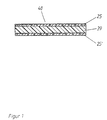
- Fig. 1 shows the sandwich panel (40) produced according to the invention, which on both sides of the foamed thermoplastic core (39) the glass mat-reinforced thermoplastic outer layers (25, 25 ').
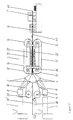
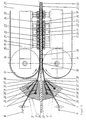
- Fig. 2 shows essentially the extruders (1, 2) Impregnation nozzles (3, 4) and the double belt press (5).
- FIG. 3 shows the section from FIG. 1 relating to the extruder units (1) and (2), the control units (8) and (9) with the Melting slides (29, 29 ') and the impregnation nozzles (3, 4).
- FIG. 4 shows the detail according to FIG. 1 regarding the impregnation nozzles (3, 4) and the inlet roller rollers (12, 13) of Double belt press.
- the foamed thermoplastic becomes the core layer (39) manufactured that, for example, polypropylene in granular form with a blowing agent, which is also in granular form, is mixed and in an extruder (not shown) Melting temperature is heated.
- the blowing agent disintegrates in gaseous compounds, which in the polypropylene matrix can penetrate so that it foams.
- This foamed Thermoplastic (39 ') is used for the further procedure Fig. 2 applied to the transport table (38) and in the sequence transported through the extruder die gap (37).
- Sandwich plate (40) is a thermoplastic in the extruder (1, 2), for example polypropylene, which if necessary with Additives such as peroxides are added.
- thermoplastic Extruders (1, 2) melt the thermoplastic and into it Form of the thermoplastic melts (26) and (28) the control units (8) and (9) fed.
- the Melt flow through the measure of a fusible valve (29, 29 ') are regulated; the melt streams (26 ', 26 ") and (28 ', 28 ") which form the nozzle slots (31, 31') the impregnation nozzle (3) and (32) and (32 ') of the impregnation nozzle 4 be fed.
- the impregnation nozzles (3, 4) are at least heated to the melting temperature of the thermoplastic.
- the glass fiber mats (10, 11) are fed to the impregnation nozzles (3, 4) from the supply rolls (33, 34).
- These glass fiber mats can for example be needled random fiber mats with an area content of 450 to 1300 g / m 2 .
- These glass fiber mats (10, 11) are fed in such a way that that they pass through the preheated nozzle gaps (3 ', 4').
- the Nozzle columns (3 ', 4') are designed such that they are used for Nozzle gap outlet (27, 27 ') are tapered.
- the Nozzle gap cross section is therefore at the nozzle gap inlet (3 ", 4") wider than at the nozzle gap exit (27, 27 ').
- the extent of the impregnation by the Measure of the regulating units (8, 9) is set.
- the properties, for example the surface properties, the glass fiber reinforced outer layers (25, 25 ') can be significantly influenced.
- the glass fiber mats pre-impregnated on both sides are then together with the foamed thermoplastic (39 ') in the inlet roller nip (18) of the double belt press (5).
- This consists of the heated inlet roller pair (12, 13) and the outlet roller pair (14, 15), with the roller pair (12, 14) or (13, 15) each an endless steel belt (16, 17) stretched is.
- the cross section of the inlet nip (18) is adjustable so that a pre-calibration of the pre-impregnated Glass fiber mat (30, 30 ') takes place.
- the pre-impregnated Glass fiber mats on both sides without the addition of an adhesive foamed thermoplastics (39 ') laminated so that a pre-composite (36) for the sandwich plate (40). This will be the Cooling plates (22, 22 ') fed through which the heat from the Preliminary composite (36) is discharged.
- the cooling plates (22, 22 ') serve as Pressure plates and are therefore with the slide films (23, 23 ') the side facing the endless steel strips (16, 17); they are on the frame of the double belt press (5) by means of pressure cylinders (21, 21 ') attached and are therefore on both sides on Pre-composite (36) pressed.
- the thermoplastic melt from flowing out the guide belts (35, 35 ') which have approximately the thickness of the pre-composite (36), carried endlessly on the side in the double belt press (5).
- the contact pressure of the cooling plates are kept, for example at 1 bar, to ensure that the Press to the finished sandwich plate (40) cause. That is because the sufficient Preimpregnation of the glass fiber mats (10.11) already on Nozzle gap exit (27, 27 ') of the impregnation nozzles (3, 4) takes place, so that the contact pressure is not for impregnation, but for the Formation of the preliminary assembly (36) of the finished sandwich panel (40) serves.
- the cooled sandwich plate (40) is after passing the pair of outlet rollers (14, 15) of an arrangement supplied by circular knives (6), on which their side edges get cut. Then the sandwich plate (40) in cut to length by the guillotine shears (7).
- This sandwich plate has, for example, a bending strength of 80 N / mm 2 and an elastic modulus of 2200.
- the sandwich panel produced according to the invention can be used for the production of molded parts for the interior of motor vehicles. In this application, it can be subjected to better elastic stress than the commonly used plywood-based sandwich panel, which only has a bending strength of 50 N / mm 2 . However, it is just as mechanically resilient as the plywood-based sandwich panel mentioned, since it also has a modulus of elasticity of 2200, which is a known criterion with regard to the rigidity of a mechanically stressable component.
Landscapes
- Engineering & Computer Science (AREA)
- Architecture (AREA)
- Civil Engineering (AREA)
- Structural Engineering (AREA)
- Life Sciences & Earth Sciences (AREA)
- Wood Science & Technology (AREA)
- Physics & Mathematics (AREA)
- Fluid Mechanics (AREA)
- Laminated Bodies (AREA)
- Extrusion Moulding Of Plastics Or The Like (AREA)
- Molding Of Porous Articles (AREA)
- Manufacture Of Electron Tubes, Discharge Lamp Vessels, Lead-In Wires, And The Like (AREA)
- Battery Mounting, Suspending (AREA)
Description
Claims (10)
- Verfahren zur Herstellung einer Sandwichplatte bestehend aus einer geschäumten thermoplastischen Kernschicht (39), welche beidseitig mit glasfasermattenverstärkten, thermoplastischen Außenschichten (25, 25') kleberfrei verbunden ist, dadurch gekennzeichnet, daß1) für die Ausbildung der Außenschichten (25, 25') in Form von glasfasermattenverstärkten Thermoplasten gleichzeitig zwei Glasfasermatten (10, 11) durch die Düsenspalte (3', 4') der Imprägnierdüsen (3, 4) geführt werden, welche von den Extrudern (1, 2) mit den Thermoplastschmelzen (26, 28) regelbar gespeist werden, und daß jeweils zwei Schmelzströme (26', 26") und (28', 28") gebildet werden, welche am Düsenspaltausgang (27, 27') auf die Ober- und Unterseite der Glasmatten (10, 11) aufgetragen werden, wobei die Vorimprägnierung der Glasfasermatten stattfindet, und daß2) diese mit Thermoplast vorimprägnierten Glasmatten (30, 30'), zusammen mit dem durch den Extruderdüsenspalt (37) transportierten, geschäumten Thermoplasten (39'), welcher zur Ausbildung der Kernschicht (39) dient, in den Einlaufwalzenspalt (18) der Doppelbandpresse (5) geführt werden, wobei die vorimprägnierten Glasfasermatten einerseits vorkalibriert und andererseits ohne Zusatz eines Klebers beidseitig auf den geschäumten Thermoplasten (39') kaschiert werden, sodaß ein Vorverbund (36) gebildet wird, welcher anschließend unter Druck mittels der Kühlplatten (22, 22') zu der Sandwichplatte (40) verpreßt wird.
- Verfahren nach Anspruch 1, dadurch gekennzeichnet, daß die thermoplastischen Materialien für die Kern- und die Außenschichten aus derselben Gruppe von Kunststoffen, vorteilhafterweise aus der Gruppe der Polyolefine ausgewählt werden.
- Verfahren nach Anspruch 2, dadurch gekennzeichnet, daß das thermoplastische polyolefinische Material Polypropylen ist.
- Verfahren nach einem der Ansprüche 1 bis 3 dadurch gekennzeichnet, daß die Glasfasermatten (10, 11) im Düsenspalt (3', 4') und der geschäumte Thermoplast (39') im Düsenspalt (37) vorgewärmt werden.
- Verfahren nach einem der Ansprüche 1 bis 4, dadurch gekennzeichnet, daß als Thermoplastschmelze (26, 28) eine niedrigviskose Polypropylen-Schmelze, welche gegebenenfalls Additive wie Peroxide enthält, eingesetzt wird.
- Verfahren nach einem der Ansprüche 1 bis 5, dadurch gekennzeichnet, daß der Schmelzestrom (26', 26") und (28', 28") durch den im Verteilerblock (8, 9) angebrachten Schmelzschieber (29, 29') regelbar ist.
- Verfahren nach einem der Ansprüche 1 bis 6, dadurch gekennzeichnet, daß die Glasfasermatte aus geschnittenen, wirr gelegten und/oder unidirektionalen und/oder direktionalen ungeschnittenen Glasfasern mit einem Flächengehalt von 450 bis 1300 g/m2 besteht.
- Verfahren nach einem der Ansprüche 1 bis 7, dadurch gekennzeichnet, daß die vorimprägnierten Glasfasermatten (30, 30') im in seinem Querschnitt verstellbaren Einlaufwalzenspalt (18) vorkalibriert werden.
- Verfahren nach einem der Ansprüche 1 bis 8, dadurch gekennzeichnet, daß der Vorverbund (36) für die Ausbildung der Sandwichplatte (40) in der Druckzone mit max. 2 bar verpreßt wird.
- Verfahren nach einem der Ansprüche 1 bis 9, dadurch gekennzeichnet, daß der durch den Extruderdüsenspalt (37) transportierte geschäumte Thermoplast (39') aus Polypropylen besteht.
Priority Applications (1)
| Application Number | Priority Date | Filing Date | Title |
|---|---|---|---|
| SI9630215T SI0794859T1 (en) | 1995-10-04 | 1996-10-04 | Process for manufacturing a composite panel |
Applications Claiming Priority (4)
| Application Number | Priority Date | Filing Date | Title |
|---|---|---|---|
| AT1643/95 | 1995-10-04 | ||
| AT164395 | 1995-10-04 | ||
| AT0164395A AT405382B (de) | 1995-10-04 | 1995-10-04 | Verfahren zur herstellung einer sandwichplatte sowie deren verwendung |
| PCT/AT1996/000186 WO1997012756A1 (de) | 1995-10-04 | 1996-10-04 | Sandwichplatte sowie verfahren zu deren herstellung |
Publications (2)
| Publication Number | Publication Date |
|---|---|
| EP0794859A1 EP0794859A1 (de) | 1997-09-17 |
| EP0794859B1 true EP0794859B1 (de) | 2000-07-26 |
Family
ID=3517851
Family Applications (1)
| Application Number | Title | Priority Date | Filing Date |
|---|---|---|---|
| EP96932373A Expired - Lifetime EP0794859B1 (de) | 1995-10-04 | 1996-10-04 | Verfahren zur Herstellung einer Sandwichplatte |
Country Status (14)
| Country | Link |
|---|---|
| US (1) | US5876534A (de) |
| EP (1) | EP0794859B1 (de) |
| JP (1) | JPH10510494A (de) |
| KR (1) | KR980700170A (de) |
| AT (2) | AT405382B (de) |
| AU (1) | AU718121B2 (de) |
| CA (1) | CA2206872A1 (de) |
| CZ (1) | CZ292654B6 (de) |
| DE (1) | DE59605648D1 (de) |
| DK (1) | DK0794859T3 (de) |
| ES (1) | ES2149496T3 (de) |
| PT (1) | PT794859E (de) |
| SK (1) | SK281930B6 (de) |
| WO (1) | WO1997012756A1 (de) |
Cited By (1)
| Publication number | Priority date | Publication date | Assignee | Title |
|---|---|---|---|---|
| US8007902B2 (en) | 2008-05-05 | 2011-08-30 | A. Schulman, Inc. | Multilayer clear over color polyolefin sheets and layered backing structure |
Families Citing this family (27)
| Publication number | Priority date | Publication date | Assignee | Title |
|---|---|---|---|---|
| ATA142496A (de) * | 1996-08-07 | 2000-10-15 | Danubia Petrochem Polymere | Vorrichtung zum erhitzen von faserverstärkten thermoplasten mittels wärmekontakt |
| FR2790709A1 (fr) * | 1999-03-08 | 2000-09-15 | Lamberet Const Isothermes | Panneau composite thermo-plastique, par exemple pour thermo-isoler un volume ou une structure |
| AT409946B (de) * | 1999-04-13 | 2002-12-27 | Isosport Verbundbauteile | Mehrschichtiges verbundbauelement sowie verfahren zu dessen herstellung |
| DE19959652A1 (de) * | 1999-12-10 | 2001-06-13 | Basf Ag | Sandwichplatte |
| AT409245B (de) * | 2000-01-25 | 2002-06-25 | Isosport Verbundbauteile | Bauelement sowie ein verfahren zu dessen herstellung |
| DE20005948U1 (de) * | 2000-04-03 | 2001-08-09 | Wihag Nutzfahrzeugtechnik GmbH & Co KG, 33647 Bielefeld | Paneel |
| JP2003034192A (ja) * | 2001-07-25 | 2003-02-04 | Oji Paper Co Ltd | 自動車内装天井成形用部材及びこれを用いた自動車内装天井部材 |
| US20040115414A1 (en) * | 2002-03-15 | 2004-06-17 | Joseph Wycech | Method for stiffening or reinforcing a member in a cost effective manner and a member which is made in accordance with the method |
| BE1015537A3 (de) * | 2003-05-23 | 2005-06-07 | Franischach Belcoat Nv | |
| EP1570976A1 (de) * | 2004-03-04 | 2005-09-07 | Alcan Technology & Management Ltd. | Verarbeitung von zyklischen Oligomeren zu thermoplastischen PBT-Kunststoffen |
| JP4381941B2 (ja) * | 2004-09-17 | 2009-12-09 | 王子インターパック株式会社 | 自動車内装天井材用の積層部材 |
| WO2007088892A1 (ja) * | 2006-02-02 | 2007-08-09 | Mitsui Chemicals, Inc. | 太陽電池モジュール用裏面保護基板、並びに、太陽電池モジュール及び発電装置 |
| MX2007002114A (es) | 2006-02-24 | 2008-10-30 | Basf Corp | Artículo compuesto. |
| WO2009022022A1 (es) * | 2007-07-27 | 2009-02-19 | Ulma C Y E, S. Coop. | Procedimiento e instalación para la producción de paneles tipo sándwich de naturaleza polimérica y panel obtenido |
| DE102007051132A1 (de) | 2007-10-24 | 2009-04-30 | Polymerpark Technologies Gmbh + Co.Kg | Sandwichstruktur sowie Verfahren zur Herstellung hierfür |
| EP2177335A1 (de) * | 2008-10-17 | 2010-04-21 | Grupo Antolin-Ingenieria S.A. | Verfahren zum Erhalt eines schaumgeformten Lamellenprodukts |
| DE102010002988B4 (de) * | 2010-03-17 | 2014-07-17 | Zf Friedrichshafen Ag | Verfahren und Vorrichtung zur kontinuierlichen Herstellung von Profilbauteilen aus Faserverbundwerkstoff |
| CN103038059A (zh) * | 2010-09-14 | 2013-04-10 | 旭玻璃纤维股份有限公司 | 面材强化发泡体 |
| DE102013204012A1 (de) * | 2013-03-08 | 2014-09-11 | Bayerische Motoren Werke Aktiengesellschaft | Verfahren zum Fügen faserverstärkter Kunststoffteile |
| GB201400232D0 (en) * | 2014-01-07 | 2014-02-26 | Environmental Technology Evolution Ltd | Ete 1 |
| CN109789664A (zh) | 2017-05-24 | 2019-05-21 | 沙特基础工业全球技术公司 | 符合铁路运输内饰标准的热塑性复合材料 |
| KR101984863B1 (ko) * | 2018-05-29 | 2019-05-31 | (주)라컴텍 | 팸 너트가 구비된 복합소재 패널 및 이의 제조방법 |
| US11168485B2 (en) | 2018-09-15 | 2021-11-09 | VBBT Corp. | Low cost emergency housing |
| KR102552009B1 (ko) * | 2018-10-31 | 2023-07-10 | 주식회사 서연이화 | 자동차 내장재용 복합소재와 그 제조방법 |
| KR102208073B1 (ko) * | 2019-05-17 | 2021-01-26 | 최진경 | 복합소재 패널 및 이의 제조방법 |
| US20240009983A1 (en) * | 2022-07-05 | 2024-01-11 | Profol GmbH | Plate material and method for producing the plate material |
| EP4534283A1 (de) | 2023-10-03 | 2025-04-09 | DOKA GmbH | Schalungsplatte mit reduzierter wärmeausdehnung und verbesserter quellbeständigkeit |
Family Cites Families (29)
| Publication number | Priority date | Publication date | Assignee | Title |
|---|---|---|---|---|
| FR1306675A (fr) * | 1961-09-04 | 1962-10-19 | Chausson Usines Sa | Dispositif pour l'enduisage et l'imprégnation de feuilles souples |
| GB1209167A (en) * | 1967-11-15 | 1970-10-21 | Nippon Cloth Industry Co Ltd | A method of producing a bonded fiber material |
| US3915772A (en) * | 1969-07-30 | 1975-10-28 | Dynamit Nobel Ag | Process for the improvement of adhesion of protective layers to phenolic resin foams |
| US3765998A (en) * | 1971-01-11 | 1973-10-16 | Allied Chem | Shapable fiber-reinforced low molecular weight polyethylene terephthalate |
| CA1013624A (en) * | 1972-02-25 | 1977-07-12 | Fred H. Ancker | Calendering of laminated polymeric materials |
| US4086316A (en) * | 1974-03-12 | 1978-04-25 | Eduard Kusters | Process for the manufacture of flat sheets or webs |
| DE2545700A1 (de) * | 1975-10-11 | 1977-04-21 | Basf Ag | Verfahren zur herstellung von selbsttragenden, gepolsterten formkoerpern |
| US4302269A (en) * | 1979-10-10 | 1981-11-24 | Allied Corporation | Process of forming a fiber reinforced, stampable thermoplastic laminate |
| JPS583832A (ja) * | 1981-06-30 | 1983-01-10 | Toyobo Co Ltd | 繊維補強樹脂シ−トの製造装置 |
| JPS59203238A (ja) * | 1983-04-30 | 1984-11-17 | Tdk Corp | 磁気記録媒体の製造方法 |
| US4622192A (en) * | 1984-01-10 | 1986-11-11 | Phillips Petroleum Company | Stampable sheets of glass/carbon fiber mat reinforced polymers of olefin and method of preparation |
| US4596736A (en) * | 1984-06-04 | 1986-06-24 | The Dow Chemical Company | Fiber-reinforced resinous sheet |
| GB8519297D0 (en) * | 1985-07-31 | 1985-09-04 | Smith Tech Dev | Laminate production |
| DE3530309A1 (de) * | 1985-08-24 | 1987-02-26 | Held Kurt | Verfahren und vorrichtung zum kontinuierlichen herstellen thermoplastischer kunststoffbahnen |
| NL8703138A (nl) * | 1987-12-28 | 1989-07-17 | Schreiner Luchtvaart | Sandwichmateriaal en toepassing daarvan. |
| DE3644676A1 (de) * | 1986-12-30 | 1988-07-14 | Schladitz Klaus | Verfahren zur herstellung von leichtbauteilen |
| IT1223606B (it) * | 1987-12-24 | 1990-09-29 | Ausimont Spa | Procedimento per la preparazione in continuo di lastre termoplastiche rinforzate e dispositivo adatto allo scopo |
| DE3834993A1 (de) * | 1988-10-14 | 1990-04-19 | Held Kurt | Verfahren und vorrichtung zur kontinuierlichen herstellung von laminaten |
| DE3904813A1 (de) * | 1989-02-17 | 1990-08-23 | Basf Ag | Faserverbundwerkstoff |
| IT1233214B (it) * | 1989-04-21 | 1992-03-20 | Pianfei Engineering S R L | Procedimento di fabbricazione di manufatti termoplastici stampabili particolarmente per pannelleria di autoveicoli e manufatti ottenuti con detto procedimento |
| JPH04296539A (ja) * | 1991-03-26 | 1992-10-20 | Isuzu Motors Ltd | 繊維強化樹脂成形用コア材 |
| DE4129190A1 (de) * | 1991-09-03 | 1993-03-04 | Held Kurt | Verfahren und vorrichtung zur kontinuierlichen herstellung von harzimpraegnierten materialbahnen |
| NL9200008A (nl) * | 1992-01-06 | 1993-08-02 | Martin Theodoor De Groot | Werkwijze voor het vervaardigen van een thermoplastische sandwichplaat. |
| US5240527A (en) * | 1992-02-20 | 1993-08-31 | Schuller International, Inc. | Method of producing encapsulated fibrous insulation blanket |
| CH684180A5 (de) * | 1992-07-17 | 1994-07-29 | Thomas Cantz | Verfahren zur Herstellung eines dreidimensional geformten Schichtverbund-Bauteils. |
| US5494737A (en) * | 1992-12-28 | 1996-02-27 | Mitsui Toatsu Chemicals, Inc. | Ceiling material for vehicles and production process thereof |
| US5565056A (en) * | 1993-04-23 | 1996-10-15 | Aluminum Company Of America | Plural extruder method for making a composite building panel |
| AT401908B (de) * | 1993-11-29 | 1996-12-27 | Greiner & Soehne C A | Mehrlagiges bauelement sowie verfahren und vorrichtung zu seiner herstellung |
| CN1067939C (zh) * | 1994-01-28 | 2001-07-04 | 伊索斯波特联合机械构件有限公司 | 制造玻璃纤维毡增强的热塑性塑料板的方法和实施此方法的设备 |
-
1995
- 1995-10-04 AT AT0164395A patent/AT405382B/de not_active IP Right Cessation
-
1996
- 1996-10-04 SK SK703-97A patent/SK281930B6/sk unknown
- 1996-10-04 JP JP9513820A patent/JPH10510494A/ja not_active Ceased
- 1996-10-04 CA CA002206872A patent/CA2206872A1/en not_active Abandoned
- 1996-10-04 DE DE59605648T patent/DE59605648D1/de not_active Expired - Lifetime
- 1996-10-04 CZ CZ19971695A patent/CZ292654B6/cs unknown
- 1996-10-04 AU AU71204/96A patent/AU718121B2/en not_active Ceased
- 1996-10-04 KR KR1019970703618A patent/KR980700170A/ko not_active Abandoned
- 1996-10-04 EP EP96932373A patent/EP0794859B1/de not_active Expired - Lifetime
- 1996-10-04 US US08/849,124 patent/US5876534A/en not_active Expired - Lifetime
- 1996-10-04 PT PT96932373T patent/PT794859E/pt unknown
- 1996-10-04 AT AT96932373T patent/ATE194942T1/de active
- 1996-10-04 WO PCT/AT1996/000186 patent/WO1997012756A1/de not_active Ceased
- 1996-10-04 DK DK96932373T patent/DK0794859T3/da active
- 1996-10-04 ES ES96932373T patent/ES2149496T3/es not_active Expired - Lifetime
Cited By (2)
| Publication number | Priority date | Publication date | Assignee | Title |
|---|---|---|---|---|
| US8007902B2 (en) | 2008-05-05 | 2011-08-30 | A. Schulman, Inc. | Multilayer clear over color polyolefin sheets and layered backing structure |
| US8182906B2 (en) | 2008-05-05 | 2012-05-22 | A. Schulman, Inc. | Multilayer clear over color polyolefin sheets and layered backing structure |
Also Published As
| Publication number | Publication date |
|---|---|
| CA2206872A1 (en) | 1997-04-10 |
| AU718121B2 (en) | 2000-04-06 |
| US5876534A (en) | 1999-03-02 |
| AT405382B (de) | 1999-07-26 |
| CZ169597A3 (en) | 1997-09-17 |
| ATE194942T1 (de) | 2000-08-15 |
| DK0794859T3 (da) | 2000-10-02 |
| WO1997012756A1 (de) | 1997-04-10 |
| AU7120496A (en) | 1997-04-28 |
| ATA164395A (de) | 1998-12-15 |
| EP0794859A1 (de) | 1997-09-17 |
| PT794859E (pt) | 2000-11-30 |
| SK281930B6 (sk) | 2001-09-11 |
| CZ292654B6 (cs) | 2003-11-12 |
| DE59605648D1 (de) | 2000-08-31 |
| JPH10510494A (ja) | 1998-10-13 |
| KR980700170A (ko) | 1998-03-30 |
| SK70397A3 (en) | 1997-10-08 |
| ES2149496T3 (es) | 2000-11-01 |
Similar Documents
| Publication | Publication Date | Title |
|---|---|---|
| AT405382B (de) | Verfahren zur herstellung einer sandwichplatte sowie deren verwendung | |
| EP0691903B1 (de) | Verfahren zur herstellung glasfasermattenverstärkten thermoplastplatten und vorrichtung zur durchführung dieses verfahrens | |
| DE3784836T2 (de) | Verfahren zum herstellen von schichtstoffteilen. | |
| DE102014116924B4 (de) | Haftfilm zum Niedrigtemperatur-Kleben und seine Verwendung | |
| DE4035610A1 (de) | Verfahren zur herstellung von faserverbundwerkstoffen | |
| DE102017122478B4 (de) | Verbundmaterial und Verfahren zur Herstellung eines Kraftfahrzeuginnenmaterials unter Verwendung dieses Verbundmaterials | |
| EP1593490B1 (de) | Verfahren zur Herstellung eines flächigen Halbzeugs | |
| DE4330860C2 (de) | Verfahren zur Herstellung eines flächigen Halbzeugs aus glasmattenverstärkten Propylenpolymerisaten | |
| EP0345463B1 (de) | Verfahren zur kontinuierlichen Herstellung von faserverstärkten Thermoplastbahnen, faserverstärkte Thermoplastbahnen sowie ihre Verwendung | |
| EP0985519A2 (de) | Verfahren zur Herstellung von mit Naturfasermatten verstärkten Thermoplastplatten sowie deren Verwendung zur Hestellung von Formteilen | |
| EP3261822A1 (de) | Prozessanordnung sowie verfahren zur herstellung eines faserverstärkten kunststoffbauteils | |
| AT404835B (de) | Zur herstellung lackierbarer teile geeignete glasmattenverstärkte thermoplasten und daraus hergestellte teile | |
| EP0019754A1 (de) | Verfahren zum Verbinden eines Flächengebildes aus thermoplastischem Kunststoff mit einem Polyesterfaservlies | |
| EP1570977A1 (de) | Verfahren zur kontinuierlichen Herstellung von faserverstärkten Kunststoffplatten | |
| EP0084135B1 (de) | Verfahren zur Herstellung von Formkörpern aus faserverstärkten Schichtstoffen | |
| DE102008021796C9 (de) | Verfahren zum Herstellen von Kunststoffplatten in einer kontinuierlichen Presse | |
| EP0794214B1 (de) | Zur Herstellung lackierbarer Teile geeignete glasmattenverstärkte Thermoplasten | |
| EP2732946A1 (de) | Komposit, Bauteil hieraus sowie Verfahren zur Herstellung hierfür | |
| DE10258935A1 (de) | Verfahren zur Herstellung von dreidimensionalen Bauteilen | |
| EP0654341B1 (de) | Verfahren zur kontinuierlichen Herstellung von verstärkten Kunststoffen | |
| DE102007028872A1 (de) | Verfahren zur Herstellung eines flächigen Strukturverbundbauteils | |
| DE102010009942A1 (de) | Faserverstärkte Thermoplastfolie und deren Herstellung |
Legal Events
| Date | Code | Title | Description |
|---|---|---|---|
| PUAI | Public reference made under article 153(3) epc to a published international application that has entered the european phase |
Free format text: ORIGINAL CODE: 0009012 |
|
| 17P | Request for examination filed |
Effective date: 19970603 |
|
| AK | Designated contracting states |
Kind code of ref document: A1 Designated state(s): AT BE CH DE DK ES FI FR GB IE IT LI NL PT SE |
|
| AX | Request for extension of the european patent |
Free format text: SI PAYMENT 970603 |
|
| RBV | Designated contracting states (corrected) |
Designated state(s): AT BE CH DE DK ES FI FR GB IE IT LI NL PT SE |
|
| 17Q | First examination report despatched |
Effective date: 19990310 |
|
| GRAG | Despatch of communication of intention to grant |
Free format text: ORIGINAL CODE: EPIDOS AGRA |
|
| RTI1 | Title (correction) |
Free format text: PROCESS FOR MANUFACTURING A COMPOSITE PANEL |
|
| RTI1 | Title (correction) |
Free format text: PROCESS FOR MANUFACTURING A COMPOSITE PANEL |
|
| GRAG | Despatch of communication of intention to grant |
Free format text: ORIGINAL CODE: EPIDOS AGRA |
|
| GRAH | Despatch of communication of intention to grant a patent |
Free format text: ORIGINAL CODE: EPIDOS IGRA |
|
| GRAH | Despatch of communication of intention to grant a patent |
Free format text: ORIGINAL CODE: EPIDOS IGRA |
|
| GRAA | (expected) grant |
Free format text: ORIGINAL CODE: 0009210 |
|
| AK | Designated contracting states |
Kind code of ref document: B1 Designated state(s): AT BE CH DE DK ES FI FR GB IE IT LI NL PT SE |
|
| AX | Request for extension of the european patent |
Free format text: SI PAYMENT 19970603 |
|
| REF | Corresponds to: |
Ref document number: 194942 Country of ref document: AT Date of ref document: 20000815 Kind code of ref document: T |
|
| REG | Reference to a national code |
Ref country code: CH Ref legal event code: NV Representative=s name: RIEDERER HASLER & PARTNER PATENTANWAELTE AG Ref country code: CH Ref legal event code: EP |
|
| REG | Reference to a national code |
Ref country code: IE Ref legal event code: FG4D Free format text: GERMAN |
|
| REF | Corresponds to: |
Ref document number: 59605648 Country of ref document: DE Date of ref document: 20000831 |
|
| ET | Fr: translation filed | ||
| REG | Reference to a national code |
Ref country code: DK Ref legal event code: T3 |
|
| ITF | It: translation for a ep patent filed | ||
| REG | Reference to a national code |
Ref country code: ES Ref legal event code: FG2A Ref document number: 2149496 Country of ref document: ES Kind code of ref document: T3 |
|
| GBT | Gb: translation of ep patent filed (gb section 77(6)(a)/1977) |
Effective date: 20001027 |
|
| REG | Reference to a national code |
Ref country code: PT Ref legal event code: SC4A Free format text: AVAILABILITY OF NATIONAL TRANSLATION Effective date: 20000831 |
|
| PLBE | No opposition filed within time limit |
Free format text: ORIGINAL CODE: 0009261 |
|
| STAA | Information on the status of an ep patent application or granted ep patent |
Free format text: STATUS: NO OPPOSITION FILED WITHIN TIME LIMIT |
|
| 26N | No opposition filed | ||
| REG | Reference to a national code |
Ref country code: GB Ref legal event code: IF02 |
|
| PGFP | Annual fee paid to national office [announced via postgrant information from national office to epo] |
Ref country code: PT Payment date: 20030919 Year of fee payment: 8 |
|
| PGFP | Annual fee paid to national office [announced via postgrant information from national office to epo] |
Ref country code: GB Payment date: 20030929 Year of fee payment: 8 |
|
| PGFP | Annual fee paid to national office [announced via postgrant information from national office to epo] |
Ref country code: NL Payment date: 20030930 Year of fee payment: 8 Ref country code: IE Payment date: 20030930 Year of fee payment: 8 |
|
| PGFP | Annual fee paid to national office [announced via postgrant information from national office to epo] |
Ref country code: SE Payment date: 20031001 Year of fee payment: 8 |
|
| PGFP | Annual fee paid to national office [announced via postgrant information from national office to epo] |
Ref country code: FI Payment date: 20031002 Year of fee payment: 8 |
|
| PGFP | Annual fee paid to national office [announced via postgrant information from national office to epo] |
Ref country code: DK Payment date: 20031003 Year of fee payment: 8 |
|
| PGFP | Annual fee paid to national office [announced via postgrant information from national office to epo] |
Ref country code: FR Payment date: 20031009 Year of fee payment: 8 Ref country code: BE Payment date: 20031009 Year of fee payment: 8 |
|
| PGFP | Annual fee paid to national office [announced via postgrant information from national office to epo] |
Ref country code: ES Payment date: 20031020 Year of fee payment: 8 |
|
| PG25 | Lapsed in a contracting state [announced via postgrant information from national office to epo] |
Ref country code: IE Free format text: LAPSE BECAUSE OF NON-PAYMENT OF DUE FEES Effective date: 20041004 Ref country code: GB Free format text: LAPSE BECAUSE OF NON-PAYMENT OF DUE FEES Effective date: 20041004 Ref country code: FI Free format text: LAPSE BECAUSE OF NON-PAYMENT OF DUE FEES Effective date: 20041004 |
|
| PG25 | Lapsed in a contracting state [announced via postgrant information from national office to epo] |
Ref country code: SE Free format text: LAPSE BECAUSE OF NON-PAYMENT OF DUE FEES Effective date: 20041005 Ref country code: ES Free format text: LAPSE BECAUSE OF NON-PAYMENT OF DUE FEES Effective date: 20041005 |
|
| PG25 | Lapsed in a contracting state [announced via postgrant information from national office to epo] |
Ref country code: BE Free format text: LAPSE BECAUSE OF NON-PAYMENT OF DUE FEES Effective date: 20041031 |
|
| PG25 | Lapsed in a contracting state [announced via postgrant information from national office to epo] |
Ref country code: DK Free format text: LAPSE BECAUSE OF NON-PAYMENT OF DUE FEES Effective date: 20041101 |
|
| REG | Reference to a national code |
Ref country code: SI Ref legal event code: IF |
|
| PG25 | Lapsed in a contracting state [announced via postgrant information from national office to epo] |
Ref country code: PT Free format text: LAPSE BECAUSE OF NON-PAYMENT OF DUE FEES Effective date: 20050404 |
|
| BERE | Be: lapsed |
Owner name: *ISOSPORT VERBUNDBAUTEILE G.M.B.H. Effective date: 20041031 |
|
| PG25 | Lapsed in a contracting state [announced via postgrant information from national office to epo] |
Ref country code: NL Free format text: LAPSE BECAUSE OF NON-PAYMENT OF DUE FEES Effective date: 20050501 |
|
| GBPC | Gb: european patent ceased through non-payment of renewal fee |
Effective date: 20041004 |
|
| EUG | Se: european patent has lapsed | ||
| REG | Reference to a national code |
Ref country code: DK Ref legal event code: EBP |
|
| REG | Reference to a national code |
Ref country code: IE Ref legal event code: MM4A |
|
| PG25 | Lapsed in a contracting state [announced via postgrant information from national office to epo] |
Ref country code: FR Free format text: LAPSE BECAUSE OF NON-PAYMENT OF DUE FEES Effective date: 20050630 |
|
| REG | Reference to a national code |
Ref country code: PT Ref legal event code: MM4A Free format text: LAPSE DUE TO NON-PAYMENT OF FEES Effective date: 20050404 |
|
| NLV4 | Nl: lapsed or anulled due to non-payment of the annual fee |
Effective date: 20050501 |
|
| REG | Reference to a national code |
Ref country code: FR Ref legal event code: ST |
|
| PG25 | Lapsed in a contracting state [announced via postgrant information from national office to epo] |
Ref country code: IT Free format text: LAPSE BECAUSE OF NON-PAYMENT OF DUE FEES Effective date: 20051004 |
|
| REG | Reference to a national code |
Ref country code: SI Ref legal event code: KO00 Effective date: 20050801 |
|
| REG | Reference to a national code |
Ref country code: ES Ref legal event code: FD2A Effective date: 20041005 |
|
| BERE | Be: lapsed |
Owner name: *ISOSPORT VERBUNDBAUTEILE G.M.B.H. Effective date: 20041031 |
|
| REG | Reference to a national code |
Ref country code: CH Ref legal event code: PCAR Free format text: RIEDERER HASLER & PARTNER PATENTANWAELTE AG;ELESTASTRASSE 8;7310 BAD RAGAZ (CH) |
|
| PGFP | Annual fee paid to national office [announced via postgrant information from national office to epo] |
Ref country code: DE Payment date: 20151022 Year of fee payment: 20 Ref country code: CH Payment date: 20151021 Year of fee payment: 20 |
|
| PGFP | Annual fee paid to national office [announced via postgrant information from national office to epo] |
Ref country code: AT Payment date: 20150903 Year of fee payment: 20 |
|
| REG | Reference to a national code |
Ref country code: DE Ref legal event code: R071 Ref document number: 59605648 Country of ref document: DE |
|
| REG | Reference to a national code |
Ref country code: CH Ref legal event code: PL |
|
| REG | Reference to a national code |
Ref country code: AT Ref legal event code: MK07 Ref document number: 194942 Country of ref document: AT Kind code of ref document: T Effective date: 20161004 |