EP0796245B1 - Verfahren zur herstellung von n-(amidinophenyl pyrrolidin)-n'-beta-alanin-substituierten harnstoffen - Google Patents
Verfahren zur herstellung von n-(amidinophenyl pyrrolidin)-n'-beta-alanin-substituierten harnstoffen Download PDFInfo
- Publication number
- EP0796245B1 EP0796245B1 EP95940016A EP95940016A EP0796245B1 EP 0796245 B1 EP0796245 B1 EP 0796245B1 EP 95940016 A EP95940016 A EP 95940016A EP 95940016 A EP95940016 A EP 95940016A EP 0796245 B1 EP0796245 B1 EP 0796245B1
- Authority
- EP
- European Patent Office
- Prior art keywords
- formula
- process according
- compound
- group
- alkyl
- Prior art date
- Legal status (The legal status is an assumption and is not a legal conclusion. Google has not performed a legal analysis and makes no representation as to the accuracy of the status listed.)
- Expired - Lifetime
Links
- -1 amidino phenyl pyrrolidine beta-alanine urea analogs Chemical class 0.000 title claims abstract description 58
- 238000000034 method Methods 0.000 title claims abstract description 51
- 238000002360 preparation method Methods 0.000 title claims abstract description 25
- 150000003951 lactams Chemical class 0.000 claims abstract description 25
- 239000000010 aprotic solvent Substances 0.000 claims abstract description 13
- IAZDPXIOMUYVGZ-UHFFFAOYSA-N Dimethylsulphoxide Chemical group CS(C)=O IAZDPXIOMUYVGZ-UHFFFAOYSA-N 0.000 claims description 21
- 150000001875 compounds Chemical class 0.000 claims description 21
- IJGRMHOSHXDMSA-UHFFFAOYSA-N Atomic nitrogen Chemical compound N#N IJGRMHOSHXDMSA-UHFFFAOYSA-N 0.000 claims description 20
- 125000003118 aryl group Chemical group 0.000 claims description 16
- BWHMMNNQKKPAPP-UHFFFAOYSA-L potassium carbonate Chemical group [K+].[K+].[O-]C([O-])=O BWHMMNNQKKPAPP-UHFFFAOYSA-L 0.000 claims description 16
- PFKFTWBEEFSNDU-UHFFFAOYSA-N carbonyldiimidazole Chemical compound C1=CN=CN1C(=O)N1C=CN=C1 PFKFTWBEEFSNDU-UHFFFAOYSA-N 0.000 claims description 15
- WTDHULULXKLSOZ-UHFFFAOYSA-N Hydroxylamine hydrochloride Chemical compound Cl.ON WTDHULULXKLSOZ-UHFFFAOYSA-N 0.000 claims description 12
- 229910052757 nitrogen Inorganic materials 0.000 claims description 10
- 125000001584 benzyloxycarbonyl group Chemical group C(=O)(OCC1=CC=CC=C1)* 0.000 claims description 8
- 239000004202 carbamide Substances 0.000 claims description 8
- 125000004432 carbon atom Chemical group C* 0.000 claims description 8
- 229910000027 potassium carbonate Inorganic materials 0.000 claims description 8
- SFZULDYEOVSIKM-UHFFFAOYSA-N chembl321317 Chemical compound C1=CC(C(=N)NO)=CC=C1C1=CC=C(C=2C=CC(=CC=2)C(=N)NO)O1 SFZULDYEOVSIKM-UHFFFAOYSA-N 0.000 claims description 7
- 125000005042 acyloxymethyl group Chemical group 0.000 claims description 6
- 125000003710 aryl alkyl group Chemical group 0.000 claims description 6
- VFJYIHQDILEQNR-UHFFFAOYSA-M trimethylsulfanium;iodide Chemical compound [I-].C[S+](C)C VFJYIHQDILEQNR-UHFFFAOYSA-M 0.000 claims description 6
- 229910052739 hydrogen Inorganic materials 0.000 claims description 5
- 229910052760 oxygen Inorganic materials 0.000 claims description 5
- 239000001301 oxygen Substances 0.000 claims description 5
- 229910052717 sulfur Inorganic materials 0.000 claims description 5
- 125000006239 protecting group Chemical group 0.000 claims description 4
- NINIDFKCEFEMDL-UHFFFAOYSA-N Sulfur Chemical compound [S] NINIDFKCEFEMDL-UHFFFAOYSA-N 0.000 claims description 3
- QVGXLLKOCUKJST-UHFFFAOYSA-N atomic oxygen Chemical compound [O] QVGXLLKOCUKJST-UHFFFAOYSA-N 0.000 claims description 3
- 239000001257 hydrogen Substances 0.000 claims description 3
- 125000004435 hydrogen atom Chemical group [H]* 0.000 claims description 3
- 239000011593 sulfur Substances 0.000 claims description 3
- 230000008878 coupling Effects 0.000 claims description 2
- 238000010168 coupling process Methods 0.000 claims description 2
- 238000005859 coupling reaction Methods 0.000 claims description 2
- 125000001360 methionine group Chemical class N[C@@H](CCSC)C(=O)* 0.000 claims 9
- 125000004169 (C1-C6) alkyl group Chemical group 0.000 claims 8
- GSQBIOQCECCMOQ-UHFFFAOYSA-N β-alanine ethyl ester Chemical group CCOC(=O)CCN GSQBIOQCECCMOQ-UHFFFAOYSA-N 0.000 claims 4
- MYMOFIZGZYHOMD-UHFFFAOYSA-N Dioxygen Chemical compound O=O MYMOFIZGZYHOMD-UHFFFAOYSA-N 0.000 claims 2
- 125000004434 sulfur atom Chemical group 0.000 claims 2
- 239000000543 intermediate Substances 0.000 abstract description 8
- FFEARJCKVFRZRR-BYPYZUCNSA-N L-methionine Chemical compound CSCC[C@H](N)C(O)=O FFEARJCKVFRZRR-BYPYZUCNSA-N 0.000 abstract description 5
- 229960004676 antithrombotic agent Drugs 0.000 abstract description 5
- 229930182817 methionine Natural products 0.000 abstract description 5
- DSJRMYGLIXGHHM-UHFFFAOYSA-N 3-aminopropanoic acid;urea Chemical class NC(N)=O.NCCC(O)=O DSJRMYGLIXGHHM-UHFFFAOYSA-N 0.000 abstract description 4
- 230000002785 anti-thrombosis Effects 0.000 abstract description 3
- 150000002742 methionines Chemical class 0.000 abstract 2
- 239000000047 product Substances 0.000 description 41
- XEKOWRVHYACXOJ-UHFFFAOYSA-N Ethyl acetate Chemical compound CCOC(C)=O XEKOWRVHYACXOJ-UHFFFAOYSA-N 0.000 description 32
- OKKJLVBELUTLKV-UHFFFAOYSA-N Methanol Chemical compound OC OKKJLVBELUTLKV-UHFFFAOYSA-N 0.000 description 30
- ZMXDDKWLCZADIW-UHFFFAOYSA-N N,N-Dimethylformamide Chemical compound CN(C)C=O ZMXDDKWLCZADIW-UHFFFAOYSA-N 0.000 description 30
- ZMANZCXQSJIPKH-UHFFFAOYSA-N Triethylamine Chemical compound CCN(CC)CC ZMANZCXQSJIPKH-UHFFFAOYSA-N 0.000 description 29
- HEDRZPFGACZZDS-MICDWDOJSA-N Trichloro(2H)methane Chemical compound [2H]C(Cl)(Cl)Cl HEDRZPFGACZZDS-MICDWDOJSA-N 0.000 description 22
- WYURNTSHIVDZCO-UHFFFAOYSA-N Tetrahydrofuran Chemical compound C1CCOC1 WYURNTSHIVDZCO-UHFFFAOYSA-N 0.000 description 20
- LFQSCWFLJHTTHZ-UHFFFAOYSA-N Ethanol Chemical compound CCO LFQSCWFLJHTTHZ-UHFFFAOYSA-N 0.000 description 18
- SJRJJKPEHAURKC-UHFFFAOYSA-N N-Methylmorpholine Chemical compound CN1CCOCC1 SJRJJKPEHAURKC-UHFFFAOYSA-N 0.000 description 18
- XLYOFNOQVPJJNP-UHFFFAOYSA-N water Chemical compound O XLYOFNOQVPJJNP-UHFFFAOYSA-N 0.000 description 18
- 238000005160 1H NMR spectroscopy Methods 0.000 description 17
- 235000019439 ethyl acetate Nutrition 0.000 description 16
- 229910001868 water Inorganic materials 0.000 description 16
- VEXZGXHMUGYJMC-UHFFFAOYSA-N Hydrochloric acid Chemical compound Cl VEXZGXHMUGYJMC-UHFFFAOYSA-N 0.000 description 13
- 239000000243 solution Substances 0.000 description 13
- JUJWROOIHBZHMG-UHFFFAOYSA-N Pyridine Chemical compound C1=CC=NC=C1 JUJWROOIHBZHMG-UHFFFAOYSA-N 0.000 description 12
- 239000011541 reaction mixture Substances 0.000 description 12
- QAEDZJGFFMLHHQ-UHFFFAOYSA-N trifluoroacetic anhydride Chemical compound FC(F)(F)C(=O)OC(=O)C(F)(F)F QAEDZJGFFMLHHQ-UHFFFAOYSA-N 0.000 description 12
- 150000002741 methionine derivatives Chemical class 0.000 description 11
- 238000006243 chemical reaction Methods 0.000 description 10
- 239000002904 solvent Substances 0.000 description 10
- YLQBMQCUIZJEEH-UHFFFAOYSA-N tetrahydrofuran Natural products C=1C=COC=1 YLQBMQCUIZJEEH-UHFFFAOYSA-N 0.000 description 10
- KDLHZDBZIXYQEI-UHFFFAOYSA-N Palladium Chemical compound [Pd] KDLHZDBZIXYQEI-UHFFFAOYSA-N 0.000 description 9
- HEMHJVSKTPXQMS-UHFFFAOYSA-M Sodium hydroxide Chemical compound [OH-].[Na+] HEMHJVSKTPXQMS-UHFFFAOYSA-M 0.000 description 9
- 239000002585 base Substances 0.000 description 9
- 125000002924 primary amino group Chemical group [H]N([H])* 0.000 description 9
- QTBSBXVTEAMEQO-UHFFFAOYSA-N Acetic acid Chemical compound CC(O)=O QTBSBXVTEAMEQO-UHFFFAOYSA-N 0.000 description 8
- JGFZNNIVVJXRND-UHFFFAOYSA-N N,N-Diisopropylethylamine (DIPEA) Chemical compound CCN(C(C)C)C(C)C JGFZNNIVVJXRND-UHFFFAOYSA-N 0.000 description 8
- 125000002915 carbonyl group Chemical group [*:2]C([*:1])=O 0.000 description 8
- 150000002148 esters Chemical group 0.000 description 8
- 125000001997 phenyl group Chemical group [H]C1=C([H])C([H])=C(*)C([H])=C1[H] 0.000 description 8
- HNJBEVLQSNELDL-UHFFFAOYSA-N pyrrolidin-2-one Chemical compound O=C1CCCN1 HNJBEVLQSNELDL-UHFFFAOYSA-N 0.000 description 8
- 239000003153 chemical reaction reagent Substances 0.000 description 7
- 150000002825 nitriles Chemical class 0.000 description 7
- 239000002244 precipitate Substances 0.000 description 7
- 238000007363 ring formation reaction Methods 0.000 description 7
- 239000000725 suspension Substances 0.000 description 7
- 0 *C(CC(*)=O)NC(NC(CCN1c(cc2)ccc2C(N)=N)C1=O)=O Chemical compound *C(CC(*)=O)NC(NC(CCN1c(cc2)ccc2C(N)=N)C1=O)=O 0.000 description 6
- CSNNHWWHGAXBCP-UHFFFAOYSA-L Magnesium sulfate Chemical compound [Mg+2].[O-][S+2]([O-])([O-])[O-] CSNNHWWHGAXBCP-UHFFFAOYSA-L 0.000 description 6
- UMJSCPRVCHMLSP-UHFFFAOYSA-N pyridine Natural products COC1=CC=CN=C1 UMJSCPRVCHMLSP-UHFFFAOYSA-N 0.000 description 6
- IAZDPXIOMUYVGZ-WFGJKAKNSA-N Dimethyl sulfoxide Chemical compound [2H]C([2H])([2H])S(=O)C([2H])([2H])[2H] IAZDPXIOMUYVGZ-WFGJKAKNSA-N 0.000 description 5
- 229910004373 HOAc Inorganic materials 0.000 description 5
- 125000000217 alkyl group Chemical group 0.000 description 5
- ABFPKTQEQNICFT-UHFFFAOYSA-M 2-chloro-1-methylpyridin-1-ium;iodide Chemical compound [I-].C[N+]1=CC=CC=C1Cl ABFPKTQEQNICFT-UHFFFAOYSA-M 0.000 description 4
- WEVYAHXRMPXWCK-UHFFFAOYSA-N Acetonitrile Chemical compound CC#N WEVYAHXRMPXWCK-UHFFFAOYSA-N 0.000 description 4
- KFZMGEQAYNKOFK-UHFFFAOYSA-N Isopropanol Chemical compound CC(C)O KFZMGEQAYNKOFK-UHFFFAOYSA-N 0.000 description 4
- FXHOOIRPVKKKFG-UHFFFAOYSA-N N,N-Dimethylacetamide Chemical compound CN(C)C(C)=O FXHOOIRPVKKKFG-UHFFFAOYSA-N 0.000 description 4
- XSQUKJJJFZCRTK-UHFFFAOYSA-N Urea Chemical compound NC(N)=O XSQUKJJJFZCRTK-UHFFFAOYSA-N 0.000 description 4
- 230000015572 biosynthetic process Effects 0.000 description 4
- 229960004452 methionine Drugs 0.000 description 4
- 238000003756 stirring Methods 0.000 description 4
- VZAWCLCJGSBATP-UHFFFAOYSA-N 1-cycloundecyl-1,2-diazacycloundecane Chemical compound C1CCCCCCCCCC1N1NCCCCCCCCC1 VZAWCLCJGSBATP-UHFFFAOYSA-N 0.000 description 3
- QIKYZXDTTPVVAC-UHFFFAOYSA-N 4-Aminobenzamide Chemical compound NC(=O)C1=CC=C(N)C=C1 QIKYZXDTTPVVAC-UHFFFAOYSA-N 0.000 description 3
- UHOVQNZJYSORNB-UHFFFAOYSA-N Benzene Chemical compound C1=CC=CC=C1 UHOVQNZJYSORNB-UHFFFAOYSA-N 0.000 description 3
- 239000004215 Carbon black (E152) Substances 0.000 description 3
- AFVFQIVMOAPDHO-UHFFFAOYSA-N Methanesulfonic acid Chemical compound CS(O)(=O)=O AFVFQIVMOAPDHO-UHFFFAOYSA-N 0.000 description 3
- UIIMBOGNXHQVGW-UHFFFAOYSA-M Sodium bicarbonate Chemical class [Na+].OC([O-])=O UIIMBOGNXHQVGW-UHFFFAOYSA-M 0.000 description 3
- YXFVVABEGXRONW-UHFFFAOYSA-N Toluene Chemical compound CC1=CC=CC=C1 YXFVVABEGXRONW-UHFFFAOYSA-N 0.000 description 3
- CPTGVMRFMOAQDV-UQKRIMTDSA-N acetic acid ethyl 3-[[(3S)-1-(4-methanehydrazonoylphenyl)-2-oxopyrrolidin-3-yl]carbamoylamino]propanoate Chemical compound CC(O)=O.O=C1[C@@H](NC(=O)NCCC(=O)OCC)CCN1C1=CC=C(C=NN)C=C1 CPTGVMRFMOAQDV-UQKRIMTDSA-N 0.000 description 3
- 239000002253 acid Substances 0.000 description 3
- 150000001412 amines Chemical class 0.000 description 3
- MXOQNVMDKHLYCZ-UHFFFAOYSA-N benzamidoxime Chemical compound ON=C(N)C1=CC=CC=C1 MXOQNVMDKHLYCZ-UHFFFAOYSA-N 0.000 description 3
- 150000001576 beta-amino acids Chemical class 0.000 description 3
- HJZVHUQSQGITAM-UHFFFAOYSA-N butanamide Chemical compound CC[CH]C(N)=O HJZVHUQSQGITAM-UHFFFAOYSA-N 0.000 description 3
- KRKNYBCHXYNGOX-UHFFFAOYSA-N citric acid Chemical compound OC(=O)CC(O)(C(O)=O)CC(O)=O KRKNYBCHXYNGOX-UHFFFAOYSA-N 0.000 description 3
- 238000001816 cooling Methods 0.000 description 3
- 125000005842 heteroatom Chemical group 0.000 description 3
- 229930195733 hydrocarbon Natural products 0.000 description 3
- 229910052943 magnesium sulfate Inorganic materials 0.000 description 3
- IWYDHOAUDWTVEP-UHFFFAOYSA-M mandelate Chemical class [O-]C(=O)C(O)C1=CC=CC=C1 IWYDHOAUDWTVEP-UHFFFAOYSA-M 0.000 description 3
- 239000000203 mixture Substances 0.000 description 3
- 238000003786 synthesis reaction Methods 0.000 description 3
- 150000003512 tertiary amines Chemical class 0.000 description 3
- 231100000331 toxic Toxicity 0.000 description 3
- 230000002588 toxic effect Effects 0.000 description 3
- HOBFSNNENNQQIU-SNVBAGLBSA-N (2r)-2-[(2-methylpropan-2-yl)oxycarbonylamino]-2-phenylacetic acid Chemical compound CC(C)(C)OC(=O)N[C@@H](C(O)=O)C1=CC=CC=C1 HOBFSNNENNQQIU-SNVBAGLBSA-N 0.000 description 2
- RYHBNJHYFVUHQT-UHFFFAOYSA-N 1,4-Dioxane Chemical compound C1COCCO1 RYHBNJHYFVUHQT-UHFFFAOYSA-N 0.000 description 2
- YOETUEMZNOLGDB-UHFFFAOYSA-N 2-methylpropyl carbonochloridate Chemical compound CC(C)COC(Cl)=O YOETUEMZNOLGDB-UHFFFAOYSA-N 0.000 description 2
- QCQCHGYLTSGIGX-GHXANHINSA-N 4-[[(3ar,5ar,5br,7ar,9s,11ar,11br,13as)-5a,5b,8,8,11a-pentamethyl-3a-[(5-methylpyridine-3-carbonyl)amino]-2-oxo-1-propan-2-yl-4,5,6,7,7a,9,10,11,11b,12,13,13a-dodecahydro-3h-cyclopenta[a]chrysen-9-yl]oxy]-2,2-dimethyl-4-oxobutanoic acid Chemical compound N([C@@]12CC[C@@]3(C)[C@]4(C)CC[C@H]5C(C)(C)[C@@H](OC(=O)CC(C)(C)C(O)=O)CC[C@]5(C)[C@H]4CC[C@@H]3C1=C(C(C2)=O)C(C)C)C(=O)C1=CN=CC(C)=C1 QCQCHGYLTSGIGX-GHXANHINSA-N 0.000 description 2
- 238000006218 Arndt-Eistert homologation reaction Methods 0.000 description 2
- HEDRZPFGACZZDS-UHFFFAOYSA-N Chloroform Chemical compound ClC(Cl)Cl HEDRZPFGACZZDS-UHFFFAOYSA-N 0.000 description 2
- OKKJLVBELUTLKV-MZCSYVLQSA-N Deuterated methanol Chemical compound [2H]OC([2H])([2H])[2H] OKKJLVBELUTLKV-MZCSYVLQSA-N 0.000 description 2
- YXHKONLOYHBTNS-UHFFFAOYSA-N Diazomethane Chemical compound C=[N+]=[N-] YXHKONLOYHBTNS-UHFFFAOYSA-N 0.000 description 2
- YMWUJEATGCHHMB-UHFFFAOYSA-N Dichloromethane Chemical compound ClCCl YMWUJEATGCHHMB-UHFFFAOYSA-N 0.000 description 2
- OFOBLEOULBTSOW-UHFFFAOYSA-N Malonic acid Chemical compound OC(=O)CC(O)=O OFOBLEOULBTSOW-UHFFFAOYSA-N 0.000 description 2
- IMNFDUFMRHMDMM-UHFFFAOYSA-N N-Heptane Chemical compound CCCCCCC IMNFDUFMRHMDMM-UHFFFAOYSA-N 0.000 description 2
- YGYAWVDWMABLBF-UHFFFAOYSA-N Phosgene Chemical compound ClC(Cl)=O YGYAWVDWMABLBF-UHFFFAOYSA-N 0.000 description 2
- VYPSYNLAJGMNEJ-UHFFFAOYSA-N Silicium dioxide Chemical compound O=[Si]=O VYPSYNLAJGMNEJ-UHFFFAOYSA-N 0.000 description 2
- KEAYESYHFKHZAL-UHFFFAOYSA-N Sodium Chemical compound [Na] KEAYESYHFKHZAL-UHFFFAOYSA-N 0.000 description 2
- DTQVDTLACAAQTR-UHFFFAOYSA-N Trifluoroacetic acid Chemical compound OC(=O)C(F)(F)F DTQVDTLACAAQTR-UHFFFAOYSA-N 0.000 description 2
- 150000008044 alkali metal hydroxides Chemical class 0.000 description 2
- 150000001371 alpha-amino acids Chemical class 0.000 description 2
- 235000008206 alpha-amino acids Nutrition 0.000 description 2
- 150000001448 anilines Chemical class 0.000 description 2
- 239000003146 anticoagulant agent Substances 0.000 description 2
- 239000003054 catalyst Substances 0.000 description 2
- 239000003610 charcoal Substances 0.000 description 2
- 238000004296 chiral HPLC Methods 0.000 description 2
- WRJWRGBVPUUDLA-UHFFFAOYSA-N chlorosulfonyl isocyanate Chemical compound ClS(=O)(=O)N=C=O WRJWRGBVPUUDLA-UHFFFAOYSA-N 0.000 description 2
- ZUOUZKKEUPVFJK-UHFFFAOYSA-N diphenyl Chemical compound C1=CC=CC=C1C1=CC=CC=C1 ZUOUZKKEUPVFJK-UHFFFAOYSA-N 0.000 description 2
- RJCGNNHKSNIUAT-UHFFFAOYSA-N ethyl 3-aminopropanoate;hydron;chloride Chemical compound Cl.CCOC(=O)CCN RJCGNNHKSNIUAT-UHFFFAOYSA-N 0.000 description 2
- 125000001495 ethyl group Chemical group [H]C([H])([H])C([H])([H])* 0.000 description 2
- 238000001704 evaporation Methods 0.000 description 2
- 230000008020 evaporation Effects 0.000 description 2
- 238000001914 filtration Methods 0.000 description 2
- 239000007789 gas Substances 0.000 description 2
- XLYOFNOQVPJJNP-ZSJDYOACSA-N heavy water Substances [2H]O[2H] XLYOFNOQVPJJNP-ZSJDYOACSA-N 0.000 description 2
- 238000007327 hydrogenolysis reaction Methods 0.000 description 2
- 230000007062 hydrolysis Effects 0.000 description 2
- 238000006460 hydrolysis reaction Methods 0.000 description 2
- INQOMBQAUSQDDS-UHFFFAOYSA-N iodomethane Chemical compound IC INQOMBQAUSQDDS-UHFFFAOYSA-N 0.000 description 2
- 239000000463 material Substances 0.000 description 2
- VLKZOEOYAKHREP-UHFFFAOYSA-N n-Hexane Chemical class CCCCCC VLKZOEOYAKHREP-UHFFFAOYSA-N 0.000 description 2
- GVOISEJVFFIGQE-YCZSINBZSA-N n-[(1r,2s,5r)-5-[methyl(propan-2-yl)amino]-2-[(3s)-2-oxo-3-[[6-(trifluoromethyl)quinazolin-4-yl]amino]pyrrolidin-1-yl]cyclohexyl]acetamide Chemical compound CC(=O)N[C@@H]1C[C@H](N(C)C(C)C)CC[C@@H]1N1C(=O)[C@@H](NC=2C3=CC(=CC=C3N=CN=2)C(F)(F)F)CC1 GVOISEJVFFIGQE-YCZSINBZSA-N 0.000 description 2
- 239000003921 oil Substances 0.000 description 2
- 238000001953 recrystallisation Methods 0.000 description 2
- 239000000741 silica gel Substances 0.000 description 2
- 229910002027 silica gel Inorganic materials 0.000 description 2
- 239000012312 sodium hydride Substances 0.000 description 2
- 229910000104 sodium hydride Inorganic materials 0.000 description 2
- 239000007787 solid Substances 0.000 description 2
- 239000007858 starting material Substances 0.000 description 2
- GFCIJEJVLLBDOI-ZDUSSCGKSA-N tert-butyl n-[(3s)-1-(4-cyanophenyl)-2-oxopyrrolidin-3-yl]carbamate Chemical compound O=C1[C@@H](NC(=O)OC(C)(C)C)CCN1C1=CC=C(C#N)C=C1 GFCIJEJVLLBDOI-ZDUSSCGKSA-N 0.000 description 2
- FYSNRJHAOHDILO-UHFFFAOYSA-N thionyl chloride Chemical compound ClS(Cl)=O FYSNRJHAOHDILO-UHFFFAOYSA-N 0.000 description 2
- 238000010626 work up procedure Methods 0.000 description 2
- 150000003952 β-lactams Chemical class 0.000 description 2
- HBENZIXOGRCSQN-VQWWACLZSA-N (1S,2S,6R,14R,15R,16R)-5-(cyclopropylmethyl)-16-[(2S)-2-hydroxy-3,3-dimethylpentan-2-yl]-15-methoxy-13-oxa-5-azahexacyclo[13.2.2.12,8.01,6.02,14.012,20]icosa-8(20),9,11-trien-11-ol Chemical compound N1([C@@H]2CC=3C4=C(C(=CC=3)O)O[C@H]3[C@@]5(OC)CC[C@@]2([C@@]43CC1)C[C@@H]5[C@](C)(O)C(C)(C)CC)CC1CC1 HBENZIXOGRCSQN-VQWWACLZSA-N 0.000 description 1
- SZUVGFMDDVSKSI-WIFOCOSTSA-N (1s,2s,3s,5r)-1-(carboxymethyl)-3,5-bis[(4-phenoxyphenyl)methyl-propylcarbamoyl]cyclopentane-1,2-dicarboxylic acid Chemical compound O=C([C@@H]1[C@@H]([C@](CC(O)=O)([C@H](C(=O)N(CCC)CC=2C=CC(OC=3C=CC=CC=3)=CC=2)C1)C(O)=O)C(O)=O)N(CCC)CC(C=C1)=CC=C1OC1=CC=CC=C1 SZUVGFMDDVSKSI-WIFOCOSTSA-N 0.000 description 1
- MEFKFJOEVLUFAY-UHFFFAOYSA-N (2,2,2-trichloroacetyl) 2,2,2-trichloroacetate Chemical compound ClC(Cl)(Cl)C(=O)OC(=O)C(Cl)(Cl)Cl MEFKFJOEVLUFAY-UHFFFAOYSA-N 0.000 description 1
- IMUSLIHRIYOHEV-ZETCQYMHSA-N (2s)-2-[(2-methylpropan-2-yl)oxycarbonylamino]-4-methylsulfanylbutanoic acid Chemical compound CSCC[C@@H](C(O)=O)NC(=O)OC(C)(C)C IMUSLIHRIYOHEV-ZETCQYMHSA-N 0.000 description 1
- QFLWZFQWSBQYPS-AWRAUJHKSA-N (3S)-3-[[(2S)-2-[[(2S)-2-[5-[(3aS,6aR)-2-oxo-1,3,3a,4,6,6a-hexahydrothieno[3,4-d]imidazol-4-yl]pentanoylamino]-3-methylbutanoyl]amino]-3-(4-hydroxyphenyl)propanoyl]amino]-4-[1-bis(4-chlorophenoxy)phosphorylbutylamino]-4-oxobutanoic acid Chemical compound CCCC(NC(=O)[C@H](CC(O)=O)NC(=O)[C@H](Cc1ccc(O)cc1)NC(=O)[C@@H](NC(=O)CCCCC1SC[C@@H]2NC(=O)N[C@H]12)C(C)C)P(=O)(Oc1ccc(Cl)cc1)Oc1ccc(Cl)cc1 QFLWZFQWSBQYPS-AWRAUJHKSA-N 0.000 description 1
- HJJGOOONOIFDRH-UHFFFAOYSA-N (4-oxoazetidin-2-yl) benzoate Chemical compound C=1C=CC=CC=1C(=O)OC1CC(=O)N1 HJJGOOONOIFDRH-UHFFFAOYSA-N 0.000 description 1
- IWYDHOAUDWTVEP-SSDOTTSWSA-N (R)-mandelic acid Chemical compound OC(=O)[C@H](O)C1=CC=CC=C1 IWYDHOAUDWTVEP-SSDOTTSWSA-N 0.000 description 1
- BJEPYKJPYRNKOW-REOHCLBHSA-N (S)-malic acid Chemical compound OC(=O)[C@@H](O)CC(O)=O BJEPYKJPYRNKOW-REOHCLBHSA-N 0.000 description 1
- WSLDOOZREJYCGB-UHFFFAOYSA-N 1,2-Dichloroethane Chemical compound ClCCCl WSLDOOZREJYCGB-UHFFFAOYSA-N 0.000 description 1
- POYMFKJUYZDXAT-UHFFFAOYSA-N 1-(4-iodophenyl)pyrrolidine Chemical compound C1=CC(I)=CC=C1N1CCCC1 POYMFKJUYZDXAT-UHFFFAOYSA-N 0.000 description 1
- XIWRCSVXKPGGAJ-UHFFFAOYSA-N 1-(5-tert-butyl-2-phenylpyrazol-3-yl)-3-(4-chlorophenyl)urea Chemical compound C=1C=CC=CC=1N1N=C(C(C)(C)C)C=C1NC(=O)NC1=CC=C(Cl)C=C1 XIWRCSVXKPGGAJ-UHFFFAOYSA-N 0.000 description 1
- PVOAHINGSUIXLS-UHFFFAOYSA-N 1-Methylpiperazine Chemical compound CN1CCNCC1 PVOAHINGSUIXLS-UHFFFAOYSA-N 0.000 description 1
- AMLDZYCRKRBTAA-UHFFFAOYSA-N 10,29-diphenyl-12,15,18,21,24,27-hexaoxapentacyclo[26.8.0.02,11.03,8.031,36]hexatriaconta-1(28),2(11),3,5,7,9,29,31,33,35-decaene Chemical compound O1CCOCCOCCOCCOCCOC2=C(C=3C=CC=CC=3)C=C3C=CC=CC3=C2C(C2=CC=CC=C2C=2)=C1C=2C1=CC=CC=C1 AMLDZYCRKRBTAA-UHFFFAOYSA-N 0.000 description 1
- FFRBMBIXVSCUFS-UHFFFAOYSA-N 2,4-dinitro-1-naphthol Chemical compound C1=CC=C2C(O)=C([N+]([O-])=O)C=C([N+]([O-])=O)C2=C1 FFRBMBIXVSCUFS-UHFFFAOYSA-N 0.000 description 1
- FPQQSJJWHUJYPU-UHFFFAOYSA-N 3-(dimethylamino)propyliminomethylidene-ethylazanium;chloride Chemical compound Cl.CCN=C=NCCCN(C)C FPQQSJJWHUJYPU-UHFFFAOYSA-N 0.000 description 1
- QKQROTAMDLJPFX-PPHPATTJSA-N 4-[(3s)-3-amino-2-oxopyrrolidin-1-yl]benzonitrile;hydrochloride Chemical compound Cl.O=C1[C@@H](N)CCN1C1=CC=C(C#N)C=C1 QKQROTAMDLJPFX-PPHPATTJSA-N 0.000 description 1
- USFZMSVCRYTOJT-UHFFFAOYSA-N Ammonium acetate Chemical compound N.CC(O)=O USFZMSVCRYTOJT-UHFFFAOYSA-N 0.000 description 1
- 239000005695 Ammonium acetate Substances 0.000 description 1
- 125000006847 BOC protecting group Chemical group 0.000 description 1
- IZYLGYWYPZNPIQ-XQRVVYSFSA-N CCC(/C=C\CC(C(N)=N)=C)N(CCC1NC(N)=O)C1=O Chemical compound CCC(/C=C\CC(C(N)=N)=C)N(CCC1NC(N)=O)C1=O IZYLGYWYPZNPIQ-XQRVVYSFSA-N 0.000 description 1
- OUIUEOOHIMLGFZ-UHFFFAOYSA-N CSCCC(C(Nc1ccccc1)=O)N Chemical compound CSCCC(C(Nc1ccccc1)=O)N OUIUEOOHIMLGFZ-UHFFFAOYSA-N 0.000 description 1
- XTHFKEDIFFGKHM-UHFFFAOYSA-N Dimethoxyethane Chemical compound COCCOC XTHFKEDIFFGKHM-UHFFFAOYSA-N 0.000 description 1
- 108010016626 Dipeptides Proteins 0.000 description 1
- CPELXLSAUQHCOX-UHFFFAOYSA-N Hydrogen bromide Chemical compound Br CPELXLSAUQHCOX-UHFFFAOYSA-N 0.000 description 1
- AVXURJPOCDRRFD-UHFFFAOYSA-N Hydroxylamine Chemical compound ON AVXURJPOCDRRFD-UHFFFAOYSA-N 0.000 description 1
- GSYTVXOARWSQSV-BYPYZUCNSA-N L-methioninamide Chemical compound CSCC[C@H](N)C(N)=O GSYTVXOARWSQSV-BYPYZUCNSA-N 0.000 description 1
- BZLVMXJERCGZMT-UHFFFAOYSA-N Methyl tert-butyl ether Chemical compound COC(C)(C)C BZLVMXJERCGZMT-UHFFFAOYSA-N 0.000 description 1
- PAYRUJLWNCNPSJ-UHFFFAOYSA-N N-phenyl amine Natural products NC1=CC=CC=C1 PAYRUJLWNCNPSJ-UHFFFAOYSA-N 0.000 description 1
- OPFJDXRVMFKJJO-ZHHKINOHSA-N N-{[3-(2-benzamido-4-methyl-1,3-thiazol-5-yl)-pyrazol-5-yl]carbonyl}-G-dR-G-dD-dD-dD-NH2 Chemical compound S1C(C=2NN=C(C=2)C(=O)NCC(=O)N[C@H](CCCN=C(N)N)C(=O)NCC(=O)N[C@H](CC(O)=O)C(=O)N[C@H](CC(O)=O)C(=O)N[C@H](CC(O)=O)C(N)=O)=C(C)N=C1NC(=O)C1=CC=CC=C1 OPFJDXRVMFKJJO-ZHHKINOHSA-N 0.000 description 1
- 238000005481 NMR spectroscopy Methods 0.000 description 1
- 239000007832 Na2SO4 Substances 0.000 description 1
- NBIIXXVUZAFLBC-UHFFFAOYSA-N Phosphoric acid Chemical compound OP(O)(O)=O NBIIXXVUZAFLBC-UHFFFAOYSA-N 0.000 description 1
- XBDQKXXYIPTUBI-UHFFFAOYSA-M Propionate Chemical compound CCC([O-])=O XBDQKXXYIPTUBI-UHFFFAOYSA-M 0.000 description 1
- IWYDHOAUDWTVEP-UHFFFAOYSA-N R-2-phenyl-2-hydroxyacetic acid Natural products OC(=O)C(O)C1=CC=CC=C1 IWYDHOAUDWTVEP-UHFFFAOYSA-N 0.000 description 1
- PMZURENOXWZQFD-UHFFFAOYSA-L Sodium Sulfate Chemical compound [Na+].[Na+].[O-]S([O-])(=O)=O PMZURENOXWZQFD-UHFFFAOYSA-L 0.000 description 1
- VMHLLURERBWHNL-UHFFFAOYSA-M Sodium acetate Chemical compound [Na+].CC([O-])=O VMHLLURERBWHNL-UHFFFAOYSA-M 0.000 description 1
- FAPWRFPIFSIZLT-UHFFFAOYSA-M Sodium chloride Chemical class [Na+].[Cl-] FAPWRFPIFSIZLT-UHFFFAOYSA-M 0.000 description 1
- KDYFGRWQOYBRFD-UHFFFAOYSA-N Succinic acid Natural products OC(=O)CCC(O)=O KDYFGRWQOYBRFD-UHFFFAOYSA-N 0.000 description 1
- LNUFLCYMSVYYNW-ZPJMAFJPSA-N [(2r,3r,4s,5r,6r)-2-[(2r,3r,4s,5r,6r)-6-[(2r,3r,4s,5r,6r)-6-[(2r,3r,4s,5r,6r)-6-[[(3s,5s,8r,9s,10s,13r,14s,17r)-10,13-dimethyl-17-[(2r)-6-methylheptan-2-yl]-2,3,4,5,6,7,8,9,11,12,14,15,16,17-tetradecahydro-1h-cyclopenta[a]phenanthren-3-yl]oxy]-4,5-disulfo Chemical compound O([C@@H]1[C@@H](COS(O)(=O)=O)O[C@@H]([C@@H]([C@H]1OS(O)(=O)=O)OS(O)(=O)=O)O[C@@H]1[C@@H](COS(O)(=O)=O)O[C@@H]([C@@H]([C@H]1OS(O)(=O)=O)OS(O)(=O)=O)O[C@@H]1[C@@H](COS(O)(=O)=O)O[C@H]([C@@H]([C@H]1OS(O)(=O)=O)OS(O)(=O)=O)O[C@@H]1C[C@@H]2CC[C@H]3[C@@H]4CC[C@@H]([C@]4(CC[C@@H]3[C@@]2(C)CC1)C)[C@H](C)CCCC(C)C)[C@H]1O[C@H](COS(O)(=O)=O)[C@@H](OS(O)(=O)=O)[C@H](OS(O)(=O)=O)[C@H]1OS(O)(=O)=O LNUFLCYMSVYYNW-ZPJMAFJPSA-N 0.000 description 1
- 159000000021 acetate salts Chemical class 0.000 description 1
- SVNWCSJYCCLXPB-YLCXCWDSSA-N acetic acid ethyl (3R)-3-[[(3S)-1-(4-methanehydrazonoylphenyl)-2-oxopyrrolidin-3-yl]carbamoylamino]butanoate Chemical compound CC(O)=O.O=C1[C@@H](NC(=O)N[C@H](C)CC(=O)OCC)CCN1C1=CC=C(C=NN)C=C1 SVNWCSJYCCLXPB-YLCXCWDSSA-N 0.000 description 1
- 229910052783 alkali metal Inorganic materials 0.000 description 1
- 229910000288 alkali metal carbonate Inorganic materials 0.000 description 1
- 150000008041 alkali metal carbonates Chemical class 0.000 description 1
- 150000001336 alkenes Chemical class 0.000 description 1
- 125000003342 alkenyl group Chemical group 0.000 description 1
- 150000004703 alkoxides Chemical class 0.000 description 1
- 239000002168 alkylating agent Substances 0.000 description 1
- 125000000304 alkynyl group Chemical group 0.000 description 1
- HSFWRNGVRCDJHI-UHFFFAOYSA-N alpha-acetylene Natural products C#C HSFWRNGVRCDJHI-UHFFFAOYSA-N 0.000 description 1
- BJEPYKJPYRNKOW-UHFFFAOYSA-N alpha-hydroxysuccinic acid Natural products OC(=O)C(O)CC(O)=O BJEPYKJPYRNKOW-UHFFFAOYSA-N 0.000 description 1
- 235000001014 amino acid Nutrition 0.000 description 1
- 150000001413 amino acids Chemical class 0.000 description 1
- 229940043376 ammonium acetate Drugs 0.000 description 1
- 235000019257 ammonium acetate Nutrition 0.000 description 1
- 238000004458 analytical method Methods 0.000 description 1
- 239000000538 analytical sample Substances 0.000 description 1
- 238000013459 approach Methods 0.000 description 1
- 239000007864 aqueous solution Substances 0.000 description 1
- 238000011914 asymmetric synthesis Methods 0.000 description 1
- 230000009286 beneficial effect Effects 0.000 description 1
- UCMIRNVEIXFBKS-UHFFFAOYSA-N beta-alanine Chemical class NCCC(O)=O UCMIRNVEIXFBKS-UHFFFAOYSA-N 0.000 description 1
- 239000004305 biphenyl Substances 0.000 description 1
- 235000010290 biphenyl Nutrition 0.000 description 1
- KDYFGRWQOYBRFD-NUQCWPJISA-N butanedioic acid Chemical compound O[14C](=O)CC[14C](O)=O KDYFGRWQOYBRFD-NUQCWPJISA-N 0.000 description 1
- 125000004369 butenyl group Chemical group C(=CCC)* 0.000 description 1
- 125000000480 butynyl group Chemical group [*]C#CC([H])([H])C([H])([H])[H] 0.000 description 1
- 125000002837 carbocyclic group Chemical group 0.000 description 1
- 150000004649 carbonic acid derivatives Chemical class 0.000 description 1
- 239000012230 colorless oil Substances 0.000 description 1
- 229940125904 compound 1 Drugs 0.000 description 1
- 229940126543 compound 14 Drugs 0.000 description 1
- 229940126086 compound 21 Drugs 0.000 description 1
- 238000010511 deprotection reaction Methods 0.000 description 1
- XXTZHYXQVWRADW-UHFFFAOYSA-N diazomethanone Chemical compound [N]N=C=O XXTZHYXQVWRADW-UHFFFAOYSA-N 0.000 description 1
- 238000007865 diluting Methods 0.000 description 1
- HCUYBXPSSCRKRF-UHFFFAOYSA-N diphosgene Chemical compound ClC(=O)OC(Cl)(Cl)Cl HCUYBXPSSCRKRF-UHFFFAOYSA-N 0.000 description 1
- 239000003480 eluent Substances 0.000 description 1
- CLJNLRDNSCVSDL-CTUJMYERSA-N ethyl (3R)-3-aminobutanoate (2R)-2-hydroxy-2-phenylacetic acid Chemical compound CCOC(=O)C[C@@H](C)N.OC(=O)[C@H](O)C1=CC=CC=C1 CLJNLRDNSCVSDL-CTUJMYERSA-N 0.000 description 1
- XETXOGVMURXUCX-DOMZBBRYSA-N ethyl (3r)-3-[[(3s)-1-(4-cyanophenyl)-2-oxopyrrolidin-3-yl]carbamoylamino]butanoate Chemical compound O=C1[C@@H](NC(=O)N[C@H](C)CC(=O)OCC)CCN1C1=CC=C(C#N)C=C1 XETXOGVMURXUCX-DOMZBBRYSA-N 0.000 description 1
- JFIFHGIETUDBLC-RISCZKNCSA-N ethyl (3r)-3-[[(3s)-1-[4-(n'-hydroxycarbamimidoyl)phenyl]-2-oxopyrrolidin-3-yl]carbamoylamino]butanoate Chemical compound O=C1[C@@H](NC(=O)N[C@H](C)CC(=O)OCC)CCN1C1=CC=C(C(N)=NO)C=C1 JFIFHGIETUDBLC-RISCZKNCSA-N 0.000 description 1
- JZHVSPMBKVUOCC-ZDUSSCGKSA-N ethyl (3s)-3-[(2-methylpropan-2-yl)oxycarbonylamino]-3-phenylpropanoate Chemical compound CCOC(=O)C[C@H](NC(=O)OC(C)(C)C)C1=CC=CC=C1 JZHVSPMBKVUOCC-ZDUSSCGKSA-N 0.000 description 1
- ATSZQDTVNRNXKB-PPHPATTJSA-N ethyl (3s)-3-amino-3-phenylpropanoate;hydrochloride Chemical compound Cl.CCOC(=O)C[C@H](N)C1=CC=CC=C1 ATSZQDTVNRNXKB-PPHPATTJSA-N 0.000 description 1
- POAMJLIPTYAAIG-ZDUSSCGKSA-N ethyl 3-[[(3s)-1-[4-[(e)-n'-hydroxycarbamimidoyl]phenyl]-2-oxopyrrolidin-3-yl]carbamoylamino]propanoate Chemical compound O=C1[C@@H](NC(=O)NCCC(=O)OCC)CCN1C1=CC=C(C(N)=NO)C=C1 POAMJLIPTYAAIG-ZDUSSCGKSA-N 0.000 description 1
- HHIOOBJZIASBFF-UHFFFAOYSA-N ethyl 3-aminobutanoate Chemical compound CCOC(=O)CC(C)N HHIOOBJZIASBFF-UHFFFAOYSA-N 0.000 description 1
- ISVBSAIYXBEVSI-UHFFFAOYSA-N ethyl 3-aminobutanoate;hydrochloride Chemical compound Cl.CCOC(=O)CC(C)N ISVBSAIYXBEVSI-UHFFFAOYSA-N 0.000 description 1
- 125000004494 ethyl ester group Chemical group 0.000 description 1
- 125000002534 ethynyl group Chemical group [H]C#C* 0.000 description 1
- 239000000706 filtrate Substances 0.000 description 1
- 239000006260 foam Substances 0.000 description 1
- 239000012458 free base Substances 0.000 description 1
- 238000007429 general method Methods 0.000 description 1
- 238000010438 heat treatment Methods 0.000 description 1
- 150000002390 heteroarenes Chemical class 0.000 description 1
- 125000000623 heterocyclic group Chemical group 0.000 description 1
- 125000004415 heterocyclylalkyl group Chemical group 0.000 description 1
- 125000006038 hexenyl group Chemical group 0.000 description 1
- 125000004051 hexyl group Chemical group [H]C([H])([H])C([H])([H])C([H])([H])C([H])([H])C([H])([H])C([H])([H])* 0.000 description 1
- 125000005980 hexynyl group Chemical group 0.000 description 1
- 238000011905 homologation Methods 0.000 description 1
- 238000005984 hydrogenation reaction Methods 0.000 description 1
- 125000000959 isobutyl group Chemical group [H]C([H])([H])C([H])(C([H])([H])[H])C([H])([H])* 0.000 description 1
- 238000010829 isocratic elution Methods 0.000 description 1
- 125000004491 isohexyl group Chemical group C(CCC(C)C)* 0.000 description 1
- 125000001449 isopropyl group Chemical group [H]C([H])([H])C([H])(*)C([H])([H])[H] 0.000 description 1
- 239000001630 malic acid Substances 0.000 description 1
- 235000011090 malic acid Nutrition 0.000 description 1
- 229940098779 methanesulfonic acid Drugs 0.000 description 1
- 125000002496 methyl group Chemical group [H]C([H])([H])* 0.000 description 1
- 125000002950 monocyclic group Chemical group 0.000 description 1
- 239000012452 mother liquor Substances 0.000 description 1
- 125000004108 n-butyl group Chemical group [H]C([H])([H])C([H])([H])C([H])([H])C([H])([H])* 0.000 description 1
- 125000004123 n-propyl group Chemical group [H]C([H])([H])C([H])([H])C([H])([H])* 0.000 description 1
- 125000001624 naphthyl group Chemical group 0.000 description 1
- 125000001971 neopentyl group Chemical group [H]C([*])([H])C(C([H])([H])[H])(C([H])([H])[H])C([H])([H])[H] 0.000 description 1
- 239000012038 nucleophile Substances 0.000 description 1
- 229910052763 palladium Inorganic materials 0.000 description 1
- 125000002255 pentenyl group Chemical group C(=CCCC)* 0.000 description 1
- 125000001147 pentyl group Chemical group C(CCCC)* 0.000 description 1
- 125000005981 pentynyl group Chemical group 0.000 description 1
- VLTRZXGMWDSKGL-UHFFFAOYSA-N perchloric acid Chemical compound OCl(=O)(=O)=O VLTRZXGMWDSKGL-UHFFFAOYSA-N 0.000 description 1
- BASFCYQUMIYNBI-UHFFFAOYSA-N platinum Chemical compound [Pt] BASFCYQUMIYNBI-UHFFFAOYSA-N 0.000 description 1
- 150000003140 primary amides Chemical class 0.000 description 1
- 125000004368 propenyl group Chemical group C(=CC)* 0.000 description 1
- 125000002568 propynyl group Chemical group [*]C#CC([H])([H])[H] 0.000 description 1
- 230000006340 racemization Effects 0.000 description 1
- 150000003254 radicals Chemical class 0.000 description 1
- 239000012070 reactive reagent Substances 0.000 description 1
- 150000003839 salts Chemical class 0.000 description 1
- 229920006395 saturated elastomer Polymers 0.000 description 1
- 125000002914 sec-butyl group Chemical group [H]C([H])([H])C([H])([H])C([H])(*)C([H])([H])[H] 0.000 description 1
- QDRKDTQENPPHOJ-UHFFFAOYSA-N sodium ethoxide Chemical compound [Na+].CC[O-] QDRKDTQENPPHOJ-UHFFFAOYSA-N 0.000 description 1
- 229910052938 sodium sulfate Inorganic materials 0.000 description 1
- 125000000999 tert-butyl group Chemical group [H]C([H])([H])C(*)(C([H])([H])[H])C([H])([H])[H] 0.000 description 1
- PUBHTFSYOYYSNF-AWEZNQCLSA-N tert-butyl n-[(2s)-1-(4-cyanoanilino)-4-methylsulfanyl-1-oxobutan-2-yl]carbamate Chemical compound CC(C)(C)OC(=O)N[C@@H](CCSC)C(=O)NC1=CC=C(C#N)C=C1 PUBHTFSYOYYSNF-AWEZNQCLSA-N 0.000 description 1
- ZIFPNLLCVZRVKG-ZDUSSCGKSA-N tert-butyl n-[(2s)-1-anilino-4-methylsulfanyl-1-oxobutan-2-yl]carbamate Chemical compound CC(C)(C)OC(=O)N[C@@H](CCSC)C(=O)NC1=CC=CC=C1 ZIFPNLLCVZRVKG-ZDUSSCGKSA-N 0.000 description 1
- IULGBGUUYULUHE-LBPRGKRZSA-N tert-butyl n-[(3s)-2-oxo-1-phenylpyrrolidin-3-yl]carbamate Chemical compound O=C1[C@@H](NC(=O)OC(C)(C)C)CCN1C1=CC=CC=C1 IULGBGUUYULUHE-LBPRGKRZSA-N 0.000 description 1
- WROMPOXWARCANT-UHFFFAOYSA-N tfa trifluoroacetic acid Chemical compound OC(=O)C(F)(F)F.OC(=O)C(F)(F)F WROMPOXWARCANT-UHFFFAOYSA-N 0.000 description 1
- UCPYLLCMEDAXFR-UHFFFAOYSA-N triphosgene Chemical compound ClC(Cl)(Cl)OC(=O)OC(Cl)(Cl)Cl UCPYLLCMEDAXFR-UHFFFAOYSA-N 0.000 description 1
- 238000001665 trituration Methods 0.000 description 1
- 125000000391 vinyl group Chemical group [H]C([*])=C([H])[H] 0.000 description 1
Classifications
-
- C—CHEMISTRY; METALLURGY
- C07—ORGANIC CHEMISTRY
- C07D—HETEROCYCLIC COMPOUNDS
- C07D207/00—Heterocyclic compounds containing five-membered rings not condensed with other rings, with one nitrogen atom as the only ring hetero atom
- C07D207/02—Heterocyclic compounds containing five-membered rings not condensed with other rings, with one nitrogen atom as the only ring hetero atom with only hydrogen or carbon atoms directly attached to the ring nitrogen atom
- C07D207/18—Heterocyclic compounds containing five-membered rings not condensed with other rings, with one nitrogen atom as the only ring hetero atom with only hydrogen or carbon atoms directly attached to the ring nitrogen atom having one double bond between ring members or between a ring member and a non-ring member
- C07D207/22—Heterocyclic compounds containing five-membered rings not condensed with other rings, with one nitrogen atom as the only ring hetero atom with only hydrogen or carbon atoms directly attached to the ring nitrogen atom having one double bond between ring members or between a ring member and a non-ring member with hetero atoms or with carbon atoms having three bonds to hetero atoms with at the most one bond to halogen, e.g. ester or nitrile radicals, directly attached to ring carbon atoms
- C07D207/24—Oxygen or sulfur atoms
- C07D207/26—2-Pyrrolidones
- C07D207/273—2-Pyrrolidones with hetero atoms or with carbon atoms having three bonds to hetero atoms with at the most one bond to halogen, e.g. ester or nitrile radicals, directly attached to other ring carbon atoms
-
- A—HUMAN NECESSITIES
- A61—MEDICAL OR VETERINARY SCIENCE; HYGIENE
- A61P—SPECIFIC THERAPEUTIC ACTIVITY OF CHEMICAL COMPOUNDS OR MEDICINAL PREPARATIONS
- A61P7/00—Drugs for disorders of the blood or the extracellular fluid
- A61P7/02—Antithrombotic agents; Anticoagulants; Platelet aggregation inhibitors
Definitions
- the invention herein is directed to the cyclization of a methionine analog to a lactam using new reaction reagents and conditions.
- the invention herein is further directed to the enantioselective synthesis of ethyl 3-[[[[1-[4-(aminoiminomethyl)phenyl]-2-oxo-3(S)-pyrrolidinyl]amino]carbonyl]amino]propionate acetate and related ⁇ -alanine analogs.
- Such compounds are useful as antithrombotic agents.
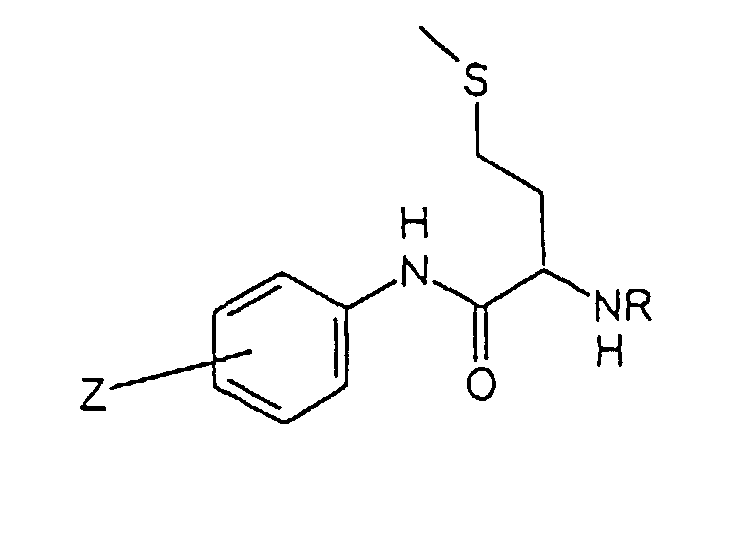
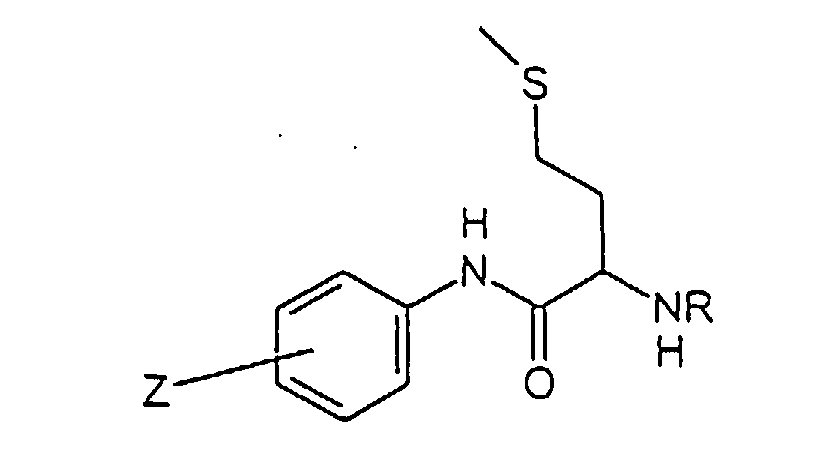
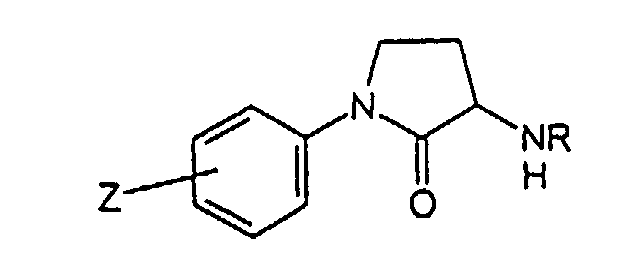
- the invention herein is directed to a process for producing a lactam of the formula wherein R is a protecting group such as t-butoxycarbonyl (BOC) or carbobenzyloxy (CBZ) and Z is H, -CN, -CONH 2 or CO 2 alkyl, from a methionine analog of the formula by treating the methionine analog with trimethylsulfonium halide or trimethylsulfoxonium halide in the presence of an inorganic or aminergic base, such as alkali metal hydroxides, alkoxides or carbonates or a tertiary amine, diazabicycloundecane (DBU), or Hunig's base [diisopropylethylamine (DIEA)], in a suitable aprotic solvent.
- R is a protecting group such as t-butoxycarbonyl (BOC) or carbobenzyloxy (CBZ) and Z is H, -CN, -CONH 2
- the invention herein is further directed to the preparation of amidinophenyl pyrrolidinyl ⁇ -alanine urea analogs using such methionine and lactam compounds as intermediates, which ⁇ -alanine urea analogs are useful as antithrombotics.
- the invention herein is directed to a process for producing a lactam of the formula wherein R is a protecting group such as t-butoxycarbonyl (BOC) or carbobenzyloxy (CBZ) and Z is H, -CN, -CONH 2 or CO 2 alkyl from a methionine analog of the formula by treating the methionine analog with trimethylsulfonium halide or trimethylsulfoxonium halide (such as trimethylsulfonium iodide or trimethylsulfoxonium chloride) in the presence of an inorganic or aminergic base in a suitable aprotic solvent.
- R is a protecting group such as t-butoxycarbonyl (BOC) or carbobenzyloxy (CBZ) and Z is H, -CN, -CONH 2 or CO 2 alkyl
- Z is H, -CN, -CONH 2 or CO 2 alkyl
- Z is H, -CN, -CONH 2
- the invention herein is further directed to the preparation of amidinophenyl pyrrolidinyl ⁇ -alanine urea analogs using such methionine and lactam compounds as intermediates, which ⁇ -alanine urea analogs are useful as anti-thrombotics.
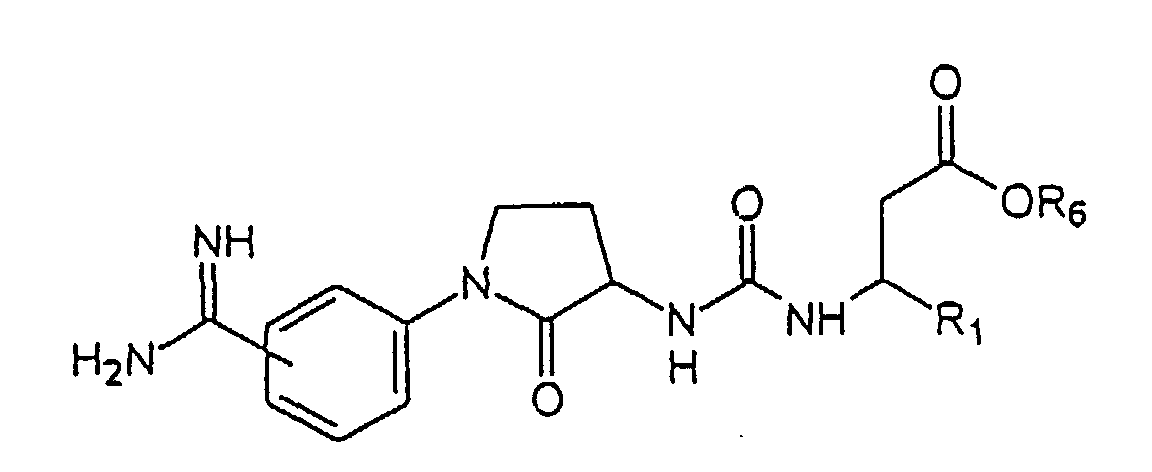
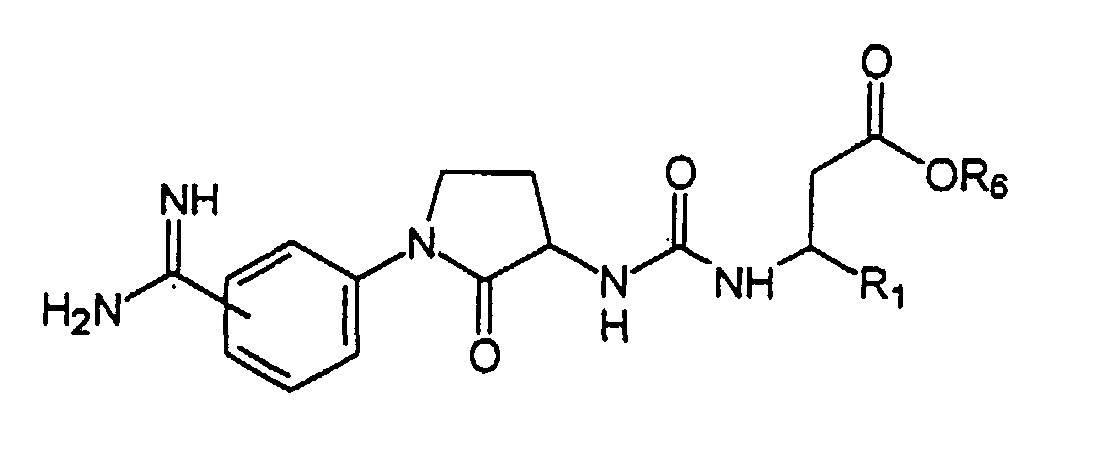
- Such process includes treating a methionine analog of the formula (wherein Z is -CN or -CONH 2 ) with trimethylsulfonium halide or trimethylsulfoxonium halide in the presence of a base, preferably potassium carbonate, in an aprotic solvent, preferably DMSO, to afford a lactam of the formula dehydrating when Z is -CONH 2 and deprotecting the lactam, reacting the resulting product with a ⁇ -amino ester in the presence of CDI to produce a urea of the formula treating the urea with hydroxylamine to produce an amidoxime, hydrogenating the amidoxime; and isolating a compound of the formula wherein R 1 is hydrogen, alkyl, aryl, arylalkyl, a heterocyclyl radical containing 1 to 3 heteroatoms or a heterocyclylalkyl and R 6 is selected from alkyl, aryl, arylalkyl or acyloxymethyl.
- N-methylmorpholine, N-methylpiperazine or triethylamine in a suitable aprotic solvent (e.g. dimethylformamide (DMF), tetrahydrofuran (THF) or CH 2 Cl 2 ) at a temperature ranging from -15°C to 25°C to give the methionine analog 1 .
- a suitable aprotic solvent e.g. dimethylformamide (DMF), tetrahydrofuran (THF) or CH 2 Cl 2
- Methionine analog 1 is cyclized to lactam 2 via a novel set of reaction conditions.
- Treatment of compound 1 with trimethylsulfonium halide or trimethylsulfoxonium halide in the presence of an inorganic or aminergic base e.g. alkali metal hydroxide, alkali metal alkoxides, alkali metal carbonates or tertiary amines such as DBU or Hunig's base
- an inorganic or aminergic base e.g. alkali metal hydroxide, alkali metal alkoxides, alkali metal carbonates or tertiary amines such as DBU or Hunig's base
- potassium carbonate e.g. DMF, dimethylacetamide (DMA), DMSO or THF
- the lactam 2 can be dehydrated when Z is -CONH 2 to the nitrile 3 using standard reagents (e.g. trifluoroacetic anhydride (TFAA), trichloroacetic anhydride or thionyl chloride) in the presence of an amine base (e.g. Et 3 N, pyridine, N-methylmorpholine or N,N-diisopropylethylamine) in an aprotic solvent (e.g. THF, EtOAc, pyridine or DME).
- TFAA trifluoroacetic anhydride
- thionyl chloride e.g. trifluoroacetic anhydride (TFAA), trichloroacetic anhydride or thionyl chloride
- an amine base e.g. Et 3 N, pyridine, N-methylmorpholine or N,N-diisopropylethylamine
- an aprotic solvent e.g. THF, Et
- Aromatic analogs of methionine undergo cyclization as illustrated in Table 1.
- the nitrile compound 1b prepared by dehydrating 1a (TFAA, Et 3 N)
- the carbomethoxyanilides 1d and 1e undergo cyclization without subsequent hydrolysis of the ester function. This is important to note since ester containing intermediates cyclized under the Freidinger conditions undergo hydrolysis of the ester.
- Synthesis of the urea product 5 is accomplished by sequential addition of an appropriate ⁇ -amino ester and aminolactam 4 to a suitable phosgene equivalent (e.g. triphosgene, diphosgene, phosgene, 1,1'-carbonyldiimidazole) in a suitable solvent (e.g. CH 2 CI 2 , CHCl 3 , ClCH 2 CH 2 Cl, DMF, DMA, pyridine, dioxane, THF, benzene, toluene). Reaction of 5 with hydroxylamine hydrochloride in the presence of a suitable base (e.g.
- a suitable base e.g.
- Formation of the nitrile 10 is carried out by dehydrating the primary amide with a standard reagent (trifluoroacetic anhydride/Et 3 N) in THF. Removal of the BOC protecting group with HCl/EtOAc affords the amine hydrochloride 11 . Sequential addition of ⁇ -alanine ethyl ester hydrochloride and compound 11 to 1,1'-carbonyldiimidazole in DMF/pyridine (1:1) affords the unsymmetrical urea 12 .
- a standard reagent trifluoroacetic anhydride/Et 3 N
- the ⁇ -amino acids and esters can be purchased or prepared from commercially available starting materials using known methods as illustrated in Scheme 5.
- the racemic ⁇ -heteroaryl ⁇ -amino acids can be prepared from the appropriate aryl aldehyde, malonic acid, and ammonium acetate (Method 1) [Johnson and Livak, J. Am. Chem. Soc., 229 (1936)].
- the racemic ⁇ -alkyl ⁇ -amino acids can be prepared from the corresponding alkene and chlorosulfonyl isocyanate (CSI) which goes through the ⁇ -lactam as shown in Method 2 [W. A. Szabo, Aldrichimica Acta, 23 (1977); R. Graf, Anagw.
- the ⁇ -lactam can be opened to the ethyl ester by treatment with anhydrous HCl in ethanol.
- An alternative method to form racemic ⁇ -amino esters is shown in Method 3. Nucleophiles can be added to 4-benzoyloxy-2-azetidinone to afford a variety of 3-substituted ⁇ -amino esters after treatment with anhydrous HCl in ethanol [K. Prasad et al., Vol. 19, Heterocycles, 2099 (1982)].
- the racemic ⁇ -amino acids and esters can be resolved using classical methods described in the literature [E. Fischer, H. Scheibler, R. Groh, Ber. , 2020 (1910); E. Fischer, H. Scheibler, Annalen, 337 (1911)].
- Chiral ⁇ -amino acids and esters can also be prepared using many different approaches including the following methods: 1) homologation of suitably protected ⁇ -amino acids using the Arndt-Eistert reaction as shown in Method 4 [Meier and Zeller, Angew. Chem. Int. Ed., 32-43 (1975); M. Rodriguez et al., Tetrahedron Lett., 5153 (1990); W. J. Greenlee, J. Med. Chem. 434 (1985) and references therein], 2) through the addition of an amine to ⁇ , ⁇ -unsaturated esters bearing a chiral auxiliary as shown in Method 5 [J. d'Angelo, J. Maddaluno, J. Am. Chem.
- lower alkyl refers to a straight or branched chain hydrocarbon radical having from 1 to about 6 carbon atoms.
- Examples of such "lower alkyl” radicals are methyl, ethyl, n-propyl, isopropyl, n-butyl, isobutyl, sec-butyl, t-butyl, pentyl, neo-pentyl, hexyl, isohexyl and the like.
- lower alkenyl refers to unsaturated acyclic hydrocarbon radicals containing at least one double bond and 2 to about 6 carbon atoms. Examples of such groups include, ethenyl, propenyl, butenyl, isobutenyl, pentenyl, hexenyl and the like.
- lower alkynyl refers to unsaturated acyclic hydrocarbon radicals containing one or more triple bonds and 2 to about 6 carbon atoms. Examples of such groups are ethynyl, propynyl, butynyl, pentynyl, hexynyl and the like.
- aryl denotes carbocyclic aromatic ring systems composed of one or more aromatic rings.
- Preferred aryl groups are those consisting of one, two or three benzene rings.
- the term embraces aromatic radicals such as phenyl, naphthyl and biphenyl.
- acyloxymethyl embraces groups of the formula wherein R 7 is alkyl or aryl as defined above.
- heterocyclyl radical containing 1 to 3 heteroatoms refers to monocyclic or bicyclic radicals wherein 1 to 3 carbon atoms have been replaced with a heteroatom selected from oxygen, nitrogen or sulfur. Such rings can be saturated or unsaturated and include heteroaromatics.
- HC1 gas was bubbled through a solution of the product of example 3 (62.0 g, 206 mmol) in EtOAc (750 mL) at ambient temperature for 15 minutes. After an additional 30 minutes, the precipitated product was filtered, washed with EtOAc and dried affording 46.7 g (96%) [m.p. 253-254.5°C (dec.), >99.9% e. e.].
- Enantiomeric purity was determined by chiral HPLC analysis using a Crownpak CR(-) column (15 cm x 4.0 mm) and isocratic elution with 1% aqueous HClO 4 at 1.2 mL/min. The detector was set at 254 nm.
- N-BOC-D-phenylglycine 5.02 g, 20 mmol
- N-methylmorpholine 2.02 g, 20 mmol
- EtOAc 100 mL
- isobutyl chloroformate 2.73 g, 20 mmol
- the cooling bath was removed and the reaction mixture stirred at ambient temperature for 2 hours.
- the reaction mixture was purged with nitrogen for 15 minutes to remove the excess diazomethane.
- reaction mixture was diluted with EtOAc, washed with 1N HCl, saturated NaHCO 3 , and dried (MgSO 4 ). Evaporation of the solvent afforded the crude diazoketone which was dissolved in EtOH (100 mL) and then treated sequentially with AgO 2 CPh (1.6 g, 7 mmol) and triethylamine (6.06 g, 60 mmol). After 20 hours the reaction mixture was concentrated and chromatographed (silica gel, 15% EtOAc/hexanes) affording 4.90 g (85%) of product as a colorless oil.
Landscapes
- Organic Chemistry (AREA)
- Chemical & Material Sciences (AREA)
- Health & Medical Sciences (AREA)
- Pharmacology & Pharmacy (AREA)
- Bioinformatics & Cheminformatics (AREA)
- Diabetes (AREA)
- Chemical Kinetics & Catalysis (AREA)
- General Chemical & Material Sciences (AREA)
- Medicinal Chemistry (AREA)
- Nuclear Medicine, Radiotherapy & Molecular Imaging (AREA)
- Engineering & Computer Science (AREA)
- Life Sciences & Earth Sciences (AREA)
- Hematology (AREA)
- Animal Behavior & Ethology (AREA)
- General Health & Medical Sciences (AREA)
- Public Health (AREA)
- Veterinary Medicine (AREA)
- Pharmaceuticals Containing Other Organic And Inorganic Compounds (AREA)
- Pyrrole Compounds (AREA)
- Organic Low-Molecular-Weight Compounds And Preparation Thereof (AREA)
- Plural Heterocyclic Compounds (AREA)
Claims (24)
- Ein Verfahren zur Herstellung eines Lactams der Formelworin R eine Schutzgruppe ist, ausgewählt aus der Gruppe bestehend aus t-Butoxycarbonyl und Carbobenzyloxy,
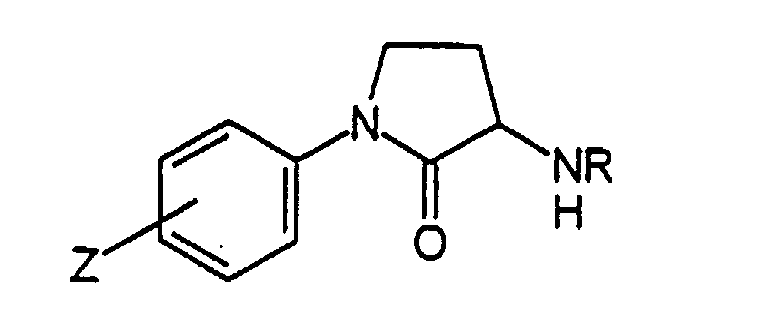
worin Z ausgewählt ist aus der Gruppe bestehend aus -CN, -CONH2 und CO2alkyl, umfassend:
Behandlung eines Methionin-Analogs der Formelmit einer Verbindung ausgewählt aus Trimethylsulfoniumhalogenid und Trimethylsulfoxoniumhalogenid in Gegenwart einer Base in einem aprotischen Lösungsmittel.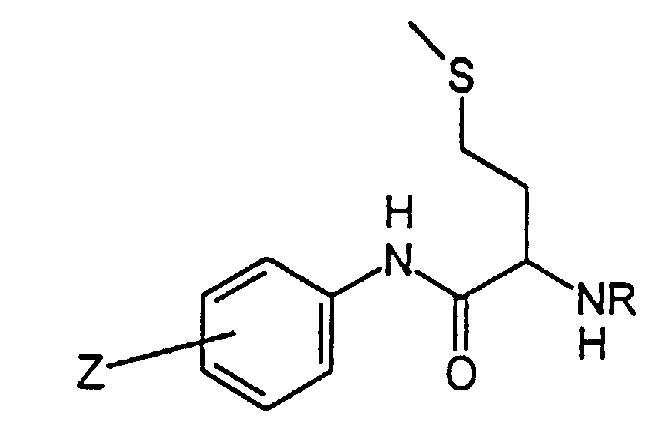
- Ein Verfahren nach Anspruch 1, worin das Methionin-Analog die Formelaufweist.

- Ein Verfahren gemäß Anspruch 2, worin das Methionin-Analog behandelt wird mit Trimethylsulfoniumiodid.
- Ein Verfahren gemäß Anspruch 3, worin die Base Kaliumcarbonat ist.
- Ein Verfahren gemäß Anspruch 4, worin das aprotische Lösungsmittel DMSO ist.
- Ein Verfahren gemäß Anspruch 5, worin Z -CN ist.
- Ein Verfahren gemäß Anspruch 5, worin Z -CONH2 ist.
- Ein Verfahren gemäß Anspruch 1, weiter umfassend Entfernung der Schutzgruppe vom Lactam und Kupplung des dabei entstehenden ungeschützten Lactams mit einem β-Aminoester unter Bildung einer Verbindung der Formelworin R1 ausgewählt ist aus der Gruppe bestehend aus H, C1-C6-Alkyl, Aryl und Heterocyclylresten, worin 1 bis 3 Kohlenstoffatome ersetzt sind durch ein Stickstoff, Sauerstoff oder Schwefel; worin R6 ausgewählt ist aus der Gruppe bestehend aus C1-C6-Alkyl, Aryl, Arylalkyl und Acyloxymethyl.

- Ein Verfahren zur Herstellung einer Verbindung der Formelworin R1 ausgewählt ist aus der Gruppe bestehend aus Wasserstoff, C1-C6-Alkyl, Aryl und monocyclischen Heterocyclylen, worin 1 bis 2 Kohlenstoffatome ersetzt sind durch ein Stickstoff-, Sauerstoff- oder Schwefelatom; R6 ausgewählt ist aus der Gruppe bestehend aus C1-C6-Alkyl, Aryl, Arylalkyl und Acyloxymethyl, umfassend:
 Behandlung eines Methionin-Analogs der Formelworin R ausgewählt ist aus der Gruppe bestehend aus BOC oder CBZ und Z -CONH2 ist; mit einer Verbindung, ausgewählt aus Trimethylsulfoniumhalogenid und Trimethylsulfoxoniumhalogenid, in Gegenwart einer Base in einem aprotischen Lösungsmittel unter Bildung eines Lactams der Formel
 Dehydrierung und Entfernung der Schutzgruppe vom Lactam;Umsetzung des dabei entstehenden Produktes mit einem β-Aminoester in Gegenwart eines 1,1-Carbonyldiimidazols unter Bildung einer Hamstoffverbindung der Formel
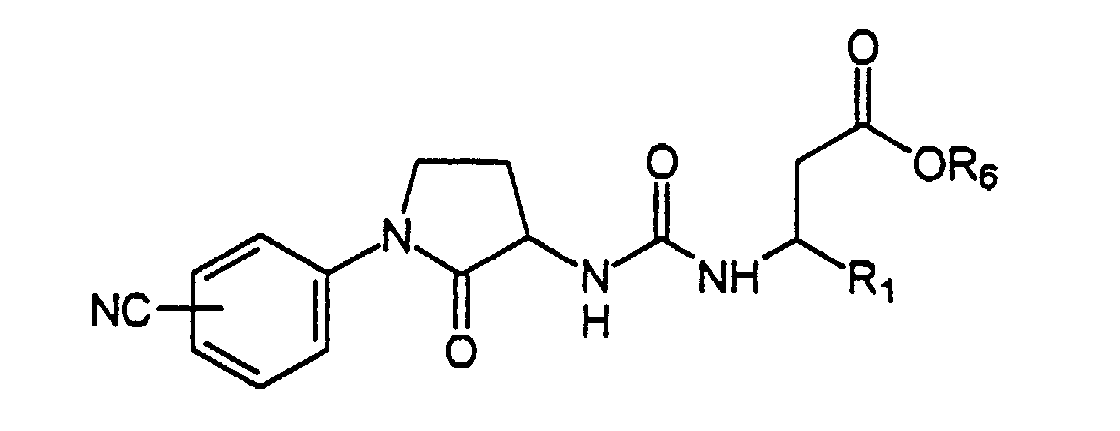 Umsetzung der Hamstoffverbindung mit Hydroxylaminhydrochlorid unter Bildung eines Amidoxim-Zwischenproduktes,Hydrierung des Amidoxims und Isolierung einer Verbindung der Formel
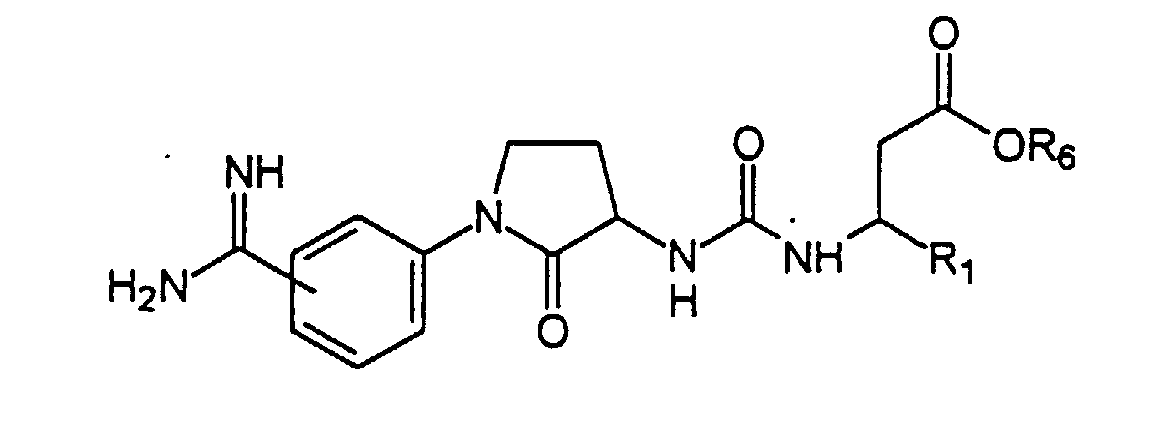
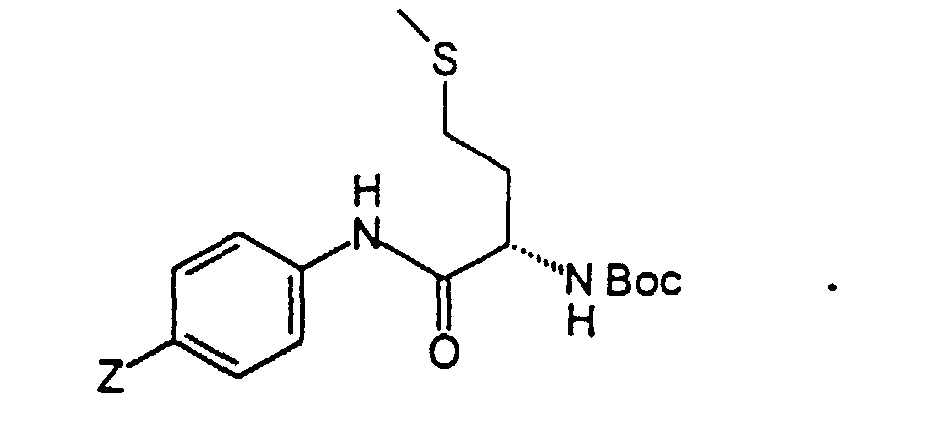
- Ein Verfahren gemäß Anspruch 9, worin das Methionin-Analog die Formelaufweist.
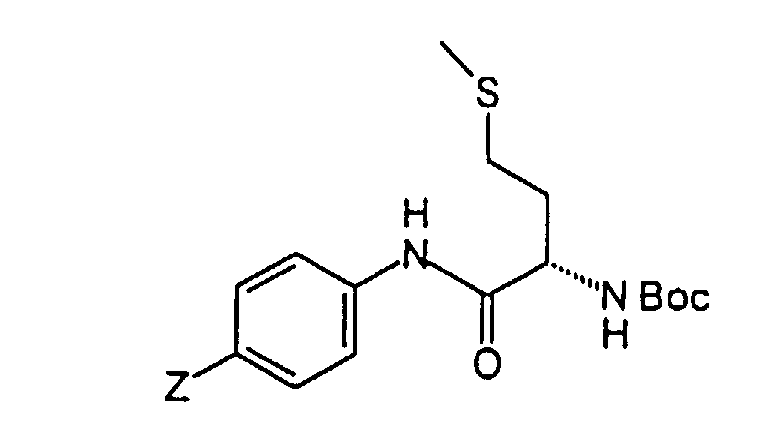
- Das Verfahren gemäß Anspruch 10, worin das Methionin-Analog mit Trimethylsulfoniumiodid behandelt wird.
- Das Verfahren gemäß Anspruch 11, worin die Base Kaliumcarbonat ist.
- Das Verfahren gemäß Anspruch 12, worin das aprotische Lösungsmittel DMSO ist.
- Das Verfahren gemäß Anspruch 10, worin der β-Aminoester β-Alaninethylester ist.
- Das Verfahren gemäß Anspruch 12, worin der β-Aminoester β-Alaninethylester ist.
- Ein Verfahren zur Herstellung einer Verbindung der Formelworin R1 ausgewählt ist aus der Gruppe bestehend aus Wasserstoff, C1-C6-Alkyl-, Aryl- und Heterocyclylresten, worin 1 bis 3 Kohlenstoffatome ersetzt sind durch ein Stickstoff-, Sauerstoff oder Schwefelatom; R6 ausgewählt ist aus der Gruppe bestehend aus C1-C6-Alkyl, Aryl, Arylalkyl und Acyloxymethyl, umfassend:
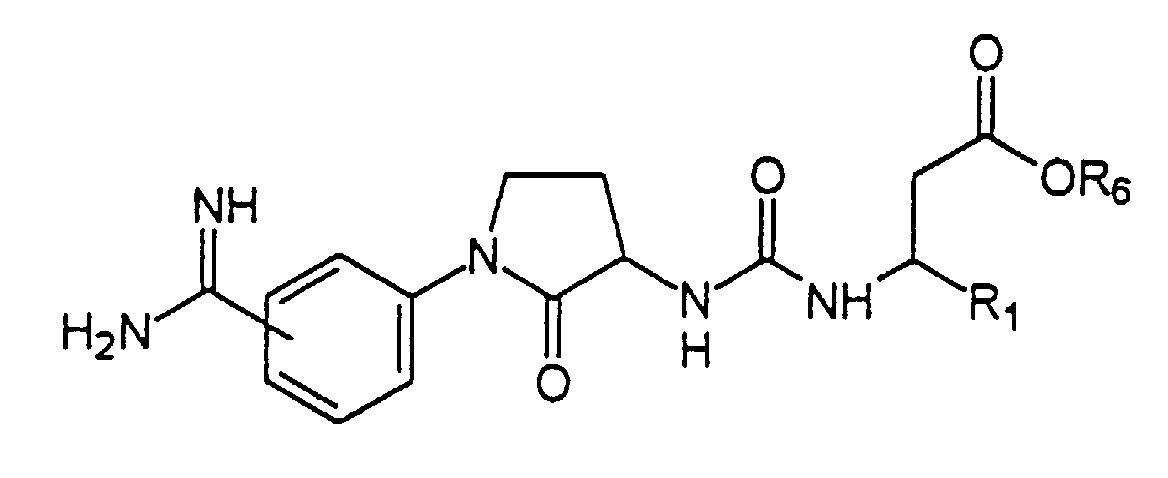 Behandlung eines Methionin-Analogs der Formelworin R ausgewählt ist aus der Gruppe bestehend aus BOC oder CBZ und Z -CN ist; mit einer Verbindung, ausgewählt aus Trimethylsulfoniumhalogenid und Trimethylsulfoxoniumhalogenid, in Gegenwart einer Base in einem aprotischen Lösungsmittel unter Bildung eines Lactams der Formel
 Entfernung der Schutzgruppe vom Lactam;Umsetzung des dabei entstehenden Produktes mit einem β-Aminoester in Gegenwart von 1,1-Carbonyldiimidazol unter Bildung einer Harnstoffverbindung der Formel
 Umsetzung der Hamstoffverbindung mit Hydroxylaminhydrochlorid unter Bildung eines Amidoxim-Zwischenproduktes,Hydrierung des Amidoxims und Isolierung einer Verbindung der Formel
- Ein Verfahren gemäß Anspruch 16, worin das Methionin-Analog die Formelaufweist.
- Ein Verfahren gemäß Anspruch 17, worin der β-Aminoester β-Alaninethylester ist.
- Ein Verfahren gemäß Anspruch 17, worin das Methionin-Analog mit Trimethylsulfoniumiodid behandelt wird.
- Ein Verfahren gemäß Anspruch 19, worin die Base Kaliumcarbonat ist.
- Ein Verfahren gemäß Anspruch 20, worin das aprotische Lösungsmittel DMSO ist.
- Ein Verfahren gemäß Anspruch 21, worin der β-Aminoester β-Alaninethylester ist.
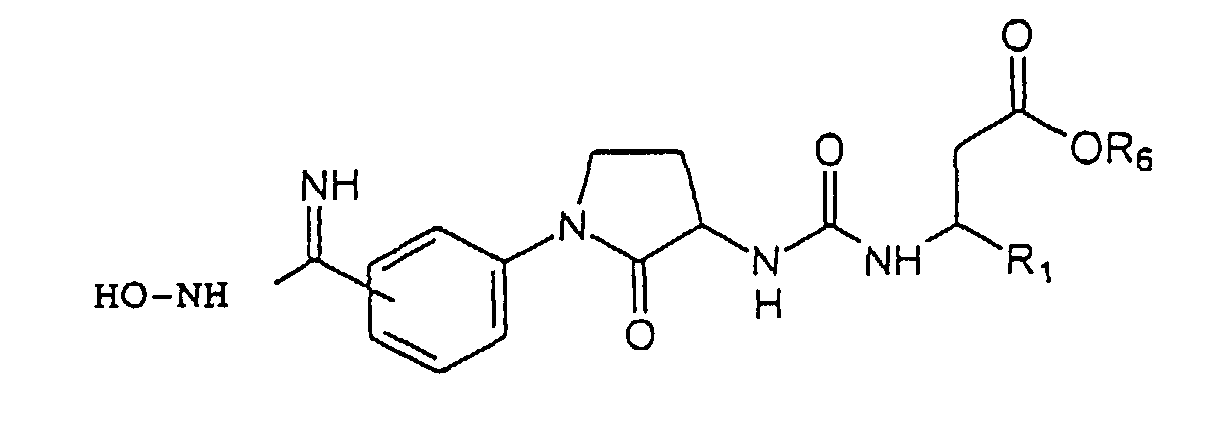
- Eine Verbindung der Formelworin R1 ausgewählt ist aus der Gruppe bestehend aus H, C1-C6-Alkyl-, Aryl- und einem Heterocyclylrest, worin 1 bis 3 Kohlenstoffatome ersetzt sind durch Stickstoff, Sauerstoff oder Schwefel und worin R6 ausgewählt ist aus der Gruppe bestehend aus C1-C6-Alkyl, Aryl, Arylalkyl und Acyloxymethyl.
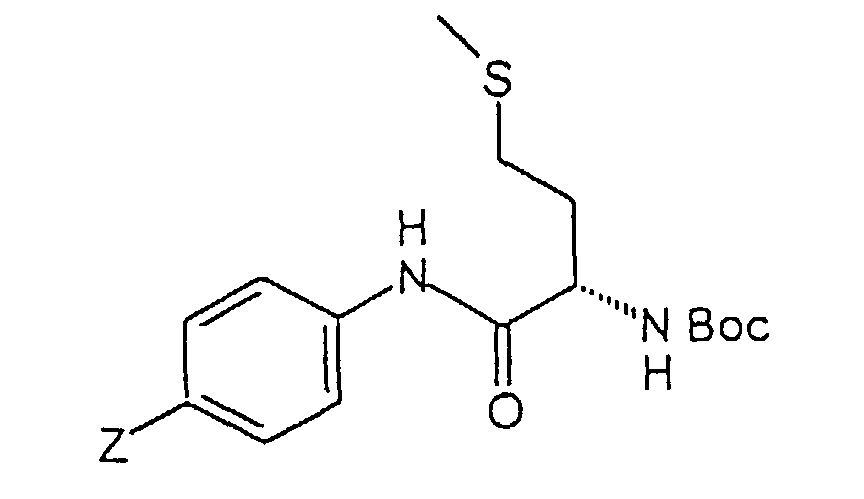
- Eine Verbindung der Formelworin Z H, -CN, -CONH2 oder CO2alkyl ist.
Applications Claiming Priority (3)
| Application Number | Priority Date | Filing Date | Title |
|---|---|---|---|
| US349333 | 1994-12-05 | ||
| US08/349,333 US5610296A (en) | 1994-12-05 | 1994-12-05 | Process for the preparation of amidino phenyl pyrrolidine beta-alanine urea analogs |
| PCT/US1995/014948 WO1996017827A1 (en) | 1994-12-05 | 1995-12-04 | PROCESS FOR THE PREPARATION OF AMIDINO PHENYL PYRROLIDINE β-ALANINE UREA ANALOGS |
Publications (2)
| Publication Number | Publication Date |
|---|---|
| EP0796245A1 EP0796245A1 (de) | 1997-09-24 |
| EP0796245B1 true EP0796245B1 (de) | 2000-07-26 |
Family
ID=23371935
Family Applications (1)
| Application Number | Title | Priority Date | Filing Date |
|---|---|---|---|
| EP95940016A Expired - Lifetime EP0796245B1 (de) | 1994-12-05 | 1995-12-04 | Verfahren zur herstellung von n-(amidinophenyl pyrrolidin)-n'-beta-alanin-substituierten harnstoffen |
Country Status (11)
| Country | Link |
|---|---|
| US (4) | US5610296A (de) |
| EP (1) | EP0796245B1 (de) |
| JP (1) | JPH10509960A (de) |
| AT (1) | ATE194976T1 (de) |
| AU (1) | AU4163696A (de) |
| DE (1) | DE69518164T2 (de) |
| DK (1) | DK0796245T3 (de) |
| ES (1) | ES2150592T3 (de) |
| GR (1) | GR3034516T3 (de) |
| PT (1) | PT796245E (de) |
| WO (1) | WO1996017827A1 (de) |
Families Citing this family (15)
| Publication number | Priority date | Publication date | Assignee | Title |
|---|---|---|---|---|
| IL125859A0 (en) * | 1996-03-28 | 1999-04-11 | Glaxo Group Ltd | Pyrrolopyrrolone derivatives useful as inhibitors of neutrophil elastase |
| ZA988469B (en) * | 1997-09-17 | 1999-03-17 | Biocryst Pharm Inc | Pyrrolidin-2-one compounds and their use as neuraminidase inhibitors |
| ZA988735B (en) | 1997-10-06 | 2000-03-23 | Du Pont Pharm Co | An efficient method for the conversion of nitriles to amidines. |
| US5986107A (en) * | 1998-04-08 | 1999-11-16 | G. D. Searle & Co. | Process for the preparation of a 2-oxopyrrolidine compound |
| US6025358A (en) * | 1998-06-11 | 2000-02-15 | G. D. Searle & Co. | Double prodrugs of potent GP IIb/IIIa antagonists |
| DE19841895A1 (de) * | 1998-09-11 | 2000-03-23 | Degussa | Neues Verfahren zur Herstellung von 3-Amino-2-oxo-pyrrolidinen, neue Zwischenprodukte und deren Verwendung |
| US6723711B2 (en) | 1999-05-07 | 2004-04-20 | Texas Biotechnology Corporation | Propanoic acid derivatives that inhibit the binding of integrins to their receptors |
| RU2263109C2 (ru) * | 1999-05-07 | 2005-10-27 | Тексэс Байотекнолоджи Копэрейшн | ПРОИЗВОДНЫЕ КАРБОНОВЫХ КИСЛОТ (ВАРИАНТЫ), ФАРМАЦЕВТИЧЕСКАЯ КОМПОЗИЦИЯ И СПОСОБ СЕЛЕКТИВНОГО ИНГИБИРОВАНИЯ СВЯЗЫВАНИЯ α4β1 ИНТЕГРИНА У МЛЕКОПИТАЮЩЕГО |
| US6972296B2 (en) * | 1999-05-07 | 2005-12-06 | Encysive Pharmaceuticals Inc. | Carboxylic acid derivatives that inhibit the binding of integrins to their receptors |
| RU2195447C1 (ru) * | 2001-07-31 | 2002-12-27 | Кубанский государственный технологический университет | 1-(4-нитрофенил)-4-n-x-аминопирролидоны-2, проявляющие рострегулирующую и антистрессовую активность, и способ их получения |
| SI21096B (sl) * | 2001-10-09 | 2012-05-31 | Encysive Pharmaceuticals Inc | Derivati karboksilne kisline ki inhibirajo vezavo integrinov na njihove receptorje |
| AU2002365132A1 (en) | 2001-10-17 | 2003-07-15 | Bristol-Myers Squibb Company | BICYCLIC LACTAM DERIVATIVES AS INHIBITORS OF MATRIX METALLOPROTEINASES AND/OR TNF-Alpha CONVERTING ENZYME (TACE) |
| EP2192905A4 (de) | 2007-08-29 | 2010-11-10 | Adam Lubin | Verfahren zur selektiven behandlung von erkrankungen |
| ES2690315T3 (es) | 2012-06-15 | 2018-11-20 | Mitsubishi Tanabe Pharma Corporation | Compuestos de imidazol y triazol como inhibidores de DGAT-1 |
| CN111440149A (zh) * | 2020-03-31 | 2020-07-24 | 浙江美诺华药物化学有限公司 | 一种达比加群酯中间体的制备方法 |
Family Cites Families (3)
| Publication number | Priority date | Publication date | Assignee | Title |
|---|---|---|---|---|
| IL55573A0 (en) * | 1977-10-03 | 1978-12-17 | Erba Carlo Spa | Substituted n-(ss-alkoxy-ethyl)-n-(4-phenoxybenzyl)-dichloroacetamides and process for their preparation |
| US5239113A (en) * | 1991-10-15 | 1993-08-24 | Monsanto Company | Substituted β-amino acid derivatives useful as platelet aggregation inhibitors and intermediates thereof |
| DE69425431T2 (de) * | 1993-03-31 | 2001-02-08 | G.D. Searle & Co., Chicago | 1-amdinophenyl-pyrrolidone/piperidinone als blutblättchen-aggregations inhibitoren |
-
1994
- 1994-12-05 US US08/349,333 patent/US5610296A/en not_active Expired - Fee Related
-
1995
- 1995-06-05 US US08/465,212 patent/US5576447A/en not_active Expired - Fee Related
- 1995-06-05 US US08/463,657 patent/US5484946A/en not_active Expired - Fee Related
- 1995-06-06 US US08/467,417 patent/US5659063A/en not_active Expired - Fee Related
- 1995-12-04 AU AU41636/96A patent/AU4163696A/en not_active Abandoned
- 1995-12-04 ES ES95940016T patent/ES2150592T3/es not_active Expired - Lifetime
- 1995-12-04 JP JP8517599A patent/JPH10509960A/ja not_active Abandoned
- 1995-12-04 DE DE69518164T patent/DE69518164T2/de not_active Expired - Fee Related
- 1995-12-04 AT AT95940016T patent/ATE194976T1/de not_active IP Right Cessation
- 1995-12-04 WO PCT/US1995/014948 patent/WO1996017827A1/en not_active Ceased
- 1995-12-04 EP EP95940016A patent/EP0796245B1/de not_active Expired - Lifetime
- 1995-12-04 DK DK95940016T patent/DK0796245T3/da active
- 1995-12-04 PT PT95940016T patent/PT796245E/pt unknown
-
2000
- 2000-09-29 GR GR20000402206T patent/GR3034516T3/el not_active IP Right Cessation
Also Published As
| Publication number | Publication date |
|---|---|
| JPH10509960A (ja) | 1998-09-29 |
| US5610296A (en) | 1997-03-11 |
| DE69518164T2 (de) | 2001-03-22 |
| GR3034516T3 (en) | 2000-12-29 |
| EP0796245A1 (de) | 1997-09-24 |
| ATE194976T1 (de) | 2000-08-15 |
| AU4163696A (en) | 1996-06-26 |
| PT796245E (pt) | 2000-12-29 |
| US5576447A (en) | 1996-11-19 |
| WO1996017827A1 (en) | 1996-06-13 |
| US5659063A (en) | 1997-08-19 |
| US5484946A (en) | 1996-01-16 |
| ES2150592T3 (es) | 2000-12-01 |
| DK0796245T3 (da) | 2000-09-11 |
| DE69518164D1 (de) | 2000-08-31 |
Similar Documents
| Publication | Publication Date | Title |
|---|---|---|
| US5659063A (en) | Intermediates for amidino phenyl pyrrolidine β-alanine urea analogs | |
| Webb et al. | Conformationally restricted arginine analogs | |
| NL8201326A (nl) | N-gesubstitueerde amidoaminozuren. | |
| US5686622A (en) | Thiazolidine derivatives, their preparation and the medicaments containing the same | |
| Aggarwal et al. | The use of enantiomerically pure ketene dithioacetal bis (sulfoxides) in highly diastereoselective intramolecular nitrone cycloadditions. Application in the total synthesis of the β-amino acid (−)-cispentacin and the first asymmetric synthesis of cis-(3 R, 4 R)-4-amino-pyrrolidine-3-carboxylic acid | |
| Yuste et al. | Synthesis of enantiomerically pure 2-amino alcohols from amino acids mediated by sulfoxides | |
| US4987253A (en) | Method for the synthesis of desferrioxamine B and analogs thereof | |
| US5707991A (en) | N-acylpyrrolidines and medicaments for the treatment or prevention of disorders linked to CKK and to gastrin | |
| Kanno et al. | Efficient syntheses of (S)-4-hydroxy-2-pyrrolidinone derivatives | |
| Freidinger et al. | Novel glutamic acid-derived cholecystokinin receptor ligands | |
| CA2261628C (en) | Process for preparing 3-pyrroline-2-carboxylic acid derivatives | |
| Micouin et al. | Asymmetric synthesis. XXXIX. 1 Synthesis of 3-substituted piperidin-2-ones from chiral non-racemic lactams | |
| Thomas et al. | A practical ex-chiral-pool synthesis of β-proline and homo-β-proline | |
| Altman et al. | Synthesis of chiral 1, 2, 4-triaminobutanes | |
| Cremonesi et al. | [2+ 2] Cycloaddition Reactions of Imines with Cyclic Ketenes: Synthesis of 1, 3‐Thiazolidine Derived Spiro‐β‐lactams and Their Transformations | |
| EP0278090B1 (de) | Pyridinyl-Derivate von 2-Aminoacetamid | |
| CA2207102A1 (en) | Process for the preparation of amidino phenyl pyrrolidine .beta.-alanine urea analogs | |
| Tanaka et al. | Synthesis of (3S, 5S)-3, 5-diaminopiperidin-2-one as a conformationally restricted surrogate of Dab-Gly dipeptide | |
| US5252747A (en) | Chiral quinolone intermediates | |
| Lehmann et al. | Chemo-and regioselective syntheses of enantiopure aminopyrrolidinones as building blocks for constrained peptidomimetics | |
| EP0279937A1 (de) | 2-Aminoacetamidderivate | |
| US20040127703A1 (en) | Process for the manufacture of 3-amino-pyrrolidine derivatives | |
| Kato et al. | Synthesis of 6‐amino‐1‐benzyl‐4‐methylhexahydro‐1H‐1, 4‐diazepine | |
| Tanaka et al. | Synthesis of (3S, 5R)-3, 5-diaminoazepan-2-one as a conformationally restricted surrogate of the Dab-Gly dipeptide | |
| Hirokawa et al. | Synthesis of optically active af‐(1‐Ethyl‐3‐methylhexahydro‐1, 3‐diazin‐5‐yl)‐and N‐(1‐Ethyl‐5‐methyloctahydro‐1, 5‐diazocin‐3‐yl) pyridine‐3‐carboxamides |
Legal Events
| Date | Code | Title | Description |
|---|---|---|---|
| PUAI | Public reference made under article 153(3) epc to a published international application that has entered the european phase |
Free format text: ORIGINAL CODE: 0009012 |
|
| 17P | Request for examination filed |
Effective date: 19970528 |
|
| AK | Designated contracting states |
Kind code of ref document: A1 Designated state(s): AT BE CH DE DK ES FR GB GR IE IT LI LU NL PT SE |
|
| 17Q | First examination report despatched |
Effective date: 19990211 |
|
| GRAG | Despatch of communication of intention to grant |
Free format text: ORIGINAL CODE: EPIDOS AGRA |
|
| RTI1 | Title (correction) |
Free format text: PROCESS FOR THE PREPARATION OF AMIDINO PHENYL PYRROLIDINE BETA-ALANINE UREA ANALOGS |
|
| GRAG | Despatch of communication of intention to grant |
Free format text: ORIGINAL CODE: EPIDOS AGRA |
|
| GRAG | Despatch of communication of intention to grant |
Free format text: ORIGINAL CODE: EPIDOS AGRA |
|
| GRAH | Despatch of communication of intention to grant a patent |
Free format text: ORIGINAL CODE: EPIDOS IGRA |
|
| GRAH | Despatch of communication of intention to grant a patent |
Free format text: ORIGINAL CODE: EPIDOS IGRA |
|
| GRAA | (expected) grant |
Free format text: ORIGINAL CODE: 0009210 |
|
| ITF | It: translation for a ep patent filed | ||
| AK | Designated contracting states |
Kind code of ref document: B1 Designated state(s): AT BE CH DE DK ES FR GB GR IE IT LI LU NL PT SE |
|
| REF | Corresponds to: |
Ref document number: 194976 Country of ref document: AT Date of ref document: 20000815 Kind code of ref document: T |
|
| REG | Reference to a national code |
Ref country code: CH Ref legal event code: NV Representative=s name: DIETLIN & CIE S.A. Ref country code: CH Ref legal event code: EP |
|
| REG | Reference to a national code |
Ref country code: IE Ref legal event code: FG4D |
|
| REF | Corresponds to: |
Ref document number: 69518164 Country of ref document: DE Date of ref document: 20000831 |
|
| REG | Reference to a national code |
Ref country code: DK Ref legal event code: T3 |
|
| ET | Fr: translation filed | ||
| REG | Reference to a national code |
Ref country code: ES Ref legal event code: FG2A Ref document number: 2150592 Country of ref document: ES Kind code of ref document: T3 |
|
| REG | Reference to a national code |
Ref country code: PT Ref legal event code: SC4A Free format text: AVAILABILITY OF NATIONAL TRANSLATION Effective date: 20001006 |
|
| PLBE | No opposition filed within time limit |
Free format text: ORIGINAL CODE: 0009261 |
|
| STAA | Information on the status of an ep patent application or granted ep patent |
Free format text: STATUS: NO OPPOSITION FILED WITHIN TIME LIMIT |
|
| 26N | No opposition filed | ||
| REG | Reference to a national code |
Ref country code: GB Ref legal event code: IF02 |
|
| PGFP | Annual fee paid to national office [announced via postgrant information from national office to epo] |
Ref country code: NL Payment date: 20050316 Year of fee payment: 10 |
|
| PGFP | Annual fee paid to national office [announced via postgrant information from national office to epo] |
Ref country code: PT Payment date: 20050928 Year of fee payment: 11 |
|
| PGFP | Annual fee paid to national office [announced via postgrant information from national office to epo] |
Ref country code: GR Payment date: 20051024 Year of fee payment: 11 |
|
| PGFP | Annual fee paid to national office [announced via postgrant information from national office to epo] |
Ref country code: IE Payment date: 20051026 Year of fee payment: 11 |
|
| PGFP | Annual fee paid to national office [announced via postgrant information from national office to epo] |
Ref country code: GB Payment date: 20051104 Year of fee payment: 11 Ref country code: AT Payment date: 20051104 Year of fee payment: 11 |
|
| PGFP | Annual fee paid to national office [announced via postgrant information from national office to epo] |
Ref country code: DK Payment date: 20051107 Year of fee payment: 11 |
|
| PGFP | Annual fee paid to national office [announced via postgrant information from national office to epo] |
Ref country code: FR Payment date: 20051201 Year of fee payment: 11 |
|
| PGFP | Annual fee paid to national office [announced via postgrant information from national office to epo] |
Ref country code: SE Payment date: 20051202 Year of fee payment: 11 |
|
| PGFP | Annual fee paid to national office [announced via postgrant information from national office to epo] |
Ref country code: ES Payment date: 20051216 Year of fee payment: 11 Ref country code: CH Payment date: 20051216 Year of fee payment: 11 |
|
| PGFP | Annual fee paid to national office [announced via postgrant information from national office to epo] |
Ref country code: DE Payment date: 20051230 Year of fee payment: 11 |
|
| PGFP | Annual fee paid to national office [announced via postgrant information from national office to epo] |
Ref country code: BE Payment date: 20060113 Year of fee payment: 11 |
|
| PGFP | Annual fee paid to national office [announced via postgrant information from national office to epo] |
Ref country code: LU Payment date: 20060510 Year of fee payment: 11 |
|
| PG25 | Lapsed in a contracting state [announced via postgrant information from national office to epo] |
Ref country code: NL Free format text: LAPSE BECAUSE OF NON-PAYMENT OF DUE FEES Effective date: 20060701 |
|
| NLV4 | Nl: lapsed or anulled due to non-payment of the annual fee |
Effective date: 20060701 |
|
| PG25 | Lapsed in a contracting state [announced via postgrant information from national office to epo] |
Ref country code: IE Free format text: LAPSE BECAUSE OF NON-PAYMENT OF DUE FEES Effective date: 20061204 |
|
| PG25 | Lapsed in a contracting state [announced via postgrant information from national office to epo] |
Ref country code: SE Free format text: LAPSE BECAUSE OF NON-PAYMENT OF DUE FEES Effective date: 20061205 |
|
| PG25 | Lapsed in a contracting state [announced via postgrant information from national office to epo] |
Ref country code: LI Free format text: LAPSE BECAUSE OF NON-PAYMENT OF DUE FEES Effective date: 20061231 Ref country code: CH Free format text: LAPSE BECAUSE OF NON-PAYMENT OF DUE FEES Effective date: 20061231 Ref country code: BE Free format text: LAPSE BECAUSE OF NON-PAYMENT OF DUE FEES Effective date: 20061231 |
|
| PGFP | Annual fee paid to national office [announced via postgrant information from national office to epo] |
Ref country code: IT Payment date: 20061231 Year of fee payment: 12 |
|
| PG25 | Lapsed in a contracting state [announced via postgrant information from national office to epo] |
Ref country code: PT Free format text: LAPSE BECAUSE OF NON-PAYMENT OF DUE FEES Effective date: 20070604 |
|
| REG | Reference to a national code |
Ref country code: PT Ref legal event code: MM4A Free format text: LAPSE DUE TO NON-PAYMENT OF FEES Effective date: 20070604 |
|
| PG25 | Lapsed in a contracting state [announced via postgrant information from national office to epo] |
Ref country code: DE Free format text: LAPSE BECAUSE OF NON-PAYMENT OF DUE FEES Effective date: 20070703 |
|
| REG | Reference to a national code |
Ref country code: DK Ref legal event code: EBP |
|
| REG | Reference to a national code |
Ref country code: CH Ref legal event code: PL |
|
| EUG | Se: european patent has lapsed | ||
| GBPC | Gb: european patent ceased through non-payment of renewal fee |
Effective date: 20061204 |
|
| REG | Reference to a national code |
Ref country code: IE Ref legal event code: MM4A |
|
| REG | Reference to a national code |
Ref country code: FR Ref legal event code: ST Effective date: 20070831 |
|
| PG25 | Lapsed in a contracting state [announced via postgrant information from national office to epo] |
Ref country code: GB Free format text: LAPSE BECAUSE OF NON-PAYMENT OF DUE FEES Effective date: 20061204 Ref country code: AT Free format text: LAPSE BECAUSE OF NON-PAYMENT OF DUE FEES Effective date: 20061204 |
|
| BERE | Be: lapsed |
Owner name: G.D. *SEARLE & CO. Effective date: 20061231 |
|
| PG25 | Lapsed in a contracting state [announced via postgrant information from national office to epo] |
Ref country code: DK Free format text: LAPSE BECAUSE OF NON-PAYMENT OF DUE FEES Effective date: 20070102 |
|
| REG | Reference to a national code |
Ref country code: ES Ref legal event code: FD2A Effective date: 20061205 |
|
| PG25 | Lapsed in a contracting state [announced via postgrant information from national office to epo] |
Ref country code: FR Free format text: LAPSE BECAUSE OF NON-PAYMENT OF DUE FEES Effective date: 20070102 Ref country code: ES Free format text: LAPSE BECAUSE OF NON-PAYMENT OF DUE FEES Effective date: 20061205 |
|
| PG25 | Lapsed in a contracting state [announced via postgrant information from national office to epo] |
Ref country code: LU Free format text: LAPSE BECAUSE OF NON-PAYMENT OF DUE FEES Effective date: 20061204 |
|
| PG25 | Lapsed in a contracting state [announced via postgrant information from national office to epo] |
Ref country code: GR Free format text: LAPSE BECAUSE OF NON-PAYMENT OF DUE FEES Effective date: 20070704 |
|
| PG25 | Lapsed in a contracting state [announced via postgrant information from national office to epo] |
Ref country code: IT Free format text: LAPSE BECAUSE OF NON-PAYMENT OF DUE FEES Effective date: 20071204 |