EP0796276B1 - Modification graduelle, super-agonistes et antagonistes de peptides et de proteines-signaux - Google Patents
Modification graduelle, super-agonistes et antagonistes de peptides et de proteines-signaux Download PDFInfo
- Publication number
- EP0796276B1 EP0796276B1 EP95929258A EP95929258A EP0796276B1 EP 0796276 B1 EP0796276 B1 EP 0796276B1 EP 95929258 A EP95929258 A EP 95929258A EP 95929258 A EP95929258 A EP 95929258A EP 0796276 B1 EP0796276 B1 EP 0796276B1
- Authority
- EP
- European Patent Office
- Prior art keywords
- modification
- modified
- lys
- activity
- specific
- Prior art date
- Legal status (The legal status is an assumption and is not a legal conclusion. Google has not performed a legal analysis and makes no representation as to the accuracy of the status listed.)
- Expired - Lifetime
Links
Images


Classifications
-
- C—CHEMISTRY; METALLURGY
- C07—ORGANIC CHEMISTRY
- C07K—PEPTIDES
- C07K16/00—Immunoglobulins [IG], e.g. monoclonal or polyclonal antibodies
- C07K16/18—Immunoglobulins [IG], e.g. monoclonal or polyclonal antibodies against material from animals or humans
- C07K16/28—Immunoglobulins [IG], e.g. monoclonal or polyclonal antibodies against material from animals or humans against receptors, cell surface antigens or cell surface determinants
-
- A—HUMAN NECESSITIES
- A61—MEDICAL OR VETERINARY SCIENCE; HYGIENE
- A61P—SPECIFIC THERAPEUTIC ACTIVITY OF CHEMICAL COMPOUNDS OR MEDICINAL PREPARATIONS
- A61P31/00—Antiinfectives, i.e. antibiotics, antiseptics, chemotherapeutics
- A61P31/12—Antivirals
-
- A—HUMAN NECESSITIES
- A61—MEDICAL OR VETERINARY SCIENCE; HYGIENE
- A61P—SPECIFIC THERAPEUTIC ACTIVITY OF CHEMICAL COMPOUNDS OR MEDICINAL PREPARATIONS
- A61P37/00—Drugs for immunological or allergic disorders
-
- C—CHEMISTRY; METALLURGY
- C07—ORGANIC CHEMISTRY
- C07K—PEPTIDES
- C07K1/00—General methods for the preparation of peptides, i.e. processes for the organic chemical preparation of peptides or proteins of any length
- C07K1/107—General methods for the preparation of peptides, i.e. processes for the organic chemical preparation of peptides or proteins of any length by chemical modification of precursor peptides
- C07K1/1072—General methods for the preparation of peptides, i.e. processes for the organic chemical preparation of peptides or proteins of any length by chemical modification of precursor peptides by covalent attachment of residues or functional groups
- C07K1/1077—General methods for the preparation of peptides, i.e. processes for the organic chemical preparation of peptides or proteins of any length by chemical modification of precursor peptides by covalent attachment of residues or functional groups by covalent attachment of residues other than amino acids or peptide residues, e.g. sugars, polyols, fatty acids
-
- C—CHEMISTRY; METALLURGY
- C07—ORGANIC CHEMISTRY
- C07K—PEPTIDES
- C07K14/00—Peptides having more than 20 amino acids; Gastrins; Somatostatins; Melanotropins; Derivatives thereof
- C07K14/435—Peptides having more than 20 amino acids; Gastrins; Somatostatins; Melanotropins; Derivatives thereof from animals; from humans
- C07K14/475—Growth factors; Growth regulators
- C07K14/50—Fibroblast growth factor [FGF]
- C07K14/501—Fibroblast growth factor [FGF] acidic FGF [aFGF]
-
- C—CHEMISTRY; METALLURGY
- C07—ORGANIC CHEMISTRY
- C07K—PEPTIDES
- C07K16/00—Immunoglobulins [IG], e.g. monoclonal or polyclonal antibodies
- C07K16/18—Immunoglobulins [IG], e.g. monoclonal or polyclonal antibodies against material from animals or humans
- C07K16/28—Immunoglobulins [IG], e.g. monoclonal or polyclonal antibodies against material from animals or humans against receptors, cell surface antigens or cell surface determinants
- C07K16/2803—Immunoglobulins [IG], e.g. monoclonal or polyclonal antibodies against material from animals or humans against receptors, cell surface antigens or cell surface determinants against the immunoglobulin superfamily
- C07K16/2809—Immunoglobulins [IG], e.g. monoclonal or polyclonal antibodies against material from animals or humans against receptors, cell surface antigens or cell surface determinants against the immunoglobulin superfamily against the T-cell receptor (TcR)-CD3 complex
-
- A—HUMAN NECESSITIES
- A61—MEDICAL OR VETERINARY SCIENCE; HYGIENE
- A61K—PREPARATIONS FOR MEDICAL, DENTAL OR TOILETRY PURPOSES
- A61K38/00—Medicinal preparations containing peptides
Definitions
- This invention is on the area of the chemical modification technology of biologically active proteins and peptides. More specifically it concerns use of chemical modification to obtain a protein or peptide with superior properties or with new or even counteracting properties.
- the invention also concerns a new method for structure-function analysis by using gradual chemical modification, a biological principle, namely the catalytic activity of signal peptides and the successful abrogation thereof, leading to a very effective inhibitor of Acute Myeloid Leukemia cells.
- a biological principle namely the catalytic activity of signal peptides and the successful abrogation thereof, leading to a very effective inhibitor of Acute Myeloid Leukemia cells.
- we show the chemical modification of human IL-3 a protein that also has a substantial therapeutic value after modification.
- This patent-description also contains specific examples within the therapeutic field of the invention.
- Superagonist an IL-3 with superior properties
- Antagonist an IL-3 with counteracting or new properties
- Superagonists are for instance an IL-3 with a lowered antigenecity and/or a higher biological activity and/or a higher stability.
- Possible applications of IL-3 Superagonists are:
- the modified signal peptides can also be generated by molecular biology
- these mutant proteins, DNA-constructs and the use thereof are also considered to be within the scope of the invention.
- the use in gene-therapy can result in cells that are producing and excreting the super-agonist or the antagonist. Therefore, in one of the examples there is also an elaboration on the possibility to construct a growth factor with a reduced stability. This can be used especially in combination with antagonistic action, thus resulting in a selective administration whereby the high rate of breakdown of the antagonist can contain the action to a very localized environment. This is particularly interesting in gene-therapy for solid tumors.
- the description of the invention also discloses the importance of metal ions with more than 1 valence in charge, by preference Zinc-ions, especially for catalytic activity and the subsequent efficacy. Therefore, it is possible to influence the growth factor action by manipulating the (local) metal ions concentrations. Since there is a usual optimum in efficacy of the metal ions concentration, and any concentration below or beyond this optimum can lead to reduction of efficacy of the growth factor. This enables manipulation of the efficacy of the growth factor. In this way also indirect therapeutic effects can be achieved with metal-, preferably Zinc ions. This can be used in treatment of skin-diseases like wrath's in the form of ointments. Also, the use of inhalation-sprays for treatment of lung-affects is possible.
- Interleukin-3 which was first isolated from T-cells as a glycoprotein, has been demonstrated to act on bone-marrow cells. Either with or without other growth factors it has been shown to induce the formation of various blood cells from these bone-marrow cells. Human IL-3 has been cloned for the first time in 1987 by Dorssers et al. who used a human c-DNA library and hybridization with a probe of mouse DNA (Gene 55:115 (1987)).
- Electrophoresis 15:251 (1994) describes the chemical modification of hIL-3 by acetic anhydride or succinic anhydride at pH's of between 5.5 and 9.5 to demonstrate the improved quality of separation of a new electrophoresis buffer system.
- Present invention has a different approach.
- the native IL-3 is used as starting material.
- stepwise gradually increasing modification an extra selectivity is introduced in the chemical reaction.
- the modification that occurs simultaneous with the first change in biological activity can be simply localized with specific proteases and new forms of mass spectrometry.
- important amino acid residues can be quickly localized and minimal change (and therefore maximal control) can be achieved in the introduction or change of a desired property.
- the starting material can be any protein or peptide containing substance.
- the Zinc ions can protect against denaturation, it might be necessary to reversibly denaturate the molecule and to add chelating agents to remove this Zinc from the molecule.
- the modification of IL-3 with lodo-acetate is described. At the concerning pH this modification is directed to alkylation of His-residues.
- the method can be performed easily also with other reagents by a person that is skilled in the art.
- the same can be stated about the modification of other amino acids that are involved in the catalytic activity and/or Zinc binding.
- these residues can be easily modified by other chemical ways or by molecular biological ways, for instance by using deletion or substitution mutations.
- IL-3 In addition this is not limited to IL-3 alone: There is a significant homology among the various receptors of the cytokine-superfamily: For instance Interleukins 2-7 Epo and GM-CSF. On top of that specific Zinc binding has also been found for IL-2 IL-6 GM-CSF and gamma IFN. It is also conceivable that the invention can be applied to much more signal peptides and/or proteins, since for instance Insulin, human growth hormone and prolactin also have specific Zinc binding properties. In addition, it has been found that for certain cell-lines IL-3 can be replaced by for instance Insulin. Finally it is possible that alkylation of a growth factor also has an other mechanism in the generation of a antagonist or cell-inhibitor.
- the reaction mixture contained 50 mM buffer, 2 mg/ml hIL-3 and 3 mM Acetic anhydride or Succinic anhydride respectively.
- the 10 times concentrated stock solutions were prepared fresh at the day of the experiment. Modification of hIL-3 was performed overnight at 30 °C. After modification it was determined by SDS-electrophoresis that the IL-3 was not degraded.
- MO-7 cells were a kind gift of dr. I.P. Touw (Erasmus University of Rotterdam, The Netherlands).
- RPMI culture medium was from Gibco (Paisly, UK.). supplemented Bovine Calf Serum was from Hyclone (Logan, Utah, USA.)
- the cell culture medium consisted of RPMI with 10 % of the calf serum. During normal tissue culture of the cells also 100 ng/ml IL-3 was added.
- the relative activity of the modified substances was determined as the ratio of these 50 % concentrations of the modified and the native IL-3 respectively ( [IL-3 modified ] 50% / [IL-3 native ] 50% ).
- Acetic Acid, dioxane, lysine hydrochloride and MES were from Sigma.
- the modifying agent was from Fluka.
- Buffers Acetate/NaOH was used for modification at pH 5.0, MES/NaOH was used for modification at pH 5.5, 6.0 and 6.5. At pH 7.0 an NaH 2 PO 4 / NaOH buffer was used.
- Ten times concentrated stock solutions were prepared and directly filtered trough a 0.22 micron filter.
- the reaction mixture contained 50 mM buffer, 2 mg/ml hIL-3 and 3 mM Acetic anhydride or Succinic anhydride respectively.
- the 10 times concentrated stock solutions were prepared fresh at the day of the experiment. Modification of hIL-3 was performed overnight at 30 °C. After modification it was determined by SDS-electrophoresis that the IL-3 was not degraded.
- a method to chemically modify biologically active peptides or proteins for the generation of a protein or peptide antagonist is a method to chemically modify biologically active peptides or proteins for the generation of a protein or peptide antagonist.
- Urea, EDTA, MES and NaOH were from Sigma.
- the Na-Iodo-acetate was from Fluka.
- Ten times concentrated stock solutions were prepared in 8 M urea and filter-sterilized directly thereafter with a 0.22 micron filter.
- the reaction mixture contained 50 mM buffer, 5.5 M urea and 50 mM EDTA. From these reagents 10 times concentrated stock solutions in 8 M urea were made freshly on the day of the experiment.
- lodo-acetate was added in a concentration of 3, 10 and 30 mM.
- the IL-3 concentration was 2 mg/ml.
- the modification was performed during 24, 48 and 72 hours at 37 °C and subsequently it was studied by native electrophoresis. After 2 days and 30 mM Iodo-acetate there was maximal modification without severe distortion of the bands from the modified material (an indication of severe denaturation of the molecules). In this case less than 2 % of the starting material was left. Because in this case there was an expectation of a minimal biological activity without severe denaturation of the protein, this sample was used in further experiments. Subsequently, SDS electrophoresis was used to demonstrate that no degradation of the molecule was found after modification.
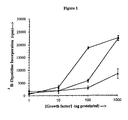
- partially modified IL-3 was titrated in serial 7 fold dilution in presence of 3 ng/ml of native IL-3.
- the titration range was from 15 ⁇ g/ml to 0.1 ng/ml and the titration was performed on only 4000 M07 cells/ml to exclude any starvation phenomena's.
- the modified IL-3 is capable to inhibit the control-IL-3 by a factor 10-100.
- 3 ng/ml of the modified IL-3 is able to suppress thymidine incorporation of 30-100 ng/ml control IL-3 for 80-90 %. Therefore, the modified IL-3 does not only have an Inhibitory activity, it also has an enhanced receptor binding capacity. This is confirmed in the titration of partially modified IL-3 (figure 2): Only 0.1 ng of partially modified IL-3 is sufficient for almost 50 % inhibition of 3 ng/ ml native IL-3.
- Exoprotease treatments have been performed with Cathepsine-C and with Carboxypeptidase-Y from Boehringer. 1 mg/ml of IL-3 was incubated for 18 hours at 37 °C in presence of the protease. Cathepsine-C was added in serial two fold dilution's in a range of 1/2 to 1/128 mg/ml. The other reaction conditions were as described by the manufacturer. Biological activities have been determined as described in example 1.
- the modified material was dialyzed against the appropriate buffer and subsequently fragmented by Endo Glu-C or Endo Lys-C as described by the manufacturer (Boehringer Mannheim, Germany). The incubation was overnight at 37 °C, 2 mg/ml hIL-3 and a protein to protease ratio of 30.
- Matrix Assisted Laser Desorption mass spectrometry was performed on a Finnegan MAT Vision 200 laser desorption mass spectrometer, equipped with a pulsed nitrogen laser (337 nm, pulse width 3 ns). The sample was exited to just above the ionization threshold (10 6 -10 7 W/cm 2 ). The acceleration voltage was 6.5 kV. The ions were post accelerated to the conversion dynode on - 10 kV for the electron amplification. Standard accuracy was about 0.05 %, but this can deteriorate to 0.1-0.2 % due to experimental conditions.
- Acetic anhydride (1, 2 and 3 mM respectively) was used for the modification at pH 6.8 which is well within the buffering range of both buffers.
- 10 mM or more phosphate there was protection of 1 group: Lys 116 .
- Lys 116 At a phosphate concentration below 1 mM this protection was absent. Since 10 mM is the physiological phosphate concentration, it can be assumed that present localization method enabled the demonstration and localization of a biologically significant phosphate binding. Therefore it is very conceivable that an antagonist or cell-growth inhibitor can be generated by distortion of this phosphate binding. Therefore, also this is to be considered within the scope of the invention.
- the second step is the monitoring of the modification reaction.
- a mild and sensitive method is needed. This method is native electrophoresis (Electrophoresis 15: 251 (1994)).
- electrospray mass spectrometry can form a suitable alternative. This is demonstrated in figure 3: Electrospray Mass Spectrometry of Succinylated IL-3 at pH 5-7. Especially the combination of both enables the demonstration of complete specificity on amine-residues.
- the third step is the confirmation of the overall structural integrity.
- Circular Dichroism Spectroscopy can be used for this purpose(Electrophoresis 15: 251 (1994)). Although small differences are not visible by this method, substantial structural changes like denaturation are clearly detected.
- the fourth step is the characterization and localization of the modified residues, for which the following techniques were used: native digestion with specific protease's, electrophoresis, electrospray mass spectrometry, and LDMS.
- native digestion with specific protease's native digestion with specific protease's
- electrophoresis electrophoresis
- electrospray mass spectrometry and LDMS.
- the reaction specificity was determined by the combination of native electrophoresis and electrospray mass spectrometry. Localization was performed with endoprotease's and LDMS, as described in the previous example.
- the fifth and last step is the testing of biological activity of the various modified forms of the protein. After this determination of activity the real involvement of the various localized residues can be deduced.
- Lys 116 is the best candidate for the biological activity. This is confirmed by the factor 3 lowered modification at pH 7 (in comparison with pH 6.5), that is accompanied with a factor 3 increase in activity. Therefore, Lys 116 is important for biological activity. This was all confirmed by modification with Succinic anhydride. In this case there was no decrease in modification for the at pH 7 modified material as compared to the at pH 6.5 modified material. Accompanying this phenomenon there was no enhancement of activity either.
- Lys 116 and the amino-terminus are of biological significance, while the amino terminus seems to have an inhibitory or regulating influence, Lys 116 seems to be important for the biological activity.
- Lys 116 is also protected by phosphate, suggesting a phosphate binding by that residue. Since the residue is also important for the biological activity of the interleukin, this suggests that phosphate-binding is of importance for the mode of action of IL-3 and if this process is of importance for IL-3, it can also be of importance for other peptides and proteins.
- this method enables the localization of biologically important residues and the demonstrated phosphate binding has also enabled the establishment and localization of a possibly important physiological process. Therefore, the invention also embodies the modification of a protein or peptide to introduce a new, preferably antagonistic activity by means of the manipulation of the phosphate binding of the protein or peptide.
Landscapes
- Health & Medical Sciences (AREA)
- Chemical & Material Sciences (AREA)
- Organic Chemistry (AREA)
- Immunology (AREA)
- Life Sciences & Earth Sciences (AREA)
- General Health & Medical Sciences (AREA)
- Medicinal Chemistry (AREA)
- Biophysics (AREA)
- Genetics & Genomics (AREA)
- Molecular Biology (AREA)
- Proteomics, Peptides & Aminoacids (AREA)
- Biochemistry (AREA)
- Chemical Kinetics & Catalysis (AREA)
- General Chemical & Material Sciences (AREA)
- Zoology (AREA)
- Toxicology (AREA)
- Gastroenterology & Hepatology (AREA)
- Analytical Chemistry (AREA)
- Nuclear Medicine, Radiotherapy & Molecular Imaging (AREA)
- Pharmacology & Pharmacy (AREA)
- Animal Behavior & Ethology (AREA)
- Public Health (AREA)
- Veterinary Medicine (AREA)
- Virology (AREA)
- Oncology (AREA)
- Communicable Diseases (AREA)
- Engineering & Computer Science (AREA)
- Bioinformatics & Cheminformatics (AREA)
- Medicines That Contain Protein Lipid Enzymes And Other Medicines (AREA)
- Peptides Or Proteins (AREA)
- Micro-Organisms Or Cultivation Processes Thereof (AREA)
- Medicines Containing Antibodies Or Antigens For Use As Internal Diagnostic Agents (AREA)
Claims (20)
- Méthode de recherche d'analyse quantitative structure - fonction pour des protéines ou peptides biologiquement actifs choisis parmi des récepteurs humains tels que les interleukines, les facteurs de croissance hématopoïétiques, les hormones peptidiques ou les hormones protéiniques, les peptides signaux ou les protéines signaux, aux fins d'introduction d'une ou plusieurs des caractéristiques suivantes : activité biologique augmentée, stabilité augmentée, antigénicité supprimée, acquisition d'une activité antagoniste ou d'une activité inhibitrice cellulaire, ladite méthode comprenant l'application d'une modification chimique spécifique d'acides aminés sélectionnés avec utilisation(a) d'une modification chimique graduelle de la protéine ou du peptide, suivie(b) du suivi de la réaction modificatrice par une méthode douce et sensible telle qu'une électrophorèse non-dénaturante et/ou une spectrométrie de masse en mode électrospray et ledit suivi comprenant de façon optionnelle en outre la confirmation de l'intégrité de la structure globale, par exemple par utilisation de la spectroscopie de dichroïsme circulaire,(c) d'un traitement par des protéases,(d) de la spectrométrie de masse et(e) de la détermination de l'activité biologique du produit modifié et, de façon optionnelle de la détermination de la stabilité du produit modifié, lesdits peptides ou protéines étant choisis, de préférence, parmi les interleukines 1 à 8, l'interleukine 10, GM-CSF, TNF, l'insuline, la prolactine et γIFN, plus préférablement GM-CSF, EPO ou une interleukine choisie parmi les interleukines 2 à 7 choisies dans la super famille des cytokines.
- Méthode selon la revendication 1, dans laquelle une digestion spécifique avec des protéases spécifiques et une spectrométrie de masse sont effectuées pour caractériser et localiser les acides aminés modifiés.
- Méthode selon la revendication 1 ou 2, dans laquelle une digestion spécifique avec des endoprotéases spécifiques et une spectrométrie de masse à désorption laser (LDMS) sont effectuées pour caractériser et localiser les acides aminés modifiés, ladite endoprotéase étant par exemple l'Endo Glu C ou l'Endo Lys C.
- Méthode selon l'une quelconque des revendications 1 à 3, dans laquelle la modification est effectuée par digestion spécifique avec des exoprotéases spécifiques et la spectrométrie de masse en mode électrospray est effectuée pour caractériser et localiser les acides aminés modifiés, de façon appropriée l'exoprotéase est N-terminale, par exemple la cathepsine C, ou C-terminale, par exemple la carboxypeptidase Y.
- Méthode selon l'une quelconque des revendications 1 à 3, dans laquelle la modification est une modification chimique, ladite modification étant une alkylation et/ou ladite modification étant une acylation, telle qu'une acétylation, par exemple par l'iodoacétate, ou une succinylation, par exemple par l'anhydride succinique, ladite modification étant, de façon appropriée, une modification dans des conditions variant graduellement, dans laquelle on fait varier une ou plusieurs des conditions suivantes comme suit : on fait varier le pH entre 5,0 et 7,0, de préférence par incréments de 0,5 unité de pH, et/ou la durée ou les concentrations des réactifs.
- Méthode selon la revendication 5, dans laquelle la modification est effectuée en présence de tampon phosphate, de préférence en combinaison avec l'anhydride acétique.
- Méthode selon l'une quelconque des revendications précédentes, pour l'introduction d'une activité antagoniste et/ou inhibitrice cellulaire, dans laquelle la modification est spécifique d'un ou plusieurs résidus impliqués dans l'activité catalytique, par exemple dans laquelle la modification est au niveau, ou très proche, d'un centre catalytique partiel ou complet, ladite modification modifiant de préférence l'activité catalytique, ledit résidu étant, de façon appropriée, un résidu histidine.
- Méthode selon l'une quelconque des revendications précédentes, dans laquelle la modification est au niveau, ou très proche, d'un centre de liaison à un métal, de préférence un centre de liaison au zinc, ledit résidu étant, de façon appropriée, un résidu histidine.
- Méthode selon l'une quelconque des revendications précédentes, dans laquelle la modification est réalisée par dénaturation réversible du substrat et par addition d'un agent chélatant pour éliminer l'ion métallique, par exemple en présence d'urée et d'EDTA, ladite urée étant de préférence à une concentration supérieure à 5 M, et ledit EDTA étant de préférence à une concentration de 50 mM.
- Méthode selon l'une quelconque des revendications précédentes, dans laquelle la modification est spécifique d'un type d'acide aminé, par exemple un résidu amine et/ou est même spécifique d'uniquement un résidu amine dans le peptide ou la protéine, ladite amine étant par exemple la partie N-terminale.
- Méthode selon l'une quelconque des revendications précédentes, dans laquelle le substrat est l'interleukine-3 humaine, ladite méthode donnant de préférence une interleukine-3 modifiée uniquement au niveau d'un ou plusieurs des résidus suivants : Ala1, His26, Lys28, Lys66, His95, His98, Lys100 ou Lys116.
- Méthode selon l'une quelconque des revendications précédentes, pour l'introduction d'une activité antagoniste et/ou inhibitrice cellulaire, ladite méthode comprenant la rupture d'une liaison phosphate.
- Substance signal modifiée à activité superagoniste ou antagoniste choisie dans le groupe constitué par un facteur de croissance, une interleukine, un facteur stimulant les colonies, un TNF et un interféron, où la modification est une modification chimique et/ou de biologie moléculaire, au niveau ou très proche d'un centre catalytique partiel ou complet, ladite modification étant au niveau ou très proche d'un centre de liaison à un métal et/ou d'un centre de liaison à un phosphate.
- Substance signal modifiée selon la revendication 13, dans laquelle le centre de liaison à un métal est un centre de liaison au zinc.
- Substance signal modifiée selon la revendication 13 ou 14, dans laquelle la modification chimique est une modification chimique graduelle.
- Substance signal modifiée selon les revendications 13 à 15, dans laquelle la modification est une délétion et/ou une substitution d'un acide aminé impliqué dans la liaison à un ion métallique.
- Substance signal modifiée selon les revendications 13 à 15, dans laquelle la modification est une alkylation ou une acylation.
- Substance signal modifiée selon les revendications 13 à 17, dans laquelle la modification sc situe dans une histidine dans le centre de liaison à un métal.
- Substance signal modifiée selon les revendications 13 à 18, la substance signal modifiée étant une interleukine 1 à 8, GM-CSF, TNF ou le γ-interféron.
- Utilisation d'une substance signal modifiée selon les revendications 13 à 19, ou d'une séquence d'acide nucléique codant pour celle-ci, pour la préparation d'un médicament destiné à être appliqué dans un traitement comprenant la stimulation de la réplication de cellules souches ou la thérapie génique.
Applications Claiming Priority (5)
| Application Number | Priority Date | Filing Date | Title |
|---|---|---|---|
| NL9401404 | 1994-08-31 | ||
| NL9401404A NL9401404A (nl) | 1994-08-31 | 1994-08-31 | Graduele chemische modificatie van biologisch actieve peptiden en eiwitten. |
| NL1000332 | 1995-05-10 | ||
| NL1000332A NL1000332C1 (nl) | 1994-08-31 | 1995-05-10 | Graduele chemische modificatie van biologisch actieve peptiden en eiwitten. |
| PCT/NL1995/000292 WO1996006860A2 (fr) | 1994-08-31 | 1995-08-30 | Modification graduelle, super-agonistes et antagonistes de peptides et de proteines-signaux |
Publications (2)
| Publication Number | Publication Date |
|---|---|
| EP0796276A1 EP0796276A1 (fr) | 1997-09-24 |
| EP0796276B1 true EP0796276B1 (fr) | 2003-10-15 |
Family
ID=26642070
Family Applications (1)
| Application Number | Title | Priority Date | Filing Date |
|---|---|---|---|
| EP95929258A Expired - Lifetime EP0796276B1 (fr) | 1994-08-31 | 1995-08-30 | Modification graduelle, super-agonistes et antagonistes de peptides et de proteines-signaux |
Country Status (9)
| Country | Link |
|---|---|
| US (1) | US20020150551A1 (fr) |
| EP (1) | EP0796276B1 (fr) |
| JP (1) | JPH10507161A (fr) |
| AU (1) | AU3266895A (fr) |
| CA (1) | CA2198919A1 (fr) |
| DE (1) | DE69531955T2 (fr) |
| ES (1) | ES2208691T3 (fr) |
| NL (1) | NL1000332C1 (fr) |
| WO (1) | WO1996006860A2 (fr) |
Families Citing this family (3)
| Publication number | Priority date | Publication date | Assignee | Title |
|---|---|---|---|---|
| US6955807B1 (en) | 1998-05-15 | 2005-10-18 | Bayer Pharmaceuticals Corporation | IL-2 selective agonists and antagonists |
| US6399570B1 (en) | 1999-02-05 | 2002-06-04 | Agennix, Inc. | Antimicrobial/endotoxin neutralizing polypeptide |
| DE602006019916D1 (de) * | 2005-12-12 | 2011-03-10 | Canji Inc | Adenovirale expressionsvektoren mit einer expressionskassette im e1-bereich und einer inaktivierten e2b-polymerase |
Family Cites Families (8)
| Publication number | Priority date | Publication date | Assignee | Title |
|---|---|---|---|---|
| US4511502A (en) * | 1982-12-22 | 1985-04-16 | Genentech, Inc. | Purification and activity assurance of precipitated heterologous proteins |
| US5206344A (en) * | 1985-06-26 | 1993-04-27 | Cetus Oncology Corporation | Interleukin-2 muteins and polymer conjugation thereof |
| WO1988001511A1 (fr) * | 1986-09-04 | 1988-03-10 | Cetus Corporation | Interleukine-2 succinylee pour compositions pharmaceutiques |
| US4904584A (en) * | 1987-12-23 | 1990-02-27 | Genetics Institute, Inc. | Site-specific homogeneous modification of polypeptides |
| EP1361273A3 (fr) * | 1992-11-24 | 2004-02-11 | G.D. Searle & Co. | Mutants de l'interleukine-3 (iL-3) avec de multiples mutations |
| US5501962A (en) * | 1993-06-21 | 1996-03-26 | G. D. Searle & Co. | Interleuken-3 (IL-3) human/murine hybrid polypeptides and recombinant production of the same |
| US5658739A (en) * | 1994-05-10 | 1997-08-19 | The Regents Of The University Of California | Method for characterization of the fine structure of protein binding sites |
| US5710252A (en) * | 1995-02-03 | 1998-01-20 | Eastman Kodak Company | Method for recombinant yeast expression and isolation of water-soluble collagen-type polypeptides |
-
1995
- 1995-05-10 NL NL1000332A patent/NL1000332C1/xx not_active IP Right Cessation
- 1995-08-30 AU AU32668/95A patent/AU3266895A/en not_active Abandoned
- 1995-08-30 WO PCT/NL1995/000292 patent/WO1996006860A2/fr not_active Ceased
- 1995-08-30 DE DE69531955T patent/DE69531955T2/de not_active Expired - Lifetime
- 1995-08-30 ES ES95929258T patent/ES2208691T3/es not_active Expired - Lifetime
- 1995-08-30 US US08/807,506 patent/US20020150551A1/en not_active Abandoned
- 1995-08-30 JP JP8508637A patent/JPH10507161A/ja not_active Ceased
- 1995-08-30 CA CA002198919A patent/CA2198919A1/fr not_active Abandoned
- 1995-08-30 EP EP95929258A patent/EP0796276B1/fr not_active Expired - Lifetime
Also Published As
| Publication number | Publication date |
|---|---|
| WO1996006860A2 (fr) | 1996-03-07 |
| DE69531955D1 (de) | 2003-11-20 |
| US20020150551A1 (en) | 2002-10-17 |
| EP0796276A1 (fr) | 1997-09-24 |
| WO1996006860A3 (fr) | 1996-07-18 |
| CA2198919A1 (fr) | 1996-03-07 |
| NL1000332C1 (nl) | 1996-03-04 |
| AU3266895A (en) | 1996-03-22 |
| DE69531955T2 (de) | 2004-07-29 |
| JPH10507161A (ja) | 1998-07-14 |
| ES2208691T3 (es) | 2004-06-16 |
Similar Documents
| Publication | Publication Date | Title |
|---|---|---|
| EP1961425B1 (fr) | Procédés et analogues de l'érytropoïétine pour la prévention et le traitement de l'anémie | |
| US7973009B2 (en) | Methods and compositions for the prevention and treatment of anemia | |
| JP3261124B2 (ja) | ナチュラルキラー細胞刺激因子 | |
| US6433142B1 (en) | Megakaryocyte stimulating factors | |
| JPH05503003A (ja) | 潜在性関与ペプチドおよびその使用 | |
| Bikfalvi et al. | Interaction of fibroblast growth factor (FGF) with megakaryocytopoiesis and demonstration of FGF receptor expression in megakaryocytes and megakaryocytic-like cells | |
| US20030124677A1 (en) | Amino-terminally truncated MCP-2 as chemokine antagonists | |
| EP0796276B1 (fr) | Modification graduelle, super-agonistes et antagonistes de peptides et de proteines-signaux | |
| JP2003516729A (ja) | ヒト循環ウイルス阻害ペプチド(virip)及びその使用 | |
| AU762023B2 (en) | Gradual modification, super-agonists and antagonists of signal-proteins and peptides | |
| AU2003248017B2 (en) | Gradual modification super-agonists and antagonists of signal-proteins and peptides | |
| US6465616B1 (en) | Interleukin-5 antagonist | |
| AU2007200889A1 (en) | Gradual modification super-agonists and antagonists of signal-proteins and peptides | |
| AU723413B2 (en) | An interleukin-5 antagonist | |
| CA2256368A1 (fr) | Antagoniste d'interleukine-5 | |
| HK1075258A (en) | Megakaryocyte stimulating factors | |
| HK1003893A (en) | Gradual modification, super agonists and antagonists of signal-proteins and peptides | |
| HK1066827A (en) | Megakaryocyte stimulating factors | |
| JPH06501009A (ja) | ナチュラルキラー刺激因子 | |
| HK1127275A (en) | Methods and compositions for the prevention and treatment of anemia |
Legal Events
| Date | Code | Title | Description |
|---|---|---|---|
| PUAI | Public reference made under article 153(3) epc to a published international application that has entered the european phase |
Free format text: ORIGINAL CODE: 0009012 |
|
| 17P | Request for examination filed |
Effective date: 19970225 |
|
| AK | Designated contracting states |
Kind code of ref document: A1 Designated state(s): BE CH DE ES FR GB IT LI NL SE |
|
| 17Q | First examination report despatched |
Effective date: 19990604 |
|
| RBV | Designated contracting states (corrected) |
Designated state(s): BE CH DE ES FR GB IT LI NL SE |
|
| GRAH | Despatch of communication of intention to grant a patent |
Free format text: ORIGINAL CODE: EPIDOS IGRA |
|
| GRAS | Grant fee paid |
Free format text: ORIGINAL CODE: EPIDOSNIGR3 |
|
| RIN1 | Information on inventor provided before grant (corrected) |
Inventor name: HUPPES, WILLEM Inventor name: SMIT, VICTOR |
|
| RAP1 | Party data changed (applicant data changed or rights of an application transferred) |
Owner name: PHARMA KEY B.V. |
|
| RIN1 | Information on inventor provided before grant (corrected) |
Inventor name: HUPPES, WILLEM Inventor name: SMIT, VICTOR |
|
| GRAA | (expected) grant |
Free format text: ORIGINAL CODE: 0009210 |
|
| AK | Designated contracting states |
Kind code of ref document: B1 Designated state(s): BE CH DE ES FR GB IT LI NL SE |
|
| REG | Reference to a national code |
Ref country code: GB Ref legal event code: FG4D Ref country code: CH Ref legal event code: EP |
|
| REF | Corresponds to: |
Ref document number: 69531955 Country of ref document: DE Date of ref document: 20031120 Kind code of ref document: P |
|
| REG | Reference to a national code |
Ref country code: SE Ref legal event code: TRGR |
|
| REG | Reference to a national code |
Ref country code: CH Ref legal event code: NV Representative=s name: BUGNION S.A. |
|
| REG | Reference to a national code |
Ref country code: GB Ref legal event code: 732E |
|
| RAP2 | Party data changed (patent owner data changed or rights of a patent transferred) |
Owner name: STICHTING PHARMA PARK IP |
|
| REG | Reference to a national code |
Ref country code: ES Ref legal event code: FG2A Ref document number: 2208691 Country of ref document: ES Kind code of ref document: T3 |
|
| NLS | Nl: assignments of ep-patents |
Owner name: STICHTING PHARMA PARK IP |
|
| ET | Fr: translation filed | ||
| PLBQ | Unpublished change to opponent data |
Free format text: ORIGINAL CODE: EPIDOS OPPO |
|
| PLBI | Opposition filed |
Free format text: ORIGINAL CODE: 0009260 |
|
| NLT2 | Nl: modifications (of names), taken from the european patent patent bulletin |
Owner name: STICHTING PHARMA PARK IP |
|
| PLAX | Notice of opposition and request to file observation + time limit sent |
Free format text: ORIGINAL CODE: EPIDOSNOBS2 |
|
| 26 | Opposition filed |
Opponent name: FRESENIUS KABI DEUTSCHLAND GMBH Effective date: 20040712 |
|
| REG | Reference to a national code |
Ref country code: FR Ref legal event code: TP |
|
| NLR1 | Nl: opposition has been filed with the epo |
Opponent name: FRESENIUS KABI DEUTSCHLAND GMBH |
|
| REG | Reference to a national code |
Ref country code: CH Ref legal event code: PUE Owner name: STICHTING PHARMA PARK IP Free format text: PHARMA KEY B.V.#ONNEMAHEERD 12#9736 AM GRONINGEN (NL) -TRANSFER TO- STICHTING PHARMA PARK IP#OMMELANDVAART 70#1335 SJ ALMERE (NL) |
|
| PLAX | Notice of opposition and request to file observation + time limit sent |
Free format text: ORIGINAL CODE: EPIDOSNOBS2 |
|
| PLBB | Reply of patent proprietor to notice(s) of opposition received |
Free format text: ORIGINAL CODE: EPIDOSNOBS3 |
|
| PG25 | Lapsed in a contracting state [announced via postgrant information from national office to epo] |
Ref country code: FR Free format text: LAPSE BECAUSE OF NON-PAYMENT OF DUE FEES Effective date: 20060428 |
|
| REG | Reference to a national code |
Ref country code: FR Ref legal event code: ST Effective date: 20060428 |
|
| REG | Reference to a national code |
Ref country code: FR Ref legal event code: D3 |
|
| PLAY | Examination report in opposition despatched + time limit |
Free format text: ORIGINAL CODE: EPIDOSNORE2 |
|
| REG | Reference to a national code |
Ref country code: FR Ref legal event code: ST Effective date: 20070430 |
|
| PLAH | Information related to despatch of examination report in opposition + time limit modified |
Free format text: ORIGINAL CODE: EPIDOSCORE2 |
|
| REG | Reference to a national code |
Ref country code: FR Ref legal event code: D3 |
|
| PLBC | Reply to examination report in opposition received |
Free format text: ORIGINAL CODE: EPIDOSNORE3 |
|
| PLAB | Opposition data, opponent's data or that of the opponent's representative modified |
Free format text: ORIGINAL CODE: 0009299OPPO |
|
| PGFP | Annual fee paid to national office [announced via postgrant information from national office to epo] |
Ref country code: ES Payment date: 20090225 Year of fee payment: 14 |
|
| PLBD | Termination of opposition procedure: decision despatched |
Free format text: ORIGINAL CODE: EPIDOSNOPC1 |
|
| PGFP | Annual fee paid to national office [announced via postgrant information from national office to epo] |
Ref country code: NL Payment date: 20090225 Year of fee payment: 14 |
|
| PLBP | Opposition withdrawn |
Free format text: ORIGINAL CODE: 0009264 |
|
| PGFP | Annual fee paid to national office [announced via postgrant information from national office to epo] |
Ref country code: BE Payment date: 20090218 Year of fee payment: 14 |
|
| PGFP | Annual fee paid to national office [announced via postgrant information from national office to epo] |
Ref country code: SE Payment date: 20090218 Year of fee payment: 14 Ref country code: IT Payment date: 20090226 Year of fee payment: 14 |
|
| PLBM | Termination of opposition procedure: date of legal effect published |
Free format text: ORIGINAL CODE: 0009276 |
|
| STAA | Information on the status of an ep patent application or granted ep patent |
Free format text: STATUS: OPPOSITION PROCEDURE CLOSED |
|
| 27C | Opposition proceedings terminated |
Effective date: 20090613 |
|
| NLR2 | Nl: decision of opposition |
Effective date: 20090613 |
|
| BERE | Be: lapsed |
Owner name: *STICHTING PHARMA PARK IP Effective date: 20090831 |
|
| REG | Reference to a national code |
Ref country code: NL Ref legal event code: V1 Effective date: 20100301 |
|
| PGFP | Annual fee paid to national office [announced via postgrant information from national office to epo] |
Ref country code: CH Payment date: 20100228 Year of fee payment: 15 |
|
| REG | Reference to a national code |
Ref country code: FR Ref legal event code: ST Effective date: 20100430 |
|
| PG25 | Lapsed in a contracting state [announced via postgrant information from national office to epo] |
Ref country code: BE Free format text: LAPSE BECAUSE OF NON-PAYMENT OF DUE FEES Effective date: 20090831 |
|
| PGFP | Annual fee paid to national office [announced via postgrant information from national office to epo] |
Ref country code: GB Payment date: 20100301 Year of fee payment: 15 Ref country code: DE Payment date: 20100301 Year of fee payment: 15 |
|
| PG25 | Lapsed in a contracting state [announced via postgrant information from national office to epo] |
Ref country code: NL Free format text: LAPSE BECAUSE OF NON-PAYMENT OF DUE FEES Effective date: 20100301 |
|
| REG | Reference to a national code |
Ref country code: ES Ref legal event code: FD2A Effective date: 20090831 |
|
| PGFP | Annual fee paid to national office [announced via postgrant information from national office to epo] |
Ref country code: FR Payment date: 20100727 Year of fee payment: 15 |
|
| REG | Reference to a national code |
Ref country code: FR Ref legal event code: D3 |
|
| PGRI | Patent reinstated in contracting state [announced from national office to epo] |
Ref country code: FR Effective date: 20101103 |
|
| PG25 | Lapsed in a contracting state [announced via postgrant information from national office to epo] |
Ref country code: IT Free format text: LAPSE BECAUSE OF NON-PAYMENT OF DUE FEES Effective date: 20090830 |
|
| REG | Reference to a national code |
Ref country code: CH Ref legal event code: PL |
|
| GBPC | Gb: european patent ceased through non-payment of renewal fee |
Effective date: 20100830 |
|
| PG25 | Lapsed in a contracting state [announced via postgrant information from national office to epo] |
Ref country code: CH Free format text: LAPSE BECAUSE OF NON-PAYMENT OF DUE FEES Effective date: 20100831 Ref country code: LI Free format text: LAPSE BECAUSE OF NON-PAYMENT OF DUE FEES Effective date: 20100831 |
|
| REG | Reference to a national code |
Ref country code: FR Ref legal event code: ST Effective date: 20110502 |
|
| PG25 | Lapsed in a contracting state [announced via postgrant information from national office to epo] |
Ref country code: SE Free format text: LAPSE BECAUSE OF NON-PAYMENT OF DUE FEES Effective date: 20090831 |
|
| REG | Reference to a national code |
Ref country code: DE Ref legal event code: R119 Ref document number: 69531955 Country of ref document: DE Effective date: 20110301 |
|
| PG25 | Lapsed in a contracting state [announced via postgrant information from national office to epo] |
Ref country code: DE Free format text: LAPSE BECAUSE OF NON-PAYMENT OF DUE FEES Effective date: 20110301 |
|
| PGRI | Patent reinstated in contracting state [announced from national office to epo] |
Ref country code: FR Effective date: 20101103 |
|
| PG25 | Lapsed in a contracting state [announced via postgrant information from national office to epo] |
Ref country code: GB Free format text: LAPSE BECAUSE OF NON-PAYMENT OF DUE FEES Effective date: 20100830 |
|
| PG25 | Lapsed in a contracting state [announced via postgrant information from national office to epo] |
Ref country code: ES Free format text: LAPSE BECAUSE OF NON-PAYMENT OF DUE FEES Effective date: 20090831 |