EP0796534B2 - Procede de controle de transmission de message vocaux telephoniques - Google Patents
Procede de controle de transmission de message vocaux telephoniques Download PDFInfo
- Publication number
- EP0796534B2 EP0796534B2 EP95942392A EP95942392A EP0796534B2 EP 0796534 B2 EP0796534 B2 EP 0796534B2 EP 95942392 A EP95942392 A EP 95942392A EP 95942392 A EP95942392 A EP 95942392A EP 0796534 B2 EP0796534 B2 EP 0796534B2
- Authority
- EP
- European Patent Office
- Prior art keywords
- voice message
- address
- telephonic
- destination
- data
- Prior art date
- Legal status (The legal status is an assumption and is not a legal conclusion. Google has not performed a legal analysis and makes no representation as to the accuracy of the status listed.)
- Expired - Lifetime
Links
Images
Classifications
-
- H—ELECTRICITY
- H04—ELECTRIC COMMUNICATION TECHNIQUE
- H04M—TELEPHONIC COMMUNICATION
- H04M3/00—Automatic or semi-automatic exchanges
- H04M3/42—Systems providing special services or facilities to subscribers
- H04M3/50—Centralised arrangements for answering calls; Centralised arrangements for recording messages for absent or busy subscribers ; Centralised arrangements for recording messages
- H04M3/53—Centralised arrangements for recording incoming messages, i.e. mailbox systems
- H04M3/533—Voice mail systems
- H04M3/53325—Interconnection arrangements between voice mail systems
-
- H—ELECTRICITY
- H04—ELECTRIC COMMUNICATION TECHNIQUE
- H04M—TELEPHONIC COMMUNICATION
- H04M3/00—Automatic or semi-automatic exchanges
- H04M3/42—Systems providing special services or facilities to subscribers
- H04M3/50—Centralised arrangements for answering calls; Centralised arrangements for recording messages for absent or busy subscribers ; Centralised arrangements for recording messages
-
- H—ELECTRICITY
- H04—ELECTRIC COMMUNICATION TECHNIQUE
- H04M—TELEPHONIC COMMUNICATION
- H04M3/00—Automatic or semi-automatic exchanges
- H04M3/42—Systems providing special services or facilities to subscribers
- H04M3/50—Centralised arrangements for answering calls; Centralised arrangements for recording messages for absent or busy subscribers ; Centralised arrangements for recording messages
- H04M3/53—Centralised arrangements for recording incoming messages, i.e. mailbox systems
- H04M3/533—Voice mail systems
-
- H—ELECTRICITY
- H04—ELECTRIC COMMUNICATION TECHNIQUE
- H04M—TELEPHONIC COMMUNICATION
- H04M3/00—Automatic or semi-automatic exchanges
- H04M3/42—Systems providing special services or facilities to subscribers
- H04M3/50—Centralised arrangements for answering calls; Centralised arrangements for recording messages for absent or busy subscribers ; Centralised arrangements for recording messages
- H04M3/53—Centralised arrangements for recording incoming messages, i.e. mailbox systems
- H04M3/533—Voice mail systems
- H04M3/53316—Messaging centre selected by message originator
-
- H—ELECTRICITY
- H04—ELECTRIC COMMUNICATION TECHNIQUE
- H04M—TELEPHONIC COMMUNICATION
- H04M3/00—Automatic or semi-automatic exchanges
- H04M3/42—Systems providing special services or facilities to subscribers
- H04M3/50—Centralised arrangements for answering calls; Centralised arrangements for recording messages for absent or busy subscribers ; Centralised arrangements for recording messages
- H04M3/53—Centralised arrangements for recording incoming messages, i.e. mailbox systems
- H04M3/533—Voice mail systems
- H04M3/53333—Message receiving aspects
-
- H—ELECTRICITY
- H04—ELECTRIC COMMUNICATION TECHNIQUE
- H04M—TELEPHONIC COMMUNICATION
- H04M2201/00—Electronic components, circuits, software, systems or apparatus used in telephone systems
- H04M2201/60—Medium conversion
-
- H—ELECTRICITY
- H04—ELECTRIC COMMUNICATION TECHNIQUE
- H04M—TELEPHONIC COMMUNICATION
- H04M2203/00—Aspects of automatic or semi-automatic exchanges
- H04M2203/30—Aspects of automatic or semi-automatic exchanges related to audio recordings in general
- H04M2203/301—Management of recordings
-
- H—ELECTRICITY
- H04—ELECTRIC COMMUNICATION TECHNIQUE
- H04M—TELEPHONIC COMMUNICATION
- H04M2242/00—Special services or facilities
- H04M2242/22—Automatic class or number identification arrangements
-
- H—ELECTRICITY
- H04—ELECTRIC COMMUNICATION TECHNIQUE
- H04M—TELEPHONIC COMMUNICATION
- H04M3/00—Automatic or semi-automatic exchanges
- H04M3/38—Graded-service arrangements, i.e. some subscribers prevented from establishing certain connections
-
- H—ELECTRICITY
- H04—ELECTRIC COMMUNICATION TECHNIQUE
- H04M—TELEPHONIC COMMUNICATION
- H04M3/00—Automatic or semi-automatic exchanges
- H04M3/42—Systems providing special services or facilities to subscribers
- H04M3/42025—Calling or Called party identification service
- H04M3/42034—Calling party identification service
- H04M3/42059—Making use of the calling party identifier
-
- H—ELECTRICITY
- H04—ELECTRIC COMMUNICATION TECHNIQUE
- H04M—TELEPHONIC COMMUNICATION
- H04M3/00—Automatic or semi-automatic exchanges
- H04M3/42—Systems providing special services or facilities to subscribers
- H04M3/42025—Calling or Called party identification service
- H04M3/42085—Called party identification service
- H04M3/42102—Making use of the called party identifier
-
- H—ELECTRICITY
- H04—ELECTRIC COMMUNICATION TECHNIQUE
- H04M—TELEPHONIC COMMUNICATION
- H04M3/00—Automatic or semi-automatic exchanges
- H04M3/42—Systems providing special services or facilities to subscribers
- H04M3/436—Arrangements for screening incoming calls, i.e. evaluating the characteristics of a call before deciding whether to answer it
-
- H—ELECTRICITY
- H04—ELECTRIC COMMUNICATION TECHNIQUE
- H04M—TELEPHONIC COMMUNICATION
- H04M3/00—Automatic or semi-automatic exchanges
- H04M3/42—Systems providing special services or facilities to subscribers
- H04M3/54—Arrangements for diverting calls for one subscriber to another predetermined subscriber
-
- H—ELECTRICITY
- H04—ELECTRIC COMMUNICATION TECHNIQUE
- H04Q—SELECTING
- H04Q3/00—Selecting arrangements
- H04Q3/72—Finding out and indicating number of calling subscriber
Definitions
- the present invention relates to telephonic voice message systems, sometimes referred to as Voice Mail systems and, in particular, to a method of controlling transmission of telephonic voice message data in such systems.
- Electronic interpersonal communication may be conducted in a variety of formats including direct telephonic voice communication, facsimile document communication, electronic mail communication, and telephonic voice message communication. Facsimile document communication and electronic mail communication may be characterized as document-based, and the other two formats as voice-based.
- Direct telephonic voice communication is unique among these formats in that it requires contemporaneous participation by all parties. In many business situations, the requirement for contemporaneous participation is unnecessary, disruptive, and time-consuming. As a consequence, the noncontemporaneous communication formats of facsimile document communication, electronic mail communication, and telephonic voice message communication are becoming preferred over direct telephonic voice communication for many situations.
- voice-based information or messages on telephonic voice message systems are reviewed aurally, which requires that the recipient review telephonic voice messages serially.
- the review of messages by a recipient can become excessively time-consuming and burdensome.
- EP-A-0 588 101 discloses a message storage and retrieval system employing selected caller processing which uses automatic number identification (ANI) to implement several voice message instruction features such as message forwarding, message priority, customized greetings and single digit call-back to the voice message originator.
- ANI automatic number identification
- the instructions are executed on voice messages that have already been transmitted and stored by a sender in the recipient's voice message system.
- An object of the present invention is, therefore, to provide a method of controlling transmission of telephonic voice message information.
- Another object of this invention is to provide such a method in which the recipient controls the telephonic voice message data to be received.
- a further object of this invention is to provide such a method in which the telephonic voice message data to be received is controlled according to the voice message system address of the sender.
- the present invention is directed to a method of controlling transmission of voice messages or information via telephonic voice message systems.
- a person speaks into a telephone to create or originate a voice message to be sent to another person.
- the recipient of the message has an assigned address or "mailbox" on the telephonic voice message system analogous to a telephone number and referred to as the destination voice message address.
- the sender may have an assigned address on and be a system user of the voice message system or may be a system visitor without a permanent system address and who, for example, accesses the system after an unsuccessful direct telephone call to the recipient.
- the sender After the sender has originated the voice message, the sender directs the voice message to the recipient by sending the voice message and the destination address to the telephonic voice message system.
- the originator keys the destination address number into a DTMF telephone keypad.
- Other voice message systems include voice recognition sub-systems that allow the originator to enter the destination address merely by stating it.
- the telephonic voice message system determines whether the destination voice message address is valid and whether it has a specified voice message transmission instruction previously selected by the recipient for controlling voice messages directed to the destination address.
- a variety of voice message transmission instructions can be selected by the recipient.
- the selectable voice message transmission instructions can include, for example, transmitting the telephonic voice message data to an alternate or additional voice message destination having a voice message address different from the destination voice message address, determining whether the origination address is included in a list of at least one acceptable origin address and transmitting the voice message to the destination only if the origination address is included in the preselected set, or determining whether the origination address is included in a list of at least one unacceptable origin address and blocking transmission of the voice message to the destination address whenever the origination address is included in the list.
- the selectable voice message transmission instructions also can include assigning voice messages from a specified origination address with a delivery priority (e.g., high or low) that determines the sequence in which messages are retrieved by the recipient, or designating voice messages from a specified origination address as being private so the messages cannot be copied or forwarded.
- a delivery priority e.g., high or low
- the selectable voice message transmission instructions can include converting voice messages to electronic mail or facsimile documents and delivering them to a selected electronic mailbox or facsimile device, respectively.
- the voice message system processes the voice message according to the instruction.
- the voice message is transmitted to the destination address and stored for retrieval by the recipient, as in conventional operation of voice message systems.
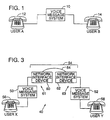
- Fig. 1 is a simplified schematic block diagram of a telephonic voice message system in which voice message transmission is controllable according to the method of the present invention.
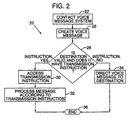
- Fig. 2 is a flow diagram showing a method of controlling voice message transmission in the system of Fig. 1 according to the present invention.
- Fig. 3 is a simplified schematic block diagram of a pair of networked telephonic voice message systems in which voice message transmission is controllable according to the method of the present invention.
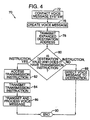
- Fig. 4 is a flow diagram showing a method of controlling voice message transmission in the system of Fig. 3 according to the present invention.
- Fig. 1 represents a generally conventional telephonic voice message apparatus or system 10 that controls transmission, delivery, and storage of voice messages, which are sometimes referred to as Voice Mail messages.
- Telephonic voice message system 10 may be of the type manufactured and sold by any of a large number of manufacturers that include VMI, Comverse, Centigram, Rolm, Northern, or Boston Technology.
- Exemplary models of voice message system 10 may include the INFINITY 2 manufactured by Comverse Technology Inc. of Woodbury, New York and the ONE-VIEW manufactured by Centigram Communications of San Jose, California.
- Voice message system 10 may be telephonically accessed by multiple system users, each of which has an assigned message address or "mailbox," as well as system visitors who do not have assigned message addresses on voice message system 10.
- voice message system 10 is shown connected to telephones 12 and 14 by which, respectively, a message sender (user A) and a message recipient (user B) access voice message system 10.
- telephones 12 and 14 may be located any where and can access voice message system through any switching or transmission systems, including a private branch exchange (PBX), local public switched telephone network (PSTN), or long distance or international telephone lines or channels.
- Telephones 12 and 14 require only basic capabilities (e.g., a DTMF keypad) to be operable with voice message system 10.
- Voice message system 10 is also capable of receiving voice messages from others, who are referred to herein as system visitors.
- the following description is directed mainly to communication between system users A and B, but is similarly applicable to communication between a system visitor and either of system users A and B.
- voice message system 10 In conventional operation of voice message system 10, user A sends user B a voice message by telephoning voice message system 10 from telephone 12 and speaking into it to create a voice message or voice message data.
- Voice message system 10 automatically digitizes the voice message for storage.
- User A directs the voice message to its destination (e.g., user B) and adds any conventional sender delivery commands forvoice message system 10 (e.g., message delivery priority) by keying the destination message address and sender delivery command codes on the DT-MF keypad of telephone 12.
- voice message system 10 includes a voice recognition subsystem that allows the sender to enter the destination address and any sender delivery commands merely by stating them.
- Voice message system 10 associates the digitized voice message data with the destination message address and sender delivery commands and stores them for retrieval by the recipient (user B). Typically, voice message system 10 delivers to telephone 14 an indication that a message is available for retrieval by user B. Alternatively, user B may call voice message system 10 to check for any voice messages. In generally this manner, a system user A on virtually any voice mail system is able to send a voice message to another system user B.
- users A and B can control the transmission of voice messages or information directed to their message addresses by selecting preprogrammed voice message transmission instructions that are stored on voice message system 10.
- voice message transmission instructions selectable by the recipient can prevent voice message system 10 from becoming inconvenient or burdensome to use.
- Fig. 2 is a flow diagram showing a preferred method 20 of controlling transmission of voice message data according to the present invention.
- Voice message transmission control method 20 is described with reference to communication between systems users A and B, but is similarly applicable to communication from a system visitor to a system user.
- Process block 22 represents that user A makes telephone contact with voice message system 10.
- the telephone contact with voice message system 10 may be specifically initiated by user A, or user A may be automatically transferred to voice message system 10 as a result of attempting to make a direct telephonic call to user B.
- Process block 26 represents that user A speaks into a telephone to create or originate for user B a voice message from which voice message system 10 generates and stores voice message data or information.
- Voice message system 10 also acquires and stores the message address for user B and any sender delivery commands selected by user A.
- the message address for user B may be keyed into a DTMF telephone keypad by user A or may have been previously acquired by voice message system 10.
- voice message system 10 includes a voice recognition subsystem that allows the sender to enter the destination address and any sender delivery commands merely by stating them.
- Inquiry block 28 represents an inquiry whether the destination message address is a valid address on voice message system 10 and whether there is a specified voice message transmission instruction previously selected by user B for controlling voice messages directed to the destination message address. This inquiry takes place in response to the entry by user A of a destination message address or any sender delivery commands that are stored for delivery to the destination voice message address of user B. For example, voice message system 10 confirms whether the destination message address is a valid address and reviews a stored first listing of destination message addressees that have specified voice message transmission instructions.
- inquiry block 28 proceeds to process block 30. If the destination message address is valid and does not have a specified voice message transmission instruction, inquiry block 28 proceeds to process block 34. If the destination message address is not valid, an invalid address message is delivered to user A.
- Process block 30 represents that voice message system 10 accesses the specified voice message transmission instructions for the destination message address from a stored listing of destination message addresses and associated specified voice message transmission instructions. It will be appreciated that voice message system 10 is analogous to a computer by being programmable and having large information storage capacity. Storing the listings and programming voice message system 10 to create, review and access the listings is within the capabilities of persons skilled in the art.
- the selectable voice message transmission instructions can include, for example, transmitting the telephonic voice message data to an alternate or additional voice message destination having a voice message address different from the destination voice message address, determining whether the origination address is included in a list of at least one acceptable origin address and transmitting the voice message to the destination only if the origination address is included in the preselected set, or determining whether the origination address is included in a list of at least one unacceptable origin address and blocking transmission of the voice message to the destination address whenever the origination address is included in the list.
- the selectable voice message transmission instructions also can include assigning voice messages from a specified origination address with a priority (e.g., high or low) that determines the sequence in which messages are retrieved by the recipient, or designating voice messages from a specified origination address as being private so the messages cannot be copied or forwarded.
- voice message system 10 includes a voice recognition and conversion subsystem
- the selectable voice message transmission instructions can include converting voice messages to text data suitable for delivery as electronic mail to a selected electronic mailbox.
- the selectable voice message transmission instructions can further include converting the text data to a facsimile document suitable for delivery to a facsimile device.
- voice message system 10 includes a voice recognition subsystem that allows user B to select voice message transmission instructions merely by stating the corresponding command or selection codes.
- user B can select voice message transmission instructions by entering corresponding command or selection codes into voice message system 10 with a personal computer in communication with system 10.
- Process block 32 represents that voice message system 10 processes the voice message data in accordance with any specified voice message transmission instruction.
- Process block 34 represents that voice message system 10 directs the voice message data to the destination message address as a conventional voice message, stores it for retrieval by the recipient (user B), and provides an indication at telephone 14 that a voice message is available for retrieval.
- voice message system 10 directs the voice message data to the destination message address as a conventional voice message, stores it for retrieval by the recipient (user B), and provides an indication at telephone 14 that a voice message is available for retrieval.
- directing voice message data to the destination message address may or may not include shifting or transmitting voice message data.
- the signal processing details by which a particular voice message system makes a voice message available for retrieval are not material.
- Process block 36 represents that method 20 is completed.
- Voice message transmission control method 20 has been described with reference to a single otherwise conventional voice message system 10.
- the voice message transmission control method of the present invention is also applicable to a network of at least two separate voice message systems. With the increased numbers of users and potential voice messages on such a network, recipient control over voice messages becomes particularly desirable.
- Fig. 3 shows a telephonic voice message apparatus 40 having a pair of generally conventional telephonic voice message systems 50 and 52 that are operable independently and communicate with each other through a voice message system network 54.
- Telephonic voice message systems 50 and 52 are preferably simitar to voice message system 10.
- Voice message systems 50 and 52 may be telephonically accessed by multiple system users of either system, each system user having an assigned message address or "mailbox," as well as system visitors who do not have message addresses on voice message system 50 or 52.
- voice message systems 50 and 52 are shown connected to telephones 56 and 58 by which a message sender (user X) and a message recipient (user Y) access voice message systems 50 and 52, respectively.
- Telephones 56 and 58 provide substantially the same access to respective voice message systems 50 and 52 that telephones 12 and 14 provide to voice message system 10.
- Voice message system network 54 includes network interface nodes or devices 60 and 62 through which voice message systems 50 and 52 access each other, as well as other voice message systems connected to network 54 but not shown.
- Network interface devices 60 and 62 may be, for example, an APOGEE WORLDGATE manufactured by the assignee of this application.
- Voice message system 50 and network interface device 60 compose a first voice message network subsystem 61
- voice message system 52 and network interface device 62 compose a second voice message network subsystem 63.
- Network interface devices 60 and 62 are operable independently of and may each serve one or more voice message systems.
- Network interface devices 60 and 62 are interconnected by at least one telecommunication channel 64, which is preferably a high capacity digital telecommunication channel over which large volumes of voice message data can be transmitted efficiently.
- Fig. 4 is a flow diagram showing a preferred method 70 of controlling transmission of voice message data between independently operable voice message systems 50 and 52 in accordance with the present invention.
- Voice message transmission control method 70 is described with reference to communication between system users X and Y, but is similarly applicable to communication between a system user and a system visitor.
- Process block 72 represents that user X makes telephone contact with voice message system 50.
- the telephone contact with voice message system 50 would typically be specifically initiated by user X. If user X attempts to make a direct telephonic call to user Y and is redirected to a voice message system, user X typically would be transferred to voice message system 52 with which user Y is associated. A voice message left by user X directly on voice message system 52 would preferably be processed by voice message transmission control method 20.
- Process block 76 represents that user X speaks into telephone 56 to create or originate for user Y a voice message from which voice message system 50 generates and stores voice message data or information.
- Voice message system 50 also acquires and stores the message address for user Y and any sender delivery instructions selected by user X.
- the destination message address may be keyed into a DTMF telephone keypad by user X or may have been previously acquired by voice message system 50.
- voice message system 50 includes a voice recognition subsystem that allows user X to enter the destination address and any sender delivery commands merely by stating them. Since the destination message address does not reside on voice message system 50, user X would typically have to enter an expanded destination message address that includes an indication that it resides on voice message system 52.
- Process block 78 represents that expanded destination message address of recipient's (user Y's) telephone 58 is transmitted from voice message system 50 to associated network interface device 60.
- Inquiry block 80 represents an inquiry whether the destination message address is a valid address on voice message system 52 and whether there is a specified voice message transmission instruction previously selected by user Y for controlling voice messages directed to the destination message address.
- voice message system 50 transmits the expanded destination message address to associated network interface device 60, which forwards the destination message address over channel 64 to network interface device 62 associated with voice message system 52.
- Network interface device 62 confirms whether the destination message address is a valid address of voice message system 52 and reviews a stored first listing of destination message addressees that have specified voice message transmission instructions.
- information regarding valid addresses of voice message system 52 and their associated voice message transmission instructions are periodically transferred from system 52 to network interface device 62.
- the expanded destination message address is transmitted to voice message system 52 via network interface device 60, channel 64, and network interface device 62.
- voice message system 52 confirms whether the destination message address is a valid address and reviews a stored first listing of destination message addressees that have specified voice message transmission instructions.
- inquiry block 80 proceeds to process block 82. If the destination message address is valid and does not have a specified voice message transmission instruction, inquiry block 80 proceeds to process block 88. If the destination message address is not valid, an invalid address message is provided to user X by way of the sender's voice message address.
- Process block 82 represents that the specified voice message transmission instructions for the destination message address are accessed from a stored listing of destination message addresses and associated specified voice message transmission instructions.
- the instructions are accessed by network interface device 62 and voice message system 52, respectively.
- voice message systems 50 and 52 and network interface devices 60 and 62 are analogous to computers by being programmable and having large information storage capacity. Storing the listings on and programming voice message system 52 or network interface devices 62 to create, review and access the listings is within the capabilities of persons skilled in the art.
- the voice message transmission instructions and manner of selecting them can include those described above with reference to voice message system 10.
- network 54 could provide operator assistance services by which user Y could select voice message transmission instructions by calling and informing a network operator of the instructions the user has selected.
- Process block 84 represents that a signal carrying the voice message transmission instructions is transmitted to network interface device 60 via network interface device 62 and channel 64.
- a message recipient (user Y) can block or reroute selected messages before there is an attempt to transmit them to the recipient as designated by the message originator (user X) .
- Process block 86 represents that voice message system 50 transmits the voice message data to network interface device 60, which processes the voice message data in accordance with any specified voice message transmission instruction.
- voice message system 50 transmits the voice message data to network interface device 60, which processes the voice message data in accordance with any specified voice message transmission instruction.
- Process block 88 represents that voice message system 50 directs the voice message data to the destination message address on voice message system 52 via network 54.
- Voice message system 52 stores the voice message data for retrieval by the recipient (user Y) and provides an indication at telephone 58 that a voice message is available for retrieval.
- Process block 90 represents that method 70 is completed.
- User X wants to leave a message for user Y.
- User X specifies certain delivery instructions such as routine delivery scheduling and nonconfidential message, but user Y has specified for messages addressed to him different message delivery instructions that include location re-routing, priority delivery, private message, encrypted message, and delivery certification. Processing of the message by user X proceeds as follows.
- Voice message system 50 communicates with network interface device 60 to indicate the presence of the message user X left and gives delivery instructions including the delivery address, length, and urgency of the message.
- Network interface device 60 communicates the delivery instruction information across telecommunication channel 64 to network interface device 62, which in turn communicates with voice message system 52 to validate the delivery address and check for any alternative delivery instructions placed by user Y in either network interface device 62 or voice message system 52.
- Voice message system 52 provides back to network interface device 62 the alternative instructions specified by user Y and a confirmation of a valid delivery address.
- the alternative instructions and confirmation are then transmitted across telecommunication channel 64 to network interface device 60 to substitute the message delivery instructions of user Y for those of user X. Because user Y specified that messages addressed to him be re-routed, a significant cost saving is achieved as a consequence of the nontransmission of the message of user X to the original delivery address of user Y
- the processing of message setup instructions is analogous to that for real-time telephone call setup instructions, and in both cases the cost is relatively low. Neither user X nor user Y incurs a cost above that of normal network overhead; therefore, the transmission of voice message transmission instructions achieves the savings objective for user Y
- network interface device 60 can reroute the message in accordance with the alternative instructions, which at a minimal cost change the delivery address, priority, confidentiality, encryption, and certification to those specified by user Y. For example, if user Y specifies an address on the same system as that of the address of user X, the only cost incurred to deliverthe message would be the local access charge to point the message to the delivery address commanded by user Y
- This example demonstrates that no message originator or recipient is on line during message management processing of a previously recorded message, which processing is based on functions a message non-originator has defined.
- This example also shows the invention can be implemented in a local system, local area network (LAN), and wide area network (WAN) environment. Skilled persons will appreciate that the message management functions carried out by way of example with reference to the Fig. 3 system can be distributed to other system components, such as those of the system of Fig. 1.
- voice message transmission example would also be applicable to other types of non-contemporaneous message transmission such as those found in facsimile document store and forward services and electronic mail, and that the communications medium employed need not be a telecommunications channel.
- voice message transmission control method 70 is described with reference to separate network interface devices 60 and 62 for respective voice message systems 50 and 52.
- voice message transmission control method 70 could operate with voice message systems 50 and 52 and only a single network interface device in direct communication with both message systems. The scope of the present invention should be determined, therefore, only by the following claims.
Landscapes
- Engineering & Computer Science (AREA)
- Signal Processing (AREA)
- Telephonic Communication Services (AREA)
- Computer And Data Communications (AREA)
- Information Transfer Between Computers (AREA)
- Facsimile Transmission Control (AREA)
- Transmitters (AREA)
- Data Exchanges In Wide-Area Networks (AREA)
Claims (18)
- Procédé de contrôle d'une transmission de données de message vocal téléphonique depuis un émetteur ayant une adresse de message vocal d'origine vers un récepteur potentiel ayant une adresse de message vocal de destination, le procédé comprenant les étapes de :fournir sélectivement par le récepteur potentiel pour l'enregistrement dans l'appareil de message vocal téléphonique (10; 40) une instruction de transmission de message vocal spécifiée pour contrôler la transmission des données de message vocal téléphonique dirigées vers l'adresse de message vocal de destination ;diriger les données de message vocal téléphonique associées à l'adresse de message vocal d'origine vers l'adresse de message vocal de destination ;déterminer dans l'appareil de message vocal téléphonique (10; 40) en réponse à la direction des données de message vocal téléphonique vers l'adresse de message vocal de destination si l'instruction de transmission de message vocal spécifiée enregistrée pour contrôler la transmission des données de message vocal téléphonique correspond à l'adresse de message vocal de destination ; etlors de la détermination de la correspondance de l'instruction de transmission de message vocal spécifiée à l'adresse de message vocal de destination, traiter les données de message vocal téléphonique selon l'instruction de transmission de message vocal spécifiée, le procédé étant caractérisé par l'étape de :ledit traitement comprenant un blocage ou re-routage des données de message téléphonique sélectionnées avant qu'il y ait une tentative.de les transmettre au récepteur comme désigné par l'émetteur.
- Procédé de la Revendication 1 selon lequel l'appareil de message vocal téléphonique (40) inclut des premier et deuxième systèmes de message vocal téléphonique fonctionnant de manière indépendante (50, 52) et selon lequel l'adresse de message vocal d'origine est associée au premier système de message vocal téléphonique (50) et l'adresse de message vocal de destination est associée au deuxième système de message vocal téléphonique (52).
- Procédé de la Revendication 2 selon lequel l'appareil de message vocal téléphonique (40) inclut en outre un noeud d'interface (60, 62) qui fournit une communication de données entre les premier et deuxième systèmes de message vocal téléphonique (50, 52), le noeud d'interface (60, 62) coopérant avec les premier et deuxième systèmes de message vocal téléphonique (50, 52) pour déterminer si l'adresse de message vocal de destination correspond à une instruction de transmission de message vocal spécifiée pour contrôler la transmission des données de message vocal téléphonique.
- Procédé de la Revendication 3 selon lequel l'étape de diriger les données de message vocal associées à l'adresse de message vocal d'origine inclut une transmission de l'adresse de message vocal de destination depuis le premier système de message vocal téléphonique (50) vers le noeud d'interface (60) et l'envoi d'une question depuis le noeud d'interface (62) vers le deuxième système de message vocal téléphonique (52) au sujet de la correspondance de l'adresse de message vocal de destination à une instruction de transmission de message vocal spécifiée.
- Procédé d'une quelconque revendication précédente, selon lequel l'instruction de transmission de message vocal spécifiée inclut au moins l'une d'un ensemble prédéterminé d'instructions de transmission de message vocal.
- Procédé d'une quelconque revendication précédente, selon lequel l'instruction de transmission de message vocal inclut une transmission des données de message vocal téléphonique vers une destination de message vocal alternative ayant une adresse de message vocal alternative qui est différente de l'adresse de message de destination.
- Procédé d'une quelconque revendication précédente, selon lequel l'instruction de transmission de message vocal inclut une détermination si l'adresse de message vocal d'origine est incluse dans un premier ensemble présélectionné d'au moins une adresse d'origine acceptable et après ceci une transmission des données de message vocal téléphonique à l'adresse de message vocal de destination seulement si l'adresse de message vocal d'origine est incluse dans le premier ensemble présélectionné.
- Procédé d'une quelconque revendication précédente, selon lequel l'instruction de transmission de message vocal inclut une détermination si l'adresse de message vocal d'origine est incluse dans un ensemble présélectionné d'au moins une adresse d'origine inacceptable et après ceci un blocage de la transmission des données de message vocal téléphonique à l'adresse de message vocal de destination si l'adresse de message vocal d'origine est incluse dans l'ensemble présélectionné.
- Procédé d'une quelconque revendication précédente, selon lequel l'instruction de transmission de message vocal (30) inclut une détermination si l'adresse de message vocal d'origine est inclut dans un ensemble présélectionné d'au moins une adresse et après ceci l'assignation aux données de message vocal d'une priorité de délivrance pour établir la priorité à retrouver les données de message vocal à partir de l'adresse de message vocal de destination chaque fois que l'adresse de message vocal d'origine est incluse dans l'ensemble présélectionné.
- Procédé d'une quelconque revendication précédente, selon lequel l'instruction de transmission de message vocal inclut l'interdiction de copier ou de transmettre les données de message vocal.
- Procédé d'une quelconque revendication précédente, selon lequel l'appareil de message vocal téléphonique (10) inclut un sous-système de conversion et reconnaissance vocale et l'instruction de transmission de message vocal inclut une conversion des données de message vocal en des données de document électronique et une délivrance de celles-ci à un système de document électronique sélectionné.
- Procédé de la Revendication 11, selon lequel le système de document électronique sélectionné inclut un système de courrier électronique ou un système de document télécopié.
- Procédé de contrôle d'une transmission de données de message vocal téléphonique dans un sous-système de réseau de message vocal téléphonique depuis un premier sous-système de réseau de message vocal (50) associé à une adresse de message vocal d'origine et dirigé à travers un moyen de communication (64) d'un réseau de système de message vocal (54) vers un deuxième sous-système de réseau de message vocal (52) associé à une adresse de message vocal de destination, le procédé comprenant les étapes de :enregistrer sélectivement par le récepteur potentiel dans le deuxième sous-système de réseau de message vocal (52) une instruction de transmission de message vocal spécifiée pour contrôler la transmission des données de message vocal téléphonique dirigées vers l'adresse de message vocal de destination ;diriger depuis le premier sous-système de réseau de message vocal (50) des données de message vocal téléphonique pour une transmission à travers le moyen de communication (64) vers l'adresse de message vocal de destination ;transmettre à travers le moyen de communication (64) depuis le premier sous-système de réseau de message vocal (50) vers le deuxième sous-système de réseau de message vocal l'adresse de message vocal de destination ;déterminer dans le deuxième sous-système de réseau de message vocal (52) en réponse à l'adresse de message vocal de destination (58) si l'adresse de message vocal de destination correspond à l'instruction de transmission de message vocal spécifiée enregistrée pour commander une transmission des données de message vocal téléphonique ; andlors de la détermination de la correspondance de la deuxième adresse de message vocal à l'instruction de transmission de message vocal spécifiée, fournir un signal à travers le moyen de communication (64) depuis le deuxième sous-système de réseau de message vocal (52) vers le premier sous-système de réseau de message vocal (50) pour permettre le traitement des données de message vocal téléphonique selon l'instruction de transmission de message vocal spécifiée, le procédé étant caractérisé par l'étape de :ledit traitement comprenant un blocage ou re-routage des données de message téléphonique sélectionnées avant qu'il y ait une tentative de les transmettre au récepteur comme désigné par l'émetteur des données de message vocal téléphonique.
- Le procédé de la Revendication 13, selon lequel l'instruction de transmission de message vocal spécifiée inclut une transmission des données de message vocal téléphonique vers un troisième sous système de réseau de message vocal ayant une troisième adresse de message vocal qui est différente de l'adresse de message vocal de destination, une détermination si l'adresse de message vocal d'origine est incluse dans un premier ensemble présélectionné d'au moins une adresse d'origine acceptable et après ceci une transmission des données de message vocal téléphonique à l'adresse de message vocal de destination seulement si l'adresse de message vocal d'origine est incluse dans le premier ensemble présélectionné, ou la détermination si l'adresse de message vocal d'origine est incluse dans un deuxième ensemble présélectionné d'au moins une adresse d'origine inacceptable et après ceci un blocage de la transmission des données de message vocal téléphonique à l'adresse de message vocal de destination chaque fois que l'adresse de message vocal d'origine est incluse dans le deuxième ensemble présélectionné.
- Le procédé des Revendications 13 ou 14, selon lequel l'instruction de transmission de message vocal spécifiée inclut une détermination si l'adresse de message vocal d'origine est incluse dans un troisième ensemble présélectionné d'au moins une adresse et après cela soit l'assignation aux données de message vocal d'une priorité de délivrance pour établir la priorité à retrouver les données de message vocal à partir de l'adresse de message vocal de destination chaque fois que l'adresse de message vocal d'origine est incluse dans le troisième ensemble présélectionné, soit l'interdiction de copier ou transmettre les données de message vocal.
- Procédé de l'une quelconque des Revendications 13 à 15, selon lequel au moins les premier et deuxième sous-systèmes de réseau de message vocal (50,52) inclut un noeud d'interface (60,62) qui fournit une communication de données entre les premier et deuxième sous-systèmes de réseau de message vocal (50, 52) pour déterminer si l'adresse de message vocal de destination correspond à l'instruction de transmission de message vocal spécifiée pour contrôler la transmission des données de message vocal téléphonique.
- Le procédé de la Revendication 13, selon lequel la détermination sur la correspondance de l'adresse de message vocal de destination à l'instruction de transmission de message vocal spécifiée inclut une transmission de l'adresse de message vocal de destination depuis le premier sous-système de réseau de message vocal (50) au noeud d'interface (60), une détermination si l'adresse de message vocal de destination correspond à l'instruction de transmission de message vocal spécifiée, et poser une question depuis le noeud d'interface (62) au deuxième sous-système de réseau de message vocal (52) au sujet de la correspondance de l'adresse de message vocal de destination à l'instruction de transmission de message vocal spécifiée.
- Le procédé de la Revendication 13, selon lequel les premier et deuxième sous-systèmes de réseau de message vocal (50, 52) incluent des premier et deuxième noeuds d'interface respectifs (60, 62) qui fournissent une communication de données entre les premier et deuxième sous-systèmes de réseau de message vocal (50, 52), les premier et deuxième noeuds d'interface (60, 62) coopérant avec les premier et deuxième sous-systèmes de réseau de message vocal (50, 52) pour déterminer si l'adresse de message vocal de destination correspond à l'instruction de transmission de message vocal spécifiée pour contrôler la transmission des données de message vocal téléphonique.
Applications Claiming Priority (3)
| Application Number | Priority Date | Filing Date | Title |
|---|---|---|---|
| US33210294A | 1994-10-31 | 1994-10-31 | |
| US332102 | 1994-10-31 | ||
| PCT/US1995/014204 WO1996014701A2 (fr) | 1994-10-31 | 1995-10-31 | Procede de controle de transmission de message vocaux telephoniques |
Publications (3)
| Publication Number | Publication Date |
|---|---|
| EP0796534A2 EP0796534A2 (fr) | 1997-09-24 |
| EP0796534B1 EP0796534B1 (fr) | 2001-03-28 |
| EP0796534B2 true EP0796534B2 (fr) | 2005-06-01 |
Family
ID=23296734
Family Applications (1)
| Application Number | Title | Priority Date | Filing Date |
|---|---|---|---|
| EP95942392A Expired - Lifetime EP0796534B2 (fr) | 1994-10-31 | 1995-10-31 | Procede de controle de transmission de message vocaux telephoniques |
Country Status (6)
| Country | Link |
|---|---|
| US (1) | US5687220A (fr) |
| EP (1) | EP0796534B2 (fr) |
| AT (1) | ATE200172T1 (fr) |
| CA (3) | CA2203993C (fr) |
| DE (1) | DE69520506T3 (fr) |
| ES (1) | ES2155542T5 (fr) |
Families Citing this family (56)
| Publication number | Priority date | Publication date | Assignee | Title |
|---|---|---|---|---|
| US6564321B2 (en) | 1995-04-28 | 2003-05-13 | Bobo Ii Charles R | Systems and methods for storing, delivering, and managing messages |
| US6396513B1 (en) * | 1996-05-14 | 2002-05-28 | At&T Corp. | Electronic message sorting and notification system |
| US6002751A (en) * | 1996-11-13 | 1999-12-14 | Siemens Information And Communication Networks, Inc. | System and method for improved mail networking |
| US7457281B1 (en) | 1996-11-15 | 2008-11-25 | Ele Tel, Inc. | System and method for transmitting voice messages through the internet |
| US6339591B1 (en) | 1996-11-15 | 2002-01-15 | Eletel, Inc | System and method for transmitting voice messages through the internet |
| US6006087A (en) * | 1997-04-10 | 1999-12-21 | At&T Wireless Services, Inc. | Method and system for delivering a voice mail notification to a subscriber using cellular phone network |
| US7522931B2 (en) * | 1998-06-05 | 2009-04-21 | Netnumber, Inc. | Method and apparatus for accessing a network computer to establish a push-to-talk session |
| US6539077B1 (en) | 1998-06-05 | 2003-03-25 | Netnumber.Com, Inc. | Method and apparatus for correlating a unique identifier, such as a PSTN telephone number, to an internet address to enable communications over the internet |
| US6292799B1 (en) | 1998-06-05 | 2001-09-18 | Netnumber.Com, Inc. | Method and apparatus to automatically address a voice mail reply to a voice mail message |
| US6597688B2 (en) | 1998-06-12 | 2003-07-22 | J2 Global Communications, Inc. | Scalable architecture for transmission of messages over a network |
| US6587871B1 (en) * | 1998-12-22 | 2003-07-01 | Ericsson Inc. | System, method, and apparatus for converting voice mail to text and transmitting as an email or facsimile |
| US6707890B1 (en) | 2002-09-03 | 2004-03-16 | Bell South Intellectual Property Corporation | Voice mail notification using instant messaging |
| US6795536B1 (en) * | 1999-02-26 | 2004-09-21 | Mitel, Inc. | Automatic user preference selection for message playback based on caller line identification data |
| US7283620B2 (en) * | 1999-02-26 | 2007-10-16 | At&T Bls Intellectual Property, Inc. | Systems and methods for originating and sending a voice mail message to an instant messaging platform |
| US6882708B1 (en) * | 1999-02-26 | 2005-04-19 | Bellsouth Intellectual Property Corporation | Region-wide messaging system and methods including validation of transactions |
| US7035666B2 (en) * | 1999-06-09 | 2006-04-25 | Shimon Silberfening | Combination cellular telephone, sound storage device, and email communication device |
| US6510207B1 (en) * | 1999-06-29 | 2003-01-21 | Agere Systems Inc. | Voice messaging system storage of emergency alert system warnings |
| US6501832B1 (en) | 1999-08-24 | 2002-12-31 | Microstrategy, Inc. | Voice code registration system and method for registering voice codes for voice pages in a voice network access provider system |
| US6792086B1 (en) | 1999-08-24 | 2004-09-14 | Microstrategy, Inc. | Voice network access provider system and method |
| US7457397B1 (en) | 1999-08-24 | 2008-11-25 | Microstrategy, Inc. | Voice page directory system in a voice page creation and delivery system |
| US6888929B1 (en) | 1999-08-24 | 2005-05-03 | Microstrategy, Inc. | Revenue generation method for use with voice network access provider system and method |
| US6707889B1 (en) | 1999-08-24 | 2004-03-16 | Microstrategy Incorporated | Multiple voice network access provider system and method |
| US6263051B1 (en) | 1999-09-13 | 2001-07-17 | Microstrategy, Inc. | System and method for voice service bureau |
| US7039165B1 (en) | 1999-09-13 | 2006-05-02 | Microstrategy Incorporated | System and method for personalizing an interactive voice broadcast of a voice service based on automatic number identification |
| US7127403B1 (en) | 1999-09-13 | 2006-10-24 | Microstrategy, Inc. | System and method for personalizing an interactive voice broadcast of a voice service based on particulars of a request |
| US6973091B1 (en) * | 1999-10-04 | 2005-12-06 | Hester Rex R | Enabling quality voice communications from web page call control |
| US6466654B1 (en) | 2000-03-06 | 2002-10-15 | Avaya Technology Corp. | Personal virtual assistant with semantic tagging |
| WO2001078245A1 (fr) * | 2000-04-06 | 2001-10-18 | Tom North | Service d'envoi de messages courts ameliore |
| US6493696B1 (en) | 2000-04-13 | 2002-12-10 | Avaya Technology Corp. | Message forwarding of multiple types of messages based upon a criteria |
| US7167701B1 (en) * | 2001-12-18 | 2007-01-23 | Bellsouth Intellectual Property Corporation | Voice mailbox with management support |
| US7460654B1 (en) * | 2001-12-28 | 2008-12-02 | Vocada, Inc. | Processing of enterprise messages integrating voice messaging and data systems |
| US7324942B1 (en) | 2002-01-29 | 2008-01-29 | Microstrategy, Incorporated | System and method for interactive voice services using markup language with N-best filter element |
| US20050053205A1 (en) * | 2002-03-07 | 2005-03-10 | Hays Jeffrey C | Message delivery and acquisition system |
| US8239197B2 (en) * | 2002-03-28 | 2012-08-07 | Intellisist, Inc. | Efficient conversion of voice messages into text |
| WO2003084196A1 (fr) | 2002-03-28 | 2003-10-09 | Martin Dunsmuir | Instruction en boucle fermee et systeme de reponse pour communications automatiques entre systemes informatiques a interaction via un canal de communication audio |
| US7379540B1 (en) * | 2003-09-24 | 2008-05-27 | Shortel, Inc. | Server with backup capability for distributed IP telephony systems |
| US7177406B2 (en) * | 2003-11-21 | 2007-02-13 | Mci, Llc | Systems and methods for providing portable voicemail services |
| US8059793B2 (en) * | 2005-02-07 | 2011-11-15 | Avaya Inc. | System and method for voicemail privacy |
| US7729478B1 (en) | 2005-04-12 | 2010-06-01 | Avaya Inc. | Change speed of voicemail playback depending on context |
| US7924987B2 (en) * | 2005-10-19 | 2011-04-12 | At&T Intellectual Property I., L.P. | Methods, apparatus and data structures for managing distributed communication systems |
| US8238327B2 (en) * | 2005-10-19 | 2012-08-07 | At&T Intellectual Property I, L.P. | Apparatus and methods for subscriber and enterprise assignments and resource sharing |
| US20070086432A1 (en) * | 2005-10-19 | 2007-04-19 | Marco Schneider | Methods and apparatus for automated provisioning of voice over internet protocol gateways |
| US20070116234A1 (en) * | 2005-10-19 | 2007-05-24 | Marco Schneider | Methods and apparatus for preserving access information during call transfers |
| US7839988B2 (en) * | 2005-10-19 | 2010-11-23 | At&T Intellectual Property I, L.P. | Methods and apparatus for data structure driven authorization and/or routing of outdial communication services |
| US7643472B2 (en) | 2005-10-19 | 2010-01-05 | At&T Intellectual Property I, Lp | Methods and apparatus for authorizing and allocating outdial communication services |
| US20070086433A1 (en) * | 2005-10-19 | 2007-04-19 | Cunetto Philip C | Methods and apparatus for allocating shared communication resources to outdial communication services |
| US8036362B1 (en) | 2006-03-17 | 2011-10-11 | RNK Inc. | Communication system and call forwarding management |
| US20070280214A1 (en) * | 2006-05-31 | 2007-12-06 | At&T Corp. | Method and apparatus for providing electronic mail and voicemail retrieval |
| US9860383B2 (en) | 2008-12-12 | 2018-01-02 | Mitel Networks Corporation | Method and apparatus for managing voicemail in a communication session |
| US8681948B2 (en) * | 2008-12-12 | 2014-03-25 | Mitel Networks Corporation | Method and apparatus for managing voicemail in a communication session |
| CA2782828C (fr) * | 2009-12-04 | 2019-04-02 | Intellisist, Inc. | Conversion d'un message par l'intermediaire d'un convertisseur d'article de discussion |
| US8897432B2 (en) | 2010-07-01 | 2014-11-25 | Etherfax, Llc | System and method of remote fax interconnect technology |
| CN102833431A (zh) * | 2011-06-17 | 2012-12-19 | 中兴通讯股份有限公司 | 语音信箱的处理方法及装置 |
| US8249230B1 (en) | 2012-01-09 | 2012-08-21 | EC Data Systems, Inc. | Scalable and flexible internet fax architecture |
| US8254538B1 (en) | 2012-02-27 | 2012-08-28 | EC Data Systems, Inc. | Scalable and flexible internet fax architecture for processing outbound fax messages |
| US10277778B2 (en) | 2014-06-24 | 2019-04-30 | Ec Data Systems Inc. | Audit logging for a secure, scalable and flexible internet fax architecture |
Family Cites Families (18)
| Publication number | Priority date | Publication date | Assignee | Title |
|---|---|---|---|---|
| US4371752A (en) * | 1979-11-26 | 1983-02-01 | Ecs Telecommunications, Inc. | Electronic audio communication system |
| US4277649A (en) * | 1980-01-18 | 1981-07-07 | Bell Telephone Laboratories, Incorporated | Method and apparatus for screening telephone calls |
| US4757525A (en) * | 1982-09-29 | 1988-07-12 | Vmx, Inc. | Electronic audio communications system with voice command features |
| DE3382772T2 (de) * | 1982-09-29 | 1995-05-24 | Vmx Inc | System zur elektronischen Übermittlung von Audiosignalen mit Nachrichtenadresssteuerung durch den Anwender. |
| JPS62163445A (ja) * | 1986-01-14 | 1987-07-20 | Mitsubishi Electric Corp | 電話切換装置 |
| US4790003A (en) * | 1987-04-27 | 1988-12-06 | American Telephone And Telegraph Company, At&T Information Systems | Message service system network |
| US5109405A (en) * | 1988-07-11 | 1992-04-28 | Dytel Corporation | Automated call screening |
| US5014300A (en) * | 1988-08-05 | 1991-05-07 | Atlas Telecom, Inc. | Method and apparatus for accessing a facsimile store and forward network |
| US5029199A (en) * | 1989-08-10 | 1991-07-02 | Boston Technology | Distributed control and storage for a large capacity messaging system |
| US5153905A (en) * | 1989-11-27 | 1992-10-06 | Dictaphone Corporation | Priority voice message delivery system |
| US5113430A (en) * | 1990-10-01 | 1992-05-12 | United States Advanced Network, Inc. | Enhanced wide area audio response network |
| US5193110A (en) * | 1990-10-09 | 1993-03-09 | Boston Technology, Incorporated | Integrated services platform for telephone communication system |
| JPH04177960A (ja) * | 1990-11-13 | 1992-06-25 | Fujitsu Ltd | 伝言サービス制御方式 |
| US5274696A (en) * | 1991-04-05 | 1993-12-28 | Rolm Company | Protocol for transmitting messages in a network |
| US5276731A (en) * | 1991-04-26 | 1994-01-04 | Rolm Company | Method and apparatus for handling incoming telephone calls |
| US5278897A (en) * | 1992-03-09 | 1994-01-11 | Rolm Company | Smart internodal transfer for subscriber access in multinode voice messaging systems |
| US5329578A (en) * | 1992-05-26 | 1994-07-12 | Northern Telecom Limited | Personal communication service with mobility manager |
| EP0588101A3 (fr) * | 1992-09-14 | 1995-03-08 | Rolm Co | Systèmes de stockage et de rappel de messages avec traitement de l'appelant d'une façon sélective. |
-
1995
- 1995-10-31 AT AT95942392T patent/ATE200172T1/de not_active IP Right Cessation
- 1995-10-31 DE DE69520506T patent/DE69520506T3/de not_active Expired - Lifetime
- 1995-10-31 CA CA002203993A patent/CA2203993C/fr not_active Expired - Fee Related
- 1995-10-31 CA CA2640595A patent/CA2640595C/fr not_active Expired - Fee Related
- 1995-10-31 ES ES95942392T patent/ES2155542T5/es not_active Expired - Lifetime
- 1995-10-31 EP EP95942392A patent/EP0796534B2/fr not_active Expired - Lifetime
- 1995-10-31 CA CA2640593A patent/CA2640593C/fr not_active Expired - Fee Related
-
1996
- 1996-07-18 US US08/684,318 patent/US5687220A/en not_active Expired - Lifetime
Also Published As
| Publication number | Publication date |
|---|---|
| ES2155542T3 (es) | 2001-05-16 |
| CA2203993C (fr) | 2009-10-06 |
| DE69520506T3 (de) | 2006-01-19 |
| ATE200172T1 (de) | 2001-04-15 |
| DE69520506T2 (de) | 2001-10-25 |
| CA2203993A1 (fr) | 1996-05-17 |
| DE69520506D1 (de) | 2001-05-03 |
| EP0796534B1 (fr) | 2001-03-28 |
| CA2640595C (fr) | 2011-05-31 |
| US5687220A (en) | 1997-11-11 |
| CA2640595A1 (fr) | 1996-05-17 |
| CA2640593A1 (fr) | 1996-05-17 |
| ES2155542T5 (es) | 2005-12-01 |
| EP0796534A2 (fr) | 1997-09-24 |
| CA2640593C (fr) | 2011-01-11 |
Similar Documents
| Publication | Publication Date | Title |
|---|---|---|
| EP0796534B1 (fr) | Procede de controle de transmission de message vocaux telephoniques | |
| US6173043B1 (en) | Telephonic voice message transmission control method | |
| US5999611A (en) | Subscriber interface for accessing and operating personal communication services | |
| US6430289B1 (en) | System and method for computerized status monitor and use in a telephone network | |
| US5461665A (en) | Voice processing system | |
| US6226359B1 (en) | Voice mail source address indentification blocking | |
| US8830991B1 (en) | Email notification of voice messages | |
| EP0455912A2 (fr) | Système de messagerie électronique à multiples annonces personnelles | |
| JP2004537192A (ja) | 電話取り扱いシステムおよび方法 | |
| WO2000039990A1 (fr) | Intervention sur une messagerie vocale | |
| JPS59214366A (ja) | メ−ルサ−ビス方式 | |
| EP0920174A2 (fr) | Appareil et méthode pour transmettre un indicateur de messages en attente | |
| KR100430387B1 (ko) | 전화음성메시지전송제어방법 | |
| US5388151A (en) | Technique for reducing message notification blockage in voice mail systems | |
| US20050100138A1 (en) | Telephone call management | |
| JP2003525531A (ja) | 音声メッセージングシステム | |
| MXPA97003115A (en) | Method of control of transmission of telephone deconversation messages | |
| JPS59214367A (ja) | 複合メ−ル装置 | |
| JP2776611B2 (ja) | ファクシミリ蓄積交換装置 | |
| EP1354467A2 (fr) | Dispositif de services de telecommunication | |
| JPH01137742A (ja) | メッセージ蓄積交換システム | |
| EP0996271A2 (fr) | Répondeur téléphonique actif | |
| GB2407736A (en) | Voice message service with text notification |
Legal Events
| Date | Code | Title | Description |
|---|---|---|---|
| PUAI | Public reference made under article 153(3) epc to a published international application that has entered the european phase |
Free format text: ORIGINAL CODE: 0009012 |
|
| 17P | Request for examination filed |
Effective date: 19970528 |
|
| AK | Designated contracting states |
Kind code of ref document: A2 Designated state(s): AT BE CH DE DK ES FR GB GR IE IT LI LU MC NL PT SE |
|
| 17Q | First examination report despatched |
Effective date: 19990222 |
|
| GRAG | Despatch of communication of intention to grant |
Free format text: ORIGINAL CODE: EPIDOS AGRA |
|
| GRAG | Despatch of communication of intention to grant |
Free format text: ORIGINAL CODE: EPIDOS AGRA |
|
| GRAG | Despatch of communication of intention to grant |
Free format text: ORIGINAL CODE: EPIDOS AGRA |
|
| GRAH | Despatch of communication of intention to grant a patent |
Free format text: ORIGINAL CODE: EPIDOS IGRA |
|
| RAP1 | Party data changed (applicant data changed or rights of an application transferred) |
Owner name: WORLDVOICE LICENSING, INC. |
|
| GRAH | Despatch of communication of intention to grant a patent |
Free format text: ORIGINAL CODE: EPIDOS IGRA |
|
| GRAA | (expected) grant |
Free format text: ORIGINAL CODE: 0009210 |
|
| ITF | It: translation for a ep patent filed | ||
| AK | Designated contracting states |
Kind code of ref document: B1 Designated state(s): AT BE CH DE DK ES FR GB GR IE IT LI LU MC NL PT SE |
|
| PG25 | Lapsed in a contracting state [announced via postgrant information from national office to epo] |
Ref country code: NL Free format text: LAPSE BECAUSE OF FAILURE TO SUBMIT A TRANSLATION OF THE DESCRIPTION OR TO PAY THE FEE WITHIN THE PRESCRIBED TIME-LIMIT Effective date: 20010328 Ref country code: LI Free format text: LAPSE BECAUSE OF FAILURE TO SUBMIT A TRANSLATION OF THE DESCRIPTION OR TO PAY THE FEE WITHIN THE PRESCRIBED TIME-LIMIT Effective date: 20010328 Ref country code: CH Free format text: LAPSE BECAUSE OF FAILURE TO SUBMIT A TRANSLATION OF THE DESCRIPTION OR TO PAY THE FEE WITHIN THE PRESCRIBED TIME-LIMIT Effective date: 20010328 Ref country code: BE Free format text: LAPSE BECAUSE OF FAILURE TO SUBMIT A TRANSLATION OF THE DESCRIPTION OR TO PAY THE FEE WITHIN THE PRESCRIBED TIME-LIMIT Effective date: 20010328 Ref country code: AT Free format text: LAPSE BECAUSE OF FAILURE TO SUBMIT A TRANSLATION OF THE DESCRIPTION OR TO PAY THE FEE WITHIN THE PRESCRIBED TIME-LIMIT Effective date: 20010328 |
|
| REF | Corresponds to: |
Ref document number: 200172 Country of ref document: AT Date of ref document: 20010415 Kind code of ref document: T |
|
| REG | Reference to a national code |
Ref country code: CH Ref legal event code: EP |
|
| REG | Reference to a national code |
Ref country code: IE Ref legal event code: FG4D |
|
| REF | Corresponds to: |
Ref document number: 69520506 Country of ref document: DE Date of ref document: 20010503 |
|
| REG | Reference to a national code |
Ref country code: ES Ref legal event code: FG2A Ref document number: 2155542 Country of ref document: ES Kind code of ref document: T3 |
|
| PG25 | Lapsed in a contracting state [announced via postgrant information from national office to epo] |
Ref country code: SE Free format text: LAPSE BECAUSE OF FAILURE TO SUBMIT A TRANSLATION OF THE DESCRIPTION OR TO PAY THE FEE WITHIN THE PRESCRIBED TIME-LIMIT Effective date: 20010628 Ref country code: PT Free format text: LAPSE BECAUSE OF FAILURE TO SUBMIT A TRANSLATION OF THE DESCRIPTION OR TO PAY THE FEE WITHIN THE PRESCRIBED TIME-LIMIT Effective date: 20010628 Ref country code: DK Free format text: LAPSE BECAUSE OF FAILURE TO SUBMIT A TRANSLATION OF THE DESCRIPTION OR TO PAY THE FEE WITHIN THE PRESCRIBED TIME-LIMIT Effective date: 20010628 |
|
| PG25 | Lapsed in a contracting state [announced via postgrant information from national office to epo] |
Ref country code: GR Free format text: LAPSE BECAUSE OF FAILURE TO SUBMIT A TRANSLATION OF THE DESCRIPTION OR TO PAY THE FEE WITHIN THE PRESCRIBED TIME-LIMIT Effective date: 20010629 |
|
| ET | Fr: translation filed | ||
| NLV1 | Nl: lapsed or annulled due to failure to fulfill the requirements of art. 29p and 29m of the patents act | ||
| REG | Reference to a national code |
Ref country code: CH Ref legal event code: PL |
|
| PG25 | Lapsed in a contracting state [announced via postgrant information from national office to epo] |
Ref country code: MC Free format text: LAPSE BECAUSE OF NON-PAYMENT OF DUE FEES Effective date: 20011031 Ref country code: LU Free format text: LAPSE BECAUSE OF NON-PAYMENT OF DUE FEES Effective date: 20011031 Ref country code: IE Free format text: LAPSE BECAUSE OF FAILURE TO SUBMIT A TRANSLATION OF THE DESCRIPTION OR TO PAY THE FEE WITHIN THE PRESCRIBED TIME-LIMIT Effective date: 20011031 |
|
| PLBI | Opposition filed |
Free format text: ORIGINAL CODE: 0009260 |
|
| REG | Reference to a national code |
Ref country code: GB Ref legal event code: IF02 |
|
| PLBQ | Unpublished change to opponent data |
Free format text: ORIGINAL CODE: EPIDOS OPPO |
|
| PLAB | Opposition data, opponent's data or that of the opponent's representative modified |
Free format text: ORIGINAL CODE: 0009299OPPO |
|
| PLBF | Reply of patent proprietor to notice(s) of opposition |
Free format text: ORIGINAL CODE: EPIDOS OBSO |
|
| 26 | Opposition filed |
Opponent name: ALCATEL Effective date: 20011218 |
|
| R26 | Opposition filed (corrected) |
Opponent name: ALCATEL Effective date: 20011218 |
|
| PLBF | Reply of patent proprietor to notice(s) of opposition |
Free format text: ORIGINAL CODE: EPIDOS OBSO |
|
| PLBF | Reply of patent proprietor to notice(s) of opposition |
Free format text: ORIGINAL CODE: EPIDOS OBSO |
|
| REG | Reference to a national code |
Ref country code: IE Ref legal event code: MM4A |
|
| PLBF | Reply of patent proprietor to notice(s) of opposition |
Free format text: ORIGINAL CODE: EPIDOS OBSO |
|
| PUAH | Patent maintained in amended form |
Free format text: ORIGINAL CODE: 0009272 |
|
| STAA | Information on the status of an ep patent application or granted ep patent |
Free format text: STATUS: PATENT MAINTAINED AS AMENDED |
|
| 27A | Patent maintained in amended form |
Effective date: 20050601 |
|
| AK | Designated contracting states |
Kind code of ref document: B2 Designated state(s): AT BE CH DE DK ES FR GB GR IE IT LI LU MC NL PT SE |
|
| REG | Reference to a national code |
Ref country code: ES Ref legal event code: DC2A Date of ref document: 20050823 Kind code of ref document: T5 |
|
| ET3 | Fr: translation filed ** decision concerning opposition | ||
| PLAB | Opposition data, opponent's data or that of the opponent's representative modified |
Free format text: ORIGINAL CODE: 0009299OPPO |
|
| PG25 | Lapsed in a contracting state [announced via postgrant information from national office to epo] |
Ref country code: IT Free format text: LAPSE BECAUSE OF NON-PAYMENT OF DUE FEES Effective date: 20091031 |
|
| PGRI | Patent reinstated in contracting state [announced from national office to epo] |
Ref country code: IT Effective date: 20110616 |
|
| PGFP | Annual fee paid to national office [announced via postgrant information from national office to epo] |
Ref country code: DE Payment date: 20121107 Year of fee payment: 18 Ref country code: FR Payment date: 20121128 Year of fee payment: 18 |
|
| PGFP | Annual fee paid to national office [announced via postgrant information from national office to epo] |
Ref country code: IT Payment date: 20121030 Year of fee payment: 18 Ref country code: GB Payment date: 20121031 Year of fee payment: 18 Ref country code: ES Payment date: 20121120 Year of fee payment: 18 |
|
| GBPC | Gb: european patent ceased through non-payment of renewal fee |
Effective date: 20131031 |
|
| PG25 | Lapsed in a contracting state [announced via postgrant information from national office to epo] |
Ref country code: GB Free format text: LAPSE BECAUSE OF NON-PAYMENT OF DUE FEES Effective date: 20131031 |
|
| REG | Reference to a national code |
Ref country code: DE Ref legal event code: R119 Ref document number: 69520506 Country of ref document: DE Effective date: 20140501 |
|
| REG | Reference to a national code |
Ref country code: FR Ref legal event code: ST Effective date: 20140630 |
|
| PG25 | Lapsed in a contracting state [announced via postgrant information from national office to epo] |
Ref country code: FR Free format text: LAPSE BECAUSE OF NON-PAYMENT OF DUE FEES Effective date: 20131031 Ref country code: DE Free format text: LAPSE BECAUSE OF NON-PAYMENT OF DUE FEES Effective date: 20140501 Ref country code: IT Free format text: LAPSE BECAUSE OF NON-PAYMENT OF DUE FEES Effective date: 20131031 |
|
| REG | Reference to a national code |
Ref country code: ES Ref legal event code: FD2A Effective date: 20141107 |
|
| PG25 | Lapsed in a contracting state [announced via postgrant information from national office to epo] |
Ref country code: ES Free format text: LAPSE BECAUSE OF NON-PAYMENT OF DUE FEES Effective date: 20131101 |