EP0796874A2 - Verfahren zur Herstellung von Peroxycarboxylgruppen enthaltenden Polymerisaten - Google Patents
Verfahren zur Herstellung von Peroxycarboxylgruppen enthaltenden Polymerisaten Download PDFInfo
- Publication number
- EP0796874A2 EP0796874A2 EP97104515A EP97104515A EP0796874A2 EP 0796874 A2 EP0796874 A2 EP 0796874A2 EP 97104515 A EP97104515 A EP 97104515A EP 97104515 A EP97104515 A EP 97104515A EP 0796874 A2 EP0796874 A2 EP 0796874A2
- Authority
- EP
- European Patent Office
- Prior art keywords
- vinyl
- acrylate
- unsaturated dicarboxylic
- anhydride
- olefins
- Prior art date
- Legal status (The legal status is an assumption and is not a legal conclusion. Google has not performed a legal analysis and makes no representation as to the accuracy of the status listed.)
- Withdrawn
Links
- 229920000642 polymer Polymers 0.000 title claims abstract description 63
- 238000000034 method Methods 0.000 title claims abstract description 21
- 238000002360 preparation method Methods 0.000 title claims abstract description 11
- MHAJPDPJQMAIIY-UHFFFAOYSA-N Hydrogen peroxide Chemical compound OO MHAJPDPJQMAIIY-UHFFFAOYSA-N 0.000 claims abstract description 59
- 239000000725 suspension Substances 0.000 claims abstract description 13
- 239000003701 inert diluent Substances 0.000 claims abstract description 5
- 150000001990 dicarboxylic acid derivatives Chemical class 0.000 claims abstract 4
- FPYJFEHAWHCUMM-UHFFFAOYSA-N maleic anhydride Chemical compound O=C1OC(=O)C=C1 FPYJFEHAWHCUMM-UHFFFAOYSA-N 0.000 claims description 26
- 229920001577 copolymer Polymers 0.000 claims description 24
- 150000008064 anhydrides Chemical class 0.000 claims description 23
- -1 alkyl vinyl ethers Chemical class 0.000 claims description 20
- 150000002734 metacrylic acid derivatives Chemical class 0.000 claims description 18
- 239000000203 mixture Substances 0.000 claims description 18
- NIXOWILDQLNWCW-UHFFFAOYSA-M Acrylate Chemical compound [O-]C(=O)C=C NIXOWILDQLNWCW-UHFFFAOYSA-M 0.000 claims description 17
- WHNWPMSKXPGLAX-UHFFFAOYSA-N N-Vinyl-2-pyrrolidone Chemical compound C=CN1CCCC1=O WHNWPMSKXPGLAX-UHFFFAOYSA-N 0.000 claims description 17
- 150000001336 alkenes Chemical class 0.000 claims description 15
- 229960000834 vinyl ether Drugs 0.000 claims description 15
- MYRTYDVEIRVNKP-UHFFFAOYSA-N 1,2-Divinylbenzene Chemical compound C=CC1=CC=CC=C1C=C MYRTYDVEIRVNKP-UHFFFAOYSA-N 0.000 claims description 11
- 238000006243 chemical reaction Methods 0.000 claims description 11
- 150000002009 diols Chemical class 0.000 claims description 8
- 150000004985 diamines Chemical class 0.000 claims description 7
- BAPJBEWLBFYGME-UHFFFAOYSA-N Methyl acrylate Chemical compound COC(=O)C=C BAPJBEWLBFYGME-UHFFFAOYSA-N 0.000 claims description 6
- 229920002554 vinyl polymer Polymers 0.000 claims description 6
- JWYVGKFDLWWQJX-UHFFFAOYSA-N 1-ethenylazepan-2-one Chemical compound C=CN1CCCCCC1=O JWYVGKFDLWWQJX-UHFFFAOYSA-N 0.000 claims description 5
- 239000004971 Cross linker Substances 0.000 claims description 5
- LYCAIKOWRPUZTN-UHFFFAOYSA-N Ethylene glycol Chemical compound OCCO LYCAIKOWRPUZTN-UHFFFAOYSA-N 0.000 claims description 5
- 150000003926 acrylamides Chemical class 0.000 claims description 5
- FQPSGWSUVKBHSU-UHFFFAOYSA-N methacrylamide Chemical compound CC(=C)C(N)=O FQPSGWSUVKBHSU-UHFFFAOYSA-N 0.000 claims description 5
- VXNZUUAINFGPBY-UHFFFAOYSA-N 1-Butene Chemical compound CCC=C VXNZUUAINFGPBY-UHFFFAOYSA-N 0.000 claims description 4
- AFFLGGQVNFXPEV-UHFFFAOYSA-N 1-decene Chemical compound CCCCCCCCC=C AFFLGGQVNFXPEV-UHFFFAOYSA-N 0.000 claims description 4
- CRSBERNSMYQZNG-UHFFFAOYSA-N 1-dodecene Chemical compound CCCCCCCCCCC=C CRSBERNSMYQZNG-UHFFFAOYSA-N 0.000 claims description 4
- GQEZCXVZFLOKMC-UHFFFAOYSA-N 1-hexadecene Chemical compound CCCCCCCCCCCCCCC=C GQEZCXVZFLOKMC-UHFFFAOYSA-N 0.000 claims description 4
- LIKMAJRDDDTEIG-UHFFFAOYSA-N 1-hexene Chemical compound CCCCC=C LIKMAJRDDDTEIG-UHFFFAOYSA-N 0.000 claims description 4
- KWKAKUADMBZCLK-UHFFFAOYSA-N 1-octene Chemical compound CCCCCCC=C KWKAKUADMBZCLK-UHFFFAOYSA-N 0.000 claims description 4
- HFDVRLIODXPAHB-UHFFFAOYSA-N 1-tetradecene Chemical compound CCCCCCCCCCCCC=C HFDVRLIODXPAHB-UHFFFAOYSA-N 0.000 claims description 4
- NIXOWILDQLNWCW-UHFFFAOYSA-N 2-Propenoic acid Natural products OC(=O)C=C NIXOWILDQLNWCW-UHFFFAOYSA-N 0.000 claims description 4
- PIICEJLVQHRZGT-UHFFFAOYSA-N Ethylenediamine Chemical group NCCN PIICEJLVQHRZGT-UHFFFAOYSA-N 0.000 claims description 4
- VQTUBCCKSQIDNK-UHFFFAOYSA-N Isobutene Chemical compound CC(C)=C VQTUBCCKSQIDNK-UHFFFAOYSA-N 0.000 claims description 4
- QQONPFPTGQHPMA-UHFFFAOYSA-N Propene Chemical compound CC=C QQONPFPTGQHPMA-UHFFFAOYSA-N 0.000 claims description 4
- PPBRXRYQALVLMV-UHFFFAOYSA-N Styrene Chemical compound C=CC1=CC=CC=C1 PPBRXRYQALVLMV-UHFFFAOYSA-N 0.000 claims description 4
- WERYXYBDKMZEQL-UHFFFAOYSA-N butane-1,4-diol Chemical compound OCCCCO WERYXYBDKMZEQL-UHFFFAOYSA-N 0.000 claims description 4
- VHRGRCVQAFMJIZ-UHFFFAOYSA-N cadaverine Chemical compound NCCCCCN VHRGRCVQAFMJIZ-UHFFFAOYSA-N 0.000 claims description 4
- NLDGJRWPPOSWLC-UHFFFAOYSA-N deca-1,9-diene Chemical compound C=CCCCCCCC=C NLDGJRWPPOSWLC-UHFFFAOYSA-N 0.000 claims description 4
- 239000000645 desinfectant Substances 0.000 claims description 4
- 125000001449 isopropyl group Chemical group [H]C([H])([H])C([H])(*)C([H])([H])[H] 0.000 claims description 4
- DNIAPMSPPWPWGF-UHFFFAOYSA-N monopropylene glycol Natural products CC(O)CO DNIAPMSPPWPWGF-UHFFFAOYSA-N 0.000 claims description 4
- CCCMONHAUSKTEQ-UHFFFAOYSA-N octadec-1-ene Chemical compound CCCCCCCCCCCCCCCCC=C CCCMONHAUSKTEQ-UHFFFAOYSA-N 0.000 claims description 4
- YWAKXRMUMFPDSH-UHFFFAOYSA-N pentene Chemical compound CCCC=C YWAKXRMUMFPDSH-UHFFFAOYSA-N 0.000 claims description 4
- 238000006116 polymerization reaction Methods 0.000 claims description 4
- KIDHWZJUCRJVML-UHFFFAOYSA-N putrescine Chemical compound NCCCCN KIDHWZJUCRJVML-UHFFFAOYSA-N 0.000 claims description 4
- XFNJVJPLKCPIBV-UHFFFAOYSA-N trimethylenediamine Chemical compound NCCCN XFNJVJPLKCPIBV-UHFFFAOYSA-N 0.000 claims description 4
- SMZOUWXMTYCWNB-UHFFFAOYSA-N 2-(2-methoxy-5-methylphenyl)ethanamine Chemical compound COC1=CC=C(C)C=C1CCN SMZOUWXMTYCWNB-UHFFFAOYSA-N 0.000 claims description 3
- QYKIQEUNHZKYBP-UHFFFAOYSA-N Vinyl ether Chemical class C=COC=C QYKIQEUNHZKYBP-UHFFFAOYSA-N 0.000 claims description 3
- 239000002253 acid Substances 0.000 claims description 3
- 238000004132 cross linking Methods 0.000 claims description 3
- 239000003999 initiator Substances 0.000 claims description 3
- TVMXDCGIABBOFY-UHFFFAOYSA-N n-Octanol Natural products CCCCCCCC TVMXDCGIABBOFY-UHFFFAOYSA-N 0.000 claims description 3
- KAKZBPTYRLMSJV-UHFFFAOYSA-N vinyl-ethylene Natural products C=CC=C KAKZBPTYRLMSJV-UHFFFAOYSA-N 0.000 claims description 3
- DNIAPMSPPWPWGF-VKHMYHEASA-N (+)-propylene glycol Chemical compound C[C@H](O)CO DNIAPMSPPWPWGF-VKHMYHEASA-N 0.000 claims description 2
- DNIAPMSPPWPWGF-GSVOUGTGSA-N (R)-(-)-Propylene glycol Chemical compound C[C@@H](O)CO DNIAPMSPPWPWGF-GSVOUGTGSA-N 0.000 claims description 2
- YPFDHNVEDLHUCE-UHFFFAOYSA-N 1,3-propanediol Substances OCCCO YPFDHNVEDLHUCE-UHFFFAOYSA-N 0.000 claims description 2
- QJJDJWUCRAPCOL-UHFFFAOYSA-N 1-ethenoxyoctadecane Chemical compound CCCCCCCCCCCCCCCCCCOC=C QJJDJWUCRAPCOL-UHFFFAOYSA-N 0.000 claims description 2
- PBGPBHYPCGDFEZ-UHFFFAOYSA-N 1-ethenylpiperidin-2-one Chemical compound C=CN1CCCCC1=O PBGPBHYPCGDFEZ-UHFFFAOYSA-N 0.000 claims description 2
- GOXQRTZXKQZDDN-UHFFFAOYSA-N 2-Ethylhexyl acrylate Chemical compound CCCCC(CC)COC(=O)C=C GOXQRTZXKQZDDN-UHFFFAOYSA-N 0.000 claims description 2
- CFVWNXQPGQOHRJ-UHFFFAOYSA-N 2-methylpropyl prop-2-enoate Chemical compound CC(C)COC(=O)C=C CFVWNXQPGQOHRJ-UHFFFAOYSA-N 0.000 claims description 2
- NMVGNHRDGKUPIT-UHFFFAOYSA-N 3-methylideneoxetane-2,4-dione Chemical compound C=C1C(=O)OC1=O NMVGNHRDGKUPIT-UHFFFAOYSA-N 0.000 claims description 2
- JTHZUSWLNCPZLX-UHFFFAOYSA-N 6-fluoro-3-methyl-2h-indazole Chemical compound FC1=CC=C2C(C)=NNC2=C1 JTHZUSWLNCPZLX-UHFFFAOYSA-N 0.000 claims description 2
- HRPVXLWXLXDGHG-UHFFFAOYSA-N Acrylamide Chemical compound NC(=O)C=C HRPVXLWXLXDGHG-UHFFFAOYSA-N 0.000 claims description 2
- VGGSQFUCUMXWEO-UHFFFAOYSA-N Ethene Chemical compound C=C VGGSQFUCUMXWEO-UHFFFAOYSA-N 0.000 claims description 2
- CERQOIWHTDAKMF-UHFFFAOYSA-N Methacrylic acid Chemical compound CC(=C)C(O)=O CERQOIWHTDAKMF-UHFFFAOYSA-N 0.000 claims description 2
- ALQSHHUCVQOPAS-UHFFFAOYSA-N Pentane-1,5-diol Chemical compound OCCCCCO ALQSHHUCVQOPAS-UHFFFAOYSA-N 0.000 claims description 2
- XTXRWKRVRITETP-UHFFFAOYSA-N Vinyl acetate Chemical compound CC(=O)OC=C XTXRWKRVRITETP-UHFFFAOYSA-N 0.000 claims description 2
- XYLMUPLGERFSHI-UHFFFAOYSA-N alpha-Methylstyrene Chemical compound CC(=C)C1=CC=CC=C1 XYLMUPLGERFSHI-UHFFFAOYSA-N 0.000 claims description 2
- 239000007844 bleaching agent Substances 0.000 claims description 2
- ULEAQRIQMIQDPJ-UHFFFAOYSA-N butane-1,2-diamine Chemical compound CCC(N)CN ULEAQRIQMIQDPJ-UHFFFAOYSA-N 0.000 claims description 2
- BMRWNKZVCUKKSR-UHFFFAOYSA-N butane-1,2-diol Chemical compound CCC(O)CO BMRWNKZVCUKKSR-UHFFFAOYSA-N 0.000 claims description 2
- CQEYYJKEWSMYFG-UHFFFAOYSA-N butyl acrylate Chemical compound CCCCOC(=O)C=C CQEYYJKEWSMYFG-UHFFFAOYSA-N 0.000 claims description 2
- 239000012459 cleaning agent Substances 0.000 claims description 2
- 125000000113 cyclohexyl group Chemical group [H]C1([H])C([H])([H])C([H])([H])C([H])(*)C([H])([H])C1([H])[H] 0.000 claims description 2
- 229940069096 dodecene Drugs 0.000 claims description 2
- 238000006735 epoxidation reaction Methods 0.000 claims description 2
- UYMKPFRHYYNDTL-UHFFFAOYSA-N ethenamine Chemical class NC=C UYMKPFRHYYNDTL-UHFFFAOYSA-N 0.000 claims description 2
- GFJVXXWOPWLRNU-UHFFFAOYSA-N ethenyl formate Chemical compound C=COC=O GFJVXXWOPWLRNU-UHFFFAOYSA-N 0.000 claims description 2
- UIWXSTHGICQLQT-UHFFFAOYSA-N ethenyl propanoate Chemical compound CCC(=O)OC=C UIWXSTHGICQLQT-UHFFFAOYSA-N 0.000 claims description 2
- 125000001495 ethyl group Chemical group [H]C([H])([H])C([H])([H])* 0.000 claims description 2
- JVQUBHIPPUVHCN-UHFFFAOYSA-N hexane-1,2-diamine Chemical compound CCCCC(N)CN JVQUBHIPPUVHCN-UHFFFAOYSA-N 0.000 claims description 2
- NAQMVNRVTILPCV-UHFFFAOYSA-N hexane-1,6-diamine Chemical compound NCCCCCCN NAQMVNRVTILPCV-UHFFFAOYSA-N 0.000 claims description 2
- XXMIOPMDWAUFGU-UHFFFAOYSA-N hexane-1,6-diol Chemical compound OCCCCCCO XXMIOPMDWAUFGU-UHFFFAOYSA-N 0.000 claims description 2
- LNMQRPPRQDGUDR-UHFFFAOYSA-N hexyl prop-2-enoate Chemical compound CCCCCCOC(=O)C=C LNMQRPPRQDGUDR-UHFFFAOYSA-N 0.000 claims description 2
- 125000000959 isobutyl group Chemical group [H]C([H])([H])C([H])(C([H])([H])[H])C([H])([H])* 0.000 claims description 2
- PBOSTUDLECTMNL-UHFFFAOYSA-N lauryl acrylate Chemical compound CCCCCCCCCCCCOC(=O)C=C PBOSTUDLECTMNL-UHFFFAOYSA-N 0.000 claims description 2
- 125000002496 methyl group Chemical group [H]C([H])([H])* 0.000 claims description 2
- OVHHHVAVHBHXAK-UHFFFAOYSA-N n,n-diethylprop-2-enamide Chemical compound CCN(CC)C(=O)C=C OVHHHVAVHBHXAK-UHFFFAOYSA-N 0.000 claims description 2
- 229940088644 n,n-dimethylacrylamide Drugs 0.000 claims description 2
- YLGYACDQVQQZSW-UHFFFAOYSA-N n,n-dimethylprop-2-enamide Chemical compound CN(C)C(=O)C=C YLGYACDQVQQZSW-UHFFFAOYSA-N 0.000 claims description 2
- 125000004108 n-butyl group Chemical group [H]C([H])([H])C([H])([H])C([H])([H])C([H])([H])* 0.000 claims description 2
- RQAKESSLMFZVMC-UHFFFAOYSA-N n-ethenylacetamide Chemical compound CC(=O)NC=C RQAKESSLMFZVMC-UHFFFAOYSA-N 0.000 claims description 2
- ZQXSMRAEXCEDJD-UHFFFAOYSA-N n-ethenylformamide Chemical compound C=CNC=O ZQXSMRAEXCEDJD-UHFFFAOYSA-N 0.000 claims description 2
- SWPMNMYLORDLJE-UHFFFAOYSA-N n-ethylprop-2-enamide Chemical compound CCNC(=O)C=C SWPMNMYLORDLJE-UHFFFAOYSA-N 0.000 claims description 2
- GCGQYJSQINRKQL-UHFFFAOYSA-N n-hexylprop-2-enamide Chemical compound CCCCCCNC(=O)C=C GCGQYJSQINRKQL-UHFFFAOYSA-N 0.000 claims description 2
- YPHQUSNPXDGUHL-UHFFFAOYSA-N n-methylprop-2-enamide Chemical compound CNC(=O)C=C YPHQUSNPXDGUHL-UHFFFAOYSA-N 0.000 claims description 2
- AWGZKFQMWZYCHF-UHFFFAOYSA-N n-octylprop-2-enamide Chemical compound CCCCCCCCNC(=O)C=C AWGZKFQMWZYCHF-UHFFFAOYSA-N 0.000 claims description 2
- 125000004123 n-propyl group Chemical group [H]C([H])([H])C([H])([H])C([H])([H])* 0.000 claims description 2
- 125000002347 octyl group Chemical group [H]C([*])([H])C([H])([H])C([H])([H])C([H])([H])C([H])([H])C([H])([H])C([H])([H])C([H])([H])[H] 0.000 claims description 2
- LPGZAWSMGCIBOF-UHFFFAOYSA-N pentane-1,2-diamine Chemical compound CCCC(N)CN LPGZAWSMGCIBOF-UHFFFAOYSA-N 0.000 claims description 2
- WCVRQHFDJLLWFE-UHFFFAOYSA-N pentane-1,2-diol Chemical compound CCCC(O)CO WCVRQHFDJLLWFE-UHFFFAOYSA-N 0.000 claims description 2
- ULDDEWDFUNBUCM-UHFFFAOYSA-N pentyl prop-2-enoate Chemical compound CCCCCOC(=O)C=C ULDDEWDFUNBUCM-UHFFFAOYSA-N 0.000 claims description 2
- 229920000166 polytrimethylene carbonate Polymers 0.000 claims description 2
- PNXMTCDJUBJHQJ-UHFFFAOYSA-N propyl prop-2-enoate Chemical compound CCCOC(=O)C=C PNXMTCDJUBJHQJ-UHFFFAOYSA-N 0.000 claims description 2
- 235000013772 propylene glycol Nutrition 0.000 claims description 2
- AOHJOMMDDJHIJH-UHFFFAOYSA-N propylenediamine Chemical compound CC(N)CN AOHJOMMDDJHIJH-UHFFFAOYSA-N 0.000 claims description 2
- ISXSCDLOGDJUNJ-UHFFFAOYSA-N tert-butyl prop-2-enoate Chemical compound CC(C)(C)OC(=O)C=C ISXSCDLOGDJUNJ-UHFFFAOYSA-N 0.000 claims description 2
- 229920001567 vinyl ester resin Polymers 0.000 claims description 2
- 125000000391 vinyl group Chemical group [H]C([*])=C([H])[H] 0.000 claims description 2
- LLRXHDXIJPIPAJ-UHFFFAOYSA-N 1,1-bis(ethenyl)-3-ethylurea Chemical compound CCNC(=O)N(C=C)C=C LLRXHDXIJPIPAJ-UHFFFAOYSA-N 0.000 claims 1
- 229940015975 1,2-hexanediol Drugs 0.000 claims 1
- FVWJYVIAHLLJNF-UHFFFAOYSA-N N-ethyl-2-methylidenepentanamide Chemical compound CCCC(=C)C(=O)NCC FVWJYVIAHLLJNF-UHFFFAOYSA-N 0.000 claims 1
- YCZVNBQAIZENBU-UHFFFAOYSA-N NC(=O)N.C(=C)C=CC=C Chemical compound NC(=O)N.C(=C)C=CC=C YCZVNBQAIZENBU-UHFFFAOYSA-N 0.000 claims 1
- FHKSXSQHXQEMOK-UHFFFAOYSA-N hexane-1,2-diol Chemical compound CCCCC(O)CO FHKSXSQHXQEMOK-UHFFFAOYSA-N 0.000 claims 1
- XEKOWRVHYACXOJ-UHFFFAOYSA-N Ethyl acetate Chemical compound CCOC(C)=O XEKOWRVHYACXOJ-UHFFFAOYSA-N 0.000 description 27
- 239000000047 product Substances 0.000 description 21
- 239000003085 diluting agent Substances 0.000 description 12
- 238000001914 filtration Methods 0.000 description 12
- 239000011521 glass Substances 0.000 description 10
- VLKZOEOYAKHREP-UHFFFAOYSA-N n-Hexane Chemical compound CCCCCC VLKZOEOYAKHREP-UHFFFAOYSA-N 0.000 description 9
- XLYOFNOQVPJJNP-UHFFFAOYSA-N water Substances O XLYOFNOQVPJJNP-UHFFFAOYSA-N 0.000 description 9
- IMNFDUFMRHMDMM-UHFFFAOYSA-N N-Heptane Chemical compound CCCCCCC IMNFDUFMRHMDMM-UHFFFAOYSA-N 0.000 description 8
- OFOBLEOULBTSOW-UHFFFAOYSA-N Propanedioic acid Natural products OC(=O)CC(O)=O OFOBLEOULBTSOW-UHFFFAOYSA-N 0.000 description 6
- 229910052757 nitrogen Inorganic materials 0.000 description 6
- 239000003431 cross linking reagent Substances 0.000 description 5
- 150000001991 dicarboxylic acids Chemical class 0.000 description 5
- 239000000243 solution Substances 0.000 description 5
- IJGRMHOSHXDMSA-UHFFFAOYSA-N Atomic nitrogen Chemical compound N#N IJGRMHOSHXDMSA-UHFFFAOYSA-N 0.000 description 4
- FAPWRFPIFSIZLT-UHFFFAOYSA-M Sodium chloride Chemical compound [Na+].[Cl-] FAPWRFPIFSIZLT-UHFFFAOYSA-M 0.000 description 4
- 239000003795 chemical substances by application Substances 0.000 description 4
- 150000002978 peroxides Chemical class 0.000 description 4
- VZCYOOQTPOCHFL-UHFFFAOYSA-N trans-butenedioic acid Natural products OC(=O)C=CC(O)=O VZCYOOQTPOCHFL-UHFFFAOYSA-N 0.000 description 4
- 125000003903 2-propenyl group Chemical group [H]C([*])([H])C([H])=C([H])[H] 0.000 description 3
- UHOVQNZJYSORNB-UHFFFAOYSA-N Benzene Chemical compound C1=CC=CC=C1 UHOVQNZJYSORNB-UHFFFAOYSA-N 0.000 description 3
- YXFVVABEGXRONW-UHFFFAOYSA-N Toluene Chemical compound CC1=CC=CC=C1 YXFVVABEGXRONW-UHFFFAOYSA-N 0.000 description 3
- 150000001335 aliphatic alkanes Chemical class 0.000 description 3
- QVGXLLKOCUKJST-UHFFFAOYSA-N atomic oxygen Chemical compound [O] QVGXLLKOCUKJST-UHFFFAOYSA-N 0.000 description 3
- 238000004061 bleaching Methods 0.000 description 3
- MTHSVFCYNBDYFN-UHFFFAOYSA-N diethylene glycol Chemical compound OCCOCCO MTHSVFCYNBDYFN-UHFFFAOYSA-N 0.000 description 3
- 239000011976 maleic acid Substances 0.000 description 3
- 239000000178 monomer Substances 0.000 description 3
- 239000001301 oxygen Substances 0.000 description 3
- 229910052760 oxygen Inorganic materials 0.000 description 3
- 239000007787 solid Substances 0.000 description 3
- 238000004659 sterilization and disinfection Methods 0.000 description 3
- VZCYOOQTPOCHFL-OWOJBTEDSA-N Fumaric acid Chemical compound OC(=O)\C=C\C(O)=O VZCYOOQTPOCHFL-OWOJBTEDSA-N 0.000 description 2
- CTQNGGLPUBDAKN-UHFFFAOYSA-N O-Xylene Chemical group CC1=CC=CC=C1C CTQNGGLPUBDAKN-UHFFFAOYSA-N 0.000 description 2
- URLKBWYHVLBVBO-UHFFFAOYSA-N Para-Xylene Chemical group CC1=CC=C(C)C=C1 URLKBWYHVLBVBO-UHFFFAOYSA-N 0.000 description 2
- 150000001252 acrylic acid derivatives Chemical class 0.000 description 2
- 238000004140 cleaning Methods 0.000 description 2
- 150000001875 compounds Chemical class 0.000 description 2
- 230000002951 depilatory effect Effects 0.000 description 2
- 239000012442 inert solvent Substances 0.000 description 2
- IVSZLXZYQVIEFR-UHFFFAOYSA-N m-xylene Chemical group CC1=CC=CC(C)=C1 IVSZLXZYQVIEFR-UHFFFAOYSA-N 0.000 description 2
- VZCYOOQTPOCHFL-UPHRSURJSA-N maleic acid Chemical compound OC(=O)\C=C/C(O)=O VZCYOOQTPOCHFL-UPHRSURJSA-N 0.000 description 2
- 238000004519 manufacturing process Methods 0.000 description 2
- 239000002674 ointment Substances 0.000 description 2
- 150000004965 peroxy acids Chemical class 0.000 description 2
- 229920001223 polyethylene glycol Polymers 0.000 description 2
- 239000000843 powder Substances 0.000 description 2
- 238000012673 precipitation polymerization Methods 0.000 description 2
- 238000010926 purge Methods 0.000 description 2
- 239000011541 reaction mixture Substances 0.000 description 2
- 230000035484 reaction time Effects 0.000 description 2
- 238000010992 reflux Methods 0.000 description 2
- 239000011780 sodium chloride Substances 0.000 description 2
- 125000001424 substituent group Chemical group 0.000 description 2
- 150000005846 sugar alcohols Polymers 0.000 description 2
- 238000010557 suspension polymerization reaction Methods 0.000 description 2
- KMOUUZVZFBCRAM-UHFFFAOYSA-N 1,2,3,6-tetrahydrophthalic anhydride Chemical compound C1C=CCC2C(=O)OC(=O)C21 KMOUUZVZFBCRAM-UHFFFAOYSA-N 0.000 description 1
- KGRVJHAUYBGFFP-UHFFFAOYSA-N 2,2'-Methylenebis(4-methyl-6-tert-butylphenol) Chemical compound CC(C)(C)C1=CC(C)=CC(CC=2C(=C(C=C(C)C=2)C(C)(C)C)O)=C1O KGRVJHAUYBGFFP-UHFFFAOYSA-N 0.000 description 1
- HIXDQWDOVZUNNA-UHFFFAOYSA-N 2-(3,4-dimethoxyphenyl)-5-hydroxy-7-methoxychromen-4-one Chemical compound C=1C(OC)=CC(O)=C(C(C=2)=O)C=1OC=2C1=CC=C(OC)C(OC)=C1 HIXDQWDOVZUNNA-UHFFFAOYSA-N 0.000 description 1
- LCZVSXRMYJUNFX-UHFFFAOYSA-N 2-[2-(2-hydroxypropoxy)propoxy]propan-1-ol Chemical compound CC(O)COC(C)COC(C)CO LCZVSXRMYJUNFX-UHFFFAOYSA-N 0.000 description 1
- QZPSOSOOLFHYRR-UHFFFAOYSA-N 3-hydroxypropyl prop-2-enoate Chemical compound OCCCOC(=O)C=C QZPSOSOOLFHYRR-UHFFFAOYSA-N 0.000 description 1
- OFNISBHGPNMTMS-UHFFFAOYSA-N 3-methylideneoxolane-2,5-dione Chemical compound C=C1CC(=O)OC1=O OFNISBHGPNMTMS-UHFFFAOYSA-N 0.000 description 1
- FYRWKWGEFZTOQI-UHFFFAOYSA-N 3-prop-2-enoxy-2,2-bis(prop-2-enoxymethyl)propan-1-ol Chemical compound C=CCOCC(CO)(COCC=C)COCC=C FYRWKWGEFZTOQI-UHFFFAOYSA-N 0.000 description 1
- ATVJXMYDOSMEPO-UHFFFAOYSA-N 3-prop-2-enoxyprop-1-ene Chemical compound C=CCOCC=C ATVJXMYDOSMEPO-UHFFFAOYSA-N 0.000 description 1
- YIHKILSPWGDWPR-UHFFFAOYSA-N 6708-37-8 Chemical compound C1CC2C3C(=O)OC(=O)C3C1C=C2 YIHKILSPWGDWPR-UHFFFAOYSA-N 0.000 description 1
- KNDQHSIWLOJIGP-UHFFFAOYSA-N 826-62-0 Chemical compound C1C2C3C(=O)OC(=O)C3C1C=C2 KNDQHSIWLOJIGP-UHFFFAOYSA-N 0.000 description 1
- 208000002874 Acne Vulgaris Diseases 0.000 description 1
- DKPFZGUDAPQIHT-UHFFFAOYSA-N Butyl acetate Natural products CCCCOC(C)=O DKPFZGUDAPQIHT-UHFFFAOYSA-N 0.000 description 1
- SNRUBQQJIBEYMU-UHFFFAOYSA-N Dodecane Natural products CCCCCCCCCCCC SNRUBQQJIBEYMU-UHFFFAOYSA-N 0.000 description 1
- JIGUQPWFLRLWPJ-UHFFFAOYSA-N Ethyl acrylate Chemical compound CCOC(=O)C=C JIGUQPWFLRLWPJ-UHFFFAOYSA-N 0.000 description 1
- 150000001204 N-oxides Chemical class 0.000 description 1
- 239000004698 Polyethylene Substances 0.000 description 1
- 239000002202 Polyethylene glycol Substances 0.000 description 1
- XBDQKXXYIPTUBI-UHFFFAOYSA-M Propionate Chemical compound CCC([O-])=O XBDQKXXYIPTUBI-UHFFFAOYSA-M 0.000 description 1
- ZJCCRDAZUWHFQH-UHFFFAOYSA-N Trimethylolpropane Chemical compound CCC(CO)(CO)CO ZJCCRDAZUWHFQH-UHFFFAOYSA-N 0.000 description 1
- 238000010521 absorption reaction Methods 0.000 description 1
- KXKVLQRXCPHEJC-UHFFFAOYSA-N acetic acid trimethyl ester Natural products COC(C)=O KXKVLQRXCPHEJC-UHFFFAOYSA-N 0.000 description 1
- 150000007513 acids Chemical class 0.000 description 1
- 206010000496 acne Diseases 0.000 description 1
- 150000001298 alcohols Chemical class 0.000 description 1
- 150000001299 aldehydes Chemical class 0.000 description 1
- 239000003513 alkali Substances 0.000 description 1
- 229910001854 alkali hydroxide Inorganic materials 0.000 description 1
- 229910052783 alkali metal Inorganic materials 0.000 description 1
- 150000001340 alkali metals Chemical class 0.000 description 1
- 229910052784 alkaline earth metal Inorganic materials 0.000 description 1
- 229910001860 alkaline earth metal hydroxide Inorganic materials 0.000 description 1
- 125000000217 alkyl group Chemical group 0.000 description 1
- 229940072049 amyl acetate Drugs 0.000 description 1
- PGMYKACGEOXYJE-UHFFFAOYSA-N anhydrous amyl acetate Natural products CCCCCOC(C)=O PGMYKACGEOXYJE-UHFFFAOYSA-N 0.000 description 1
- 230000000844 anti-bacterial effect Effects 0.000 description 1
- 239000007864 aqueous solution Substances 0.000 description 1
- 150000001491 aromatic compounds Chemical class 0.000 description 1
- 125000003118 aryl group Chemical group 0.000 description 1
- 239000002585 base Substances 0.000 description 1
- 229920001400 block copolymer Polymers 0.000 description 1
- CDQSJQSWAWPGKG-UHFFFAOYSA-N butane-1,1-diol Chemical compound CCCC(O)O CDQSJQSWAWPGKG-UHFFFAOYSA-N 0.000 description 1
- 229940043232 butyl acetate Drugs 0.000 description 1
- BVKZGUZCCUSVTD-UHFFFAOYSA-N carbonic acid Chemical class OC(O)=O BVKZGUZCCUSVTD-UHFFFAOYSA-N 0.000 description 1
- 150000004649 carbonic acid derivatives Chemical class 0.000 description 1
- 150000001733 carboxylic acid esters Chemical class 0.000 description 1
- 239000003054 catalyst Substances 0.000 description 1
- 239000007795 chemical reaction product Substances 0.000 description 1
- 238000007334 copolymerization reaction Methods 0.000 description 1
- 239000002537 cosmetic Substances 0.000 description 1
- 239000007822 coupling agent Substances 0.000 description 1
- 229920006037 cross link polymer Polymers 0.000 description 1
- 150000003972 cyclic carboxylic anhydrides Chemical class 0.000 description 1
- DIOQZVSQGTUSAI-NJFSPNSNSA-N decane Chemical compound CCCCCCCCC[14CH3] DIOQZVSQGTUSAI-NJFSPNSNSA-N 0.000 description 1
- 230000007423 decrease Effects 0.000 description 1
- SZXQTJUDPRGNJN-UHFFFAOYSA-N dipropylene glycol Chemical compound OCCCOCCCO SZXQTJUDPRGNJN-UHFFFAOYSA-N 0.000 description 1
- VWPOBUVSGMLNCM-UHFFFAOYSA-L disodium prop-2-enoate Chemical class [Na+].C(C=C)(=O)[O-].[Na+].C(C=C)(=O)[O-] VWPOBUVSGMLNCM-UHFFFAOYSA-L 0.000 description 1
- 125000003438 dodecyl group Chemical group [H]C([H])([H])C([H])([H])C([H])([H])C([H])([H])C([H])([H])C([H])([H])C([H])([H])C([H])([H])C([H])([H])C([H])([H])C([H])([H])C([H])([H])* 0.000 description 1
- 239000000839 emulsion Substances 0.000 description 1
- 238000007720 emulsion polymerization reaction Methods 0.000 description 1
- 150000002118 epoxides Chemical class 0.000 description 1
- RTZKZFJDLAIYFH-UHFFFAOYSA-N ether Substances CCOCC RTZKZFJDLAIYFH-UHFFFAOYSA-N 0.000 description 1
- 229940052303 ethers for general anesthesia Drugs 0.000 description 1
- 229940093499 ethyl acetate Drugs 0.000 description 1
- 238000002474 experimental method Methods 0.000 description 1
- 238000005187 foaming Methods 0.000 description 1
- 238000010528 free radical solution polymerization reaction Methods 0.000 description 1
- 239000001530 fumaric acid Substances 0.000 description 1
- QQYNRBAAQFZCLF-UHFFFAOYSA-N furan-maleic anhydride adduct Chemical compound O1C2C3C(=O)OC(=O)C3C1C=C2 QQYNRBAAQFZCLF-UHFFFAOYSA-N 0.000 description 1
- 229920000578 graft copolymer Polymers 0.000 description 1
- 230000037308 hair color Effects 0.000 description 1
- 125000005843 halogen group Chemical group 0.000 description 1
- MNWFXJYAOYHMED-UHFFFAOYSA-M heptanoate Chemical compound CCCCCCC([O-])=O MNWFXJYAOYHMED-UHFFFAOYSA-M 0.000 description 1
- ACCCMOQWYVYDOT-UHFFFAOYSA-N hexane-1,1-diol Chemical compound CCCCCC(O)O ACCCMOQWYVYDOT-UHFFFAOYSA-N 0.000 description 1
- AVIYEYCFMVPYST-UHFFFAOYSA-N hexane-1,3-diol Chemical compound CCCC(O)CCO AVIYEYCFMVPYST-UHFFFAOYSA-N 0.000 description 1
- FUZZWVXGSFPDMH-UHFFFAOYSA-M hexanoate Chemical compound CCCCCC([O-])=O FUZZWVXGSFPDMH-UHFFFAOYSA-M 0.000 description 1
- 229920001519 homopolymer Polymers 0.000 description 1
- 238000009434 installation Methods 0.000 description 1
- 238000002955 isolation Methods 0.000 description 1
- JMMWKPVZQRWMSS-UHFFFAOYSA-N isopropanol acetate Natural products CC(C)OC(C)=O JMMWKPVZQRWMSS-UHFFFAOYSA-N 0.000 description 1
- 229940011051 isopropyl acetate Drugs 0.000 description 1
- GWYFCOCPABKNJV-UHFFFAOYSA-M isovalerate Chemical compound CC(C)CC([O-])=O GWYFCOCPABKNJV-UHFFFAOYSA-M 0.000 description 1
- 125000005395 methacrylic acid group Chemical group 0.000 description 1
- 125000000896 monocarboxylic acid group Chemical group 0.000 description 1
- 239000002324 mouth wash Substances 0.000 description 1
- 229940051866 mouthwash Drugs 0.000 description 1
- DIOQZVSQGTUSAI-UHFFFAOYSA-N n-butylhexane Natural products CCCCCCCCCC DIOQZVSQGTUSAI-UHFFFAOYSA-N 0.000 description 1
- YRVUCYWJQFRCOB-UHFFFAOYSA-N n-butylprop-2-enamide Chemical compound CCCCNC(=O)C=C YRVUCYWJQFRCOB-UHFFFAOYSA-N 0.000 description 1
- WDFKEEALECCKTJ-UHFFFAOYSA-N n-propylprop-2-enamide Chemical compound CCCNC(=O)C=C WDFKEEALECCKTJ-UHFFFAOYSA-N 0.000 description 1
- 229940078552 o-xylene Drugs 0.000 description 1
- 229940065472 octyl acrylate Drugs 0.000 description 1
- ANISOHQJBAQUQP-UHFFFAOYSA-N octyl prop-2-enoate Chemical compound CCCCCCCCOC(=O)C=C ANISOHQJBAQUQP-UHFFFAOYSA-N 0.000 description 1
- JRZJOMJEPLMPRA-UHFFFAOYSA-N olefin Natural products CCCCCCCC=C JRZJOMJEPLMPRA-UHFFFAOYSA-N 0.000 description 1
- 239000007800 oxidant agent Substances 0.000 description 1
- 230000003647 oxidation Effects 0.000 description 1
- 238000007254 oxidation reaction Methods 0.000 description 1
- 230000001590 oxidative effect Effects 0.000 description 1
- PNJWIWWMYCMZRO-UHFFFAOYSA-N pent‐4‐en‐2‐one Natural products CC(=O)CC=C PNJWIWWMYCMZRO-UHFFFAOYSA-N 0.000 description 1
- 125000001997 phenyl group Chemical group [H]C1=C([H])C([H])=C(*)C([H])=C1[H] 0.000 description 1
- 229920000573 polyethylene Polymers 0.000 description 1
- 150000003839 salts Chemical class 0.000 description 1
- 239000012265 solid product Substances 0.000 description 1
- 239000002904 solvent Substances 0.000 description 1
- 239000007858 starting material Substances 0.000 description 1
- 238000003756 stirring Methods 0.000 description 1
- 229920001897 terpolymer Polymers 0.000 description 1
- UWHCKJMYHZGTIT-UHFFFAOYSA-N tetraethylene glycol Chemical compound OCCOCCOCCOCCO UWHCKJMYHZGTIT-UHFFFAOYSA-N 0.000 description 1
- 238000004448 titration Methods 0.000 description 1
- 239000000606 toothpaste Substances 0.000 description 1
- ZIBGPFATKBEMQZ-UHFFFAOYSA-N triethylene glycol Chemical compound OCCOCCOCCO ZIBGPFATKBEMQZ-UHFFFAOYSA-N 0.000 description 1
- 239000006216 vaginal suppository Substances 0.000 description 1
- 230000002087 whitening effect Effects 0.000 description 1
Images
Classifications
-
- C—CHEMISTRY; METALLURGY
- C08—ORGANIC MACROMOLECULAR COMPOUNDS; THEIR PREPARATION OR CHEMICAL WORKING-UP; COMPOSITIONS BASED THEREON
- C08F—MACROMOLECULAR COMPOUNDS OBTAINED BY REACTIONS ONLY INVOLVING CARBON-TO-CARBON UNSATURATED BONDS
- C08F8/00—Chemical modification by after-treatment
- C08F8/06—Oxidation
-
- C—CHEMISTRY; METALLURGY
- C08—ORGANIC MACROMOLECULAR COMPOUNDS; THEIR PREPARATION OR CHEMICAL WORKING-UP; COMPOSITIONS BASED THEREON
- C08F—MACROMOLECULAR COMPOUNDS OBTAINED BY REACTIONS ONLY INVOLVING CARBON-TO-CARBON UNSATURATED BONDS
- C08F291/00—Macromolecular compounds obtained by polymerising monomers on to macromolecular compounds according to more than one of the groups C08F251/00 - C08F289/00
- C08F291/18—Macromolecular compounds obtained by polymerising monomers on to macromolecular compounds according to more than one of the groups C08F251/00 - C08F289/00 on to irradiated or oxidised macromolecules
- C08F291/185—The monomer(s) not being present during the irradiation or the oxidation of the macromolecule
Definitions
- the present invention relates to a process for the preparation of polymers containing peroxycarboxyl groups, suitable usable polymers and process products, and their use.
- DD-A-252 378 describes a process for the preparation of uncrosslinked polymer percarboxylates, in which uncrosslinked polymers containing maleic and / or fumaric acid are dissolved in an inert solvent which is difficult to oxidize, then hydrogen peroxide is added and the product is reduced under reduced pressure Temperatures below 100 ° C is obtained as a solid product.
- the ratio between maleic acid copolymer base units and hydrogen peroxide is preferably 1: 2 to 1: 4.
- the ratio of maleic acid units to hydrogen peroxide must be 1: 2 or more. Partially hydrolyzed or hydrolyzed maleic acid copolymers are used.
- DD-A-272 654 describes a process for the preparation of copolymeric peroxydicarboxylic acids and their salts, copolymeric dicarboxylic acid anhydrides being reacted with hydrogen peroxide in the absence of solvents and catalysts in the heterogeneous phase. Active oxygen levels of 3.1 to 5.8% are achieved.
- An object of the present invention is to provide a process for the preparation of polymers containing peroxycarboxyl groups by reacting polymers containing monoolefinically unsaturated dicarboxylic acid anhydride building blocks with hydrogen peroxide, a high proportion of peroxycarboxyl groups being able to be produced with a small amount of hydrogen peroxide.
- Another object of the present invention is to provide a method as described above, in which the product can be easily isolated.
- Another object of the invention is to provide a method as described above in which the content of peroxycarboxyl groups in the product can be easily controlled.
- a further object of the invention is to provide a process for the preparation of crosslinked or partially crosslinked polymers containing peroxycarboxyl groups.
- Another object of the invention is to provide new polymers containing peroxycarboxyl groups.
- a further object of the invention is to provide new polymers containing monoolefinically unsaturated dicarboxylic anhydride basic units, which can be converted into polymers containing peroxycarboxyl groups.
- the polymers containing monoolefinically unsaturated dicarboxylic acid anhydride building blocks are suspended in an inert solvent and reacted with a desired amount of hydrogen peroxide according to an embodiment of the invention in a two-phase reaction.
- the content of peroxycarboxyl groups in the polymers can easily be controlled via the amount of hydrogen peroxide added.
- the polymer containing monoolefinically unsaturated dicarboxylic anhydride basic building blocks used according to the invention can preferably be a homopolymer, copolymer, terpolymer, graft copolymer or block copolymer or another polymer.
- the polymer used according to the invention can be a copolymer of at least one monoolefinically unsaturated dicarboxylic anhydride basic unit and at least one monoethylenically unsaturated comonomer basic unit.
- Monoolefinically unsaturated dicarboxylic anhydride basic units can be, for example, cyclic dicarboxylic anhydrides which have a monoolefinic unsaturation in the ring structure.
- dicarboxylic anhydrides are maleic, citraconic and glutaconic anhydrides.
- anhydrides can optionally be substituted by one or more C 1 -C 20 alkyl radicals, preferably C 1 -C 10 alkyl radicals, in particular C 1 -C 5 alkyl radicals, or by aromatic radicals such as phenyl or naphthyl radicals.
- the ring-shaped dicarboxylic anhydrides, as well as the alkyl or aryl substituents, can optionally be substituted with suitable inert substituents, such as halogen atoms.
- the dicarboxylic acid anhydrides which can be used can also have the monoolefinic unsaturation outside the cyclic anhydride structure, for example due to an attached olefin radical.
- Examples are methylene malonic anhydride, itaconic anhydride, 1,2,3,6-tetrahydrophthalic anhydride, 3-methyl-1,2,6-tetrahydrophthalic anhydride, 2-methyl-1,2,6-tetrahydrophthalic anhydride, 3,6-epoxy-1,2, 3,6-tetrahydrophthalic anhydride, 5-norbornene-2,3-dicarboxylic acid anhydride, bicyclo [2.2.2] -5-octene-2,3-dicarboxylic acid anhydride.
- Maleic anhydride is preferably used.
- Suitable basic building blocks can be used as monoethylenically unsaturated comonomer basic building blocks.
- Suitable basic building blocks are, for example, N-vinyl lactams, preferably N-vinyl pyrrolidone, N-vinyl piperidone, N-vinyl caprolactam, which can be substituted by one or more substituents as described above for the dicarboxylic acid anhydrides.
- N-vinylpyrrolidone and / or N-vinylcaprolactam are particularly preferably used, in particular in combination with maleic anhydride as the monoolefinically unsaturated dicarboxylic anhydride basic building block.
- N-vinylamides such as N-vinylformamide or N-vinylacetamide.
- vinyl ethers for example C 1 -C 20 alkyl vinyl ethers, preferably C 1 -C 10 alkyl vinyl ethers, particularly preferably C 1 -C 4 alkyl vinyl ethers, for example methyl, ethyl, n-propyl, i-propyl, n-butyl, i-butyl, octyl, cyclohexyl, 2-ethylhexyl, dodecyl, octadecyl vinyl ether.
- C 1 -C 20 alkyl vinyl ethers preferably C 1 -C 10 alkyl vinyl ethers, particularly preferably C 1 -C 4 alkyl vinyl ethers, for example methyl, ethyl, n-propyl, i-propyl, n-butyl, i-butyl, octyl, cyclohexyl, 2-ethylhexyl, dodecyl,
- Vinyl esters for example vinyl formate, vinyl acetate, vinyl propionate, can also be used.
- Vinylaromatic compounds such as styrene and ⁇ -methylstyrene, can also be used.
- Acrylic and methacrylic acid as well as acrylic esters and methacrylic esters, and acrylamides and methacrylamides can also be used. Examples of these are methyl acrylate, ethyl acrylate, propyl acrylate, i-propyl acrylate, butyl acrylate, i-butyl acrylate, t-butyl acrylate, pentyl acrylate, hexyl acrylate, 2-ethylhexyl acrylate, octyl acrylate, lauryl acrylate, stearyl acrylate, and mono- and acrylamides, such as undylamyl acrylate, and mono- and acrylamides, such as undylamyl acrylate, and mono- and acrylamides, and methacrylamides, and the corresponding methacrylates and disodium acrylates, and the corresponding methacrylates and methacrylates, and the corresponding methacrylates and methacrylates
- Suitable comonomers are the monoolefinically unsaturated dicarboxylic anhydrides described above.
- Olefins such as C 2 -C 30 olefins, for example ethene, propene, isobutene, 1-butene, 1-pentene, 1-hexene, 1-octene, 1-decene, 1-dodecene, can also be used.
- Particularly preferred monoethylenically unsaturated comonomer building blocks are N-vinylpyrrolidone, C 1 -C 4 vinyl ether and C 2 -C 8 olefins.
- the (co) monomers can be used individually or in a mixture.
- the molar ratio of unsaturated dicarboxylic anhydride basic units to monoethylenically unsaturated comonomer basic units can be chosen as desired, depending on the desired polymer.
- the ratio is preferably 20: 1 to 1:20, particularly preferably 10: 1 to 1:10, in particular 5: 1 to 1: 5.
- the molar ratio of monoolefinically unsaturated dicarboxylic acid anhydride basic units to N-vinyllactam basic units is 20: 1 to 1:20, preferably 5: 1 to 1: 5, especially 2: 1 to 1: 2.
- 1 to 95%, preferably 30 to 95%, of the monoolefinically unsaturated dicarboxylic anhydride basic units are converted into monoolefinically unsaturated monoperoxybicarboxylic acid basic units in these copolymers.
- the polymers used according to the invention can also be partially crosslinked subsequently.
- the polymers can be reacted with diols and / or diamines as crosslinking agents before or during the reaction with hydrogen peroxide.
- diols suitable as crosslinking agents are ethanediol, 1,2-propanediol, 1,3-propanediol, 1,2-butanediol, 1,4-butanediol, 1,5-pentanediol, 1,2-pentanediol, 1,3-hexanediol, 1,6-hexanediol.
- diamines which can be used are ethanediamine, 1,2-propanediamine, 1,3-propanediamine, 1,2-butanediamine, 1,4-butanediamine, 1,5-pentanediamine, 1,2-pentanediamine, 1,2-hexanediamine, 1 , 6-hexanediamine.
- crosslinkers can be used in suitable amounts, depending on the desired degree of crosslinking. Usually only small amounts of crosslinking agent are used, for example 0.001 to 10, preferably 0.01 to 5% by weight, based on the totality of the other basic building blocks.
- copolymers according to the invention which comprise at least one monoolefinically unsaturated dicarboxylic anhydride basic building block, preferably maleic acid anhydride basic building block, and at least one N-vinyllactam basic building block, preferably N-vinylpyrrolidone and / or N-vinylcaprolactam basic building block, are at least partially in accordance with one embodiment of the invention crosslinked via divinylbenzene and / or divinylethyleneurea and / or alkyldienes and / or divinylalkylether and / or diols and / or diamines.
- the copolymers according to the invention are produced by the process described below.
- Divinylbenzene, divinylethyleneurea, alkyldienes or divinylalkyl ether are preferably used as crosslinker building blocks.
- the latter are preferably selected from ⁇ - ⁇ -alkyl dienes, preferably 1,9-decadiene or butanediol-1,4-divinyl ether, hexanediol-1,6-divinyl ether, hexanediol-1,6-divinyl ether or octanediol-1,8-divinyl ether.
- the polymers used according to the invention can have any suitable molecular weight, preferably a number average of Molecular weight of 1,000 to 5,000,000, preferably 2,000 to 1,000,000.
- the polymers or copolymers used to prepare the polymers containing peroxycarboxyl groups according to the invention are suspended in a diluent which does not dissolve either the starting polymer or the product. All diluents which do not dissolve both the starting polymer and the product can thus be used as diluents.
- the diluent should preferably be inert, i.e. show no significant reaction with hydrogen peroxide.
- diluents which can be used are aromatic compounds, such as benzene, toluene, o-xylene, m-xylene, p-xylene, and also carboxylic acid esters, for example methyl acetate, ethyl acetate, isopropyl acetate, butyl acetate, amyl acetate, alkanes, such as hexane, non-heptane, octane , Decane or their isomers or mixtures of alkanes.
- aromatic compounds such as benzene, toluene, o-xylene, m-xylene, p-xylene
- carboxylic acid esters for example methyl acetate, ethyl acetate, isopropyl acetate, butyl acetate, amyl acetate, alkanes, such as hexane, non-heptane, octane
- the inert diluent is preferably a diluent which is immiscible or not very miscible with water.
- reaction products can be isolated from the diluent in a simple manner, for example by filtration or by decanting.
- the products obtained can then be dried under reduced pressure at suitable temperatures, for example up to 50 ° C.
- the starting polymer (s) are suspended in a suitable inert diluent and at a temperature in the range from 0 ° to 70 ° C., preferably 20 ° to 55 ° C., with a desired amount of hydrogen peroxide, preferably aqueous Hydrogen peroxide.
- the ratio of hydrogen peroxide to dicarboxylic anhydride basic units in the polymer can be used to influence how large the content of peroxycarboxyl groups in the product polymer is.
- the amount of hydrogen peroxide used is 0.01 to 1.5, preferably 0.1 to 1.5, in particular 0.3 to 1.5 moles of hydrogen peroxide per mole of dicarboxylic anhydride in the starting polymer.
- the reaction time can be set depending on the desired content of peroxycarboxyl groups in the product and on the reaction temperature.
- the reaction time is preferably 0.1 to 8 hours, particularly preferably 0.5 to 6 hours.
- the polymers used as starting materials can be used as finished solids which are suspended in the diluent.
- the starting polymers can be prepared via suspension polymerization or precipitation polymerization and can be reacted further with hydrogen peroxide and optionally diols and / or diamines without prior isolation.
- a diluent is preferably used for the polymerization, which is a suitable diluent in the subsequent reaction with hydrogen peroxide. This reaction procedure enables a very simple preparation of polymers containing peroxycarboxyl groups.
- the hydrogen peroxide is preferably used as an aqueous solution which has a hydrogen peroxide content of 10 to 100% by weight, preferably 30 to 60% by weight.
- the polymers containing peroxycarboxyl groups obtained from the reaction with hydrogen peroxide can furthermore be converted to their alkali metal or alkaline earth metal salts before being obtained from the reaction mixture. This is preferably done by adding aqueous alkali or alkaline earth metal hydroxides, hydrogen carbonates or carbonates.
- the polymer containing peroxycarboxyl groups can be obtained from the reaction mixture by filtration or decanting.
- the products produced according to the invention contain 1 to 95% of monoperoxycarboxyl groups, based on the total amount of dicarboxylic anhydride groups in the starting polymer. According to one embodiment of the invention, these high levels of monoperoxycarboxyl groups are also obtained when using water-containing hydrogen peroxide solution. Surprisingly, even with aqueous hydrogen peroxide solution, primarily hydrogen peroxide is incorporated into the polymer compared to water.
- the bound amount of active oxygen can be determined, for example, by iodometric titration.
- the polymers containing peroxycarboxyl groups prepared according to the invention can be used in a wide range of applications, for example as bleaching agents, disinfectants, cleaning agents or for epoxidation.
- Applications in both cosmetic and pharmaceutical field are possible. Examples of such applications are in the areas: agents against acne, tooth bleaching or teeth whitening, non-aqueous toothpastes and tooth powder, cleaning of dentures and braces, foaming mouthwash tablets, depilatory agents (oxidizing depilatory agents), hair bleaching, bleaching of the skin, coupling agents the hair coloring and the creation of permanent waves (alkaline cold wave), softening of cuticles, for example in foot care, installation in depth filter systems, filled tamponades for simultaneous absorption and disinfection, disinfectant wipes, disinfectants for medical devices, surface disinfection, water disinfection, vaginal suppositories, non-aqueous ointments , for example ointments based on polyethylene, antibacterial lipsticks, wound dressings, wound powder, contact
- the products according to the invention are also suitable for use in chemical reactions, for example in the production of N-oxides, epoxides, for the oxidation of alcohols and aldehydes and other compounds, for use as initiators in polymerizations, such as solution, emulsion, precipitation and Suspension polymerizations with all known suitable monomers and combinations thereof in homo- and copolymerizations, or for crosslinking polymers.
- the molar ratio of vinyl pyrrolidone / maleic anhydride is 1: 1.
- a viscous solution with a solids content of 20% and a K value * of 51.0 is obtained.
- the K values were measured according to Fikentscher, Cellulosechemie, vol. 13, pp. 58-64 (1932) at 25 ° C 0.1% by weight in 0.5 molar NaCl solution.
Landscapes
- Chemical & Material Sciences (AREA)
- Health & Medical Sciences (AREA)
- Chemical Kinetics & Catalysis (AREA)
- Medicinal Chemistry (AREA)
- Polymers & Plastics (AREA)
- Organic Chemistry (AREA)
- General Chemical & Material Sciences (AREA)
- Addition Polymer Or Copolymer, Post-Treatments, Or Chemical Modifications (AREA)
- Polymerization Catalysts (AREA)
Abstract
Description
- Die vorliegende Erfindung betrifft ein Verfahren zur Herstellung von Peroxycarboxylgruppen enthaltenden Polymerisaten, geeignete einsetzbare Polymerisate und Verfahrensprodukte, sowie deren Verwendung.
- Aus der DD-A-252 378 ist ein Verfahren zur Herstellung von unvernetzten Polymerpercarboxylaten beschrieben, wobei Malein- und/oder Fumarsäure enthaltende, unvernetzte Polymere in einem inerten, schwer oxidierbaren Lösungsmittel gelöst werden, sodann Wasserstoffperoxid zugesetzt wird und das Produkt unter vermindertem Druck bei Temperaturen kleiner 100°C als festes Produkt gewonnen wird. Im beschriebenen Verfahren beträgt das Verhältnis zwischen Maleinsäurecopolymergrundeinheiten und Wasserstoffperoxid vorzugsweise 1:2 bis 1:4. Um Ausbeuten an Percarboxylat zu COOH von 60% und mehr zu erhalten, muß das Verhältnis von Maleinsäureeinheiten zu Wasserstoffperoxid 1:2 oder mehr betragen. Eingesetzt werden teilhydrolysierte bzw. hydrolysierte Maleinsäurecopolymere.
- In der DD-A-272 654 ist ein Verfahren zur Herstellung von copolymeren Peroxydicarbonsäuren und deren Salzen beschrieben, wobei copolymere Dicarbonsäureanhydride mit Wasserstoffperoxid in Abwesenheit von Lösungsmitteln und Katalysatoren in heterogener Phase umgesetzt werden. Erreicht werden Aktivsauerstoffgehalte von 3,1 bis 5,8%.
- Eine Aufgabe der vorliegenden Erfindung ist die Bereitstellung eines Verfahrens zur Herstellung von Peroxycarboxylgruppen enthaltenden Polymerisaten durch Umsetzung von monoolefinisch ungesättigten Dicarbonsäureanhydrid-Grundbausteine enthaltenden Polymerisaten mit Wasserstoffperoxid, wobei mit einer geringen Menge an Wasserstoffperoxid ein hoher Anteil an Peroxycarboxylgruppen erzeugt werden kann.
- Eine weitere Aufgabe der vorliegenden Erfindung ist die Bereitstellung eines wie vorstehend beschriebenen Verfahrens, wobei das Produkt einfach isoliert werden kann.
- Eine weitere Aufgabe der Erfindung ist die Bereitstellung eines wie vorstehend beschriebenen Verfahrens, in dem sich der Gehalt an Peroxycarboxylgruppen im Produkt einfach steuern läßt.
- Eine weitere Aufgabe der Erfindung ist die Bereitstellung eines Verfahrens zur Herstellung vernetzter oder teilvernetzter Peroxycarboxylgruppen enthaltender Polymerisate.
- Eine weitere Aufgabe der Erfindung ist die Bereitstellung von neuen Peroxycarboxylgruppen enthaltenden Polymerisaten.
- Eine weitere Aufgabe der Erfindung ist die Bereitstellung von neuen monoolefinisch ungesättigte Dicarbonsäureanhydrid-Grundbausteine enthaltenden Polymerisaten, die zu Peroxycarboxylgruppen enthaltenden Polymerisaten umgesetzt werden können.
- Diese Aufgaben werden erfindungsgemäß gelöst durch ein Verfahren zur Herstellung von Peroxycarboxylgruppen enthaltenden Polymerisaten, wobei man eine Suspension eines monoolefinisch ungesättigte Dicarbonsäureanhydridgruppen-Grundbausteine enthaltenden Polymerisats in einem inerten Verdünnungsmittel mit Wasserstoffperoxid versetzt sowie ein Copolymerisat, umfassend mindestens ein monoolefinisch ungesättigtes Dicarbonsäureanhydrid und mindestens ein N-Vinyllactam als Grundbausteine.
- Im erfindungsgemäßen Verfahren werden die monoolefinisch ungesättigte Dicarbonsäureanhydrid-Grundbausteine enthaltenden Polymerisate in einem inerten Lösungsmittel suspendiert und mit einer gewünschten Menge an Wasserstoffperoxid gemäß einer erfindungsgemäßen Ausführungsform in einer zwei-Phasen-Reaktion umgesetzt. Dabei läßt sich der Gehalt an Peroxycarboxylgruppen in den Polymerisaten einfach über die Menge des zugesetzten Wasserstoffperoxids steuern.
- Das erfindungsgemäß verwendete monoolefinisch ungesättigte Dicarbonsäureanhydrid-Grundbausteine enthaltende Polymerisat kann vorzugsweise ein Homopolymerisat, Copolymerisat, Terpolymerisat, Pfropfcopolymerisat oder Blockcopolymerisat oder ein anderes Polymerisat sein.
- Das erfindungsgemäß verwendete Polymerisat kann ein Copolymerisat sein aus mindestens einem monoolefinisch ungesättigten Dicarbonsäureanhydrid-Grundbaustein und mindestens einem monoethylenisch ungesättigten Comonomerengrundbaustein.
- Monoolefinisch ungesättigte Dicarbonsäureanhydrid-Grundbausteine können beispielsweise cyclische Dicarbonsäureanhydride sein, die in der Ringstruktur eine monoolefinische Unsättigung aufweisen. Beispiele solcher Dicarbonsäureanhydride sind Maleinsäure-, Citraconsäure- und Glutaconsäureanhydride.
- Diese Anhydride können ggf. substituiert sein durch einen oder mehrere C1-C20-Alkylreste, vorzugsweise C1-C10-Alkylreste, insbesondere C1-C5-Alkylreste, oder durch aromatische Reste wie Phenyl- oder Naphthylreste. Die ringförmigen Dicarbonsäureanhydride, wie auch die Alkyl- oder Arylsubstituenten können wahlweise mit geeigneten inerten Substituenten substituiert sein, wie beispielsweise Halogenatomen.
- Die verwendbaren Dicarbonsäureanhydride können die monoolefinische Unsättigung auch außerhalb der cyclischen Anhydridstruktur aufweisen, beispielsweise durch einen anhängenden Olefinrest. Beispiele sind Methylenmalonsäureanhydrid, Itaconsäureanhydrid, 1,2,3,6-Tetrahydrophthalsäureanhydrid, 3-Methyl-1,2,6-tetrahydrophthalsäureanhydrid, 2-Methyl-1,2,6-tetrahydrophthalsäureanhydrid, 3,6-Epoxy-1,2,3,6-tetrahydrophthalsäureanhydrid, 5-Norbornen-2,3-dicarbonsäureanhydrid,Bicyclo[2.2.2]-5-octen-2,3-dicarbonsäureanhydrid.
- Bevorzugt wird Maleinsäureanhydrid verwendet.
- Als monoethylenisch ungesättigte Comonomergrundbausteine können alle geeigneten Grundbausteine verwendet werden. Geeignete Grundbausteine sind beispielsweise N-Vinyllactame, vorzugsweise N-Vinylpyrrolidon, N-Vinylpiperidon, N-Vinylcaprolactam, die substituiert sein können durch einen oder mehrere wie vorstehend bei den Dicarbonsäureanhydriden beschriebene Substituenten. Besonders bevorzugt werden N-Vinylpyrrolidon und/oder N-Vinylcaprolactam eingesetzt, insbesondere in Kombination mit Maleinsäureanhydrid als monoolefinisch ungesättigtem Dicarbonsäureanhydrid-Grundbaustein.
- Eine weitere Gruppe geeigneter monoethylenisch ungesättigter Comonomere sind die N-Vinylamide, wie N-Vinylformamid oder N-Vinylacetamid.
- Weiterhin verwendbar sind Vinylether, beispielsweise C1-C20-Alkylvinylether, vorzugsweise C1-C10-Alkylvinylether, besonderes bevorzugt C1-C4-Alkylvinylether, beispielsweise Methyl-, Ethyl-, n-Propyl-, i-Propyl-, n- Butyl, i-Butyl-, Octyl-, Cyclohexyl-, 2-Ethylhexyl-, Dodecyl-, Octadecylvinylether.
- Weiterhin verwendbar sind Vinylester, beispielsweise Vinylformiat, Vinylacetat, Vinylpropionat.
- Zudem können vinylaromatische Verbindungen eingesetzt werden, wie Styrol und α-Methylstyrol.
- Ebenfalls verwendbar sind Acryl- und Methacrylsäure, wie auch Acrylester und Methacrylester, sowie Acrylamide und Methacrylamide. Beispiele hierfür sind Methylacrylat, Ethylacrylat, Propylacrylat, i-Propylacrylat, Butylacrylat, i-Butylacrylat, t-Butylacrylat, Pentylacrylat, Hexylacrylat, 2-Ethylhexylacrylat, Octylacrylat, Laurylacrylat, Stearylacrylat und die entsprechenden Methacrylate, mono- und disubstituierte Acrylamide und Methacrylamide, wie N-Methylacrylamid, N-Ethylacrylamid, N-Propylacrylamid, N-i-Propylacrylamid, N-t-Butylacrylamid, N-Butylacrylamid, N-Hexylacrylamid, N-Octylacrylamid, N,N-Dimethylacrylamid, N,N-Diethylacrylamid und die entsprechenden Methacrylamide.
- Eine weitere Gruppe geeigneter Comonomere sind die vorstehend beschriebenen monoolefinisch ungesättigten Dicarbonsäureanhydride.
- Weiterhin verwendbar sind Olefine, wie C2-C30-Olefine, beispielsweise Ethen, Propen, Isobuten, 1-Buten, 1-Penten, 1-Hexen, 1-Octen, 1-Decen, 1-Dodecen, 1-Tetradecen, 1-Hexadecen, 1-Octadecen sowie handelsübliche Mischungen höherer Olefine, wie C12/C14-Olefine, C12/C16-Olefine, C20/C24-Olefine, C24/C28-Olefine.
- Besonders bevorzugte monoethylenisch ungesättigte Comonomergrundbausteine sind N-Vinylpyrrolidon, C1-C4-Vinylether und C2-C8-Olefine.
- Die (Co)Monomere können einzeln oder im Gemisch eingesetzt werden.
- Das Mol-Verhältnis von ungesättigten Dicarbonsäureanhydrid-Grundbausteinen zu monoethylenisch ungesättigten Comonomergrundbausteinen kann beliebig gewählt werden, je nach gewünschtem Polymerisat. Vorzugsweise beträgt das Verhältnis 20:1 bis 1:20, besonders bevorzugt 10:1 bis 1:10, insbesondere 5:1 bis 1:5.
- Gemäß einer Ausführungsform der Erfindung, bei der N-Vinyllactam-Grundbausteine verwendet werden, beträgt das Mol-Verhältnis von monoolefinisch ungesättigten Dicarbonsäureanhydrid-Grundbausteinen zu N-Vinyllactam-Grundbausteinen 20:1 bis 1: 20, vorzugsweise 5:1 bis 1:5, insbesondere 2:1 bis 1:2.
- Bei diesen Copolymerisaten sind gemäß einer Ausführungsform der Erfindung 1 bis 95%, vorzugsweise 30 bis 95%, der monoolefinisch ungesättigten Dicarbonsäureanhydrid-Grundbausteine umgesetzt zu monoolefinisch ungesättigten Monoperoxybicarbonsäure-Grundbausteinen.
- Die erfindungsgemäß eingesetzten Polymerisate können gemäß einer Ausführungsform der Erfindung teilweise oder vollständig vernetzt sein. Als Vernetzer können beliebige geeignete Vernetzer eingesetzt werden. Beispiele geeigneter Vernetzer sind:
- Alkyldiene, z.B. α,ω-Alkyldiene wie 1,9-Decadien
- Divinylalkylether, z.B. Butandiol-1,4-divinylether, Hexandiol-1,6-divinylether, Octandiol-1,8-divinylether
- Di(meth)acrylate von Diolen, z.B. Ethylenglykoldi(meth)acrylat, 1,2-Propylenglykoldi(meth)acrylat, Butandiol-1,4-di(meth)acrylat, Hexandiol-1,6-di(meth)acrylat, Diethylenglykoldi(meth)acrylat, Triethylenglykoldi(meth)acrylat, Tetraethylenglykoldi(meth)acrylat, Dipropylenglykoldi(meth)acrylat, Tripropylenglykoldi(meth)acrylat, Polyethylenglykoldi(meth)acrylat
- Tri(meth)acrylate von mehrwertigen Alkoholen, z.B. Trimethylolpropantri(meth)acrylat
- Allylester, z.B. Allyl(meth)acrylat
- Allylether mehrwertiger Alkohole, z.B. Pentaerithrittriallylether
- N,N'-Divinylalkylenharnstoffe, z.B. Divinylethylenharnstoff, Divinylpropylenharnstoff
- Methylenbis(meth)acrylamid
- Divinylbenzol.
- Die erfindungsgemäß verwendeten Polymerisate können auch nachträglich teilvernetzt werden. Dazu können die Polymerisate vor oder bei der Umsetzung mit Wasserstoffperoxid mit Diolen und/oder Diaminen als Vernetzern umgesetzt werden. Beispiele von als Vernetzer geeigneten Diolen sind Ethandiol, 1,2-Propandiol, 1,3-Propandiol, 1,2-Butandiol, 1,4-Butandiol, 1,5-Pentandiol, 1,2-Pentandiol, 1,3-Hexandiol, 1,6-Hexandiol. Beispiele für verwendbare Diamine sind Ethandiamin, 1,2-Propandiamin, 1,3-Propandiamin, 1,2-Butandiamin, 1,4-Butandiamin, 1,5-Pentandiamin, 1,2-Pentandiamin, 1,2-Hexandiamin, 1,6-Hexandiamin.
- Die Vernetzer können in geeigneten Mengen eingesetzt werden, je nach gewünschtem Vernetzungsgrad. Gewöhnlich werden nur geringe Mengen von Vernetzer eingesetzt, beispielsweise 0,001 bis 10, vorzugsweise 0,01 bis 5 Gew.-%, bezogen auf die Gesamtheit der anderen Grundbausteine.
- Die erfindungsgemäßen Copolymerisate, die mindestens einen monoolefinisch ungesättigten Dicarbonsäureanhydrid-Grundbaustein, vorzugsweise Maleisssäureanhydrid-Grundbaustein, und mindestens einen N-Vinyllactam-Grundbaustein, vorzugsweise N-Vinylpyrrolidon und/oder N-Vinylcaprolactam-Grundbaustein, umfassen, sind gemäß einer Ausführungsform der Erfindung zumindest teilweise vernetzt über Divinylbenzol und/oder Divinylethylenharnstoff und/oder Alkyldiene und/oder Divinylalkylether und/oder Diole und/oder Diamine. Gemaß einer bevorzugten Ausführungsform der Erfindung sind die erfindungsgemäßen Copolymerisate hergestellt nach dem nachstehend beschriebenen Verfahren.
- Bevorzugt werden als Vernetzergrundbausteine Divinylbenzol, Divinylethylenharnstoff, Alkyldiene oder Divinylalzylether eingesetzt. Vorzugsweise sind letztere ausgewählt aus α-ω-Alkyldienen, vorzugsweise 1,9-Decadien oder Butandiol-1,4-divinylether, Hexandiol-1,6-divinylether, Hexandiol-1,6-divinylether oder Octandiol-1,8-divinylether.
- Die erfindungsgemäß eingesetzten Polymerisate können ein beliebiges geeignetes Molekulargewicht aufweisen, vorzugsweise ein Zahlenmittel des Molekulargewichts von 1.000 bis 5.000.000, vorzugsweise 2.000 bis 1.000.000.
- Die zur Herstellung der erfindungsgemäßen Peroxycarboxylgruppen enthaltenden Polymerisate verwendeten Polymere oder Copolymere werden gemäß einer Ausführungsform der Erfindung in einem Verdünnungsmittel suspendiert, das sowohl das Ausgangspolymerisat wie auch das Produkt nicht löst. Als Verdünnungsmittel können somit alle Verdünngsmittel verwendet werden, die sowohl das Ausgangspolymer wie auch das Produkt nicht lösen. Zudem sollte das Verdünnungsmittel vorzugsweise inert sein, d.h. keine wesentliche Reaktion mit Wasserstoffperoxid zeigen. Als Verdünnungsmittel sind beispielsweise aromatische Verbindungen verwendbar, wie Benzol, Toluol, o-Xylol, m-Xylol, p-Xylol, wie auch Carbonsäureester, beispielsweise Essigsäuremethylester, Essigsäureethylester, Essigsäureisopropylester, Essigsäurebutylester, Essigsäureamylester, Alkane, wie Hexan, Heptan, Octan, Nonan, Decan oder deren Isomere oder Gemische von Alkanen. Andere geeignete Verdünngsmittel sind dem Fachmann bekannt.
- Vorzugsweise ist das inerte Verdünnungsmittel ein nicht oder wenig mit Wasser mischbares Verdünnungsmittel.
- Bevorzugt wird Essigsäurethylester oder ein Alkan, wie Hexan oder Heptan verwendet.
- Die Reaktionsprodukte können aus dem Verdünnungsmittel in einfacher Weise isoliert werden, beispielsweise durch Filtration oder durch Dekantieren. Sodann können die erhaltenen Produkte unter vermindertem Druck bei geeigneten Temperaturen, beispielsweise bis 50°C, getrocknet werden.
- Gemäß einer Ausführungsform der Erfindung werden das oder die Ausgangspolymerisat(e) in einem geeigneten inerten Verdünnungsmittel suspendiert und bei einer Temperatur im Bereich von 0° bis 70°C, vorzugsweise 20° bis 55°C, mit einer gewünschten Menge von Wasserstoffperoxid, bevorzugt wäßrigem Wasserstoffperoxid, versetzt. Über das Verhältnis an Wasserstoffperoxid zu Dicarbonsäureanhydrid-Grundbausteinen im Polymerisat kann beeinflußt werden, wie groß der Gehalt an Peroxycarboxylgruppen im Produkpolymerisat ist. Gemäß einer Ausführungsform der Erfindung beträgt die Menge an eingesetztem Wasserstoffperoxid 0,01 bis 1,5, vorzugsweise 0,1 bis 1,5, insbesondere 0,3 bis 1,5 Mol Wasserstoffperoxid pro Mol Dicarbonsäureanhydrid im Ausgangspolymerisat.
- Die Umsetzungsdauer kann je nach gewünschtem Gehalt an Peroxycarboxylgruppen im Produkt und nach der Umsetzungstemperatur eingestellt werden. Vorzugsweise beträgt die Umsetzungsdauer 0,1 bis 8 Stunden, besonders bevorzugt 0,5 bis 6 Stunden.
- Die als Ausgangsstoffe verwendeten Polymerisate können als fertige Feststoffe eingesetzt werden, die im Verdünnungsmittel suspendiert werden. Gemäß einer Ausführungsform der Erfindung können die Ausgangspolymerisate über eine Suspensionspolymerisation oder Fällungspolymerisation hergestellt werden und ohne vorherige Isolierung mit Wasserstoffperoxid und gegebenenfalls Diolen und/oder Diaminen weiter umgesetzt werden. Vorzugsweise wird für die Polymerisation ein Verdünnungsmittel verwendet, das bei der anschließenden Umsetzung mit Wasserstoffperoxid ein geeignetes Verdünnungsmittel ist. Diese Reaktionsführung ermöglicht eine sehr einfache Herstellung von Peroxycarboxylgruppen enthaltenden Polymerisaten.
- Vorzugsweise wird das Wasserstoffperoxid als eine wäßrige Lösung eingesetzt, die einen Gehalt an Wasserstoffperoxid von 10 bis 100 Gew.-%, vorzugsweise 30 bis 60 Gew.-% aufweist.
- Die aus der Umsetzung mit Wasserstoffperoxid erhaltenen Peroxycarboxylgruppen enthaltenden Polymerisate können weiterhin gemaß einer Ausführungsform der Erfindung vor der Gewinnung aus dem Reaktionsgemisch zu ihren Alkali- oder Erdalkalisalzen umgesetzt werden. Dies erfolgt vorzugsweise durch Versetzen mit wäßrigern Alkali- oder Erdalkalihydroxiden, - hydrogencarbonaten oder -carbonaten.
- Das Peroxycarboxylgruppen enthaltende Polymerisat kann durch Filtration oder Dekantieren aus dem Reaktionsgemisch gewonnen werden.
- Die erfindungsgemäß hergestellten Produkte enthalten je nach eingesetzter Menge an Wasserstoffperoxid 1 bis 95% an Monoperoxycarboxylgruppen, bezogen auf die Gesamtmenge an Dicarbonsäureanhydridgruppen im Ausgangspolymerisat. Gemäß einer Ausführungsform der Erfindung werden diese hohen Gehalte an Monoperoxycarboxylgruppen auch bei der Verwendung von wasserhaltiger Wasserstoffperoxidlösung erhalten. Überraschenderweise wird auch bei wäßriger Wasserstoffperoxidlösung vorrangig Wasserstoffperoxid in das Polymerisat eingebaut im Vergleich zu Wasser.
- Die gebundene Menge an Aktivsauerstoff kann beispielsweise bestimmt werden durch iodometrische Titration.
- Die erfindungsgemäß hergestellten Peroxycarboxylgruppen enthaltenden Polymerisate können in einem weiten Bereich von Anwendungen Verwendung finden, beispielsweise als Bleichmittel, Desinfektionsmittel, Reinigungsmittel oder zur Epoxydierung. Sowohl Anwendungen im kosmetischen wie auch im pharmazeutischen Bereich sind möglich. Beispiele solcher Anwendungen liegen in den Bereichen: Mittel gegen Akne, Zahnbleiche, bzw. Aufhellung der Zähne, nicht-wäßrige Zahnpasten und Zahnpulver, Reinigung von Zahnprothesen und Zahnspangen, schäumende Mundwaschtabletten, Enthaarungsmittel (oxidierende Depilationsmittel), Haarbleiche, Bleichung der Haut, Kupplungsagens bei der Haarfärbung und Erzeugung von Dauerwellen (alkalische Kaltwelle), Aufweichen von Nagelhaut, beispielsweise in der Fußpflege, Einbau in Tiefenfiltersysteme, gefüllte Tamponaden zur gleichzeitigen Absorption und Desinfektion, desinfizierende Wischtücher, Desinfektionsmittel für medizinische Geräte, Flächendesinfektion, Wasserdesinfektion, Vaginalsuppositorien, nicht-wäßrige Salben, beispielsweise Salben auf Polyethylenbasis, antibakterielle Lippenstifte, Wundverbände, Wundpulver, Kontaktlinsenreinigung, Kaltwaschtabletten. Ebenfalls geeignet sind die erfindungsgemäßen Produkte zum Einsatz in chemischen Umsetzungen, beispielsweise bei der Herstellung von N-Oxiden, Epoxiden, zur Oxidation von Alkoholen und Aldehyden und anderen Verbindungen, zur Anwendung als Initiatoren bei Polymerisationen, wie Lösungs-, Emulsions-, Fällungs- und Suspensionspolymerisationen mit allen bekannten geeigneten Monomeren und Kombinationen hiervon in Homo- und Copolymerisationen, oder zur Vernetzung von Polymeren.
- Nachstehend wird die Erfindung anhand von Ausführungsbeispielen erläutert.
- In allen Beispielen beträgt das Mol-Verhältnis Vinylpyrrolidon/Maleinsäureanhydrid 1:1.
- In einem 100 ml fassenden Glaskolben, der ausgestattet ist mit einem Rückwerk, werden 10 g eines Copolymeren aus N-Vinylpyrrolidon und Maleinsäureanhydrid vorgelegt und in 50 ml Essigsäureethylester suspendiert. Sodann wird die Suspension mit 0,96 g H2O2 (50%ig, entsprechend 30 mol-%, bezogen auf den Maleinsäureanhydridanteil) versetzt. Das Gemisch wird für 4 Stunden bei 25°C gerührt, worauf das Peroxycarboxylgruppen enthaltende Polymerisat durch Filtration isoliert wird. Das Produkt weist einen gebundenen Anteil an H2O2 von 2,5% auf (entspricht 54,0% der Theorie).
- In einem 100 ml fassenden Glaskolben, der ausgestattet ist mit einem Rührwerk, werden 10 g eines Copolymeren aus N-Vinylpyrrolidon und Maleinsäureanhydrid vorgelegt und in 50 ml Essigsäureethylester suspendiert. Sodann wird die Suspension mit 3,84 g H2O2 (50%-ig, entsprechend 120 mol-%, bezogen auf den Maleinsäureanhydridanteil) versetzt. Das Gemisch wird für 2 Stunden bei 0°C gerührt, worauf das Peroxycarboxylgruppen enthaltende Polymerisat durch Filtration isoliert wird. Das Produkt weist einen gebundenen Anteil an H2O2 von 7,2% auf (entspricht 51,4% der Theorie).
- In einem 250 ml fassenden Glaskolben, der ausgestattet ist mit einem Rührwerk, werden 25 g eines Copolymeren aus N-Vinylpyrrolidon und Maleinsäureanhydrid vorgelegt und in 125 ml Essigsäureethylester suspendiert. Sodann wird die Suspension mit 9,6 g H2O2 (50%ig, entsprechend 120 mol-%, bezogen auf den Maleinsäureanhydridanteil) versetzt. Das Gemisch wird für 4 Stunden bei 25°C gerührt, worauf das Peroxycarboxylgruppen enthaltende Polymerisat durch Filtration isoliert wird. Das Produkt weist einen gebundenen Anteil an H2O2 von 11,1% auf (entspricht 79,3 % der Theorie).
- In einem 100 ml fassenden Glaskolben, der ausgestattet ist mit einem Rührwerk, werden 10 g eines Copolymeren aus N-Vinylpyrrolidon und Maleinsäureanhydrid vorgelegt und in 50 ml Essigsäureethylester suspendiert. Sodann wird die Suspension mit 4,79 g H2O2 (50%ig, entsprechend 150 mol-%, bezogen auf den Maleinsäureanhydridanteil) versetzt. Das Gemisch wird für 2 Stunden bei 50°C gerührt, worauf das Peroxycarboxylgruppen enthaltende Polymerisat durch Filtration isoliert wird. Das Produkt weist einen gebundenen Anteil an H2O2 von 13,3% auf (entspricht 95% der Theorie).
- In einem 100 ml fassenden Glaskolben, der ausgestattet ist mit einem Rührwerk, werden 10 g eines Copolymeren aus N-Vinylpyrrolidon und Maleinsäureanhydrid vorgelegt und in 50 ml Essigsäureethylester suspendiert. Sodann wird die Suspension mit 4,79 g H2O2 (50%ig, entsprechend 150 mol-%, bezogen auf den Maleinsäureanhydridanteil) versetzt. Das Gemisch wird für 2 Stunden bei 25°C gerührt, worauf das Peroxycarboxylgruppen enthaltende Polymerisat durch Filtration isoliert wird. Das Produkt weist einen gebundenen Anteil an H2O2 von 10,7% auf (entspricht 76,4% der Theorie).
- In einem 100 ml fassenden Glaskolben, der ausgestattet ist mit einem Rührwerk, werden 10 g eines Copolymeren aus N-Vinylpyrrolidon und Maleinsäureanhydrid vorgelegt und in 50 ml Heptan suspendiert. Sodann wird die Suspension mit 4,08 g H2O2 (50%ig, entsprechend 125 mol-%, bezogen auf den Maleinsäureanhydridanteil) versetzt. Das Gemisch wird für 2 Stunden bei 50°C gerührt, worauf das Peroxycarboxylgruppen enthaltende Polymerisat durch Filtration isoliert wird. Das Produkt weist einen gebundenen Anteil an H2O2 von 11,2% auf (entspricht 79,9% der Theorie).
- In einem 500 ml fassenden Glaskolben, der ausgestattet ist mit einem Rührwerk, werden 60 g eines Copolymeren aus N-Vinylpyrrolidon und Maleinsäureanhydrid vorgelegt und in 350 ml Essigsäureethylester suspendiert. Sodann wird die Suspension mit 28,74 g H2O2 (50%ig, entsprechend 150 mol-%, bezogen auf den Maleinsäureanhydridanteil) versetzt. Das Gemisch wird für 4 Stunden bei 25°C gerührt, worauf das Peroxycarboxylgruppen enthaltende Polymerisat durch Filtration isoliert wird. Das Produkt weist einen gebundenen Anteil an H2O2 von 12,45% auf (entspricht 88,9% der Theorie).
- In einem 100 ml fassenden Glaskolben, der ausgestattet ist mit einem Rührwerk, werden 10 g eines Copolymeren aus N-Vinylpyrrolidon und Maleinsäureanhydrid vorgelegt und in 50 ml Heptan suspendiert. Sodann wird die Suspension mit 3,36 g H2O2 (50%ig, entsprechend 100 mol-%, bezogen auf den Maleinsäureanhydridanteil) versetzt. Das Gemisch wird für 2 Stunden bei 50°C gerührt, worauf das Peroxycarboxylgruppen enthaltende Polymerisat durch Filtration isoliert wird. Das Produkt weist einen gebundenen Anteil an H2O2 von 10,3% auf (entspricht 73,6% der Theorie).
- In einem 100 ml fassenden Glaskolben, der ausgestattet ist mit einem Rührwerk, werden 10 g eines Copolymeren aus N-Vinylpyrrolidon und Maleinsäureanhydrid vorgelegt und in 50 ml Hexan suspendiert. Sodann wird die Suspension mit 4,79 g H2O2 (50%ig, entsprechend 150 mol-%, bezogen auf den Maleinsäureanhydridanteil) versetzt. Das Gemisch wird für 4 Stunden bei 50°C gerührt, worauf das Peroxycarboxylgruppen enthaltende Polymerisat durch Filtration isoliert wird. Das Produkt weist einen gebundenen Anteil an H2O2 von 13,0% auf (entspricht 93,0% der Theorie).
- In einem 100 ml fassenden Glaskolben, der ausgestattet ist mit einem Rührwerk, werden 10 g eines Copolymeren aus N-Vinylpyrrolidon und Maleinsäureanhydrid vorgelegt und in 50 ml Essigsäureethylester suspendiert. Sodann wird die Suspension mit 1,6 g H2O2 (10%ig, entsprechend 10 mol-%, bezogen auf den Maleinsäureanhydridanteil) versetzt. Das Gemisch wird für 4 Stunden bei 25°C gerührt, worauf das Peroxycarboxylgruppen enthaltende Polymerisat durch Filtration isoliert wird. Das Produkt weist einen gebundenen Anteil an H2O2 von 0,8% auf (entspricht 50% der Theorie).
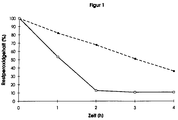
- In einem Versuch wurde die Zerfallskinetik des Peroxycarboxylgruppen enthaltenden Polymerisats aus Beispiel 7 mit der Zerfallskinetik von Wasserstoffperoxid unter gleichen Bedingungen verglichen. Die Temperatur betrug 90°C, der pH-Wert 2 und der Ausgangsgehalt an Peroxid betrug 0,2 Gew.-%. Der Peroxidgehalt wurde iodometrisch bestimmt. Die Ergebnisse der Zerfallskinetik sind in der Graphik in Figur 1 wiedergegeben, in der der Restgehalt an Peroxid gegen die Zeit aufgetragen ist. (Durchgezogene Linie: Polymerisat aus Beispiel 7, gestrichelte Linie: technisch stabilisiertes Wasserstoffperoxid). Man erkennt, daß der Peroxidgehalt in dem Polymerisat aus Beispiel 7 wesentlich schneller abnimmt als der einer vergleichbaren Wasserstoffperoxidlösung. Dies zeigt, daß die erfindungsgemäßen Peroxycarboxylgruppen enthaltenden Polymerisate besser geeignet sind als Oxidationsmittel bzw. als Mittel zur Bereitstellung von Aktivsauerstoff.
- In einer Rührapparatur mit aufgesetztem Rückflußkühler und Stickstoffspülung werden 28,8 g (0,4 mol) Acrylsäure in 67 g Wasser vorgelegt. Man fügt 1,36 g der polymeren Persäure aus Beispiel 3 hinzu und erhitzt 2 Stunden bei 85°C, danach weitere 2 Stunden bei 95°C. Gegen Ende der Reaktion wird mit 125 ml Wasser verdünnt. Man erhält eine viskose Lösung mit einem Feststoffgehalt von 13%. Der K-Wert* beträgt 30,4.
*Die K-Werte wurden nach Fikentscher, Cellulosechemie, Bd. 13, S. 58-64 (1932) bei 25°C 0,1 gew.-%ig in 0,5 molarer NaCl-Lösung gemessen. - In einer Rührapparatur mit aufgesetztem Rückflußkühler und Stickstoffspülung werden 30 g (0,23 mol) Hydroxypropylacrylat, 60 g (0,09 mol) N,N-Dimethyl-N-ethyl-N-(2-methacryloyloxy)-ethylammonium-ethylsulfat (50%ig in Wasser), 110 g Wasser sowie 1,12 g polymere Persäure aus Beispiel 3 vorgelegt. Man erhitzt 2 Stunden bei 90°C, danach weitere 2 h bei 100°C. Gegen Ende der Reaktion wird mit 100 ml Wasser verdünnt. Man erhält eine viskose Lösung mit einem Festgehalt von 20 % und einem K-Wert* von 51,0.
*Die K-Werte wurden nach Fikentscher, Cellulosechemie, Bd. 13, S. 58-64 (1932) bei 25°C 0,1 gew.-%ig in 0,5 molarer NaCl-Lösung gemessen.
Claims (9)
- Verfahren zur Herstellung von Peroxycarboxylgruppen enthaltenden Polymerisaten, wobei man eine Suspension eines monoolefinisch ungesättigte Dicarbonsäureanhydridgruppen-Grundbausteine enthaltenden Polymerisats in einem inerten Verdünngsmittel mit Wasserstoffperoxid versetzt.
- Verfahren ach Anspruch 1, wobei das monoolefinisch ungesättigte Dicarbonsäureanhydrid-Grundbausteine enthaltende Polymerisat ein Copolymerisat aus mindestens einem monoolefinisch ungesättigten Dicarbonsäureanhydrid-Grundbaustein und mindestens einem monoethylenisch ungesättigten Comonomergrundbaustein ist.
- Verfahren nach Anspruch 1 oder 2, wobei der monoolefinisch ungesättigte Dicarbonsäureanhydrid-Grundbaustein ausgewählt ist aus Maleinsäure-, Itaconsäure-, Citraconsäure-, Glutaconsäure-, Methylenmalonsäureanhydrid und deren Gemischen, vorzugsweise Maleinsäureanhydrid.
- Verfahren nach Anspruch 2 oder 3, wobei der monoethylenisch ungesättigte Comonomergrundbaustein ausgewählt ist aus N-Vinyllactamen, vorzugsweise N-Vinylpyrrolidon, N-Vinylpiperidon oder N-Vinylcaprolactam, Vinylethern, vorzugsweise C1-C20-Alkylvinylethern, vorzugsweise Methyl-, Ethyl-, n-Propyl-, i-Propyl-, n-Butyl-, i-Butyl-, Octyl-, Cyclohexyl-, 2-Ethylhexyl-, oder Octadecylvinylether, Olefinen, vorzugsweise C2-C30-Olefinen, vorzugsweise Ethen, Propen, Isobuten, 1-Buten, 1-Penten, 1-Hexen, 1-Octen, 1-Decen, 1-Dodecen, 1-Tetradecen, 1-Hexadecen, 1-Octadecen oder Mischungen von C8-30-Olefinen, vorzugsweise C12/C14-Olefinen, C12/C16-Olefinen, C20/C24-Olefinen oder C24/C28-Olefinen, vinylaromatischen Verbindungen, vorzugsweise Styrol oder α-Methylstyrol, Vinylestern, vorzugsweise Vinylformiat, Vinylacetat, oder Vinylpropionat, N-Vinylamiden, vorzugsweise N-Vinylformamid, N-Vinylacetamid, Acrylsäure, Methacrylsäure, (Meth)acrylestern, vorzugsweise Methylacrylat, Methylacrylat, Propylacrylat, i-Propylacrylat, Butylacrylat, i-Butylacrylat, t-Butylacrylat, Pentylacrylat, Hexylacrylat, 2-Ethylhexylacrylat, Ocrylacrylat, Laurylacrylat, Stearylacrylat und entsprechenden Methacrylaten, Acrylamid, Methacrylamid, Mono- und disubstituierten (Meth)acrylamiden, vorzugsweise N-Methylacrylamid, N-Ethylacrylamid, N-Propylacrylamid, N-i-Propylacrylamid, N-t-Butylacrylamid, N-Butylacrylamid, N-Hexylacrylamid, N-Octylacrylamid, N,N-Dimethylacrylamid, N,N-Diethylacrylamid und den entsprechenden Methacrylamiden oder ungesättigten Dicarbonsäureanhydriden.
- Verfahren nach einem der Ansprüche 1 bis 4, wobei das eingesetzte Polymerisat zusätzlich Vernetzergrundbausteine enthält, vorzugsweise Divinylbenzol, Divinylethylenharnstoff, Alkyldiene oder Divinylalkylether, wobei der Vernetzergrundbaustein insbesondere ausgewählt ist aus α-ω-Alkyldienen, vorzugsweise 1,9-Decadien, oder Butandiol-1,4-divinylether, Hexandiol-1,6-divinylether, Hexandiol-1,6-divinylether oder Octandiol-1,8-divinylether.
- Verfahren nach Anspruch 1 bis 5, wobei die eingesetzten Polymerisate vor oder während der Umsetzung mit Wasserstoffperoxid mit mindestens einem Diol und/oder mindestens einem Diamin umgesetzt werden, wobei das Diol vorzugsweise ausgewählt ist aus Ethandiol, 1,2-Propandiol, 1,3-Propandiol, 1,2-Butandiol, 1,4-Butandiol, 1,5-Pentandiol, 1,2-Pentandiol, 1,2-Hexandiol, 1,6-Hexandiol und das Diamin ausgewählt ist aus Ethandiamin, 1,2-Propandiamin, 1,3-Propandiamin, 1,2-Butandiamin, 1,4-Butandiamin, 1,5-Pentandiamin, 1,2-Pentandiamin, 1,2-Hexandiamin, 1,6-Hexandiamin.
- Copolymerisat, umfassend mindestens ein monoolefinisch ungesättigtes Dicarbonsäureanhydrid und mindestens ein N-Vinyllactam als Grundbausteine.
- Copolymerisat nach Anspruch 7 mit einem oder mehreren der nachstehenden Merkmale:- der monoolefinisch ungesättigte Dicarbonsäureanhydrid-Grundbaustein ist Maleinsäureanhydrid und der N-Vinyllactam-Grundbaustein ist N-Vinylpyrrolidon und/oder N-Vinylcaprolactam;- das Mol-Verhältnis von monoolefinisch ungesättigtem Dicarbonsäureanhydrid-Grundbausteinen zu N-Vinyllactam-Grundbausteinen beträgt 20:1 bis 1:20, vorzugsweise 5:1 bis 1:5, insbesondere 2:1 bis 1:2;
1 bis 95%, vorzugsweise 30 bis 95%, der monoolefinisch ungesättigten Dicarbonsäureanhydrid-Grundbausteine sind umgesetzt zu monoolefinisch ungesättigten Monoperoxybicarbonsäure-Grundbausteinen;- es ist zumindest teilweise vernetzt über Divinylbenzol und/oder Divinylethylerharnstoff und/oder Alkyldiene und/oder Divinylalkylether und/oder Diole und/oder Diamine. - Verwendung der in einem der Ansprüche 1 bis 8 definierten Peroxycarboxylgruppen enthaltenden Polymerisate als Bleichmittel, Desinfektionsmittel, Reinigungsmittel, Initiatoren bei Polymerisationen oder zur Epoxidierung.
Applications Claiming Priority (2)
| Application Number | Priority Date | Filing Date | Title |
|---|---|---|---|
| DE19610817A DE19610817A1 (de) | 1996-03-19 | 1996-03-19 | Verfahren zur Herstellung von Peroxycarboxylgruppen enthaltenden Polymerisaten |
| DE19610817 | 1996-03-19 |
Publications (2)
| Publication Number | Publication Date |
|---|---|
| EP0796874A2 true EP0796874A2 (de) | 1997-09-24 |
| EP0796874A3 EP0796874A3 (de) | 1998-02-11 |
Family
ID=7788775
Family Applications (1)
| Application Number | Title | Priority Date | Filing Date |
|---|---|---|---|
| EP97104515A Withdrawn EP0796874A3 (de) | 1996-03-19 | 1997-03-17 | Verfahren zur Herstellung von Peroxycarboxylgruppen enthaltenden Polymerisaten |
Country Status (6)
| Country | Link |
|---|---|
| US (1) | US5804669A (de) |
| EP (1) | EP0796874A3 (de) |
| JP (1) | JPH107724A (de) |
| CN (1) | CN1168384A (de) |
| CA (1) | CA2199743A1 (de) |
| DE (1) | DE19610817A1 (de) |
Cited By (1)
| Publication number | Priority date | Publication date | Assignee | Title |
|---|---|---|---|---|
| EP2168576A2 (de) | 2001-09-14 | 2010-03-31 | Shionogi & Co., Ltd. | Neue Nutzungen von trizyklischen Verbindungen |
Families Citing this family (7)
| Publication number | Priority date | Publication date | Assignee | Title |
|---|---|---|---|---|
| US20040248950A1 (en) * | 2001-08-24 | 2004-12-09 | Natsuki Ishizuka | Apo ai expression accelerating agent |
| JP2005320391A (ja) * | 2004-05-07 | 2005-11-17 | Mitsubishi Gas Chem Co Inc | 有機過酸ポリマーおよびその製造方法 |
| CN101243133B (zh) * | 2005-07-27 | 2011-08-31 | 三菱瓦斯化学株式会社 | 有机过酸聚合物组合物及其制造方法 |
| BR112017021946B1 (pt) * | 2015-04-28 | 2021-10-05 | Basf Se | Uso de um copolímero, copolímero, formulação, e, método para estabilização de um composto peroxídico contra decomposição |
| WO2016198857A1 (en) | 2015-06-09 | 2016-12-15 | P2I Ltd | Coatings |
| DE102016121093A1 (de) | 2016-11-04 | 2018-05-09 | Saurer Germany Gmbh & Co. Kg | Fadenspleißvorrichtung |
| CN106832086B (zh) * | 2017-01-11 | 2019-06-25 | 北京长江脉医药科技有限责任公司 | 一种速溶性过氧化高分子共聚物消毒材料 |
Family Cites Families (14)
| Publication number | Priority date | Publication date | Assignee | Title |
|---|---|---|---|---|
| DE252378C (de) * | ||||
| DE272654C (de) * | 1900-01-01 | |||
| US2866775A (en) * | 1953-09-16 | 1958-12-30 | Johnson & Johnson | Adhesive composition comprising crosslinked maleic ester copolymers, method of preparation and a backing coated with said composition |
| US3002954A (en) * | 1958-09-04 | 1961-10-03 | Johnson & Johnson | Cross linked polymers of maleic anhydride |
| GB995880A (en) * | 1961-06-20 | 1965-06-23 | Rohm & Haas | Treatment of n-vinylpyrrolidinone polymers |
| US3592948A (en) * | 1968-03-08 | 1971-07-13 | Pennwalt Corp | Addition reaction involving diperoxyfumarate to form compounds having diperoxysuccinyl groups |
| US3496150A (en) * | 1968-03-22 | 1970-02-17 | Procter & Gamble | Photochemical bleaching of polymaleate homopolymers and copolymers |
| US3634503A (en) * | 1969-05-13 | 1972-01-11 | Petro Tex Chem Corp | Purification of poly(maleic acid) |
| CA994355A (en) * | 1971-09-01 | 1976-08-03 | James E. Crawford | Process for the preparation of multifunctional peroxydiesters |
| US3850891A (en) * | 1971-09-01 | 1974-11-26 | Owens Illinois Inc | Process for the preparation of multifunctional peroxydiesters |
| US3975332A (en) * | 1975-01-20 | 1976-08-17 | Borg-Warner Corporation | Epoxidized copolymers |
| DD252378A1 (de) * | 1986-07-22 | 1987-12-16 | Adw Ddr | Verfahren zur herstellung polymerer percarboxyverbindungen |
| DD272654A1 (de) * | 1987-03-09 | 1989-10-18 | Leuna Werke Veb | Verfahren zur herstellung von neuen copolymeren peroxydicarbonsaeuren und deren salzen |
| GB9120773D0 (en) * | 1991-10-01 | 1991-11-13 | Ici Plc | Modified olefin polymers |
-
1996
- 1996-03-19 DE DE19610817A patent/DE19610817A1/de not_active Withdrawn
-
1997
- 1997-03-10 US US08/813,979 patent/US5804669A/en not_active Expired - Fee Related
- 1997-03-11 CA CA002199743A patent/CA2199743A1/en not_active Abandoned
- 1997-03-17 EP EP97104515A patent/EP0796874A3/de not_active Withdrawn
- 1997-03-19 JP JP9065734A patent/JPH107724A/ja not_active Withdrawn
- 1997-03-19 CN CN97110040A patent/CN1168384A/zh active Pending
Cited By (1)
| Publication number | Priority date | Publication date | Assignee | Title |
|---|---|---|---|---|
| EP2168576A2 (de) | 2001-09-14 | 2010-03-31 | Shionogi & Co., Ltd. | Neue Nutzungen von trizyklischen Verbindungen |
Also Published As
| Publication number | Publication date |
|---|---|
| US5804669A (en) | 1998-09-08 |
| JPH107724A (ja) | 1998-01-13 |
| CA2199743A1 (en) | 1997-09-19 |
| CN1168384A (zh) | 1997-12-24 |
| EP0796874A3 (de) | 1998-02-11 |
| DE19610817A1 (de) | 1997-09-25 |
Similar Documents
| Publication | Publication Date | Title |
|---|---|---|
| DE1745214A1 (de) | Neue Copolymerisate auf der Basis von Vinylverbindungen und Krotonsaeure,Verfahren zu deren Herstellung und die Copolymerisate enthaltende kosmetische Mittel | |
| WO2002044225A2 (de) | Siliziummodifizierte kammpolymere auf basis von acryloyldimethyltaurinsäure (2-acrylamido-2-methyl-1-propansulfonsäure) | |
| DE1100960B (de) | Verfahren zur Herstellung von dreidimensionalen, unloeslichen, harten und unschmelzbaren Polymeren und Copolymeren | |
| EP0709411B1 (de) | Lösliche Copolymerisate für die Haarkosmetik | |
| EP0796874A2 (de) | Verfahren zur Herstellung von Peroxycarboxylgruppen enthaltenden Polymerisaten | |
| DE1201061B (de) | Verfahren zur Herstellung verspinnbarer Loesungen faserbildender Acrylnitrilpolymerisate | |
| DE2710771C3 (de) | Verfahren zur Herstellung von carboxylierten Äthylen-Vinylacetat- Copolymerisaten oder verseiften Äthylen-Vinylacetat-Copolymerisaten | |
| CH551457A (de) | Verfahren zur herstellung von aetylen-copolymeren. | |
| DE3105279A1 (de) | Druckempfindlicher klebstoff und ihn enthaltende klebefolie | |
| EP0467178B1 (de) | Gepfropfte und vernetzte Propylencopolymerisate | |
| DE2437640A1 (de) | Verfahren zur herstellung von unloeslichen in wasser nur wenig quellbaren polymerisaten von n-vinyllactamen mit verbesserter adsorptionskraft | |
| DE2852743A1 (de) | Verfahren zur herstellung eines sauerstoffhaltigen wachses | |
| DE2643882A1 (de) | Polyaethylenwachse | |
| EP0001782B1 (de) | Verfahren zur Herstellung von Pfropfmischpolymerisaten | |
| US5654385A (en) | One-step process for making lightly-crosslinked polyvinylpyrrolidone hydrogel | |
| EP0945469A1 (de) | Verfahren zur Herstellung von Telechelen, so hergestellte Telechele und ihre Verwendung | |
| US5922814A (en) | Preparation of polymers comprising peroxycarboxyl groups | |
| DE3025760A1 (de) | Verfahren zur polymersation von (alpha) -olefinen | |
| DE3726285A1 (de) | Polymerisate mit funktionellen gruppen | |
| DE19741188A1 (de) | Verfahren zur Verminderung des Restmonomerengehalts in wässrigen Polymerdispersionen | |
| DE1720873C3 (de) | Verfahren zur Herstellung von Pfropf-Copolymeren aus polymeren N-Vinyllactamen | |
| DE1495408C (de) | Verfahren zum Pfropfen von Monomeren auf Kohlenwasserstoffpolymere | |
| DE948642C (de) | Verfahren zur Herstellung von Mischpolymerisaten auf Grundlage von Vinylidencyanid | |
| DE1720874A1 (de) | Copolymere von N-Vinyllactamen und fluorierten Estern alpha-,ss-ungesaettigter Saeuren,sowie Verfahren zu deren Herstellung | |
| DE2806044A1 (de) | Vernetzte, mit wasser quellbare polymerisate aus inden und maleinsaeureanhydrid |
Legal Events
| Date | Code | Title | Description |
|---|---|---|---|
| PUAI | Public reference made under article 153(3) epc to a published international application that has entered the european phase |
Free format text: ORIGINAL CODE: 0009012 |
|
| AK | Designated contracting states |
Kind code of ref document: A2 Designated state(s): AT BE CH DE DK ES FR GB IE IT LI NL PT SE |
|
| PUAL | Search report despatched |
Free format text: ORIGINAL CODE: 0009013 |
|
| AK | Designated contracting states |
Kind code of ref document: A3 Designated state(s): AT BE CH DE DK ES FR GB IE IT LI NL PT SE |
|
| 17P | Request for examination filed |
Effective date: 19980512 |
|
| 17Q | First examination report despatched |
Effective date: 19980806 |
|
| STAA | Information on the status of an ep patent application or granted ep patent |
Free format text: STATUS: THE APPLICATION HAS BEEN WITHDRAWN |
|
| 18W | Application withdrawn |
Withdrawal date: 19990611 |