EP0797360A2 - Verfahren zum Berechnen der Bitlänge eines Kodewortes und eine Variablenlänge-Kodeworttabelle dafür - Google Patents
Verfahren zum Berechnen der Bitlänge eines Kodewortes und eine Variablenlänge-Kodeworttabelle dafür Download PDFInfo
- Publication number
- EP0797360A2 EP0797360A2 EP97301682A EP97301682A EP0797360A2 EP 0797360 A2 EP0797360 A2 EP 0797360A2 EP 97301682 A EP97301682 A EP 97301682A EP 97301682 A EP97301682 A EP 97301682A EP 0797360 A2 EP0797360 A2 EP 0797360A2
- Authority
- EP
- European Patent Office
- Prior art keywords
- code
- classes
- variable length
- code word
- length
- Prior art date
- Legal status (The legal status is an assumption and is not a legal conclusion. Google has not performed a legal analysis and makes no representation as to the accuracy of the status listed.)
- Withdrawn
Links
- 238000000034 method Methods 0.000 title claims abstract description 35
- 238000012986 modification Methods 0.000 description 2
- 230000004048 modification Effects 0.000 description 2
- 230000015556 catabolic process Effects 0.000 description 1
- 238000006731 degradation reaction Methods 0.000 description 1
- 238000004519 manufacturing process Methods 0.000 description 1
- 238000005457 optimization Methods 0.000 description 1
Images


Classifications
-
- H—ELECTRICITY
- H04—ELECTRIC COMMUNICATION TECHNIQUE
- H04N—PICTORIAL COMMUNICATION, e.g. TELEVISION
- H04N19/00—Methods or arrangements for coding, decoding, compressing or decompressing digital video signals
- H04N19/60—Methods or arrangements for coding, decoding, compressing or decompressing digital video signals using transform coding
-
- H—ELECTRICITY
- H03—ELECTRONIC CIRCUITRY
- H03M—CODING; DECODING; CODE CONVERSION IN GENERAL
- H03M7/00—Conversion of a code where information is represented by a given sequence or number of digits to a code where the same, similar or subset of information is represented by a different sequence or number of digits
- H03M7/30—Compression; Expansion; Suppression of unnecessary data, e.g. redundancy reduction
- H03M7/40—Conversion to or from variable length codes, e.g. Shannon-Fano code, Huffman code, Morse code
- H03M7/42—Conversion to or from variable length codes, e.g. Shannon-Fano code, Huffman code, Morse code using table look-up for the coding or decoding process, e.g. using read-only memory
-
- H—ELECTRICITY
- H03—ELECTRONIC CIRCUITRY
- H03M—CODING; DECODING; CODE CONVERSION IN GENERAL
- H03M7/00—Conversion of a code where information is represented by a given sequence or number of digits to a code where the same, similar or subset of information is represented by a different sequence or number of digits
- H03M7/30—Compression; Expansion; Suppression of unnecessary data, e.g. redundancy reduction
- H03M7/40—Conversion to or from variable length codes, e.g. Shannon-Fano code, Huffman code, Morse code
- H03M7/4093—Variable length to variable length coding
-
- H—ELECTRICITY
- H04—ELECTRIC COMMUNICATION TECHNIQUE
- H04N—PICTORIAL COMMUNICATION, e.g. TELEVISION
- H04N19/00—Methods or arrangements for coding, decoding, compressing or decompressing digital video signals
- H04N19/10—Methods or arrangements for coding, decoding, compressing or decompressing digital video signals using adaptive coding
- H04N19/102—Methods or arrangements for coding, decoding, compressing or decompressing digital video signals using adaptive coding characterised by the element, parameter or selection affected or controlled by the adaptive coding
- H04N19/13—Adaptive entropy coding, e.g. adaptive variable length coding [AVLC] or context adaptive binary arithmetic coding [CABAC]
-
- H—ELECTRICITY
- H04—ELECTRIC COMMUNICATION TECHNIQUE
- H04N—PICTORIAL COMMUNICATION, e.g. TELEVISION
- H04N19/00—Methods or arrangements for coding, decoding, compressing or decompressing digital video signals
- H04N19/90—Methods or arrangements for coding, decoding, compressing or decompressing digital video signals using coding techniques not provided for in groups H04N19/10-H04N19/85, e.g. fractals
- H04N19/91—Entropy coding, e.g. variable length coding [VLC] or arithmetic coding
Definitions
- the present invention relates to a method for calculating a bit length of a code word and a variable length code table applicable to the method therefor.
- the VLC(Variable Length Code) called sometimes as the Hoffmann code, being a lossless coding method, is one of the optimization code having the statistical characteristics of a data applied thereto.
- the shorter code word is designated, the more frequent video data are generated, and the longer code word is designated, the less frequent video data are generated. If code words are designated to all possible video data applying such a method thereto, an average bit length of code words can be compressed shorter than an originally intended average bit length.
- This VLC is employed in systems which require a technique for compressing a video data, such as MPEG 1(Moving Picture Expert Group 1), MPEG 2(Moving Picture Expert Group 2) and HDTV(High Definition Television) for reproducing video data and implementing advanced picture quality.
- a technique for compressing a video data such as MPEG 1(Moving Picture Expert Group 1), MPEG 2(Moving Picture Expert Group 2) and HDTV(High Definition Television) for reproducing video data and implementing advanced picture quality.
- MPEG 1 Motion Picture Expert Group 1
- MPEG 2 Motion Picture Expert Group 2
- HDTV High Definition Television
- a random variable length code table upon reception of an encoded data(or a code word) processed by a fast data processor, produces a decoded data(code word) and a bit length of this decoded code word.
- the conventional random variable length code table consists of numerous number of combinations of logic gates. It takes a lot of times in calculating a bit length of a code word decoded applying the random variable length code table which consists of such numerous logic gates thereto. That is, upon reception of a code word pursuant to the MPEG standard, the random variable length code table executes a lot of loops continuously until the numerous logic gates satisfy the processing conditions for determining the code word length. Accordingly, a substantial amount of time is required.
- the lengthy processing time required for decoding an encoded code word and calculating a length ofthe decoded code word ofthe random variable length code table causes a problem that the processing speed of the decoder becomes slow resulting in degradation of the picture quality.
- Embodiments of the present invention are directed to method for calculating a bit length of a code word and a variable length code table applied to the method therefor that substantially obviates one or more of the problems due to limitations and disadvantages of the related art.
- a method for calculating a bit length of a received code word in decoding and a variable length code table applicable to the method is provided.
- a method for calculating a bit length of a code word comprising the steps of classifying all possible code words into a plurality of classes of statistically similar code words of the same length, storing the plurality of classes together with bit lengths thereof in a table, and producing a bit length corresponding to a class of a code word provided to the table from the table.
- variable length code table including a decoding table for producing a decoded code word corresponding to a received code word in response to the received code word, a selecting signal generating part for providing a length selecting signal in response to the received code word, a class part having a plurality of classes each having statistically similar code words of the same length, and a selecting part for selecting a bit length as a bit length of the received code word from a plurality of bit lengths provided from the class part in response to the length selecting signal.
- Fig. 1 illustrates an outline of an optimal system of a variable length code table in accordance with a preferred embodiment of the present invention.
- the variable length code table includes a plurality of variable length code table units 1, 2 and 3 each for producing a decoded code word relevant to a received code word in response to the received code word and a bit length of the code word, a first multiplexer 4 acting as a selecting part for selecting one as the decoded code word of the received code word from the decoded code words received from the plurality of variable length code tables 1, 2 and 3 in response to an external first selecting signal, and a second multiplexer 5 acting as a selecting part for selecting one as a bit length of the received code word from the bit lengths received from the plurality of variable length code tables 1, 2 and 3 in response to an external second selecting signal.
- the aforementioned code words and decoded code words may be of the MPEG standard or other standards.
- Fig. 2 illustrates a detail of the variable length code table unit in Fig. 1.
- the variable length code table unit includes a selecting signal generating part 6 for providing a length selecting signal in response to an encoded code word(or a data) received from a fast data processor, a class part 7 having a plurality of classes 7a, 7b and 7c each for receiving the encoded code word and providing a bit length of the encoded code word, a multiplexer 8 acting as a selecting part for selecting a bit length of a relevant class from the plurality of classes 7a, 7b and 7c in response to the selecting signal from the selecting signal generating part 6, and a decoding table 9 for producing a decoded code word corresponding to the received code word.
- the aforementioned code words and decoded code words may be of the MPEG standard or other standards, and each of the classes includes code words having, not only statistically similar bits, but also the same bit lengths.
- all code words which may be possibly generated are taken into account. All these possible code words are classified into statistically similar code words of the same lengths.
- the word of "statistically similar code words" denotes that the code words has at least one identical bit(or bits). Accordingly, all the possible code words may be classified into a plurality of classes. As explained, the code words included in each of the classes have at least one identical bit(or bits) in common and the same bit lengths.
- firstly at least one forward bits of all the possible code words are compared. Accordingly, all the possible code words are classified into a plurality of preliminary classes of code words having one or more than one identical forward bits at first. Then, secondly bit lengths of the code words in each of the preliminary classes are compared.
- all the possible code words are classified into the plurality of classes of code words having, not only the same bit lengths, but also at least one or more than one identical forward bits.
- the plurality of classes classified thus completely are stored into the class part 7 in each of the variable length code table units in advance.
- variable code length table in accordance with a preferred embodiment of the present invention will now be explained in detail with reference to Figs. 1 ⁇ 4.
- variable length code table shown in Fig. 1 Upon reception of encoded code words with certain numbers of bits in a form of a bit stream, the variable length code table shown in Fig. 1 processes the code words according to the MPEG standard to produce decoded code words and bit lengths of the decoded code words. As explained, the signal processing step for calculating the bit lengths includes the step of searching the plurality of classes 7a, 7b and 7c classified into classes of statistically similar code words according to the MPEG standard for a class corresponding to the received code word. As shown in Fig. 1, the variable length code table has at least one or more than one variable length code table units, such as a table for use in obtaining a decoded code word of the MPEG standard and a table for use in correcting a motion of an image.
- variable length code table units such as a table for use in obtaining a decoded code word of the MPEG standard and a table for use in correcting a motion of an image.
- each of the variable length code table units produces corresponding bit length and decoded code word in response to a received code word
- the first multiplexer 4 and the second multiplexer 5 select desired bit length and decoded code word in response to an external control signal, respectively.
- a certain one of the decoded code words from the variable length code table units 1, 2 and 3 selected by the first multiplexer 4 so as to meet the purpose of the present process in response to an external signal, and alikely the bit length of the selected code word is selected by the second multiplexer 5.
- variable length code table will be explained in more detail hereinafter.
- the class part when the variable length code table unit receives an encoded code word, the class part produces a plurality of bit lengths in response to reception of the encoded code word.
- the class part 7 has a plurality of classes, and each of the classes has statistically similar code words of the MPEG or other standard.
- each of the classes in the class parts 7 produces a corresponding bit length of a code word in response to reception of the code word at the variable length code table unit.
- the code words in the classes 3, 4 and 5 partly have identical forward bits of 001, 0001 and 00001, respectively. Therefore, by only detecting the partly identical forward bits, the bit length of a received code word can be calculated with easy.
- the selecting signal generating part 6 in Fig. 2 produces a corresponding selecting signal in response to reception of the code word, which is the encoded data.
- the selecting signal is applied to the multiplexer 8 as a control signal, thereby selects one of the plurality(or 'n' numbers, where the 'n' is a positive integer) of the bit lengths from the class part 7.
- the selected one is a bit length of the class corresponding to the received code word. Therefore, the multiplexers 4, 5 and 8 are n x 1 multiplexers.
- each of the variable length code table units processes an encoded code word of the MPEG standard at random by means of a decoding table 9 having a plurality of random logic gates, for decoding the encoded code word.
- a decoded code word corresponding to the received code word can be obtained.
- the variable length code table shown in Fig. 1 receives and processes the bits of the received code word in parallel for speeding up the decoding speed.
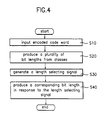
- Fig. 4 illustrates a flow chart showing an outline of the steps of a method for calculating a bit length of a code word encoded by the system shown in Fig. 2.
- each of a plurality of classes of code words classified into similar code words according to a statistical characteristic of the MPEG standard searches for at least one or more than one bits of the received code word and produces a preset bit length(S20).
- the selecting signal generating part 6 processes the received code word by means of internal combination logics, to produce a length selecting signal(S30). The length selecting signal thus produced is applied to the multiplexer 8, to select a bit length of a corresponding class from the plurality of bit lengths from the class part 7(S40).
- the method for calculating a bit length of a code word and a variable length code table applied to the method can calculate a bit length of a code word in decoding the code word, whereby a real time fast speed decoding of an image data of the MPEG standard is facilitated. And, since a sufficient allowance for a decoding speed is secured, data can be transmitted at a faster speed.
- the aforementioned two advantages facilitate realization of an advanced resolution.
Landscapes
- Engineering & Computer Science (AREA)
- Theoretical Computer Science (AREA)
- Multimedia (AREA)
- Signal Processing (AREA)
- Compression, Expansion, Code Conversion, And Decoders (AREA)
- Compression Or Coding Systems Of Tv Signals (AREA)
- Compression Of Band Width Or Redundancy In Fax (AREA)
Applications Claiming Priority (2)
| Application Number | Priority Date | Filing Date | Title |
|---|---|---|---|
| KR1019960007943A KR970068627A (ko) | 1996-03-22 | 1996-03-22 | 최적화된 가변길이 테이블장치 및 최적 길이값 산출방법 |
| KR9607943 | 1996-03-22 |
Publications (2)
| Publication Number | Publication Date |
|---|---|
| EP0797360A2 true EP0797360A2 (de) | 1997-09-24 |
| EP0797360A3 EP0797360A3 (de) | 1998-04-22 |
Family
ID=19453729
Family Applications (1)
| Application Number | Title | Priority Date | Filing Date |
|---|---|---|---|
| EP19970301682 Withdrawn EP0797360A3 (de) | 1996-03-22 | 1997-03-13 | Verfahren zum Berechnen der Bitlänge eines Kodewortes und eine Variablenlänge-Kodeworttabelle dafür |
Country Status (3)
| Country | Link |
|---|---|
| EP (1) | EP0797360A3 (de) |
| JP (1) | JPH09261077A (de) |
| KR (1) | KR970068627A (de) |
Families Citing this family (2)
| Publication number | Priority date | Publication date | Assignee | Title |
|---|---|---|---|---|
| KR100742341B1 (ko) * | 2000-11-10 | 2007-07-25 | 삼성전자주식회사 | 프레임 길이를 모르는 데이터를 디코딩하기 위한 장치 및 그 제어 방법 |
| KR101038531B1 (ko) * | 2009-06-25 | 2011-06-02 | 한양대학교 산학협력단 | 복호화시 병렬처리가 가능한 영상 부호화 장치 및 방법, 그리고 병렬처리가 가능한 영상 복호화 장치 및 방법 |
Family Cites Families (7)
| Publication number | Priority date | Publication date | Assignee | Title |
|---|---|---|---|---|
| US3918047A (en) * | 1974-03-28 | 1975-11-04 | Bell Telephone Labor Inc | Decoding circuit for variable length codes |
| US4800441A (en) * | 1986-02-28 | 1989-01-24 | Kabushiki Kaisha Toshiba | Binary data compression and expansion processing apparatus |
| US4813056A (en) * | 1987-12-08 | 1989-03-14 | General Electric Company | Modified statistical coding of digital signals |
| US5253053A (en) * | 1990-12-31 | 1993-10-12 | Apple Computer, Inc. | Variable length decoding using lookup tables |
| JP3007235B2 (ja) * | 1992-11-10 | 2000-02-07 | 富士写真フイルム株式会社 | 可変長符号の伸長装置および圧縮伸長装置 |
| JP2715871B2 (ja) * | 1993-12-20 | 1998-02-18 | 日本電気株式会社 | 可変長符号化方法 |
| WO1996033558A1 (en) * | 1995-04-18 | 1996-10-24 | Advanced Micro Devices, Inc. | Method and apparatus for hybrid vlc bitstream decoding |
-
1996
- 1996-03-22 KR KR1019960007943A patent/KR970068627A/ko not_active Ceased
-
1997
- 1997-01-13 JP JP367797A patent/JPH09261077A/ja active Pending
- 1997-03-13 EP EP19970301682 patent/EP0797360A3/de not_active Withdrawn
Also Published As
| Publication number | Publication date |
|---|---|
| JPH09261077A (ja) | 1997-10-03 |
| KR970068627A (ko) | 1997-10-13 |
| EP0797360A3 (de) | 1998-04-22 |
Similar Documents
| Publication | Publication Date | Title |
|---|---|---|
| US5724451A (en) | Image compression method and apparatus using conditional quadtree split sysyem | |
| US6351563B1 (en) | Apparatus and method for coding/decoding scalable shape binary image using mode of lower and current layers | |
| US7769088B2 (en) | Context adaptive binary arithmetic code decoding engine | |
| JP3171776B2 (ja) | 圧縮方法及びコンテキスト・モデラー | |
| US6470034B1 (en) | Method and apparatus for reduced complexity start code detection in compressed bitstream | |
| US20010012403A1 (en) | An image coding process and notion detecting process using bidirectional prediction | |
| US20040260739A1 (en) | System and method for accelerating arithmetic decoding of video data | |
| KR100470251B1 (ko) | 가변길이디코더 | |
| US5699129A (en) | Method and apparatus for motion vector determination range expansion | |
| US6011498A (en) | Dual-speed variable length decoding architecture for MPEG-2 video data | |
| US6636642B1 (en) | Image coding device, image decoding device, image coding/decoding device and image coding/decoding method | |
| US6285789B1 (en) | Variable length code decoder for MPEG | |
| EP1075087B1 (de) | Verfahren und Vorrichtung zur Codierung mit variabler Länge | |
| US5170445A (en) | Document decompressing system | |
| JPH02290371A (ja) | パターン・フリークエンシイを有するイメージの圧縮方法及びシステム並びにイメージのパターン・フリークエンシイ決定方法及びシステム | |
| US20070126611A1 (en) | Representations of compressed video | |
| US5949356A (en) | High speed variable length code decoder | |
| EP0797360A2 (de) | Verfahren zum Berechnen der Bitlänge eines Kodewortes und eine Variablenlänge-Kodeworttabelle dafür | |
| US6574367B1 (en) | Method and apparatus for pattern matching encoding | |
| US6266375B1 (en) | Method and apparatus for selecting a quantization table for encoding a digital image | |
| US7239716B2 (en) | Data insertion device and method of inserting data | |
| JPH0738445A (ja) | 可変長さ符号復号化装置 | |
| US6020835A (en) | Code decoding apparatus | |
| KR100268485B1 (ko) | 엠펙비디오데이타디코딩방법 | |
| US7251278B1 (en) | Procedure and system for performing motion estimation |
Legal Events
| Date | Code | Title | Description |
|---|---|---|---|
| PUAI | Public reference made under article 153(3) epc to a published international application that has entered the european phase |
Free format text: ORIGINAL CODE: 0009012 |
|
| 17P | Request for examination filed |
Effective date: 19970322 |
|
| AK | Designated contracting states |
Kind code of ref document: A2 Designated state(s): DE FR GB |
|
| PUAL | Search report despatched |
Free format text: ORIGINAL CODE: 0009013 |
|
| RHK1 | Main classification (correction) |
Ipc: H04N 7/32 |
|
| AK | Designated contracting states |
Kind code of ref document: A3 Designated state(s): DE FR GB |
|
| STAA | Information on the status of an ep patent application or granted ep patent |
Free format text: STATUS: THE APPLICATION HAS BEEN WITHDRAWN |
|
| 18W | Application withdrawn |
Withdrawal date: 19980416 |