EP0799724A1 - Reifenlaufflächen mit geringem Rollwiderstand und verbessertem ABS-Bremsen - Google Patents
Reifenlaufflächen mit geringem Rollwiderstand und verbessertem ABS-Bremsen Download PDFInfo
- Publication number
- EP0799724A1 EP0799724A1 EP97101860A EP97101860A EP0799724A1 EP 0799724 A1 EP0799724 A1 EP 0799724A1 EP 97101860 A EP97101860 A EP 97101860A EP 97101860 A EP97101860 A EP 97101860A EP 0799724 A1 EP0799724 A1 EP 0799724A1
- Authority
- EP
- European Patent Office
- Prior art keywords
- parts
- butadiene
- tire treads
- styrene
- copolymers
- Prior art date
- Legal status (The legal status is an assumption and is not a legal conclusion. Google has not performed a legal analysis and makes no representation as to the accuracy of the status listed.)
- Granted
Links
- 238000005096 rolling process Methods 0.000 title claims description 7
- KAKZBPTYRLMSJV-UHFFFAOYSA-N Butadiene Chemical compound C=CC=C KAKZBPTYRLMSJV-UHFFFAOYSA-N 0.000 claims abstract description 52
- PPBRXRYQALVLMV-UHFFFAOYSA-N Styrene Chemical compound C=CC1=CC=CC=C1 PPBRXRYQALVLMV-UHFFFAOYSA-N 0.000 claims abstract description 43
- RRHGJUQNOFWUDK-UHFFFAOYSA-N Isoprene Chemical compound CC(=C)C=C RRHGJUQNOFWUDK-UHFFFAOYSA-N 0.000 claims abstract description 32
- 229920001577 copolymer Polymers 0.000 claims abstract description 13
- 229920002857 polybutadiene Polymers 0.000 claims abstract description 10
- 239000000203 mixture Substances 0.000 claims description 28
- 229920001971 elastomer Polymers 0.000 claims description 16
- 239000005060 rubber Substances 0.000 claims description 16
- 125000003118 aryl group Chemical group 0.000 claims description 8
- 125000000391 vinyl group Chemical group [H]C([*])=C([H])[H] 0.000 claims description 6
- 229920002554 vinyl polymer Polymers 0.000 claims description 5
- 239000000654 additive Substances 0.000 claims description 4
- 125000002897 diene group Chemical group 0.000 claims description 4
- 239000012764 mineral filler Substances 0.000 claims description 2
- 239000010690 paraffinic oil Substances 0.000 claims description 2
- 239000004071 soot Substances 0.000 claims 1
- 238000002156 mixing Methods 0.000 abstract description 5
- VLKZOEOYAKHREP-UHFFFAOYSA-N n-Hexane Chemical compound CCCCCC VLKZOEOYAKHREP-UHFFFAOYSA-N 0.000 description 27
- MZRVEZGGRBJDDB-UHFFFAOYSA-N N-Butyllithium Chemical compound [Li]CCCC MZRVEZGGRBJDDB-UHFFFAOYSA-N 0.000 description 26
- 229920000642 polymer Polymers 0.000 description 19
- RTZKZFJDLAIYFH-UHFFFAOYSA-N Diethyl ether Chemical compound CCOCC RTZKZFJDLAIYFH-UHFFFAOYSA-N 0.000 description 15
- 229920001400 block copolymer Polymers 0.000 description 14
- MYRTYDVEIRVNKP-UHFFFAOYSA-N 1,2-Divinylbenzene Chemical compound C=CC1=CC=CC=C1C=C MYRTYDVEIRVNKP-UHFFFAOYSA-N 0.000 description 12
- YXFVVABEGXRONW-UHFFFAOYSA-N Toluene Chemical compound CC1=CC=CC=C1 YXFVVABEGXRONW-UHFFFAOYSA-N 0.000 description 12
- 238000006116 polymerization reaction Methods 0.000 description 12
- 239000000243 solution Substances 0.000 description 9
- LYCAIKOWRPUZTN-UHFFFAOYSA-N Ethylene glycol Chemical compound OCCO LYCAIKOWRPUZTN-UHFFFAOYSA-N 0.000 description 8
- 238000004519 manufacturing process Methods 0.000 description 8
- 239000003921 oil Substances 0.000 description 8
- 235000019198 oils Nutrition 0.000 description 8
- 239000002904 solvent Substances 0.000 description 8
- -1 Alkyl lithium compounds Chemical class 0.000 description 7
- 239000002585 base Substances 0.000 description 7
- 238000000034 method Methods 0.000 description 7
- 229920001897 terpolymer Polymers 0.000 description 7
- IJGRMHOSHXDMSA-UHFFFAOYSA-N Atomic nitrogen Chemical compound N#N IJGRMHOSHXDMSA-UHFFFAOYSA-N 0.000 description 6
- 239000005062 Polybutadiene Substances 0.000 description 6
- 239000006229 carbon black Substances 0.000 description 6
- 235000019241 carbon black Nutrition 0.000 description 6
- 239000010692 aromatic oil Substances 0.000 description 5
- 239000010426 asphalt Substances 0.000 description 5
- 125000004432 carbon atom Chemical group C* 0.000 description 5
- 238000006243 chemical reaction Methods 0.000 description 5
- 238000001816 cooling Methods 0.000 description 5
- 239000007822 coupling agent Substances 0.000 description 5
- XTHFKEDIFFGKHM-UHFFFAOYSA-N Dimethoxyethane Chemical compound COCCOC XTHFKEDIFFGKHM-UHFFFAOYSA-N 0.000 description 4
- IMNFDUFMRHMDMM-UHFFFAOYSA-N N-Heptane Chemical compound CCCCCCC IMNFDUFMRHMDMM-UHFFFAOYSA-N 0.000 description 4
- OUBMGJOQLXMSNT-UHFFFAOYSA-N N-isopropyl-N'-phenyl-p-phenylenediamine Chemical compound C1=CC(NC(C)C)=CC=C1NC1=CC=CC=C1 OUBMGJOQLXMSNT-UHFFFAOYSA-N 0.000 description 4
- OFBQJSOFQDEBGM-UHFFFAOYSA-N Pentane Chemical compound CCCCC OFBQJSOFQDEBGM-UHFFFAOYSA-N 0.000 description 4
- 239000004793 Polystyrene Substances 0.000 description 4
- VYPSYNLAJGMNEJ-UHFFFAOYSA-N Silicium dioxide Chemical compound O=[Si]=O VYPSYNLAJGMNEJ-UHFFFAOYSA-N 0.000 description 4
- XLOMVQKBTHCTTD-UHFFFAOYSA-N Zinc monoxide Chemical compound [Zn]=O XLOMVQKBTHCTTD-UHFFFAOYSA-N 0.000 description 4
- 230000000903 blocking effect Effects 0.000 description 4
- 239000003054 catalyst Substances 0.000 description 4
- 150000001875 compounds Chemical class 0.000 description 4
- 239000002808 molecular sieve Substances 0.000 description 4
- 239000000178 monomer Substances 0.000 description 4
- 229920002223 polystyrene Polymers 0.000 description 4
- URGAHOPLAPQHLN-UHFFFAOYSA-N sodium aluminosilicate Chemical compound [Na+].[Al+3].[O-][Si]([O-])=O.[O-][Si]([O-])=O URGAHOPLAPQHLN-UHFFFAOYSA-N 0.000 description 4
- 229920003048 styrene butadiene rubber Polymers 0.000 description 4
- 238000004073 vulcanization Methods 0.000 description 4
- WEERVPDNCOGWJF-UHFFFAOYSA-N 1,4-bis(ethenyl)benzene Chemical compound C=CC1=CC=C(C=C)C=C1 WEERVPDNCOGWJF-UHFFFAOYSA-N 0.000 description 3
- UHOVQNZJYSORNB-UHFFFAOYSA-N Benzene Chemical compound C1=CC=CC=C1 UHOVQNZJYSORNB-UHFFFAOYSA-N 0.000 description 3
- SJRJJKPEHAURKC-UHFFFAOYSA-N N-Methylmorpholine Chemical compound CN1CCOCC1 SJRJJKPEHAURKC-UHFFFAOYSA-N 0.000 description 3
- 239000002174 Styrene-butadiene Substances 0.000 description 3
- 150000001412 amines Chemical class 0.000 description 3
- 238000004458 analytical method Methods 0.000 description 3
- 239000007795 chemical reaction product Substances 0.000 description 3
- 239000003795 chemical substances by application Substances 0.000 description 3
- MTHSVFCYNBDYFN-UHFFFAOYSA-N diethylene glycol Chemical compound OCCOCCO MTHSVFCYNBDYFN-UHFFFAOYSA-N 0.000 description 3
- 238000001035 drying Methods 0.000 description 3
- 150000002170 ethers Chemical class 0.000 description 3
- 238000005227 gel permeation chromatography Methods 0.000 description 3
- 230000009477 glass transition Effects 0.000 description 3
- 229910052757 nitrogen Inorganic materials 0.000 description 3
- 150000003512 tertiary amines Chemical class 0.000 description 3
- 238000012360 testing method Methods 0.000 description 3
- SSRJUJRJVLFTJC-UHFFFAOYSA-N 2-[2,4-bis(2-trichlorosilylethyl)cyclohexyl]ethyl-trichlorosilane Chemical compound Cl[Si](Cl)(Cl)CCC1CCC(CC[Si](Cl)(Cl)Cl)C(CC[Si](Cl)(Cl)Cl)C1 SSRJUJRJVLFTJC-UHFFFAOYSA-N 0.000 description 2
- IKEHOXWJQXIQAG-UHFFFAOYSA-N 2-tert-butyl-4-methylphenol Chemical compound CC1=CC=C(O)C(C(C)(C)C)=C1 IKEHOXWJQXIQAG-UHFFFAOYSA-N 0.000 description 2
- CSDQQAQKBAQLLE-UHFFFAOYSA-N 4-(4-chlorophenyl)-4,5,6,7-tetrahydrothieno[3,2-c]pyridine Chemical compound C1=CC(Cl)=CC=C1C1C(C=CS2)=C2CCN1 CSDQQAQKBAQLLE-UHFFFAOYSA-N 0.000 description 2
- VQTUBCCKSQIDNK-UHFFFAOYSA-N Isobutene Chemical compound CC(C)=C VQTUBCCKSQIDNK-UHFFFAOYSA-N 0.000 description 2
- 235000021355 Stearic acid Nutrition 0.000 description 2
- NINIDFKCEFEMDL-UHFFFAOYSA-N Sulfur Chemical compound [S] NINIDFKCEFEMDL-UHFFFAOYSA-N 0.000 description 2
- WYURNTSHIVDZCO-UHFFFAOYSA-N Tetrahydrofuran Chemical compound C1CCOC1 WYURNTSHIVDZCO-UHFFFAOYSA-N 0.000 description 2
- DGEZNRSVGBDHLK-UHFFFAOYSA-N [1,10]phenanthroline Chemical compound C1=CN=C2C3=NC=CC=C3C=CC2=C1 DGEZNRSVGBDHLK-UHFFFAOYSA-N 0.000 description 2
- 238000005299 abrasion Methods 0.000 description 2
- 150000001350 alkyl halides Chemical class 0.000 description 2
- 230000015572 biosynthetic process Effects 0.000 description 2
- 239000006085 branching agent Substances 0.000 description 2
- YGHUUVGIRWMJGE-UHFFFAOYSA-N chlorodimethylsilane Chemical compound C[SiH](C)Cl YGHUUVGIRWMJGE-UHFFFAOYSA-N 0.000 description 2
- 230000008878 coupling Effects 0.000 description 2
- 238000010168 coupling process Methods 0.000 description 2
- 238000005859 coupling reaction Methods 0.000 description 2
- DIOQZVSQGTUSAI-UHFFFAOYSA-N decane Chemical compound CCCCCCCCCC DIOQZVSQGTUSAI-UHFFFAOYSA-N 0.000 description 2
- 230000006866 deterioration Effects 0.000 description 2
- 150000001983 dialkylethers Chemical class 0.000 description 2
- 125000001495 ethyl group Chemical group [H]C([H])([H])C([H])([H])* 0.000 description 2
- 238000009472 formulation Methods 0.000 description 2
- 229910052732 germanium Inorganic materials 0.000 description 2
- 229930195733 hydrocarbon Natural products 0.000 description 2
- 150000002430 hydrocarbons Chemical class 0.000 description 2
- 125000004435 hydrogen atom Chemical group [H]* 0.000 description 2
- WGCNASOHLSPBMP-UHFFFAOYSA-N hydroxyacetaldehyde Natural products OCC=O WGCNASOHLSPBMP-UHFFFAOYSA-N 0.000 description 2
- QIQXTHQIDYTFRH-UHFFFAOYSA-N octadecanoic acid Chemical compound CCCCCCCCCCCCCCCCCC(O)=O QIQXTHQIDYTFRH-UHFFFAOYSA-N 0.000 description 2
- OQCDKBAXFALNLD-UHFFFAOYSA-N octadecanoic acid Natural products CCCCCCCC(C)CCCCCCCCC(O)=O OQCDKBAXFALNLD-UHFFFAOYSA-N 0.000 description 2
- TVMXDCGIABBOFY-UHFFFAOYSA-N octane Chemical compound CCCCCCCC TVMXDCGIABBOFY-UHFFFAOYSA-N 0.000 description 2
- 150000002894 organic compounds Chemical class 0.000 description 2
- 239000004014 plasticizer Substances 0.000 description 2
- CYIDZMCFTVVTJO-UHFFFAOYSA-N pyromellitic acid Chemical compound OC(=O)C1=CC(C(O)=O)=C(C(O)=O)C=C1C(O)=O CYIDZMCFTVVTJO-UHFFFAOYSA-N 0.000 description 2
- 229910052710 silicon Inorganic materials 0.000 description 2
- 239000000377 silicon dioxide Substances 0.000 description 2
- 239000008117 stearic acid Substances 0.000 description 2
- 239000011593 sulfur Substances 0.000 description 2
- 229910052717 sulfur Inorganic materials 0.000 description 2
- 125000000999 tert-butyl group Chemical group [H]C([H])([H])C(*)(C([H])([H])[H])C([H])([H])[H] 0.000 description 2
- 229910052718 tin Inorganic materials 0.000 description 2
- GFJGILDCJZMQTN-UHFFFAOYSA-N trichloro(8-trichlorosilyloctyl)silane Chemical compound Cl[Si](Cl)(Cl)CCCCCCCC[Si](Cl)(Cl)Cl GFJGILDCJZMQTN-UHFFFAOYSA-N 0.000 description 2
- RCHUVCPBWWSUMC-UHFFFAOYSA-N trichloro(octyl)silane Chemical compound CCCCCCCC[Si](Cl)(Cl)Cl RCHUVCPBWWSUMC-UHFFFAOYSA-N 0.000 description 2
- IMNIMPAHZVJRPE-UHFFFAOYSA-N triethylenediamine Chemical compound C1CN2CCN1CC2 IMNIMPAHZVJRPE-UHFFFAOYSA-N 0.000 description 2
- 239000003981 vehicle Substances 0.000 description 2
- 239000011787 zinc oxide Substances 0.000 description 2
- LZDKZFUFMNSQCJ-UHFFFAOYSA-N 1,2-diethoxyethane Chemical compound CCOCCOCC LZDKZFUFMNSQCJ-UHFFFAOYSA-N 0.000 description 1
- PRJNEUBECVAVAG-UHFFFAOYSA-N 1,3-bis(ethenyl)benzene Chemical compound C=CC1=CC=CC(C=C)=C1 PRJNEUBECVAVAG-UHFFFAOYSA-N 0.000 description 1
- OWRCNXZUPFZXOS-UHFFFAOYSA-N 1,3-diphenylguanidine Chemical compound C=1C=CC=CC=1NC(=N)NC1=CC=CC=C1 OWRCNXZUPFZXOS-UHFFFAOYSA-N 0.000 description 1
- KGRVJHAUYBGFFP-UHFFFAOYSA-N 2,2'-Methylenebis(4-methyl-6-tert-butylphenol) Chemical compound CC(C)(C)C1=CC(C)=CC(CC=2C(=C(C=C(C)C=2)C(C)(C)C)O)=C1O KGRVJHAUYBGFFP-UHFFFAOYSA-N 0.000 description 1
- ZNQVEEAIQZEUHB-UHFFFAOYSA-N 2-ethoxyethanol Chemical compound CCOCCO ZNQVEEAIQZEUHB-UHFFFAOYSA-N 0.000 description 1
- PAXFMQWEAJBIJB-UHFFFAOYSA-N 3-oxohexanedial Chemical compound O=CCCC(=O)CC=O PAXFMQWEAJBIJB-UHFFFAOYSA-N 0.000 description 1
- HVCNXQOWACZAFN-UHFFFAOYSA-N 4-ethylmorpholine Chemical compound CCN1CCOCC1 HVCNXQOWACZAFN-UHFFFAOYSA-N 0.000 description 1
- QHPQWRBYOIRBIT-UHFFFAOYSA-N 4-tert-butylphenol Chemical compound CC(C)(C)C1=CC=C(O)C=C1 QHPQWRBYOIRBIT-UHFFFAOYSA-N 0.000 description 1
- RDHHIUZNPHYGME-UHFFFAOYSA-N C(CC1)CCC1NS[S+]1C2=CC=CC=C2N=C1 Chemical compound C(CC1)CCC1NS[S+]1C2=CC=CC=C2N=C1 RDHHIUZNPHYGME-UHFFFAOYSA-N 0.000 description 1
- 239000004215 Carbon black (E152) Substances 0.000 description 1
- UDSFAEKRVUSQDD-UHFFFAOYSA-N Dimethyl adipate Chemical compound COC(=O)CCCCC(=O)OC UDSFAEKRVUSQDD-UHFFFAOYSA-N 0.000 description 1
- LFQSCWFLJHTTHZ-UHFFFAOYSA-N Ethanol Chemical compound CCO LFQSCWFLJHTTHZ-UHFFFAOYSA-N 0.000 description 1
- 238000004566 IR spectroscopy Methods 0.000 description 1
- DGAQECJNVWCQMB-PUAWFVPOSA-M Ilexoside XXIX Chemical compound C[C@@H]1CC[C@@]2(CC[C@@]3(C(=CC[C@H]4[C@]3(CC[C@@H]5[C@@]4(CC[C@@H](C5(C)C)OS(=O)(=O)[O-])C)C)[C@@H]2[C@]1(C)O)C)C(=O)O[C@H]6[C@@H]([C@H]([C@@H]([C@H](O6)CO)O)O)O.[Na+] DGAQECJNVWCQMB-PUAWFVPOSA-M 0.000 description 1
- WHXSMMKQMYFTQS-UHFFFAOYSA-N Lithium Chemical compound [Li] WHXSMMKQMYFTQS-UHFFFAOYSA-N 0.000 description 1
- KWYHDKDOAIKMQN-UHFFFAOYSA-N N,N,N',N'-tetramethylethylenediamine Chemical compound CN(C)CCN(C)C KWYHDKDOAIKMQN-UHFFFAOYSA-N 0.000 description 1
- 229920002732 Polyanhydride Polymers 0.000 description 1
- 229910003902 SiCl 4 Inorganic materials 0.000 description 1
- 229910003910 SiCl4 Inorganic materials 0.000 description 1
- 238000006959 Williamson synthesis reaction Methods 0.000 description 1
- WXZIKFXSSPSWSR-UHFFFAOYSA-N [Li]CCCCC Chemical compound [Li]CCCCC WXZIKFXSSPSWSR-UHFFFAOYSA-N 0.000 description 1
- GTDPSWPPOUPBNX-UHFFFAOYSA-N ac1mqpva Chemical compound CC12C(=O)OC(=O)C1(C)C1(C)C2(C)C(=O)OC1=O GTDPSWPPOUPBNX-UHFFFAOYSA-N 0.000 description 1
- 230000002378 acidificating effect Effects 0.000 description 1
- 238000007605 air drying Methods 0.000 description 1
- 125000001931 aliphatic group Chemical group 0.000 description 1
- 125000000217 alkyl group Chemical group 0.000 description 1
- HSFWRNGVRCDJHI-UHFFFAOYSA-N alpha-acetylene Natural products C#C HSFWRNGVRCDJHI-UHFFFAOYSA-N 0.000 description 1
- 238000010539 anionic addition polymerization reaction Methods 0.000 description 1
- 230000003712 anti-aging effect Effects 0.000 description 1
- 238000000149 argon plasma sintering Methods 0.000 description 1
- 239000003849 aromatic solvent Substances 0.000 description 1
- 150000001721 carbon Chemical group 0.000 description 1
- 229910052799 carbon Inorganic materials 0.000 description 1
- 150000001735 carboxylic acids Chemical class 0.000 description 1
- 239000000470 constituent Substances 0.000 description 1
- 125000004122 cyclic group Chemical group 0.000 description 1
- 238000013016 damping Methods 0.000 description 1
- AQEFLFZSWDEAIP-UHFFFAOYSA-N di-tert-butyl ether Chemical compound CC(C)(C)OC(C)(C)C AQEFLFZSWDEAIP-UHFFFAOYSA-N 0.000 description 1
- 239000000839 emulsion Substances 0.000 description 1
- 150000002148 esters Chemical class 0.000 description 1
- BLHLJVCOVBYQQS-UHFFFAOYSA-N ethyllithium Chemical compound [Li]CC BLHLJVCOVBYQQS-UHFFFAOYSA-N 0.000 description 1
- 125000002534 ethynyl group Chemical group [H]C#C* 0.000 description 1
- 238000001704 evaporation Methods 0.000 description 1
- 230000008020 evaporation Effects 0.000 description 1
- 239000000945 filler Substances 0.000 description 1
- 150000002500 ions Chemical class 0.000 description 1
- 125000000959 isobutyl group Chemical group [H]C([H])([H])C([H])(C([H])([H])[H])C([H])([H])* 0.000 description 1
- 125000001449 isopropyl group Chemical group [H]C([H])([H])C([H])(*)C([H])([H])[H] 0.000 description 1
- 238000009533 lab test Methods 0.000 description 1
- 229910052745 lead Inorganic materials 0.000 description 1
- 235000021388 linseed oil Nutrition 0.000 description 1
- 239000000944 linseed oil Substances 0.000 description 1
- 229910052744 lithium Inorganic materials 0.000 description 1
- 150000002642 lithium compounds Chemical class 0.000 description 1
- 239000000463 material Substances 0.000 description 1
- 125000002496 methyl group Chemical group [H]C([H])([H])* 0.000 description 1
- DVSDBMFJEQPWNO-UHFFFAOYSA-N methyllithium Chemical compound C[Li] DVSDBMFJEQPWNO-UHFFFAOYSA-N 0.000 description 1
- DIHKMUNUGQVFES-UHFFFAOYSA-N n,n,n',n'-tetraethylethane-1,2-diamine Chemical compound CCN(CC)CCN(CC)CC DIHKMUNUGQVFES-UHFFFAOYSA-N 0.000 description 1
- 125000004108 n-butyl group Chemical group [H]C([H])([H])C([H])([H])C([H])([H])C([H])([H])* 0.000 description 1
- 125000004123 n-propyl group Chemical group [H]C([H])([H])C([H])([H])C([H])([H])* 0.000 description 1
- 239000003960 organic solvent Substances 0.000 description 1
- 239000004033 plastic Substances 0.000 description 1
- 229920003023 plastic Polymers 0.000 description 1
- 229920000647 polyepoxide Polymers 0.000 description 1
- 229920001228 polyisocyanate Polymers 0.000 description 1
- 239000005056 polyisocyanate Substances 0.000 description 1
- 229920001470 polyketone Polymers 0.000 description 1
- 239000011148 porous material Substances 0.000 description 1
- 159000000001 potassium salts Chemical class 0.000 description 1
- 238000002360 preparation method Methods 0.000 description 1
- 239000000047 product Substances 0.000 description 1
- 239000012429 reaction media Substances 0.000 description 1
- 239000012763 reinforcing filler Substances 0.000 description 1
- 229920005989 resin Polymers 0.000 description 1
- 239000011347 resin Substances 0.000 description 1
- 230000000630 rising effect Effects 0.000 description 1
- 125000002914 sec-butyl group Chemical group [H]C([H])([H])C([H])([H])C([H])(*)C([H])([H])[H] 0.000 description 1
- FDNAPBUWERUEDA-UHFFFAOYSA-N silicon tetrachloride Chemical compound Cl[Si](Cl)(Cl)Cl FDNAPBUWERUEDA-UHFFFAOYSA-N 0.000 description 1
- 239000011734 sodium Substances 0.000 description 1
- 229910052708 sodium Inorganic materials 0.000 description 1
- 239000007787 solid Substances 0.000 description 1
- 150000003460 sulfonic acids Chemical class 0.000 description 1
- YLQBMQCUIZJEEH-UHFFFAOYSA-N tetrahydrofuran Natural products C=1C=COC=1 YLQBMQCUIZJEEH-UHFFFAOYSA-N 0.000 description 1
- XLYOFNOQVPJJNP-UHFFFAOYSA-N water Substances O XLYOFNOQVPJJNP-UHFFFAOYSA-N 0.000 description 1
- 239000008096 xylene Substances 0.000 description 1
- 150000003738 xylenes Chemical class 0.000 description 1
Classifications
-
- C—CHEMISTRY; METALLURGY
- C08—ORGANIC MACROMOLECULAR COMPOUNDS; THEIR PREPARATION OR CHEMICAL WORKING-UP; COMPOSITIONS BASED THEREON
- C08L—COMPOSITIONS OF MACROMOLECULAR COMPOUNDS
- C08L9/00—Compositions of homopolymers or copolymers of conjugated diene hydrocarbons
-
- B—PERFORMING OPERATIONS; TRANSPORTING
- B60—VEHICLES IN GENERAL
- B60C—VEHICLE TYRES; TYRE INFLATION; TYRE CHANGING; CONNECTING VALVES TO INFLATABLE ELASTIC BODIES IN GENERAL; DEVICES OR ARRANGEMENTS RELATED TO TYRES
- B60C1/00—Tyres characterised by the chemical composition or the physical arrangement or mixture of the composition
- B60C1/0016—Compositions of the tread
-
- C—CHEMISTRY; METALLURGY
- C08—ORGANIC MACROMOLECULAR COMPOUNDS; THEIR PREPARATION OR CHEMICAL WORKING-UP; COMPOSITIONS BASED THEREON
- C08L—COMPOSITIONS OF MACROMOLECULAR COMPOUNDS
- C08L9/00—Compositions of homopolymers or copolymers of conjugated diene hydrocarbons
- C08L9/06—Copolymers with styrene
-
- Y—GENERAL TAGGING OF NEW TECHNOLOGICAL DEVELOPMENTS; GENERAL TAGGING OF CROSS-SECTIONAL TECHNOLOGIES SPANNING OVER SEVERAL SECTIONS OF THE IPC; TECHNICAL SUBJECTS COVERED BY FORMER USPC CROSS-REFERENCE ART COLLECTIONS [XRACs] AND DIGESTS
- Y02—TECHNOLOGIES OR APPLICATIONS FOR MITIGATION OR ADAPTATION AGAINST CLIMATE CHANGE
- Y02T—CLIMATE CHANGE MITIGATION TECHNOLOGIES RELATED TO TRANSPORTATION
- Y02T10/00—Road transport of goods or passengers
- Y02T10/80—Technologies aiming to reduce greenhouse gasses emissions common to all road transportation technologies
- Y02T10/86—Optimisation of rolling resistance, e.g. weight reduction
-
- Y—GENERAL TAGGING OF NEW TECHNOLOGICAL DEVELOPMENTS; GENERAL TAGGING OF CROSS-SECTIONAL TECHNOLOGIES SPANNING OVER SEVERAL SECTIONS OF THE IPC; TECHNICAL SUBJECTS COVERED BY FORMER USPC CROSS-REFERENCE ART COLLECTIONS [XRACs] AND DIGESTS
- Y10—TECHNICAL SUBJECTS COVERED BY FORMER USPC
- Y10S—TECHNICAL SUBJECTS COVERED BY FORMER USPC CROSS-REFERENCE ART COLLECTIONS [XRACs] AND DIGESTS
- Y10S152/00—Resilient tires and wheels
- Y10S152/905—Tread composition
Definitions
- the present invention relates to tire treads based on polydiene rubbers.
- the tire treads occupy a special position among the components of the tire. This is mainly due to the fact that the tire tread forms the narrow contact surface between the vehicle and the road.
- the properties of a vehicle when driving depend in particular on the type and quality of the tire tread.
- An optimal tire tread must cover a wide range of requirements.
- ABS anti-lock braking system
- EP-A 0 430 617 and EP-A 0 500 338 describe tread rubbers for improved ABS braking with the usual aromatic oils as plasticizers.
- the room temperature elasticity is of central importance for the assessment of wet slipping behavior on a laboratory scale. In the past, it has proven itself in evaluating the wet slip behavior of the emulsion SBR.
- Copolymers of butadiene and styrene produced by anionic polymerization are also suitable. These copolymers (hereinafter referred to as solution SBR) consist of a mixture of butadiene and 15 to 35% styrene, the vinyl content of the butadiene units (based on butadiene) being between 35 and 90%.
- block copolymers integrated rubber
- solution SBR solution SBR
- Example 2 This is realized in Table 1 in Example 2 using the model of a typical AB block copolymer B. Compared to the base (example 1), an elasticity of 8 when blocking braking on asphalt and concrete results in values of 101 and 116. However, the drop in ABS braking on asphalt to 85% compared to the base is completely surprising. This means that the wet slip potential built into the integral rubber molecule cannot be implemented on the road under low loads, such as ABS braking on asphalt at low speeds.
- ABS braking is significantly improved by producing a blend with polybutadiene rubber (BR) with such a high-T G rubber in spite of deterioration in the test data.
- BR polybutadiene rubber
- An inert organic solvent is used as the reaction medium.
- Particularly suitable are hydrocarbons with 6 to 12 carbon atoms, such as pentane, hexane, heptane, octane and decane, and their cyclic analogs.
- Aromatic solvents such as. B. benzene, toluene, xylenes and the like. a. Of course, mixtures of the solvents described above can also be used.
- Alkyl lithium compounds are used as catalysts, which are easily accessible by reacting lithium with the corresponding alkyl halides.
- the alkyl radicals have 1 to 10 carbon atoms. Individual hydrogen atoms can be substituted by phenyl radicals.
- the following alkyl lithium compounds are particularly suitable: methyl lithium, ethyl lithium, pentyllithium; n-butyllithium is preferred.
- At least one polymerization step is advantageously carried out in the presence of small amounts of a branching agent, such as. B. divinylbenzene (DVB) performed.
- a branching agent such as. B. divinylbenzene (DVB) performed.
- DVB divinylbenzene
- Related to 100 parts of monomers use a maximum of 0.5 parts of DVB. Such an addition is omitted if a coupling is provided after the polymerization.
- block B is produced in the presence of a cocatalyst.
- cocatalysts therefore depends on their ability to regulate the microstructure, that is to say to direct the course of the polymerization with a view to the complete formation of 1,2- and / or 3,4-structural units.
- ethers of the general formula R 1 - O - CH 2 - CH 2 - O - R 2 preferred, wherein R 1 and R 2 are alkyl radicals with a different number of carbon atoms from the group methyl, ethyl, n- and iso-propyl and n-, iso-, sec- and tert-butyl.
- the sum of the C atoms of the two radicals R 1 and R 2 is preferably 5 to 7, in particular 6.
- the glycol ethers are accessible, for example, according to the Williamson synthesis principle from a sodium alcoholate and an alkyl halide.
- the ethers of the formula R 1 - O - CH 2 - CH 2 - O - C (CH 3 ) 3 can be done easily by implementing the appropriate alcohol R 1 - O - CH 2 - CH 2 - OH with isobutene in the presence of an acidic ion exchanger.
- Suitable tertiary amines are e.g. B. N, N, N ', N'-tetramethylethylenediamine, N, N, N', N'-tetraethylethylenediamine and triethylenediamine.
- Suitable ether-containing amines are N-methylmorpholine and N-ethylmorpholine.
- the cocatalyst is used in a ratio of 2: 1 to 30: 1, in particular 2: 1 to 15: 1, based on the number of moles of the catalyst. At higher temperatures, larger amounts of cocatalyst are generally required to achieve the desired microstructure control. Reaction temperatures of 100 ° C should not be exceeded. It is also possible to work with rising or falling temperature; however, care must be taken in this case that the microstructure is not fundamentally changed.
- styrene is added as a comonomer.
- Appropriate measures must be taken to ensure that the content of polystyrene blocks in the AB block copolymer does not exceed 2% by mass.
- a method for determining the content of polystyrene blocks is given in the standard work Houben-Weyl "Methods of Organic Chemistry", volume 14/1 (1061), page 698.
- the "living polymers" present after the end of the polymerization can be reacted with a coupling agent to form branched or star-shaped block copolymers.
- the process can be operated batchwise or continuously.
- a hydrocarbon mixture consisting of about 50% hexane is used as the solvent. Further constituents of this hydrogenated C 6 cut are in particular pentane, heptane and octane and their isomers.
- the solvent is dried over a molecular sieve with a pore size of 0.4 nm, so that the water content is reduced below 10 ppm, and then stripped with N 2 .
- the organic lithium compound is n-butyllithium, which, unless stated otherwise, is used in the form of a 20% by weight solution in hexane.
- the monomers isoprene and styrene are refluxed over calcium hydride for 24 hours before use, distilled off and titrated with n-butyllithium in the presence of o-phenanthroline.
- glycol ethers are distilled over calcium hydride and then titrated with n-butyllithium in the presence of o-phenanthroline.
- the divinylbenzene (DVB) is a mixture of the m- and p-divinylbenzene and is used in the form of a 64% solution in hexane.
- the conversion is determined by determining the solids content after evaporation of the solvent and the monomers.
- the microstructure is determined by IR spectroscopy.
- Coupling yield is the percentage of rubber which, after the reaction with a coupling agent, has a star-shaped structure and is distinguished by a considerably higher molecular weight than the uncoupled rubber.
- the determination is carried out with the GPC analysis, using tetrahydrofuran as the solvent and polystyrene as the column material.
- the polymers are characterized by a light scattering detector. For this purpose, samples are taken from the reactor before the coupling agent is added and at the end of the reaction.
- the Defo hardness (DH) and the Defo elasticity (DE) are determined according to the usual measuring methods (DIN 53 514).
- oils to be used or any combination of these oils can be characterized as follows (see rubber + rubber plastics 39th year No. 9/86, page 816): Paraffinic Paraffinic / naphthenic Naphthenic Naphthenic / aromatic Aromatic Very aromatic C A (aromatic) ⁇ 10 ⁇ 15 0-30 25-40 35-50 50-60 C N (naphthenic) 20-30 25-40 30-45 20-45 25-40 ⁇ 40 C P (paraffinic) 55-75 55-65 35-55 25-45 20-35 ⁇ 25 C ⁇ carbon atom
- the amount of oil depends on the amount of active, reinforcing filler used.
- the treads according to the invention can contain both aromatic and naphthenic or paraffinic oil or any blend from the specifications given above.
- Aromatic or naphthenic oil is preferably used.
- a mineral filler e.g. silica
- the carbon black or the silica are used from 50 to 90 phr. For blends made from both components, the amount of blends is also 50 to 90 phr.
- the tread rubber is produced according to the general vulcanization mixture (see examples) with 50 phr carbon black and 10 phr aromatic oil and subjected to a laboratory test, whereby the room temperature elasticity is determined at 22 ° C.
- This can be an integral rubber or any blend of the specified rubbers.
- ABS braking can be significantly improved by producing a blend with BR.
- the tire treads are produced in a manner known per se by mixing the rubber component with the additives.
- Typical additives are carbon blacks, silicas, plasticizers, accelerators, anti-aging and anti-ozone agents and resins.
- the mixing takes place in conventional mixing units, e.g. B. kneaders and rolling mills.
- the temperature to be set depends in a known manner on the composition of the compounds and the mixing process. Table 1 example 1 base 2nd 3rd 4th 5 6 polymer A B C.
- BUNA® HÜLS EM 1712 is a common styrene-butadiene rubber, stretched with 37.5 parts of oil. Deviating from the general vulcanization mixture specified later, BUNA® HÜLS EM 1712 is vulcanized in the following composition: 137.5 parts BUNA® HÜLS EM 1712 75 pieces Carbon black N 339 3 parts aromatic oil 3 parts zinc oxide 2 parts Stearic acid 1st chapter VULKANOX® 4010 NA 1st chapter VULKANOX® 4020 1st chapter KORESIN® 1.5 parts CBS 0.2 parts DPG 2 parts sulfur
- 275 parts of hexane, 40 parts of 1,3-butadiene and 0.03 part of DVB are placed in a first V2A stirred autoclave flushed with dry nitrogen and, after drying over a molecular sieve (0.4 mm) under thermoelectric control with n-butyllithium ( Buli) titrated.
- the polymerization is started at 50 ° C. by adding 0.032 parts of n-butyllithium. Despite cooling, the temperature rises briefly to a maximum of 62 ° C. After 107 minutes, after the 1,3-butadiene present has been virtually completely reacted, an IR sample is taken and worked up like the end product.
- V2A stirred autoclave (40 ° C.) is added within 100 seconds.
- 275 parts of hexane, 50 parts of 1,3-butadiene and 0.03 part of DVB are placed in a first V2A stirred autoclave flushed with dry nitrogen, and after drying over a molecular sieve (0.4 mm) under thermoelectric control with n-butyllithium ( Buli) titrated.
- the polymerization is started at 50 ° C. by adding 0.032 parts of n-butyllithium. Despite cooling, the temperature rises briefly to a maximum of 62 ° C. After 107 minutes, after the 1,3-butadiene present has been virtually completely reacted, an IR sample is taken and worked up like the end product.
- V2A stirred autoclave (40 ° C.) is added within 100 seconds.
- the preparation is the same as for terpolymer E, but the temperature is raised to approximately 120 ° C. after the addition of 0.054 parts of n-butyllithium without cooling. At this temperature, the batch can react for 30 minutes.
- Vulcanization mixtures of the following composition are produced from the tread rubbers according to the invention (see Table 1): 100 parts Tread rubber 50 parts Carbon black N 339 10 parts aromatic oil or naphthenic oil 3 parts zinc oxide 1st chapter Stearic acid 1st chapter N-isopropyl-N'-phenyl-p-phenylenediamine (VULKANOX® 4010 NA) 1st chapter N- (1,3-Dimethylbutyl) -N'-phenylenediamine VULKANOX® 4020 1st chapter KORESIN®, reaction product of p-tert-butylphenol with acetylene 1.3 parts N-cyclohexyl-1-benzothiazole sulfenamide (CBS, VULKACIT® CZ) 0.3 parts Diphenylguanidine (DPG, VULKACIT® DZ) 1.6 parts sulfur
- VULKANOX® 4010 NA, VULKANOX® 4020, VULKACIT® CZ and VULKACIT® DZ are available from Bayer AG, Leverkusen, and KORESIN® from BASF AG, Ludwigshafen.
Landscapes
- Chemical & Material Sciences (AREA)
- Health & Medical Sciences (AREA)
- Chemical Kinetics & Catalysis (AREA)
- Medicinal Chemistry (AREA)
- Polymers & Plastics (AREA)
- Organic Chemistry (AREA)
- Engineering & Computer Science (AREA)
- Mechanical Engineering (AREA)
- Compositions Of Macromolecular Compounds (AREA)
- Tires In General (AREA)
Abstract
Description
- Die vorliegende Erfindung betrifft Reifenlaufflächen auf Basis von Polydien-Kautschuken.
- Die Reifenlaufflächen nehmen unter den Bauelementen des Reifens eine Sonderstellung ein. Dies liegt vor allem daran, daß die Reifenlauffläche die schmale Kontaktfläche zwischen Fahrzeug und Fahrbahn bildet. Die Eigenschaften eines Fahrzeugs beim Fahren hängen dabei besonders von der Art und Qualität der Reifenlauffläche ab. Eine optimale Reifenlauffläche muß dabei ein umfangreiches Anforderungsprofil abdecken. Neben einem hohen Abriebwiderstand und Allwettereigenschaften, d. h. auch gleichzeitig gute Wintereigenschaften, soll ein niedriger Rollwiderstand vorhanden sein. Fragen der Fahrsicherheit lassen dem Rutschwiderstand, insbesondere auf nasser Fahrbahn, eine sehr hohe Bedeutung zukommen. Dabei erhält neben dem konventionellen Blockierbremsen das in den letzten Jahren immer stärker verbesserte und weit verbreitete Antiblockiersystem (ABS) eine zunehmende Bedeutung auch für die Entwicklung von neuen Laufflächenpolymeren, die speziell auf die besonderen Gegebenheiten beim ABS-Bremsen abgestimmt sein müssen. Die EP-A 0 430 617 und EP-A 0 500 338 beschreiben Laufflächenkautschuke für verbessertes ABS-Bremsen mit den üblichen aromatischen Ölen als Weichmacher.
- Zur Beurteilung des Naßrutschverhaltens im Labormaßstab hat die Raumtemperaturelastizität eine zentrale Bedeutung. Sie hat sich in der Vergangenheit bei der Bewertung des Naßrutschverhaltens beim Emulsions-SBR bewährt.
- Um gute Bremswerte zu erreichen, ist es notwendig, Laufflächenpolymere mit hoher Dämpfung, d. h. mit besonders niedriger Raumtemperaturelastizität einzusetzen. Dies bedingt im allgemeinen die Herstellung von Polymeren mit hoher Glastemperatur gemäß der DE-A-37 24 871. Es handelt sich hierbei um ungesättigte, elastomere AB-Blockcopolymerisate bestehend aus
- 40 bis 80 %
- eines Blockes A auf Basis Butadien (gleichmäßig verteilter Vinylgruppengehalt von 8 bis 60 %),
- 60 bis 20 %
- eines Blockes B auf Basis von
- bis zu 60 % Butadien,
- 0 bis 60 % Isopren und
- 0 bis 45 % Styrol,
- Ebenso kommen durch anionische Polymerisation hergestellte Copolymere aus Butadien und Styrol in Frage. Diese Copolymeren (im folgenden mit Lösungs-SBR bezeichnet) bestehen aus einem Gemisch aus Butadien und 15 bis 35 % Styrol, wobei der Vinylgehalt der Butadieneinheiten (bezogen auf Butadien) zwischen 35 und 90 % liegt.
- Diese Blockcopolymerisate (Integralkautschuk) oder Lösungs-SBR weisen eine hohe Glastemperatur auf.
- Am Modell eines typischen AB-Blockcopolymeren B ist dies in Tabelle 1 bei Beispiel 2 realisiert. Gegenüber der Basis (Beispiel 1) ergeben sich bei einer Elastizität von 8 beim Blockierbremsen auf Asphalt und Beton Werte von 101 und 116. Völlig überraschend ist aber der Einbruch beim ABS-Bremsen auf Asphalt auf 85 % gegenüber der Basis. Dies bedeutet, daß das im Integralkautschukmolekül eingebaute Naßrutschpotential bei schwachen Beanspruchungen, wie es das ABS-Bremsen auf Asphalt bei niedrigen Geschwindigkeiten darstellt, nicht auf der Straße umgesetzt werden kann.
- Beim Bremsen auf Beton, d. h. bei schärferer Beanspruchung, wird mit einem Rating von 98 % fast das Standardniveau erreicht.
- Für den Fachmann völlig überraschend wurde jetzt gefunden, daß durch Herstellung eines Blends mit Polybutadienkautschuk (BR) mit einem derartigen Hoch-TG-Kautschuk trotz Verschlechterung der Prüfdaten das ABS-Bremsen deutlich verbessert wird.
- Diese Ergebnisse sind insofern überraschend, da die Blendkomponente Polybutadienkautschuk eine niedrige Glastemperatur besitzt und daher eigentlich bei Zugabe von Polybutadienkautschuk eine Verschlechterung im Naßrutschen zu erwarten war.
- Anhand eines typischen AB-Blockcopolymers läßt sich zeigen, wie z. B. Polymer C in Beispiel 3, daß es möglich ist, unter bestimmten Voraussetzungen die beiden Blöcke A und B getrennt herzustellen und durch anschließendes Blenden wieder die Reifeneigenschaften des ursprünglichen AB-Blockcopolymers zu erhalten. So entspricht Terpolymer E exakt der Zusammensetzung des B-Blocks von Polymer C, wobei allerdings die Polymerisation in adiabatischer Fahrweise durchgeführt wurde. Ein Blend von 50 phr BR mit 50 phr Terpolymer E (siehe Beispiel 5) wird damit bezüglich der Zusammensetzung mit dem AB-Blockcopolymeren vergleichbar. Die Reifendaten von Beispiel 5 sind allerdings beim Blockierbremsen deutlich besser als beim Blockcopolymeren C in Beispiel 3.
- Wird der B-Block des AB-Blockcopolymeren C mit isothermer Polymerisation hergestellt (siehe Terpolymer D) und dann wieder im gleichen Verhältnis mit 50 phr BR geblendet (vgl. Beispiel 4), so wird trotz verbesserter Laborwerte (vgl. Raumtemperaturelastizität von 6) beim ABS-Bremsen mit 90 % nicht das ABS-Bremsniveau des AB-Blockcopolymeren C in Beispiel 3 erreicht. Erst der Austausch des aromatischen Öls in der Mischungsrezeptur gegen ein naphthenisches Öl ergibt bei Beispiel 6 mit 108 % ein deutlich verbessertes ABS-Bremsen. Gleichzeitig wird der Rollwiderstand auf 102 % verbessert.
- Bevorzugt werden Copolymere auf Basis von Butadien und Isopren und/oder Styrol eingesetzt. Als Beispiel sei aufgeführt:
der isolierte B-Block (= Terpolymer) aus den AB-Blockcopolymerisaten auf Basis von - 5 bis 60 % Butadien,
- bis zu 60 % Isopren und
- bis zu 45 % Styrol,
- Ebenso kommen Copolymere aus Butadien und Styrol
- mit 65 bis 85 % Butadien-1,3
- und 35 bis 15 % Styrol, wobei der
- Vinylgehalt der Dieneinheiten zwischen 35 bis 90 % beträgt, zum Einsatz.
- Das Blendverhältnis mit Polybutadien und diesen Polymeren kann zwischen
- 10 bis 60 phr Polybutadienkautschuk und
- 90 bis 40 phr Polymer liegen.
- Es werden also Reifenlaufflächen beansprucht auf Basis von Copolymerisaten aus Butadien und Isopren und/oder Styrol, welche eine Raumtemperaturelastizität zwischen 5 und 35 % (bei 22 °C) aufweisen, sowie üblichen Zuschlagstoffen mit deutlich verbessertem Rollwiderstand und Naßrutschverhalten beim ABS-Bremsen, dadurch gekennzeichnet, daß die Copolymerisate mit Polybutadienkautschuk verblendet werden.
- Im folgenden soll das Herstellungsverfahren der Copolymerisate detailliert beschrieben werden.
- Als Reaktionsmedium wird ein inertes organisches Lösemittel verwendet. Geeignet sind insbesondere Kohlenwasserstoffe mit 6 bis 12 C-Atomen, wie Pentan, Hexan, Heptan, Oktan und Dekan sowie deren cyclische Analogen. Geeignet sind auch aromatische Lösemittel, wie z. B. Benzol, Toluol, Xylole u. a. Selbstverständlich können auch Gemische der vorstehend beschriebenen Lösemittel eingesetzt werden.
- Als Katalysator werden Alkyllithiumverbindungen eingesetzt, die durch Umsetzung von Lithium mit den entsprechenden Alkylhalogeniden leicht zugänglich sind. Die Alkylreste weisen 1 bis 10 C-Atome auf. Einzelne Wasserstoffatome können durch Phenylreste substituiert sein. Folgende Alkyllithiumverbindungen sind besonders geeignet: Methyllithium, Ethyllithium, Pentyllithium; bevorzugt wird n-Butyllithium.
- Zur Verbesserung des kalten Flusses wird wenigstens eine Polymerisationsstufe vorteilhafterweise in Anwesenheit geringer Mengen eines Verzweigungsmittels, wie z. B. Divinylbenzol (DVB), durchgeführt. Bezogen auf 100 Teile Monomere werden maximal 0,5 Teile DVB eingesetzt. Ein solcher Zusatz entfällt, wenn nach der Polymerisation eine Kupplung vorgesehen ist.
- Art und Menge von Katalysator und Verzweigungsmittel werden im allgemeinen so ausgewählt, daß das erhaltene Blockcopolymerisat folgende Eigenschaften aufweist:
Mooney-Viskosität (ML1-4, 100 °C, DIN 53 523) 35 bis 120 Uneinheitlichkeit U = (Mw/Mn) - 1, bestimmt durch gelpermeationschromatografische Analyse (GPC-Analyse) 0,6 bis 3,0 Defo-Elastizität (80 °C, DIN 53 514) ≥ 20 - Bei dem vorliegenden Verfahren wird der Block B in Anwesenheit eines Cokatalysators hergestellt.
- In diesem Fall ist man daran interessiert, Polymerisat mit einem möglichst hohen Anteil von 1,2- und/oder 3,4-Struktureinheiten zu erhalten.
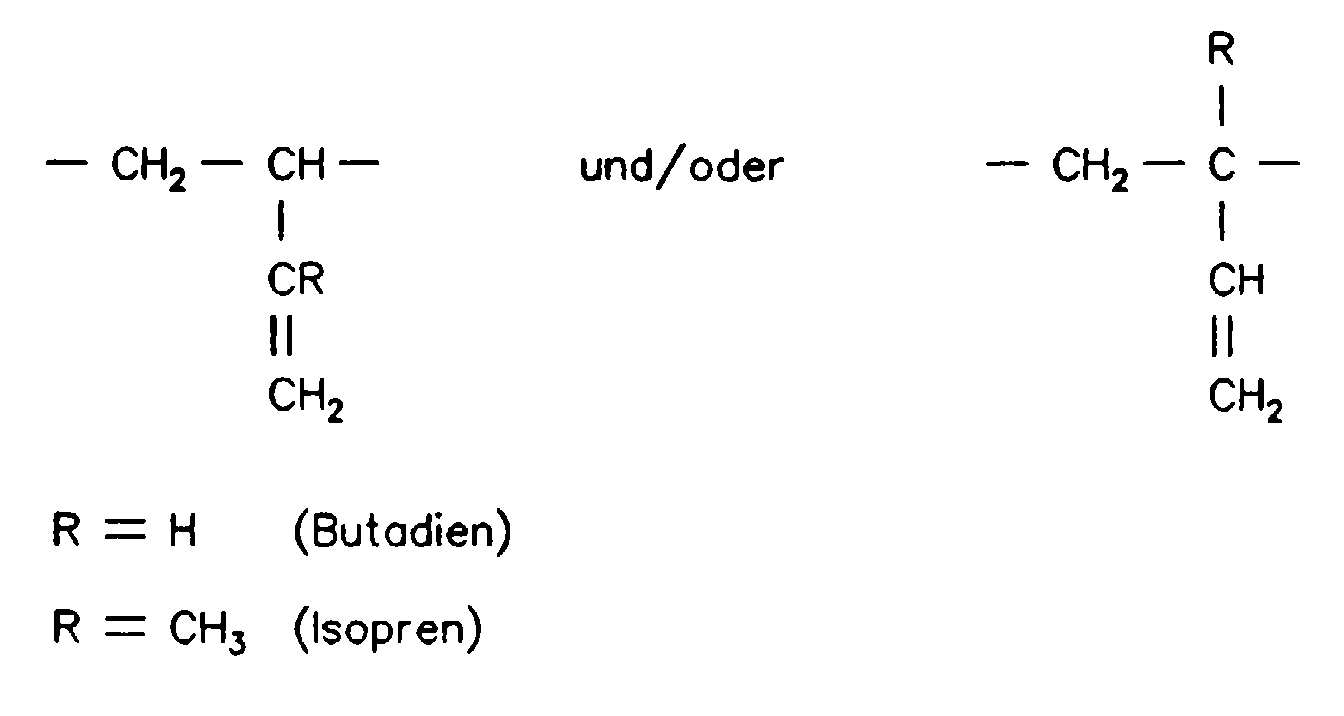
- Die Auswahl der Cokatalysatoren richtet sich daher nach ihrer Fähigkeit, die Mikrostruktur zu regeln, d. h. den Verlauf der Polymerisation im Hinblick auf eine möglichst vollständige Bildung von 1,2- und/oder 3,4-Struktureinheiten zu lenken.
- Der Cokatalysator wird im allgemeinen aus der Gruppe
- der Ether,
- der tertiären Amine oder
- der etherhaltigen tertiären Amine
- Geeignete Ether umfassen insbesondere
- Dialkylether des Ethylenglykols und Diethylenglykols, deren Alkylgruppen jeweils bis zu 4 C-Atome aufweisen, wie Ethylenglykoldiethylether (DEE).
- Insbesondere bei der Herstellung von verzweigten Blockcopolymeren werden Ether der allgemeinen Formel
R1 - O - CH2 - CH2 - O - R2
bevorzugt, wobei R1 und R2 Alkylreste mit einer unterschiedlichen Zahl von C-Atomen aus der Gruppe Methyl, Ethyl, n- und iso-Propyl sowie n-, iso-, sek.- und tert.-Butyl sind. Vorzugsweise beträgt die Summe der C-Atome der beiden Reste R1 und R2 5 bis 7, insbesondere 6. Ein besonders geeigneter Ethylenglykolether ist die Verbindung mit R1 = Ethyl und R2 = tert.-Butyl. Die Glykolether sind beispielsweise nach dem Prinzip der Williamson-Synthese aus einem Natriumalkoholat und einem Alkylhalogenid zugänglich. Die Ether der Formel
R1 - O - CH2 - CH2 - O - C(CH3)3
können in einfacher Weise durch Umsetzung des entsprechenden Alkohols
R1 - O - CH2 - CH2 - OH
mit Isobuten in Gegenwart eines sauren Ionenaustauschers hergestellt werden. - Geeignete tertiäre Amine sind z. B. N,N,N',N'-Tetramethylethylendiamin, N,N,N',N'-Tetraethylethylendiamin und Triethylendiamin.
- Geeignete etherhaltige Amine sind N-Methylmorpholin und N-Ethylmorpholin.
- Der Cokatalysator wird in einem Verhältnis von 2 : 1 bis 30 : 1, insbesondere 2 : 1 bis 15 : 1, bezogen auf die Molzahl des Katalysators, eingesetzt. Bei höheren Temperaturen werden im allgemeinen größere Mengen an Cokatalysator benötigt, um die gewünschte Mikrostrukturregelung zu erzielen. Reaktionstemperaturen von 100 °C sollten nicht überschritten werden. Es ist auch möglich, bei steigender oder fallender Temperatur zu arbeiten; jedoch ist in diesem Fall dafür Sorge zu tragen, daß die Mikrostruktur nicht grundsätzlich verändert wird.
- Bei der Herstellung von Block B und gegebenenfalls A wird Styrol als Comonomer zugesetzt. Durch geeignete Maßnahmen ist dafür Sorge zu tragen, daß der Gehalt an Polystyrolblöcken im AB-Blockcopolymerisat 2 Massen-% nicht überschreitet. Ein Verfahren zur Bestimmung des Gehalts an Polystyrolblöcken ist in dem Standardwerk Houben-Weyl "Methoden der Organischen Chemie", Band 14/1 (1061), Seite 698, angegeben.
- Es ist bekannt, daß einige als Cokatalysatoren vorgeschlagene Verbindungen die Eigenschaft haben, die Ausbildung von Polystyrolblöcken zu unterdrücken. Die gleiche Eigenschaft haben Verbindungen, die als Randomizer bezeichnet werden und meist Kaliumsalze von Alkoholaten sowie organischen Carbon- und Sulfonsäuren sind.
- Gemäß einer besonderen Ausführungsform des Verfahrens können die nach Abschluß der Polymerisation vorliegenden "lebenden Polymere" mit einem Kupplungsmittel zu verzweigten oder sternförmigen Blockcopolymerisaten umgesetzt werden.
- Geeignete Kupplungsmittel sind Polyepoxide, wie epoxidiertes Leinsamenöl, Polyisocyanate, Polyketone, wie 1,3,6-Hexantrion, Polyanhydride, wie beispielsweise das Dianhydrid der Pyromellithsäure und Dicarbonsäureester, wie Adipinsäuredimethylester. Besonders geeignet sind
- die Tetrahalogenide der Elemente Si, Ge, Sn und Pb, insbesondere SiCl4.
- Organische Verbindungen der allgemeinen Formel Rn[SiHal3]n, mit n = 1 bis 6, insbesondere n = 1 und 2. Hierbei ist R ein n-wertiger organischer Rest, beispielsweise ein aliphatischer, cycloaliphatischer oder aromatischer Rest mit 6 bis 16 C-Atomen. Beispielhaft seien 1,2,4-Tris(2-trichlorsilylethyl)-cyclohexan, 1,8-Bis(trichlorsilyl)-octan und 1-(Trichlorsilyl)-octan genannt.
- Organische Verbindungen, die mindestens einmal die Gruppierung > SiHal2 enthalten, wie z. B. Dimethylsilylchlorid.
- Halogensilanwasserstoffe der allgemeinen Formel Si(H)m(Hal)4-m mit 3 ≥ m ≥ 1.
- Di- und Trivinylbenzole, wie z. B. 1,4-Divinylbenzol.
- Es hat sich als zweckmäßig erwiesen, als Kupplungsmittel Divinylbenzol zu verwenden.
- Das Verfahren kann sowohl diskontinuierlich als auch kontinuierlich betrieben werden.
- Als Lösemittel wird ein Kohlenwasserstoffgemisch eingesetzt, das zu etwa 50 % aus Hexan besteht. Weitere Bestandteile dieses hydrierten C6-Schnitts sind insbesondere Pentan, Heptan und Oktan sowie deren Isomere. Das Lösemittel wird über einem Molekularsieb der Porenweite 0,4 nm getrocknet, so daß der Wasseranteil unter 10 ppm gesenkt wird, und anschließend mit N2 gestrippt.
- Die organische Lithiumverbindung ist n-Butyllithium, die, wenn nicht anders angegeben, in Form einer 20gewichtsprozentigen Lösung in Hexan zur Anwendung kommt.
- Die Monomeren Isopren und Styrol werden vor ihrem Einsatz 24 Stunden über Calciumhydrid unter Rückfluß gekocht, abdestilliert und mit n-Butyllithium in Gegenwart von o-Phenanthrolin austitriert.
- Die Glykolether werden über Calciumhydrid destilliert und anschließend mit n-Butyllithium in Gegenwart von o-Phenanthrolin austitriert.
- Das Divinylbenzol (DVB) stellt ein Gemisch des m- und p-Divinylbenzols dar und wird in Form einer 64%igen Lösung in Hexan eingesetzt. Die Bestimmung des Umsatzes erfolgt, indem man den Feststoffgehalt nach Abdampfen des Lösemittels und der Monomeren bestimmt.
- Die Bestimmung der Mikrostruktur erfolgt IR-spektroskopisch.
- Als Kupplungsausbeute wird der Prozentanteil an Kautschuk angesehen, der nach der Umsetzung mit einem Kupplungsmittel eine sternförmige Struktur aufweist und sich gegenüber dem ungekuppelten Kautschuk durch ein erheblich höheres Molekulargewicht auszeichnet. Die Bestimmung erfolgt mit der GPC-Analyse, wobei Tetrahydrofuran als Lösemittel und Polystyrol als Säulenmaterial eingesetzt wird. Die Polymerisate werden mit einem Lichtstreuungsdetektor charakterisiert. Zu diesem Zweck werden dem Reaktor vor Zugabe des Kupplungsmittels und zu Ende der Reaktion Proben entnommen. Die Defo-Härte (DH) und die Defo-Elastizität (DE) werden nach den üblichen Meßmethoden bestimmt (DIN 53 514).
- Die zu verwendenden Öle oder beliebige Kombinationen aus diesen Ölen können folgendermaßen charakterisiert werden (siehe dazu Kautschuk + Gummi Kunststoffe 39. Jahrgang Nr. 9/86, Seite 816):
Paraffinisch Paraffinisch/naphthenisch Naphthenisch Naphthenisch/aromatisch Aromatisch Sehr aromatisch CA (aromatisch) < 10 < 15 0 - 30 25 - 40 35 - 50 50 - 60 CN (naphthenisch) 20 - 30 25 - 40 30 - 45 20 - 45 25 - 40 < 40 CP (paraffinisch) 55 - 75 55 - 65 35 - 55 25 - 45 20 - 35 < 25 C ≙ Kohlenstoffatom - Sie können im Bereich von 10 phr bis 50 phr zum Einsatz kommen, d. h. die Ölmenge richtet sich jeweils nach der Einsatzmenge des aktiven, verstärkenden Füllstoffs.
- Die erfindungsgemäßen Laufflächen können sowohl aromatisches als auch naphthenisches oder paraffinisches Öl oder einen beliebigen Blend aus den oben angegebenen Spezifikationen enthalten. Bevorzugt wird aromatisches oder naphthenisches Öl eingesetzt. Anstelle eines üblichen aktiven Rußes kann auch ein mineralischer Füllstoff (z. B. Kieselsäure) oder eine Kombination aus beiden eingesetzt werden. Der Ruß oder die Kieselsäure werden von 50 bis 90 phr eingesetzt. Bei Blends aus beiden Komponenten beträgt die Menge der Blends ebenfalls 50 bis 90 phr.
- Der Laufflächenkautschuk wird nach der allgemeinen Vulkanisationsmischung (siehe Beispiele) mit 50 phr Ruß und 10 phr aromatischem Öl hergestellt und einer Laborprüfung unterzogen, wobei die Raumtemperaturelastizität bei 22 °C bestimmt wird. Dabei kann es sich um einen Integralkautschuk oder um einen beliebigen Blend aus den angegeben Kautschuken handeln.
- Liegt die Raumtemperaturelastizität der Mischung zwischen 5 und 35 %, dann kann durch Herstellung eines Blends mit BR das ABS-Bremsen deutlich verbessert werden.
- Die Herstellung der Reifenlaufflächen erfolgt in an sich bekannter Weise durch Vermischen der Kautschukkomponente mit den Zuschlagstoffen. Übliche Zuschlagstoffe sind beispielsweise Ruße, Kieselsäuren, Weichmacher, Beschleuniger, Alterungs- und Ozonschutzmittel und Harze. Das Vermischen erfolgt in üblichen Mischungsaggregaten, z. B. Kneter und Walzwerke. Die dabei einzustellende Temperatur hängt in bekannter Weise von der Zusammensetzung der Compounds und den Mischungsverfahren ab.
Tabelle 1 Beispiel 1 Basis 2 3 4 5 6 Polymer A B C D E D Polymer (phr) 100 100 100 50 50 50 BR (phr)a) - - - 50 50 50 Öltyp aromatisch 37,5 10 10 10 10 - naphthenischb) - - - - - 10 Füllstoff N-339 75 50 50 50 50 50 Labordaten Härte (Shore A) % bei 0 °C 67 99 91 80 85 Härte (Shore A) % bei 22 °C 65 68 66 66 66 65 Elastizität (%) bei 22 °C1) 29 8 30 10 23 17 Elastizität (%) bei 75 °C1) 45 49 57 54 54 56 Abrieb in mm 3 2) 40 150 128 146 144 149 Reifendaten3) Naßrutschen BL-Bremsen Asphalt4) 100 101 101 106 102 106 Beton4) 100 116 103 109 106 110 ABS-Bremsen Asphalt5) 100 84 100 90 95 108 Beton5) 100 98 - - - - Rollwiderstand6) 100 83 101 92 99 102 -
- 1) Prüfung gemäß DIN 53 512
- 2) Prüfung gemäß DIN 53 516
- 3) Reifengröße 195/65 R 15, alle Ratings beziehen sich auf die Basis Beispiel 1, alle Werte > 100 sind besser als die Basis
- 4) Blockierbremsen aus Tempo 50 km/h bei Luftdruck 2,2 bar, naß
- 5) 4-Rad-ABS-Bremsen aus Tempo 50 km/h, naß
- 6) Gemessen auf einem Rollenprüfstand bei einer Geschwindigkeit von 110 km/h, Luftdruck 2,5 kg/cm2, Last 330 kg, Temperatur 35 °C, alle Werte > 100 sind besser als die Basis
- a) Auf Basis Li-Katalysator, z. B. CB 45
- b) z. B. Circosol 4240, Puccini Q8 6OP
- BUNA® HÜLS EM 1712 ist ein üblicher Styrol-Butadien-Kautschuk, mit 37,5 Teilen Öl gestreckt. Abweichend von der später angegebenen, allgemeinen Vulkanisationsmischung wird BUNA® HÜLS EM 1712 in folgender Zusammensetzung vulkanisiert:
137,5 Teile BUNA® HÜLS EM 1712 75 Teile Ruß N 339 3 Teile aromatisches Öl 3 Teile Zinkoxid 2 Teile Stearinsäure 1 Teil VULKANOX® 4010 NA 1 Teil VULKANOX® 4020 1 Teil KORESIN® 1,5 Teile CBS 0,2 Teile DPG 2 Teile Schwefel - In einem mit trockenem Stickstoff gespülten, ersten V2A-Rührautoklaven werden 275 Teile Hexan, 40 Teile 1,3-Butadien und 0,03 Teile DVB vorgelegt und nach Trocknung über einem Molekularsieb (0,4 mm) unter thermoelektrischer Kontrolle mit n-Butyllithium (Buli) titriert. Die Polymerisation wird bei 50 °C durch Zugabe von 0,032 Teilen n-Butyllithium gestartet. Die Temperatur steigt trotz Kühlung kurzzeitig bis auf maximal 62 °C. Nach 107 Minuten, nachdem das vorgelegte 1,3-Butadien praktisch vollständig umgesetzt ist, wird eine IR-Probe entnommen und wie das Endprodukt aufgearbeitet.
- Unmittelbar danach wird innerhalb von 100 Sekunden der Inhalt eines zweiten V2A-Rührautoklaven (40 °C) zugegeben. Dieser enthält eine mit n-Butyllithium titrierte Lösung von 15 Teilen 1,3-Butadien, 30 Teilen Isopren und 15 Teilen Styrol in 190 Teilen Hexan.
- Unmittelbar danach werden 2,0 Teile Ethylenglykoldimethylether zugegeben. Die Temperatur wird konstant bei 50 °C gehalten. 4 Stunden nach dem Start wird die Polymerisation durch Zugabe einer Lösung von 0,5 Teilen 2,2-Methylen-(4-methyl-6-tertiär-butylphenol) in 2 Teilen feuchtem Toluol gestoppt. Das Lösemittel wird mit Wasserdampf abdestilliert und das Polymerisat 24 Stunden bei 70 °C im Umluftschrank getrocknet.
Mikrostruktur: Butadien: 1,4-trans 23 1,2 17 1,4-cis 17 Isopren: 3,4 24 1,4 3 Styrol: 16 - In einem mit trockenem Stickstoff gespülten, ersten V2A-Rührautoklaven werden 275 Teile Hexan, 50 Teile 1,3-Butadien und 0,03 Teile DVB vorgelegt und nach Trocknung über einem Molekularsieb (0,4 mm) unter thermoelektrischer Kontrolle mit n-Butyllithium (Buli) titriert. Die Polymerisation wird bei 50 °C durch Zugabe von 0,032 Teilen n-Butyllithium gestartet. Die Temperatur steigt trotz Kühlung kurzzeitig bis auf maximal 62 °C. Nach 107 Minuten, nachdem das vorgelegte 1,3-Butadien praktisch vollständig umgesetzt ist, wird eine IR-Probe entnommen und wie das Endprodukt aufgearbeitet.
- Unmittelbar danach wird innerhalb von 100 Sekunden der Inhalt eines zweiten V2A-Rührautoklaven (40 °C) zugegeben. Dieser enthält eine mit n-Butyllithium titrierte Lösung von 20 Teilen 1,3-Butadien, 15 Teilen Isopren und 15 Teilen Styrol in 190 Teilen Hexan.
- Unmittelbar danach werden 2,0 Teile Ethylenglykoldimethylether zugegeben. Die Temperatur wird konstant bei 50 °C gehalten. 4 Stunden nach dem Start wird die Polymerisation durch Zugabe einer Lösung von 0,5 Teilen 2,2-Methylen-(4-methyl-6-tertiär-butylphenol) in 2 Teilen feuchtem Toluol gestoppt. Das Lösemittel wird mit Wasserdampf abdestilliert und das Polymerisat 24 Stunden bei 70 °C im Umluftschrank getrocknet.
Mikrostruktur: Butadien: 1,4-trans 29 1,2 19 1,4-cis 22 Isopren: 3,4 10 1,4 3 Styrol: 16 - In einem mit trockenem Stickstoff gespülten V2A-Autoklaven werden 400 Teile Hexan, ein Monomeren-Gemisch aus 40 Teilen 1,3-Butadien, 30 Teilen Isopren, 30 Teilen Styrol, 0,02 Teilen DVB und 1,0 Teilen Ethylglykoltertiär-butylether vorgelegt und nach Trocknung über Molekularsieb (0,4 mm) unter thermoelektrischer Kontrolle mit Butyllithium titriert. Die Polymerisation wird bei 40 °C durch Zugabe von 0,054 Teilen n-Butyllithium gestartet. Die Temperatur wird unter Kühlung im Bereich von 40 bis 60 °C gehalten. Bei dieser Endtemperatur kann der Ansatz 2 Stunden lang nachreagieren. Nach Abkühlung auf 50 °C wird die Polymerisation durch Zugabe einer Lösung von 0,5 Teilen 2,2'-Methylen-bis-(4-methyl-6-tertiärbutylphenol) in 2 Teilen feuchtem Toluol gestoppt. Das Lösemittel wird mit Wasserdampf abdestilliert und das Polymerisat 24 Stunden bei 70 °C im Umlufttrockenschrank getrocknet.
Mikrostruktur: Butadien: 1,4-trans 7 1,2 28 1,4-cis 5 Isopren: 3,4 20 1,4 8 Styrol: 32 - Die Herstellung erfolgt wie beim Terpolymer E, jedoch wird die Temperatur nach der Zugabe von 0,054 Teilen n-Butyllithium ohne Kühlung auf ca. 120 °C hochgefahren. Bei dieser Temperatur kann der Ansatz 30 Minuten lang nachreagieren.
Mikrostruktur: Butadien: 1,4-trans 10 1,2 27 1,4-cis 9 Isopren: 3,4 18 1,4 5 Styrol: 31 - Aus den erfindungsgemäßen Laufflächenkautschuken werden Vulkanisationsmischungen folgender Zusammensetzung hergestellt (siehe Tabelle 1):
100 Teile Laufflächenkautschuk 50 Teile Ruß N 339 10 Teile aromatisches Öl oder naphthenisches Öl 3 Teile Zinkoxid 1 Teil Stearinsäure 1 Teil N-Isopropyl-N'-phenyl-p-phenylendiamin (VULKANOX® 4010 NA) 1 Teil N-(1,3-Dimethylbutyl)-N'-phenylendiamin VULKANOX® 4020 1 Teil KORESIN®, Umsetzungsprodukt von p-tert.-Butylphenol mit Acetylen 1,3 Teile N-Cyclohexyl-1-benzothiazolsulfenamid (CBS, VULKACIT® CZ) 0,3 Teile Diphenylguanidin (DPG, VULKACIT® DZ) 1,6 Teile Schwefel - Die Produkte VULKANOX® 4010 NA, VULKANOX® 4020, VULKACIT® CZ und VULKACIT® DZ sind bei der Bayer AG, Leverkusen, und KORESIN® bei der BASF AG, Ludwigshafen, erhältlich.
Claims (4)
- Reifenlaufflächen auf Basis von Copolymerisaten aus Butadien und Isopren und/oder Styrol, welche eine Raumtemperaturelastizität zwischen 5 und 35 % (bei 22 °C) aufweisen, sowie üblichen Zuschlagstoffen mit deutlich verbessertem Rollwiderstand und Naßrutschverhalten beim ABS-Bremsen,
dadurch gekennzeichnet,
daß die Copolymerisate mit Polybutadienkautschuk verblendet werden. - Reifenlaufflächen gemäß Anspruch 1,
dadurch gekennzeichnet,
daß die Copolymerisate aus- 5 bis 60 % Butadien,- bis zu 60 % Isopren und- bis zu 45 % Styrol,wobei der Vinylgehalt der Dieneinheiten 50 bis 90 % beträgt, bestehen. - Reifenlaufflächen gemäß den Ansprüchen 1 und 2,
dadurch gekennzeichnet,
daß der Laufflächenkautschuk aromatisches und/oder naphthenisches und/oder paraffinisches Öl mit Ruß und/oder einen mineralischen Füllstoff enthält. - Reifenlaufflächen gemäß den Ansprüchen 1 bis 3,
dadurch gekennzeichnet,
daß das Blendverhältnis von Copolymer zu Polybutadienkautschuk bei 90 : 10 bis 40 : 60 liegt.
Applications Claiming Priority (2)
| Application Number | Priority Date | Filing Date | Title |
|---|---|---|---|
| DE19613195A DE19613195A1 (de) | 1996-04-02 | 1996-04-02 | Reifenlaufflächen mit geringem Rollwiderstand und verbessertem ABS-Bremsen |
| DE19613195 | 1996-04-02 |
Publications (2)
| Publication Number | Publication Date |
|---|---|
| EP0799724A1 true EP0799724A1 (de) | 1997-10-08 |
| EP0799724B1 EP0799724B1 (de) | 2004-05-12 |
Family
ID=7790285
Family Applications (1)
| Application Number | Title | Priority Date | Filing Date |
|---|---|---|---|
| EP97101860A Expired - Lifetime EP0799724B1 (de) | 1996-04-02 | 1997-02-06 | Reifenlaufflächen mit geringem Rollwiderstand und verbessertem ABS-Bremsen |
Country Status (4)
| Country | Link |
|---|---|
| US (1) | US6119743A (de) |
| EP (1) | EP0799724B1 (de) |
| JP (1) | JP3964957B2 (de) |
| DE (2) | DE19613195A1 (de) |
Families Citing this family (5)
| Publication number | Priority date | Publication date | Assignee | Title |
|---|---|---|---|---|
| JP2001097005A (ja) * | 1999-09-29 | 2001-04-10 | Toyo Tire & Rubber Co Ltd | Abs装着車用空気入りタイヤ |
| DE10234746B4 (de) * | 2002-07-30 | 2004-04-29 | Sasol Germany Gmbh | Verfahren zur Herstellung von Polymerisaten unter Verwendung von konjugierten Dienen und vinylaromatischen Verbindungen, nach diesem Verfahren hergestellte Polymerisate und deren Verwendung |
| ITTO20060552A1 (it) * | 2006-07-26 | 2008-01-27 | Bridgestone Corp | Mescola di connessione per la ricostruzione a freddo dei pneumatici |
| EP2675845B1 (de) | 2011-02-14 | 2021-09-08 | Kuraray America Inc. | Elastomere formulierungen für schichten und folien |
| JP6557102B2 (ja) * | 2015-09-17 | 2019-08-07 | 日立造船株式会社 | ポリイソプレンの製造方法 |
Citations (4)
| Publication number | Priority date | Publication date | Assignee | Title |
|---|---|---|---|---|
| JPS62175203A (ja) * | 1986-01-29 | 1987-07-31 | Yokohama Rubber Co Ltd:The | アンチロツクブレ−キシステム装着車両専用タイヤ |
| US5159020A (en) * | 1989-12-28 | 1992-10-27 | The Goodyear Tire & Rubber Company | Tire with tread comprising styrene, isoprene, butadiene terpolymer rubber |
| EP0645423A1 (de) * | 1993-09-20 | 1995-03-29 | The Goodyear Tire & Rubber Company | Reifen mit Kieselsäure verstärkter Lauffläche |
| EP0677548A1 (de) * | 1994-04-14 | 1995-10-18 | Semperit Reifen Aktiengesellschaft | Kautschukmischung |
Family Cites Families (9)
| Publication number | Priority date | Publication date | Assignee | Title |
|---|---|---|---|---|
| JPS56122845A (en) * | 1980-03-04 | 1981-09-26 | Yokohama Rubber Co Ltd:The | Rubber composition for tire tread and tire using same |
| US5164450A (en) * | 1984-05-16 | 1992-11-17 | Japan Synthetic Rubber Co. | Butadiene copolymer rubber composition |
| JPH0621186B2 (ja) * | 1984-06-08 | 1994-03-23 | 旭化成工業株式会社 | 改良されたタイヤ用ゴム組成物 |
| JPH0621191B2 (ja) * | 1984-07-02 | 1994-03-23 | 旭化成工業株式会社 | タイヤトレツド用加硫ゴム組成物 |
| GB8724437D0 (en) * | 1987-10-19 | 1987-11-25 | Shell Int Research | Elastomeric compositions |
| US5047483A (en) * | 1988-06-29 | 1991-09-10 | The Goodyear Tire & Rubber Company | Pneumatic tire with tread of styrene, isoprene, butadiene rubber |
| JPH06102737B2 (ja) * | 1989-04-13 | 1994-12-14 | 東洋ゴム工業株式会社 | タイヤ用トレッドゴム組成物 |
| US5272220A (en) * | 1992-09-14 | 1993-12-21 | The Goodyear Tire & Rubber Company | Process for preparing styrene-isoprene-butadiene rubber |
| US5623035A (en) * | 1995-07-21 | 1997-04-22 | The Goodyear Tire & Rubber Company | Process for the synthesis of rubbery polymers |
-
1996
- 1996-04-02 DE DE19613195A patent/DE19613195A1/de not_active Withdrawn
-
1997
- 1997-02-06 DE DE59711605T patent/DE59711605D1/de not_active Expired - Lifetime
- 1997-02-06 EP EP97101860A patent/EP0799724B1/de not_active Expired - Lifetime
- 1997-03-31 JP JP07943797A patent/JP3964957B2/ja not_active Expired - Fee Related
- 1997-04-02 US US08/832,542 patent/US6119743A/en not_active Expired - Lifetime
Patent Citations (4)
| Publication number | Priority date | Publication date | Assignee | Title |
|---|---|---|---|---|
| JPS62175203A (ja) * | 1986-01-29 | 1987-07-31 | Yokohama Rubber Co Ltd:The | アンチロツクブレ−キシステム装着車両専用タイヤ |
| US5159020A (en) * | 1989-12-28 | 1992-10-27 | The Goodyear Tire & Rubber Company | Tire with tread comprising styrene, isoprene, butadiene terpolymer rubber |
| EP0645423A1 (de) * | 1993-09-20 | 1995-03-29 | The Goodyear Tire & Rubber Company | Reifen mit Kieselsäure verstärkter Lauffläche |
| EP0677548A1 (de) * | 1994-04-14 | 1995-10-18 | Semperit Reifen Aktiengesellschaft | Kautschukmischung |
Non-Patent Citations (1)
| Title |
|---|
| PATENT ABSTRACTS OF JAPAN vol. 012, no. 14 (M - 659) 16 January 1988 (1988-01-16) * |
Also Published As
| Publication number | Publication date |
|---|---|
| DE59711605D1 (de) | 2004-06-17 |
| EP0799724B1 (de) | 2004-05-12 |
| JP3964957B2 (ja) | 2007-08-22 |
| JPH1017716A (ja) | 1998-01-20 |
| US6119743A (en) | 2000-09-19 |
| DE19613195A1 (de) | 1997-10-09 |
Similar Documents
| Publication | Publication Date | Title |
|---|---|---|
| EP0302196B1 (de) | AB-Blockcopolymerisate auf Basis von Butadien, Isopren und Styrol, Verfahren zu ihrer Herstellung und ihre Verwendung | |
| EP0256261B1 (de) | ABC-Blockcopolymerisate auf Basis von Butadien und Isopren, Verfahren zu ihrer Herstellung und ihre Verwendung | |
| EP0328774B1 (de) | ABC-Blockcopolymerisate auf Basis von Butadien, Isopren und Styrol, Verfahren zu ihrer Herstellung und ihre Verwendung | |
| DE69922900T2 (de) | Ölgestreckter Gummi und Gummizusammensetzung | |
| DE69312891T2 (de) | Verfahren zur Herstellung von Dienpolymerisaten und die hierbei erhaltene Kautschuckmischungen | |
| DE3519430A1 (de) | Kautschukmasse fuer kraftfahrzeugreifen | |
| EP0304589B1 (de) | Verfahren zur Herstellung von Polymerisaten auf Basis von konjugierten Dienen und ggf. monovinylaromatischen Verbindungen | |
| EP0799726B1 (de) | Reifenlaufflächen mit geringem Rollwiderstand und verbessertem ABS-Bremsen | |
| DE69822278T2 (de) | Kautschuk aus einem konjugierten Diolefin -Copolymer und dessen Zusammensetzungen | |
| EP0362514B1 (de) | Ungesättigte, elastomere, asymmetrisch gekuppelte Blockcopolymere, ein Eintopfverfahren zu ihrer Herstellung und ihre Verwendung zur Herstellung von Reifenbauteilen | |
| EP0384033B1 (de) | Statistische AB-Blockcopolymere mit verbesserten Eigenschaften, Verfahren zu ihrer Herstellung und ihre Verwendung | |
| EP0799725B1 (de) | Reifenlaufflächen mit geringem Rollwiderstand und verbesserten ABS-Bremsen | |
| EP0362515B1 (de) | Ungesättigte, elastomere, asymmetrisch gekuppelte Blockcopolymere, ein Zweitopfverfahren zu ihrer Herstellung und ihre Verwendung zur Herstellung von Reifenbauteilen | |
| EP0344441B1 (de) | AB-Blockcopolymerisate auf Basis von Butadien, Isopren und Styrol, Verfahren zu ihrer Herstellung und ihre Verwendung | |
| EP0799724B1 (de) | Reifenlaufflächen mit geringem Rollwiderstand und verbessertem ABS-Bremsen | |
| EP1525239B1 (de) | Verfahren zur herstellung von polymerisaten unter verwendung von konjugierten dienen und vinylaromatischen verbindungen, nach diesem verfahren hergestellte polymerisate und deren verwendung | |
| EP0248175B1 (de) | Polyisoprene mit einem hohen Anteil von 1, 2- und 3, 4- Struktureinheiten, Verfahren zu ihrer Herstellung und ihre Verwendung | |
| DE10243618A1 (de) | Mikrostrukturregler zur Herstellung von Homo- und Copolymeren von Dienen und Vinylaromaten durch anionische Polymerisation | |
| EP1453869A2 (de) | Mikrostrukturregler für die anionische polymerisation | |
| DE1720704A1 (de) | Verfahren zur Herstellung hochmolekularer Polymere | |
| EP1670836A1 (de) | Katalysatorsystem zur herstellung von homo- und copolymeren von dienen und vinylaromaten durch anionische polymerisation |
Legal Events
| Date | Code | Title | Description |
|---|---|---|---|
| PUAI | Public reference made under article 153(3) epc to a published international application that has entered the european phase |
Free format text: ORIGINAL CODE: 0009012 |
|
| AK | Designated contracting states |
Kind code of ref document: A1 Designated state(s): DE ES FR GB IT LU |
|
| 17P | Request for examination filed |
Effective date: 19970830 |
|
| RAP1 | Party data changed (applicant data changed or rights of an application transferred) |
Owner name: DEGUSSA-HUELS AKTIENGESELLSCHAFT |
|
| 17Q | First examination report despatched |
Effective date: 20000720 |
|
| RAP1 | Party data changed (applicant data changed or rights of an application transferred) |
Owner name: DEGUSSA AG |
|
| RAP1 | Party data changed (applicant data changed or rights of an application transferred) |
Owner name: CONTINENTAL AKTIENGESELLSCHAFT |
|
| GRAP | Despatch of communication of intention to grant a patent |
Free format text: ORIGINAL CODE: EPIDOSNIGR1 |
|
| GRAS | Grant fee paid |
Free format text: ORIGINAL CODE: EPIDOSNIGR3 |
|
| GRAA | (expected) grant |
Free format text: ORIGINAL CODE: 0009210 |
|
| AK | Designated contracting states |
Kind code of ref document: B1 Designated state(s): DE ES FR GB IT LU |
|
| PG25 | Lapsed in a contracting state [announced via postgrant information from national office to epo] |
Ref country code: IT Free format text: LAPSE BECAUSE OF FAILURE TO SUBMIT A TRANSLATION OF THE DESCRIPTION OR TO PAY THE FEE WITHIN THE PRESCRIBED TIME-LIMIT;WARNING: LAPSES OF ITALIAN PATENTS WITH EFFECTIVE DATE BEFORE 2007 MAY HAVE OCCURRED AT ANY TIME BEFORE 2007. THE CORRECT EFFECTIVE DATE MAY BE DIFFERENT FROM THE ONE RECORDED. Effective date: 20040512 Ref country code: GB Free format text: LAPSE BECAUSE OF FAILURE TO SUBMIT A TRANSLATION OF THE DESCRIPTION OR TO PAY THE FEE WITHIN THE PRESCRIBED TIME-LIMIT Effective date: 20040512 |
|
| REG | Reference to a national code |
Ref country code: GB Ref legal event code: FG4D Free format text: NOT ENGLISH |
|
| REF | Corresponds to: |
Ref document number: 59711605 Country of ref document: DE Date of ref document: 20040617 Kind code of ref document: P |
|
| PG25 | Lapsed in a contracting state [announced via postgrant information from national office to epo] |
Ref country code: ES Free format text: LAPSE BECAUSE OF FAILURE TO SUBMIT A TRANSLATION OF THE DESCRIPTION OR TO PAY THE FEE WITHIN THE PRESCRIBED TIME-LIMIT Effective date: 20040823 |
|
| GBV | Gb: ep patent (uk) treated as always having been void in accordance with gb section 77(7)/1977 [no translation filed] |
Effective date: 20040512 |
|
| ET | Fr: translation filed | ||
| PG25 | Lapsed in a contracting state [announced via postgrant information from national office to epo] |
Ref country code: LU Free format text: LAPSE BECAUSE OF NON-PAYMENT OF DUE FEES Effective date: 20050206 |
|
| PLBE | No opposition filed within time limit |
Free format text: ORIGINAL CODE: 0009261 |
|
| STAA | Information on the status of an ep patent application or granted ep patent |
Free format text: STATUS: NO OPPOSITION FILED WITHIN TIME LIMIT |
|
| 26N | No opposition filed |
Effective date: 20050215 |
|
| REG | Reference to a national code |
Ref country code: FR Ref legal event code: PLFP Year of fee payment: 20 |
|
| PGFP | Annual fee paid to national office [announced via postgrant information from national office to epo] |
Ref country code: DE Payment date: 20160229 Year of fee payment: 20 |
|
| PGFP | Annual fee paid to national office [announced via postgrant information from national office to epo] |
Ref country code: FR Payment date: 20160218 Year of fee payment: 20 |
|
| REG | Reference to a national code |
Ref country code: DE Ref legal event code: R071 Ref document number: 59711605 Country of ref document: DE |