EP0801301A2 - Procédé optique pour la détermination de l'acide mévalonique - Google Patents
Procédé optique pour la détermination de l'acide mévalonique Download PDFInfo
- Publication number
- EP0801301A2 EP0801301A2 EP97105960A EP97105960A EP0801301A2 EP 0801301 A2 EP0801301 A2 EP 0801301A2 EP 97105960 A EP97105960 A EP 97105960A EP 97105960 A EP97105960 A EP 97105960A EP 0801301 A2 EP0801301 A2 EP 0801301A2
- Authority
- EP
- European Patent Office
- Prior art keywords
- sample
- light
- excitation light
- acid
- raman
- Prior art date
- Legal status (The legal status is an assumption and is not a legal conclusion. Google has not performed a legal analysis and makes no representation as to the accuracy of the status listed.)
- Withdrawn
Links
- KJTLQQUUPVSXIM-UHFFFAOYSA-N DL-mevalonic acid Natural products OCCC(O)(C)CC(O)=O KJTLQQUUPVSXIM-UHFFFAOYSA-N 0.000 title claims abstract description 85
- KJTLQQUUPVSXIM-ZCFIWIBFSA-N (R)-mevalonic acid Chemical compound OCC[C@](O)(C)CC(O)=O KJTLQQUUPVSXIM-ZCFIWIBFSA-N 0.000 title claims abstract description 40
- 238000000034 method Methods 0.000 title claims abstract description 28
- 230000003287 optical effect Effects 0.000 title claims description 54
- 230000005284 excitation Effects 0.000 claims abstract description 68
- -1 lactone mevalonate Chemical class 0.000 claims abstract description 45
- 238000001069 Raman spectroscopy Methods 0.000 claims abstract description 43
- 239000002253 acid Substances 0.000 claims abstract description 7
- 230000003595 spectral effect Effects 0.000 claims description 16
- VEXZGXHMUGYJMC-UHFFFAOYSA-N Hydrochloric acid Chemical group Cl VEXZGXHMUGYJMC-UHFFFAOYSA-N 0.000 claims description 12
- 238000010306 acid treatment Methods 0.000 claims description 10
- 238000005259 measurement Methods 0.000 claims description 9
- 239000007789 gas Substances 0.000 claims description 5
- 230000001678 irradiating effect Effects 0.000 claims description 5
- 238000011088 calibration curve Methods 0.000 claims description 4
- IXCSERBJSXMMFS-UHFFFAOYSA-N hydrogen chloride Substances Cl.Cl IXCSERBJSXMMFS-UHFFFAOYSA-N 0.000 claims description 4
- 229910000041 hydrogen chloride Inorganic materials 0.000 claims description 4
- 210000002700 urine Anatomy 0.000 abstract description 13
- 238000006243 chemical reaction Methods 0.000 abstract description 11
- 210000002381 plasma Anatomy 0.000 abstract description 11
- 210000002966 serum Anatomy 0.000 abstract description 3
- 238000002095 near-infrared Raman spectroscopy Methods 0.000 abstract 1
- 238000012937 correction Methods 0.000 description 24
- 238000012545 processing Methods 0.000 description 12
- 238000001237 Raman spectrum Methods 0.000 description 10
- 238000010586 diagram Methods 0.000 description 7
- 230000005540 biological transmission Effects 0.000 description 6
- 230000000903 blocking effect Effects 0.000 description 6
- HVYWMOMLDIMFJA-DPAQBDIFSA-N cholesterol Chemical compound C1C=C2C[C@@H](O)CC[C@]2(C)[C@@H]2[C@@H]1[C@@H]1CC[C@H]([C@H](C)CCCC(C)C)[C@@]1(C)CC2 HVYWMOMLDIMFJA-DPAQBDIFSA-N 0.000 description 6
- 238000001228 spectrum Methods 0.000 description 6
- 239000000126 substance Substances 0.000 description 6
- 238000001514 detection method Methods 0.000 description 5
- 230000010355 oscillation Effects 0.000 description 5
- 229910000530 Gallium indium arsenide Inorganic materials 0.000 description 4
- QAOWNCQODCNURD-UHFFFAOYSA-N Sulfuric acid Chemical compound OS(O)(=O)=O QAOWNCQODCNURD-UHFFFAOYSA-N 0.000 description 4
- 239000007864 aqueous solution Substances 0.000 description 4
- 230000005494 condensation Effects 0.000 description 4
- 238000009833 condensation Methods 0.000 description 4
- VLTRZXGMWDSKGL-UHFFFAOYSA-N perchloric acid Chemical compound OCl(=O)(=O)=O VLTRZXGMWDSKGL-UHFFFAOYSA-N 0.000 description 4
- 239000004065 semiconductor Substances 0.000 description 4
- 210000001124 body fluid Anatomy 0.000 description 3
- 239000010839 body fluid Substances 0.000 description 3
- 235000012000 cholesterol Nutrition 0.000 description 3
- 239000000356 contaminant Substances 0.000 description 3
- 238000004811 liquid chromatography Methods 0.000 description 3
- 238000000926 separation method Methods 0.000 description 3
- XLYOFNOQVPJJNP-UHFFFAOYSA-N water Substances O XLYOFNOQVPJJNP-UHFFFAOYSA-N 0.000 description 3
- NWUYHJFMYQTDRP-UHFFFAOYSA-N 1,2-bis(ethenyl)benzene;1-ethenyl-2-ethylbenzene;styrene Chemical compound C=CC1=CC=CC=C1.CCC1=CC=CC=C1C=C.C=CC1=CC=CC=C1C=C NWUYHJFMYQTDRP-UHFFFAOYSA-N 0.000 description 2
- NBIIXXVUZAFLBC-UHFFFAOYSA-N Phosphoric acid Chemical compound OP(O)(O)=O NBIIXXVUZAFLBC-UHFFFAOYSA-N 0.000 description 2
- 210000004369 blood Anatomy 0.000 description 2
- 239000008280 blood Substances 0.000 description 2
- 239000003456 ion exchange resin Substances 0.000 description 2
- 229920003303 ion-exchange polymer Polymers 0.000 description 2
- 150000002500 ions Chemical class 0.000 description 2
- 230000035945 sensitivity Effects 0.000 description 2
- 239000011973 solid acid Substances 0.000 description 2
- CABVTRNMFUVUDM-VRHQGPGLSA-N (3S)-3-hydroxy-3-methylglutaryl-CoA Chemical compound O[C@@H]1[C@H](OP(O)(O)=O)[C@@H](COP(O)(=O)OP(O)(=O)OCC(C)(C)[C@@H](O)C(=O)NCCC(=O)NCCSC(=O)C[C@@](O)(CC(O)=O)C)O[C@H]1N1C2=NC=NC(N)=C2N=C1 CABVTRNMFUVUDM-VRHQGPGLSA-N 0.000 description 1
- 102100029077 3-hydroxy-3-methylglutaryl-coenzyme A reductase Human genes 0.000 description 1
- 101710158485 3-hydroxy-3-methylglutaryl-coenzyme A reductase Proteins 0.000 description 1
- 229910000980 Aluminium gallium arsenide Inorganic materials 0.000 description 1
- 108090000790 Enzymes Proteins 0.000 description 1
- 102000004190 Enzymes Human genes 0.000 description 1
- 238000005079 FT-Raman Methods 0.000 description 1
- 229910001218 Gallium arsenide Inorganic materials 0.000 description 1
- 206010034972 Photosensitivity reaction Diseases 0.000 description 1
- 229930182558 Sterol Natural products 0.000 description 1
- 238000010521 absorption reaction Methods 0.000 description 1
- 229910000147 aluminium phosphate Inorganic materials 0.000 description 1
- 238000004458 analytical method Methods 0.000 description 1
- 238000005452 bending Methods 0.000 description 1
- 230000008033 biological extinction Effects 0.000 description 1
- 230000001851 biosynthetic effect Effects 0.000 description 1
- 230000006696 biosynthetic metabolic pathway Effects 0.000 description 1
- 230000015572 biosynthetic process Effects 0.000 description 1
- 239000007853 buffer solution Substances 0.000 description 1
- 210000004027 cell Anatomy 0.000 description 1
- 230000001276 controlling effect Effects 0.000 description 1
- 230000001419 dependent effect Effects 0.000 description 1
- 238000007865 diluting Methods 0.000 description 1
- 239000006185 dispersion Substances 0.000 description 1
- 238000011156 evaluation Methods 0.000 description 1
- 235000013305 food Nutrition 0.000 description 1
- 229910052736 halogen Inorganic materials 0.000 description 1
- 150000002367 halogens Chemical class 0.000 description 1
- 239000013067 intermediate product Substances 0.000 description 1
- 150000002596 lactones Chemical class 0.000 description 1
- 239000007788 liquid Substances 0.000 description 1
- 238000004949 mass spectrometry Methods 0.000 description 1
- 230000002503 metabolic effect Effects 0.000 description 1
- 230000037361 pathway Effects 0.000 description 1
- 230000036211 photosensitivity Effects 0.000 description 1
- 108091006091 regulatory enzymes Proteins 0.000 description 1
- 230000000087 stabilizing effect Effects 0.000 description 1
- 150000003432 sterols Chemical class 0.000 description 1
- 235000003702 sterols Nutrition 0.000 description 1
- 239000013076 target substance Substances 0.000 description 1
- 238000012360 testing method Methods 0.000 description 1
- 150000007970 thio esters Chemical group 0.000 description 1
- 238000000825 ultraviolet detection Methods 0.000 description 1
Images




Classifications
-
- G—PHYSICS
- G01—MEASURING; TESTING
- G01N—INVESTIGATING OR ANALYSING MATERIALS BY DETERMINING THEIR CHEMICAL OR PHYSICAL PROPERTIES
- G01N21/00—Investigating or analysing materials by the use of optical means, i.e. using sub-millimetre waves, infrared, visible or ultraviolet light
- G01N21/62—Systems in which the material investigated is excited whereby it emits light or causes a change in wavelength of the incident light
- G01N21/63—Systems in which the material investigated is excited whereby it emits light or causes a change in wavelength of the incident light optically excited
- G01N21/65—Raman scattering
-
- Y—GENERAL TAGGING OF NEW TECHNOLOGICAL DEVELOPMENTS; GENERAL TAGGING OF CROSS-SECTIONAL TECHNOLOGIES SPANNING OVER SEVERAL SECTIONS OF THE IPC; TECHNICAL SUBJECTS COVERED BY FORMER USPC CROSS-REFERENCE ART COLLECTIONS [XRACs] AND DIGESTS
- Y10—TECHNICAL SUBJECTS COVERED BY FORMER USPC
- Y10T—TECHNICAL SUBJECTS COVERED BY FORMER US CLASSIFICATION
- Y10T436/00—Chemistry: analytical and immunological testing
- Y10T436/14—Heterocyclic carbon compound [i.e., O, S, N, Se, Te, as only ring hetero atom]
- Y10T436/142222—Hetero-O [e.g., ascorbic acid, etc.]
-
- Y—GENERAL TAGGING OF NEW TECHNOLOGICAL DEVELOPMENTS; GENERAL TAGGING OF CROSS-SECTIONAL TECHNOLOGIES SPANNING OVER SEVERAL SECTIONS OF THE IPC; TECHNICAL SUBJECTS COVERED BY FORMER USPC CROSS-REFERENCE ART COLLECTIONS [XRACs] AND DIGESTS
- Y10—TECHNICAL SUBJECTS COVERED BY FORMER USPC
- Y10T—TECHNICAL SUBJECTS COVERED BY FORMER US CLASSIFICATION
- Y10T436/00—Chemistry: analytical and immunological testing
- Y10T436/20—Oxygen containing
- Y10T436/200833—Carbonyl, ether, aldehyde or ketone containing
- Y10T436/201666—Carboxylic acid
-
- Y—GENERAL TAGGING OF NEW TECHNOLOGICAL DEVELOPMENTS; GENERAL TAGGING OF CROSS-SECTIONAL TECHNOLOGIES SPANNING OVER SEVERAL SECTIONS OF THE IPC; TECHNICAL SUBJECTS COVERED BY FORMER USPC CROSS-REFERENCE ART COLLECTIONS [XRACs] AND DIGESTS
- Y10—TECHNICAL SUBJECTS COVERED BY FORMER USPC
- Y10T—TECHNICAL SUBJECTS COVERED BY FORMER US CLASSIFICATION
- Y10T436/00—Chemistry: analytical and immunological testing
- Y10T436/25—Chemistry: analytical and immunological testing including sample preparation
Definitions
- the present invention relates to a method of optically quantitatively measuring mevalonic acid which is contained in a sample such as a body fluid through Raman scattered light in the field of clinical tests.
- the body fluid sample may be prepared from urine, blood plasma or serum.
- Mevalonic acid which is an intermediate product in a cholesterol biosynthetic pathway, is synthesized when a thioester group of 3-hydroxy-3-methylglutaryl coenzyme A is reduced with 3-hydroxy-3-methylglutaryl coenzyme A reductase which is a regulatory enzyme of sterol biosynthesis.
- Intravital cholesterol is biosynthesized through the aforementioned pathway, or ingested through food.
- Mevalonic acid may be determined by a measuring method through antigen-antibody reaction (refer to Japanese Patent Laying-Open Gazette Nos. 6-273417 (1994), 5-199869 (1993) etc.).
- this method is inferior in measuring accuracy due to interposition of the antigen-antibody reaction, which is mediatory reaction, and participation of an antibody with respect to an enzyme related to a fat metabolic system or the like.
- this method requires an operation such as B-F separation, i.e., separating an immune complex resulting from the antigen-antibody reaction with mevalonic acid from the antibody not reacted with mevalonic acid.
- a method of converting mevalonic acid to a derivative and thereafter separating and determining the same by a GC-MS (gas chromatograpy - mass spectrometry) method or through liquid chromatography is also known as a measuring method employing no mediatory reaction.
- mevalonic acid must be trimethylsilylated through complicated pretreatment or lactonized and thereafter dehydrated (refer to Japanese Patent Laying-Open Gazette No. 7-159400 (1995)). Further, separation is required in advance of such measurement, and hence the target substance contained in a mixed sample cannot be directly determined.
- Mevalonic acid is lactonized and thereafter dehydrated through pretreatment to be brought into a structure having UV absorption, so that the same can be detected by a UV detector after separated through liquid chromatography.
- liquid chromatography-UV detection is insufficient in specificity also in the method of measuring mevalonic acid through no mediatory reaction.
- Raman scattered light is specific to a substance.
- An object of the present invention is to provide a method of determining mevalonic acid, which can quantitatively measure mevalonic acid in a short time with high specificity and through simple pretreatment while requiring no separation such as liquid chromatography in advance of detection as a direct method employing no mediatory reaction.
- mevalonic acid which is contained in a target sample is converted to a derivative, i.e., lactone mevalonate, and the sample is thereafter irradiated with Raman excitation light, for determining mevalonic acid by measuring generated Raman scattered light.
- a derivative i.e., lactone mevalonate
- Mevalonic acid is so instable that its structure is readily changed due to influence by a contaminant or a coexistent contained in the sample, or pH.
- mevalonic acid is converted to lactone mevalonate so that its Raman scattering is measured, for stabilizing mevalonic acid contained in the sample by converting the same to a lactone type.
- the sample is acid-treated.
- the acid treatment can be carried out by adding acid such as hydrochloric acid, hydrogen chloride gas, sulfuric acid or perchloric acid, or a phosphoric acid buffer solution of pH 2 to 3 to the sample or bringing the sample into contact with solid acid such as ion exchange resin.
- the most preferable acid treatment is a method employing hydrochloric acid or hydrogen chloride gas which scatters no Raman light.
- hydrogen chloride gas has an advantage of diluting no sample.
- a preferable sample is prepared from blood plasma, serum or urine.
- the Raman excitation light which is applied to the sample is preferably prepared from near infrared light, in order to suppress generation of fluorescence from the sample thereby detecting Raman scattered light in high sensitivity.
- Quantitative measurement is performed by a method of previously selecting a wavenumber having excellent correlation between the concentration and the Raman spectral intensity as to lactone mevalonate, irradiating the sample with Raman excitation light, and determining the mevalonic acid concentration in the sample through a calibration curve previously formed as to the Raman spectral intensity and the lactone mevalonate concentration at the selected wavenumber.
- the shift wavenumber of the Raman scattered light measured for determining lactone mevalonate is preferably selected from the range of 650 to 700 cm -1 , 730 to 790 cm -1 , 1000 to 1100 cm -1 , 1100 to 1190 cm -1 , 1220 to 1300 cm -1 , 1320 to 1500 cm -1 , 1690 to 1750 cm -1 or 2900 to 3000 cm -1.
- the pretreatment employed in the present invention which is merely adapted to convert mevalonic acid to lactone mevalonate, can be performed through an extremely simple operation of acid-treating the sample.
- the reaction is as follows:
- a signal specific to the substance of lactone mevalonate is directly measured through no mediatory reaction, whereby specificity is high, errors are hardly included, and influence by a contaminant or a pseudo substance having a similar bonding site with the antibody can be avoided.
- mevalonic acid can be measured in a short time since the sample is simply irradiated with the excitation light so that Raman scattered light is measured.
- mevalonic acid contained in a target sample is converted to a derivative, i.e., lactone mevalonate, the sample is irradiated with Raman excitation light, and generated Raman scattered light is measured for determining mevalonic acid, whereby it comes to that lactone mevalonate is directly measured through no mediatory reaction, errors are hardly included, and influence by a contaminant or a pseudo substance having a similar bonding site with an antibody can be avoided.
- the sample is merely irradiated with excitation light so that Raman scattered light specific to the substance is measured, whereby specificity is high and mevalonic acid can be measured in a short time.
- the pretreatment for converting mevalonic acid to lactone mevalonate is merely acid treatment of adding acid or the like, and its operation is simple. Lactone mevalonate is stable and a standard sample is easy to obtain, favorably for quantitative measurement.
- Figs. 1 to 6 show some exemplary measuring apparatuses for carrying out the measuring method according to the present invention.
- Fig. 1 schematically shows a measuring apparatus comprising an excitation light source part 2 for emitting single-wavelength light having an excitation light source and a beam splitter for splitting a beam from the excitation light source into a sample beam and a correction beam, a sample part 4 for irradiating a sample with the sample beam, an optical target adjusting part 6 having filter means for removing the same wavelength component as the excitation light from scattered light generated from the sample irradiated with the sample beam and extracting target light containing fluorescence and Raman scattered light and an optical system for adjusting a beam, an optical correction adjusting part 8 for adjusting the correction beam split by a half mirror in the excitation light source part 2, beam combining means 10 for placing the beam outgoing from the optical target adjusting part 6 and the correction beam outgoing from the optical correction adjusting part 8 on the same optical axis, a single spectral processing part 12 having a spectroscope for separating the beam outgoing from the beam combining means 10 into its spectral components and a detector
- the correction beam is adapted to correct fluctuation of the light emission intensity of the light source, and the beam splitter provided on the excitation light source part 2, the optical correction adjusting part 8 and the beam combining means 10 are unnecessary if such correction is not made.
- the filter means provided on the optical target adjusting part 6 is preferably formed by any of a holographic notch filter including an excitation light wavelength in its notch region, a cut filter including the excitation light wavelength and blocking a shorter wavelength side, a bandpass filter having characteristics of transmitting and removing an excitation light wavelength component and reflecting a target light component, and a holographic beam splitter for removing the excitation light wavelength by transmission or reflection.
- the spectral processing part 12 is preferably formed by a polychrometer comprising a multi-channel photodetector for simultaneously detecting target wavelength regions.
- the target wavelength regions can be simultaneously measured, and a target light spectrum of a prescribed region and the excitation light can be simultaneously detected. Consequently, no difference is caused between detection times for respective wavelengths of the target light and that for the excitation light. If difference may be caused between the detection times for the respective wavelengths of the target light and that for the excitation light, however, a wavelength scanning type spectroscope and a single-channel photodetector may be provided as the spectral processing part 12 for successively detecting the target wavelength regions.
- the holographic notch filter is adapted to block only a desired wave length region while transmitting wavelength light in other regions.
- a holographic notch filter which is so set as to include the excitation light wavelength in the blocked region (notch region) is employed, the beam outgoing from the optical target adjusting part 6 includes no excitation light component but only the target light component.
- the correction beam which includes only the excitation light from the light source not through the sample, is not dependent on the sample but expresses intensity fluctuation of the light source in fidelity.
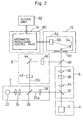
- Figs. 2 to 6 show concrete examples illustrating the block diagram of Fig. 1 in detail.
- Fig. 2 illustrates an embodiment employing a holographic notch filter including an excitation light wavelength in its notch region or a cut filter including the excitation light wavelength and blocking a shorter wavelength side as filter means of an optical target adjusting part 6 for receiving target light in a direction of 180 degrees to the excitation light with respect to a sample.
- An excitation light source part 2 is provided with a light source 22, and a half mirror 26 is arranged as a beam splitter for splitting the excitation light from the light source 22 into a sample beam 20s and a correction beam 20r.
- the light source 22 is formed by a laser unit, for example.
- the laser unit can be prepared from an Ar ion laser unit, a Kr ion laser unit, an He-Ne laser unit, an He-Cd laser unit, an Nd:YAG laser unit, or a semiconductor laser unit which are continuously oscillating lasers, or a pulse laser, and can be selected from laser units of a wide wavelength range over near ultraviolet to near infrared regions.
- a light source other than the laser unit a light source such as a halogen lamp generating multi-wavelength light can be combined with a spectroscope.
- the wavelength of the excitation light is preferably at least 800 nm, i.e., in a longer wavelength region exceeding the near infrared region.
- the reason for this is as follows: A vital component has high florescence and exhibits high fluoroemission efficiency when excited with visible light such that the spectrum is readily influenced by fluorescence, while the fluoroemission efficiency is reduced and the influence by fluorescence can be reduced when the vital component is excited with light of a longer wavelength region exceeding the near infrared region. Consequently, the background of Raman scattered light measurement is reduced and the signal-to-noise ratio of Raman scattered light detection is improved to be suitable for analysis of a microcomponent.
- this excitation wavelength region has smaller photon energy as compared with the visible region, and hence damage of the sample is reduced. Consequently, sample damage is small as compared with visible light excitation Raman spectroscopy and influence by fluorescence is also small, to be suitable for measurement of a vital substance. Further, influence by external light such as fluorescent light which becomes stray light can also be reduced.
- a near infrared semiconductor laser diode is a preferable example having an oscillation wavelength of at least 800 nm, and that having an oscillation wavelength of 800 to 1600 nm is preferable.
- GaAs/AlGaAs, InGaAs or InGaAsP can be employed as such a near infrared semiconductor laser diode.
- the cost can be reduced with a smaller space, and a compact Raman spectroscopic measuring apparatus can be implemented.
- the laser diode may be instable in oscillation intensity, such instability of oscillation intensity can be corrected by detecting the light source intensity through a monitor and standardizing the Raman scattered light detection intensity with the light source intensity.
- a light source condenser lens 24 and a convergent lens 28 are arranged on the excitation light source part 2 through the half mirror 26, in order to converge a sample beam 20s on a sample 5 provided in a sample part 4.
- the sample 5 is stored in a cell and set in the sample part 4.
- the sample beam 20s from the excitation light source part 2 is reflected by a half mirror 32 which is arranged on an optical target adjusting part 6 and applied to the sample 5 provided in the sample part 4.
- the optical target adjusting part 6 is provided with condenser lenses 34 and 36, in order to converge scattered light from the sample 5 which is transmitted through the half mirror 32 on an inlet slit 50 of a spectroscope 52.
- a holographic notch filter 38 which is so set as to include the wavelength of the excitation light in its notch region is arranged in the optical target adjusting part 6 between the condenser lenses 34 and 36, as a filter for removing the same wavelength component as the excitation light and taking out target light.
- the holographic notch filter is available on Kaiser Optical Systems, Inc., U.S.A., for example.
- the holographic notch filter 38 has characteristics of completely blocking wavelength light included in the notch region and transmitting at least 80 % of light of wavelength regions other than the notch region, for example.
- a half mirror 40 is arranged between the condenser lens 36 of the optical target adjusting part 6 and the inlet slit 50 of the spectroscope 52 as beam combining means, so that the target light is transmitted through the half mirror 40 and incident upon the spectroscope 52.
- a optical correction adjusting part 8 is adapted to guide the correction beam 20r which is split by the half mirror 26 in the excitation light source part 2 to the half mirror 40 of the beam combining means.
- This optical correction adjusting part 8 is provided with an extinction filter 42 for attenuating the light quantity, a bandpass filter 46 for blocking wavelength light generated in the half mirror 26 of the excitation light source part 2 and blocking a sideband from a laser beam when the light source 22 is formed by a laser unit, and a mirror 44 for bending an optical path.
- the correction beam 20r which is guided to the inlet slit 50 by the optical correction adjusting part 8 through the half mirror 40 is condensed on the inlet slit 50 by the light source condenser lens 24.
- the target light outgoing from the optical target adjusting part 6 and the correction beam 20r guided from the optical correction adjusting part 8 are guided onto the same optical axis in the half mirror 40, and guided to the spectroscope 52 of a spectral processing part 12 through the inlet slit 50.
- the spectroscope 52 which is a polychrometer, comprises a diffraction grating 54 for separating incident light into its spectral components, and a multi-channel photodetector 56 provided with a plurality of photodetection elements along a dispersion direction of the diffraction grating 54, in order to simultaneously detect the spectral components separated by the diffraction grating 54 over a prescribed wavelength region.
- a spectroscope called a Czerny-Turner type combining a flat diffraction grating with a spherical mirror or a spectroscope employing a transmission diffraction grating is also employable.
- photodetection elements of Ge, InGaAs or PbS In order to detect Raman scattered light by excitation light of the near infrared region, photodetection elements of Ge, InGaAs or PbS, a single-channel detector such as a photomultiplier having wavelength sensitivity in 300 to 1700 nm, or a multi-channel detector such as a photodetector array of Ge, InGaAs or PbS can be employed.
- Numeral 60 denotes an arithmetic processing control part for controlling operations of the respective parts and processing a signal detected by the photodetector 56.
- This arithmetic processing control part 60 also includes a function for serving as a data processing part for correcting a detected intensity of the target light with reference to that of the excitation light component in the spectrum detected by the photodetector 56, for operating a Raman scattering spectrum with corrected fluctuation of the light source, and qualitatively or quantitatively analyzing the sample 5 with reference to the target light intensity.
- Numeral 62 denotes an output unit such as a printer or a display for outputting the data processed in the arithmetic processing control part 60.
- the holographic notch filter 38 may be replaced with a sharp cut filter having a sharp wavelength characteristic for blocking a shorter wavelength side than the excitation light wavelength.
- Fig. 3 shows an embodiment employing a holographic notch filter or a cut filter as filter means of an optical target adjusting part 6 similarly to the embodiment shown in Fig. 2, while this embodiment is adapted to receive target light in a direction of 90 degrees to excitation light with respect to a sample 5.
- no half mirror 32 is required for irradiating the sample 5 with a sample beam 20s and introducing scattered light from the sample 5 into a condenser lens 34 of the optical target adjusting part 6.
- the sample beam 20s is converged by a light source condenser lens 24 and a convergent lens 28 of an excitation light source part 2 to be directly applied to the sample 5, while scattered light from the sample 5 is directly incident upon the condenser lens 34 of the optical target adjusting part 6.
- bandpass filter 46 is arranged on the optical path of the optical correction adjusting part 8 in Fig. 2, that in Fig. 3 is arranged on an optical path of a beam from an excitation light source, which is not yet split into the sample beam 20s and a correction beam by a beam splitter 26, in the excitation light source part 2. Due to the arrangement of the bandpass filter 46 on the position shown in Fig. 3, a sideband of a laser beam can be blocked against both of the sample beam 20s and the correction beam.
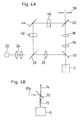
- Fig. 4A shows an embodiment employing a holographic beam splitter 70 having characteristics of reflecting excitation light and transmitting Raman light as filter means of an optical target adjusting part 6 and receiving target light in a direction of 180 degrees to the excitation light with respect to a sample 5.
- the holographic beam splitter 70 reflects a sample beam 20s and applies the same to the sample 5, for transmitting only target light 74 in scattered light 72, including the target light 74 and Rayleigh scattered light, from the sample 5 and introducing the same into a condenser lens 34 of the optical target adjusting part 6.
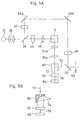
- Fig. 5A shows an embodiment employing a bandpass filter 82 having characteristics of transmitting and removing an excitation light wavelength component and reflecting a target light component and receiving target light in a direction of 90 degrees to excitation light with respect to a sample 5.
- the bandpass filter 82 is arranged on a mirror face side of a transmission condensation mirror 80, while a beam stopper 84 is arranged on an opposite side of the transmission condensation mirror 80.
- Scattered light 72, including target light 74 and Rayleigh scattered light 76, from the sample 5 is condensed by condenser lenses 34a and 36a, to be incident upon the bandpass filter 82 from a rear surface of the transmission condensation mirror 80 through its incidence hole.
- the Rayleigh light 76 is transmitted and absorbed by the beam stopper 84, while the target light 74 is reflected and condensed by the mirror face of the transmission condensation mirror 80, to be incident upon a spectroscope from an inlet slit 50 through a half mirror 40.
- a optical correction adjusting part 8 is provided with two mirrors 44a and 44b, in order to bend an optical path by 180 degrees.
- Fig. 6 shows an embodiment employing a bandpass filter 82 having characteristics of transmitting and removing an excitation light wavelength component and reflecting a target light component as filter means of an optical target adjusting part 6 similarly to that shown in Figs. 5A and 5B, while receiving target light in a direction of 180 degrees to excitation light with respect to a sample 5.
- a half mirror 32 is arranged for applying a sample beam 20s to the sample 5 and introducing scattered light from the sample 5 into a condenser lens 34a of the optical target adjusting part 6.
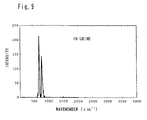
- Figs. 7, 8 and 9 show Raman spectra of lactone mevalonate in an aqueous solution, blood plasma and urine respectively.
- Samples of blood plasma and urine employed for this measurement were prepared by dissolving 100 mg/ml of lactone mevalonate in blood plasma and urine respectively, while a sample of the aqueous solution was prepared by dissolving 200 mg/ml of lactone mevalonate in water.
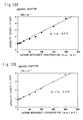
- Figs. 10A and 10B show results obtained by employing standard samples prepared by dissolving lactone mevalonate in water, varying the lactone mevalonate concentrations, and measuring correlation between peak intensities and lactone mevalonate concentrations of Raman spectra obtained as shown in Fig. 7.
- Figs. 10A and 10B show results obtained by employing peaks at shift wavenumbers of 680 cm -1 and 769 cm -1 respectively. Correlation coefficients R 2 of 0.990 are obtained in Figs. 11A and 11B respectively.
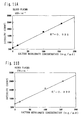
- Figs. 11A and 11B show results obtained by employing standard samples prepared by dissolving lactone mevalonate in blood plasma, varying the lactone mevalonate concentrations, and measuring correlation between peak intensities and lactone mevalonate concentrations of Raman spectra obtained as shown in Fig. 8.
- Figs. 11A and 11B show results obtained by employing peaks at shift wavenumbers of 680 cm -1 and 769 cm -1 respectively. Correlation coefficients R 2 of 0.999 and 0.998 are obtained in Figs. 11A and 11B respectively.
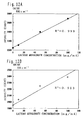
- Figs. 12A and 12B show results obtained by employing standard samples prepared by dissolving lactone mevalonate in urine, varying the lactone mevalonate concentrations, and measuring correlation between peak intensities and lactone mevalonate concentrations of Raman spectra obtained as shown in Fig. 9.
- Figs. 12A and 12B show results obtained by employing peaks at shift wavenumbers of 680 cm -1 and 769 cm -1 respectively. Correlation coefficients R 2 of 0.998 and 0.963 are obtained in Figs. 12A and 12B respectively.
- a mevalonic acid concentration in an aqueous solution, blood plasma or urine can be determined by utilizing such correlation as a calibration curve.
- a sample is prepared from blood plasma or urine so that acid such as hydrochloric acid, sulfuric acid or perchloric acid is added thereto or acid treatment is performed with solid acid (ion exchange resin etc.) for converting mevalonic acid contained in the sample to lactone mevalonate and thereafter measuring Raman scattered light.
- acid such as hydrochloric acid, sulfuric acid or perchloric acid
- solid acid ion exchange resin etc.
Landscapes
- Health & Medical Sciences (AREA)
- Nuclear Medicine, Radiotherapy & Molecular Imaging (AREA)
- Physics & Mathematics (AREA)
- Life Sciences & Earth Sciences (AREA)
- Chemical & Material Sciences (AREA)
- Analytical Chemistry (AREA)
- Biochemistry (AREA)
- General Health & Medical Sciences (AREA)
- General Physics & Mathematics (AREA)
- Immunology (AREA)
- Pathology (AREA)
- Investigating, Analyzing Materials By Fluorescence Or Luminescence (AREA)
- Investigating Or Analysing Biological Materials (AREA)
Applications Claiming Priority (2)
| Application Number | Priority Date | Filing Date | Title |
|---|---|---|---|
| JP8114106A JPH09281045A (ja) | 1996-04-10 | 1996-04-10 | メバロン酸の光学的測定方法 |
| JP114106/96 | 1996-04-10 |
Publications (2)
| Publication Number | Publication Date |
|---|---|
| EP0801301A2 true EP0801301A2 (fr) | 1997-10-15 |
| EP0801301A3 EP0801301A3 (fr) | 1998-03-11 |
Family
ID=14629280
Family Applications (1)
| Application Number | Title | Priority Date | Filing Date |
|---|---|---|---|
| EP97105960A Withdrawn EP0801301A3 (fr) | 1996-04-10 | 1997-04-10 | Procédé optique pour la détermination de l'acide mévalonique |
Country Status (3)
| Country | Link |
|---|---|
| US (1) | US5804451A (fr) |
| EP (1) | EP0801301A3 (fr) |
| JP (1) | JPH09281045A (fr) |
Cited By (3)
| Publication number | Priority date | Publication date | Assignee | Title |
|---|---|---|---|---|
| WO2000016149A1 (fr) * | 1998-09-15 | 2000-03-23 | Leica Microsystems Heidelberg Gmbh | Dispositif optique place dans le trajet du rayonnement d'un microscope a fluorescence confocal |
| EP1430278A4 (fr) * | 2001-08-29 | 2007-07-25 | Becton Dickinson Co | Systeme d'analyse a haut debit |
| US9458491B2 (en) | 2009-01-19 | 2016-10-04 | Asahi Kasei Pharma Corporation | Method and reagent for measuring mevalonic acid, 3-hydroxymethylglutaryl coenzyme A, and coenzyme A |
Families Citing this family (10)
| Publication number | Priority date | Publication date | Assignee | Title |
|---|---|---|---|---|
| ATE403145T1 (de) * | 2000-01-31 | 2008-08-15 | Univ Texas | Tragbare vorrichtung mit einer sensor-array- anordnung |
| JP2002005835A (ja) * | 2000-06-23 | 2002-01-09 | 宏夫 ▲浜▼口 | ラマン分光測定装置及びそれを用いた生体試料分析方法 |
| US7189366B2 (en) * | 2001-05-25 | 2007-03-13 | The United States Of America As Represented By The Secretary Of The Interior | Molecular tag reader |
| US8101431B2 (en) | 2004-02-27 | 2012-01-24 | Board Of Regents, The University Of Texas System | Integration of fluids and reagents into self-contained cartridges containing sensor elements and reagent delivery systems |
| WO2007053186A2 (fr) | 2005-05-31 | 2007-05-10 | Labnow, Inc. | Méthodes et compositions en rapport avec la détermination et l’utilisation de la numération de globules blancs |
| JP4389991B2 (ja) * | 2007-10-26 | 2009-12-24 | ソニー株式会社 | 微小粒子の光学的測定方法及び光学的測定装置 |
| CN103238062B (zh) * | 2010-12-08 | 2016-04-20 | 株式会社日立高新技术 | 自动分析装置 |
| US10660523B2 (en) | 2017-07-07 | 2020-05-26 | Hideo Ando | Light-source unit, measurement apparatus, near-infrared microscopic apparatus, optical detection method, imaging method, calculation method, functional bio-related substance, state management method, and manufacturing method |
| KR20220052965A (ko) * | 2019-08-28 | 2022-04-28 | 다니스코 유에스 인크. | 메발로노락톤을 포함하는 스킨 케어 조성물 |
| WO2022176208A1 (fr) | 2021-02-22 | 2022-08-25 | 株式会社 ジャパンセル | Procédé de génération de lumière prédéterminée, procédé d'utilisation de lumière prédéterminée, procédé de fourniture de service utilisant une lumière prédéterminée, procédé de mesure/imagerie, élément de conversion de caractéristiques optiques, unité source lumineuse, unité de mesure, dispositif d'observation, dispositif d'utilisation de lumière prédéterminée et système de fourniture de service |
Family Cites Families (4)
| Publication number | Priority date | Publication date | Assignee | Title |
|---|---|---|---|---|
| EP0281143B1 (fr) * | 1987-03-04 | 1993-03-10 | Asahi Denka Kogyo Kabushiki Kaisha | Procédé de préparation de l'acide mévalonique |
| US4847198A (en) * | 1987-10-07 | 1989-07-11 | The Board Of Governors For Higher Education, State Of Rhode Island And Providence Plantations | Detection and indentification of bacteria by means of ultra-violet excited resonance Raman spectra |
| JPH0749309A (ja) * | 1993-08-05 | 1995-02-21 | Kyoto Daiichi Kagaku:Kk | 光散乱式成分濃度測定装置および方法 |
| JPH07159400A (ja) * | 1993-12-10 | 1995-06-23 | S R L:Kk | メバロン酸の測定方法 |
-
1996
- 1996-04-10 JP JP8114106A patent/JPH09281045A/ja active Pending
-
1997
- 1997-04-08 US US08/832,189 patent/US5804451A/en not_active Expired - Fee Related
- 1997-04-10 EP EP97105960A patent/EP0801301A3/fr not_active Withdrawn
Cited By (5)
| Publication number | Priority date | Publication date | Assignee | Title |
|---|---|---|---|---|
| WO2000016149A1 (fr) * | 1998-09-15 | 2000-03-23 | Leica Microsystems Heidelberg Gmbh | Dispositif optique place dans le trajet du rayonnement d'un microscope a fluorescence confocal |
| US6785302B1 (en) | 1998-09-15 | 2004-08-31 | Leica Microsystems Heidelberg Gmbh | Optical system in the ray path of a confocal fluorescence microscope |
| EP1430278A4 (fr) * | 2001-08-29 | 2007-07-25 | Becton Dickinson Co | Systeme d'analyse a haut debit |
| US9458491B2 (en) | 2009-01-19 | 2016-10-04 | Asahi Kasei Pharma Corporation | Method and reagent for measuring mevalonic acid, 3-hydroxymethylglutaryl coenzyme A, and coenzyme A |
| US10975411B2 (en) | 2009-01-19 | 2021-04-13 | Asahi Kasei Pharma Corporation | Method and reagent for measuring mevalonic acid, 3-hydroxymethylglutaryl coenzyme A, and coenzyme A |
Also Published As
| Publication number | Publication date |
|---|---|
| JPH09281045A (ja) | 1997-10-31 |
| US5804451A (en) | 1998-09-08 |
| EP0801301A3 (fr) | 1998-03-11 |
Similar Documents
| Publication | Publication Date | Title |
|---|---|---|
| US5870188A (en) | Measuring method and measuring apparatus by light scattering | |
| US5617205A (en) | Spectral measuring method and spectral measuring apparatus | |
| US5754289A (en) | Raman scattered light measuring apparatus | |
| US5828450A (en) | Spectral measuring apparatus and automatic analyzer | |
| US5804451A (en) | Optical measuring method for mevalonic acid | |
| EP1784625B1 (fr) | Procede d'etalonnage autonome pour systeme d'analyse optique | |
| US7903252B2 (en) | Noise cancellation in fourier transform spectrophotometry | |
| US5481113A (en) | Apparatus and method for measuring concentrations of components with light scattering | |
| EP0383912B1 (fr) | Procede et appareil de mesure optique de la concentration d'une substance | |
| EP0091126B1 (fr) | Fluorimètre | |
| US6141095A (en) | Apparatus for measuring and applying instrumentation correction to produce a standard Raman spectrum | |
| CN103649726A (zh) | 用于荧光和吸收率分析的系统和方法 | |
| EP0121404B1 (fr) | Appareil photométrique pour la mesure de l'absorption lumineuse | |
| JP2936947B2 (ja) | 分光蛍光光度計 | |
| JPH1189799A (ja) | 特定成分の濃度測定装置および濃度測定方法 | |
| Rkanofsky | [6] Assay for singlet-oxygen generation by peroxidases using 1270-nm chemiluminescence | |
| US5712167A (en) | Method of measuring Amadori compound by light scattering | |
| JPH0989763A (ja) | 原子吸光分光光度計 | |
| JP2003329581A (ja) | 光ファイバ型多波長分光測定装置および光ファイバを用いた多波長分光測定方法 | |
| Bright et al. | Minimisation of bilirubin interference in the determination of fluorescein using first-derivative synchronous excitation fluorescence spectroscopy | |
| JP2005331319A (ja) | 分光蛍光光度計及び試料セル | |
| JPH09145619A (ja) | 散乱光等の分光測定方法及び装置 | |
| US20250321191A1 (en) | Analysis apparatus | |
| CN1160201A (zh) | 用拉曼散射测定过氧化氢的方法和仪器 | |
| JP7812699B2 (ja) | アミノ酸の分析方法及びアミノ酸分析装置 |
Legal Events
| Date | Code | Title | Description |
|---|---|---|---|
| PUAI | Public reference made under article 153(3) epc to a published international application that has entered the european phase |
Free format text: ORIGINAL CODE: 0009012 |
|
| AK | Designated contracting states |
Kind code of ref document: A2 Designated state(s): DE FR GB IT |
|
| PUAL | Search report despatched |
Free format text: ORIGINAL CODE: 0009013 |
|
| AK | Designated contracting states |
Kind code of ref document: A3 Designated state(s): DE FR GB IT |
|
| 17P | Request for examination filed |
Effective date: 19980525 |
|
| STAA | Information on the status of an ep patent application or granted ep patent |
Free format text: STATUS: THE APPLICATION HAS BEEN WITHDRAWN |
|
| 18W | Application withdrawn |
Effective date: 20030414 |