EP0801437A2 - Réseau de formation de faisceaux pour système d'antenne à faisceaux multiples utilisant les mêmes éléments d'antenne - Google Patents
Réseau de formation de faisceaux pour système d'antenne à faisceaux multiples utilisant les mêmes éléments d'antenne Download PDFInfo
- Publication number
- EP0801437A2 EP0801437A2 EP97105042A EP97105042A EP0801437A2 EP 0801437 A2 EP0801437 A2 EP 0801437A2 EP 97105042 A EP97105042 A EP 97105042A EP 97105042 A EP97105042 A EP 97105042A EP 0801437 A2 EP0801437 A2 EP 0801437A2
- Authority
- EP
- European Patent Office
- Prior art keywords
- feed
- combiners
- dividers
- divider
- signals
- Prior art date
- Legal status (The legal status is an assumption and is not a legal conclusion. Google has not performed a legal analysis and makes no representation as to the accuracy of the status listed.)
- Withdrawn
Links
Images





Classifications
-
- H—ELECTRICITY
- H01—ELECTRIC ELEMENTS
- H01Q—ANTENNAS, i.e. RADIO AERIALS
- H01Q25/00—Antennas or antenna systems providing at least two radiating patterns
- H01Q25/007—Antennas or antenna systems providing at least two radiating patterns using two or more primary active elements in the focal region of a focusing device
-
- H—ELECTRICITY
- H01—ELECTRIC ELEMENTS
- H01Q—ANTENNAS, i.e. RADIO AERIALS
- H01Q3/00—Arrangements for changing or varying the orientation or the shape of the directional pattern of the waves radiated from an antenna or antenna system
- H01Q3/26—Arrangements for changing or varying the orientation or the shape of the directional pattern of the waves radiated from an antenna or antenna system varying the relative phase or relative amplitude of energisation between two or more active radiating elements; varying the distribution of energy across a radiating aperture
- H01Q3/30—Arrangements for changing or varying the orientation or the shape of the directional pattern of the waves radiated from an antenna or antenna system varying the relative phase or relative amplitude of energisation between two or more active radiating elements; varying the distribution of energy across a radiating aperture varying the relative phase between the radiating elements of an array
- H01Q3/34—Arrangements for changing or varying the orientation or the shape of the directional pattern of the waves radiated from an antenna or antenna system varying the relative phase or relative amplitude of energisation between two or more active radiating elements; varying the distribution of energy across a radiating aperture varying the relative phase between the radiating elements of an array by electrical means
- H01Q3/40—Arrangements for changing or varying the orientation or the shape of the directional pattern of the waves radiated from an antenna or antenna system varying the relative phase or relative amplitude of energisation between two or more active radiating elements; varying the distribution of energy across a radiating aperture varying the relative phase between the radiating elements of an array by electrical means with phasing matrix
Definitions
- the present invention generally relates to communication satellites and, more specifically, to a beam forming network for use with a communications satellite.
- communications satellites communicate through transmitters and receivers with remote devices.
- the transmitters and receivers are connected to antennas which emit and sense radio frequency (RF) signals that pass to and from the remote devices such as mobile and fixed cellular telephone stations.
- RF radio frequency
- the antennas include one or more feed elements (also referred to as "radiating elements") which transmit the communications beams.
- the communications beams are received by one or more feed elements.
- Antennas which form a plurality of communication beams are referred to as multiple beam antennas (MBA).
- the radiating or feed elements are generally arranged in an array geometrically shaped as a square, hexagon and the like.
- the MBA may use one or more feed elements in connection with each communications beam.
- Conventional antennas which use a single feed element in connection with each communications beam have been found to have unduly low antenna efficiency due to excessive spillover losses.
- past MBA systems have been proposed which utilize multiple feed elements to transmit and receive each communications beam (also referred to as a "composite beam"). These past MBA systems divide each composite or full-power beam into a set of lower power beam components. Each beam component is used to drive a separate feed element. The group of feed elements combines to generate the complete composite beam at its original power level.
- past MBA systems are arranged such that feed element groups overlap whereby a feed element is driven to generate beam components from more than one composite beam.
- a feed element cooperates with a number of different groups of feed elements to define a corresponding number of different beams. This phenomenon is referred to as “multiple-shared-feeds-per-beam” and is controlled by a low level beam forming network (LLBFN) within the communications satellite.
- LLBFN low level beam forming network
- the LLBFN 300 includes a power divider circuit 302 and a power combiner circuit 304 connected to one another through an interconnection circuit 306.
- the divider circuit 302 includes a plurality of dividers 308 (Fig. 14), and the combiner circuit 304 includes a plurality of combiners 310.
- the dividers 308 separate or split a plurality of incoming beam signals on beam ports 312 into lower power beam components.
- the beam components are passed along leads in the interconnection circuit 306 to corresponding combiners 310.
- Each combiner 310 combines the incoming signals to form an output feed signal at feed ports 314.
- the dividers 308 and combiners 310 have been numbered in Fig. 14 from #1 to #37. If it is assumed that dividers #13 and #19 separate an incoming beam signal 312 into seven beam components, then each of dividers #13 and # 19 will have seven output leads 321-327 and 331-337, respectively.
- the leads 321-327 from divider #13 are connected to combiners #7, #8, #12, #13, #14, #19 and #20 in order to deliver the beam component signals thereto.
- divider #19 is connected to combiners #12, #13, #18, #19, #20, #25 and #26 through leads 331-337.
- the combiner #12 combines the beam components on lines 323 and 331 to form a feed signal.
- the feed signals ultimately are fed to corresponding feed elements which emit beam components that cooperate to form the original communications beams.
- a beam forming network is disclosed in USP 4,907,004 (Zacharatos et al.), which is incorporated herein by reference. Exemplary Multiple Beam Antenna systems can be found in Phased Array Antenna Handbook , by Robert Mailloux, Artech House, 1993, Chapter 8.1, and in Antenna Engineering Handbook , by Richard Johnson, McGraw-Hill, Inc. 1993.
- each combiner 310 may receive component beam signals from dividers 308 located anywhere along the side of the LLBFN.
- This conventional linear topology necessitates the use of a large number of interconnecting leads 306 of varying length between the power dividers and corresponding power combiners (as shown by leads 321-327 and 331-337).
- the leads 321-327 and 331-337 extend in multiple directions and form a large number of cross-overs.
- LLBFNs formed according to the conventional linear topology require a large physical area for implementation due to the large number of dividers 308 and combiners 310 along opposed sides and due to the large number of cross-overs and interconnecting leads 306.
- lead transmission paths become longer which result in greater variations within the amplitude and phase of the signals passed between the dividers and combiners. Such variations are undesirable.
- a need remains within the industry for an improved beam forming network design. It is an object of the present invention to meet this need.
- a multiple beam antenna system having an array of feed elements for receiving or transmitting composite communications beams.
- a beam forming network (Fig. 12) is included with beam ports for conveying composite beam signals representative of the composite communications beams and with feed ports for conveying, to the array, feed signals containing component beam signals.
- the network includes dividers 66 and combiners 80.
- the dividers 66 divide composite beam signals into beam component signals.
- the combiners 80 combine beam component signals from the dividers 66 for different composite beams to form the feed signals.
- the dividers 66 and combiners 80 are arranged within parallel planes 46, 48 and are clustered 92, 94 for local interconnection such that each divider 66 only connects with combiners 80 located immediately adjacent thereto in the opposed plane. Inputs and outputs of the dividers 66 and combiners 80 are further arranged such that leads extending therebetween are of substantially equal length and are aligned substantially perpendicular to the opposed planes.
- the system is operative with a receiver or a transmitter.
- Fig. 1 generally illustrates a multiple beam antenna (MBA) system, generally designated by the reference numeral 10.
- the MBA system 10 includes a channelizer 12 for performing a signal-channelizing operation of the system as a receiving unit and/or a transmitting unit.
- the channelizer routes the signals to/from the receiving/transmitting unit from/to one or more beam ports of the BFN.
- the channelizer 12 is interconnected with a beam forming network (BFN) 14 via a plurality of beam ports 16 which convey composite beam signals between the beam forming network 14 and the channelizer 12.
- BFN 14 is connected to a feed array 20 through a plurality of feed ports 18.
- the feed ports 18 convey feed signals between the feed array 20 and BFN 14.
- the feed array 20 comprises a plurality of feed elements 22 arranged in a desired pattern and connected with corresponding feed ports 18.
- the MBA system 10 further includes a reflector 24 which cooperates with the feed array 20 to reflect incoming and outgoing communications beams to and from the feed elements 22.
- the reflector 24 may be omitted and the feed array 20 modified to operate as a direct radiating array.
- Feed array 20 may include any number of separate feed elements 22.
- Each feed element 22 may be assigned a unique identifier (as evidenced by the numbers 1-37).
- the elements 22 have been ordered in rows and assigned ascending numbers.
- the elements 22 may be arranged in a hexagonal layout or any other desired layout.
- Fig. 3 illustrates an exemplary beam configuration 26 which may be produced by the feed array 20 when operating as a transmitting unit.
- the beam configuration 26 includes a plurality of beams 28 (referred to hereinafter as “composite” or “communications” beams).
- the communications beams 28 may be similarly arranged in a hexagonal layout or any other desired layout.
- each communications beam within Fig. 3 also has been assigned a unique identifier (1-37).
- each beam 28 is not solely or necessarily formed by a similarly numbered feed element 22 in a multiple-shared-feeds-per-beam system. Instead, a plurality of feed elements 22 cooperate to define each beam 28. According to the present invention, each beam 28 is defined by a plurality of feed elements 22 located adjacent to one another in a cluster or group.
- beam #1 is generated by elements #1, #2, #5 and #6 (as noted by similar hatching), each of which transmits a component or portion thereof.
- the beam components transmitted by elements #1, #2, #5 and #6 combine to equal beam #1.
- Beam #19 is generated by elements #12, #13, #18, #19, #20, #25 and #26, each of which transmits a component of the resultant beam #19.
- Beam #13 is generated by elements #7, #8, #12, #13, #14, #19 and #20, each of which transmits a portion or component of the beam #13. From this example it is clear that clusters of elements 22 grouped adjacent to one another cooperate to define each beam 28. The number of elements 22 within each group used to form a beam 28 may vary. It is also clear that each element may transmit beam components of more than one beam 28 simultaneously.
- the BFN 14 includes a plurality of feed port connectors 32 and beam port connectors 34 mounted thereto.
- the feed port connectors 32 are attached to the feed ports 18, while the beam port connectors 34 are attached to the beam ports 16.
- the feed and beam port connectors 32 and 34 are mounted to the top surface 30 of the BFN 14.
- the feed and beam port connectors 32 and 34 can be mounted to the top surface and the bottom surface of the BFN 14, respectivley.
- the BFN 14 includes upper and lower layers 36 and 38 which serve as grounding layers and sandwich therebetween a power combiner layer 40 and a power divider layer 42.
- a grounding layer 44 is disposed between the combiner layer 40 and divider layer 42.
- the combiner layer 40 and divider layer 42 include corresponding combiner and divider circuit traces 46 and 48, respectively, described in more detail below in connection with Figs. 6-12.
- the combiner circuit trace 46 and divider circuit trace 48 may be constructed from stripline circuits of dielectric material and the like.
- the circuit traces 46 and 48 are separated by dielectric layers 52, 54, 56 and 58.
- the combiner and divider circuit traces 46 and 48 are interconnected at a plurality of points via interconnector leads 60.
- the feed and beam port connectors 32 and 34 are connected at desired points to the combiner and divider circuit traces 46 and 48 through interconnectors 62 and 64, respectively.
- the configuration of connections between the connectors 32 and 34 and traces 46 and 48 is discussed in more detail below in connection with Figs. 6-12.
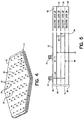
- Fig. 6 illustrates a top plan view of the divider circuit trace 48.
- the circuit trace 48 includes a plurality of dividers 66, each of which is configured with a substantially circular perimeter.
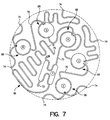
- the dividers may be constructed as 7-way equal or unequal power beam dividers with each divider 66 including a plurality of two way power dividers (also referred to as sub-dividers) 68 connected to one another via leads 70.
- One of the sub-dividers 68 (Fig. 7) is connected to an input terminal 72.
- the input terminal 72 receives an incoming composite beam signal from one of the beam ports 16.
- the sub-dividers 68 are also attached to a plurality of output terminals 74 through leads 70.
- the sub-dividers 68, terminals 72 and 74 and leads 70 cooperate to receive a composite beam signal at input terminal 72 and equally or unequally divide a power level of the composite beam signal among the output terminals 74.
- 7 output terminals 74 are utilized within each divider 66.
- FIG. 8 a top plan view is illustrated of a combiner circuit trace 46.
- the circuit trace 46 includes a plurality of combiners 80 having substantial circular outlines or perimeters.
- the combiners 80 are located immediately adjacent one another in a substantially hexagonal layout.
- the combiners 80 represent seven way equal or unequal power beam combiners.
- each combiner 80 includes a plurality of two way power dividers or sub-dividers 82 disposed thereabout and interconnected via leads 84.
- the sub-dividers 82 communicate with a plurality of input terminals 86.
- One of the sub-dividers 82 communicates with an output terminal 88.
- Resisters 90 are utilized to achieve two way power division in the combiners 80 and dividers 66.
- sub-dividers 68 and 82 may be implemented using Wilkinson power dividers, hybrids, couplers and the like so long as the resultant combiners 80 and dividers 66 achieve the objectives of the present inventions.
- a single divider 100 and a cluster 92 of corresponding combiners 111-117 The divider 100 is connected at the input terminal 72 to a beam port 150 (generally designated by the dashed line). It is assumed that a composite beam signal A is delivered along beam port 150 to divider 100.
- the output terminals 74 of the divider 100 are connected via the interconnector leads 101-107 to corresponding input terminals 86 of the combiners 111-117 within cluster 92.
- the composite beam signal A is split into seven lower power components A 1 -A 7 .
- the beam component signals A 1 -A 7 are delivered separately along leads 101-107 to corresponding combiners 111-117, respectively.
- the combiners 111-117 output corresponding beam component signals A 1 -A 7 , respectively, along feed ports 151-157 to seven corresponding feed elements 22.
- beam component signals A 1 -A 7 are delivered to feed elements #12, #13, #18, #19, #20, #25 and #26.
- the combiners 111-117 which receive input signals from the single divider 100 are located immediately adjacent one another. By arranging the combiners 111-117 in clusters 92, excessively long interconnection leads are avoided.
- the leads 101-107 are substantially of equal length and aligned substantially perpendicular to the circuit traces 46 and 48.
- Fig. 11 illustrates the arrangement and interconnection between a single combiner 120 and a plurality of dividers 121-127.
- the dividers 121-127 are similarly grouped to form a cluster 94, wherein each divider 121-127 in the cluster 94 delivers at least one output signal to the common combiner 120 via interconnection leads 131-137.
- beam ports 141-147 deliver composite beam signals to input terminals 72 of corresponding dividers 121-127.
- Each composite beam signal is divided into multiple beam component signals, each of which is delivered from an output terminal 74.
- the plurality of beam component signals are delivered to different combiners. For example, if each composite beam signal is to be divided into seven component signals, these seven components may be delivered to seven separate combiners.
- dividers 121-127 receive composite beam signals A-G.
- the dividers 121-127 separate the composite beam signals A-G into beam component signals A 1 -A 7 through G 1 -G 7 , of which only signals A 1 , B 1 , C 1 , D 1 , E 1 , F 1 and G 1 are illustrated.
- the dividers 121-127 then deliver associated components A 1 , B 1 , C 1 , D 1 , E 1 , F 1 , G 1 to the combiner 120.
- the beam component signals A 1 -G 1 are output along feed port 160 as a feed signal equaling the combination of beam component signals A 1 +B 1 +C 1 +D 1 +E 1 +F 1 +G 1 .
- the feed signal along feed port 160 is in turn transmitted from a corresponding feed element 22.
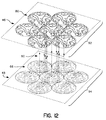
- Fig. 12 illustrates two clusters 92 and 94 of combiners 80 and dividers 66 connected through the corresponding interconnection leads 60.
- the foregoing configuration arranges the dividers 66 and combiners 80 evenly along two substantially parallel planes.
- the input and output terminals are preferably arranged directly opposite associated input and output terminals. This arrangement aligns the leads 60 substantially parallel to one another and along axes substantially perpendicular to the planes of the dividers 66 and combiners 80. This arrangement also enables all of the leads 60 to be substantially of equal length.
- each feed element in the hexagonal array layout is only shared by nearby beams in the hexagonal layout.
- the preferred embodiment utilizes 37 feed elements and beams, any number of feed elements, beams, beam ports and feed ports may be utilized.
- the inventive system is not limited to a hexagonal layout, but optionally may be utilized with other configurations, such as circular, square, rectangular and the like.
- the preferred divider and combiner network utilizes seven way elements, the invention is not so limited. Instead, each divider may divide a composite beam signal into any desired number of components.
- the combiners may combine any number of beam components to form a single feed signal.
- each combiner may receive more than one beam component signal from a single divider.
- the dividers need not necessarily evenly divide the composite beam signal, but instead may divide it unevenly between the output terminals.
Landscapes
- Variable-Direction Aerials And Aerial Arrays (AREA)
- Aerials With Secondary Devices (AREA)
Applications Claiming Priority (2)
| Application Number | Priority Date | Filing Date | Title |
|---|---|---|---|
| US629860 | 1996-04-09 | ||
| US08/629,860 US5760741A (en) | 1996-04-09 | 1996-04-09 | Beam forming network for multiple-beam-feed sharing antenna system |
Publications (2)
| Publication Number | Publication Date |
|---|---|
| EP0801437A2 true EP0801437A2 (fr) | 1997-10-15 |
| EP0801437A3 EP0801437A3 (fr) | 2000-04-12 |
Family
ID=24524798
Family Applications (1)
| Application Number | Title | Priority Date | Filing Date |
|---|---|---|---|
| EP97105042A Withdrawn EP0801437A3 (fr) | 1996-04-09 | 1997-03-25 | Réseau de formation de faisceaux pour système d'antenne à faisceaux multiples utilisant les mêmes éléments d'antenne |
Country Status (4)
| Country | Link |
|---|---|
| US (1) | US5760741A (fr) |
| EP (1) | EP0801437A3 (fr) |
| JP (1) | JP3046941B2 (fr) |
| TW (1) | TW350154B (fr) |
Cited By (2)
| Publication number | Priority date | Publication date | Assignee | Title |
|---|---|---|---|---|
| WO1999036992A3 (fr) * | 1998-01-14 | 1999-10-07 | Raytheon Co | Antenne reseau a faisceaux multiples diriges independamment |
| EP1124283A3 (fr) * | 2000-02-08 | 2004-01-28 | The Boeing Company | Réseau de formation de faisceaux à un plan de réutilisation et méthode de mise en oeuvre |
Families Citing this family (12)
| Publication number | Priority date | Publication date | Assignee | Title |
|---|---|---|---|---|
| US6121929A (en) * | 1997-06-30 | 2000-09-19 | Ball Aerospace & Technologies Corp. | Antenna system |
| US5974314A (en) * | 1997-08-22 | 1999-10-26 | Lockheed Martin Corp. | Spacecraft cellular communication system |
| US6078287A (en) * | 1999-08-13 | 2000-06-20 | Hughes Electronics Corporation | Beam forming network incorporating phase compensation |
| US6275188B1 (en) | 2000-02-17 | 2001-08-14 | Trw Inc. | Nulling direct radiating array |
| US20020073437A1 (en) * | 2000-12-12 | 2002-06-13 | Hughes Electronics Corporation | Television distribution system using multiple links |
| US7181162B2 (en) * | 2000-12-12 | 2007-02-20 | The Directv Group, Inc. | Communication system using multiple link terminals |
| US7103317B2 (en) | 2000-12-12 | 2006-09-05 | The Directv Group, Inc. | Communication system using multiple link terminals for aircraft |
| US7400857B2 (en) * | 2000-12-12 | 2008-07-15 | The Directv Group, Inc. | Communication system using multiple link terminals |
| US7068616B2 (en) * | 2001-02-05 | 2006-06-27 | The Directv Group, Inc. | Multiple dynamic connectivity for satellite communications systems |
| JP2003078332A (ja) * | 2001-09-04 | 2003-03-14 | Hitachi Kokusai Electric Inc | アレーアンテナ装置 |
| US7315279B1 (en) * | 2004-09-07 | 2008-01-01 | Lockheed Martin Corporation | Antenna system for producing variable-size beams |
| KR100943763B1 (ko) * | 2007-12-12 | 2010-02-23 | 한국전자통신연구원 | 이동통신망에서 채널을 추정하는 방법 및 이를 수행하는장치 |
Family Cites Families (12)
| Publication number | Priority date | Publication date | Assignee | Title |
|---|---|---|---|---|
| US4231040A (en) * | 1978-12-11 | 1980-10-28 | Motorola, Inc. | Simultaneous multiple beam antenna array matrix and method thereof |
| US4424500A (en) * | 1980-12-29 | 1984-01-03 | Sperry Corporation | Beam forming network for a multibeam antenna |
| JPS59178002A (ja) * | 1983-03-29 | 1984-10-09 | Radio Res Lab | 円偏波アンテナ |
| US4647879A (en) * | 1985-07-08 | 1987-03-03 | Ford Aerospace & Communications Corporation | Radial/axial power divider/combiner |
| US4901084A (en) * | 1988-04-19 | 1990-02-13 | Millitech Corporation | Object detection and location system |
| US4721960A (en) * | 1986-07-15 | 1988-01-26 | Canadian Marconi Company | Beam forming antenna system |
| US4907004A (en) * | 1988-05-23 | 1990-03-06 | Spar Aerospace Limited | Power versatile satellite transmitter |
| US5289193A (en) * | 1990-11-29 | 1994-02-22 | Alcatel Espace | Reconfigurable transmission antenna |
| FR2670327A1 (fr) * | 1990-12-06 | 1992-06-12 | Europ Agence Spatiale | Coupleur hybride hyperfrequence a 3xn entrees et 3xm sorties, notamment coupleur 3x3. |
| FR2672436B1 (fr) * | 1991-01-31 | 1993-09-10 | Europ Agence Spatiale | Dispositif de controle electronique du diagramme de rayonnement d'une antenne a un ou plusieurs faisceaux de direction et/ou de largeur variable. |
| US5539415A (en) * | 1994-09-15 | 1996-07-23 | Space Systems/Loral, Inc. | Antenna feed and beamforming network |
| EP0727839A1 (fr) * | 1995-02-16 | 1996-08-21 | SPACE ENGINEERING S.p.A. | Réseau d'antennes de rayonnement directe à faisceau multi-conforme |
-
1996
- 1996-04-09 US US08/629,860 patent/US5760741A/en not_active Expired - Fee Related
-
1997
- 1997-03-25 TW TW086103753A patent/TW350154B/zh active
- 1997-03-25 EP EP97105042A patent/EP0801437A3/fr not_active Withdrawn
- 1997-04-09 JP JP9090835A patent/JP3046941B2/ja not_active Expired - Fee Related
Cited By (4)
| Publication number | Priority date | Publication date | Assignee | Title |
|---|---|---|---|---|
| WO1999036992A3 (fr) * | 1998-01-14 | 1999-10-07 | Raytheon Co | Antenne reseau a faisceaux multiples diriges independamment |
| US6104343A (en) * | 1998-01-14 | 2000-08-15 | Raytheon Company | Array antenna having multiple independently steered beams |
| US6232920B1 (en) | 1998-01-14 | 2001-05-15 | Raytheon Company | Array antenna having multiple independently steered beams |
| EP1124283A3 (fr) * | 2000-02-08 | 2004-01-28 | The Boeing Company | Réseau de formation de faisceaux à un plan de réutilisation et méthode de mise en oeuvre |
Also Published As
| Publication number | Publication date |
|---|---|
| JPH1065441A (ja) | 1998-03-06 |
| TW350154B (en) | 1999-01-11 |
| EP0801437A3 (fr) | 2000-04-12 |
| US5760741A (en) | 1998-06-02 |
| JP3046941B2 (ja) | 2000-05-29 |
Similar Documents
| Publication | Publication Date | Title |
|---|---|---|
| EP0970541B1 (fr) | Antenne d'emission/reception integree avec utilisation arbitraire de l'ouverture d'antenne | |
| US5760741A (en) | Beam forming network for multiple-beam-feed sharing antenna system | |
| US5734345A (en) | Antenna system for controlling and redirecting communications beams | |
| US7271767B2 (en) | Beamforming architecture for multi-beam phased array antennas | |
| US6686885B1 (en) | Phased array antenna for space based radar | |
| RU2162260C2 (ru) | Антенная система | |
| US5561434A (en) | Dual band phased array antenna apparatus having compact hardware | |
| US3803625A (en) | Network approach for reducing the number of phase shifters in a limited scan phased array | |
| US6011512A (en) | Thinned multiple beam phased array antenna | |
| US7095373B2 (en) | Planar array antenna | |
| CN106602265B (zh) | 波束成形网络及其输入结构、输入输出方法及三波束天线 | |
| CN112332111B (zh) | 一种双圆极化可扩展有源子阵 | |
| US7262744B2 (en) | Wide-band modular MEMS phased array | |
| WO1998011626A1 (fr) | Systeme d'antenne ameliorant la zone de couverture, la portee et la fiabilite de stations de base sans fil | |
| SE429280B (sv) | Flerkanaligt sendarsystem for ett mobilt kommunikationssystem | |
| EP0981838B1 (fr) | Combinaison des ports de faisceaux butler destinee a une couverture de cellule hexagonale | |
| US12494835B2 (en) | Communication system | |
| US5333001A (en) | Multifrequency antenna array | |
| US5548295A (en) | Multishaped beam direct radiating array antenna | |
| CN113906632B (zh) | 一种天线及基站 | |
| CN119050680A (zh) | 一种圆极化切换相控阵天线及极化切换方法 | |
| US4503436A (en) | Beam forming network | |
| CN206003971U (zh) | 波束成形网络及其输入结构、三波束天线 | |
| US3438029A (en) | Distributive manifold | |
| JP3280081B2 (ja) | アレーアンテナ |
Legal Events
| Date | Code | Title | Description |
|---|---|---|---|
| PUAI | Public reference made under article 153(3) epc to a published international application that has entered the european phase |
Free format text: ORIGINAL CODE: 0009012 |
|
| AK | Designated contracting states |
Kind code of ref document: A2 Designated state(s): DE FR GB IT |
|
| PUAL | Search report despatched |
Free format text: ORIGINAL CODE: 0009013 |
|
| AK | Designated contracting states |
Kind code of ref document: A3 Designated state(s): DE FR GB IT |
|
| 17P | Request for examination filed |
Effective date: 20000713 |
|
| 17Q | First examination report despatched |
Effective date: 20010706 |
|
| GRAG | Despatch of communication of intention to grant |
Free format text: ORIGINAL CODE: EPIDOS AGRA |
|
| STAA | Information on the status of an ep patent application or granted ep patent |
Free format text: STATUS: THE APPLICATION HAS BEEN WITHDRAWN |
|
| 18W | Application withdrawn |
Withdrawal date: 20020610 |