EP0802363A2 - Procédé et appareil pour cuire un tiroir dans un système de manipulation de semi-conducteurs - Google Patents
Procédé et appareil pour cuire un tiroir dans un système de manipulation de semi-conducteurs Download PDFInfo
- Publication number
- EP0802363A2 EP0802363A2 EP97302630A EP97302630A EP0802363A2 EP 0802363 A2 EP0802363 A2 EP 0802363A2 EP 97302630 A EP97302630 A EP 97302630A EP 97302630 A EP97302630 A EP 97302630A EP 0802363 A2 EP0802363 A2 EP 0802363A2
- Authority
- EP
- European Patent Office
- Prior art keywords
- gate valve
- heater
- heating
- semiconductor processing
- processing system
- Prior art date
- Legal status (The legal status is an assumption and is not a legal conclusion. Google has not performed a legal analysis and makes no representation as to the accuracy of the status listed.)
- Withdrawn
Links
Images



Classifications
-
- H—ELECTRICITY
- H10—SEMICONDUCTOR DEVICES; ELECTRIC SOLID-STATE DEVICES NOT OTHERWISE PROVIDED FOR
- H10P—GENERIC PROCESSES OR APPARATUS FOR THE MANUFACTURE OR TREATMENT OF DEVICES COVERED BY CLASS H10
- H10P72/00—Handling or holding of wafers, substrates or devices during manufacture or treatment thereof
- H10P72/04—Apparatus for manufacture or treatment
- H10P72/0402—Apparatus for fluid treatment
-
- F—MECHANICAL ENGINEERING; LIGHTING; HEATING; WEAPONS; BLASTING
- F16—ENGINEERING ELEMENTS AND UNITS; GENERAL MEASURES FOR PRODUCING AND MAINTAINING EFFECTIVE FUNCTIONING OF MACHINES OR INSTALLATIONS; THERMAL INSULATION IN GENERAL
- F16K—VALVES; TAPS; COCKS; ACTUATING-FLOATS; DEVICES FOR VENTING OR AERATING
- F16K51/00—Other details not peculiar to particular types of valves or cut-off apparatus
- F16K51/02—Other details not peculiar to particular types of valves or cut-off apparatus specially adapted for high-vacuum installations
-
- F—MECHANICAL ENGINEERING; LIGHTING; HEATING; WEAPONS; BLASTING
- F04—POSITIVE - DISPLACEMENT MACHINES FOR LIQUIDS; PUMPS FOR LIQUIDS OR ELASTIC FLUIDS
- F04B—POSITIVE-DISPLACEMENT MACHINES FOR LIQUIDS; PUMPS
- F04B37/00—Pumps having pertinent characteristics not provided for in, or of interest apart from, groups F04B25/00 - F04B35/00
- F04B37/06—Pumps having pertinent characteristics not provided for in, or of interest apart from, groups F04B25/00 - F04B35/00 for evacuating by thermal means
- F04B37/08—Pumps having pertinent characteristics not provided for in, or of interest apart from, groups F04B25/00 - F04B35/00 for evacuating by thermal means by condensing or freezing, e.g. cryogenic pumps
-
- F—MECHANICAL ENGINEERING; LIGHTING; HEATING; WEAPONS; BLASTING
- F16—ENGINEERING ELEMENTS AND UNITS; GENERAL MEASURES FOR PRODUCING AND MAINTAINING EFFECTIVE FUNCTIONING OF MACHINES OR INSTALLATIONS; THERMAL INSULATION IN GENERAL
- F16K—VALVES; TAPS; COCKS; ACTUATING-FLOATS; DEVICES FOR VENTING OR AERATING
- F16K49/00—Means in or on valves for heating or cooling
- F16K49/002—Electric heating means
-
- Y—GENERAL TAGGING OF NEW TECHNOLOGICAL DEVELOPMENTS; GENERAL TAGGING OF CROSS-SECTIONAL TECHNOLOGIES SPANNING OVER SEVERAL SECTIONS OF THE IPC; TECHNICAL SUBJECTS COVERED BY FORMER USPC CROSS-REFERENCE ART COLLECTIONS [XRACs] AND DIGESTS
- Y10—TECHNICAL SUBJECTS COVERED BY FORMER USPC
- Y10T—TECHNICAL SUBJECTS COVERED BY FORMER US CLASSIFICATION
- Y10T137/00—Fluid handling
- Y10T137/6416—With heating or cooling of the system
- Y10T137/6606—With electric heating element
Definitions
- This invention relates generally to semiconductor processing systems and more particularly to gate valve bake out devices and methods for more quickly achieving low pressure conditions in a vacuum chamber, in particular a semiconductor processing chamber.
- a film layer to a substrate such as a panel, a semiconductor wafer or other workpiece during a deposition process depends to a great extent on the cleanliness of the workpiece surface prior to deposition.
- Many semiconductor processes such as physical vapor deposition (PVD) rely on ultra high vacuum (UHV) chambers for the most favorable processing conditions and performance.
- UHV ultra high vacuum
- An ultra high vacuum delays the growth of contaminating films on the wafer surface prior to deposition, because materials, such as oxygen, which react with, or deposit on, the substrate to form contamination films, are present in very small quantities in an UHV.
- a UHV chamber used for PVD should operate at pressures of lower than about 10 -8 torr.
- a cryogenic pump may be utilized in order to achieve such low pressures.
- a PVD system may employ more than one vacuum pump, for example, a roughing pump for achieving about 10 -2 torr and a cryo-pump for achieving lower pressures.
- One such cryo-pump useful for achieving high vacuum is manufactured by CTI Cryogenics.
- a gate valve having a passage coupling the chamber to the cryo-pump.
- the passage in the gate valve may be opened and closed in order to open or close off the cryo-pump from the chamber.
- a gate valve is manufactured, for example, by VAT Incorporated, of Woburn, MA.
- a vacuum chamber When a vacuum chamber is first pumped to vacuum, such as after it has been opened or cleaned, materials which have adhered on or in the vacuum chamber surfaces can detach therefrom as vacuum is achieved. In many cases, these materials, one being water vapor, will generally continuously leak into the chamber and thereby make it difficult or impossible for the chamber to achieve UHV. Therefore, a bake out step may also be utilized in which the reaction chamber is heated and contaminates are desorbed or evaporated from the chamber surfaces by the heating and then pumped out of the chamber.
- Contaminants may accumulate due to a variety of causes, including (1) deposition processes; (2) replacement of the process kit (target and shield) or other consumables; (3) parts wearing out; and (4) anytime the chamber is vented to the atmosphere and contaminants enter the system. It is desirable to prevent the accumulation of such contaminants in order to reduce pump down time and to Increase the yield during processing.
- Chamber pump down and initial bake out to remove contaminants prior to semiconductor wafer processing are time consuming steps.
- PVD systems Prior to commercial use, PVD systems are often qualified to ensure that the system can achieve the necessary vacuum conditions for wafer processing. Qualification is typically accomplished by baking out and pumping down the chamber to establish that proper vacuum conditions can be achieved. Furthermore, any time the chamber is vented and exposed to atmosphere, the chamber may be baked out. The chamber bake out time and the pump down time are affected by various factors, including the pumping speed and efficiency of the cryo-pump, the surface area available for gas flow into the port of the cryo-pump, the quantity of contaminants in the chamber and the release rate of the contaminants from the interior surfaces of the chamber.
- the chamber may have internal heating elements for use during the bake out step.
- internal heating elements for use during the bake out step.
- flexible external heating jackets that may be wrapped around external components such as inlet pipes to the chamber in order to bake out and prevent accumulation of contaminants.
- Such flexible heating jackets typically have a flexible heating pad that is wrapped around the outside surface of a component.
- Flexible heating jackets are manufactured by HPS Division of MKS Instruments, Inc.
- Flexible heating jackets are generally designed for products with rounded surfaces or surfaces that are smooth, so that the entire surface of the device can be covered by the jacket.
- heating jackets are typically used for wrapping around relatively small parts such as rounded pipes and fittings. Large components may be difficult to adequately heat using a heating jacket, due to the large volume that must be heated and the heat loss through the jacket itself.
- flexible heating jackets may present a hazard to the user due to elevated temperatures on the jacket surface.
- flexible heating jackets have a relatively short expected lifetime and can wear out during repeated use.
- Components for use on a PVD system should be designed to minimize the chance that particles will flake off and contaminate the system. As a flexible heating jacket wears out, the risk of particle flake-off and system contamination will increase.
- One embodiment of the present invention provides for a gate valve bake out device having at least one external rigid body portion having a heating element therein.
- the heating element is coupled to a contact surface which is placed into contact with an external surface of the gate valve.
- the gate valve heater includes a plurality of heated plates in contact with the gate valve and two rigid outer shells sized to accommodate ribs in the structure of the gate valve.
- embodiments of the present invention relate to a method for removing contaminants from a semiconductor processing system having a vacuum pump, a gate valve and a chamber.
- Embodiments of the method include heating a portion of the gate valve to drive contaminants towards the vacuum pump, without significantly affecting the vacuum pump performance.
- FIG. 1 is a schematic diagram illustrating the relative locations of a cryogenic pump, a gate valve and a chamber in a PVD system.
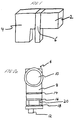
- FIG. 2a is a end view of a gate valve.
- FIG. 2b is a perspective view of the lower body portion of the gate valve of Fig. 2a.
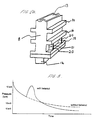
- Fig. 3 is a graph of pressure versus time for processes with and without a bake out step.
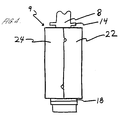
- FIG. 4 is a front view of a gate valve heater in accordance with one embodiment of the present invention, disposed on the lower body portion of a gate valve.
- FIG. 5 is a front view of a gate valve heater of Fig. 4.
- Fig. 6 is a top view of a retainer clip used in conjunction with the embodiment shown in Fig. 5.
- Fig. 7 is a exploded view of a section of the gate valve heater of Fig. 5.
- Fig. 8 is a cross-sectional view of the gate valve heater of Fig. 5 as viewed along the lines 8-8'.
- Fig. 9 is a side view of the gate valve heater of Fig. 8.
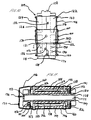
- Fig. 10 is an end view of a gate valve heater according to another embodiment of the present invention.
- Fig. 11 is a cross-sectional view along the lines 11-11' of the embodiment of Fig. 10.
- Fig. 12 is a side view of the gate valve heater of Fig. 11.
- Fig. 13 is an interior view of a portion of the gate valve heater of Fig. 12.
- a semiconductor processing system may include components for performing plasma vapor deposition, which, as shown in Fig. 1, includes a processing chamber 2 for preparing semiconductor wafers, a cryogenic vacuum pump 4 for achieving low pressures and a gate valve 6 disposed between the chamber 2 and cryo-pump 4.
- the gate valve 6 functions to open or close the chamber 2 to the cryo-pump 4.
- embodiments of the device include a solid housing with thermally conductive contact plates which are placed into contact with a portion of the gate valve. Such embodiments are durable and consistent over many cycles of heating and cooling, are resistant to contaminating the system, and are easy to install and utilize.
- Embodiments of the method include heating the lower portion of the gate valve so as drive contaminants towards the vacuum pump without causing an adverse effect on vacuum pump performance due to the elevated temperature.
- FIG. 2a and 2b A schematic design of a gate valve 6 is shown in Figs. 2a and 2b.
- the gate valve 6 includes a body portion 3 and a passage 10, the passage 10 (Fig. 2b) being aligned between a vacuum pump and a processing chamber.
- the gate valve 6 includes plates (not shown) disposed within a slot 13 in the gate valve body portion 8 (Fig. 2b), which intersects with the passage 10 and which may be raised and lowered by a controller 12 in order to selectively block all or a portion of the passage 10 and thereby limit or prevent communication between the process chamber and cryo-pump.
- the gate valve 6 may also have horizontal ribs 14, 16 and 18 and vertical ribs 20 built into, and extending from, the body portion for added rigidity and strength.
- the gate valve passage 10 (Fig. 2a) may be fully opened or partially opened during operation of the cryo-pump and pump down of the chamber, depending on the pumping conditions needed. The amount the gate valve is opened can regulate the pumping speed. To prevent damage to the cryo-pump, the gate valve passage 10 is typically closed during the venting of the chamber. The gate valve passage 10 is also closed during the regeneration of the cryo-pump to prevent contaminants released from the pump surfaces during regeneration from entering the chamber.
- the pump is warmed and accumulated contaminants and water molecules are released therefrom. These contaminants travel towards the gate valve and the chamber, and settle on cool surfaces of the gate valve. Similarly, whenever the chamber is vented or exposed to atmosphere, contaminants may enter the gate valve.
- the gate valve has a significant interior surface area available for condensation and accumulation of contaminants.
- the surface area of the internal walls of the gate valve and the plates used to block the passage between the chamber and the cryo-pump may be approximately 1/3 of the total surface area exposed to vacuum during wafer processing.
- the chamber may contain built-in heating elements or lamps designed to bake out the interior of the chamber to drive off the accumulated contaminants. Typical bake out temperatures in the chamber may range from about 100°C to about 200°C.
- the bake cut process enables low pressures to be reached in the chamber more rapidly than if no bake out process is performed.
- the graph in Fig. 3 compares the chamber pressure versus time for a pump down process utilizing a bake out procedure and a pump down process not utilizing a bake out procedure. As seen in the Fig. 3, there is a short time of increased pressure using bake out, presumably when certain contaminants are volatized off the surfaces in the chamber. After this short time, the bake out enables the pressure to decrease more rapidly than without the bake out.
- the gate valve heater 9 is placed over the lower part of the body portion 8 of the gate valve as shown in Fig. 4 and includes two separate sections or body portions 22 and 24 which may be connected around a portion of the gate valve.
- the gate valve heater 9 of the embodiment shown in Fig. 4 is designed to be received between ribs 14 and 18 and over ribs 16 and 20 (shown in Fig. 2b).
- Figure 5 provides a more detailed end view of the front end of the gate valve heat embodiment shown in Fig. 4.
- a retainer clip 26 may be utilized to hold the sections 22 and 24 firmly around the gate valve. As best seen in the top view shown in Fig. 6, the retainer clip 26 may be substantially U-shaped when extended around three sides of the gate valve heater. Ends 28 of the retainer clip are slightly flared away from the gate valve heater to facilitate placing it over the sections 22 and 24.
- the retainer clip 26 may also have handle grip portions 30 for easier installation and for safety reasons, because the handle portions will be cooler to the touch than the outer walls of sections 22 and 24.
- the retainer clip 26 may be made from a material such as a heat treated stainless steel or spring steel that is somewhat flexible and has a high elasticity.
- the retainer clip 26 is designed to have a memory after it is flexed so that upon application to the heater it will apply a continuous force to the outer sides of the heater body and ensure contact between the gate valve heater and the surface of the gate valve.
- Fig. 5 also illustrates the location of adjustment screws 32, which, as explained later herein, are used to align the position of the heater on the gate valve.
- Input and output lines 34 are present for functions such as power supply and temperature output. Strain relief lines for example, a rubber boot on the wires) may be used to increase safety.
- section 22 of the gate valve heater of the illustrated embodiment and the position of the components relative to the gate valve can be seen in the exploded view of Fig. 7.
- the other section 24 (not shown) is constructed in a similar fashion.)
- These components include rigid upper and lower contact plates 36 and 38, having flat contact surfaces which are placed into direct contact with the corresponding flat outer surfaces of the gate valve body 8.
- Upper and lower heating elements 40 and 42 are connected to the upper and lower contact plates 36 and 38, respectively, so that the heat is transferred from the heating elements to the contact plates.
- insulation material 44 is disposed between the heating elements and an outer shell or cover 46.
- the outer shell 46 of the gate valve heater may be fabricated from a metal such as stainless steel.
- the shell 46 preferably has a box-like shape to provide a degree of stiffness or rigidity to each section 22 or 24 of the gate valve heater so that the sections 22 and 24 may be held in place by the retainer clip 26.
- the amount of insulation may be varied.
- the insulation 44 covers all or nearly all of the interior surfaces of the outer shell 46 of the heater.
- the insulation 44 may also engage portions of the gate valve such as the ribs 16 and 20 and help to insure properly positioning of the heater on the gate valve.
- the insulation 44 should be fabricated from a material that is unlikely to flake off or shed into particles during use. Furthermore, the insulation 44 should preferably be selected so as to minimize the heat transfer to the outer shell 46, to reduce the risk of injury to the user.
- a preferred material for the insulation 44 is EXOBLOCK® BF-1000 Silicone Foam, manufactured by Bisco Products, a Dow Corning subsidiary.
- the EXOBLOCK® BF-1000 insulation material may include an adhesive on one surface, which can be utilized to attach the insulation 44 to the inside surface of the cover 46.
- the contact plates 36 and 38 may be fabricated from a variety of materials that have a high thermal conductivity, so that thermal energy will be efficiently transmitted to the gate valve.
- a preferred material is aluminum.
- Suitably sized heating elements 40 and 42 are placed into contact with the contact plates 36 and 38.
- a preferred heating element is a resistive metal wire embedded in a silicone pad such as that manufactured by Minco Products, Inc. Such a heating element may include an adhesive on one surface for attaching the heating element to a contact plate.
- the heating elements 40 and 42 and contact plates 36 and 38 do not need to extend over the ribs in order to adequately heat the gate valve.
- the lower contact plate 38 and heating element 42 of the illustrated embodiment are smaller than the upper contact plate 36 and heating element 40.
- the upper contact plate 36 and heating element 40 can be larger than the lower contact plate 38 and heating element 42 because there are no vertical ribs between the horizontal ribs 14 and 16 in the illustrated gate valve.
- the space between the upper contact plate 36 and lower contact plate 38 permits the horizontal rib 16 to fit between these plates within the gate valve heater body.
- FIG. 8 A top cross-sectional view along the lines 8-8' of the gate valve heater of Fig. 5 is shown in Fig. 8.
- the position of the gate valve body portion 8 within the gate valve heater is presented in phantom, including front side 48 and rear side 49.
- each section 22, 24 of the gate valve heater may extend beyond the front edge 48 of the gate valve in order to provide space for input and output wiring and insulation around the ends of the gate valve.
- a gap 50 between the insulation 44 and the heating element 40 is preferably provided a gap 50 so that the insulation 44 is not in direct contact with the heating element 40, and also provides a space for additional components such a thermocouple to be mounted. Such an arrangement also facilitates a distribution of heat transfer throughout the gap 50 by convection.
- the upper heating element 40 of each section 22, 24 is attached to the upper contact block 36, which, in turn, is positioned against the surface of the gate valve.
- the contact blocks 36 and 38 (38 is not shown in Fig. 8) may attached to the outer shell 46 of each section 22, 24 using a variety of fasteners, for example, a bolt 60 (shown in phantom) together with a bushing spacer 62 (also shown in phantom) to rigidly support the contact block 36, 38 on a section 22, 24 and to provide a predetermined spacing between the outer shell 46 of each section 22, 24 and the contact blocks 36, 38.
- two bolts and bushing spacers may be used to attach each contact block to the outer shell.
- embodiments such as the one shown in Fig. 8 may utilize bolts 60 that are spot welded or otherwise attached to the inner surface of the outer shell 46.
- Other fasteners for example, a prim bolt countersunk into the outer shell 46, may be attached to the inner surface of the outer shell 46, so that there is no direct contact from the contact block to the outer surface of the outer shell 46.
- Bolts extending through the outer surface of the outer shell 46 may also be utilized, but internally attached bolts can reduce direct heat flow from the contact blocks 36 and 38 through the fastener to the outer surface of the outer shell 46, to protect the user.
- the gate valve heater does not extend around the entire periphery of the gate valve. Depending on the temperatures utilized and the wall thickness of the gate valve, extending the heater so that it completely encircles the gate valve may be avoided because the heat loss through the back wall portion of the gate valve may be minimal. In the embodiment shown in Fig. 8, the rear end 47 of the gate valve heater does not extend across one side 49 of the gate valve body.
- FIG. 9 A side view of one section of the gate valve heater embodiment of Fig. 8 is shown in Fig. 9.
- the locations of the upper and lower contact plates 36 and 38 within the gate valve heater are indicated in phantom.
- the size, shape and position of the plates may preferably conform to the outlines of the gate valve body.
- the gate valve may have both vertical and horizontal ribs.
- the gate valve heater as shown in Fig. 9, permits the horizontal rib 16 and vertical ribs 20 (shown in phantom)to be received within the outer shell 46 and between the spaced plates 36 and 33.
- the gate valve heater may also include support posts 52 as shown in phantom in Fig. 9, which are preferably attached to each of the outer shells of the gate valve heater through support member 53.
- Each section 22, 24 of the gate valve heater may contain two support members 53 having support posts 52 extending therefrom (Fig. 9).
- Each heater section 22, 24 is placed over a portion of the gate valve body 8 and the support posts 52 are inserted into openings 21 (see Fig. 2b) incorporated into the vertical ribs 20 of the gate valve body 8 in order to support the gate valve heater in the proper position on the gate valve.
- the gate valve heater support posts 52 are placed into the openings 21 of the gate valve ribs 20 and forced therein until support member 53 contacts the rib 20 of the gate valve.
- the gate valve heater is tightly positioned on the gate valve by turning the adjustment screws 32 (Fig. 5).
- the adjustment screws 32 may be positioned with the tip end in contact with the gate valve body. Then, further tightening of the adjustment screws 32 applies a force to the gate valve heater that pushes the support members 53 into tight contact with the vertical ribs 20.
- Retainer clip 26 may be placed onto the gate valve heater sections 22 and 24 in order to apply a force through the sections and to the contact plates 36, 40. This force insures an adequate contact is made with the gate valve surface.
- the retainer clip 26 may be held in position on the outer shell 46 of each section 22, 24 by its frictional grip on the two sections 22, 24 or alternatively a screw or other fastener may be used to secure the retainer clip 26 in place.
- gate valve heaters may utilize a separate temperature controller or an internal temperature controller that provides the appropriate temperature after power is supplied to the heater.
- a variety of switches such as a thermostat switch 54, an "at” temperature switch 56, and an “over” temperature switch 58 may be present.
- the “at” switch controls the heater so that the appropriate temperature is achieved and maintained.
- the “over temperature” switch prevents the heater from significantly exceeding the appropriate temperature. If the "at” temperature is significantly exceeded, for example, by 10°C, the power is shut off and restarted after the gate valve surface has cooled by heat transfer to the adjacent ambient environment.
- the switches of the illustrated embodiment have an accuracy of +/- 5°C.
- the preferred target or "at” temperature is 150°C at the surface of the gate valve body.
- Such a temperature has been successfully utilized for an embodiment of a heater placed on a VAT Series 10 UHV Gate Valve, size DN200 (200 mm passage size), having a modified rib structure.
- Embodiments of the gate valve heater may also include one or more thermocouples or other temperature sensors, preferably attached to or in contact with one or more of the contact plates, heating elements, or the surface of the gate valve.
- FIG. 10-13 Another embodiment of a gate valve heating device, as mounted on a gate valve body 108, is shown in Figs. 10-13.
- This embodiment is similar to the those shown in earlier figures and described above, and include similar upper and lower contact plates 136 and 138, upper and lower heating elements 140 and 142, as well as insulation 144.
- the gate valve body 108 like the gate valve body 8 of Fig. 2, has horizontal ribs 116, vertical ribs 120, and openings 121 in the vertical ribs 120.
- certain differences in the embodiment shown in Fig. 10 relate to the shape of the retainer clip 126 and the shape of the outer shell 146.
- the gate valve heater 109 of this embodiment also has two opposing sections 122 and 124 and a retainer clip 126 having a central handle 130 to apply pressure to the sections 122 and 124 to insure good contact with the gate valve.
- Fig. 10 shows input and output lines 134, or functions such as temperature output, and power line 174 disposed through the bottom central portion 135 of the front face of the gate valve heater. Alternatively the input and output lines 134 may also extend through the bottom central portion 135 of the gate valve heater.
- Nema style power connectors may be used for both main power and for connecting the heating elements 140 and 142 in each section 122 and 124 to one another.
- Bolts 160 that extend through the outer shell 146 are used to connect interior portions, including contact blocks 136 and 138, and heating elements 140 and 142, to the outer shell 146.
- Fig. 11 shows a top cross-sectional view of the embodiment shown in Fig. 10 along the lines 11-11'.
- Fig. 11 also shows the exterior wall 107 of the gate valve body 108 (the structure of the interior portion 111 of the gate valve body 108 has been omitted for clarity).
- An outer shell 146 of the two sections may be tapered inward at one end in order to reduce the outer dimensions of the gate valve heater.
- bushing spacers 162 space the outer shell from the contact plate 138. Between the insulation 144 and the lower heating element 142 lies a gap 150.
- support posts 152 are be attached to the shell 146 through support members 153.
- the support posts 152 are positioned to fit within an opening 121 (Fig. 11) located about midway in a vertical rib 120 on the gate valve.
- An adjustment screw 132 threaded into the outer shell 146 of the heater has one end 133 abutting the end wall 48 of the gate valve.
- the retainer clip 126 may have a centrally disposed handle 130, for example, a screw and nut attached to the retainer clip.
- the handle 130 may be used to fasten the retainer clip 126 to the gate valve heater.
- the gate valve heater assembly is configured to have spaces in it which conform to any ribs or other projections extending from the surfaces of the gate valve over which the gate valve heater is attached.
- the outer shell 146 of each section has a bottom wall portion 171 that defines openings 172, and further has a side wall portion 175 which defines an opening 176.
- the openings 172 are positioned to receive vertical ribs of the gate valve and the opening 176 is positioned to receive a horizontal rib of the gate valve.
- the outer shells 146 of the two heater sections can have top, bottom and side wall portions to more fully enclose the heater yet accommodate the ribs of the gate valve.
- the bottom openings 172 are preferably sized to accommodate lateral movement between the heater and the gate valve as the adjustment screw 132 is rotated to seat the support posts 152 into the rib openings as described above.
- a terminal block 168 (Fig. 12) and terminal connectors 170 may be disposed between the lower contact plate 138 and the shell 146. (See Fig. 12) Similarly situated between the lower contact plate 138 and the shell 146 may be a thermocouple 164 and thermocouple connector 166, as well as various connectors and switches for operation of the heater, for example, an "at" temperature switch 156, an "over” temperature switch 158, and a reset switch 155. These switches control the gate valve heater to achieve the proper temperature. Should the temperature become too high, the system will be cooled and reset. Preferred embodiments may also include an indicator light 178 (Fig. 13) to indicate proper functioning of the gate valve heater.
- embodiments of the gate valve heater may be positioned at the lower portion of the body of the gate valve. Such placement of the gate valve heater leads to certain advantages and increased efficiencies in the system.
- the positioning of the gate valve heating device and temperatures utilized are significant because heat traveling through the gate valve body to the cryo-pump can result in decreased cryo-pump efficiency.
- the gate valve heater is preferably positioned on the lower body portion of the gate valve, which is spaced apart from the cryo-pump.
- the gate valve is also preferably insulated as discussed above to retard heat from traveling through the air and heating the cryo-pump.
- contaminants may settle near the bottom portion of the gate valve.
- these contaminants are driven up through the length of the gate valve and towards the vacuum pump. Areas of the gate valve disposed just above the location of the heater are believed to still receive adequate heat from the heater. However, because the heat will be greater in the portion of the gate valve directly contacted by the heater, the contaminants are driven up through the length of the gate valve as heated gases rise towards the opening to the vacuum pump, where the contaminants can be removed from the system.
- the framed construction of embodiments of the gate valve heater is believed to be more durable than prior art flexible heating jackets, and less susceptible to particle flake off during repeated use.
- the use of the gate valve heater reduced the bake out time needed to achieve base pressure in a chamber having a volume of approximately 2.6 x 10 4 cm 3 by approximately 5 hours, using a CTI Cryogenics cryogenic vacuum pump, model 8F on board cryc-pump, and a VAT Series 10 gate valve, size DN200 (having a modified rib structure) that has a maximum passage area of approximately 3.1 x 10 2 cm 2 .
- the parameters used in the heater were a hold temperature of 125°C, a hold time of 31 hours and a ramp rate of heating and cooling of 50°C/hour. Aspects such as the size and geometry of the chamber and gate valve, as well as the types of contaminants present in the system, will influence the optimal hold temperature and hold time.
- a gate valve heater according to embodiments of the present invention may differ from those described above in that its specific configuration may vary, depending, for example, on the design of the gate valve body, such as, for example, whether the gate valve has strengthening ribs, the wall thickness of the gate valve, the interior geometry of the gate valve, etc. Likewise, the physical parameters of the gate valve body, its orientation with respect to the chamber, vacuum pump and accompanying hardware, will influence the exact design of the gate valve heater and its optimal positioning on the gate valve.
Landscapes
- Engineering & Computer Science (AREA)
- General Engineering & Computer Science (AREA)
- Mechanical Engineering (AREA)
- Details Of Valves (AREA)
- Sliding Valves (AREA)
- Drying Of Solid Materials (AREA)
- Compressors, Vaccum Pumps And Other Relevant Systems (AREA)
- Physical Deposition Of Substances That Are Components Of Semiconductor Devices (AREA)
Applications Claiming Priority (2)
| Application Number | Priority Date | Filing Date | Title |
|---|---|---|---|
| US635094 | 1990-12-28 | ||
| US08/635,094 US5965046A (en) | 1996-04-17 | 1996-04-17 | Method and apparatus for baking out a gate valve in a semiconductor processing system |
Publications (2)
| Publication Number | Publication Date |
|---|---|
| EP0802363A2 true EP0802363A2 (fr) | 1997-10-22 |
| EP0802363A3 EP0802363A3 (fr) | 1998-05-20 |
Family
ID=24546429
Family Applications (1)
| Application Number | Title | Priority Date | Filing Date |
|---|---|---|---|
| EP97302630A Withdrawn EP0802363A3 (fr) | 1996-04-17 | 1997-04-17 | Procédé et appareil pour cuire un tiroir dans un système de manipulation de semi-conducteurs |
Country Status (5)
| Country | Link |
|---|---|
| US (2) | US5965046A (fr) |
| EP (1) | EP0802363A3 (fr) |
| JP (1) | JPH1068381A (fr) |
| KR (1) | KR970072032A (fr) |
| TW (1) | TW322592B (fr) |
Cited By (3)
| Publication number | Priority date | Publication date | Assignee | Title |
|---|---|---|---|---|
| EP0863348A3 (fr) * | 1997-03-07 | 1999-06-09 | Fujikin Incorporated | Dispositif pour le chauffage des appareils régulateurs pour fluides |
| US6076359A (en) * | 1996-11-25 | 2000-06-20 | American Air Liquide Inc. | System and method for controlled delivery of liquified gases |
| EP1087159A4 (fr) * | 1998-05-20 | 2001-05-09 | Smc Kk | Soupape a pression tres negative |
Families Citing this family (15)
| Publication number | Priority date | Publication date | Assignee | Title |
|---|---|---|---|---|
| US20040149214A1 (en) * | 1999-06-02 | 2004-08-05 | Tokyo Electron Limited | Vacuum processing apparatus |
| US6506994B2 (en) | 2001-06-15 | 2003-01-14 | Applied Materials, Inc. | Low profile thick film heaters in multi-slot bake chamber |
| US6607580B1 (en) * | 2002-03-04 | 2003-08-19 | Agilent Technologies, Inc. | Separation column for a gas chromatograph |
| JP2005096923A (ja) * | 2003-09-24 | 2005-04-14 | Shin Meiwa Ind Co Ltd | 塵芥貯留排出装置 |
| KR101094913B1 (ko) * | 2006-06-09 | 2011-12-16 | 소이텍 | Iii-v 족 반도체 물질을 형성하기 위한 제조 공정 시스템 |
| US9481944B2 (en) | 2006-11-22 | 2016-11-01 | Soitec | Gas injectors including a funnel- or wedge-shaped channel for chemical vapor deposition (CVD) systems and CVD systems with the same |
| KR101390425B1 (ko) * | 2006-11-22 | 2014-05-19 | 소이텍 | 화학기상증착 챔버용 온도제어 퍼지 게이트 밸브 |
| US8197597B2 (en) | 2006-11-22 | 2012-06-12 | Soitec | Gallium trichloride injection scheme |
| US8382898B2 (en) | 2006-11-22 | 2013-02-26 | Soitec | Methods for high volume manufacture of group III-V semiconductor materials |
| WO2008064080A1 (fr) * | 2006-11-22 | 2008-05-29 | S.O.I.Tec Silicon On Insulator Technologies | Système de distribution à haut volume pour le trichlorure de gallium |
| US9481943B2 (en) | 2006-11-22 | 2016-11-01 | Soitec | Gallium trichloride injection scheme |
| KR101379410B1 (ko) | 2006-11-22 | 2014-04-11 | 소이텍 | 3-5족 반도체 재료들의 대량생산을 위한 설비 |
| US20090045172A1 (en) * | 2007-08-13 | 2009-02-19 | Lincoln Global, Inc. | Method of open root welding |
| US8877001B2 (en) * | 2009-05-07 | 2014-11-04 | Applied Materials, Inc. | Shuttered gate valve |
| US9945292B2 (en) * | 2015-03-10 | 2018-04-17 | Hamilton Sundstrand Corporation | Thermoelectric cooled torque motor |
Family Cites Families (27)
| Publication number | Priority date | Publication date | Assignee | Title |
|---|---|---|---|---|
| US1706997A (en) * | 1925-11-10 | 1929-03-26 | Nat Aniline And Chemical Co In | Valve heater |
| US1748510A (en) * | 1929-01-09 | 1930-02-25 | Nat Pneumatic Co | Electric heater for valves |
| US1952589A (en) | 1930-07-30 | 1934-03-27 | Ernst L Ruby | Heating device for railroad rails and switches |
| US1991801A (en) | 1930-10-07 | 1935-02-19 | William H Greenfield | Rail heating device |
| US2646065A (en) * | 1950-12-01 | 1953-07-21 | Standard Oil Dev Co | Valve |
| US2608996A (en) * | 1951-08-30 | 1952-09-02 | Forman Ralph | Glass valve |
| US2739221A (en) * | 1954-12-02 | 1956-03-20 | Linton Summit Coal Company Inc | Method and apparatus for heating vessels |
| US3055055A (en) * | 1959-10-15 | 1962-09-25 | Cardinal Entpr Ltd | Runner heater for injection molding machines |
| US3158363A (en) * | 1963-06-10 | 1964-11-24 | Catalyst Research Corp | Clip-on heater |
| US3349722A (en) | 1964-11-27 | 1967-10-31 | Cleveland Technical Ct Inc | Electrical resistance rail heater |
| US3398262A (en) * | 1967-09-14 | 1968-08-20 | Electro Trace Corp | Pipe heating arrangement |
| AT327335B (de) * | 1968-01-29 | 1976-01-26 | Boehler & Co Ag Geb | Vorrichtung zur abdichtung von spindeln, insbesondere bei ventilen fur flussige metalle, wie flussiges natrium, z.b. in kernreaktoren |
| US3679189A (en) * | 1970-04-03 | 1972-07-25 | Raychem Corp | Pyrotechnic heating device |
| US3633891A (en) * | 1970-05-06 | 1972-01-11 | Robert F Heran | Method and apparatus for heating annular workpieces |
| US3733459A (en) * | 1971-02-09 | 1973-05-15 | C Lengstorf | Internal heating device for air valves |
| US3747892A (en) * | 1972-01-27 | 1973-07-24 | Steinen Mfg Co Wm | Magnetic valve |
| US4152577A (en) * | 1976-06-23 | 1979-05-01 | Leavines Joseph E | Method of improving heat transfer for electric pipe heaters |
| FR2418600A1 (fr) * | 1978-02-23 | 1979-09-21 | Commissariat Energie Atomique | Procede de chauffage d'un organe d'un circuit pour porter a une temperature determinee un fluide circulant dans ledit organe |
| DE3689735T2 (de) * | 1985-08-02 | 1994-06-30 | Semiconductor Energy Lab | Verfahren und Gerät zur Herstellung von Halbleitervorrichtungen. |
| AU592513B2 (en) * | 1986-06-18 | 1990-01-11 | Elektro-Thermit Gmbh | Process for welding a railway rail, aluminothermic heating blocks for use in the process, and method of making said aluminothermic heating blocks |
| DE8703184U1 (de) * | 1986-12-24 | 1987-07-16 | Kuhlmann, Günter, 4795 Delbrück | Isolierbox für Absperr- und Regelarmaturen |
| US4726394A (en) * | 1987-04-13 | 1988-02-23 | Commercial Insulation Company | Heated cover for pipeline backflow preventer component assembly |
| JPH0322710Y2 (fr) * | 1988-05-26 | 1991-05-17 | ||
| JPH0464788A (ja) | 1990-06-29 | 1992-02-28 | Fujikin:Kk | 恒温バルブ |
| DE9205235U1 (de) * | 1992-04-15 | 1992-06-25 | Pierburg GmbH, 4040 Neuss | Beheizbares, druckluftgesteuertes Ventil |
| JP3274895B2 (ja) * | 1992-12-02 | 2002-04-15 | ミリポア・コーポレイション | スロットルバルブ |
| US5462080A (en) * | 1993-08-31 | 1995-10-31 | Applied Materials, Inc. | Heated removable throttle valve |
-
1996
- 1996-04-17 US US08/635,094 patent/US5965046A/en not_active Expired - Fee Related
-
1997
- 1997-04-12 TW TW086104735A patent/TW322592B/zh active
- 1997-04-17 EP EP97302630A patent/EP0802363A3/fr not_active Withdrawn
- 1997-04-17 KR KR1019970014108A patent/KR970072032A/ko not_active Withdrawn
- 1997-04-17 JP JP9100206A patent/JPH1068381A/ja not_active Withdrawn
-
1999
- 1999-08-10 US US09/371,804 patent/US6274854B1/en not_active Expired - Fee Related
Cited By (5)
| Publication number | Priority date | Publication date | Assignee | Title |
|---|---|---|---|---|
| US6076359A (en) * | 1996-11-25 | 2000-06-20 | American Air Liquide Inc. | System and method for controlled delivery of liquified gases |
| EP0863348A3 (fr) * | 1997-03-07 | 1999-06-09 | Fujikin Incorporated | Dispositif pour le chauffage des appareils régulateurs pour fluides |
| US6014498A (en) * | 1997-03-07 | 2000-01-11 | Fujikin Incorporated | Device for heating fluid control apparatus |
| EP1087159A4 (fr) * | 1998-05-20 | 2001-05-09 | Smc Kk | Soupape a pression tres negative |
| US6433308B1 (en) | 1998-05-20 | 2002-08-13 | Smc Kabushiki Kaisha | High vacuum valve |
Also Published As
| Publication number | Publication date |
|---|---|
| US5965046A (en) | 1999-10-12 |
| EP0802363A3 (fr) | 1998-05-20 |
| US6274854B1 (en) | 2001-08-14 |
| JPH1068381A (ja) | 1998-03-10 |
| KR970072032A (ko) | 1997-11-07 |
| TW322592B (fr) | 1997-12-11 |
Similar Documents
| Publication | Publication Date | Title |
|---|---|---|
| US5965046A (en) | Method and apparatus for baking out a gate valve in a semiconductor processing system | |
| US6202656B1 (en) | Uniform heat trace and secondary containment for delivery lines for processing system | |
| US6765178B2 (en) | Chamber for uniform substrate heating | |
| JP4808467B2 (ja) | 基板リングアセンブリ及び基板処理チャンバ | |
| CN1088765C (zh) | 等离子体处理装置 | |
| US8080107B2 (en) | Showerhead electrode assembly for plasma processing apparatuses | |
| US8871027B2 (en) | Electrical contacts for use with vacuum deposition sources | |
| US6825447B2 (en) | Apparatus and method for uniform substrate heating and contaminate collection | |
| EP0803904A2 (fr) | Support de substrat | |
| CN1849697A (zh) | 具有动态温度控制的基片支架 | |
| JPH10218632A (ja) | 大面積ガラス基板の冷却および加熱方法とそのための装置 | |
| US6998579B2 (en) | Chamber for uniform substrate heating | |
| US6083360A (en) | Supplemental heating of deposition tooling shields | |
| US5733426A (en) | Semiconductor wafer clamp device and method | |
| KR101035828B1 (ko) | 균일한 기판 가열을 위한 챔버 | |
| US6620250B2 (en) | Method and apparatus for shielding a device from a semiconductor wafer process chamber | |
| CN115020289A (zh) | 加热装置以及半导体清洗设备 | |
| JP3736103B2 (ja) | プラズマ処理装置およびその処理方法 | |
| TW202246569A (zh) | 用於腔室內電阻加熱元件的腔室主體饋通 | |
| JP2003059625A (ja) | 加熱プレートの取付構造および半導体製造装置 | |
| JP2001153487A (ja) | ペルチェ素子の取付け構造 | |
| WO2008048324A2 (fr) | Bouclier anti-rayonnement pour pompe cryogénique destinée à un dépôt physique en phase vapeur à haute température | |
| JPH05320899A (ja) | 加熱冷却兼用基板ホルダ | |
| JP2007335699A (ja) | 基板処理装置 |
Legal Events
| Date | Code | Title | Description |
|---|---|---|---|
| PUAI | Public reference made under article 153(3) epc to a published international application that has entered the european phase |
Free format text: ORIGINAL CODE: 0009012 |
|
| AK | Designated contracting states |
Kind code of ref document: A2 Designated state(s): BE DE FR GB IE IT |
|
| PUAL | Search report despatched |
Free format text: ORIGINAL CODE: 0009013 |
|
| AK | Designated contracting states |
Kind code of ref document: A3 Designated state(s): BE DE FR GB IE IT |
|
| 17P | Request for examination filed |
Effective date: 19981118 |
|
| 17Q | First examination report despatched |
Effective date: 20010717 |
|
| STAA | Information on the status of an ep patent application or granted ep patent |
Free format text: STATUS: THE APPLICATION IS DEEMED TO BE WITHDRAWN |
|
| 18D | Application deemed to be withdrawn |
Effective date: 20011102 |