EP0802635A2 - Procédé pour la transmission de données codées - Google Patents
Procédé pour la transmission de données codées Download PDFInfo
- Publication number
- EP0802635A2 EP0802635A2 EP97104261A EP97104261A EP0802635A2 EP 0802635 A2 EP0802635 A2 EP 0802635A2 EP 97104261 A EP97104261 A EP 97104261A EP 97104261 A EP97104261 A EP 97104261A EP 0802635 A2 EP0802635 A2 EP 0802635A2
- Authority
- EP
- European Patent Office
- Prior art keywords
- data
- error
- transmitted
- information
- correcting code
- Prior art date
- Legal status (The legal status is an assumption and is not a legal conclusion. Google has not performed a legal analysis and makes no representation as to the accuracy of the status listed.)
- Granted
Links
- 238000000034 method Methods 0.000 title claims abstract description 37
- 238000012937 correction Methods 0.000 claims abstract description 9
- 230000005540 biological transmission Effects 0.000 description 37
- 238000012360 testing method Methods 0.000 description 8
- 230000008901 benefit Effects 0.000 description 3
- 230000008569 process Effects 0.000 description 2
- 238000010276 construction Methods 0.000 description 1
- 238000001514 detection method Methods 0.000 description 1
- 238000011161 development Methods 0.000 description 1
- 230000018109 developmental process Effects 0.000 description 1
- 101150086005 gob-1 gene Proteins 0.000 description 1
- 238000012423 maintenance Methods 0.000 description 1
- 230000007257 malfunction Effects 0.000 description 1
- 238000012986 modification Methods 0.000 description 1
- 230000004048 modification Effects 0.000 description 1
- 230000008520 organization Effects 0.000 description 1
- 238000012545 processing Methods 0.000 description 1
- 230000008439 repair process Effects 0.000 description 1
- 230000001360 synchronised effect Effects 0.000 description 1
Images

Classifications
-
- H—ELECTRICITY
- H04—ELECTRIC COMMUNICATION TECHNIQUE
- H04L—TRANSMISSION OF DIGITAL INFORMATION, e.g. TELEGRAPHIC COMMUNICATION
- H04L1/00—Arrangements for detecting or preventing errors in the information received
- H04L1/004—Arrangements for detecting or preventing errors in the information received by using forward error control
- H04L1/0056—Systems characterized by the type of code used
- H04L1/0057—Block codes
-
- H—ELECTRICITY
- H04—ELECTRIC COMMUNICATION TECHNIQUE
- H04L—TRANSMISSION OF DIGITAL INFORMATION, e.g. TELEGRAPHIC COMMUNICATION
- H04L1/00—Arrangements for detecting or preventing errors in the information received
- H04L1/004—Arrangements for detecting or preventing errors in the information received by using forward error control
- H04L1/0072—Error control for data other than payload data, e.g. control data
-
- H—ELECTRICITY
- H04—ELECTRIC COMMUNICATION TECHNIQUE
- H04L—TRANSMISSION OF DIGITAL INFORMATION, e.g. TELEGRAPHIC COMMUNICATION
- H04L1/00—Arrangements for detecting or preventing errors in the information received
- H04L1/004—Arrangements for detecting or preventing errors in the information received by using forward error control
- H04L1/0075—Transmission of coding parameters to receiver
Definitions
- the method according to the invention is based on a method for transmitting coded data according to the category of the independent patent claim.
- a transmission method for coded data as a video coding standard has already been proposed by the International Telecommunication Union, which is intended for the line-based, low-rate transmission of video images.
- the standard has the title "Draft ITU-T Recommendation H.263" and comes from Study Group 15, Working Party 15/1, December 5, 1995.
- This document contains the essential information about the source coding of the video signals, the syntax and semantics included in the transmission of the data and for decoding the data in the receiver.
- the method according to the type of the independent claim has the advantage over the fact that data can also be transmitted over heavily disturbed data channels.
- the effort for error correction can be adapted to the extent of the interference in the data channel. This makes it possible to transmit the optimal amount of data even if the level of interference in the data channel changes.
- FIG. 1 shows some areas of application for the method according to the invention
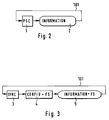
- FIG. 2 shows the already known structure of a message according to the H.263 standard
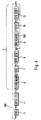
- FIGS. 3 and 4 show the structure of the message according to the invention.
- the method according to the invention is to be used in the transmission of data via interference-prone data channels, in particular image data.
- a mobile radio channel is intended as the transmission channel.
- the transmission rate is very limited.
- image resolution cannot be as great as e.g. B. in conventional television pictures.
- Figure 1 shows some applications of such image transfers.
- Figure 1a shows z. B. a video surveillance system that is used to secure buildings at risk.
- Figure 1b shows as an application the transmission of image data between two mobile video phones.
- Figure 1c shows the application of the person check using a mobile video phone.
- Figure 1d shows the application of message transmission to a mobile videophone.
- Figure 1e shows the use of a video phone in a motor vehicle workshop for the purpose of maintenance work.
- repair instructions can be transmitted from a central station to a mobile receiving device.
- the claimed methods are then implemented in the end devices (video telephone, video image receiver, video image camera, etc.).
- FIG. 2 shows in a general form how coded data are transmitted.
- the data is transmitted through a serial data channel, ie through a medium which is suitable for transmitting signals.
- a serial data channel ie through a medium which is suitable for transmitting signals.
- the transmission of image data via a mobile radio channel is considered here in particular.
- a first code word 1 is sent, which indicates that data are subsequently being transmitted.
- This code word enables the receiver to be synchronized, ie the receiver can use the received code word to determine where the message begins and thus interpret the subsequent coded data stream, which generally consists of individual zero or one bit states.
- this code word 1 consists of the PSC (Picture Start Code) as it is in the H.263 standard was defined.
- This PSC is followed by an information field 2 of any length, which contains the data necessary for the image structure.
- the individual images are transmitted in individual data packets, each with its own PSC at the beginning. A single one of these data packets is shown in FIG. The arrow 101 from the end of the information field 2 back to the beginning of the PSC 1 shows that this data is often repeated in order to transmit successive video images.
- a fixed length was assigned to the PSC in the H.263.
- data fields with a fixed length are represented by rectangular boxes, while data fields with a variable length are represented by boxes with rounded corners.
- the method according to the H.263 standard shown in FIG. 2 assumes that the data are transmitted with a high level of transmission security.
- the receiver can no longer interpret the following information field 2 with the picture data. Measures must therefore be taken which can nevertheless be interpreted in the case of a transmission channel which is severely faulty, such as for example mobile radio, the transmitted coded data.
- Error-correcting coding methods are known for such faulty data channels. The principle of such error-correcting coding methods is that the coding provides a certain redundancy, so that it can be determined which bits were transmitted incorrectly. This redundancy naturally requires that more data be transmitted. The better the error correction of the code used, the greater the amount of data required. However, since it is not possible to transmit any amount of data per unit of time, a must A compromise can be found between the performance of the error-correcting code and the transmission capacity of the data channel.
- FIG. 3 shows how data is encoded using the method according to the invention in order to maintain good error protection, ie the use of an error-correcting code, and at the same time to maintain the transmission rate of the data channel.
- the coded data shown in FIG. 3 have a synchronization field 3, a configuration field 4 and an information field 5.
- the information field 5 has an error protection (FS). This error protection reduces the useful information in information field 5.
- information field 2 without error protection has a length of 100 bits (ie 100 bit useful information)
- information field 5 of the same length in FIG. 3 can only transmit less useful information, e.g. .E.g. only 80 bit. Thus 20 bits were used to ensure that transmission errors can be corrected.
- the proportion of useful information in information field 5 would be correspondingly shorter or longer.
- the known methods for forward error correction such as the BCH code, the REED-Solomon code, the RCPC code or other error-correcting coding methods, can be used for coding.
- a non-exhaustive overview of error-correcting coding methods is known, for example, from the Furrer textbook mentioned at the beginning.
- strong error protection or less severe error protection is now used for information field 5.
- the configuration field 4 thus contains information about the error-correcting code of the information field 5, for example it is recorded in the configuration field 4 which coding method is used and how many additional bits are used for error protection.
- the configuration field thus contains control data which only enables the decoding of the useful data contained in the information field. Since a transmission error in configuration field 4 would mean that the following information could not be interpreted, configuration field 4 (CONFIG) itself is provided with a particularly strong error protection (FS).
- 4 bits are enough to represent 16 different levels of error protection, for example.
- another 10 bits can be used to secure these 4 bits in order to ensure that the configuration field is provided with a particularly strong error protection.
- a synchronization field 3 (SYNC) is used in FIG.
- This synchronization field 3 differs from the picture start code of FIG. 2 in that it is a particularly transmission-safe synchronization signal which can be recognized with great reliability, even if individual bits are transmitted with interference.
- Such synchronization signals are known as Barker or Williard words and described, for example, in the book by Furrer.
- the synchronization field 3 shown in FIG. 3 can thus be recognized particularly reliably.
- the synchronization field thus also contains control data which only enables the useful information contained in the information field to be decoded.
- the method according to the invention now provides that, depending on the interference on the transmission channel, a corresponding effort is made to secure the information field 5. Since the transmission capacity of the transmission channel is limited, this means a strong safeguard, ie a large effort for error protection, which means that less information (useful signal) can be transmitted. In the case of the transmission of image data, this means, for example, that if the transmission signal is severely disturbed, only data can be transmitted which enables the construction of an unsharp image or an image with low color brilliance or only a black and white image. With an undisturbed transmission channel, however, images can be transmitted with great sharpness and great color brilliance.
- the method according to the invention thus provides variable error protection, which is set depending on the strength of the interference in the transmission channel.
- the level of error protection can be changed from frame to frame when transmitting video images.
- the transmitter of the coded data requires information about the extent of the interference in the data channel. This information can be made available to the sender of the coded data, for example by the receiver of the coded data, who can determine it on the basis of the coded data received by him can determine how many errors have occurred, ie how much the transmission channel is disturbed.
- Information field 5 now contains data of different importance. When transferring images, these are parts of the information field that contain information for a large number of pixels. According to the invention, these parts of the information field 5 are particularly strongly secured. Such protection is shown in FIG. 4 on the basis of the bit stream of the coded data for an image.
- the synchronization field 3 and the configuration field 4 correspond to the already known fields from FIG. 3.
- the actual information field 5 is divided into a plurality of information subfields 6 to 11, which perform different functions.
- the method according to the invention is described here on the basis of an image transmission according to the H.263 standard. In principle, however, the method according to the invention can also be used for other types of data transmission.
- the first header 6 of an image has a special function here, because certain information that is defined therein applies to all information that follows in this image.
- this header of the first block groups the name Picture Header 6 because it contains data that applies to the entire picture. Since a malfunction in this picture header has 6 consequences for the entire picture, this picture header is transmitted with a particularly high level of data security, ie a very large amount of effort is spent on error correction here.
- a test field 7 is also transmitted after the picture header 6, this test field 7 being designed, for example, as a CRC field. This test field 7 allows, with relatively little effort, to determine whether the data of the picture header has been transmitted correctly or whether the correct data have now been calculated or not after decoding and error correction.
- the test field 7 is designed only as an error-detecting code, but not as an error-correcting code.
- the advantage of such error-recognizing coding methods is that relatively little effort is required to confirm that the previously transmitted data are free of errors.
- the actual data for the first block group are then transmitted with the field 8.
- the headers 9 (GOB header i), the test fields 10 and the data 11 (INFO GOB i) are then transmitted for the further block groups. As indicated by the repeat arrow 100, this process is repeated until the information is transmitted from all block groups.
- the repeat arrow 101 indicates that this process is repeated for each image.
- the header 9 of each block group is in turn protected by a test field 10.
- the organization of the data for image transmission is based on the H.263 standard.
- the picture header 9 can, for example, consist of the H.263 symbols TR, PTYPE, PQUANT, CPM, PSBI, TRB, DBQUANT, PEI, PSPARE exist.
- the GOB headers 9 for the block groups consist, for example, of the H.263 symbols GN, GSBI, GFID, GQUANT. Since both the picture header 6 and the GOB header 9 have a variable length, it is also possible to insert check fields 7, 10 designed as CRC checksums after a fixed length that is greater than the maximum header length. This results in a simpler and less susceptible structure.
- the configuration field 4 can contain information about whether or not these additional error-detecting test fields are used.
Landscapes
- Engineering & Computer Science (AREA)
- Computer Networks & Wireless Communication (AREA)
- Signal Processing (AREA)
- Detection And Prevention Of Errors In Transmission (AREA)
- Compression Or Coding Systems Of Tv Signals (AREA)
- Error Detection And Correction (AREA)
- Transmission Systems Not Characterized By The Medium Used For Transmission (AREA)
Applications Claiming Priority (2)
| Application Number | Priority Date | Filing Date | Title |
|---|---|---|---|
| DE19614701A DE19614701A1 (de) | 1996-04-15 | 1996-04-15 | Verfahren zur Übertragung von codierten Daten |
| DE19614701 | 1996-04-15 |
Publications (3)
| Publication Number | Publication Date |
|---|---|
| EP0802635A2 true EP0802635A2 (fr) | 1997-10-22 |
| EP0802635A3 EP0802635A3 (fr) | 2001-02-28 |
| EP0802635B1 EP0802635B1 (fr) | 2003-09-10 |
Family
ID=7791234
Family Applications (1)
| Application Number | Title | Priority Date | Filing Date |
|---|---|---|---|
| EP97104261A Expired - Lifetime EP0802635B1 (fr) | 1996-04-15 | 1997-03-13 | Procédé pour la transmission de données codées |
Country Status (3)
| Country | Link |
|---|---|
| US (1) | US5923274A (fr) |
| EP (1) | EP0802635B1 (fr) |
| DE (2) | DE19614701A1 (fr) |
Families Citing this family (9)
| Publication number | Priority date | Publication date | Assignee | Title |
|---|---|---|---|---|
| US6043766A (en) * | 1997-12-10 | 2000-03-28 | National Semiconductor Corporation | Distributive encoder for encoding error signals which represent signal peak errors in data signals for identifying erroneous signal baseline, peak and equalization conditions |
| US6125470A (en) * | 1997-12-10 | 2000-09-26 | National Semiconductor Corporation | Distributive encoder for encoding error signals which represent signal peak errors in data signals for correcting erroneous signal baseline conditions |
| JP3449204B2 (ja) | 1998-01-23 | 2003-09-22 | ソニー株式会社 | 制御装置、無線伝送装置及び無線伝送方法 |
| FR2811832B1 (fr) * | 2000-07-13 | 2003-09-26 | Canon Kk | Procedes, dispositifs et appareils d'optimisation adaptative pour la transmission de signaux codes |
| FR2852180B1 (fr) * | 2003-03-07 | 2005-08-26 | Thales Sa | Procede et systeme de protection de donnees avec en-tete dans un systeme de transmission |
| JP2007524865A (ja) * | 2004-01-15 | 2007-08-30 | コーニンクレッカ フィリップス エレクトロニクス エヌ ヴィ | 透かしのペイロード・ビットの割り当て方法 |
| US20060014530A1 (en) * | 2004-07-16 | 2006-01-19 | Denenberg Lawrence A | Personal server |
| US8276049B2 (en) * | 2007-09-04 | 2012-09-25 | Ricoh Company Limited | Information processing device and method |
| CN102098130A (zh) * | 2009-12-15 | 2011-06-15 | 意法半导体研发(深圳)有限公司 | 具有高速度和高可靠性的高效动态传输 |
Family Cites Families (11)
| Publication number | Priority date | Publication date | Assignee | Title |
|---|---|---|---|---|
| US4001504A (en) * | 1975-06-09 | 1977-01-04 | International Business Machines Corporation | Automatic terminal data rate selection |
| JPH0681058B2 (ja) * | 1983-09-26 | 1994-10-12 | パイオニア株式会社 | デ−タ送受信方式 |
| DE3426568C2 (de) * | 1984-07-19 | 1995-05-11 | Deutsche Aerospace | Verfahren zur Übertragung von Daten in einem digitalen Funktelegraphiesystem |
| CA1235189A (fr) * | 1985-01-14 | 1988-04-12 | Haruhiko Akiyama | Systeme de codage pour la correction des erreurs |
| US4916701A (en) * | 1988-09-21 | 1990-04-10 | International Business Machines Corporation | Method and system for correcting long bursts of consecutive errors |
| US5267248A (en) * | 1990-12-24 | 1993-11-30 | Eastman Kodak Company | Method and apparatus for selecting an optimum error correction routine |
| DE4240226C2 (de) * | 1992-11-30 | 1996-12-12 | Deutsche Forsch Luft Raumfahrt | Verfahren zum digitalen Übertragen von hierarchischen HDTV-, EDTV- und SDTV-Fernsehsignalen |
| US5377051A (en) * | 1993-01-13 | 1994-12-27 | Hitachi America, Ltd. | Digital video recorder compatible receiver with trick play image enhancement |
| DE4408163A1 (de) * | 1994-03-11 | 1995-09-14 | Bosch Gmbh Robert | Verfahren zum Übertragen von Daten |
| US5703887A (en) * | 1994-12-23 | 1997-12-30 | General Instrument Corporation Of Delaware | Synchronization and error detection in a packetized data stream |
| DE19521992A1 (de) * | 1995-06-20 | 1997-01-02 | Bosch Gmbh Robert | Verfahren zur Erzeugung eines Stroms von Bilddaten für die Übertragung eines Bildes und Verfahren zur Auswertung eines Stroms von Bilddaten |
-
1996
- 1996-04-15 DE DE19614701A patent/DE19614701A1/de not_active Ceased
-
1997
- 1997-03-13 EP EP97104261A patent/EP0802635B1/fr not_active Expired - Lifetime
- 1997-03-13 DE DE59710707T patent/DE59710707D1/de not_active Expired - Lifetime
- 1997-04-15 US US08/839,245 patent/US5923274A/en not_active Expired - Lifetime
Also Published As
| Publication number | Publication date |
|---|---|
| DE59710707D1 (de) | 2003-10-16 |
| US5923274A (en) | 1999-07-13 |
| EP0802635B1 (fr) | 2003-09-10 |
| EP0802635A3 (fr) | 2001-02-28 |
| DE19614701A1 (de) | 1997-10-16 |
Similar Documents
| Publication | Publication Date | Title |
|---|---|---|
| DE69518095T2 (de) | Verfahren zur Kommunikation von blockkodierten digitalen Daten mit zugeordneten Synchronisierungs- oder Kontrolldaten | |
| DE19635116C2 (de) | Verfahren zur Videokommunikation | |
| DE4240226C2 (de) | Verfahren zum digitalen Übertragen von hierarchischen HDTV-, EDTV- und SDTV-Fernsehsignalen | |
| EP0827312A2 (fr) | Procédé de changement de configuration de paquets de données | |
| DE10393682T5 (de) | Verfahren zur Fehlerschutzcodierung und -decodierung von Nachrichten in einem Datenübertragungssystem mit Paketvermittlung | |
| DE19801143C2 (de) | Verfahren für die Dekodierung von Videodaten | |
| EP0781051A2 (fr) | Transmission hiérarchique de signaux numériques d'images | |
| DE2930903A1 (de) | Verfahren und vorrichtung zum uebertragen von faksimilesignalen | |
| EP0802635B1 (fr) | Procédé pour la transmission de données codées | |
| DE3939136A1 (de) | Verfahren zur decodierung von codierten bilddaten | |
| DE69426219T2 (de) | System und Verfahren zur hocheffizienten Bildübertragung | |
| DE69031015T2 (de) | Zur Ausführung einer Wiederholungskontrolle pro Zeiteinheit fähiges Signalübertragungssystem | |
| EP0834233B1 (fr) | Procede de production et d'evaluation d'un flux de donnees d'image pour la transmission d'une image | |
| DE60119499T2 (de) | Übertragungssystem mit anzeige von schlechten rahmen zur wiedersynchronisierung | |
| DE69416547T2 (de) | System zum Empfang und zur Dekodierung von digitalen Signalen entsprechend zweier Bildauflösungen | |
| DE60108792T2 (de) | Übertragungswiederholungsverfahren und -gerät für funkverbindungen | |
| EP1512242B1 (fr) | Pointillage identique pour donnees d'identification d'equipement utilisateur et pour donnees utiles de canal hs-scch | |
| DE102004041418A1 (de) | Verfahren zur Codierung eines ersten und zweiten Datenwortes und Verfahren zur Decodierung eines codierten Datenwortes | |
| DE69120252T2 (de) | Verfahren zur Nachrichtenübertragung über einen Fernsehkanal mit dem Teletextsystem | |
| EP0762699B1 (fr) | Procédé pour lever l'ambiguité de phase dans un système de modulation codée en treillis | |
| DE19705678A1 (de) | Verfahren zur Übertragung multimedialer Daten | |
| DE19837717C2 (de) | Verfahren zur Übertragung von Signalisierungsdaten und von Nutzdaten über eine Funkschnittstelle, Nachrichtenübertragungsnetz, Endgerät und Netzanpassungsmittel dafür | |
| DE4435833A1 (de) | Verfahren zur Codierung, Übertragung, Speicherung und/oder Decodierung eines Informationskanals | |
| WO2002001786A1 (fr) | Procede de transmission simultanee de plusieurs courants partiels de donnees, et dispositif pour corriger des erreurs de transmission par demande de repetition automatique (arq) | |
| DE4336101A1 (de) | Standbild-Codierer mit einem Bewegtbild-Codierer als Codiereinheit |
Legal Events
| Date | Code | Title | Description |
|---|---|---|---|
| PUAI | Public reference made under article 153(3) epc to a published international application that has entered the european phase |
Free format text: ORIGINAL CODE: 0009012 |
|
| AK | Designated contracting states |
Kind code of ref document: A2 Designated state(s): DE FR GB IT |
|
| PUAL | Search report despatched |
Free format text: ORIGINAL CODE: 0009013 |
|
| AK | Designated contracting states |
Kind code of ref document: A3 Designated state(s): DE FR GB IT |
|
| 17P | Request for examination filed |
Effective date: 20010828 |
|
| 17Q | First examination report despatched |
Effective date: 20020802 |
|
| GRAH | Despatch of communication of intention to grant a patent |
Free format text: ORIGINAL CODE: EPIDOS IGRA |
|
| GRAS | Grant fee paid |
Free format text: ORIGINAL CODE: EPIDOSNIGR3 |
|
| GRAA | (expected) grant |
Free format text: ORIGINAL CODE: 0009210 |
|
| AK | Designated contracting states |
Kind code of ref document: B1 Designated state(s): DE FR GB IT |
|
| REG | Reference to a national code |
Ref country code: GB Ref legal event code: FG4D Free format text: NOT ENGLISH |
|
| REF | Corresponds to: |
Ref document number: 59710707 Country of ref document: DE Date of ref document: 20031016 Kind code of ref document: P |
|
| GBT | Gb: translation of ep patent filed (gb section 77(6)(a)/1977) |
Effective date: 20031222 |
|
| ET | Fr: translation filed | ||
| PLBE | No opposition filed within time limit |
Free format text: ORIGINAL CODE: 0009261 |
|
| STAA | Information on the status of an ep patent application or granted ep patent |
Free format text: STATUS: NO OPPOSITION FILED WITHIN TIME LIMIT |
|
| 26N | No opposition filed |
Effective date: 20040614 |
|
| REG | Reference to a national code |
Ref country code: FR Ref legal event code: PLFP Year of fee payment: 20 |
|
| PGFP | Annual fee paid to national office [announced via postgrant information from national office to epo] |
Ref country code: FR Payment date: 20160322 Year of fee payment: 20 Ref country code: GB Payment date: 20160322 Year of fee payment: 20 |
|
| PGFP | Annual fee paid to national office [announced via postgrant information from national office to epo] |
Ref country code: DE Payment date: 20160525 Year of fee payment: 20 |
|
| PGFP | Annual fee paid to national office [announced via postgrant information from national office to epo] |
Ref country code: IT Payment date: 20160318 Year of fee payment: 20 |
|
| REG | Reference to a national code |
Ref country code: DE Ref legal event code: R071 Ref document number: 59710707 Country of ref document: DE |
|
| REG | Reference to a national code |
Ref country code: GB Ref legal event code: PE20 Expiry date: 20170312 |
|
| PG25 | Lapsed in a contracting state [announced via postgrant information from national office to epo] |
Ref country code: GB Free format text: LAPSE BECAUSE OF EXPIRATION OF PROTECTION Effective date: 20170312 |