EP0805152A2 - Cyclisches Amin substituiertes Phenyl-alkyl-Keton und Verfahren zu dessen Herstellung - Google Patents
Cyclisches Amin substituiertes Phenyl-alkyl-Keton und Verfahren zu dessen Herstellung Download PDFInfo
- Publication number
- EP0805152A2 EP0805152A2 EP97810255A EP97810255A EP0805152A2 EP 0805152 A2 EP0805152 A2 EP 0805152A2 EP 97810255 A EP97810255 A EP 97810255A EP 97810255 A EP97810255 A EP 97810255A EP 0805152 A2 EP0805152 A2 EP 0805152A2
- Authority
- EP
- European Patent Office
- Prior art keywords
- alkyl
- formula
- phenyl
- substituted
- unbranched
- Prior art date
- Legal status (The legal status is an assumption and is not a legal conclusion. Google has not performed a legal analysis and makes no representation as to the accuracy of the status listed.)
- Granted
Links
- 0 *C(N[N+](c1ccc(*)cc1)[O-])=C Chemical compound *C(N[N+](c1ccc(*)cc1)[O-])=C 0.000 description 3
- MBSNWZTZDWVIDP-UHFFFAOYSA-N CCC(C(c(cc1)ccc1N1CCOCC1)=O)Br Chemical compound CCC(C(c(cc1)ccc1N1CCOCC1)=O)Br MBSNWZTZDWVIDP-UHFFFAOYSA-N 0.000 description 1
Classifications
-
- C—CHEMISTRY; METALLURGY
- C07—ORGANIC CHEMISTRY
- C07D—HETEROCYCLIC COMPOUNDS
- C07D295/00—Heterocyclic compounds containing polymethylene-imine rings with at least five ring members, 3-azabicyclo [3.2.2] nonane, piperazine, morpholine or thiomorpholine rings, having only hydrogen atoms directly attached to the ring carbon atoms
- C07D295/04—Heterocyclic compounds containing polymethylene-imine rings with at least five ring members, 3-azabicyclo [3.2.2] nonane, piperazine, morpholine or thiomorpholine rings, having only hydrogen atoms directly attached to the ring carbon atoms with substituted hydrocarbon radicals attached to ring nitrogen atoms
- C07D295/10—Heterocyclic compounds containing polymethylene-imine rings with at least five ring members, 3-azabicyclo [3.2.2] nonane, piperazine, morpholine or thiomorpholine rings, having only hydrogen atoms directly attached to the ring carbon atoms with substituted hydrocarbon radicals attached to ring nitrogen atoms substituted by doubly bound oxygen or sulphur atoms
- C07D295/112—Heterocyclic compounds containing polymethylene-imine rings with at least five ring members, 3-azabicyclo [3.2.2] nonane, piperazine, morpholine or thiomorpholine rings, having only hydrogen atoms directly attached to the ring carbon atoms with substituted hydrocarbon radicals attached to ring nitrogen atoms substituted by doubly bound oxygen or sulphur atoms with the ring nitrogen atoms and the doubly bound oxygen or sulfur atoms separated by carbocyclic rings or by carbon chains interrupted by carbocyclic rings
-
- C—CHEMISTRY; METALLURGY
- C07—ORGANIC CHEMISTRY
- C07D—HETEROCYCLIC COMPOUNDS
- C07D265/00—Heterocyclic compounds containing six-membered rings having one nitrogen atom and one oxygen atom as the only ring hetero atoms
- C07D265/28—1,4-Oxazines; Hydrogenated 1,4-oxazines
- C07D265/30—1,4-Oxazines; Hydrogenated 1,4-oxazines not condensed with other rings
-
- C—CHEMISTRY; METALLURGY
- C07—ORGANIC CHEMISTRY
- C07D—HETEROCYCLIC COMPOUNDS
- C07D295/00—Heterocyclic compounds containing polymethylene-imine rings with at least five ring members, 3-azabicyclo [3.2.2] nonane, piperazine, morpholine or thiomorpholine rings, having only hydrogen atoms directly attached to the ring carbon atoms
- C07D295/04—Heterocyclic compounds containing polymethylene-imine rings with at least five ring members, 3-azabicyclo [3.2.2] nonane, piperazine, morpholine or thiomorpholine rings, having only hydrogen atoms directly attached to the ring carbon atoms with substituted hydrocarbon radicals attached to ring nitrogen atoms
- C07D295/12—Heterocyclic compounds containing polymethylene-imine rings with at least five ring members, 3-azabicyclo [3.2.2] nonane, piperazine, morpholine or thiomorpholine rings, having only hydrogen atoms directly attached to the ring carbon atoms with substituted hydrocarbon radicals attached to ring nitrogen atoms substituted by singly or doubly bound nitrogen atoms
- C07D295/135—Heterocyclic compounds containing polymethylene-imine rings with at least five ring members, 3-azabicyclo [3.2.2] nonane, piperazine, morpholine or thiomorpholine rings, having only hydrogen atoms directly attached to the ring carbon atoms with substituted hydrocarbon radicals attached to ring nitrogen atoms substituted by singly or doubly bound nitrogen atoms with the ring nitrogen atoms and the substituent nitrogen atoms separated by carbocyclic rings or by carbon chains interrupted by carbocyclic rings
-
- C—CHEMISTRY; METALLURGY
- C08—ORGANIC MACROMOLECULAR COMPOUNDS; THEIR PREPARATION OR CHEMICAL WORKING-UP; COMPOSITIONS BASED THEREON
- C08F—MACROMOLECULAR COMPOUNDS OBTAINED BY REACTIONS ONLY INVOLVING CARBON-TO-CARBON UNSATURATED BONDS
- C08F2/00—Processes of polymerisation
- C08F2/46—Polymerisation initiated by wave energy or particle radiation
- C08F2/48—Polymerisation initiated by wave energy or particle radiation by ultraviolet or visible light
- C08F2/50—Polymerisation initiated by wave energy or particle radiation by ultraviolet or visible light with sensitising agents
-
- G—PHYSICS
- G03—PHOTOGRAPHY; CINEMATOGRAPHY; ANALOGOUS TECHNIQUES USING WAVES OTHER THAN OPTICAL WAVES; ELECTROGRAPHY; HOLOGRAPHY
- G03F—PHOTOMECHANICAL PRODUCTION OF TEXTURED OR PATTERNED SURFACES, e.g. FOR PRINTING, FOR PROCESSING OF SEMICONDUCTOR DEVICES; MATERIALS THEREFOR; ORIGINALS THEREFOR; APPARATUS SPECIALLY ADAPTED THEREFOR
- G03F7/00—Photomechanical, e.g. photolithographic, production of textured or patterned surfaces, e.g. printing surfaces; Materials therefor, e.g. comprising photoresists; Apparatus specially adapted therefor
- G03F7/004—Photosensitive materials
- G03F7/027—Non-macromolecular photopolymerisable compounds having carbon-to-carbon double bonds, e.g. ethylenic compounds
- G03F7/028—Non-macromolecular photopolymerisable compounds having carbon-to-carbon double bonds, e.g. ethylenic compounds with photosensitivity-increasing substances, e.g. photoinitiators
-
- G—PHYSICS
- G03—PHOTOGRAPHY; CINEMATOGRAPHY; ANALOGOUS TECHNIQUES USING WAVES OTHER THAN OPTICAL WAVES; ELECTROGRAPHY; HOLOGRAPHY
- G03F—PHOTOMECHANICAL PRODUCTION OF TEXTURED OR PATTERNED SURFACES, e.g. FOR PRINTING, FOR PROCESSING OF SEMICONDUCTOR DEVICES; MATERIALS THEREFOR; ORIGINALS THEREFOR; APPARATUS SPECIALLY ADAPTED THEREFOR
- G03F7/00—Photomechanical, e.g. photolithographic, production of textured or patterned surfaces, e.g. printing surfaces; Materials therefor, e.g. comprising photoresists; Apparatus specially adapted therefor
- G03F7/004—Photosensitive materials
- G03F7/027—Non-macromolecular photopolymerisable compounds having carbon-to-carbon double bonds, e.g. ethylenic compounds
- G03F7/028—Non-macromolecular photopolymerisable compounds having carbon-to-carbon double bonds, e.g. ethylenic compounds with photosensitivity-increasing substances, e.g. photoinitiators
- G03F7/031—Organic compounds not covered by group G03F7/029
Definitions
- the invention relates to novel, cyclic amine substituted phenylalkyl ketones, a new process for their preparation, their use for the preparation of photoinitiators for the photopolymerization of ethylenically unsaturated compounds, and a photopolymerizable composition containing such photoinitiators.
- EP-B-0284 561 discloses ⁇ -aminoacetophenones which are used as photoinitiators. These compounds are produced by a series of process steps which, in the case of aromatic amines, always start from a derivative of a p-fluorophenylalkylene-1-one, the p-fluorine being replaced by an amino group in the last synthesis stage. This exchange takes place in an organic solvent, e.g. Dimethylformamide or dimethyl sulfoxide, in the presence of potassium carbonate.
- an organic solvent e.g. Dimethylformamide or dimethyl sulfoxide
- the object of the invention was inter alia on the one hand to develop reactions which avoid fluoroaromatics, since they are ecologically problematic, cause unwanted disposal of the wastes and are sensitive to amines because of their comparatively high reactivity, and on the other hand to get away from organic solvents, since working in them more or less dark colored products with by-products leads, ie on the one hand, less pure products and lower yields are obtained.
- Phenyl-alkyl-ketones of this type which are substituted in the p-position in the phenyl nucleus by a cyclic amine and also have a free methylene group in the ⁇ -position to the keto group, are only little known; is referenced e.g. to EP-B-0'138'754 (2-methyl-1 (4-piperidinophenyl) propanone-1); CH 200365 (p-dimethylamino steaphone, but instead of the dimethylamino residue as described, piperidine is also possible, but without giving a specific example); G. Kresze and H. Goetz, Chem.
- the invention and at the same time the solution of the problem, relates both to new phenyl-alkyl-ketones p-substituted with cyclic amine, which can be used, inter alia, as new intermediates for the production of certain photoinitiators, and to a new process for the preparation of these intermediates .
- R 1 and R 2 together represent a C 3 -C 20 -alkylene radical
- the inclusion of the N atom is a heterocyclic ring system.
- This N-heterocyclic ring system can also be interrupted by one or more further heteroatoms such as -O-, -S- and / or -N (R 4 ) groups and it can also be substituted one or more times.
- Suitable as C 3 -C 20 alkylene radicals are both unbranched and branched alkylene radicals and as substituents, for example hydroxy, C 1 -C 4 alkoxy, hydroxymethyl, C 1 -C 4 alkoxymethyl, -COO (C 1 -C 4 - Alkyl) or phenyl.
- Unbranched or branched C 3 -C 20 alkylene radicals are, for example, tri, tetra, penta-, hexa-, hepta-, octa-, deca-, dodeca- or octadecamethylene, and 2,2-dimethyltrimethylene or 1,3,3 -Trimethyltetramethylene.
- R 1 and R 2 are, for example, the following heterocyclic radicals:
- heterocyclic radical is a 6-ring system, this may be in the 6-position not be substituted.
- a 6-ring system is preferred, especially morpholine.
- R 3 is an unsubstituted or substituted C 2 -C 20 -alkyl radical, this can also be unbranched or branched.
- alkyl radicals ethyl, propyl, n-butyl, pentyl, hexyl, heptyl, octyl, nonyl, decyl, undecyl, dodecyl, tridecyl, tetradecyl, pentadecyl, hexadecyl, heptadecyl, octadecyl, isopropyl, sec-butyl, Isobutyl, tert-butyl, 2-ethylbutyl, isopentyl, 1-methylpentyl, 1,3-dimethylbutyl, 1-methylhexyl, isoheptyl, 1,1,3,3-tetramethylbutyl, 2,2,4,4-
- C 2 -C 20 alkyl radicals can also be substituted one or more times, for example by cyclohexyl, phenyl, C 1 -C 4 alkoxy or phenoxy.
- R 3 radicals are then, for example: 2-methoxyethyl, 3-butoxypropyl, 2-isopropoxyethyl, 4-phenoxybutyl, 2-phenylethyl or 3-phenylpropyl.
- R 3 alkyl radicals are unsubstituted, unbranched or branched alkyl radicals having 2 to 10 carbon atoms, especially those having 2 to 7 carbon atoms, in particular having 2 to 5 carbon atoms, such as ethyl or propyl.
- R 4 is C 1 -C 3 alkyl, this can be unbranched or branched; for example, it is methyl, ethyl, n- and iso-propyl.
- R 4 is C 3 -C 5 alkenyl, it is unbranched or branched alkenyl such as, for example, propenyl, allyl, butenyl such as 2-butenyl, 3-butenyl and isobutenyl, and pentenyl such as n-2,4-pentadienyl.
- R 4 is C 7 -C 9 -phenylalkyl, it is, for example, benzyl, ⁇ -methylbenzyl, ⁇ , ⁇ -dimethylbenzyl or 2-phenylethyl.
- R 4 is C 1 -C 4 -hydroxyalkyl, it is, for example, 2-hydroxyethyl, 2-hydroxypropyl or 2-hydroxyisobutyl.
- R 4 is hydrogen, C 1 -C 3 alkyl, allyl, benzyl or C 2 -C 3 hydroxyalkyl and especially hydrogen or methyl.
- the compounds of the formula I are prepared by a new process which is a further subject of the invention.
- a p-halophenyl alkyl ketone of the formula II is preferably one in which X is bromine and in particular chlorine.
- the amount of cyclic amine of the formula III is advantageously present in excess, based on the p-halophenylalkyl ketone of the formula II. This excess is above all about 2.5-20, in particular 2.5-12, mol equivalents.
- the amount of water is between about 1 to 100, preferably 2 to 20 and in particular 2.5 to 10 mol equivalents based on 1 mol equivalent of p-halophenyl alkyl ketone of the formula II; Larger amounts of water are also not critical.
- the reaction is advantageously carried out under pressure (approx. 3-30 bar) in a pressure vessel, especially in a high-pressure steel reactor with paddle stirrer, pressure gauge and thermocouple.
- pressure approximately 3-30 bar
- the temperature is expediently in a temperature range from approximately 140 ° C. to 240 ° C., in particular 150 ° C. to 230 ° C. If you work with the p-bromophenyl alkyl ketone of the formula II, the temperature range between about 140 ° C and 200 ° C is advantageously between 160 ° C - 180 ° C, and if you work with the p-chlorophenyl alkyl ketone of the formula II, the temperature range is between about 180 ° C and 240 ° C, advantageously between 200 ° C and 230 ° C.
- Catalysts can, but do not have to be added; These accelerate the reaction to a certain extent, but on the other hand working without a catalyst reduces ecological problems and relativizes the advantages of adding heavy metals.
- the main catalysts used are: Copper or nickel compounds or their salts, such as copper (I) chloride, copper (I) bromide, copper (I) iodide, copper (II) bromide, copper (II) chloride, copper carbonate, copper (II) sulfate, copper oxide and copper powder , or nickel acetate, nickel oxide, nickel chloride and nickel bromide.
- Copper or nickel compounds or their salts such as copper (I) chloride, copper (I) bromide, copper (I) iodide, copper (II) bromide, copper (II) chloride, copper carbonate, copper (II) sulfate, copper oxide and copper powder , or nickel acetate, nickel oxide, nickel chloride and nickel bromide.
- catalysts are added in amounts of about 0.1-15% by weight, in particular 0.5-5% by weight, based on 100.0% by weight of p-halophenyl alkyl ketone of the formula II.
- solvents such as diethylene glycol, diethylene glycol monomethyl ether, diethylene glycol dimethyl ether, benzyl alcohol, phenylethyl alcohol or phenoxyethanol.
- Preferred process procedures consist, for example, in that 1 part (parts here and in the following are based on molar amounts) of p-bromophenylalkyl ketone or 1 part of p-chlorophenylalkyl ketone of the formula II in which R 3 is unbranched or branched, unsubstituted C 2 -C 7 -alkyl means with 5 parts of a cyclic amine of the formula III in which R 1 and R 2 together are C 4 -C 6 alkylene, which can be interrupted by an -O-, -S- or -N (R 4 ) group and R 4 means hydrogen or methyl and 5 parts of water in Reaction vessel are submitted and reacted under pressure at a temperature of about 160 ° C - 180 ° C or 200 ° C - 230 ° C or that 10 to 20 parts of a cyclic amine of formula III, wherein R 1 and R 2 together C 4 -C 6 alkylene which can be interrupted by an
- the new phenylalkyl ketones of the formula I which are substituted with a cyclic amine are worked up and purified by known methods, e.g. by means of distillation, crystallization and filtration.
- the cyclic amines of the formula III are known, some are commercially available, and can be prepared in a known manner (for example Houben-Weyl, Vol. 11/1 (1957) pp. 26-29, 32-33 and 63-67 ; Org. Synth. Coll. Vol. 3, 307 (1955); JACS 109, 1496-1502 (1987) or Tetrahedron Vol. 40, 1433-1456 (1984).
- morpholine for example, the following compounds are involved: morpholine, piperidine, pyrrolidine, piperazine, N-methylpiperazine, 2,6-dimethylmorpholine, dimethylpiperidine, dimethylpiperazine, thiomorpholine, 4-hydroxypiperidine, 3-ethoxycarbonylpiperidine or hexamethyleneimine.
- the p-halophenylalkyl ketones of formula II are also known (e.g. Friedel-Crafts and related Reactions, Ed. CA Olah, J. Wiley and Sons, NY (1964) Vol. 3, Parts 1 + 2; Chem. Rev. 55, 229 (1955); Org. Synth. Coll. Vol. 3.14 (1955) and JACS 109.7122 (1987).
- Examples of individual compounds are: 1- (4-bromophenyl) -n-butan-1-one, -n-pentan-1-one, -n-hexan-1-one, -n-heptan-1-one, - n-octan-1-one, iso-nonan-1-one, 1- (4-chlorophenyl) -n-butan-1-one and 1- (4-chlorophenyl) -n-pentan-1-one.
- the p-halophenylalkyl ketones of the formula II are prepared in a known manner, for example by means of a Friedel-Crafts reaction from a halogenobenzene and an alkane carboxylic acid chloride according to the following reaction scheme:
- X represents a halogen atom, preferably chlorine or bromine, and R 3 has the meaning given above.
- halogenobenzenes are especially monobromobenzene and especially monochlorobenzene.
- alkane carboxylic acid chlorides are e.g. Butyric acid chloride, isobutyric acid chloride, n-valeric acid chloride, isovaleric acid chloride, caproic acid chloride, oenanthic acid chloride, caprylic acid chloride, pelargonic acid chloride, capric acid chloride, lauric acid chloride, myristic acid chloride, palmitic acid chloride, stearic acid chloride, arachic acid chloride, eicosane carboxylic acid chloride and behenic acid chloride.
- Butyric acid chloride isobutyric acid chloride, n-valeric acid chloride, isovaleric acid chloride, caproic acid chloride, oenanthic acid chloride, caprylic acid chloride, pelargonic acid chloride, capric acid chloride, lauric acid chloride, myristic acid chloride, palmitic acid chloride, stearic acid chloride, arachic acid chloride,
- the process according to the invention thus enables the preparation of photoinitiators of the formula IV in a simple manner which is very easy to implement on an industrial scale, starting from monohalobenzene and an acid chloride of the formula by means of a Friedel-Crafts reaction to give a p-halophenylalkyl ketone of the formula II and its aminolysis, with a cyclic amine of formula III in water at a temperature of at least 130 ° C. in which formulas X denotes a halogen atom and R 1 , R 2 and R 3 have the meaning given above, to give a cyclic amine-substituted phenylalkyl ketone of the formula I.
- the halogenation of the phenyl-alkyl-ketone compound of the formula I is an ⁇ -halogenation with, for example, bromine or chlorine in a solvent such as, for example, glacial acetic acid at room temperature.
- a solvent such as, for example, glacial acetic acid at room temperature.
- the subsequent amination with an amine of the formula wherein R 6 and R 7 have the meaning given above (for example dimethylamine) is carried out in a suitable solvent, for example methyl ethyl ketone.
- the reaction is carried out with a compound introducing group R 5 , for example benzyl bromide, benzyl chloride, allyl bromide or allyl chloride, and then the Stevens rearrangement under basic conditions, for example NaOH or KOH.
- the presence of a basic amino group means that the photoinitiators of the formula IV can be converted into the corresponding acid addition salts by adding acids.
- the acids can be inorganic or organic acids. Examples of such acids are HCl, HBr, H 2 SO 4 , H 3 PO 4 , mono- or polycarboxylic acids such as acetic acid, oleic acid, succinic acid, sebacic acid, tartaric acid or CF 3 COOH, sulfonic acids such as CH 3 SO 3 H, C 12 H 25 SO 3 H, pC 12 H 25 -C 6 H 4 -SO 3 H, p-CH 3 -C 6 H 4 -SO 3 H or CF 3 SO 3 H, acrylic acid, methacrylic acid, polyacrylic acid, polymethacrylic acid and benzoic acid.
- Photoinitiators for free-radically polymerizable compounds are compounds which disintegrate into free-radical fragments when irradiated with short-wave light, which are the actual initiators for the polymerization of the ethylenically unsaturated compounds.
- photoinitiators are mainly used for the photopolymerization of ethylenically unsaturated compounds or mixtures containing such compounds, for the photocuring of pigmented systems such as printing inks or white lacquers, for the Photocuring of unpigmented systems, such as UV-curable printing inks, for the production of photoresists and printing plates and for exterior coatings that cure superficially in daylight.
- the unsaturated compounds can contain one or more olefinic double bonds. They can be low molecular weight (monomeric) or higher molecular weight (oligomeric). Examples of monomers with a double bond are alkyl or hydroxyalkyl acrylates or methacrylates, e.g. Methyl, ethyl, butyl, 2-ethylhexyl or 2-hydroxyethyl acrylate, isobornyl acrylate, methyl or ethyl methacrylate.
- acrylonitrile acrylamide, methacrylamide, N-substituted (meth) acrylamides
- vinyl esters such as vinyl acetates
- vinyl ethers such as isobutyl vinyl ether, styrene, alkyl and halostyrenes
- N-vinyl pyrrolidone vinyl chloride or vinylidene chloride.
- Examples of monomers with several double bonds are ethylene glycol, propylene glycol, neopentyl glycol, hexamethylene glycol, or bisphenol-A diacrylate, 4,4'-bis (2-acryloyloxyethoxy) diphenylpropane, trimethylolpropane triacrylate, pentaerythritol triacrylate or vinylacetate , Divinylbenzene, divinylsuccinate, diallyl phthalate, triallyl phosphate, triallyl isocyanurate or tris (2-acryloyloxyethyl) isocyanurate.
- oligomeric polyunsaturated compounds examples include acrylated epoxy resins, acrylated polyethers, acrylated polyurethanes or acrylated polyesters.
- unsaturated oligomers are unsaturated polyester resins, which are usually produced from maleic acid, phthalic acid and one or more diols and have molecular weights of approximately 500 to 3000. Such unsaturated oligomers can also be referred to as prepolymers.
- Two-component mixtures of a prepolymer with a polyunsaturated monomer or three-component mixtures which also contain a monounsaturated monomer are frequently used.
- the prepolymer is primarily decisive for the properties of the lacquer film; through its variation, the person skilled in the art can influence the properties of the hardened film.
- the polyunsaturated monomer acts as a crosslinker, which makes the paint film insoluble.
- the monounsaturated monomer acts as a reactive diluent that lowers the viscosity without the need to use a solvent.
- Such two- and three-component systems based on a prepolymer are used both for printing inks and for lacquers, photoresists or other photocurable compositions.
- One-component systems based on photo-curable prepolymers are also often used as binders for printing inks.
- Unsaturated polyester resins are mostly used in two-component systems together with a monounsaturated monomer, preferably with styrene.
- Specific one-component systems are often used for photoresist, e.g. Polymaleimides, polychalkones or polyimides, as described in DE-OS 2 308 830.
- the unsaturated compounds can also be used in a mixture with non-photopolymerizable film-forming components. These can e.g. physically drying polymers or their solutions in organic solvents, e.g. Nitrocellulose or cellulose acetobutyrate. However, these can also be chemically or thermally curable resins, such as Polyisocyanates, polyepoxides or melamine resins. The use of thermally curable resins is important for use in so-called hybrid systems, which are photopolymerized in a first stage and crosslinked by thermal aftertreatment in a second stage.
- the photopolymerizable mixtures can contain various additives.
- thermal inhibitors which are intended to prevent premature polymerization, e.g. Hydroquinone or hindered phenols.
- To increase dark storage stability e.g. Copper compounds, phosphorus compounds, quaternary ammonium compounds or hydroxylamine derivatives can be used.
- paraffin or similar wax-like substances can be added, which migrate to the surface at the start of the polymerization.
- Small amounts of UV absorbers such as e.g. those of the benzotriazole, benzophenone or oxalanilide type can be added. It is even better to add light stabilizers that do not absorb UV light, e.g. of sterically hindered amines (HALS).
- HALS sterically hindered amines
- mixtures of two or more of the photoinitiators of formula IV can be used with known photoinitiators, for example mixtures with benzophenone, acetophenone derivatives, benzoin ethers, benzil ketals, monoacrylic phosphine oxides or bisacylphosphine oxides.
- Amines can be added to accelerate the photopolymerization, e.g. Triethanolamine, N-methyl-diethanolamine, ethyl p-dimethylaminobenzoate, Michler's ketone or bisdiethylaminobenzophenone.
- the effect of the amines can be enhanced by adding aromatic ketones of the benzophenone type.
- the photopolymerization can also be accelerated by adding photosensitizers which shift or broaden the spectral sensitivity.
- photosensitizers which shift or broaden the spectral sensitivity.
- aromatic carbonyl compounds such as Benzophenone, thioxanthone, anthraquinone and 3-acylcoumarin derivatives as well as 3- (aroylmethylene) thiazolines.
- the effectiveness of the photoinitiators can be increased by adding titanocene derivatives with fluoroorganic radicals, as described in EP-A-122'223, 186'626 and 318894, e.g. in an amount of 0.1-20%.
- titanocenes are bis (methylcyclopentadienyl) bis (2,3,6-trifluorophenyl) titanium, bis (cyclopentadienyl) bis (4-di-butylamino-2,3,5,6-tetrafluorophenyl) titanium, Bis (methylcyclopentadienyl) -2- (trifluoromethyl) phenyl-titanium isocyanate, bis (cyclopentadienyl) -2- (trifluoromethyl) phenyl-titanium trifluoroacetate, bis (methylcyclopentadienyl) bis (4-decyloxy-2,3,5,6 -tetrafluorophenyl) -titanium, bis (cyclopentadienyl) -bis- [2,6-difluoro-3- (pyrr-1-yl) phenyl] -titanium, bis (methylcyclopentadienyl) -bis-
- paints which can be pigmented or unpigmented.
- the mixtures in white lacquers are particularly valuable, which is understood to mean paints pigmented by TiO2.
- the pigment contained in the photocurable compositions can be an inorganic pigment, such as e.g. Titanium dioxide (rutile or anatase), iron oxide yellow, iron oxide red, chrome yellow, chrome green, nickel titanium yellow, ultramarine blue, cobalt blue, cadmium yellow, cadmium red or zinc white.
- the pigment can be an organic pigment, e.g. a mono- or bisazo pigment or a metal complex thereof, a phthalocyanine pigment, a polycyclic pigment, such as e.g.
- the pigment can also be a carbon black or a metal powder such as e.g. Aluminum or copper powder.
- the pigment can also be a mixture of two or more different pigments, as is customary to achieve certain shades.
- the pigment can be present in an amount of 5 to 60% by weight, based on the total mass; 10-30% pigment is usually present in printing inks.
- dyes are often used instead of pigments for coloring. These can be organic dyes of the most diverse classes, for example azo dyes, methine dyes, anthraquinone dyes or metal complex dyes. These dyes are soluble in the respective binders in the concentrations used. The usual concentrations are 0.1 to 20%, preferably 1-5% by weight, based on the total mass.
- the photoinitiators are expediently used for the application fields mentioned in amounts of 0.1 to 20% by weight, preferably about 0.5 to 5% by weight, based on the photopolymerizable composition.
- the polymerization is carried out according to the known methods of photopolymerization by irradiation with light which is rich in short-wave radiation.
- light sources e.g. Medium-pressure mercury, high-pressure and low-pressure lamps, superactinic fluorescent tubes, metal halide lamps or lasers are suitable, the emission maxima of which are in the range between 250 and 450 nm.
- longer-wave light or laser beams up to 600 nm can also be used.
- the reaction solution is heated in a distillation apparatus to approx. 104 ° C. in order to distill off the water. Then the morpholine is distilled off under a weak vacuum.
- 144.0 g (0.80 mol) of 30% sodium methylate solution in methanol are added and the suspension is heated in order to distill off the methanol.
- the reaction mixture is evacuated and the morpholine is distilled off.
- 90 g of deionized water are then added and stirred. The water is then separated.
- the supernatant phase (approx. 196 g crude yield, approx.
- a further 19.8 g (approx. 10% of theory) of 1- (4-morpholinophenyl) butan-1-one can be obtained from the filtrate (isopropanol).
- the morpholine salt is neutralized with 75.6 g (0.945 mol) of 50% sodium hydroxide solution.
- a morpholine-water mixture is distilled off under reduced vacuum at 80 ° C - 100 ° C.
- 180 g of deionized water and 203 g of boiling point petrol 110 ° C - 140 ° C boiling range
- the mixture is clarified at 80 ° C over a little activated carbon.
- the water phase is separated off at 80 ° C.
- the product is crystallized from the boiling point petrol, filtered and dried.
- the yield of the final product is 200.6 g of 1- (4-morpholinophenyl) butan-1-one (approx. 95.5% of theory).
- the beige product has a purity of> 99.0%, the melting point is 64.8 ° C. Only product and starting material can be found in the filtrate. Elemental analysis: % C %H % N calculated 72.07 calculated 8.21 calculated 6.00 found 72.09 found 8.26 found 5.86
- Dosing time 3 hours. The pressure drops to 18.5 bar. The mixture is then stirred for a further 3 hours at 215 ° C - 220 ° C. The pressure drops to 17.8 bar. It is then cooled to approx. 80 ° C.
- the reaction solution is transferred to a distillation apparatus and 36.0 g (0.90 mol) of sodium hydroxide in pearl form are added. Then the water is distilled off between 70 ° C and 90 ° C under reduced pressure and then also the morpholine. The final vacuum is approx. 30 mbar. The apparatus is then relieved of nitrogen and 171.8 g of deionized water and 30.2 g of toluene are added at about 88.degree. After stirring, the water is separated off and the toluene is distilled off. The reaction solution is mixed warm with 152.9 g of isopropanol and clarified hot at about 65 ° C. using a pressure filter. The isopropanol solution is cooled and inoculated.
- the morpholine salt is neutralized with 75.6 g (0.945 mol) of 50% sodium hydroxide solution and the catalyst is precipitated.
- a morpholine-water mixture is distilled off under reduced vacuum at 80 ° C - 100 ° C.
- 180 g of deionized water and 203 g of boiling point petrol 110 ° C - 140 ° C boiling range
- the mixture is clarified at 80 ° C. over a little activated carbon to remove the catalyst.
- the water phase is separated off at 80 ° C.
- the product is crystallized from the boiling point petrol, filtered and dried.
- the yield of the final product is 199.8 g of 1- (4-morpholinophenyl) butan-1-one (approx. 95.2% of theory).
- the beige product has a purity of> 99.0%, the melting point is 64.8 ° C. Only product and starting material can be found in the filtrate.
Landscapes
- Chemical & Material Sciences (AREA)
- Organic Chemistry (AREA)
- Physics & Mathematics (AREA)
- Spectroscopy & Molecular Physics (AREA)
- General Physics & Mathematics (AREA)
- Chemical Kinetics & Catalysis (AREA)
- Health & Medical Sciences (AREA)
- Medicinal Chemistry (AREA)
- Polymers & Plastics (AREA)
- Organic Low-Molecular-Weight Compounds And Preparation Thereof (AREA)
- Hydrogenated Pyridines (AREA)
- Heterocyclic Carbon Compounds Containing A Hetero Ring Having Nitrogen And Oxygen As The Only Ring Hetero Atoms (AREA)
- Polymerisation Methods In General (AREA)
Abstract
Description
- Die Erfindung betriffl neue, mit cyclischem Amin substituierte Phenyl-alkyl-Ketone, ein neues Verfahren zu deren Herstellung, ihre Verwendung zur Herstellung von Photoinitiatoren für die Photopolymerisation von ethylenisch ungesättigten Verbindungen, sowie eine photopolymerisierbare Zusammensetzung, enthaltend derartige Photoinitiatoren.
- In der EP-B-0284 561 sind α-Aminoacetophenone offenbart, welche als Photoinitiatoren verwendet werden. Hergestellt werden diese Verbindungen durch eine Reihe von Verfahrensschritten, welche im Falle von aromatischen Aminen immer von einem Derivat eines p-Fluorphenylalkylen-1-on ausgehen, wobei in der letzten Synthesestufe das p-ständige Fluor durch eine Aminogruppe ausgetauscht wird. Dieser Austausch erfolgt in einem organischen Lösungsmittel, z.B. Dimethylformamid oder Dimethylsulfoxid, in Gegenwart von Kaliumcarbonat.
- Aufgabe der Erfindung war es u.a. einerseits Reaktionen zu entwickeln, welche Fluoraromaten vermeiden, da diese ökologisch problematisch sind, eine unerwünschte Beseitigung der Abfälle verursachen und gegenüber Aminen, wegen ihrer vergleichsweisen hohen Reaktivität, empfindlich sind, und andererseits von organischen Lösungsmitteln wegzukommen, da ein Arbeiten in diesen zu mehr oder weniger dunkel gefärbten Produkten mit Nebenprodukten führt, d.h. einerseits weniger reine Produke und geringere Ausbeuten erhalten werden.
- Die aus der Literatur bekannten Verfahren, wonach in einem Alkylphenylketon mit p-ständigem Halogen, vor allem Fluor oder Chlor, im Phenylkern das Halogen gegen einen Aminrest ausgetauscht wird, arbeiten:
- a) in einem organischen Lösungsmittel (z.B. EP-B-0138754, Umsetzung von 1-(4-Fluorphenyl)-2-methyl-propanon-1 mit Piperidin in Dimethylsulfoxid; CH 200 365, Umsetzung von p-Chlorstearophenon mit Dimethylamin in Ethanol in Gegenwart von Kupferpulver als Katalysator; T. lbata, Y. lsogami, J. Toyoda, Bull. Chem. Soc. Jpn. 64(1)42-49 (1991), Umsetzung von Chloracetophenon mit Pyrrolidin in Tetrahydrofuran unter Anwendung extrem hoher Drucke (7,2 Kbar); J. Org. Chem. 31(7), 2319-21 (1966), Umsetzung von 1-(4-Fluorphenyl)-propan-1-on mit alicyclischen Aminen, wie Piperidin, in Dimethylformamid oder Dimethylsulfoxid, oder
- b) ohne Lösungsmittel (z.B. G. Kresze und H. Goetz, Chem. Berichte 90, 2161, 2174 (1957)), Umsetzung von p-Bromacetophenon mit Piperidin unter Rückfluss mit Ausbeuten an 1-(4-piperidinophenyl)-ethanon von 19 %; oder
- c) in Wasser (z.B.: T. Lundstedt, P. Thoren, R. Carlson, Acta Chemica Scand. B 38, 1984 No. 8 S. 717-719; Umsetzung von p-Chloracetophenon mit Dimethylamin unter Druck in Wasser; US-A-1'946'058, Umsetzung von p-Chloracetophenon mit wässrigem Ammoniak in Wasser unter Druck in Gegenwart von Kupferoxid als Katalysator; JP 78-40404, Umsetzung von p-Chloracetophenon mit Mono- oder Dialkylaminen in Wasser unter Druck in Gegenwart von Kupferpulver als Katalysator) wo einerseits Explosionen auftraten und andererseits die Ausbeuten unter 80 % liegen.
- Es wurde nun gefunden, dass überraschenderweise unter bestimmten Voraussetzungen eine Reaktion von p-Halogenphenylalkylketonen, vor allem den entsprechenden p-Brom- und p-Chlorverbindungen, mit Aminen, vor allem cyclischen Aminen, in Wasser sehr selektiv und gut mit hohen Ausbeuten verläuft.
- Derartige Phenyl-alkyl-ketone, welche in p-Stellung im Phenylkern durch ein cyclisches Amin substituiert sind, und zudem in α-Stellung zur Ketogruppe eine freie Methylengruppe besitzen sind nur wenig bekannt; verwiesen wird z.B. auf die EP-B-0'138'754 (2-Methyl-1(4-piperidinophenyl)-propanon-1); CH 200365 (p-Dimethylaminostearophon, wobei anstelle des Dimethylaminorestes gemäss Beschreibung auch Piperidin möglich ist, ohne aber ein konkretes Beispiel zu geben); G. Kresze und H. Goetz, Chem. Berichte 90, 2161, 2174 (1957), (1-(4-Piperidinophenyl)-ethanon); T. lbata, Y. Isogami, J. Toyoda, Bull. Chem. Soc. JPn. 64(1), 42-49 (1991), (1-(4-Pyrrolidon)acetophenon); und J. Org. Chem. 31(7), 2319-21 (1966), (1-(4-Piperidinophenyl)-propanon-1).
- Die Erfindung, und gleichzeitig die Lösung der gestellten Aufgabe, betrifft nun sowohl neue mit cyclischem Amin p-substituierte Phenyl-alkyl-ketone, welche u.a. als neue Zwischenprodukte zur Herstellung von bestimmten Photoinitiatoren verwendet werden können, als auch ein neues Verfahren zur Herstellung dieser Zwischenprodukte.
- Bei den neuen, erfindungsgemässen, mit cyclischem Amin p-substituierten Phenyl-alkyl-Ketonen handelt es sich um Verbindungen der Formel (I)

- R1 und R2 zusammen unverzweigtes oder verzweigtes, unsubstituiertes oder substituiertes C3-C20-Alkylen, welches durch ein oder mehrere -O-, -S- oder -N(R4)-Gruppen unterbrochen sein kann,
- R3 unverzweigtes oder verzweigtes, unsubstituiertes oder substituiertes C2-C20-Alkyl, und
- R4 Wasserstoff, unverzweigtes oder verzweigtes C1-C3-Alkyl, unverzweigtes oder verzweigtes C3-C5-Alkenyl, C7-C9-Phenylalkyl, C1-C4-Hydroxyalkyl oder Phenyl, wobei wenn R1 und R2 zusammen unsubstituiertes Tetramethylen bedeuten, R3 nicht unsubstituiertes C6-Alkyl bedeutet.
- Bedeuten R1 und R2 zusammen einen C3-C20-Alkylenrest so handelt es sich, durch den Einschluss des N-Atoms, um ein heterocyclisches Ringsystem. Dieses N-heterocyclische Ringsystem kann zudem noch unterbrochen sein durch ein oder mehrere weitere Heteroatome wie -O-, -S- und/oder -N(R4)-Gruppen und es kann zudem noch ein- oder mehrmals substituiert sein.
- Als C3-C20-Alkylenreste kommen sowohl unverzweigte als auch verzweigte Alkylenreste in Betracht und als Substituenten z.B. Hydroxy, C1-C4-Alkoxy, Hydroxymethyl, C1-C4-Alkoxymethyl, -COO(C1-C4-Alkyl) oder auch Phenyl.
- Unverzweigte oder verzweigte C3-C20-Alkylenreste sind beispielsweise Tri-, Tetra-, Penta-, Hexa-, Hepta-, Octa-, Deca-, Dodeca- oder Octadecamethylen, und 2,2-Dimethyltrimethylen oder 1,3,3-Trimethyltetramethylen.
- Durch Sauerstoff, Schwefel oder -N(R4)-unterbrochenes C3-C20-Alkylen kann ein- oder mehrfach unterbrochen sein und bedeutet beispielsweise:
- -CH2-CH2-O-CH2-CH2-, -CH2-CH(CH3)-O-CH(CH3)-CH2-,
- -CH2-CH2-(O-CH2-CH2-)2-O-CH2-CH2-, -CH2-CH2-(O-CH2-CH2-)3-O-CH2-CH2-,
- -CH2-CH2-(O-CH2-CH2-)4-O-CH2-CH2-, -CH2-CH2-O-CH2-CH2-NH-CH2-CH2-O-CH2-CH2-,
- -CH2-CH2-(O-CH2-CH2-)2-NH-CH2-CH2-O-CH2-CH2-,
- -CH2-CH2-(O-CH2-CH2-)2-NH-(CH2-CH2-O-)2-CH2-CH2-, -CH2-CH2-S-CH2-CH2-,
- -CH2-CH2-NH-CH2-CH2-, -CH2-CH2-N(CH3)-CH2-CH2-, -CH(CH3)-CH2-NH-CH(CH3)-CH2-,
- -CH2-CH2-NH-CH2-CH2-NH-CH2-CH2-, -CH2-CH2-CH2-NH-CH2-CH2-CH2-NH-CH2-CH2-CH2-,
- -CH2-CH2-(NH-CH2-CH2-)2-NH-CH2-CH2-, -CH2-CH2-(NH-CH2-CH2-)4-NH-CH2-CH2-,
- -CH2-CH2-NH-CH2-CH2-CH2-NH-CH2-CH2-NH-CH2-CH2-CH2- oder
- -CH2-CH2-CH2-NH-CH2-CH2-CH2-NH-CH2-CH2-NH-CH2-CH2-CH2-.
- Es handelt sich bei R1 und R2 unter Einschluss des N-Atoms beispielsweise um folgende heterocyclischen Reste:


- Sofern es sich beim heterocyclischen Rest um ein 6-Ringsystem handelt, darf dieses in 6-Stellung

- Bevorzugt ist ein 6-Ringsystem, vor allem Morpholin.
- Bedeutet R3 einen unsubstituierten oder substituierten C2-C20-Alkylrest, so kann auch dieser unverzweigt oder verzweigt sein. Beispielsweise handelt es sich um folgende Alkylreste: Ethyl, Propyl, n-Butyl, Pentyl, Hexyl, Heptyl, Octyl, Nonyl, Decyl, Undecyl, Dodecyl, Tridecyl, Tetradecyl, Pentadecyl, Hexadecyl, Heptadecyl, Octadecyl, Isopropyl, sec-Butyl, Isobutyl, tert-Butyl, 2-Ethylbutyl, Isopentyl, 1-Methylpentyl, 1,3-Dimethylbutyl, 1-Methylhexyl, Isoheptyl, 1,1,3,3-Tetramethylbutyl, 2,2,4,4-Tetramethylbutyl, 1-Methylheptyl, 3-Methylheptyl, 2-Ethylhexyl, 1,1,3-Trimethylhexyl, 1,1,3,3-Tetramethylpentyl, lsodecyl, 1-Methylundecyl oder 1,1,3,3,5,5-Hexamethylhexyl.
- Diese C2-C20-Alkylreste können ferner noch ein- oder mehrmals substituiert sein, z.B. durch Cyclohexyl, Phenyl, C1-C4-Alkoxy oder Phenoxy.
- Es handelt sich dann beispielsweise um die R3-Reste: 2-Methoxyethyl, 3-Butoxypropyl, 2-Isopropoxyethyl, 4-Phenoxybutyl, 2-Phenylethyl oder 3-Phenylpropyl.
- Besonders bevorzugte R3 Alkylreste sind unsubstituierte, unverzweigte oder verzweigte Alkylreste mit 2 bis 10 Kohlenstoffatomen, vor allem solche mit 2 bis 7 Kohlenstoffatomen, insbesondere mit 2 bis 5 Kohlenstoffatomen wie Ethyl oder Propyl.
- Bedeutet R4 C1-C3-Alkyl so kann dieses unverzweigt oder verzweigt sein; z.B. handelt es sich um Methyl, Ethyl, n- und iso-Propyl.
- Bedeutet R4 C3-C5-Alkenyl so handelt es sich um unverzweigtes oder verzweigtes Alkenyl wie beispielsweise um Propenyl, Allyl, Butenyl wie 2-Butenyl, 3-Butenyl und Isobutenyl, und um Pentenyl wie n-2,4-Pentadienyl.
- Bedeutet R4 C7-C9-Phenylalkyl so handelt es sich z.B. um Benzyl, α-Methylbenzyl, α,α-Dimethylbenzyl oder 2-Phenylethyl.
- Bedeutet R4 C1-C4-Hydroxyalkyl, so handelt es sich z.B. um 2-Hydroxyethyl, 2-Hydroxypropyl oder um 2-Hydroxyisobutyl.
- In den bevorzugten Verbindungen der Formel I bedeutet R4 Wasserstoff, C1-C3-Alkyl, Allyl, Benzyl oder C2-C3-Hydroxyalkyl und vor allem Wasserstoff oder Methyl.
- Bevorzugte Verbindungen entsprechen der Formel I worin bedeuten:
- R1 und R2 zusammen unsubstituiertes oder durch Hydroxy, C1-C4-Alkoxy, Hydroxymethyl, C1-C4-Alkoxymethyl, -COO(C1-C4-Alkyl) oder Phenyl substituiertes C3-C20-Alkylen, welches durch ein oder mehrere -O-, -S- oder -N(R4)-Gruppen unterbrochen sein kann,
- R3 unsubstituiertes oder durch C1-C4-Alkoxy, Phenoxy, Cyclohexyl oder Phenyl substituiertes C2-C20-Alkyl, und
- R4 Wasserstoff, C1-C3-Alkyl, C3-C5-Alkenyl, C7-C9-Phenylalkyl, C1-C4-Hydroxyalkyl oder Phenyl,
- R1 und R2 zusammen unverzweigtes oder verzweigtes C4-C12-Alkylen, das durch eine -O-, -S- oder -N(R4)-Gruppe unterbrochen sein kann,
- R3 C2-C10-Alkyl, und
- R4 Wasserstoff, C1-C3-Alkyl, Allyl, Benzyl oder C2-C3-Hydroxyalkyl,
- R1 und R2 zusammen unverzweigtes oder verzweigtes C4-C8-Alkylen unter Bildung eines 6-gliedrigen Ringes, der durch eine -O-, -S- oder -N(R4)-Gruppe unterbrochen sein kann,
- R3 C2-C7-Alkyl, und
- R4 Wasserstoff oder Methyl,
- Die Herstellung der Verbindungen der Formel I erfolgt nach einem neuen Verfahren, welches einen weiteren Gegenstand der Erfindung darstellt.
- Dieses erfindungsgemässe Verfahren zur Herstellung von Verbindungen der Formel I

- R1 und R2 zusammen unverzweigtes oder verzweigtes, unsubstituiertes oder substituiertes C3-C20-Alkylen, welches durch ein oder mehrere -O-, -S- oder -N(R4)-Gruppen unterbrochen sein kann,
- R3 unverzweigtes oder verzweigtes, unsubstituiertes oder substituiertes C2-C20-Alkyl, und
- R4 Wasserstoff, unverzweigtes oder verzweigtes C1-C3-Alkyl, unverzweigtes oder verzweigtes C3-C5-Alkenyl, C7-C9-Phenylalkyl, C1-C4-Hydroxyalkyl oder Phenyl, besteht in der Aminolyse eines p-Halogenphenylalkylketons der Formel II


- in Wasser bei einer Temperatur von mindestens 130°C in welchen Formeln X ein Halogenatom bedeutet und R1, R2 und R3 die unter Formel I angegebene Bedeutung haben.
- Vorzugsweise wird als p-Halogenphenylalkylketon der Formel II ein solches verwendet worin X Brom und insbesondere Chlor bedeutet.
- Vorteilhaft ist die Menge an cyclischem Amin der Formel III im Ueberschuss, bezogen auf das p-Halogenphenylalkylketon der Formel II, vorhanden. Dieser Ueberschuss beträgt vor allem etwa 2,5-20 insbesondere 2,5-12 Moläquivalente.
- Die Menge an Wasser liegt zwischen etwa 1 bis 100 vorzugsweise 2 bis 20 und insbesondere 2,5 bis 10 Moläquivalenten bezogen auf 1 Moläquivalent p-Halogenphenylalkylketon der Formel II; grössere Wassermengen sind aber auch nicht kritisch.
- Die Umsetzung wird vorteilhafterweise unter Druck (ca. 3-30 bar) in einem Druckkessel, vor allem in einem Hochdruckreaktor aus Stahl mit Flügelrührer, Manometer und Thermoelement durchgeführt. Es ist aber auch möglich die Reaktion ohne Druckkessel unter Rückfluss (ca. 105°C - 110°C) durchzuführen.
- Zweckmässig liegt die Temperatur in einem Temperaturbereich von etwa 140°C bis 240°C insbesondere 150°C bis 230°C. Arbeitet man mit dem p-Bromphenylalkylketon der Formel II so liegt der Temperaturbereich zwischen etwa 140°C und 200°C vorteilhaft zwischen 160°C - 180°C, und arbeitet man mit dem p-Chlorphenylalkylketon der Formel II so liegt der Temperaturbereich zwischen etwa 180°C und 240°C, vorteilhaft zwischen 200°C und 230°C.
- Katalysatoren können, müssen aber nicht zugesetzt werden; diese beschleunigen die Reaktion zwar in einem gewissen Ausmass, aber andererseits vermindert ein Arbeiten ohne Katalysator ökologische Probleme und relativisiert die Vorteile eines Schwermetallzusatzes.
- Als Katalysatoren kommen vor allem in Betracht:
Kupfer- oder Nickelverbindungen oder deren Salze, wie Kupfer(I)chlorid, Kupfer(I)bromid, Kupfer(I)jodid, Kupfer(ll)bromid, Kupfer(ll)chlorid, Kupfercarbonat, Kupfer(ll)sulfat, Kupferoxid sowie Kupferpulver, oder Nickelacetat, Nickeloxid, Nickelchlorid und Nickelbromid. - Diese Katalysatoren werden in Mengen von etwa 0,1-15 Gew.%, insbesondere 0,5 - 5 Gew.% bezogen auf 100,0 Gew.% p-Halogenphenylalkylketon der Formel II zugesetzt.
- Weitere Lösungsmittel sind im Prinzip zur Durchführung der Umsetzung nicht nötig, können aber mitverwendet werden; zweckmässig haben sich dabei hochsiedende und polare Lösungsmittel bewährt wie Diethylenglykol, Diethylenglykolmonomethylether, Diethylenglykoldimethylether, Benzylalkohol, Phenylethylalkohol oder Phenoxyethanol.
- Die Umsetzung des cyclischen Amins der Formel III mit dem p-Halogenphenylalkylketon der Formel II wird vorteilhafterweise derart durchgeführt, dass entweder:
- a) das p-Halogenphenylalkylketon der Formel II im Reaktionsgefäss zusammen mit dem Wasser und dem cyclischen Amin vorgelegt wird und sofort bis zur Endtemperatur aufgeheizt wird, oder
- b) das p-Halogenphenylalkylketon der Formel II wird im Reaktionsgefäss zusammen mit dem Wasser und dem Amin vorgelegt und langsam über Stunden während der Reaktion bis zur Endtemperatur aufgeheizt, oder
- c) das p-Halogenphenylalkylketon der Formel II wird während der Reaktion, zweckmässig geschmolzen, zum Wasser und dem cyclischen Amin, das vorgängig auf die Reaktionstemperatur aufgeheizt wurde, zudosiert. Diese Verfahrensvariante reduziert oder eliminiert vor allem das Risiko einer autokatalytischen Zersetzung bei sehr hohen Temperaturen. Beispielsweise kann so verfahren werden, dass alle Komponenten im Reaktionsgefäss vorgelegt werden und das p-Bromphenylalkylketon der Formel II in einem Temperaturbereich von etwa 140°C-190°C während Stunden zudosiert wird, wobei die Temperatur während etwa 3-12 Stunden vom tieferen Niveau allmählich aufs höhere Niveau erhöht wird, oder, dass das p-Chlorphenylalkylketon der Formel II in einem Temperaturbereich von etwa 180°C-230°C während Stunden zudosiert wird, wobei die Temperatur während etwa 3-12 Stunden vom tieferen Niveau allmählich aufs höhere Niveau erhöht wird.
- Aus Sicherheitsgründen ist es zweckmässig die Akkumulation des p-Halogenphenylalkylketons unter Kontrolle zu halten.
- Bevorzugte Verfahrens-Arbeitsweisen bestehen z.B. darin, dass 1 Teil (Teile sind hier und im folgenden auf Molmengen bezogen) p-Bromphenylalkylketon bzw. 1 Teil p-Chlorphenylalkylketon der Formel II worin R3 unverzweigtes oder verzweigtes, unsubstituiertes C2-C7-Alkyl bedeutet mit 5 Teilen eines cyclischen Amins der Formel III worin R1 und R2 zusammen C4-C6-Alkylen bedeuten, das durch eine -O-, -S- oder -N(R4)-Gruppe unterbrochen sein kann und R4 Wasserstoff oder Methyl bedeutet und 5 Teile Wasser im Reaktionsgefäss vorgelegt werden und unter Druck bei einer Temperatur von etwa 160°C - 180°C bzw. 200°C - 230°C umgesetzt werden oder, dass 10 bis 20 Teile eines cyclischen Amins der Formel III, worin R1 und R2 zusammen C4-C6-Alkylen bedeuten, das durch eine -O-, -S- oder -N(R4)-Gruppe unterbrochen sein kann und R4 Wasserstoff oder Methyl bedeutet und 20 bis 40 Teile Wasser im Reaktionsgefäss vorgelegt werden, 2 bis 4 Teile p-Chlorphenylalkylketon der Formel II, worin R3 unverzweigtes oder verzweigtes, unsubstituiertes C2-C7-Alkyl bedeutet zudosiert werden und unter Druck bei etwa 210°C - 230°C umgesetzt werden.
- Die Aufarbeitung und Reinigung der neuen Phenyl-alkyl-Ketone der Formel I, welche mit einem cyclischen Amin substituiert sind, erfolgt nach bekannten Methoden, z.B. mittels Destillation, Kristallisation und Filtration.
- Die cyclischen Amine der Formel III sind bekannt, teilweise im Handel erhältlich, und können nach bekannter Art und Weise hergestellt werden (z.B. Houben-Weyl, Vol. 11/1 (1957) S. 26-29, 32-33 und 63-67; Org. Synth. Coll. Vol. 3, 307 (1955); JACS 109, 1496-1502 (1987) oder Tetrahedron Vol. 40, 1433-1456 (1984).
- Beispielsweise handelt es sich um folgende Verbindungen: Morpholin, Piperidin, Pyrrolidin, Piperazin, N-Methylpiperazin, 2,6-Dimethylmorpholin, Dimethylpiperidin, Dimethylpiperazin, Thiomorpholin, 4-Hydroxypiperidin, 3-Ethoxycarbonylpiperidin oder Hexamethylenimin.
- Die p-Halogenphenylalkylketone der Formel II sind ebenfalls bekannt (z.B. Friedel-Crafts and related Reactions, Ed. C.A. Olah, J. Wiley and Sons, N.Y. (1964) Vol. 3, Parts 1+2; Chem. Rev. 55, 229 (1955); Org. Synth. Coll. Vol. 3,14 (1955) und JACS 109,7122 (1987).
- Beispiele für einzelne Verbindungen sind: 1-(4-Bromphenyl)-n-butan-1-on, -n-pentan-1-on, -n-hexan-1-on, -n-heptan-1-on, -n-octan-1-on, -iso-nonan-1-on, 1-(4-Chlorphenyl)-n-butan-1-on und 1-(4-Chlorphenyl)-n-pentan-1-on.
- Die Herstellung der p-Halogenphenylalkylketone der Formel II erfolgt nach bekannter Art und Weise z.B. mittels einer Friedel-Crafts-Reaktion aus einem Halogenbenzol und einem Alkancarbonsäurechlorid nach folgendem Reaktionsschema:

- In diesen Formeln bedeutet X ein Halogenatom, vorzugsweise Chlor oder Brom, und R3 hat die weiter vorne angegebene Bedeutung.
- Beide Edukte, das Halogenbenzol und das Alkancarbonsäurechlorid, sind bekannt.
- Beispiele für Halogenbenzole sind vor allem das Monobrombenzol und insbesondere das Monochlorbenzol.
- Beispiele für Alkancarbonsäurechloride sind z.B. Buttersäurechlorid, lsobuttersäurechlorid, n-Valeriansäurechlorid, Isovaleriansäurechlorid, Capronsäurechlorid, Oenanthsäurechlorid, Caprylsäurechlorid, Pelargonsäurechlorid, Caprinsäurechlorid, Laurinsäurechlorid, Myristinsäurechlorid, Palmitinsäurechlorid, Stearinsäurechlorid, Arachinsäurechlorid, Eikosancarbonsäurechlorid und Behensäurechlorid.
- Das gemäss der Umsetzung erhaltene p-Halogenphenylalkylketon der Formel II muss vor dessen weiteren Umsetzung mit dem cyclischen Amin der Formel III isoliert werden.
- Es ist überraschend, und war aus der eingangs genannten Literatur nicht vorhersehbar, dass der Zusatz von Wasser zur Reaktion des p-Halogenphenylalkylketons der Formel II mit dem cyclischen Amin der Formel III sehr effizient die Bildung von farbigen Nebenprodukten und Verharzungen verhindert, und sehr reine, helle Produkte, die eine Reinheit von >99,0 % besitzen, erhalten werden.
- Zudem bringt ein Arbeiten in Wasser, vor allem grosstechnisch, im Vergleich zu organischen Lösungsmitteln, wie Dimethylsulfoxid oder Dimethylformamid, ökologische Vorteile mit sich.
- Es ist weiterhin überraschend, dass die Reaktion des p-Halogenphenylalkylketons der Formel II mit dem cyclischen Amin der Formel III, d.h. der Halogen-Austausch bei einem wenig aktivierten Benzolderivat so glatt und so schnell in Wasser verläuft.
- Ferner ist es auch überraschend, dass die Aminolyse-Reaktion ohne zwingenden Zusatz eines Katalysators verläuft und hohe Ausbeuten von 88 % bis 96 % erzielt werden; durch die Abwesenheit eines Katalysators erspart man sich auch die Entfernung desselben aus dem Endprodukt, welches meistens ein zeitaufwendiges Verfahren ist.
- Verwendet werden die Verbindungen der Formel I

- R1 und R2 zusammen unverzweigtes oder verzweigtes, unsubstituiertes oder substituiertes C3-C20-Alkylen, welches durch ein oder mehrere -O-, -S- oder -N(R4)-Gruppen unterbrochen sein kann,
- R3 unverzweigtes oder verzweigtes, unsubstituiertes oder substituiertes C2-C20-Alkyl, und
- R4 Wasserstoff, unverzweigtes oder verzweigtes C1-C3-Alkyl, unverzweigtes oder verzweigtes C3-C5-Alkenyl, C7-C9-Phenylalkyl, C1-C4-Hydroxyalkyl oder Phenyl, bzw. die Verbindungen erhalten gemäss dem genannten erfindungsgemässen Verfahren, vor allem zur Herstellung von radikalischen Photoinitiatoren der Formel IV

- R1 und R2 zusammen unverzweigtes oder verzweigtes, unsubstituiertes C3-C20-Alkylen, das durch ein oder mehrere -O-, -S- oder -N(R4)-Gruppen unterbrochen, und/oder mit Hydroxy, C1-C4-Alkoxy, Hydroxymethyl, C1-C4-Alkoxymethyl, -COO(C1-C4-Alkyl) oder Phenyl substituiert sein kann;
- R3 unverzweigtes oder verzweigtes, unsubstituiertes oder durch C1-C4-Alkoxy, Phenoxy, Cyclohexyl oder Phenyl substituiertes C2-C20-Alkyl,
- R4 Wasserstoff, C1-C3-Alkyl, C3-C5-Alkenyl, C7-C9-Phenylalkyl, C1-C4-Hydroxyalkyl oder Phenyl;
- R5 entweder
- (a) ein Rest der Formel

oder - (b) ein Rest der Formel

oder - c) ein Rest der Formel

- (a) ein Rest der Formel
- R12 Wasserstoff, C1-C8-Alkyl, C3-C5-Alkenyl, C7-C9-Phenylalkyl, C1-C4-Hydroxyalkyl oder Phenyl bedeutet,
- R8 Wasserstoff, C1-C8-Alkyl oder Phenyl bedeutet, und
- R9, R10 und R11 unabhängig voneinander Wasserstoff oder C1-C4-Alkyl bedeuten oder R9 und R10 zusammen C3-C7-Alkylen sind,
- R6 Wasserstoff, C1-C12-Alkyl, durch Hydroxy, C1-C4-Alkoxy, -CN oder -COO(C1-C4-Alkyl) substituiertes C2-C4-Alkyl; C3-C5-Alkenyl, C5-C12-Cycloalkyl oder C7-C9-Phenylalkyl bedeutet, R7 C1-C12-Alkyl, durch Hydroxy, C1-C4-Alkoxy, -CN oder -COO(C1-C4-Alkyl) substituiertes C2-C4-Alkyl; C3-C5-Alkenyl, C5-C12-Cycloalkyl, C7-C9-Phenylalkyl, Phenyl oder durch Halogen, C1-C12-Alkyl, C1-C4-Alkoxy oder -COO(C1-C4-Alkyl) substituiertes Phenyl bedeutet oder R7 zusammen mit R3 C1-C7-Alkylen, C7-C10-Phenylalkylen, o-Xylylen, 2-Butenylen oder C2-C3-Oxa- oder Azaalkylen bedeutet, oder
- R6 und R7 zusammen C3-C7-Alkylen bedeuten, das durch -O-, -S-, -CO- oder -N(R13)-unterbrochen sein kann oder durch Hydroxy, C1-C4-Alkoxy oder -COO(C1-C4-Alkyl) substituiert sein kann, wobei R13 Wasserstoff, C1-C12-Alkyl, das durch ein oder mehrere -O- unterbrochen sein kann, C3-C5-Alkenyl, C7-C9-Phenylalkyl, C1-C4-Hydroxyalkyl, -CH2CH2CN, -CH2CH2COO(C1-C4-Alkyl), C2-C8-Alkanoyl oder Benzoyl bedeutet.
- Das erfindungsgemässe Verfahren erlaubt so auf einfache, grosstechnisch sehr gut realisierbare, Art und Weise die Herstellung von Photoinitiatoren der Formel IV ausgehend von Monohalogenbenzol und einem Säurechlorid der Formel

mit einem cyclischen Amin der Formel III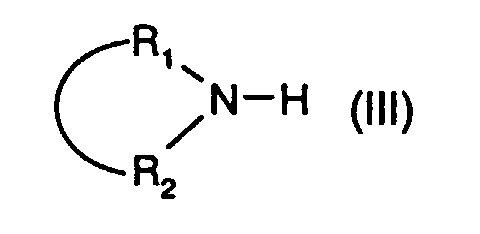

- Halogenierung dieser Phenyl-alkyl-Keton-Verbindung der Formel I, Umsetzung mit einem Amin der Formel
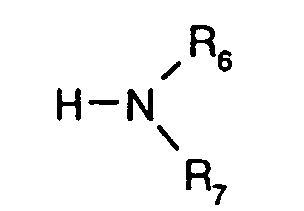
- Bei der Halogenierung der Phenyl-alkyl-Keton Verbindung der Formel I handelt es sich um eine α-Halogenierung mit z.B. Brom oder Chlor in einem Lösungsmittel wie z.B. Eisessig bei Raumtemperatur. Die anschliessende Aminierung mit einem Amin der Formel

- Durch das Vorhandensein einer basischen Aminogruppe lassen sich die Photoinitiatoren der Formel IV durch Addition von Säuren in die entsprechenden Säureadditionssalze überführen. Die Säuren können anorganische oder organische Säuren sein. Beispiele für solche Säuren sind HCI, HBr, H2SO4, H3PO4, Mono- oder Polycarbonsäuren wie z.B. Essigsäure, Oelsäure, Bemsteinsäure, Sebacinsäure, Weinsäure oder CF3COOH, Sulfonsäuren wie z.B. CH3SO3H, C12H25SO3H, p-C12H25-C6H4-SO3H, p-CH3-C6H4-SO3H oder CF3SO3H, Acrylsäure, Methacrylsäure, Polyacrylsäure, Polymethacrylsäure und Benzoesäure.
- Photoinitiatoren für radikalisch polymerisierbare Verbindungen sind Verbindungen, welche bei Bestrahlung mit kurzwelligem Licht in radikalische Bruchstücke zerfallen, welche die eigentlichen Initiatoren für die Polymerisation der ethylenisch ungesättigten Verbindungen sind.
- Diese Photoinitiatoren werden vor allem verwendet für die Photopolymerisation ethylenisch ungesättigter Verbindungen bzw. Gemischen, die solche Verbindungen enthalten, für die Photohärtung von pigmentierten Systemen wie Druckfarben oder Weisslacke, für die Photohärtung von unpigmentierten Systemen, wie UV-härtbare Druckfarben, für die Herstellung von Photoresists und Druckplatten und für Aussenanstriche, die im Tageslicht oberflächlich nachhärten.
- Die ungesättigten Verbindungen können eine oder mehrere olefinische Doppelbindungen enthalten. Sie können niedermolekular (monomer) oder höhermolekular (oligomer) sein. Beispiele für Monomere mit einer Doppelbindung sind Alkyl- oder Hydroxyalkyl-acrylate oder -methacrylate, wie z.B. Methyl-, Ethyl-, Butyl-, 2-Ethylhexyl- oder 2-Hydroxyethylacrylat, Isobornylacrylat, Methyl- oder Ethylmethacrylat. Weitere Beispiele hierfür sind Acrylnitril, Acrylamid, Methacrylamid, N-substituierte (Meth)acrylamide, Vinylester wie Vinylacetate, Vinylether wie Isobutylvinylether, Styrol, Alkyl- und Halogenstyrole, N-Vinylpyrrolidon, Vinylchlorid oder Vinylidenchlorid.
- Beispiele für Monomere mit mehreren Doppelbindungen sind Ethylenglykol-, Propylenglykol-, Neopentylglykol-, Hexamethylenglykol-, oder Bisphenol-A-diacrylat, 4,4'-Bis(2-acryloyloxyethoxy)-diphenylpropan, Trimethylolpropan-triacrylat, Pentaerythrittriacrylat oder -tetraacrylat, Vinylacrylat, Divinylbenzol, Divinylsuccinat, Diallylphthalat, Triallylphosphat, Triallylisocyanurat oder Tris-(2-acryloyloxyethyl)isocyanurat.
- Beispiele für höhermolekulare (oligomere) mehrfach ungesättigte Verbindungen sind acrylierte Epoxidharze, acrylierte Polyether, acrylierte Polyurethane oder acrylierte Polyester. Weitere Beispiele für ungesättigte Oligomere sind ungesättigte Polyesterharze, die meist aus Maleinsäure, Phthalsäure und einem oder mehreren Diolen hergestellt werden und Molekulargewichte von etwa 500 bis 3000 besitzen. Solche ungesättigten Oligomere kann man auch als Prepolymere bezeichnen.
- Häufig verwendet man Zweikomponenten-Gemische eines Prepolymeren mit einem mehrfach ungesättigten Monomeren oder Dreikomponentengemische, die ausserdem noch ein einfach ungesättigtes Monomer enthalten. Das Prepolymere ist hierbei in erster Linie für die Eigenschaften des Lackfilmes massgebend, durch seine Variation kann der Fachmann die Eigenschaften des gehärteten Filmes beeinflussen. Das mehrfach ungesättigte Monomere fungiert als Vernetzer, das den Lackfilm unlöslich macht. Das einfach ungesättigte Monomere fungiert als reaktiver Verdünner, mit dessen Hilfe die Viskosität herabgesetzt wird, ohne dass man ein Lösungsmittel verwenden muss.
- Solche Zwei- und Dreikomponentensysteme auf der Basis eines Prepolymeren werden sowohl für Druckfarben als auch für Lacke, Photoresists oder andere photohärtbare Massen verwendet. Als Bindemittel für Druckfarben werden vielfach auch Einkomponenten-Systeme auf der Basis photohärtbarer Prepolymerer verwendet.
- Ungesättigte Polyesterharze werden meist in Zweikomponentensystemen zusammen mit einem einfach ungesättigten Monomer, vorzugsweise mit Styrol, verwendet. Für Photoresist werden oft spezifische Einkomponentensysteme verwendet, wie z.B. Polymaleinimide, Polychalkone oder Polyimide, wie sie in der DE-OS 2 308 830 beschrieben sind.
- Die ungesättigten Verbindungen können auch im Gemisch mit nicht-photopolymerisierbaren filmbildenden Komponenten verwendet werden. Diese können z.B. physikalisch trocknende Polymere bzw. deren Lösungen in organischen Lösungsmitteln sein, wie z.B. Nitrocellulose oder Celluloseacetobutyrat. Diese können aber auch chemisch bzw. thermisch härtbare Harze sein, wie z.B. Polyisocyanate, Polyepoxide oder Melaminharze. Die Mitverwendung von thermisch härtbaren Harzen ist für die Verwendung in sogenannten Hybrid-Systemen von Bedeutung, die in einer ersten Stufe photopolymerisiert werden und in einer zweiten Stufe durch thermische Nachbehandlung vernetzt werden.
- Die photopolymerisierbaren Gemische können ausser dem Photoinitiator verschiedene Additive enthalten. Beispiele hierfür sind thermische Inhibitoren, die eine vorzeitige Polymerisation verhindern sollen, wie z.B. Hydrochinon oder sterisch gehinderte Phenole. Zur Erhöhung der Dunkellagerstabilität können z.B. Kupferverbindungen, Phosphorverbindungen, quartäre Ammoniumverbindungen oder Hydroxylaminderivate verwendet werden. Zwecks Ausschluss des Luftsauerstoffes während der Polymerisation kann man Paraffin oder ähnliche wachsartige Stoffe zusetzen, die bei Beginn der Polymerisation an die Oberfläche wandern. Als Lichtschutzmittel können in geringer Menge UV-Absorber, wie z.B. solche vom Benztriazol-, Benzophenon- oder Oxalanilid-Typ, zugesetzt werden. Noch besser ist der Zusatz von Lichtschutzmitteln, die UV-Licht nicht absorbieren, wie z.B. von sterisch gehinderten Aminen (HALS).
- In bestimmten Fällen kann es von Vorteil sein, Gemische von zwei oder mehr der Photoinitiatoren der Formel IV zu verwenden. Selbstverständlich können auch Gemische mit bekannten Photoinitiatoren verwendet werden, z.B. Gemische mit Benzophenon, Acetophenonderivaten, Benzoinethern, Benzilketalen, Monoacrylphosphinoxiden oder Bisacylphosphinoxiden.
- Zur Beschleunigung der Photopolymerisation können Amine zugesetzt werden, wie z.B. Triethanolamin, N-Methyl-diethanolamin, p-Dimethylaminobenzoesäure-ethylester, Michlers Keton oder Bisdiethylaminobenzophenon. Die Wirkung der Amine kann verstärkt werden durch den Zusatz von aromatischen Ketonen vom Typ des Benzophenons.
- Eine Beschleunigung der Photopolymerisation kann weiterhin durch Zusatz von Photosensibilisatoren geschehen, welche die spektrale Empfindlichkeit verschieben bzw. verbreitern. Dies sind insbesondere aromatische Carbonylverbindungen wie z.B. Benzophenon-, Thioxanthon-, Anthrachinon- und 3-Acylcumarinderivate sowie 3-(Aroylmethylen)-thiazoline.
- Die Wirksamkeit der Photoinitiatoren lässt sich steigern durch Zusatz von Titanocenderivaten mit fluororganischen Resten, wie sie in den EP-A-122'223, 186'626 und 318894 beschrieben sind, z.B. in einer Menge von 0,1 - 20 %. Beispiele für solche Titanocene sind Bis(methylcyclopentadienyl)-bis-(2,3,6-trifluorphenyl)-titan, Bis(cyclopentadienyl)-bis(4-di-butylamino-2,3,5,6-tetrafluorphenyl)-titan, Bis(methylcyclopentadienyl)-2-(trifluormethyl)phenyl-titan-isocyanat, Bis(cyclopentadienyl)-2-(trifluormethyl)phenyl-titan-trifluoracetat, Bis(methylcyclopentadienyl)-bis(4-decyloxy-2,3,5,6-tetrafluorphenyl)-titan, Bis(cyclopentadienyl)-bis-[2,6-difluor-3-(pyrr-1-yl)phenyl]-titan, Bis(methylcyclopentadienyl)-bis-[2,6-difluor-3-(pyrr-1-yl)phenyl]-titan, Bis(cyclopentadienyl)-bis-[2,6-difluor-3-(2,5-dimethyl-pyrr-1-yl)phenyl]-titan und Bis(methylcyclopentadienyl)-bis-[2,6-difluor-3-(2,5-dimethyl-pyrr-1-yl)phenyl]-titan. Für diese Gemische eignen sich vor allem flüssige α-Aminoketone.
- Die photopolymerisierbare Zusammensetzung, enthaltend
- A) mindestens eine ethylenisch ungesättigte photopolymerisierbare Verbindung, und
- B) mindestens einen Photoinitiator der Formel IV sowie
- C) gegebenenfalls weitere bekannte und übliche Zusatzstoffe
- Ein weiteres wichtiges Einsatzgebiet sind Anstrichstoffe, die pigmentiert oder unpigmentiert sein können. Besonders wertvoll sind die Gemische in Weisslacken, worunter man durch TiO2 pigmentierte Anstrichstoffe versteht. Das in den photohärtbaren Massen enthaltene Pigment kann ein anorganisches Pigment sein, wie z.B. Titandioxid (Rutil oder Anatas), Eisenoxidgelb, Eisenoxidrot, Chromgelb, Chromgrün, Nickeltitangelb, Ultramarinblau, Kobaltblau, Cadmiumgelb, Cadmiumrot oder Zinkweiss. Das Pigment kann ein organisches Pigment sein, wie z.B. ein Mono- oder Bisazopigment oder ein Metallkomplex davon, ein Phthalocyaninpigment, ein polycyclisches Pigment, wie z.B. ein Perylen-, Thioindigo-, Flavanthron-, Chinacridon-, Tetrachlorisoindolinon- oder Triphenylmethan-Pigment. Das Pigment kann auch ein Russ sein oder ein Metallpulver, wie z.B. Aluminium- oder Kupferpulver. Das Pigment kann auch ein Gemisch von zwei oder mehreren verschiedenen Pigmenten sein, wie es zur Erzielung bestimmter Farbtöne üblich ist.
- Das Pigment kann in einer Menge von 5 bis 60 Gew.%, bezogen auf die gesamte Masse, vorliegen; in Druckfarben liegen meist 10 - 30 % Pigment vor.
- Weitere Einsatzgebiete sind die Strahlenhärtung von Photoresists, die Photovernetzung silberfreier Filme sowie die Herstellung von Druckplatten. Eine weitere Verwendung ist die für Aussenanstriche, die im Tageslicht oberflächlich nachhärten. In Photresist oder reprographischen Filmen werden zur Farbgebung statt Pigmenten auch häufig Farbstoffe verwendet. Hierbei kann es sich um organische Farbstoffe der verschiedensten Klassen handeln, beispielsweise Azofarbstoffe, Methinfarbstoffe, Anthrachinon-Farbstoffe oder Metallkomplexfarbstoffe. Diese Farbstoffe sind in den verwendeten Konzentrationen in den jeweiligen Bindemitteln löslich. Die üblichen Konzentrationen sind 0,1 bis 20 %, vorzugsweise 1-5 Gew.%, bezogen auf die gesamte Masse.
- Die Photoinitiatoren werden für die angeführten Anwendungsgebiete zweckmässig in Mengen von 0,1 bis 20 Gew.%, vorzugsweise etwa 0,5 bis 5 Gew.%, bezogen auf die photopolymerisierbare Zusammensetzung, angewendet.
- Die Polymerisation erfolgt nach den bekannten Methoden der Photopolymerisation durch Bestrahlung mit Licht, das reich an kurzwelliger Strahlung ist. Als Lichtquellen sind z.B. Quecksilbermitteldruck-, -hochdruck- und -niederdruckstrahler, superaktinische Leuchtstoffröhren, Metallhalogenid-Lampen oder Laser geeignet, deren Emissionsmaxima im Bereich zwischen 250 und 450 nm liegen. Im Falle einer Kombination mit Photosensibilisatoren oder Ferrocenderivaten kann auch längerwelliges Licht oder Laserstrahlen bis 600 nm verwendet werden.
- Die folgenden Beispiele veranschaulichen die Erfindung ohne sie darauf zu limitieren.
- In einem 1 l Hochdruckreaktor werden 181,7 g (0,80 Mol) 1-(4-Bromphenyl)butan-1-on und 348,5 g (4,0 Mol) Morpholin purum und 72,0 g (4,0 Mol) deionisiertes Wasser vorgelegt. Der Reaktor wird verschlossen und die Lösung wird in ca. 90 Minuten auf 170°C geheizt. Der Innendruck steigt von Null auf 5-6 bar und stabilisiert sich eine Stunde später bei 4-5 bar. Die Reaktionslösung wird ca. 28 Stunden bei ca. 170°C weitergerührt. Dann wird die Reaktionslösung abgekühlt und bei ca. 80°C dem Reaktor entnommen.
- Die Reaktionslösung wird in einer Destillationsapparatur auf ca. 104°C erwärmt, um das Wasser abzudestillieren. Dann wird unter schwachem Vakuum das Morpholin abdestilliert. Nach beendeter Destillation wird 144,0 g (0,80 Mol) Natriummethylatlösung à 30 % in Methanol zugesetzt und die Suspension wird aufgeheizt, um das Methanol abzudestillieren. Nach beendeter Methanoldestillation wird die Reaktionsmischung evakuiert und das Morpholin abdestilliert. Bei ca. 80°C werden dann 90 g deionisiertes Wasser zugegeben und verrührt. Das Wasser wird dann abgetrennt. Die überstehende Phase (ca. 196 g Rohausbeute, ca. 105 % der Theorie) wird mit 150 ml (117,5 g) Isopropanol verdünnt, abgekühlt und zur Kristallisation angeimpft. Die Suspension wird bei ca. -10°C filtriert und mit kaltem Isopropanol nachgewaschen. Es werden 148,7 g 1-(4-Morpholinophenyl)-butan-1-on (79,6 % der Theorie) als hellbeige Kristalle mit einem Smp. 64,5°C - 65,5°C erhalten. Reinheit: >99,0 %.
Elementaranalyse: %C %H % N berechnet 72,07 berechnet 8,21 berechnet 6,00 gefunden 72,03 gefunden 8,29 gefunden 5,92 - Aus dem Filtrat (Isopropanol) lassen sich weitere 19,8 g (ca. 10 % der Theorie) an 1-(4-Morpholinophenyl)-butan-1-on gewinnen.
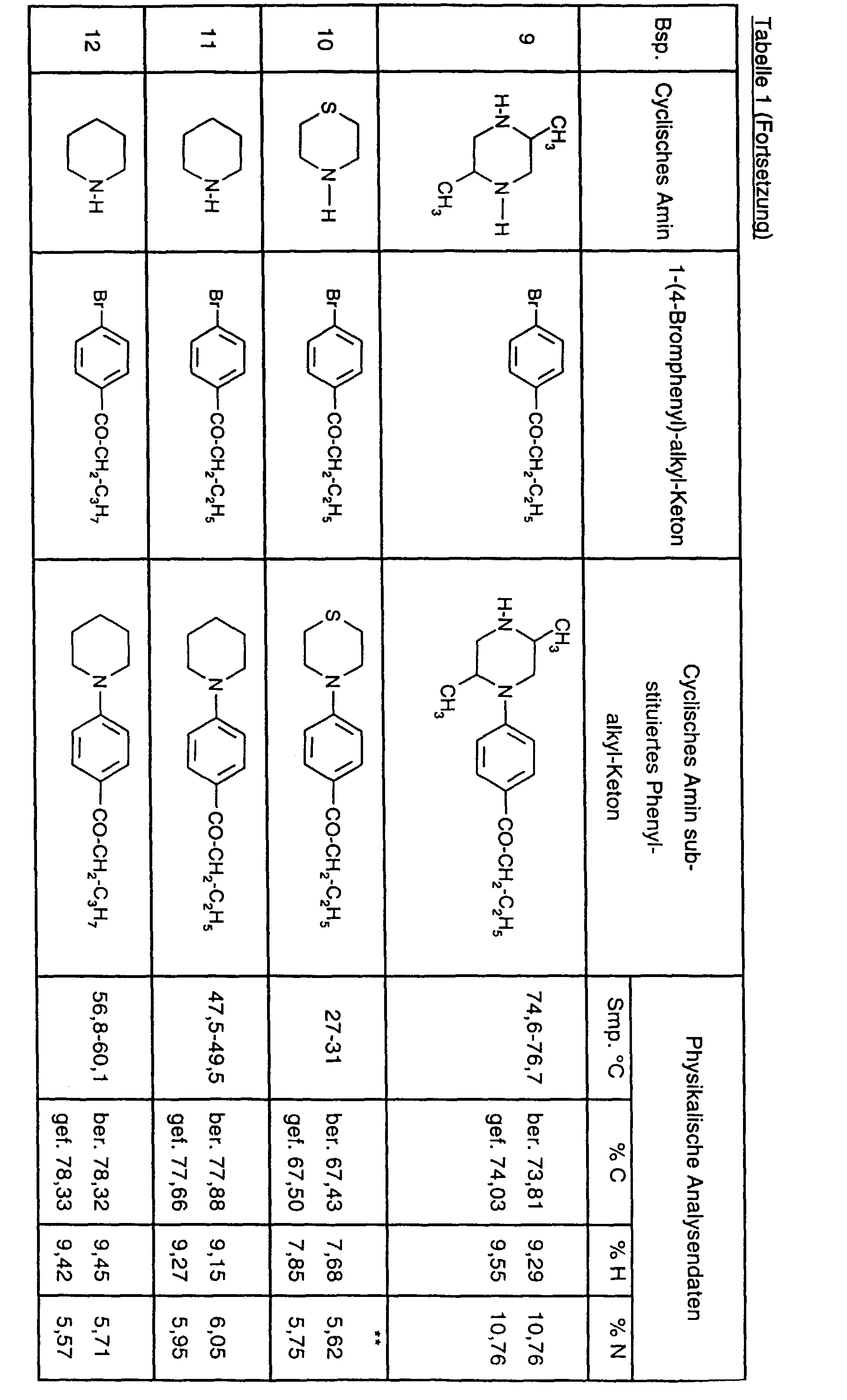
- Arbeitet man analog nach der Arbeitsweise von Beispiel 1, verwendet aber äquimolekulare Mengen der cyclischen Amine gemäss Tabelle 1 und äquimolekulare Mengen an 1-(4-Bromphenyl)-alkyl-keton gemäss Tabelle 1 so werden die cyclischen Amin substituierten Phenyl-alkyl-Keton-Verbindungen gemäss der Tabelle 1 erhalten, deren physikalische Analysendaten ebenfalls in der Tabelle 1 angegeben sind.




- In einem 1l Hochdruckreaktor werden 392,1 g (4,50 Mol) Morpholin purum und 162,0 g (9,00 Mol) deionisiertes Wasser vorgelegt. Der Reaktor wird verschlossen und die Lösung wird unter Rühren in ca. 1 Stunde auf 220°C geheizt, wobei der Innendruck auf 20 bar steigt. Dann werden während fünf Stunden 164,4 g (0,90 Mol) 1-(4-Chlorphenyl)butan-1-on gleichmässig bei 220°C zudosiert. Am Ende des Zudosierens ist der Druck auf ca. 18 bar gefallen und die Reaktion ist über 80 % abgelaufen. Das Reaktionsgemisch wird weitere fünf Stunden bei 220°C nachgerührt. Der Druck sinkt langsam auf 17 bar. Dann lässt man auf 80°C abkühlen.
- Mit 75,6 g (0,945 Mol) Natronlauge à 50 % wird das Morpholinsalz neutralisiert. Unter reduziertem Vakuum wird bei 80°C - 100°C ein Morpholin-Wasser-Gemisch abdestilliert. Dann werden 180 g deionisiertes Wasser und 203 g Siedegrenzenbenzin (110°C - 140°C Siedebereich) zugegeben. Das Gemisch wird bei 80°C über wenig Aktivkohle klarfiltriert. Die Wasserphase wird bei 80°C abgetrennt. Das Produkt wird aus dem Siedegrenzenbenzin auskristallisiert, filtriert und getrocknet. Die Ausbeute an Endprodukt beträgt 200,6 g 1-(4-Morpholinophenyl)-butan-1-on (ca. 95,5 % der Theorie). Das beige Produkt hat eine Reinheit von >99,0 %, der Schmelzpunkt liegt bei 64,8°C. Im Filtrat sind nur Produkt und Edukt feststellbar.
Elementaranalyse: %C %H % N berechnet 72,07 berechnet 8,21 berechnet 6,00 gefunden 72,09 gefunden 8,26 gefunden 5,86 - In einem 1 l Hochdruckreaktor werden 392,1 g (4,50 Mol) Morpholin purum und 162,0 g (9,00 Mol) deionisiertes Wasser vorgelegt. Der Reaktor wird verschlossen und in ca. 60 Minuten auf 215°C - 220°C aufgeheizt. Der Druck erreicht 19,9 bar. Dann werden 164,4 g (0,90 Mol) 1-(4-Chlorphenyl)-butan-1-on in flüssiger Form mit einer Druckpumpe zudosiert und die Temperatur bei 215°C - 220°C gehalten.
- Dauer der Dosierzeit: 3 Stunden. Der Druck sinkt auf 18,5 bar. Anschliessend wird während 3 weiteren Stunden bei 215°C - 220°C nachgerührt. Der Druck sinkt auf 17,8 bar. Anschliessend wird auf ca. 80°C abgekühlt.
- Die Reaktionslösung wird in eine Destillationsapparatur transferiert und mit 36,0 g (0,90 Mol) Natriumhydroxid in Perlenform versetzt. Dann wird das Wasser zwischen 70°C und 90°C unter reduziertem Druck abdestilliert und anschliessend auch das Morpholin. Das Endvacuum ist ca. 30 mbar. Anschliessend wird die Apparatur mit Stickstoff entlastet und es werden bei ca. 88°C 171,8 g deionisiertes Wasser und 30,2 g Toluol zugesetzt. Nach dem Verrühren wird das Wasser abgetrennt und das Toluol abdestilliert. Die Reaktionslösung wird warm mit 152,9 g Isopropanol versetzt und bei ca. 65°C heiss über einen Druckfilter geklärt. Die Isopropanollösung wird gekühlt und angeimpft. Die Suspension wird bei ca. 0°C filtriert und mit kaltem Isopropanol nachgewaschen. Es werden 186,7 g 1-(4-Morpholinophenyl)-butan-1-on (88,9 % der Theorie) als hellbeige Kristalle mit einem Smp.: 64,4°C - 65,5°C erhalten.
- In einem 1 l Hochdruckreaktor werden 164,4 g (0,90 Mol) 1-(4-Chlorphenyl)butan-1-on, 392,1 g (4,50 Mol) Morpholin purum, 162,0 g (9,00 Mol) deionisiertes Wasser und 0,89 g (0,90 mMol) Kupfer-1-chlorid vorgelegt. Der Reaktor wird verschlossen und die Lösung wird unter Rühren in ca. 1 Stunde auf 180°C geheizt. Dann wird langsam weitergeheizt und pro Stunde die Temperatur um ca. 10°C erhöht. In vier Stunden werden 220°C und ein Druck von 20 bar erreicht. Dann lässt man weitere fünf Stunden bei 220°C nachreagieren. Der Druck sinkt dabei langsam auf 17 bar. Dann lässt man auf 80°C abkühlen.
- Mit 75,6 g (0,945 Mol) Natronlauge à 50 % wird das Morpholinsalz neutralisiert und der Katalysator gefällt. Unter reduziertem Vakuum wird bei 80°C - 100°C ein Morpholin-Wasser-Gemisch abdestilliert. Dann werden 180 g deionisiertes Wasser und 203 g Siedegrenzenbenzin (110°C - 140°C Siedebereich) zugegeben. Das Gemisch wird bei 80°C über wenig Aktivkohle klarfiltriert um den Katalysator zu entfernen. Die Wasserphase wird bei 80°C abgetrennt. Das Produkt wird aus dem Siedegrenzenbenzin auskristallisiert, filtriert und getrocknet. Die Ausbeute an Endprodukt beträgt 199,8 g 1-(4-Morpholinophenyl)-butan-1-on (ca. 95,2 % der Theorie). Das beige Produkt besitzt eine Reinheit von >99,0 %, der Schmelzpunkt liegt bei 64,8°C. Im Filtrat sind nur Produkt und Edukt feststellbar.
-
a) 2-Brom-1-(4-morpholinophenyl)-butan-1-on
Elementaranalyse %C %H %N %Br berechnet 53,86 5,81 4,49 25,59 gefunden 53,23 5,73 4,24 25,50
b) 2-Dimethylamino-1-(4-morpholinophenyl)-butan-1-on
In einem 2,5 l Sulfierkolben werden 312,2 g (1 Mol) 2-Brom-1-(4-morpholinophenyl)butan-1-on gemäss a) oben mit 600 ml Methylethylketon versetzt und unter Rühren auf 50°C erwärmt. Zur erhaltenen Lösung gibt man 207,3 g (1,5 Mol) Kaliumcarbonat und leitet bei 50°C innerhalb 1,5 Stunden unter Niveau 56,6 g (1,3 Mol) gasförmiges Dimethylamin in die Suspension ein. Dann lässt man noch weitere 4 bis 5 Stunden nachreagieren, bis im Dünnschichtchromatogramm kein Edukt mehr nachweisbar ist. Die Suspension wird dann mit 550 ml Wasser versetzt und verrührt. Die wässrige Phase wird abgetrennt und die 900 ml organische Phase, enthaltend 2-Dimethylamino-1-(4-morpholinophenyl)-butan-1-on, wird unverändert in der nächsten Reaktionsstufe eingesetzt.
In einem Parallelversuch wird die organische Phase eingeengt. Die erhaltenen Kristalle werden aus Hexan umkristallisiert. Nach demTrocknen erhält man 235,1 g hellgelbe Kristalle, die bei 53°C bis 56°C schmelzen. Das 1H-NMR-Spektrum des Produktes, 2-Dimethylamino-1-(4-morpholinophenyl)-butan-1-on, stimmt mit der angegebenen Struktur überein.Elementaranalyse %C %H %N berechnet 69,53 8,75 10,14 gefunden 68,91 8,59 9,74
c) 2-Benzyl-2-dimethylamino-1-(4-morpholinophenyl)-butan-1-on
In einem 2,5 l Sulfierkolben werden 900 ml Lösung (1 Mol) von 2-Dimethylamino-1-(4-morpholinophenyl)-butan-1-on gemäss b) oben wieder auf 50°C erwärmt. Dann werden in 20 Minuten 179,7 g (1,05 Mol) Benzylbromid zugetropft. Dann lässt man noch weitere 3 bis 4 Stunden bei 50°C nachrühren, bis im Dünnschichtchromatogramm kein Edukt mehr nachweisbar ist. Nun wird die Temperatur auf 60°C erhöht und innert 45 Minuten werden portionenweise 80 g (2 Mol) Natriumhydroxidpulver zugegeben. Anschliessend wird noch 1 bis 2 Stunden bei 50°C weitergerührt, bis im Dünnschichtchromatogramm kein Edukt mehr nachweisbar ist. Das Reaktionsgemisch wird mit 150 ml Wasser versetzt und verrührt. Die Wasserphase wird abgetrennt und die organische Phase am Vacuumrotationsverdampfer eingeengt. Im Kolben bleiben 378,3 g gelbliches Rohprodukt von 2-Benzyl-2-dimethylamino-1-(4-morpholinophenyl)-butan-1-on, das bei 102°C bis 110°C schmilzt. Das Rohprodukt wird in 600 ml Ethanol heiss gelöst, abgekühlt, kristallisiert, filtriert und mit kaltem Ethanol nachgewaschen. Die Kristalle werden getrocknet. Sie schmelzen bei 114°C bis 115°C und sind im Gas- und im Dünnschicht-chromatogramm rein. Die Ausbeute ist 299,0 g von 2-Benzyl-2-dimethylamino-1-(4-morpholinophenyl)-butan-1-on. Aus der Mutterlauge lassen sich weitere 22,4 g an reinem Produkt isolieren. Das 1H-NMR-Spektrum des Reinproduktes stimmt mit der angegebenen Struktur überein.Elementaranalyse %C %H %N berechnet 75,38 8,25 7,64 gefunden 75,23 8,21 7,58
R1 und R2 zusammen unter Einschluss des N-Atoms einen 6-gliedrigen Ring, welcher noch durch eine -O-, -S- oder -N(R4)-Gruppe unterbrochen sein kann, oder worin bedeuten:
R1 und R2 zusammen unter Einschluss des N-Atoms einen Morpholinyl-, Dimethyl)morpholinyl-, Piperazinyl-, N-Methylpiperazinyl- oder 2,5-Dimethylpiperazinylrest, und insbesondere solche worin R1 und R2 zusammen unter Einschluss des N-Atoms den Morpholinylrest bilden.
Claims (21)
- Verbindungen der Formel (I)
 R1 und R2 zusammen unverzweigtes oder verzweigtes, unsubstituiertes oder substituiertes C3-C20-Alkylen, welches durch ein oder mehrere -O-, -S- oder -N(R4)-Gruppen unterbrochen sein kann,R3 unverzweigtes oder verzweigtes, unsubstituiertes oder substituiertes C2-C20-Alkyl, undR4 Wasserstoff, unverzweigtes oder verzweigtes C1-C3-Alkyl, unverzweigtes oder verzweigtes C3-C5-Alkenyl, C7-C9-Phenylalkyl, C1-C4-Hydroxyalkyl oder Phenyl, wobei wenn R1 und R2 zusammen unsubstituiertes Tetramethylen bedeuten, R3 nicht unsubstituiertes C6-Alkyl bedeutet.
 - Verbindungen der Formel I gemäss Anspruch 1 worin bedeuten:R1 und R2 zusammen unsubstituiertes oder durch Hydroxy, C1-C4-Alkoxy, Hydroxymethyl, C1-C4-Alkoxymethyl, -COO(C1-C4-Alkyl) oder Phenyl substituiertes C3-C20-Alkylen, welches durch ein oder mehrere -O-, -S- oder -N(R4)-Gruppen unterbrochen sein kann,R3 unsubstituiertes oder durch C1-C4-Alkoxy, Phenoxy, Cyclohexyl oder Phenyl substituiertes C2-C20-Alkyl, undR4 Wasserstoff, C1-C3-Alkyl, C3-C5-Alkenyl, C7-C9-Phenylalkyl, C1-C4-Hydroxyalkyl oder Phenyl.
- Verbindungen der Formel I gemäss Anspruch 1 worin bedeuten:R1 und R2 zusammen unverzweigtes oder verzweigtes C4-C12-Alkylen, das durch eine -O-, -S- oder -N(R4)-Gruppe unterbrochen sein kann,R3 C2-C10-Alkyl, undR4 Wasserstoff, C1-C3-Alkyl, Allyl, Benzyl oder C2-C3-Hydroxyalkyl.
- Verbindungen der Formel I gemäss Anspruch 1, worin
R1 und R2 zusammen unter Einschluss des N-Atoms einen 6-gliedrigen Ring, welcher noch durch eine -O-, -S- oder -N(R4)-Gruppe unterbrochen sein kann, bedeutet und R3 und R4 die im Anspruch 1 angegebene Bedeutung hat. - Verbindungen der Formel I gemäss Anspruch 1 worin bedeuten:R1 und R2 zusammen C4-C6-Alkylen, das durch eine -O-, -S- oder -N(R4)-Gruppe unterbrochen sein kann,R3 unverzweigtes und verzweigtes, unsubstituiertes C2-C7-Alkyl, undR4 Wasserstoff oder Methyl.
- Verbindungen der Formel I gemäss Anspruch 1, worinR1 und R2 zusammen unter Einschluss des N-Atoms den Morpholinylrest, undR3 unsubstituiertes C2-C10-Alkyl bedeutet.
- Verfahren zur Herstellung von Verbindungen der Formel I
 R1 und R2 zusammen unverzweigtes oder verzweigtes, unsubstituiertes oder substituiertes C3-C20-Alkylen, welches durch ein oder mehrere -O-, -S- oder -N(R4)-Gruppen unterbrochen sein kann,R3 unverzweigtes oder verzweigtes, unsubstituiertes oder substituiertes C2-C20-Alkyl, undR4 Wasserstoff, unverzweigtes oder verzweigtes C1-C3-Alkyl, unverzweigtes oder verzweigtes C3-C5-Alkenyl, C7-C9-Phenylalkyl, C1-C4-Hydroxyalkyl oder Phenyl, durch Aminolyse eines p-Halogenphenylalkylketons der Formel II
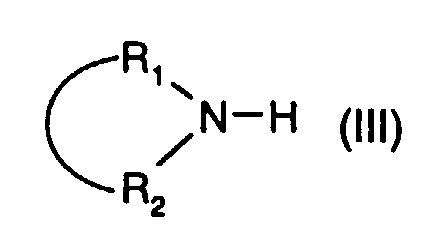
- Verfahren gemäss Anspruch 7, gekennzeichnet durch die Verwendung eines p-Halogenphenylalkylketons der Formel II, worin X Chlor oder Brom bedeutet und R3 die unter Formel I angegebene Bedeutung hat.
- Verfahren gemäss der Ansprüche 7 und 8, dadurch gekennzeichnet, dass die Menge an cyclischem Amin der Formel III zwischen etwa 2,5-12 Moläquivalente bezogen auf das p-Halogenphenylalkylketon der Formel II beträgt.
- Verfahren gemäss der Ansprüche 7 bis 9, dadurch gekennzeichnet, dass die Menge an Wasser zwischen etwa 1-100 Moläquivalenten bezogen auf das p-Halogenphenylalkyl-keton der Formel II beträgt.
- Verfahren gemäss den Ansprüchen 7 bis 10, dadurch gekennzeichnet, dass die Reaktion unter Druck in einem Druckkessel durchgeführt wird.
- Verfahren gemäss den Ansprüchen 7 bis 11, dadurch gekennzeichnet, dass die Temperatur in einem Bereich von etwa 140°C - 240°C liegt.
- Verfahren gemäss den Ansprüchen 7 bis 12, dadurch gekennzeichnet, dass das p-Halogenphenylalkylketon der Formel II im Reaktionsgefäss zusammen mit dem Wasser und dem cyclischen Amin vorgelegt wird und entweder sofort oder langsam während der Reaktion bis zur Endtemperatur aufgeheizt wird.
- Verfahren gemäss den Ansprüchen 7 bis 13, dadurch gekennzeichnet, dass das p-Halogenphenylalkylketon der Formel II während der Reaktion zum Wasser und dem cyclischen Amin, das vorgängig auf die Reaktionstemperatur geheizt wurde, zudosiert wird.
- Verfahren gemäss Anspruch 7, dadurch gekennzeichnet, dass 1 Teil p-Bromphenylalkylketon oder 1 Teil p-Chlorphenylalkylketon der Formel II, worin R3 unverzweigtes oder verzweigtes, unsubstituiertes C2-C7-Alkyl bedeutet mit 5 Teilen eines cyclischen Amins der Formel III, worin R1 und R2 zusammen C4-C6-Alkylen bedeuten, das durch eine -O-, -S- oder -N(R4)-Gruppe unterbrochen sein kann und R4 Wasserstoff oder Methyl bedeutet und 5 Teile Wasser im Reaktionsgefäss vorgelegt werden und unter Druck bei einer Temperatur von etwa 160°C - 180°C im Fall von p-Bromphenylalkylketon bzw. von etwa 200°C - 230°C im Fall von p-Chlorphenylalkylketon umgesetzt werden.
- Verfahren gemäss Anspruch 7, dadurch gekennzeichnet, dass 10 bis 20 Teile eines cyclischen Amins der Formel III, worin R1 und R2 zusammen C4-C6-Alkylen bedeuten, das durch eine -O-, -S- oder -N(R4)-Gruppe unterbrochen sein kann und R4 Wasserstoff oder Methyl bedeutet und 20 bis 40 Teile Wasser im Reaktionsgefäss vorgelegt werden, 2 bis 4 Teile p-Chlorphenylalkylketon der Formel II, worin R3 unverzweigtes oder verzweigtes, unsubstituiertes C2-C7-Alkyl bedeutet, zudosiert werden und unter Druck bei etwa 210°C - 230°C umgesetzt werden.
- Verwendung der Verbindungen der Formel I
 R1 und R2 zusammen unverzweigtes oder verzweigtes, unsubstituiertes oder substituiertes C3-C20-Alkylen, welches durch ein oder mehrere -O-, -S- oder -N(R4)-Gruppen unterbrochen sein kann,R3 unverzweigtes oder verzweigtes, unsubstituiertes oder substituiertes C2-C20-Alkyl, undR4 Wasserstoff, unverzweigtes oder verzweigtes C1-C3-Alkyl, unverzweigtes oder verzweigtes C3-C5-Alkenyl, C7-C9-Phenylalkyl, C1-C4-Hydroxyalkyl oder Phenyl, bzw. der Verbindungen erhalten gemäss den Verfahren der Ansprüche 13 bis 23 zur Herstellung von Photoinitiatoren der Formel IVoder deren Säureadditionssalze, worin bedeuten:
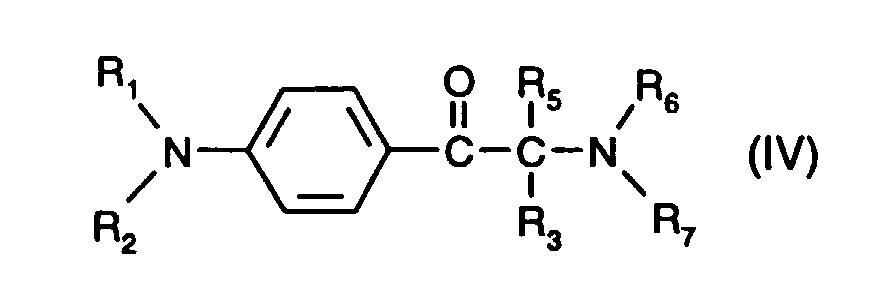 R1 und R2 zusammen unverzweigtes oder verzweigtes, unsubstituiertes C3-C20-Alkylen, das durch ein oder mehrere -O-, -S- oder -N(R4)-Gruppen unterbrochen, und/oder mit Hydroxy, C1-C4-Alkoxy, Hydroxymethyl, C1-C4-Alkoxymethyl, -COO(C1-C4-Alkyl) oder Phenyl substituiert sein kann;R3 unverzweigtes oder verzweigtes, unsubstituiertes oder durch C1-C4-Alkoxy, Phenoxy, Cyclohexyl oder Phenyl substituiertes C2-C20-Alkyl;R4 Wasserstoff, C1-C3-Alkyl, C3-C5-Alkenyl, C7-C9-Phenylalkyl, C1-C4-Hydroxyalkyl oder Phenyl;R5 entwederin welchen Formeln(a) ein Rest der Formel
oder(b) ein Rest der Formel
oderc) ein Rest der Formel R12 Wasserstoff, C1-C8-Alkyl, C3-C5-Alkenyl, C7-C9-Phenylalkyl, C1-C4-Hydroxyalkyl oder Phenyl bedeutet,R8 Wasserstoff, C1-C8-Alkyl oder Phenyl bedeutet, undR9, R10 und R11 unabhängig voneinander Wasserstoff oder C1-C4-Alkyl bedeuten oder R9 und R10 zusammen C3-C7-Alkylen sind,R6 Wasserstoff, C1-C12-Alkyl, durch Hydroxy, C1-C4-Alkoxy, -CN oder -COO(C1-C4-Alkyl) substituiertes C2-C4-Alkyl; C3-C5-Alkenyl, C5-C12-Cycloalkyl oder C7-C9-Phenylalkyl bedeutet,R7 C1-C12-Alkyl, durch Hydroxy, C1-C4-Alkoxy, -CN oder -COO(C1-C4-Alkyl) substituiertes C2-C4-Alkyl; C3-C5-Alkenyl, C5-C12-Cycloalkyl, C7-C9-Phenylalkyl, Phenyl oder durch Halogen, C1-C12-Alkyl, C1-C4-Alkoxy oder -COO(C1-C4-Alkyl) substituiertes Phenyl bedeutet oder R7 zusammen mit R3 C1-C7-Alkylen, C7-C10-Phenylalkylen, o-Xylylen, 2-Butenylen oder C2-C3-Oxa- oder Azaalkylen bedeutet, oderR6 und R7 zusammen C3-C7-Alkylen bedeuten, das durch -O-, -S-, -CO- oder -N(R13)-unterbrochen sein kann oder durch Hydroxy, C1-C4-Alkoxy oder -COO(C1-C4-Alkyl) substituiert sein kann, wobei R13 Wasserstoff, C1-C12-Alkyl, das durch ein oder mehrere -O- unterbrochen sein kann, C3-C5-Alkenyl, C7-C9-Phenylalkyl, C1-C4-Hydroxyalkyl, -CH2CH2CN, -CH2CH2COO(C1-C4-Alkyl), C2-C8-Alkanoyl oder Benzoyl bedeutet.
 - Verfahren zur Herstellung von Photoinitiatoren der Formel IV
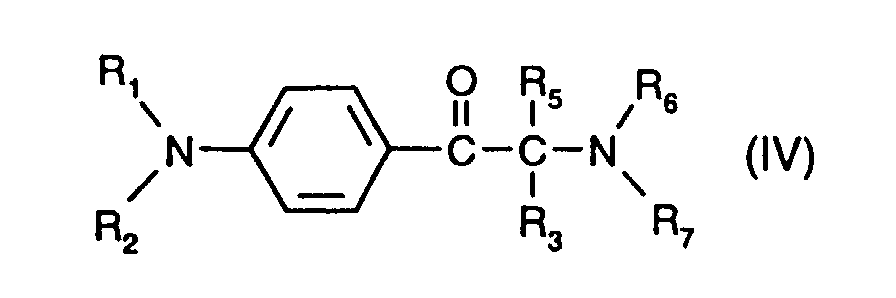 R1 und R2 zusammen unverzweigtes oder verzweigtes, unsubstituiertes C3-C20-Alkylen, das durch ein oder mehrere -O-, -S- oder -N(R4)-Gruppen unterbrochen, und/oder mit Hydroxy, C1-C4-Alkoxy, Hydroxymethyl, C1-C4-Alkoxymethyl, -COO(C1-C4-Alkyl) oder Phenyl substituiert sein kann;R3 unverzweigtes oder verzweigtes, unsubstituiertes oder durch C1-C4-Alkoxy, Phenoxy, Cyclohexyl oder Phenyl substituiertes C2-C20-Alkyl;R4 Wasserstoff, C1-C3-Alkyl, C3-C5-Alkenyl, C7-C9-Phenylalkyl, C1-C4-Hydroxyalkyl oder Phenyl;R5 entweder(a) ein Rest der Formel
oder(b) ein Rest der Formel
oderc) ein Rest der Formelin welchen Formeln R12 Wasserstoff, C1-C8-Alkyl, C3-C5-Alkenyl, C7-C9-Phenylalkyl, C1-C4-Hydroxyalkyl oder Phenyl bedeutet,R8 Wasserstoff, C1-C8-Alkyl oder Phenyl bedeutet, undR9, R10 und R11 unabhängig voneinander Wasserstoff oder C1-C4-Alkyl bedeuten oder R9 und R10 zusammen C3-C7-Alkylen sind,R6 Wasserstoff, C1-C12-Alkyl, durch Hydroxy, C1-C4-Alkoxy, -CN oder -COO(C1-C4-Alkyl) substituiertes C2-C4-Alkyl; C3-C5-Alkenyl, C5-C12-Cycloalkyl oder C7-C9-Phenylalkyl bedeutet,R7 C1-C12-Alkyl, durch Hydroxy, C1-C4-Alkoxy, -CN oder -COO(C1-C4-Alkyl) substituiertes C2-C4-Alkyl; C3-C5-Alkenyl, C5-C12-Cycloalkyl, C7-C9-Phenylalkyl, Phenyl oder durch Halogen, C1-C12-Alkyl, C1-C4-Alkoxy oder -COO(C1-C4-Alkyl) substituiertes Phenyl bedeutet oder R7 zusammen mit R3 C1-C7-Alkylen, C7-C10-Phenylalkylen, o-Xylylen, 2-Butenylen oder C2-C3-Oxa- oder Azaalkylen bedeutet, oderR6 und R7 zusammen C3-C7-Alkylen bedeuten, das durch -O-, -S-, -CO- oder -N(R13)-unterbrochen sein kann oder durch Hydroxy, C1-C4-Alkoxy oder -COO(C1-C4-Alkyl) substituiert sein kann, wobei R13 Wasserstoff, C1-C12-Alkyl, das durch ein oder mehrere -O- unterbrochen sein kann, C3-C5-Alkenyl, C7-C9-Phenylalkyl, C1-C4-Hydroxyalkyl, -CH2CH2CN, -CH2CH2COO(C1-C4-Alkyl), C2-C8-Alkanoyl oder Benzoyl bedeutet,durch Aminolyse eines p-Halogenphenylalkylketons der Formel II


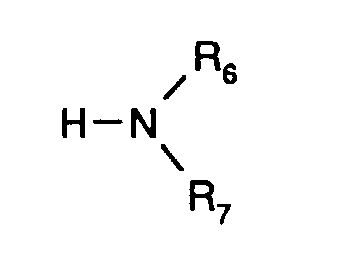
- Verwendung der Photoinitiatoren der Formel IV gemäss Anspruch 17 bzw. der gemäss dem Verfahren des Anspruches 18 erhaltenen Photoinitiatoren für die Photopolymerisation ethylenisch ungesättigter Verbindungen.
- Verwendung der Photoinitiatoren der Formel IV gemäss Anspruch 17 bzw. der gemäss dem Verfahren des Anspruches 18 erhaltenen Photoinitiatoren für die Photohärtung von pigmentierten Systemen wie Druckfarben oder Weisslacke, für die Photohärtung von unpigmentierten Systemen, wie UV-härtbare Druckfarben für die Herstellung von Photoresists und Druckplatten und für Aussenanstriche, die im Tageslicht oberflächlich nachhärten.
- Photopolymerisierbare Zusammensetzung, enthaltendA) mindestens eine ethylenisch ungesättigte photopolymerisierbare Verbindung, undB) mindestens einen Photoinitiator der Formel IV gemäss Anspruch 17, bzw. mindestens einen gemäss dem Verfahren des Anspruches 18 erhaltenen Photoinitiator, sowieC) gegebenenfalls weitere bekannte und übliche Zusatzstoffe.
Priority Applications (3)
| Application Number | Priority Date | Filing Date | Title |
|---|---|---|---|
| DK97810255T DK0805152T3 (da) | 1996-05-03 | 1997-04-24 | Phenyl-alkyl-keton substitueret med cyclisk amin og fremgangsmåde til fremstilling deraf |
| EP04102145A EP1468994B1 (de) | 1996-05-03 | 1997-04-24 | Verfahren zur Herstellung von Cyclischen Amin substituierten Phenyl-alkyl-Ketonen |
| DK04102145.2T DK1468994T3 (da) | 1996-05-03 | 1997-04-24 | Fremgangsmåde til fremstilling af cykliske aminsubstituerede phenyl-alkyl-ketoner |
Applications Claiming Priority (3)
| Application Number | Priority Date | Filing Date | Title |
|---|---|---|---|
| CH113896 | 1996-05-03 | ||
| CH113896 | 1996-05-03 | ||
| CH1138/96 | 1996-05-03 |
Related Child Applications (1)
| Application Number | Title | Priority Date | Filing Date |
|---|---|---|---|
| EP04102145A Division EP1468994B1 (de) | 1996-05-03 | 1997-04-24 | Verfahren zur Herstellung von Cyclischen Amin substituierten Phenyl-alkyl-Ketonen |
Publications (3)
| Publication Number | Publication Date |
|---|---|
| EP0805152A2 true EP0805152A2 (de) | 1997-11-05 |
| EP0805152A3 EP0805152A3 (de) | 1998-01-28 |
| EP0805152B1 EP0805152B1 (de) | 2005-06-08 |
Family
ID=4203382
Family Applications (2)
| Application Number | Title | Priority Date | Filing Date |
|---|---|---|---|
| EP04102145A Expired - Lifetime EP1468994B1 (de) | 1996-05-03 | 1997-04-24 | Verfahren zur Herstellung von Cyclischen Amin substituierten Phenyl-alkyl-Ketonen |
| EP97810255A Expired - Lifetime EP0805152B1 (de) | 1996-05-03 | 1997-04-24 | Cyclisches Amin substituiertes Phenyl-alkyl-Keton und Verfahren zu dessen Herstellung |
Family Applications Before (1)
| Application Number | Title | Priority Date | Filing Date |
|---|---|---|---|
| EP04102145A Expired - Lifetime EP1468994B1 (de) | 1996-05-03 | 1997-04-24 | Verfahren zur Herstellung von Cyclischen Amin substituierten Phenyl-alkyl-Ketonen |
Country Status (14)
| Country | Link |
|---|---|
| US (3) | US5795985A (de) |
| EP (2) | EP1468994B1 (de) |
| JP (1) | JP4545835B2 (de) |
| KR (2) | KR100507664B1 (de) |
| CN (2) | CN1072662C (de) |
| AT (2) | ATE489373T1 (de) |
| BR (1) | BR9703050A (de) |
| CA (1) | CA2204200C (de) |
| DE (2) | DE59712337D1 (de) |
| DK (2) | DK1468994T3 (de) |
| ES (2) | ES2356448T3 (de) |
| ID (1) | ID16845A (de) |
| TW (1) | TW455592B (de) |
| ZA (1) | ZA973797B (de) |
Cited By (3)
| Publication number | Priority date | Publication date | Assignee | Title |
|---|---|---|---|---|
| WO1999054363A1 (en) * | 1998-04-17 | 1999-10-28 | Kimberly-Clark Worldwide, Inc. | Novel photoinitiators and applications therefor |
| WO2001087865A1 (en) * | 2000-05-18 | 2001-11-22 | Astrazeneca Ab | A new process for the synthesis of morpholinylbenzenes |
| WO2009147033A1 (en) | 2008-06-06 | 2009-12-10 | Basf Se | Photoinitiator mixtures |
Families Citing this family (43)
| Publication number | Priority date | Publication date | Assignee | Title |
|---|---|---|---|---|
| US5681380A (en) | 1995-06-05 | 1997-10-28 | Kimberly-Clark Worldwide, Inc. | Ink for ink jet printers |
| JP4202423B2 (ja) * | 1996-08-05 | 2008-12-24 | バイエル・アクチエンゲゼルシヤフト | 2―および2,5―置換フェニルケトエノール |
| US6524379B2 (en) | 1997-08-15 | 2003-02-25 | Kimberly-Clark Worldwide, Inc. | Colorants, colorant stabilizers, ink compositions, and improved methods of making the same |
| SK1542000A3 (en) | 1998-06-03 | 2001-11-06 | Kimberly Clark Co | Neonanoplasts produced by microemulsion technology and inks for ink jet printing |
| SK1552000A3 (en) | 1998-06-03 | 2000-08-14 | Kimberly Clark Co | Novel photoinitiators and applications therefor |
| JP2002520470A (ja) | 1998-07-20 | 2002-07-09 | キンバリー クラーク ワールドワイド インコーポレイテッド | 改良されたインクジェットインク組成物 |
| BR9914123B1 (pt) | 1998-09-28 | 2010-11-30 | fotoiniciadores e aplicações para os mesmos. | |
| EP1144512B1 (de) | 1999-01-19 | 2003-04-23 | Kimberly-Clark Worldwide, Inc. | Farbstoffe, farbstoffstabilisatoren, tintenzusammensetzungen und verfahren zu deren herstellung |
| US6331056B1 (en) | 1999-02-25 | 2001-12-18 | Kimberly-Clark Worldwide, Inc. | Printing apparatus and applications therefor |
| US6294698B1 (en) | 1999-04-16 | 2001-09-25 | Kimberly-Clark Worldwide, Inc. | Photoinitiators and applications therefor |
| US6368395B1 (en) | 1999-05-24 | 2002-04-09 | Kimberly-Clark Worldwide, Inc. | Subphthalocyanine colorants, ink compositions, and method of making the same |
| AU2001269905A1 (en) * | 2000-06-19 | 2002-01-08 | Kimberly-Clark Worldwide, Inc. | Novel photoinitiators and applications therefor |
| US6562989B2 (en) * | 2000-08-07 | 2003-05-13 | Yale University | Catalyst for aromatic C—O, C—N, and C—C bond formation |
| US6359075B1 (en) | 2001-01-09 | 2002-03-19 | Bridgestone/Firestone, Inc. | Means of producing high diblock content thermoplastic elastomers via chain transfer |
| RU2005116302A (ru) * | 2002-10-28 | 2006-01-20 | Циба Спешиалти Кемикэлз Холдинг Инк. (Ch) | Улучшение стабильности фотоинициаторов при хранении |
| US6780896B2 (en) * | 2002-12-20 | 2004-08-24 | Kimberly-Clark Worldwide, Inc. | Stabilized photoinitiators and applications thereof |
| US8409618B2 (en) | 2002-12-20 | 2013-04-02 | Kimberly-Clark Worldwide, Inc. | Odor-reducing quinone compounds |
| US7666410B2 (en) | 2002-12-20 | 2010-02-23 | Kimberly-Clark Worldwide, Inc. | Delivery system for functional compounds |
| US7582308B2 (en) | 2002-12-23 | 2009-09-01 | Kimberly-Clark Worldwide, Inc. | Odor control composition |
| US7879350B2 (en) | 2003-10-16 | 2011-02-01 | Kimberly-Clark Worldwide, Inc. | Method for reducing odor using colloidal nanoparticles |
| US7794737B2 (en) * | 2003-10-16 | 2010-09-14 | Kimberly-Clark Worldwide, Inc. | Odor absorbing extrudates |
| US7488520B2 (en) | 2003-10-16 | 2009-02-10 | Kimberly-Clark Worldwide, Inc. | High surface area material blends for odor reduction, articles utilizing such blends and methods of using same |
| US7754197B2 (en) | 2003-10-16 | 2010-07-13 | Kimberly-Clark Worldwide, Inc. | Method for reducing odor using coordinated polydentate compounds |
| US7582485B2 (en) | 2003-10-16 | 2009-09-01 | Kimberly-Clark Worldride, Inc. | Method and device for detecting ammonia odors and helicobacter pylori urease infection |
| US7141518B2 (en) * | 2003-10-16 | 2006-11-28 | Kimberly-Clark Worldwide, Inc. | Durable charged particle coatings and materials |
| US7678367B2 (en) | 2003-10-16 | 2010-03-16 | Kimberly-Clark Worldwide, Inc. | Method for reducing odor using metal-modified particles |
| US7837663B2 (en) | 2003-10-16 | 2010-11-23 | Kimberly-Clark Worldwide, Inc. | Odor controlling article including a visual indicating device for monitoring odor absorption |
| US7413550B2 (en) | 2003-10-16 | 2008-08-19 | Kimberly-Clark Worldwide, Inc. | Visual indicating device for bad breath |
| US7438875B2 (en) | 2003-10-16 | 2008-10-21 | Kimberly-Clark Worldwide, Inc. | Method for reducing odor using metal-modified silica particles |
| US20070048247A1 (en) * | 2005-08-31 | 2007-03-01 | Kimberly-Clark Worldwide, Inc. | Deodorizing tablets |
| CN101792497B (zh) * | 2010-01-28 | 2013-03-13 | 四川大学 | 一种光敏剂及其光引发剂组合物 |
| CN103360272A (zh) * | 2012-04-10 | 2013-10-23 | 北京英力科技发展有限公司 | 一种季铵盐的制备方法及其用途 |
| AT514594B1 (de) | 2013-09-06 | 2015-02-15 | Durst Phototech Digital Tech | Photoinitiator |
| CN105384707B (zh) * | 2014-09-03 | 2018-04-17 | 山东久日化学科技有限公司 | 一种α‑氨基苯乙酮类光引发剂的制备方法 |
| JP6449445B2 (ja) | 2014-09-04 | 2019-01-09 | アイ ジー エム マルタ リミテッド | 多環式光開始剤 |
| CN109721566B (zh) * | 2017-10-27 | 2022-03-22 | 天津久日新材料股份有限公司 | 一种1-(4-吗啉苯基)-1-丁酮的制备方法 |
| CN108358871B (zh) * | 2018-02-01 | 2020-05-22 | 浙江扬帆新材料股份有限公司 | 一种2-苄基-2-二甲基氨基-1-(4-吗啉苯基)丁酮的合成方法 |
| CN108503556B (zh) * | 2018-03-19 | 2020-12-29 | 同济大学 | 以联苯基二苯基胺为共轭主体结构的羰基类化合物及其制备方法与应用 |
| IT201800009683A1 (it) * | 2018-10-22 | 2020-04-22 | Ind Chimica Srl | Processo per la preparazione di 3α-idrossi-5α-pregnan-20-one (brexanolone) |
| CN110776480B (zh) * | 2019-11-28 | 2022-05-03 | 怀化市恒渝新材料有限公司 | 一种光引发剂的回收方法 |
| CN116178336B (zh) * | 2022-12-26 | 2025-04-25 | 西安近代化学研究所 | 一种酸催化缩酮法合成n-芳基酮亚胺的方法及应用 |
| CN117683000B (zh) * | 2023-10-30 | 2025-11-28 | 甘肃金盾化工有限责任公司 | 一类芳基α酮类光引发剂的制备方法 |
| CN118307495B (zh) * | 2024-04-11 | 2025-10-17 | 甘肃得中聚成新材料有限公司 | 2-苯基苄-2-二甲基胺-1-(4-吗啉苄苯基)丁酮的合成方法 |
Family Cites Families (17)
| Publication number | Priority date | Publication date | Assignee | Title |
|---|---|---|---|---|
| US1946058A (en) * | 1932-07-27 | 1934-02-06 | Dow Chemical Co | Amino-aromatic ketones and method of making same |
| CH200365A (de) * | 1937-07-16 | 1938-10-15 | Geigy Ag J R | Verfahren zur Darstellung eines neuen Aminoketons. |
| US2205728A (en) * | 1937-07-16 | 1940-06-25 | Geigy Ag J R | Process of manufacturing amino ketones |
| US3317538A (en) * | 1965-10-22 | 1967-05-02 | American Home Prod | 4, 4'-diamino-butyrophenones |
| GB1164608A (en) * | 1966-08-23 | 1969-09-17 | May & Baker Ltd | Semicarbazone and Thiosemicarbazone Quaternary Salts |
| US3975388A (en) * | 1971-02-22 | 1976-08-17 | Bdh Pharmaceuticals Limited | Pyridazinones |
| US3806526A (en) * | 1972-01-28 | 1974-04-23 | Richardson Merrell Inc | 1-aroylalkyl-4-diphenylmethyl piperidines |
| LU80081A1 (fr) * | 1977-08-26 | 1979-05-15 | Delalande Sa | Nouvelles hydroxymethyl-5 oxazolidinones-2,leur procede de preparation et leur application therapeutique |
| JPS54132542A (en) * | 1978-04-07 | 1979-10-15 | Mitsui Toatsu Chem Inc | Production of n-alkyl derivative of p-aminoacetophenone |
| DE3471486D1 (de) * | 1983-08-15 | 1988-06-30 | Ciba Geigy Ag | Photocurable compositions |
| JPS61134346A (ja) * | 1984-12-03 | 1986-06-21 | Shionogi & Co Ltd | 4−オキソカルボン酸誘導体および抗潰瘍剤 |
| DE3768919D1 (en) * | 1986-11-26 | 1991-05-02 | Ciba Geigy Ag | Fluessige photoinitiatorgemische. |
| ES2054861T3 (es) * | 1987-03-26 | 1994-08-16 | Ciba Geigy Ag | Nuevas alfa-aminoacetofenonas como fotoiniciadores. |
| JP2969359B2 (ja) * | 1989-01-13 | 1999-11-02 | 武田薬品工業株式会社 | 環状アミン化合物 |
| JP2861274B2 (ja) * | 1989-06-06 | 1999-02-24 | 武田薬品工業株式会社 | アミノケトン誘導体 |
| DE69108733T2 (de) * | 1990-08-21 | 1995-09-14 | Upjohn Co | Bisphosphonsäurederivate als antiarthritische mittel. |
| NZ323329A (en) * | 1995-12-22 | 1999-02-25 | Warner Lambert Co | 4-phenyl-piperidin-1-yl butyric acid derivatives and medicaments |
-
1997
- 1997-04-21 US US08/847,519 patent/US5795985A/en not_active Expired - Lifetime
- 1997-04-24 DE DE59712337T patent/DE59712337D1/de not_active Expired - Lifetime
- 1997-04-24 ES ES04102145T patent/ES2356448T3/es not_active Expired - Lifetime
- 1997-04-24 EP EP04102145A patent/EP1468994B1/de not_active Expired - Lifetime
- 1997-04-24 ES ES97810255T patent/ES2242974T3/es not_active Expired - Lifetime
- 1997-04-24 DE DE59713049T patent/DE59713049D1/de not_active Expired - Lifetime
- 1997-04-24 AT AT04102145T patent/ATE489373T1/de active
- 1997-04-24 DK DK04102145.2T patent/DK1468994T3/da active
- 1997-04-24 AT AT97810255T patent/ATE297387T1/de not_active IP Right Cessation
- 1997-04-24 DK DK97810255T patent/DK0805152T3/da active
- 1997-04-24 EP EP97810255A patent/EP0805152B1/de not_active Expired - Lifetime
- 1997-04-29 ID IDP971429A patent/ID16845A/id unknown
- 1997-04-30 CN CN97110835A patent/CN1072662C/zh not_active Expired - Lifetime
- 1997-04-30 CN CNB00135342XA patent/CN1168700C/zh not_active Expired - Lifetime
- 1997-05-01 CA CA002204200A patent/CA2204200C/en not_active Expired - Lifetime
- 1997-05-01 JP JP12794597A patent/JP4545835B2/ja not_active Expired - Lifetime
- 1997-05-01 TW TW086105781A patent/TW455592B/zh not_active IP Right Cessation
- 1997-05-02 ZA ZA9703797A patent/ZA973797B/xx unknown
- 1997-05-02 KR KR1019970017007A patent/KR100507664B1/ko not_active Expired - Lifetime
- 1997-05-05 BR BR9703050A patent/BR9703050A/pt not_active IP Right Cessation
-
1998
- 1998-06-01 US US09/088,218 patent/US5977357A/en not_active Expired - Lifetime
-
1999
- 1999-06-10 US US09/329,833 patent/US6191182B1/en not_active Expired - Lifetime
-
2004
- 2004-09-24 KR KR1020040077005A patent/KR100479989B1/ko not_active Expired - Lifetime
Cited By (3)
| Publication number | Priority date | Publication date | Assignee | Title |
|---|---|---|---|---|
| WO1999054363A1 (en) * | 1998-04-17 | 1999-10-28 | Kimberly-Clark Worldwide, Inc. | Novel photoinitiators and applications therefor |
| WO2001087865A1 (en) * | 2000-05-18 | 2001-11-22 | Astrazeneca Ab | A new process for the synthesis of morpholinylbenzenes |
| WO2009147033A1 (en) | 2008-06-06 | 2009-12-10 | Basf Se | Photoinitiator mixtures |
Also Published As
| Publication number | Publication date |
|---|---|
| KR100507664B1 (ko) | 2005-11-22 |
| KR970074775A (ko) | 1997-12-10 |
| DK0805152T3 (da) | 2005-08-08 |
| JP4545835B2 (ja) | 2010-09-15 |
| CA2204200A1 (en) | 1997-11-03 |
| US5977357A (en) | 1999-11-02 |
| JPH1087643A (ja) | 1998-04-07 |
| ATE297387T1 (de) | 2005-06-15 |
| EP1468994A1 (de) | 2004-10-20 |
| TW455592B (en) | 2001-09-21 |
| CN1072662C (zh) | 2001-10-10 |
| EP0805152A3 (de) | 1998-01-28 |
| ES2242974T3 (es) | 2005-11-16 |
| CN1309116A (zh) | 2001-08-22 |
| US5795985A (en) | 1998-08-18 |
| ZA973797B (en) | 1997-12-01 |
| DE59712337D1 (de) | 2005-07-14 |
| DK1468994T3 (da) | 2011-02-21 |
| BR9703050A (pt) | 1998-09-01 |
| ATE489373T1 (de) | 2010-12-15 |
| ID16845A (id) | 1997-11-13 |
| EP0805152B1 (de) | 2005-06-08 |
| EP1468994B1 (de) | 2010-11-24 |
| KR100479989B1 (ko) | 2005-03-31 |
| MX9703235A (es) | 1997-11-29 |
| CA2204200C (en) | 2007-04-10 |
| DE59713049D1 (de) | 2011-01-05 |
| US6191182B1 (en) | 2001-02-20 |
| ES2356448T3 (es) | 2011-04-08 |
| CN1166487A (zh) | 1997-12-03 |
| CN1168700C (zh) | 2004-09-29 |
Similar Documents
| Publication | Publication Date | Title |
|---|---|---|
| EP1468994B1 (de) | Verfahren zur Herstellung von Cyclischen Amin substituierten Phenyl-alkyl-Ketonen | |
| EP0284561B1 (de) | Neue alpha-Aminoacetophenone als Photoinitiatoren | |
| EP0138754B1 (de) | Photohärtbare Gemische | |
| DE3209706C2 (de) | ||
| EP0216884B1 (de) | Fotoinitiatoren für die fotopolymerisation von ungesättigten systemen | |
| EP0217205B1 (de) | Copolymerisierbare Fotoinitiatoren | |
| EP0117233B1 (de) | Photohärtbare gefärbte Massen | |
| DE2722264C2 (de) | Verwendung von substituierten Oxyalkylphenonen als Photosensibilisatoren | |
| EP0354458A2 (de) | Fotoinitiatoren kombinierter Struktur | |
| EP0088050B1 (de) | Photohärtbare gefärbte Massen | |
| EP2664629B1 (de) | Funktionalisierte Fotoinitiatoren | |
| EP0192167A1 (de) | Verwendung thiosubstituierter Ketone als Photoinitiatoren | |
| CH648016A5 (de) | Aromatisch-aliphatische ketone und ihre verwendung als photoinitiatoren. | |
| AT500127A1 (de) | Oximester-photostarter | |
| EP0670323A1 (de) | Dimere Bisacylphosphine, -oxide und -sulfide | |
| DE112020002202T5 (de) | Neuartige Diaroylcarbazolverbindung und Verwendung derselben als Sensibilisierungsmittel | |
| DE3820463A1 (de) | Strahlungsempfindliche, ethylenisch ungesaettigte, copolymerisierbare verbindungen und verfahren zu deren herstellung | |
| EP0008638A1 (de) | Benzoinderivate mit quartärer Ammoniumgruppe, Verfahren zu ihrer Herstellung und ihre Verwendung | |
| EP0097124B1 (de) | Verfahren zur Photopolymerisation ungesättigter Verbindungen | |
| DE69609219T2 (de) | Peroxycarbonsäureester Photoinitiatoren abgeleitet von Stickstoff-Heterozyklen | |
| MXPA97003235A (es) | Fenil alquil cetona substituida por amina ciclica y un procedimiento para su preparacion | |
| AT501750B1 (de) | Photopolymerisierbare mischungen mit photoinitiatoren auf basis von benzophenon und phenylglycin | |
| EP0387193A1 (de) | Substituierte ungesättigte bireaktive bicyclische Imide und deren Verwendung |
Legal Events
| Date | Code | Title | Description |
|---|---|---|---|
| PUAI | Public reference made under article 153(3) epc to a published international application that has entered the european phase |
Free format text: ORIGINAL CODE: 0009012 |
|
| AK | Designated contracting states |
Kind code of ref document: A2 Designated state(s): AT BE CH DE DK ES FR GB IT LI NL |
|
| PUAL | Search report despatched |
Free format text: ORIGINAL CODE: 0009013 |
|
| AK | Designated contracting states |
Kind code of ref document: A3 Designated state(s): AT BE CH DE DK ES FR GB IT LI NL |
|
| 17P | Request for examination filed |
Effective date: 19980620 |
|
| 17Q | First examination report despatched |
Effective date: 20030526 |
|
| GRAP | Despatch of communication of intention to grant a patent |
Free format text: ORIGINAL CODE: EPIDOSNIGR1 |
|
| GRAS | Grant fee paid |
Free format text: ORIGINAL CODE: EPIDOSNIGR3 |
|
| GRAA | (expected) grant |
Free format text: ORIGINAL CODE: 0009210 |
|
| AK | Designated contracting states |
Kind code of ref document: B1 Designated state(s): AT BE CH DE DK ES FR GB IT LI NL |
|
| REG | Reference to a national code |
Ref country code: GB Ref legal event code: FG4D Free format text: NOT ENGLISH |
|
| REG | Reference to a national code |
Ref country code: CH Ref legal event code: EP |
|
| REF | Corresponds to: |
Ref document number: 59712337 Country of ref document: DE Date of ref document: 20050714 Kind code of ref document: P |
|
| GBT | Gb: translation of ep patent filed (gb section 77(6)(a)/1977) |
Effective date: 20050624 |
|
| REG | Reference to a national code |
Ref country code: DK Ref legal event code: T3 |
|
| REG | Reference to a national code |
Ref country code: ES Ref legal event code: FG2A Ref document number: 2242974 Country of ref document: ES Kind code of ref document: T3 |
|
| ET | Fr: translation filed | ||
| PLBE | No opposition filed within time limit |
Free format text: ORIGINAL CODE: 0009261 |
|
| STAA | Information on the status of an ep patent application or granted ep patent |
Free format text: STATUS: NO OPPOSITION FILED WITHIN TIME LIMIT |
|
| PG25 | Lapsed in a contracting state [announced via postgrant information from national office to epo] |
Ref country code: AT Free format text: LAPSE BECAUSE OF NON-PAYMENT OF DUE FEES Effective date: 20060424 |
|
| 26N | No opposition filed |
Effective date: 20060309 |
|
| REG | Reference to a national code |
Ref country code: CH Ref legal event code: PFA Owner name: CIBA HOLDING INC. Free format text: CIBA SPECIALTY CHEMICALS HOLDING INC.#KLYBECKSTRASSE 141#4057 BASEL (CH) -TRANSFER TO- CIBA HOLDING INC.#KLYBECKSTRASSE 141#4057 BASEL (CH) |
|
| REG | Reference to a national code |
Ref country code: FR Ref legal event code: PLFP Year of fee payment: 20 |
|
| PGFP | Annual fee paid to national office [announced via postgrant information from national office to epo] |
Ref country code: NL Payment date: 20160426 Year of fee payment: 20 |
|
| PGFP | Annual fee paid to national office [announced via postgrant information from national office to epo] |
Ref country code: CH Payment date: 20160426 Year of fee payment: 20 Ref country code: ES Payment date: 20160518 Year of fee payment: 20 Ref country code: GB Payment date: 20160502 Year of fee payment: 20 |
|
| PGFP | Annual fee paid to national office [announced via postgrant information from national office to epo] |
Ref country code: BE Payment date: 20160427 Year of fee payment: 20 Ref country code: FR Payment date: 20160428 Year of fee payment: 20 Ref country code: DK Payment date: 20160426 Year of fee payment: 20 Ref country code: IT Payment date: 20160428 Year of fee payment: 20 |
|
| PGFP | Annual fee paid to national office [announced via postgrant information from national office to epo] |
Ref country code: DE Payment date: 20160630 Year of fee payment: 20 |
|
| REG | Reference to a national code |
Ref country code: DE Ref legal event code: R071 Ref document number: 59712337 Country of ref document: DE |
|
| REG | Reference to a national code |
Ref country code: NL Ref legal event code: MK Effective date: 20170423 |
|
| REG | Reference to a national code |
Ref country code: DK Ref legal event code: EUP Effective date: 20170424 |
|
| REG | Reference to a national code |
Ref country code: CH Ref legal event code: PL |
|
| REG | Reference to a national code |
Ref country code: GB Ref legal event code: PE20 Expiry date: 20170423 |
|
| PG25 | Lapsed in a contracting state [announced via postgrant information from national office to epo] |
Ref country code: GB Free format text: LAPSE BECAUSE OF EXPIRATION OF PROTECTION Effective date: 20170423 |
|
| REG | Reference to a national code |
Ref country code: ES Ref legal event code: FD2A Effective date: 20170731 |
|
| PG25 | Lapsed in a contracting state [announced via postgrant information from national office to epo] |
Ref country code: ES Free format text: LAPSE BECAUSE OF EXPIRATION OF PROTECTION Effective date: 20170425 |