EP0806171B1 - Articulated floor scrubber - Google Patents
Articulated floor scrubber Download PDFInfo
- Publication number
- EP0806171B1 EP0806171B1 EP97303100A EP97303100A EP0806171B1 EP 0806171 B1 EP0806171 B1 EP 0806171B1 EP 97303100 A EP97303100 A EP 97303100A EP 97303100 A EP97303100 A EP 97303100A EP 0806171 B1 EP0806171 B1 EP 0806171B1
- Authority
- EP
- European Patent Office
- Prior art keywords
- vehicle
- scrub head
- recovery tank
- rear portion
- front portion
- Prior art date
- Legal status (The legal status is an assumption and is not a legal conclusion. Google has not performed a legal analysis and makes no representation as to the accuracy of the status listed.)
- Expired - Lifetime
Links
- 238000011084 recovery Methods 0.000 claims description 48
- 230000035939 shock Effects 0.000 claims description 32
- 238000005201 scrubbing Methods 0.000 claims description 26
- 238000004140 cleaning Methods 0.000 claims description 19
- 230000033001 locomotion Effects 0.000 claims description 6
- 238000005096 rolling process Methods 0.000 claims description 3
- 230000003247 decreasing effect Effects 0.000 claims 1
- 238000006073 displacement reaction Methods 0.000 claims 1
- 230000007246 mechanism Effects 0.000 description 25
- 238000010586 diagram Methods 0.000 description 5
- 238000000034 method Methods 0.000 description 4
- 230000008569 process Effects 0.000 description 4
- 230000000717 retained effect Effects 0.000 description 4
- 241001417527 Pempheridae Species 0.000 description 2
- 238000010521 absorption reaction Methods 0.000 description 2
- 230000005540 biological transmission Effects 0.000 description 2
- 230000005611 electricity Effects 0.000 description 2
- 238000012986 modification Methods 0.000 description 2
- 230000004048 modification Effects 0.000 description 2
- 238000012545 processing Methods 0.000 description 2
- 230000004044 response Effects 0.000 description 2
- 230000000712 assembly Effects 0.000 description 1
- 238000000429 assembly Methods 0.000 description 1
- 230000008901 benefit Effects 0.000 description 1
- 230000007812 deficiency Effects 0.000 description 1
- 238000013461 design Methods 0.000 description 1
- 238000011161 development Methods 0.000 description 1
- 230000009977 dual effect Effects 0.000 description 1
- 239000012530 fluid Substances 0.000 description 1
- 238000003780 insertion Methods 0.000 description 1
- 230000037431 insertion Effects 0.000 description 1
- 238000012544 monitoring process Methods 0.000 description 1
- 238000004064 recycling Methods 0.000 description 1
- 238000012546 transfer Methods 0.000 description 1
- 230000032258 transport Effects 0.000 description 1
Images




Classifications
-
- A—HUMAN NECESSITIES
- A47—FURNITURE; DOMESTIC ARTICLES OR APPLIANCES; COFFEE MILLS; SPICE MILLS; SUCTION CLEANERS IN GENERAL
- A47L—DOMESTIC WASHING OR CLEANING; SUCTION CLEANERS IN GENERAL
- A47L11/00—Machines for cleaning floors, carpets, furniture, walls, or wall coverings
- A47L11/40—Parts or details of machines not provided for in groups A47L11/02 - A47L11/38, or not restricted to one of these groups, e.g. handles, arrangements of switches, skirts, buffers, levers
- A47L11/4061—Steering means; Means for avoiding obstacles; Details related to the place where the driver is accommodated
-
- A—HUMAN NECESSITIES
- A47—FURNITURE; DOMESTIC ARTICLES OR APPLIANCES; COFFEE MILLS; SPICE MILLS; SUCTION CLEANERS IN GENERAL
- A47L—DOMESTIC WASHING OR CLEANING; SUCTION CLEANERS IN GENERAL
- A47L11/00—Machines for cleaning floors, carpets, furniture, walls, or wall coverings
- A47L11/29—Floor-scrubbing machines characterised by means for taking-up dirty liquid
- A47L11/30—Floor-scrubbing machines characterised by means for taking-up dirty liquid by suction
- A47L11/302—Floor-scrubbing machines characterised by means for taking-up dirty liquid by suction having rotary tools
- A47L11/305—Floor-scrubbing machines characterised by means for taking-up dirty liquid by suction having rotary tools the tools being disc brushes
-
- B—PERFORMING OPERATIONS; TRANSPORTING
- B62—LAND VEHICLES FOR TRAVELLING OTHERWISE THAN ON RAILS
- B62D—MOTOR VEHICLES; TRAILERS
- B62D63/00—Motor vehicles or trailers not otherwise provided for
Definitions
- the present invention relates to cleaning apparatuses and, in particular, to scrubbers that are used to clean floors.
- industrial floor scrubbers are of two types in terms of the location of the operator.
- the operator walks behind a scrubber vehicle and performs steering and other scrubber operations via a user interface located on the rear of the vehicle.
- This type of scrubber generally exhibits a high degree of maneuverability.
- the speed with which such a scrubber can clean a floor is limited to the walking speed of the operator.
- operator fatigue limits the time of operation of such a scrubber. Due to the noted speed and time limitations, the amount of floor space that can be scrubbed in any given period of time is limited. Consequently, such scrubbers are particularly well suited to applications involving a relative small amount of floor surface and requiring a high degree of maneuverability.
- the operator is stationed on the scrubber vehicle, typically in a seat, and performs steering and other scrubber operations via an interface located adjacent to the operator station.
- This type of scrubber is typically used in applications involving large open floor areas or large floor areas defined by broad aisles, such as factories and airplane hangers, in which it would be impractical to use the first type of scrubber. Since this type of scrubber is particularly adapted to large open floor applications, it generally does not exhibit, nor is it required to have a high degree of maneuverability.
- the present invention provides a vehicle for scrubbing floors that is particularly well suited to applications that involve relatively large floor surfaces defined by' relatively narrow aisles.
- the present invention addresses the deficiencies of the two noted types of scrubbers in such applications, i.e., the limitations associated with an operator in the first type of scrubber and the lack of maneuverability in the second type of scrubber.
- the articulated scrubber in a preferred embodiment of the present invention also addresses the noted application by placing components in certain locations, such as on the front portion or rear portion of the vehicle. Similarly, many components have particular shapes that benefit the noted application. Furthermore, the orientation of one component to one or more other components contributes to achieving a scrubber having a high degree of functionality in the noted application. For instance, the solution tank used to provide the cleaning solution applied to the floor and the recovery tank used to retain cleaning solution recovered from the floor after scrubbing are respectively associated with the front portion and rear portion of the vehicle in the preferred embodiment of the invention. The solution tank is also shaped to rake efficient use of space.
- the solution tank includes a seat shaped portion to which an operator seat is mounted and a portion shaped to serve as a wheel well.
- a portion shaped to serve as a wheel well Exemplary of the relative orientation of several components is the placement of an electric motor for providing drive power to a wheel, the battery for providing electricity to the motor, and a portion of the recovery tank at respectively increasing distances from the floor in the preferred embodiment of the invention.
- Other locational, shape, orientations of one component to another component, and combinations thereof are also present in the invention.
- a further preferred embodiment provides a shock absorbing system for a scrub head that addresses the positional relationship of a scrub head to one of the wheels of the scrubber in accommodating the noted application. More specifically, the scrub head has a first end that protrudes beyond the body of the scrubber and a second end that lies underneath the scrubber and adjacent to one of the wheels. Occasionally, a wall or similar structure contacts the exposed first end of the scrub head. To absorb the shock in a manner that avoids contact between the second end of the scrub head and the adjacent wheel, the present invention provides a shock absorbing system that moves the second end of the scrub head away from the wheel.
- the shock absorbing system upon a shock being applied to the first end of the scrub head, applies a force that moves the second end of the scrub head forward, i.e., towards the front of the vehicle, to avoid the noted wheel.
- the lift mechanism used to raise and lower the scrub head accommodates shocks applied to scrub head by rotating about a pivot point, which is preferably implemented with a gimbal.
- a further embodiment also provides a shock absorbing system for a squeegee associated with the rear portion of the articulated vehicle and with an end that extends beyond the body of the vehicle, thereby making the squeegee susceptible to contact with a wall or like structure.
- the shock absorbing system operates to hold the squeegee in a fixed orientation relative to the rest of the rear portion of the vehicle during normal operation, i.e., when a lateral force or a shock is not being applied to the squeegee.
- the shock absorbing system releases the squeegee from its fixed orientation, thereby permitting the squeegee to "float".
- a rod is attached to the squeegee and held in the fixed orientation by a notched block. Upon application of the lateral force to the squeegee, the rod is displaced from the notch and the squeegee is free to float.
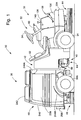
- the present invention is directed to an articulated vehicle 30, hereinafter vehicle 30, for use in scrubbing relatively large floor spaces, typically on the order of 60,000 to 120,000 square feet, that are defined by relatively narrow aisles, typically on the order of 46 inches in width. Further, the vehicle 30 accommodates an operator on the vehicle.
- the vehicle 30 employs an articulated steering architecture for achieving a tight turning radius.
- the vehicle 30 includes a front portion 32 that is supported by a front pair of wheels 34A, 34B, both of which are non-steerable.
- the vehicle 30 also includes a rear portion 36 that is supported by a rear set of wheels, 38A, 38B, both of which are also non-steerable.
- the front portion 32 is connected to the rear portion 36 by a pivotal connection structure 40. Steering of the scrubber is achieved with a steering mechanism that manipulates the pivotal connection 40 to "scissor" the front and rear portions 32, 36, relative to one another and thereby turn the vehicle 30.
- Another characteristic of an articulated steering architecture is that all of the wheels associated with each of the vehicle portions cannot, without the support of the wheels associated with the other portion, facilitate rolling movement of the portion with which the wheels are associated.
- a similar statement can be made with respect to the rear portion 36.
- the vehicle also generally includes a drive system for selectively applying drive power to one or more wheels, a braking system, and a steering system, as previously mentioned, for manipulating the pivotal connection structure 40.
- the vehicle 30 also includes a number of basic scrubbing elements including a solution tank 42 that provides a cleaning solution which is used in scrubbing the floor.
- a solution tank 42 that provides a cleaning solution which is used in scrubbing the floor.
- Another of the basic scrubbing elements is a scrub head 44 that is used to scrub the floor and is comprised of a brush assembly and a motor assembly that drives the brush assembly.
- a vacuum squeegee 46 and recovery tank 48 constitute the remaining primary scrubbing elements.
- the vacuum squeegee 46 operates to remove cleaning solution from the floor after the scrubbing is done by the scrub head 44. Cleaning solution removed by the vacuum squeegee 46 is transported to, and retained by the recovery tank 48 for later disposal or recycling.
- An operator station 50 is provided for accommodating an operator on the vehicle. Operator interfaces of the steering system, drive power system, braking system and various elements comprising the scrubbing system are located in the operator station. More specifically, the operator station 50 includes a seat 52, a steering wheel 54, a forward/reverse accelerator pedal 56, a brake pedal 58 and a control panel 60.
- the dimensional aspects of the vehicle 30 are now discussed and, in particular, the length characteristics of the vehicle 30 when used to scrub aisles of 46 inches in width, the narrowest width presently found in the 60,000 to 120,000 square foot commercial buildings in which the vehicle 30 is to operate. It should, however, be appreciated that the dimensions noted hereinafter can be modified to accommodate aisles of different widths.
- the length dimensions of the vehicle 30 are discussed with respect to Figure 7, which illustrates the vehicle 30 turning from a first aisle into a second aisle that is perpendicular to the first aisle, with each aisle having a width of approximately 46 inches.
- the vehicle 30 is also shown turning with the maximum vehicle articulation of 71°.
- the length of the front portion 32 is measured from the pivot point 64 associated with the pivotal connection structure 40 to the front most point 66 of the front portion 32 of the vehicle 30. In the illustrated embodiment, the length of the front portion 32 is approximately 50 inches.
- the maximum possible length for the front portion 32 is determined by the squeegee length, which is slightly less than the aisle width of 46 inches.
- a center 68 is defined by the convergence of a first common axis of rotation 70 for the front wheels 34A, 34B, and a second common axis of rotation 72 for the rear wheels 38A, 38B.
- the first and second arcs 74, 76 also define the envelope that the front portion 32 must fit within in order to service aisles 46 inches in width.
- the length of the rear portion is measured from the pivot point 64 to the rearmost point 80 on the rear portion 36 of the vehicle 30. In the illustrated embodiment, the length of the rear portion is approximately 43 inches.
- the maximum possible length for the rear portion 36 is determined by the aisle width of 46 inches. More specifically, a first rear arc 82 having a radius that extends from the center 68 to a length that is substantially equal to the aisle width and a second rear arc 84 that is a mirror of the first rear arc converge at a maximum rear length point 86, which is approximately 57 inches from the pivot point 64.
- the first and second rear arcs 82, 84 also define the envelope that the rear portion 36 must fit within in order to service an aisle 46 inches in width.
- the vehicle 30 has an overall length of approximately 93 inches that could be increased to a maximum overall length of approximately 120 inches.
- the width of the front portion 32 is approximately 34 inches to allow the vehicle 30 to pass through, with the scrub head 44 removed or retracted, the narrowest door found in the application in which the vehicle 30 is to operate.
- the width of the rear portion 32 is also about 34 inches with the vacuum squeegee 46 removed to accommodate entry through the noted door.
- the height of the vehicle 30 is also of concern because of the relative narrow width of the vehicle 30. To elaborate, given the width of the vehicle, it is desirable to keep the height of the vehicle 30 low relative to the floor to reduce the possibility of the vehicle 30 tipping over during turns.
- the maximum height of the front portion 32 occurs at the top of the steering wheel 54 and is approximately 45 inches from the floor.
- the top of the solution tank 42 is approximately 36 inches from the floor.
- the maximum height of the rear portion 36 of the vehicle 30 occurs at the top of the recovery tank 48 and is also approximately 45 inches from the floor.
- the length, width and height constraints imposed on the vehicle 30 by the application affected the orientation and/or shape of a number of components and/or the positional relationship of one component to another component as more fully described hereinafter.
- the pivotal connection structure 40 and steering system associated therewith is described.
- the pivotal connection structure 40 is comprised of a yoke 90 that is pivotally attached to the frame of the front portion 32 so as to pivot about the pivot point 64.
- the yoke 90 includes a receptacle 92 (Fig. 5B) for receiving a pin 94 (Fig. 6A) to fixedly connect the rear portion 36 to the yoke 90.
- An armature 96 extends horizontally from the yoke 90 to define a first armature end 98A disposed to one side of the pivot point 64 and a second armature end 98B disposed to the opposite side of the pivot point 64 relative to the longitudinal axis of the vehicle 30.
- the armature 96 is the structure to which the steering system applies torque in order to articulate the front and rear portions 32, 36 relative to one another and thereby turn the vehicle 30.
- the steering system includes a steering wheel 54. Also generally included in the system is a steering column 102 that connects the steering wheel 54 to the armature 96 via a steering linkage 104. More specifically, the steering column 102 extends from the steering wheel 54 to a steering column end 106 and is supported by a bearing assembly 108.
- the steering linkage 104 is comprised of a gear 110 that is attached to the steering column end 106. The gear 110, in turn, engages a cable 112 and, more specifically, a chain portion 114 of the cable 112 that is located substantially mid-way between a first end of the cable 116A and a second cable end 116B.
- the terminal portions of the first and second cable ends 116A, 116B are respectively connected to the first and second armature ends 98A, 98B.
- a dual groove pulley 118 serves to cross the first and second cable ends 116A, 116B so that when the steering wheel is rotated in a clockwise direction, the front portion 32 turns to the right relative to the rear portion 36 and when the steering wheel 54 is turned in a counter clockwise direction, the front portion 32 turns to the left relative to the rear portion 36.
- the steering system further includes two pairs of pulleys 120 to translate the first and second cable ends 116A, 116B around other components comprising the front portion 32 of the vehicle 30.
- a curved band 122 is employed to direct the terminal portions of the first and second cable ends 116A, 116B so that each is substantially perpendicular to the first and second armature ends 98A, 98B, thereby facilitating connection of the cable 112 to the armature 96 by conventional means.
- a spring 124 extends between the frame of the front portion 32 and an ear 126 extending from the yoke 90. During a turn, the spring 124 is stretched and serves, following the end of the turn, to apply a torque to the yoke 90 that tends to realign the front portion 32 with the rear portion 36 of the vehicle 30.
- the steering system employed in the vehicle 30 avoids the use of hydraulic components.
- the steering system is also a safety feature. Specifically, the steering system will extert relatively little force on someone or something that becomes confined between the front portion 32 and the rear portion 36 during a turn compared to an articulated vehicle that uses hydraulics in the steering system.
- the front and rear portions 32, 36 can be readily separated.
- the steering system is inexpensive to implement compared to a steering system that employs hydraulic componentry.
- the steering column 102 is tiltable to facilitate entry and exit of an operator from the operator station 50.
- the steering column 102 is comprised of an upper steering column 130, a lower steering column 132, and a pivot joint 134 that pivotally connects the upper steering column 130 and the lower steering column 132.
- Adjustment of the angle of the upper steering column 130 is accomplished with an arm 136 that has one end thereof pivotally attached to a cover 138 and a second end with a pin 140 that is accessible to the operator and engages a notched bracket 142 that is attached to the upper steering column 130.
- the pin 140 is biased into the notched bracket via a spring 144.
- an operator moves the pin 140 upward to disengage the pin from the notched bracket, tilts the upper steering column 130 to the desired angle, and then releases the pin 140 so as to engage the notched bracket 142.
- the application for the vehicle 30 has dictated certain dimensional constraints that impact the location and shape of several components, as well as the locations and orientations of one component of the vehicle to another component.
- the 60,000 to 120,000 square foot floor area to be serviced by the vehicle 30 has further dictated that the solution tank 42 have a capacity of 35-42 gallons and that the recovery tank 48 have a comparable capacity. Due to these dimensional and capacity restraints, the solution tank 42 is associated with the front portion 32 of the vehicle and the recovery tank 48 is associated with the rear portion 36 of the vehicle. The locations of the solution tank 42 and the recovery tank 48 could be reversed. However, since it is most desirable to have the scrub head 44 associated with the front portion 36 of the vehicle 30, association of the solution tank 42 with the front portion 32 simplifies the overall design of the vehicle 30.
- the shape of the solution tank 42 is impacted by the dimensional and capacity requirements, as well as other factors. To elaborate, it is most desirable to associate the scrub head 44 with the front portion 32 of the vehicle 30. Relatedly, to facilitate monitoring of the scrub head 44, the operator station 50 is also associated with the front portion 32 of the vehicle 30. The dimensional aspects of the typical operator and of the scrub head 44 impose further constraints on the shape of the solution tank 42.
- the shape of the solution tank 42 has a number of characteristic features.
- the solution tank 42 includes a seat portion 48 with mounting slots 150 for the seat 52.
- the solution tank 42 further includes a floor portion 152 that forms a portion of the floor of the operator station 50.
- the floor portion 152 also includes floor mounting structures 154 that are used to attach a floor board 156 (see Fig. 1) on which the forward/reverse pedal 56 and other operator interface elements are mounted.
- Further characterizing the solution tank 42 are wheel well shaped portions 158A, 158B that respectively form wheel wells for the front pair of wheels 34A, 34B.
- the solution tank 42 is further characterized by a saddle bag shaped portion that has a first side portion 162, a second side portion 164, and a bridge portion 166 that extends between the first side portion 162 and the second side portion 164 and over a space 168 between the first and second side portions 162, 164.
- the space 168 primarily accommodates components of the steering system.
- the lower half of the solution tank 42 is wider and provides the majority of the capacity relative to the top half of the solution tank 42. This, in turn, stabilizes the front portion 32 of the vehicle 30 by keeping most of the weight attributable to the cleaning solution relatively near to the floor.
- the solution tank 42 is also substantially symmetrical about the longitudinal plane of the front portion 32 of the vehicle 30.
- solution tank 42 tapers from the front to the back where the seat portion 148 is located. This tapering facilitates the articulated steering of the vehicle by allowing the rear portion 36 to come, as illustrated in Figure 7, very close to the front portion 32.
- Filling of the solution tank 42 is accomplished via a filling port 170 located on the top of the seat portion 148.
- Cleaning solution is provided to the floor and/or scrub head 44 via first exit port 172 and second exit port 174 which are respectively associated with the lowest points of the first side portion 162 and second side portion 164 of the solution tank 42.
- the shape of the solution tank 42, articulated architecture, and dimensional aspects of the vehicle 30 provide a turning radius of 48-50 inches, which is the radius of the first arc 74 previously described with respect to Fig. 7.
- a scrub head includes a first end that typically extends outside of an area defined by the body of the vehicle so that an operator can monitor the operation of the scrub head relative to the floor being scrubbed.
- a second end of the scrub head generally underlies the vehicle.
- a shock absorbing system is employed to move the scrub head away from the object applying the force and then return the scrub head to its initial position when the force has dissipated.
- the scrub head 44 includes a first end 178 that extends beyond an area defined by the body of the front portion 32 and a second end 180 that underlies the front portion 32.
- the scrub head further includes first and second brushes 182A, 182B that are respectively rotated by first and second motors 184A, 184B.
- the scrub head is disposed at an angle to the longitudinal axis of the front portion 32, thereby overlapping the areas scrubbed by the first and second brushes 182A, 182B. Due to one or more of the previously noted constraints, the second end 180 of the scrub head 44 is disposed adjacent to the front left wheel 34B.
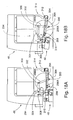
- a scrub head shock absorbing system 188 is provided to prevent the second end 180 of the scrub head 44 from contacting the front left wheel 34B.
- the system 188 includes a first bracket 190 having one end thereof pivotally attached to the frame of the front portion 32 at a first pivot point 192.
- the other end of the first bracket 190 is pivotally attached to a second bracket 194 at a second pivot point 196.
- the second bracket 194 is operatively connected to the scrub head 44.
- Also part of the second bracket 194 is an arm 198.
- a rod 200 having one end thereof pivotally attached to the frame of the front portion 32 at a third pivot point 202 and the other end thereof pivotally attached to the arm 198 at a fourth pivot point 204.
- a spring 206 with one end attached to the frame of the front portion 32 and another end attached to a point on the first bracket 190 between the first pivot point 192 and the second pivot point 196 is also included in the system 188.
- the elements of the system 188 cooperate, in the absence of a lateral force being applied to the first end 178 of the scrub head 44, to hold the scrub head 44 in the position illustrated in Figure 10A.
- the first bracket 190 rotates to move the scrub head 44 away from the object applying the force to the scrub head 44.
- the elements of the system 188 and, in particular the arm 198 and rod 200 move the scrub head 44 away from the wheel 34B by rotating the second bracket 194. Consequently, the system 188 operates to move the second end 180 of the scrub head 44 forward to avoid contacting the wheel 34B.
- the spring 206 which was elongated during rotation of the first bracket 190, operates upon dissipation of the lateral force to move the scrub head 44 from the orientation shown in Figure 10B to the orientation shown in Figure 10A.
- a lift mechanism 210 for raising and lowering the scrub head 44 in cooperation with the scrub head shock absorbing system 188 is discussed.
- the lift mechanism associated with a scrub head cannot be readily connected and disconnected from the vehicle during scrubbing operations when the scrub head may be subjected to a lateral force that makes use of a shock absorbing system.
- the lift mechanism 210 associated with the vehicle 30 is adapted to follow the path that the scrub head 44 follows when moved by the scrub head shock absorbing system 188 previously described.
- the lift mechanism 210 is comprised of the first bracket 190 which is, in turn, comprised of a four element pivoting parallelogram structure.
- the lift mechanism 210 further includes the second bracket 194 which, as previously mentioned, is attached to the first bracket 190 and retains the scrub head 44.
- Further included in the lift mechanism 210 is a screw and threaded bore structure 212 with one end of the threaded bore portion operatively connected to the second bracket 194 by a first gimbal 214.
- one end of the screw portion of the structure 212 is connected to the cover 138 by a second gimbal 216.
- An actuator 218 is operatively connected to the screw portion of the structure 212 to raise and lower the scrub head 44 by applying the appropriate rotational power to the screw portion of the structure 212.
- the first and second gimbals 214, 216 permit the lift mechanism 210 to follow the path of the scrub head 44 when the scrub head shock absorption system 188 is responding to a lateral force applied to the scrub head.
- Figs. 12A and 12B respectively show the lift mechanism 210 in the absence of a lateral force being applied to the scrub head 44, as in Fig. 10A, and how the lift mechanism 210 rotates from right to left during application of a lateral force to the scrub head 44, as in Fig. 10B.
- a similar rotation of the lift mechanism 210 occurs forward and backward to follow the path of the scrub head during application of a lateral force.
- the structure 222 includes a first mount that is associated with the frame of the vehicle, a second mount that is associated with the scrub head, and a latching mechanism that can be operated without the use of tools to connect and disconnect the scrub head 44.
- the mounting structure 222 includes a cylindrical pin 224 that is operatively connected to the second bracket 194 and has a hole 226 extending through the tip thereof.
- the mounting structure 222 further includes a bracket 228 that is operatively attached to the scrub head 44 and has two, holed flanges for receiving the pin 224.
- a hairpin 230 that can be readily inserted and removed from the hole 226 in the pin 224 is used to connect and disconnect the bracket 228 from the pin 224. It should be appreciated that the locations of the pin and bracket can be reversed, i.e., the pin can be attached to the scrub head 44 and the bracket can be attached to the frame of the vehicle.
- connection or disconnection of a scrub head from the vehicle 30 commences with removal of a front bumper 234 to obtain access to the pin 224.
- the front bumper 234 is connected to the frame of the front portion 32 by a simple latch mechanism that is readily manipulated by an operator without the use of tools. If a scrub head is to be mounted, the scrub head 44 is placed in front of the pin 224 and the lift mechanism 210 is commanded, via the control panel 60, to place the pin 224 at a height appropriate for insertion through the holes associated with the bracket 228. At this point, the pin 224 can be inserted through the holes in the bracket 228 by simply driving the vehicle 30 forward.
- the hairpin 230 is inserted through the hole 226 to fix the scrub head 44 to the vehicle 30. Dismounting of the scrub head 44 merely involves reversal of the operations associated with mounting the scrub head 44.
- the mounting structure 222 permits an operator to readily use a number of different types of scrub heads.
- the illustrated scrub head can be interchanged with a burnisher head, a cylindrical scrub head, a scrub head with a greater width, a sweeper head, and a combination scrubber/sweeper head among others.
- the constraints associated with the application require that the solution tank 42 be associated with the front portion 32 and the recovery tank 48 be associated with the rear portion 36.
- the shape of the recovery tank is affected by the need to associate several of the remaining vehicle components with the rear portion 36 because the components already associated with the front portion and the dimensional constraints associated with the front portion prevent these components from also being associated with the front portion. Most significantly, the drive power system, less the interface portion thereof, is associated with the rear portion 36 of the vehicle 30. The shape of the recovery tank 48 is also affected by the previously noted capacity requirement as well as other factors.
- the recovery tank 48 is a box-like structure that lacks a front and bottom side and defines an interior cavity 236 that accommodates at least a portion of the drive power system. More specifically, the recovery tank 48 includes a first side portion 238A, a second side portion 238B that is substantially parallel to the first side portion 238A, an end portion 240 and top portion 242 that each join the first and second side portions 238A, 238B.
- the recovery tank 48 is further characterized as having wheel well portions 244A, 244B that each serve, at least in part, to define wheel wells for the rear pair of wheels 38A, 38B.
- the recovery tank 48 is substantially symmetrical about the longitudinal plane of the rear portion 36 of the vehicle 30. This promotes stability by evenly distributing the recovered cleaning solution retained in the recovery tank 48 about the longitudinal axis of the rear portion 36.
- Another feature of the recovery tank 48 are first and second cut-outs 246A, 246B that accommodate an operator's elbows during, for example, maximum articulations of the vehicle 30, as shown in Figure 7.
- the exterior surfaces of the first and second side portions 238A, 238B of the recovery tank 48 are, as shown in Figure 7, curved. More specifically, the curves of the exterior surfaces of the first and second side portions 238A, 238B are respectively concentric and interior to the first rear arc 82 and second rear arc 84.
- the recovery tank 48 further includes a drain port 250 (see Fig. 2) that is operatively connected to a drain hose 252.
- a first service port located on the top portion 242 of the recovery tank 48 provides access to the interface between the recovery tank 48 and the tubing or piping that transports cleaning fluid from the vacuum squeegee 46 to the recovery tank 48.
- a second service port 256 facilitates cleaning of the recovery tank and the like.
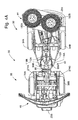
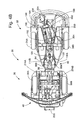
- Figures 14A and 14B illustrate the positional relationships of the recovery tank 48 and components of the drive power system associated with the rear portion 36 to one another.
- the drive power systems components associated with the rear portion 36 include an electric motor 260, batteries 262 for providing electrical power to the electrical motor 260, and a drive linkage 264 for transmitting drive power from the electric motor 260 to the rear wheels 38A, 38B.
- the cavity 236 formed by the recovery tank 48 accommodates or houses the batteries 262.
- the batteries 262 in turn, have a positional relationship to the electric motor 260 and the drive linkage 264.
- the batteries 262 are located above the electric motor 260 and drive linkage 264.
- the electric motor 260 and the drive linkage 264 are positioned very close to the rear wheels 38A, 38B.
- This provides for efficient transmission of power from the electric motor 260 to the wheels 38A, 38B because, due to the proximity of the electric motor 260 and drive linkage 264 to the wheels 238A, 238B, transmission losses associated with the drive linkage 264 are kept relatively low.
- the drive linkage 264 is relatively simple and is comprised of a drive chain-sprocket system 266 that transmits rotational power from the motor 260 to a differential drive shaft 268.
- rotational power is transmitted from the differential drive shaft 268 to the rear wheels 38A, 38B by first and second wheel chain-sprocket assemblies 270A, 270B. Braking of the rear wheels 38A, 38B is achieved using first and second disk brakes 272A, 272B.
- first and second vacuum motors 274A, 274B that interface to the vacuum squeegee 46 and recovery tank 48.
- the recovery tank 48 can be displaced to expose these components of the drive power system. Specifically, the recovery tank 48 is connected to a vertical panel 276 by a hinge 278 that permits the recovery tank 48, when substantially empty, to be displaced and servicing conducted.
- the vacuum squeegee is also associated with the rear portion due to various features of the vehicle required to address the noted application. For instance, the vacuum squeegee is associated with the rear portion to facilitate transfer of cleaning solution to the recovery tank which is also associated with the rear portion based upon the constraints of the application, as previously noted. The vacuum squeegee is also associated with the rear portion and, more specifically, located behind the rear wheels so that the vehicle avoids leaving tire tracks during the scrubbing of a floor.
- association of the vacuum squeegee with the rear portion 36, the limitation of the width of the rear portion 36, and the width of the aisles in the noted application have impacted the vacuum squeegee 46.
- association of thevacuum squeegee 46 with the rear portion 36 due to the articulated steering architecture, requires that the vacuum squeegee remain in a fixed position during scrubbing operations.
- the ends of the vacuum squeegee must extend beyond the lateral bounds of the body of the rear portion 36 because the width of the rear portion 36 is constrained to be narrower than the width of the vacuum squeegee, which has a width that is slightly less than the width of the aisle in the application.
- the vacuum squeegee can be damaged by lateral shock forces.
- a vacuum squeegee shock absorbing system 282 is discussed.
- the system 282 operates to hold the vacuum squeegee 46 in a fixed position in the absence of a lateral force being applied to one of the ends of the vacuum squeegee 46 that extends beyond the area defined by the body of the rear portion 36.
- the system 282 further operates, when a lateral force is applied to one of the ends, to permit the vacuum squeegee 46 to move and thereby absorb the lateral force.
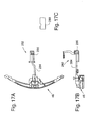
- the system 282 includes a rod 284 with a first end thereof connected to the vacuum squeegee 46 and a second end thereof pivotally connected to the frame of the rear portion 36 at a pivot point 286.
- the system 282 further includes a notched block 288 that is connected to the frame of the rear portion 36 by a leaf spring 290.
- a leaf spring 290 In the absence of a lateral force being applied to one of the ends of the vacuum squeegee 46, the notched rod 284 is retained by the notched block 288 and the vacuum squeegee 46 is held in the required fixed position. If, however, a lateral force is applied to one end of the vacuum squeegee 46, the leaf spring 290 permits the notched block 288 to be downwardly displaced and the rod 284 and vacuum squeegee 46 to rotate about the pivot point 286, thereby absorbing the force.
- the vacuum squeegee 46 and the rod 284 rotate back towards the notched block 288 as the vehicle moves forward and eventually are captured by the notched block 288 to again hold the vacuum squeegee 46 in the requisite fixed position.
- a squeegee lift system 294 is provided that lifts the vacuum squeegee 46 regardless of whether the vacuum shock absorbing system 282 is holding the vacuum squeegee in the noted fixed position or permitting the vacuum squeegee 46 to "float" in response to a lateral force.
- the squeegee lift system uses a cam to lift the vacuum squeegee 46.
- the squeegee lift system 294 includes first and second arms 296A, 296B, a camming rod 298 that connects corresponding ends of the first and second arms 296A, 296B, an axle 300 connecting the other ends of the first and second arms 296A, 296B, a bracket 302 with one end rigidly connected to the second arm 296B, a screw and threaded bore structure 304 having one end pivotally connected to the bracket at pivot first point 306 and the other end pivotally connected to the frame of the rear portion 36 at second pivot point 308, and an actuator 310 for applying rotational force to the screw portion of the screw end threaded bore structure 304 to raise or lower the vacuum squeegee 46.
- the rod 284 previously utilized in the vacuum squeegee shock absorbing system 282, which is also pivotally connected to the frame of the rear portion 36 at third pivot point 312.
- An arm and spring structure 314 is operatively connected to the rod 284 so as to bias the vacuum squeegee against the floor during scrubbing operations.
- Raising of the vacuum squeegee 48 is accomplished by using the actuator 310 to rotate the bracket 302, first and second arms 296A, 296B, and camming rod 298 about the axle 300. This causes the camming rod 298 to engage and rotate the rod 284 about the pivot point 312, thereby lifting the vacuum squeegee 46.
- the lifting process is reversed.
- the lifting mechanism 294 operates regardless of whether the vacuum squeegee shock absorbing system 282 is holding the vacuum squeegee 46 in the noted fixed position or permitting the vacuum squeegee 46 to "float" in response to a lateral force.
Landscapes
- Engineering & Computer Science (AREA)
- Chemical & Material Sciences (AREA)
- Combustion & Propulsion (AREA)
- Transportation (AREA)
- Mechanical Engineering (AREA)
- Steering-Linkage Mechanisms And Four-Wheel Steering (AREA)
- Electric Suction Cleaners (AREA)
- Motorcycle And Bicycle Frame (AREA)
- Cleaning In General (AREA)
Applications Claiming Priority (2)
| Application Number | Priority Date | Filing Date | Title |
|---|---|---|---|
| US643471 | 1996-05-06 | ||
| US08/643,471 US5742975A (en) | 1996-05-06 | 1996-05-06 | Articulated floor scrubber |
Publications (3)
| Publication Number | Publication Date |
|---|---|
| EP0806171A2 EP0806171A2 (en) | 1997-11-12 |
| EP0806171A3 EP0806171A3 (en) | 2000-04-26 |
| EP0806171B1 true EP0806171B1 (en) | 2006-04-05 |
Family
ID=24580965
Family Applications (1)
| Application Number | Title | Priority Date | Filing Date |
|---|---|---|---|
| EP97303100A Expired - Lifetime EP0806171B1 (en) | 1996-05-06 | 1997-05-06 | Articulated floor scrubber |
Country Status (5)
| Country | Link |
|---|---|
| US (1) | US5742975A (da) |
| EP (1) | EP0806171B1 (da) |
| JP (1) | JPH1080385A (da) |
| DE (1) | DE69735607T2 (da) |
| DK (1) | DK0806171T3 (da) |
Families Citing this family (56)
| Publication number | Priority date | Publication date | Assignee | Title |
|---|---|---|---|---|
| SE501600C2 (sv) * | 1994-05-20 | 1995-03-27 | Stiga Ab | Styranordning i en åkgräsklippare samt däri ingående länkelement för hopkoppling av transmissionskedjor |
| DE19748277C1 (de) * | 1997-10-31 | 1999-06-17 | Kaercher Gmbh & Co Alfred | Fahrbares Bodenreinigungsgerät |
| US6263989B1 (en) | 1998-03-27 | 2001-07-24 | Irobot Corporation | Robotic platform |
| US6023813A (en) * | 1998-04-07 | 2000-02-15 | Spectrum Industrial Products, Inc. | Powered floor scrubber and buffer |
| US5993563A (en) * | 1998-05-05 | 1999-11-30 | Windsor Industries, Inc. | Combination of main scrubbing machine and attachment scrubbing machine |
| SE9803535L (sv) * | 1998-10-14 | 2000-04-15 | Noton Ab | Städmaskin |
| CA2374976C (en) * | 1999-06-08 | 2006-05-30 | S.C. Johnson Commercial Markets, Inc. | Floor cleaning apparatus |
| US8412377B2 (en) | 2000-01-24 | 2013-04-02 | Irobot Corporation | Obstacle following sensor scheme for a mobile robot |
| US6357070B1 (en) | 2000-02-16 | 2002-03-19 | Windsor Industries, Inc. | Multi-function, battery-powered, rider cleaning machine |
| US6956348B2 (en) | 2004-01-28 | 2005-10-18 | Irobot Corporation | Debris sensor for cleaning apparatus |
| AU2001253151A1 (en) * | 2000-04-04 | 2001-10-15 | Irobot Corporation | Wheeled platforms |
| DE10019682B4 (de) * | 2000-04-20 | 2004-02-05 | Tremmel, Dieter, Prof. Dr. | Vorrichtung zur Bodenreinigung |
| US6760947B2 (en) | 2000-08-22 | 2004-07-13 | Alto U.S. Inc. | Apparatus for treating a floor surface utilizing a handle mounted traverse switch |
| US6763544B2 (en) * | 2000-08-22 | 2004-07-20 | Alto Us, Inc. | Apparatus for treating a floor surface |
| US6557207B2 (en) | 2000-08-22 | 2003-05-06 | Alto U.S. Inc. | Squeegee assembly for a floor surface treatment apparatus |
| US6690134B1 (en) | 2001-01-24 | 2004-02-10 | Irobot Corporation | Method and system for robot localization and confinement |
| US7571511B2 (en) | 2002-01-03 | 2009-08-11 | Irobot Corporation | Autonomous floor-cleaning robot |
| US7429843B2 (en) | 2001-06-12 | 2008-09-30 | Irobot Corporation | Method and system for multi-mode coverage for an autonomous robot |
| US6827164B2 (en) | 2001-09-21 | 2004-12-07 | Anthony J. Palumbo | Industrial truck |
| US8428778B2 (en) | 2002-09-13 | 2013-04-23 | Irobot Corporation | Navigational control system for a robotic device |
| US20070157417A1 (en) * | 2003-02-14 | 2007-07-12 | O'hara Robert J | Articulated floor scrubber |
| US20120096671A1 (en) | 2010-10-26 | 2012-04-26 | Karcher North America, Inc. | Floor cleaning apparatus employing a combined sweeper and vaccum assembly |
| US8302240B2 (en) * | 2009-07-29 | 2012-11-06 | Karcher North America, Inc. | Selectively adjustable steering mechanism for use on a floor cleaning machine |
| US7533435B2 (en) | 2003-05-14 | 2009-05-19 | Karcher North America, Inc. | Floor treatment apparatus |
| US20060064844A1 (en) * | 2003-05-14 | 2006-03-30 | Venard Daniel C | Floating deck for use with a floor cleaning apparatus |
| US7332890B2 (en) | 2004-01-21 | 2008-02-19 | Irobot Corporation | Autonomous robot auto-docking and energy management systems and methods |
| EP1715783B1 (en) * | 2004-02-16 | 2015-01-21 | Kärcher North America, Inc. | Apparatus for floor cleaning and treatment |
| WO2006002385A1 (en) | 2004-06-24 | 2006-01-05 | Irobot Corporation | Programming and diagnostic tool for a mobile robot |
| US8972052B2 (en) | 2004-07-07 | 2015-03-03 | Irobot Corporation | Celestial navigation system for an autonomous vehicle |
| US7706917B1 (en) | 2004-07-07 | 2010-04-27 | Irobot Corporation | Celestial navigation system for an autonomous robot |
| USD533320S1 (en) | 2004-11-11 | 2006-12-05 | Castle Rock Industries, Inc. | Floor treatment device |
| KR101247933B1 (ko) | 2005-02-18 | 2013-03-26 | 아이로보트 코퍼레이션 | 습식 및 건식 청소를 위한 자동 표면 청소 로봇 |
| US7389156B2 (en) | 2005-02-18 | 2008-06-17 | Irobot Corporation | Autonomous surface cleaning robot for wet and dry cleaning |
| US7620476B2 (en) | 2005-02-18 | 2009-11-17 | Irobot Corporation | Autonomous surface cleaning robot for dry cleaning |
| US8392021B2 (en) | 2005-02-18 | 2013-03-05 | Irobot Corporation | Autonomous surface cleaning robot for wet cleaning |
| US8930023B2 (en) | 2009-11-06 | 2015-01-06 | Irobot Corporation | Localization by learning of wave-signal distributions |
| WO2007065034A1 (en) | 2005-12-02 | 2007-06-07 | Irobot Corporation | Modular robot |
| KR101099808B1 (ko) | 2005-12-02 | 2011-12-27 | 아이로보트 코퍼레이션 | 로봇 시스템 |
| EP2251757B1 (en) | 2005-12-02 | 2011-11-23 | iRobot Corporation | Coverage robot mobility |
| ES2706729T3 (es) | 2005-12-02 | 2019-04-01 | Irobot Corp | Sistema de robot |
| ES2583374T3 (es) | 2006-05-19 | 2016-09-20 | Irobot Corporation | Eliminación de residuos de robots de limpieza |
| US8417383B2 (en) | 2006-05-31 | 2013-04-09 | Irobot Corporation | Detecting robot stasis |
| EP2574265B1 (en) | 2007-05-09 | 2015-10-14 | iRobot Corporation | Compact autonomous coverage robot |
| US8678883B2 (en) * | 2008-01-18 | 2014-03-25 | Onfloor Technologies, L.L.C. | Riding apparatus for polishing and cleaning floor surfaces |
| US8966693B2 (en) | 2009-08-05 | 2015-03-03 | Karcher N. America, Inc. | Method and apparatus for extended use of cleaning fluid in a floor cleaning machine |
| USD654234S1 (en) | 2010-12-08 | 2012-02-14 | Karcher North America, Inc. | Vacuum bag |
| US8978190B2 (en) | 2011-06-28 | 2015-03-17 | Karcher North America, Inc. | Removable pad for interconnection to a high-speed driver system |
| USD693529S1 (en) | 2012-09-10 | 2013-11-12 | Karcher North America, Inc. | Floor cleaning device |
| US20140173864A1 (en) * | 2012-12-20 | 2014-06-26 | Amano Pioneer Eclipse Corporation | Ultra high speed twin headed burnisher with pologanial pads and methods |
| JP2014144051A (ja) * | 2013-01-28 | 2014-08-14 | Sharp Corp | 清掃装置、及び、制御方法 |
| JP6006669B2 (ja) * | 2013-03-29 | 2016-10-12 | 古河ロックドリル株式会社 | アーティキュレート式作業車両 |
| EP3013205A1 (de) * | 2013-06-28 | 2016-05-04 | Alfred Kärcher GmbH & Co. KG | Fahrbare aufsitz-bodenreinigungsmaschine und verfahren zur positionierung eines saugbalkens einer fahrbaren aufsitz-bodenreinigungsmaschine |
| EP2954817B1 (de) * | 2014-06-11 | 2016-10-26 | Hako GmbH | Bodenreinigungsmaschine |
| WO2018202301A1 (de) | 2017-05-04 | 2018-11-08 | Alfred Kärcher SE & Co. KG | Bodenreinigungsgerät und verfahren zum reinigen einer bodenfläche |
| USD907868S1 (en) | 2019-01-24 | 2021-01-12 | Karcher North America, Inc. | Floor cleaner |
| US11744427B2 (en) | 2019-11-05 | 2023-09-05 | Betco Corporation | Floor cleaning machine with solid chemical delivery system |
Family Cites Families (15)
| Publication number | Priority date | Publication date | Assignee | Title |
|---|---|---|---|---|
| US3277511A (en) * | 1964-04-15 | 1966-10-11 | Nat Super Service Company | Adjustable width floor treating machine |
| GB1155847A (en) * | 1965-09-30 | 1969-06-25 | Secr Defence | Improvements in or relating to Articulated Vehicles |
| US3363711A (en) * | 1966-02-03 | 1968-01-16 | Caterpillar Tractor Co | Mechanism for steering follow-up linkage |
| US3395930A (en) * | 1966-03-07 | 1968-08-06 | Int Harvester Co | Tiltable steering wheel |
| US3942218A (en) * | 1972-05-22 | 1976-03-09 | Tennant Company | Scrubbing machine |
| SE382785B (sv) * | 1974-06-26 | 1976-02-16 | Stiga Ab | Styrinrettning |
| US4378855A (en) * | 1979-08-20 | 1983-04-05 | Tennant Company | Multi-speed drive with forward/reverse lockout |
| US4317252A (en) * | 1980-07-14 | 1982-03-02 | The Scott & Fetzer Company | Sweeper-scrubber |
| FR2488637A1 (fr) * | 1980-08-14 | 1982-02-19 | Gibert Pierre | Vehicule de manutention et de terrassement, simplifie |
| US4320556A (en) * | 1980-09-12 | 1982-03-23 | Tennant Company | Surface maintenance equipment |
| US4492002A (en) * | 1980-09-12 | 1985-01-08 | Wetrok, Inc. | Floor cleaning machine |
| SE454127B (sv) * | 1985-08-08 | 1988-04-11 | Husqvarna Ab | Akbar gresklippare |
| US4787646A (en) * | 1987-05-07 | 1988-11-29 | Simplicity Manufacturing, Inc. | Riding mower chassis with floating steerable rear wheels |
| ES2048703T3 (es) * | 1991-02-01 | 1996-10-01 | Kurt Zachhuber | Maquina para el tratamiento del suelo. |
| US5623743A (en) * | 1996-06-04 | 1997-04-29 | Clarke Industries, Inc. | Mobile surface scrubber solution recovery system |
-
1996
- 1996-05-06 US US08/643,471 patent/US5742975A/en not_active Expired - Lifetime
-
1997
- 1997-05-06 EP EP97303100A patent/EP0806171B1/en not_active Expired - Lifetime
- 1997-05-06 DE DE69735607T patent/DE69735607T2/de not_active Expired - Lifetime
- 1997-05-06 DK DK97303100T patent/DK0806171T3/da active
- 1997-05-06 JP JP9152772A patent/JPH1080385A/ja active Pending
Also Published As
| Publication number | Publication date |
|---|---|
| DE69735607T2 (de) | 2007-06-06 |
| EP0806171A3 (en) | 2000-04-26 |
| JPH1080385A (ja) | 1998-03-31 |
| DE69735607D1 (de) | 2006-05-18 |
| EP0806171A2 (en) | 1997-11-12 |
| DK0806171T3 (da) | 2006-07-31 |
| US5742975A (en) | 1998-04-28 |
Similar Documents
| Publication | Publication Date | Title |
|---|---|---|
| EP0806171B1 (en) | Articulated floor scrubber | |
| JPH1080385A5 (da) | ||
| US5454138A (en) | Squegee mounting for floor scrubber | |
| US5467500A (en) | Steering mechanism for a cleaning vehicle | |
| CN112932332B (zh) | 表面维护机器 | |
| US6088873A (en) | Floor cleaning machine and method | |
| EP4216783B1 (en) | Cleaning robot | |
| US7059004B2 (en) | Floor surface treatment apparatus | |
| US4483041A (en) | Support for a squeegee assembly | |
| US6618888B2 (en) | Dual downforce mechanism for a cleaning head of a surface conditioning vehicle | |
| CA2265406A1 (en) | Transmission neutral locking arrangment for a self-propelled vacuum cleaner | |
| CN113576332A (zh) | 一种清洁机器人 | |
| US20020170130A1 (en) | Suspension for a surface maintenance appliance | |
| EP2814371B1 (en) | Surface maintenance vehicle with compact cleaning head lift mechanism and suspension | |
| US20070157417A1 (en) | Articulated floor scrubber | |
| US5901410A (en) | Apparatus for cleaning a floor surface | |
| GB2244749A (en) | Sound attenuation duct for a cleaning vehicle | |
| CN119453845A (zh) | 一种主动越障式驱动轮及其机器人 | |
| WO1991019048A1 (en) | Cleaning and other vehicles | |
| CN220045789U (zh) | 自主移动设备 | |
| US4135270A (en) | Portable carwash apparatus | |
| WO1990010416A1 (en) | A machine for treating floor surfaces | |
| CN114668350A (zh) | 行走装置及清洁设备 | |
| CN119112039B (zh) | 自主移动设备及其工作方法 | |
| EP0792614B1 (en) | Apparatus for cleaning a ground |
Legal Events
| Date | Code | Title | Description |
|---|---|---|---|
| PUAI | Public reference made under article 153(3) epc to a published international application that has entered the european phase |
Free format text: ORIGINAL CODE: 0009012 |
|
| AK | Designated contracting states |
Kind code of ref document: A2 Designated state(s): CH DE DK FR GB IT LI NL SE |
|
| PUAL | Search report despatched |
Free format text: ORIGINAL CODE: 0009013 |
|
| AK | Designated contracting states |
Kind code of ref document: A3 Designated state(s): CH DE DK FR GB IT LI NL SE |
|
| 17P | Request for examination filed |
Effective date: 20000810 |
|
| 17Q | First examination report despatched |
Effective date: 20020321 |
|
| RAP1 | Party data changed (applicant data changed or rights of an application transferred) |
Owner name: CASTLE ROCK INDUSTRIES, INC. |
|
| GRAP | Despatch of communication of intention to grant a patent |
Free format text: ORIGINAL CODE: EPIDOSNIGR1 |
|
| GRAS | Grant fee paid |
Free format text: ORIGINAL CODE: EPIDOSNIGR3 |
|
| GRAA | (expected) grant |
Free format text: ORIGINAL CODE: 0009210 |
|
| AK | Designated contracting states |
Kind code of ref document: B1 Designated state(s): CH DE DK FR GB IT LI NL SE |
|
| REG | Reference to a national code |
Ref country code: GB Ref legal event code: FG4D |
|
| REG | Reference to a national code |
Ref country code: CH Ref legal event code: EP |
|
| REF | Corresponds to: |
Ref document number: 69735607 Country of ref document: DE Date of ref document: 20060518 Kind code of ref document: P |
|
| PGFP | Annual fee paid to national office [announced via postgrant information from national office to epo] |
Ref country code: IT Payment date: 20060531 Year of fee payment: 10 |
|
| REG | Reference to a national code |
Ref country code: SE Ref legal event code: TRGR |
|
| REG | Reference to a national code |
Ref country code: DK Ref legal event code: T3 Ref country code: CH Ref legal event code: NV Representative=s name: TROESCH SCHEIDEGGER WERNER AG |
|
| ET | Fr: translation filed | ||
| PLBE | No opposition filed within time limit |
Free format text: ORIGINAL CODE: 0009261 |
|
| STAA | Information on the status of an ep patent application or granted ep patent |
Free format text: STATUS: NO OPPOSITION FILED WITHIN TIME LIMIT |
|
| 26N | No opposition filed |
Effective date: 20070108 |
|
| REG | Reference to a national code |
Ref country code: CH Ref legal event code: PFA Owner name: KARCHER FLOOR CARE, INC. Free format text: CASTLE ROCK INDUSTRIES, INC.#1351 W. STANFORD AVE.#ENGLEWOOD, COLORADO 80110 (US) -TRANSFER TO- KARCHER FLOOR CARE, INC.#1351 W. STANFORD AVE.#ENGLEWOOD, CO 80110 (US) |
|
| NLT1 | Nl: modifications of names registered in virtue of documents presented to the patent office pursuant to art. 16 a, paragraph 1 |
Owner name: KARCHER FLOOR CARE, INC. |
|
| REG | Reference to a national code |
Ref country code: FR Ref legal event code: CD |
|
| REG | Reference to a national code |
Ref country code: GB Ref legal event code: 732E Free format text: REGISTERED BETWEEN 20090507 AND 20090513 |
|
| REG | Reference to a national code |
Ref country code: CH Ref legal event code: PUE Owner name: KARCHER NORTH AMERICA, INC. Free format text: KARCHER FLOOR CARE, INC.#1351 W. STANFORD AVE.#ENGLEWOOD, CO 80110 (US) -TRANSFER TO- KARCHER NORTH AMERICA, INC.#5001- B SOUTH ZUNI STREET#LITTLETON, CO 80120 (US) |
|
| PG25 | Lapsed in a contracting state [announced via postgrant information from national office to epo] |
Ref country code: IT Free format text: LAPSE BECAUSE OF NON-PAYMENT OF DUE FEES Effective date: 20070506 |
|
| REG | Reference to a national code |
Ref country code: FR Ref legal event code: TP Ref country code: FR Ref legal event code: CD |
|
| NLS | Nl: assignments of ep-patents |
Owner name: KARCHER NORTH AMERICA, INC. Effective date: 20090804 |
|
| PGFP | Annual fee paid to national office [announced via postgrant information from national office to epo] |
Ref country code: GB Payment date: 20140430 Year of fee payment: 18 |
|
| PGFP | Annual fee paid to national office [announced via postgrant information from national office to epo] |
Ref country code: SE Payment date: 20140513 Year of fee payment: 18 Ref country code: DE Payment date: 20140430 Year of fee payment: 18 Ref country code: NL Payment date: 20140510 Year of fee payment: 18 Ref country code: FR Payment date: 20140509 Year of fee payment: 18 Ref country code: CH Payment date: 20140513 Year of fee payment: 18 |
|
| PGFP | Annual fee paid to national office [announced via postgrant information from national office to epo] |
Ref country code: DK Payment date: 20140512 Year of fee payment: 18 |
|
| REG | Reference to a national code |
Ref country code: CH Ref legal event code: PCOW Free format text: NEW ADDRESS: 4555 AIRPORT WAY, DENVER, COLORADO 80239 (US) |
|
| REG | Reference to a national code |
Ref country code: DE Ref legal event code: R119 Ref document number: 69735607 Country of ref document: DE |
|
| REG | Reference to a national code |
Ref country code: DK Ref legal event code: EBP Effective date: 20150531 |
|
| REG | Reference to a national code |
Ref country code: CH Ref legal event code: PL |
|
| GBPC | Gb: european patent ceased through non-payment of renewal fee |
Effective date: 20150506 |
|
| PG25 | Lapsed in a contracting state [announced via postgrant information from national office to epo] |
Ref country code: CH Free format text: LAPSE BECAUSE OF NON-PAYMENT OF DUE FEES Effective date: 20150531 Ref country code: LI Free format text: LAPSE BECAUSE OF NON-PAYMENT OF DUE FEES Effective date: 20150531 |
|
| REG | Reference to a national code |
Ref country code: NL Ref legal event code: MM Effective date: 20150601 |
|
| REG | Reference to a national code |
Ref country code: FR Ref legal event code: ST Effective date: 20160129 |
|
| PG25 | Lapsed in a contracting state [announced via postgrant information from national office to epo] |
Ref country code: SE Free format text: LAPSE BECAUSE OF NON-PAYMENT OF DUE FEES Effective date: 20150507 |
|
| PG25 | Lapsed in a contracting state [announced via postgrant information from national office to epo] |
Ref country code: NL Free format text: LAPSE BECAUSE OF NON-PAYMENT OF DUE FEES Effective date: 20150601 Ref country code: GB Free format text: LAPSE BECAUSE OF NON-PAYMENT OF DUE FEES Effective date: 20150506 Ref country code: DE Free format text: LAPSE BECAUSE OF NON-PAYMENT OF DUE FEES Effective date: 20151201 Ref country code: DK Free format text: LAPSE BECAUSE OF NON-PAYMENT OF DUE FEES Effective date: 20150531 |
|
| PG25 | Lapsed in a contracting state [announced via postgrant information from national office to epo] |
Ref country code: FR Free format text: LAPSE BECAUSE OF NON-PAYMENT OF DUE FEES Effective date: 20150601 |