EP0807662B1 - Amidoamin-modifiziertes Polypropylen - Google Patents
Amidoamin-modifiziertes Polypropylen Download PDFInfo
- Publication number
- EP0807662B1 EP0807662B1 EP97105165A EP97105165A EP0807662B1 EP 0807662 B1 EP0807662 B1 EP 0807662B1 EP 97105165 A EP97105165 A EP 97105165A EP 97105165 A EP97105165 A EP 97105165A EP 0807662 B1 EP0807662 B1 EP 0807662B1
- Authority
- EP
- European Patent Office
- Prior art keywords
- polypropylene
- amidoamine
- composition
- carbon atoms
- independently
- Prior art date
- Legal status (The legal status is an assumption and is not a legal conclusion. Google has not performed a legal analysis and makes no representation as to the accuracy of the status listed.)
- Expired - Lifetime
Links
- -1 polypropylene Polymers 0.000 title claims description 117
- 239000004743 Polypropylene Substances 0.000 title claims description 98
- 229920001155 polypropylene Polymers 0.000 title claims description 79
- 230000004048 modification Effects 0.000 title 1
- 238000012986 modification Methods 0.000 title 1
- 239000000203 mixture Substances 0.000 claims description 77
- 238000000034 method Methods 0.000 claims description 33
- 125000000217 alkyl group Chemical group 0.000 claims description 28
- 125000004432 carbon atom Chemical group C* 0.000 claims description 26
- 229920001971 elastomer Polymers 0.000 claims description 23
- JBKVHLHDHHXQEQ-UHFFFAOYSA-N epsilon-caprolactam Chemical compound O=C1CCCCCN1 JBKVHLHDHHXQEQ-UHFFFAOYSA-N 0.000 claims description 22
- 239000000806 elastomer Substances 0.000 claims description 18
- 239000007795 chemical reaction product Substances 0.000 claims description 14
- 150000004985 diamines Chemical class 0.000 claims description 9
- 238000013329 compounding Methods 0.000 claims description 7
- 238000006243 chemical reaction Methods 0.000 claims description 6
- OKTJSMMVPCPJKN-UHFFFAOYSA-N Carbon Chemical compound [C] OKTJSMMVPCPJKN-UHFFFAOYSA-N 0.000 claims description 5
- 229910052799 carbon Inorganic materials 0.000 claims description 5
- 238000002360 preparation method Methods 0.000 claims description 3
- WTFAGPBUAGFMQX-UHFFFAOYSA-N 1-[2-[2-(2-aminopropoxy)propoxy]propoxy]propan-2-amine Chemical compound CC(N)COCC(C)OCC(C)OCC(C)N WTFAGPBUAGFMQX-UHFFFAOYSA-N 0.000 description 34
- 229920002397 thermoplastic olefin Polymers 0.000 description 12
- 239000011521 glass Substances 0.000 description 11
- 239000000945 filler Substances 0.000 description 10
- 229920001451 polypropylene glycol Polymers 0.000 description 10
- 229920001577 copolymer Polymers 0.000 description 9
- 229920000570 polyether Polymers 0.000 description 9
- 239000004721 Polyphenylene oxide Substances 0.000 description 8
- 239000011342 resin composition Substances 0.000 description 8
- 229920000428 triblock copolymer Polymers 0.000 description 8
- 239000000178 monomer Substances 0.000 description 7
- 150000003141 primary amines Chemical class 0.000 description 7
- 229920002292 Nylon 6 Polymers 0.000 description 6
- 150000001412 amines Chemical class 0.000 description 6
- RTZKZFJDLAIYFH-UHFFFAOYSA-N Diethyl ether Chemical compound CCOCC RTZKZFJDLAIYFH-UHFFFAOYSA-N 0.000 description 5
- IAYPIBMASNFSPL-UHFFFAOYSA-N Ethylene oxide Chemical compound C1CO1 IAYPIBMASNFSPL-UHFFFAOYSA-N 0.000 description 5
- FPYJFEHAWHCUMM-UHFFFAOYSA-N maleic anhydride Chemical compound O=C1OC(=O)C=C1 FPYJFEHAWHCUMM-UHFFFAOYSA-N 0.000 description 5
- 229920001223 polyethylene glycol Polymers 0.000 description 5
- 239000005060 rubber Substances 0.000 description 5
- GOOHAUXETOMSMM-UHFFFAOYSA-N Propylene oxide Chemical compound CC1CO1 GOOHAUXETOMSMM-UHFFFAOYSA-N 0.000 description 4
- 239000000835 fiber Substances 0.000 description 4
- 238000004519 manufacturing process Methods 0.000 description 4
- 125000002496 methyl group Chemical group [H]C([H])([H])* 0.000 description 4
- 229920000642 polymer Polymers 0.000 description 4
- 229920005992 thermoplastic resin Polymers 0.000 description 4
- NIXOWILDQLNWCW-UHFFFAOYSA-M Acrylate Chemical compound [O-]C(=O)C=C NIXOWILDQLNWCW-UHFFFAOYSA-M 0.000 description 3
- 239000009261 D 400 Substances 0.000 description 3
- 239000012141 concentrate Substances 0.000 description 3
- 229920000098 polyolefin Polymers 0.000 description 3
- 229920005989 resin Polymers 0.000 description 3
- 239000011347 resin Substances 0.000 description 3
- 125000000999 tert-butyl group Chemical group [H]C([H])([H])C(*)(C([H])([H])[H])C([H])([H])[H] 0.000 description 3
- VZCYOOQTPOCHFL-UHFFFAOYSA-N trans-butenedioic acid Natural products OC(=O)C=CC(O)=O VZCYOOQTPOCHFL-UHFFFAOYSA-N 0.000 description 3
- XLYOFNOQVPJJNP-UHFFFAOYSA-N water Substances O XLYOFNOQVPJJNP-UHFFFAOYSA-N 0.000 description 3
- SMZOUWXMTYCWNB-UHFFFAOYSA-N 2-(2-methoxy-5-methylphenyl)ethanamine Chemical compound COC1=CC=C(C)C=C1CCN SMZOUWXMTYCWNB-UHFFFAOYSA-N 0.000 description 2
- NIXOWILDQLNWCW-UHFFFAOYSA-N 2-Propenoic acid Natural products OC(=O)C=C NIXOWILDQLNWCW-UHFFFAOYSA-N 0.000 description 2
- BQBSIHIZDSHADD-UHFFFAOYSA-N 2-ethenyl-4,5-dihydro-1,3-oxazole Chemical class C=CC1=NCCO1 BQBSIHIZDSHADD-UHFFFAOYSA-N 0.000 description 2
- VZCYOOQTPOCHFL-OWOJBTEDSA-N Fumaric acid Chemical compound OC(=O)\C=C\C(O)=O VZCYOOQTPOCHFL-OWOJBTEDSA-N 0.000 description 2
- 239000004609 Impact Modifier Substances 0.000 description 2
- JHWNWJKBPDFINM-UHFFFAOYSA-N Laurolactam Chemical compound O=C1CCCCCCCCCCCN1 JHWNWJKBPDFINM-UHFFFAOYSA-N 0.000 description 2
- ISWSIDIOOBJBQZ-UHFFFAOYSA-N Phenol Chemical compound OC1=CC=CC=C1 ISWSIDIOOBJBQZ-UHFFFAOYSA-N 0.000 description 2
- 239000004952 Polyamide Substances 0.000 description 2
- 239000004698 Polyethylene Substances 0.000 description 2
- 239000002202 Polyethylene glycol Substances 0.000 description 2
- OFOBLEOULBTSOW-UHFFFAOYSA-N Propanedioic acid Natural products OC(=O)CC(O)=O OFOBLEOULBTSOW-UHFFFAOYSA-N 0.000 description 2
- 239000002318 adhesion promoter Substances 0.000 description 2
- 125000003277 amino group Chemical group 0.000 description 2
- 229920001400 block copolymer Polymers 0.000 description 2
- 229920001038 ethylene copolymer Polymers 0.000 description 2
- 210000003195 fascia Anatomy 0.000 description 2
- 150000002334 glycols Chemical class 0.000 description 2
- 239000007924 injection Substances 0.000 description 2
- 238000002347 injection Methods 0.000 description 2
- 238000001746 injection moulding Methods 0.000 description 2
- VZCYOOQTPOCHFL-UPHRSURJSA-N maleic acid Chemical compound OC(=O)\C=C/C(O)=O VZCYOOQTPOCHFL-UPHRSURJSA-N 0.000 description 2
- 239000011976 maleic acid Substances 0.000 description 2
- 239000000463 material Substances 0.000 description 2
- 238000000465 moulding Methods 0.000 description 2
- 239000005022 packaging material Substances 0.000 description 2
- 229920003023 plastic Polymers 0.000 description 2
- 239000004033 plastic Substances 0.000 description 2
- 229920002647 polyamide Polymers 0.000 description 2
- 229920000573 polyethylene Polymers 0.000 description 2
- QQONPFPTGQHPMA-UHFFFAOYSA-N propylene Natural products CC=C QQONPFPTGQHPMA-UHFFFAOYSA-N 0.000 description 2
- 125000004805 propylene group Chemical group [H]C([H])([H])C([H])([*:1])C([H])([H])[*:2] 0.000 description 2
- 239000012744 reinforcing agent Substances 0.000 description 2
- 239000007787 solid Substances 0.000 description 2
- 239000000126 substance Substances 0.000 description 2
- UTOVMEACOLCUCK-SNAWJCMRSA-N (e)-4-butoxy-4-oxobut-2-enoic acid Chemical compound CCCCOC(=O)\C=C\C(O)=O UTOVMEACOLCUCK-SNAWJCMRSA-N 0.000 description 1
- STMDPCBYJCIZOD-UHFFFAOYSA-N 2-(2,4-dinitroanilino)-4-methylpentanoic acid Chemical compound CC(C)CC(C(O)=O)NC1=CC=C([N+]([O-])=O)C=C1[N+]([O-])=O STMDPCBYJCIZOD-UHFFFAOYSA-N 0.000 description 1
- JAHNSTQSQJOJLO-UHFFFAOYSA-N 2-(3-fluorophenyl)-1h-imidazole Chemical compound FC1=CC=CC(C=2NC=CN=2)=C1 JAHNSTQSQJOJLO-UHFFFAOYSA-N 0.000 description 1
- MAGFQRLKWCCTQJ-UHFFFAOYSA-N 4-ethenylbenzenesulfonic acid Chemical compound OS(=O)(=O)C1=CC=C(C=C)C=C1 MAGFQRLKWCCTQJ-UHFFFAOYSA-N 0.000 description 1
- 229920000049 Carbon (fiber) Polymers 0.000 description 1
- 229920002943 EPDM rubber Polymers 0.000 description 1
- 239000004593 Epoxy Substances 0.000 description 1
- 229920000181 Ethylene propylene rubber Polymers 0.000 description 1
- 229940123457 Free radical scavenger Drugs 0.000 description 1
- BJSKBZUMYQBSOQ-UHFFFAOYSA-N Jeffamine M-600 Chemical compound COCCOCC(C)OCC(C)OCC(C)OCC(C)OCC(C)OCC(C)OCC(C)OCC(C)OCC(C)N BJSKBZUMYQBSOQ-UHFFFAOYSA-N 0.000 description 1
- CERQOIWHTDAKMF-UHFFFAOYSA-N Methacrylic acid Chemical compound CC(=C)C(O)=O CERQOIWHTDAKMF-UHFFFAOYSA-N 0.000 description 1
- WYURNTSHIVDZCO-UHFFFAOYSA-N Tetrahydrofuran Chemical compound C1CCOC1 WYURNTSHIVDZCO-UHFFFAOYSA-N 0.000 description 1
- 238000002835 absorbance Methods 0.000 description 1
- 238000010521 absorption reaction Methods 0.000 description 1
- 239000002253 acid Substances 0.000 description 1
- 125000004018 acid anhydride group Chemical group 0.000 description 1
- 239000003377 acid catalyst Substances 0.000 description 1
- 150000001252 acrylic acid derivatives Chemical class 0.000 description 1
- 239000000654 additive Substances 0.000 description 1
- 230000000996 additive effect Effects 0.000 description 1
- 150000008064 anhydrides Chemical class 0.000 description 1
- 230000004888 barrier function Effects 0.000 description 1
- 239000011324 bead Substances 0.000 description 1
- UTOVMEACOLCUCK-PLNGDYQASA-N butyl maleate Chemical compound CCCCOC(=O)\C=C/C(O)=O UTOVMEACOLCUCK-PLNGDYQASA-N 0.000 description 1
- 239000004917 carbon fiber Substances 0.000 description 1
- 230000015556 catabolic process Effects 0.000 description 1
- 239000003795 chemical substances by application Substances 0.000 description 1
- 239000004927 clay Substances 0.000 description 1
- 150000001875 compounds Chemical class 0.000 description 1
- 230000003750 conditioning effect Effects 0.000 description 1
- 238000006731 degradation reaction Methods 0.000 description 1
- 229920000359 diblock copolymer Polymers 0.000 description 1
- 150000001991 dicarboxylic acids Chemical class 0.000 description 1
- MSVGHYYKWDQHFV-BQYQJAHWSA-N ditert-butyl (e)-but-2-enedioate Chemical compound CC(C)(C)OC(=O)\C=C\C(=O)OC(C)(C)C MSVGHYYKWDQHFV-BQYQJAHWSA-N 0.000 description 1
- MSVGHYYKWDQHFV-FPLPWBNLSA-N ditert-butyl (z)-but-2-enedioate Chemical compound CC(C)(C)OC(=O)\C=C/C(=O)OC(C)(C)C MSVGHYYKWDQHFV-FPLPWBNLSA-N 0.000 description 1
- 230000000694 effects Effects 0.000 description 1
- 229920006351 engineering plastic Polymers 0.000 description 1
- 239000001530 fumaric acid Substances 0.000 description 1
- 125000000524 functional group Chemical group 0.000 description 1
- 125000003055 glycidyl group Chemical group C(C1CO1)* 0.000 description 1
- 125000004356 hydroxy functional group Chemical group O* 0.000 description 1
- 238000010952 in-situ formation Methods 0.000 description 1
- 150000003951 lactams Chemical group 0.000 description 1
- 238000005259 measurement Methods 0.000 description 1
- 150000002734 metacrylic acid derivatives Chemical class 0.000 description 1
- 125000000956 methoxy group Chemical group [H]C([H])([H])O* 0.000 description 1
- LVHBHZANLOWSRM-UHFFFAOYSA-N methylenebutanedioic acid Natural products OC(=O)CC(=C)C(O)=O LVHBHZANLOWSRM-UHFFFAOYSA-N 0.000 description 1
- 239000010445 mica Substances 0.000 description 1
- 229910052618 mica group Inorganic materials 0.000 description 1
- 150000002763 monocarboxylic acids Chemical class 0.000 description 1
- 125000005968 oxazolinyl group Chemical group 0.000 description 1
- 239000002245 particle Substances 0.000 description 1
- OJMIONKXNSYLSR-UHFFFAOYSA-N phosphorous acid Chemical compound OP(O)O OJMIONKXNSYLSR-UHFFFAOYSA-N 0.000 description 1
- 230000000704 physical effect Effects 0.000 description 1
- 229920001281 polyalkylene Polymers 0.000 description 1
- 229920000768 polyamine Polymers 0.000 description 1
- 238000010094 polymer processing Methods 0.000 description 1
- 229920005862 polyol Polymers 0.000 description 1
- 150000003077 polyols Chemical class 0.000 description 1
- 239000000047 product Substances 0.000 description 1
- 238000007348 radical reaction Methods 0.000 description 1
- 239000002516 radical scavenger Substances 0.000 description 1
- 150000003254 radicals Chemical class 0.000 description 1
- 229920005604 random copolymer Polymers 0.000 description 1
- 230000002787 reinforcement Effects 0.000 description 1
- 239000012758 reinforcing additive Substances 0.000 description 1
- 239000012763 reinforcing filler Substances 0.000 description 1
- 238000000518 rheometry Methods 0.000 description 1
- 239000004065 semiconductor Substances 0.000 description 1
- 238000004513 sizing Methods 0.000 description 1
- 239000000243 solution Substances 0.000 description 1
- 239000003381 stabilizer Substances 0.000 description 1
- 239000012899 standard injection Substances 0.000 description 1
- 125000000472 sulfonyl group Chemical group *S(*)(=O)=O 0.000 description 1
- 239000000454 talc Substances 0.000 description 1
- 229910052623 talc Inorganic materials 0.000 description 1
Classifications
-
- C—CHEMISTRY; METALLURGY
- C08—ORGANIC MACROMOLECULAR COMPOUNDS; THEIR PREPARATION OR CHEMICAL WORKING-UP; COMPOSITIONS BASED THEREON
- C08F—MACROMOLECULAR COMPOUNDS OBTAINED BY REACTIONS ONLY INVOLVING CARBON-TO-CARBON UNSATURATED BONDS
- C08F8/00—Chemical modification by after-treatment
- C08F8/30—Introducing nitrogen atoms or nitrogen-containing groups
-
- C—CHEMISTRY; METALLURGY
- C08—ORGANIC MACROMOLECULAR COMPOUNDS; THEIR PREPARATION OR CHEMICAL WORKING-UP; COMPOSITIONS BASED THEREON
- C08L—COMPOSITIONS OF MACROMOLECULAR COMPOUNDS
- C08L23/00—Compositions of homopolymers or copolymers of unsaturated aliphatic hydrocarbons having only one carbon-to-carbon double bond; Compositions of derivatives of such polymers
- C08L23/02—Compositions of homopolymers or copolymers of unsaturated aliphatic hydrocarbons having only one carbon-to-carbon double bond; Compositions of derivatives of such polymers not modified by chemical after-treatment
- C08L23/10—Homopolymers or copolymers of propene
-
- C—CHEMISTRY; METALLURGY
- C08—ORGANIC MACROMOLECULAR COMPOUNDS; THEIR PREPARATION OR CHEMICAL WORKING-UP; COMPOSITIONS BASED THEREON
- C08L—COMPOSITIONS OF MACROMOLECULAR COMPOUNDS
- C08L2205/00—Polymer mixtures characterised by other features
- C08L2205/03—Polymer mixtures characterised by other features containing three or more polymers in a blend
-
- C—CHEMISTRY; METALLURGY
- C08—ORGANIC MACROMOLECULAR COMPOUNDS; THEIR PREPARATION OR CHEMICAL WORKING-UP; COMPOSITIONS BASED THEREON
- C08L—COMPOSITIONS OF MACROMOLECULAR COMPOUNDS
- C08L51/00—Compositions of graft polymers in which the grafted component is obtained by reactions only involving carbon-to-carbon unsaturated bonds; Compositions of derivatives of such polymers
- C08L51/06—Compositions of graft polymers in which the grafted component is obtained by reactions only involving carbon-to-carbon unsaturated bonds; Compositions of derivatives of such polymers grafted on to homopolymers or copolymers of aliphatic hydrocarbons containing only one carbon-to-carbon double bond
-
- C—CHEMISTRY; METALLURGY
- C08—ORGANIC MACROMOLECULAR COMPOUNDS; THEIR PREPARATION OR CHEMICAL WORKING-UP; COMPOSITIONS BASED THEREON
- C08L—COMPOSITIONS OF MACROMOLECULAR COMPOUNDS
- C08L53/00—Compositions of block copolymers containing at least one sequence of a polymer obtained by reactions only involving carbon-to-carbon unsaturated bonds; Compositions of derivatives of such polymers
-
- C—CHEMISTRY; METALLURGY
- C08—ORGANIC MACROMOLECULAR COMPOUNDS; THEIR PREPARATION OR CHEMICAL WORKING-UP; COMPOSITIONS BASED THEREON
- C08L—COMPOSITIONS OF MACROMOLECULAR COMPOUNDS
- C08L77/00—Compositions of polyamides obtained by reactions forming a carboxylic amide link in the main chain; Compositions of derivatives of such polymers
Definitions
- This invention relates to an olefin polymer composed of the reaction product of a functionalized polypropylene and a amidoamine. This invention also relates to thermoplastic resin blends containing the olefin polymer and polypropylene.
- compatibilizers for polyblends are rapidly gaining popularity. In the last few years, more and more cases have been reported where advantage is taken of the presence of reactive groups to form a graft or a block or a random copolymer, which could act as a compatibilizer for a mixture of two or more polymers.
- Process Requirements of the Reactive Compatibilization of Nylon 6/Polypropylene Blends by S.S. Dagli, M. Xanthos and J.A. Biensenberger: Polymer Processing Institute at Stevens Institute of Technology, Hoboken, N.J. 07030 reveals an acrylic acid grafted modified polypropylene used with a blend of nylon-6 and polypropylene.
- Thermoplastic resin compositions containing polypropylene are well known in the art (e.g. U.S. Patent 5,208,081).
- U.S. Patent 5,179,164 describes a polypropylene/polyamide composition suitable for producing moldings.
- the patent describes an ethylene copolymer useful as an adhesion promoter.
- the patent indicates that maleic acid is a suitable monomer for preparing the ethylene copolymer.
- European patent application 0 367 832 discloses a resin composition containing an olefinic polymer having acid anhydride groups. As in U.S. Patent 5,179,164, the novel compound is blended with a polyamide.
- compositions of the above-mentioned patents take advantage of copolymers to alter some properties of thermoplastic resin compositions, they do not succeed in significantly improving the resilience of the resin to meet requirements for high impact applications. Hence, it would be desirable to develop a copolymer blend that would significantly improve the impact resistance and modify the water absorbance and melt rheology of the resin compositions.
- the present invention provides a solution to one or more disadvantages described above or otherwise known to one skilled in the art.
- this invention is a composition useful for the preparation of molded articles comprising polypropylene and the reaction product of a functionalized polypropylene and an amidoamine.
- this invention is a process for making a composition, comprising compounding polypropylene, a functionalized polypropylene and an amidoamine, such that the functionalized polypropylene and the amidoamine form a reaction product.
- this invention is a process for making a composition, comprising compounding polypropylene with the reaction product of a functionalized polypropylene and an amidoamine.
- compositions of the present invention are useful for preparing molded automotive body parts, including thermoplastic polyolefins ("TPO") based automotive body parts. It is also contemplated that the compositions are useful for making molded parts that contain filler such as glass. It is yet further contemplated that the compositions of the present invention may be useful in the preparation of films, including printable films; fibers including diable and non-woven polypropylene fibers; and in packaging materials for electronics components such as semiconductor chips, wherein the packaging materials may provide electrostatic dissipation which would thereby protect the chips from damage. It is yet further contemplated that the composition of the present invention may be useful to improve the barrier properties for polyethylene and to modify polyethylene as a tie layer in multilayer films. It is further contemplated that the composition of the present invention may be useful as an additive as polypropylene based reinforcement fibers for concrete.
- TPO thermoplastic polyolefins
- polypropylene is blended with the reaction product of maleated polypropylene and amidoamine to achieve improved impact resistance and excellent mold flowability over blends of polypropylene and maleated polypropylene.
- Plastics are increasingly being employed in the production of motor vehicles.
- Impact-modified PP has proved to be particularly suitable for applications such as bumpers, spoilers, fenders and side bump strips. Therefore, a thermoplastic resin blend having the improved properties of the instant invention has significant potential commercial usefulness.
- resin compositions are useful as engineering plastics which are materials for structural members in the fields of transport machines (automobiles and ships), apparatus, tools, electronic appliances, electric appliances, sporting goods and leisure goods; and for connectors and tubes.
- Suitable polypropylenes are known from polymer chemistry, are described for example in Kunststoff-Handbuch, volume IV, Polyolefins, edited by R. Vieweg, A. Schley and A. Schwarz. Carol Hanser Verlag, Kunststoff, 1969, and are commercially available, so that no details need be given.
- Functionalized PP is PP onto which a monomer has been grafted.
- the usual method of such grafting is by free radical reaction.
- the maleated polypropylene is not a copolymer of maleic anhydride or equivalent thereof, and propylene, such that the maleic anhydride moiety is predominantly in the backbone of the copolymer.
- Suitable monomers for preparing other functionalized polypropylenes are, for example, olefinically unsaturated monocarboxylic acids of less than 12 carbon atoms.
- tert-butyl esters e.g., tert-butyl (meth)acrylate
- olefinically unsaturated dicarboxylic acids of less than 12 carbon atoms, e.g., fumaric acid, maleic acid, and itaconic acid and the corresponding mono-and/or di-tert-butyl esters, e.g., mono- or di-tert-butyl fumarate and mono- or di-tert-butyl maleate
- olefinically unsaturated dicarboxylic anhydrides of less than 12 carbon atoms e.g., maleic anhydride, sulfo- or sulfonyl-containing olefinically unsaturated monomers of less than 12 carbon atoms, e.g., p-styrenesulfonic acid, 2-(meth)acrylamide-2-methylpropene
- the functionalized polypropylene used in the practice of this invention may have a wide variety of number average molecular weights.
- the functionalized polypropylene When the functionalized polypropylene is used to make paintable articles, such as automotive body parts, the functionalized polypropylene preferably has a number average molecular weight greater than 3,000 and preferably less than 20,000, more preferably less than 10,000.
- a representative example of a maleated polypropylene that is currently commercially available is under the name EPOLENE E-43, available from Eastman Chemical.
- EPOLENE E-43 available from Eastman Chemical.
- a higher average number molecular weight greater than 40,000 and less than 60,000 may be employed.
- glass filler and polypropylene are not miscible, and their combination commonly leads to voids in the resulting compositions.
- the relatively higher molecular weight materials "wet" the glass to make the glass filler particles and polypropylene more combinable to thereby decrease the amount of voids in the resulting compositions.
- the amidoamines of the present invention can be prepared using the techniques described in U.S. -A- 5,254,668. Generally, the amidoamine is made by reacting caprolactam, laurolactam or another cyclic lactam with a polyetheramine. The mole ratio of cyclic lactam to polyetheramine may range from a few to very many, and a heterogenous or homogeneous acid catalyst may be employed. Water may be used to control the speed of the reaction and the molecular weight of the amidoamine product.
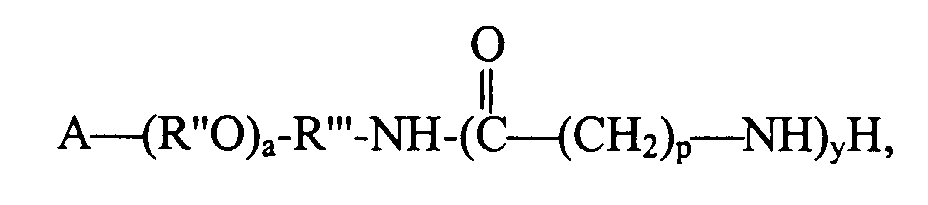
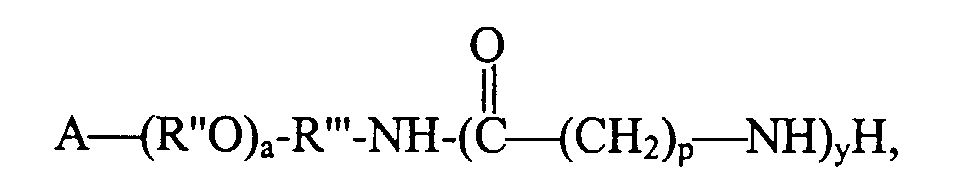
- amidoamines have the formula: wherein:
- Suitable cyclic lactams for forming amidoamine endblocks are those having from 2 to about 11 methyl groups. Preferred cyclic lactams have from 5 to 11 methyl groups. A more preferred cyclic lactam is caprolactam, having 5 methyl groups. Also preferred is laurolactam.
- the cyclic lactam may react with a polyetheramine to form polylactam endblocks on the amidoamine having from 2 to 300 lactam groups. In one preferred embodiment, caprolactam reacts with a polyetheramine to form a amidoamine having polycaprolactam (i.e. nylon 6) endblocks.
- Suitable polyether blocks for the amidoamines include polyethylene glycol, polypropylene glycol, copolymers of polyethylene glycol and polypropylene glycol, poly(1,2-butylene glycol), and poly(tetramethylene glycol).
- the glycols can be aminated using well known methods to produce the polyetheramines that are in turn to be reacted with a cyclic lactam.
- the glycols are prepared from ethylene oxide, propylene oxide, butylene oxide or combination thereof using well known methods such as by a methoxy or hydroxy initiated reaction. When more than one oxide is used, the oxides can be reacted simultaneously when a random polyether is desired, or reacted sequentially when a block polyether is desired.
- the polyetheramines used to make the amidoamines of the present invention are prepared from ethylene oxide, propylene oxide or combinations thereof. Any combination of ethylene oxide and propylene oxide will work, however, the ratio of ethylene oxide to propylene oxide may be tailored to control water absorption. Generally, the amount of ethylene oxide on a molar basis is greater than 50 percent of the polyetheramine, preferably greater than 75 percent and more preferably greater than 90 percent.
- polyols and amines including polyalkylene polyamines and alkanol amines or any amine that is not a polyetheramine as disclosed herein may be absent from the composition. Similarly, functional groups other than ether linkages and amine groups may be absent from the polyetheramine.
- amidoamines include those described in U.S. Pat. No. 5,254,668. These amidoamines are poly(ether amide) diblock, poly(amide ether amide) triblock and three arm, poly(ether amide) starblock copolymers prepared by reacting a cyclic lactam with mono-, di- or tri-functional amine terminated polyethers. Suitable monoamines include JEFFAMINE M-600, JEFFAMINE M-1000, JEFFAMINE M-2070, and JEFFAMINE M-2005.
- Suitable diamines that may be used to create triblock copolymers include JEFFAMINE ED-6000, JEFFAMINE ED-4000, JEFFAMINE ED-2001, JEFFAMINE D-2000, JEFFAMINE D-4000, JEFFAMINE ED-900, JEFFAMINE ED-600, JEFFAMINE D-400, JEFFAMINE EDR-148, JEFFAMINE EDR-192 and BASF Poly.
- Suitable triamines that may be used to create starblock polymers include JEFFAMINE ET-3000, JEFFAMINE T-403, JEFFAMINE T-3000 and JEFFAMINE T-5000. The structural formulas of some of these polyetheramines can be found in the Glossary. These polyetheramines may be incorporated into the amidoamine copolymer at levels ranging from 2% to 40%, preferably from 2% to 20%.
- Preferred amidoamines are those diblock, triblock and starblock copolymers formed by reacting caprolactam with a polyetheramine and are characterized by having poly(propylene glycol) or poly(ethylene glycol) based midblocks and caprolactam based endblocks. More preferred amidoamines include triblock copolymers having from a 148 gm/mol to a 6000 gm/mol poly(propylene glycol) based midblock and caprolactam based endblocks. An even more preferred amidoamine is a triblock copolymer prepared by reacting caprolactam with from 2% to 20% of 2000 gm/mol, primary amine terminated poly(propylene glycol) diamine (JEFFAMINE D-2000). Also more preferred is a triblock copolymer amidoamine prepared by reacting caprolactam with from 2% to 20% of 2000 gm/mol, primary amine terminated poly (ethylene glycol) diamine (JEFFAMINE ED-2003).
- the mixing of the functionalized PP and amidoamine and optionally also PP may be carried out in a customary mixing apparatus including batch mixers, continuous mixers, kneaders, and extruders.
- the preferred mixing apparatus is an extruder.
- the preferred functionalized polypropylene used in the blend is maleated polypropylene.
- the preferred amidoamines used in the blend are diblock copolymers containing from 2% to 40% of 600 gm/mol to 2100 gm/mol primary amine terminated poly(propylene glycol) monoamine, triblock copolymers containing from 2% to 40% of 148 gm/mol to 6000 gm/mol primary amine terminated poly(propylene glycol) diamine, and starblock amidoamines containing from 2% to 40% of 400 gm/mol to 5000 gm/mol primary amine terminated poly(propylene glycol) triamine.
- a more preferred amidoamine used in the blend is a triblock copolymer containing from 2% to 20% of about 2000 gm/mol primary amine terminated poly(propylene glycol) diamine. Also more preferred is a triblock copolymer amidoamine containing from 2% to 20% of about 2000 gm/mol primary amine terminated poly(ethylene glycol) diamine.
- the resin composition may, to improve the impact strength, contain impact modifiers, advantageously impact-modifying elastomers.
- Impact-modifying elastomers for the instant invention are known to a skilled worker. Examples are rubbers based on ethylene, propylene, butadiene, and acrylates, e.g. methacrylates, or mixtures thereof. Other examples include EP and EPDM rubbers, with EP rubber (ethylene propylene rubber) being preferred in applications where automotive body parts are being prepared.
- EP rubber ethylene propylene rubber
- a representative example of a currently commercially available EP rubber is sold under the name VISTALON 878 by Exxon Chemical.
- Suitable impact-modifying elastomers are described for example in Methoden der organischen Chemie (Houben-Weyl), volume XIV/1, Makromolekulare Chemie (Georg-Thieme-Verlag, Stuttgart, 1961), pages 390 to 406, and in the monograph by C.B. Bucknal, Toughened Plastics (Applied Publishers, London, 1977).
- TPO thermoplastic polyolefin
- molded automotive body parts such as bumper fascias.
- Such molded parts may also contain other components such as fillers, as described hereinbelow.
- TPO-based compositions can be prepared in the same manner as for non-elastomer-containing compositions.
- TPO's are commonly sold in compounded or reactor grades.
- amidoamine and functionalized polypropylene can be reacted to form a reaction product concentrate and, later, the reaction product concentrate can be blended with polypropylene or TPO.
- the amidoamine comprises from 10 to 50 weight percent of the concentrate.
- the reaction product of amidoamine and maleated PP is prepared neat, the reaction product can be blended or compounded with polypropylene or TPO and any other components of the desired composition to the desired levels using a mixing apparatus such as an extruder.
- PP may be commonly used to dilute the reaction.
- the reaction product, polypropylene and any other components can be thoroughly mixed as solids prior to introducing the admixture in the mixing apparatus.
- mixers are available which will mix the components during operation. In either case, during operation of the mixer, the components are heated to melt the solids, with the melted components being thereafter mixed to form the final composition.
- the resin may also contain reinforcing agents and/or additives.
- the reinforcing agents used may be reinforcing fillers, for example, carbon or carbon fibers: clay, chalk, talc, and mica to control shrinkage and control coefficient of thermal expansion; glass (beads or fibers) to increase stiffness.
- the fillers may be finished with adhesion promoters and/or sizing agents.
- phosphite or hindered phenol or both can be added as a stabilizer (as a free radical scavenger).
- compositions include a glass filler
- the composition can contain up to 40% glass filler if highly stiff compositions are desired. More typically, from 2% to 10% glass filler in the composition is employed.
- the compositions of the present invention that contain glass filler generally are substantially free of voids that typically develop in compositions containing polypropylene and glass. In this aspect of the invention, it is preferred to employ maleated polypropylene having an average molecular weight of 6,000 to 60,000, as is described hereinabove.
- Suitable resin compositions may contain from 1% to 90 wt% PP, from 0.5 to 10 wt% maleated PP and from 1 to 90 wt% amidoamine.
- the compositions include elastomers, such as in TPO-based compositions used to make automotive body parts, the compositions generally comprise from 0.5 40 wt% maleated PP, from 5 to 30 wt% amidoamine and from 50 to 93 wt% PP, such percentages based on the weights of these components of the composition.
- Preferred compositions that include elastomers comprise 15 to 30 wt% maleated PP, from 20 to 30 wt% amidoamine and from 62 to 83 wt% PP.
- the preferred customary mixing apparatus is an extruder in which the amidoamine reacts with the maleated polypropylene to form a reaction product at from 230°C to 300°C in the course of a residence time of from 25 to 300 seconds.
- degradation begins to occur above this temperature range and below this range the compositions generally do not melt.
- Polypropylene is a non-reactive component of the mixing blend.
- the preferred temperature range is from 240°C to 260°C.
- continuous compounding was carried out in a Haake 0.75 inch single screw extruder, having a 20:1 L/D barrel configuration in which the feed sequence was a combined feed with all the components being fed at the same location (hopper of the extruder).
- Blends of polypropylene, maleated polypropylene and amidoamine were produced in a single screw extruder.
- the amidoamine used was a triblock copolymer that has a 2000 gm/mol poly propylene glycol based midblock and nylon 6 end blocks.
- the terminal amine groups of this amidoamine are available to react with the maleic anhydride group of the maleated propylene to stabilize the blend morphology.
- concentration and characteristics of amidoamine was varied.
- Examples 1-3 demonstrate that as the amount of amine terminated polyether is increased in the block copolymer, both the notched and unnotched izod performance increases significantly. Tensile elongation remains relatively constant until 25% of amidoamine having 35% polyether is incorporated. At this point, the tensile elongation begins to increase. Measurements of flexural modulus, tensile modulus and yield stress drop with the addition of the block copolymer as well as with an increase in the amount of polyether contained in the copolymer.
- compositions prepared in accordance with the present invention may be used to prepare molded articles of manufacture using conventional, well known, molding techniques under standard conditions. For instance, standard injection molding techniques may be employed. Certain compositions (blends) of the present invention have surprisingly been found to have improved flowability characteristics during injection molding of TPO-based compositions such that less pressure may be used when injecting the melted compositions into a mold, as compared to compositions in which amidoamine is absent.
- the desired shape of the molded article may vary depending on end use of the article. For instance, rubber containing compositions of the present invention may be injection molded to manufacture automotive body parts such as bumper fascias, if desired.
- R H, CH 3 , m is from 3 to 32, and n is from 10 to 32.
- JEFFAMINE D-2000 JEFFAMINE D-4000 and JEFFAMINE D-400 where x is about 33 for D-2000, x is about 68 for D-4000 and x is about 5.6 for D-400.
- JEFFAMINE ED-600 JEFFAMINE ED-900.
- JEFFAMINE ED-2001 JEFFAMINE ED-2003.
- JEFFAMINE ED-4000 JEFFAMINE ED-6000
- e b is about 8.5 and a + c is about 2.5 for ED-600, b is about 15.5 and a + c is about 2.5 for ED-900, b is about 40.5 and a + c is about 2.5 for ED-2001, b is about 86.0 and a + c is about 2.5 for ED-4000, and b is about 132.0 and a + c is about 3.0 for ED-6000.
Landscapes
- Chemical & Material Sciences (AREA)
- Health & Medical Sciences (AREA)
- Chemical Kinetics & Catalysis (AREA)
- Medicinal Chemistry (AREA)
- Polymers & Plastics (AREA)
- Organic Chemistry (AREA)
- General Chemical & Material Sciences (AREA)
- Compositions Of Macromolecular Compounds (AREA)
- Addition Polymer Or Copolymer, Post-Treatments, Or Chemical Modifications (AREA)
Claims (29)
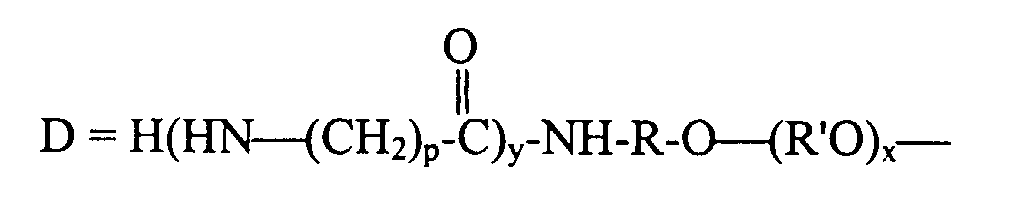
- Für die Herstellung von Formteilen brauchbare Zusammensetzung, die Polypropylen und das Reaktionsprodukt eines funktionalisierten Polypropylens und eines Amidoamins umfaßt, wobei das Amidoamin die Formel hat:in der:
 A = B oder D undB = R-O-(R'O)x-
 R ein Alkyl mit 1 Kohlenstoffatom ist, wenn A = B;R' ein Alkyl mit 2 Kohlenstoffatomen ist, wenn A = B;R ein geradkettiges oder verzweigtes Alkyl mit 0 bis 3 Kohlenstoffatomen ist, wenn A = D;R' eine Alkylgruppe mit 2 Kohlenstoffatomen oder eine verzweigte Alkylgruppe mit 3 Kohlenstoffatomen ist, wenn A = D;R" eine verzweigte Alkylgruppe mit 3 Kohlenstoffatomen ist;R"' eine verzweigte Alkylgruppe mit 3 Kohlenstoffatomen ist;a unabhängig 1 bis 200 ist;x unabhängig 1 bis 200 ist;y unabhängig 1 bis 300 ist; undp unabhängig 2 bis 11 ist.
 - Zusammensetzung nach Anspruch 1, dadurch gekennzeichnet, daß das funktionalisierte Polypropylen maleiniertes Polypropylen ist.
- Zusammensetzung nach Anspruch 1, dadurch gekennzeichnet, daß das Amidoamin gewonnen ist aus der Reaktion von Caprolactam und einem Polyetheramin, das ausgewählt ist aus der Gruppe, die aus Monoaminen, Diaminen und Triaminen mit einer relativen Molekülmasse von 148 bis 6.000 besteht.
- Zusammensetzung nach Anspruch 2, dadurch gekennzeichnet, daß das Polypropylen in einer Menge im Bereich von 1 bis 90 Gew.-% vorliegt, das maleinierte Polypropylen in einer Menge von 0,5 bis 10 Gew.-% vorliegt und das Amidoamin in einer Menge von 1 bis 90 Gew.-% vorliegt.
- Zusammensetzung nach Anspruch 1, dadurch gekennzeichnet, daß sie außerdem ein Elastomer umfaßt.
- Zusammensetzung nach Anspruch 2, dadurch gekennzeichnet, daß sie außerdem ein Elastomer umfaßt.
- Zusammensetzung nach Anspruch 6, dadurch gekennzeichnet, daß das maleinierte Polypropylen in einer Menge im Bereich von 0,5 bis 40 Gew.-% vorliegt, das Amidoamin in einer Menge von 5 bis 30 Gew.-% vorliegt und das Polypropylen und Elastomer zusammen in einer Menge von 50 bis 93 Gew.-% vorliegen.
- Zusammensetzung nach Anspruch 5, dadurch gekennzeichnet, daß die Zusammensetzung hergestellt wird durch Durchmischen von Polypropylen, einem funktionalisierten Polypropylen, Amidoamin und einem Elastomer in einem Extruder.
- Zusammensetzung nach Anspruch 6, dadurch gekennzeichnet, daß die Zusammensetzung hergestellt wird durch Durchmischen von Polypropylen, maleiniertem Polypropylen, Amidoamin und einem Elastomer in einem Extruder.
- Verfahren zur Herstellung einer Zusammensetzung, welches umfaßt: Durchmischen von Polypropylen, einem funktionalisierten Polypropylen und einem Amidoamin, so daß das funktionalisierte Polypropylen und das Amidoamin ein Reaktionsprodukt bilden, wobei das Amidoamin die Formel hat:in der:
 A = B oder D undB = R-O-(R'O)x-
 R ein Alkyl mit 1 Kohlenstoffatom ist, wenn A = B;R' ein Alkyl mit 2 Kohlenstoffatomen ist, wenn A = B;R ein geradkettiges oder verzweigtes Alkyl mit 0 bis 3 Kohlenstoffatomen ist, wenn A = D;R' eine Alkylgruppe mit 2 Kohlenstoffatomen oder eine verzweigte Alkylgruppe mit 3 Kohlenstoffatomen ist, wenn A = D;R" eine verzweigte Alkylgruppe mit 3 Kohlenstoffatomen ist;R"' eine verzweigte Alkylgruppe mit 3 Kohlenstoffatomen ist;a unabhängig 1 bis 200 ist;x unabhängig 1 bis 200 ist;y unabhängig 1 bis 300 ist; undp unabhängig 2 bis 11 ist.
 - Verfahren nach Anspruch 10, dadurch gekennzeichnet, daß das funktionalisierte Polypropylen maleiniertes Polypropylen ist.
- Verfahren nach Anspruch 10, dadurch gekennzeichnet, daß das Amidoamin gewonnen ist aus der Reaktion von Caprolactam und einem Polyetheramin, das ausgewählt ist aus der Gruppe, die aus Monoaminen, Diaminen und Triaminen mit einer relativen Molekülmasse von 148 bis 6.000 besteht.
- Verfahren nach Anspruch 11, dadurch gekennzeichnet, daß die Zusammensetzung von 1 bis 90 Gew.-% Polypropylen, von 0,5 bis 10 Gew.-% maleiniertes Polypropylen und von 1 bis 90 Gew.-% Amidoamin umfaßt.
- Verfahren nach Anspruch 10, dadurch gekennzeichnet, daß die Zusammensetzung außerdem ein Elastomer umfaßt.
- Verfahren nach Anspruch 11, dadurch gekennzeichnet, daß die Zusammensetzung außerdem ein Elastomer umfaßt.
- Verfahren nach Anspruch 15, dadurch gekennzeichnet, daß die Zusammensetzung von 0,5 bis 40 Gew.-% maleiniertes Polypropylen, von 5 bis 30 Gew.-% Amidoamin und von 50 bis 93 Gew.-% Polypropylen und Elastomer zusammengenommen umfaßt.
- Verfahren nach Anspruch 14, dadurch gekennzeichnet, daß das Verfahren in einem Extruder durchgeführt wird.
- Verfahren nach Anspruch 15, dadurch gekennzeichnet, daß das Verfahren in einem Extruder durchgeführt wird.
- Verfahren nach Anspruch 18, dadurch gekennzeichnet, daß die Extrudertemperatur zwischen 240°C und 260°C liegt.
- Verfahren zur Herstellung einer Zusammensetzung, welches das Durchmischen von Polypropylen mit dem Reaktionsprodukt eines funktionalisierten Polypropylens und eines Amidoamins umfaßt, wobei das Amidoamin die Formel hat:in der:
 A = B oder D undB = R-O-(R'O)x-
 R ein Alkyl mit 1 Kohlenstoffatom ist, wenn A = B;R' ein Alkyl mit 2 Kohlenstoffatomen ist, wenn A = B;R ein geradkettiges oder verzweigtes Alkyl mit 0 bis 3 Kohlenstoffatomen ist, wenn A = D;R' eine Alkylgruppe mit 2 Kohlenstoffatomen oder eine verzweigte Alkylgruppe mit 3 Kohlenstoffatomen ist, wenn A = D;R" eine verzweigte Alkylgruppe mit 3 Kohlenstoffatomen ist;R"' eine verzweigte Alkylgruppe mit 3 Kohlenstoffatomen ist;a unabhängig 1 bis 200 ist;x unabhängig 1 bis 200 ist;y unabhängig 1 bis 300 ist; undp unabhängig 2 bis 11 ist.
 - Verfahren nach Anspruch 20, dadurch gekennzeichnet, daß das funktionalisierte Polypropylen maleiniertes Polypropylen ist.
- Verfahren nach Anspruch 20, dadurch gekennzeichnet, daß das Amidoamin gewonnen ist aus der Reaktion von Caprolactam und einem Polyetheramin, das ausgewählt ist aus der Gruppe, die aus Monoaminen, Diaminen und Triaminen mit einer relativen Molekülmasse von 148 bis 6.000 besteht.
- Verfahren nach Anspruch 21, dadurch gekennzeichnet, daß die Zusammensetzung von 1 bis 90 Gew.-% Polypropylen, von 0,5 bis 10 Gew.-% maleiniertes Polypropylen und von 1 bis 90 Gew.-% Amidoamin umfaßt.
- Verfahren nach Anspruch 20, dadurch gekennzeichnet, daß die Zusammensetzung außerdem ein Elastomer umfaßt.
- Verfahren nach Anspruch 21, dadurch gekennzeichnet, daß die Zusammensetzung außerdem ein Elastomer umfaßt.
- Verfahren nach Anspruch 25, dadurch gekennzeichnet, daß die Zusammensetzung von 0,5 bis 40 Gew.-% maleiniertes Polypropylen, von 5 bis 30 Gew.-% Amidoamin und von 50 bis 93 Gew.-% Polypropylen und Elastomer zusammengenommen umfaßt.
- Verfahren nach Anspruch 24, dadurch gekennzeichnet, daß das Verfahren in einem Extruder durchgeführt wird.
- Verfahren nach Anspruch 25, dadurch gekennzeichnet, daß das Verfahren in einem Extruder durchgeführt wird.
- Verfahren nach Anspruch 28, dadurch gekennzeichnet, daß die Extrudertemperatur zwischen 240°C und 260°C liegt.
Applications Claiming Priority (2)
| Application Number | Priority Date | Filing Date | Title |
|---|---|---|---|
| US08/648,917 US5668217A (en) | 1996-05-16 | 1996-05-16 | Amidoamine modification of polypropylene |
| US648917 | 1996-05-16 |
Publications (2)
| Publication Number | Publication Date |
|---|---|
| EP0807662A1 EP0807662A1 (de) | 1997-11-19 |
| EP0807662B1 true EP0807662B1 (de) | 1999-12-29 |
Family
ID=24602750
Family Applications (1)
| Application Number | Title | Priority Date | Filing Date |
|---|---|---|---|
| EP97105165A Expired - Lifetime EP0807662B1 (de) | 1996-05-16 | 1997-03-26 | Amidoamin-modifiziertes Polypropylen |
Country Status (4)
| Country | Link |
|---|---|
| US (1) | US5668217A (de) |
| EP (1) | EP0807662B1 (de) |
| DE (1) | DE69701015T2 (de) |
| ES (1) | ES2140929T3 (de) |
Families Citing this family (12)
| Publication number | Priority date | Publication date | Assignee | Title |
|---|---|---|---|---|
| CA2391561A1 (en) * | 1999-11-18 | 2001-05-25 | Dow Global Technologies Inc. | Compatibilized resin blends and the preparation thereof |
| US6469099B1 (en) | 2000-11-14 | 2002-10-22 | Dow Global Technologies Inc. | Compatibilized resin blends and the preparation thereof |
| US7056975B2 (en) | 2003-05-27 | 2006-06-06 | Ube Industries, Ltd. | Thermoplastic resin composition having improved resistance to hydrolysis |
| EP2894176B1 (de) * | 2005-03-17 | 2022-06-01 | Dow Global Technologies LLC | Katalysatorzusammensetzung mit reversiblem Kettenübertragungsreagenz für die regio-irreguläre Multiblock-Copolymer-Synthese |
| US9758672B2 (en) * | 2008-02-08 | 2017-09-12 | Union Carbide Chemicals & Plastics Technology Llc | Flame-retardant polyolefin/thermoplastic polyurethane composition |
| US9663958B2 (en) | 2013-12-31 | 2017-05-30 | Toray Plastics (America), Inc. | Methods of producing foam structures from recycled metallized polyolefin material |
| US10384388B2 (en) | 2014-12-30 | 2019-08-20 | Toray Plastics (America), Inc. | Coextruded, crosslinked multilayer polyolefin foam structures and methods of making the same |
| US11007761B2 (en) | 2017-03-31 | 2021-05-18 | Toray Plastics (America), Inc. | Method of making coextruded, cross-linked polyolefin foam with TPU cap layers |
| US10501598B2 (en) | 2017-06-29 | 2019-12-10 | Toray Plastics (America), Inc. | Method of making coextruded, crosslinked multilayer polyolefin foam structures from recycled crosslinked polyolefin foam material |
| US11590730B2 (en) | 2019-03-29 | 2023-02-28 | Toray Plastics (America), Inc. | Coextruded, crosslinked polyolefin foam with KEE cap layers |
| US11590677B2 (en) | 2019-03-29 | 2023-02-28 | Toray Plastics (America), Inc. | Method of making coextruded, crosslinked polyolefin foam with KEE cap layers |
| CN116444984B (zh) * | 2023-05-15 | 2024-12-03 | 链行走新材料科技(广州)有限公司 | 一种官能化低温热封材料及其应用 |
Family Cites Families (47)
| Publication number | Priority date | Publication date | Assignee | Title |
|---|---|---|---|---|
| US3320226A (en) * | 1966-04-26 | 1967-05-16 | Montedison Spa | Dye-receptive polyolefin fibers containing saturated, unsubstituted dicarboxylic acid or acid anhydride |
| US3897454A (en) * | 1968-10-08 | 1975-07-29 | Atlantic Richfield Co | Polyalkylene glycol polyalkylene polyamine dispersants for lubricant fluids |
| DE2115046A1 (de) * | 1970-03-30 | 1971-10-21 | Grace W R & Co | Dichtungsmasse auf Basis eines 2-Chlor-J ,3-butadien-Poly meren |
| US3654370A (en) * | 1970-08-28 | 1972-04-04 | Jefferson Chem Co Inc | Process for preparing polyoxyalkylene polyamines |
| JPS593292B2 (ja) * | 1977-07-26 | 1984-01-23 | トヨタ自動車株式会社 | 減速度感知式制動油圧制御装置の制御機構 |
| US4137185A (en) * | 1977-07-28 | 1979-01-30 | Exxon Research & Engineering Co. | Stabilized imide graft of ethylene copolymeric additives for lubricants |
| US4505834A (en) * | 1980-10-27 | 1985-03-19 | Edwin Cooper, Inc. | Lubricating oil compositions containing graft copolymer as viscosity index improver-dispersant |
| CA1184554A (en) * | 1981-03-23 | 1985-03-26 | Andrew G. Papay | Lubricating oil compositions |
| US4520171A (en) * | 1982-05-05 | 1985-05-28 | Hercules Incorporated | Polymeric hindered amines |
| IT1155437B (it) * | 1982-12-22 | 1987-01-28 | Montedison Spa | Fibre tessili di polimeri olefinici funzionalizzati e procedimento per la loro preparazione |
| JPS60195120A (ja) * | 1984-03-19 | 1985-10-03 | Asahi Chem Ind Co Ltd | ポリオレフイン樹脂組成物 |
| JPH0618929B2 (ja) * | 1984-03-28 | 1994-03-16 | チッソ株式会社 | ガラス繊維強化ポリプロピレン組成物 |
| FR2572417B1 (fr) * | 1984-10-30 | 1987-05-29 | Atochem | Compositions adhesives a base de polypropylene modifie par greffage d'un monomere insature |
| US4632769A (en) * | 1984-12-07 | 1986-12-30 | Exxon Research & Engineering Co. | Ethylene copolymer viscosity index improver-dispersant additive useful in oil compositions |
| CA1249383A (en) * | 1985-06-27 | 1989-01-24 | Liqui-Box Canada Inc. | Blends of polyolefins with polymers containing reactive agents |
| US4753997A (en) * | 1985-11-27 | 1988-06-28 | The Standard Oil Company | Process for grafting maleic anhydride or styrene-maleic anhydride onto polyolefins |
| US4952631A (en) * | 1986-01-03 | 1990-08-28 | Exxon Chemical Patents Inc. | Compositions for preparing cement-adhesive reinforcing fibers |
| US4861812A (en) * | 1986-12-23 | 1989-08-29 | Exxon Chemical Patents Inc. | Compositions for preparing cement-adhesive reinforcing fibers |
| US4710540A (en) * | 1986-01-03 | 1987-12-01 | Exxon Chemical Patents Inc. | Composition for preparing cement-adhesive reinforcing fibers |
| US4680129A (en) * | 1986-01-17 | 1987-07-14 | Chevron Research Company | Modified succinimides (x) |
| US4795782A (en) * | 1986-09-25 | 1989-01-03 | Shell Oil Company | Impact resistant blends of thermoplastic polyamides, functionalized polyolefins and functionalized elastomers |
| US5006601A (en) * | 1986-09-25 | 1991-04-09 | Shell Oil Company | Impact resistant blends of thermoplastic polyamides, polyolefins and elastomers |
| US4857595A (en) * | 1987-08-12 | 1989-08-15 | Pennwalt Corporation | Polymer bound hindered amine light stabilizers |
| US5115018A (en) * | 1987-08-24 | 1992-05-19 | Allied-Signal Inc. | High-impact, styrenic polymer/thermoplastic polymer grafted blends |
| WO1989001962A1 (en) * | 1987-08-24 | 1989-03-09 | Allied-Signal Inc. | High impact, styrenic polymer/thermoplastic polymer grafted blends |
| US5210134A (en) * | 1987-08-24 | 1993-05-11 | Allied Signal | High impact, styrenic polymer/thermoplastic polymer grafted blends |
| US5010119A (en) * | 1987-12-23 | 1991-04-23 | Mcelrath Jr Kenneth O | Ternary adhesive compositions |
| US5112916A (en) * | 1988-03-04 | 1992-05-12 | Asahi Kasei Kogyo Kabushiki Kaisha | Olefin polymer and a resin composition containing the same |
| US4981896A (en) * | 1988-03-31 | 1991-01-01 | Sumitomo Chemical Company | Thermoplastic resin composition |
| JPH02237943A (ja) * | 1989-03-10 | 1990-09-20 | Sekiyu Sangyo Katsuseika Center | 2,7―ジメチルナフタレンの分離方法 |
| US4994503A (en) * | 1989-09-13 | 1991-02-19 | The Dow Chemical Company | Particulate polymer and polymer compositions therewith |
| GB8921382D0 (en) * | 1989-09-21 | 1989-11-08 | Bp Chemicals Additives | Chemical compounds |
| US5073600A (en) * | 1989-10-12 | 1991-12-17 | Shell Oil Company | Dispersant viscosity index improvers |
| DE4025361A1 (de) * | 1990-08-10 | 1992-02-13 | Hoechst Ag | Kunststoff-formkoerper mit lackierter oberflaeche und verfahren zu seiner herstellung |
| US5225483A (en) * | 1991-07-22 | 1993-07-06 | Exxon Chemical Patents Inc. | Thermoplastic composition of polypropylene and styrene copolymer resins |
| US5244971A (en) * | 1991-07-22 | 1993-09-14 | Exxon Chemical Patents Inc. | Graft polymers for use in engineering thermoplastic blends |
| EP0567058A3 (de) * | 1992-04-21 | 1995-02-22 | Idemitsu Petrochemical Co | Polypropylenharz Zusammensetzung. |
| WO1993024938A1 (en) * | 1992-05-26 | 1993-12-09 | Union Carbide Chemicals & Plastics Technology Corporation | Telephone cables |
| US5254668A (en) * | 1992-06-29 | 1993-10-19 | Texaco Chemical Company | Polyamidopolyfunctional amine from lactam and ether amine |
| US5346951A (en) * | 1992-07-17 | 1994-09-13 | Sanyo Chemical Industries, Ltd. | Releasing agents and resin compositions therewith |
| US5364909A (en) * | 1992-07-23 | 1994-11-15 | Arco Chemical Technology, L.P. | Graft polymer compositions containing mono-amine functionalized polyoxyalkylene ethers |
| DE69403398T2 (de) * | 1993-07-13 | 1997-09-25 | Huntsman Spec Chem Corp | Modifikation von Polypropylen durch Polyetheramine |
| US5373048A (en) * | 1993-07-30 | 1994-12-13 | Eastman Chemical Company | Aqueous coating composition |
| JPH0753812A (ja) * | 1993-08-11 | 1995-02-28 | Asahi Chem Ind Co Ltd | アミノ基含有ポリプロピレン樹脂組成物 |
| US5369170A (en) * | 1993-12-13 | 1994-11-29 | Shell Oil Company | Composite systems of polyketone and aminated, modified polyolefins |
| EP0662496A3 (de) * | 1994-01-06 | 1995-09-27 | Goldschmidt Ag Th | Zusatzstoffe für anstreichbare und bedruckbare Polyolefinzusammensetzungen. |
| US5384375A (en) * | 1994-02-28 | 1995-01-24 | Eastman Kodak Company | Urea derivatives of maleated polyolefins |
-
1996
- 1996-05-16 US US08/648,917 patent/US5668217A/en not_active Expired - Lifetime
-
1997
- 1997-03-26 EP EP97105165A patent/EP0807662B1/de not_active Expired - Lifetime
- 1997-03-26 DE DE69701015T patent/DE69701015T2/de not_active Expired - Fee Related
- 1997-03-26 ES ES97105165T patent/ES2140929T3/es not_active Expired - Lifetime
Also Published As
| Publication number | Publication date |
|---|---|
| DE69701015D1 (de) | 2000-02-03 |
| US5668217A (en) | 1997-09-16 |
| ES2140929T3 (es) | 2000-03-01 |
| DE69701015T2 (de) | 2000-05-25 |
| EP0807662A1 (de) | 1997-11-19 |
Similar Documents
| Publication | Publication Date | Title |
|---|---|---|
| US6465606B2 (en) | Polyether monoamine with 36-44 EO units and 1-6 PO units | |
| US6093773A (en) | Polyether amine modification of polyproplene | |
| EP0837895B1 (de) | Modifikation von polypropylen durch polyetheramine | |
| US6306964B1 (en) | Polyether amine modification of polypropylene | |
| US5668217A (en) | Amidoamine modification of polypropylene | |
| EP1235879B1 (de) | Kompatibilisierte harz-zusammensetzungen und deren herstellung | |
| US8410216B2 (en) | Impact-resistant composition based on a polyamide resin and on a blend of at least one graft copolymer with polyamide blocks and a low-density ethylene polymer | |
| JP2500825B2 (ja) | ポリアミド/ポリプロピレン配合物 | |
| JP2008542485A (ja) | ポリマーブレンドを製造するために両親媒性ブロック共重合体を使用する方法 | |
| CN1109706C (zh) | 聚丙烯的聚醚胺改性 | |
| US11945939B2 (en) | Polypropylene composition comprising glass fibers | |
| CN115803384B (zh) | 低密度聚醚嵌段酰胺和中空玻璃增强物组合物及其用途 | |
| EP0981582A1 (de) | Mischungen von polyolefinen mit durch polyetheramine funktionalisierten polyolefinen | |
| US20050171303A1 (en) | Process for marking a thermoplastic composition comprising dynamic cross-linking | |
| MXPA99000432A (en) | Modification of polypropylene polyetheramine | |
| WO1998020070A2 (en) | Compatibilized blends of syndiotactic polystyrene with further thermoplastic polymers |
Legal Events
| Date | Code | Title | Description |
|---|---|---|---|
| PUAI | Public reference made under article 153(3) epc to a published international application that has entered the european phase |
Free format text: ORIGINAL CODE: 0009012 |
|
| AK | Designated contracting states |
Kind code of ref document: A1 Designated state(s): BE DE ES FR GB IT LU NL |
|
| 17P | Request for examination filed |
Effective date: 19980422 |
|
| 17Q | First examination report despatched |
Effective date: 19990114 |
|
| GRAG | Despatch of communication of intention to grant |
Free format text: ORIGINAL CODE: EPIDOS AGRA |
|
| GRAG | Despatch of communication of intention to grant |
Free format text: ORIGINAL CODE: EPIDOS AGRA |
|
| GRAH | Despatch of communication of intention to grant a patent |
Free format text: ORIGINAL CODE: EPIDOS IGRA |
|
| GRAH | Despatch of communication of intention to grant a patent |
Free format text: ORIGINAL CODE: EPIDOS IGRA |
|
| GRAA | (expected) grant |
Free format text: ORIGINAL CODE: 0009210 |
|
| AK | Designated contracting states |
Kind code of ref document: B1 Designated state(s): BE DE ES FR GB IT LU NL |
|
| PGFP | Annual fee paid to national office [announced via postgrant information from national office to epo] |
Ref country code: NL Payment date: 20000131 Year of fee payment: 5 |
|
| REF | Corresponds to: |
Ref document number: 69701015 Country of ref document: DE Date of ref document: 20000203 |
|
| ET | Fr: translation filed | ||
| REG | Reference to a national code |
Ref country code: ES Ref legal event code: FG2A Ref document number: 2140929 Country of ref document: ES Kind code of ref document: T3 |
|
| ITF | It: translation for a ep patent filed | ||
| PLBE | No opposition filed within time limit |
Free format text: ORIGINAL CODE: 0009261 |
|
| STAA | Information on the status of an ep patent application or granted ep patent |
Free format text: STATUS: NO OPPOSITION FILED WITHIN TIME LIMIT |
|
| 26N | No opposition filed | ||
| PGFP | Annual fee paid to national office [announced via postgrant information from national office to epo] |
Ref country code: LU Payment date: 20010124 Year of fee payment: 5 |
|
| PGFP | Annual fee paid to national office [announced via postgrant information from national office to epo] |
Ref country code: GB Payment date: 20010202 Year of fee payment: 5 |
|
| PGFP | Annual fee paid to national office [announced via postgrant information from national office to epo] |
Ref country code: FR Payment date: 20010301 Year of fee payment: 5 |
|
| PGFP | Annual fee paid to national office [announced via postgrant information from national office to epo] |
Ref country code: ES Payment date: 20010314 Year of fee payment: 5 |
|
| PGFP | Annual fee paid to national office [announced via postgrant information from national office to epo] |
Ref country code: DE Payment date: 20010330 Year of fee payment: 5 |
|
| PGFP | Annual fee paid to national office [announced via postgrant information from national office to epo] |
Ref country code: BE Payment date: 20010417 Year of fee payment: 5 |
|
| REG | Reference to a national code |
Ref country code: GB Ref legal event code: IF02 |
|
| PG25 | Lapsed in a contracting state [announced via postgrant information from national office to epo] |
Ref country code: LU Free format text: LAPSE BECAUSE OF NON-PAYMENT OF DUE FEES Effective date: 20020326 Ref country code: GB Free format text: LAPSE BECAUSE OF NON-PAYMENT OF DUE FEES Effective date: 20020326 |
|
| PG25 | Lapsed in a contracting state [announced via postgrant information from national office to epo] |
Ref country code: ES Free format text: LAPSE BECAUSE OF NON-PAYMENT OF DUE FEES Effective date: 20020327 |
|
| PG25 | Lapsed in a contracting state [announced via postgrant information from national office to epo] |
Ref country code: BE Free format text: LAPSE BECAUSE OF NON-PAYMENT OF DUE FEES Effective date: 20020331 |
|
| BERE | Be: lapsed |
Owner name: *HUNTSMAN PETROCHEMICAL CORP. Effective date: 20020331 |
|
| PG25 | Lapsed in a contracting state [announced via postgrant information from national office to epo] |
Ref country code: NL Free format text: LAPSE BECAUSE OF NON-PAYMENT OF DUE FEES Effective date: 20021001 Ref country code: DE Free format text: LAPSE BECAUSE OF NON-PAYMENT OF DUE FEES Effective date: 20021001 |
|
| GBPC | Gb: european patent ceased through non-payment of renewal fee |
Effective date: 20020326 |
|
| PG25 | Lapsed in a contracting state [announced via postgrant information from national office to epo] |
Ref country code: FR Free format text: LAPSE BECAUSE OF NON-PAYMENT OF DUE FEES Effective date: 20021129 |
|
| NLV4 | Nl: lapsed or anulled due to non-payment of the annual fee |
Effective date: 20021001 |
|
| REG | Reference to a national code |
Ref country code: FR Ref legal event code: ST |
|
| REG | Reference to a national code |
Ref country code: ES Ref legal event code: FD2A Effective date: 20030410 |
|
| PG25 | Lapsed in a contracting state [announced via postgrant information from national office to epo] |
Ref country code: IT Free format text: LAPSE BECAUSE OF NON-PAYMENT OF DUE FEES;WARNING: LAPSES OF ITALIAN PATENTS WITH EFFECTIVE DATE BEFORE 2007 MAY HAVE OCCURRED AT ANY TIME BEFORE 2007. THE CORRECT EFFECTIVE DATE MAY BE DIFFERENT FROM THE ONE RECORDED. Effective date: 20050326 |