EP0808822B1 - Verfahren zur Herstellung von Malonat enthaltenden Acrylatmonomeren - Google Patents
Verfahren zur Herstellung von Malonat enthaltenden Acrylatmonomeren Download PDFInfo
- Publication number
- EP0808822B1 EP0808822B1 EP97108238A EP97108238A EP0808822B1 EP 0808822 B1 EP0808822 B1 EP 0808822B1 EP 97108238 A EP97108238 A EP 97108238A EP 97108238 A EP97108238 A EP 97108238A EP 0808822 B1 EP0808822 B1 EP 0808822B1
- Authority
- EP
- European Patent Office
- Prior art keywords
- malonate
- mixture
- mol
- acrylate
- ethyl methacrylate
- Prior art date
- Legal status (The legal status is an assumption and is not a legal conclusion. Google has not performed a legal analysis and makes no representation as to the accuracy of the status listed.)
- Expired - Lifetime
Links
Classifications
-
- C—CHEMISTRY; METALLURGY
- C07—ORGANIC CHEMISTRY
- C07C—ACYCLIC OR CARBOCYCLIC COMPOUNDS
- C07C69/00—Esters of carboxylic acids; Esters of carbonic or haloformic acids
- C07C69/52—Esters of acyclic unsaturated carboxylic acids having the esterified carboxyl group bound to an acyclic carbon atom
- C07C69/533—Monocarboxylic acid esters having only one carbon-to-carbon double bond
- C07C69/54—Acrylic acid esters; Methacrylic acid esters
Definitions
- This invention relates to malonate group-containing acrylate monomers and a method for producing them.
- Michael reactions in which base-catalyzed addition of activated methylene to polarized double bond are utilized in the crossing reaction of resinous compositions for coating use. These compositions are advantageous in that the Michael reaction gives a chemically stable crosslinking bond without forming any reaction by-product.
- Typical examples of activated methylene compounds used in the Michael reaction are acetoacetates, cyanoacetates and malonates.
- the Michael donor For use in the crosslinking reaction of resins or polymers, the Michael donor must be a compound or polymer having a plurality of activated methylene groups in the molecule.
- Acrylic monomers having an acetoacetoxy group can be synthesized relatively easily by reacting diketene with a hydroxylalkyl acrylate or methacrylate such as 2-hydroxyethyl acrylate (HEA) or 2-hydroxylethyl methacrylate (HEMA).
- Activated methylene-containing acrylic polymers used in the prior art are either polymers of acetoacetylated hydroxyalkyl (meth)acrylate monomers or acetoacetylated acrylic polyols produced by reacting diketene with an acrylic polyol polymer.
- U.S.Patent No. 4,602,061 discloses a liquid two-component coating composition comprising (a) an oligomeric or polymeric malonate compound such as polyurethanes, polyesters, polyacrylates, epoxy resins, polyamides or polyvinyl resins containing malonate groups, either in the main chain or the side chain or in both, (b) an ⁇ , ⁇ -ethylenically unsaturated carbonyl compound and (c) a basic catalyst.
- an oligomeric or polymeric malonate compound such as polyurethanes, polyesters, polyacrylates, epoxy resins, polyamides or polyvinyl resins containing malonate groups, either in the main chain or the side chain or in both
- an ⁇ , ⁇ -ethylenically unsaturated carbonyl compound and (c) a basic catalyst.
- the malonate group-containing polyacrylate resin disclosed therein is a reaction products of the abovementioned malonate polyester resin first with a diisocyanate and then with HEA or HEMA.
- EP-A-0 392 464 describes a method for the production of amphiphilic monomers by reacting a dicarboxylic acid or an activated derivative thereof with an unsaturated alcohol and further reacting the monoester thus obtained with a long chain alcohol or amine.
- JP-A-03206012 and EP-A-0 413 290 disclose a series of acrylic monomers in which one of the carboxyl groups of an aliphatic dicarboxylic acid such as malonic, succinic or glutaric acid is esterified with an alkanol while the other carboxylic acid is esterified with an alkanol.
- These monomers are used for the production of odorless, low irritating and low water absorption polymeric dental materials.
- 2-(methoxymalonyloxy)ethyl methacrylate otherwise called 2-methacryloyloxyethyl methyl malonate is named, its production method is not specifically disclosed.
- the malonate monomer can be produced in the same manner as the corresponding succinate monomer which is produced by reacting succininc anhydride with HEMA and then reacting the resulting half ester with methanol. Because malonic anhydride does not occur, this method is not applicable to the malonate monomer.
- acrylic polymers having malonate group-containing pendant groups exhibit higher weatherability than the corresponding polymers having actoacetate-terminated pendant groups when used for coating purposes. This is because the terminal structure of activated methyle is a stable ester linkage.
- the present invention provides a malonate group-containing acrylate monomer of the formula I: wherein R 1 is hydrogen or methyl, R 2 is a C 2 -C 6 -alkylene, R 3 is a C 1 -C 10 -alkyl, preferably a C 1 -C 6 -alkyl and n is an integer from 1 to 10 with the proviso that when R 1 is methyl, n is 1 and R 2 is ethylene, 1,3-propylene, 1,2-propylene, 1,4-butylene or 1,6-hexylene, or when R 1 is hydrogen, n is 1 and R 2 is ethylene, R 3 cannot mean methyl.
- Particular acrylate monomers are 2-(ethoxymalonyloxy)ethyl methacrylate, 2-(isopropoxymalonyloxy)ethyl methacrylate, 2-(butoxymalonyloxy)ethyl methacrylate, 2-(t-butoxymalonyloxy)ethyl methacrylate, 2-(ethoxymalonyloxy) ethyl acrylate, 4-(ethoxymalonyloxy) butyl acrylate or polyethylene glycol ethoxymalonate methacrylate.
- the present invention also provides a method for preparing a malonate group-containing acrylate monomer according to formula (I) comprising heating a hydroxyl group-containing acrylic monomer of the formula II: wherein R 1 , R 2 and n have the meanings given above, and an excess of dialkyl malonate in the presence of a catalyst and a polymerization inhibitor while bubbling with a gas; and removing an alcohol produced as a reaction by-product from the system during the heating step.
- hydroxylalkyl (meth) acrylate examples include 2-hydroxyethyl acrylate (HEA), 2-hydroxyethyl methacrylate (HEMA), 2-hydroxylpropyl (meth) acrylate, 3-hydroxypropyl (meth)acrylate, 2-hydroxybutyl (meth)acrylate, 4-hydroxylbutyl (meth)acrylate, and 3-hydroxybutyl (meth)acrylate.
- HEA and HEMA are preferable.
- Polyalkylene glycol mono(meth)acrylates are derived from acrylic or methacrylic acid and a ring opening polymerization product of an alkylene oxide or cyclic ether such as ethylene oxide, propylene oxide or tetrahydrofuran.
- Polyethylene glycol mono(meth)acrylate, polypropylene glycol mono(meth)acrylate and polytetramethylene glycol mono(meth) acrylate are commercially available.
- Dialkyl malonates are also commercially available as starting materials of, for example, barbiturate drugs. Examples thereof include dimethyl malonate, diethyl malonate, dipropyl malonate, dibutyl malonate, dipentyl malonate, dihexyl molanate, diheptyl malonate, dioctyl malonate, diisopropyl malonate, and di-t-butyl malonate. Asymmetric dialkyl malonates may also be used.
- a transesterification reaction is accelerated in the presence of a catalyst such as a Bronsted acid/base, Lewis acid/base, or solid acid/base.
- catalysts include acids such as p-toluenesulfonic acid, dodecylbenzenesulfonic acid, sulfuric acid, hydrochloric acid, nitric acid, boric acid, phosphoric acid, pyrophosphoric acid, polyphosphoric acid, phosphonic acid, phosphinic aicd or a stongly acidic cation exchange resin; bases such as triethylamaine, 1,4-diazabicyclo[2.2.2] octane known as DABC, 1,8-diazabicyclo[5.4.0]undecane-7, pyridine, sodium methoxide, sodium ethoxide, potassium t-butoxide or hexamethylphosphoric triamide; organic tin compounds such as dibutyltin dilaurate
- Aromatic sulfonic acids, organotin compounds, phosphorus-containing inorganic or organic acids and acidic phosphates or pyrophosphates are preferable. Particularly preferred are phosphorus based inorganic or organic acids and acidic phosphates or pyrophosphates. These catalysts are advantageous because they substantially prevent various side reactions from occurring and can be easily removed from the end product by absorption or filtration.
- a number of polymerization inhibitors are known in the art.
- usable inhibitors include hydroquinone, p-methoxyphenol, 2,6-di-t-butyl-4-methylphenol (BHT), t-butylhydroxyanisole (BHA), 4-t-butylcatechol, bis(dihydroxybenzyl)benzene, 2,2'-methylenbis(6-t-butyl-3-methylphenol), 4,4-thiobis(6-t-butyl-3-methylphenol), N-nitrosophenylhydroxylamine ammonium salt, 1,1-diphenyl-2-picrylhydrazil, 1,3,5-triphenylpheldazil, dithiobenzoylsulfide, p,p'-ditolyltrisulfide, p,p'-ditolyltetrasulfide, dibenzyltetrasulfide, tetraethylthiuramsulfide, 2,2'-e
- An excess, generally from 2 to 30 times, preferably from 3 to 15 times molar excess of a dialkyl malonate relative to a hydroxyalkyl (meth)acrylate or polyoxyalkylene glycol mono(meth)acrylate is used in the reaction.
- the reaction is carried out by heating both reactants in the presence of a catalyst and a polymerization inhibitor to a temperature from 50 to 200 °C , preferably from 70 to 150 °C while bubbling with a gas such as air or nitrogen or argon.
- a gas such as air or nitrogen or argon.
- dialkyl malonate is distilled off from the reaction mixture in an evaporator or reaction vessel at a temperature from 70 to 140°C under a vacuum from 1.33 ⁇ 10 -5 - 0.04 bar (0.01 to 30 Torr). If necessary, the product may be further purified by distillation at a temperature from 115 to 140°C under a vaccuum from 0.0133 to 1.33 mbar (0.01 to 1.0 Torr). Recovered dialkyl malonate may be used repeatedly in the reaction as such or after purifying briefly.
- dialkyl malonate excessively added to the reaction system acts as a reaction solvent, it is normally not necessary to use a separate solvent.
- an inert solvent such as hydrocarbons, ethers, ketones, esters, amides, nitriles or DMSO may be used.
- the resulting malonate group-containing acrylate monomer of the above formula I may be copolymerized with other comonomers using a known method to produce an acrylic polymer which is capable of crosslinking with an ⁇ , ⁇ -unsaturated carbonyl compound or resin. Cured films produced from this acrylic polymer exhibit higher weatherability than the corresponding films produced from an acrylic polymer having acetoacetyl groups.
- Example 2 The same flask as used in Example 1 was charged with a mixture of 130.14g (1.0 mol) of HEMA, 800.85g (5.0 mol) of diethyl malonate, 4g (23 mmol) of p-toluenesulfonic acid, and 8g (23 mmol) of 2,2'-methylenebis(4-methyl-6-t-butylphenol). The mixture was heated at 130 °C for 4 hours while vigorously bubbling with nitrogen gas. 38g (0.8 mol) of ethanol was recovered during the reaction period. Then the mixture was evaporated and purified as in Example 1 whereupon 213g (87.2 % of theory) of 2-(ethoxymalonyloxy) ethyl methacrylate was obtained.
- Example 2 The same flask as used in Example 1 was charged with a mixture of 13.01g (0.1 mol) of HEMA, 66.6g (0.5 mol) of dimethyl malonate, 0.4g (0.6 mmol) of dibutyltin dilaurate, and 0.8g (2.3 mmol) of 2,2'-methylenebis(4-methyl-6-t-phenol). The mixture was heated at 130°C for 2 hours while vigorously bubbling with nitrogen gas. 2.5g (0.08 mol) of methanol was recovered during the reaction period. Then the mixture was evaporated and purified as in Example 1 to obtain 2-(methoxymalonyloxy)ethyl methacrylate.
- Example 2 The same flask as used in Example 1 was charged with a mixture of 6.51g (0.05 mol) of HEMA, 160.17g (1.0 mol) of diethyl malonate, 0.2g (1 mmol) of dibutyltin dilaurate, and 0.4g (12 mmol) of 2,2'-methylenebis(4-methyl-6-t-butylphenol). The mixture was heated at 130 °C for 2 hours while vigorously bubbling with nitrogen gas. 2.0g (0.04 mol) of ethanol was recovered during the reaction period. Then the mixture was evaporated and purified as in Example 1 to obtain 2-(ethoxymalonyloxy)ethyl methacrylate.
- Example 2 The same flask as used in Example 1 was charged with a mixture of 130.14g (1.0 mol) of HEMA, 800.85g (5.0 mol) of diethyl malonate, 4g (21 mmol) of p-toluenesulfonic acid, and 8g (27 mmol) of 2,2'-methylenebis(4-methyl-6-t-butylphenol). The mixture was heated at 130 °C for 4 hours while vigorously bubbling with nitrogen gas. 38g (0.8 mol) of ethanol was recovered during the reaction period. Then the mixture was evaporated and purified as in Example 1 to obtain 165g (67.4 % of theory) of 2-(ethoxymalonyloxy)ethyl methacrylate.
- Example 2 The same flask as used in Example 1 was charged with a mixture of 130.14g (1.0 mol) of HEMA, 800.85g (5.0 mol) of diethyl malonate, 4g (6.3 mmol) of dibutyltin dilaurate, and 8g (36 mmol) of 2,2'-methylenebis(4-methyl-6-t-butylphenol). The mixture was heated at 70 °C for 8 hours while vigorously bubbling with nitrogen gas. 40g (0.8 mol) of ethanol was recovered during the reaction period. Then the mixture was evaporated and purified as in Example 1 to obtain 2-(ethoxymalonyloxy)ethyl methacrylate.
- Example 2 The same flask as used in Example 1 was charged with a mixture of 130.14g (1.0 mol) of HEMA, 940.96g (5.0 mol) of diisopropyl malonate, 4g (6.3 mmol) of dibutyltin dilaurate, and 8g (23 mmol) of 2,2'-methylenebis(4-methyl-6-t-butylphenol). The mixture was heated at 130°C for 8 hours while vigorously bubbling with nitrogen gas. Then the mixture was evaporated and purified as in Example 1 to obtain 2-(isopropoxymalonyloxy)ethyl methacrylate.
- Example 2 The same flask as used in Example 1 was charged with a mixture of 13.01g (0.1 mol) of HEMA, 108.11g (0.5 mol) of di-t-butyl malonate, 0.4g (0.6 mmol) of dibutyltin dilaurate, and 0.8g (2.3 mmol) of 2,2'-methylenebis(4-methyl-6-t-butylphenol). The mixture was heated at 130 °C for 16 hours while vigorously bubbling with nitrogen gas. An amount of t-butanol was recovered during the reaction period. Then mixture was evaporated and purified as in Example 1 to obtain 2-(t-butoxymalonyloxy)ethyl methacrylate.
- Example 2 The same flask as used in Example 1 was charged with a mixture of 116.1g (1.0 mol) of 2-hydroxyethyl acrylate (HEA) , 800.85g (5.0 mol) of diethyl malonate, 4g (6.3 mmol) of dibutyltin dilaurate, and 8g (23 mmol) of 2,2'-methylenebis(4-methyl-6-t-butylphenol). The mixture was heated at 130°C for 2 hours while vigorously bubbling with nitrogen gas. An amount of ethanol was recovered during the reaction period. Then mixture was evaporated and purified as in Example 1 to obtain 2-(ethoxymalonyloxy)ethyl acrylate.
- HOA 2-hydroxyethyl acrylate
- Example 2 The same flask as used in Example 1 was charged with a mixture of 1281.36g (8.0 mol) of diethyl malonate, 4.58g (34 mmol) of potassium dihydrogen phosphate, and 1.95 g (0.9 mmol) of 2,6-di-t-butyl-4-methylphenol. After raising the inner teperature to 130 °C, 115.26g (0.8 mol) of 4-hydroxybutyl acrylate was added to the flask dropwise over 1 hour. After the addition, the mixture was heated at 130 °C for 4 hours while vigorously bubbling with nitrogen gas. 32.74g (0.7 mol) of ethanol was recovered during the reaction period.
- Example 2 The same flask as used in Example 1 was charged with a mixture of 13.01g (0.1 mol) of HEMA, 108.11g (0.5 mol) of dibutyl malonate, 4g (6.3 mmol) of dibutyltin dilaurate, and 0.8g (2.3 mmol) of 2,2'-methylenebis(4-methyl-6-t-butylphenol). The mixture was heated at 130°C for 12 hours while vigorously bubbling with nitrogen gas. An amount of butanol was recovered during the reaction period. Then the mixture was evaporated and purified as in Example 1 to obtain 2-(butoxymalonyloxy)ethyl methacrylate.
- Example 2 The same flask as used in Example 1 was charged with a mixture of 104.11g (0.8 mol) of HEMA, 1281.36g (8.0 mol) of diethyl malonate, 3.33g (34 mmol) of phosphoric acid, and 1.95g (0.9 mmol) of 2,6-di-t-butyl-4-methylphenol. The mixture was heated at 130°C for 4 hours while vigorously bubbling with nitrogen gas. 34.35g (0.7 mol) of ethanol was recovered during the reaction period. Then the mixture was evaporated to remove remaining diethyl malonate. 193.44g (99.0 % of theory) of 2-(ethoxymalonyloxy)ethyl methacrylate was obtained.
- Example 2 The same flask as used in Example 1 was charged with a mixture of 104.11g (0.8 mol) of HEMA, 1281.36g (8.0 mol) of diethyl malonate, 6.05g (34 mmol) of pyrophosphoric acid, and 1.95g (0.9 mmol) of 2,6-di-t-butyl-4-methylphenol. The mixture was heated at 130°C for 3 hours while vigorously bubbling with nitrogen gas. 33.95g (0.7 mol) of ethanol was recovered during the reaction period. Then the mixture was evaporated to remove remaining diethyl malonate. 192.40g (99.0 % of theory) of 2-(ethoxymalonyloxy)ethyl methacrylate was obtained.
- Example 2 The same flask as used in Example 1 was charged with a mixture of 1281.36g (8.0 mol) of diethyl malonate, 4.58g (34 mmol) of potassium dihydrogen phosphate, and 1.95g (0.9 mmol) of 2,6-di-t-butyl-4-methylphenol. After raising the inner temperature to 130 °C, 104.11g (0.8 mol) of HEMA was added dropwise over 2 hours. Thereafter the mixture was heated at 130 °C while vigorously bubbling with nitrogen gas. 34.80g (0.7 mol) of ethanol was recovered during the reaction period. Then the mixture was filtered to remove potassium dihydrogen phosphate and evaporated to remove remaining diethyl malonate. 193.29g (99.0 % of theory) of 2-(ethoxymalonyloxy)ethyl methacrylate was obtained.
- Example 2 The same flask as used in Example 1 was charged with a mixture of 104.11g (0.8 mol) of HEMA, 281.36g (8.0 mol) of diethyl malonate, 4.08g (34 mmol) of sodium dihydrogen phosphate, and 1.95g (0.9 mmol) of 2,6-di-t-butyl-4-methylphenol. The mixture was heated at 130 °C for 4 hours while vigorously bubbling with nitrogen gas. 34.97g (0.7 mol) of ethanol was recovered during the reaction period. Then the mixture was filtered to remove sodium dihydrogen phosphate and evaporated to remove remaining diethyl malonate. 193.14g (99.0 % of theory) of 2-(ethoxymalonyloxy)ethyl methacrylate was obtained.
- Example 2 The same flask as used in Example 1 was charged with a mixture of 104.11g (0.8 mol) of HEMA, 1281.36g (8.0 mol) of diethyl malonate, 7.96g (34 mmol) of sodium dihydrogen phosphate, and 1.95g (0.9 mmol) of 2,6-di-t-butyl-4-methylphenol. The mixture was heated at 130°C for 4 hours while vigorously bubbling with nitrogen gas. 34.15g (0.7 mol) of ethanol was recovered during the reaction period. Then the mixture was filtered to remove sodium dihydrogen phosphate and evaporated to remove remaining diethyl malonate. 193.44g (99.0 % of theory) of 2-(ethoxymalonyloxy)ethyl methacrylate was obtained.
- Example 2 The same flask as used in Example 1 was charged with a mixture of 1281.36g (8.0 mol) of diethyl malonate, 4.58g (34 mmol) of potassium dihydrogen phosphate, and 1.95g (0.9 mmol) of 2,6-di-t-butyl-4-methylphenol. After raising the inner teperature to 130°C, 174.48g (0.8 mol) of triethylene glycol monomethacrylate (MA-30 sold by Nippon Nyukazai Co., Ltd.) was added dropwise over 1 hour. After the addition, the mixture was heated at 130°C for 4 hours. 32.21g (0.7 mol) of ethanol was recovered during the reaction period. Then the mixture was filtered to remove potassium dihydrogen phosphate and evaporated to remove remaining diethyl malonate. 252.48g (95.0 % of theory) of triethylene glycol ethoxymalonate methacrylate was obtained'.
- MA-30 sold by Nippon Nyukazai Co
Landscapes
- Chemical & Material Sciences (AREA)
- Organic Chemistry (AREA)
- Organic Low-Molecular-Weight Compounds And Preparation Thereof (AREA)
- Addition Polymer Or Copolymer, Post-Treatments, Or Chemical Modifications (AREA)
- Low-Molecular Organic Synthesis Reactions Using Catalysts (AREA)
Claims (9)
- Ein Acrylatmonomer der Formel:worin R1 Wasserstoff oder Methyl ist, R2 für C2-C6-Alkylen steht, R3 für C1-C10-Alkyl steht, und n eine ganze Zahl von 1 bis 10 ist, mit der Maßgabe, dass R3 nicht Methyl bedeuten kann für den Fall, dass R1 Methyl ist, n 1 ist und R2 für Ethylen, 1,3-Propylen, 1,2-Propylen, 1,4-Butylen oder 1,6-Hexylen steht, oder für den Fall, dass R1 Wasserstoff ist, n 1 ist und R2 Ethylen ist.
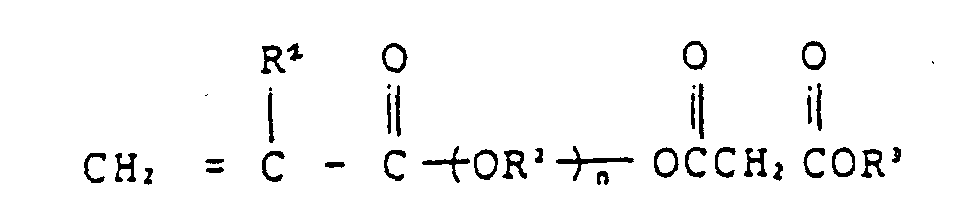
- Acrylatmonomer nach Anspruch 1, nämlich 2-(Ethoxymalonyloxy)ethylmethacrylat, 2-(Isopropoxymalonyloxy)ethylmethacrylat, 2-(Butoxymalonyloxy)ethylmethacrylat, 2-(t-Butoxymalonyloxy)ethylmethacrylat, 2-(Ethoxymalonyloxy)ethylacrylat, 4-(Ethoxymalonyloxy)butylacrylat oder Polyethylenglycolethoxymalonatmethacrylat.
- Verfahren zur Herstellung eines wie in Anspruch 1 oder 2 definierten, Malonatgruppen enthaltenden Monomers, wobei man:ein Hydroxylgruppen enthaltendes Acrylmonomer der Formel:
 worin R1, R2 und n die in Anspruch 1 angegebenen Bedeutungen besitzen,und einen Überschuss an Dialkylmalonat in Gegenwart eines Katalysators und eines Polymerisationsinhibitors unter Durchleiten eines Gases erwärmt; undeinen als Reaktionsnebenprodukt erzeugten Alkohol aus dem System während des Erwärmungsschritts entfernt.
 - Verfahren nach Anspruch 3, wobei das Dialkylmalonat ein Di-C1-C10-Alkylmalonat ist.
- Verfahren nach Anspruch 3, wobei der Katalysator eine Brönsted-Säure oder -Base, eine Lewis-Säure oder -Base, oder eine feste Säure oder Base ist.
- Verfahren nach Anspruch 3, wobei der Katalysator eine Phosphor enthaltende, anorganische oder organische Säure ist.
- Verfahren nach Anspruch 3, wobei der Katalysator ein saures Phosphat- oder Pyrophosphatsalz ist.
- Verfahren nach Anspruch 3, wobei ein 2- bis 30-facher molarer Überschuss an Dialkylmalonat relativ zu dem Hydroxylgruppen enthaltenden Acrylmonomer verwendet wird.
- Verfahren nach Anspruch 3, wobei man des weiteren überschüssiges Dialkylmalonat entfernt, indem man das Reaktionsprodukt verdampft oder destilliert.
Applications Claiming Priority (3)
| Application Number | Priority Date | Filing Date | Title |
|---|---|---|---|
| JP15154496 | 1996-05-22 | ||
| JP15154496 | 1996-05-22 | ||
| JP151544/96 | 1996-05-22 |
Publications (2)
| Publication Number | Publication Date |
|---|---|
| EP0808822A1 EP0808822A1 (de) | 1997-11-26 |
| EP0808822B1 true EP0808822B1 (de) | 2001-10-04 |
Family
ID=15520841
Family Applications (1)
| Application Number | Title | Priority Date | Filing Date |
|---|---|---|---|
| EP97108238A Expired - Lifetime EP0808822B1 (de) | 1996-05-22 | 1997-05-21 | Verfahren zur Herstellung von Malonat enthaltenden Acrylatmonomeren |
Country Status (5)
| Country | Link |
|---|---|
| US (1) | US6054606A (de) |
| EP (1) | EP0808822B1 (de) |
| KR (1) | KR100291626B1 (de) |
| CA (1) | CA2205753A1 (de) |
| DE (1) | DE69707055T2 (de) |
Families Citing this family (20)
| Publication number | Priority date | Publication date | Assignee | Title |
|---|---|---|---|---|
| JP3661600B2 (ja) * | 2000-07-27 | 2005-06-15 | 住友化学株式会社 | メタクリル酸メチル系樹脂組成物およびその成形体 |
| US20050054801A1 (en) * | 2003-09-04 | 2005-03-10 | Arizona Chemical Company | Resins and adhesive formulations therewith |
| US20050287339A1 (en) * | 2004-06-25 | 2005-12-29 | Schlegel Corporation | Weatherseal having surface roughness forming particles of a polar material in a resin matrix having a maleated polyolefin |
| KR20090116774A (ko) * | 2007-02-02 | 2009-11-11 | 다이킨 고교 가부시키가이샤 | 세탁 내구성이 우수한 불소 함유 공중합체 및 오염 이탈제 |
| DE102010029930A1 (de) | 2010-06-10 | 2011-12-15 | Evonik Röhm Gmbh | Verfahren zur Herstellung von Acetoacetoxyalkyl(meth)acrylat |
| US9828324B2 (en) | 2010-10-20 | 2017-11-28 | Sirrus, Inc. | Methylene beta-diketone monomers, methods for making methylene beta-diketone monomers, polymerizable compositions and products formed therefrom |
| US10414839B2 (en) | 2010-10-20 | 2019-09-17 | Sirrus, Inc. | Polymers including a methylene beta-ketoester and products formed therefrom |
| US9249265B1 (en) | 2014-09-08 | 2016-02-02 | Sirrus, Inc. | Emulsion polymers including one or more 1,1-disubstituted alkene compounds, emulsion methods, and polymer compositions |
| EP3517523A1 (de) | 2011-10-19 | 2019-07-31 | Sirrus, Inc. | Multifunktionsmonomere und verfahren zur deren herstellung |
| CN114395496A (zh) * | 2012-03-06 | 2022-04-26 | 利戈斯股份有限公司 | 用于产生丙二酸的重组宿主细胞 |
| EP2926368B1 (de) | 2012-11-30 | 2020-04-08 | Sirrus, Inc. | Elektronische anordnung |
| US9416091B1 (en) | 2015-02-04 | 2016-08-16 | Sirrus, Inc. | Catalytic transesterification of ester compounds with groups reactive under transesterification conditions |
| US9315597B2 (en) | 2014-09-08 | 2016-04-19 | Sirrus, Inc. | Compositions containing 1,1-disubstituted alkene compounds for preparing polymers having enhanced glass transition temperatures |
| US10501400B2 (en) | 2015-02-04 | 2019-12-10 | Sirrus, Inc. | Heterogeneous catalytic transesterification of ester compounds with groups reactive under transesterification conditions |
| US9617377B1 (en) | 2016-06-03 | 2017-04-11 | Sirrus, Inc. | Polyester macromers containing 1,1-dicarbonyl-substituted 1 alkenes |
| US9567475B1 (en) | 2016-06-03 | 2017-02-14 | Sirrus, Inc. | Coatings containing polyester macromers containing 1,1-dicarbonyl-substituted 1 alkenes |
| US10196481B2 (en) | 2016-06-03 | 2019-02-05 | Sirrus, Inc. | Polymer and other compounds functionalized with terminal 1,1-disubstituted alkene monomer(s) and methods thereof |
| US10428177B2 (en) | 2016-06-03 | 2019-10-01 | Sirrus, Inc. | Water absorbing or water soluble polymers, intermediate compounds, and methods thereof |
| KR20190132996A (ko) | 2017-03-22 | 2019-11-29 | 니폰 제온 가부시키가이샤 | 불소화 탄화수소의 제조 방법 |
| US10886562B2 (en) | 2019-02-15 | 2021-01-05 | Robert Bosch Gmbh | Acrylate polymers with dicarbonyl pendant groups as electrolytes for lithium ion batteries |
Family Cites Families (2)
| Publication number | Priority date | Publication date | Assignee | Title |
|---|---|---|---|---|
| DE3911929A1 (de) * | 1989-04-12 | 1990-10-18 | Hoechst Ag | Amphiphile monomere und polymere und film aus mindestens einer monomolekularen schicht daraus |
| AU632605B2 (en) * | 1989-08-14 | 1993-01-07 | Mitsubishi Rayon Company Limited | Material for dentistry |
-
1997
- 1997-05-21 EP EP97108238A patent/EP0808822B1/de not_active Expired - Lifetime
- 1997-05-21 CA CA002205753A patent/CA2205753A1/en not_active Abandoned
- 1997-05-21 DE DE69707055T patent/DE69707055T2/de not_active Expired - Fee Related
- 1997-05-21 US US08/861,015 patent/US6054606A/en not_active Expired - Fee Related
- 1997-05-22 KR KR1019970019917A patent/KR100291626B1/ko not_active Expired - Fee Related
Non-Patent Citations (1)
| Title |
|---|
| 1999/2000: "FLUKA CHEMICALS CATALOG", SIGMA-ALDRICH, PP. 898-900, 917, 917 * |
Also Published As
| Publication number | Publication date |
|---|---|
| EP0808822A1 (de) | 1997-11-26 |
| DE69707055T2 (de) | 2002-06-27 |
| CA2205753A1 (en) | 1997-11-22 |
| KR970074742A (ko) | 1997-12-10 |
| DE69707055D1 (de) | 2001-11-08 |
| US6054606A (en) | 2000-04-25 |
| KR100291626B1 (ko) | 2002-01-19 |
Similar Documents
| Publication | Publication Date | Title |
|---|---|---|
| EP0808822B1 (de) | Verfahren zur Herstellung von Malonat enthaltenden Acrylatmonomeren | |
| CN107207930B (zh) | 具有在酯交换条件下具有反应性的基团的酯化合物的催化酯交换 | |
| CN103547556B (zh) | 基本不含杂质的亚甲基丙二酸酯的合成 | |
| EP0646567B1 (de) | Organozinnkatalysierte Transesterifikation | |
| US4683287A (en) | Compositions containing a reactive monomer derived from a lactone | |
| WO2013059473A2 (en) | Multifunctional monomers, methods for making multifunctional monomers, polymerizable compositions and products formed therefrom | |
| JP2000503695A (ja) | ポリグリコール(メタ)アクリレートの製造方法 | |
| JP5080473B2 (ja) | 四価または多価アルコールの(メタ)アクリレートを製造する方法 | |
| US4059721A (en) | Stabilized acrylic acid esters of polyhydric alcohols and a process for their preparation | |
| CN1105992A (zh) | 制备烷基咪唑啉酮(甲基)丙烯酸酯的方法 | |
| Kurcok et al. | Reactions of β-lactones with potassium alkoxides and their complexes with 18-crown-6 in aprotic solvents | |
| JPH10109034A (ja) | マロネート基を結合したアクリル単量体およびその製造法 | |
| US20100274042A1 (en) | Process for preparing (meth)acrylic esters of alcohols comprising polyalkoxy groups | |
| CN111954659A (zh) | 包含在酯交换条件下具有反应性的基团的酯化合物的非均相催化酯交换 | |
| US6479696B1 (en) | Method for synthesis and process inhibition of isobornyl (meth)acrylate | |
| EP0108372B1 (de) | Zusammensetzungen, die ein von einem Lacton abgeleitetes reaktives Monomer enthalten | |
| JPH01221348A (ja) | 新規なジ(メタ)アクリラート、その製法及び用途 | |
| JPS59106436A (ja) | エステルのエステル交換方法 | |
| JP2003286226A (ja) | エステル交換反応方法、及びエステル交換反応触媒 | |
| JP2000016967A (ja) | シクロヘキサンジメタノールモノ(メタ)アクリラート・ラクトン変性物、その組成物及びそれらの製造方法 | |
| JPH09132555A (ja) | アリルアミン誘導体の製造方法 | |
| JPH0627083B2 (ja) | プロパンジオールおよびその製造法 | |
| JP2500540B2 (ja) | カプロラクトン変性ポリオ―ルポリ(メタ)アクリレ―トの製造方法 | |
| JP2000302749A (ja) | (メタ)アクリル酸ポリオキシエチレン化ビスフェノ−ルsエステル、その製造法及び感光性樹脂組成物 | |
| JPH08333302A (ja) | 水溶性マレイン酸ジエステルの製造方法 |
Legal Events
| Date | Code | Title | Description |
|---|---|---|---|
| PUAI | Public reference made under article 153(3) epc to a published international application that has entered the european phase |
Free format text: ORIGINAL CODE: 0009012 |
|
| AK | Designated contracting states |
Kind code of ref document: A1 Designated state(s): DE FR GB |
|
| 17P | Request for examination filed |
Effective date: 19971222 |
|
| 17Q | First examination report despatched |
Effective date: 19990427 |
|
| GRAG | Despatch of communication of intention to grant |
Free format text: ORIGINAL CODE: EPIDOS AGRA |
|
| GRAG | Despatch of communication of intention to grant |
Free format text: ORIGINAL CODE: EPIDOS AGRA |
|
| GRAG | Despatch of communication of intention to grant |
Free format text: ORIGINAL CODE: EPIDOS AGRA |
|
| GRAH | Despatch of communication of intention to grant a patent |
Free format text: ORIGINAL CODE: EPIDOS IGRA |
|
| GRAH | Despatch of communication of intention to grant a patent |
Free format text: ORIGINAL CODE: EPIDOS IGRA |
|
| GRAA | (expected) grant |
Free format text: ORIGINAL CODE: 0009210 |
|
| AK | Designated contracting states |
Kind code of ref document: B1 Designated state(s): DE FR GB |
|
| REF | Corresponds to: |
Ref document number: 69707055 Country of ref document: DE Date of ref document: 20011108 |
|
| REG | Reference to a national code |
Ref country code: GB Ref legal event code: IF02 |
|
| ET | Fr: translation filed | ||
| PGFP | Annual fee paid to national office [announced via postgrant information from national office to epo] |
Ref country code: GB Payment date: 20020516 Year of fee payment: 6 |
|
| PG25 | Lapsed in a contracting state [announced via postgrant information from national office to epo] |
Ref country code: FR Free format text: LAPSE BECAUSE OF NON-PAYMENT OF DUE FEES Effective date: 20020531 |
|
| PGFP | Annual fee paid to national office [announced via postgrant information from national office to epo] |
Ref country code: DE Payment date: 20020726 Year of fee payment: 6 |
|
| PLBE | No opposition filed within time limit |
Free format text: ORIGINAL CODE: 0009261 |
|
| STAA | Information on the status of an ep patent application or granted ep patent |
Free format text: STATUS: NO OPPOSITION FILED WITHIN TIME LIMIT |
|
| 26N | No opposition filed | ||
| PG25 | Lapsed in a contracting state [announced via postgrant information from national office to epo] |
Ref country code: GB Free format text: LAPSE BECAUSE OF NON-PAYMENT OF DUE FEES Effective date: 20030521 |
|
| PG25 | Lapsed in a contracting state [announced via postgrant information from national office to epo] |
Ref country code: DE Free format text: LAPSE BECAUSE OF NON-PAYMENT OF DUE FEES Effective date: 20031202 |
|
| GBPC | Gb: european patent ceased through non-payment of renewal fee |
Effective date: 20030521 |
|
| REG | Reference to a national code |
Ref country code: FR Ref legal event code: ST |