EP0808838B1 - Antagonistes de bradykinine soufrés, procédé pour leur préparation et leur utilisation - Google Patents
Antagonistes de bradykinine soufrés, procédé pour leur préparation et leur utilisation Download PDFInfo
- Publication number
- EP0808838B1 EP0808838B1 EP97107623A EP97107623A EP0808838B1 EP 0808838 B1 EP0808838 B1 EP 0808838B1 EP 97107623 A EP97107623 A EP 97107623A EP 97107623 A EP97107623 A EP 97107623A EP 0808838 B1 EP0808838 B1 EP 0808838B1
- Authority
- EP
- European Patent Office
- Prior art keywords
- formula
- alkyl
- compound
- formulae
- xvi
- Prior art date
- Legal status (The legal status is an assumption and is not a legal conclusion. Google has not performed a legal analysis and makes no representation as to the accuracy of the status listed.)
- Expired - Lifetime
Links
- 0 C*CCCCN1C(*C(*)*(CC2CCC2)*2)C2SC1* Chemical compound C*CCCCN1C(*C(*)*(CC2CCC2)*2)C2SC1* 0.000 description 10
Classifications
-
- C—CHEMISTRY; METALLURGY
- C07—ORGANIC CHEMISTRY
- C07D—HETEROCYCLIC COMPOUNDS
- C07D417/00—Heterocyclic compounds containing two or more hetero rings, at least one ring having nitrogen and sulfur atoms as the only ring hetero atoms, not provided for by group C07D415/00
- C07D417/02—Heterocyclic compounds containing two or more hetero rings, at least one ring having nitrogen and sulfur atoms as the only ring hetero atoms, not provided for by group C07D415/00 containing two hetero rings
- C07D417/12—Heterocyclic compounds containing two or more hetero rings, at least one ring having nitrogen and sulfur atoms as the only ring hetero atoms, not provided for by group C07D415/00 containing two hetero rings linked by a chain containing hetero atoms as chain links
-
- A—HUMAN NECESSITIES
- A61—MEDICAL OR VETERINARY SCIENCE; HYGIENE
- A61P—SPECIFIC THERAPEUTIC ACTIVITY OF CHEMICAL COMPOUNDS OR MEDICINAL PREPARATIONS
- A61P43/00—Drugs for specific purposes, not provided for in groups A61P1/00-A61P41/00
-
- C—CHEMISTRY; METALLURGY
- C07—ORGANIC CHEMISTRY
- C07D—HETEROCYCLIC COMPOUNDS
- C07D277/00—Heterocyclic compounds containing 1,3-thiazole or hydrogenated 1,3-thiazole rings
- C07D277/60—Heterocyclic compounds containing 1,3-thiazole or hydrogenated 1,3-thiazole rings condensed with carbocyclic rings or ring systems
- C07D277/62—Benzothiazoles
- C07D277/64—Benzothiazoles with only hydrocarbon or substituted hydrocarbon radicals attached in position 2
Definitions
- EP-A 622 361, US 5,212,182, US 5,126,165 and US 5,438,064 are the O- and N-substituted quinolines and their use as Bradykinin receptor antagonists known.
- WO 95/06469 describes Aminoaralkyloxybenzothiazole, which show a proliferative effect and as Chemotherapeutics can be used.
- the present invention relates to sulfur-containing heterocyclic Compounds with improved pharmacokinetics.
- Alkyl and alkenyl can be straight-chain or branched. The same applies for residues derived therefrom, e.g. Alkoxy.
- Alkenyl stands for mono- or polyunsaturated compounds such as 1,4-butadienyl, 8,11-heptadienyl, 8,11,14-heptatrienyl, butenyl. The same applies to cycloalkenyl.
- Cycloalkyl stands for mono- or bicyclic compounds such as cyclopropyl, cyclopentyl, cyclohexyl, bicyclononyl. The same applies to cycloalkenyl.
- (C 6 -C 12 ) aryl is, for example, phenyl, naphthyl or biphenylyl, preferably phenyl. The same also applies to residues derived therefrom, such as aralkyl.
- Halogen represents fluorine, chlorine, bromine or iodine, preferably chlorine or fluorine.
- (C 1 -C 9 ) heteroaryl is understood to mean residues which are derived from phenyl or naphthyl, in which one or more CH groups have been replaced by N and / or in which at least two adjacent CH groups (to form a five-membered group) aromatic ring) are replaced by S, NH or O.
- one or both atoms of the condensation site of bicyclic radicals can also be N atoms.
- Heteroaryl is especially furanyl, thienyl, pyrrolyl, imidazolyl, Pyrazolyl, triazolyl, tetrazolyl, oxazolyl, isoxazolyl, thiazolyl, isothiazolyl, Pyridyl, pyrazinyl, pyrimidinyl, pyridazinyl, indolyl, indazolyl, quinolyl, Isoquinolyl, phthalazinyl, quinoxalinyl, quinazolinyl, cinnolinyl, benzopyranonyl, Coumarinyl, pyranonyl, furandionyl.
- the exchange of chlorine for alkoxy or the corresponding S-alkylene is carried out by reaction with the corresponding alcoholates or thiolates, preferably their alkali or alkaline earth metal salts are preferred in inert solvents DMF, NMP or the corresponding alcohol at temperatures between 0 ° C and 60 ° C, preferably between 0 ° C and room temperature.
- Chlorine is replaced by cyano by the action of cyanides, preferably the copper cyanides, in inert high-boiling solvents, such as e.g. DMF or NMP at their boiling points.
- cyanides preferably the copper cyanides
- inert high-boiling solvents such as e.g. DMF or NMP at their boiling points.
- the conversion to the bromoethyl compound takes place by reacting the corresponding methyl derivative with N-bromosuccinimide, dibromo hydantoin or Bromine in inert solvents, preferably bromobenzene or cyclohexane Temperatures from 60 ° C to the boiling point.
- protective groups can also be used, which protect both protons of the amino group, e.g. two benzyl groups.
- the compounds according to the invention individually or in combination, have one bradykinin antagonistic effect, tested in different models (see Handbook of Exp. Pharmacol. Vol. 25, Springer Verlag, 1970, Pp. 53 - 55), e.g. B. on the isolated rat uterus, on the guinea pig ileum, the Jugular vein of the rabbit or on the isolated pulmonary artery of the Guinea pig.
- the effects of the compounds of formula (I) on bradykinin-induced Bronchoconstriction and carregeenin-induced paw edema can analog Br. J. Pharmacol. 102, 774-777 (1991).
- the determinations of the antagonistic effect on the bradykinin-induced The guinea pig ileum contracts according to the following protocol:
- Guinea pigs weighing approx. 300 g are killed and bled by blows to the neck.
- the ileum is dissected out in a length of approx. 20 cm, rinsed with Tyrode solution (record syringe) and thus freed from the intestinal contents. Now it is divided into 1.5 cm sections. These are fixed in 10 ml organ baths filled with Tyrode solution and connected with strain gauges (isometric contraction measurement).
- the preload is 1g.
- the Tyrode solution is heated to 37 ° C in a water bath and bubbled with compressed air. After an interval of 30 min. the experiment is started.
- bradykinin is added per organ bath in a final concentration of 4 ⁇ 10 -8 mol / l and the concentration is recorded. Then 3 min. rinsed with Tyrode solution and after a break of 20 min. Bradykinin added again. The maximum contraction has been reached (control). Rinse again, rest. Now the bradykinin antagonist is added (exposure time 10 min.). Bradykinin is then added again and the contraction now taking place is compared with the control. The test is recorded on an ink pen.
- Tyrode solution (mM): NaCl 137 glucose 5.05 KCl 2.68 NaHCO 3 11.9 NaH 2 PO 4 0.47 MgCl 2 x 2H 2 O 0.49 CaCl 2 x 2H 2 O 0.68 Amplifier: TF6 V3 from Fleck, Mainz Ink pen: Goerz Metrawatt SE 460, BBC Bradykinin: Bachem
- guinea pigs (Dunkin Hartley) weighing 400-450 g killed by a blow to the neck.
- the chest is opened and the pulmonary artery carefully dissected.
- the surrounding tissue is carefully removed and the Pulmonary artery spirally cut open at an angle of 45 °.
- the vascular strip of 2.5 cm in length and 3-4 mm in width is in a 10 ml containing organ bath, which is filled with Ringer's solution.
- the solution is bubbled with 95% O 2 and 5% CO 2 and heated to 37 ° C.
- the pH is 7.4, the preload on the vascular strip is 1.0 g.
- the isotonic contraction changes are made with a lever actuator and an HF modem (odometer) from Hugo Sachs and on one Compensation recorder (BEC, Goerz Metrawatt SE 460) registered.
- the experiment is started after 1 hour of equilibration. After the vascular strips have reached their maximum sensitivity to 2x10 -7 mol / l bradykinin - bradykinin leads to contraction of the vascular strips - the test compounds in the doses 5x10 -8 - 1x10 -5 mol / l are allowed to act for 10 minutes each time and after repeated administration of bradykinin compared the decrease in the effect of bradykinin over the control.
- the antagonistic effect of Examples 3, 6, 11, 12, 23, 37 was limited to the B 2 receptor of the guinea pig as IC 50 ⁇ 1 • 10 -7 M and on the pulmonary artery of guinea pigs with IC 50 values less than 1 x 10 -6 M determined.
- the active compounds For oral use or for application to the mucous membranes the active compounds with the usual additives such as Carriers, stabilizers or inert diluents mixed and brought into suitable dosage forms by conventional methods, such as Tablets, dragees, capsules, aqueous, alcoholic or oily Suspensions or aqueous, alcoholic or oily solutions.
- an inert carrier can e.g. B. gum arabic, magnesia, magnesium carbonate, Potassium phosphate, milk sugar, glucose, magnesium stearyl fumarate or starch, especially corn starch can be used.
- the preparation can both dry and wet granules.
- oily carriers or Solvents are, for example, vegetable or animal oils, like sunflower oil and cod liver oil.
- a preparation for topical use can be an aqueous or oily solution, Lotion, emulsion or jelly, ointment or fatty ointment or, if possible, in Spray form are present, the optionally by adding a polymer Liability can be improved.
- the connections with the are usual additives such as stabilizers or inert diluents mixed and by usual methods in suitable dosage forms brought, such as aqueous, alcoholic or oily suspensions or aqueous, alcoholic or oily solutions.
- Aqueous intranasal preparations can Chelating agent, ethylenediamine-N, N, N ', N'-tetraacetic acid, citric acid, Tartaric acid or its salts are added.
- the application of the Nasal solutions can be done using a dosing atomizer or as a nasal drop Viscosity increasing portion or nasal gel or nasal creams.
- the described compounds of formula (I) and their pharmacological suitable salts are potent bradykinin antagonists. Hence you therapeutic benefits in the treatment and / or prevention of all pathological conditions caused by bradykinin and bradykinin-analog peptides mediated, triggered or supported. This includes a.
- bradykinin is linked to the release of Mediators such as prostaglandins, leukotrienes, tachykinins, histamine, Thromboxanes, the compounds of formula (I) thus also have that Potential for treatment and / or prevention of the diseases caused by these mediators are evoked.
- the invention therefore also relates to the use of compounds of the formula (I) as a medicinal and pharmaceutical preparation containing these compounds contain.
- compositions contain an effective amount of the active ingredient Formula (I) - individually or in combination - together with an inorganic or organic pharmaceutically usable carrier.
- the application can be enteral, parenteral - such as. B. subcutaneously, i. m. or I. v. - sublingually, epicutaneously, nasally, rectally, intravaginally, intrabuccally or by inhalation respectively.
- the dosage of the active ingredient depends on the warm-blooded species, the Body weight, age and the type of application.
- the pharmaceutical preparations of the present invention are in themselves known solution, mixing, granulating or coating processes.
- nebulizers or compressed gas packs can be found below Use of inert carrier gases can be used.
- the active compounds or their physiologically tolerable salts for example for isotonicity or pH adjustment as well as solubilizers, emulsifiers, or other excipients, brought in solution, suspension or emulsion.
- tissue-compatible polymers in particular biodegradable polymers such as. B. can be built on the basis of polylactic acid-polyglycolic acid copolymers or human albumin.
- a suitable dose range for topical and inhalation use forms are solutions with 0.01 - 5 mg / l, with systemic application forms 0.01 - 10 mg / kg are suitable. In general, amounts of 0.1 mg to 1000 mg, based on an adult of 75 kg body weight, can be administered daily.
- Examples 4-39 can be obtained analogously to Examples 1 and 3 (Tab. 1).
Landscapes
- Chemical & Material Sciences (AREA)
- Organic Chemistry (AREA)
- Health & Medical Sciences (AREA)
- Life Sciences & Earth Sciences (AREA)
- General Health & Medical Sciences (AREA)
- General Chemical & Material Sciences (AREA)
- Medicinal Chemistry (AREA)
- Nuclear Medicine, Radiotherapy & Molecular Imaging (AREA)
- Bioinformatics & Cheminformatics (AREA)
- Pharmacology & Pharmacy (AREA)
- Engineering & Computer Science (AREA)
- Animal Behavior & Ethology (AREA)
- Chemical Kinetics & Catalysis (AREA)
- Public Health (AREA)
- Veterinary Medicine (AREA)
- Pharmaceuticals Containing Other Organic And Inorganic Compounds (AREA)
- Plural Heterocyclic Compounds (AREA)
- Medicines That Contain Protein Lipid Enzymes And Other Medicines (AREA)
- Thiazole And Isothizaole Compounds (AREA)
- Nitrogen Condensed Heterocyclic Rings (AREA)
Claims (6)
- Composés de formule Iles symboles possèdent les significations suivantes :
 a) un des restes X1, X2 ou X3 représente un groupe C-O-R2 et chaque fois les autres X1, X2, X3 et X4 sont identiques ou différents et représentent un groupe1. N2. CR1 ;ainsi que leurs sels physiologiquement compatibles.b) R1 et R3 sont identiques ou différents et représentent un groupe3., 7., 8., 11. peuvent éventuellement être substitués par un ou plusieurs groupes tels que C(O)-(O)0-alkyle en C1-C5, OR6, SR7, NO2, CN, NHR8, halogène ;1. hydrogène2. halogène3. alkyle en C1-C64. O-R65. S-R66. NHR67. aryle en C6-C128. (aryl en C6-C12)-alkyle en C1-C39. C(O)-OR610. C(O)-H11. alcényle en C2-C512. NO213 SO3R714. CN15. C(O)NHR8c) R2 représente un reste de formule (II)
 d) R4 et R5 sont identiques ou différents et représentent un groupe1. hydrogène2. halogène3. O-R64. S-R65. CN6. alkyle en C1-C5e) R6' R7 et R8 sont identiques ou différents et représentent un groupe1. hydrogène2. alkyle en C1-C53. alcényle en C3-C54. (aryl en C6-C12)-alkyle en C1-C35. cycloalkyle en C3-C106. (cycloalkyle en C3-C10)-(alkyle en C1-C3)7. C(O)-(O)0-alkyle en C1-C58. C(O)-(NH)0-alkyle en C1-C5f) A représente un acide aminocarboxylique pris dans le groupe comprenant la méthionine, l'alanine, la phénylalanine, la 2-chlorophénylalanine, la 3-chlorophénylalanine, la 4-chlorophénylalanine, la 2-fluorophényl-alanine, la 3-fluorophénylalanine, la 4-fluorophénylalanine, la tyrosine, l'O-méthyltyrosine, la β-(2-thiényl)alanine, la glycine, la cyclohexylalanine, la leucine, l'isoleucine, la valine, la norleucine, la phénylglycine, la sérine, la cystéine, l'acide aminopropionique ou l'acide aminobutyrique ;g) R9 représente un groupe1. hydrogène2. C(O)-(O)0-alkyle en C1-C53. C(O)-(O)0-alkyl en C1-C3)-(aryle en C6-C10)h) R10 représente un groupe1. -C(O)-D-E2. -C(S)-D-E3. -SO2-D-E4. hydrogènei) D représente un groupe1. (alcène en C2-C5)diyle2. (alcane en C1-C8)diyle3. -(CH2)n-Yo-(CH2)m-4. cyclo(alcane en C3-C10)diyle5. cyclo(alkyl en C3-C10)-(alcane en C1-C3)diyle6. cyclo(alcène en C3-C10)diyle7. cyclo(alcényl en C3-C10)-(alcane en C1-C3)-diyle1.-7. pouvant être éventuellement substitués par un ou plusieurs groupes comme par exemple OR6, NO2, CN, CO2R7, NR8R9, SO2R6, SO2NR8R9, SO3R7 ou C(O)-NR8R9 ;j) E représente un groupe2. et 3. pouvant éventuellement être substitués par un ou plusieurs groupes comme par exemple NR8R9, CN, CO2R6, SO3R7, NO2, SO2NR8R9, SO2R6, O-alkyle en C1-C5, S-alkyle en C1-C5, alkyle en C1-C5, alcényle en C2-C5, O-alkyle en C1-C5 et alkyle en C1-C5 pouvant éventuellement être partiellement ou entièrement substitués par des substituants halogènes ;1. H2. aryle en C6-C103. hétéroaryle en C1-C9k) Y représente un groupe1. O2. S3. NR8 ;l) n et m sont identiques ou différents et vont de 0 à 6 ;m) o vaut 0, 1 ;
 - Composés de formule (I) selon la revendication 1, dans laquelle les symboles possèdent les significations suivantes :a) R1 et R3 sont identiques ou différents et représentent un groupe2. et 6. pouvant éventuellement être substitués par un ou plusieurs groupes, comme par exemple halogène, CO2R6, NHR8 ;1. hydrogène2. alkyle en C1-C63. O-R64. S-R65. NHR66. alcényle en C2-C57. C(O)-OR68. C(O)-H9. NO210. CN11. C(O)NHR8b) R6, R7 et R8 sont identiques ou différents et représentent un groupe1. hydrogène2. alkyle en C1-C53. (aryl en C6-C10)-(alkyle en C1-C3).
- Composés de formule (I) selon la revendication 1 ou 2, oùa) R1 et R3 sont identiques ou différents et représentent un groupe1. hydrogène2. alkyle en C1-C43. NH-(alkyle en C1-C5)4. O-(alkyle en C1-C5)5. S-(alkyle en C1-C5)6. C(O)-H7. CO2R68. alcényle en C2-C3 2.-5. et 8. pouvant éventuellement être substitués par un ou plusieurs restes, comme par exemple halogène, CO2R6, NHR8 ;b) A représente la leucine, l'isoleucine, la valine, l'alanine, la méthionine, la glycine, la sérine, l'acide amino-propionique, l'acide aminobutyrique.
- Procédé pour la préparation de composés de formule (I) selon les revendications 1 à 3, caractérisé en ce quea1)ou1. un composé de formule (III)où R3, X2, X3 et X4 sont définis comme ci-dessus,

est d'abord acylé par des dérivés d'acides carboxyliques activés en utilisant une base auxiliaire, à une température comprise entre 0 et 20°C,2. le composé de formule (IV) ainsi obtenuest chauffé à ébullition avec le réactif de Lawesson dans de l'acétate de butyle ou d'autres solvants inertes de haut point d'ébullition et on obtient ainsi un composé de formule (V)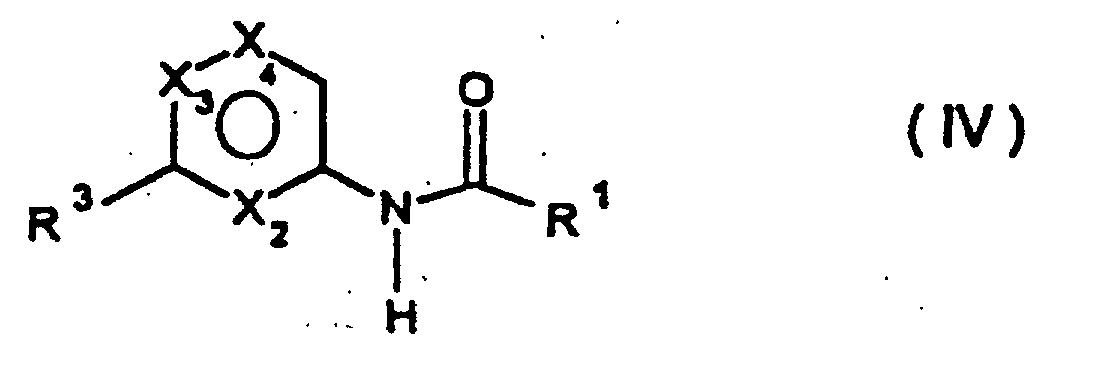 où R1, R3, X2, X3 et X4 dans les formules IV et V sont définis comme ci-dessus dans la formule I, X2 ou X3 = C-O-R2, R2 représente R2' = H ou alkyle en C1-C5,
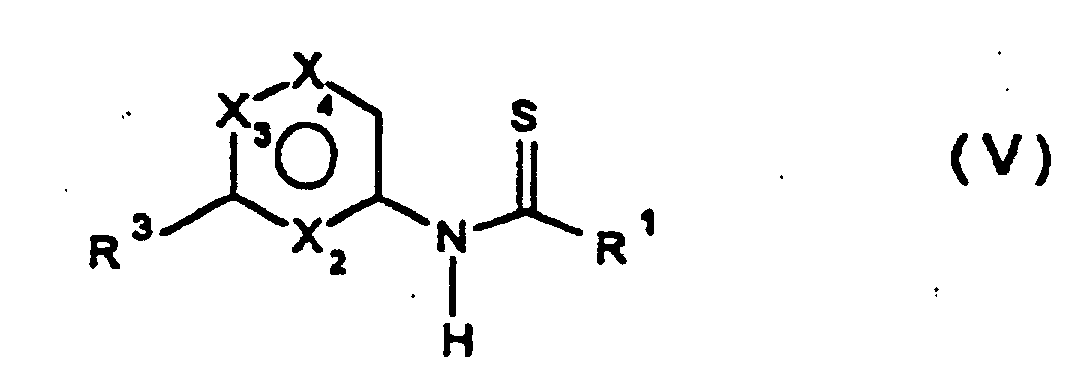 3. on fait réagir le composé (V) ainsi obtenu par cyclisation radicalaire avec des réactifs engendrant des radicaux, de préférence K3Fe(CN)6 ou Br2 dans des solvants inertes à une température comprise entre 80 et 110°C et ce faisant, on obtient un composé de formule (VI)où les restes R1, R3, X2, X3 et X4 sont définis comme ci-dessus dans la formule I, X2 ou X3 = C-O-R2, R2 représente R2' = H ou alkyle en C1-C5,
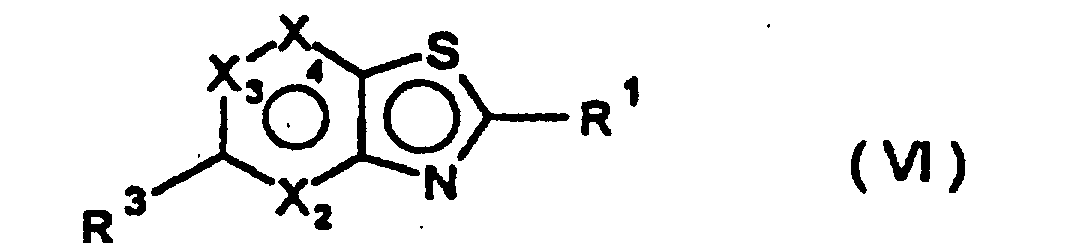 4. un composé de formule (VI), où X2 ou X3 = C-O-R2 et sont définis comme au point 3., par des réactifs à coupure éther dans des solvants inertes ou sans solvant à une température comprise entre 0°C et le point d'ébullition, pour obtenir des composés de formule (VI), où X2 ou X3 représentent C-O-R2 et R2 = R2' = hydrogène ;a2)1. un composé de formule (VII)où R3, X3, X4 sont définis comme ci-dessus à la formule I et M représente un atome de potassium, de sodium ou de césium, est transformé par traitement successif par CO2 et ensuite par NH3 sous pression et température élevées, de préférence 100 atm et 200°C, en un composé de formule (VIII)
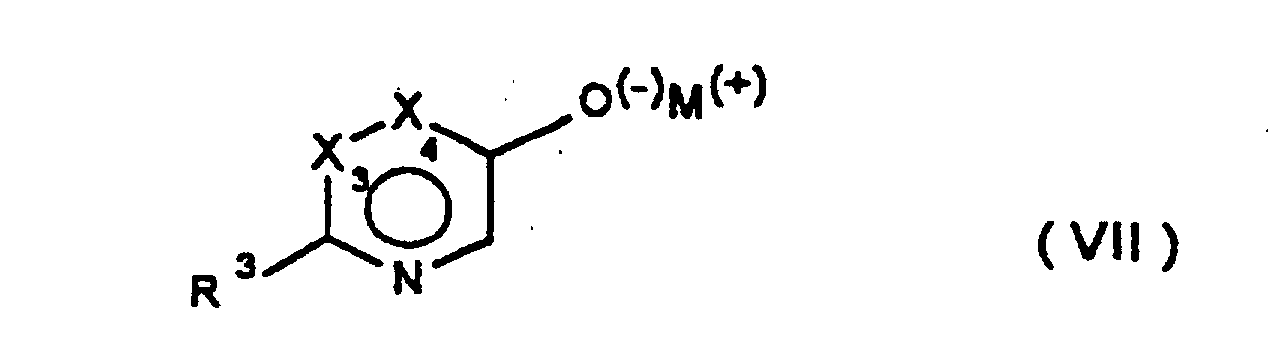 où R3, X3, X4 sont définis comme ci-dessus à la formule I,
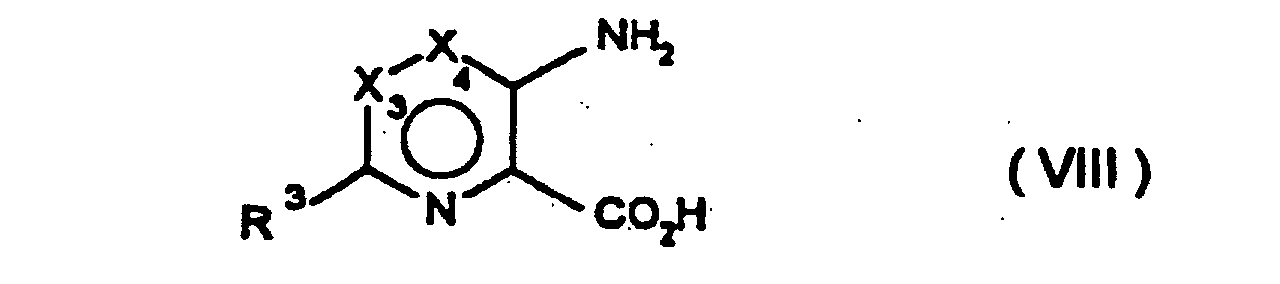 2. un composé de formule (VIII) est transformé par diazotation et traitement ultérieur par HS-CHR1-CO2H en un composé de formule (IX),où R1, R3, X3, X4 sont définis comme ci-dessus à la formule I,
 3. un composé de formule (IX) est transformé par cyclisation en décarboxylant et en séparant l'eau en même temps dans des solvants inertes ou sans solvants en un composé de formule (X),où R1, R3, X3, X4 sont définis comme ci-dessus à la formule I,
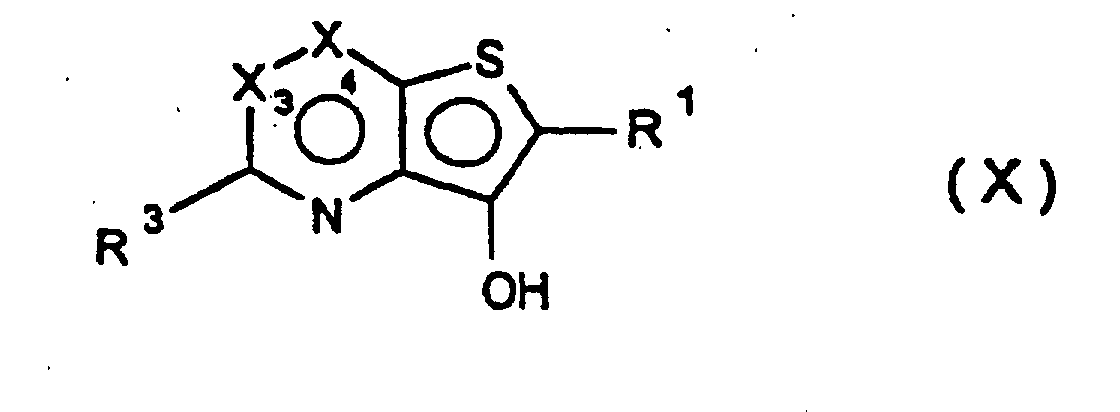 b) un composé de formule (VI) ou (X)
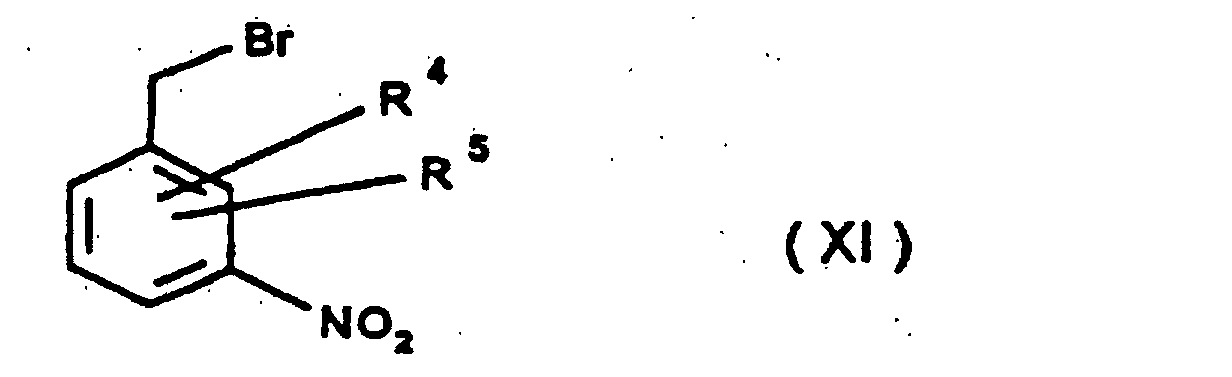
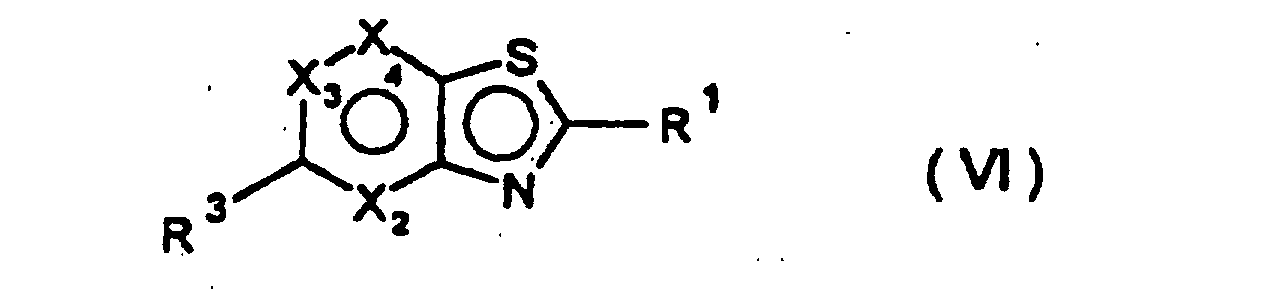 où X2, X3, X4, R1 et R3 sont définis comme ci-dessus à la formule I, dans le cas de composés de formule (VI) X2 ou X3 = C-O-H, est déprotoné par CsCO3 ou K2CO3 dans un solvant inerte et à température ambiante sur un composé de formule (XI)
 où R4 et R5 sont définis comme ci-dessus à la formule (II) ;
 c) on fait réagir les composés ainsi obtenus de formules (XII) ou (XII')où R1, R3, R4, R5, X2, X3, X4 sont définis comme ci-dessus aux formules (I) et (II), on les réduit à l'aide d'halogénures de métaux de transition pour obtenir un composé de formules (XIII) ou (XIII')
 où R1, R3, R4, R5, X2, X3 et X4 sont définis comme ci-dessus aux formules (I) et (II) ;
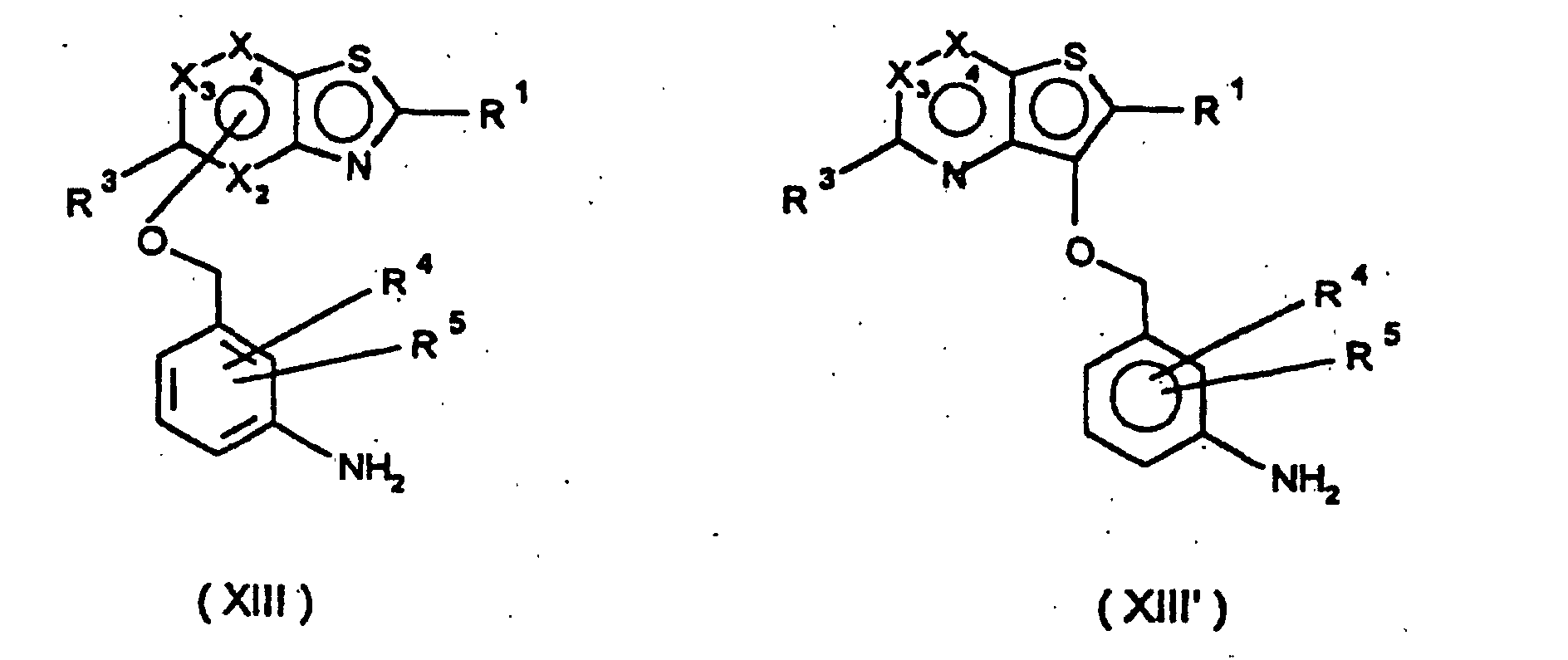 d) on fait réagir un composé de formules (XIII) ou (XIII') sur des dérivés d'acides amino-carboxyliques A (A-Prot) activés, protégés de façon appropriée, dans des solvants inertes, éventuellement par ajout de DMAP, et on obtient ainsi un composé de formules (XIV) ou XIV')où A, R1, R3, R4, R5, X2, X3 et X4 sont définis comme ci-dessus aux formules (I) et (II) et Prot représente un groupe protecteur d'amino, les deux protons du groupe protecteur d'amino étant protégés ;
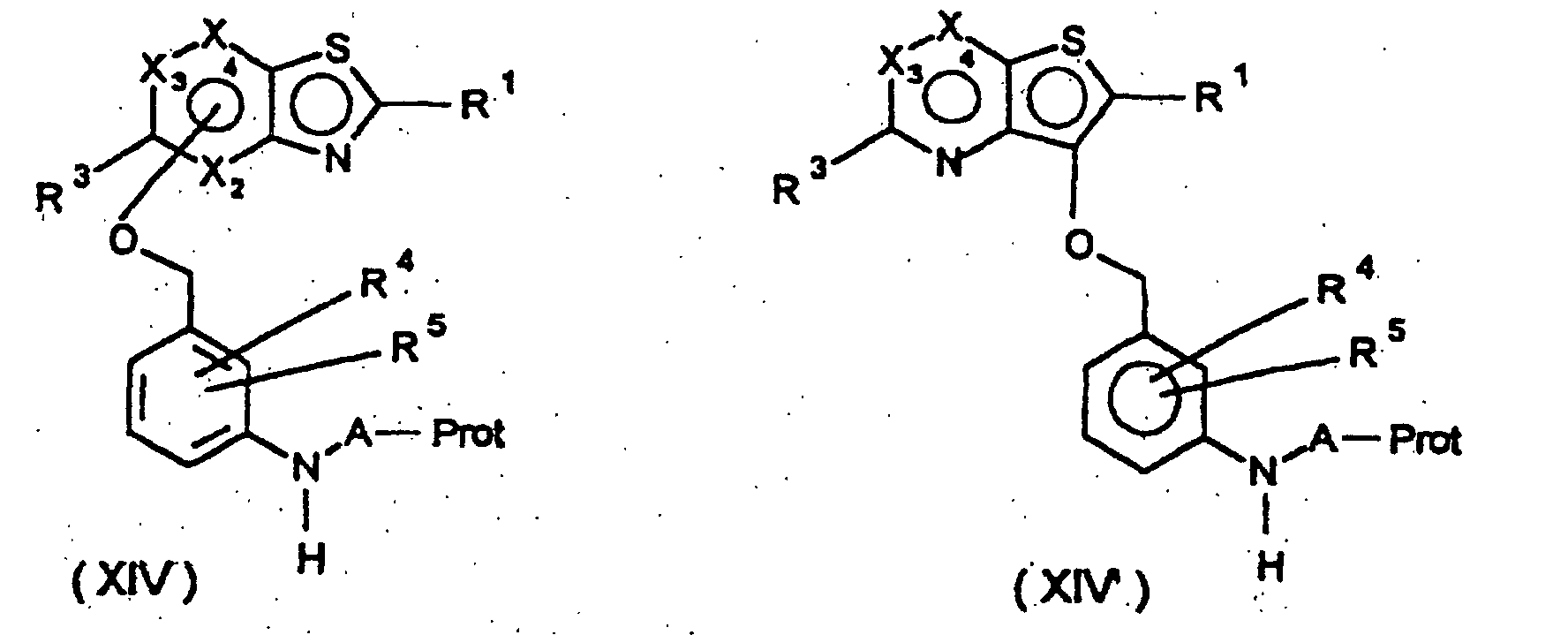 e) on fait réagir un composé de formules (XIV) ou (XIV') après avoir fait agir des hydrures alcalins, des carbonates alcalins ou des alcoolates dans des solvants inertes, suivie d'un traitement par R6X, R6 étant défini comme ci-dessus à la formule (I), à l'exception de R6 = H, et X représente un groupe partant, en obtenant un composé de formules (XV) ou (XV')où A, R1, R3, R4, R5, X2, X3 et X4 sont définis comme ci-dessus aux formules (I) et (II) et Prot est défini comme ci-dessus à la formule (XIV) ;
 f) pour éliminer le groupe protecteur (Prot.) du composé de formules (XV) ou (XV'), dans le cas du groupe phtaloyle de préférence par l'hydrazine dans des alcools comme solvants, à une température, comprise entre la température ambiante et le point d'ébullition, en obtenant un composé de formules (XVI) ou (XVI')où R1, R3, R4, R5, R6, X2, X3 et X4 sont définis comme ci-dessus aux formules (I) et (II) et Prot est défini comme ci-dessus à la formule (XIV) et A' représente un reste de l'aminoacide A ;
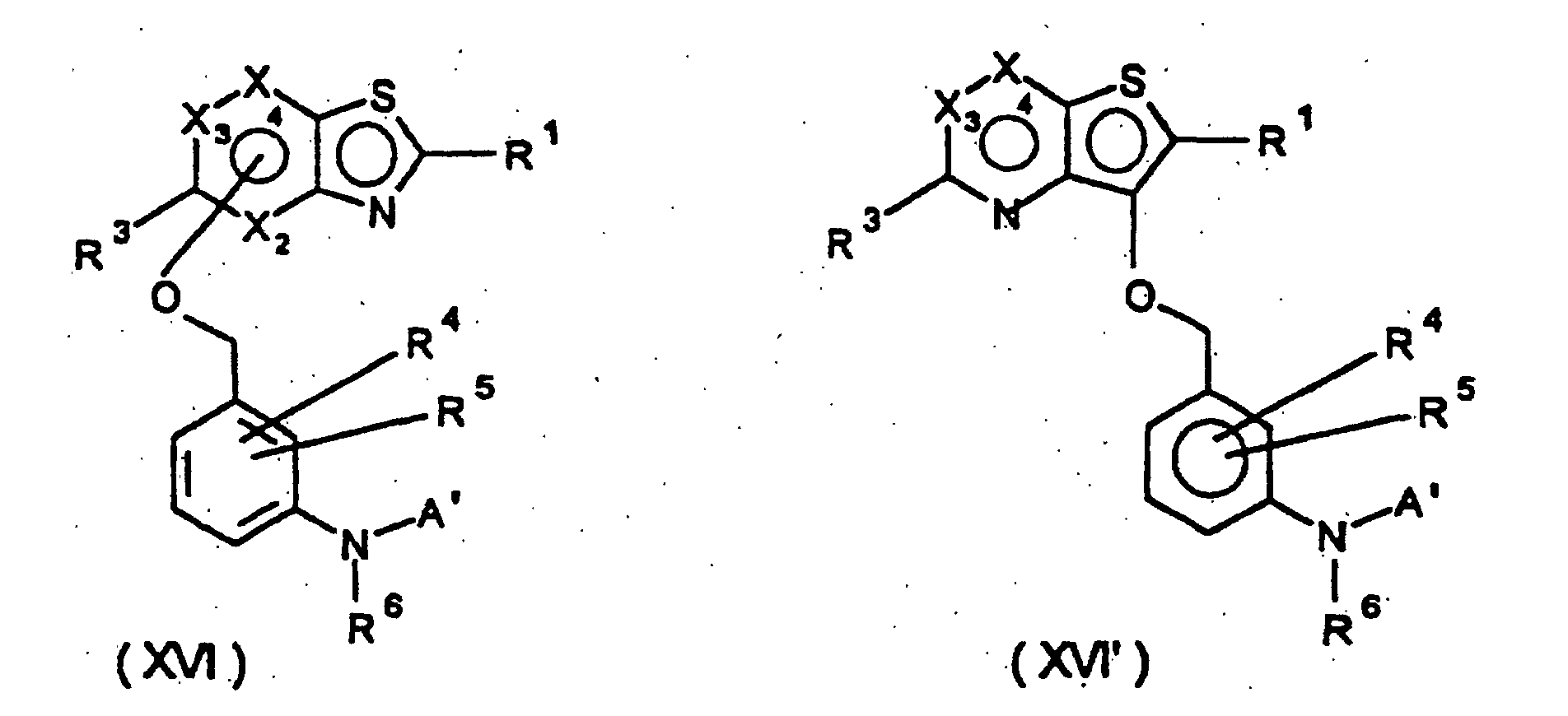 g1) on fait réagir un composé de formules (XVI) ou (XVI') sur des dérivés d'acide activés de formules (XVII), (XVIII) ou (XIX)g2) on fait réagir un composé de formules (XVI) ou (XVI') sur une amine ou un alcool de formule (XX)g3) on fait réagir un composé de formules (XVI) ou (XVI') sur un isocyanate ou isothiocyanate correspondant dans des solvants inertes, eth) éventuellement on convertit le composé obtenu de formule (I) selon des méthodes connues en leurs sels physiologiquement tolérés.
 - Utilisation des composés de formules (I) selon les revendications 1 à 3 comme médicament.
- Médicament renfermant au moins un composé de formule (I) selon les revendications 1 à 4.
Applications Claiming Priority (2)
| Application Number | Priority Date | Filing Date | Title |
|---|---|---|---|
| DE19620508A DE19620508A1 (de) | 1996-05-22 | 1996-05-22 | Schwefelenthaltende heterocyclische Bradykinin-Antagonisten, Verfahren zu ihrer Herstellung und ihre Verwendung |
| DE19620508 | 1996-05-22 |
Publications (2)
| Publication Number | Publication Date |
|---|---|
| EP0808838A1 EP0808838A1 (fr) | 1997-11-26 |
| EP0808838B1 true EP0808838B1 (fr) | 2003-10-22 |
Family
ID=7794948
Family Applications (1)
| Application Number | Title | Priority Date | Filing Date |
|---|---|---|---|
| EP97107623A Expired - Lifetime EP0808838B1 (fr) | 1996-05-22 | 1997-05-09 | Antagonistes de bradykinine soufrés, procédé pour leur préparation et leur utilisation |
Country Status (21)
| Country | Link |
|---|---|
| US (1) | US5834500A (fr) |
| EP (1) | EP0808838B1 (fr) |
| JP (1) | JP4125803B2 (fr) |
| KR (1) | KR970074781A (fr) |
| CN (1) | CN1169992A (fr) |
| AT (1) | ATE252567T1 (fr) |
| AU (1) | AU2351097A (fr) |
| BR (1) | BR9703370A (fr) |
| CA (1) | CA2205785A1 (fr) |
| CZ (1) | CZ154797A3 (fr) |
| DE (2) | DE19620508A1 (fr) |
| ES (1) | ES2205086T3 (fr) |
| HR (1) | HRP970279A2 (fr) |
| HU (1) | HUP9700914A3 (fr) |
| ID (1) | ID16952A (fr) |
| IL (1) | IL120863A0 (fr) |
| NO (1) | NO972312L (fr) |
| PL (1) | PL320105A1 (fr) |
| SK (1) | SK63197A3 (fr) |
| TR (1) | TR199700391A2 (fr) |
| ZA (1) | ZA974416B (fr) |
Families Citing this family (6)
| Publication number | Priority date | Publication date | Assignee | Title |
|---|---|---|---|---|
| US7202363B2 (en) * | 2003-07-24 | 2007-04-10 | Abbott Laboratories | Thienopyridine and furopyridine kinase inhibitors |
| EP1863804A1 (fr) * | 2005-04-01 | 2007-12-12 | Methylgene, Inc. | Inhibiteurs de l'histone desacetylase |
| KR101639642B1 (ko) | 2008-12-05 | 2016-07-14 | 애브비 바하마스 리미티드 | 암 치료에 사용하기 위한 키나제 억제제로서의 티에노[3,2-c]피리딘 유도체 |
| WO2013012909A1 (fr) | 2011-07-20 | 2013-01-24 | Abbott Laboratories | Inhibiteur de kinase ayant une solubilité améliorée dans l'eau |
| MD3762368T2 (ro) | 2018-03-08 | 2022-07-31 | Incyte Corp | Compuși diol aminopirazină ca inhibitori ai PI3K-Y |
| US11046658B2 (en) | 2018-07-02 | 2021-06-29 | Incyte Corporation | Aminopyrazine derivatives as PI3K-γ inhibitors |
Family Cites Families (12)
| Publication number | Priority date | Publication date | Assignee | Title |
|---|---|---|---|---|
| IE64995B1 (en) * | 1987-07-14 | 1995-09-20 | Warner Lambert Co | Novel benzothiophenes having antiallergic activity and both novel and other selected benzothiophenes having activity for treating acute respiratory distress syndrome |
| US4863923A (en) * | 1988-07-01 | 1989-09-05 | Eli Lilly And Company | Method of inhibiting superoxide release |
| DE69028662T2 (de) * | 1989-07-06 | 1997-03-06 | Toyoda Chuo Kenkyusho Kk | Verfahren und Vorrichtung zum Laseraufdampfen |
| US5212182A (en) * | 1990-10-03 | 1993-05-18 | American Home Products Corpooration | Substituted quinolinyl- and naphthalenylbenzamides or benzylamines and related compounds useful as analgesics |
| GB9122098D0 (en) * | 1991-10-17 | 1991-11-27 | Ici Plc | Fungicides |
| US5438064A (en) * | 1991-12-23 | 1995-08-01 | American Home Products Corporation | Derivatives of 4-anilinoquinoline-3-carboxamide as analgesic agents |
| AU686115B2 (en) * | 1992-11-02 | 1998-02-05 | Fujisawa Pharmaceutical Co., Ltd. | Imidazo (I,2-a) pyridine derivatives as bradykinin antagonists, pharmaceuticals and processes for their preparation |
| AU680870B2 (en) * | 1993-04-28 | 1997-08-14 | Astellas Pharma Inc. | New heterocyclic compounds |
| GB9317949D0 (en) * | 1993-08-28 | 1993-10-13 | Stevens Malcolm F G | Benzothiazole compounds |
| AU3953695A (en) * | 1994-10-20 | 1996-05-15 | Eli Lilly And Company | Bicyclic bradykinin receptor antagonists |
| US5545641A (en) * | 1994-10-20 | 1996-08-13 | Eli Lilly And Company | Methods of inhibiting physiological conditions associated with an excess of bradykinin |
| WO1996013485A1 (fr) * | 1994-10-27 | 1996-05-09 | Fujisawa Pharmaceutical Co., Ltd. | Pyridopyrimidones, quinoleines et heterocycles azotes fusionnes comme antagonistes de la bradykinine |
-
1996
- 1996-05-22 DE DE19620508A patent/DE19620508A1/de not_active Withdrawn
-
1997
- 1997-05-09 ES ES97107623T patent/ES2205086T3/es not_active Expired - Lifetime
- 1997-05-09 EP EP97107623A patent/EP0808838B1/fr not_active Expired - Lifetime
- 1997-05-09 AT AT97107623T patent/ATE252567T1/de not_active IP Right Cessation
- 1997-05-09 DE DE59710874T patent/DE59710874D1/de not_active Expired - Lifetime
- 1997-05-16 US US08/858,077 patent/US5834500A/en not_active Expired - Lifetime
- 1997-05-20 HU HU9700914A patent/HUP9700914A3/hu unknown
- 1997-05-20 CZ CZ971547A patent/CZ154797A3/cs unknown
- 1997-05-20 CN CN97113120A patent/CN1169992A/zh active Pending
- 1997-05-20 IL IL12086397A patent/IL120863A0/xx unknown
- 1997-05-20 AU AU23510/97A patent/AU2351097A/en not_active Abandoned
- 1997-05-20 TR TR97/00391A patent/TR199700391A2/xx unknown
- 1997-05-20 SK SK631-97A patent/SK63197A3/sk unknown
- 1997-05-21 CA CA002205785A patent/CA2205785A1/fr not_active Abandoned
- 1997-05-21 JP JP13116197A patent/JP4125803B2/ja not_active Expired - Fee Related
- 1997-05-21 HR HR19620508.5A patent/HRP970279A2/xx not_active Application Discontinuation
- 1997-05-21 ZA ZA9704416A patent/ZA974416B/xx unknown
- 1997-05-21 ID IDP971699A patent/ID16952A/id unknown
- 1997-05-21 PL PL97320105A patent/PL320105A1/xx unknown
- 1997-05-21 NO NO972312A patent/NO972312L/no unknown
- 1997-05-22 BR BR9703370A patent/BR9703370A/pt not_active Application Discontinuation
- 1997-05-22 KR KR1019970019898A patent/KR970074781A/ko not_active Withdrawn
Also Published As
| Publication number | Publication date |
|---|---|
| CA2205785A1 (fr) | 1997-11-22 |
| ZA974416B (en) | 1997-11-24 |
| CN1169992A (zh) | 1998-01-14 |
| SK63197A3 (en) | 1997-12-10 |
| PL320105A1 (en) | 1997-11-24 |
| DE59710874D1 (de) | 2003-11-27 |
| HUP9700914A2 (hu) | 1998-11-30 |
| ID16952A (id) | 1997-11-27 |
| HUP9700914A3 (en) | 1999-05-28 |
| ATE252567T1 (de) | 2003-11-15 |
| IL120863A0 (en) | 1997-09-30 |
| KR970074781A (ko) | 1997-12-10 |
| JPH1067762A (ja) | 1998-03-10 |
| JP4125803B2 (ja) | 2008-07-30 |
| AU2351097A (en) | 1997-11-27 |
| MX9703724A (es) | 1998-06-28 |
| DE19620508A1 (de) | 1997-11-27 |
| HU9700914D0 (en) | 1997-07-28 |
| BR9703370A (pt) | 1998-09-22 |
| CZ154797A3 (en) | 1997-12-17 |
| US5834500A (en) | 1998-11-10 |
| EP0808838A1 (fr) | 1997-11-26 |
| NO972312D0 (no) | 1997-05-21 |
| NO972312L (no) | 1997-11-24 |
| TR199700391A2 (xx) | 1997-12-21 |
| HRP970279A2 (en) | 1998-04-30 |
| ES2205086T3 (es) | 2004-05-01 |
Similar Documents
| Publication | Publication Date | Title |
|---|---|---|
| DE69232060T2 (de) | Stickstoff enthaltende bicyclische Verbindungen, Verfahren zu ihrer Herstellung, ihre Verwendung als Arzneimittel und diese enthaltende Zusammensetzungen | |
| DE2705446C2 (fr) | ||
| EP0796848B1 (fr) | Bradykinine antagonistes hétérocycliques substituées par fluoralkyl ou par fluoralkoxy | |
| DE60118564T2 (de) | Propan-1,3-dion-derivate | |
| EP0503162B1 (fr) | Dérivés d'azole, procédé de leur fabrication et leur application | |
| EP0795547B1 (fr) | (Aminoalkyl- et acylaminoalkyl-oxy)benzyloxyquinolines, procédé de préparation et leur utilisation comme antagonistes des récepteurs de la bradykinine | |
| EP1991529B1 (fr) | Arylsulfonamides substitués utilisés en tant qu'agents antiviraux | |
| DE69015322T2 (de) | Substituierte Zyklobutendion-Verbindungen. | |
| EP0013894A1 (fr) | Aryléthers, procédé pour leur préparation et médicaments les contenant | |
| EP0867432A2 (fr) | Composés N-hétérocycliques condensés substitués avec benzyloxy, procédé de préparation et leur utilisation comme antagonistes des récepteurs de la bradykinine | |
| DE68917556T2 (de) | Quinolyloxazol-2-one, nützlich als Proteinkinase-C-Inhibitoren. | |
| DE60222286T2 (de) | Verfahren zur erhöhung des testosteronspiegels | |
| DE69521037T2 (de) | Chinazolinylamino derivate mit alfa-antagonist wirkung | |
| EP0808838A1 (fr) | Antagonistes de bradykinine soufrés, procédé pour leur préparation et leur utilisation | |
| DE602004008300T2 (de) | Thiazolinderivate als selektive androgenrezeptormodulatoren (sarms) | |
| EP1994020B1 (fr) | Quinolones substituées III | |
| DE3820775A1 (de) | Neue 4,5,7,8-tetrahydro-6h-thiazolo(5,4,-d)azepine, ihre herstellung und ihre verwendung als arzneimittel | |
| DE60206376T2 (de) | Faktor xa inhibitor | |
| EP0005154A1 (fr) | Dérivés du 1-oxo-1H-pyrimido (6,1-b) benzothiazole, procédés pour leur préparation et compositions pharmaceutiques les contenant | |
| DE60122575T2 (de) | 7-HETEROCYCLYL-SUBSTITUIERTE CHINOLIN- UND THIENOi2,3-BöPYRIDIN-DERIVATE ALS ANTAGONISTEN DES GONADOTROPIN-FREISETZENDEN HORMONS | |
| DE3132915A1 (de) | 1,5-diphenylpyrazolin-3-on-verbindungen sowie verfahren und zwischenprodukte zu ihrer herstellung und diese verbindungen enthaltende arzneimittel | |
| DE3917233A1 (de) | 8-substituierte 4-(heterocyclylmethylamino)-chinoline, ihre verwendung und daraus hergestellte arzneimittel | |
| DE69836427T2 (de) | Heterozyclische ketonen als npy y5 antagonisten | |
| DE69431820T2 (de) | Bicyclische Imidazolverbindungen, Verfahren zu ihrer Herstellung, Zwischenverbindungen, ihre Anwendung als Medikamente und sie enthaltende pharmazeutische Zusammensetzungen | |
| AT392788B (de) | Neue benzimidazolverbindungen, verfahren zu ihrer herstellung und sie enthaltende pharmazeutische zubereitungen |
Legal Events
| Date | Code | Title | Description |
|---|---|---|---|
| PUAI | Public reference made under article 153(3) epc to a published international application that has entered the european phase |
Free format text: ORIGINAL CODE: 0009012 |
|
| AK | Designated contracting states |
Kind code of ref document: A1 Designated state(s): AT BE CH DE DK ES FI FR GB GR IE IT LI LU NL PT SE |
|
| AX | Request for extension of the european patent |
Free format text: SI PAYMENT 970609 |
|
| 17P | Request for examination filed |
Effective date: 19980526 |
|
| 17Q | First examination report despatched |
Effective date: 20010611 |
|
| GRAH | Despatch of communication of intention to grant a patent |
Free format text: ORIGINAL CODE: EPIDOS IGRA |
|
| GRAS | Grant fee paid |
Free format text: ORIGINAL CODE: EPIDOSNIGR3 |
|
| GRAA | (expected) grant |
Free format text: ORIGINAL CODE: 0009210 |
|
| AK | Designated contracting states |
Kind code of ref document: B1 Designated state(s): AT BE CH DE DK ES FI FR GB GR IE IT LI LU NL PT SE |
|
| AX | Request for extension of the european patent |
Extension state: SI |
|
| PG25 | Lapsed in a contracting state [announced via postgrant information from national office to epo] |
Ref country code: IE Free format text: LAPSE BECAUSE OF FAILURE TO SUBMIT A TRANSLATION OF THE DESCRIPTION OR TO PAY THE FEE WITHIN THE PRESCRIBED TIME-LIMIT Effective date: 20031022 Ref country code: FI Free format text: LAPSE BECAUSE OF FAILURE TO SUBMIT A TRANSLATION OF THE DESCRIPTION OR TO PAY THE FEE WITHIN THE PRESCRIBED TIME-LIMIT Effective date: 20031022 |
|
| REG | Reference to a national code |
Ref country code: GB Ref legal event code: FG4D Free format text: NOT ENGLISH |
|
| REG | Reference to a national code |
Ref country code: CH Ref legal event code: EP |
|
| REG | Reference to a national code |
Ref country code: IE Ref legal event code: FG4D Free format text: GERMAN |
|
| REF | Corresponds to: |
Ref document number: 59710874 Country of ref document: DE Date of ref document: 20031127 Kind code of ref document: P |
|
| PG25 | Lapsed in a contracting state [announced via postgrant information from national office to epo] |
Ref country code: SE Free format text: LAPSE BECAUSE OF FAILURE TO SUBMIT A TRANSLATION OF THE DESCRIPTION OR TO PAY THE FEE WITHIN THE PRESCRIBED TIME-LIMIT Effective date: 20040122 Ref country code: GR Free format text: LAPSE BECAUSE OF FAILURE TO SUBMIT A TRANSLATION OF THE DESCRIPTION OR TO PAY THE FEE WITHIN THE PRESCRIBED TIME-LIMIT Effective date: 20040122 Ref country code: DK Free format text: LAPSE BECAUSE OF FAILURE TO SUBMIT A TRANSLATION OF THE DESCRIPTION OR TO PAY THE FEE WITHIN THE PRESCRIBED TIME-LIMIT Effective date: 20040122 |
|
| GBT | Gb: translation of ep patent filed (gb section 77(6)(a)/1977) |
Effective date: 20040128 |
|
| REG | Reference to a national code |
Ref country code: ES Ref legal event code: FG2A Ref document number: 2205086 Country of ref document: ES Kind code of ref document: T3 |
|
| PG25 | Lapsed in a contracting state [announced via postgrant information from national office to epo] |
Ref country code: LU Free format text: LAPSE BECAUSE OF NON-PAYMENT OF DUE FEES Effective date: 20040509 Ref country code: AT Free format text: LAPSE BECAUSE OF NON-PAYMENT OF DUE FEES Effective date: 20040509 |
|
| PG25 | Lapsed in a contracting state [announced via postgrant information from national office to epo] |
Ref country code: LI Free format text: LAPSE BECAUSE OF NON-PAYMENT OF DUE FEES Effective date: 20040531 Ref country code: CH Free format text: LAPSE BECAUSE OF NON-PAYMENT OF DUE FEES Effective date: 20040531 Ref country code: BE Free format text: LAPSE BECAUSE OF NON-PAYMENT OF DUE FEES Effective date: 20040531 |
|
| ET | Fr: translation filed | ||
| PLBE | No opposition filed within time limit |
Free format text: ORIGINAL CODE: 0009261 |
|
| STAA | Information on the status of an ep patent application or granted ep patent |
Free format text: STATUS: NO OPPOSITION FILED WITHIN TIME LIMIT |
|
| 26N | No opposition filed |
Effective date: 20040723 |
|
| BERE | Be: lapsed |
Owner name: *HOECHST A.G. Effective date: 20040531 |
|
| PG25 | Lapsed in a contracting state [announced via postgrant information from national office to epo] |
Ref country code: NL Free format text: LAPSE BECAUSE OF NON-PAYMENT OF DUE FEES Effective date: 20041201 |
|
| REG | Reference to a national code |
Ref country code: CH Ref legal event code: PL |
|
| NLV4 | Nl: lapsed or anulled due to non-payment of the annual fee |
Effective date: 20041201 |
|
| PGFP | Annual fee paid to national office [announced via postgrant information from national office to epo] |
Ref country code: ES Payment date: 20050624 Year of fee payment: 9 |
|
| PG25 | Lapsed in a contracting state [announced via postgrant information from national office to epo] |
Ref country code: ES Free format text: LAPSE BECAUSE OF NON-PAYMENT OF DUE FEES Effective date: 20060510 |
|
| PGFP | Annual fee paid to national office [announced via postgrant information from national office to epo] |
Ref country code: IT Payment date: 20060531 Year of fee payment: 10 |
|
| REG | Reference to a national code |
Ref country code: ES Ref legal event code: FD2A Effective date: 20060510 |
|
| PG25 | Lapsed in a contracting state [announced via postgrant information from national office to epo] |
Ref country code: PT Free format text: LAPSE BECAUSE OF NON-PAYMENT OF DUE FEES Effective date: 20040322 |
|
| PG25 | Lapsed in a contracting state [announced via postgrant information from national office to epo] |
Ref country code: IT Free format text: LAPSE BECAUSE OF NON-PAYMENT OF DUE FEES Effective date: 20070509 |
|
| PGFP | Annual fee paid to national office [announced via postgrant information from national office to epo] |
Ref country code: FR Payment date: 20110523 Year of fee payment: 15 |
|
| PGFP | Annual fee paid to national office [announced via postgrant information from national office to epo] |
Ref country code: GB Payment date: 20110504 Year of fee payment: 15 |
|
| PGFP | Annual fee paid to national office [announced via postgrant information from national office to epo] |
Ref country code: DE Payment date: 20110505 Year of fee payment: 15 |
|
| GBPC | Gb: european patent ceased through non-payment of renewal fee |
Effective date: 20120509 |
|
| REG | Reference to a national code |
Ref country code: FR Ref legal event code: ST Effective date: 20130131 |
|
| REG | Reference to a national code |
Ref country code: DE Ref legal event code: R119 Ref document number: 59710874 Country of ref document: DE Effective date: 20121201 |
|
| PG25 | Lapsed in a contracting state [announced via postgrant information from national office to epo] |
Ref country code: FR Free format text: LAPSE BECAUSE OF NON-PAYMENT OF DUE FEES Effective date: 20120531 Ref country code: GB Free format text: LAPSE BECAUSE OF NON-PAYMENT OF DUE FEES Effective date: 20120509 |
|
| PG25 | Lapsed in a contracting state [announced via postgrant information from national office to epo] |
Ref country code: DE Free format text: LAPSE BECAUSE OF NON-PAYMENT OF DUE FEES Effective date: 20121201 |