EP0809228A2 - Einrichtung und Verfahren zur Abtastung einer monolithisch integrierten LED-Matrix - Google Patents
Einrichtung und Verfahren zur Abtastung einer monolithisch integrierten LED-Matrix Download PDFInfo
- Publication number
- EP0809228A2 EP0809228A2 EP97107138A EP97107138A EP0809228A2 EP 0809228 A2 EP0809228 A2 EP 0809228A2 EP 97107138 A EP97107138 A EP 97107138A EP 97107138 A EP97107138 A EP 97107138A EP 0809228 A2 EP0809228 A2 EP 0809228A2
- Authority
- EP
- European Patent Office
- Prior art keywords
- column
- row
- coupled
- switches
- light emitting
- Prior art date
- Legal status (The legal status is an assumption and is not a legal conclusion. Google has not performed a legal analysis and makes no representation as to the accuracy of the status listed.)
- Withdrawn
Links
- 238000000034 method Methods 0.000 title claims description 5
- 239000011159 matrix material Substances 0.000 claims abstract description 29
- 230000000295 complement effect Effects 0.000 claims description 6
- 230000003213 activating effect Effects 0.000 claims description 5
- 239000004973 liquid crystal related substance Substances 0.000 claims description 2
- 239000004065 semiconductor Substances 0.000 claims description 2
- 239000000758 substrate Substances 0.000 abstract description 7
- 230000015654 memory Effects 0.000 description 8
- 230000010354 integration Effects 0.000 description 7
- 238000004519 manufacturing process Methods 0.000 description 7
- 230000009467 reduction Effects 0.000 description 6
- 238000013459 approach Methods 0.000 description 5
- 238000010586 diagram Methods 0.000 description 5
- 239000007943 implant Substances 0.000 description 5
- 230000006872 improvement Effects 0.000 description 4
- 229910001218 Gallium arsenide Inorganic materials 0.000 description 3
- XUIMIQQOPSSXEZ-UHFFFAOYSA-N Silicon Chemical compound [Si] XUIMIQQOPSSXEZ-UHFFFAOYSA-N 0.000 description 3
- 238000003491 array Methods 0.000 description 3
- 230000008901 benefit Effects 0.000 description 3
- 238000002955 isolation Methods 0.000 description 3
- 229910052710 silicon Inorganic materials 0.000 description 3
- 239000010703 silicon Substances 0.000 description 3
- JBRZTFJDHDCESZ-UHFFFAOYSA-N AsGa Chemical compound [As]#[Ga] JBRZTFJDHDCESZ-UHFFFAOYSA-N 0.000 description 2
- 230000004913 activation Effects 0.000 description 2
- 230000005669 field effect Effects 0.000 description 2
- 238000012986 modification Methods 0.000 description 2
- 230000004048 modification Effects 0.000 description 2
- 101100521334 Mus musculus Prom1 gene Proteins 0.000 description 1
- 230000001413 cellular effect Effects 0.000 description 1
- 239000003086 colorant Substances 0.000 description 1
- 238000004891 communication Methods 0.000 description 1
- 230000001419 dependent effect Effects 0.000 description 1
- 238000009792 diffusion process Methods 0.000 description 1
- 239000002019 doping agent Substances 0.000 description 1
- 230000006870 function Effects 0.000 description 1
- 239000000463 material Substances 0.000 description 1
- 230000004044 response Effects 0.000 description 1
Images



Classifications
-
- G—PHYSICS
- G09—EDUCATION; CRYPTOGRAPHY; DISPLAY; ADVERTISING; SEALS
- G09G—ARRANGEMENTS OR CIRCUITS FOR CONTROL OF INDICATING DEVICES USING STATIC MEANS TO PRESENT VARIABLE INFORMATION
- G09G3/00—Control arrangements or circuits, of interest only in connection with visual indicators other than cathode-ray tubes
- G09G3/20—Control arrangements or circuits, of interest only in connection with visual indicators other than cathode-ray tubes for presentation of an assembly of a number of characters, e.g. a page, by composing the assembly by combination of individual elements arranged in a matrix no fixed position being assigned to or needed to be assigned to the individual characters or partial characters
- G09G3/22—Control arrangements or circuits, of interest only in connection with visual indicators other than cathode-ray tubes for presentation of an assembly of a number of characters, e.g. a page, by composing the assembly by combination of individual elements arranged in a matrix no fixed position being assigned to or needed to be assigned to the individual characters or partial characters using controlled light sources
- G09G3/30—Control arrangements or circuits, of interest only in connection with visual indicators other than cathode-ray tubes for presentation of an assembly of a number of characters, e.g. a page, by composing the assembly by combination of individual elements arranged in a matrix no fixed position being assigned to or needed to be assigned to the individual characters or partial characters using controlled light sources using electroluminescent panels
- G09G3/32—Control arrangements or circuits, of interest only in connection with visual indicators other than cathode-ray tubes for presentation of an assembly of a number of characters, e.g. a page, by composing the assembly by combination of individual elements arranged in a matrix no fixed position being assigned to or needed to be assigned to the individual characters or partial characters using controlled light sources using electroluminescent panels semiconductive, e.g. using light-emitting diodes [LED]
- G09G3/3208—Control arrangements or circuits, of interest only in connection with visual indicators other than cathode-ray tubes for presentation of an assembly of a number of characters, e.g. a page, by composing the assembly by combination of individual elements arranged in a matrix no fixed position being assigned to or needed to be assigned to the individual characters or partial characters using controlled light sources using electroluminescent panels semiconductive, e.g. using light-emitting diodes [LED] organic, e.g. using organic light-emitting diodes [OLED]
- G09G3/3216—Control arrangements or circuits, of interest only in connection with visual indicators other than cathode-ray tubes for presentation of an assembly of a number of characters, e.g. a page, by composing the assembly by combination of individual elements arranged in a matrix no fixed position being assigned to or needed to be assigned to the individual characters or partial characters using controlled light sources using electroluminescent panels semiconductive, e.g. using light-emitting diodes [LED] organic, e.g. using organic light-emitting diodes [OLED] using a passive matrix
-
- G—PHYSICS
- G09—EDUCATION; CRYPTOGRAPHY; DISPLAY; ADVERTISING; SEALS
- G09G—ARRANGEMENTS OR CIRCUITS FOR CONTROL OF INDICATING DEVICES USING STATIC MEANS TO PRESENT VARIABLE INFORMATION
- G09G3/00—Control arrangements or circuits, of interest only in connection with visual indicators other than cathode-ray tubes
- G09G3/20—Control arrangements or circuits, of interest only in connection with visual indicators other than cathode-ray tubes for presentation of an assembly of a number of characters, e.g. a page, by composing the assembly by combination of individual elements arranged in a matrix no fixed position being assigned to or needed to be assigned to the individual characters or partial characters
-
- G—PHYSICS
- G09—EDUCATION; CRYPTOGRAPHY; DISPLAY; ADVERTISING; SEALS
- G09G—ARRANGEMENTS OR CIRCUITS FOR CONTROL OF INDICATING DEVICES USING STATIC MEANS TO PRESENT VARIABLE INFORMATION
- G09G3/00—Control arrangements or circuits, of interest only in connection with visual indicators other than cathode-ray tubes
- G09G3/20—Control arrangements or circuits, of interest only in connection with visual indicators other than cathode-ray tubes for presentation of an assembly of a number of characters, e.g. a page, by composing the assembly by combination of individual elements arranged in a matrix no fixed position being assigned to or needed to be assigned to the individual characters or partial characters
- G09G3/22—Control arrangements or circuits, of interest only in connection with visual indicators other than cathode-ray tubes for presentation of an assembly of a number of characters, e.g. a page, by composing the assembly by combination of individual elements arranged in a matrix no fixed position being assigned to or needed to be assigned to the individual characters or partial characters using controlled light sources
- G09G3/30—Control arrangements or circuits, of interest only in connection with visual indicators other than cathode-ray tubes for presentation of an assembly of a number of characters, e.g. a page, by composing the assembly by combination of individual elements arranged in a matrix no fixed position being assigned to or needed to be assigned to the individual characters or partial characters using controlled light sources using electroluminescent panels
- G09G3/32—Control arrangements or circuits, of interest only in connection with visual indicators other than cathode-ray tubes for presentation of an assembly of a number of characters, e.g. a page, by composing the assembly by combination of individual elements arranged in a matrix no fixed position being assigned to or needed to be assigned to the individual characters or partial characters using controlled light sources using electroluminescent panels semiconductive, e.g. using light-emitting diodes [LED]
- G09G3/3208—Control arrangements or circuits, of interest only in connection with visual indicators other than cathode-ray tubes for presentation of an assembly of a number of characters, e.g. a page, by composing the assembly by combination of individual elements arranged in a matrix no fixed position being assigned to or needed to be assigned to the individual characters or partial characters using controlled light sources using electroluminescent panels semiconductive, e.g. using light-emitting diodes [LED] organic, e.g. using organic light-emitting diodes [OLED]
- G09G3/3266—Details of drivers for scan electrodes
-
- G—PHYSICS
- G09—EDUCATION; CRYPTOGRAPHY; DISPLAY; ADVERTISING; SEALS
- G09G—ARRANGEMENTS OR CIRCUITS FOR CONTROL OF INDICATING DEVICES USING STATIC MEANS TO PRESENT VARIABLE INFORMATION
- G09G3/00—Control arrangements or circuits, of interest only in connection with visual indicators other than cathode-ray tubes
- G09G3/20—Control arrangements or circuits, of interest only in connection with visual indicators other than cathode-ray tubes for presentation of an assembly of a number of characters, e.g. a page, by composing the assembly by combination of individual elements arranged in a matrix no fixed position being assigned to or needed to be assigned to the individual characters or partial characters
- G09G3/22—Control arrangements or circuits, of interest only in connection with visual indicators other than cathode-ray tubes for presentation of an assembly of a number of characters, e.g. a page, by composing the assembly by combination of individual elements arranged in a matrix no fixed position being assigned to or needed to be assigned to the individual characters or partial characters using controlled light sources
- G09G3/30—Control arrangements or circuits, of interest only in connection with visual indicators other than cathode-ray tubes for presentation of an assembly of a number of characters, e.g. a page, by composing the assembly by combination of individual elements arranged in a matrix no fixed position being assigned to or needed to be assigned to the individual characters or partial characters using controlled light sources using electroluminescent panels
- G09G3/32—Control arrangements or circuits, of interest only in connection with visual indicators other than cathode-ray tubes for presentation of an assembly of a number of characters, e.g. a page, by composing the assembly by combination of individual elements arranged in a matrix no fixed position being assigned to or needed to be assigned to the individual characters or partial characters using controlled light sources using electroluminescent panels semiconductive, e.g. using light-emitting diodes [LED]
- G09G3/3208—Control arrangements or circuits, of interest only in connection with visual indicators other than cathode-ray tubes for presentation of an assembly of a number of characters, e.g. a page, by composing the assembly by combination of individual elements arranged in a matrix no fixed position being assigned to or needed to be assigned to the individual characters or partial characters using controlled light sources using electroluminescent panels semiconductive, e.g. using light-emitting diodes [LED] organic, e.g. using organic light-emitting diodes [OLED]
- G09G3/3275—Details of drivers for data electrodes
-
- G—PHYSICS
- G09—EDUCATION; CRYPTOGRAPHY; DISPLAY; ADVERTISING; SEALS
- G09G—ARRANGEMENTS OR CIRCUITS FOR CONTROL OF INDICATING DEVICES USING STATIC MEANS TO PRESENT VARIABLE INFORMATION
- G09G2300/00—Aspects of the constitution of display devices
- G09G2300/04—Structural and physical details of display devices
- G09G2300/0404—Matrix technologies
- G09G2300/0408—Integration of the drivers onto the display substrate
-
- G—PHYSICS
- G09—EDUCATION; CRYPTOGRAPHY; DISPLAY; ADVERTISING; SEALS
- G09G—ARRANGEMENTS OR CIRCUITS FOR CONTROL OF INDICATING DEVICES USING STATIC MEANS TO PRESENT VARIABLE INFORMATION
- G09G2310/00—Command of the display device
- G09G2310/02—Addressing, scanning or driving the display screen or processing steps related thereto
- G09G2310/0264—Details of driving circuits
- G09G2310/0289—Details of voltage level shifters arranged for use in a driving circuit
-
- G—PHYSICS
- G09—EDUCATION; CRYPTOGRAPHY; DISPLAY; ADVERTISING; SEALS
- G09G—ARRANGEMENTS OR CIRCUITS FOR CONTROL OF INDICATING DEVICES USING STATIC MEANS TO PRESENT VARIABLE INFORMATION
- G09G2310/00—Command of the display device
- G09G2310/02—Addressing, scanning or driving the display screen or processing steps related thereto
- G09G2310/0264—Details of driving circuits
- G09G2310/0297—Special arrangements with multiplexing or demultiplexing of display data in the drivers for data electrodes, in a pre-processing circuitry delivering display data to said drivers or in the matrix panel, e.g. multiplexing plural data signals to one D/A converter or demultiplexing the D/A converter output to multiple columns
-
- G—PHYSICS
- G09—EDUCATION; CRYPTOGRAPHY; DISPLAY; ADVERTISING; SEALS
- G09G—ARRANGEMENTS OR CIRCUITS FOR CONTROL OF INDICATING DEVICES USING STATIC MEANS TO PRESENT VARIABLE INFORMATION
- G09G2330/00—Aspects of power supply; Aspects of display protection and defect management
- G09G2330/02—Details of power systems and of start or stop of display operation
- G09G2330/021—Power management, e.g. power saving
Definitions
- the present invention relates, in general, to display devices, and more particularly, to a novel drive device for operating a display.
- this invention relates to Light Emitting Device (LED) arrays, and more specifically to a monolithic drive device integrated with an LED array.
- LED Light Emitting Device
- Matrix addressing techniques are well known in the art and have been utilized to control various types of displays such as light emitting diode displays, liquid crystal device (LCD) displays, and field emission device (FED) displays.
- Matrix addressing schemes typically organize the light emitting elements or pixels into a number of rows and columns with each pixel at an intersection of a particular row and a particular column. Illuminating the pixel requires activating an intersecting row and column thereby providing a closed current path that includes the pixel to be illuminated.
- Circuitry for driving an LED matrix display having rows and columns with a plurality of pixels includes a memory with a certain number of bits width, where the number of bits is equal to the number of pixels, a column output for supplying the number of bits in parallel to a matrix display connected to the column output, and row selection and driver circuitry connected to the memory and to the column output for selecting a complete row of bits of data stored in the memory and supplying the complete row of bits to the column output.
- Memory for the driver circuitry is for example any of the electronic memories available on the market including but not limited to ROMs, PROMs, EPROMs, EEPROMs, RAMs, etc.,.
- Image information is generally supplied to the LED driver circuitry memory by way of a data input and is stored in a predetermined location by means of an address supplied to the address input.
- the stored data is supplied to the LED display a complete row at a time by way of a latch/column driver.
- Each bit of data for each column in the row is accessed in memory and transferred to a latch circuit.
- the current data is then supplied to the column drivers to drive each pixel in the row simultaneously.
- a shift register is sequentially selecting a new row of data each time a pulse is received from a clock.
- the newly selected row of pixels is actuated by row drivers so that data supplied to the same pixels by a latch/column driver causes the pixel to emit the required amount of light.
- the shift register takes advantage of the fact that random access to the rows and columns is not generally required in matrix displays, they need only be addressed sequentially.
- the advantage to the shift register approach is that it only requires a clock pulse to initiate a new row sequence.
- an LED matrix display could be a simple monochrome configuration, a display utilizing monochrome grayscale, or color.
- a simple monochrome display only a one bit digital signal is needed for each pixel, as the pixel is either on or off.
- a display utilizing monochrome grayscale either an analog signal or a multi-bit digital signal is required.
- a sixteen level grayscale for example, needs a four bit digital signal.
- Full color generally requires at least three light emitting elements per pixel, one for each of the basic colors (red, green and blue), and a type of grayscale signal system to achieve the appropriate amount of each color.
- each pixel contains a single light emitting device which must be driven in a range of values to achieve a range of gray (gray scale) between full on (white) and full off (black).
- gray gray scale
- the data drivers In order to get good gray scale, the data drivers generally have to be able to deliver an accurate analog voltage to each pixel.
- analog driver circuits are very expensive and, since there must be hundreds of data drivers (one for each row of light emitting devices), are the major part of the display cost.
- each pixel contains at least three light emitting devices, each of which produces a different color (e.g. red, green, and blue) and each of which must be driven (generally a row at a time) in a range of values to achieve a range of that specific color between full on and full off.
- full color displays contain three times as many analog drivers, which at least triples the manufacturing cost of the display.
- the additional analog drivers require additional space and power, which can be a problem in portable electronic devices, such as pagers, cellular and regular telephones, radios, data banks, etc.
- the columns and rows of the LED matrix require drivers for each individual column or row with additional latching circuits for the column drivers.
- This configuration is heavily dependent on a large number of I/O terminal counts and the circuit becomes burdensome and not conducive to miniaturization.
- Displays utilizing two dimensional arrays, or matrices, of pixels each containing one or more light emitting devices are very popular in the electronic field and especially in portable electronic and communication devices, because large amounts of data and pictures can be transmitted very rapidly and to virtually any location.
- One problem with these matrices is that each row (or column) of light emitting devices in the matrix must be separately addressed and driven with a video or data driver.
- a matrix including a plurality of light emitting devices organized into a plurality of rows of first contacts and columns of second contacts.
- Row/column decoding switches each coupled to a number of individual rows/columns and to a number of row/column address lines for selecting an addressed one of the number of individual rows/columns, and to an individual row/column data lead for selecting a row/column decoding switch.
- the matrix and row and column switches are integrated onto a common substrate. Also, a programmable voltage source is coupled to the column decoding switches by the column data leads and a programmable current sink is coupled to the row decoding switches by the row data leads.
- FIG. 1 illustrates a light emitting device (LED) array integrated circuit 10.
- Integrated circuit 10 includes an array 11 of 240 by 144 elements designated pixels, each pixel with a unique column and row electrical connection. It will of course be understood that integrated circuit 10 is being utilized for purposes of this explanation and could in fact include any of a large variety of arrays and specifically, different numbers of columns and rows and/or different types of devices.
- a plurality of column decoder switches 12 comprise 60 column signals, C0 through C59.
- Input signals C0 through C59 are designated as data signals and two pairs of complimentary input signals, A 0 , A 0 ⁇ ,, A 1 and A 1 ⁇ ,are designated as address signals.
- Each column decoder switch 12 is illustrated as having input signals A 0 , A 0 ⁇ , A 1 , and A 1 ⁇ , and one of C0 through C59 applied thereto. It will be understood that only two signals and their compliments are used herein because generally a single circuit can generate each signal and its compliment, resulting in further saving of circuitry and chip area.
- Four individual i.e.
- column decoding switches 12 are proposed for use with an LED array monolithically integrated with the decoding switches to simultaneously reduce the chip I/O count. All of column decoding switches 12 used for column scanning have common address lines A 0 , A 0 ⁇ , A 1 , and A 1 ⁇ coupled thereto. As a result, the proposed column decoding switch 12 provides a great reduction in the column related I/O count.
- the improvements provided by the reduced number of elements for driving the column circuits 13 includes, specifically, a reduction in the number of I/O terminals and in the array power dissipation.
- the means of addressing columns 13 of array 11 is generally as follows:
- FIG. 1 Also illustrated in FIG. 1 is a plurality of row decoder switches 15, each with an individual data line of a plurality of input data lines R 0 through R 35 coupled thereto (for a total of 36 row decoder switches 15 in this embodiment).
- Four individual (i.e. separate and distinct) rows 14 of array 11 are coupled to each row decoder switch 15.
- Each row decoder switch 15 is activated by the individual data signal R 0 through R 35 coupled thereto and by row address lines B 0 , B 0 ⁇ , B 1 , and B 1 ⁇ .
- the means of addressing rows 14 of array 11 is generally as follows:
- a programmable power supply (see FIG 5) is include in a silicon driver integrated circuit and connected as an input to column decoding circuits 12. Also, a programmable current sink circuit (see FIG. 6) is included in the silicon driver integrated circuit and connected as an output from row drivers 15. With the programmable power supply and the programmable current sink the number of devices used for decoding switches 12 and 15 can be minimized. All of column decoding switches 12 have common address lines. As a result, the columns can be scanned sequentially, with no greater than n/4 (where n is the total number of columns) column decoders 12 at once depending on the input power from the programmable power supply. All of row decoding switches 15 have common address lines.
- the rows can be scanned sequentially, with no greater than m/4 (where m is the total number of rows) row decoders 14 at once depending on the input power from the programmable current sink.
- Power dissipation is limited by the silicon driver integrated circuit leakage current instead of MESFET leakage current. As a result, the power dissipation is much lower than that obtained from LED array 11 with a conventional decoder.
- the instant invention thereby reduces the number of I/O terminals required to address LED each pixel of array 11 and greatly reduces the power consumption of LED integrated circuit 10.
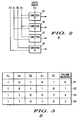
- Decoder switch 12 n includes a plurality of column decoder circuits 16, 17, 18, and 19 connected to output a signal to one of column 0 through column 3 of LED array 11 in response to appropriate address signals.
- a truth table 30 illustrated in FIG. 3 which will be referenced as the illustration of FIG. 2 is described.
- Truth table 30 illustrates the signal levels of each address line, A 0 , A 0 ⁇ , A 1 , and A 1 ⁇ designated as a '1' or a '0', with column decoder switch 12 n selected by a high data signal C n provided by the programmable power supply.
- a 0 and A 0 ⁇ are complementary signals and A 1 and A 1 ⁇ are complementary signals so that when one of the pair is a logic high the other is a logic low level.
- a first row 31 illustrates the logic signals required for the selection of column circuit 16, note that the input C n is at a logic high level, A 0 and A 1 are at a logic low level and A 0 ⁇ and A 1 ⁇ are at a logic high level.
- a second row 32 in truth table 30 which illustrates the logic signals required for the selection of column circuit 17, the input C n is still at a logic high level, with A 0 and A 1 ⁇ being a logic low level and A 0 ⁇ and A 1 being a logic high level.
- truth table 30 which illustrates the logic signals required for the selection of column circuit 18, the input C n is still at a logic high level, with A 0 and A 1 ⁇ being a logic high level and A 0 ⁇ and A 1 being a logic low level.
- a fourth row 34 in truth table 30, which illustrates the logic signals required for the selection of column circuit 19 the input C n is still at a logic high level, with A 0 and A 1 being a logic high level and A 0 ⁇ and A 1 ⁇ being a logic low level.
- any column decoder switch 12 is selected by applying a logic high level signal to the associated data input C n and any of the columns attached to the selected decoder switch 12 n are selected by utilizing an appropriate combination of address signals A 0 , A 0 ⁇ , A 1 , and A 1 ⁇ .
- FIG. 4 illustrates a selection logic truth table 40 for row decoder switches 15 n , which is similar to the column selection of truth table 30.
- a specific row decoder switch 15 n is selected by supplying a logic high level signal to the associated data input R n .
- selection of one of four rows is accomplished by means of address lines B 0 , B 0 ⁇ , B 1 , and B 1 ⁇ .
- Output R 0 is electrically connected to a current sink by means of the programmable current sink and, when connected, designated a 1 in the circuit logic.
- address signal input B 0 at a high level which is a designation by a 1 in truth table 40
- the variation of inputs from the address lines determines which of the rows attached to decoder switch 15 n will be activated.
- the four rows 41 through 44 of truth table 40 illustrate the logic required for the selection of the four rows of array 10 associated with the particular decoder switch 15 n .
- each column decoder switch 12 includes four column circuits 50.
- Column circuit 50 includes two field effect transistors (FETs) 52 and 53 connected in series between programmable power supply 54 and a specific column of array 11.
- programmable power supply 54 is coupled to the input of selected column decoder switches 12 as data signal C n .
- address line A 0 is connected to the gate of FET 52.
- FET 52 couples a 5 volt potential, provided by means of programmable power supply 54, to second FET 53 when a high logic level is present on address line A 0 .
- FET 52 does not couple the 5 volt potential to FET 53 when address signal A 0 is a low logic level.
- Address line A 1 is connected to the gate of FET 53 through two level shifting diodes 55 and 56, which are connected in series with address line A 1 .
- Level shifting diodes 55 and 56 provide a voltage shift to the gate of FET 53 to prevent forward biasing the gate-drain diode of FET 53.
- level shifting diodes 55 and 56 are used to prevent a MESFET gate from being driven into forward bias.
- field effect transistor 53 conducts when address line A 1 is at a high level and couples the 5 volt potential from FET 52 to the associated column of array 11, illustrated as terminal 57.
- a low logic level on address line A1 prevents FET 28 from conducting.
- Row circuit 60 is schematically illustrated, four of which make up a complete row decode switch 15.
- Row circuit 60 includes two FETs 62 and 63 connected in series between an associated row of array 11 and current sink 64, which is the programmable current sink previously discussed.
- programmable current sink 64 is coupled to the input of selected row decoder switches 15 as data signal R n .
- FET 62 couples the associated row of array 11 to FET 63 when address line B 0 applies a logic high level signal to the gate.
- Address line B 1 must be at a logic high level to activate FET 63 to complete an electrical circuit to current sink 64.
- Current sink 64 is electrically coupled to FET 63 as a logic high level signal applied to data line R n (illustrated as a terminal in FIG. 6). Current sink 64 must be electrically connected to allow current to flow through row circuit 60. Electrical conductivity from the associated row of array 11 to current sink 64 completes an electrical circuit (assuming that at least one column circuit 50 is activated) which activates the specifically addressed LED to emit light.
- LED array integrated circuit 10 is illustrated schematically, with portions thereof removed.
- Integrated circuit 10 includes a plurality of LED's in LED matrix array 11.
- one terminal of a specific LED 70 is electrically connected to a first column circuit 50 (illustrated individually in FIG. 5) of a first column decoder switch 12, enclosed in a broken line for convenience of viewing.
- a second terminal of LED 70 is connected to a first row circuit 60 (illustrated individually in FIG. 6) in row decoder switch 15, enclosed in a broken line for convenience of viewing, as a singular illustration of a plurality of column decoder switches and a plurality of row decoder switches utilized to activate the plurality of columns and rows of LED array 11.
- This figure illustrates the four LED circuit arrangement of FIG.
- column decoder switch 12 activates four columns by connecting programmable power source 54 to the addressed column, with a corresponding row decoder switch 15 completing the circuit by electrically connecting an addressed row from a four row decoder switch 15 to current sink 62.
- Column circuit 50 is connected to programmable power source 54 on data line C 0 by a switch or circuit within programmable power source 54 (illustrated as a block 72), or by otherwise completing a circuit to programmable power source 54.
- row circuit 60 is connected to programmable current sink 64 on data line R 0 by a switch or circuit within programmable current sink 64 (illustrated as a block 74), or by otherwise completing a circuit to current sink 64.
- programmable power source 54 and programmable current sink 64 in addition to being programmable as to the amount of power supplied at any predetermined time, may also be programmed to sequence automatically through a predetermined program of input signals on data lines C 0 through C 58 and through a predetermined program of input signals on data lines R 0 through R 35 .
- LED array 83 Illustrated in FIG. 8 is an epi-structure 80 with monolithic integration of a low power decoding switch 82 (illustrated as a single FET) with an LED array 83 (illustrated as a single LED) onto the same substrate.
- LED array 83 includes a plurality of doped and undoped epitaxial layers formed sequentially on a semi-insulated gallium arsenide substrate 84.
- the epitaxial layers are an n+-GaAs layer 85, a n-InGap layer 86, an n-AlInP layer 87, an undoped AIGaInP layer 88, an undoped AlInP layer 89, a p-AlInP layer 90, a p-InGaP layer 91 approximately 200 ⁇ thick, and an undoped GaAs layer 92 approximately 500 ⁇ thick to form LED array 83 integrated with corresponding switch 82.
- implants 94 provided for pixel isolation, implant 95 provided electrical connection to the lower terminal of each pixel, and implant 96 provided for row isolation. Metalized connections to each LED in array 83 are provided by contacts 97 and 98.
- Switch 82 includes device isolation implants 100, source and drain connection implants 102 and 104, and metalized contacts 112, 113, and 114 for source, gate and drain terminals, respectively. Additional information on this type of array can be found in U.S. Patent No. 5,453,386, entitled “Method of Fabrication of Implanted LED Array", issued September 26, 1995, and assigned to the same assignee. Also, for integration techniques, see U.S. Patent No. 5,483,085, entitled “Electro-Optic Integrated Circuit With Diode Decoder” issued January 9, 1996 and assigned to the same assignee.
- a modified epi-structure 120 is illustrated in FIG. 9 which includes a decoding switch 122 integrated with an LED array 130 as a monolithic integration onto the same substrate.
- LED array 130 is similar to LED array 83 of FIG. 8.
- Decoding switch 122 is similar to switch 82 of FIG. 8 except that it is fabricated by adding additional epitaxial layers on LED array 130, from LED array 130 to FET 122, during the device fabrication so that p-dopant out diffusion is less of a problem.
- an LED display can be provided with only one of the assembly of column or row decoding switches and the other of the assembly of row or column (these are of course interchangeable) decoding switches can be replaced with normal hardwired connections, some form of decoding, a shift register, or the like.
- the number of devices used for a decoding switch can be minimized. Power dissipation is limited by driver leakage current instead of MESFET leakage current. As a result, the power dissipation is much lower than that obtained from an array without programmable power supply or programmable current sink.
- All the column decoding switches have common address lines. As a result, the column can be scanned sequentially as n/4 where n is the number of columns at once depending on the input power supply from a driver. All the row decoding switches have common address lines. As a result rows can be scanned sequentially or as m/4 where m is the number of rows at once depending on the status of a programmable current sink. Level shifting diodes used to prevent a MESFET gate from being driven into forward bias are placed in a CMOS driver to supply the decoding switch sequential scanning.
- the instant invention reduces the number of I/O terminals to activate LED pixels and greatly reduces the power consumption of the LED integrated circuit.
- the added reduction of I/O terminals, from 384 to 104 is a great improvement over the LED array without the integration of decoding switches.
- the integrated circuit can be formed in any convenient semiconductor material system or in any convenient organic system.
- the LED array and switches can be formed in a variety of ways while still performing the stated functions.
- a variety of different light emitting devices may be utilized and fabricated in a variety of somewhat modified and/or interchanged steps.
Landscapes
- Engineering & Computer Science (AREA)
- Physics & Mathematics (AREA)
- Computer Hardware Design (AREA)
- General Physics & Mathematics (AREA)
- Theoretical Computer Science (AREA)
- Control Of Indicators Other Than Cathode Ray Tubes (AREA)
- Devices For Indicating Variable Information By Combining Individual Elements (AREA)
- Control Of El Displays (AREA)
- Led Devices (AREA)
Applications Claiming Priority (2)
| Application Number | Priority Date | Filing Date | Title |
|---|---|---|---|
| US08/652,075 US5751263A (en) | 1996-05-23 | 1996-05-23 | Drive device and method for scanning a monolithic integrated LED array |
| US652075 | 1996-05-23 |
Publications (2)
| Publication Number | Publication Date |
|---|---|
| EP0809228A2 true EP0809228A2 (de) | 1997-11-26 |
| EP0809228A3 EP0809228A3 (de) | 1997-12-03 |
Family
ID=24615420
Family Applications (1)
| Application Number | Title | Priority Date | Filing Date |
|---|---|---|---|
| EP97107138A Withdrawn EP0809228A3 (de) | 1996-05-23 | 1997-04-30 | Einrichtung und Verfahren zur Abtastung einer monolithisch integrierten LED-Matrix |
Country Status (4)
| Country | Link |
|---|---|
| US (1) | US5751263A (de) |
| EP (1) | EP0809228A3 (de) |
| JP (1) | JPH1063227A (de) |
| CN (1) | CN1185686A (de) |
Cited By (5)
| Publication number | Priority date | Publication date | Assignee | Title |
|---|---|---|---|---|
| GB2350226A (en) * | 1999-06-22 | 2000-11-22 | Sec Dep For The Dept Of The En | Traffic sign |
| EP1033290A3 (de) * | 1999-03-01 | 2002-04-24 | Delphi Technologies, Inc. | Infrarot-Belegungserkennungsvorrichtung in einem Kraftfahrzeug sowie Verfahren |
| WO2004114267A1 (en) | 2003-06-26 | 2004-12-29 | Philips Intellectual Property & Standards Gmbh | Integrated display unit |
| DE102004053387B4 (de) * | 2003-11-04 | 2015-07-30 | Lantiq Deutschland Gmbh | Verbesserte LED-Array-Implementierung |
| CN105551394A (zh) * | 2016-02-18 | 2016-05-04 | 张志通 | 一种基于gps的无线电子信息显示屏 |
Families Citing this family (33)
| Publication number | Priority date | Publication date | Assignee | Title |
|---|---|---|---|---|
| US6072517A (en) * | 1997-01-17 | 2000-06-06 | Xerox Corporation | Integrating xerographic light emitter array with grey scale |
| US6137523A (en) * | 1997-01-17 | 2000-10-24 | Xerox Corporation | Reducing pixel footprint in a light emitter array using organic light emitting diodes |
| US6023259A (en) * | 1997-07-11 | 2000-02-08 | Fed Corporation | OLED active matrix using a single transistor current mode pixel design |
| JP3732345B2 (ja) * | 1998-02-10 | 2006-01-05 | 株式会社沖データ | 駆動回路、ledヘッド及びプリンタ |
| US6160354A (en) * | 1999-07-22 | 2000-12-12 | 3Com Corporation | LED matrix current control system |
| GB9923591D0 (en) * | 1999-10-07 | 1999-12-08 | Koninkl Philips Electronics Nv | Current source and display device using the same |
| US6570548B2 (en) * | 2001-02-06 | 2003-05-27 | Ronald E. Smith | Display device for providing graphical display having a variable number of vertical and horizontal lines of resolution |
| WO2002089067A1 (fr) * | 2001-04-27 | 2002-11-07 | Johnson Controls Automotive Electronics | Procede de commande et d'activation d'indicateurs de tableau de bord de vehicule |
| US20020171611A1 (en) * | 2001-05-15 | 2002-11-21 | Eastman Kodak Company | Active matrix organic light emitting diode flat-panel display |
| JP2006502421A (ja) * | 2001-11-06 | 2006-01-19 | キーオティ | 画像投影装置 |
| US7046222B2 (en) * | 2001-12-18 | 2006-05-16 | Leadis Technology, Inc. | Single-scan driver for OLED display |
| US6639574B2 (en) | 2002-01-09 | 2003-10-28 | Landmark Screens Llc | Light-emitting diode display |
| CN1615505A (zh) * | 2002-01-15 | 2005-05-11 | 皇家飞利浦电子股份有限公司 | 具有多个发光图像元素并防止非选择图像元素的充电/放电的无源寻址矩阵显示器 |
| US7170478B2 (en) * | 2002-03-26 | 2007-01-30 | Semiconductor Energy Laboratory Co., Ltd. | Method of driving light-emitting device |
| US7993285B2 (en) * | 2002-11-05 | 2011-08-09 | Boston Scientific Scimed, Inc. | Medical device having flexible distal tip |
| TW200606708A (en) * | 2004-03-12 | 2006-02-16 | Matsushita Electric Industrial Co Ltd | Portable terminal device |
| US6999015B2 (en) * | 2004-06-03 | 2006-02-14 | E. I. Du Pont De Nemours And Company | Electronic device, a digital-to-analog converter, and a method of using the electronic device |
| EP1755316A4 (de) * | 2004-06-08 | 2009-08-12 | Mitsubishi Electric Corp | Mobile vorrichtung |
| CN102572043A (zh) * | 2004-06-08 | 2012-07-11 | 苹果公司 | 便携式设备 |
| US20080084368A1 (en) * | 2004-10-18 | 2008-04-10 | Mitsubishi Electric Corporation | Portable terminal |
| US20090221330A1 (en) * | 2004-10-18 | 2009-09-03 | Mitsubishi Electric Corporation | Portable terminal |
| GB2433638B (en) * | 2005-12-22 | 2011-06-29 | Cambridge Display Tech Ltd | Passive matrix display drivers |
| US8791645B2 (en) | 2006-02-10 | 2014-07-29 | Honeywell International Inc. | Systems and methods for controlling light sources |
| TWI342542B (en) * | 2006-03-27 | 2011-05-21 | Himax Tech Inc | Source driver for display and method of driving thereof |
| US7551508B2 (en) * | 2007-11-16 | 2009-06-23 | International Business Machines Corporation | Energy efficient storage device using per-element selectable power supply voltages |
| TWI394125B (zh) * | 2008-04-11 | 2013-04-21 | Chunghwa Picture Tubes Ltd | 背光模組 |
| US20090284445A1 (en) * | 2008-05-15 | 2009-11-19 | Sheng-Chang Kuo | Led data input scheme with sequential scan method and cascade connection for light emitting diode (led) display system |
| US10102792B2 (en) * | 2016-03-30 | 2018-10-16 | Novatek Microelectronics Corp. | Driving circuit of display panel and display apparatus using the same |
| US10839771B2 (en) | 2016-12-22 | 2020-11-17 | Intel Corporation | Display driver |
| US20180182294A1 (en) * | 2016-12-22 | 2018-06-28 | Intel Corporation | Low power dissipation pixel for display |
| US10909933B2 (en) | 2016-12-22 | 2021-02-02 | Intel Corporation | Digital driver for displays |
| TWI633531B (zh) * | 2017-10-13 | 2018-08-21 | 點晶科技股份有限公司 | 發光二極體驅動電路以及發光二極體顯示裝置 |
| US11670224B1 (en) * | 2022-01-06 | 2023-06-06 | Novatek Microelectronics Corp. | Driving circuit for LED panel and LED panel thereof |
Family Cites Families (8)
| Publication number | Priority date | Publication date | Assignee | Title |
|---|---|---|---|---|
| US4141000A (en) * | 1975-02-21 | 1979-02-20 | Data Recording Instrument Company, Ltd. | Interactive displays comprising a plurality of individual display elements |
| DE3302288A1 (de) * | 1983-01-25 | 1984-07-26 | Licentia Patent-Verwaltungs-Gmbh, 6000 Frankfurt | Schaltungsanordnung zur getasteten ansteuerung von leuchtdioden |
| US4701754A (en) * | 1985-04-18 | 1987-10-20 | Fmc Corporation | Indicator device for substance receiving wells in a microtiter plate |
| US4975691A (en) * | 1987-06-16 | 1990-12-04 | Interstate Electronics Corporation | Scan inversion symmetric drive |
| JPH05158430A (ja) * | 1991-12-03 | 1993-06-25 | Rohm Co Ltd | 表示装置 |
| US5510807A (en) * | 1993-01-05 | 1996-04-23 | Yuen Foong Yu H.K. Co., Ltd. | Data driver circuit and associated method for use with scanned LCD video display |
| US5430461A (en) * | 1993-08-26 | 1995-07-04 | Industrial Technology Research Institute | Transistor array for addressing display panel |
| US5583349A (en) * | 1995-11-02 | 1996-12-10 | Motorola | Full color light emitting diode display |
-
1996
- 1996-05-23 US US08/652,075 patent/US5751263A/en not_active Expired - Fee Related
-
1997
- 1997-04-30 EP EP97107138A patent/EP0809228A3/de not_active Withdrawn
- 1997-05-22 CN CN97113429.4A patent/CN1185686A/zh active Pending
- 1997-05-22 JP JP9148531A patent/JPH1063227A/ja active Pending
Cited By (5)
| Publication number | Priority date | Publication date | Assignee | Title |
|---|---|---|---|---|
| EP1033290A3 (de) * | 1999-03-01 | 2002-04-24 | Delphi Technologies, Inc. | Infrarot-Belegungserkennungsvorrichtung in einem Kraftfahrzeug sowie Verfahren |
| GB2350226A (en) * | 1999-06-22 | 2000-11-22 | Sec Dep For The Dept Of The En | Traffic sign |
| WO2004114267A1 (en) | 2003-06-26 | 2004-12-29 | Philips Intellectual Property & Standards Gmbh | Integrated display unit |
| DE102004053387B4 (de) * | 2003-11-04 | 2015-07-30 | Lantiq Deutschland Gmbh | Verbesserte LED-Array-Implementierung |
| CN105551394A (zh) * | 2016-02-18 | 2016-05-04 | 张志通 | 一种基于gps的无线电子信息显示屏 |
Also Published As
| Publication number | Publication date |
|---|---|
| US5751263A (en) | 1998-05-12 |
| JPH1063227A (ja) | 1998-03-06 |
| EP0809228A3 (de) | 1997-12-03 |
| CN1185686A (zh) | 1998-06-24 |
Similar Documents
| Publication | Publication Date | Title |
|---|---|---|
| US5751263A (en) | Drive device and method for scanning a monolithic integrated LED array | |
| US5748160A (en) | Active driven LED matrices | |
| US6518941B1 (en) | Display device | |
| US5798535A (en) | Monolithic integration of complementary transistors and an LED array | |
| KR100450761B1 (ko) | 능동 구동형 유기 이엘 다이오드 디스플레이 패널 회로 | |
| US6806857B2 (en) | Display device | |
| JP3618687B2 (ja) | 表示装置 | |
| CN100511366C (zh) | 具有矩阵型电流负载驱动电路的半导体器件及其驱动方法 | |
| US5723950A (en) | Pre-charge driver for light emitting devices and method | |
| CN114220392B (zh) | 微型发光二极体显示面板及其画素驱动电路 | |
| US7872626B2 (en) | System and method for dynamically calibrating driver circuits in a display device | |
| KR100932084B1 (ko) | 전계발광 디스플레이 장치 | |
| WO2001054107A1 (en) | Gray scale pixel driver for electronic display and method of operation therefor | |
| US20050151705A1 (en) | Electroluminescent display device | |
| US6859195B2 (en) | Display device driven with dual transistors | |
| EP0128238B1 (de) | Anzeigeeinrichtung | |
| US6509690B2 (en) | Display device | |
| US7746306B2 (en) | Display device having an improved video signal drive circuit | |
| EP0809229A2 (de) | Abtaststeuerschaltung für eine monolithisch integrierte LED-Matrix | |
| US5999149A (en) | Matrix display with peripheral drive signal sources | |
| US20250140177A1 (en) | Multi-rail subpixel group for a display | |
| JPH06110402A (ja) | 低消費電力のマトリクスディスプレイ駆動回路 |
Legal Events
| Date | Code | Title | Description |
|---|---|---|---|
| PUAI | Public reference made under article 153(3) epc to a published international application that has entered the european phase |
Free format text: ORIGINAL CODE: 0009012 |
|
| PUAL | Search report despatched |
Free format text: ORIGINAL CODE: 0009013 |
|
| AK | Designated contracting states |
Kind code of ref document: A2 Designated state(s): DE FR GB |
|
| AK | Designated contracting states |
Kind code of ref document: A3 Designated state(s): DE FR GB |
|
| 17P | Request for examination filed |
Effective date: 19980603 |
|
| STAA | Information on the status of an ep patent application or granted ep patent |
Free format text: STATUS: THE APPLICATION HAS BEEN WITHDRAWN |
|
| 18W | Application withdrawn |
Withdrawal date: 19990222 |