EP0809352A1 - Circuit amplificateur inverseur - Google Patents
Circuit amplificateur inverseur Download PDFInfo
- Publication number
- EP0809352A1 EP0809352A1 EP97108149A EP97108149A EP0809352A1 EP 0809352 A1 EP0809352 A1 EP 0809352A1 EP 97108149 A EP97108149 A EP 97108149A EP 97108149 A EP97108149 A EP 97108149A EP 0809352 A1 EP0809352 A1 EP 0809352A1
- Authority
- EP
- European Patent Office
- Prior art keywords
- input
- inverted amplifying
- stage
- circuit
- capacitance
- Prior art date
- Legal status (The legal status is an assumption and is not a legal conclusion. Google has not performed a legal analysis and makes no representation as to the accuracy of the status listed.)
- Granted
Links
- 230000010355 oscillation Effects 0.000 claims description 13
- 101150110971 CIN7 gene Proteins 0.000 description 11
- 101100286980 Daucus carota INV2 gene Proteins 0.000 description 11
- 101150110298 INV1 gene Proteins 0.000 description 11
- 101100397044 Xenopus laevis invs-a gene Proteins 0.000 description 11
- 101100397045 Xenopus laevis invs-b gene Proteins 0.000 description 11
- 230000007423 decrease Effects 0.000 description 7
- 239000006185 dispersion Substances 0.000 description 5
- 101100112673 Rattus norvegicus Ccnd2 gene Proteins 0.000 description 4
- 102100031880 Helicase SRCAP Human genes 0.000 description 3
- 101000704158 Homo sapiens Helicase SRCAP Proteins 0.000 description 3
- 230000003247 decreasing effect Effects 0.000 description 3
- 230000035508 accumulation Effects 0.000 description 2
- 238000009825 accumulation Methods 0.000 description 2
- 230000002401 inhibitory effect Effects 0.000 description 2
- 230000002265 prevention Effects 0.000 description 2
- 101100188686 Danio rerio opn1sw2 gene Proteins 0.000 description 1
- 102100031414 EF-hand domain-containing protein D1 Human genes 0.000 description 1
- 102100031418 EF-hand domain-containing protein D2 Human genes 0.000 description 1
- 101150096151 EFHD1 gene Proteins 0.000 description 1
- 101000802344 Homo sapiens Zinc finger SWIM domain-containing protein 7 Proteins 0.000 description 1
- 101150035405 SWF1 gene Proteins 0.000 description 1
- 101150089053 SWS2 gene Proteins 0.000 description 1
- 230000009471 action Effects 0.000 description 1
- 230000008901 benefit Effects 0.000 description 1
- 230000008878 coupling Effects 0.000 description 1
- 238000010168 coupling process Methods 0.000 description 1
- 238000005859 coupling reaction Methods 0.000 description 1
- 230000000694 effects Effects 0.000 description 1
- 230000001360 synchronised effect Effects 0.000 description 1
- 230000001052 transient effect Effects 0.000 description 1
Images




Classifications
-
- H—ELECTRICITY
- H03—ELECTRONIC CIRCUITRY
- H03F—AMPLIFIERS
- H03F1/00—Details of amplifiers with only discharge tubes, only semiconductor devices or only unspecified devices as amplifying elements
- H03F1/34—Negative-feedback-circuit arrangements with or without positive feedback
- H03F1/342—Negative-feedback-circuit arrangements with or without positive feedback in field-effect transistor amplifiers
-
- H—ELECTRICITY
- H03—ELECTRONIC CIRCUITRY
- H03F—AMPLIFIERS
- H03F1/00—Details of amplifiers with only discharge tubes, only semiconductor devices or only unspecified devices as amplifying elements
- H03F1/08—Modifications of amplifiers to reduce detrimental influences of internal impedances of amplifying elements
- H03F1/083—Modifications of amplifiers to reduce detrimental influences of internal impedances of amplifying elements in transistor amplifiers
- H03F1/086—Modifications of amplifiers to reduce detrimental influences of internal impedances of amplifying elements in transistor amplifiers with FET's
Definitions
- the present invention relates to an inverted amplifying circuit including CMOS inverters serially connected in an odd number of stages and a feedback capacitance for feeding back the output of the last-stage CMOS inverter to the input of the first-stage CMOS inverter.
- the inventors of the present invention proposed this kind of inverted amplifying circuit in Japanese Patent Laid-Open Publication No. 7-95947: using analog voltages to prevent unstable oscillation during computation and guarantee linearity characteristics.
- Fig. 5 shows one of its proposed circuit.
- CMOS inverters I1, I2 and I3 in an odd number of stages are connected in serial, and the output of last-stage CMOS inverter I3 is input to CMOS inverter I1 through feedback capacitance CF.
- voltage Vout equal to the inversion of input voltage Vin input to I1 is generated by the high gain of each CMOS inverter as an output of I3 with accuracy.
- a balancing resistance containing a pair of resistances RE1 and RE2 is connected to the output of CMOS inverter I2 at the stage immediately preceding the last-stage.
- RE1 and RE2 are connected to high-potential supply voltage Vdd and low-potential supply voltage Vss, respectively.
- Resistances RE1 and RE2 decrease the open gain of I2 and restrain the gain of the whole inverted amplifying circuit.
- This inverted amplifying circuit has a decreased gain in the high-frequency area and an increased phase margin.
- Phase margin and gain margin can be obtained as stated above, and oscillation can be prevented up to within the high-frequency area.
- the present invention solves the above problems and has an object to provide an inverted amplifying circuit enabling a balancing resistance to reduce the consumption with no sacrifice of stability, and enabling a balancing resistance to reduce power consumption with no sacrifice of stability, while simultaneously incorporating a sleep mode.
- an inverted amplifying circuit In an inverted amplifying circuit according to the present invention, the generation of low-frequency electric current is prevented by connecting capacitances to a balancing resistances in serial. Also, this inverted amplifying circuit works to prevent low-frequency electric current by connecting capacitances in serial to the circuit to prevent oscillation, cuts off the feedback route of the feedback capacitance, and leads a CMOS in the inverted amplifying portion to a cutoff or a saturation point.
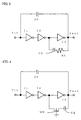
- Fig. 1 shows the first embodiment of an inverted amplifying circuit according to the present invention.
- Fig. 2 shows a variation of the first embodiment.
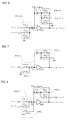
- Fig. 3 shows the second embodiment of the present invention.
- Fig. 4 shows the third embodiment of the present invention.
- Fig. 5 shows a conventional inverted amplifying circuit.
- FIG. 6 shows the fourth embodiment of an inverted amplifying circuit.
- FIG. 7 shows the fifth embodiment.
- FIG. 8 shows the sixth embodiment.
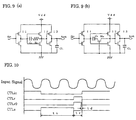
- FIG. 9(a) shows an example of the inverted amplifying circuit of the fourth embodiment.
- FIG. 9(b) shows another example of the inverted amplifying circuit.
- FIG. 10 shows a timing chart of the fourth embodiment.
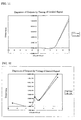
- FIG. 11 is a graph showing the relationship between the refresh time in FIG. 10 and output accuracy.
- FIG. 12 is a graph showing output accuracy in FIG. 11 with logarithm.
- FIG. 13 is a graph showing the relationship between the refresh time in another input condition and output accuracy.
- FIG. 14 is a graph showing output accuracy in FIG. 13 with logarithm.
- FIG. 15 shows the fourth embodiment of the present invention.
- FIG. 16 shows another embodiment of the present invention.
- FIG. 17 shows an embodiment other than those of FIGs. 6, 7, 8, 15 and 16.
- FIG. 18 shows an embodiment other than those of FIGs. 6, 7, 8, 15, 16 and 17.
- FIG. 19 shows an embodiment other than those of FIGs. 6, 7, 8, 15, 16, 17 and 18.
- FIG. 20 shows a reference voltage generating circuit
- CMOS inverters I1, I2 and I3 in an odd number of stages are connected in serial, and the output of the last-stage CMOS inverter I3 is input to the first-stage CMOS inverter I1 through feedback capacitance CF.
- a balancing resistance containing a pair of resistances RE1 and RE2 is connected to the output of CMOS inverter I2 at the stage previous to the last one.
- Capacitances CE1 and CE2 are serially connected to RE1 and RE2, respectively. That is, one serial circuit consisting of RE1 and CE1 is provided between the output of I2 and Vdd, and another consisting of RE2 and CE2 is provided between the output of I2 and Vss.
- Resistances RE1 and RE2 and capacitances CE1 and CE2 can be adopted. Resistances can be placed closer or farther to the supply voltage than capacitances as in Figs. 1 and 2. Either will do.
- the balancing resistance need not necessarily be connected to the output of I2; it can be the output of I1. Generally, good results ensue from connecting it to the CMOS inverter one stage prior to the final one.
- Fig. 2 shows a variation that uses the grounded capacitance CL, as in the conventional embodiment, to prevent oscillation more effectively. Connecting the balancing resistance to the output of I1 also gives good oscillation prevention results.
- Another effective structure results from connecting only one high-or low-potential RC circuit at its balancing resistance to one or both of the outputs of I1 and I2, and further connect a high-potential serial circuit to one of them and a low-potential serial circuit to the other.
- Fig. 3 shows the second embodiment.
- a serial circuit consisting of resistance RE and capacitance CE is provided instead of the balancing resistance as in the circuits in Figs. 1 and 2.
- the serial circuit is a negative feedback line of, and becomes a load of, I3
- the gain of the inverted amplifying circuit is restrained similar to the above circuits by decreasing the gain of I3. Since there are fewer components in the present embodiment than in those of the circuits in Figs. 1 and 2, the size and area of this circuit are smaller.
- Resistance RE and capacitance CE can be placed inversely. Good oscillation prevention results can be obtained by placing the serial circuit between the input and output of I2.
- Fig. 4 shows the third embodiment of the present invention.
- MOS resistance MR instead of resistance RE as in Fig. 3, the size and the area of the circuit further decrease.
- a serial circuit can be provided between the input and output of I2.
- a pMOS is used as a MOS resistance, and an nMOS can also be used.
- Table 1 compares the embodiments in Figs. 2 to 4 with the conventional circuit in Fig. 5. Area ratios are shown with that of the conventional circuit assumed to be 1.
- Electric power consumption A is the result of the AC analysis of the sinusoidal wave input, and electric power consumption B is the result of the transient analysis by rectangular waves.
- nMOS and pMOS are connected in parallel
- MOS resistance in the embodiment in Fig. 4.
- dependence on the resistance voltage can be reduced and constant characteristics maintained regardless of input voltage.
- a predetermined plus, minus, or 0V of supply voltage or ground can be used.
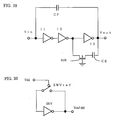
- FIG. 6 shows the fourth embodiment of an inverted amplifying circuit.
- input voltage Vin is connected to input capacitance Ci, which is connected to both input terminals of odd number of stages of serial CMOS inverter INV and feedback capacitance Cf.
- the first sleep-refresh switch SWSR1 is connected to the output of Cf.
- Cf is connected to one of these three: the output terminal of INV, the reference voltage Vref, or the ground by SWSR1.
- Vref is the reference voltage of the range of output voltage of INV, usually half of the supply voltage Vdd.
- SWSR1 consists of switches SWf, SWrf and SWsf, connected respectively to the output of INV, Vref and the ground, which are selectively closed.
- Ci is selectively connected to input voltage Vin, reference voltage Vref, or the ground by SWSR2 which consists of switches SWin, SWri and SWsi connected to input voltage Vin, Vref and the ground, respectively. They are selectively closed.
- Refresh switch SWrf0 is connected between the input and output of INV. It is opened and closed by working with SWri in SWSR2 and SWrf in SWSR1 to cancel and refresh the residual charge of Ci and Cf.
- INV becomes an inverter circuit
- each CMOS operates at its cutoff point. Therefore, the electric power consumption of each CMOS can be ignored. Also, when an input of INV is connected to the supply voltage and each CMOS functions at its saturation point, no electric current is generated. As shown in FIGs. 9(a) and 9(b), a conventional balancing resistance is not provided in the inverted amplifying portion INV. Therefore, no electric current is generated in the balancing resistance, and electric power consumption is reduced.
- the inverted amplifying portion in FIG. 9(b) utilizes MOS resistance Mc instead of resistance Rc as in FIG. 9(a).
- MOS resistance Mc instead of resistance Rc as in FIG. 9(a).
- the size and area of the circuit can be further reduced.
- a pMOS is used as the MOS resistance in FIG. 9(b)
- an nMOS also can be used.
- FIG. 10 is a timing chart of this embodiment showing the timings of input signal Vin, and control signals CTSin, CTLr, CTLr0 and CTLs.
- CTLin controls the opening and closing of switches SWin and SWf for usual work: they are closed when the circuit is high-level and open when low-level.
- CTLr0 similarly controls switch SWrf0 for refreshing: it is closed when the circuit is high-level and open when low-level.
- CTLs controls switches SWsi and SWsf for the sleep mode: they are closed when the circuit is high-level and open when low-level.
- ts and tr show the sleep mode and refresh periods, respectively. Other periods show usual work.
- a refresh period is set before usual work because the residual load has to be canceled when usual work is started.
- SWrf0 is opened slightly later than switches SWri and SWfr.
- FIGs. 11 to 14 show the effectiveness of the delay times.
- FIG. 11 shows the relationship between delay time -td and output voltage dispersion, assuming that input voltage Vin is 1.5V on average, amplitude is 1.0V and frequency is 1.3MHz.
- the vertical axis shows linearity graduation: dispersion decreases when td ⁇ 0 compared to when case of td>0.
- the delay effect is clear, and
- FIG. 12 shows the same data in FIG. 11 by log scale: dispersion is minimal when delay time td is around 1nsec.
- FIG. 13 shows the relationship between the delay time -td and output Vout dispersion, given that Vin is 1.5V on average, amplitude is 0.5V and frequency is 1.3MHz.
- the horizontal axis shows negative delay time, and the vertical axis shows linearity graduation: dispersion is minimal when delay time td is around 1nsec, similar to FIG. 12.
- FIG. 7 shows the fifth embodiment of the present invention.
- the refresh function is omitted by adopting first and second sleep switches SWS1 and SWS2 instead of first and second sleep-refresh switches SWSR1 and SWSR2 as in FIG. 6.
- Such a simplified structure is effective when the allowable output accuracy is low.
- FIG. 8 shows the sixth embodiment of the present invention.
- SWsi in SWSR2 of FIG. 6 is independent as a sleep switch and directly connected to the input of INV.
- the second refresh switch SWSR2 including SWin and SWri is connected to input capacitance Ci.
- the first refresh switch SWR1 is set instead of SWSR1 in FIG. 6, omitting SWsf in SWSR1.
- SWf and SWrf0 are opened, electric power consumption is reduced by inputting INV to the ground and designating INV the cutoff point.
- the circuit structure of this embodiment is simpler than that of the fourth embodiment, and the refresh function omitted from the fifth embodiment can be implemented.
- a supply voltage can be connected instead of the ground in the sleep mode.
- FIG. 15 shows the embodiment in which two stages of inverted amplifying circuits are serially connected to perform addition including signs.
- a plurality of input voltages Vin1 to Vin8 are connected to parallel capacitances C11 to C14 and C21 to C24.
- C11 to C14 perform addition of Vin1 to Vin4, and
- C21 to C24 perform addition of Vin5 to Vin8 as capacity couplings.
- C11 to C14 correspond to the input capacitances, and their outputs are input to inverted amplifying portion INV1.
- feedback capacitance CF1 is connected parallel to INV1.
- first sleep-refresh switch SWSR1 is connected to the output of CF1.
- second sleep-refresh switch SWSR2 is connected to the inputs of capacitances C11 to C14 and C21 to C24.
- the capacitances are connected to the corresponding input voltage, the reference voltage, or the ground.
- C21 to C24 also correspond to the input capacitance, and their outputs are input to inverted amplifying portion INV2.
- feedback capacitance CF2 is connected in parallel to INV2.
- the output of CF2 is connected to third sleep-refresh switch SWSR1', which consists of parts identical to those of SWSR1.
- SWSR1' the output of CF2 is connected to an output of INV2, the reference voltage Vref, or the ground.
- SWSR1 consists of switch SWR1 to connect an output of CF1 to an output of INV1 or switch SWR3.
- SWR3 connects an output of SWR1 to Vref or the ground.
- the third sleep-refresh switch SWSR1' consists of switch SWR2 to connect the output of CF2 to the output of INV2 or switch SWR3.
- the second sleep-refresh switch SWSR2 consists of switches SW11 to SW14 and SW21 to SW24 to connect the input of each capacitance to the input voltage or switch SWR3.
- SWR3 is used in common with the sleep-refresh switch above.
- refresh switches SWF1 and SWF2 corresponding to SWrf in FIG. 6 are respectively connected.
- circuit structure can be simplified as a whole by one common switch to connect an input or output to Vref and the ground.
- INV1 The output of INV1 is connected to INV2 in parallel to the output of C21 to C24 through intermediate capacitance CC, and the accumulations including signs below are performed.
- Formula (7) demonstrates how the weighted accumulation result of Vin5 to Vin8 is subtracted from that of Vin1 to Vin4.
- INV1 is connected to intermediate capacitance CC through intermediate switch SWCC.
- SWCC connects the input terminal of CC to INV1 or SWR3.
- the input of INV2 is connected to the ground through SWCC and SWR3 when it is in the sleep mode, and is connected to the reference voltage when in the refresh mode. Both refresh and sleep modes can be completely realized with respect to INV2.
- SWCC is connected to the input of inverted amplifying portion INV2, it works synchronous to second sleep-refresh switch SWSR2 and can thus be included in SWSR2.
- FIG. 11 shows another embodiment of the inverted amplifying portion, wherein a balancing resistance consisting of a pair of resistances RE1 and RE2 is connected to an output of CMOS inverter I2 at the stage immediately preceding the last stage.
- Capacitances CE1 and CE2 are serially connected to RE1 and RE2, respectively. That is, a serial circuit including RE1 and CE1 is connected between the output of I2 and Vdd, and another serial circuit including RE2 and CE2 is connected between the output of I2 and Vss.
- Resistances RE1 and RE2 and capacitances CE1 and CE2 can be adopted. Resistances can be placed closer to or farther from the supply voltage than capacitances as in FIGs. 16 and 17.
- the balancing resistance need not necessarily be connected to the output of I2; it can be connected to the output of I1. Generally, good results ensue from connecting it to the CMOS inverter one stage prior to the final one.
- the inverted amplifying portion in FIG. 18 shows a variation of that in FIG. 9(a).
- a serial circuit including resistance RE and capacitance CE is connected between the input and output of the last-stage CMOS inverter I3.
- This serial circuit is a negative feedback line of I3 and a load of I3, it decreases the gain of I3 and restrains the gain of the inverted amplifying circuit.
- the circuit in FIG. 9(a) has the advantage of receiving no influence from any capacitance component at the following stages, when compared with the present circuit.
- FIG. 19 shows a circuit of reduced size and area in which the serial circuit of MOS resistance MR capacitance in FIG. 9(b) is connected between an input and output of the last stage CMOS inverter.
- the circuit in FIG. 9(b) is superior to the present one because it receives no influence from the circuit at any following stage.
- FIG. 20 shows a reference voltage generating circuit to generate Vref with a structure enabling connection to supply voltage in the sleep mode.
- the circuit includes inverted amplifying portion INV consisting of CMOS inverters serially connected in an odd number of stages, similar to INV1 and INV2 in FIG. 15.
- the output of INV is connected to its input through switch SWVref, which either connects the input to the output or to the supply voltage Vdd.
- switch SWVref When the INV input is connected to its output, input and output are balanced and converged in the voltage approximately Vdd/2.
- the grounded voltage (0V) is generated as the inversion of Vdd at the output of INV. Therefore, Vref-dd of the reference voltage generating circuit output is the reference voltage Vref or 0V.
- this circuit is used instead of SWR3 in FIG. 15, the function of SWR3 can be included in the reference voltage generating circuit.
- the present invention it is possible to reduce electric power consumption by a balancing resistance without inhibiting the stability of the inverted amplifying circuit, because a capacitance is connected to a balancing resistance in series and the generation of low-frequency electric current is arrested.
- low-frequency current is arrested by serially connecting capacitances to a circuit to prevent oscillation, the feedback route of a feedback capacitance is cut off, and a CMOS inverter is led to the cutoff point by connecting an input capacitance and a feedback capacitance to the ground. Therefore, it is feasible to reduce the circuit's electric power consumption, thus preventing oscillation, and to realize a sleep mode without inhibiting its stability.
Landscapes
- Engineering & Computer Science (AREA)
- Power Engineering (AREA)
- Amplifiers (AREA)
Applications Claiming Priority (6)
| Application Number | Priority Date | Filing Date | Title |
|---|---|---|---|
| JP8150018A JPH09312527A (ja) | 1996-05-21 | 1996-05-21 | 反転増幅回路 |
| JP15001896 | 1996-05-21 | ||
| JP150018/96 | 1996-05-21 | ||
| JP20327396 | 1996-07-12 | ||
| JP203273/96 | 1996-07-12 | ||
| JP8203273A JPH1032470A (ja) | 1996-07-12 | 1996-07-12 | 反転増幅回路 |
Publications (2)
| Publication Number | Publication Date |
|---|---|
| EP0809352A1 true EP0809352A1 (fr) | 1997-11-26 |
| EP0809352B1 EP0809352B1 (fr) | 2002-01-02 |
Family
ID=26479744
Family Applications (1)
| Application Number | Title | Priority Date | Filing Date |
|---|---|---|---|
| EP97108149A Expired - Lifetime EP0809352B1 (fr) | 1996-05-21 | 1997-05-20 | Circuit amplificateur inverseur |
Country Status (5)
| Country | Link |
|---|---|
| US (1) | US5936463A (fr) |
| EP (1) | EP0809352B1 (fr) |
| KR (1) | KR980012850A (fr) |
| CN (1) | CN1090838C (fr) |
| DE (1) | DE69709437T2 (fr) |
Families Citing this family (6)
| Publication number | Priority date | Publication date | Assignee | Title |
|---|---|---|---|---|
| JP3283210B2 (ja) * | 1997-05-30 | 2002-05-20 | 株式会社鷹山 | スペクトラム拡散通信方式における信号受信装置 |
| US6353366B1 (en) * | 2000-04-28 | 2002-03-05 | Telecommunications Laboratories | Bandwidth enhancement of transimpedance amplifier by capacitive peaking design |
| WO2004021100A2 (fr) * | 2002-08-29 | 2004-03-11 | Koninklijke Philips Electronics N.V. | Signalisation par commutation de courant dans un circuit de traitement de donnees electroniques |
| US7622845B2 (en) * | 2003-03-31 | 2009-11-24 | Suren Systems, Ltd. | Piezoelectric transducer signal processing circuit |
| US8508294B2 (en) * | 2010-01-04 | 2013-08-13 | Marvell World Trade Ltd. | Power amplifier with feedback impedance for stable output |
| CN106712730B (zh) * | 2016-11-30 | 2020-05-15 | 上海集成电路研发中心有限公司 | 一种可调节信号且可编程的增益放大器 |
Citations (3)
| Publication number | Priority date | Publication date | Assignee | Title |
|---|---|---|---|---|
| GB2080649A (en) * | 1980-06-25 | 1982-02-03 | Mostek Corp | Low power differential amplifier |
| US4446444A (en) * | 1981-02-05 | 1984-05-01 | Harris Corporation | CMOS Amplifier |
| EP0584544A1 (fr) * | 1992-07-24 | 1994-03-02 | Yozan Inc. | Amplificateur opérationnel |
Family Cites Families (13)
| Publication number | Priority date | Publication date | Assignee | Title |
|---|---|---|---|---|
| JP2944302B2 (ja) * | 1992-05-27 | 1999-09-06 | 株式会社沖エル・エス・アイ・テクノロジ関西 | サンプリング回路 |
| JP3131915B2 (ja) * | 1992-07-24 | 2001-02-05 | 株式会社鷹山 | 演算増幅器 |
| US5424973A (en) * | 1992-11-12 | 1995-06-13 | Yozan Inc. | Apparatus and method for performing small scale subtraction |
| JP3219880B2 (ja) * | 1992-12-22 | 2001-10-15 | 株式会社鷹山 | 乗算回路 |
| JP2985999B2 (ja) * | 1993-02-04 | 1999-12-06 | 株式会社高取育英会 | 重み付き加算回路 |
| US5604458A (en) * | 1993-02-05 | 1997-02-18 | Yozan Inc. | Scaler circuit |
| JP3023434B2 (ja) * | 1993-02-05 | 2000-03-21 | 株式会社鷹山 | スケーラ回路 |
| JPH0794957A (ja) * | 1993-09-20 | 1995-04-07 | Takayama:Kk | 線形特性補償回路 |
| JP3109706B2 (ja) * | 1994-03-25 | 2000-11-20 | 川崎製鉄株式会社 | チョッパ型コンパレータ |
| FR2722625B1 (fr) * | 1994-07-18 | 1996-10-04 | Thomson Consumer Electronics | Convertisseur a/n a comparaison multiple utilisant le principe d'interpolation |
| JP3511320B2 (ja) * | 1994-09-30 | 2004-03-29 | 株式会社鷹山 | 乗算回路 |
| JPH08305781A (ja) * | 1995-04-26 | 1996-11-22 | Sharp Corp | 乗算回路 |
| JP3126629B2 (ja) * | 1995-05-30 | 2001-01-22 | シャープ株式会社 | 演算増幅器 |
-
1997
- 1997-05-20 EP EP97108149A patent/EP0809352B1/fr not_active Expired - Lifetime
- 1997-05-20 CN CN97113115A patent/CN1090838C/zh not_active Expired - Fee Related
- 1997-05-20 US US08/859,109 patent/US5936463A/en not_active Expired - Fee Related
- 1997-05-20 DE DE69709437T patent/DE69709437T2/de not_active Expired - Fee Related
- 1997-05-21 KR KR1019970019709A patent/KR980012850A/ko not_active Abandoned
Patent Citations (3)
| Publication number | Priority date | Publication date | Assignee | Title |
|---|---|---|---|---|
| GB2080649A (en) * | 1980-06-25 | 1982-02-03 | Mostek Corp | Low power differential amplifier |
| US4446444A (en) * | 1981-02-05 | 1984-05-01 | Harris Corporation | CMOS Amplifier |
| EP0584544A1 (fr) * | 1992-07-24 | 1994-03-02 | Yozan Inc. | Amplificateur opérationnel |
Non-Patent Citations (4)
| Title |
|---|
| AZEREDO LEME C ET AL: "CMOS ABSOLUTE VALUE PRECISION CAPACITANCE MEASUREMENT SYSTEM", PROCEEDINGS OF THE INTERNATIONAL SYMPOSIUM ON CIRCUITS AND SYSTEMS, SAN DIEGO, MAY 10 - 13, 1992, vol. 3 OF 6, 10 May 1992 (1992-05-10), INSTITUTE OF ELECTRICAL AND ELECTRONICS ENGINEERS, pages 1277 - 1279, XP000338182 * |
| M.KRAUSS: "ENTWURF UND REALISIERUNG EINES INTEGRIERTEN OPERATIONSVERSTÀRKERS IN ENHANCEMENT/DEPLETION-MOS-TECHNIK", NACHRICHTEN TECHNIK ELEKTRONIK, vol. 35, no. 9, 1985, BERLIN DE, pages 327 - 330, XP002037534 * |
| PARZHUBER H ET AL: "AN ADAPTIVE BIASING ONE-STAGE CMOS OPERATIONAL AMPLIFIER FOR DRIVING HIGH CAPACITIVE LOADS", IEEE JOURNAL OF SOLID-STATE CIRCUITS, vol. 26, no. 10, 1 October 1991 (1991-10-01), pages 1457 - 1460, XP000264312 * |
| R.A. RIKOSKI ET AL: "A MICROPOWER COMPLEMENTARY-MOS D.C. AMPLIFIER", INTERNATIONAL JOURNAL OF ELECTRONICS, vol. 40, no. 3, March 1976 (1976-03-01), LONDON GB, pages 237 - 240, XP002037533 * |
Also Published As
| Publication number | Publication date |
|---|---|
| DE69709437D1 (de) | 2002-02-07 |
| KR980012850A (ko) | 1998-04-30 |
| EP0809352B1 (fr) | 2002-01-02 |
| CN1175820A (zh) | 1998-03-11 |
| DE69709437T2 (de) | 2002-08-14 |
| US5936463A (en) | 1999-08-10 |
| CN1090838C (zh) | 2002-09-11 |
Similar Documents
| Publication | Publication Date | Title |
|---|---|---|
| KR100326878B1 (ko) | 증폭회로 | |
| Crols et al. | Switched-opamp: An approach to realize full CMOS switched-capacitor circuits at very low power supply voltages | |
| Redman-White | A high bandwidth constant g/sub m/and slew-rate rail-to-rail CMOS input circuit and its application to analog cells for low voltage VLSI systems | |
| US7633338B1 (en) | Compensation circuit for amplifiers having multiple stages | |
| US7400183B1 (en) | Voltage controlled oscillator delay cell and method | |
| JPH11150427A (ja) | 増幅回路及びこれを用いた液晶ディスプレイ装置 | |
| EP0911978B1 (fr) | Génération de tensions de références symétriques à faible bruit et compensées en température | |
| CN100549898C (zh) | 利用双向非对称缓冲器结构提高性能的ldo电路 | |
| JPH02262714A (ja) | デューティ制御回路装置 | |
| EP4383039A1 (fr) | Circuit de suppression d'alimentation électrique, puce et terminal de communication | |
| KR100877626B1 (ko) | 클래스 ab 증폭기 및 이를 위한 입력 스테이지 회로 | |
| Kinget et al. | Full analog CMOS integration of very large time constants for synaptic transfer in neural networks | |
| US6414552B1 (en) | Operational transconductance amplifier with a non-linear current mirror for improved slew rate | |
| US20110121871A1 (en) | Current converting method, transconductance amplifier and filter circuit using the same | |
| US5936463A (en) | Inverted amplifying circuit | |
| US7091785B2 (en) | Load and line regulation using operational transconductance amplifier and operational amplifier in tandem | |
| JP2011254408A (ja) | パワーアンプモジュール及び携帯情報端末 | |
| US5926060A (en) | Mirror model for designing a continuous-time filter with reduced filter noise | |
| Kumar et al. | A low-voltage low power CMOS companding filter | |
| US6300752B1 (en) | Common mode bias voltage generator | |
| US8816760B2 (en) | Capacitor amplifying circuit and operating method thereof | |
| JPH0730342A (ja) | 演算増幅回路 | |
| CN100399224C (zh) | 一种具有极高输出阻抗的电流源 | |
| US5942912A (en) | Devices for the self-adjusting setting of the operating point in amplifier circuits with neuron MOS transistors | |
| US5438288A (en) | High differential output impedance setter |
Legal Events
| Date | Code | Title | Description |
|---|---|---|---|
| PUAI | Public reference made under article 153(3) epc to a published international application that has entered the european phase |
Free format text: ORIGINAL CODE: 0009012 |
|
| AK | Designated contracting states |
Kind code of ref document: A1 Designated state(s): DE FR GB |
|
| 17P | Request for examination filed |
Effective date: 19980115 |
|
| 17Q | First examination report despatched |
Effective date: 20000406 |
|
| GRAG | Despatch of communication of intention to grant |
Free format text: ORIGINAL CODE: EPIDOS AGRA |
|
| GRAG | Despatch of communication of intention to grant |
Free format text: ORIGINAL CODE: EPIDOS AGRA |
|
| GRAH | Despatch of communication of intention to grant a patent |
Free format text: ORIGINAL CODE: EPIDOS IGRA |
|
| GRAH | Despatch of communication of intention to grant a patent |
Free format text: ORIGINAL CODE: EPIDOS IGRA |
|
| GRAA | (expected) grant |
Free format text: ORIGINAL CODE: 0009210 |
|
| REG | Reference to a national code |
Ref country code: GB Ref legal event code: IF02 |
|
| AK | Designated contracting states |
Kind code of ref document: B1 Designated state(s): DE FR GB |
|
| REF | Corresponds to: |
Ref document number: 69709437 Country of ref document: DE Date of ref document: 20020207 |
|
| PGFP | Annual fee paid to national office [announced via postgrant information from national office to epo] |
Ref country code: GB Payment date: 20020430 Year of fee payment: 6 |
|
| PGFP | Annual fee paid to national office [announced via postgrant information from national office to epo] |
Ref country code: FR Payment date: 20020523 Year of fee payment: 6 |
|
| ET | Fr: translation filed | ||
| PGFP | Annual fee paid to national office [announced via postgrant information from national office to epo] |
Ref country code: DE Payment date: 20020628 Year of fee payment: 6 |
|
| RAP2 | Party data changed (patent owner data changed or rights of a patent transferred) |
Owner name: YOZAN, INC. |
|
| PLBE | No opposition filed within time limit |
Free format text: ORIGINAL CODE: 0009261 |
|
| STAA | Information on the status of an ep patent application or granted ep patent |
Free format text: STATUS: NO OPPOSITION FILED WITHIN TIME LIMIT |
|
| 26N | No opposition filed | ||
| REG | Reference to a national code |
Ref country code: GB Ref legal event code: 732E |
|
| REG | Reference to a national code |
Ref country code: FR Ref legal event code: TP Ref country code: FR Ref legal event code: CD |
|
| PG25 | Lapsed in a contracting state [announced via postgrant information from national office to epo] |
Ref country code: GB Free format text: LAPSE BECAUSE OF NON-PAYMENT OF DUE FEES Effective date: 20030520 |
|
| PG25 | Lapsed in a contracting state [announced via postgrant information from national office to epo] |
Ref country code: DE Free format text: LAPSE BECAUSE OF NON-PAYMENT OF DUE FEES Effective date: 20031202 |
|
| GBPC | Gb: european patent ceased through non-payment of renewal fee |
Effective date: 20030520 |
|
| PG25 | Lapsed in a contracting state [announced via postgrant information from national office to epo] |
Ref country code: FR Free format text: LAPSE BECAUSE OF NON-PAYMENT OF DUE FEES Effective date: 20040130 |
|
| REG | Reference to a national code |
Ref country code: FR Ref legal event code: ST |