EP0809626B1 - Herstellung von mit enantiomer angereicherten ortho-substituierten alpha, alpha-diaromatischen methanolen - Google Patents
Herstellung von mit enantiomer angereicherten ortho-substituierten alpha, alpha-diaromatischen methanolen Download PDFInfo
- Publication number
- EP0809626B1 EP0809626B1 EP96903991A EP96903991A EP0809626B1 EP 0809626 B1 EP0809626 B1 EP 0809626B1 EP 96903991 A EP96903991 A EP 96903991A EP 96903991 A EP96903991 A EP 96903991A EP 0809626 B1 EP0809626 B1 EP 0809626B1
- Authority
- EP
- European Patent Office
- Prior art keywords
- alkoxy
- group
- formula
- alkyl
- independently selected
- Prior art date
- Legal status (The legal status is an assumption and is not a legal conclusion. Google has not performed a legal analysis and makes no representation as to the accuracy of the status listed.)
- Expired - Lifetime
Links
Classifications
-
- C—CHEMISTRY; METALLURGY
- C07—ORGANIC CHEMISTRY
- C07C—ACYCLIC OR CARBOCYCLIC COMPOUNDS
- C07C231/00—Preparation of carboxylic acid amides
- C07C231/16—Preparation of optical isomers
- C07C231/18—Preparation of optical isomers by stereospecific synthesis
-
- C—CHEMISTRY; METALLURGY
- C07—ORGANIC CHEMISTRY
- C07C—ACYCLIC OR CARBOCYCLIC COMPOUNDS
- C07C213/00—Preparation of compounds containing amino and hydroxy, amino and etherified hydroxy or amino and esterified hydroxy groups bound to the same carbon skeleton
- C07C213/08—Preparation of compounds containing amino and hydroxy, amino and etherified hydroxy or amino and esterified hydroxy groups bound to the same carbon skeleton by reactions not involving the formation of amino groups, hydroxy groups or etherified or esterified hydroxy groups
-
- C—CHEMISTRY; METALLURGY
- C07—ORGANIC CHEMISTRY
- C07C—ACYCLIC OR CARBOCYCLIC COMPOUNDS
- C07C233/00—Carboxylic acid amides
- C07C233/01—Carboxylic acid amides having carbon atoms of carboxamide groups bound to hydrogen atoms or to acyclic carbon atoms
- C07C233/56—Carboxylic acid amides having carbon atoms of carboxamide groups bound to hydrogen atoms or to acyclic carbon atoms having carbon atoms of carboxamide groups bound to carbon atoms of carboxyl groups, e.g. oxamides
-
- C—CHEMISTRY; METALLURGY
- C07—ORGANIC CHEMISTRY
- C07C—ACYCLIC OR CARBOCYCLIC COMPOUNDS
- C07C37/00—Preparation of compounds having hydroxy or O-metal groups bound to a carbon atom of a six-membered aromatic ring
- C07C37/001—Preparation of compounds having hydroxy or O-metal groups bound to a carbon atom of a six-membered aromatic ring by modification in a side chain
- C07C37/002—Preparation of compounds having hydroxy or O-metal groups bound to a carbon atom of a six-membered aromatic ring by modification in a side chain by transformation of a functional group, e.g. oxo, carboxyl
-
- C—CHEMISTRY; METALLURGY
- C07—ORGANIC CHEMISTRY
- C07B—GENERAL METHODS OF ORGANIC CHEMISTRY; APPARATUS THEREFOR
- C07B2200/00—Indexing scheme relating to specific properties of organic compounds
- C07B2200/07—Optical isomers
Definitions
- the invention relates to the field of enantiomeric synthesis generally and to enantiomeric synthesis of asymmetric ⁇ , ⁇ -diaromatic methanols, in particular.
- An objective of the present invention is to provide a convenient asymmetric synthetic process for the production of enantiomerically enriched ⁇ , ⁇ -diaromatic methanols.
- Another object of the invention is to provide enantiomerically enriched ⁇ , ⁇ -diaromatic methanols in high yield and purity.
- R 1 , R 2 , R 3 , and R 4 are all bound to atoms that are ortho to the central ketone between AR 1 and AR 2 ;
- AR 1 and AR 2 are each selected from aromatic carbocyclic and heterocyclic ring systems which are made up of one or two rings, of 5 to 7 members each and at least one of the rings in each bi-ring system is aromatic;
- one of R 1 and R 2 is selected from -OH, -SH, and -NHR 7 ; and the other of R 1 and R 2 is selected from H, -OH, -SH, -NHR 7 , and R 8 ;
- R 3 and R 4 are each independently selected from H and R 8 ;
- the present invention is the reduction of the keto bond of an prochiral ortho-substituted biaromatic ketone compound of formula II in the presence of an isopinocampheylborane of formula III or IIIa in which R 9 is C 1-6 alkyl, C 5-6 cycloalkyl, phenyl, or isopinocampheyl, and X is hydrogen or halogen, to yield the corresponding asymmetic biaromatic methanol of formula I in enantiomerically enriched form.
- X is preferably halogen, more preferably chlorine or bromine, most preferably chlorine.
- R 9 is preferably selected from methyl, ethyl, propyl, isopropyl, butyl, isobutyl, sec-butyl, tertiary butyl, thexyl (ie 2,1,1-trimethyl propyl), cyclopentyl, phenyl, or isopinocampheyl; more preferably isopinocampheyl.
- R 9 isopinocampheyl, it must be of the same configuration of the isopinocampheyl structure shown in formula III and IIIa respectively.
- the compound of formula In is (1R)-(-)-B-halodiisopinocampheylborane
- the compound of formula IIIa is (1S)-(+)-B-halodiisopinocampheylborane.
- Compounds of formulae III and IIIa may be used as such or may be prepared in situ, without isolation.
- Compounds of formulae III and IIIa are preferably prepared in the manner described in King, J. Org. Chem. 1993, 58 , 3731-3735; Simpson, et al., Syn. comm. 21 (15 & 16), 1705-1714 (1991); Brown, J. Org. Chem. 1984, 49 , 945; and/or Brown, J. Org. Chem 1989, 54 1577.
- Chem. Pharm. Bull 39(10) 2498-2501 (1991) discloses the asymmetric reduction of 2-amiobenzophenones to asymmetric ⁇ , ⁇ -diaromatic methanols by a fermentation process using a yeast instead of a chemical reduction with an organic boron derivative of formula III or IIIa. This teaching is entirely different from the process of the present invention.
- US Patent No. 4,866,181 does not disclose the preparation of benzophenone derivatives.
- AR 1 and AR 2 are each independently selected from carbocyclic and heterocyclic ring systems having one or two fused rings each, with each ring having from 5 to 7 ring members, and at least the ring bound to R 1 and R 3 being aromatic.
- at least one of AR 1 and AR 2 is carbocyclic, more preferably both are carbocyclic.
- the ring of the bicyclic system which is attached to the ketone to be reduced is preferably carbocyclic, most preferably when both AR 1 and AR 2 are bicyclic, the ring of each bicyclic system which is attached to the ketone to be reduced is carbocyclic.
- both rings of the bicyclic ring system are aromatic, either ring may be attached to the ketone intended to be reduced.
- One particularly preferred group is when both AR 1 and AR 2 are the same ring system, whether mono or bi-cyclic, whether carbocyclic or heterocyclic. In all cases where either AR 1 or AR 2 are heterocyclic, the atom of the ring system which is bound to the carbonyl (between AR 1 and AR 2 ) intended to be reduced must be carbon.
- AR 1 and AR 2 carbocyclic rings are indepedendently selected from phenyl, naphthyl, indanyl, indenyl, tetrahydronaphthyl, dihydronaphthyl, cycloheptaphenyl, cycloheptadienphenyl, and cycloheptatrienphenyl, preferably phenyl and naphthyl, most preferably, phenyl.
- a highly preferred group of compounds of formula I and II are when both AR 1 and AR 2 are phenyl.
- AR 1 and AR 2 heterocyclic mono ring systems include thienyl, furanyl, pyridyl, pyrrolyl, imidazolyl, pyrazolyl, triazolyl, dithiolyl, oxathiolyl, oxazolyl, thiazolyl, oxadiazolyl, pyranyl, pyridazinyl, pyrimidinyl, pyrazinyl, and triazinyl.
- the heteroatoms can take any suitable position, such that the "term triazolyl" for example includes both 1,2,3-triazolyl as well as 1,2,4-triazolyl.
- Preferred monocyclic heterorings for AR 1 and AR 2 include, furanyl, pyrrolyl, pyridyl, pyrazolyl, triazolyl, thiazolyl, pyranyl, pyridazinyl, pyrimidinyl, and triazinyl; more highly preferred are pyridyl, pyrazolyl, triazolyl, pyridazinyl, pyrimidinyl, and triazinyl; most highly preferred is pyridyl.
- AR 1 and AR 2 heterocyclic bi-cyclic ring systems include those in which one or both rings are heteroaromatic, the other ring being carbocyclic or heterocyclic, and aromatic or not aromatic. In cases where both rings of the bicyclic ring system are aromatic, either ring may be attached to the ketone intended to be reduced.
- Such bicyclic aromatic ring systems include benzopyrrolyl, benzofuranyl, thionaphthenyl, benzoxazolyl, benzpyrazolyl, benzopyranyl, benzoxazinyl, quinolinyl, benzodiazinyl, pyrindenyl, pyranopyrrolyl, pyranopyranyl, pyanofuranyl, indolizinyl, naphthyridinyl, pyridopyridinyl, purinyl, pteridinyl, and their partial hydrogenated counterparts, provided that at least one heteroring of each fused ring system remains aromatic.
- the fused bond may be any side of either ring, and the heteratoms may be in any suitable position, such that the term "benzodiazinyl” for example includes phthalazinyl, cinnolinyl, and quinazolinyl.
- Preferred bicyclic rings are fused benzoheterorings, such as indolyl, benzofuranyl, benzopyranyl, quinolinyl, quinazolinyl, and the benzo(partially saturated)heteroring counterparts.
- Preferred bicyclic biheteroring systems include pyridopyridine, purine, and their partially saturated counterparts.
- the reaction of the invention reduces the keto group shown in formula II to the corresponding alcohol shown in formula I in substantial enantiomeric excess.
- AR 1 and AR 2 are as defined above, R 1 -R 4 are all ortho to the bond that connect the respective AR group to the central ketone (in formula II) or corresponding hydroxy group (in formula I).
- R 1 and R 2 must be selected from -OH, -SH, and -NHR 7 ; and the other of R 1 and R 2 is selected from H, -OH, -SH, -NHR 7 , and R 8 ; preferably, one of R 1 and R 2 is -OH, and the other is selected from H, -OH, -SH, -NHR 7 , and R 8 ; more preferably, the second of R 1 and R 2 is H or -OH.
- R 7 is selected from the group consisting of H, C 1 -C 7 alkyl, C 1 -C 7 alkanoyl, and C 1 -C 7 alkoxycarbonyl.
- R 7 is selected from the group consisting of H, C 1 -C 7 alkyl, and C 1 -C 7 alkanoyl, more preferably, R 7 is H.
- R 3 and R 4 are independently selected from the group consisting of H and R 8 .
- n and m are each independently an integer of from 0 to the number of free substitution positions on the AR group to which it relates.
- n is 0 to 3, more preferably 0 or 1, most preferably one of m and n is 0 and the other of m and n is 1.
- Each R 5 and each R 6 is independently selected from the group consisting of R 8 , H, -OH, -SH, and -NHR 7 wherein R 7 is as defined above; preferably H and R 8 .
- R 8 is selected from formula IV below, halogen (preferably F, Cl, or Br, more preferably F), nitro, carboxy, -Si(R 14 ) 3 (in which each R 14 is independently selected from H, C 1 -C 3 alkyl, and phenyl), C 1 -C 7 alkoxy, C 1 -C 7 alkanoyloxy, C 1 -C 7 alkoxycanlonyl, C 1 -C 7 alkylthio, -N(R 15 ) 2 (in which each R 15 group is independently of the other R 7 or in which both R 15 groups together with the nitrogen to which they are attached form a ring of 5-6 ring members having 0-2 additional heteroatoms selected from N, O, or S), -C(O)-N(R 15 ) 2 (in which each R 15 group is independently of the other R 7 or in which both R 15 groups together with the nitrogen to which they are attached form a ring of 5-6 ring members having 0-2 additional heteroatoms selected from N,
- R 8 is selected from formula IV below, carboxy, C 1 -C 7 alkoxy, and C 1 -C 7 alkanoyloxy.
- ring is selected from pyrrolyl, pyrazolyl, triazolyl, oxazolyl, thiazolyl, oxadiazolyl, dioxazolyl, oxathiazolyl, pyridyl, diazinyl, triazinyl, oxazinyl, thiazinyl, oxathiazinyl, oxadiazinyl, and the partial and fully saturated counterparts thereof, each of which is unsubstituted or may be further substituted by C 1 - 7 alkyl, or N-substituted (where appropriate) by C 1-7 alkyl, carboxy, or C 1-7 alkoxycarbonyl.
- R 16 is selected from OH, C 1 -C 7 alkoxy, (amino, acylamino, mono- or di-C 1-7 alkylamino)-C 1 -C 7 alkoxy, carboxy-C 1 -C 7 alkoxy (e.g. alpha-carboxy-C 1 -C 7 alkoxy), C 1 -C 7 alkoxycarbonyl-C 1 -C 7 alkoxy (e.g.
- alpha-C 1 -C 7 alkoxycarbonyl-C 1 -C 7 alkoxy carbonyl-C 1 -C 7 alkoxy
- pivaloyloxymethoxy (hydroxy, C 1 -C 7 alkanoyloxy, or C 1 -C 7 alkoxy)-C 1 -C 7 alkoxymethoxy, 1-(C 1 -C 7 alkoxycarbonyloxy)-C 1 -C 7 alkoxy, phenoxy, substituted phenoxy (in which the phenyl ring has one to three substituents, each independently selected from the group consisting of C 1 -C 7 alkyl, halogen, and trifluoromethyl), 5-indanyloxy, 3-phthalidoxy, (C 1 -C 7 alkyl, C 1 -C 7 alkoxy or halo)-substituted-3-phthalidoxy, dihydroxypropyloxy, and -N(R 15 ) 2 (in which each R 15 is as defined above), preferably OH, C 1 -C 7 alkoxy, and -N(R 15 ) 2 with each R 15 preferably being independently selected from H and C 1 -
- R 16 is preferably selected from OH, C 1 -C 7 alkoxy, phenoxy, substituted phenoxy (in which the phenyl ring has one to three substituents, each independently selected from the group consisting of C 1 -C 7 alkyl, halogen, and trifluoromethyl), and -N(R 15 ) 2 (in which each R 15 is as defined above), preferably OH, C 1 -C 7 alkoxy, and -N(R 15 ) 2 with each R 15 preferably being independently selected from H and C 1 -C 7 alkyl.
- R 8 is of formula IV are disclosed in US Ser No 08/154,203, filed November 18,1993 and its corresponding European Application No. 938 10495.7.
- subgroups that have carbon limits of C 1-7 are preferably C 1-4 , more preferably are C 1-3 .
- Each of these groups and subgroups may be either straight or branched.
- ketone compounds for reduction in the present invention are those of formula II in which AR 1 is a phenyl ring, AR 2 is a phenyl ring, R 1 is hydroxy, R 2 -R 4 are all hydrogen, n and m are each 1, R 5 is fluorine, and R 6 is of formula IV.
- R 5 be para to and R 6 be meta to the ketone group between AR 1 and AR 2 .
- R 6 be para to R 1 .
- Even more highly preferred within this group are those compounds in which formula IV is 4-((C 1 - 4 alkoxycarbonyl or carboxy)-carbamoyl)-2,6-di(C 1-4 alkyl)-phenoxy.
- the instant process comprises reducing a compound of formula II above with a borane compound of formula III or IIIa above to obtain a compound of formula I above in substantial enantiomeric excess.
- One of the enantiomers of the compounds having formula III or IIIa is either dissolved in a suitable solvent or prepared in situ for use in the invention process.
- suitable solvents are selected from tetrahydrofuran, methylene chloride, ethyl ether, t-butyl methyl ether, toluene, and 1,2-dichloroethane, preferably tetrahydrofuran.
- the temperature is reduced to from about -25°C to about 25°C, preferably about -20°C to about 20°C, more preferably about -17°C to about 0°C, most preferably about -15°C.
- the ketone to be reduced (the compound of formula II) is added to this solution and held there for a period of from about 1 hour to about 72 hours, preferably about 2 hours to about 36 hours, more preferably about 2.5 hours to about 10 hours, most preferably about 3 hours.
- the reaction mixture is then warmed to from about -15°C to about 35°C, preferably from about 0°C to about 25°C, most preferably to about ambient temperature and subsequently treated with a triC 1-4 alkanolamine, preferably triethanolamine, and 3% hydrogen peroxide solution. Extractive isolation of the resultant solution with ethylacetate followed by column chromatography on silica gel, yields a high enantiomeric excess of one of the two enantiomers of the compound I (with respect to the chiral hydroxy group that results from the reduction).
- Use of the other enantiomer of the borane compound of formula III or IIIa yields the other enantiomer of the compound of formula I.
- the compounds of formula III and IIIa can be utilized as pure compounds or can be made in situ, without isolation.
- a solution of 1.3g (2.9 mmol) of the ortho-hydroxy benzophenone of formula A in 10 ml of THF is prepared and added to the above solution over a period of 1 hour.
- the mixture is stirred at -20°C for a period of 2.5 hours.
- the mixture is then warmed to 0°C and a solution of 30% hydrogen peroxide (1.5 g, 13 mmol), K 2 HPO 4 •3H 2 O (1.69 g, 7.4 mmol), KH 2 PO 4 (1 g, 7.4 mmol) in 13 ml of water is added.
- the mixture is stirred for an additional 15 minutes without cooling to give a precipitate.
- the precipitate is removed by filtration and a solution of 30% hydrogen peroxide (0.75 g, 6.5 mmol), K 2 HPO 4 •3H 2 O (0.85 g, 3.7 mmol), KH 2 PO 4 (0.5 g, 3.7 mmol) in 6.5 ml water is added at 0°C. The mixture is stirred for another 15 minutes. Water (50 ml) and ethylacetate (30 ml) are added and the organic layer separated. A solution of 10% NaHSO 3 (0.7 g) in 12 ml of water is then added at 0°C and the organic layer separated, washed with 12 ml of water and saturated sodium chloride, and dried over magnesium sulfate.
- the organic layer is stirred with a solution of 0.8 g of 30% hydrogen peroixide, 0.8 g K 2 PO 4 •3H 2 O, and 0.5 g KH 2 PO 4 in 3.75 ml of water for 30 minutes.
- the organic layer is separated and washed with 10% NaHSO 3 (once, 6 ml), water (once, 6 ml), and saturated NaCI (once, 6 ml).
- Solvent is evaporated to dryness and the crude product is analyzed with chiral HPLC. A yield of 70.3 % is obtained with 94% being the desired enantiomer shown below and 6% being the undesired enantiomer for an enantiomeric excess of 88%.
Landscapes
- Chemical & Material Sciences (AREA)
- Organic Chemistry (AREA)
- Chemical Kinetics & Catalysis (AREA)
- Organic Low-Molecular-Weight Compounds And Preparation Thereof (AREA)
- Pharmaceuticals Containing Other Organic And Inorganic Compounds (AREA)
- Heterocyclic Carbon Compounds Containing A Hetero Ring Having Oxygen Or Sulfur (AREA)
Claims (15)
- Verfahren zur Herstellung eines Enantiomers einer Verbindung der Formel I:in einem merklichen Enantiomerenüberschuß durch Reduzieren einer Verbindung der Formel II
 mit einem Reduktionsmittel das aus Verbindungen der Formel III oder IIIa ausgewählt ist: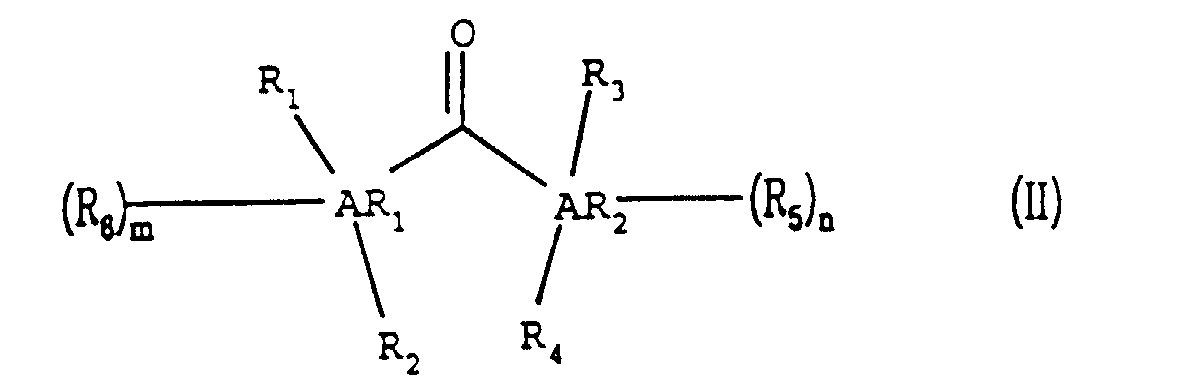
 worin AR1 und AR2 jeweils unabhängig voneinander aus carbocyclischen und heterocyclischen Ring-systemen mit jeweils einem oder zwei kondensierten Ringen ausgewählt sind, wobei jeder Ring 1 bis 7 Ringglieder aufweist und mindestens der an R1 und R3 gebundene Ring aromatisch ist; n und m jeweils unabhängig voneinander für eine ganze Zahl von 0 bis zur Zahl der freien Substitutionspositionen an der AR-Gruppe, wozu es gehört, stehen; R1 bis R4 alle ortho zu der Bindung stehen, die die jeweilige Gruppe AR mit der zentralen Ketongruppe (in Formel II) oder der entsprechenden Hydroxygruppe (in Formel I) verbindet; einer der Reste R1 und R2 aus -OH, -SH und -NHR7 ausgewählt sein muß und der andere der Reste R1 und R2 aus H, -OH, -SH, -NHR7 und R8 ausgewählt ist; R3 und R4 unabhängig voneinander aus H und R8 ausgewählt sind; jeder Rest R5 und jeder Rest R6 unabhängig voneinander aus R8, H, -OH, -SH und -NHR7 ausgewählt ist; R7 aus H, C1-C7-Alkyl, C1-C7-Alkanoyl und C1-C7-Alkoxycarbonyl ausgewählt ist; R8 aus der folgenden Formel IV, Halogen, Nitro, Carboxy, -Si(R14)3 (worin jeder Rest R14 unabhangig voneinander aus H, C1-C3-Alkyl und Phenyl ausgewählt ist), C1-C7-Alkoxy, C1-C7-Alkanoyloxy, C1-C7-Alkoxycarbonyl, C1-C7-Alkylthio, -N(R15)2 (worin jede Gruppe R15 unabhängig von dem anderen Rest R7 ist oder worin beide Gruppen R15 zusammen mit dem Stickstoff, an dem sie hängen, einen 5- bis 6-gliedrigen Ring mit 0 bis zwei weiteren Heteroatomen, ausgewählt aus N, O oder S, bilden), -C(O)-N(R15)2 (worin jede Gruppe R15 unabhängig von dem anderen Rest R7 ist oder worin beide Gruppen R15 zusammen mit dem Stickstoff, an dem sie hängen, einen 5- bis 6-gliedrigen Ring mit 0 bis zwei weiteren Heteroatomen, ausgewählt aus N, O oder S, bilden), nichtsubstituiertem oder substituiertem Phenoxy und nichtsubstituiertem oder substituiertem Phenylthio, wobei die Substituenten an den Phenylgruppen in der Phenoxy- und Phenylthiogruppe bis zu 3 betragen und unabhängig voneinander aus Wasserstoff, Halogen und Trifluormethyl ausgewählt sind, ausgewählt ist; die Formel IV die folgende Bedeutung besitzt:
 worin W für O oder S steht; Y O, S oder NR7 bedeutet; R10 und R11 unabhängig voneinander aus H, Halogen, C1-C7-Alkyl und Trifluormethyl ausgewählt sind; R12 aus Wasserstoff, C1-C7-Alkyl und Phenyl-C1-C7-alkyl ausgewählt ist und R13 Wasserstoff bedeutet oder R12 und R13 zusammen = O bedeuten und Z aus -COR16 ausgewählt ist, worin R16 aus OH, C1-C7-Alkoxy, (Amino, Acylamino, Mono- oder Di-C1-C7-alkylamino)-C1-C7-alkoxy, Carboxy-C1-C7-alkoxy, C1-C7-Alkoxycarbonyl-C1-C7-alkoxy, alpha-(Di-C1-C7-alkylamino, Amino, Mono-C1-C7-alkylamino, Morpholino, Piperidino, Pyrrolidino oder 1-C1-C7-Alkylpiperazino)-carbonyl-C1-C7-alkoxy, (carbocyclischem oder heterocyclischem Aryl)-C1-C7-alkoxy (das nicht substituiert ist oder in der Arylgruppe mit bis zu drei Substituenten substituiert ist, die aus Halogen, C1-C7-Alkyl und C1-C7-Alkoxy ausgewählt sind), 1-(Hydroxy, C1-C7-Alkanoyloxy oder C1-C7-Alkoxy)-C1-C7-alkoxy, (Hydroxy, C1-C7-Alkanoyloxy oder C1-C7-Alkoxy)-C1-C7-alkoxymethoxy, 1-(C1-C7-Alkoxycarbonyloxy)-C1-C7-alkoxy, Phenoxy, substituiertem Phenoxy (worin der Phenylring ein bis drei Substituenten aufweist, wobei jeder unabhängig voneinander aus C1-C7-Alkyl, Halogen und Trifluormethyl ausgewählt ist), 5-Indanyloxy, 3-Phthalidoxy, (C1-C7-Alkyl, C1-C7-Alkoxy oder Halogen)-substituiertem-3-Phthalidoxy, Dihydroxypropyloxy und -N(R15)2 (worin jeder Rest R15 die oben angegebene Bedeutung besitzt) ausgewählt ist; R9 für C1-C6-Alkyl, C5-C6-Cycloalkyl, Phenyl oder Isopinocampheyl (derselben Konfiguration wie die andere Isopinocampheylgruppe im Molekül) steht und X Wasserstoff oder Halogen bedeutet.
- Verfahren nach Anspruch 1, wobei die Verbindung der Formel III oder IIIa entweder (1S)-(+)-B-Diisopinocampheylboranchlond oder (1R)-(-)-B-Diisopinocampheylboranchlorid ist.
- Verfahren nach Anspruch 1, worin jeder der Reste AR1 und AR2 unabhängig voneinander aus Phenyl, Naphthyl, Pyridyl, Pyrimidinyl und Triazinyl ausgewählt ist.
- Verfahren nach Anspruch 1, worin jeder der Reste AR1 und AR2 für dasselbe Ringsystem stehen, jedoch unabhängig voneinander nichtsubstituiert oder substituiert sind, wobei gilt, daß die Zahl, Art und Position der Substituenten an AR1 nicht identisch mit der Zahl, Art und Position der Substituenten an AR2 sind.
- Verfahren nach Anspruch 1, worin AR1 und AR2 jeweils für Phenylringe stehen, die nichtsubstituiert oder gemäß den Angaben in Anspruch 1 substituiert sind.
- Verfahren nach Anspruch 1, worin mindestens einer der Reste R1 und R2 aus -OH und -NHR7 ausgewählt ist.
- Verfahren nach Anspruch 1, worin mindestens einer der Reste R1 und R2 aus -OH ausgewählt ist.
- Verfahren nach Anspruch 1, worin n und m unabhängig voneinander aus 0 bis 3 ausgewählt sind.
- Verfahren nach Anspruch 1, worin jeder der Reste R5 und R6 unabhängig voneinander aus H und R8 ausgewählt ist.
- Verfahren nach Anspruch 1, worin jeder Rest R7 unabhängig voneinander aus H, C1-C7-Alkyl und C1-C7-Alkanoyl ausgewählt ist.
- Verfahren nach Anspruch 1, worin jeder Rest R7 für H steht.
- Verfahren nach Anspruch 1, worin jeder Rest R8 unabhängig voneinander aus Gruppen der Formel IV ausgewählt ist.
- Verfahren nach Anspruch 1, worin R12 und R13 zusammen Oxo bedeuten.
- Verfahren nach Anspruch 13, worin R16 aus OH, C1-C7-Alkoxy, Phenoxy, substituiertem Phenoxy (worin der Phenylring ein bis drei Substituenten aufweist, wobei jeder unabhängig voneinander aus C1-C7-Alkyl, Halogen und Trifluormethyl ausgewählt ist) und -N(R15)2 ausgewählt ist, wobei jeder Rest R15 unabhängig voneinander aus H und C1-C7-Alkyl ausgewählt ist.
- Verfahren nach Anspruch 1, das des weiteren das Herstellen der Verbindung der Formel III oder der Verbindung der Formel IIIa in situ vor der Zugabe der Verbindung der Formel II, das (a) das Umsetzen des geeigneten Enantiomers von α-Pinen mit Halogenboran-Methylsulfid oder Boran-Methylsulfid oder (b) das Umsetzen des geeigneten Enantiomers von α-Pinen mit Boran-Methylsulfid in Gegenwart einer Halogenwasserstoffsäure oder (c) das Hydroborieren von α-Pinen mit R9BH(X) umfaßt, umfaßt.
Applications Claiming Priority (3)
| Application Number | Priority Date | Filing Date | Title |
|---|---|---|---|
| US08/390,255 US5646330A (en) | 1995-02-17 | 1995-02-17 | Production of enantiomerically enriched ortho-substituted α,α-diaromatic methanols |
| US390255 | 1995-02-17 | ||
| PCT/EP1996/000479 WO1996025390A1 (en) | 1995-02-17 | 1996-02-06 | PRODUCTION OF ENANTIOMERICALLY ENRICHED ORTHO-SUBSTITUTED α,α-DIAROMATIC METHANOLS |
Publications (2)
| Publication Number | Publication Date |
|---|---|
| EP0809626A1 EP0809626A1 (de) | 1997-12-03 |
| EP0809626B1 true EP0809626B1 (de) | 1999-09-01 |
Family
ID=23541741
Family Applications (1)
| Application Number | Title | Priority Date | Filing Date |
|---|---|---|---|
| EP96903991A Expired - Lifetime EP0809626B1 (de) | 1995-02-17 | 1996-02-06 | Herstellung von mit enantiomer angereicherten ortho-substituierten alpha, alpha-diaromatischen methanolen |
Country Status (8)
| Country | Link |
|---|---|
| US (1) | US5646330A (de) |
| EP (1) | EP0809626B1 (de) |
| JP (1) | JP3868488B2 (de) |
| AT (1) | ATE183995T1 (de) |
| AU (1) | AU4787696A (de) |
| CA (1) | CA2211981C (de) |
| DE (1) | DE69604054T2 (de) |
| WO (1) | WO1996025390A1 (de) |
Families Citing this family (11)
| Publication number | Priority date | Publication date | Assignee | Title |
|---|---|---|---|---|
| AU2008210455A1 (en) * | 2007-01-31 | 2008-08-07 | Vertex Pharmaceuticals Incorporated | 2-aminopyridine derivatives useful as kinase inhibitors |
| US8173635B2 (en) | 2007-11-02 | 2012-05-08 | Vertex Pharmaceuticals Incorporated | Kinase inhibitors |
| AU2009274011B2 (en) | 2008-07-23 | 2014-12-18 | Vertex Pharmaceuticals Incorporated | Pyrazolopyridine kinase inhibitors |
| US8569337B2 (en) | 2008-07-23 | 2013-10-29 | Vertex Pharmaceuticals Incorporated | Tri-cyclic pyrazolopyridine kinase inhibitors |
| CN102131809A (zh) | 2008-07-23 | 2011-07-20 | 沃泰克斯药物股份有限公司 | 三环吡唑并吡啶激酶抑制剂 |
| JP2011530527A (ja) * | 2008-08-06 | 2011-12-22 | バーテックス ファーマシューティカルズ インコーポレイテッド | アミノピリジンキナーゼ阻害剤 |
| MX2011011653A (es) | 2009-05-06 | 2012-01-20 | Vertex Pharma | Pirazolopiridinas. |
| AU2011209649A1 (en) | 2010-01-27 | 2012-08-09 | Vertex Pharmaceuticals Incorporated | Pyrazolopyrazine kinase inhibitors |
| CN102858769A (zh) | 2010-01-27 | 2013-01-02 | 沃泰克斯药物股份有限公司 | 吡唑并吡啶激酶抑制剂 |
| JP2013518114A (ja) | 2010-01-27 | 2013-05-20 | バーテックス ファーマシューティカルズ インコーポレイテッド | ピラゾロピリミジンキナーゼ阻害剤 |
| CN118772088B (zh) * | 2024-06-14 | 2025-10-03 | 北京农学院 | 2-丁烯羟酸内酯硫代乙酸酯类化合物及其制备方法和应用 |
Family Cites Families (6)
| Publication number | Priority date | Publication date | Assignee | Title |
|---|---|---|---|---|
| US5043479A (en) * | 1986-08-29 | 1991-08-27 | Aldrich Chemical Company, Inc. | Chemically and optically pure diisopinocampheylhaloboranes |
| US4866181A (en) * | 1986-08-29 | 1989-09-12 | Aldrich-Boranes, Inc. | Process for producing optically active alcohols |
| US4772752A (en) * | 1986-08-29 | 1988-09-20 | Aldrich-Boranes, Inc. | Mono- and diisopinocampheylhaloboranes as new chiral reducing agents |
| US4868344A (en) * | 1988-03-30 | 1989-09-19 | Aldrich-Boranes, Inc. | Novel process of producing phenyl or substituted phenylalkylamine pharmaceutical agents and novel chiral intermediates of high enantiomeric purity useful therein |
| US4950791A (en) * | 1988-03-30 | 1990-08-21 | Brown Herbert C | Novel process of producing phenyl or substituted phenylalkylamine pharmaceutical agents and novel chiral intermediates of high enantiomeric purity useful therein |
| EP0580550B1 (de) * | 1992-07-21 | 1997-10-22 | Novartis AG | Oxamidsäure-Derivate als hypocholesterämische Mittel |
-
1995
- 1995-02-17 US US08/390,255 patent/US5646330A/en not_active Expired - Fee Related
-
1996
- 1996-02-06 DE DE69604054T patent/DE69604054T2/de not_active Expired - Fee Related
- 1996-02-06 AU AU47876/96A patent/AU4787696A/en not_active Abandoned
- 1996-02-06 WO PCT/EP1996/000479 patent/WO1996025390A1/en not_active Ceased
- 1996-02-06 EP EP96903991A patent/EP0809626B1/de not_active Expired - Lifetime
- 1996-02-06 AT AT96903991T patent/ATE183995T1/de not_active IP Right Cessation
- 1996-02-06 JP JP52462996A patent/JP3868488B2/ja not_active Expired - Fee Related
- 1996-02-06 CA CA002211981A patent/CA2211981C/en not_active Expired - Fee Related
Also Published As
| Publication number | Publication date |
|---|---|
| WO1996025390A1 (en) | 1996-08-22 |
| JP3868488B2 (ja) | 2007-01-17 |
| CA2211981A1 (en) | 1996-08-22 |
| DE69604054D1 (de) | 1999-10-07 |
| DE69604054T2 (de) | 2000-01-27 |
| CA2211981C (en) | 2008-04-15 |
| JPH11500118A (ja) | 1999-01-06 |
| US5646330A (en) | 1997-07-08 |
| EP0809626A1 (de) | 1997-12-03 |
| ATE183995T1 (de) | 1999-09-15 |
| AU4787696A (en) | 1996-09-04 |
Similar Documents
| Publication | Publication Date | Title |
|---|---|---|
| US6444854B1 (en) | Process for the production of enantiomerically pure or optically enriched sertraline-tetralone using continuous chromatography | |
| EP1242361B1 (de) | Verfahren für die herstellung von tolterodine und deren analoga sowie im verfahren hergestellte zwischenprodukte | |
| US5646330A (en) | Production of enantiomerically enriched ortho-substituted α,α-diaromatic methanols | |
| CN103080072A (zh) | 制备可用于生产nep抑制剂的中间体的新方法 | |
| CN114846008B (zh) | 具有果糖激酶(khk)抑制作用的嘧啶类化合物 | |
| CA2299447C (en) | Procedure for obtaining the enantiomers of cyzolirtine | |
| EP3421455B1 (de) | Verbessertes verfahren zur herstellung von chiralen 3-amino-piperidinen, nützliche zwischenprodukte zur herstellung von tofacitinib | |
| JPH02289A (ja) | 光学活性なアミン−ホウ素系化合物、それを有効成分とする不斉還元剤ならびにそれを用いる光学活性化合物の製造方法 | |
| IE902938A1 (en) | Halogenoalkylphenyl-alcohols, -ketones and hydrates thereof | |
| Van et al. | Synthesis of chiral cis-1, 2, 3-trisubstituted aziridines | |
| Mahmoud et al. | Chiral enrichment of 2-amino-2′-hydroxy-1, 1′-binaphthyl | |
| US6689916B2 (en) | Phenyl propenone compounds | |
| JP3716460B2 (ja) | 不斉シクロプロパン化反応 | |
| EA026337B1 (ru) | Способы разделения замещенных по атому азота производных (s)-5-алкокси-2-аминотетралина | |
| MX2012009920A (es) | Proceso para la obtencion de los enantiomeros del praziquantel y sus derivados 4´-hidroxilados. | |
| KR20120022421A (ko) | 신규의 로수바스타틴 엔-메틸벤질아민 염 및 그의 제조방법 | |
| HK1040516A1 (en) | Process for the production of paroxetine | |
| Wong et al. | Tandem crystallization strategies for resolution of 3, 3, 3‐trifluorolactic acid [CF3CH (OH) COOH] by chiral benzylamines | |
| EP0879225B1 (de) | Trennung von 4-cyano-4-(3,4-dimethoxyphenyl)-5-methylexancarbonsäure | |
| US5892093A (en) | Resolution | |
| Olbrycht et al. | Development of a Route to the Most Active Nafronyl Stereoisomer by Coupling Asymmetric Synthesis and Chiral Chromatography Separation | |
| JPH07224033A (ja) | 光学活性アザスピロ化合物の製法 | |
| JP2012508780A (ja) | γ−アミノ−α,β−不飽和カルボン酸誘導体のエナンチオ選択的合成 | |
| JPH0475207B2 (de) | ||
| JPH02133A (ja) | ノルエフェドリン誘導体および光学活性な第2アルコールの製造法 |
Legal Events
| Date | Code | Title | Description |
|---|---|---|---|
| PUAI | Public reference made under article 153(3) epc to a published international application that has entered the european phase |
Free format text: ORIGINAL CODE: 0009012 |
|
| 17P | Request for examination filed |
Effective date: 19970711 |
|
| AK | Designated contracting states |
Kind code of ref document: A1 Designated state(s): AT BE CH DE DK ES FR GB GR IE IT LI LU MC NL PT SE |
|
| 17Q | First examination report despatched |
Effective date: 19980219 |
|
| GRAG | Despatch of communication of intention to grant |
Free format text: ORIGINAL CODE: EPIDOS AGRA |
|
| GRAG | Despatch of communication of intention to grant |
Free format text: ORIGINAL CODE: EPIDOS AGRA |
|
| GRAH | Despatch of communication of intention to grant a patent |
Free format text: ORIGINAL CODE: EPIDOS IGRA |
|
| RAP1 | Party data changed (applicant data changed or rights of an application transferred) |
Owner name: NOVARTIS-ERFINDUNGEN VERWALTUNGSGESELLSCHAFT M.B. Owner name: NOVARTIS AG |
|
| GRAH | Despatch of communication of intention to grant a patent |
Free format text: ORIGINAL CODE: EPIDOS IGRA |
|
| GRAA | (expected) grant |
Free format text: ORIGINAL CODE: 0009210 |
|
| AK | Designated contracting states |
Kind code of ref document: B1 Designated state(s): AT BE CH DE DK ES FR GB GR IE IT LI LU MC NL PT SE |
|
| PG25 | Lapsed in a contracting state [announced via postgrant information from national office to epo] |
Ref country code: SE Free format text: THE PATENT HAS BEEN ANNULLED BY A DECISION OF A NATIONAL AUTHORITY Effective date: 19990901 Ref country code: NL Free format text: LAPSE BECAUSE OF FAILURE TO SUBMIT A TRANSLATION OF THE DESCRIPTION OR TO PAY THE FEE WITHIN THE PRESCRIBED TIME-LIMIT Effective date: 19990901 Ref country code: GR Free format text: LAPSE BECAUSE OF NON-PAYMENT OF DUE FEES Effective date: 19990901 Ref country code: ES Free format text: THE PATENT HAS BEEN ANNULLED BY A DECISION OF A NATIONAL AUTHORITY Effective date: 19990901 Ref country code: BE Free format text: LAPSE BECAUSE OF FAILURE TO SUBMIT A TRANSLATION OF THE DESCRIPTION OR TO PAY THE FEE WITHIN THE PRESCRIBED TIME-LIMIT Effective date: 19990901 Ref country code: AT Free format text: LAPSE BECAUSE OF FAILURE TO SUBMIT A TRANSLATION OF THE DESCRIPTION OR TO PAY THE FEE WITHIN THE PRESCRIBED TIME-LIMIT Effective date: 19990901 |
|
| REF | Corresponds to: |
Ref document number: 183995 Country of ref document: AT Date of ref document: 19990915 Kind code of ref document: T |
|
| REG | Reference to a national code |
Ref country code: CH Ref legal event code: EP |
|
| REF | Corresponds to: |
Ref document number: 69604054 Country of ref document: DE Date of ref document: 19991007 |
|
| REG | Reference to a national code |
Ref country code: IE Ref legal event code: FG4D |
|
| ITF | It: translation for a ep patent filed | ||
| ET | Fr: translation filed | ||
| PG25 | Lapsed in a contracting state [announced via postgrant information from national office to epo] |
Ref country code: DK Free format text: LAPSE BECAUSE OF FAILURE TO SUBMIT A TRANSLATION OF THE DESCRIPTION OR TO PAY THE FEE WITHIN THE PRESCRIBED TIME-LIMIT Effective date: 19991201 |
|
| PG25 | Lapsed in a contracting state [announced via postgrant information from national office to epo] |
Ref country code: PT Free format text: LAPSE BECAUSE OF FAILURE TO SUBMIT A TRANSLATION OF THE DESCRIPTION OR TO PAY THE FEE WITHIN THE PRESCRIBED TIME-LIMIT Effective date: 19991202 |
|
| NLV1 | Nl: lapsed or annulled due to failure to fulfill the requirements of art. 29p and 29m of the patents act | ||
| PG25 | Lapsed in a contracting state [announced via postgrant information from national office to epo] |
Ref country code: LU Free format text: LAPSE BECAUSE OF NON-PAYMENT OF DUE FEES Effective date: 20000206 Ref country code: IE Free format text: LAPSE BECAUSE OF NON-PAYMENT OF DUE FEES Effective date: 20000206 |
|
| PG25 | Lapsed in a contracting state [announced via postgrant information from national office to epo] |
Ref country code: MC Free format text: THE PATENT HAS BEEN ANNULLED BY A DECISION OF A NATIONAL AUTHORITY Effective date: 20000229 |
|
| PLBE | No opposition filed within time limit |
Free format text: ORIGINAL CODE: 0009261 |
|
| STAA | Information on the status of an ep patent application or granted ep patent |
Free format text: STATUS: NO OPPOSITION FILED WITHIN TIME LIMIT |
|
| 26N | No opposition filed | ||
| REG | Reference to a national code |
Ref country code: IE Ref legal event code: MM4A |
|
| REG | Reference to a national code |
Ref country code: GB Ref legal event code: IF02 |
|
| PGFP | Annual fee paid to national office [announced via postgrant information from national office to epo] |
Ref country code: CH Payment date: 20080129 Year of fee payment: 13 |
|
| PGFP | Annual fee paid to national office [announced via postgrant information from national office to epo] |
Ref country code: IT Payment date: 20080227 Year of fee payment: 13 Ref country code: GB Payment date: 20080206 Year of fee payment: 13 Ref country code: DE Payment date: 20080131 Year of fee payment: 13 |
|
| PGFP | Annual fee paid to national office [announced via postgrant information from national office to epo] |
Ref country code: FR Payment date: 20080208 Year of fee payment: 13 |
|
| REG | Reference to a national code |
Ref country code: CH Ref legal event code: PL |
|
| GBPC | Gb: european patent ceased through non-payment of renewal fee |
Effective date: 20090206 |
|
| PG25 | Lapsed in a contracting state [announced via postgrant information from national office to epo] |
Ref country code: LI Free format text: LAPSE BECAUSE OF NON-PAYMENT OF DUE FEES Effective date: 20090228 Ref country code: CH Free format text: LAPSE BECAUSE OF NON-PAYMENT OF DUE FEES Effective date: 20090228 |
|
| REG | Reference to a national code |
Ref country code: FR Ref legal event code: ST Effective date: 20091030 |
|
| PG25 | Lapsed in a contracting state [announced via postgrant information from national office to epo] |
Ref country code: DE Free format text: LAPSE BECAUSE OF NON-PAYMENT OF DUE FEES Effective date: 20090901 |
|
| PG25 | Lapsed in a contracting state [announced via postgrant information from national office to epo] |
Ref country code: GB Free format text: LAPSE BECAUSE OF NON-PAYMENT OF DUE FEES Effective date: 20090206 Ref country code: FR Free format text: LAPSE BECAUSE OF NON-PAYMENT OF DUE FEES Effective date: 20090302 |
|
| PG25 | Lapsed in a contracting state [announced via postgrant information from national office to epo] |
Ref country code: IT Free format text: LAPSE BECAUSE OF NON-PAYMENT OF DUE FEES Effective date: 20090206 |