EP0812821B1 - Ester carbonique de betaine, leur préparation et utilisation - Google Patents
Ester carbonique de betaine, leur préparation et utilisation Download PDFInfo
- Publication number
- EP0812821B1 EP0812821B1 EP97109372A EP97109372A EP0812821B1 EP 0812821 B1 EP0812821 B1 EP 0812821B1 EP 97109372 A EP97109372 A EP 97109372A EP 97109372 A EP97109372 A EP 97109372A EP 0812821 B1 EP0812821 B1 EP 0812821B1
- Authority
- EP
- European Patent Office
- Prior art keywords
- choline
- process according
- reaction
- value
- atoms
- Prior art date
- Legal status (The legal status is an assumption and is not a legal conclusion. Google has not performed a legal analysis and makes no representation as to the accuracy of the status listed.)
- Expired - Lifetime
Links
- 0 CC(C)(*)N(*)C(C)(C)*O Chemical compound CC(C)(*)N(*)C(C)(C)*O 0.000 description 3
Classifications
-
- C—CHEMISTRY; METALLURGY
- C07—ORGANIC CHEMISTRY
- C07C—ACYCLIC OR CARBOCYCLIC COMPOUNDS
- C07C219/00—Compounds containing amino and esterified hydroxy groups bound to the same carbon skeleton
- C07C219/02—Compounds containing amino and esterified hydroxy groups bound to the same carbon skeleton having esterified hydroxy groups and amino groups bound to acyclic carbon atoms of the same carbon skeleton
- C07C219/04—Compounds containing amino and esterified hydroxy groups bound to the same carbon skeleton having esterified hydroxy groups and amino groups bound to acyclic carbon atoms of the same carbon skeleton the carbon skeleton being acyclic and saturated
- C07C219/16—Compounds containing amino and esterified hydroxy groups bound to the same carbon skeleton having esterified hydroxy groups and amino groups bound to acyclic carbon atoms of the same carbon skeleton the carbon skeleton being acyclic and saturated having at least one of the hydroxy groups esterified by an inorganic acid or a derivative thereof
-
- C—CHEMISTRY; METALLURGY
- C07—ORGANIC CHEMISTRY
- C07C—ACYCLIC OR CARBOCYCLIC COMPOUNDS
- C07C213/00—Preparation of compounds containing amino and hydroxy, amino and etherified hydroxy or amino and esterified hydroxy groups bound to the same carbon skeleton
- C07C213/04—Preparation of compounds containing amino and hydroxy, amino and etherified hydroxy or amino and esterified hydroxy groups bound to the same carbon skeleton by reaction of ammonia or amines with olefin oxides or halohydrins
Definitions
- the invention relates to carbonic acid ester betaines and their preparation and use, especially for the production of choline salts, especially of choline salts that are practically free of By-products are.
- French patent 736 107 already mentions the use of choline salts in pharmaceutical and cosmetic Creams, as well as additives in coloring or finishing processes in the leather and textile industry.
- DE-A1 3 135 671 describes a process for continuous Preparation of salts of choline described in the trimethylamine, Ethylene oxide and an acid in the presence of water at a pH above 9 to 12 and a temperature from 50 to 80 ° C can be implemented.
- the salts thus obtained can used as starting materials for pharmaceuticals and animal feed become.
- EP-A-0 400 435 discloses betaine-like carbonic acid semiesters of the formula wherein R 1 and R 2 are the same or different and are, inter alia, a C 1 to C 25 alkyl group, R 3 is, inter alia, a C 1 to C 10 alkyl group and R 4 is, inter alia, a C 1 to C 25 alkylene group , which are produced from alkanolamines and carbonic acid diesters with a yield of 40 to 42%.
- Choline is generally made by that trimethylamine in the presence of water with ethylene oxide implements. Doing the implementation of trimethylamine and ethylene oxide in the presence of carbon dioxide and water directly choline bicarbonate or choline carbonate, i.e. choline salts carbonic acid. By adding acids such as hydrochloric acid or organic acids such as Then you get the tartaric acid corresponding choline salts.
- choline chloride One of the most important choline salts, namely choline chloride, can won according to the procedures described above, but also how in French Pat. No. 1,458,127, by reacting trimethylammonium chloride can be obtained with ethylene oxide. But also There are problems with the by-products in this process.
- the object of the invention is therefore to provide a process for the preparation of a specific compound which is practically free from oligomers and other by-products and can be converted directly into salts of the formula (III). It is another object of the invention to provide a process for the preparation of salts of the formula (III) in which the salts are obtained directly without corresponding impurities, so that the cleaning processes and the disposal of by-products or the processing of previously required There is no mother liquor.
- Another object of the invention is to provide a method for To provide such a connection, that works economically, where the yield is very high, i.e. is almost quantitative and operates with less effort must be, both when processing the product itself as well as in the isolation of the derived products made from it, especially the salts.
- Ethylene oxide is preferred as the alkylene oxide. It is advantageous to use the alkylene oxide and carbon dioxide in excess, based on the amine, the excess alkylene oxide preferably being 1 to 200 mol%. The excess of carbon dioxide is preferably ensured by setting an excess pressure of carbon dioxide in the reaction vessel, which is preferably constant during the entire reaction.
- the temperature at which the reaction is carried out can be varied within wide ranges, e.g. of Room temperature up to 150 ° C. However, the reaction is preferred performed at a temperature of 40 - 80 ° C.
- the pressure which is preferably set with carbon dioxide is preferably in a range from 1 to 5 bar.
- the reaction is carried out in the absence of water
- the absence of water means that there is essentially no water is available; so there is no addition of water instead of.
- Small amounts of water in the solvent used or moisture in the reagents used are up to harmless to a certain degree.
- the amount of water should be however not more than 0.1 mol%, based on the amount used Amine.
- the reaction is carried out in the presence of solvents, methanol being particularly suitable as solvent.
- solvents methanol being particularly suitable as solvent.
- Other useful solvents are e.g. n-propanol, isopropanol and n-butanol.
- polar and protic aprotic solvents suitable under the reaction conditions essentially inert to the chemicals used and the corresponding product.
- Solvents which are suitable under the reaction conditions are suitable with the chemicals used and the corresponding Product as little or as little or very little as possible Respond.
- an inert gas in the reaction space is possible.
- the reaction chamber first with an inert gas rinsed, e.g. Nitrogen or argon. That in the reaction vessel existing inert gas after the purging process during the Reaction remain in it.
- an inert gas rinsed e.g. Nitrogen or argon. That in the reaction vessel existing inert gas after the purging process during the Reaction remain in it.
- the preparation of the carbonic ester betaines can e.g. on the following Way done.
- a suitable reaction vessel is first filled with an inert gas, e.g. Flushed with nitrogen or argon. Then the solvent submitted, especially methanol, and the amine either metered into the solvent in gaseous or liquid form. Then gaseous carbon dioxide is injected onto the system.
- the reaction vessel is expediently an autoclave, so that Prints e.g. of 2 bar and more can be set. Then a temperature of, for example, 40 to 80 ° C. is set and metered in with stirring alkylene oxide, which in liquid or can also be introduced in gaseous form. While the temperature of the feed of the alkylene oxide is checked, whereby the reaction temperature by removing the heat of reaction preferably keeps constant.
- the reaction can also be continuous, i.e. especially continuously be performed.
- the salts of the formula (III) can be prepared by the action of acids with pK s ⁇ 6.46 on the ester betaines of the formula (I).
- choline bitartrate Like most of the choline salts mentioned above, e.g. B. choline chloride, choline bitartrate (see formula IV) is mainly used as an additive in animal feed, especially in cat and chicken feed. In addition, choline bitartrate is also used for pharmaceutical purposes for the therapy of patients with cirrhosis or other liver diseases. A larger amount of choline bitartrate is also used in soft drinks and in so-called power drinks.
- a product accessible in the form of a carbonic acid monocholine ester betaine is that itself has a very high degree of purity has, i.e. practically no oligomers and other by-products contains.
- the degree of purity of this substance is special Advantageously noticeable if one from the carbonic acid monocholine ester betaine descendants of the Want to make cholins, such as Salts, especially that already mentioned choline bitartrate or choline citrate.
- Another object of the invention is therefore the use of carbonic acid monocholine ester betaine for the production of Salts of formula (III) e.g. for the production of choline salts.
- the method according to the invention runs considerably faster, than the known methods for producing, for example Choline or choline carbonates.
- Example 1 The mother liquor obtained in Example 1 (339.5 g) was up to evaporated to a total weight of 210 g and as a solvent used for 158.4 g tartaric acid. This solution was then for the production of choline bitartrate starting from carbonic acid monocholine ester betaine used that previously in a like in Example 1 described, batch was prepared. In this In this case, 266.8 g (99.6%) choline bitartrate could be obtained.
- choline salts tricholine citrate, Bis-choline tartrate, bis-choline hydrogen phosphate, choline dihydrogen phosphate, Choline dihydrogen citrate, bis-choline hydrogen citrate, Choline gluconate, choline salicylate, choline carboxymethyl cellulose and choline ascorbate.
- the CO 2 consumption during the reaction was measured and regulated using a flow controller. After a total reaction time of about 1.5 hours, the theoretical amount of CO 2 (28.6 g corresponds to 0.65 mol) was absorbed by the reaction solution and no additional consumption could be determined. After a total of 2 hours of reaction time, the reactor was cooled, the solution was removed from the reactor and completely evaporated on a rotary evaporator. A yellowish viscous oil was obtained as residue, which gradually crystallized after standing for a long time. The yield of product (A) determined by GPC and NMR analysis was 94%.
- a 1000 ml Büchi reactor was flushed with nitrogen and then filled with 400 ml of methanol and 37.46 g (0.2 mol) of N, N-dibutyl-N- (2-hydroxypropyl) amine (DBHPA). After the reactor had been closed, the DBHPA solution was heated to 55 ° C. and 19.44 g (0.4 mol) of ethylene oxide were metered in by means of a membrane pump within 10 minutes. A total pressure of about 2 bar was then set with CO 2 . The reaction was allowed to proceed with the CO 2 valve open. After a total reaction time of about 31 hours, the reaction was terminated, the solvent was evaporated off completely at 50 ° C. in vacuo and the product (D) was obtained in a yield of 91.2%.
- DBHPA N, N-dibutyl-N- (2-hydroxypropyl) amine
- a 1000 ml Büchi reactor was flushed with nitrogen and then filled with 250 ml of methanol and 40.27 g (0.2 mol) of N, N-dibutyl-N- (2-hydroxybutyl) amine (DBHBA). After the reactor had been closed, the DBHBA solution was heated to 55 ° C. and 17.6 g (0.4 mol) of ethylene oxide were metered in by means of a membrane pump within 10 minutes. A total pressure of 2 bar was then set with CO 2 . With the CO 2 valve open, the reaction was allowed to run overnight. After a total reaction time of about 31 hours, the reaction was terminated and the solvent was completely evaporated off at 50 ° C. in vacuo. The yield of product (E) determined by GPC analysis was 74.8%.
- DBHBA N, N-dibutyl-N- (2-hydroxybutyl) amine
Landscapes
- Chemical & Material Sciences (AREA)
- Organic Chemistry (AREA)
- Chemical Kinetics & Catalysis (AREA)
- Inorganic Chemistry (AREA)
- Organic Low-Molecular-Weight Compounds And Preparation Thereof (AREA)
- Polysaccharides And Polysaccharide Derivatives (AREA)
Claims (15)
- Procédé pour la fabrication d'ester carbonique de bétaïne ayant la formule (I)où R est un groupe alkyle ou différents groupes alkyles ayant 1 à 18 atomes de carbone, R' est un groupe alkylène ayant 2 à 12 atomes de carbone et Z est un groupe hydroxyalkyle ayant 1 à 12 atomes de carbone, m et n sont des nombres entiers, m est compris entre 0 et 3 et n est compris entre 3 et 0, et m+n=3, caractérisé en ce que l'on fait réagir une amine ayant la formule (II)
 où R et Z sont définis comme précédemment, r, p et q sont des nombres entiers, r+p+q=3, r est compris entre 0 et 3, p est compris entre 3 et 0 et q est compris entre 0 et 2, avec un oxyde d'alkylène ayant 2 à 12 atomes de carbone en présence de dioxyde de carbone dans un agent dissolvant sensiblement inerte et en l'absence d'eau.
- Procédé selon la revendication 1, caractérisé en ce que l'oxyde d'alkylène est l'oxyde d'éthylène.
- Procédé selon l'une des revendications 1 et 2, caractérisé en ce que la réaction se déroule dans un agent dissolvant organique.
- Procédé selon la revendication 3, caractérisé en ce que l'on utilise du méthanol comme agent dissolvant organique.
- Procédé selon l'une des revendications 1 à 4, caractérisé en ce que l'on réalise la réaction avec un excès d'oxyde d'alkylène et avec un excès de dioxyde de carbone, par rapport à l'amine utilisée.
- Procédé selon la revendication 5, caractérisé en ce que l'on utilise un excès de 1 à 200% molaire d'oxyde d'alkylène et 10 à 800% molaire de dioxyde de carbone.
- Procédé selon l'une des revendications 1 à 6, caractérisé en ce que la réaction se déroule à une température comprise entre la température ambiante et 150°C.
- Procédé selon l'une des revendications 1 à 7, caractérisé en ce que la réaction se déroule à une température comprise entre 40 et 80°C.
- Procédé selon l'une des revendications 1 à 8, caractérisé en ce que la pression obtenue avec le dioxyde de carbone se trouve dans une gamme allant de 1 à 5 bars.
- Procédé selon l'une des revendications 1 à 9, caractérisé en ce que la chambre de réaction est tout d'abord lavée avec un gaz inerte, de préférence de l'azote ou de l'argon, qui peut rester dans la chambre pendant la réaction.
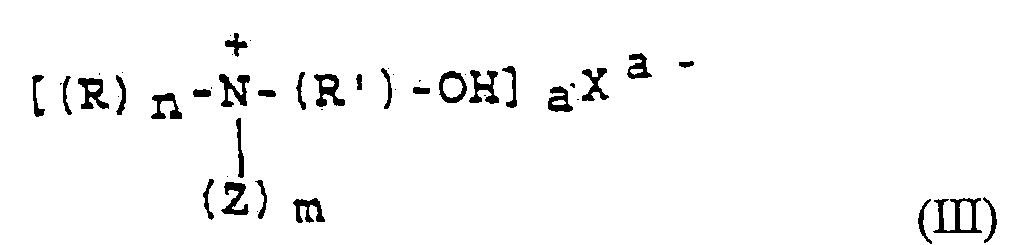
- Procédé pour la fabrication de sels ayant la formule (III)où R est un groupe alkyle ou différents groupes alkyles ayant 1 à 18 atomes de carbone, R' est un groupe alkylène ayant 2 à 12 atomes de carbone et Z est un groupe hydroxyalkyle ayant 1 à 12 atomes de carbone, m et n sont des nombres entiers, m est compris entre 0 et 3 et n est compris entre 3 et 0, m+n=3, X désigne l'anion d'un acide organique ou minéral et a est un nombre entier compris entre 1 et 3, caractérisé en ce que l'on fabrique tout d'abord de l'ester carbonique de bétaïne ayant la formule (I)
 en faisant réagir une amine ayant la formule (II)
 où R et Z sont définis comme précédemment, r, p et q sont des nombres entiers, r+p+q=3, r est compris entre 0 et 3, p est compris entre 3 et 0 et q est compris entre 0 et 2, avec un oxyde d'alkylène ayant 2 à 12 atomes de carbone en présence de dioxyde de carbone dans un agent dissolvant sensiblement inerte et en l'absence d'eau, après quoi on laisse réagir des acides HaXa ayant un pKs inférieur à 6,46, où a et X sont comme définis ci-dessus, sur l'ester carbonique de bétaïne ayant la formule (I).
- Procédé selon la revendication 11 pour la fabrication de bitartrate de choline.
- Procédé selon la revendication 11 pour la fabrication de citrate de tricholine, de tartrate de bis-choline, d'hydrogène-phosphate de bis-choline, de dihydrogène-phosphate de choline, d'hydrogène-citrate de bis-choline, de dihydrogène-citrate de choline, de gluconate de choline, de salicylate de choline, de chlorure de choline et d'ascorbate de choline.
- Procédé selon la revendication 11 pour la fabrication de carboxyméthylcellulose de choline.
- Ester carbonique de bétaïne ayant la formule (I)où R, R', Z, m et n sont comme définis dans la revendication 1, à l'exception des composés pour lesquels n=3.

Applications Claiming Priority (2)
| Application Number | Priority Date | Filing Date | Title |
|---|---|---|---|
| DE19623324 | 1996-06-12 | ||
| DE19623324 | 1996-06-12 |
Publications (2)
| Publication Number | Publication Date |
|---|---|
| EP0812821A1 EP0812821A1 (fr) | 1997-12-17 |
| EP0812821B1 true EP0812821B1 (fr) | 2000-11-29 |
Family
ID=7796661
Family Applications (1)
| Application Number | Title | Priority Date | Filing Date |
|---|---|---|---|
| EP97109372A Expired - Lifetime EP0812821B1 (fr) | 1996-06-12 | 1997-06-10 | Ester carbonique de betaine, leur préparation et utilisation |
Country Status (3)
| Country | Link |
|---|---|
| EP (1) | EP0812821B1 (fr) |
| DE (1) | DE59702678D1 (fr) |
| ES (1) | ES2153622T3 (fr) |
Families Citing this family (7)
| Publication number | Priority date | Publication date | Assignee | Title |
|---|---|---|---|---|
| DE10109073A1 (de) * | 2001-02-23 | 2002-09-05 | Basf Ag | Kristallines Cholinascorbat |
| ITMI20052459A1 (it) * | 2005-12-22 | 2007-06-23 | Isagro Spa | Sali quaternari e relativo uso per il controllo di fitopatogeni |
| CN106397082A (zh) * | 2016-09-18 | 2017-02-15 | 河南工业大学 | 一种基于抗坏血酸的低共熔溶剂及其制备方法和应用 |
| CN109438268B (zh) * | 2018-10-18 | 2021-08-03 | 济南蓬勃生物技术有限公司 | 一种酒石酸氢胆碱及其制备方法 |
| CN109748808B (zh) * | 2018-12-26 | 2021-12-24 | 济南蓬勃生物技术有限公司 | 一种胆碱碳酸氢盐和碳酸盐的制备方法 |
| CN115850094B (zh) * | 2022-09-07 | 2025-02-11 | 北华航天工业学院 | 一种利用1,2-环氧丁烷合成β-氨基醇的方法 |
| CN117800855A (zh) * | 2023-12-21 | 2024-04-02 | 济南亚西亚药业有限公司 | 一种磷酸二氢胆碱的制备方法 |
Family Cites Families (4)
| Publication number | Priority date | Publication date | Assignee | Title |
|---|---|---|---|---|
| GB379260A (en) * | 1931-04-29 | 1932-08-25 | Fride Koerner | Improvements in and relating to the production of choline compounds |
| DE2849065A1 (de) * | 1978-11-11 | 1980-05-22 | Basf Ag | Verwendung von quartaeren ammoniumsalzen als leitsalze |
| DE3135671A1 (de) * | 1981-09-09 | 1983-03-24 | Basf Ag, 6700 Ludwigshafen | Verfahren zur kontinuierlichen herstellung von salzen des cholins |
| DE3917830A1 (de) * | 1989-06-01 | 1991-02-21 | Basf Ag | Amphotere kohlensaeurehalbester |
-
1997
- 1997-06-10 EP EP97109372A patent/EP0812821B1/fr not_active Expired - Lifetime
- 1997-06-10 ES ES97109372T patent/ES2153622T3/es not_active Expired - Lifetime
- 1997-06-10 DE DE59702678T patent/DE59702678D1/de not_active Expired - Fee Related
Also Published As
| Publication number | Publication date |
|---|---|
| ES2153622T3 (es) | 2001-03-01 |
| EP0812821A1 (fr) | 1997-12-17 |
| DE59702678D1 (de) | 2001-01-04 |
Similar Documents
| Publication | Publication Date | Title |
|---|---|---|
| DE4414879C2 (de) | Verfahren zur Herstellung von farbstabilem Dialkylaminoethanol | |
| EP0812821B1 (fr) | Ester carbonique de betaine, leur préparation et utilisation | |
| DE3240805A1 (de) | Verfahren zur herstellung von hydroxy-phenoxy-alkancarbonsaeuren | |
| DE3308922A1 (de) | Verfahren zur herstellung von fettsaeureestern der ascorbinsaeure | |
| DE3051036C2 (fr) | ||
| DE2130981A1 (de) | Neue Thiazol Verbindungen | |
| DE3538747C2 (fr) | ||
| DE2519315C2 (de) | Verfahren zur Herstellung von 3-Trichlormethyl-5-chlor-1,2,4-thiadiazol | |
| DE2719020A1 (de) | Verfahren zur herstellung von anthranilamiden | |
| DE2527157C2 (de) | Verfahren zur Herstellung von 2-Formylchinoxalin-N↑1↑,N↑4↑-dioxyddimethylacetal | |
| DE60030435T2 (de) | Verfahren zum austausch und zur freisetzung von aminen aus ihrem carbamoylfluorid | |
| DE3234917C2 (fr) | ||
| DE2651984A1 (de) | Verfahren zur herstellung von n,n- dimethylpiperidiniumchlorid bzw. n,n- dimethylmorpholiniumchlorid | |
| DE2304615C3 (de) | Verfahren zur Herstellung von reinem N-Isopropyl-α -chloracetanilid | |
| DE69401676T2 (de) | Verfahren zur Herstellung von ein N,N-disubstituiertes p-Phenylendiamine sulfat Derivate | |
| DE19853401C1 (de) | Verfahren zur Herstellung eines Iodalkinylcarbamates | |
| DE2033611C3 (de) | Verfahren zur Herstellung von 1-(2-Thiazolyl)-2-oxotetrahydroimidazol | |
| EP0066856A1 (fr) | Procédé de préparation des composés organiques polyfonctionnels portant au moins un groupe éther tert. butylique ou un groupe ester tert. butylique | |
| DE3902239A1 (de) | Verfahren zur herstellung von 2-nitro-4-trifluormethyl-anilin | |
| DE169746C (fr) | ||
| DE1445951C3 (de) | Verfahren zur Herstellung von diquaternären 4,4'Bipyridyliumsalzen | |
| EP0542086A1 (fr) | Procédé de préparation de la N-[2-chloropyridin-5-yl)méthyl]éthylènediamine | |
| DD290189A5 (de) | Verbessertes verfahren zur herstellung von 2-benzimidazol-carbaminsaeuremethylester | |
| DE3431009A1 (de) | Verfahren zur herstellung von 6-demethyl-6-desoxy-6-methylen-5-oxytetracyclin und dessen 11a-chlorderivat | |
| DE2355917A1 (de) | Verfahren zur herstellung von hochreinem 1.3-bis-(beta-aethylhexyl)-5-amino- 5-methyl-hexahydropyrimidin |
Legal Events
| Date | Code | Title | Description |
|---|---|---|---|
| PUAI | Public reference made under article 153(3) epc to a published international application that has entered the european phase |
Free format text: ORIGINAL CODE: 0009012 |
|
| AK | Designated contracting states |
Kind code of ref document: A1 Designated state(s): BE CH DE ES FR GB IT LI NL SE |
|
| 17P | Request for examination filed |
Effective date: 19980609 |
|
| AKX | Designation fees paid |
Free format text: BE CH DE ES FR GB IT LI NL SE |
|
| RBV | Designated contracting states (corrected) |
Designated state(s): BE CH DE ES FR GB IT LI NL SE |
|
| 17Q | First examination report despatched |
Effective date: 19990430 |
|
| GRAG | Despatch of communication of intention to grant |
Free format text: ORIGINAL CODE: EPIDOS AGRA |
|
| 17Q | First examination report despatched |
Effective date: 19990430 |
|
| GRAG | Despatch of communication of intention to grant |
Free format text: ORIGINAL CODE: EPIDOS AGRA |
|
| GRAH | Despatch of communication of intention to grant a patent |
Free format text: ORIGINAL CODE: EPIDOS IGRA |
|
| GRAH | Despatch of communication of intention to grant a patent |
Free format text: ORIGINAL CODE: EPIDOS IGRA |
|
| GRAA | (expected) grant |
Free format text: ORIGINAL CODE: 0009210 |
|
| AK | Designated contracting states |
Kind code of ref document: B1 Designated state(s): BE CH DE ES FR GB IT LI NL SE |
|
| REG | Reference to a national code |
Ref country code: CH Ref legal event code: EP |
|
| REF | Corresponds to: |
Ref document number: 59702678 Country of ref document: DE Date of ref document: 20010104 |
|
| ITF | It: translation for a ep patent filed | ||
| REG | Reference to a national code |
Ref country code: CH Ref legal event code: NV Representative=s name: RITSCHER & SEIFERT |
|
| REG | Reference to a national code |
Ref country code: ES Ref legal event code: FG2A Ref document number: 2153622 Country of ref document: ES Kind code of ref document: T3 |
|
| ET | Fr: translation filed | ||
| GBT | Gb: translation of ep patent filed (gb section 77(6)(a)/1977) |
Effective date: 20010222 |
|
| PLBE | No opposition filed within time limit |
Free format text: ORIGINAL CODE: 0009261 |
|
| STAA | Information on the status of an ep patent application or granted ep patent |
Free format text: STATUS: NO OPPOSITION FILED WITHIN TIME LIMIT |
|
| 26N | No opposition filed | ||
| REG | Reference to a national code |
Ref country code: GB Ref legal event code: IF02 |
|
| PGFP | Annual fee paid to national office [announced via postgrant information from national office to epo] |
Ref country code: NL Payment date: 20030522 Year of fee payment: 7 |
|
| PGFP | Annual fee paid to national office [announced via postgrant information from national office to epo] |
Ref country code: GB Payment date: 20030604 Year of fee payment: 7 |
|
| PGFP | Annual fee paid to national office [announced via postgrant information from national office to epo] |
Ref country code: SE Payment date: 20030619 Year of fee payment: 7 Ref country code: FR Payment date: 20030619 Year of fee payment: 7 |
|
| PGFP | Annual fee paid to national office [announced via postgrant information from national office to epo] |
Ref country code: CH Payment date: 20030623 Year of fee payment: 7 |
|
| PGFP | Annual fee paid to national office [announced via postgrant information from national office to epo] |
Ref country code: DE Payment date: 20030630 Year of fee payment: 7 |
|
| PGFP | Annual fee paid to national office [announced via postgrant information from national office to epo] |
Ref country code: ES Payment date: 20030708 Year of fee payment: 7 |
|
| PGFP | Annual fee paid to national office [announced via postgrant information from national office to epo] |
Ref country code: BE Payment date: 20030724 Year of fee payment: 7 |
|
| PG25 | Lapsed in a contracting state [announced via postgrant information from national office to epo] |
Ref country code: GB Free format text: LAPSE BECAUSE OF NON-PAYMENT OF DUE FEES Effective date: 20040610 |
|
| PG25 | Lapsed in a contracting state [announced via postgrant information from national office to epo] |
Ref country code: SE Free format text: LAPSE BECAUSE OF NON-PAYMENT OF DUE FEES Effective date: 20040611 Ref country code: ES Free format text: LAPSE BECAUSE OF NON-PAYMENT OF DUE FEES Effective date: 20040611 |
|
| PG25 | Lapsed in a contracting state [announced via postgrant information from national office to epo] |
Ref country code: LI Free format text: LAPSE BECAUSE OF NON-PAYMENT OF DUE FEES Effective date: 20040630 Ref country code: CH Free format text: LAPSE BECAUSE OF NON-PAYMENT OF DUE FEES Effective date: 20040630 Ref country code: BE Free format text: LAPSE BECAUSE OF NON-PAYMENT OF DUE FEES Effective date: 20040630 |
|
| BERE | Be: lapsed |
Owner name: *AKZO NOBEL N.V. Effective date: 20040630 |
|
| PG25 | Lapsed in a contracting state [announced via postgrant information from national office to epo] |
Ref country code: NL Free format text: LAPSE BECAUSE OF NON-PAYMENT OF DUE FEES Effective date: 20050101 Ref country code: DE Free format text: LAPSE BECAUSE OF NON-PAYMENT OF DUE FEES Effective date: 20050101 |
|
| EUG | Se: european patent has lapsed | ||
| GBPC | Gb: european patent ceased through non-payment of renewal fee |
Effective date: 20040610 |
|
| EUG | Se: european patent has lapsed | ||
| REG | Reference to a national code |
Ref country code: CH Ref legal event code: PL |
|
| PG25 | Lapsed in a contracting state [announced via postgrant information from national office to epo] |
Ref country code: FR Free format text: LAPSE BECAUSE OF NON-PAYMENT OF DUE FEES Effective date: 20050228 |
|
| NLV4 | Nl: lapsed or anulled due to non-payment of the annual fee |
Effective date: 20050101 |
|
| REG | Reference to a national code |
Ref country code: FR Ref legal event code: ST |
|
| PG25 | Lapsed in a contracting state [announced via postgrant information from national office to epo] |
Ref country code: IT Free format text: LAPSE BECAUSE OF NON-PAYMENT OF DUE FEES;WARNING: LAPSES OF ITALIAN PATENTS WITH EFFECTIVE DATE BEFORE 2007 MAY HAVE OCCURRED AT ANY TIME BEFORE 2007. THE CORRECT EFFECTIVE DATE MAY BE DIFFERENT FROM THE ONE RECORDED. Effective date: 20050610 |
|
| REG | Reference to a national code |
Ref country code: ES Ref legal event code: FD2A Effective date: 20040611 |