EP0813558B1 - Neue blockcopolymere und eine neue methode zur herstellung von (co)polymeren mit enger molekulargewichtsverteilung durch metallfreie anionische polymersiation in gegenwart eines phosphoniumkations - Google Patents
Neue blockcopolymere und eine neue methode zur herstellung von (co)polymeren mit enger molekulargewichtsverteilung durch metallfreie anionische polymersiation in gegenwart eines phosphoniumkations Download PDFInfo
- Publication number
- EP0813558B1 EP0813558B1 EP96907099A EP96907099A EP0813558B1 EP 0813558 B1 EP0813558 B1 EP 0813558B1 EP 96907099 A EP96907099 A EP 96907099A EP 96907099 A EP96907099 A EP 96907099A EP 0813558 B1 EP0813558 B1 EP 0813558B1
- Authority
- EP
- European Patent Office
- Prior art keywords
- carbon atoms
- alkyl
- polymer
- phenyl
- group
- Prior art date
- Legal status (The legal status is an assumption and is not a legal conclusion. Google has not performed a legal analysis and makes no representation as to the accuracy of the status listed.)
- Expired - Lifetime
Links
Classifications
-
- C—CHEMISTRY; METALLURGY
- C08—ORGANIC MACROMOLECULAR COMPOUNDS; THEIR PREPARATION OR CHEMICAL WORKING-UP; COMPOSITIONS BASED THEREON
- C08F—MACROMOLECULAR COMPOUNDS OBTAINED BY REACTIONS ONLY INVOLVING CARBON-TO-CARBON UNSATURATED BONDS
- C08F297/00—Macromolecular compounds obtained by successively polymerising different monomer systems using a catalyst of the ionic or coordination type without deactivating the intermediate polymer
- C08F297/02—Macromolecular compounds obtained by successively polymerising different monomer systems using a catalyst of the ionic or coordination type without deactivating the intermediate polymer using a catalyst of the anionic type
- C08F297/026—Macromolecular compounds obtained by successively polymerising different monomer systems using a catalyst of the ionic or coordination type without deactivating the intermediate polymer using a catalyst of the anionic type polymerising acrylic acid, methacrylic acid or derivatives thereof
-
- C—CHEMISTRY; METALLURGY
- C08—ORGANIC MACROMOLECULAR COMPOUNDS; THEIR PREPARATION OR CHEMICAL WORKING-UP; COMPOSITIONS BASED THEREON
- C08F—MACROMOLECULAR COMPOUNDS OBTAINED BY REACTIONS ONLY INVOLVING CARBON-TO-CARBON UNSATURATED BONDS
- C08F2/00—Processes of polymerisation
- C08F2/04—Polymerisation in solution
- C08F2/06—Organic solvent
-
- C—CHEMISTRY; METALLURGY
- C08—ORGANIC MACROMOLECULAR COMPOUNDS; THEIR PREPARATION OR CHEMICAL WORKING-UP; COMPOSITIONS BASED THEREON
- C08F—MACROMOLECULAR COMPOUNDS OBTAINED BY REACTIONS ONLY INVOLVING CARBON-TO-CARBON UNSATURATED BONDS
- C08F4/00—Polymerisation catalysts
Definitions
- the present invention concerns novel block copolymers and a novel method for preparing polymers (preferably (meth)acrylate polymers and copolymers) having a narrow molecular weight distribution by metal-free anionic polymerization in the presence of a phosphonium cation.
- GTP Group Transfer Polymerization
- PMMA poly(methyl methacrylate)
- MWD molecular weight distribution
- coordinating ligands such as metalated alkoxides 3 and lithium chloride 4 were utilized in the anionic polymerization of MMA.
- control of the MWD was lost at temperatures of ⁇ -40 °C.
- anionic polymerization in the presence of coordinating ligands was limited to temperatures of ⁇ -40 °C.
- anionic polymerizations have been successful to varying degrees in producing narrow MWD PMMA at ambient temperatures.
- anionic polymerization of MMA is conducted using bulky, delocalized carbanions as initiators, in polar solvents such as tetrahydrofuran (THF) at low temperatures (i.e., -78°C) to prevent nucleophilic attack of the carbanion initiator at the carbonyl carbon atom of the ester group of the monomer or polymer.
- polar solvents such as tetrahydrofuran (THF) at low temperatures (i.e., -78°C) to prevent nucleophilic attack of the carbanion initiator at the carbonyl carbon atom of the ester group of the monomer or polymer.
- TAS + trisdimethylaminosulfonium
- anionic polymerizations with ammonium countercations also suffer from some drawbacks, such as low yield, which may be the result of a Hoffmann elimination of a 6-hydrogen from the ammonium cation at a rate competitive with polymerization.
- the present process can be used to make polymers and copolymers (hereinafter "(co)polymers”) from a wide variety of monomers.
- Vinyl monomers suitable for the present process should bear at least one electron-withdrawing and/or formal negative charge-stabilizing group, such as an ester group, a keto group, a sulfone group, a phosphonate group, a heterocyclic ring, a phenyl ring bearing one or more electron-withdrawing and/or formal negative charge-stabilizing substituents, etc.
- the initiator can be any stabilized carbanion, but preferably one in which the corresponding neutral carbon acid has a pK a of from 12 to 37, and more preferably, a pK a of from 18 to 35.
- the key to the present process involving the anionic, metal-free polymerization of a vinyl monomer lies in the use of a phosphonium countercation.
- MMA methylmethacrylate
- n-Bu 4 N + tetrabutylammonium cation
- Ph 3 C - triphenylmethyl anion
- the present invention provides (co)polymers, and particularly poly(meth)acrylates, having a relatively narrow molecular weight distribution, in quantitative yields at ambient temperatures.
- Molecular weights of the (co)polymers produced by the present process may be controlled by controlling the molar ratio of initiator to monomer, and may range from 500 g/mol to 300,000 g/mol, preferably from 1,000 to 200,000 g/mol, and most preferably from 2,000 to 60,000 g/mol.
- the (co)polymers produced are relatively monodisperse (M w /M n ⁇ 1.3), but at 0°C, the (co)polymers become very monodisperse (e.g., an M w /M n of about 1.06 for a PMMA produced using (PPh 4 ) + (CPh 3 ) - , having a MW of 30,000).
- the term "monodisperse” refers to a (co)polymer having a weight average molecular weight (M w )/number average molecular weight (M n ) of ⁇ 2.0, preferably ⁇ 1.5, and most preferably ⁇ 1.1.
- the polymerization step of the present method is relatively rapid, generally being completed in 10 minutes or less. In some cases, the polymerization step may be completed in 5 minutes or less, and in further cases, 1 minute or less. However, the more rapid the polymerization, the higher the heat of polymerization and the higher the reaction temperature. Monomer conversions typically are complete (e.g., at least 90%, preferably at least 95% and most preferably at least 98% of the monomer are consumed during the polymerization reaction).
- the process can be applied to preparation of block and multi-block copolymers.
- the bulky phosphonium cations are believed to prevent intramolecular cation coordination to the ante-penultimate ester carbonyl group.
- Polymers produced using the present process have a variety of uses.
- PMMA is the polymer used to make PLEXIGLAS RTM .
- the polymers produced by the present method are sufficiently monodisperse as to provide PMMA or other polymer standards for size exclusion chromatography.
- Monomers suitable for polymerization in the present method include those of the formula: wherein:
- aryl refers to phenyl and naphthyl, which may be substituted from 1 to 5 times (in the case of phenyl) or from 1 to 7 times (in the case of naphthyl) and preferably from 1 to 3 times (in both cases) with alkyl of from 1 to 20 carbon atoms, alkyl of from 1 to 6 carbon atoms (preferably methyl) in which each of the hydrogen atoms may be independently replaced by a halide (preferably a fluoride or a chloride), alkenyl of from 2 to 20 carbon atoms, alkynyl of from 1 to 20 carbon atoms, alkoxy of from 1 to 6 carbon atoms, alkylthio of from 1 to 6 carbon atoms, phenyl, halogen, C 1 -C 6 -dialkylamino, and phenyl which may be substituted with from 1 to 5 halogen atoms and/or C 1 -C 4 alkyl groups.
- aryl may also refer to pyridyl, preferably 2-pyridyl. More preferably, “aryl” refers to phenyl, phenyl substituted from 1 to 5 times with fluorine or chlorine, and phenyl substituted from 1 to 3 times with a substituent selected from the group consisting of alkyl of from 1 to 6 carbon atoms, alkoxy of from 1 to 4 carbon atoms and phenyl. Most preferably, "aryl” refers to phenyl.
- heterocyclic rings capable of stabilizing an ⁇ -anion refer to those heterocyclic rings which can stabilize a formal negative charge at a carbon atom covalently bound to the heterocyclic ring, such as is postulated for "living" anionic polymers.
- the vinyl group undergoing polymerization should be attached to the heterocyclic ring such that one or more of the heteroatoms in the heterocyclic ring stabilizes the negative charge on the "living" polymer intermediate.
- suitable vinyl heterocycles include 2-vinyl pyridine, 6-vinyl pyridine, 2-vinyl pyrrole, 5-vinyl pyrrole, 2-vinyl oxazole, 5-vinyl oxazole, 2-vinyl thiazole, 5-vinyl thiazole, 2-vinyl imidazole, 5-vinyl imidazole, 3-vinyl pyrazole, 5-vinyl pyrazole, 3-vinyl pyridazine, 6-vinyl pyridazine, 3-vinyl isoxazole, 3-vinyl isothiazoles, 2-vinyl pyrimidine, 4-vinyl pyrimidine, 6-vinyl pyrimidine, and any vinyl pyrazine.
- the vinyl heterocycles mentioned above may bear one or more (preferably 1 or 2) C 1 -C 6 alkyl or alkoxy groups, cyano groups, ester groups or halogen atoms. Further, those vinyl heterocycles which, when unsubstituted, contain an N-H group are protected at that position with a conventional blocking or protecting group, such as a C 1 -C 6 alkyl group, a tris-C 1 -C 6 alkyl silyl group, an acyl group of the formula R 18 CO (defined below), etc.
- a conventional blocking or protecting group such as a C 1 -C 6 alkyl group, a tris-C 1 -C 6 alkyl silyl group, an acyl group of the formula R 18 CO (defined below), etc.
- preferred monomers include (meth)acrylate esters of C 1 -C 20 alcohols, acrylonitrile, cyanoacrylate esters of C 1 -C 20 alcohols, didehydromalonate esters of C 1 -C 6 alcohols, vinyl pyridines, vinyl N-alkylpyrroles, vinyl oxazoles, vinyl thiazoles, vinyl pyrimidines and vinyl imidazoles, vinyl ketones in which the ⁇ -carbon atom of the alkyl group does not bear a hydrogen atom (e.g., vinyl C 1 -C 6 -alkyl ketones in which both ⁇ -hydrogens are replaced with C 1 -C 4 alkyl, halogen, etc., or a vinyl phenyl ketone in which the phenyl may be substituted with 1-5 C 1 -C 6 -alkyl groups), and styrenes bearing electron- donating and electron-withdrawing groups on the phenyl ring (e.g.,
- Suitable initiators include those of the formula: (PR 6 R 7 R 8 R 9 ) + (R 10 R 11 R 12 C) - or of the formula [(PR 6 R 7 R 8 R 9 ) + ] 2 [(R 10 R 11 CCH 2 ) 2 ] 2- wherein:
- aralkyl means aryl-substituted alkyl.
- aralkyl is an aryl-substituted C 1 -C 20 -alkyl group, more preferably an aryl-substituted C 1 -C 6 -alkyl group.
- R 6 , R 7 , R 8 and R 9 are aryl or aralkyl
- the aryl moiety is phenyl, naphthyl, phenyl having from 1 to 5 substituents or naphthyl having from 1 to 7 substituents, the substituents being independently selected from the group consisting of alkyl of from 1 to 6 carbon atoms, alkoxy of from 1 to 6 carbon atoms, alkylthio of from 1 to 6 carbon atoms and NR 13 R 14 in which R 13 and R 14 are independently alkyl of from 1 to 6 carbon atoms.
- each of R 6 , R 7 , R 8 and R 9 is phenyl.
- R 10 and R 11 are independently phenyl or phenyl having from 1 to 3 substituents selected from the group consisting of alkyl of from 1 to 6 carbon atoms, alkoxy of from 1 to 4 carbon atoms, phenyl and halogen; and R 12 is preferably H, alkyl of from 1 to 6 carbon atoms, phenyl, or phenyl having from 1 to 3 substituents selected from the group consisting of alkyl of from 1 to 6 carbon atoms, alkoxy of from 1 to 4 carbon atoms, phenyl and halogen. Most preferably, each of R 10 , R 11 and R 12 is phenyl.
- R 10 and R 11 being joined together to form a ring include fluorenyl and indenyl ring systems.
- alkali metal carbanion salts can be prepared in accordance with known procedures (e.g., treatment of a compound of the formula R 10 R 11 R 12 CH with an alkali metal hydride reagent; direct treatment of the compound of the formula R 10 R 11 R 12 CH with an alkali metal; or by a metal-halide exchange between an alkali metal and the halide atom of a compound of the formula R 10 R 11 R 12 CX, where X is chloride, bromide or iodide, preferably chloride).
- Alkali metals include lithium, sodium, potassium, rubidium and cesium, preferably potassium, rubidium and cesium, and most preferably potassium.
- phosphonium halide reagents are commercially available. Others can be made by reacting a phosphine (i.e., a compound of the formula PR 6 R 7 R 8 ) with an alkyl or aryl halide of the formula R 9 X in accordance with known methods and procedures.
- a phosphine i.e., a compound of the formula PR 6 R 7 R 8
- an alkyl or aryl halide of the formula R 9 X in accordance with known methods and procedures.
- the alkali metal halide salt formed as a result of cation exchange can be filtered prior to use of the initiator in polymerization, but filtration is not necessary for polymerization to be successful.
- the cation metathesis reaction occurs very rapidly (e.g., within seconds) and quantitatively, even at -78 °C, in concurrence with previous reports. 14
- a bathochromic shift in the maximum absorbance wavelength ( ⁇ max ) is observed during cation metathesis.
- the peak shape of the absorption spectrum remains the same after cation exchange, indicating that the structure of the carbanion is unchanged.
- Diaryl carbanions are also appropriate initiators.
- Such initiators can be used for living polymerization of a polymer, or for preparation of a block copolymer.
- an organometal reagent-initiated (e.g., a C 1 -C 4 -alkyllithiuminitiated) polymerization of an anionically polymerizable monomer (e.g., styrene) can be conducted in accordance with known methods to provide a "living" polymeric anion, which can be used to initiate the polymerization of the next comonomer.
- Suitable monomers for preparation of such a "living" (co)polymeric anion include styrene, ⁇ -methylstyrene, styrene or ⁇ -methylstyrene having 1 to 5 (preferably 1 to 3, most preferably 1) C 1 -C 4 -alkyl and/or C 1 -C 4 -alkoxy substituents on the phenyl ring, butadiene, isoprene, dimethylbutadiene, or mixtures thereof.
- the (co)polymeric anion can then be reacted with a 1,1-diarylethylene (for example, 1,1-diphenylethylene) to form a (co)polymerdiarylmethyl anion, which is then metathesized with a tetrasubstituted phosphonium halide to provide an initiator of the formula: (co)polymer- (CAr 2 ) - (PR 6 R 7 R 8 R 9 ) + where Ar is an aryl group as defined above.
- a 1,1-diarylethylene for example, 1,1-diphenylethylene
- This initiator can be used in the process of the present invention to make a block copolymer having a first polystyrene block and a second (co)polymer (e.g., poly(meth)acrylate or polyacrylonitrile) block.
- a block copolymer having a first polystyrene block and a second (co)polymer (e.g., poly(meth)acrylate or polyacrylonitrile) block.
- the present invention also encompasses a method for preparing a block (co)polymer, comprising the steps of:
- the present invention is also concerned with a block copolymer of the formula: A-(CH 2 CAr 2 )-B where A is a (co)polymer produced by anionic polymerization (preferably of styrene, ⁇ -methylstyrene, styrene or ⁇ -methylstyrene having 1 to 5 C 1 -C 4 -alkyl and/or C 1 -C 4 -alkoxy substituents on the phenyl ring, butadiene, isoprene, dimethylbutadiene, or mixtures thereof), Ar is an aryl group (as defined above) and B is a (co)polymer of one or more monomers the formula: where R 1 and R 2 are as defined above.
- A is a (co)polymer produced by anionic polymerization (preferably of styrene, ⁇ -methylstyrene, styrene or ⁇ -methylstyrene having 1 to 5 C 1
- the weight or number average molecular weight of block A may range from 300 to 500,000 g/mol, more preferably 500 to 300,000 g/mol, and most preferably 1,000 to 100,000 g/mol. Similar to the monodisperse (co)polymer described above, the weight or number average molecular weight of block B may range from 500 g/mol to 300,000 g/mol, preferably from 1,000 to 200,000 g/mol, and more preferably from 2,000 to 60,000 g/mol.
- the present block copolymers are also preferably "monodisperse" in that they may have a M w /M n value of ⁇ 2.0, preferably ⁇ 1.5, and most preferably ⁇ 1.1.
- a preferred block copolymer is one in which block A is polystyrene, poly( ⁇ -methylstyrene) or copoly(styrene- ⁇ -methylstyrene), and block B is polyacrylonitrile.
- a dimeric initiator having the formula (Ar 2 C - CH 2 ) 2 (PR 6 R 7 R 8 R 9 ) + 2 where Ar is aryl can be prepared by reacting a 1,1-diarylethylene (preferably 1,1-diphenylethylene) with an alkali metal in THF, followed by metathesis with two equivalents of a phosphonium halide of the formula (PR 6 R 7 R 8 R 9 ) + X - .
- This dimeric initiator is stable at temperatures of -20 °C or less (preferably -40 °C, more preferably -78 °C), and typically has a lifetime of about 30 minutes at 25°C.
- dimeric initiators of the formula [(PR 6 R 7 R 8 R 9 ) + ] 2 [(R 10 R 11 CCH 2 ) 2 ] 2- , where R 10 and R 11 are other than Ar, can be made in accordance with this procedure or in combination with known reactions for reducing a 1,1-disubstituted ethylene by electron transfer (e.g., with an alkali metal, by electrochemical reduction at a cathode, etc.) as long as the R 10 and R 11 groups are not also reduced under the reaction conditions.
- the dimeric initiator can be used to prepare triblock copolymers by reacting it with a first monomer to prepare a "living" anionic first block, followed by reacting the "living" anionic first block with a second monomer to provide terminal blocks on each end of the "living" first block.
- the present invention also concerns a method for preparing a triblock copolymer, comprising:
- the present invention is also concerned with a triblock copolymer of the formula: B' -A' - (R 10 R 11 CCH 2 CH 2 CR 10 R 11 ) -A' -B' where A' is a first (co)polymer block and B' is a second (co)polymer block, the (co)polymers of each of A' and B' independently being of one or more monomers of the formula: wherein:
- a triblock copolymer may be prepared from the dimeric dianion of an aromatic vinyl monomer such styrene or ⁇ -methylstyrene prepared, for example, by reacting the aromatic vinyl monomer with sodium or lithium naphthalide (in a known manner).
- the dimeric dianion of the aromatic vinyl monomer may be subsequently reacted with a monomer selected from the group consisting of styrene, ⁇ -methylstyrene, styrene or ⁇ -methylstyrene having 1 to 5 C 1 -C 4 -alkyl and/or C 1 -C 4 -alkoxy substituents on the phenyl ring, butadiene, isoprene, dimethylbutadiene and mixtures thereof to prepare a dianion of a first polymer block.
- a monomer selected from the group consisting of styrene, ⁇ -methylstyrene, styrene or ⁇ -methylstyrene having 1 to 5 C 1 -C 4 -alkyl and/or C 1 -C 4 -alkoxy substituents on the phenyl ring, butadiene, isoprene, dimethylbutadiene and mixtures thereof to prepare
- the weight or number average molecular weight of each of blocks A' and B' may range from 500 g/mol to 300,000 g/mol, preferably from 1,000 to 200,000 g/mol, and more preferably from 2,000 to 60,000 g/mol.
- the present triblock copolymers are also preferably "monodisperse" in that they may have a M w /M n value of ⁇ 2.0, preferably ⁇ 1.5, and most preferably ⁇ 1.1.
- Suitable solvents for the reacting or polymerizing step include ethers, cyclic ethers, aromatic hydrocarbon solvents, and mixtures thereof.
- Suitable ethers include compounds of the formula R 16 OR 17 , in which each of R 16 and R 17 is independently an alkyl group of from 1 to 6 carbon atoms which may be further substituted with a C 1 -C 4 -alkoxy group.
- R 16 and R 17 is methyl
- the other of R 16 and R 17 is alkyl of from 4 to 6 carbon atoms or C 1 -C 4 -alkoxyethyl.
- Examples include diethyl ether, ethyl propyl ether, dipropyl ether, methyl t-butyl ether, di-t-butyl ether, glyme (dimethoxyethane), diglyme (diethylene glycol, dimethyl ether), etc.
- Suitable cyclic ethers include THF and dioxane.
- Suitable aromatic hydrocarbon solvents include benzene, toluene, o-xylene, m-xylene, p-xylene and any isomer or mixture of isomers of cumene.
- the initiator should be at least partially soluble in the solvent.
- the reaction may be advantageously promoted by increasing the lipophilicity of the initiator (e.g., having a C 6 -C 20 -alkyl substituent in one or both of the ionic components [preferably at least in the phosphonium cation]).
- the initiator has the formula Ar 4 P + Ar' 3 C - , where each Ar and Ar' are independently an aryl group
- one or more of the Ar and Ar' groups should include one or more alkyl substituents having from 1 to 20 carbon atoms, preferably having from 4 to 20 carbon atoms and more preferably having from 6 to 20 carbon atoms.
- the polymer should also be soluble in the solvent selected.
- the polymerization may be conducted by dropwise addition of a solution of monomer (e.g., 0.01-5.0 M, preferably 0.1-2.0 M and most preferably about 1.0 M in THF) into a solution of initiator in THF (e.g., from 10 -5 to 10 -1 , preferably from 10 -4 to 10 -2 and most preferably about 2 x 10 -3 molar equivalents with respect to moles of monomer), in accordance with the reaction scheme shown in Scheme 1 below:
- a solution of monomer e.g., 0.01-5.0 M, preferably 0.1-2.0 M and most preferably about 1.0 M in THF
- initiator in THF e.g., from 10 -5 to 10 -1 , preferably from 10 -4 to 10 -2 and most preferably about 2 x 10 -3 molar equivalents with respect to moles of monomer
- the rate of initiation is very rapid, as observed by an instantaneous change in color from deep maroon to brick-red, characteristic of a polymerization solution, becoming complete typically in a matter of seconds.
- the observation of a rust-colored polymerization solution usually indicates that termination reactions have occurred, and is often accompanied by a wide MWD of the resulting polymer and lower polymer yields (e.g., 50-65%).
- the present reaction may be conducted at a temperature of from -78°C to 40°C, the preferred range is from -20°C to 30°C, more preferably from 0°C to 25°C.
- the organic phosphonium cation is believed to facilitate the formation of narrow MWD (co)polymers at ambient temperature by reducing the rate of termination (e.g., by intramolecular Claisen condensation reaction), relative to the rate of propagation.
- Suitable quenching reagents in the present process include acyl halides, acid anhydrides and substances containing an active hydrogen atom.
- Suitable acyl halides include halides, preferably chlorides, of organic acids, including carboxylic acids, sulfonic acids, phosphonic acids, etc.
- X is a fluorine, chlorine, bromine or iodine
- Preferred acyl halides include benzenesulfonyl chloride, toluenesulfonyl chloride and those of the formula R 20 COX, in which R 20 is alkyl of from 1 to 4 carbon atoms, vinyl, 2-propenyl or phenyl, and X is chlorine (e.g., acetyl chloride, propionyl chloride, (meth)acryloyl chloride and benzoyl chloride).
- the most preferred acyl halide is methacryloyl chloride.
- Suitable acid anhydrides include those of the formula (R 18 CO) 2 O, where R 18 is as defined above.
- Preferred acid anhydrides include acetic anhydride, propionic anhydride, and (meth)acrylic anhydride.
- Active hydrogen atom-containing substances include those substances in which a hydrogen atom is attached to a heteroatom, and which have a pK a of about 18 or less.
- Such compounds include water, alcohols of from 1 to 6 carbon atoms, aqueous solutions of ammonium salts (e.g., ammonium halide or ammonium carbonates), etc., with methanol being the most preferred quenching agent.
- the present isolating step is conducted in accordance with known procedures and methods, such as precipitating the (co)polymer and filtering the precipitated (co)polymer.
- Precipitation can be conducted using a suitable C 5 -C 8 -alkane or cycloalkane solvent, such as hexane, heptane, cyclohexane, pentane, mineral spirits, or a C 1 -C 6 -alcohol, such as methanol, ethanol or isopropanol, or any mixture of suitable solvents.
- the solvent for precipitating is hexane, mixtures of hexanes, or methanol.
- the precipitated (co)polymer can be filtered by gravity or by vacuum filtration, in accordance with known methods (e.g., using a Büchner funnel and an aspirator).
- the polymer can then be washed with the solvent used to precipitate the polymer, if desired.
- the steps of precipitating, filtering and washing may be repeated, as desired.
- the (co)polymer may be dried by drawing air through the (co)polymer, by vacuum, etc., in accordance with known methods (preferably by vacuum).
- the present (co)polymer may be analyzed and/or characterized by size exclusion chromatography, in accordance with known procedures.
- the syndiotactic content of PMMA prepared by the present process at 25°C is moderately high (about 50-70%).
- the syndiotacticity can be increased by conducting the reaction at a lower temperature.
- the stereochemistry of PMMA produced by the present method is similar to that obtained by GTP 15 and other MMA polymerizations 16 at comparable temperatures.
- Table 1 summarizes results obtained for the polymerization of MMA at 0°C and at 20°C in THF.
- the polymers produced generally have a relatively narrow MWD (from 1.04 to 1.79) and are obtained in quantitative yields, indicating that the polymerization proceeds with little chain termination, even at ambient temperatures.
- An intramolecular Claisen-type termination reaction, usually observed in anionic polymerization of MMA at higher temperatures (e.g., > -20 °C) in the presence of an alkali cation is greatly reduced in the present method as seen from the narrow MWD of the polymers produced.
- the 1 H NMR of spectra of the polymers display aromatic resonances resulting from the initiator, thus providing a means for determining the number average molecular weight (M n ).
- M n number average molecular weight
- the 1 H NMR analyses providing the M n results in Table 1 below were performed using a Bruker AM-250 MHz Ft-NMR, and the concentration of the PMMA solutions used in the experiments were 10-15 wt.% in CDCl 3 .
- the M n,NMR was calculated based on the integrated area of the methylene (backbone) resonance signals and the aromatic resonance signals in the 1 H NMR spectrum.
- the stereochemistry of the polymers was determined through integration of the 1 H NMR resonance absorptions of the methyl groups as previously assigned. 17
- the M n as determined by NMR (9300) corresponds well to that determined by SEC (8500).
- Control of molecular weight is possible, and is optimal when polymerization is performed immediately after the formation of the phosphonium-containing initiator.
- the optimum control of molecular weight is best provided using a Flow Tube Reactor. 18
- molecular weight control can be somewhat empirically derived for a given initiator and initiator-to-monomer ratio.
- a continuous flow reactor system (such as those conventional continuous flow reactors known in the art) will also help to overcome potential problems with bulk polymerization, which may include, for example, generation of an appreciable amount of heat.
- the heat of reaction may be dissipated more efficiently than in a bulk system, where some contents of the reaction mixture may be relatively far removed from a heat-exchange surface.
- the polymers produced by the present method are "monodisperse”; that is, the polymers have a narrow molecular weight distribution.
- a “monodisperse” polymer has a ratio of weight average molecular weight to number average molecular weight (M w /M n ) of 2.0 or less, more preferably of 1.5 or less, and most preferably of 1.1 or less.
- the number average molecular weight of polymer produced by the present method depends linearly on the conversion.
- a further initiator suitable for use in the present invention is the phosphonium salt of an isobutyric ester enolate.
- the advantage of this initiator is that it has the same structure of the monomer units of the corresponding methacrylate polymer.
- Tetrabutylammonium chloride (NBu 4 Cl) and tetraphenylphosphonium chloride (Ph 4 PCl) were dried by heating (80°C) the salts under high-vacuum prior to use. About a hundred polymerizations were performed, and about 60 of those runs were performed in the presence of Ph 4 P + .
- NBu 4 + salts of 9-phenylfluorenyl (9-PF, yellow), 9-ethylfluorenyl (9-EF, red-orange), triphenylmethyl (Ph 3 C, red), and carbazolyl (CB, brown) anions were prepared by cation exchange of the respective potassium (K + ) salts of the carbanions with NBu 4 + Cl - .
- the cation exchange was performed in situ prior to the polymerization at -78°C in order to reduce the decomposition of the initiator.
- the initator (2 x 10 -4 mol) was added to ⁇ 50 mL of THF and brought to the desired temperature (-78 to 30 °C).
- MMA ⁇ 1-3 g was added by distillation into the polymerization flask (when the polymerization temperature was ⁇ 0 °C) or added dropwise to the polymerization solution (at temperatures > 0 °C).
- the temperature of the polymerization was maintained using a temperature-controlled bath.
- the monomer addition was accomplished in from ⁇ 20 to 30 min., and thereafter, the polymerization was terminated with methanol.
- the polymerization solution was generally orange in color, and the color was attributed to either residual initiator due to slow initiation at low temperatures or the color of the propagating chain in the presence of NBu 4 + .
- the terminated solution was colorless.
- Table 2 The results of the polymerizations are summarized in Table 2.
- Example 1 Anionic Polymerization of MMA in the Presence of Ph 4 P + in THF
- a typical polymerization involved 3 major steps: cation metathesis, polymerization, and termination.
- the K + salt of Ph 3 C (red-orange) or diphenyl-2-pyridylmethyl (2-PyrPh 2 C, red) (2.0 x 10 -4 mol, 0.20 M in THF) was added to a flask containing ⁇ 5 mL of THF, and and the flask was cooled to -78 °C.
- the cation exchange was accomplished by addition of Ph 4 PCl (white solid, 2.2 x 10 -4 mol) to the initiator solution to produce Ph 3 C-Ph 4 (deep-maroon).
- Example 2 Anionic Polymerization of MMA in the Presence of Ph 4 P + in Toluene-THF and Toluene at 0°C
- Example 2 The same procedure was used as given above (Example 1), the only difference being the solvent used in the polymerization.
- toluene was used as a solvent, some precipitate (black) was observed when Ph 3 C-Ph 4 P+ was introduced into the toluene, and the initiator solution was blue-violet in color.
- the addition of MMA-toluene ( ⁇ 10 mL over ⁇ 3 min., 1.0 M) produced a black solution with an insoluble black precipitate. Termination with methanol produced a clear solution.
- the polymerization was also performed in a THF-toluene mixture (5:1 by volume). Upon addition of toluene to the initiator solution in THF, a maroon colored solution with some black precipitate was observed. Addition of MMA-THF-toluene ( ⁇ 10 mL over ⁇ 3 min., 1.0 M) produced a brown polymerization solution, which became pale yellow upon addition of methanol. The PMMA was produced in 5% yield and had two distinct sizes of polymers.
- Example 4 Anionic Block Copolymerization of MMA and n-BuA in the Presence of Ph 4 P + in THF at 0°C
- Example 6 The same procedure was used given above (Example 1).
- the initial monomer added was MMA ( ⁇ 1-5 mL, .80 M in THF) followed by n -BuA ( ⁇ 1-10 mL, 1.0 M in THF).
- the results of the block-copolymerizations of MMA and n-BuA are tabulated in Table 6.
- the PMMA precursor was isolated and analyzed in one of the experiments.
- Example 5 Anionic Polymerization of MMA in the Presence of ( p -methoxyphenyl) 4 P + in THF at 0°C
- Example 2 The same procedure was used as given above (Example 1) except 2-VP replaced MMA.
- the polymerization solution was red in color, and termination of the polymerization with 100 equivalents of methanol did not occur at 0°C since the red color persisted after addition of methanol. Thereafter, the reaction temperature was raised to room temperature and, the polymerization was terminated as supported by the disappearance of the red color.
- Example 7 Anionic Polymerization of MMA initiated by methoxy trimethylsilyl dimethylketene acetal (MTS) using Ph 3 C - Ph 4 P + as catalyst in THF at 22°C
- Triphenylmethane was dried for 8h under reduced pressure and then admixed in THF with Na-K alloy. After 4h stirring, the remaining metal was filtered off and the concentration of PH 3 CK/THF solution was determined by titration of acetanilide as 0.146 mol/l.
- 9-Ethylfluorene was predried over alumina beads, diluted with THF and reacted with nBuLi or with potassium to form 9-EFluK or 9-EFLi.
- the methyl methacrylate was purified by introduction of nitrogen and storage over alumina, followed by stirring over CaH 2 and subsequent recondensation under reduced pressure.
- the Ph 4 PCl was first dried for about 8h at about 100°C in a high vacuum. The Ph 4 PCl thus predried was then slurried up in THF and titrated with tritylpotassium/THF solution at -15°C to a red color. The white Ph 4 PCl was then filtered off and subsequently dried under reduced pressure.
- the initiator was prepared in situ by adding the solution of the respective cation in THF to a suspension of an excess of Ph 4 PCl in 30 ml of THF. After 10 min stirring at -15°c, about 0.8 ml of MMA (about 2.7% by volume of monomer) was added to the deep-red initiator solution. The temperature rose to about -8°C within a few seconds, only to return back to the bath temperature within a few minutes. The polymerization was stopped with methanol/acetic acid, and the deep-red color disappeared. The polymer was precipitated with methanol or petroleum ether, filtered off and dried under reduced pressure. The GPC measurements were carried out in relation to PMMA standards.
- methyl methacrylate was polymerized as described above. After 5 min 0.8 ml of nBA was added and the mixture was subsequently stirred for 20 min. Thereafter the polymerization reaction was stopped by addition of 0.5 ml of 10% acetic acid in methanol, the solvent removed, and the product purified by dissolving in toluene and extraction with water.
- Example 9 was repeated with a polymerization temperature of -30°C and the n-BA being added after 10 minutes.
- Example 10 was repeated with three times the monomer concentration (2.4 ml of MMA) and the addition of 2.4 ml of n-BA after 2 minutes.
- Example 9 was repeated using t-BA.
Landscapes
- Chemical & Material Sciences (AREA)
- Health & Medical Sciences (AREA)
- Chemical Kinetics & Catalysis (AREA)
- Medicinal Chemistry (AREA)
- Polymers & Plastics (AREA)
- Organic Chemistry (AREA)
- Inorganic Chemistry (AREA)
- Engineering & Computer Science (AREA)
- Materials Engineering (AREA)
- Graft Or Block Polymers (AREA)
- Transition And Organic Metals Composition Catalysts For Addition Polymerization (AREA)
- Polymerization Catalysts (AREA)
- Addition Polymer Or Copolymer, Post-Treatments, Or Chemical Modifications (AREA)
- Polymers With Sulfur, Phosphorus Or Metals In The Main Chain (AREA)
Claims (20)
- Verfahren zur Herstellung eines (Co)polymeren, umfassend die Schritte:
Umsetzen eines Monomeren der Formel:mit einem Initiator der Formel Quenchen der Reaktionsmischung mit einem Säurehalogenid, einem Säureanhydrid oder einer Substanz, welche ein aktives Wasserstoffatom enthält, unter Ausbildung eines (Co)polymeren; undR1 aus der Gruppe ausgewählt ist, bestehend aus H, CN, CF3, Alkyl mit 1 bis 6 Kohlenstoffatomen und Aryl,R2 unabhängig aus der Gruppe ausgewählt ist, bestehend aus CN, C(=X)R3, C(=X)NR4R5 und heterocyclischen Ringen, die zur Stabilisierung eines a-Anions in der Lage sind, wobei X gleich NR (R ist C1-C20-Alkyl), O oder S ist,R3 gleich Alkyl mit 1 bis 20 Kohlenstoffatomen, Alkoxy mit 1 bis 20 Kohlenstoffatomen oder Alkylthio mit 1 bis 20 Kohlenstoffatomen ist, und R4 und R5 unabhängig Alkyl mit 1 bis 20 Kohlenstoffatomen sind oder unter Ausbildung einer Alkylengruppe mit 2 bis 5 Kohlenstoffatomen miteinander verbunden sind, wobei sie somit einen 3- bis 6-gliedrigen Ring bilden;R6, R7, R8 und R9 unabhängig Alkyl mit 1 bis 20 Kohlenstoffatomen, Aryl oder Aralkyl sind (wobei ein beliebiges Paar aus R6, R7, R8 und R9 unter Ausbildung eines Rings verbunden sein kann, einschließlich der Möglichkeit, daß beide Paare aus R6-R9 unter Ausbildung eines Rings verbunden sein können),R10 und R11 unabhängig Alkyl. mit 1 bis 20 Kohlenstoffatomen, eine Arylgruppe, CN, C(=X)R3 wie oben definiert und C(=X)NR4R5 wie oben definiert sind und R10 und R11 unter Ausbildung eines Rings miteinander verbunden sein können, mit der Ausnahme, daß R10 und R11 nicht beide ein Alkyl mit 1 bis 20 Kohlenstoffatomen sind, undR12 unabhängig H, Alkyl mit 1 bis 20 Kohlenstoffatomen, Aryl oder ein (Co)polymerrest ist;
Isolieren des gebildeten (Co)polymeren. - Verfahren nach Anspruch 1, wobei R6, R7, R8 und R9 unabhängig Phenyl, Naphthyl, Phenyl mit 1 bis 5 Substituenten oder Naphthyl mit 1 bis 7 Substituenten sind, wobei jeder der Substituenten unabhängig aus der Gruppe ausgewählt ist, bestehend aus Alkyl mit 1 bis 20 Kohlenstoffatomen, Alkyl mit 1 bis 6 Kohlenstoffatomen, in welchem jedes der Wasserstoffatome unabhängig durch ein Halogen ersetzt sein kann, Alkenyl mit 1 bis 20 Kohlenstoffatomen, Alkinyl mit 1 bis 20 Kohlenstoffatomen, Alkoxy mit 1 bis 6 Kohlenstoffatomen, Alkylthio mit 1 bis 6 Kohlenstoffatomen, Phenyl, Halogen, C1-C6-Dialkylamino, mit 1 bis 5 Halogenatomen substituiertes Phenyl und mit 1 bis 5 Alkylgruppen mit 1 bis 4 Kohlenstoffatomen substituiertes Phenyl.
- Verfahren nach Anspruch 2, wobei R6, R7, R8 und R9 unabhängig Phenyl, 1- bis 5-mal mit Fluor oder Chlor substituiertes Phenyl oder 1- bis 3-mal mit einem Substituenten, welcher aus der Gruppe ausgewählt ist, bestehend aus Alkyl mit 1 bis 6 Kohlenstoffatomen, Alkoxy mit 1 bis 4 Kohlenstoffatomen und Phenyl, substituiertes Phenyl sind.
- Verfahren nach Anspruch 1, wobei die Umsetzung bei einer Temperatur von -20°C bis 30°C durchgeführt wird.
- Verfahren nach Anspruch 4, wobei die Umsetzung bei einer Temperatur von 0°C bis 25°C durchgeführt wird.
- Verfahren nach Anspruch 1, wobei das Quenchen mit Wasser oder einem Alkohol mit 1 bis 6 Kohlenstoffatomen durchgeführt wird.
- Verfahren nach Anspruch 1, wobei der Initiator die FormelR10 und R11 unabhängig C(=X)R3, C(=X)NR4R5, Phenyl, Naphtyl, Phenyl mit 1 bis 5 Substituenten oder Naphthyl mit 1 bis 7 Substituenten sind; wobei X gleich O, S oder NR ist, wobei R gleich C1-C20-Alkyl ist, R3 gleich Alkyl mit 1 bis 20 Kohlenstoffatomen, Alkoxy mit 1 bis 20 Kohlenstoffatomen oder Alkylthio mit 1 bis 20 Kohlenstoffatomen ist, R4 und R5 unabhängig Alkyl mit 1 bis 20 Kohlenstoffatomen sind oder unter Ausbildung einer Alkylengruppe mit 2 bis 5 Kohlenstoffatomen miteinander verbunden sind, wobei sie somit einen 3- bis 6-gliedrigen Ring bilden, und jeder der Substituenten unabhängig aus der Gruppe ausgewählt ist, bestehend aus Alkyl mit 1 bis 20 Kohlenstoffatomen, Alkyl mit 1 bis 6 Kohlenstoffatomen, in welchem jedes der Wasserstoffatome unabhängig durch ein Halogen ersetzt sein kann, Alkenyl mit 1 bis 20 Kohlenstoffatomen, Alkinyl mit 1 bis 20 Kohlenstoffatomen, Alkoxy mit 1 bis 6 Kohlenstoffatomen, Alkylthio mit 1 bis 6 Kohlenstoffatomen, Phenyl, Halogen, C1-C6-Dialkylamino, mit 1 bis 5 Halogenatomen substituiertes Phenyl und mit 1 bis 5 Alkylgruppen mit 1 bis 4 Kohlenstoffatomen substituiertes Phenyl; undR12 unabhängig H, Alkyl mit 1 bis 20 Kohlenstoffatomen, Phenyl, Naphtyl, Phenyl mit 1 bis 5 Substituenten oder Naphthyl mit 1 bis 7 Substituenten ist; wobei jeder der Substituenten unabhängig aus der Gruppe ausgewählt ist, bestehend aus Alkyl mit 1 bis 20 Kohlenstoffatomen, Alkyl mit 1 bis 6 Kohlenstoffatomen, in welchem jedes der Wasserstoffatome unabhängig durch ein Halogen ersetzt sein kann, Alkenyl mit 1 bis 20 Kohlenstoffatomen, Alkinyl mit 1 bis 20 Kohlenstoffatomen, Alkoxy mit 1 bis 6 Kohlenstoffatomen, Alkylthio mit 1 bis 6 Kohlenstoffatomen, Phenyl, Halogen, C1-C6-Dialkylamino, mit 1 bis 5 Halogenatomen substituiertes Phenyl und mit 1 bis 5 Alkylgruppen mit 1 bis 4 Kohlenstoffatomen substituiertes Phenyl.
- Verfahren nach Anspruch 7, wobei R10 und R11 unabhängig Phenyl oder Phenyl mit 1 bis 3 Substituenten, ausgewählt aus der Gruppe, bestehend aus Alkyl mit 1 bis 6 Kohlenstoffatomen, Alkoxy mit 1 bis 4 Kohlenstoffatomen, Phenyl und Halogen, sind; und R12 unabhängig H, Alkyl mit 1 bis 6 Kohlenstoffatomen, Phenyl oder Phenyl mit 1 bis 3 Substituenten, ausgewählt aus der Gruppe, bestehend aus Alkyl mit 1 bis 6 Kohlenstoffatomen, Alkoxy mit 1 bis 4 Kohlenstoffatomen, Phenyl und Halogen, ist.
- Verfahren nach Anspruch 1, wobei der Initiator die Formel:
- Verfahren nach Anspruch 9, wobei der (Co)polymerrest ein oder mehrere Monomere ist, ausgewählt aus der Gruppe, bestehend aus Styrol, a-Methylstyrol, Styrol mit 1 bis 5 Substituenten am Phenylring, a-Methylstyrol mit 1 bis 5 Substituenten am Phenylring, Butadien, Isopren, Dimethylbutadien und deren Mischungen; wobei die Substituenten aus der aus C1-C4-Alkyl und C1-C4-Alkoxy bestehenden Gruppe ausgewählt sind.
- Verfahren nach Anspruch 1, wobei das Monomer ein (Meth)acrylatester eines C1-C20-Alkohols, Acrylnitril, ein Cyanoacrylatester eines C1-C20-Alkohols, ein Didehydromalonatester eines C1-C6-Alkohols, ein Vinylketon, in welchem das α-Kohlenstoffatom der Alkylgruppe kein Wasserstoffatom trägt, ein Styrol mit einem oder mehreren Halogenatomen, Nitrogruppen, C1-C6-Estergruppen oder Cyanogruppen am Phenylring, oder einen Vinylheterocyclus ist, der aus der Gruppe ausgewählt ist, bestehend aus 2-Vinylpyridin, 6-Vinylpyridin, 2-Vinylpyrrol, 5-Vinylpyrrol, 2-Vinyloxazol, 5-Vinyloxazol, 2-Vinylthiazol, 5-Vinylthiazol, 2-Vinylimidazol, 5-Vinylimidazol, 3-Vinylpyrazol, 5-Vinylpyrazol, 3-Vinylpyridazin, 6-Vinylpyridazin, 3-Vinylisoxazol, 3-Vinylisothiazole, 2-Vinylpyrimidin, 4-Vinylpyrimidin, 6-Vinylpyrimidin und Vinylpyrazin; wobei der Vinylheterocyclus eine oder mehrere C1-C6-Alkyl- oder -alkoxygruppen, Cyanogruppen, Estergruppen oder Halogenatome tragen kann, und wenn die Vinylheterocyclen nicht substituiert sind, dann enthalten sie N-H-Gruppen, welche blockiert oder geschützt sind.
- Verfahren nach-Anspruch 11, wobei das Monomer Methylmethacrylat ist.
- Verfahren zur Herstellung eines Triblock(co)polymeren, umfassend die Schritte:Umsetzen eines ersten Monomeren der Formel:mit einem Initiator der Formel
 R1 aus der Gruppe ausgewählt ist, bestehend aus H, CN, CF3, Alkyl mit 1 bis 6 Kohlenstoffatomen und Aryl,R2 unabhängig aus der Gruppe ausgewählt ist, bestehend aus CN, C(=X)R3, C(=X)NR4R5 und heterocyclischen Ringen, die zur Stabilisierung eines α-Anions in der Lage sind, wobei X gleich NR (R ist C1-C20-Alkyl), O oder S ist,R3 gleich Alkyl mit 1 bis 20 Kohlenstoffatomen, Alkoxy mit 1 bis 20 Kohlenstoffatomen oder Alkylthio mit 1 bis 20 Kohlenstoffatomen ist, und R4 und R5 unabhängig Alkyl mit 1 bis 20 Kohlenstoffatomen sind oder unter Ausbildung einer Alkylengruppe mit 2 bis 5 Kohlenstoffatomen miteinander verbunden sind, wobei sie somit einen 3- bis 6-gliedrigen Ring bilden;R6, R7, R8 und R9 unabhängig Alkyl mit 1 bis 20 Kohlenstoffatomen, Aryl oder Aralkyl sind (wobei ein beliebiges Paar aus R6, R7, R8 und R9 unter Ausbildung eines Rings verbunden sein kann, einschließlich der Möglichkeit, daß beide Paare aus R6-R9 unter Ausbildung eines Rings verbunden sein können), undR10 und R11 unabhängig Alkyl mit 1 bis 20 Kohlenstoffatomen, eine Arylgruppe, CN, C(=X)R3 wie oben definiert und C(=X)NR4R5 wie oben definiert sind und R10 und R11 unter Ausbildung eines Rings miteinander verbunden sein können, mit der Ausnahme, daß R10 und R11 nicht beide ein Alkyl mit 1 bis 20 Kohlenstoffatomen sind;Zugeben eines zweiten Monomeren der Formel:wobei R1 und R2 wie oben definiert sind, wobei das zweite Monomer von dem ersten Monomer verschieden ist, bei der Temperatur und Umsetzen über eine Zeitdauer, die ausreicht, um ein Triblock(co)polymer-Zwischenprodukt zu bilden,
 Quenchen des Triblock(co)polymer-Zwischenprodukts mit einem Säurehalogenid, einem Säureanhydrid oder einer Substanz, welche ein aktives Wasserstoffatom enthält, unter Ausbildung eines Triblock(co)polymeren; undIsolieren des gebildeten Triblock(co)polymeren.
 - Verfahren zur Herstellung eines Block(co)polymeren, umfassend die Schritte:anionisches Polymerisieren von einem oder mehreren ersten Monomeren unter Ausbildung eines (Co)polymeranions;Umsetzen des Polymeranions mit einem 1,1-Diarylethylen unter Ausbildung eines (Co)polymerdiarylmethlanions;Metathesieren des (Co)polymerdiarylmethylanions mit einem Phosphoniumhalogenidsalz der Formel:Umsetzen des Initiators mit einem oder mehreren Monomeren der Formel:
 bei einer Temperatur von -78°C bis 40°C in einem Lösungsmittel, in welchem der Initiator sich zumindest teilweise löst und welches die Reaktion nicht quencht, über eine Zeitdauer, die ausreicht, um das erste Monomer zu polymerisieren, wobei R1 aus der Gruppe ausgewählt ist, bestehend aus H, CN, CF3, Alkyl mit 1 bis 6 Kohlenstoffatomen und Aryl, und R2 unabhängig aus der Gruppe ausgewählt ist, bestehend aus CN, C(=X)R3, C(=X)NR4R5 und heterocyclischen Ringen, die zur Stabilisierung eines a-Anions in der Lage sind, wobei X gleich NR (R ist C1-C20-Alkyl), O oder S ist, R3 gleich Alkyl mit 1 bis 20 Kohlenstoffatomen, Alkoxy mit 1 bis 20 Kohlenstoffatomen oder Alkylthio mit 1 bis 20 Kohlenstoffatomen ist, und R4 und R5 unabhängig Alkyl mit 1 bis 20 Kohlenstoffatomen sind oder unter Ausbildung einer Alkylengruppe mit 2 bis 5 Kohlenstoffatomen miteinander verbunden sind, wobei sie somit einen 3- bis 6-gliedrigen Ring bilden, um eine Reaktionsmischung zu bilden;Quenchen der Reaktionsmischung mit einem Säurehalogenid, einem Säureanhydrid oder einer Substanz, welche ein aktives Wasserstoffatom enthält, unter Ausbildung eines Block(co)polymeren; undIsolieren des gebildeten Block(co)polymeren.
 - Verfahren nach Anspruch 14, wobei das anionische Polymerisieren ein Umsetzen des oder der ersten Monomeren mit einem C1-C4-Alkyllithiumreagens umfaßt.
- Verfahren nach Anspruch 14, wobei X- aus der Gruppe ausgewählt ist, bestehend aus einem Halogen, Nitrat, Nitrit, Borat, Trifluormethansulfonat, (SO4)0,5, (PO4)0,33 und (CO3)0,5.
- Blockcopolymer der Formel:ist, wobei das erste (Co)polymer von dem zweiten (Co)polymer verschieden ist, R1 aus der Gruppe ausgewählt ist, bestehend aus H, CN, CF3, Alkyl mit 1 bis 6 Kohlenstoffatomen und Aryl, und R2 unabhängig aus der Gruppe ausgewählt ist, bestehend aus CN, C(=X)R3, C(=X)NR4R5 und heterocyclischen Ringen, die zur Stabilisierung eines a-Anions in der Lage sind, wobei X gleich NR (R ist C1-C20-Alkyl), O oder S ist, R3 gleich Alkyl mit 1 bis 20 Kohlenstoffatomen, Alkoxy mit 1 bis 20 Kohlenstoffatomen oder Alkylthio mit 1 bis 20 Kohlenstoffatomen ist, und R4 und R5 unabhängig Alkyl mit 1 bis 20 Kohlenstoffatomen sind oder unter Ausbildung einer Alkylengruppe mit 2 bis 5 Kohlenstoffatomen miteinander verbunden sind, wobei sie somit einen 3- bis 6-gliedrigen Ring bilden.

- Blockcopolymer nach Anspruch 17, wobei das erste (Co)polymer ein (Co)polymer von Styrol; α-Methylstyrol; Styrol oder α-Methylstyrol mit 1 bis 5 C1-C4-Alkylsubstituenten, C1-C4-Alkoxysubstituenten oder beidem am Phenylring; Butadien; Isopren; Dimethylbutadien oder eine Mischung davon ist.
- Triblockcopolymer der Formel:sind, wobei:
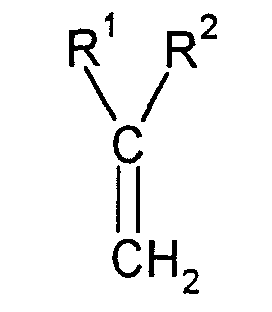 R1 aus der Gruppe ausgewählt ist, bestehend aus H, CN, CF3, Alkyl mit 1 bis 6 Kohlenstoffatomen und Aryl,R2 unabhängig aus der Gruppe ausgewählt ist, bestehend aus CN, C(=X)R3, C(=X)NR4R5 und heterocyclischen Ringen, die zur Stabilisierung eines α-Anions in der Lage sind, wobei X gleich NR (R ist C1-C20-Alkyl), O oder S ist, R3 gleich Alkyl mit 1 bis 20 Kohlenstoffatomen, Alkoxy mit 1 bis 20 Kohlenstoffatomen oder Alkylthio mit 1 bis 20 Kohlenstoffatomen ist, und R4 und R5 unabhängig Alkyl mit 1 bis 20 Kohlenstoffatomen sind oder unter Ausbildung einer Alkylengruppe mit 2 bis 5 Kohlenstoffatomen miteinander verbunden sind, wobei sie somit einen 3- bis 6-gliedrigen Ring bilden;R10 und R11 jeweils unabhängig eine Arylgruppe sind; unddas erste (Co)polymer von dem zweiten (Co)polymer verschieden ist.
 - Triblockcopolymer nach Anspruch 19, wobei R10 und R11 jeweils unabhängig Phenyl, Naphthyl, Phenyl mit 1 bis 5 Substituenten oder Naphthyl mit 1 bis 7 Substituenten sind, wobei jeder der Substituenten unabhängig aus der Gruppe ausgewählt ist, bestehend aus Alkyl mit 1 bis 20 Kohlenstoffatomen, Alkyl mit 1 bis 6 Kohlenstoffatomen, in welchem jedes der Wasserstoffatome unabhängig durch ein Halogen ersetzt sein kann, Alkenyl mit 1 bis 20 Kohlenstoffatomen, Alkinyl mit 1 bis 20 Kohlenstoffatomen, Alkoxy mit 1 bis 6 Kohlenstoffatomen, Alkylthio mit 1 bis 6 Kohlenstoffatomen, Phenyl, Halogen, C1-C6-Dialkylamino, mit 1 bis 5 Halogenatomen substituiertes Phenyl und mit 1 bis 5 Alkylgruppen mit 1 bis 4 Kohlenstoffatomen substituiertes Phenyl.
Applications Claiming Priority (3)
| Application Number | Priority Date | Filing Date | Title |
|---|---|---|---|
| US08/398,694 US5610248A (en) | 1995-03-06 | 1995-03-06 | Block copolymers and a novel method for preparing (co)polymers having a narrow molecular weight distribution by metal-free anionic polymerization in the presence of a phosphonium cation |
| US398694 | 1995-03-06 | ||
| PCT/US1996/002438 WO1996028487A2 (en) | 1995-03-06 | 1996-03-06 | Narrow molecular weight distribution block copolymers by metal-free anionic polymerization in the presence of a phosphonium cation |
Publications (3)
| Publication Number | Publication Date |
|---|---|
| EP0813558A2 EP0813558A2 (de) | 1997-12-29 |
| EP0813558A4 EP0813558A4 (de) | 1998-10-14 |
| EP0813558B1 true EP0813558B1 (de) | 2001-05-23 |
Family
ID=23576419
Family Applications (1)
| Application Number | Title | Priority Date | Filing Date |
|---|---|---|---|
| EP96907099A Expired - Lifetime EP0813558B1 (de) | 1995-03-06 | 1996-03-06 | Neue blockcopolymere und eine neue methode zur herstellung von (co)polymeren mit enger molekulargewichtsverteilung durch metallfreie anionische polymersiation in gegenwart eines phosphoniumkations |
Country Status (6)
| Country | Link |
|---|---|
| US (1) | US5610248A (de) |
| EP (1) | EP0813558B1 (de) |
| JP (1) | JPH11501966A (de) |
| AT (1) | ATE201421T1 (de) |
| DE (1) | DE69612969T2 (de) |
| WO (1) | WO1996028487A2 (de) |
Families Citing this family (8)
| Publication number | Priority date | Publication date | Assignee | Title |
|---|---|---|---|---|
| JP2000506194A (ja) * | 1996-03-01 | 2000-05-23 | ビーエーエスエフ アクチェンゲゼルシャフト | 新規ブロック共重合体、および窒素、酸素もしくは硫黄アニオンのホスホニウム塩の存在下に、金属を使用しないアニオン重合を行なわせることにより、狭まい分子量分布を有する(共)重合体を製造するための新規方法 |
| DE19651300A1 (de) | 1996-12-10 | 1998-06-18 | Basf Ag | Verfahren zur Herstellung kautschukmodifizierter Formmassen |
| US6303722B1 (en) | 1997-02-26 | 2001-10-16 | Basf Aktiengesellschaft | Method for preparing (co)polymers having a narrow molecular weight distribution |
| US6143847A (en) * | 1997-04-07 | 2000-11-07 | Basf Aktiengesellschaft | Method for preparing (co) polymers by metal-free anionic polymerization in the presence of a phosphonium cation containing at least one annellated aromatic ring |
| US6107424A (en) * | 1998-08-18 | 2000-08-22 | Basf Aktiengesellschaft | Nitrogen-containing metal-free initiators for anionic polymerization of acrylates |
| AU750851B2 (en) * | 1998-08-21 | 2002-08-01 | Ciba Specialty Chemicals Holding Inc. | Thermal- and photoinitiated radical polymerization in the presence of an addition fragmentation agent |
| CA2318720C (en) * | 1999-09-20 | 2008-10-14 | Kuraray Co., Ltd. | Process for polymerizing a methacrylic ester or an acrylic ester |
| WO2013101648A1 (en) | 2011-12-31 | 2013-07-04 | Bridgestone Corporation | Functionalized polymer |
Family Cites Families (6)
| Publication number | Priority date | Publication date | Assignee | Title |
|---|---|---|---|---|
| DE3632361A1 (de) * | 1986-09-24 | 1988-06-01 | Bayer Ag | Polymerisation von acrylderivaten |
| DE3700195C2 (de) * | 1987-01-06 | 1997-01-16 | Bayer Ag | Polymerisation von Acrylderivaten mittels phosphororganischen Katalysatoren |
| IT1211749B (it) * | 1986-09-24 | 1989-11-03 | Bayer Aktinegesellschaft | Procedimento per la polimerizzazio ne di derivati acrilici |
| DE3700196C2 (de) * | 1987-01-06 | 1997-01-09 | Bayer Ag | Polymerisation von Acrylderivaten mittels phosphororganischen Katalysatoren |
| US5436280A (en) * | 1993-11-17 | 1995-07-25 | Edison Polymer Innovation Corp. | Bi(phosphine) photoinitiators and chain transfer agents |
| JP2000506194A (ja) * | 1996-03-01 | 2000-05-23 | ビーエーエスエフ アクチェンゲゼルシャフト | 新規ブロック共重合体、および窒素、酸素もしくは硫黄アニオンのホスホニウム塩の存在下に、金属を使用しないアニオン重合を行なわせることにより、狭まい分子量分布を有する(共)重合体を製造するための新規方法 |
-
1995
- 1995-03-06 US US08/398,694 patent/US5610248A/en not_active Expired - Fee Related
-
1996
- 1996-03-06 AT AT96907099T patent/ATE201421T1/de not_active IP Right Cessation
- 1996-03-06 EP EP96907099A patent/EP0813558B1/de not_active Expired - Lifetime
- 1996-03-06 WO PCT/US1996/002438 patent/WO1996028487A2/en not_active Ceased
- 1996-03-06 JP JP8527616A patent/JPH11501966A/ja active Pending
- 1996-03-06 DE DE69612969T patent/DE69612969T2/de not_active Expired - Fee Related
Also Published As
| Publication number | Publication date |
|---|---|
| EP0813558A4 (de) | 1998-10-14 |
| ATE201421T1 (de) | 2001-06-15 |
| JPH11501966A (ja) | 1999-02-16 |
| EP0813558A2 (de) | 1997-12-29 |
| WO1996028487A2 (en) | 1996-09-19 |
| WO1996028487A3 (en) | 1996-11-07 |
| DE69612969T2 (de) | 2002-04-04 |
| US5610248A (en) | 1997-03-11 |
| DE69612969D1 (de) | 2001-06-28 |
Similar Documents
| Publication | Publication Date | Title |
|---|---|---|
| Wang et al. | Ethylene, styrene, and α-methylstyrene polymerization by mono (pentamethylcyclopentadienyl)(Cp*) complexes of titanium, zirconium, and hafnium: roles of cationic complexes of the type [Cp* MR2]+(R= alkyl) as both coordination polymerization catalysts and carbocationic polymerization initiators | |
| Webster | Group transfer polymerization: a critical review of its mechanism and comparison with other methods for controlled polymerization of acrylic monomers | |
| Van Beylen et al. | Developments in anionic polymerization—a critical review | |
| KR100266114B1 (ko) | 양이온 촉매 및 이 촉매를 사용하는 방법 | |
| US5656704A (en) | Highly syndiotactic PMMA polymers | |
| EP1211270B1 (de) | Sternblockcopolymer | |
| EP0451679A2 (de) | Verfahren zur Herstellung von Polymeren | |
| Ozaki et al. | Anionic polymerization of alkyl methacrylates in the presence of diethylzinc | |
| US5610248A (en) | Block copolymers and a novel method for preparing (co)polymers having a narrow molecular weight distribution by metal-free anionic polymerization in the presence of a phosphonium cation | |
| JP4623690B2 (ja) | 星型ブロックコポリマー | |
| Chang et al. | Reversible-deactivation radical polymerization of vinyl acetate mediated by tralen, an organomediator | |
| EP0095086A1 (de) | Polymerisationsfähiges und optisch aktives Polymer und Verfahren zur Herstellung eines polymerisationsfähigen Polymers | |
| Sato et al. | Kinetic and ESR studies on the radical polymerization of N-cyclohexylmaleimide in benzene | |
| Matsuzaki et al. | Polymerization of methyl methacrylate with phenylmagnesium bromide—stereoregularity, molecular weight distribution and polymerization mechanism— | |
| EP0883631B1 (de) | Verfahren zur herstellung von (co)polymeren mit einer engen molmasseverteilung | |
| JPH1121308A (ja) | (メタ)アクリル系、ビニル芳香族系および/またはジエン系単量体のアニオン(共)重合のための開始系およびその使用法 | |
| JPH055009A (ja) | ビニル系単量体の重合法 | |
| US6143847A (en) | Method for preparing (co) polymers by metal-free anionic polymerization in the presence of a phosphonium cation containing at least one annellated aromatic ring | |
| US6107424A (en) | Nitrogen-containing metal-free initiators for anionic polymerization of acrylates | |
| Matyjaszewski et al. | Cationic polymerization of styrenes by activated covalent species. Direct 1H‐NMR observation of complexes of 1‐phenylethyl acetates with lewis acids | |
| US6303722B1 (en) | Method for preparing (co)polymers having a narrow molecular weight distribution | |
| JPH03287605A (ja) | 重合体の製造方法 | |
| Novakov et al. | Effect of tetraalkylammonium salts on the tacticity of poly (methyl methacrylate), 1. Initiation by ethyl α‐lithioisobutyrate | |
| KR20000057461A (ko) | 아크릴레이트 및 메타크릴레이트의 음이온 중합 방법 | |
| Long et al. | Controlled synthesis of various poly (alkyl methacrylates) by anionic techniques |
Legal Events
| Date | Code | Title | Description |
|---|---|---|---|
| PUAI | Public reference made under article 153(3) epc to a published international application that has entered the european phase |
Free format text: ORIGINAL CODE: 0009012 |
|
| 17P | Request for examination filed |
Effective date: 19970904 |
|
| AK | Designated contracting states |
Kind code of ref document: A2 Designated state(s): AT BE CH DE ES FR GB IE IT LI NL SE |
|
| A4 | Supplementary search report drawn up and despatched |
Effective date: 19980901 |
|
| AK | Designated contracting states |
Kind code of ref document: A4 Designated state(s): AT BE CH DE ES FI FR GB IE IT LI NL SE |
|
| GRAG | Despatch of communication of intention to grant |
Free format text: ORIGINAL CODE: EPIDOS AGRA |
|
| 17Q | First examination report despatched |
Effective date: 20000209 |
|
| RBV | Designated contracting states (corrected) |
Designated state(s): AT BE CH DE ES FR GB IE IT LI NL SE |
|
| GRAG | Despatch of communication of intention to grant |
Free format text: ORIGINAL CODE: EPIDOS AGRA |
|
| GRAH | Despatch of communication of intention to grant a patent |
Free format text: ORIGINAL CODE: EPIDOS IGRA |
|
| GRAH | Despatch of communication of intention to grant a patent |
Free format text: ORIGINAL CODE: EPIDOS IGRA |
|
| GRAA | (expected) grant |
Free format text: ORIGINAL CODE: 0009210 |
|
| AK | Designated contracting states |
Kind code of ref document: B1 Designated state(s): AT BE CH DE ES FR GB IE IT LI NL SE |
|
| PG25 | Lapsed in a contracting state [announced via postgrant information from national office to epo] |
Ref country code: NL Free format text: LAPSE BECAUSE OF FAILURE TO SUBMIT A TRANSLATION OF THE DESCRIPTION OR TO PAY THE FEE WITHIN THE PRESCRIBED TIME-LIMIT Effective date: 20010523 Ref country code: LI Free format text: LAPSE BECAUSE OF FAILURE TO SUBMIT A TRANSLATION OF THE DESCRIPTION OR TO PAY THE FEE WITHIN THE PRESCRIBED TIME-LIMIT Effective date: 20010523 Ref country code: IT Free format text: LAPSE BECAUSE OF FAILURE TO SUBMIT A TRANSLATION OF THE DESCRIPTION OR TO PAY THE FEE WITHIN THE PRE;WARNING: LAPSES OF ITALIAN PATENTS WITH EFFECTIVE DATE BEFORE 2007 MAY HAVE OCCURRED AT ANY TIME BEFORE 2007. THE CORRECT EFFECTIVE DATE MAY BE DIFFERENT FROM THE ONE RECORDED.SCRIBED TIME-LIMIT Effective date: 20010523 Ref country code: CH Free format text: LAPSE BECAUSE OF FAILURE TO SUBMIT A TRANSLATION OF THE DESCRIPTION OR TO PAY THE FEE WITHIN THE PRESCRIBED TIME-LIMIT Effective date: 20010523 Ref country code: BE Free format text: LAPSE BECAUSE OF FAILURE TO SUBMIT A TRANSLATION OF THE DESCRIPTION OR TO PAY THE FEE WITHIN THE PRESCRIBED TIME-LIMIT Effective date: 20010523 Ref country code: AT Free format text: LAPSE BECAUSE OF FAILURE TO SUBMIT A TRANSLATION OF THE DESCRIPTION OR TO PAY THE FEE WITHIN THE PRESCRIBED TIME-LIMIT Effective date: 20010523 |
|
| REF | Corresponds to: |
Ref document number: 201421 Country of ref document: AT Date of ref document: 20010615 Kind code of ref document: T |
|
| REG | Reference to a national code |
Ref country code: CH Ref legal event code: EP |
|
| REF | Corresponds to: |
Ref document number: 69612969 Country of ref document: DE Date of ref document: 20010628 |
|
| REG | Reference to a national code |
Ref country code: IE Ref legal event code: FG4D |
|
| PG25 | Lapsed in a contracting state [announced via postgrant information from national office to epo] |
Ref country code: SE Free format text: LAPSE BECAUSE OF FAILURE TO SUBMIT A TRANSLATION OF THE DESCRIPTION OR TO PAY THE FEE WITHIN THE PRESCRIBED TIME-LIMIT Effective date: 20010823 |
|
| ET | Fr: translation filed | ||
| NLV1 | Nl: lapsed or annulled due to failure to fulfill the requirements of art. 29p and 29m of the patents act | ||
| PG25 | Lapsed in a contracting state [announced via postgrant information from national office to epo] |
Ref country code: ES Free format text: LAPSE BECAUSE OF FAILURE TO SUBMIT A TRANSLATION OF THE DESCRIPTION OR TO PAY THE FEE WITHIN THE PRESCRIBED TIME-LIMIT Effective date: 20011130 |
|
| REG | Reference to a national code |
Ref country code: CH Ref legal event code: PL |
|
| REG | Reference to a national code |
Ref country code: GB Ref legal event code: IF02 |
|
| PGFP | Annual fee paid to national office [announced via postgrant information from national office to epo] |
Ref country code: FR Payment date: 20020214 Year of fee payment: 7 |
|
| PGFP | Annual fee paid to national office [announced via postgrant information from national office to epo] |
Ref country code: GB Payment date: 20020305 Year of fee payment: 7 |
|
| PG25 | Lapsed in a contracting state [announced via postgrant information from national office to epo] |
Ref country code: IE Free format text: LAPSE BECAUSE OF NON-PAYMENT OF DUE FEES Effective date: 20020306 |
|
| PGFP | Annual fee paid to national office [announced via postgrant information from national office to epo] |
Ref country code: DE Payment date: 20020309 Year of fee payment: 7 |
|
| PLBE | No opposition filed within time limit |
Free format text: ORIGINAL CODE: 0009261 |
|
| STAA | Information on the status of an ep patent application or granted ep patent |
Free format text: STATUS: NO OPPOSITION FILED WITHIN TIME LIMIT |
|
| 26N | No opposition filed | ||
| REG | Reference to a national code |
Ref country code: IE Ref legal event code: MM4A |
|
| PG25 | Lapsed in a contracting state [announced via postgrant information from national office to epo] |
Ref country code: GB Free format text: LAPSE BECAUSE OF NON-PAYMENT OF DUE FEES Effective date: 20030306 |
|
| PG25 | Lapsed in a contracting state [announced via postgrant information from national office to epo] |
Ref country code: DE Free format text: LAPSE BECAUSE OF NON-PAYMENT OF DUE FEES Effective date: 20031001 |
|
| GBPC | Gb: european patent ceased through non-payment of renewal fee |
Effective date: 20030306 |
|
| PG25 | Lapsed in a contracting state [announced via postgrant information from national office to epo] |
Ref country code: FR Free format text: LAPSE BECAUSE OF NON-PAYMENT OF DUE FEES Effective date: 20031127 |
|
| REG | Reference to a national code |
Ref country code: FR Ref legal event code: ST |