EP0814689B1 - Nouveau matelas ameliore ou similaire realise a partir d'un ensemble blocs-ressorts utilise - Google Patents
Nouveau matelas ameliore ou similaire realise a partir d'un ensemble blocs-ressorts utilise Download PDFInfo
- Publication number
- EP0814689B1 EP0814689B1 EP96904687A EP96904687A EP0814689B1 EP 0814689 B1 EP0814689 B1 EP 0814689B1 EP 96904687 A EP96904687 A EP 96904687A EP 96904687 A EP96904687 A EP 96904687A EP 0814689 B1 EP0814689 B1 EP 0814689B1
- Authority
- EP
- European Patent Office
- Prior art keywords
- inner spring
- spring assembly
- mattress
- new
- coils
- Prior art date
- Legal status (The legal status is an assumption and is not a legal conclusion. Google has not performed a legal analysis and makes no representation as to the accuracy of the status listed.)
- Expired - Lifetime
Links
- 238000010438 heat treatment Methods 0.000 claims abstract description 23
- 238000000034 method Methods 0.000 claims description 22
- 230000008569 process Effects 0.000 claims description 21
- 238000004519 manufacturing process Methods 0.000 claims description 3
- 230000003028 elevating effect Effects 0.000 claims 2
- 239000000463 material Substances 0.000 abstract description 12
- 230000000712 assembly Effects 0.000 description 10
- 238000000429 assembly Methods 0.000 description 10
- 238000005452 bending Methods 0.000 description 7
- 239000011521 glass Substances 0.000 description 5
- 230000006872 improvement Effects 0.000 description 4
- 238000011012 sanitization Methods 0.000 description 4
- 230000000694 effects Effects 0.000 description 2
- 239000002184 metal Substances 0.000 description 2
- 239000000126 substance Substances 0.000 description 2
- 229910000831 Steel Inorganic materials 0.000 description 1
- 230000008901 benefit Effects 0.000 description 1
- 230000015572 biosynthetic process Effects 0.000 description 1
- 230000015556 catabolic process Effects 0.000 description 1
- 238000010276 construction Methods 0.000 description 1
- 238000006731 degradation reaction Methods 0.000 description 1
- 239000000645 desinfectant Substances 0.000 description 1
- 239000012212 insulator Substances 0.000 description 1
- 239000007769 metal material Substances 0.000 description 1
- 239000000203 mixture Substances 0.000 description 1
- 229910052755 nonmetal Inorganic materials 0.000 description 1
- 230000003647 oxidation Effects 0.000 description 1
- 238000007254 oxidation reaction Methods 0.000 description 1
- 230000009467 reduction Effects 0.000 description 1
- 230000008439 repair process Effects 0.000 description 1
- 238000010186 staining Methods 0.000 description 1
- 239000010959 steel Substances 0.000 description 1
- 238000011282 treatment Methods 0.000 description 1
Images

Classifications
-
- A—HUMAN NECESSITIES
- A47—FURNITURE; DOMESTIC ARTICLES OR APPLIANCES; COFFEE MILLS; SPICE MILLS; SUCTION CLEANERS IN GENERAL
- A47C—CHAIRS; SOFAS; BEDS
- A47C27/00—Spring, stuffed or fluid mattresses or cushions specially adapted for chairs, beds or sofas
- A47C27/04—Spring, stuffed or fluid mattresses or cushions specially adapted for chairs, beds or sofas with spring inlays
-
- Y—GENERAL TAGGING OF NEW TECHNOLOGICAL DEVELOPMENTS; GENERAL TAGGING OF CROSS-SECTIONAL TECHNOLOGIES SPANNING OVER SEVERAL SECTIONS OF THE IPC; TECHNICAL SUBJECTS COVERED BY FORMER USPC CROSS-REFERENCE ART COLLECTIONS [XRACs] AND DIGESTS
- Y10—TECHNICAL SUBJECTS COVERED BY FORMER USPC
- Y10T—TECHNICAL SUBJECTS COVERED BY FORMER US CLASSIFICATION
- Y10T29/00—Metal working
- Y10T29/49—Method of mechanical manufacture
- Y10T29/49609—Spring making
- Y10T29/49613—Spring making for human comfort
-
- Y—GENERAL TAGGING OF NEW TECHNOLOGICAL DEVELOPMENTS; GENERAL TAGGING OF CROSS-SECTIONAL TECHNOLOGIES SPANNING OVER SEVERAL SECTIONS OF THE IPC; TECHNICAL SUBJECTS COVERED BY FORMER USPC CROSS-REFERENCE ART COLLECTIONS [XRACs] AND DIGESTS
- Y10—TECHNICAL SUBJECTS COVERED BY FORMER USPC
- Y10T—TECHNICAL SUBJECTS COVERED BY FORMER US CLASSIFICATION
- Y10T29/00—Metal working
- Y10T29/49—Method of mechanical manufacture
- Y10T29/49718—Repairing
- Y10T29/49721—Repairing with disassembling
- Y10T29/49723—Repairing with disassembling including reconditioning of part
- Y10T29/49725—Repairing with disassembling including reconditioning of part by shaping
-
- Y—GENERAL TAGGING OF NEW TECHNOLOGICAL DEVELOPMENTS; GENERAL TAGGING OF CROSS-SECTIONAL TECHNOLOGIES SPANNING OVER SEVERAL SECTIONS OF THE IPC; TECHNICAL SUBJECTS COVERED BY FORMER USPC CROSS-REFERENCE ART COLLECTIONS [XRACs] AND DIGESTS
- Y10—TECHNICAL SUBJECTS COVERED BY FORMER USPC
- Y10T—TECHNICAL SUBJECTS COVERED BY FORMER US CLASSIFICATION
- Y10T29/00—Metal working
- Y10T29/49—Method of mechanical manufacture
- Y10T29/49718—Repairing
- Y10T29/49721—Repairing with disassembling
- Y10T29/4973—Replacing of defective part
-
- Y—GENERAL TAGGING OF NEW TECHNOLOGICAL DEVELOPMENTS; GENERAL TAGGING OF CROSS-SECTIONAL TECHNOLOGIES SPANNING OVER SEVERAL SECTIONS OF THE IPC; TECHNICAL SUBJECTS COVERED BY FORMER USPC CROSS-REFERENCE ART COLLECTIONS [XRACs] AND DIGESTS
- Y10—TECHNICAL SUBJECTS COVERED BY FORMER USPC
- Y10T—TECHNICAL SUBJECTS COVERED BY FORMER US CLASSIFICATION
- Y10T29/00—Metal working
- Y10T29/49—Method of mechanical manufacture
- Y10T29/49718—Repairing
- Y10T29/49748—Repairing by shaping, e.g., bending, extruding, turning, etc.
- Y10T29/4975—Repairing by shaping, e.g., bending, extruding, turning, etc. including heating
-
- Y—GENERAL TAGGING OF NEW TECHNOLOGICAL DEVELOPMENTS; GENERAL TAGGING OF CROSS-SECTIONAL TECHNOLOGIES SPANNING OVER SEVERAL SECTIONS OF THE IPC; TECHNICAL SUBJECTS COVERED BY FORMER USPC CROSS-REFERENCE ART COLLECTIONS [XRACs] AND DIGESTS
- Y10—TECHNICAL SUBJECTS COVERED BY FORMER USPC
- Y10T—TECHNICAL SUBJECTS COVERED BY FORMER US CLASSIFICATION
- Y10T29/00—Metal working
- Y10T29/49—Method of mechanical manufacture
- Y10T29/49751—Scrap recovering or utilizing
Definitions
- This invention relates to the production of new improved inner spring containing products such as mattresses, box springs, cushions or the like from discarded used products of this type (e.g. US-A-5 048 167).
- This sanitizing process includes heating the used mattress to some 110 to 116 degrees Celsius (230 to 240 degrees Fahrenheit) as well as treating same with chemical disinfectants. Such refurbished mattresses can then be sold as used products.
- the basic component of most spring filled mattresses is of course the inner spring assembly whose construction has remained essentially unchanged for nearly a century.
- This inner spring assembly comprises a series of hour glass shaped coils of heavy wire arranged in rows and tied together in their rows by various means such as pigtails or crimp rods formed of much lighter wire than the coils. Border wires tied to the boundary coils surround the inner spring assembly.
- the inner spring assembly of many box springs is generally similar to that of a mattress except that the coils have an inverted cone shape and, since the assembly is attached at the bottom to a wooden frame, the border wire and connecting wire are only fastened to the top side of the coils.
- the components of the inner spring assembly are all made of metal wire which becomes stressed at positions where significant permanent bending of the wire takes place and results in a reduction of the load bearing capacity of the wire at said positions.
- this stressing happens when the wire is formed into a shape such as the hour glass coil or the border wire or when the the wire is bent or wrapped to join the other components as in the case of crimp rods and pigtails.
- These stresses can be relieved to a greater or lesser extent, depending on the temperature and duration of the heating process, by heating the wire and then allowing the wire to cool in air to room temperature which results in an improvement in the wire's mechanical properties and a corresponding improvement in the load bearing capacity of the inner spring assembly.
- the individual hour glass shaped coils are normally subjected to a brief and often uneven heat treatment process that partially relieves stresses after their formation.
- the border wires and wire elements tying the spring coils together are not stress relieved. In some instances they are briefly heated to obtain a partial relief of stresses. Because these components are either not stress relieved or only partially stress relieved, the inner spring assembly can be improved by subsequent heat treatments.
- the inner spring covering of ticking and padding material and the like is subjected to staining, ripping, lumping and tearing.
- the border wires and connecting wire elements sometimes experience minor bending.
- the coil springs may in fact shift out of proper position or, in rare instances, become distorted or broken.
- the load bearing capacity of the individual coils is substantially unimpaired so that a subsequent heat treatment of the inner spring assembly actually improves the load bearing capacity of the individual coils compared to when new.
- the inner spring assembly is enclosed by the ticking and padding material, it is essentially protected from oxidation which could deleteriously affect the wire members including the hour glass coils.
- the inner spring assembly of a used mattress is removed therefrom and cleaned of all ticking and padding material. Any bent or broken coil spring connector wires or border wires are then straightened or replaced and any displaced coil springs restored to their original position. In the unlikely event of a bent or broken coil, said coil would be replaced.
- the inner spring assembly is then subjected to a heat treating process in which it is introduced into an oven and heated to a temperature of the order of 288 degrees Celsius (550 degrees Fahrenheit) for a period of about ten to twenty minutes.
- This heat treating process functions not only to provide a further and additional stress relieving of the previously stress relieved coils but provides stress relief in all of the other wire elements as well.
- any new wire elements are stress relieved as well as any of the original wire elements that did not require replacement. Frequently these original wire elements would not have been stress relieved at the time of the original mattress manufacture but even if they were their quality would be improved by the subsequent stress relieving process of the present invention.
- any border wires or connecting wires that experienced minor bending away from their normal shape and position through heavy use and were subsequently bent back to their proper position will receive an additional benefit at these twice bent locations beyond that obtained from the stress relief heat treatment.
- the said heating of the inner spring assembly to provide for stress relief takes place at a higher temperature than that required for mere sanitization of the assembly whereby sanitization is automatically effected in the stress relieving process.
- the inner spring assembly is covered with the usual ticking and padding material ready for sale as a mattress having superior qualities to the original mattress from which the inner spring assembly had been taken.
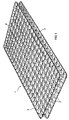
- Figure 1 is a perspective view of an inner spring assembly.
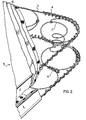
- Figure 2 is a cut away corner view of a mattress.
- Figure 3 is a cut away view of the top surface of an inner spring assembly which uses a crimp rod to join adjacent coils.
- Figure 4 is a cut away detailed view of a crimp connector on a crimp rod.
- an inner spring assembly 1 comprises hour glass coils 2 arranged in a two dimensional array, border wire 3 forming a perimeter around top and bottom surfaces of said array, and pigtail wire 4 wound in a helical fashion along said border wire and between the rows of coils thereby connecting each coil and the border wires to their respective adjacent coils.
- a mattress 5 has covering layers 6 attached to the inner spring assembly 1.
- Said covering layers typically consist of an insulator pad against the inner spring assembly, followed by one or more layers of cushioning material, and an outer layer of ticking material.
- crimp rods are used in some inner spring assemblies in place of pigtails between the coils.
- a crimp rod 7 has crimp connectors 8 made from multiple folds in the crimp rod wire creating an inner opening 9 and an outer opening 10 used to hold two coils together. Once the coils have been placed in their respective openings, the outer opening 10 is bent closed to lock the coils in place.
- the used inner spring assembly of a used mattress is extracted by removing the mattress covering layers therefrom in a conventional manner such as by cutting, tearing and pulling the non metal material from the assembly.
- the resulting inner spring assembly is then inspected for suitability for re-use. In many cases, the assembly is undamaged and retains its shape despite years of use and requires no structural repair. In other cases, the inner spring assembly has been subjected to some extreme forces which will have bent the border wire or the connecting wire elements in one or more localized areas away from the assembly's original shape or position.
- the wire components in said localized areas can be bent by hand or by mechanical means to restore said components to their original shape and positions which improves the mechanical properties of said localized areas as herein described. If the border or connecting wire is actually damaged, it may be replaced, but it is often more efficient to leave the damaged component in place and attach an additional component adjacent to the damaged one.
- Said restored or undamaged inner spring assembly is then heat treated to relieve the stresses in the wire components.
- the degree of stress relief achieved for the wire components depends on what temperatures they are raised to and the period of time they are maintained at the elevated temperatures. If the temperatures are too low or the durations at those temperatures is too short, little or no stress relief will be achieved. If the temperatures are too high, the wire risks undergoing degradation in its mechanical strength.
- the degree of stress relief obtained for given temperatures and durations of heat treatment further depends on the chemical composition of the wire, the gage of the wire, and the methodology of the drawing of the wire. However, for the vast majority of inner spring assemblies, the wire components will achieve substantial stress relief without undergoing undesirable physical changes when heated to between about 204 to 288 degrees Celsius (400 and 550 degrees Fahrenheit) for between about ten to twenty minutes.
- said restored or undamaged inner spring assemblies are vertically positioned on dollies which are wheeled into a conventional batch type gas fired double skin insulated steel oven for heat treatment.
- said oven has an internal temperature of about 149 degrees Celsius (300 degrees Fahrenheit) which is gradually raised to 288 degrees Celsius (550 degrees Fahrenheit) over a period of about 38 minutes. Said oven is then maintained at 288 degrees Celsius (550 degrees Fahrenheit) for about 17 minutes.
- the inner spring assemblies are then wheeled out of the oven on their supporting dollies and allowed to cool.
- the temperature of the oven will drop back to about 149 degrees Celsius (300 degrees Fahrenheit) as a result of having the two winged doors opened to remove a first batch of heat treated inner spring assemblies and to insert a second batch of inner spring assemblies for treatment.
- the temperature in a conventional oven is not perfectly homogeneous throughout the oven which fact has been taken into account in choosing an oven temperature and duration that will ensure substantial stress relief of all the components of the entire batch of inner spring assemblies receiving heat treatment according to the preferred embodiment. It is therefore understood that substantial stress relief of the inner spring assemblies will be achieved at different temperatures and durations depending on the characteristics of the oven used to effect the heat treatment process.
- Said inner spring assemblies which were either undamaged or restored and subjected to the heat treatment process according to the present invention have the same structure as when new but have overall improved load bearing capacity than when new.
- each resulting mattress contains both an inner spring assembly that is better than when new and a new mattress covering which warrants the sale of the resulting mattress as a new product.
Landscapes
- Mattresses And Other Support Structures For Chairs And Beds (AREA)
- Springs (AREA)
Claims (10)
- Procédé de préparation d'un ensemble de ressorts intérieurs (1), précédemment utilisé dans un matelas ou analogue, pour une utilisation dans un nouveau matelas ou analogue, comprenant les étapes de remise à la forme adéquate de tout fil métallique de bordure ou de liaison (3, 4 ou 7), ainsi que de remise dans sa position adéquate, à l'intérieur de l'ensemble de ressorts intérieurs, de tout élément de ressort intérieur qui a été déplacé, et de chauffage dudit ensemble de ressorts intérieurs jusqu'à une température comprise dans la plage d'environ 204 à 288 degrés Celsius (400 à 550 degrés Fahrenheit) pendant une durée d'au moins environ 10 à 20 minutes.
- Procédé selon la revendication 1, comprenant en outre l'étape d'enlèvement, dudit ensemble de ressorts intérieurs, de tout boudin (2) endommagé et de remplacement desdits boudins endommagés par des boudins de rechange, préalablement à ladite étape de chauffage.
- Procédé selon la revendication 1, comprenant en outre l'étape d'addition, audit ensemble de ressorts intérieurs, et préalablement à ladite étape de chauffage, de fils métalliques de bordure ou de liaison, de rechange ou supplémentaires, lorsque de tels fils sont endommagés.
- Procédé selon la revendication 2 ou la revendication 3, dans lequel ladite étape de chauffage comprend les étapes de mise en place dudit ensemble de ressorts intérieurs dans un four, la température du four étant alors d'environ 149 degrés Celsius (300 degrés Fahrenheit), puis d'élévation graduelle de ladite température du four jusqu'à environ 288 degrés Celsius (550 degrés Fahrenheit) sur une période comprise entre 30 et 45 minutes, et de maintien de ladite température élevée du four pendant une période d'environ 17 minutes.
- Procédé selon la revendication 2 ou la revendication 3, comprenant en outre, ensuite, les étapes de refroidissement à l'air libre dudit ensemble de ressorts intérieurs (1) et de fixation de couches de recouvrement audit ensemble de ressorts intérieurs, afin de constituer un matelas terminé, ou analogue, à soutien par ressorts intérieurs.
- Procédé de fabrication d'un nouveau matelas amélioré à partir d'un matelas usé, contenant un ensemble de ressorts intérieurs (1), comprenant les étapes d'enlèvement, dudit ensemble de ressorts intérieurs (1), des couches de recouvrement du matelas usé, de chauffage dudit ensemble de ressorts intérieurs jusqu'à une température comprise dans la plage d'environ 204 à 288 degrés Celsius (400 à 550 degrés Fahrenheit) pendant une durée d'au moins environ 10 à 20 minutes, de refroidissement à l'air libre dudit ensemble de ressorts intérieurs (1), et de fixation de couche neuve de recouvrement de matelas audit ensemble de ressorts intérieurs.
- Procédé selon la revendication 6, comprenant en outre l'étape de remise à la forme adéquate de tout fil métallique de bordure ou de liaison (3, 4 ou 7), ainsi que de remise dans sa position adéquate, à l'intérieur dudit ensemble de ressorts intérieurs (1), de tout élément de ressort intérieur qui a été déplacé, préalablement à ladite étape de chauffage.
- Procédé selon la revendication 6, comprenant en outre l'étape d'enlèvement, dudit ensemble de ressorts intérieurs (1), de tout boudin (2) endommagé et de remplacement desdits boudins endommagés par des boudins de rechange, préalablement à ladite étape de chauffage.
- Procédé selon la revendication 6, comprenant en outre l'étape d'addition, audit ensemble de ressorts intérieurs (1), et préalablement à ladite étape de chauffage, de fils métalliques de bordure ou de liaison, de rechange ou supplémentaires, lorsque de tels fils sont endommagés.
- Procédé selon la revendication 6, 7, 8 ou 9, dans lequel ladite étape de chauffage comprend les étapes de mise en place dudit ensemble de ressorts intérieurs dans un four, la température du four étant alors d'environ 149 degrés Celsius (300 degrés Fahrenheit), puis d'élévation graduelle de ladite température du four jusqu'à environ 288 degrés Celsius (550 degrés Fahrenheit) sur une période comprise entre 30 et 45 minutes, et de maintien de ladite température élevée du four pendant une période d'environ 17 minutes.
Applications Claiming Priority (3)
| Application Number | Priority Date | Filing Date | Title |
|---|---|---|---|
| CA002144506A CA2144506C (fr) | 1995-03-13 | 1995-03-13 | Nouveau matelas ameliore ou autre objet du genre a partir d'un jeu de ressorts usages |
| CA2144506 | 1995-03-13 | ||
| PCT/CA1996/000138 WO1996028068A2 (fr) | 1995-03-13 | 1996-03-11 | Nouveau matelas ameliore ou similaire realise a partir d'un ensemble blocs-ressorts utilise |
Publications (2)
| Publication Number | Publication Date |
|---|---|
| EP0814689A2 EP0814689A2 (fr) | 1998-01-07 |
| EP0814689B1 true EP0814689B1 (fr) | 2000-11-08 |
Family
ID=4155411
Family Applications (1)
| Application Number | Title | Priority Date | Filing Date |
|---|---|---|---|
| EP96904687A Expired - Lifetime EP0814689B1 (fr) | 1995-03-13 | 1996-03-11 | Nouveau matelas ameliore ou similaire realise a partir d'un ensemble blocs-ressorts utilise |
Country Status (8)
| Country | Link |
|---|---|
| US (1) | US6101718A (fr) |
| EP (1) | EP0814689B1 (fr) |
| AT (1) | ATE197385T1 (fr) |
| AU (1) | AU4872896A (fr) |
| CA (1) | CA2144506C (fr) |
| DE (1) | DE69610903T2 (fr) |
| ES (1) | ES2153093T3 (fr) |
| WO (1) | WO1996028068A2 (fr) |
Cited By (1)
| Publication number | Priority date | Publication date | Assignee | Title |
|---|---|---|---|---|
| US7469431B2 (en) | 2005-12-07 | 2008-12-30 | Stelpro Wire & Springs, Inc. | Nestable box spring foundation |
Families Citing this family (4)
| Publication number | Priority date | Publication date | Assignee | Title |
|---|---|---|---|---|
| CA2695550C (fr) * | 2007-08-07 | 2012-07-17 | Luke Mills | Dispositif de retrait de materiau de matelas |
| CA2639740A1 (fr) * | 2007-09-25 | 2009-03-25 | Simon Zysman | Remise a neuf de matelas et de sommiers de recuperation |
| US8007606B2 (en) * | 2008-06-25 | 2011-08-30 | Caterpillar Inc. | Salvage process for spring elements |
| CN103449026B (zh) * | 2013-06-28 | 2015-12-09 | 厦门大端工业设计有限公司 | 一种弹性床垫的包装方法 |
Family Cites Families (12)
| Publication number | Priority date | Publication date | Assignee | Title |
|---|---|---|---|---|
| US144630A (en) * | 1873-11-18 | Improvement in the processes of repairing spinning-rings | ||
| US379573A (en) * | 1888-03-20 | Bdwaed w | ||
| US401721A (en) * | 1889-04-16 | Method of tempering spiral springs | ||
| US894428A (en) * | 1907-11-12 | 1908-07-28 | Albert H Emery | Process of raising the elastic limit of metals and relieving them of injurious strains. |
| US1722389A (en) * | 1927-10-19 | 1929-07-30 | M P Mfg Company | Method of reclaiming worn piston pins |
| US2305711A (en) * | 1939-06-28 | 1942-12-22 | Sperry Prod Inc | Method for reforming rails |
| US3002865A (en) * | 1958-10-30 | 1961-10-03 | Associated Spring Corp | Method of strengthening the surface of metallic springs by warm working |
| US3343573A (en) * | 1965-04-14 | 1967-09-26 | James Hill Mfg Company | Roving can spring |
| US3711917A (en) * | 1969-08-18 | 1973-01-23 | North American Rockwell | Coated spring |
| US4229962A (en) * | 1979-06-08 | 1980-10-28 | William Tunderman | Method for reconditioning rivetless chain links |
| DE3505571C2 (de) * | 1985-02-18 | 1991-03-07 | GVB SANIMED Hygiene- und Medizintechnik GmbH, 3070 Nienburg | Vorrichtung zur Desinfektion und Sterilisation von Matratzen mit Hilfe von Mikrowellen |
| US5048167A (en) * | 1989-03-13 | 1991-09-17 | Heffley James R | Method for restoring used mattresses |
-
1995
- 1995-03-13 CA CA002144506A patent/CA2144506C/fr not_active Expired - Fee Related
-
1996
- 1996-03-11 ES ES96904687T patent/ES2153093T3/es not_active Expired - Lifetime
- 1996-03-11 US US08/913,154 patent/US6101718A/en not_active Expired - Fee Related
- 1996-03-11 DE DE69610903T patent/DE69610903T2/de not_active Expired - Fee Related
- 1996-03-11 EP EP96904687A patent/EP0814689B1/fr not_active Expired - Lifetime
- 1996-03-11 WO PCT/CA1996/000138 patent/WO1996028068A2/fr not_active Ceased
- 1996-03-11 AU AU48728/96A patent/AU4872896A/en not_active Abandoned
- 1996-03-11 AT AT96904687T patent/ATE197385T1/de active
Cited By (1)
| Publication number | Priority date | Publication date | Assignee | Title |
|---|---|---|---|---|
| US7469431B2 (en) | 2005-12-07 | 2008-12-30 | Stelpro Wire & Springs, Inc. | Nestable box spring foundation |
Also Published As
| Publication number | Publication date |
|---|---|
| DE69610903D1 (de) | 2000-12-14 |
| AU4872896A (en) | 1996-10-02 |
| ES2153093T3 (es) | 2001-02-16 |
| WO1996028068A3 (fr) | 1996-11-21 |
| CA2144506A1 (fr) | 1996-09-14 |
| DE69610903T2 (de) | 2001-03-01 |
| WO1996028068A2 (fr) | 1996-09-19 |
| US6101718A (en) | 2000-08-15 |
| CA2144506C (fr) | 2006-01-31 |
| EP0814689A2 (fr) | 1998-01-07 |
| ATE197385T1 (de) | 2000-11-11 |
Similar Documents
| Publication | Publication Date | Title |
|---|---|---|
| EP0814689B1 (fr) | Nouveau matelas ameliore ou similaire realise a partir d'un ensemble blocs-ressorts utilise | |
| US20070083996A1 (en) | Continuous wire spring mattress or seating product and method of manufacture | |
| EP0668523B1 (fr) | Procédé de fabrication d'un objet en alliage de nickel-titane métalisé | |
| EP1149548A3 (fr) | Meuble d'assise ou de couchage comportant une garniture avec noyau à ressort | |
| US5062172A (en) | Bedding mattress spring assembly having border edge support | |
| AU2016223811B2 (en) | Method for producing an upholster spring, upholstery spring, mattress, and upholstered furniture | |
| US2094074A (en) | Cushion unit and method of making the same | |
| US2858401A (en) | Electric heating units and methods of making the same | |
| TWI433940B (zh) | 用於定位燃料棒的間隔格網 | |
| JP5197007B2 (ja) | 沸騰水型原子炉において使用するためのシート状金属の製造方法 | |
| WO1997033501A1 (fr) | Ame a ressorts continus positionnes pour matelas | |
| US20230389713A1 (en) | Mattress assembly including coil innerspring units, coil innerspring units, and processes for making the same | |
| NO321173B1 (no) | Fjaermadrass | |
| KR102651247B1 (ko) | 침대메트리스용 쿠션 및 그 제조방법 | |
| US3681798A (en) | Spring interiors and articles combining spring interiors | |
| WO2020233872A1 (fr) | Procédé de fabrication d'un noyau de ressorts pour un matelas ou pour des produits d'assise | |
| JPH0711035B2 (ja) | 方向性電磁鋼板の歪取り焼鈍方法 | |
| WO2021188075A1 (fr) | Procédé pour ressorts de matelas ou de meubles rembourrés présentant des caractéristiques mécaniques améliorées avec un traitement thermique supplémentaire | |
| JPS5934210B2 (ja) | コネクテイングロツドの製造方法 | |
| CN121674781A (zh) | 一种传感调控一体化多功能记忆金属绞线及其制备方法和应用 | |
| US422845A (en) | Process of manufacturing spring-beds | |
| DE830558C (de) | Umkleidung fuer Federn von Polstern oder Matratzen | |
| JPH0235022B2 (fr) | ||
| JPH01205838A (ja) | コイルばねの製造方法 | |
| JPS6364219A (ja) | Ofケ−ブルの製造方法 |
Legal Events
| Date | Code | Title | Description |
|---|---|---|---|
| PUAI | Public reference made under article 153(3) epc to a published international application that has entered the european phase |
Free format text: ORIGINAL CODE: 0009012 |
|
| 17P | Request for examination filed |
Effective date: 19970930 |
|
| AK | Designated contracting states |
Kind code of ref document: A2 Designated state(s): AT BE CH DE DK ES FI FR GB IT LI NL SE |
|
| 17Q | First examination report despatched |
Effective date: 19980420 |
|
| GRAG | Despatch of communication of intention to grant |
Free format text: ORIGINAL CODE: EPIDOS AGRA |
|
| 17Q | First examination report despatched |
Effective date: 19980420 |
|
| GRAG | Despatch of communication of intention to grant |
Free format text: ORIGINAL CODE: EPIDOS AGRA |
|
| GRAH | Despatch of communication of intention to grant a patent |
Free format text: ORIGINAL CODE: EPIDOS IGRA |
|
| GRAH | Despatch of communication of intention to grant a patent |
Free format text: ORIGINAL CODE: EPIDOS IGRA |
|
| GRAA | (expected) grant |
Free format text: ORIGINAL CODE: 0009210 |
|
| AK | Designated contracting states |
Kind code of ref document: B1 Designated state(s): AT BE CH DE DK ES FI FR GB IT LI NL SE |
|
| PG25 | Lapsed in a contracting state [announced via postgrant information from national office to epo] |
Ref country code: NL Free format text: LAPSE BECAUSE OF FAILURE TO SUBMIT A TRANSLATION OF THE DESCRIPTION OR TO PAY THE FEE WITHIN THE PRESCRIBED TIME-LIMIT Effective date: 20001108 Ref country code: LI Free format text: LAPSE BECAUSE OF FAILURE TO SUBMIT A TRANSLATION OF THE DESCRIPTION OR TO PAY THE FEE WITHIN THE PRESCRIBED TIME-LIMIT Effective date: 20001108 Ref country code: IT Free format text: LAPSE BECAUSE OF FAILURE TO SUBMIT A TRANSLATION OF THE DESCRIPTION OR TO PAY THE FEE WITHIN THE PRE;WARNING: LAPSES OF ITALIAN PATENTS WITH EFFECTIVE DATE BEFORE 2007 MAY HAVE OCCURRED AT ANY TIME BEFORE 2007. THE CORRECT EFFECTIVE DATE MAY BE DIFFERENT FROM THE ONE RECORDED.SCRIBED TIME-LIMIT Effective date: 20001108 Ref country code: FI Free format text: LAPSE BECAUSE OF FAILURE TO SUBMIT A TRANSLATION OF THE DESCRIPTION OR TO PAY THE FEE WITHIN THE PRESCRIBED TIME-LIMIT Effective date: 20001108 Ref country code: CH Free format text: LAPSE BECAUSE OF FAILURE TO SUBMIT A TRANSLATION OF THE DESCRIPTION OR TO PAY THE FEE WITHIN THE PRESCRIBED TIME-LIMIT Effective date: 20001108 Ref country code: BE Free format text: LAPSE BECAUSE OF FAILURE TO SUBMIT A TRANSLATION OF THE DESCRIPTION OR TO PAY THE FEE WITHIN THE PRESCRIBED TIME-LIMIT Effective date: 20001108 Ref country code: AT Free format text: LAPSE BECAUSE OF FAILURE TO SUBMIT A TRANSLATION OF THE DESCRIPTION OR TO PAY THE FEE WITHIN THE PRESCRIBED TIME-LIMIT Effective date: 20001108 |
|
| REF | Corresponds to: |
Ref document number: 197385 Country of ref document: AT Date of ref document: 20001111 Kind code of ref document: T |
|
| REG | Reference to a national code |
Ref country code: CH Ref legal event code: EP |
|
| REF | Corresponds to: |
Ref document number: 69610903 Country of ref document: DE Date of ref document: 20001214 |
|
| PG25 | Lapsed in a contracting state [announced via postgrant information from national office to epo] |
Ref country code: SE Free format text: LAPSE BECAUSE OF FAILURE TO SUBMIT A TRANSLATION OF THE DESCRIPTION OR TO PAY THE FEE WITHIN THE PRESCRIBED TIME-LIMIT Effective date: 20010208 Ref country code: DK Free format text: LAPSE BECAUSE OF FAILURE TO SUBMIT A TRANSLATION OF THE DESCRIPTION OR TO PAY THE FEE WITHIN THE PRESCRIBED TIME-LIMIT Effective date: 20010208 |
|
| REG | Reference to a national code |
Ref country code: ES Ref legal event code: FG2A Ref document number: 2153093 Country of ref document: ES Kind code of ref document: T3 |
|
| ET | Fr: translation filed | ||
| NLV1 | Nl: lapsed or annulled due to failure to fulfill the requirements of art. 29p and 29m of the patents act | ||
| REG | Reference to a national code |
Ref country code: CH Ref legal event code: PL Ref country code: CH Ref legal event code: AEN Free format text: LE BREVET A ETE REACTIVE SELON LA DEMANDE DE POURSUITE DE LA PROCEDURE DU 05.03.2001. |
|
| PLBE | No opposition filed within time limit |
Free format text: ORIGINAL CODE: 0009261 |
|
| STAA | Information on the status of an ep patent application or granted ep patent |
Free format text: STATUS: NO OPPOSITION FILED WITHIN TIME LIMIT |
|
| 26N | No opposition filed | ||
| REG | Reference to a national code |
Ref country code: CH Ref legal event code: PL |
|
| REG | Reference to a national code |
Ref country code: GB Ref legal event code: IF02 |
|
| PGFP | Annual fee paid to national office [announced via postgrant information from national office to epo] |
Ref country code: GB Payment date: 20030314 Year of fee payment: 8 |
|
| PGFP | Annual fee paid to national office [announced via postgrant information from national office to epo] |
Ref country code: FR Payment date: 20030317 Year of fee payment: 8 |
|
| PGFP | Annual fee paid to national office [announced via postgrant information from national office to epo] |
Ref country code: ES Payment date: 20030320 Year of fee payment: 8 |
|
| PGFP | Annual fee paid to national office [announced via postgrant information from national office to epo] |
Ref country code: DE Payment date: 20030331 Year of fee payment: 8 |
|
| PG25 | Lapsed in a contracting state [announced via postgrant information from national office to epo] |
Ref country code: GB Free format text: LAPSE BECAUSE OF NON-PAYMENT OF DUE FEES Effective date: 20040311 |
|
| PG25 | Lapsed in a contracting state [announced via postgrant information from national office to epo] |
Ref country code: ES Free format text: LAPSE BECAUSE OF NON-PAYMENT OF DUE FEES Effective date: 20040312 |
|
| PG25 | Lapsed in a contracting state [announced via postgrant information from national office to epo] |
Ref country code: DE Free format text: LAPSE BECAUSE OF NON-PAYMENT OF DUE FEES Effective date: 20041001 |
|
| GBPC | Gb: european patent ceased through non-payment of renewal fee |
Effective date: 20040311 |
|
| PG25 | Lapsed in a contracting state [announced via postgrant information from national office to epo] |
Ref country code: FR Free format text: LAPSE BECAUSE OF NON-PAYMENT OF DUE FEES Effective date: 20041130 |
|
| REG | Reference to a national code |
Ref country code: FR Ref legal event code: ST |
|
| REG | Reference to a national code |
Ref country code: ES Ref legal event code: FD2A Effective date: 20040312 |