EP0815100B1 - Derives d'amide et d'uree tricycliques utilises pour inhiber la fonction de proteine g et pour le traitement des maladies proliferatives - Google Patents
Derives d'amide et d'uree tricycliques utilises pour inhiber la fonction de proteine g et pour le traitement des maladies proliferatives Download PDFInfo
- Publication number
- EP0815100B1 EP0815100B1 EP96909651A EP96909651A EP0815100B1 EP 0815100 B1 EP0815100 B1 EP 0815100B1 EP 96909651 A EP96909651 A EP 96909651A EP 96909651 A EP96909651 A EP 96909651A EP 0815100 B1 EP0815100 B1 EP 0815100B1
- Authority
- EP
- European Patent Office
- Prior art keywords
- alkyl
- substituted
- carbon atoms
- compound
- halo
- Prior art date
- Legal status (The legal status is an assumption and is not a legal conclusion. Google has not performed a legal analysis and makes no representation as to the accuracy of the status listed.)
- Expired - Lifetime
Links
- 0 CNC(N(*)N)=* Chemical compound CNC(N(*)N)=* 0.000 description 50
- VOSZPPRMDUUIIU-UHFFFAOYSA-N Bc(cc1CCc2cc(Cl)ccc22)cnc1C2=C(CC1)CCN1C(CN(CC1)CCN1c1c(C)cccc1)O Chemical compound Bc(cc1CCc2cc(Cl)ccc22)cnc1C2=C(CC1)CCN1C(CN(CC1)CCN1c1c(C)cccc1)O VOSZPPRMDUUIIU-UHFFFAOYSA-N 0.000 description 1
- HQPIILKGTFWSDJ-UHFFFAOYSA-N CC(C=C1)=CN(C)C1=O Chemical compound CC(C=C1)=CN(C)C1=O HQPIILKGTFWSDJ-UHFFFAOYSA-N 0.000 description 1
- VOTFXESXPPEARL-UHFFFAOYSA-N CC(CC1)=NNC1=O Chemical compound CC(CC1)=NNC1=O VOTFXESXPPEARL-UHFFFAOYSA-N 0.000 description 1
- GAEKPEKOJKCEMS-UHFFFAOYSA-N CC(CC1)OC1=O Chemical compound CC(CC1)OC1=O GAEKPEKOJKCEMS-UHFFFAOYSA-N 0.000 description 1
- XKFPNHDGLSYZRC-UHFFFAOYSA-N CC(CCC1)CN1C(C)=O Chemical compound CC(CCC1)CN1C(C)=O XKFPNHDGLSYZRC-UHFFFAOYSA-N 0.000 description 1
- FGNCGVGFKAHBTH-UHFFFAOYSA-N CC(CCCC1)N1C(C)=O Chemical compound CC(CCCC1)N1C(C)=O FGNCGVGFKAHBTH-UHFFFAOYSA-N 0.000 description 1
- BHSPJQTVTYUBLH-UHFFFAOYSA-N CC(Cc(cc1)ccc1O)N(CC1)CCC1C(c(cc1)c(CCc2c3)cc1Cl)c2ncc3Br Chemical compound CC(Cc(cc1)ccc1O)N(CC1)CCC1C(c(cc1)c(CCc2c3)cc1Cl)c2ncc3Br BHSPJQTVTYUBLH-UHFFFAOYSA-N 0.000 description 1
- ONQLCPDIXPYJSS-UHFFFAOYSA-N CC1CN(C)CCC1 Chemical compound CC1CN(C)CCC1 ONQLCPDIXPYJSS-UHFFFAOYSA-N 0.000 description 1
- YRPDCERXKOLAFN-UHFFFAOYSA-N CCC(CC1)CCN1C(C)=O Chemical compound CCC(CC1)CCN1C(C)=O YRPDCERXKOLAFN-UHFFFAOYSA-N 0.000 description 1
- CZXVWYLYVPKBAR-UHFFFAOYSA-N CCC1CCN(C)CC1 Chemical compound CCC1CCN(C)CC1 CZXVWYLYVPKBAR-UHFFFAOYSA-N 0.000 description 1
- AYKDRCAWLFFSGS-UHFFFAOYSA-N CCOC(N(CC1)CCC1=C(c(c(C=Cc1c2)c3)ccc3Cl)c1ncc2N)=O Chemical compound CCOC(N(CC1)CCC1=C(c(c(C=Cc1c2)c3)ccc3Cl)c1ncc2N)=O AYKDRCAWLFFSGS-UHFFFAOYSA-N 0.000 description 1
- VJXRKZJMGVSXPX-UHFFFAOYSA-N CCc1ccncc1 Chemical compound CCc1ccncc1 VJXRKZJMGVSXPX-UHFFFAOYSA-N 0.000 description 1
- MFEIKQPHQINPRI-UHFFFAOYSA-N CCc1cnccc1 Chemical compound CCc1cnccc1 MFEIKQPHQINPRI-UHFFFAOYSA-N 0.000 description 1
- NRGGMCIBEHEAIL-UHFFFAOYSA-N CCc1ncccc1 Chemical compound CCc1ncccc1 NRGGMCIBEHEAIL-UHFFFAOYSA-N 0.000 description 1
- SJRJJKPEHAURKC-UHFFFAOYSA-N CN1CCOCC1 Chemical compound CN1CCOCC1 SJRJJKPEHAURKC-UHFFFAOYSA-N 0.000 description 1
- STLFXEVKHSIPOX-UHFFFAOYSA-N COC(c(cc1CCc2cccnc22)ccc1C2=C1CCNCC1)=O Chemical compound COC(c(cc1CCc2cccnc22)ccc1C2=C1CCNCC1)=O STLFXEVKHSIPOX-UHFFFAOYSA-N 0.000 description 1
- OKUYPBBMHZTKAE-VUUJKMBOSA-N C[C@@H](C(N1CCC(CC(N(CC2)CCN2C2c3ncccc3CCc3c2ccc(Cl)c3)=O)CC1)=O)NC(OC(C)(C)C)=O Chemical compound C[C@@H](C(N1CCC(CC(N(CC2)CCN2C2c3ncccc3CCc3c2ccc(Cl)c3)=O)CC1)=O)NC(OC(C)(C)C)=O OKUYPBBMHZTKAE-VUUJKMBOSA-N 0.000 description 1
- CJJINQKFWSZOQO-UHFFFAOYSA-N Clc(cc1C=CC(C2=NC3)=CC3Br)ccc1C2=C1CCNCC1 Chemical compound Clc(cc1C=CC(C2=NC3)=CC3Br)ccc1C2=C1CCNCC1 CJJINQKFWSZOQO-UHFFFAOYSA-N 0.000 description 1
- CTYOYANIPLUGLH-WYHWPVCHSA-N N/C=C(\C=C(\C=C(c1c2)[N+]([O-])=O)/C(O)=C(C3CCNCC3)c1ccc2Cl)/Br Chemical compound N/C=C(\C=C(\C=C(c1c2)[N+]([O-])=O)/C(O)=C(C3CCNCC3)c1ccc2Cl)/Br CTYOYANIPLUGLH-WYHWPVCHSA-N 0.000 description 1
- JUFVUIKWAYBFAQ-UHFFFAOYSA-N O=C(CC1CCN(CI)CC1)N(CC1)CCC1C(c(c(CCc1c2)c3)ccc3Cl)c1ncc2Br Chemical compound O=C(CC1CCN(CI)CC1)N(CC1)CCC1C(c(c(CCc1c2)c3)ccc3Cl)c1ncc2Br JUFVUIKWAYBFAQ-UHFFFAOYSA-N 0.000 description 1
- OCQMLWAKDUESEF-UHFFFAOYSA-N O=C(CC1CNCCC1)N(CC1)CCN1C1c2ncccc2CCc2cc(Cl)ccc12 Chemical compound O=C(CC1CNCCC1)N(CC1)CCN1C1c2ncccc2CCc2cc(Cl)ccc12 OCQMLWAKDUESEF-UHFFFAOYSA-N 0.000 description 1
- AOBFELQWTWJTRH-UHFFFAOYSA-N O=C(CN(CC1)CCS1(=O)=O)N(CC1)CCC1=C(c(c(CCc1c2)c3)ccc3Cl)c1ncc2Br Chemical compound O=C(CN(CC1)CCS1(=O)=O)N(CC1)CCC1=C(c(c(CCc1c2)c3)ccc3Cl)c1ncc2Br AOBFELQWTWJTRH-UHFFFAOYSA-N 0.000 description 1
- GNCFIEYUYCSKKM-UHFFFAOYSA-N OCC(N(CC1)CCC1C(c(c(CCc1c2)c3)ccc3Cl)c1ncc2Br)=O Chemical compound OCC(N(CC1)CCC1C(c(c(CCc1c2)c3)ccc3Cl)c1ncc2Br)=O GNCFIEYUYCSKKM-UHFFFAOYSA-N 0.000 description 1
- AYCWPAVKMUNKNF-BIUBORJMSA-N OC[C@@H](C(N1CCC(CC(N(CC2)CCN2C(C2NC=CCC2CCc2c3)c2ccc3Cl)=O)CC1)=O)[IH2] Chemical compound OC[C@@H](C(N1CCC(CC(N(CC2)CCN2C(C2NC=CCC2CCc2c3)c2ccc3Cl)=O)CC1)=O)[IH2] AYCWPAVKMUNKNF-BIUBORJMSA-N 0.000 description 1
Classifications
-
- C—CHEMISTRY; METALLURGY
- C07—ORGANIC CHEMISTRY
- C07D—HETEROCYCLIC COMPOUNDS
- C07D231/00—Heterocyclic compounds containing 1,2-diazole or hydrogenated 1,2-diazole rings
- C07D231/02—Heterocyclic compounds containing 1,2-diazole or hydrogenated 1,2-diazole rings not condensed with other rings
- C07D231/10—Heterocyclic compounds containing 1,2-diazole or hydrogenated 1,2-diazole rings not condensed with other rings having two or three double bonds between ring members or between ring members and non-ring members
- C07D231/12—Heterocyclic compounds containing 1,2-diazole or hydrogenated 1,2-diazole rings not condensed with other rings having two or three double bonds between ring members or between ring members and non-ring members with only hydrogen atoms, hydrocarbon or substituted hydrocarbon radicals, directly attached to ring carbon atoms
-
- A—HUMAN NECESSITIES
- A61—MEDICAL OR VETERINARY SCIENCE; HYGIENE
- A61K—PREPARATIONS FOR MEDICAL, DENTAL OR TOILETRY PURPOSES
- A61K31/00—Medicinal preparations containing organic active ingredients
- A61K31/33—Heterocyclic compounds
- A61K31/395—Heterocyclic compounds having nitrogen as a ring hetero atom, e.g. guanethidine or rifamycins
- A61K31/435—Heterocyclic compounds having nitrogen as a ring hetero atom, e.g. guanethidine or rifamycins having six-membered rings with one nitrogen as the only ring hetero atom
- A61K31/44—Non condensed pyridines; Hydrogenated derivatives thereof
- A61K31/4427—Non condensed pyridines; Hydrogenated derivatives thereof containing further heterocyclic ring systems
- A61K31/444—Non condensed pyridines; Hydrogenated derivatives thereof containing further heterocyclic ring systems containing a six-membered ring with nitrogen as a ring heteroatom, e.g. amrinone
-
- A—HUMAN NECESSITIES
- A61—MEDICAL OR VETERINARY SCIENCE; HYGIENE
- A61K—PREPARATIONS FOR MEDICAL, DENTAL OR TOILETRY PURPOSES
- A61K31/00—Medicinal preparations containing organic active ingredients
- A61K31/33—Heterocyclic compounds
- A61K31/395—Heterocyclic compounds having nitrogen as a ring hetero atom, e.g. guanethidine or rifamycins
- A61K31/435—Heterocyclic compounds having nitrogen as a ring hetero atom, e.g. guanethidine or rifamycins having six-membered rings with one nitrogen as the only ring hetero atom
- A61K31/44—Non condensed pyridines; Hydrogenated derivatives thereof
- A61K31/445—Non condensed piperidines, e.g. piperocaine
-
- A—HUMAN NECESSITIES
- A61—MEDICAL OR VETERINARY SCIENCE; HYGIENE
- A61K—PREPARATIONS FOR MEDICAL, DENTAL OR TOILETRY PURPOSES
- A61K31/00—Medicinal preparations containing organic active ingredients
- A61K31/33—Heterocyclic compounds
- A61K31/395—Heterocyclic compounds having nitrogen as a ring hetero atom, e.g. guanethidine or rifamycins
- A61K31/435—Heterocyclic compounds having nitrogen as a ring hetero atom, e.g. guanethidine or rifamycins having six-membered rings with one nitrogen as the only ring hetero atom
- A61K31/47—Quinolines; Isoquinolines
-
- A—HUMAN NECESSITIES
- A61—MEDICAL OR VETERINARY SCIENCE; HYGIENE
- A61K—PREPARATIONS FOR MEDICAL, DENTAL OR TOILETRY PURPOSES
- A61K31/00—Medicinal preparations containing organic active ingredients
- A61K31/33—Heterocyclic compounds
- A61K31/395—Heterocyclic compounds having nitrogen as a ring hetero atom, e.g. guanethidine or rifamycins
- A61K31/495—Heterocyclic compounds having nitrogen as a ring hetero atom, e.g. guanethidine or rifamycins having six-membered rings with two or more nitrogen atoms as the only ring heteroatoms, e.g. piperazine or tetrazines
-
- A—HUMAN NECESSITIES
- A61—MEDICAL OR VETERINARY SCIENCE; HYGIENE
- A61K—PREPARATIONS FOR MEDICAL, DENTAL OR TOILETRY PURPOSES
- A61K31/00—Medicinal preparations containing organic active ingredients
- A61K31/33—Heterocyclic compounds
- A61K31/395—Heterocyclic compounds having nitrogen as a ring hetero atom, e.g. guanethidine or rifamycins
- A61K31/495—Heterocyclic compounds having nitrogen as a ring hetero atom, e.g. guanethidine or rifamycins having six-membered rings with two or more nitrogen atoms as the only ring heteroatoms, e.g. piperazine or tetrazines
- A61K31/496—Non-condensed piperazines containing further heterocyclic rings, e.g. rifampin, thiothixene or sparfloxacin
-
- A—HUMAN NECESSITIES
- A61—MEDICAL OR VETERINARY SCIENCE; HYGIENE
- A61K—PREPARATIONS FOR MEDICAL, DENTAL OR TOILETRY PURPOSES
- A61K31/00—Medicinal preparations containing organic active ingredients
- A61K31/33—Heterocyclic compounds
- A61K31/395—Heterocyclic compounds having nitrogen as a ring hetero atom, e.g. guanethidine or rifamycins
- A61K31/495—Heterocyclic compounds having nitrogen as a ring hetero atom, e.g. guanethidine or rifamycins having six-membered rings with two or more nitrogen atoms as the only ring heteroatoms, e.g. piperazine or tetrazines
- A61K31/50—Pyridazines; Hydrogenated pyridazines
-
- A—HUMAN NECESSITIES
- A61—MEDICAL OR VETERINARY SCIENCE; HYGIENE
- A61K—PREPARATIONS FOR MEDICAL, DENTAL OR TOILETRY PURPOSES
- A61K31/00—Medicinal preparations containing organic active ingredients
- A61K31/33—Heterocyclic compounds
- A61K31/395—Heterocyclic compounds having nitrogen as a ring hetero atom, e.g. guanethidine or rifamycins
- A61K31/495—Heterocyclic compounds having nitrogen as a ring hetero atom, e.g. guanethidine or rifamycins having six-membered rings with two or more nitrogen atoms as the only ring heteroatoms, e.g. piperazine or tetrazines
- A61K31/505—Pyrimidines; Hydrogenated pyrimidines, e.g. trimethoprim
-
- A—HUMAN NECESSITIES
- A61—MEDICAL OR VETERINARY SCIENCE; HYGIENE
- A61P—SPECIFIC THERAPEUTIC ACTIVITY OF CHEMICAL COMPOUNDS OR MEDICINAL PREPARATIONS
- A61P35/00—Antineoplastic agents
-
- C—CHEMISTRY; METALLURGY
- C07—ORGANIC CHEMISTRY
- C07D—HETEROCYCLIC COMPOUNDS
- C07D221/00—Heterocyclic compounds containing six-membered rings having one nitrogen atom as the only ring hetero atom, not provided for by groups C07D211/00 - C07D219/00
- C07D221/02—Heterocyclic compounds containing six-membered rings having one nitrogen atom as the only ring hetero atom, not provided for by groups C07D211/00 - C07D219/00 condensed with carbocyclic rings or ring systems
- C07D221/04—Ortho- or peri-condensed ring systems
- C07D221/06—Ring systems of three rings
- C07D221/16—Ring systems of three rings containing carbocyclic rings other than six-membered
-
- C—CHEMISTRY; METALLURGY
- C07—ORGANIC CHEMISTRY
- C07D—HETEROCYCLIC COMPOUNDS
- C07D233/00—Heterocyclic compounds containing 1,3-diazole or hydrogenated 1,3-diazole rings, not condensed with other rings
- C07D233/54—Heterocyclic compounds containing 1,3-diazole or hydrogenated 1,3-diazole rings, not condensed with other rings having two double bonds between ring members or between ring members and non-ring members
- C07D233/56—Heterocyclic compounds containing 1,3-diazole or hydrogenated 1,3-diazole rings, not condensed with other rings having two double bonds between ring members or between ring members and non-ring members with only hydrogen atoms or radicals containing only hydrogen and carbon atoms, attached to ring carbon atoms
-
- C—CHEMISTRY; METALLURGY
- C07—ORGANIC CHEMISTRY
- C07D—HETEROCYCLIC COMPOUNDS
- C07D249/00—Heterocyclic compounds containing five-membered rings having three nitrogen atoms as the only ring hetero atoms
- C07D249/02—Heterocyclic compounds containing five-membered rings having three nitrogen atoms as the only ring hetero atoms not condensed with other rings
- C07D249/08—1,2,4-Triazoles; Hydrogenated 1,2,4-triazoles
-
- C—CHEMISTRY; METALLURGY
- C07—ORGANIC CHEMISTRY
- C07D—HETEROCYCLIC COMPOUNDS
- C07D401/00—Heterocyclic compounds containing two or more hetero rings, having nitrogen atoms as the only ring hetero atoms, at least one ring being a six-membered ring with only one nitrogen atom
- C07D401/02—Heterocyclic compounds containing two or more hetero rings, having nitrogen atoms as the only ring hetero atoms, at least one ring being a six-membered ring with only one nitrogen atom containing two hetero rings
- C07D401/04—Heterocyclic compounds containing two or more hetero rings, having nitrogen atoms as the only ring hetero atoms, at least one ring being a six-membered ring with only one nitrogen atom containing two hetero rings directly linked by a ring-member-to-ring-member bond
-
- C—CHEMISTRY; METALLURGY
- C07—ORGANIC CHEMISTRY
- C07D—HETEROCYCLIC COMPOUNDS
- C07D401/00—Heterocyclic compounds containing two or more hetero rings, having nitrogen atoms as the only ring hetero atoms, at least one ring being a six-membered ring with only one nitrogen atom
- C07D401/02—Heterocyclic compounds containing two or more hetero rings, having nitrogen atoms as the only ring hetero atoms, at least one ring being a six-membered ring with only one nitrogen atom containing two hetero rings
- C07D401/12—Heterocyclic compounds containing two or more hetero rings, having nitrogen atoms as the only ring hetero atoms, at least one ring being a six-membered ring with only one nitrogen atom containing two hetero rings linked by a chain containing hetero atoms as chain links
-
- C—CHEMISTRY; METALLURGY
- C07—ORGANIC CHEMISTRY
- C07D—HETEROCYCLIC COMPOUNDS
- C07D401/00—Heterocyclic compounds containing two or more hetero rings, having nitrogen atoms as the only ring hetero atoms, at least one ring being a six-membered ring with only one nitrogen atom
- C07D401/14—Heterocyclic compounds containing two or more hetero rings, having nitrogen atoms as the only ring hetero atoms, at least one ring being a six-membered ring with only one nitrogen atom containing three or more hetero rings
-
- C—CHEMISTRY; METALLURGY
- C07—ORGANIC CHEMISTRY
- C07D—HETEROCYCLIC COMPOUNDS
- C07D405/00—Heterocyclic compounds containing both one or more hetero rings having oxygen atoms as the only ring hetero atoms, and one or more rings having nitrogen as the only ring hetero atom
- C07D405/14—Heterocyclic compounds containing both one or more hetero rings having oxygen atoms as the only ring hetero atoms, and one or more rings having nitrogen as the only ring hetero atom containing three or more hetero rings
-
- C—CHEMISTRY; METALLURGY
- C07—ORGANIC CHEMISTRY
- C07D—HETEROCYCLIC COMPOUNDS
- C07D409/00—Heterocyclic compounds containing two or more hetero rings, at least one ring having sulfur atoms as the only ring hetero atoms
- C07D409/14—Heterocyclic compounds containing two or more hetero rings, at least one ring having sulfur atoms as the only ring hetero atoms containing three or more hetero rings
-
- C—CHEMISTRY; METALLURGY
- C07—ORGANIC CHEMISTRY
- C07D—HETEROCYCLIC COMPOUNDS
- C07D417/00—Heterocyclic compounds containing two or more hetero rings, at least one ring having nitrogen and sulfur atoms as the only ring hetero atoms, not provided for by group C07D415/00
- C07D417/14—Heterocyclic compounds containing two or more hetero rings, at least one ring having nitrogen and sulfur atoms as the only ring hetero atoms, not provided for by group C07D415/00 containing three or more hetero rings
Definitions
- Ras oncoprotein To acquire transforming potential, the precursor of the Ras oncoprotein must undergo farnesylation of the cysteine residue located in a carboxyl-terminal tetrapeptide. Inhibitors of the enzyme that catalyzes this modification, farnesyl protein transferase, have therefore been suggested as anticancer agents for tumors in which Ras contributes to transformation. Mutated, oncogenic forms of ras are frequently found in many human cancers, most notably in more than 50% of colon and pancreatic carcinomas (Kohl et al., Science, Vol. 260, 1834 to 1837, 1993).
- a welcome contribution to the art would be compounds useful for the inhibition of farnesyl protein transferase. Such a contribution is provided by this invention.
- this invention provides a method for inhibiting farnesyl protein transferase using tricyclic compounds of this invention which: (i) potently inhibit farnesyl protein transferase, but not geranylgeranyl protein transferase I, in vitro ; (ii) block the phenotypic change induced by a form of transforming Ras which is a famesyl acceptor but not by a form of transforming Ras engineered to be a geranylgeranyl acceptor; (iii) block intracellular processing of Ras which is a famesyl acceptor but not of Ras engineered to be a geranylgeranyl acceptor; and (iv) block abnormal cell growth in culture induced by transforming Ras.
- tricyclic compounds of this invention which: (i) potently inhibit farnesyl protein transferase, but not geranylgeranyl protein transferase I, in vitro ; (ii) block the phenotypic change induced by a form of transforming Ras
- This invention provides compounds for inhibiting the abnormal growth of cells, including transformed cells, by administering an effective amount of a compound of this invention.
- Abnormal growth of cells refers to cell growth independent of normal regulatory mechanisms (e.g., loss of contact inhibition). This includes the abnormal growth of: (1) tumor cells (tumors) expressing an activated Ras oncogene; (2) tumor cells in which the Ras protein is activated as a result of oncogenic mutation in another gene; and (3) benign and malignant cells of other proliferative diseases in which aberrant Ras activation occurs.
- R 20 , R 21 , and R 46 for the above formulas include:
- R 25 groups include: wherein Y represents N or NO, R 28 is selected from the group consisting of: C 1 to C 4 alkyl, halo, hydroxy, NO 2 , amino (-NH 2 ), -NHR 30 , and -N(R 30 ) 2 wherein R 30 represents C 1 to C 6 alkyl.
- This invention also provides novel compounds of Formula 1.0 having the Formula 5.0. This invention further provides novel compounds of Formula 1.0 having the Formula 5.1. Additionally, this invention provides novel compounds of Formula 1.0 having the Formula 5.2. These formulas are identified below and all substituents are as defined for Formula 1.0:
- This invention further provides novel compounds of Formula 1.0 having the formula: or wherein a, b, c, d, R 5 , R 6 , R 7 , R 8 , A, B and Z are as defined for Formula 1.0; each R 1 and each R 2 is independently selected from H, halo, -CF 3 , OR 10 , -COR 10 , -SR 10 , -S(O) t R 11 (wherein t is 0, 1 or 2), -SCN, -N(R 10 ) 2 , -NR 10 R 11 , -NO 2 , -OC(O)R 10 , -CO 2 R 10 , -OCO 2 R 11 , -CN, -NHC(O)R 10 , -NHSO 2 R 10 , -CONHR 10 , -CONHCH 2 CH 2 OH, -NR 10 COOR 11 , -SR 11 C(O)OR 11 , -SR 11 N(R 75 ) 2 (wherein each
- This invention provides, the use of compounds according to the invention in the manufacture of a pharmaceutical composition for inhibiting tumor growth by administering an effective amount of the tricyclic compounds, described herein, to a mammal (e.g., a human) in need of such treatment.
- this invention provides the use of compounds according to the invention in the manufacture of a pharmaceutical composition for inhibiting the growth of tumors expressing an activated Ras oncogene by the administration of an effective amount of the above described compounds.
- tumors which may be inhibited include, but are not limited to, lung cancer (e.g., lung adenocarcinoma), pancreatic cancers (e.g., pancreatic carcinoma such as, for example, exocrine pancreatic carcinoma), colon cancers (e.g., colorectal carcinomas, such as, for example, colon adenocarcinoma and colon adenoma), myeloid leukemias (for example, acute myelogenous leukemia (AML)), thyroid follicular cancer, myelodysplastic syndrome (MDS), bladder carcinoma and epidermal carcinoma.
- lung cancer e.g., lung adenocarcinoma
- pancreatic cancers e.g., pancreatic carcinoma such as, for example, exocrine pancreatic carcinoma
- colon cancers e.g., colorectal carcinomas, such as, for example, colon adenocarcinoma and colon adenoma
- myeloid leukemias for
- this invention also provides the use of compounds according to the invention in the manufacture of a pharmaceutical composition for inhibiting proliferative diseases, both benign and malignant, wherein Ras proteins are aberrantly activated as a result of oncogenic mutation in other genes-- i.e., the Ras gene itself is not activated by mutation to an oncogenic formwith said inhibition being accomplished by the administration of an effective amount of the tricyclic compounds described herein, to a mammal (e.g., a human) in need of such treatment.
- a mammal e.g., a human
- the benign proliferative disorder neurofibromatosis, or tumors in which Ras is activated due to mutation or overexpression of tyrosine kinase oncogenes may be inhibited by the tricyclic compounds described herein.
- the compounds of this invention inhibit farnesyl protein transferase and the farnesylation of the oncogene protein Ras.
- This invention further provides the use of compounds according to the invention in the manufacture of a pharmaceutical composition for inhibiting ras famesyl protein transferase, in mammals, especially humans, by the administration of an effective amount of the tricyclic compounds described above.
- the administration of the compounds of this invention to patients, to inhibit famesyl protein transferase, is useful in the treatment of the cancers described above.
- the tricyclic compounds useful in the uses and pharmaceutical compositions of this invention inhibit the abnormal growth of cells. Without wishing to be bound by theory, it is believed that these compounds may function through the inhibition of G-protein function, such as ras p21, by blocking G-protein isoprenylation, thus making them useful in the treatment of proliferative diseases such as tumor growth and cancer. Without wishing to be bound by theory, it is believed that these compounds inhibit ras famesyl protein transferase, and thus show antiproliferative activity against ras transformed cells.
- solvents and reagents are referred to herein by the abbreviations indicated: tetrahydrofuran (THF); ethanol (EtOH); methanol (MeOH); acetic acid (HOAc or AcOH); ethyl acetate (EtOAc); N,N-dimethylformamide (DMF); trifluoroacetic acid (TFA); trifluoroacetic anhydride (TFAA); 1-hydroxybenzotriazole (HOBT); m-chloroperbenzoic acid (MCPBA); triethylamine (Et 3 N); diethyl ether (Et 2 O); ethyl chloroformate (ClCO 2 Et); and 1-(3-dimethylaminopropyl)-3-ethyl carbodiimide hydrochloride (DEC).
- THF tetrahydrofuran
- EtOH ethanol
- MeOH methanol
- EtOAc acetic acid
- EtOAc e
- R 1 can be at the C-4 position and R 2 can be at the C-2 or C-3 position.
- R 3 can be at the C-8 position and R 4 can be at the C-9 position.
- Representative structures of Formula 1.0 include but are not limited to:
- Compounds of Formula 5.0 include:
- Compounds of Formula 5.1 include:
- Compounds of Formula 5.2 additionally include:
- Compounds of Formula 5.3 include:
- the definitions of the substituents are as defined for Formula 1.0.
- the definitions of the substituents are as defined for Formulas 5.3, 5.3A and 5.3B.
- R 46 is selected from piperidine Ring V, heteroaryl, phenyl, substituted phenyl, substitued pyridyl or substituted pyridyl N-oxide, and R 20 and R 21 are independently selected from H or alkyl.
- R 46 is pyridyl, pyridyl N-oxide or piperidine Ring V. More preferably, R 46 is pyridyl, pyridyl N-oxide or piperidine Ring V and both R 20 and R 21 are hydrogen or both R 20 and R 21 are alkyl (still more preferably methyl).
- R 46 is selected from 3-pyridyl, 4-pyridyl, 3-pyridyl N-oxide, 4-pyridyl N-oxide, 4-N-methylpiperidinyl, 3-N-methylpiperidinyl, 4-N-acetylpiperidinyl or 3-N-acetylpiperidinyl, and both R 20 and R 21 are hydrogen or both R 20 and R 21 are alkyl (still even more preferably methyl). Even still more preferably, R 46 is selected from 3-pyridyl, 3-pyridyl N-oxide, 4-pyridyl, and 4-pyridyl N-oxide, and both R 20 and R 21 are hydrogen or both R 20 and R 21 are methyl.
- R 46 is preferably selected from: triazolyl, 1-N-methylpiperazinyl, 1-piperazinyl or a heterocycloalkyl group of the formula with 1-N-methylpiperazinyl, 1-piperazinyl, or a heterocycloalkyl group of the formula being more preferred.
- R 42 groups examples include:
- R 25 represents phenyl, 2-pyridyl, 3-pyridyl, 4-pyridyl, or 2-, 3- or 4-pyridyl N-oxide, and most preferably 4-pyridyl or 4-pyridyl N-oxide. More prefereably, R 48 represents H or methyl and still more preferably H.
- Representative compounds of the invention include:
- Preferred compounds are the compounds of Examples: 426, 400-G, 400-C, 400-F, 400-E, 425-H, 401, 400-B, 400, 400-L, 425-U, 413, 400-J, 417-B, 438, 411-W, 425-O, 400-D, 400-K, 410-G and 400-H.
- Lines drawn into the ring systems indicate that the indicated bond may be attached to any of the substitutable ring carbon atoms.
- Certain compounds of the invention may exist in different isomeric (e.g., enantiomers and diastereoisomers) forms.
- the invention contemplates all such isomers both in pure form and in admixture, including racemic mixtures. Enol forms are also included.
- tricyclic compounds will be acidic in nature, e.g. those compounds which possess a carboxyl or phenolic hydroxyl group. These compounds may form pharmaceutical acceptable salts. Examples of such salts may include sodium, potassium, calcium, aluminum, gold and silver salts. Also contemplated are salts formed with pharmaceutically acceptable amines such as ammonia, alkyl amines, hydroxyalkylamines, N-methylglucamine and the like.
- Certain basic tricyclic compounds also form pharmaceutically acceptable salts, e.g., acid addition salts.
- the pyrido-nitrogen atoms may form salts with strong acid, while compounds having basic substituents such as amino groups also form salts with weaker acids.
- suitable acids for salt formation are hydrochloric, sulfuric, phosphoric, acetic, citric, oxalic, malonic, salicylic, malic, fumaric, succinic, ascorbic, maleic, methanesulfonic and other mineral and carboxylic acids well known to those in the art.
- the salts are prepared by contacting the free base form with a sufficient amount of the desired acid to produce a salt in the conventional manner.
- the free base forms may be regenerated by treating the salt with a suitable dilute aqueous base solution such as dilute aqueous NaOH, potassium carbonate, ammonia and sodium bicarbonate.
- a suitable dilute aqueous base solution such as dilute aqueous NaOH, potassium carbonate, ammonia and sodium bicarbonate.
- the free base forms differ from their respective salt forms somewhat in certain physical properties, such as solubility in polar solvents, but the acid and base salts are otherwise equivalent to their respective free base forms for purposes of the invention.
- Step A The product of Step A is hydrolyzed via substantially the same procedure as described in Example 358, Step A, of WO 95/10516, to give the iodoamine product in 89% yield.
- the compound 53(ii) from Step A (0.20 g) is hydrolyzed via substantially the same procedure as described for Example 358, Step A, of WO 95/10516 (published April 20, 1995), to give 0.16 g of the product compound.
- Example 358, Step B, of WO 95/10516 is reduced via essentially the same procedure as described in Step B of Preparative Example 47, of WO 95/10516, to give the product compound.
- mp 133.2-133.4 °C MH + 445
- Example 402 The product of Example 402 is reacted with methanesulfonyl chloride via substantially the same procedure as described for Example 403 to give the 0.32 g of the product compound.
- Mass Spec.: MH + 523
- Example 428-A (Example 428-A) was prepared.
- Mass Spec.: MH + 439.45
- Example 430-A (Example 430-A) was prepared.
- Mass Spec.: MH + 497.35
- Example 440-A (Example 440-A) was prepared.
- Mass Spec.: (FAB) MH + 474
- Analytical data for Example 506 are: ⁇ C (CDCl 3 ) (a) Tricyclic: (i) CH 2 : 30.0, 30.0; (ii) CH: 146.5, 140.7, 132.0, 125.7, 130.0, 78.6; and (iii) C: 119.4, 140.3, 133.6, 135.0, 136.3, 155.4; (b) Piperazine: (i) CH 2 : 43.4, 43.4, 50.8, 50.8; and (c) Piperazine N-substituent: (i) CH 3 : 46.1; (ii) CH 2 : 28.3, 21.4, 55.4; (iii) CH: 45.5; and (iv) C: 156.4.
- FPT IC 50 inhibition of famesyl protein transferase, in vitro enzyme assay
- GGPT IC 50 inhibition of geranylgeranyl protein transferase, in vitro enzyme assay
- COS Cell IC 50 Cell-Based Assay
- Cell Mat Assay was determined by the methods disclosed in WO 95/10516. Results of these assays are given in Tables 16-19.
- GGPT geranylgeranyl protein transferase
- the compounds of the invention are inactive or weakly active as geranylgeranyl transferase inhibitors at 20 ⁇ g/mL. This selectivity is important for the therapeutic potential of the compounds used in the methods of this invention, and increases the potential that the compounds will have selective growth inhibitory properties against Ras-transformed cells.
- Tricyclic famesyl protein transferase inhibitors of this invention also inhibited the growth of Ras-transformed tumor cells in the Mat assay without displaying cytotoxic activity against the normal monolayer.
- Tumor cells (5 X 10 5 to 8 X 10 6 ) of DLD-1 (human colon carcinoma cells, ATCC # CCL 221), and PT-24 (mouse fibroblast cell line transfected with human H-ras), are innoculated subcutaneously into the flank of 5-6 week old athymic nu/nu female mice. Tumor bearing animals are selected and randomized when the tumors are established. Animals are treated with vehicle only or with a compound of the present invention in vehicle four times a day (QID) for 7 days per week for 4 weeks. The percent inhibition of tumor growth relative to vehicle controls is determined by tumor measurements. The results are reported in Table 20. TABLE 20 IN VIVO ANTI-TUMOR STUDIES EXAMPLE EXPERIMENT NO.
- inert, pharmaceutically acceptable carriers can be either solid or liquid.
- Solid form preparations include powders, tablets, dispersible granules, capsules, cachets and suppositories.
- the powders and tablets may be comprised of from about 5 to about 70 percent active ingredient.
- Suitable solid carriers are known in the art, e.g. magnesium carbonate, magnesium stearate, talc, sugar, lactose. Tablets, powders, cachets and capsules can be used as solid dosage forms suitable for oral administration.
- a low melting wax such as a mixture of fatty acid glycerides or cocoa butter is first melted, and the active ingredient is dispersed homogeneously therein as by stirring. The molten homogeneous mixture is then poured into convenient sized molds, allowed to cool and thereby solidify.
- Liquid form preparations include solutions, suspensions and emulsions. As an example may be mentioned water or water-propylene glycol solutions for parenteral injection.
- Liquid form preparations may also include solutions for intranasal administration.
- Aerosol preparations suitable for inhalation may include solutions and solids in powder form, which may be in combination with a pharmaceutically acceptable carrier, such as an inert compressed gas.
- a pharmaceutically acceptable carrier such as an inert compressed gas.
- solid form preparations which are intended to be converted, shortly before use, to liquid form preparations for either oral or parenteral administration.
- liquid forms include solutions, suspensions and emulsions.
- the compounds of the invention may also be deliverable transdermally.
- the transdermal compositions can take the form of creams, lotions, aerosols and/or emulsions and can be included in a transdermal patch of the matrix or reservoir type as are conventional in the art for this purpose.
- the compound is administered orally.
- the pharmaceutical preparation is in unit dosage form.
- the preparation is subdivided into unit doses containing appropriate quantities of the active component, e.g., an effective amount to achieve the desired purpose.
- the quantity of active compound in a unit dose of preparation may be varied or adjusted from about 0.1 mg to 1000 mg, more preferably from about 1 mg. to 300 mg, according to the particular application.
- the actual dosage employed may be varied depending upon the requirements of the patient and the severity of the condition being treated. Determination of the proper dosage for a particular situation is within the skill of the art. Generally, treatment is initiated with smaller dosages which are less than the optimum dose of the compound. Thereafter, the dosage is increased by small increments until the optimum effect under the circumstances is reached. For convenience, the total daily dosage may be divided and administered in portions during the day if desired.
- a typical recommended dosage regimen is oral administration of from 10 mg to 2000 mg/day preferably 10 to 1000 mg/day, in two to four divided doses to block tumor growth.
- the compounds are non-toxic when administered within this dosage range.
Landscapes
- Chemical & Material Sciences (AREA)
- Organic Chemistry (AREA)
- Health & Medical Sciences (AREA)
- General Health & Medical Sciences (AREA)
- Veterinary Medicine (AREA)
- Pharmacology & Pharmacy (AREA)
- Life Sciences & Earth Sciences (AREA)
- Animal Behavior & Ethology (AREA)
- Medicinal Chemistry (AREA)
- Public Health (AREA)
- Epidemiology (AREA)
- Chemical Kinetics & Catalysis (AREA)
- General Chemical & Material Sciences (AREA)
- Nuclear Medicine, Radiotherapy & Molecular Imaging (AREA)
- Pharmaceuticals Containing Other Organic And Inorganic Compounds (AREA)
- Acyclic And Carbocyclic Compounds In Medicinal Compositions (AREA)
- Plural Heterocyclic Compounds (AREA)
- Nitrogen Condensed Heterocyclic Rings (AREA)
- Organic Low-Molecular-Weight Compounds And Preparation Thereof (AREA)
Abstract
Claims (21)
- Utilisation d'un composé de formule (1.0) dans la fabrication d'une composition pour inhiber la croissance anormale de cellules comprenant l'administration d'une quantité efficace d'un composé de formule (1.0) :
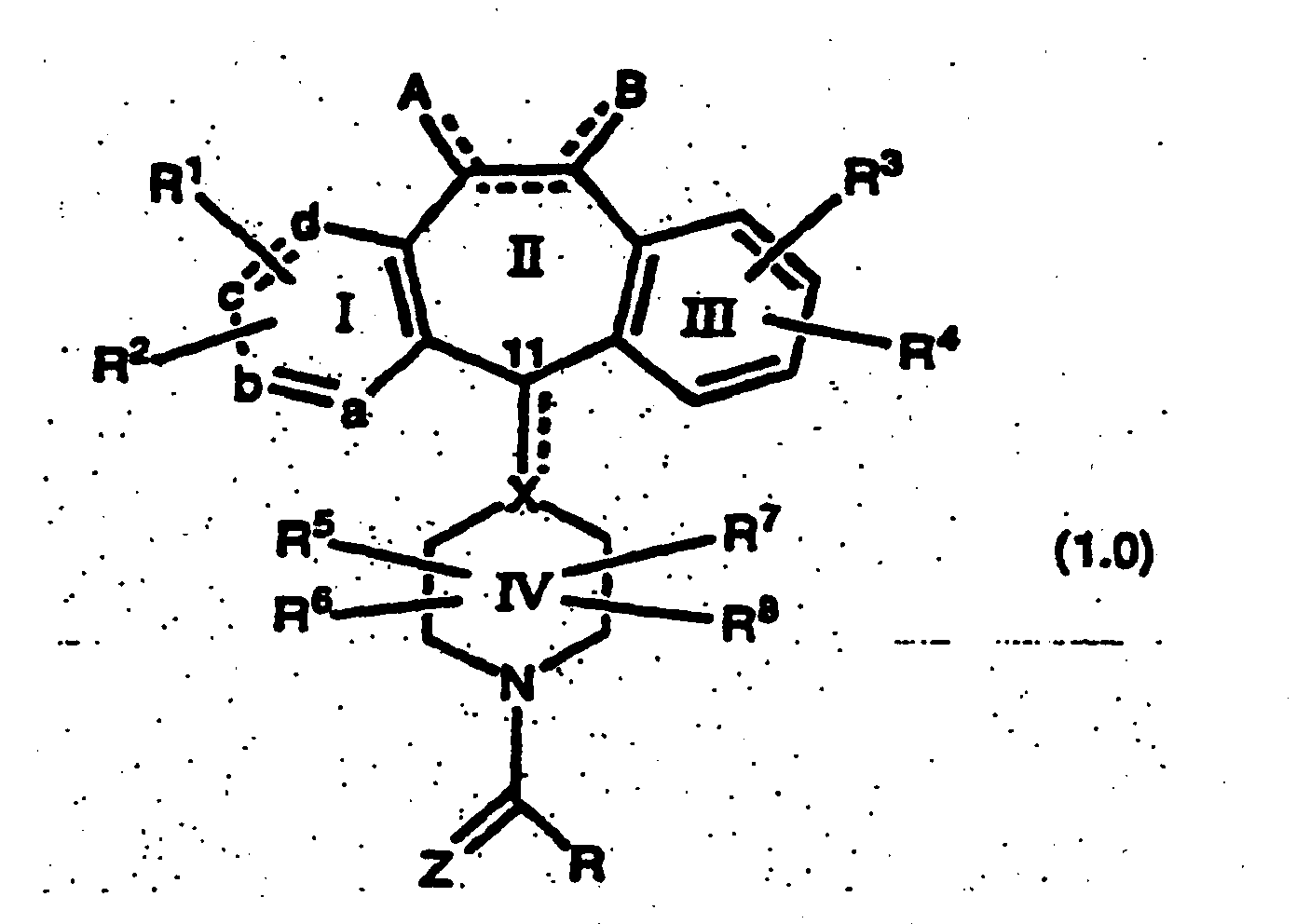 l'un des symboles a, b, c et d représente un atome de N ou un groupe NR9, où R9 représente O-, un groupe -CH3 ou -(CH2)nCO2H où n vaut de 1 à 3, et les symboles a, b, c et d restants représentent un groupe CR1 ou CR2;ou chacun des symboles a, b, c et d est indépendamment choisi parmi des groupes CR1 et CR2 ;chacun des symboles R1 et chacun des symboles R2 est indépendamment choisi parmi des atomes de H, d'halogène, des groupes -CF3, -OR10, -COR10, -SR10, -S(O)tR11 (où t vaut 0, 1 ou 2), -SCN, -N(R10)2, -NO2, -OC(O)R10, -CO2R10, -OCO2R11, -CN, -NHC(O)R10, -NHSO2R10, -CONHR10, -CONHCH2CH2OH, -NR10COOR11, -SR11C(O)OR11,
 R3 et R4 sont identiques ou différents et représentent chacun indépendamment un atome de H, l'un quelconque des groupes de substituants R1 et R2 pris ensemble, ou R3 et R4 pris ensemble, représente un cycle en C5 à C7 saturé ou insaturé condensé au cycle benzène ;R5, R6 R7 et R8 représentent chacun indépendamment un atome de H, un groupe -CF3, -COR10, alkyle ou aryle, ledit groupe alkyle ou aryle étant éventuellement substitué par un groupe -OR10, -SR10, -S(O)tR11, NR10COOR11, -N(R10)2, -NO2, -COR10, -OCOR10, -OCO2R11, -CO2R10, OPO3R10, ou l'un des symboles R5, R6, R7 et R8 peut être pris en combinaison avec R40 tel que défini ci-dessous pour représenter -(CH2)r- où r vaut de 1 à 4 qui peut être substitué par un groupe alkyle inférieur, alcoxy inférieur, -CF3 ou aryle, ou R5 est combiné avec R6 pour représenter =O ou =S et/ou R7 est combiné avec R8 pour représenter =O ou =S ;R10 représente un atome de H, un groupe alkyle, aryle ou aralkyle ;R11 représente un groupe alkyle ou aryle ;X représente N, CH, ou C, lequel C peut être relié par une double liaison éventuelle, représentée par la ligne en pointillé, avec l'atome de carbone 11 ;la ligne en pointillé entre les atomes de carbone 5 et 6 représente une double liaison éventuelle, de telle sorte que lorsqu'une double liaison est présente, A et B représentent indépendamment un groupe R10, un atome d'halogène, un groupe -OR11, -OCO2R11 ou -OC(O)R10, et lorsqu'aucune double liaison n'est présente entre les atomes de carbone 5 et 6, A et B représentent chacun indépendamment H2, un groupe -(OR11)2, un atome de H et un atome d'halogène, deux atomes d'halogène, un groupe alkyle et un atome de H, deux groupes alkyle, un atome de H et un groupe -OC(O)R10, un atome de H et un groupe -OR10, =O, un groupe aryle et un atome de H, =NOR10, ou -O-(CH2)p-O- où p vaut 2, 3 ou 4 ;R représente R40, R42, R44 ou R54 tels que définis ci-dessous ;R40 représente un atome de H, un groupe aryle, alkyle, cycloalkyle, alcényle, alcynyle ou -D où D représente
 ou R40 représente un groupe phényle substitué par un groupe choisi parmi des groupes -SO2NH2, -NHSO2CH3, -SO2NHCH3, -SO2CH3, -SOCH3, -SCH3, et -NHSO2CF3, ledit groupe étant de préférence situé en position para du cycle phényle ;ou R40 représente un groupe choisi parmi


 R42 représente un groupeoù R20, R21 et R46 sont chacun indépendamment choisis dans l'ensemble constitué par :
 (1) un atome de H ;(2) un groupe -(CH2)qSC(O)CH3 où q vaut de 1 à 3 ;(3) un groupe -(CH2)qOSO2CH3 où q vaut de 1 à 3 ;(4) un groupe -OH ;(5) un groupe -CS(CH2)w(phényle substitué) où w vaut de 1 à 3 et les substituants sur ledit groupe phényle substitué sont les mêmes substituants que ceux décrits ci-dessous pour ledit groupe phényle substitué ;(6) un groupe -NH2 :(7) un groupe -NHCBZ ;(8) un groupe -NHC(O)OR22 où R22 représente un groupe alkyle comportant 1 à 5 atomes de carbone, ou R22 représente un groupe phényle substitué par un à trois groupes alkyle ;(9) un groupe alkyle ;(10) un groupe -(CH2)kphényle où k vaut de 1 à 6 ;(11) un groupe phényle ;(12) un groupe phényle substitué où les substituants sont choisis dans l'ensemble constitué par des atomes d'halogène, des groupes NO2, -OH, -OCH3, -NH2, -NHR22, -N(R22)2, alkyle, -O(CH2)tphényle (où t vaut de 1 à 3), et -O(CH2)tphényle substitué (où t vaut de 1 à 3) ;(13) un groupe naphtyle ;(14) un groupe naphtyle substitué, où les substituants sont tels que définis pour le groupe phényle substitué ci-dessus ;(15) des hydrocarbures polycycliques pontés comportant de 5 à 10 atomes de carbone ;(16) un groupe cycloalkyle comportant 5 à 7 atomes de carbone ;(17) un groupe hétéroaryle ;(18) un groupe hydroxyalkyle ;(19) un groupe pyridyle substitué ou N-oxyde de pyridyle substitué où les substituants sont choisis parmi les groupes méthylpyridyle, morpholinyle, imidazolyle, 1-pipéridinyle, 1-(4-méthylpipérazinyle), -S(O)tR11, ou l'un quelconque des substituants donnés ci-dessus pour ledit groupe phényle substitué, et lesdits substituants sont liés à un atome de carbone du cycle par remplacement de l'atome d'hydrogène lié audit atome de carbone ;
 (23) un groupe -NHC(O)-(CH2)k-phényle ou -NH(O)-(CH2)k-phényle substitué où k est tel que défini ci-dessus ;(24) le cycle pipéridine V :
 (25) un groupe -NHC(O)CH2C6H5 ou C6H5 substitué par un groupe -NHC(O)CH2- ;(26) -NHC(O)OC6H5 ;(27)
 (28)
(28) (29)
(29) (30) un groupe -OC(O)-hétéroaryle, par exemple un groupe
 (31) un groupe -O-alkyle(par exemple, -OCH3) ;(32) et un groupe -CF3;(33) un groupe -CN;(34) un groupe hétérocycloalkyle de formule
 (35) et un groupe pipéridinyle de formuleoù R85 représente un atome de H, un groupe alkyle, ou alkyle substitué par un groupe -OH ou -SCH3
ou R20 et R21 pris ensemble forment =O et le symbole R46 restant est tel que défini ci-dessus ;
ou deux des symboles R20, R21 et R46, pris ensemble, forment un cycle pipéridine V
à condition que R46, R20 et R21 soient choisis de façon à ce que l'atome de carbone auquel ils sont liés ne porte pas plus d'un hétéroatome ;
R44 représente
R54 représente un groupe hétérocyclique N-oxyde de formule (i), (ii), (iii) ou (iv) :
ou R54 représente un groupe hétérocyclique N-oxyde de formule (ia), (iia), (iiia) ou (iva) :
ou R54 représente un groupe alkyle substitué par un desdits groupes hétérocycliques N-oxydes (i), (ii), (iii), (iv), (ia), (iia), (iiia), ou (iva) ;
et Z représente un atome de O ou de S
à condition que lorsque :(1) R1, R2, R3 et R4 sont indépendamment choisis parmi des atomes de H, d'halogène, des groupes -CF3, -OR10, -COR10, -SR10, -S(O)tR11, -N(R10)2, -NO2, OC(O)R10, -CO2R10, -OCO2R11, -CN, -NR10COOR11, -SR11C(O)OR11, -SR11N(R75)2, benzotriazol-1-yloxy, tétrazol-5-ylthio, tétrazol-5-ylthio substitué, alcynyle, alcényle et alkyle ; ou R1 et R2 sont choisis parmi des atomes de H, d'halogène, des groupes -CF3, -OR10, -COR10, -SR10, -S(O)tR11, -N(R10)2, -NO2, -OC(O)R10, -CO2R10, -OCO2R11, -CN, -NR10COOR11, -SR11C(O)OR11, -SR11N(R75)2, benzotriazol-1-yloxy, tétrazol-5-ylthio, tétrazol-5-ylthio substitué, alcynyle, alcényle et alkyle, et R3 et R4 pris ensemble représentent un cycle en C5 à C7 saturé ou insaturé condensé au cycle benzène (cycle III) ;(2) et la ligne en pointillé entre les atomes de carbone 5 et 6 représente une double liaison éventuelle, de telle sorte que lorsqu'une double liaison est présente, A et B représentent indépendamment un groupe -R10, un atome d'halogène, un groupe -OR11, -OCO2R11 ou -OC(O)R10, et lorsqu'aucune double liaison n'est présente entre les atomes de carbone 5 et 6, A et B représentent chacun indépendamment H2, un groupe -(OR11)2, un atome de H et un atome d'halogène, deux atomes d'halogène, un groupe alkyle et un atome de H, deux groupes alkyle, un atome de H et un groupe -OC(O)R10, un atome de H et un groupe -OR10, =O, un groupe aryle et un atome de H, un groupe =NOR10 ou -O-(CH2)p-O- où p vaut 2, 3 ou 4 ;
alors R est choisi parmi :(a) R42 où au moins l'un des symboles R20, R21 et R46 est choisi parmi :(1) un groupe pyridyle substitué ou N-oxyde de pyridyle substitué où les substituants sont choisis parmi les groupes méthylpyridyle, morpholinyle, imidazolyle, 1-pipéridinyle et 1-(4-méthylpipérazinyle),(2) un groupe -CN ;(3) un groupe triazolyle ;(4) un groupe hétérocycloalkyle de formule (5) ou un groupe pipéridinyle de formuleoù R85 représente un atome de H, un groupe alkyle ou alkyle substitué par un groupe -OH ou -SCH3 ;
 (b) ou R44 où R25 représente un groupe N-méthylpipéridinyle ; sachant que :un groupe alkyle (y compris les parties alkyle des groupes alcoxy, alkylamino et dialkylamino) représente une chaîne carbonée linéaire ou ramifiée et contient de 1 à 20 atomes de carbone,un groupe alcanediyle représente une chaîne hydrocarbonée divalente, linéaire ou ramifiée, comportant de 1 à 20 atomes de carbone, les deux liaisons disponibles provenant du même atome de carbone ou d'atomes de carbone différents de celle-ci ;un groupe cycloalkyle représente un carbocycle saturé, ramifié ou non ramifié, comportant de 3 à 20 atomes de carbone ;un groupe hétérocycloalkyle représente un carbocycle saturé, ramifié ou non ramifié, comportant de 3 à 15 atomes de carbone, lequel carbocycle est interrompu par 1 à 3 hétéroatomes ou groupes contenant un hétéroatome choisis parmi -O-, -S- et -NR10- ;un groupe alcényle représente une chaîne carbonée linéaire ou ramifiée, comportant au moins une double liaison carbone-carbone et contenant de 2 à 12 atomes de carbone,un groupe alcynyle représente une chaîne carbonée linéaire ou ramifiée, comportant au moins une triple liaison carbone-carbone et contenant de 2 à 12 atomes de carbone,un groupe aryle (y compris la partie aryle des groupes aryloxy et aralkyle) représente un groupe carbocyclique contenant de 6 à 15 atomes de carbone et comportant au moins un cycle aromatique, tous les atomes de carbone substituables disponibles du groupe carbocyclique étant supposés être des points de fixation possibles, ledit groupe carbocyclique étant éventuellement substitué par un ou plusieurs atomes d'halogène, groupes alkyle, hydroxy, alcoxy, phénoxy, CF3, amino, alkylamino, dialkylamino, -COOR10 ou -NO2 ;un groupe hétéroaryle représente un groupe cyclique, éventuellement substitué par R3 et R4, contenant au moins un hétéroatome choisis parmi O, S et N, ledit hétéroatome interrompant une structure carbocyclique et comportant un nombre suffisant d'électrons pi délocalisés pour présenter un caractère aromatique, et contenant de 2 à 14 atomes de carbone, (éventuellement substituée par R3 et R4) ;et sachant que le terme « inférieur » dans le contexte de « groupe alkyle inférieur », « groupe alcoxy inférieur », etc. représente une chaîne carbonée comportant de 1 à 4 atomes de carbone.
 - Utilisation selon la revendication 1, dans laquelle a représente un atome de N et b, c et d représentent des atomes de carbone ; R1 et R2 sont identiques ou différents et sont chacun indépendamment choisis parmi des atomes de H, d'halogène, des groupes -CF3, alkyle inférieur, et benzotriazol-1-yloxy, et R1 est en position C-4 et R2 est en position C-3 ; R3 et R4 sont identiques ou différents et sont chacun indépendamment choisis parmi des atomes de H et d'halogène, et R3 est en position C-8 et R4 est en position C-9 ; lorsque la double liaison entre les atomes de carbone 5 et 6 est présente, A et B représentent indépendamment un atome de H, un groupe alkyloxy ou alkyle inférieur ; et lorsque la double liaison entre les atomes de carbone 5 et 6 est absente, A et B représentent indépendamment H2, (-H et -OH) ou =O ; R5, R6, R7 et R8 représentent un atome de H ; Z représente un atome de O ; et R représente R42 ou R44.
- Utilisation selon la revendication 2, dans laquelle R20 et R21 sont chacun indépendamment choisis parmi un atome de H et un groupe alkyle, R3 représente un atome de Cl, R4 représente un atome de H, R1 et R2 sont individuellement choisis parmi un atome de H, un groupe benzotriazol-1-yloxy, alkyle en C1 à C4 et un atome d'halogène ; et R46 représente un groupe triazolyle, hétérocycloalkyle de formule


- Utilisation selon la revendication 3, dans laquelle R20 et R21 représentent tous les deux un atome de H ou R20 et R21 représentent tous les deux un groupe méthyle, R1 et R2, sont individuellement choisis parmi des atomes de H, de Br, de Cl, des groupes méthyle et benzotriazol-1-yl-oxy ; et R46 représente un groupe triazolyle, 1-N-méthylpipérazinyle, 1-pipérazinyle, hétérocycloalkyle de formule


- Utilisation selon la revendication 1, dans laquelle a représente un atome de N et b, c et d représentent des atomes de carbone ; R1 et R2 sont identiques ou différents et sont chacun indépendamment choisis parmi des atomes de H, d'halogène, des groupes -CF3, alkyle inférieur, et benzotriazol-1-yloxy, et R1 est en position C-4 et R2 est en position C-3 ; R3 et R4 sont identiques ou différents et sont chacun indépendamment choisis parmi un atome de H et un atome d'halogène, et R3 est en position C-8 et R4 est en position C-9 ; lorsque la double liaison entre les atomes de carbone 5 et 6 est présente, A et B représentent indépendamment un atome de H, un groupe alkyloxy ou alkyle inférieur ; et lorsque la double liaison entre les atomes de carbone 5 et 6 est absente, A et B représentent indépendamment H2, (-H et -OH) ou =O ; R5, R6, R7 et R8 représentent un atome de H ; Z représente un atome de O ; et R représente R44 et R25 représente un groupe 3-N-méthylpipéridinyle ou 4-N-méthylpipéridinyle.
- Utilisation selon la revendication 1, dans laquelle R25 représente un groupe 3-piridyle ou phényle, R3 représente un atome de Cl, R4 représente un atome de H, R48 représente un atome de H ou un groupe méthyle ; et R1 et R2 sont individuellement choisis parmi un atome de H, des groupes benzotriazol-1-yloxy, méthyle, et des atomes de Br et Cl.
- Utilisation selon la revendication 1, dans laquelle les cellules inhibées sont des cellules tumorales exprimant un oncogène ras activé.
- Utilisation selon la revendication 7, dans laquelle les cellules inhibées sont des cellules tumorales pancréatiques, des cellules de cancer du poumon, des cellules tumorales de leucémie myélogène, des cellules tumorales folliculaires de la thyroïde, des cellules tumorales myélodysplasiques, des cellules tumorales de cancer épidermique, des cellules tumorales de cancer de la vessie ou des cellules tumorales de colon.
- Utilisation selon la revendication 1, dans laquelle l'inhibition de la croissance anormale des cellules se fait par l'inhibition de la famésyl-protéine-transférase.
- Utilisation selon la revendication 1, dans laquelle l'inhibition est celle de cellules tumorales où la protéine Ras est activée en résultat d'une mutation oncogénique dans des gènes autres que le gène Ras.
- Utilisation selon la revendication 1, dans laquelle le composé est choisi parmi les composés présentant les structures suivantes :


- Composé choisi parmi un composé de formule :


- Composé selon la revendication 12, dans lequel a représente un atome de N et b, c et d représentent des atomes de carbone ; R1 et R2 sont identiques ou différents et sont chacun indépendamment choisis parmi des atomes de H, d'halogène, des groupes -CF3, alkyle inférieur, et benzotriazol-1-yloxy, et R1 est en position C-4 et R2 est en position C-3 ; R3 et R4 sont identiques ou différents et sont chacun indépendamment choisis parmi un atome de H et un atome d'halogène, et R3 est en position C-8 et R4 est en position C-9 ; lorsque la double liaison entre les atomes de carbone 5 et 6 est présente, A et B représentent indépendamment un atome de H, un groupe alkyloxy ou alkyle inférieur ; et lorsque la double liaison entre les atomes de carbone 5 et 6 est absente, A et B représentent indépendamment H2, (-H et -OH) ou =O ; R5, R6, R7 et R8 représentent un atome de H ; Z représente un atome de O ; et R46 est choisi parmi des groupes 1-N-méthylpipérazinyle, 1-pipérazinyle et -hétérocycloalkyle de formule

- Composé selon la revendication 13, dans lequel R20 et R21 sont chacun indépendamment choisis parmi un atome de H et un groupe alkyle, R3 représente un atome de Cl, R4 représente un atome de H, R1 et R2 sont individuellement choisis parmi un atome de H, des groupes benzotriazol-1-yloxy, alkyle en C1 à C4 et un atome d'halogène ; et R46 représente un groupe 1-N-méthylpipérazinyle, 1-pipérazinyle ou hétérocycloalkyle de formule
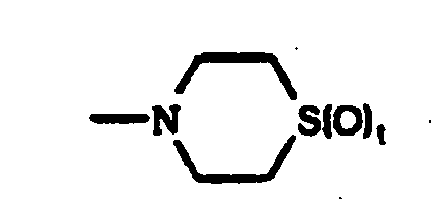
- Composé selon la revendication 14, dans lequel R20 et R21 représentent tous les deux un atome de H ou R20 et R21 représentent tous les deux un groupe méthyle ; et R1 et R2 sont individuellement choisis parmi des atomes de H, de Br, de Cl, des groupes méthyle et benzotriazol-1-yl-oxy.
- Composé choisi parmi des composés de formule :


chacun des symboles R1 et chacun des symboles R2 est indépendamment choisi parmi des atomes de H, d'halogène, des groupes -CF3, -OR10, -COR10, -SR10, -S(O)tR11 (où t vaut 0, 1 ou 2), -SCN, -N(R10)2, -NO2, -OC(O)R10, -CO2R10, -OCO2R11, -CN, -NHC (O) R10, -NHSO2R10, -CONHR10, -CONHCH2CH2OH, -NR10COOR11, -SR11C(O)OR11,
R3 et R4 sont identiques ou différents et représentent chacun indépendamment un atome de H, l'un quelconque des groupes de substituants R1 et R2 pris ensemble, ou R3 et R4 pris ensemble, représente un cycle en C5 à C7 saturé ou insaturé condensé au cycle benzène ;
R25 représente un groupe hétéroaryle, N-méthylpipéridinyle ou aryle ;
et R48 représente un atome de H ou un groupe alkyle ;
et à condition que :(1) lorsque R25 est choisi parmi des groupes hétéroaryle et aryle alors au moins l'un desdits groupes R1, R2, R3 et R4 est choisi parmi des groupes -SCN, NR10R11, -NHC(O)R10, -NHSO2R10, -CONHR10, -CONHCH2CH2OH ; et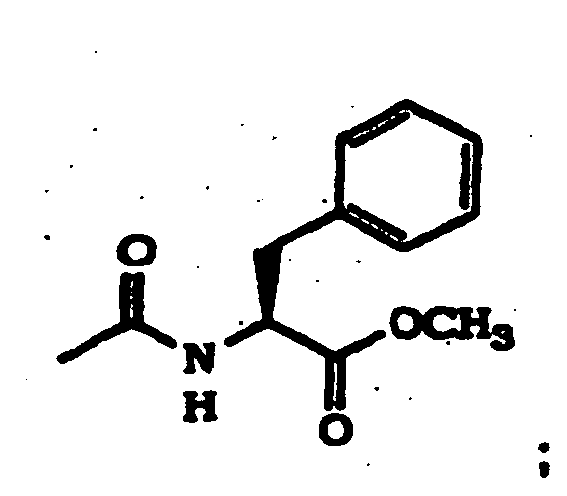 (2) lorsque R25 représente un groupe N-méthylpipéridinyle choisi parmi des groupes 3-N-méthylpipéridinyle et 4-N-méthylpipéridinyle, alors R1 et R2 ne représentent pas un atome de H, un atome d'halogène, un groupe -CF3, benzotriazol-1-yloxy ou alkyle inférieur lorsque : (a) R3 et R4 sont choisis parmi un atome de H et un atome d'halogène ; et (b) la double liaison entre les atomes de carbone 5 et 6 est présente et A et B sont choisis parmi un atome de H, des groupe alkyloxy et alkyle inférieur, ou la double liaison entre les atomes de carbone 5 et 6 est absente et A et B sont choisis parmi H2, (-H et -OH) et =O ; et (c) R5, R6, R7 etR8 représentent des atomes de H ; et (d) Z représente un atome de O.
 - Composé choisi parmi les composés présentant les structures suivantes :


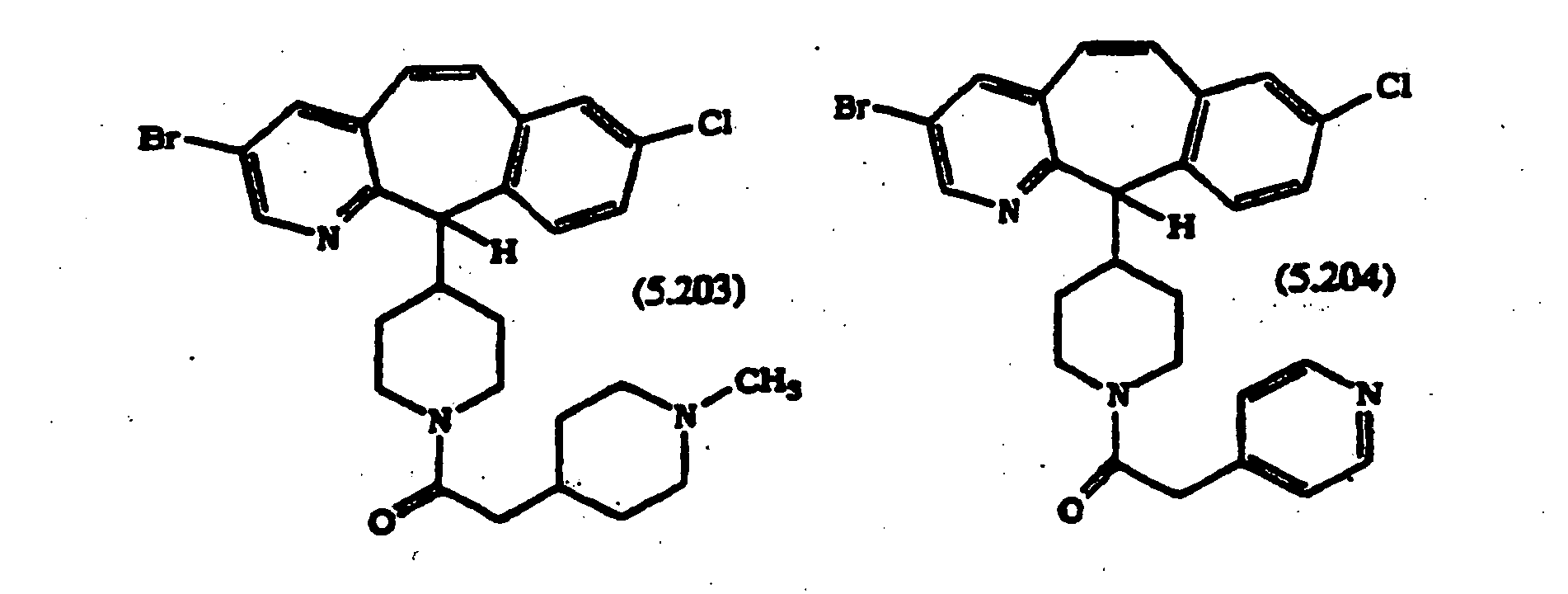


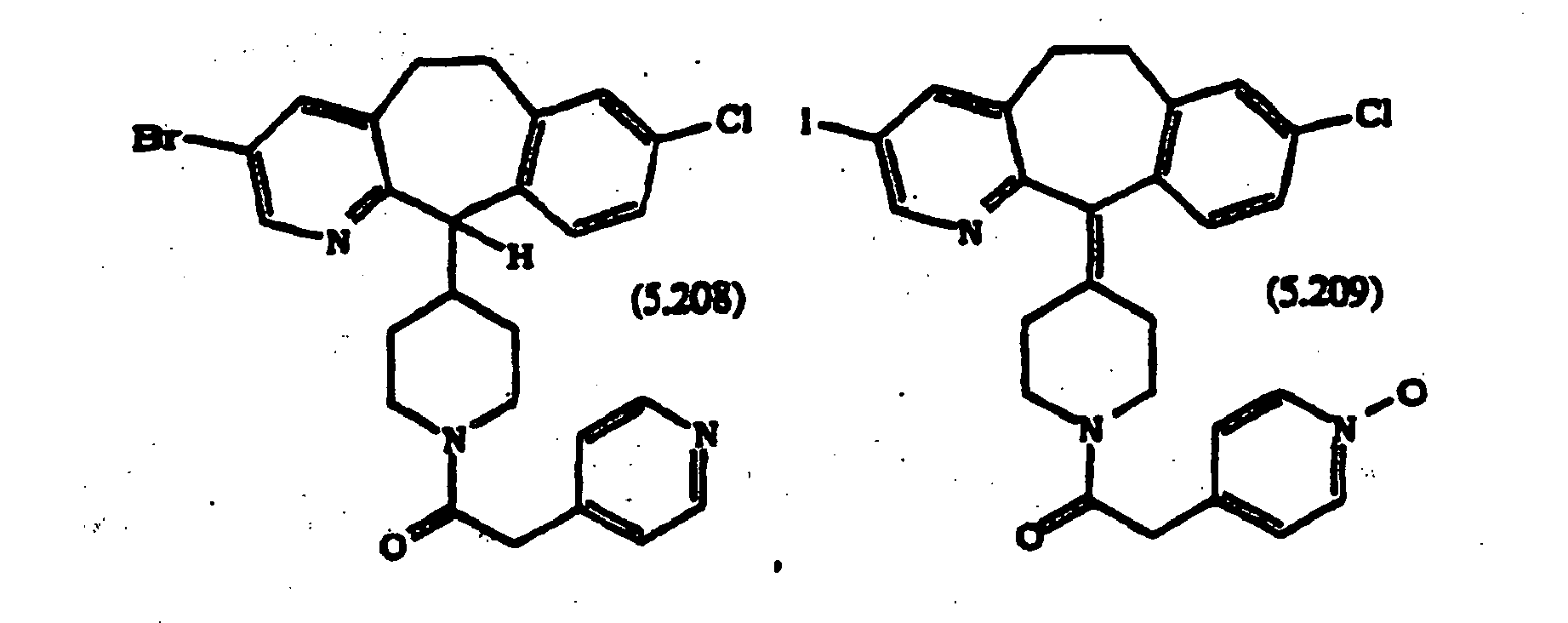


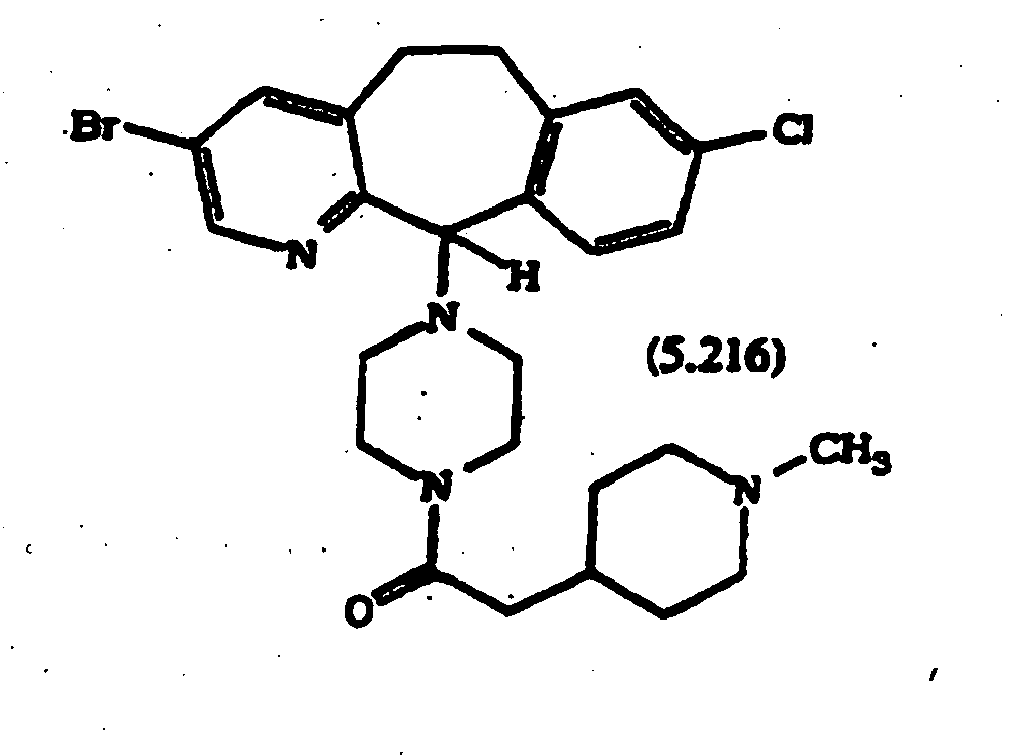


- Composé choisi parmi les composés présentant les structures suivantes :


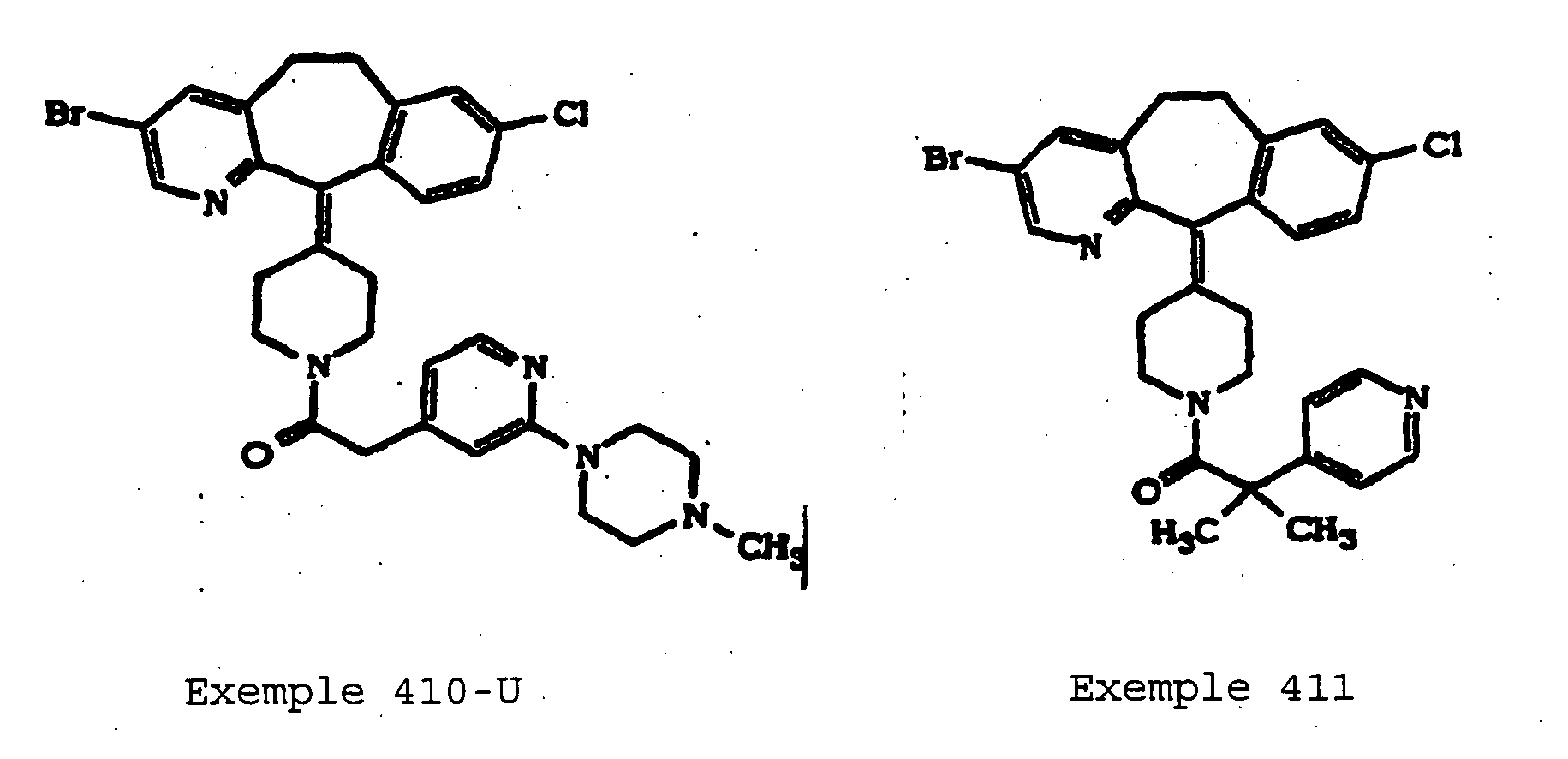


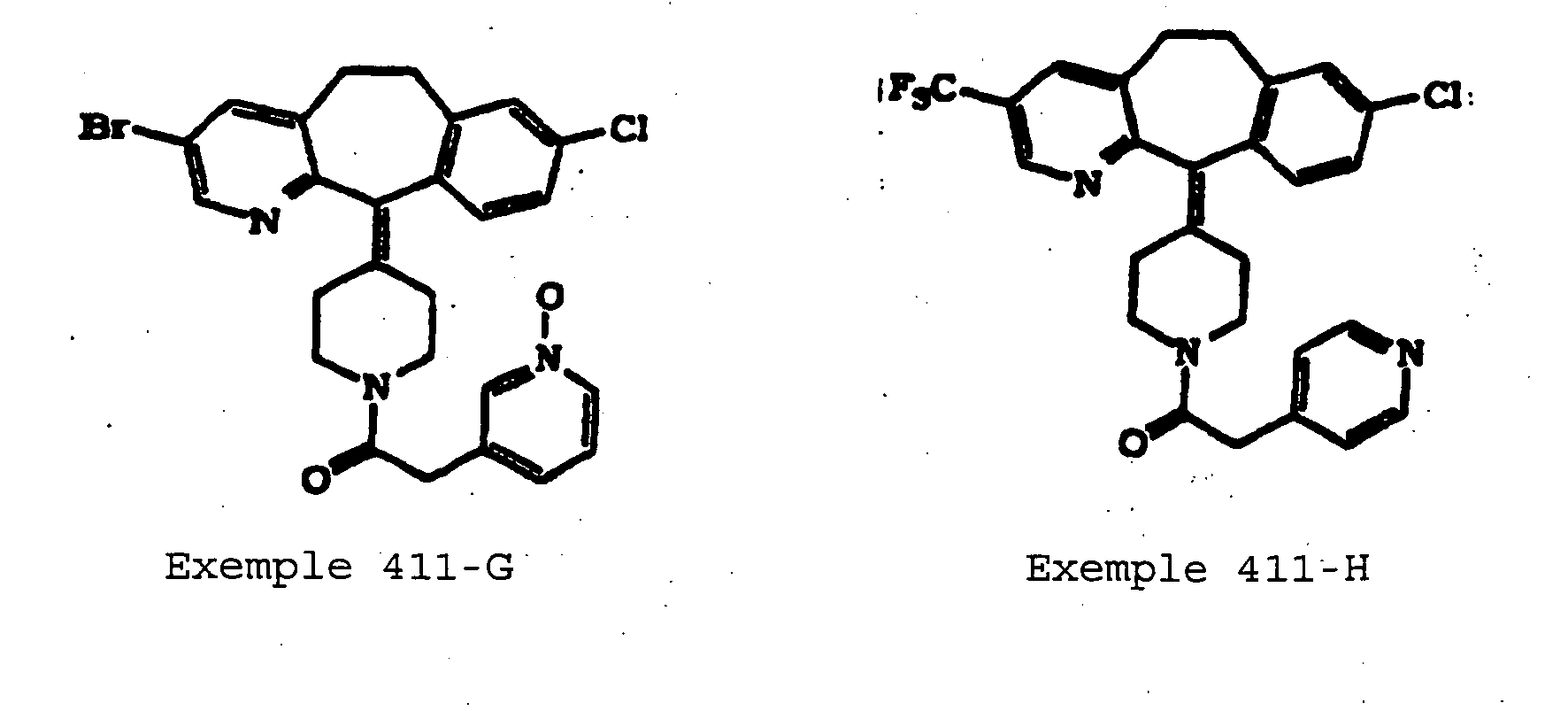


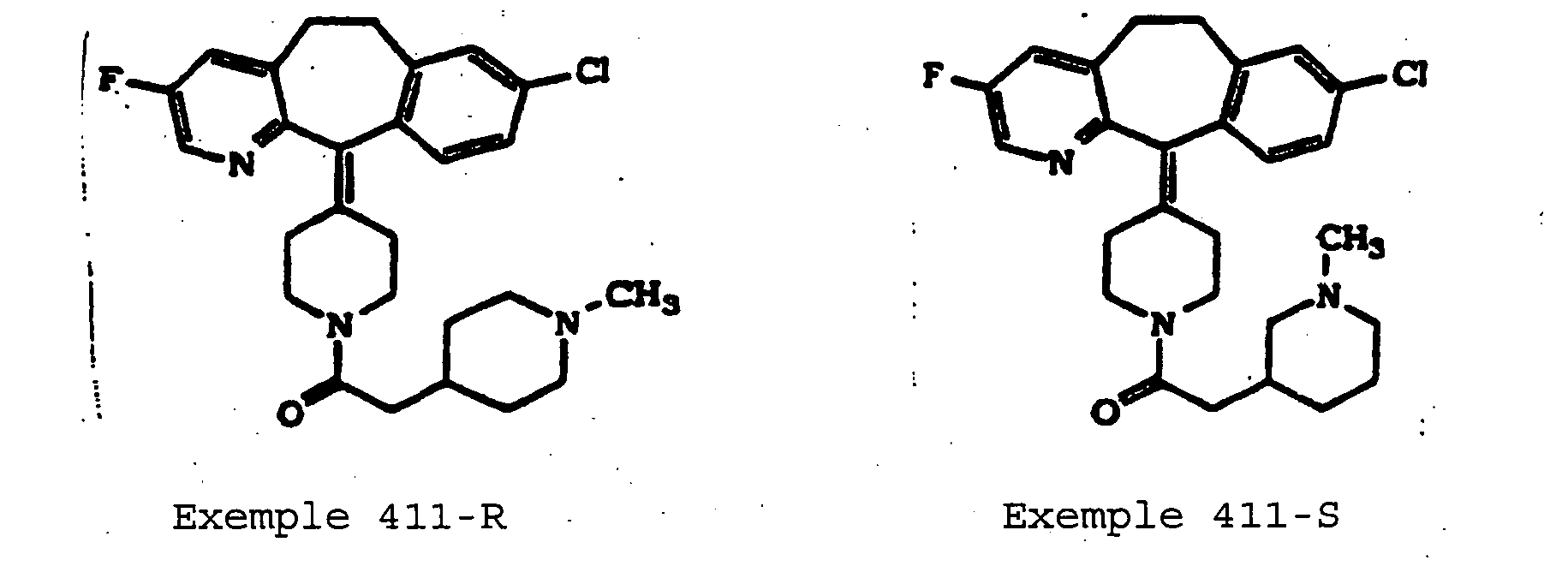


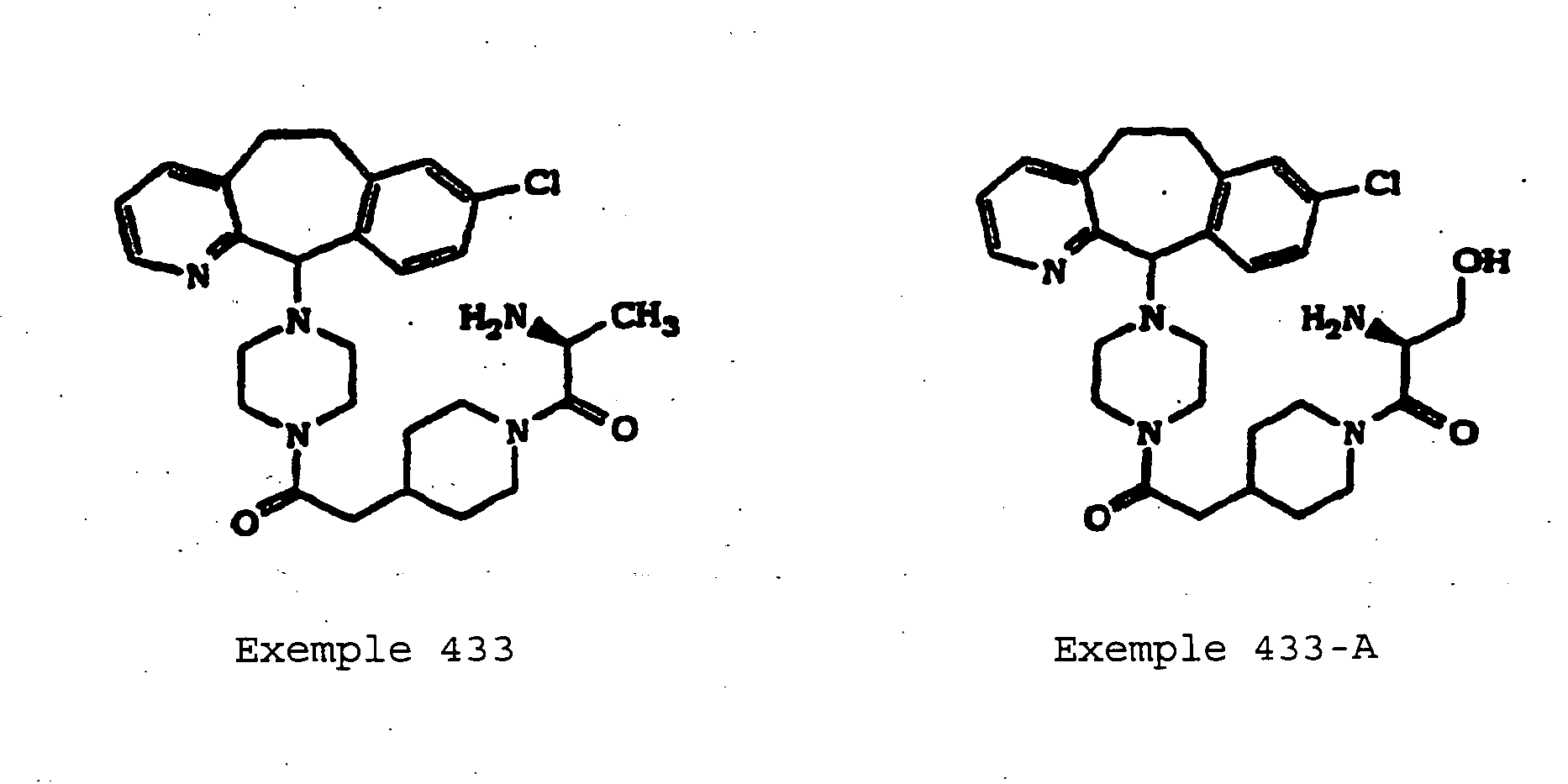


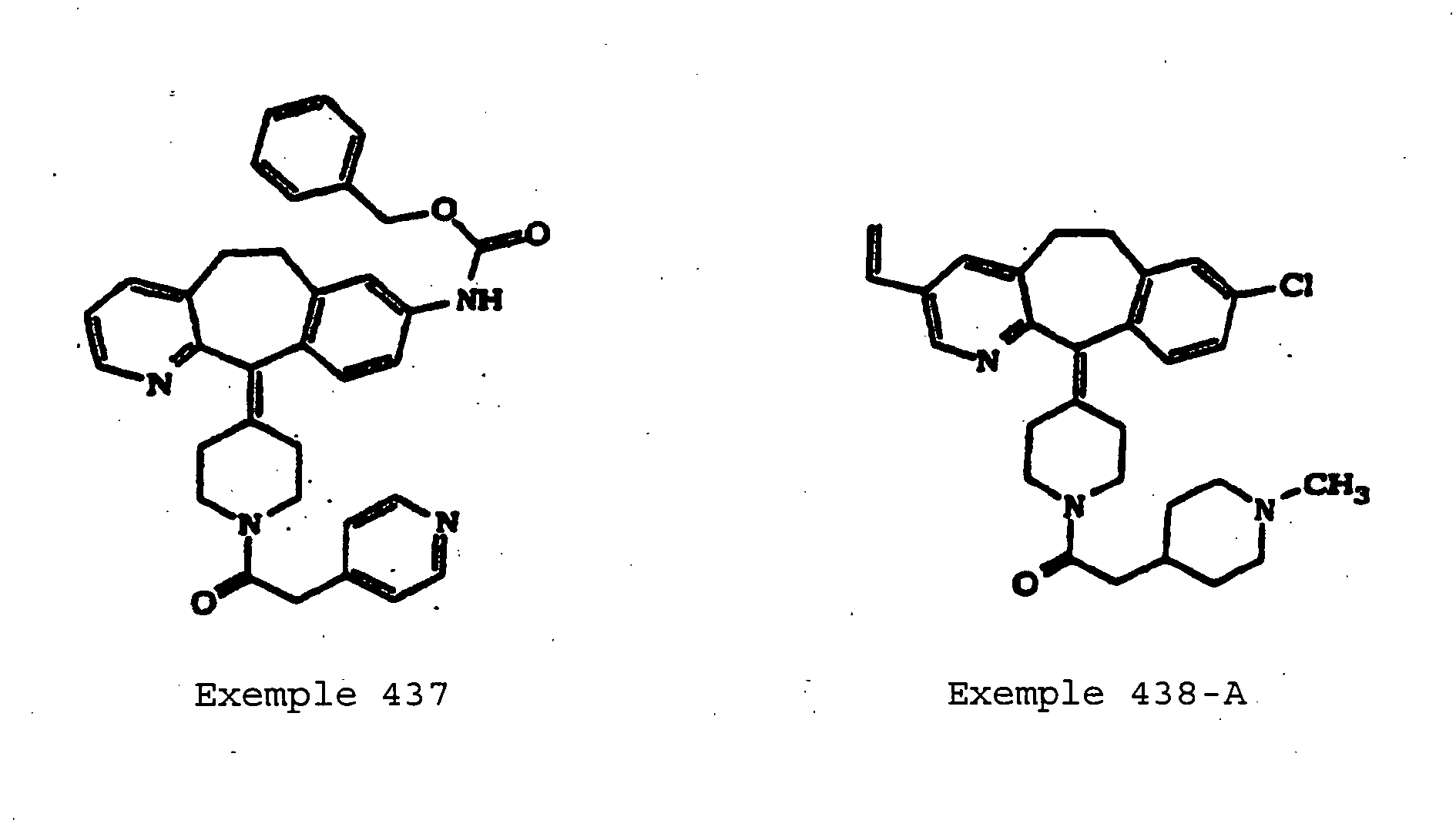


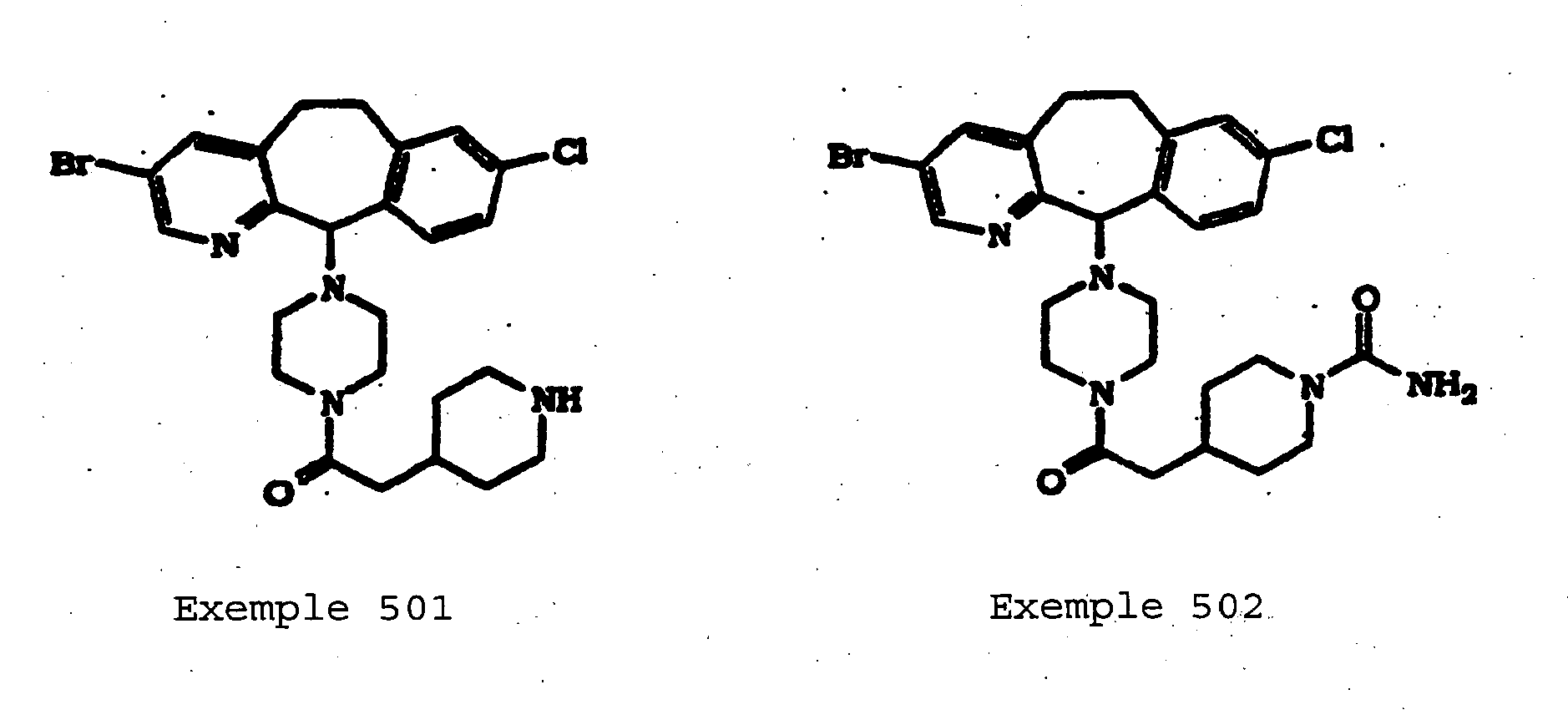


- Composition pharmaceutique pour inhiber la croissance anormale de cellules comprenant une quantité efficace d'un composé selon l'une quelconque des revendications 12 à 18 en combinaison avec un véhicule acceptable du point de vue pharmaceutique.
- Utilisation d'un composé selon l'une quelconque des revendications 12 à 18 pour la fabrication d'un médicament destiné à être utilisé pour inhiber la croissance anormale de cellules.
- Composé selon l'une quelconque des revendications 12 à 18 pour inhiber la croissance anormale de cellules.
Applications Claiming Priority (3)
| Application Number | Priority Date | Filing Date | Title |
|---|---|---|---|
| US410187 | 1995-03-24 | ||
| US08/410,187 US5719148A (en) | 1993-10-15 | 1995-03-24 | Tricyclic amide and urea compounds useful for inhibition of g-protein function and for treatment of proliferative diseases |
| PCT/US1996/003314 WO1996030363A1 (fr) | 1995-03-24 | 1996-03-21 | Composes d'amide et d'uree tricycliques utilises pour inhiber la fonction proteine g et pour le traitement des maladies proliferatives |
Publications (2)
| Publication Number | Publication Date |
|---|---|
| EP0815100A1 EP0815100A1 (fr) | 1998-01-07 |
| EP0815100B1 true EP0815100B1 (fr) | 2006-06-21 |
Family
ID=23623621
Family Applications (1)
| Application Number | Title | Priority Date | Filing Date |
|---|---|---|---|
| EP96909651A Expired - Lifetime EP0815100B1 (fr) | 1995-03-24 | 1996-03-21 | Derives d'amide et d'uree tricycliques utilises pour inhiber la fonction de proteine g et pour le traitement des maladies proliferatives |
Country Status (14)
| Country | Link |
|---|---|
| US (4) | US5719148A (fr) |
| EP (1) | EP0815100B1 (fr) |
| JP (1) | JP3368905B2 (fr) |
| KR (1) | KR19980703430A (fr) |
| AR (1) | AR003938A1 (fr) |
| AT (1) | ATE330952T1 (fr) |
| AU (1) | AU714255B2 (fr) |
| CA (1) | CA2216160C (fr) |
| DE (1) | DE69636279T2 (fr) |
| ES (1) | ES2265151T3 (fr) |
| HU (1) | HUP9800416A2 (fr) |
| IL (1) | IL117604A0 (fr) |
| MX (1) | MX9707197A (fr) |
| WO (1) | WO1996030363A1 (fr) |
Families Citing this family (155)
| Publication number | Priority date | Publication date | Assignee | Title |
|---|---|---|---|---|
| US6316607B1 (en) * | 1986-04-30 | 2001-11-13 | Igen International, Inc. | Electrochemiluminescent assays |
| US6365588B1 (en) | 1993-10-15 | 2002-04-02 | Schering Corporation | Tricyclic amide and urea compounds useful for inhibition of G-protein function and for treatment of proliferative diseases |
| US6524832B1 (en) * | 1994-02-04 | 2003-02-25 | Arch Development Corporation | DNA damaging agents in combination with tyrosine kinase inhibitors |
| AU769687B2 (en) * | 1995-12-22 | 2004-01-29 | Merck Sharp & Dohme Corp. | Tricyclic amides useful for inhibition of G-protein function and for treatment of proliferative diseases |
| CZ292791B6 (cs) * | 1995-12-22 | 2003-12-17 | Schering Corporation | Tricyklické amidy, které se používají pro inhibici G-proteinové funkce a k léčení proliferativních onemocnění |
| US5874442A (en) * | 1995-12-22 | 1999-02-23 | Schering-Plough Corporation | Tricyclic amides useful for inhibition of G-protein function and for treatment of proliferative disease |
| US5925757A (en) * | 1996-07-26 | 1999-07-20 | Schering Corporation | Method for preparing carboxamides |
| US6030982A (en) * | 1996-09-13 | 2000-02-29 | Schering Corporationm | Compounds useful for inhibition of farnesyl protein transferase |
| AU4337497A (en) * | 1996-09-13 | 1998-04-02 | Schering Corporation | Tricyclic compounds useful as fpt inhibitors |
| US5861395A (en) * | 1996-09-13 | 1999-01-19 | Schering Corporation | Compounds useful for inhibition of farnesyl proteins transferase |
| BR9712831A (pt) * | 1996-09-13 | 1999-11-16 | Schering Corp | Inibidores tricìclicos de farnesil proteìna transferase |
| EP0929544B1 (fr) * | 1996-09-13 | 2004-11-10 | Schering Corporation | Composes antitumoraux tricycliques inhibiteurs de la farnesyl transferase proteique |
| US5994364A (en) * | 1996-09-13 | 1999-11-30 | Schering Corporation | Tricyclic antitumor farnesyl protein transferase inhibitors |
| US5958890A (en) * | 1996-09-13 | 1999-09-28 | Schering Corporation | Tricyclic compounds useful for inhibition of G-protein function and for treatment of proliferative diseases |
| ES2234036T3 (es) * | 1996-09-13 | 2005-06-16 | Schering Corporation | Compuestos utiles para inhibir la farnesil-protein-transferasa. |
| US5985879A (en) * | 1996-09-13 | 1999-11-16 | Schering Corporation | Compounds useful for inhibition of farnesyl protein transferase |
| US5945429A (en) * | 1996-09-13 | 1999-08-31 | Schering Corporation | Compounds useful for inhibition of farnesyl protein transferase |
| US6040305A (en) * | 1996-09-13 | 2000-03-21 | Schering Corporation | Compounds useful for inhibition of farnesyl protein transferase |
| JP2002515052A (ja) * | 1996-09-13 | 2002-05-21 | シェーリング コーポレイション | ファルネシルタンパク質トランスフェラーゼの阻害に有用な化合物 |
| US6071907A (en) * | 1996-09-13 | 2000-06-06 | Schering Corporation | Tricyclic compounds useful as FPT inhibitors |
| CA2264513C (fr) * | 1996-09-13 | 2004-03-30 | Schering Corporation | Derives substitues de la benzocycloheptapyridine servant a inhiber la farnesyl-proteine transferase |
| US6130229A (en) * | 1996-10-09 | 2000-10-10 | Schering Corporation | Tricyclic compounds having activity as RAS-FPT inhibitors |
| US5972966A (en) * | 1996-12-05 | 1999-10-26 | Merck & Co., Inc. | Inhibitors of farnesyl-protein transferase |
| US6211193B1 (en) | 1997-06-17 | 2001-04-03 | Schering Corporation | Compounds useful for inhibition of farnesyl protein transferase |
| US6159984A (en) | 1997-06-17 | 2000-12-12 | Schering Corporation | Farnesyl protein transferase inhibitors |
| CA2293433C (fr) * | 1997-06-17 | 2009-09-29 | Schering Corporation | Derives de benzo(5,6)cyclohepta(1,2-b)pyridine s'utilisant comme inhibiteurs de transferase de proteine de farnesyl |
| WO1998057950A1 (fr) * | 1997-06-17 | 1998-12-23 | Schering Corporation | Nouveaux composes tricycliques de phenyle substitues inhibiteurs de farnesyl proteine transferase |
| US5852034A (en) * | 1997-06-17 | 1998-12-22 | Schering Corporation | Benzo(5,6)cycloheptapyridine cyclic ureas and lactams useful as farnesyl protein transferase inhibitors |
| US5877177A (en) * | 1997-06-17 | 1999-03-02 | Schering Corporation | Carboxy piperidylacetamide tricyclic compounds useful for inhibition of G-protein function and for treatment of proliferative diseases |
| IL133392A0 (en) * | 1997-06-17 | 2001-04-30 | Schering Corp | Benzo (5, 6) cyclohepta (1, 2b) pyridine derivatives useful for inhibition of farnesyl protein transferase |
| ZA985214B (en) * | 1997-06-17 | 1999-01-07 | Schering Corp | Compounds useful for inhibition of farnesyl protein transferase |
| US6051582A (en) * | 1997-06-17 | 2000-04-18 | Schering Corporation | Compounds useful for inhibition of farnesyl protein transferase |
| US6218401B1 (en) | 1997-06-17 | 2001-04-17 | Schering Corporation | Phenyl-substituted tricyclic inhibitors of farnesyl-protein transferase |
| AU8253598A (en) * | 1997-06-17 | 1999-01-04 | Schering Corporation | Novel n-substituted urea inhibitors of farnesyl-protein transferase |
| US6228865B1 (en) | 1997-06-17 | 2001-05-08 | Schering Corporation | Compounds useful for inhibition of farnesyl protein transferase |
| KR20010013882A (ko) * | 1997-06-17 | 2001-02-26 | 둘락 노먼 씨. | 파르네실 단백질 트랜스퍼라제의 억제에 유용한벤조(5,6)사이클로헵타(1,2b)피리딘 유도체 |
| US6576639B1 (en) | 1997-06-17 | 2003-06-10 | Schering Corporation | Compounds for the inhibition of farnesyl protein transferase |
| EP1156046A1 (fr) * | 1997-06-17 | 2001-11-21 | Schering Corporation | Dérivés de benzo(5,6)cyclohepta(1,2-b)pyridine pour l'inhibition de la farnesyl protéine transferase |
| US5945430A (en) * | 1997-06-17 | 1999-08-31 | Schering Corporation | Aminooxyamide tricyclic inhibitors of farnesyl-protein transferase |
| AU8253498A (en) * | 1997-06-17 | 1999-01-04 | Schering Corporation | Tricyclic compounds useful for inhibition of g-protein function and for treatment of proliferative diseases |
| US6358968B1 (en) | 1997-06-17 | 2002-03-19 | Schering Corporation | N-substituted urea inhibitors of farnesyl-protein transferase |
| DE69812945T2 (de) * | 1997-06-17 | 2004-03-11 | Schering Corp. | Tricyclische aminooxyamide derivate als farnesyl protein transferase inhibitoren |
| US5939416A (en) * | 1997-06-17 | 1999-08-17 | Schering Corporation | Benzo (5,6) cycloheptapyridine compounds useful as farnesyl protein transferase inhibitors |
| US5925639A (en) * | 1997-06-17 | 1999-07-20 | Schering Corporation | Keto amide derivatives useful as farnesyl protein transferase inhibitors |
| US6225322B1 (en) * | 1997-06-17 | 2001-05-01 | Schering Corporation | Compounds useful for inhibition of farnesyl protein transferase |
| US6239140B1 (en) | 1997-06-17 | 2001-05-29 | Schering Corporation | Compounds useful for inhibition of farnesyl protein transferase |
| US6689789B2 (en) | 1997-06-17 | 2004-02-10 | Schering Corporation | Compounds useful for inhibition of farnesyl protein transferase |
| AU753533B2 (en) * | 1997-06-17 | 2002-10-17 | Schering Corporation | Benzo(5,6)cyclohepta(1,2B)pyridine derivatives useful for inhibition of farnesyl protein transferase |
| WO1998057955A1 (fr) * | 1997-06-17 | 1998-12-23 | Schering Corporation | Composes inhibiteurs de farnesyl proteine transferase |
| US5958940A (en) * | 1997-09-11 | 1999-09-28 | Schering Corporation | Tricyclic compounds useful as inhibitors of farnesyl-protein transferase |
| US6096757A (en) * | 1998-12-21 | 2000-08-01 | Schering Corporation | Method for treating proliferative diseases |
| US6632455B2 (en) | 1997-12-22 | 2003-10-14 | Schering Corporation | Molecular dispersion composition with enhanced bioavailability |
| WO2000001382A1 (fr) | 1998-07-02 | 2000-01-13 | Merck & Co., Inc. | Inhibiteurs de prenyl-proteine transferase |
| WO2000001701A1 (fr) | 1998-07-02 | 2000-01-13 | Merck & Co., Inc. | Inhibiteurs de prenyl-proteine transferase |
| US6307048B1 (en) | 1998-11-20 | 2001-10-23 | Schering Corporation | Enantioselective alkylation of tricyclic compounds |
| US6800636B2 (en) * | 1998-12-18 | 2004-10-05 | Schering Corporation | Farnesyl protein transferase inhibitors |
| US6271378B1 (en) | 1998-12-18 | 2001-08-07 | Schering Corporation | Process for preparing tricyclic compounds having antihistaminic activity |
| US6372747B1 (en) * | 1998-12-18 | 2002-04-16 | Schering Corporation | Farnesyl protein transferase inhibitors |
| US6362188B1 (en) * | 1998-12-18 | 2002-03-26 | Schering Corporation | Farnesyl protein transferase inhibitors |
| US6432959B1 (en) | 1998-12-23 | 2002-08-13 | Schering Corporation | Inhibitors of farnesyl-protein transferase |
| US6686502B1 (en) | 1999-03-26 | 2004-02-03 | Ucb S.A. | Compounds and methods for treatment of asthma, allergy and inflammatory disorders |
| PE20001566A1 (es) | 1999-03-26 | 2001-02-05 | Ucb Sa | Piperazinas 1,4-sustituidas, piperidinas 1,4-sustituidas y 4-alquilidenilpiperidinas 1-sustituidas |
| US6316462B1 (en) | 1999-04-09 | 2001-11-13 | Schering Corporation | Methods of inducing cancer cell death and tumor regression |
| AU2001229320A1 (en) | 2000-01-12 | 2001-07-24 | Merck And Co., Inc. | Inhibitors of prenyl-protein transferase |
| WO2001051128A1 (fr) | 2000-01-12 | 2001-07-19 | Merck & Co., Inc. | Inhibiteurs de la prenyl-transferase |
| WO2001051127A1 (fr) | 2000-01-12 | 2001-07-19 | Merck & Co., Inc. | Inhibiteurs de la transferase de proteine prenyle |
| US6610722B2 (en) | 2000-04-10 | 2003-08-26 | Merck & Co., Inc. | Inhibitors of prenyl-protein transferase |
| US7342016B2 (en) * | 2000-08-30 | 2008-03-11 | Schering Corporation | Farnesyl protein transferase inhibitors as antitumor agents |
| AR033680A1 (es) * | 2000-08-30 | 2004-01-07 | Schering Corp | Compuestos triciclicos utiles como inhibidores de la farnesil proteino transferasa y su uso para la manufactura de medicamentos como agentes antitumorales |
| CN1198816C (zh) * | 2000-11-29 | 2005-04-27 | 先灵公司 | 新的法尼基蛋白转移酶抑制剂 |
| US6703400B2 (en) | 2001-02-23 | 2004-03-09 | Schering Corporation | Methods for treating multidrug resistance |
| US20030059857A1 (en) * | 2001-09-17 | 2003-03-27 | Schering Corporation | G-protein coupled receptor and methods |
| NZ536475A (en) * | 2002-05-24 | 2008-06-30 | Schering Corp | Neutralizing human anti-igfr antibody |
| ATE533748T1 (de) * | 2002-10-03 | 2011-12-15 | Schering Corp | Enantioselektive alkylierung von trizyklischen verbindungen |
| US7417026B2 (en) | 2003-08-13 | 2008-08-26 | Children's Hospital Medical Center | Mobilization of hematopoietic cells |
| PE20050928A1 (es) * | 2003-11-21 | 2005-11-08 | Schering Corp | Combinaciones terapeuticas de anticuerpo anti-igfr1 |
| US20060106060A1 (en) * | 2004-03-18 | 2006-05-18 | The Brigham And Women's Hospital, Inc. | Methods for the treatment of synucleinopathies (Lansbury) |
| JP2007529555A (ja) * | 2004-03-18 | 2007-10-25 | ザ ブライハム アンド ウイメンズ ホスピタル, インコーポレイテッド | シヌクレイノパチーを治療する方法 |
| EP1744751A4 (fr) * | 2004-03-18 | 2010-03-10 | Brigham & Womens Hospital | Traitement des synucleinopathies |
| WO2005089518A2 (fr) * | 2004-03-18 | 2005-09-29 | The Brigham And Women's Hospital, Inc. | Expression de uch-l1 et cancerotherapie |
| WO2005089515A2 (fr) * | 2004-03-18 | 2005-09-29 | The Brigham And Women's Hospital, Inc. | Procedes de traitement des synucleinopathies |
| US20070293539A1 (en) * | 2004-03-18 | 2007-12-20 | Lansbury Peter T | Methods for the treatment of synucleinopathies |
| US20060205810A1 (en) * | 2004-11-24 | 2006-09-14 | Schering Corporation | Platinum therapeutic combinations |
| US20060194821A1 (en) * | 2005-02-18 | 2006-08-31 | The Brigham And Women's Hospital, Inc. | Compounds inhibiting the aggregation of superoxide dismutase-1 |
| US20060233810A1 (en) * | 2005-04-15 | 2006-10-19 | Yaolin Wang | Methods and compositions for treating or preventing cancer |
| US8362075B2 (en) | 2005-05-17 | 2013-01-29 | Merck Sharp & Dohme Corp. | Cyclohexyl sulphones for treatment of cancer |
| AU2006259536A1 (en) | 2005-06-15 | 2006-12-28 | Schering Corporation | Anti-IGF1R antibody formulations |
| TW200804345A (en) | 2005-08-30 | 2008-01-16 | Novartis Ag | Substituted benzimidazoles and methods of preparation |
| CA2635719A1 (fr) * | 2006-01-13 | 2007-07-19 | F. Hoffmann-La Roche Ag | Derives de methanone de type cyclohexyle et piperazinyle et leur application en tant que modulateurs du recepteur h3 de l'histamine |
| GB0603041D0 (en) | 2006-02-15 | 2006-03-29 | Angeletti P Ist Richerche Bio | Therapeutic compounds |
| DK2010528T3 (en) | 2006-04-19 | 2018-01-15 | Novartis Ag | 6-O-Substituted Benzoxazole and Benzothiazole Compounds and Methods for Inhibiting CSF-1R Signaling |
| US8173629B2 (en) | 2006-09-22 | 2012-05-08 | Merck Sharp & Dohme Corp. | Method of treatment using fatty acid synthesis inhibitors |
| US20110218176A1 (en) | 2006-11-01 | 2011-09-08 | Barbara Brooke Jennings-Spring | Compounds, methods, and treatments for abnormal signaling pathways for prenatal and postnatal development |
| EA016079B1 (ru) | 2007-01-10 | 2012-01-30 | Институто Ди Ричерке Ди Биолоджиа Молеколаре П. Анджелетти Спа | Амидзамещенные индазолы в качестве ингибиторов поли(adp-рибоза)полимеразы (parp) |
| ES2431163T3 (es) | 2007-03-01 | 2013-11-25 | Novartis Ag | Inhibidores de PIM quinasa y métodos para su uso |
| BRPI0812159A2 (pt) | 2007-05-21 | 2017-05-02 | Novartis Ag | inibidores de csf-1r, composições e métodos de uso |
| AU2008269154B2 (en) | 2007-06-27 | 2014-06-12 | Merck Sharp & Dohme Llc | 4-carboxybenzylamino derivatives as histone deacetylase inhibitors |
| US8232402B2 (en) * | 2008-03-12 | 2012-07-31 | Link Medicine Corporation | Quinolinone farnesyl transferase inhibitors for the treatment of synucleinopathies and other indications |
| US20100331363A1 (en) * | 2008-11-13 | 2010-12-30 | Link Medicine Corporation | Treatment of mitochondrial disorders using a farnesyl transferase inhibitor |
| MX2011005096A (es) * | 2008-11-13 | 2011-11-18 | Link Medicine Corp | Derivados de azaquinolinona y usos de los mismos. |
| US20110060005A1 (en) * | 2008-11-13 | 2011-03-10 | Link Medicine Corporation | Treatment of mitochondrial disorders using a farnesyl transferase inhibitor |
| WO2010114780A1 (fr) | 2009-04-01 | 2010-10-07 | Merck Sharp & Dohme Corp. | Inhibiteurs de l'activité akt |
| EP2440058A4 (fr) | 2009-06-12 | 2012-11-21 | Dana Farber Cancer Inst Inc | Composés hétérocycliques fondus et leurs utilisations |
| JP5099731B1 (ja) | 2009-10-14 | 2012-12-19 | メルク・シャープ・アンド・ドーム・コーポレーション | p53活性を増大する置換ピペリジン及びその使用 |
| EP2937345B1 (fr) | 2009-12-29 | 2018-03-21 | Dana-Farber Cancer Institute, Inc. | Inhibiteurs de la kinase raf de type ii |
| BR112012023021A2 (pt) | 2010-03-16 | 2016-05-31 | Dana Farber Cancer Inst Inc | compostos de indazol e seus usos |
| EP2584903B1 (fr) | 2010-06-24 | 2018-10-24 | Merck Sharp & Dohme Corp. | Nouveaux composés hétérocycliques utilisés comme inhibiteurs de erk |
| AU2011285909B2 (en) | 2010-08-02 | 2016-11-10 | Sirna Therapeutics, Inc. | RNA interference mediated inhibition of catenin (cadherin-associated protein), beta 1 (CTNNB1) gene expression using short interfering nucleic acid (siNA) |
| EP2606134B1 (fr) | 2010-08-17 | 2019-04-10 | Sirna Therapeutics, Inc. | Inhibition médiée par des arn interférents de l'expression génique du virus de l'hépatite b (vhb) à l'aide de petits acides nucléiques interférents (pani) |
| US8883801B2 (en) | 2010-08-23 | 2014-11-11 | Merck Sharp & Dohme Corp. | Substituted pyrazolo[1,5-a]pyrimidines as mTOR inhibitors |
| EP2613782B1 (fr) | 2010-09-01 | 2016-11-02 | Merck Sharp & Dohme Corp. | Dérivés d'indazole utilisables en tant qu'inhibiteurs de la voie erk |
| US9242981B2 (en) | 2010-09-16 | 2016-01-26 | Merck Sharp & Dohme Corp. | Fused pyrazole derivatives as novel ERK inhibitors |
| EP3766975A1 (fr) | 2010-10-29 | 2021-01-20 | Sirna Therapeutics, Inc. | Inhibition au moyen d'interférence arn d'une expression de gène utilisant des acides nucléiques à petit interférent (sina) |
| WO2012075115A1 (fr) * | 2010-12-01 | 2012-06-07 | Janssen Pharmaceutica Nv | Antagonistes de ccr2 consistant en des cyclohexylamino-4-pipéridinyl-acétamides substitués en position 4 |
| EP2654748B1 (fr) | 2010-12-21 | 2016-07-27 | Merck Sharp & Dohme Corp. | Dérivés d'indazole utiles en tant qu'inhibiteurs de erk |
| EP2699567A1 (fr) | 2011-04-21 | 2014-02-26 | Merck Sharp & Dohme Corp. | Inhibiteurs du récepteur du facteur de croissance 1 analogue à l'insuline |
| WO2013063214A1 (fr) | 2011-10-27 | 2013-05-02 | Merck Sharp & Dohme Corp. | Nouveaux composés qui sont des inhibiteurs d'erk |
| WO2013074986A1 (fr) | 2011-11-17 | 2013-05-23 | Dana-Farber Cancer Institute, Inc. | Inhibiteurs de la kinase c-jun-n-terminale (jnk) |
| EP3358013B1 (fr) | 2012-05-02 | 2020-06-24 | Sirna Therapeutics, Inc. | Compositions d'acide nucléique interférent court (sina) |
| KR20150060724A (ko) | 2012-09-28 | 2015-06-03 | 머크 샤프 앤드 돔 코포레이션 | Erk 억제제인 신규 화합물 |
| US10112927B2 (en) | 2012-10-18 | 2018-10-30 | Dana-Farber Cancer Institute, Inc. | Inhibitors of cyclin-dependent kinase 7 (CDK7) |
| US10000483B2 (en) | 2012-10-19 | 2018-06-19 | Dana-Farber Cancer Institute, Inc. | Bone marrow on X chromosome kinase (BMX) inhibitors and uses thereof |
| US9758522B2 (en) | 2012-10-19 | 2017-09-12 | Dana-Farber Cancer Institute, Inc. | Hydrophobically tagged small molecules as inducers of protein degradation |
| DK2925888T3 (en) | 2012-11-28 | 2017-12-18 | Merck Sharp & Dohme | COMPOSITIONS AND METHODS OF CANCER TREATMENT |
| EP2935263B1 (fr) | 2012-12-20 | 2018-12-05 | Merck Sharp & Dohme Corp. | Imidazopyridines substituées en tant qu'inhibiteurs d'hdm2 |
| CN103044395B (zh) * | 2012-12-31 | 2015-03-11 | 天津药物研究院 | 含有地氯雷他定结构的氨基酸类衍生物、其制备方法和用途 |
| US9540377B2 (en) | 2013-01-30 | 2017-01-10 | Merck Sharp & Dohme Corp. | 2,6,7,8 substituted purines as HDM2 inhibitors |
| ES2675215T3 (es) | 2013-02-08 | 2018-07-09 | General Mills, Inc. | Productos alimentarios reducidos en sodio |
| WO2015034925A1 (fr) | 2013-09-03 | 2015-03-12 | Moderna Therapeutics, Inc. | Polynucléotides circulaires |
| WO2015058126A1 (fr) | 2013-10-18 | 2015-04-23 | Syros Pharmaceuticals, Inc. | Composés hétéroaromatiques utiles dans le traitement de maladies prolifératives |
| WO2015058140A1 (fr) | 2013-10-18 | 2015-04-23 | Dana-Farber Cancer Institute, Inc. | Inhibiteurs polycycliques de kinase cycline-dépendante 7 (cdk7) |
| US10017477B2 (en) | 2014-04-23 | 2018-07-10 | Dana-Farber Cancer Institute, Inc. | Janus kinase inhibitors and uses thereof |
| WO2015164604A1 (fr) | 2014-04-23 | 2015-10-29 | Dana-Farber Cancer Institute, Inc. | Inhibiteurs de janus kinase marqués de manière hydrophobe et utilisations associées |
| JO3589B1 (ar) | 2014-08-06 | 2020-07-05 | Novartis Ag | مثبطات كيناز البروتين c وطرق استخداماتها |
| AU2015371251B2 (en) | 2014-12-23 | 2020-06-11 | Dana-Farber Cancer Institute, Inc. | Inhibitors of cyclin-dependent kinase 7 (CDK7) |
| CN107427521B (zh) | 2015-03-27 | 2021-08-03 | 达纳-法伯癌症研究所股份有限公司 | 细胞周期蛋白依赖性激酶的抑制剂 |
| EP3307728A4 (fr) | 2015-06-12 | 2019-07-17 | Dana Farber Cancer Institute, Inc. | Thérapie d'association utilisant des inhibiteurs de transcription et des inhibiteurs de kinases |
| JP7028766B2 (ja) | 2015-09-09 | 2022-03-02 | ダナ-ファーバー キャンサー インスティテュート, インコーポレイテッド | サイクリン依存性キナーゼの阻害剤 |
| JOP20190055A1 (ar) | 2016-09-26 | 2019-03-24 | Merck Sharp & Dohme | أجسام مضادة ضد cd27 |
| WO2018071283A1 (fr) | 2016-10-12 | 2018-04-19 | Merck Sharp & Dohme Corp. | Inhibiteurs de kdm5 |
| WO2018190719A2 (fr) | 2017-04-13 | 2018-10-18 | Aduro Biotech Holdings, Europe B.V. | Anticorps anti-sirp alpha |
| CN107501323B (zh) * | 2017-08-28 | 2019-05-14 | 四川大学 | 一种三环膦酸酯类化合物的制备方法 |
| WO2019094311A1 (fr) | 2017-11-08 | 2019-05-16 | Merck Sharp & Dohme Corp. | Inhibiteurs de prmt5 |
| US11098059B2 (en) | 2017-11-08 | 2021-08-24 | Merck Sharp & Dohme Corp. | PRMT5 inhibitors |
| WO2019148412A1 (fr) | 2018-02-01 | 2019-08-08 | Merck Sharp & Dohme Corp. | Anticorps bispécifiques anti-pd-1/lag3 |
| JP7590185B2 (ja) | 2018-06-25 | 2024-11-26 | ダナ-ファーバー キャンサー インスティテュート, インコーポレイテッド | Taireファミリーキナーゼインヒビターおよびそれらの使用 |
| WO2020033285A1 (fr) | 2018-08-07 | 2020-02-13 | Merck Sharp & Dohme Corp. | Inhibiteurs de prmt5 |
| EP3833667B1 (fr) | 2018-08-07 | 2024-03-13 | Merck Sharp & Dohme LLC | Inhibiteurs de prmt5 |
| EP3833668B1 (fr) | 2018-08-07 | 2025-03-19 | Merck Sharp & Dohme LLC | Inhibiteurs de prmt5 |
| BR112021002267A8 (pt) | 2018-08-07 | 2023-02-07 | Merck Sharp & Dohme | Inibidores de prmt5 |
| WO2020140098A1 (fr) | 2018-12-28 | 2020-07-02 | Dana-Farber Cancer Institute, Inc. | Inhibiteurs de la kinase dépendante des cyclines 7 et leurs utilisations |
| AU2020372682A1 (en) * | 2019-10-31 | 2022-06-09 | Jd Bioscience Inc. | Tricyclic compound and pharmaceutical use thereof |
| BR112022012015A2 (pt) | 2019-12-17 | 2022-08-30 | Merck Sharp & Dohme Llc | Inibidores de prmt5 |
| EP4076460B1 (fr) | 2019-12-17 | 2026-01-21 | Merck Sharp & Dohme LLC | Dérivés de 1,4-dihydro-2h-spiro[isoquinoline-3,4'-piperidine] en tant qu'inhibiteurs de prmt5 pour le traitement du cancer |
| JP2026509792A (ja) | 2023-03-02 | 2026-03-25 | カルツィムン ビオテック ゲゼルシャフト ミット ベシュレンクテル ハフツング | がん及び/又は急性炎症性疾患を診断するための手段及び方法 |
Family Cites Families (17)
| Publication number | Priority date | Publication date | Assignee | Title |
|---|---|---|---|---|
| US4355036A (en) * | 1980-06-19 | 1982-10-19 | Schering Corporation | Tricyclic-substituted piperidine antihistamines |
| US4282233B1 (en) * | 1980-06-19 | 2000-09-05 | Schering Corp | Antihistaminic 11-(4-piperidylidene)-5h-benzoÄ5,6Ü-cyclohepta-Ä1,2Ü-pyridines |
| US5089496A (en) * | 1986-10-31 | 1992-02-18 | Schering Corporation | Benzo[5,6]cycloheptapyridine compounds, compositions and method of treating allergies |
| US4826853A (en) * | 1986-10-31 | 1989-05-02 | Schering Corporation | 6,11-Dihydro-11-(N-substituted-4-piperidylidene)-5H-benzo(5,6)cyclohepta(1,2-B)pyridines and compositions and methods of use |
| EP0339978B1 (fr) * | 1988-04-28 | 1996-08-21 | Schering Corporation | Composés polycycliques condensés, compositions, procédés de préparation et leur utilisation comme agents PAF antagonistiques, antihistaminiques et/ou anti-inflammatoires |
| US5104876A (en) * | 1988-04-28 | 1992-04-14 | Schering Corporation | Benzopyrido piperidine, piperidylidene and piperazine compounds, compositions, methods of manufacture and methods of use |
| US5393890A (en) * | 1988-06-02 | 1995-02-28 | Ajinomoto Co., Inc. | Piperidine derivatives and hypotensives containing the same |
| US4863931A (en) * | 1988-09-15 | 1989-09-05 | Schering Corporation | Antihistaminic fluoro substituted benzocycloheptapyridines |
| US6083917A (en) * | 1990-04-18 | 2000-07-04 | Board Of Regents, The University Of Texas System | Methods and compositions for the identification, characterization and inhibition of farnesyltransferase |
| US5141851A (en) * | 1990-04-18 | 1992-08-25 | Board Of Regents, The University Of Texas System | Isolated farnesyl protein transferase enzyme |
| ZA914764B (en) * | 1990-06-22 | 1992-03-25 | Schering Corp | Bis-benzo or benzopyrido cyclohepta piperidene,piperidylidene and piperazine compounds,compositions and methods of use |
| DE69120430D1 (de) * | 1990-12-18 | 1996-07-25 | Wellcome Found | Mittel zur verstaerkung der wirkung von antitumoralen mittel und zur widerstandsbekaempfung von vielfachdrogen |
| JPH0676403B2 (ja) * | 1991-01-18 | 1994-09-28 | エスエス製薬株式会社 | 新規なベンゾ[5,6 シクロヘプタ[1,2−b ピリジン誘導体及びこれを含有する抗アレルギー剤 |
| US5340828A (en) * | 1991-09-30 | 1994-08-23 | Merck & Co., Inc. | Inhibitors of farnesyl protein transferase |
| WO1993023400A1 (fr) | 1992-05-19 | 1993-11-25 | Schering Corporation | Antihistamines pentacyclyques |
| US5643909A (en) * | 1993-04-19 | 1997-07-01 | Syntex (U.S.A.) Inc. | 10,11-Methanodibenzosuberane derivatives |
| IL111235A (en) | 1993-10-15 | 2001-03-19 | Schering Plough Corp | Medicinal preparations for inhibiting protein G activity and for the treatment of malignant diseases, containing tricyclic compounds, some such new compounds and a process for the preparation of some of them |
-
1995
- 1995-03-24 US US08/410,187 patent/US5719148A/en not_active Expired - Lifetime
- 1995-05-25 US US08/450,064 patent/US5714609A/en not_active Expired - Lifetime
- 1995-05-25 US US08/450,433 patent/US5807853A/en not_active Expired - Lifetime
- 1995-05-25 US US08/450,288 patent/US5696121A/en not_active Expired - Lifetime
-
1996
- 1996-03-21 DE DE69636279T patent/DE69636279T2/de not_active Expired - Lifetime
- 1996-03-21 KR KR1019970706834A patent/KR19980703430A/ko not_active Ceased
- 1996-03-21 IL IL11760496A patent/IL117604A0/xx unknown
- 1996-03-21 CA CA002216160A patent/CA2216160C/fr not_active Expired - Fee Related
- 1996-03-21 JP JP52943496A patent/JP3368905B2/ja not_active Expired - Fee Related
- 1996-03-21 AU AU53077/96A patent/AU714255B2/en not_active Ceased
- 1996-03-21 ES ES96909651T patent/ES2265151T3/es not_active Expired - Lifetime
- 1996-03-21 WO PCT/US1996/003314 patent/WO1996030363A1/fr not_active Ceased
- 1996-03-21 EP EP96909651A patent/EP0815100B1/fr not_active Expired - Lifetime
- 1996-03-21 AT AT96909651T patent/ATE330952T1/de not_active IP Right Cessation
- 1996-03-21 MX MX9707197A patent/MX9707197A/es not_active IP Right Cessation
- 1996-03-21 HU HU9800416A patent/HUP9800416A2/hu unknown
- 1996-03-22 AR ARP960101891A patent/AR003938A1/es unknown
Also Published As
| Publication number | Publication date |
|---|---|
| US5719148A (en) | 1998-02-17 |
| DE69636279T2 (de) | 2007-06-21 |
| ATE330952T1 (de) | 2006-07-15 |
| CA2216160C (fr) | 2001-10-30 |
| CA2216160A1 (fr) | 1996-10-03 |
| AU5307796A (en) | 1996-10-16 |
| AU714255B2 (en) | 1999-12-23 |
| WO1996030363A1 (fr) | 1996-10-03 |
| ES2265151T3 (es) | 2007-02-01 |
| US5696121A (en) | 1997-12-09 |
| HUP9800416A2 (hu) | 1999-06-28 |
| US5807853A (en) | 1998-09-15 |
| EP0815100A1 (fr) | 1998-01-07 |
| JP3368905B2 (ja) | 2003-01-20 |
| IL117604A0 (en) | 1996-07-23 |
| MX9707197A (es) | 1997-11-29 |
| AR003938A1 (es) | 1998-09-30 |
| DE69636279D1 (de) | 2006-08-03 |
| JPH10505105A (ja) | 1998-05-19 |
| KR19980703430A (ko) | 1998-11-05 |
| US5714609A (en) | 1998-02-03 |
Similar Documents
| Publication | Publication Date | Title |
|---|---|---|
| WO1996030363A1 (fr) | Composes d'amide et d'uree tricycliques utilises pour inhiber la fonction proteine g et pour le traitement des maladies proliferatives | |
| EP0815099B1 (fr) | Composes d'amide tricyclique pour l'inhibition de la fonction proteine g et pour le traitement des maladies proliferatives | |
| EP0819120B1 (fr) | Composes tricycliques utiles a l'inhibition de la transferase de proteine farnesyle | |
| US6300338B1 (en) | Tricyclic carbamate compounds useful for inhibition of g-protein function and for treatment of proliferative diseases | |
| AU699043B2 (en) | Tricyclic carbamate compounds useful for inhibition of G-protein function and for treatment of proliferative diseases | |
| EP0819128B1 (fr) | Composes tricycliques utiles au traitement de la proliferation anormale de cellules | |
| EP0723539B1 (fr) | Composes sulfonamides tricycliques servant a inhiber la fonction de la proteine g et au traitement de maladies proliferatives | |
| EP0814807B1 (fr) | Composes tricycliques utilises pour inhiber la fonction proteine g et pour le traitement des maladies proliferatives | |
| EP0723540B1 (fr) | Composes tricycliques a base d'amides et d'uree utiles pour inhiber la fonction de la proteine g et au traitement de maladies proliferatives | |
| US6492381B1 (en) | Tricyclic carbamate compounds useful for inhibition of G-protein function and for treatment of proliferative diseases | |
| US6365588B1 (en) | Tricyclic amide and urea compounds useful for inhibition of G-protein function and for treatment of proliferative diseases | |
| EP0989978B1 (fr) | Derives tricycliques de ceto-amides s'utilisant comme inhibiteurs de la transferase de proteine de farnesyl | |
| EP0931079B1 (fr) | Derives substitues de la benzocycloheptapyridine servant a inhiber la farnesyl-proteine transferase | |
| US5925648A (en) | Tricyclic N-cyanoimines useful as inhibitors of a farnesyl-protein transferase | |
| EP0915869B1 (fr) | Nouvelles n-cyano-imines tricycliques utiles en tant qu'inhibiteurs de la farnesyle transferase | |
| EP0991643B1 (fr) | Nouveaux composes tricycliques aminooxyamide inhibiteurs de farnesyl-proteine transferase | |
| HK1023339B (en) | Novel aminooxyamide tricyclic inhibitors of farnesylprotein transferase | |
| MXPA99001110A (en) | Novel tricyclic n-cyanoimines useful as inhibitors of farnesyl-protein transferase | |
| SK33999A3 (en) | Substituted benzocycloheptapyridine derivatives useful for inhibition of farnesyl protein transferase |
Legal Events
| Date | Code | Title | Description |
|---|---|---|---|
| PUAI | Public reference made under article 153(3) epc to a published international application that has entered the european phase |
Free format text: ORIGINAL CODE: 0009012 |
|
| 17P | Request for examination filed |
Effective date: 19970917 |
|
| AK | Designated contracting states |
Kind code of ref document: A1 Designated state(s): AT BE CH DE DK ES FI FR GB GR IE IT LI LU NL PT SE |
|
| AX | Request for extension of the european patent |
Free format text: LV PAYMENT 970917 |
|
| RAX | Requested extension states of the european patent have changed |
Free format text: LT PAYMENT 970917;LV PAYMENT 970917 |
|
| 17Q | First examination report despatched |
Effective date: 20030331 |
|
| GRAP | Despatch of communication of intention to grant a patent |
Free format text: ORIGINAL CODE: EPIDOSNIGR1 |
|
| GRAS | Grant fee paid |
Free format text: ORIGINAL CODE: EPIDOSNIGR3 |
|
| GRAA | (expected) grant |
Free format text: ORIGINAL CODE: 0009210 |
|
| AK | Designated contracting states |
Kind code of ref document: B1 Designated state(s): AT BE CH DE DK ES FI FR GB GR IE IT LI LU NL PT SE |
|
| AX | Request for extension of the european patent |
Extension state: LT LV |
|
| PG25 | Lapsed in a contracting state [announced via postgrant information from national office to epo] |
Ref country code: NL Free format text: LAPSE BECAUSE OF FAILURE TO SUBMIT A TRANSLATION OF THE DESCRIPTION OR TO PAY THE FEE WITHIN THE PRESCRIBED TIME-LIMIT Effective date: 20060621 Ref country code: LI Free format text: LAPSE BECAUSE OF FAILURE TO SUBMIT A TRANSLATION OF THE DESCRIPTION OR TO PAY THE FEE WITHIN THE PRESCRIBED TIME-LIMIT Effective date: 20060621 Ref country code: IT Free format text: LAPSE BECAUSE OF FAILURE TO SUBMIT A TRANSLATION OF THE DESCRIPTION OR TO PAY THE FEE WITHIN THE PRESCRIBED TIME-LIMIT;WARNING: LAPSES OF ITALIAN PATENTS WITH EFFECTIVE DATE BEFORE 2007 MAY HAVE OCCURRED AT ANY TIME BEFORE 2007. THE CORRECT EFFECTIVE DATE MAY BE DIFFERENT FROM THE ONE RECORDED. Effective date: 20060621 Ref country code: FI Free format text: LAPSE BECAUSE OF FAILURE TO SUBMIT A TRANSLATION OF THE DESCRIPTION OR TO PAY THE FEE WITHIN THE PRESCRIBED TIME-LIMIT Effective date: 20060621 Ref country code: CH Free format text: LAPSE BECAUSE OF FAILURE TO SUBMIT A TRANSLATION OF THE DESCRIPTION OR TO PAY THE FEE WITHIN THE PRESCRIBED TIME-LIMIT Effective date: 20060621 Ref country code: BE Free format text: LAPSE BECAUSE OF FAILURE TO SUBMIT A TRANSLATION OF THE DESCRIPTION OR TO PAY THE FEE WITHIN THE PRESCRIBED TIME-LIMIT Effective date: 20060621 Ref country code: AT Free format text: LAPSE BECAUSE OF FAILURE TO SUBMIT A TRANSLATION OF THE DESCRIPTION OR TO PAY THE FEE WITHIN THE PRESCRIBED TIME-LIMIT Effective date: 20060621 |
|
| REG | Reference to a national code |
Ref country code: GB Ref legal event code: FG4D |
|
| REG | Reference to a national code |
Ref country code: CH Ref legal event code: EP |
|
| REG | Reference to a national code |
Ref country code: IE Ref legal event code: FG4D |
|
| REF | Corresponds to: |
Ref document number: 69636279 Country of ref document: DE Date of ref document: 20060803 Kind code of ref document: P |
|
| PG25 | Lapsed in a contracting state [announced via postgrant information from national office to epo] |
Ref country code: SE Free format text: LAPSE BECAUSE OF FAILURE TO SUBMIT A TRANSLATION OF THE DESCRIPTION OR TO PAY THE FEE WITHIN THE PRESCRIBED TIME-LIMIT Effective date: 20060921 Ref country code: DK Free format text: LAPSE BECAUSE OF FAILURE TO SUBMIT A TRANSLATION OF THE DESCRIPTION OR TO PAY THE FEE WITHIN THE PRESCRIBED TIME-LIMIT Effective date: 20060921 |
|
| PG25 | Lapsed in a contracting state [announced via postgrant information from national office to epo] |
Ref country code: PT Free format text: LAPSE BECAUSE OF FAILURE TO SUBMIT A TRANSLATION OF THE DESCRIPTION OR TO PAY THE FEE WITHIN THE PRESCRIBED TIME-LIMIT Effective date: 20061121 |
|
| LTIE | Lt: invalidation of european patent or patent extension |
Effective date: 20060621 |
|
| NLV1 | Nl: lapsed or annulled due to failure to fulfill the requirements of art. 29p and 29m of the patents act | ||
| REG | Reference to a national code |
Ref country code: CH Ref legal event code: PL |
|
| ET | Fr: translation filed | ||
| REG | Reference to a national code |
Ref country code: ES Ref legal event code: FG2A Ref document number: 2265151 Country of ref document: ES Kind code of ref document: T3 |
|
| PLBE | No opposition filed within time limit |
Free format text: ORIGINAL CODE: 0009261 |
|
| STAA | Information on the status of an ep patent application or granted ep patent |
Free format text: STATUS: NO OPPOSITION FILED WITHIN TIME LIMIT |
|
| 26N | No opposition filed |
Effective date: 20070322 |
|
| PG25 | Lapsed in a contracting state [announced via postgrant information from national office to epo] |
Ref country code: IE Free format text: LAPSE BECAUSE OF NON-PAYMENT OF DUE FEES Effective date: 20070321 |
|
| PG25 | Lapsed in a contracting state [announced via postgrant information from national office to epo] |
Ref country code: GR Free format text: LAPSE BECAUSE OF FAILURE TO SUBMIT A TRANSLATION OF THE DESCRIPTION OR TO PAY THE FEE WITHIN THE PRESCRIBED TIME-LIMIT Effective date: 20060922 |
|
| PG25 | Lapsed in a contracting state [announced via postgrant information from national office to epo] |
Ref country code: LU Free format text: LAPSE BECAUSE OF NON-PAYMENT OF DUE FEES Effective date: 20070321 |
|
| PGFP | Annual fee paid to national office [announced via postgrant information from national office to epo] |
Ref country code: ES Payment date: 20100323 Year of fee payment: 15 |
|
| PGFP | Annual fee paid to national office [announced via postgrant information from national office to epo] |
Ref country code: FR Payment date: 20100318 Year of fee payment: 15 |
|
| PGFP | Annual fee paid to national office [announced via postgrant information from national office to epo] |
Ref country code: GB Payment date: 20100208 Year of fee payment: 15 |
|
| PGFP | Annual fee paid to national office [announced via postgrant information from national office to epo] |
Ref country code: DE Payment date: 20100331 Year of fee payment: 15 |
|
| PGFP | Annual fee paid to national office [announced via postgrant information from national office to epo] |
Ref country code: IT Payment date: 20110326 Year of fee payment: 16 |
|
| GBPC | Gb: european patent ceased through non-payment of renewal fee |
Effective date: 20110321 |
|
| REG | Reference to a national code |
Ref country code: FR Ref legal event code: ST Effective date: 20111130 |
|
| PG25 | Lapsed in a contracting state [announced via postgrant information from national office to epo] |
Ref country code: DE Free format text: LAPSE BECAUSE OF NON-PAYMENT OF DUE FEES Effective date: 20111001 Ref country code: FR Free format text: LAPSE BECAUSE OF NON-PAYMENT OF DUE FEES Effective date: 20110331 |
|
| REG | Reference to a national code |
Ref country code: DE Ref legal event code: R119 Ref document number: 69636279 Country of ref document: DE Effective date: 20111001 |
|
| PG25 | Lapsed in a contracting state [announced via postgrant information from national office to epo] |
Ref country code: GB Free format text: LAPSE BECAUSE OF NON-PAYMENT OF DUE FEES Effective date: 20110321 |
|
| REG | Reference to a national code |
Ref country code: ES Ref legal event code: FD2A Effective date: 20120424 |
|
| PG25 | Lapsed in a contracting state [announced via postgrant information from national office to epo] |
Ref country code: ES Free format text: LAPSE BECAUSE OF NON-PAYMENT OF DUE FEES Effective date: 20110322 |
|
| PG25 | Lapsed in a contracting state [announced via postgrant information from national office to epo] |
Ref country code: IT Free format text: LAPSE BECAUSE OF NON-PAYMENT OF DUE FEES Effective date: 20120321 |