EP0820113B1 - Lithium-Mangan-Oxid vom Spinelltyp als aktives Kathodenmaterial in einer nichtwässrigen Lithiumbatterie - Google Patents
Lithium-Mangan-Oxid vom Spinelltyp als aktives Kathodenmaterial in einer nichtwässrigen Lithiumbatterie Download PDFInfo
- Publication number
- EP0820113B1 EP0820113B1 EP97111560A EP97111560A EP0820113B1 EP 0820113 B1 EP0820113 B1 EP 0820113B1 EP 97111560 A EP97111560 A EP 97111560A EP 97111560 A EP97111560 A EP 97111560A EP 0820113 B1 EP0820113 B1 EP 0820113B1
- Authority
- EP
- European Patent Office
- Prior art keywords
- lithium
- spinel
- complex oxide
- active material
- lithium secondary
- Prior art date
- Legal status (The legal status is an assumption and is not a legal conclusion. Google has not performed a legal analysis and makes no representation as to the accuracy of the status listed.)
- Expired - Lifetime
Links
Images

Classifications
-
- H—ELECTRICITY
- H01—ELECTRIC ELEMENTS
- H01M—PROCESSES OR MEANS, e.g. BATTERIES, FOR THE DIRECT CONVERSION OF CHEMICAL ENERGY INTO ELECTRICAL ENERGY
- H01M4/00—Electrodes
- H01M4/02—Electrodes composed of, or comprising, active material
- H01M4/36—Selection of substances as active materials, active masses, active liquids
- H01M4/48—Selection of substances as active materials, active masses, active liquids of inorganic oxides or hydroxides
- H01M4/50—Selection of substances as active materials, active masses, active liquids of inorganic oxides or hydroxides of manganese
- H01M4/505—Selection of substances as active materials, active masses, active liquids of inorganic oxides or hydroxides of manganese of mixed oxides or hydroxides containing manganese for inserting or intercalating light metals, e.g. LiMn2O4 or LiMn2OxFy
-
- C—CHEMISTRY; METALLURGY
- C01—INORGANIC CHEMISTRY
- C01G—COMPOUNDS CONTAINING METALS NOT COVERED BY SUBCLASSES C01D OR C01F
- C01G45/00—Compounds of manganese
- C01G45/12—Complex oxides containing manganese and at least one other metal element
- C01G45/1221—Manganates or manganites with trivalent manganese, tetravalent manganese or mixtures thereof
- C01G45/1242—Manganates or manganites with trivalent manganese, tetravalent manganese or mixtures thereof of the type (Mn2O4)-, e.g. LiMn2O4 or Li(MxMn2-x)O4
-
- C—CHEMISTRY; METALLURGY
- C01—INORGANIC CHEMISTRY
- C01G—COMPOUNDS CONTAINING METALS NOT COVERED BY SUBCLASSES C01D OR C01F
- C01G49/00—Compounds of iron
- C01G49/0018—Mixed oxides or hydroxides
- C01G49/0072—Mixed oxides or hydroxides containing manganese
-
- C—CHEMISTRY; METALLURGY
- C01—INORGANIC CHEMISTRY
- C01G—COMPOUNDS CONTAINING METALS NOT COVERED BY SUBCLASSES C01D OR C01F
- C01G51/00—Compounds of cobalt
- C01G51/40—Complex oxides containing cobalt and at least one other metal element
- C01G51/42—Complex oxides containing cobalt and at least one other metal element containing alkali metals, e.g. LiCoO2
- C01G51/44—Complex oxides containing cobalt and at least one other metal element containing alkali metals, e.g. LiCoO2 containing manganese
- C01G51/54—Complex oxides containing cobalt and at least one other metal element containing alkali metals, e.g. LiCoO2 containing manganese of the type (Mn2O4)-, e.g. Li(CoxMn2-x)O4 or Li(MyCoxMn2-x-y)O4
-
- C—CHEMISTRY; METALLURGY
- C01—INORGANIC CHEMISTRY
- C01G—COMPOUNDS CONTAINING METALS NOT COVERED BY SUBCLASSES C01D OR C01F
- C01G53/00—Compounds of nickel
- C01G53/40—Complex oxides containing nickel and at least one other metal element
- C01G53/42—Complex oxides containing nickel and at least one other metal element containing alkali metals, e.g. LiNiO2
- C01G53/44—Complex oxides containing nickel and at least one other metal element containing alkali metals, e.g. LiNiO2 containing manganese
- C01G53/54—Complex oxides containing nickel and at least one other metal element containing alkali metals, e.g. LiNiO2 containing manganese of the type (Mn2O4)-, e.g. Li(NixMn2-x)O4 or Li(MyNixMn2-x-y)O4
-
- C—CHEMISTRY; METALLURGY
- C01—INORGANIC CHEMISTRY
- C01P—INDEXING SCHEME RELATING TO STRUCTURAL AND PHYSICAL ASPECTS OF SOLID INORGANIC COMPOUNDS
- C01P2002/00—Crystal-structural characteristics
- C01P2002/30—Three-dimensional structures
- C01P2002/32—Three-dimensional structures spinel-type (AB2O4)
-
- C—CHEMISTRY; METALLURGY
- C01—INORGANIC CHEMISTRY
- C01P—INDEXING SCHEME RELATING TO STRUCTURAL AND PHYSICAL ASPECTS OF SOLID INORGANIC COMPOUNDS
- C01P2002/00—Crystal-structural characteristics
- C01P2002/50—Solid solutions
- C01P2002/52—Solid solutions containing elements as dopants
-
- C—CHEMISTRY; METALLURGY
- C01—INORGANIC CHEMISTRY
- C01P—INDEXING SCHEME RELATING TO STRUCTURAL AND PHYSICAL ASPECTS OF SOLID INORGANIC COMPOUNDS
- C01P2002/00—Crystal-structural characteristics
- C01P2002/50—Solid solutions
- C01P2002/52—Solid solutions containing elements as dopants
- C01P2002/54—Solid solutions containing elements as dopants one element only
-
- C—CHEMISTRY; METALLURGY
- C01—INORGANIC CHEMISTRY
- C01P—INDEXING SCHEME RELATING TO STRUCTURAL AND PHYSICAL ASPECTS OF SOLID INORGANIC COMPOUNDS
- C01P2004/00—Particle morphology
- C01P2004/01—Particle morphology depicted by an image
- C01P2004/03—Particle morphology depicted by an image obtained by SEM
-
- C—CHEMISTRY; METALLURGY
- C01—INORGANIC CHEMISTRY
- C01P—INDEXING SCHEME RELATING TO STRUCTURAL AND PHYSICAL ASPECTS OF SOLID INORGANIC COMPOUNDS
- C01P2004/00—Particle morphology
- C01P2004/30—Particle morphology extending in three dimensions
- C01P2004/32—Spheres
- C01P2004/34—Spheres hollow
-
- C—CHEMISTRY; METALLURGY
- C01—INORGANIC CHEMISTRY
- C01P—INDEXING SCHEME RELATING TO STRUCTURAL AND PHYSICAL ASPECTS OF SOLID INORGANIC COMPOUNDS
- C01P2004/00—Particle morphology
- C01P2004/51—Particles with a specific particle size distribution
-
- C—CHEMISTRY; METALLURGY
- C01—INORGANIC CHEMISTRY
- C01P—INDEXING SCHEME RELATING TO STRUCTURAL AND PHYSICAL ASPECTS OF SOLID INORGANIC COMPOUNDS
- C01P2004/00—Particle morphology
- C01P2004/60—Particles characterised by their size
- C01P2004/61—Micrometer sized, i.e. from 1-100 micrometer
-
- C—CHEMISTRY; METALLURGY
- C01—INORGANIC CHEMISTRY
- C01P—INDEXING SCHEME RELATING TO STRUCTURAL AND PHYSICAL ASPECTS OF SOLID INORGANIC COMPOUNDS
- C01P2004/00—Particle morphology
- C01P2004/60—Particles characterised by their size
- C01P2004/62—Submicrometer sized, i.e. from 0.1-1 micrometer
-
- C—CHEMISTRY; METALLURGY
- C01—INORGANIC CHEMISTRY
- C01P—INDEXING SCHEME RELATING TO STRUCTURAL AND PHYSICAL ASPECTS OF SOLID INORGANIC COMPOUNDS
- C01P2006/00—Physical properties of inorganic compounds
- C01P2006/12—Surface area
-
- C—CHEMISTRY; METALLURGY
- C01—INORGANIC CHEMISTRY
- C01P—INDEXING SCHEME RELATING TO STRUCTURAL AND PHYSICAL ASPECTS OF SOLID INORGANIC COMPOUNDS
- C01P2006/00—Physical properties of inorganic compounds
- C01P2006/40—Electric properties
-
- H—ELECTRICITY
- H01—ELECTRIC ELEMENTS
- H01M—PROCESSES OR MEANS, e.g. BATTERIES, FOR THE DIRECT CONVERSION OF CHEMICAL ENERGY INTO ELECTRICAL ENERGY
- H01M10/00—Secondary cells; Manufacture thereof
- H01M10/05—Accumulators with non-aqueous electrolyte
- H01M10/052—Li-accumulators
-
- H—ELECTRICITY
- H01—ELECTRIC ELEMENTS
- H01M—PROCESSES OR MEANS, e.g. BATTERIES, FOR THE DIRECT CONVERSION OF CHEMICAL ENERGY INTO ELECTRICAL ENERGY
- H01M4/00—Electrodes
- H01M4/02—Electrodes composed of, or comprising, active material
- H01M2004/021—Physical characteristics, e.g. porosity, surface area
-
- H—ELECTRICITY
- H01—ELECTRIC ELEMENTS
- H01M—PROCESSES OR MEANS, e.g. BATTERIES, FOR THE DIRECT CONVERSION OF CHEMICAL ENERGY INTO ELECTRICAL ENERGY
- H01M4/00—Electrodes
- H01M4/02—Electrodes composed of, or comprising, active material
- H01M2004/026—Electrodes composed of, or comprising, active material characterised by the polarity
- H01M2004/028—Positive electrodes
-
- H—ELECTRICITY
- H01—ELECTRIC ELEMENTS
- H01M—PROCESSES OR MEANS, e.g. BATTERIES, FOR THE DIRECT CONVERSION OF CHEMICAL ENERGY INTO ELECTRICAL ENERGY
- H01M4/00—Electrodes
- H01M4/02—Electrodes composed of, or comprising, active material
- H01M4/13—Electrodes for accumulators with non-aqueous electrolyte, e.g. for lithium-accumulators; Processes of manufacture thereof
- H01M4/131—Electrodes based on mixed oxides or hydroxides, or on mixtures of oxides or hydroxides, e.g. LiCoOx
-
- Y—GENERAL TAGGING OF NEW TECHNOLOGICAL DEVELOPMENTS; GENERAL TAGGING OF CROSS-SECTIONAL TECHNOLOGIES SPANNING OVER SEVERAL SECTIONS OF THE IPC; TECHNICAL SUBJECTS COVERED BY FORMER USPC CROSS-REFERENCE ART COLLECTIONS [XRACs] AND DIGESTS
- Y02—TECHNOLOGIES OR APPLICATIONS FOR MITIGATION OR ADAPTATION AGAINST CLIMATE CHANGE
- Y02E—REDUCTION OF GREENHOUSE GAS [GHG] EMISSIONS, RELATED TO ENERGY GENERATION, TRANSMISSION OR DISTRIBUTION
- Y02E60/00—Enabling technologies; Technologies with a potential or indirect contribution to GHG emissions mitigation
- Y02E60/10—Energy storage using batteries
Definitions
- the invention relates to a lithium secondary battery, and more particularly, a lithium secondary battery comprising a cathode having a spinel-structured lithium-manganese complex oxide as the active material.
- Lithium secondary batteries comprising a non-aqueous electrolytic solution have been put to practical use, as meeting such demands.
- a lithium secondary battery in general, includes a cathode having a lithium-containing compound as the active material, an anode having a material capable of absorbing and desorbing lithium such as a carbon material or lithium metal as the active material, and a separator containing a non-aqueous electrolytic solution or a solid electrolyte.
- the lithium-containing compound to be used as the active material of the cathode may include, for example, LiCoO 2 , LiNiO 2 and LiMn 2 O 4 which are now under study.
- Japanese Patent Application Laid-Open No. 6-333562 discloses a lithium secondary battery comprising an LiMn 2 O 4 -type compound as the cathode active material, in which the compound is in the form of spherical particles having uniformly-roughened surfaces and having a median diameter of from 0.5 to 0.6 micrometer while being distributed within a particle size range of from 0.1 to 1.1 micrometer.
- Japanese Patent Application Laid-Open No. 8-69790 discloses a lithium secondary battery comprising a lithium-manganese complex oxide as the cathode active material, in which the complex oxide has a specific surface area of from 0.05 to 5.0 m 2 /g.
- the conventional lithium secondary batteries comprising such a spinel-structured lithium-manganese complex oxide as the active material are not still satisfactory with respect to the battery capacity and the charge-discharge cycle characteristics.
- the object of the present invention is to provide a lithium secondary battery having high capacity and excellent charge-discharge cycle characteristics.
- the invention provides a lithium secondary battery of above mentioned kind, which is characterized in that the particles of said spinel-structured lithium-manganese complex oxide are hollow, spherical secondary particles by sintering of primary particles, and said secondary particles have a mean particle size of from 1 to 5 micrometer and a specific surface area of from 2 to 10 m 2 /g.
- said spinel-structured, lithium-manganese complex oxide may be represented by a general formula of Li(Mn 2-x Li x )O 4 where 0 ⁇ x ⁇ 0.02, and Mn is partially substituted by Cr, Ni, Fe, Co or Mg.
- the lithium secondary battery employs spherical hollow particles of a spinel-structured lithium-manganese complex oxide as the cathode active material, of which the particle size and the specific area are controlled in the above described manner, the non-aqueous electrolytic solution can well penetrate into the spherical hollow particles, while being prevented from being decomposed, and the contact area between the non-aqueous electrolytic solution and the particles is enlarged. Therefore, the degree of utilization of the cathode active material in the battery of the invention is improved.
- the cathode active material comprises relatively large secondary particles as formed through sintering of primary particles, it can be well shaped while having a suitably large specific surface area. Even if the amount of the binder to be added thereto is reduced, the material can still be shaped into a cathode having an increased energy density per the unit volume.
- said spinel-structured lithium-manganese complex oxide may be represented by a general formula of Li(Mn 2-x Li x )O 4 where 0 ⁇ x ⁇ 0.1.
- said spinel-structured, lithium-manganese complex oxide may be represented by a general formula of Li(Mn 2-x Li x )O 4 where 0 ⁇ x ⁇ 0.02.
- said spinel-structured lithium-manganese complex oxide may be represented by a general formula of Li(Mn 2-x Li x )O 4 where 0 ⁇ x ⁇ 0.1, and Mn is partially substituted by Cr, Ni, Fe, Co or Mg.
- the spinel-structured lithium-manganese complex oxide for use in the invention is represented by a general formula Li(Mn 2-x Li x )O 4
- x falls within the range of 0 ⁇ 0 ⁇ 0.1, in order to obtain secondary batteries having higher energy efficiency and more excellent charge-discharge cycle characteristics.
- x in said general formula Li(Mn 2-x Li x )O 4 falls within the range of 0 ⁇ x ⁇ 0.02, in order to obtain secondary batteries having much higher energy efficiency and much more excellent charge-discharge cycle characteristics.
- any other spinel-structured lithium-magnesium complex oxides to be derived from those of Li(Mn 2-x Li x )O 4 by substituting a part of the Mn site with any of Cr, Ni, Fe, Co and/or Mg are also employable in the present invention, while producing the same results.
- the lithium secondary battery of the invention may comprise, as the active material for the anode, a material capable of absorbing and desorbing lithium such as a carbon material, or lithium metal or a lithium alloy.
- the non-aqueous electrolytic solution to be in the battery may be a solution as prepared by dissolving an electrolyte of a lithium salt, such as LiPF 6 , LiClO 4 , LiBF 4 or LiAsF 6 , in a mixed solvent comprising propylene carbonate or ethylene carbonate, and diethoxyethane or dimethoxyethane.
- a lithium salt such as LiPF 6 , LiClO 4 , LiBF 4 or LiAsF 6
- the separator for the battery employable is a porous polypropylene film or non-woven fabric.
- a solid electrolyte In place of the separator impregnated with such a non-aqueous electrolytic solution, also employable is a solid electrolyte.
- Fig. 1 is an SEM photograph of the cathode active material to be used in the lithium secondary battery of the present invention.
- Fig. 2 is a cross-sectional view showing one embodiment of the lithium secondary battery of the invention.
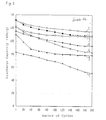
- Fig. 3 is a graph showing the charge-discharge cycle characteristics of various lithium secondary batteries.
- lithium nitrate and manganese nitrate As the compounds of the metals constituting a lithium-manganese complex oxide, prepared were lithium nitrate and manganese nitrate. Next, these lithium nitrate and manganese nitrate were accurately weighed in a molar ratio, Li/Mn of 1.02/1.98 to give a lithium-manganese complex oxide of Li(Mn 1.98 Li 0.02 )O 4 , and put into a container, to which was added 1000 ml of a mixture of water/alcohol of 1/1 by volume, and these were stirred to give a solution.
- the resulting solution was atomized into a vertical-type thermal decomposition furnace as conditioned at a predetermined temperature falling between 600°C and 800°C, at a rate of 1200 ml/hour through a nozzle, and cracked therein to obtain a powdery complex oxide.
- the resulting complex oxide was put into an alumina sagger and annealed therein at a predetermined temperature falling between 300°C and 900°C for 2 hours.
- sample Nos. 11 to 15, of Li(Mn 1.98 Li 0.02 )O 4 as shown in Table 1.
- Table 1 the samples marked with asterisk (*) are outside the scope of the present invention, while the others are within the scope of the invention.
- a comparative sample, No. 16, of Li(Mn 1.98 Li 0.02 )O 4 was obtained according to a melt impregnation method, as in Table 1.
- these lithium nitrate and electrolytic manganese dioxide (EMD) were accurately weighed in a molar ratio, Li/Mn of 1.02/1.98, then ground and mixed in a ball mill, and thereafter calcined at 600°C for 48 hours to obtain a complex oxide in which lithium had been melt-impregnated into EMD.
- sample No. 1 The SEM photograph of sample No. 1 is shown in Fig. 1.
- the complex oxide of sample No. 1 comprised spherical, hollow and porous, secondary particles as formed through sintering of primary particles.
- the surface of each hollow, spherical secondary particle had many deep pores running into the inside thereof.
- the powdery complex oxides obtained hereinabove were shaped into cathodes, whereupon their shapability was evaluated.
- 100 parts by weight of the cathode active material (complex oxide), 5 parts by weight of a conductor (acetylene black), and from 5 to 20 parts by weight of a binder (polyethylene tetrafluoride) were kneaded and shaped into sheets.
- the shapability of the mixtures into sheets is shown in Table 1.
- O means that the mixture was well shaped into sheets
- P means that the mixture was nearly shaped into sheets
- X means that the mixture could not be shaped into sheets.
- the cathode 3 was combined with an anode 4 of lithium metal (diameter: 17 mm, thickness: 0.2 mm) via a polypropylene separator 5 therebetween, with the SUS mesh of the cathode 3 facing outward, and cased in a cathode cell 1 made of stainless steel with the cathode 3 facing downward.
- an electrolytic solution was infiltrated into the separator 5.
- the electrolytic solution used herein was a solution as prepared by dissolving LiPF 6 in a 1/1 (by volume) mixed solvent of propylene carbonate and 1,1-dimethoxyethane, to have a concentration of 1 mol/liter.
- the opening of the cathode cell 1 was sealed with an anode plate 2 made of stainless steel via an insulating packing 6 therebetween.
- the lithium secondary batteries thus obtained were subjected to a charge-discharge test of 200 cycles under the conditions such that the charge-discharge current density was 1.0 mA/cm 2 , the max charge voltage was 4.3 V and the cutoff discharge voltage was 3.0 V.
- the test results are shown in Fig. 3.
- the sample numbers of the secondary batteries are the same as those of the complex oxides used as the cathode active materials.
- the lithium secondary batteries of samples Nos. 11 to 13 comprising, as the cathode active material, spinel-structured Li(Mn 1.98 Li 0.02 )O 4, which was in the form of spherical hollow secondary particles as formed through sintering of primary particles to have a mean particle size of from 1 to 5 micrometer and a specific surface area of from 2 to 10 m 2 /g, had high capacity and excellent charge-discharge cycle characteristics.
- the complex oxide, Li(Mn 1.98 Li 0.02 )O 4 in the battery of sample No. 17 was bulky. Therefore, the capacity of the battery of sample No. 17 was low and the charge-discharge characteristics thereof were bad. This is because the contact area between the complex oxide and the non-aqueous electrolytic solution in this battery could not be satisfactorily large, the proportion of the active material in the cathode of this battery could not be increased because of the poor shapability of the material, and, in addition, the composition of the complex oxide used therein was not uniform since the oxide was formed through solid phase reaction.
- lithium nitrate and manganese nitrate As the compounds of the metals constituting a lithium-manganese complex oxide, prepared were lithium nitrate and manganese nitrate. Next, these lithium nitrate and manganese nitrate were accurately weighed to give any of lithium-manganese complex oxides of a general formula Li(Mn 2-x Li x )O 4 (where 0 ⁇ x ⁇ 0.1), as shown in Table 2, and put into a container, to which was added 1000 ml of a mixture of water/alcohol of 1/1 by volume, and these were stirred to give a solution.
- Li(Mn 2-x Li x )O 4 where 0 ⁇ x ⁇ 0.1
- the resulting solution was atomized into a vertical-type thermal decomposition furnace as conditioned at 700°C, at a rate of 1200 ml/hour through a nozzle, and cracked therein to obtain a powdery complex oxide.
- the resulting complex oxide was put into an alumina sagger and annealed therein at 700°C for 2 hours. In that manner were obtained complex oxides, sample Nos. 21 to 28, as shown in Table 2.
- Example 3 In the same manner as in Example 1 but using the cathode prepared above, produced were lithium secondary batteries. These batteries were subjected to the same charge-discharge test as in Example 1. The test results are shown in Table 3. In Table 3, the sample numbers of the secondary batteries are the same as those of the complex oxides used as the cathode active materials. Sample No. Discharge Capacity (mAh/g) initial value after 100 cycles after 200 cycles 21 134 116 109 22 134 119 112 23 133 118 114 24 132 121 115 25 131 120 116 26 130 120 116 27 121 111 107 28 102 99 97
- the degree of substitution with lithium for manganese x in manganese-lithium complex oxides of formula Li(Mn 2-x Li x )O 4 is defined to be larger than 0 (0 ⁇ x), the Jahn-Teller phase transition of the complex oxides is prevented, resulting in that the capacity of the batteries comprising the complex oxides is prevented from being lowered after charge-discharge cycles.
- the degree of substitution x is defined to be equal or smaller than 0.10, preferably smaller than 0.02, the batteries comprising the complex oxides may have more elevated initial capacity.
- the value x in the formula Li(Mn 2-x Li x )O 4 is preferably within the range of 0 ⁇ x ⁇ 0.10, more preferably 0 ⁇ x ⁇ 0.02.
- spinel-structured lithium-magnesium complex oxides of formula, Li(Mn 2-x Li x )O 4 were used as the cathode active material.
- the complex oxides are not limited in the present invention. Any other spinel-structured lithium-magnesium complex oxides to be derived from those of Li(Mn 2-x Li x )O 4 by substituting a part of the Mn site with any of Cr, Ni, Fe, Co and/or Mg are also employable in the present invention, while producing the same results.
- any other methods are also employable herein to prepare the complex oxide particles.
- fine particles as obtained through wet synthesis may be grown to hollow, spherical secondary particles in a spray drier.
- the lithium secondary battery of the present invention comprises a spinel-structured lithium-manganese complex oxide as the active material, which is characterized in that the particles of said spinel-structured lithium-manganese complex oxide are hollow, spherical secondary particles by sintering of primary particles, and said secondary particles have a mean particle size of from 1 to 5 micrometer and a specific surface area of from 2 to 10 m 2 /g. Accordingly, the lithium secondary battery of the invention has high capacity and excellent charge-discharge cycle characteristics.
- the complex oxide to be used as the cathode active material in the secondary battery of the present invention is represented by Li(Mn 2-x Li x )O 4 where 0 ⁇ x ⁇ 0.1, more preferably 0 ⁇ x ⁇ 0.02.
- the lithium secondary battery of the present invention may have higher capacity and more excellent charge-discharge cycle characteristics.
- any other spinel-structured lithium-magnesium complex oxides to be derived from those of Li(Mn 2-x Li x )O 4 by substituting a part of the Mn site with any of Cr, Ni, Fe, Co and/or Mg are also employable in the present invention, while producing the same results.
Landscapes
- Chemical & Material Sciences (AREA)
- Organic Chemistry (AREA)
- Inorganic Chemistry (AREA)
- Chemical Kinetics & Catalysis (AREA)
- Electrochemistry (AREA)
- General Chemical & Material Sciences (AREA)
- Engineering & Computer Science (AREA)
- Manufacturing & Machinery (AREA)
- Battery Electrode And Active Subsutance (AREA)
- Secondary Cells (AREA)
- Carbon And Carbon Compounds (AREA)
Claims (5)
- Lithium-Sekundärbatterie, welche eine Kathode (3) mit einem Lithium-Mangankomplexoxid mit Spinellstruktur als aktive Substanz umfaßt,
dadurch gekennzeichnet, daßdie Partikel des Lithium-Mangankomplexoxids mit Spinellstruktur durch Sintern von Primärpartikeln hohle, sphärische Sekundärpartikel sind, und die Sekundärpartikel eine mittlere Partikelgröße von 1 bis 5 Mikrometer und eine spezifische Fläche von 2 bis 10 m2/g aufweisen. - Lithium-Sekundärbatterie nach Anspruch 1, dadurch gekennzeichnet, daß das Lithium-Mangankomplexoxid mit Spinellstruktur durch die allgemeine Formel Li(Mn2-xLix)O4 wiedergegeben wird, wobei 0 ≤ x ≤ 0,1 ist.
- Lithium-Sekundärbatterie nach Anspruch 1, dadurch gekennzeichnet, daß das Lithium-Mangankomplexoxid mit Spinellstruktur durch die allgemeine Formel Li(Mn2-xLix)O4 wiedergegeben wird, wobei 0 < x < 0,02 ist.
- Lithium-Sekundärbatterie nach Anspruch 1, dadurch gekennzeichnet, daß das Lithium-Mangankomplexoxid mit Spinellstruktur durch die allgemeine Formel Li(Mn2-xLix)O4 wiedergegeben wird, wobei 0 ≤ x ≤ 0,1 ist und Mn teilweise durch Cr, Ni, Fe, Co oder Mg substituiert wird.
- Lithium-Sekundärbatterie nach Anspruch 1, dadurch gekennzeichnet, daß das Lithium-Mangankomplexoxid mit Spinellstruktur durch die allgemeine Formel Li(Mn2-xLix)O4 wiedergegeben wird, wobei 0 < x < 0,02 ist und Mn teilweise durch Cr, Ni, Fe, Co oder Mg substituiert wird.
Applications Claiming Priority (4)
| Application Number | Priority Date | Filing Date | Title |
|---|---|---|---|
| JP206661/96 | 1996-07-16 | ||
| JP20666196 | 1996-07-16 | ||
| JP248673/96 | 1996-08-29 | ||
| JP8248673A JP3047827B2 (ja) | 1996-07-16 | 1996-08-29 | リチウム二次電池 |
Publications (2)
| Publication Number | Publication Date |
|---|---|
| EP0820113A1 EP0820113A1 (de) | 1998-01-21 |
| EP0820113B1 true EP0820113B1 (de) | 1999-01-07 |
Family
ID=26515783
Family Applications (1)
| Application Number | Title | Priority Date | Filing Date |
|---|---|---|---|
| EP97111560A Expired - Lifetime EP0820113B1 (de) | 1996-07-16 | 1997-07-08 | Lithium-Mangan-Oxid vom Spinelltyp als aktives Kathodenmaterial in einer nichtwässrigen Lithiumbatterie |
Country Status (7)
| Country | Link |
|---|---|
| US (1) | US6270924B1 (de) |
| EP (1) | EP0820113B1 (de) |
| JP (1) | JP3047827B2 (de) |
| KR (1) | KR100328879B1 (de) |
| CN (1) | CN1078749C (de) |
| CA (1) | CA2209531C (de) |
| DE (1) | DE69700091T2 (de) |
Cited By (1)
| Publication number | Priority date | Publication date | Assignee | Title |
|---|---|---|---|---|
| US7384680B2 (en) | 1997-07-21 | 2008-06-10 | Nanogram Corporation | Nanoparticle-based power coatings and corresponding structures |
Families Citing this family (35)
| Publication number | Priority date | Publication date | Assignee | Title |
|---|---|---|---|---|
| US5976489A (en) * | 1996-04-10 | 1999-11-02 | Valence Technology, Inc. | Method for preparing lithium manganese oxide compounds |
| JP3221352B2 (ja) | 1996-06-17 | 2001-10-22 | 株式会社村田製作所 | スピネル型リチウムマンガン複合酸化物の製造方法 |
| JPH10255804A (ja) * | 1997-01-07 | 1998-09-25 | Murata Mfg Co Ltd | リチウム二次電池 |
| US6270926B1 (en) | 1996-07-16 | 2001-08-07 | Murata Manufacturing Co., Ltd. | Lithium secondary battery |
| DE19727611A1 (de) * | 1997-06-28 | 1999-02-04 | Merck Patent Gmbh | Verfahren zur Herstellung vom Lithiummanganmischoxiden und deren Verwendung |
| US6482374B1 (en) | 1999-06-16 | 2002-11-19 | Nanogram Corporation | Methods for producing lithium metal oxide particles |
| US6607706B1 (en) | 1998-11-09 | 2003-08-19 | Nanogram Corporation | Composite metal oxide particles |
| US6749648B1 (en) | 2000-06-19 | 2004-06-15 | Nanagram Corporation | Lithium metal oxides |
| US6506493B1 (en) | 1998-11-09 | 2003-01-14 | Nanogram Corporation | Metal oxide particles |
| JPH11278848A (ja) * | 1998-03-26 | 1999-10-12 | Murata Mfg Co Ltd | スピネル型リチウムマンガン複合酸化物の製造方法 |
| JP3526223B2 (ja) * | 1998-09-17 | 2004-05-10 | 日本碍子株式会社 | リチウム二次電池 |
| US6136287A (en) * | 1998-11-09 | 2000-10-24 | Nanogram Corporation | Lithium manganese oxides and batteries |
| JP2000169150A (ja) * | 1998-12-02 | 2000-06-20 | Murata Mfg Co Ltd | スピネル型リチウムマンガン複合酸化物及びリチウム二次電池 |
| JP2000251894A (ja) * | 1998-12-29 | 2000-09-14 | Hitachi Maxell Ltd | 非水二次電池およびその使用方法 |
| US6322744B1 (en) | 1999-02-17 | 2001-11-27 | Valence Technology, Inc. | Lithium manganese oxide-based active material |
| EP1049187A3 (de) * | 1999-04-27 | 2004-04-28 | Hitachi, Ltd. | Lithium-Sekundärbatterie |
| US6706446B2 (en) * | 2000-12-26 | 2004-03-16 | Shin-Kobe Electric Machinery Co., Ltd. | Non-aqueous electrolytic solution secondary battery |
| JP2002274853A (ja) * | 2001-03-16 | 2002-09-25 | Titan Kogyo Kk | リチウムマンガン複合酸化物及びその製造方法、並びにその用途 |
| JP2003203632A (ja) * | 2002-01-09 | 2003-07-18 | Hitachi Ltd | リチウム二次電池用正極活物質とその製造法及びそれを用いたリチウム二次電池並びに組電池モジュール |
| JP4740409B2 (ja) * | 2003-06-11 | 2011-08-03 | 株式会社日立製作所 | 電気自動車或いはハイブリット自動車用リチウム二次電池 |
| KR100570616B1 (ko) * | 2004-02-06 | 2006-04-12 | 삼성에스디아이 주식회사 | 리튬 이차 전지용 양극 활물질, 그의 제조 방법 및 그를포함하는 리튬 이차 전지 |
| US7381496B2 (en) | 2004-05-21 | 2008-06-03 | Tiax Llc | Lithium metal oxide materials and methods of synthesis and use |
| US7682741B2 (en) * | 2005-06-29 | 2010-03-23 | Panasonic Corporation | Composite particle for lithium rechargeable battery, manufacturing method of the same, and lithium rechargeable battery using the same |
| JP5098192B2 (ja) * | 2005-06-29 | 2012-12-12 | パナソニック株式会社 | リチウム二次電池用複合粒子とその製造方法、それを用いたリチウム二次電池 |
| EP2239230A4 (de) | 2007-12-25 | 2017-01-04 | Kao Corporation | Verbranntes Verbundmetalloxid und sein Herstellungsverfahren |
| JP5166850B2 (ja) * | 2007-12-25 | 2013-03-21 | 花王株式会社 | 複合金属酸化物焼成体の製造方法 |
| JP5208492B2 (ja) * | 2007-12-25 | 2013-06-12 | 花王株式会社 | 複合金属酸化物焼成体 |
| CN101335348B (zh) * | 2008-07-18 | 2010-06-02 | 清华大学 | 锂离子电池5V级正极材料球形LiNi0.5Mn1.5O4的制备方法 |
| CN102482117A (zh) * | 2009-06-25 | 2012-05-30 | 日本碍子株式会社 | 正极活性物质以及锂二次电池 |
| WO2010101307A2 (ja) * | 2009-06-25 | 2010-09-10 | 日本碍子株式会社 | 正極活物質及びそれを用いたリチウム二次電池 |
| JP5670104B2 (ja) * | 2009-09-29 | 2015-02-18 | 日本碍子株式会社 | 正極活物質及びリチウム二次電池 |
| JP5175826B2 (ja) | 2009-12-02 | 2013-04-03 | トヨタ自動車株式会社 | 活物質粒子およびその利用 |
| JP2011016718A (ja) * | 2010-09-06 | 2011-01-27 | Kyocera Corp | 無機質中空粉体およびその製造方法 |
| CN103348510B (zh) * | 2010-11-12 | 2016-01-13 | 丰田自动车株式会社 | 二次电池 |
| CN111682197B (zh) * | 2020-06-02 | 2021-11-23 | 格林美股份有限公司 | 一种单晶型阴阳离子共掺杂镍镁二元无钴前驱体、正极材料及制备方法 |
Family Cites Families (35)
| Publication number | Priority date | Publication date | Assignee | Title |
|---|---|---|---|---|
| US4567031A (en) | 1983-12-27 | 1986-01-28 | Combustion Engineering, Inc. | Process for preparing mixed metal oxides |
| GB2210605B (en) | 1987-10-05 | 1991-06-26 | Merck Patent Gmbh | Process for the preparation of metal oxide powders |
| US5081102A (en) | 1988-11-09 | 1992-01-14 | Rockwell International Corporation | Preparation of precursor superconductor metal oxide powders by spray calcination from atomized nitrate solution |
| US5264201A (en) | 1990-07-23 | 1993-11-23 | Her Majesty The Queen In Right Of The Province Of British Columbia | Lithiated nickel dioxide and secondary cells prepared therefrom |
| US5122505A (en) | 1990-10-01 | 1992-06-16 | Sri International | Carbonate-free inorganic nitrates or oxides and process thereof |
| US5110696A (en) | 1990-11-09 | 1992-05-05 | Bell Communications Research | Rechargeable lithiated thin film intercalation electrode battery |
| US5135732A (en) * | 1991-04-23 | 1992-08-04 | Bell Communications Research, Inc. | Method for preparation of LiMn2 O4 intercalation compounds and use thereof in secondary lithium batteries |
| JPH05299092A (ja) | 1992-01-17 | 1993-11-12 | Matsushita Electric Ind Co Ltd | 非水電解質リチウム二次電池及びその製造方法 |
| CA2096386A1 (en) | 1992-05-18 | 1993-11-19 | Masahiro Kamauchi | Lithium secondary battery |
| EP0573040B1 (de) | 1992-06-04 | 1997-09-24 | Matsushita Electric Industrial Co., Ltd. | Positivelektrode für Lithium-Sekundärbatterie und Verfahren zu seiner Herstellung und eine nichtwässrige Elektrolyte Lithium-Sekundärbatterie unter Verwendung derselben |
| JPH0660887A (ja) | 1992-08-06 | 1994-03-04 | Sanyo Electric Co Ltd | 非水系電池 |
| DE69411714T2 (de) * | 1993-03-17 | 1998-11-12 | Ultralife Batteries Uk Ltd | Lithiumhaltiges manganoxid |
| JP2729176B2 (ja) | 1993-04-01 | 1998-03-18 | 富士化学工業株式会社 | LiM3+O2 またはLiMn2 O4 の製造方法及び2次電池正極材用LiNi3+O2 |
| FR2704216A1 (fr) | 1993-04-23 | 1994-10-28 | Centre Nat Rech Scient | Matériaux d'électrode pour batteries rechargeables au lithium et leur procédé de synthèse. |
| JP3276451B2 (ja) * | 1993-05-20 | 2002-04-22 | 新神戸電機株式会社 | リチウム電池 |
| US5599642A (en) | 1993-05-31 | 1997-02-04 | Hitachi Maxell, Ltd. | Lithium secondary battery containing organic electrolyte, active material for cathode thereof, and method for manufacturing the active material |
| JPH076764A (ja) | 1993-06-21 | 1995-01-10 | Shin Kobe Electric Mach Co Ltd | リチウム二次電池 |
| US5496664A (en) | 1993-08-18 | 1996-03-05 | Varta Batterie Aktiengesellschaft | Process for producing a positive electrode for lithium secondary batteries |
| US5742070A (en) | 1993-09-22 | 1998-04-21 | Nippondenso Co., Ltd. | Method for preparing an active substance of chemical cells |
| CA2172266A1 (en) | 1993-09-27 | 1995-04-06 | Denis G. Fauteux | Small particle electrodes by aerosol process |
| CA2114493C (en) | 1994-01-28 | 1999-01-12 | Jeffrey Raymond Dahn | Method for increasing the reversible capacity of lithium transition metal oxide cathodes |
| DE69504663T2 (de) * | 1994-06-10 | 1999-02-18 | Danionics A/S, Odense S | KATHODENMATERIAL FÜR Li-SEKUNDÄRBATTERIEN UND VERFAHREN UND VORLÄUFERMATERIAL ZU DEREN HERSTELLUNG |
| FR2721308B1 (fr) | 1994-06-21 | 1996-10-11 | Commissariat Energie Atomique | Composés d'insertion à base d'oxyde de manganèse, utilisables comme électrode positive dans un accumulateur au lithium. |
| JP3067531B2 (ja) | 1994-07-13 | 2000-07-17 | 松下電器産業株式会社 | 非水電解液二次電池の正極活物質およびそれを用いた電池 |
| WO1996012676A1 (en) * | 1994-10-19 | 1996-05-02 | Valence Technology, Inc. | Lithium manganese oxide, method of preparation and uses thereof |
| JP3427570B2 (ja) | 1994-10-26 | 2003-07-22 | ソニー株式会社 | 非水電解質二次電池 |
| JP3451763B2 (ja) * | 1994-11-29 | 2003-09-29 | ソニー株式会社 | 正極活物質の製造方法 |
| EP0720247B1 (de) | 1994-12-16 | 1998-05-27 | Matsushita Electric Industrial Co., Ltd. | Verfahren zur Herstellung positiven aktiven Materials für Lithium-Sekundärbatterien und diese enthaltende sekundäre Zellen |
| US5807646A (en) * | 1995-02-23 | 1998-09-15 | Tosoh Corporation | Spinel type lithium-mangenese oxide material, process for preparing the same and use thereof |
| JP3581474B2 (ja) * | 1995-03-17 | 2004-10-27 | キヤノン株式会社 | リチウムを利用する二次電池 |
| US5702679A (en) | 1995-10-06 | 1997-12-30 | Kerr-Mcgee Chemical Corp. | Method of preparing Li1+X- Mn2-X O4 for use as secondary battery |
| CA2163695C (en) * | 1995-11-24 | 2000-08-01 | Qiming Zhong | Method for preparing li1+xmn2-x-ymyo4 for use in lithium batteries |
| US5792442A (en) | 1995-12-05 | 1998-08-11 | Fmc Corporation | Highly homogeneous spinel Li1+X Mn2-X O4 intercalation compounds and method for preparing same |
| WO1997037935A1 (en) * | 1996-04-05 | 1997-10-16 | Fmc Corporation | METHOD FOR PREPARING SPINEL Li1+XMn2-XO4+Y INTERCALATION COMPOUNDS |
| US5718877A (en) | 1996-06-18 | 1998-02-17 | Fmc Corporation | Highly homogeneous spinal Li1+x Mn2-x O4+y intercalation compounds and method for preparing same |
-
1996
- 1996-08-29 JP JP8248673A patent/JP3047827B2/ja not_active Expired - Lifetime
-
1997
- 1997-07-02 CA CA002209531A patent/CA2209531C/en not_active Expired - Lifetime
- 1997-07-08 DE DE69700091T patent/DE69700091T2/de not_active Expired - Lifetime
- 1997-07-08 EP EP97111560A patent/EP0820113B1/de not_active Expired - Lifetime
- 1997-07-15 CN CN97115403A patent/CN1078749C/zh not_active Expired - Lifetime
- 1997-07-16 KR KR1019970033010A patent/KR100328879B1/ko not_active Expired - Lifetime
- 1997-07-16 US US08/895,319 patent/US6270924B1/en not_active Expired - Lifetime
Cited By (1)
| Publication number | Priority date | Publication date | Assignee | Title |
|---|---|---|---|---|
| US7384680B2 (en) | 1997-07-21 | 2008-06-10 | Nanogram Corporation | Nanoparticle-based power coatings and corresponding structures |
Also Published As
| Publication number | Publication date |
|---|---|
| KR100328879B1 (ko) | 2002-06-20 |
| EP0820113A1 (de) | 1998-01-21 |
| US6270924B1 (en) | 2001-08-07 |
| CN1078749C (zh) | 2002-01-30 |
| JPH1083816A (ja) | 1998-03-31 |
| JP3047827B2 (ja) | 2000-06-05 |
| CA2209531A1 (en) | 1998-01-16 |
| CA2209531C (en) | 2002-05-21 |
| DE69700091D1 (de) | 1999-02-18 |
| DE69700091T2 (de) | 1999-05-27 |
| KR980012678A (ko) | 1998-04-30 |
| CN1173746A (zh) | 1998-02-18 |
Similar Documents
| Publication | Publication Date | Title |
|---|---|---|
| EP0820113B1 (de) | Lithium-Mangan-Oxid vom Spinelltyp als aktives Kathodenmaterial in einer nichtwässrigen Lithiumbatterie | |
| EP0827223B1 (de) | Lithium-Sekundärbatterie | |
| JP4061668B2 (ja) | リチウムイオン非水電解質二次電池 | |
| JP5257272B2 (ja) | リチウム二次電池用正極材料およびそれを用いた二次電池ならびにリチウム二次電池用正極材料の製造方法 | |
| US6270926B1 (en) | Lithium secondary battery | |
| EP1142834A1 (de) | Lithiummanganmischoxid, positives elektrodenmaterial für sekundäre lithiumzellen, positive elektrode und sekundäre lithiumzelle und verfahren zur herstellung des lithiummanganmischoxids | |
| KR20020070495A (ko) | 비수성 전해질 2차 전지와 그 양극활성 물질 | |
| EP1207574A1 (de) | Positives aktives Material für Nichtwässrige-Sekundärbatterie und diese enthaltende Nichtwässrige-Sekundärbatterie | |
| JPH08217452A (ja) | マンガン複合酸化物及びその製造方法並びにその用途 | |
| JP4655453B2 (ja) | リチウム二次電池用正極材料およびそれを用いた二次電池ならびにリチウム二次電池用正極材料の製造方法 | |
| EP0653797B1 (de) | Lithiumsekundärzelle mit organischem elektrolyten, aktives material für positive elektrode einer li-sekundärzelle und verfahren zur herstellung des aktiven materials | |
| JPH0992285A (ja) | 非水電解質リチウム二次電池 | |
| KR100320801B1 (ko) | 리튬2차전지 | |
| JP3296204B2 (ja) | リチウム二次電池 | |
| JP2003229128A (ja) | 非水二次電池及びその製造方法 | |
| JP3296203B2 (ja) | リチウム二次電池 | |
| JPH10324521A (ja) | リチウムマンガン複合酸化物およびその製造法ならびにその用途 | |
| JPH1079250A (ja) | 正極活物質、その製造方法、およびそれを用いた非水溶媒系二次電池 | |
| JP2008041577A (ja) | スピネル型マンガン酸リチウム及びその製造方法、並びにスピネル型マンガン酸リチウムを使用する正極活物質及び非水電解質電池 | |
| JP2002343356A (ja) | リチウムマンガン系複酸化物粒子、その製造方法及び二次電池 | |
| JP2002184404A (ja) | 正極材料および非水電解質電池 | |
| JP2002151079A (ja) | 非水系電解質二次電池用正極活物質およびその製造方法 | |
| JP2003317718A (ja) | 正極材料、電極および電池 | |
| JPH09245795A (ja) | リチウム電池用正極活物質及びその製造方法 | |
| JPH09161800A (ja) | リチウム二次電池の製造方法 |
Legal Events
| Date | Code | Title | Description |
|---|---|---|---|
| PUAI | Public reference made under article 153(3) epc to a published international application that has entered the european phase |
Free format text: ORIGINAL CODE: 0009012 |
|
| AK | Designated contracting states |
Kind code of ref document: A1 Designated state(s): DE FR |
|
| GRAG | Despatch of communication of intention to grant |
Free format text: ORIGINAL CODE: EPIDOS AGRA |
|
| GRAG | Despatch of communication of intention to grant |
Free format text: ORIGINAL CODE: EPIDOS AGRA |
|
| GRAH | Despatch of communication of intention to grant a patent |
Free format text: ORIGINAL CODE: EPIDOS IGRA |
|
| 17P | Request for examination filed |
Effective date: 19980427 |
|
| 17Q | First examination report despatched |
Effective date: 19980602 |
|
| GRAH | Despatch of communication of intention to grant a patent |
Free format text: ORIGINAL CODE: EPIDOS IGRA |
|
| AKX | Designation fees paid |
Free format text: DE FR |
|
| RBV | Designated contracting states (corrected) |
Designated state(s): DE FR |
|
| GRAA | (expected) grant |
Free format text: ORIGINAL CODE: 0009210 |
|
| AK | Designated contracting states |
Kind code of ref document: B1 Designated state(s): DE FR |
|
| REF | Corresponds to: |
Ref document number: 69700091 Country of ref document: DE Date of ref document: 19990218 |
|
| ET | Fr: translation filed | ||
| PLBE | No opposition filed within time limit |
Free format text: ORIGINAL CODE: 0009261 |
|
| STAA | Information on the status of an ep patent application or granted ep patent |
Free format text: STATUS: NO OPPOSITION FILED WITHIN TIME LIMIT |
|
| 26N | No opposition filed | ||
| REG | Reference to a national code |
Ref country code: FR Ref legal event code: PLFP Year of fee payment: 20 |
|
| PGFP | Annual fee paid to national office [announced via postgrant information from national office to epo] |
Ref country code: DE Payment date: 20160722 Year of fee payment: 20 |
|
| PGFP | Annual fee paid to national office [announced via postgrant information from national office to epo] |
Ref country code: FR Payment date: 20160721 Year of fee payment: 20 |
|
| REG | Reference to a national code |
Ref country code: DE Ref legal event code: R071 Ref document number: 69700091 Country of ref document: DE |